Author: SwiftCargo Team

  • Watch for the Compliance Gap When You Switch Freight Forwarders

    Watch for the Compliance Gap When You Switch Freight Forwarders

    Switching freight forwarders is one of the most avoidable disruptions in an import program, and one of the most common causes of actual disruption. Importers who plan the transition carefully lose nothing. Those who switch reactively, in response to a bad experience with a shipment already in motion, can spend weeks untangling documentation and explaining delays to their customers.

    How to Switch Freight Forwarders Without Disrupting Your Supply Chain

    When Switching Is the Right Call

    Not every frustration with a freight forwarder warrants a switch. A single delayed shipment during a port congestion event is not a forwarder problem. A customs hold caused by a legitimate discrepancy in your supplier’s documentation is not a forwarder failure. Before deciding to switch, separate the forwarder’s performance from external factors beyond their control.

    The situations that genuinely warrant a switch fall into four categories.

    Repeated compliance errors

    Incorrect tariff classifications, missing biosecurity declarations, and improper Incoterm documentation create customs holds, duty shortfalls, and post-clearance audit exposure. A single classification error on a genuinely ambiguous product can happen to anyone. A pattern of errors on the same goods (especially after the issue has been raised) signals a forwarder that is not investing in your account.

    The Australian Border Force places the legal responsibility for accurate import declarations on the importer, not the customs broker. The forwarder’s errors become your compliance risk. That is a meaningful reason to switch.

    Lane expertise gap

    A forwarder that handles Australian imports from China well is not automatically equipped for USA-origin goods, Vietnamese garments with AANZFTA form requirements, or French wine with its own biosecurity and labelling conditions. If your sourcing has shifted to a new lane or product category and your forwarder’s performance has declined in proportion to that shift, the problem is likely expertise, not effort.

    Ask your forwarder directly: how many TEUs do you move on this lane per quarter? Who is your preferred carrier? What is your average transit time variance? If the answers are vague, the lane expertise is shallow.

    Rate stagnation without service improvement

    Freight rates are not static, and a long-standing forwarder relationship should translate to carrier leverage, volume-based discounts, and access to priority bookings when capacity tightens. If you have been with the same forwarder for two or more years and have never received a rate review, a consolidation proposal, or a proactive update on carrier rate changes, that relationship is coasting on inertia.

    This does not mean you should switch solely for a lower rate. Switching costs (administrative overhead, the learning curve on your product mix, the risk window of the first few shipments) are real. But if rates and service are both stagnant, the cost-benefit of switching becomes positive.

    Structural change in your import program

    Scaling from LCL to full container volume, adding a new supplier country, or moving from retail imports to wholesale volumes can create a genuine mismatch between your needs and your forwarder’s capacity. A small-volume specialist may not have the carrier contracts or the customs team depth to serve a program that has grown significantly.

    When Not to Switch

    Timing the switch correctly is as important as the decision itself. Three scenarios where you should hold the current relationship and plan the switch after the situation resolves:

    • Active shipments in transit. Any shipment that has departed origin must clear Australian customs under the current forwarder. The bill of lading, the customs broker authorisation, and the import declaration are all linked. Do not attempt to transfer these mid-transit.
    • Peak season. Activating a new forwarder during peak shipping season (October to December) or Chinese New Year is high-risk. Carrier availability is constrained, documentation errors cost more time, and your new forwarder has less capacity to absorb the learning curve on your account. Plan any switch for February to April or June to August.
    • Unresolved disputes. If you have an outstanding invoice dispute, a damaged goods claim, or a customs issue that is not yet resolved with your current forwarder, do not close the relationship before those are settled. You will need their cooperation on documentation and correspondence.

    How to Evaluate a New Freight Forwarder

    The evaluation process should be structured, not casual. A presentation and a rate quote tells you very little about how a forwarder actually performs. Build your evaluation around four concrete tests. (For the fuller first-time-selection framework, which covers licensing, route specialisation, quote structure, and a 10-point checklist, see how to choose a freight forwarder in Australia.)

    A logistics manager's hand tracing a shipping-lane route on a large wall-mounted world map in a freight-forwarder's office.

    Lane-specific reference checks

    Ask for two or three references from clients who import similar goods on the same lane: China to Australia, USA to Australia, Vietnam to Australia. General references are not useful. A forwarder that excels on the China lane may be mediocre on USA origin, because carrier relationships and port contacts are lane-specific.

    Customs broker credentials

    Confirm that the customs brokerage side of the business holds a current licence with the Australian Border Force. Licensed customs brokers are listed on the ABF broker register. In-house customs brokerage is preferable to outsourcing: a forwarder that owns its customs operation has direct control over declaration accuracy and turnaround time.

    CBFCA membership

    The Customs Brokers and Forwarders Council of Australia (CBFCA) is the peak industry body for licensed customs brokers and freight forwarders in Australia. Membership signals a commitment to professional standards and access to ongoing training and compliance updates. It is not a guarantee of performance, but its absence (particularly for a forwarder handling volume commercial imports) is a flag worth noting.

    A trial shipment

    Before fully committing, run one shipment through the new forwarder while your existing forwarder handles regular volume. Evaluate the trial on: accuracy of the pre-shipment booking confirmation, quality and timing of documentation (commercial invoice review, packing list check, draft bill of lading), clearance speed at Australian customs, and responsiveness to questions during transit. A forwarder who performs well on a trial shipment under evaluation is very likely to perform consistently when you are a full client.

    Photorealistic cinematic editorial image, outcome-focused — an Australian logistics office desk mid-handover, two stacked binders of shipping documents (bill of lading

    The Transition Protocol

    A clean handover requires a sequence of actions across four to six weeks. Below is the framework.

    Week 1–2: Documentation recovery

    Before you give formal notice, request the following from your current forwarder in writing:

    • All import declarations lodged in the past five years, in a format that includes the declaration reference number, the tariff classification, and the duty rate applied
    • Any customs rulings or binding classification decisions that apply to your goods
    • Outstanding transport documents for any in-transit shipments
    • All biosecurity import permits or DAFF clearance records relevant to your product categories
    • Carrier rate agreements in place, including terms and notice periods

    The ABF record-keeping obligations require importers to retain import records for five years. These records belong to you, not to the forwarder. If there is any resistance to providing them, escalate in writing and reference your obligations under the Customs Act 1901.

    Week 2–3: New forwarder setup

    The administrative setup for a new forwarder relationship typically takes two to three weeks. This covers:

    • Credit application: The forwarder will require a credit account application, trade references, and typically financial statements for accounts above a threshold.
    • Customs broker authorisation: You will need to sign a formal authorisation allowing the new customs broker to lodge declarations on your behalf. This is a legal document: read it carefully, particularly any indemnity clauses.
    • Product classification review: Share your existing tariff classifications with the new forwarder and ask them to independently verify two or three of your highest-volume products. This either confirms the existing classifications or surfaces a discrepancy you need to resolve with ABF before it becomes a post-clearance audit issue.
    • Carrier account setup: If you have existing carrier accounts (with CMA-CGM, Evergreen, or others), these can be transferred or maintained independently. Discuss this with the new forwarder: some prefer to book under their own house accounts for rate reasons.

    Week 3–4: Formal notice to current forwarder

    Give written notice. Thirty days is the standard. State the effective date clearly. Do not reference the reasons unless you have a specific dispute that requires acknowledgment. Keep the letter factual and professional: you may need this forwarder’s cooperation on a future shipment or documentation request.

    If you have an active service agreement with your current forwarder, review the notice and termination clauses before issuing notice. Most forwarding agreements in Australia are month-to-month by default, but some volume-based agreements include minimum term clauses.
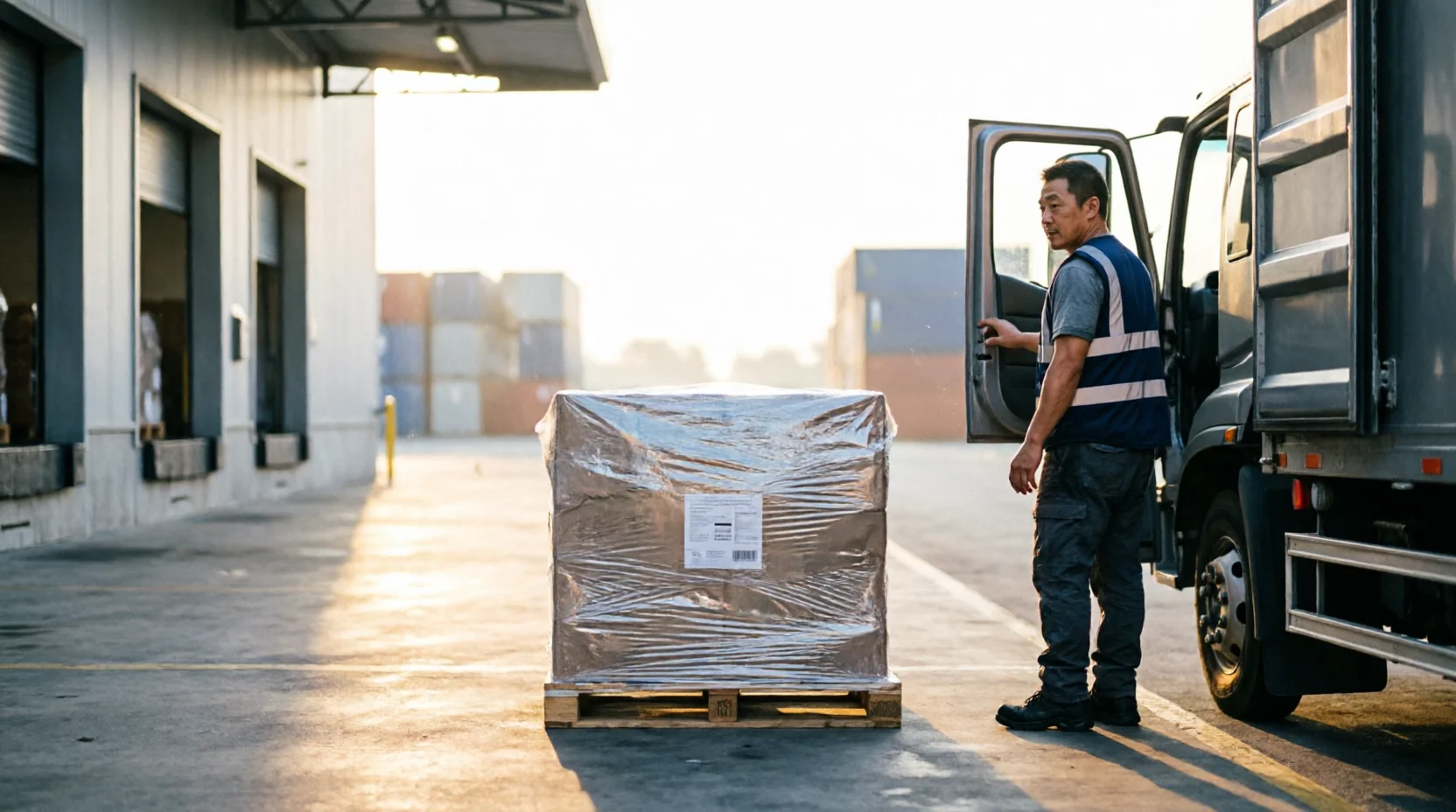
    A newly labeled pallet, its shipping tag deliberately turned away from camera.

    Week 4–6: First live shipments

    Run the first two or three shipments under active supervision: more attention than you would give a routine shipment. Confirm each stage in writing: booking confirmation, bill of lading draft, pre-arrival notification, customs clearance confirmation, delivery to warehouse. Any error or omission on these first shipments should be raised immediately and in writing so the new forwarder can correct their internal process before it becomes a pattern.

    Three documentation errors in ninety days is a demonstrated capability, not bad luck, and waiting for a fourth before you act is avoidance wearing the costume of patience. Set the threshold before you need it: three material errors in any rolling ninety-day window triggers the evaluation process in this guide, no exceptions, no waiting to see if next quarter improves on its own. A forwarder relationship earns renewal by performance, the same as any other vendor contract you would review on schedule. Holding your forwarder to that standard protects the business you are actually responsible for.

    Inventory Buffer During the Switch

    The transition period carries a higher-than-normal risk of delay. Even a well-managed switch can produce a one- to two-week gap in your standard transit timeline if documentation setup or carrier booking is slower than expected.

    Before initiating any switch, assess your current buffer stock on your highest-velocity SKUs. If you are already running lean (less than four weeks of cover), delay the switch until you have built the buffer. A stock-out during a forwarder transition compounds the disruption significantly.

    For a detailed framework on buffer stock sizing for imported goods, see How to Avoid Stockouts When Importing to Australia. The methodology there applies directly to the forwarder transition window.

    Incoterms and Supplier Instructions

    When you switch freight forwarders, your supplier also needs to be updated. If you are buying on FOB or EXW terms, your supplier is booking freight on your behalf or delivering to a nominated agent at origin, and that agent needs to change.

    Notify your supplier of the new forwarder’s origin office or agent contact at least two full shipment cycles in advance of the switch. The origin contact receives shipping instructions, issues the bill of lading, and coordinates container pickups at factory or CFS. A supplier who sends an existing shipment to the old forwarder’s origin agent after the switch has happened creates a logistical problem that takes days to untangle.

    For a full breakdown of how Incoterms determine the freight booking responsibility in your supply chain, see What Incoterms Mean for Australian Importers. The specific point at which control transfers from your supplier to your forwarder depends on the term in your purchase order.

    Renegotiating Rates as Part of the Switch

    A forwarder transition is the highest-leverage moment to renegotiate freight rates and service terms. You have clarity on your volumes, your lanes, and your requirements, and the new forwarder is motivated to win the business. Use that leverage explicitly.

    Come to the rate discussion with your annualised shipment data: total TEUs or CBM per year, peak months, average cargo weight, and the specific lanes (origin country to Australian port). A forwarder who can see a full year of volume will provide a more competitive rate than one working from a vague description.

    Negotiate the following specifically:

    • Ocean freight rate: Expressed per TEU (20-foot equivalent unit) or per CBM for LCL shipments. Confirm whether this is an all-in rate or whether BAF (Bunker Adjustment Factor) and PSS (Peak Season Surcharge) are additional.
    • Local charges: THC (Terminal Handling Charge), documentation fees, and customs entry fees vary significantly between forwarders and should be itemised, not buried in an all-in quote.
    • Rate validity: Spot rates are valid for 30 days. A volume agreement locks the rate for 90 to 180 days. If your volume justifies it, push for a rate agreement. See How to Scale Your Import Business in Australia for the volume thresholds at which a rate agreement becomes worthwhile.
    • Priority booking: During peak season, confirmed space is worth more than the headline rate. A forwarder with carrier relationships can offer priority booking on tight sailing schedules. Ask explicitly whether this is available and under what conditions.

    After the Switch: What Good Looks Like

    By the end of the third month with a new forwarder, the relationship should be producing a consistent operating rhythm. Assess performance across four dimensions:

    Documentation accuracy

    Every import declaration should match your commercial invoice and packing list exactly: commodity description, quantity, value, origin country, and HS code. A single mismatch creates a customs query that costs time and may trigger a hold. Track declaration accuracy across your first 10 shipments. If errors are present, address them with the forwarder at the shipment level, not in a quarterly review.
    A delivery truck arriving at a warehouse dock in what feels like a routine, repeated moment — long consistent morning shadows.

    Transit time consistency

    A reliable forwarder should be able to forecast your transit time within a two- to three-day band on a given lane. Compare actual transit time against quoted transit time on each shipment. Consistent underperformance against the quoted transit indicates a carrier booking problem: either the forwarder is booking on a rolling basis without securing direct sailings, or their nominated carrier is transshipping when a direct service was promised.

    Proactive communication

    You should not be chasing your forwarder for shipment updates. A well-run freight account produces proactive notifications at: booking confirmation, bill of lading issuance, departure, estimated arrival update if there is any variance, customs clearance, and delivery. If you are regularly discovering shipment delays through your own tracking rather than a forwarder notification, that is a service gap that needs to be named directly.

    Biosecurity and compliance performance

    Clearance through DAFF biosecurity should be routine for standard commodity shipments. If you are experiencing biosecurity holds on goods that have cleared without issue previously, the likely cause is a documentation change: a new supplier, a modified product description, or an updated packing material. Resolve these at the documentation level rather than accepting holds as normal.

    Supplier-to-Warehouse Chain After the Switch

    The freight forwarder controls the ocean leg, but the full chain runs from supplier payment through to warehouse receipt. A forwarder switch can expose gaps in adjacent parts of the chain that were previously hidden by the existing relationship’s workarounds.

    After the switch, review the end-to-end chain: purchase order to supplier confirmation, supplier to booking instruction, origin collection to port CFS, port departure to Australian arrival, customs clearance to port release, drayage from port to your warehouse. Each handoff is a potential failure point. The new forwarder manages most of these, but the visibility into what they are doing at each point is something you build over the first 60 to 90 days.

    For a detailed breakdown of how to manage the supplier-to-warehouse chain after a forwarder change, see How to Manage Supplier to Warehouse Logistics in Australia.

    The EXW Problem

    If you are buying on EXW (Ex Works) terms, your forwarder manages the entire movement from your supplier’s factory gate. This makes the forwarder more central to the relationship, and a switch more operationally sensitive, because the new forwarder needs to establish an origin agent relationship, understand your supplier’s location and loading requirements, and manage export customs at origin on your behalf.

    EXW switches require a minimum four-week lead time before the first shipment under the new forwarder. Allow six weeks if your supplier is in a secondary manufacturing hub that requires a two-leg movement to port (common in inland China, provincial Vietnam, and some European origins).

    A switch is also a good trigger to reassess whether EXW is the right Incoterm for your program. In many cases, FOB is simpler to manage: your supplier handles export formalities and delivers to port, and your responsibility begins at the ship’s rail. See EXW vs FOB vs CIF for Australian Importers for a direct comparison of what each term costs you in operational overhead.

    Managing the Compliance Gap

    There is a knowledge gap between when your current forwarder stops managing your account and when your new forwarder has fully internalised your compliance profile. This gap is highest in the first three shipments and narrows with each subsequent booking. During that window, certain compliance risks are elevated.

    Tariff classification continuity. If your current forwarder has been classifying a product under a specific HS code (potentially one that is borderline between two headings), the new forwarder may classify it differently. Both outcomes are possible: the new classification may be more accurate, or the existing one may be defensible under a ruling your previous forwarder obtained informally. Before the first shipment under the new forwarder, provide the HS codes you have been using and ask for a written classification opinion on your top five product lines.

    Free Trade Agreement continuity. If you have been claiming tariff preferences under CHAFTA, AANZFTA, or AUSFTA, your new forwarder needs to understand which certificates of origin or supplier declarations apply to each product line. A missed FTA preference does not create a compliance problem, but it creates an unnecessary duty payment. On high-volume product lines at a 5% duty rate, that cost accumulates quickly. Confirm that the new forwarder has reviewed and documented your FTA eligibility before the first shipment under their management.

    DAFF permit continuity. If any of your products require standing biosecurity import permits (certain processed foods, timber products, or goods containing organic materials), confirm that these permits are transferred to the new forwarder’s systems before their first shipment departs origin.

    Swift Cargo provides freight forwarding, customs brokerage, and supply chain advisory services for Australian importers. Get a quote for your import program.

    A warehouse manager and a freight coordinator reviewing a tablet screen together at a receiving bay, the screen's content reduced to soft abstract color blocks.

    What a Well-Run Forwarder Relationship Produces Over Time

    The decision to switch is often framed as a cost or a risk. The more useful framing is: what should an optimally managed freight forwarder relationship be producing, and is your current relationship producing it?

    A forwarder that knows your product mix, your supplier network, your compliance profile, and your volume cadence is worth more than a forwarder offering a lower spot rate on a single shipment. That accumulated knowledge (your customs classification history, your seasonal peak patterns, your preferred carriers on each lane) takes six to twelve months to build. If you switch every two years, you are rebuilding that relationship capital on a perpetual cycle.

    Switch when the relationship is genuinely broken or the mismatch is structural. Build for the long relationship when the forwarder is performing. And if you are not certain which category you are in: run the evaluation against the criteria above before deciding.

    Related reading: Lire cet article en français

    Frequently Asked Questions

    How much notice should I give my current freight forwarder when switching?

    A minimum of 30 days written notice is standard practice. If you have active shipments in transit, wait until those clear Australian customs before activating the new forwarder. Giving your current forwarder adequate notice also gives you time to recover outstanding documentation and customs records.

    Can I switch freight forwarders mid-shipment?

    No. A shipment that is already at origin, in transit, or awaiting customs clearance must complete with the current forwarder. Switching mid-shipment creates documentation gaps, breaks the customs broker chain, and can result in delays or penalties. Always switch between shipments.

    What records do I need to recover from my old freight forwarder?

    Request copies of all import declarations (N10 or SAC), bills of lading, commercial invoices, packing lists, and any customs rulings or tariff classification decisions that apply to your goods. ABF requires importers to retain records for five years, so you need these regardless of who holds them operationally.

    Will switching freight forwarders affect my customs compliance history?

    Your compliance history is tied to your ABN, not your forwarder. The new customs broker will be able to access your import history through the Integrated Cargo System (ICS). However, nuanced information (like informal understandings around product classification or past rulings) must be transferred manually as part of the handover.

    How long does it take to get a new freight forwarder fully operational?

    Allow four to six weeks from initial engagement to the first shipment departing under the new forwarder’s management. This covers credit application, customs broker authorisation, carrier account setup, and one trial booking. The administrative overhead is front-loaded: subsequent shipments run smoothly once the accounts are live.

    Should I run two freight forwarders in parallel during a transition?

    Only if your volume justifies it. Running a trial shipment with the new forwarder while the old one handles regular volume is a valid strategy. It lets you evaluate the new forwarder on a real shipment before full commitment. The downside is short-term administrative complexity: two sets of documentation, two contacts, two invoicing streams.
  • Moving from France to Australia: How to Ship Your Belongings

    Moving from France to Australia: How to Ship Your Belongings

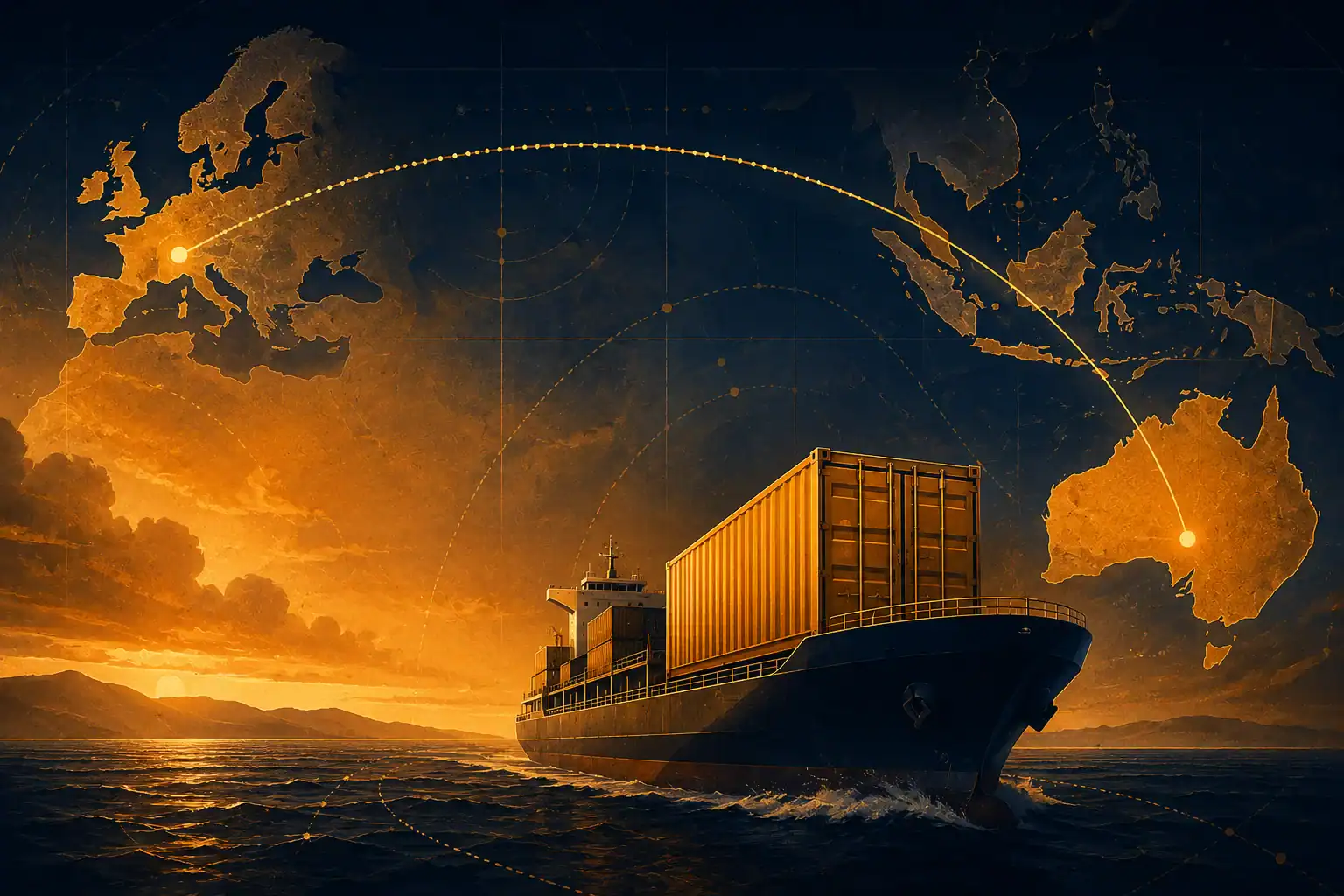
    Moving from France to Australia means crossing roughly 17,000 kilometres of sea. The physical distance is one constraint. The other is time: a container of household goods takes five to seven weeks to arrive, which means your planning calendar, your lease start date, and your customs paperwork all need to work in alignment.

    Moving from France to Australia: How to Ship Your Belongings

    The Basic Decision: What to Ship, What to Sell, What to Leave

    The first useful exercise before booking a container is sorting your belongings into three groups: what comes with you, what you sell or give away in France, and what you replace in Australia. This is not a sentimental exercise: it is a cost calculation.

    Shipping costs for household goods from France to Australia are real money. For the sea freight component alone, a 20-foot container runs AUD 3,800 to AUD 6,500. Add origin charges, destination fees, customs broker fees, and delivery in Australia and a full door-to-door move is typically AUD 7,000 to AUD 12,000 for a container-sized household. For a detailed breakdown of freight costs on this route, see the companion guide on shipping from France to Australia: costs, time and customs.
    The comparison that matters is cost to ship versus cost to replace. Flat-pack furniture, basic kitchen equipment, and inexpensive electronics are almost always cheaper to replace in Australia than to ship from France. High-quality furniture, family heirlooms, art, books, custom or made-to-order items, and anything with sentimental value are better candidates for the container.

    Australian retail prices for major furniture, appliances, and electronics are broadly comparable to Europe, and the range of quality goods available in Australian cities is wide. The calculation changes for antique or artisan furniture, bespoke items, or goods that have specific personal value.

    Sea Freight Options for Household Moves

    Full Container Load (FCL)

    A 20-foot container holds roughly 25 to 28 CBM of household goods when professionally packed: approximately the contents of a three-bedroom apartment. A 40-foot container holds 55 to 60 CBM, suitable for a large house.

    FCL gives you exclusive use of the container: no waiting for others’ cargo, no consolidation delays. Once the container is sealed and on its way, it moves as a single unit from origin to destination. This is the faster and usually more cost-effective option if your volume fills most of a 20-foot box.

    Less Than Container Load (LCL)

    LCL places your belongings alongside other shippers’ cargo in a shared container. It is the right choice when your volume is 10 to 18 CBM: enough that air freight is prohibitively expensive, but not enough to justify a full container. LCL costs are quoted per cubic metre, typically AUD 280 to AUD 420 per CBM from France to Australia including basic handling.

    The trade-off with LCL is time. Your cargo is consolidated with others at an origin depot before sailing, and de-consolidated at an Australian depot on arrival. This adds 7 to 14 days to door-to-door time compared with FCL on the same route. LCL also requires slightly more careful packing (goods are handled more times) and the biosecurity inspection burden falls on each shipper’s portion separately.

    For guidance on how to calculate your shipment’s cubic volume accurately, the CBM guide for moving shipments explains the measurement process.

    Air Freight

    Air freight for household goods is rarely economical on a route this long. The rate is AUD 8 to AUD 18 per kilogram, which means a 500 kg shipment (not much for a household) costs AUD 4,000 to AUD 9,000 in freight alone, and that does not include the Australian destination charges and customs clearance.

    Air freight makes sense for a small box of irreplaceable items you need immediately (documents, medicines, essential electronics) while the main container follows by sea. A mixed strategy (air freight for essentials, sea freight for the bulk of belongings) is common for families with a hard arrival date.

    What the Moving Process Looks Like, Step by Step

    Understanding the sequence takes most of the anxiety out of an international move. The process is well-established; it follows the same steps each time. What varies is how well each step is prepared.

    Step 1: Volume Survey and Quote

    Your freight forwarder arranges an in-home survey (either in person or, increasingly, via video call) to estimate the cubic volume of your goods. This determines whether you need FCL or LCL, gives the forwarder enough information to price the move accurately, and helps you understand what will and will not fit.

    The volume survey answers a logistics question. It does not answer the harder question sitting underneath it, which is a strategic one: what specifically are you choosing to ship, and what are you choosing to leave behind or replace. Deciding to “ship everything that fits” is not a strategy; it is an absence of one, in the same way “be a leader in the market” is not a strategy for a business. A real choice here names what does not make the cut: the furniture that costs more to ship than to replace, the appliances that will not run on Australian voltage without a transformer, the boxes of things kept out of habit rather than use. Make that choice before the survey, not during it, and the survey becomes a pricing exercise instead of a decision made under time pressure with a surveyor standing in your kitchen.

    Step 2: Packing

    Professional packing by the removals team is strongly recommended for an international move. Goods packed by the shipper (also called “owner-packed”) are typically excluded from transit insurance claims and are flagged for more scrutiny at biosecurity inspection because the contents are not professionally inventoried. Professional packing also means a detailed packing list is produced at the time of packing: this list becomes an essential customs document.

    All items must be clean and dry before packing. This is a biosecurity requirement. Used items with soil, organic material, or biological residue attached will be held by Australian biosecurity on arrival. The items most commonly flagged are garden tools and equipment, outdoor furniture, sporting goods (particularly camping gear and hiking boots), and musical instruments that have been played in outdoor settings.

    Step 3: Export from France

    Goods with a commercial value over EUR 1,000 leaving the EU require an export customs declaration to French customs (Douanes). Your freight forwarder handles this. For personal effects, the documentation requirement is lower. Your forwarder will advise based on the specific goods and the context of your move.

    There is no export duty on personal belongings leaving France. The paperwork is administrative, not a financial burden. But it must be done correctly: errors in the export declaration can create complications at the Australian end when customs cross-references origin documentation.

    Step 4: Sea Freight

    From the time your container is loaded at the French port to arrival at an Australian port, the sea transit is approximately 30 to 45 days. The main departure ports are Le Havre (northern France) and Marseille. Services run to Sydney (Port Botany), Melbourne (Swanson Dock), Brisbane (Fisherman Islands), and Fremantle.

    Your forwarder will book a sailing and issue a bill of lading: the document that proves ownership of the goods during transit and serves as the key customs document at the Australian end. Keep a copy.

    Step 5: Australian Customs and the UPE Concession

    Before your container arrives in Australia, your customs broker (usually the same company as your freight forwarder, or a partner they engage) lodges an import declaration with the Australian Border Force (ABF).

    For relocating individuals and families, the key customs benefit is the Unaccompanied Personal Effects (UPE) concession. Under this concession, Australian residents (or incoming permanent residents) can import used household goods and personal effects duty-free and GST-free if the goods:

    • Have been owned and used abroad for at least 12 months before arrival in Australia
    • Are not being imported for commercial purposes or resale
    • Are accompanied by a statutory declaration from the owner

    The concession does not apply to:

    • Goods purchased new in France and shipped to Australia
    • Alcohol (wine, spirits, beer): these attract import duty and excise-equivalent charges regardless
    • Tobacco products
    • Commercial or business goods

    For most families moving from France with a container of used furniture, kitchenware, books, clothing, and personal items, the UPE concession applies to the bulk of their shipment. The savings on a AUD 50,000 to AUD 100,000 household contents shipment (duty at 5% plus 10% GST) are substantial. Claiming it correctly requires accurate documentation, which is why working with a licensed customs broker is essential. For a full explanation of eligibility, the 12-month ownership test, and what the statutory declaration must cover, the Unaccompanied Personal Effects concession guide for Australia covers all the requirements in detail.

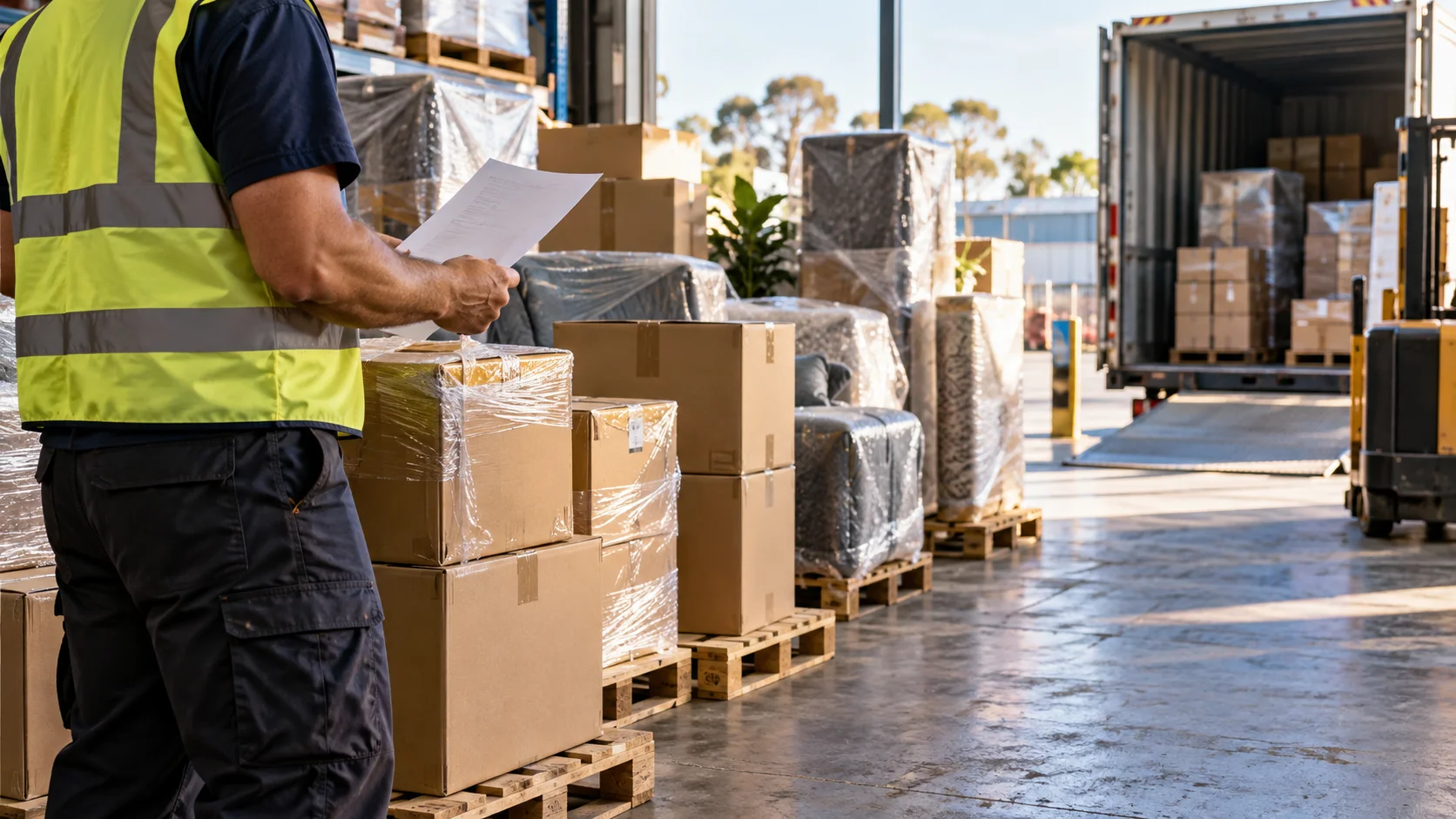
    Photorealistic cinematic editorial image, outcome-focused — an Australian rear commercial receiving area, organized pallets of household cartons and furniture being

    Step 6: Biosecurity Clearance

    Every shipment arriving in Australia goes through biosecurity assessment by the Department of Agriculture, Fisheries and Forestry (DAFF). For household goods, this typically involves documentary assessment and may include a physical inspection of the container.

    Australia’s biosecurity system is one of the world’s strictest regimes, and it applies uniformly to goods from France as it does to goods from anywhere else. The reason is straightforward: Australia is an island continent with ecosystems that evolved in isolation. Pests and pathogens that are benign in Europe can be severely damaging in the Australian agricultural or natural environment. The system exists because earlier incidents (the introduction of species through cargo and passenger movements) caused damage that is still being managed decades later.

    For a detailed understanding of what biosecurity inspectors look for and how the risk classification system works, the guide to Australia’s biosecurity rules covers both the history and the practical implications for incoming shipments.

    For incoming household moves, the items that routinely attract biosecurity attention include:

    • Garden equipment: spades, trowels, garden gloves, pots with soil residue: any soil must be removed before packing
    • Outdoor furniture: timber furniture, garden chairs, pergola sections: check for insect activity and clean thoroughly
    • Sporting goods: hiking boots, camping gear, kayaks, bicycles with mudguards: clean all surfaces; remove mud and organic material
    • Wooden items: antique timber furniture, wooden artworks, decorative timber objects: declare in the packing list; may require ISPM 15 treatment depending on origin
    • Food items: do not pack food in the shipping container unless it is commercially packaged, sealed, and declared in full on the packing list

    If a biosecurity inspection finds a problem, the importer is responsible for treatment costs (fumigation, steam cleaning) or for the cost of re-exporting or destroying the affected items. These costs are real. A contaminated garden section of a household container can add AUD 500 to AUD 2,000 to the cost of a move. Prevention (thorough cleaning before packing) is the only reliable control.

    For the full requirements applying to personal effects and household goods arriving in Australia, the biosecurity requirements guide for importing to Australia provides the complete breakdown.

    Step 7: Delivery to Your Australian Address

    Once customs and biosecurity clearance is complete, your container or LCL consignment moves from the port to your delivery address. For a 20-foot container to a major city address, delivery typically takes 1 to 3 days from port release. Regional addresses and addresses requiring specialised crane unloading or shuttle trucks add time and cost.

    Documents You Will Need

    The customs broker needs:

    • Packing list: detailed itemised list of every item in the shipment, with descriptions, quantities, approximate values, and whether each item is new or used
    • Bill of lading: issued by the carrier; your proof of the shipment
    • Passport and visa documentation: proof of your entitlement to enter Australia as a resident or incoming permanent resident
    • Statutory declaration: for the UPE concession, a signed declaration that the goods have been owned and used abroad for the required period
    • Evidence of prior ownership: purchase receipts, insurance documents, or photos showing goods in your French home, particularly for high-value items

    Missing or inaccurate documents are the most common cause of delays at the Australian border. A mismatch between the packing list and the actual container contents is the most common trigger for examination. Customs delays for Australian imports explains how holds work and the charges that accumulate while goods are held in a port terminal.

    Special Categories: What Needs Extra Planning

    Wine and Alcohol

    Wine from France is one of the most common items people want to bring when moving to Australia. The practical reality is that importing wine personally is expensive. Import duty and excise-equivalent charges on wine are material: a bottle of wine valued at EUR 20 attracts approximately AUD 3 to AUD 5 in excise charges plus the import duty rate, and then 10% GST on the total. For a case of twelve bottles, the cost of compliance often exceeds the landed value of the wine.

    Personal wine imports are permitted (there is no prohibition), but the paperwork, duty, and logistics cost make it economical only for significant collections or very high-value wines. Your customs broker can calculate the specific duty and excise costs for your wine before you decide whether to ship it or sell it in France.

    Antiques and Art

    Antiques more than 100 years old attract a zero or reduced duty rate in many categories under the Australian tariff. Original artworks by living or deceased artists are zero-rated for duty. However, the customs value must be declared accurately, and for high-value pieces, a professional valuation from a recognised appraiser is worth having before shipment. The documentation should include provenance records, certificates of authenticity for significant pieces, and condition photographs taken before packing.

    Vehicles

    Shipping a personal vehicle from France to Australia is possible but involves significant compliance. French cars are left-hand drive; Australia is a right-hand drive country. Vehicles imported for personal use can be used in Australia as left-hand drive under certain circumstances, but registration conditions vary by state. The vehicle must also pass biosecurity: it must be clean of soil, plant material, and biological residue, typically requiring professional steam cleaning before loading in France. Import duty and GST apply to the vehicle’s customs value. Many people find that the combined cost of shipping, compliance, and potential conversion makes it more economical to sell the vehicle in France and purchase in Australia.

    Pets

    Pets (dogs, cats, and some other species) can be imported to Australia from France, but the process is document-intensive and time-sensitive. Australia maintains a strict biosecurity protocol for live animals involving veterinary certificates, rabies vaccination documentation, microchipping, blood titre tests, and an approved residency period in an approved country (France qualifies). The DAFF cats and dogs import page is the definitive source. Processing takes months, not weeks. If you are bringing pets, start the process at least six months before your planned move date.

    Medications and Supplements

    Prescription medications for personal use can generally be imported in reasonable personal quantities with supporting documentation (prescription, doctor’s letter). Bring originals and copies. Some medications that are available in France require a permit in Australia (controlled substances, certain anxiolytics). Check the TGA’s (Therapeutic Goods Administration) import conditions for your specific medications before packing them.

    Insurance for Your Move

    Cargo insurance covers the goods during transit. Standard carrier liability under the bill of lading is limited: typically SDR 2 per kilogram under the Hague-Visby Rules, which is far below the replacement value of household furniture and electronics. A comprehensive marine cargo policy provides all-risk, replacement-value coverage for the duration of transit.

    Insurance is also relevant for biosecurity treatment. If items are treated at the port (fumigation, steam cleaning), treatment can cause damage to sensitive materials: electronics, delicate fabrics, some types of furniture. Insurance that covers treatment damage is worth confirming before you sail.

    How Long the Full Process Takes

    Counting from the decision to move to goods delivered to your Australian address, the realistic timeline is:

    • Forwarder survey, packing, and loading in France: 2 to 4 weeks (depending on packing preparation time)
    • Sea freight, France to Australia: 30 to 45 days
    • Australian customs clearance: 1 to 3 days (clean shipment); 5 to 14 days (if inspection or documentation issue)
    • Delivery to Australian address: 1 to 5 days from port release

    Total: 7 to 12 weeks from packing to delivery, assuming clean documentation and no biosecurity holds. Building in 12 weeks gives a realistic buffer. If you are moving to Australia at the end of the year (October to January), allow additional time: this is peak season on the Europe-to-Australia cargo lane and both space and timing become harder to confirm on short notice.

    What to Do Now if You Are Planning a Move

    A few specific actions that make the process cleaner:

    Start early. A France-to-Australia move requires more lead time than a European removal. Eight to twelve weeks of planning before your target sailing date is realistic. For moves involving pets, twelve to eighteen months is not excessive given the biosecurity preparation requirements for animals.

    Do a pre-move inventory. Walk through your home category by category and decide what travels, what sells, and what gets left. The decision made before you pack is easier than the decision made in a container depot after packing is done.

    Document high-value items now. Photographs, serial numbers, purchase receipts, and insurance documentation for furniture, art, electronics, and jewellery. These matter for customs valuation, for insurance claims, and for UPE concession documentation.

    Clean outdoor and garden items before packing. This is the single most effective biosecurity risk reduction step. Remove soil, wash surfaces, check for insect activity, dry thoroughly. A container that arrives in Australia clean clears biosecurity faster and cheaper than one that requires treatment.

    Swift Cargo handles France-to-Australia relocations including sea freight (FCL and LCL), packing services, customs entry and UPE concession handling, and delivery to your Australian address. Request a quote and timeline for your move.

    One angle worth examining before any move: the decision about what to ship is really a question about where value lives. A piece of furniture that cost EUR 800 in France is worth EUR 800 to buy again in Australia, but it costs AUD 350 to AUD 600 in freight, handling, and insurance to cross the ocean, plus the risk of treatment or damage. The economics only favour shipping when the item cannot be replaced at a comparable price, or when the cost of replacement plus the disruption of settling in without it exceeds the shipping cost. Working through this category by category before packing saves real money. French expats weighing other Asia-Pacific destinations alongside Australia (particularly those considering moving from France to Thailand) face the same calculation with different customs concession windows and duty structures.

    Estimated Moving Costs: France to Australia

    Home size Estimated cost (EUR)
    2 bedroom EUR 4,380–9,270
    3 bedroom EUR 5,950–12,460
    4 bedroom EUR 5,730–11,650
    5 bedroom EUR 5,450–11,820

    These are door to door estimations, not port to port. They include standard packing and customs clearance on both ends, and assume an origin and destination reasonably near the port on both sides; a move to or from a more remote location may cost more. Treat these as budgets, not final pricing. The final cost depends on the quantity and nature of what you are shipping, service availability, and sea freight rates at the time of your move. These figures are based on average home sizes from past moves and may not reflect your own home. Timing and availability can also materially affect the price, and in some cases whether we are able to complete the job on your preferred timeline. For an accurate quote, contact our team or start our online self service quote, a short survey about your move that takes about four minutes and lets our team provide a real quote based on your specific details.

    Related reading: Lire cet article en français

    Related reading: Shipping Timeline to Australia: Real Door-to-Door Numbers

    Frequently Asked Questions

    Can I ship my household goods from France to Australia duty-free?

    Australian residents and incoming permanent residents can import used household goods duty-free and GST-free under the Unaccompanied Personal Effects (UPE) concession, provided the goods have been owned and used abroad for at least 12 months. Goods purchased new in France do not qualify. Alcohol, tobacco, and commercial goods are excluded from the concession regardless of how long they have been owned.

    How long does it take to ship household goods from France to Australia?

    Sea freight from France takes 30 to 45 days port to port. Door to door (including packing in France and delivery in Australia) typically runs 45 to 60 days for FCL and 55 to 70 days for LCL. Air freight takes 2 to 4 days but is rarely economical for household goods volumes.

    What does Australian biosecurity check in household goods from France?

    Biosecurity inspectors look for soil, seeds, plant material, food, insects, and biological residues on all used goods. High-risk items include garden equipment, outdoor furniture, sporting goods, and wooden items. Goods must be clean and dry before packing. Items found to carry biosecurity risk material may be treated at the owner’s expense, re-exported, or destroyed.

    Can I ship my car from France to Australia?

    Yes, but French cars are left-hand drive and Australia is a right-hand drive country. Import duty, GST, and potential compliance costs apply. The vehicle must be professionally cleaned before loading to pass biosecurity. Many relocators find it more practical to sell in France and buy in Australia.

    What size container do I need to move from France to Australia?

    A one-bedroom apartment fits in LCL (10 to 15 CBM). A two-bedroom apartment needs 15 to 25 CBM. A three-to-four bedroom house typically requires a 20-foot container (25 to 40 CBM). A large family home may need a 40-foot container. Your forwarder will estimate volume from a survey.

    Do I need cargo insurance when moving from France to Australia?

    Yes. Carrier liability under the bill of lading is far below replacement value for household goods. A comprehensive marine cargo policy covers all-risk loss or damage during transit and should include coverage for biosecurity treatment damage. The cost is small relative to the replacement value of a household container.

    What items cannot be shipped to Australia from France?

    Prohibited items include firearms (without permits), drugs, endangered species products, fresh produce without permits, and some chemicals. Restricted items (food, meat, dairy, plant material) may require biosecurity permits. Wine and commercially packaged food are permitted with correct documentation and payment of applicable duties.

  • Shipping from France to Australia: Costs, Time and Customs Explained

    Shipping from France to Australia: Costs, Time and Customs Explained

    France to Australia is one of the longer-haul international cargo routes. It sits at roughly 17,000 kilometres by sea, which means the transit time, the paperwork, and the biosecurity requirements are all scaled up compared to shorter regional routes. If you are planning a shipment (whether it is a household container, a commercial cargo, a few pallets of wine, or personal effects being sent ahead of a move), understanding what this route actually costs and how it works will save you both money and weeks of avoidable delay.

    Shipping from France to Australia: Costs, Time and Customs Explained

    Sea Freight or Air Freight: The Basic Trade-off

    The route choice for France to Australia is straightforward in principle but depends entirely on the nature of your cargo. Sea freight handles volume and weight efficiently. Air freight is fast but expensive, and on a route of this distance the cost gap is substantial.

    Sea freight from France to Australia runs 30 to 45 days port to port. The main departure points in France are Le Havre (on the Atlantic coast, serving Paris and northern France) and Marseille (on the Mediterranean, handling southern France and transit from Southern Europe). Both ports have regular services to Australian gateways: Sydney, Melbourne, Brisbane, and Fremantle.

    Air freight cuts transit to 2 to 4 days but carries a cost premium that makes it viable mainly for high-value goods, urgent shipments, or consignments where volume is low and time is the governing constraint.

    For a detailed comparison of how to choose between sea and air freight for shipments into Australia, the analysis at air freight vs sea freight for Australian importers covers the decision framework in full.

    France to Australia: Realistic Cost Ranges

    Cost estimates on France-to-Australia shipping vary widely because carriers, seasons, fuel surcharges, and congestion charges all move independently. The numbers below reflect market rates as of mid-2026 and should be treated as planning ranges, not fixed prices. Any specific shipment will need a current quote based on actual cargo details.

    Full Container Load (FCL)

    A 20-foot container from France to Australia currently costs between AUD 3,800 and AUD 6,500 for the ocean freight component. A 40-foot container typically runs AUD 5,500 to AUD 9,200. These figures cover the sea leg only. On top of that, expect:

    • Origin charges in France: packing, cartage to port, origin documentation: typically EUR 600 to EUR 1,400
    • Destination charges in Australia: terminal handling, port authority fees, quarantine fees: typically AUD 800 to AUD 1,400
    • Customs broker fees for import entry: AUD 350 to AUD 700
    • Delivery from Australian port to your address: AUD 400 to AUD 900 depending on distance from port

    A 20-foot container move from Paris to Sydney, door to door, typically lands between AUD 7,000 and AUD 12,000 all-in depending on packing choice, seasonal surcharges, and delivery address. Peak season surcharges (typically October to January for the Australia-inbound direction) can add 15 to 25% to the base ocean freight rate.

    Less Than Container Load (LCL)

    LCL (where your cargo shares space in a container with other shippers’ goods) is the practical choice when your shipment does not fill a 20-foot container. For France to Australia, LCL rates run from approximately AUD 280 to AUD 420 per cubic metre (CBM), including basic origin consolidation charges. A minimum charge of 2 to 3 CBM typically applies, so very small consignments pay for more space than they physically occupy.

    For context on how to calculate your shipment’s cubic volume, the CBM guide for moving shipments explains how to measure and estimate container space accurately.

    LCL adds time compared to FCL because consolidation at the origin depot and de-consolidation at the Australian depot each add 3 to 7 days. A door-to-door LCL shipment from France to Australia realistically takes 45 to 60 days.

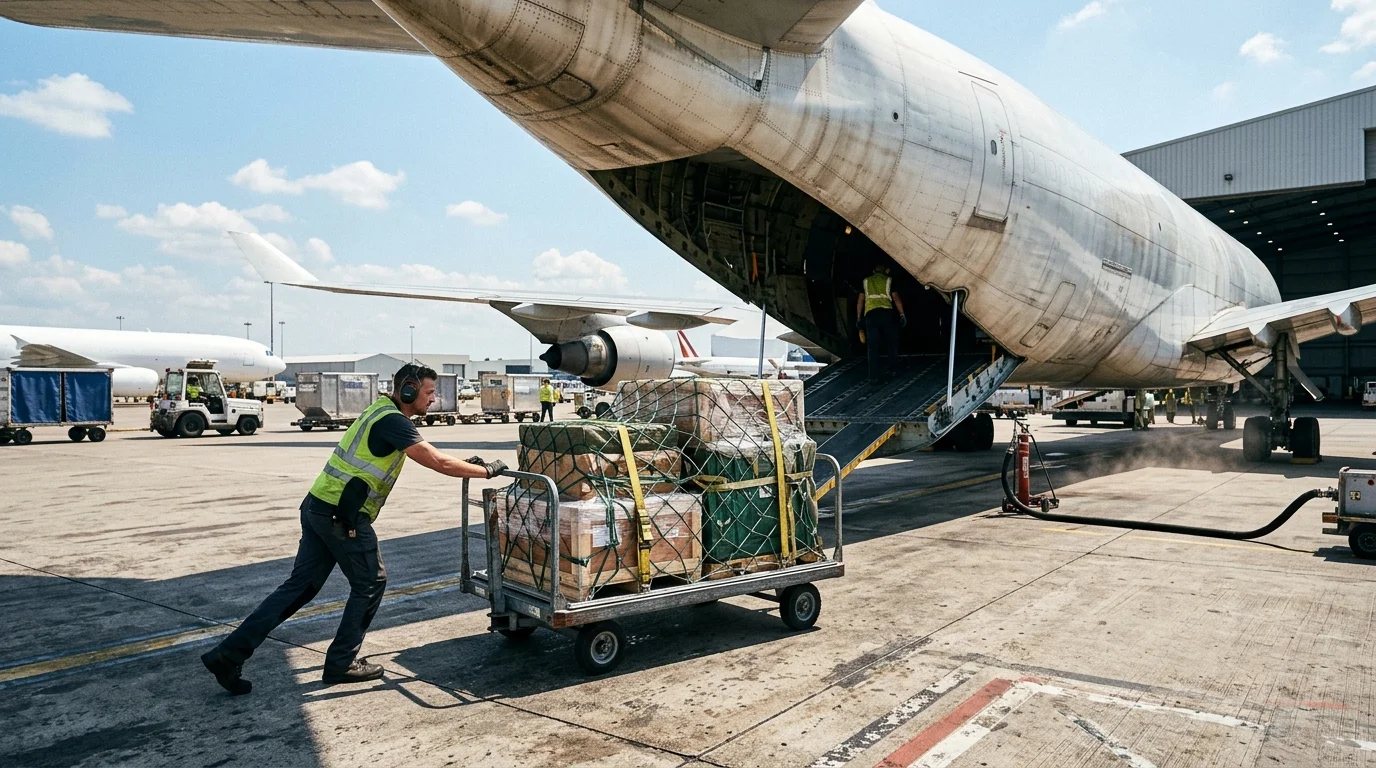
    A ground handler pushes a cart of netted, strapped cargo across the tarmac toward a cargo plane's open hold.

    Air Freight

    Air freight from France to Australia is priced by the higher of actual weight or volumetric weight (volume in centimetres divided by 6,000 for most carriers). Rates range from AUD 8 to AUD 18 per kilogram depending on urgency, carrier, and season. A 100 kg shipment might cost AUD 1,200 to AUD 1,800 in freight alone: on top of origin handling, fuel surcharges, destination charges, and delivery.

    Air freight makes sense for goods worth several hundred dollars per kilogram or more, or when a shipping delay would cost more than the premium. It is not the right mode for household furniture, a container of wine, or anything that can tolerate five or six weeks at sea.

    How Long Does France to Australia Shipping Take?

    Transit time estimates on this route require some care. Port-to-port times are one number. The actual time from your French address to your Australian address is a different number, and that is what matters for planning.

    Port-to-Port Times

    Le Havre to Sydney: approximately 28 to 35 days on direct or single-transshipment services. Most services route through Singapore or Port Klang.

    Le Havre to Melbourne: approximately 30 to 38 days.

    Marseille to Sydney or Melbourne: similar times, typically 30 to 40 days.

    Carriers operating on this lane include CMA CGM (the French shipping group with strong France-Australia coverage), Maersk, and MSC. Service frequency from Le Havre is generally weekly on the main services.

    Door-to-Door Time

    Add the following to port-to-port estimates:

    • Pickup in France and delivery to the port or consolidation depot: 2 to 5 days
    • Export customs in France: same day to 2 days for standard shipments
    • Australian customs clearance and biosecurity: 1 to 5 days for a clean shipment, longer if selected for inspection
    • Delivery from Australian port to your address: 1 to 5 days depending on location

    Under normal conditions, a door-to-door FCL shipment takes 37 to 52 days. LCL adds 7 to 14 days for consolidation. A shipment delayed at Australian biosecurity or customs adds further. Planning for 50 to 60 days from pickup in France to delivery in Australia is a sensible working assumption.

    Most planning assumptions treat transit time as a single number. It is a range. The median case for France to Australia might be 45 days, but a biosecurity inspection, a carrier schedule change, or a port congestion event can push the 90th-percentile case to 65 days or more. Bookings, lease starts, and delivery windows that require a precise date on this route consistently come unstuck. Build a buffer.

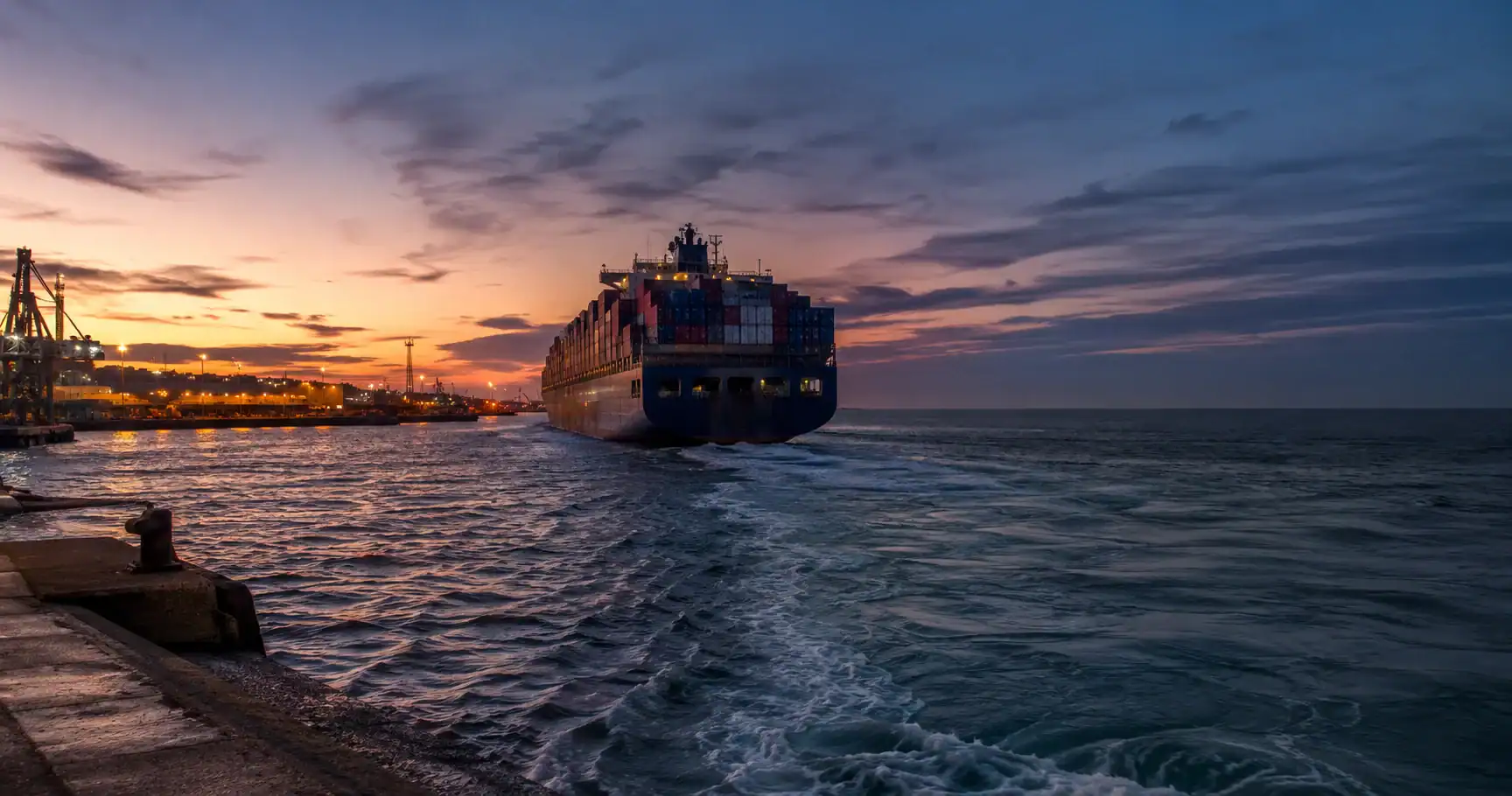
    A loaded container ship departing a European port at dusk, gantry cranes silhouetted against the sunset sky, representing the long-haul sea freight route from France to Australia

    Australian Customs: What Applies to Goods from France

    Australia does not have a broad free trade agreement with France or the European Union that significantly reduces import duties on goods. Most commercial goods from France enter under Australia’s general tariff, with a 5% duty rate applying to many categories. Some product categories (electronics, certain machinery, raw materials) have zero or reduced rates. The actual duty rate for your specific goods depends on the tariff classification under the ABF (Australian Border Force) tariff classification.

    In addition to duty, a 10% GST applies to the customs value plus duty plus insurance and freight charges (the “CIF + duty” basis). For most commercial importers, the GST paid at the border is claimable as an input tax credit if you are GST-registered.

    Import Threshold

    Australia’s low-value import threshold is AUD 1,000. Shipments with a customs value below AUD 1,000 can be cleared informally and are not subject to import duty or GST at the border. Above AUD 1,000, full formal entry is required: an import declaration lodged through the ABF’s ICS (Integrated Cargo System), supported by commercial invoice, packing list, and bill of lading or airway bill. A licensed customs broker typically lodges this on the importer’s behalf.

    Key Documents Required

    • Commercial invoice (accurate description of goods, country of origin, value in AUD or foreign currency with exchange rate)
    • Packing list (itemised, with weights and dimensions)
    • Bill of lading (sea freight) or airway bill (air freight)
    • Import declaration (lodged by a licensed customs broker with ABF)
    • Any applicable permits: required for restricted goods categories (food, plants, animal products, chemicals, firearms, medicines)

    Errors in the commercial invoice are the most common cause of delays and additional charges. The description must match what is in the container. The value must be declared accurately: customs authorities use the transaction value as defined under the WTO Customs Valuation Agreement, and ABF auditors can and do check declared values against market pricing for known categories.

    Biosecurity: The Layer Most Shippers Underestimate

    Australia’s biosecurity rules apply to every shipment entering the country, regardless of where it comes from. France is not a high-risk origin in the same way as some agricultural exporters, but the categories of goods that attract mandatory inspection are the same for all origins.

    The Department of Agriculture, Fisheries and Forestry (DAFF) is the agency responsible for biosecurity border management. Its BICON database holds the import conditions for every category of goods.

    The categories that most frequently cause problems for France-to-Australia shipments include:

    Used Household Goods and Personal Effects

    Used items (furniture, bedding, garden equipment, sports gear, tools) are treated as biosecurity risk regardless of origin. Items with soil contamination, plant material, or signs of pest activity will be held for treatment or destroyed. The key requirement is thorough cleaning before packing. Clean, dry items with no organic material attached typically clear without issue. Items that have been in outdoor storage or garden areas are higher risk.

    For a full understanding of what Australian biosecurity inspectors look for at the border, the detailed guide at Australia’s biosecurity rules explained covers the history, logic, and practical implications of the inspection regime.

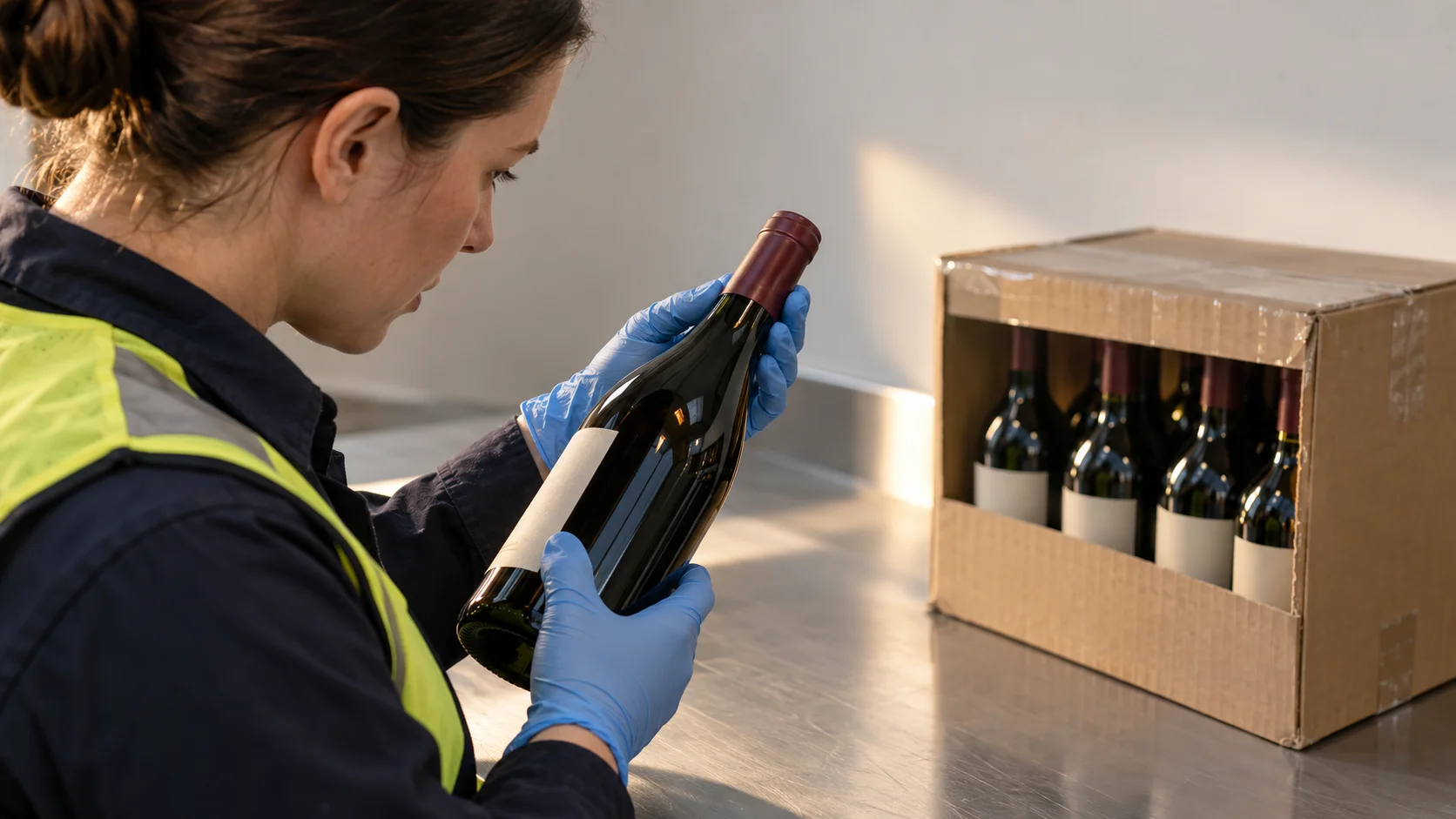
    On an inspection bench inside an Australian biosecurity-cleared facility, a staff member checks a single wine bottle's cork and capsule closely under bright, even light,

    Food, Wine, and Organic Products

    French wine can be imported commercially, but requires compliance with the Wine Australia framework, the ABF tariff and excise obligations, and biosecurity import conditions for bottled wine. Personal imports of wine are subject to the same import duty and GST as commercial imports above the AUD 1,000 threshold. For personal quantities (less than AUD 1,000 customs value) in unaccompanied baggage or postal channels, different rules apply.

    Food products from France (cheese, charcuterie, confectionery, dried goods) have varying biosecurity risk levels. Commercially produced, shelf-stable packaged food typically clears with a standard declaration. Meat products, dairy, and items containing plant material are higher risk and may require permits. Fresh produce cannot be imported without specific permits and treatment.

    Wooden Items and Packing Materials

    Solid wood items (furniture, pallets, crates) may require heat treatment or fumigation under ISPM 15 requirements. France as an EU member state applies ISPM 15-compliant treatment to commercial wooden packaging, but antique furniture, handmade items, or goods in non-compliant wood packaging may be flagged. Disclosing timber contents in the packing list is essential.

    What Happens When Customs or Biosecurity Delays Your Shipment

    Most delays on the France-to-Australia route fall into predictable patterns. Understanding them before you ship avoids surprises and allows you to plan mitigation.

    Documentation inconsistency (a mismatch between the commercial invoice description and the actual goods) is the most common cause of customs holds. Once held, the importer must provide additional documentation or attend an examination. Storage charges accrue at the Australian container terminal while the hold is in place. These charges are typically AUD 80 to AUD 150 per day per container depending on terminal.

    Biosecurity inspection (a random or targeted physical inspection of container contents) adds 2 to 7 days and incurs biosecurity levy charges. Goods found to contain prohibited items may be treated (at the importer’s cost), re-exported, or destroyed. For a household container from France, thorough pre-shipment cleaning and an accurate packing list are the main risk controls.

    For more on what triggers customs examination and how delays accumulate, the guide to customs delays for Australian imports explains the inspection triggers and how to reduce your risk profile.

    Specific Cargo Types: What to Know Before You Ship

    Household Goods and Personal Effects

    Families and individuals relocating from France to Australia are the largest category of non-commercial shippers on this route. The typical move involves 20 to 40 CBM of household contents: enough for a 20-foot container, often a little more.

    Used household goods from France pay standard import duty unless the importer qualifies for the Unaccompanied Personal Effects (UPE) concession. Under the UPE concession, Australian residents (or new arrivals settling in Australia) can import used household goods duty-free and GST-free, provided the goods have been owned and used abroad for at least 12 months. Documentation requirements include proof of prior ownership and a completed Unaccompanied Personal Effects Statement (Customs Form B534). For the full eligibility conditions, what constitutes acceptable proof of prior use, and how the statutory declaration works, the Unaccompanied Personal Effects concession guide for Australia has the detailed breakdown.

    Goods that have been purchased new in France and shipped to Australia do not qualify for the UPE concession and attract standard import duty and GST.

    A gloved conservator wraps the back of an ornate gilded picture frame in tissue paper on a padded worktable.

    Antiques and Art

    Antiques more than 100 years old qualify for a zero or reduced duty rate in many categories under the Australian tariff schedule. Art (paintings, sculptures, original prints) is also zero-rated for duty. GST still applies unless the importer is the original creator. Accurate classification and supporting documentation (certificate of authenticity, valuation) matter for antique and art shipments because duty savings are real and audits of declared values in this category do occur.

    Commercial Cargo

    Businesses importing from France typically handle wine, luxury goods (fashion, cosmetics, accessories), industrial components, and machinery. Each category carries its own tariff classification and potentially its own specialist requirements:

    • Wine: tariff + excise-equivalent charge; Wine Australia compliance for commercial quantities
    • Cosmetics and personal care: TGA (Therapeutic Goods Administration) may apply to borderline products; ACCC labelling requirements
    • Machinery: often zero-rated for duty; biosecurity for used machinery (must be clean and free of soil/biological material)
    • Fashion and textiles: duty rate typically 10%; GST at 10%; labelling requirements under Australia’s mandatory standards

    Choosing a Freight Forwarder for France to Australia

    On a route as long and document-intensive as France to Australia, the freight forwarder’s role covers the full chain: pickup in France, export customs declaration (the export must be declared to French customs for goods over EUR 1,000 leaving the EU), booking and documentation with the carrier, import entry with ABF in Australia, biosecurity management, and delivery to final address.

    Key questions when evaluating freight forwarders for this route:

    • Do they have an office or established agent in France, or are they quoting a price they will subcontract?
    • Which carriers do they use on the France-Australia lane, and what is their typical booking lead time?
    • Do they handle Australian customs entry in-house (licensed customs broker) or outsource it?
    • What is their track record with biosecurity issues: do they understand the inspection categories and help clients prepare documentation?

    Ask these four questions before you book, not after a shipment stalls at the border: that ordering is the entire point. A forwarder’s answers here are a filter, not small talk: a vague answer on the France office, a shrug on carrier lead times, or no clear owner for the customs entry is information you can act on now, while switching costs nothing. The same gaps, discovered three weeks into a stalled clearance, cost storage fees and a scramble. The four questions don’t get easier to ask later; they just get more expensive to have skipped.

    Swift Cargo handles France-to-Australia shipments as a specialist on this lane: sea freight (FCL and LCL), air freight for urgent cargo, household moves, and commercial consignments. Request a current quote specific to your cargo.

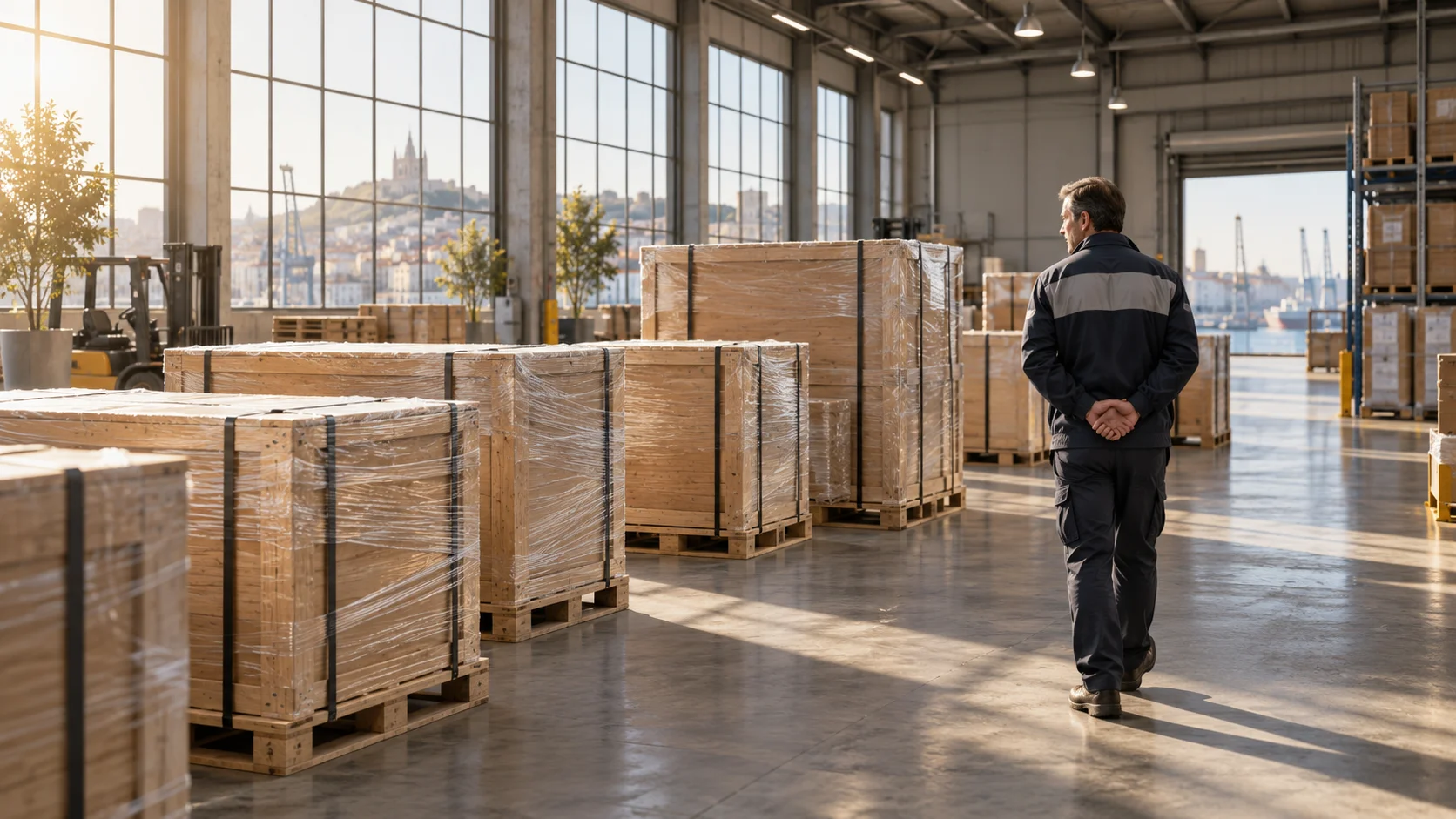
    Seen from behind with hands clasped, a worker walks past a row of wrapped wooden shipping crates in a sunlit warehouse overlooking a coastal city.

    Practical Tips Before You Ship

    Book early in the lead-up to peak season. November to January is high demand for the Australia-inbound lane, driven by the Australian Christmas and New Year period combined with consumer goods restocking. Rates and available space both tighten. Booking 8 to 10 weeks ahead of a target December arrival is practical risk management, not excessive caution.

    Clean all used goods before packing. Australian biosecurity inspectors are looking for soil, seeds, plant material, insects, and biological residues. A single contaminated item in a household container can trigger full-container examination. Clean each item individually, inspect garden and outdoor equipment particularly carefully, and document the cleaning in your packing list notes.

    Declare accurately. The most expensive customs outcome is not paying a duty rate. It is underdeclaring value and having ABF query it. The duty on a EUR 5,000 declared-value shipment is small compared to the cost of a customs hold, examination fees, and storage charges while a discrepancy is resolved.

    Get cargo insurance. France to Australia involves multiple handoffs, weeks at sea, and the possibility of biosecurity treatment that could damage goods. Cargo insurance is not a significant cost relative to the value of a typical household or commercial shipment. Cargo that is damaged, treated, or delayed without insurance exposes the shipper to the full replacement cost.

    A pattern worth naming: the documentation errors that cause customs holds on France-to-Australia shipments fall into a small number of predictable categories. Mismatch between the invoice description and what is actually in the container is the most common. A wine case listed as “12 bottles assorted” does not match a packing list that shows specific appellations and declared values per bottle, and when ABF auditors query the value of a declared wine shipment, they do it routinely, not randomly. Accurate documentation is not a formality. It is the document that ABF and DAFF use to decide whether your container goes to examination or clears the terminal. For most commercial importers, the cost of a one-hour delay in transit is acceptable. The cost of a five-day examination hold at AUD 120 per day storage is a different number. The shippers who avoid it consistently are the ones who get the paperwork right at origin, not the ones who plan to fix it at the Australian end.

    For individuals planning a relocation from France rather than a commercial shipment, the companion guide on moving from France to Australia covers the full household-goods process: UPE concession, biosecurity preparation, container sizing, and what happens at each stage from packing in France to delivery in Australia.

    Related reading: Australia Import Process: Nine Stages From Supplier to Warehouse

    Estimated Moving Costs: France to Australia

    Home size Estimated cost (EUR)
    2 bedroom EUR 4,390–9,180
    3 bedroom EUR 4,250–9,040
    4 bedroom EUR 6,170–12,880
    5 bedroom EUR 7,300–14,080

    These are door to door estimations, not port to port. They include standard packing and customs clearance on both ends, and assume an origin and destination reasonably near the port on both sides; a move to or from a more remote location may cost more. Treat these as budgets, not final pricing. The final cost depends on the quantity and nature of what you are shipping, service availability, and sea freight rates at the time of your move. These figures are based on average home sizes from past moves and may not reflect your own home. Timing and availability can also materially affect the price, and in some cases whether we are able to complete the job on your preferred timeline. For an accurate quote, contact our team or start our online self service quote, a short survey about your move that takes about four minutes and lets our team provide a real quote based on your specific details.

    Frequently Asked Questions

    How long does shipping from France to Australia take by sea?

    Sea freight from France to Australia takes 30 to 45 days port to port. Add inland pickup in France and Australian customs clearance and you are looking at 40 to 55 days door to door under normal conditions. LCL (shared container) shipments take longer due to consolidation handling.

    How much does it cost to ship from France to Australia?

    A 20-foot container (FCL) runs approximately AUD 3,800 to AUD 6,500 for ocean freight. LCL rates run AUD 280 to AUD 420 per CBM. Air freight is AUD 8 to AUD 18 per kilogram. Door-to-door costs are higher: add origin charges, destination charges, customs broker fees, and local delivery.

    What does Australian customs require for shipments from France?

    A commercial invoice, packing list, bill of lading or airway bill, and an import declaration lodged with ABF. Goods over AUD 1,000 in value require formal entry. Standard import duty applies to most French goods; GST at 10% applies to the customs value plus duty.

    Does Australia have duty-free thresholds for goods from France?

    Australia does not have a free trade agreement with France. Goods below AUD 1,000 customs value qualify for informal entry without duty or GST. Above AUD 1,000, standard rates apply. Used household goods may qualify for the Unaccompanied Personal Effects concession if eligibility conditions are met.

    Can I ship wine or food products from France to Australia?

    Yes, with the right compliance. Wine attracts import duty and excise-equivalent charges. Food requires biosecurity declarations. Meat products, fresh produce, and items with soil or plant material are higher biosecurity risk and may require permits or treatment.

    Do I need a freight forwarder to ship from France to Australia?

    For anything beyond a small courier parcel, yes. A licensed freight forwarder handles export documentation in France, booking, Australian customs entry (a licensed customs broker is required for formal import entries), biosecurity management, and delivery. Attempting to manage an international shipment from France without a forwarder introduces significant documentation risk and potential delays.

  • Importing from Vietnam to Australia: What Businesses Need to Know

    Importing from Vietnam to Australia: What Businesses Need to Know

    Vietnam has become one of Australia’s most significant sourcing markets over the past decade. Textiles and apparel, furniture, footwear, electronics, and seafood are among the product categories where Vietnamese manufacturers have built substantial export capacity, and Australian importers have responded with a rapid shift in sourcing away from China toward Vietnamese suppliers in many of those categories. Importing from Vietnam to Australia rewards that shift with 0% duty on most goods, but only with valid proof of origin for each shipment, usually a Form AANZ (RCEP origin also qualifies).

    The trade relationship is supported by a genuine tariff advantage under the ASEAN-Australia-New Zealand Free Trade Agreement (AANZFTA), which brings most Vietnamese-origin goods to zero or near-zero import duty when properly documented. But the compliance requirements (particularly for timber products, food items, and biological materials) are specific to Vietnam’s risk profile and can catch importers who approach Vietnam sourcing as though it were identical to China sourcing.

    Container ship navigating tropical waters between a Vietnamese port and the Australian coast, representing the AANZFTA import trade route

    What Australia Imports from Vietnam

    According to Austrade trade data, the major categories of Australian imports from Vietnam include:

    • Textiles and apparel: garments, footwear, handbags, and accessories: Vietnam is one of the world’s top three garment exporters and a primary sourcing market for Australian fashion retailers
    • Furniture and home goods: timber furniture, upholstered furniture, rattan and bamboo products: Vietnamese furniture manufacturing has expanded significantly since the 2010s
    • Electronics and electrical goods: consumer electronics, components, and electrical equipment: driven partly by Samsung, Intel, and LG manufacturing operations in Vietnam
    • Seafood: shrimp, pangasius, tuna, and other processed seafood products
    • Agricultural products: coffee, pepper, cashews, rice, and processed food products
    • Machinery and equipment: industrial machinery, tools, and mechanical parts

    The product category matters for compliance purposes: furniture and timber products carry specific DAFF biosecurity requirements; electronics require ACMA compliance; food and seafood require DAFF import permits and biosecurity conditions. Understanding which regime applies before placing a production order prevents costly compliance surprises on arrival.

    AANZFTA: The Tariff Advantage and How to Claim It

    The ASEAN-Australia-New Zealand Free Trade Agreement, administered by DFAT, provides preferential tariff rates for goods originating in ASEAN member states, including Vietnam. For most product categories, AANZFTA brings Australian import duty to 0%.

    To claim the AANZFTA preferential rate, the importer must hold a valid certificate of origin (Form AANZ) for each shipment. The Form AANZ must be:

    • Issued by an authorised body in Vietnam: the Ministry of Industry and Trade (MoIT), Vietnam’s sole C/O issuing body since 5 May 2025
    • Completed accurately with the correct HS code, origin criteria, and value declaration
    • Presented with the ABF import declaration before or at the time of customs entry

    The AANZFTA rules of origin require goods to satisfy one of several criteria, the most common being: wholly obtained in Vietnam (for agricultural products), or manufactured in Vietnam with regional value content of at least 40% (for manufactured goods). The certificate of origin is the supplier’s declaration that the goods meet the applicable criteria, and the importer is responsible for ensuring that the certificate is correct and held on file.

    What happens without a certificate: Without a valid AANZFTA Form AANZ, you pay Australia’s general tariff rate: typically 5% for most manufactured goods. On a AUD 200,000 annual import program, the AANZFTA saving is AUD 10,000 per year. Establishing the certificate of origin as a non-negotiable document requirement from the first order is straightforward; attempting to backfill it for historical shipments is significantly more complex.

    Exporter Declaration of Origin: Under AANZFTA amendments, exporters of goods valued above a threshold can issue a Declaration of Origin directly rather than through MoIT. This can simplify the documentation process for established supplier relationships. Ask your forwarder whether your supplier qualifies.

    Container yard at a Vietnamese export port at dusk, with a gantry crane mid-lift over stacked shipping containers

    Freight Routes and Realistic Transit Times

    Vietnam has two major export port clusters. The choice of which port your goods ship from affects your transit time and, for LCL shipments, your consolidation schedule.

    Southern Vietnam, Ho Chi Minh City (Cat Lai port): The primary export gateway for goods manufactured in the southern industrial provinces (Binh Duong, Dong Nai, Long An). Most furniture, garments, and electronics for export ship from Cat Lai.

    Northern Vietnam, Hai Phong (Lach Huyen terminal): The primary gateway for goods from Hanoi and the northern industrial belt, including Samsung’s major manufacturing facilities. Samsung-produced electronics and goods from Bac Ninh and Bac Giang provinces typically ship through Hai Phong.

    Transit times (vessel leg only, port to port):

    Origin Port Sydney Melbourne Brisbane Perth
    Ho Chi Minh City (Cat Lai) 18–24 days 20–26 days 16–22 days 14–20 days
    Hai Phong 21–28 days 23–30 days 19–26 days 17–24 days

    These are direct sailing estimates. Many Vietnam-Australia services include a transshipment call at Singapore, Port Klang (Malaysia), or Hong Kong, which can add 3–7 days to transit time and introduce a transshipment risk point. Ask your forwarder whether your booking is direct or transshipped and factor the appropriate transit range into your lead time planning.

    For total supply chain lead time from purchase order to goods in your Australian warehouse, add: production lead time (14–60 days depending on product complexity and order size), origin LCL consolidation if applicable (5–10 days), Australian port arrival to customs release (3–7 days standard, 14–28 days if examination triggered). See the supplier-to-warehouse chain guide for the full nine-stage breakdown.

    DAFF Biosecurity Requirements for Vietnamese Products

    Vietnam’s tropical climate and diverse agricultural base mean that DAFF biosecurity requirements for Vietnamese-origin goods are extensive. The categories requiring specific attention:

    Timber and Timber Products (Including Furniture)

    Vietnam is a significant timber furniture exporter, and a significant source of biosecurity risk for timber products. DAFF classifies Vietnam as a high-risk source country for several wood-boring insects and timber diseases. Requirements for timber and timber products from Vietnam include:

    • ISPM 15 treatment for all timber packaging material (pallets, crates, dunnage): heat treatment to 56°C for 30 minutes throughout the wood, or methyl bromide fumigation to ISPM 15 specifications, with an IPPC-compliant mark on all timber packaging
    • Treatment certificate for solid wood furniture: a certificate from a DAFF-approved treatment provider in Vietnam confirming the treatment method, temperature/time record, and the specific consignment it applies to
    • Phytosanitary certificate: issued by Vietnam’s Plant Protection Department for regulated plant products, required for unprocessed timber, rattan, and bamboo products

    DAFF applies a high inspection rate to timber furniture from Vietnam. Consignments that arrive without treatment certificates, or where the IPPC mark is absent from timber packaging, are held for treatment or directed for re-export. The cost and delay of a post-arrival treatment order significantly exceeds the cost of ensuring correct treatment at origin.

    Under a covered receiving bay, a warehouse quality-control staffer in plain workwear checks a stack of produce cartons against a handheld device, one carton partially opened for a visual check, the rest still sealed and orderly beside it.

    Food and Agricultural Products

    Vietnamese food products (seafood, fruit and vegetables, processed foods, coffee, spices) require DAFF import permits and biosecurity conditions specific to each product category. The DAFF BICON database (Biosecurity Import Conditions) is the authoritative source for current conditions for any specific product. Key categories:

    • Seafood: most processed seafood (cooked, canned, commercially sterile) can be imported without an import permit; raw or minimally processed seafood requires an import permit and biosecurity conditions
    • Coffee: roasted coffee is generally permitted; green (unroasted) coffee requires an import permit
    • Spices: most processed spices are permitted; fresh or minimally processed plant material requires an import permit
    • Fruit and vegetables: most fresh produce from Vietnam requires an import permit and specific treatment conditions; consult BICON for each product

    Electronics and Electrical Products

    Electronics from Vietnam do not carry specific DAFF biosecurity requirements, but must meet ACMA (Australian Communications and Media Authority) compliance standards for electromagnetic compatibility and electrical safety. Most consumer electronics must carry the RCM (Regulatory Compliance Mark) before being sold in Australia. The RCM mark requires testing to relevant Australian/New Zealand standards, which may differ from the IEC or CE standards your Vietnamese supplier’s products are manufactured to. Verify compliance testing status before placing orders.

    Vietnamese Supplier Qualification

    Vietnam’s manufacturing sector spans a wide quality range: from globally certified facilities supplying major international brands to small-scale workshops with inconsistent output. The gap between a factory’s sample quality and its production run quality can be significant, and the systems for managing that gap are less mature in Vietnam than in China’s more established export manufacturing base.

    A practical qualification process for Vietnamese suppliers:

    Step 1: Business registration verification. Vietnam’s National Business Registration Portal lets you verify a supplier’s business licence, registered address, and legal representative. A supplier that is reluctant to provide their business registration number is not a supplier you should rely on.

    Step 2: Factory audit. For first-time suppliers and orders above AUD 20,000, an independent factory audit is cost-justified. Third-party audit firms including Bureau Veritas, SGS, and Intertek operate throughout Vietnam’s industrial provinces. An audit confirms that the factory exists as described, has the capacity and equipment claimed, and meets the relevant quality and ethical standards. A video walk-through is an acceptable substitute only for very small, low-risk first orders.

    Step 3: Reference check. Ask the supplier for references from Australian or other English-speaking importers currently buying from them. Contact those importers and ask specifically about documentation quality, on-time production, and how the supplier handles quality disputes.

    Step 4: Pre-shipment inspection on first orders. A pre-shipment inspection (PSI) by an independent inspector at the factory, before goods are packed and sealed, verifies quality before title transfers to you under FOB terms. PSI costs USD 200–400 per inspection day: modest relative to the cost of receiving a non-conforming production run. The inspection report also gives you documented evidence of condition at origin if a dispute arises about damage in transit.

    For how supplier qualification feeds into the total chain management from factory to Australian warehouse, see the import chain management guide.

    Freight truck passing beneath a port checkpoint canopy, cab in warm sunlight and trailer in cool shadow

    Payment Terms and Currency Risk with Vietnamese Suppliers

    Most Vietnamese manufacturers quote in USD, which introduces currency risk for Australian importers paying in AUD. The AUD/USD exchange rate has historically ranged between 0.60 and 0.80, meaning the AUD cost of a USD 50,000 order can vary by AUD 8,000–16,000 depending on when payment is made.

    New importers typically start on 100% T/T (telegraphic transfer) before production begins: the supplier’s preferred arrangement because it eliminates their credit risk entirely. This is appropriate for first orders where the relationship is unproven, but it means your capital is at risk if the supplier fails to deliver.

    As the relationship matures, 30% deposit before production and 70% against copy bill of lading documents is a more balanced arrangement: the supplier has a deposit commitment before production, and you retain 70% of the order value until you have proof of shipment. This also reduces currency risk: you hedge or convert 30% at deposit stage and 70% at shipment, spreading the conversion across two market points rather than one. For most suppliers, that 30/70 structure is the practical middle ground when importing from Vietnam to Australia once the first orders are behind you.

    Letters of Credit (L/C) provide the strongest buyer protection for larger orders: the bank only releases payment to the supplier when compliant shipping documents are presented, but carry bank fees of 1–2% of the L/C value and require the supplier to have a bank willing to handle the L/C. Many small Vietnamese manufacturers cannot efficiently handle L/C documentation, which limits its practical use to larger, more established suppliers.

    Currency hedging through a forward contract (fixing the AUD/USD rate today for payment 60–90 days forward) removes exchange rate uncertainty from the landed cost calculation. For importers with annual Vietnam purchase volumes above AUD 500,000, forward contracts are worth discussing with your bank or a foreign exchange provider. For smaller volumes, using a currency exchange service (rather than your bank’s spot rate) captures the spread difference without the commitment of a formal hedge.

    Close on a factory inspection bench in a Vietnamese manufacturing facility, a worker's hands run a careful check along the seam of a finished textile or upholstered piece under a focused work lamp, loose thread trimmings and a soft measuring tape visible nearby.

    Quality Control Systems for Vietnamese Manufacturing

    Quality consistency is the most frequently cited challenge for Australian importers sourcing from Vietnam, particularly from smaller factories. The same factory that delivers an excellent sample may produce a first production run with 8% defects, then a second run with 2%, then a third with 12%: not because quality has deteriorated, but because it was never systematically controlled in the first place.

    Building a quality control system that works across the supply chain (without visiting Vietnam for every order) requires specific structural elements:

    Written quality specifications in the purchase order. “Same as sample” is not a specification. A purchase order quality annex that defines acceptable colour variance, dimensional tolerances, defect categories (critical, major, minor), and AQL (Acceptable Quality Level) sampling parameters gives the supplier a measurable standard and gives you a basis for rejecting non-conforming goods.

    In-line inspections for longer production runs. A pre-shipment inspection (PSI) at 100% production completion catches defects after they are made. An in-line inspection at 30–40% production completion catches process failures early enough to correct them within the production run. For orders above AUD 30,000, in-line inspection is cost-effective even at USD 400 per inspection day: the cost of correcting a defect in the factory is a fraction of the cost of receiving a non-conforming shipment in Australia.

    Photo documentation protocol. Require the supplier to send 15–20 photos of packed goods before the container is sealed: carton construction, labelling accuracy, packing list verification against physical count, and ISPM 15 marks on timber packaging. This does not replace physical inspection but catches the most common documentation and packaging failures before the container leaves.

    Defect resolution procedure defined in advance. Agree in the purchase order what happens if a non-conforming shipment arrives in Australia: credit against the next order, replacement in the next production run, or financial compensation calculated by defect category. A supplier who agrees to a clear defect resolution procedure before you place the order is a more reliable partner than one who negotiates each issue after it arises.

    In the corner of an otherwise smoothly operating warehouse, one shrink-wrapped pallet sits set apart from the main flow while a logistics staffer cross-checks it against a tablet, the rest of the floor visibly busy but orderly in the background with pallet jacks moving cartons in the distance.

    Common Compliance Problems on the Vietnam-Australia Lane

    The most frequently occurring compliance issues on Vietnam-Australia shipments, based on what triggers ABF examination, DAFF holds, and customs disputes:

    Certificate of origin missing, expired, or incorrectly issued. The AANZFTA Form AANZ has specific requirements: correct HS code, accurate origin criteria, MoIT signature and stamp. A certificate issued after the shipment date, for the wrong HS code, or without the correct authorisation is rejected, and the general tariff rate applies. Establish a pre-shipment documentation checklist that requires the certificate before the vessel departs, not after arrival.

    ISPM 15 non-compliance on timber packaging. Vietnamese factories sometimes use timber packaging that has not been treated to ISPM 15 standard or lacks the IPPC mark. The importer discovers this at the Australian port when DAFF holds the consignment. Treatment post-arrival (heat treatment or fumigation at an approved Australian facility) costs AUD 800–2,500 depending on the shipment size, plus storage charges during the hold. Specifying ISPM 15 compliance in the purchase order, and verifying the IPPC mark is present on pre-shipment photos, prevents this.

    Invoice value understatement. Some Vietnamese suppliers offer to understate the invoice value to reduce the importer’s customs duty liability. This is fraud under Australian customs law and creates personal criminal liability for the importer, not just the supplier. ABF has specific tools for detecting undervaluation, including reference pricing databases for common product categories. The duty saving is not worth the risk; insist on accurate invoicing at the transaction value.

    Misdeclared HS classification. Incorrect tariff classification is the most common cause of post-clearance ABF audits on the Vietnam lane. Products in categories with higher duty rates (footwear, textiles, certain food products) are occasionally declared under a lower-rate HS code either through error or intent. The correct classification is determined by the product’s composition and use, not by what the supplier wrote on the invoice. Your customs broker should classify the product independently, not simply transcribe the supplier’s description.

    Documentary discrepancies between commercial invoice, packing list, and bill of lading. Vietnamese export documentation quality can vary significantly between manufacturers. A commercial invoice that lists 500 units and a packing list that lists 480 units creates an ABF discrepancy flag. Require a pre-shipment photo package showing the sealed cartons, packing list, and carton count before the container is sealed.

    For the documentation standards that prevent customs delays, see the Incoterms and import compliance guide for how Incoterm selection affects which documentation obligations fall on the seller versus the buyer.

    For Swift Cargo’s Vietnam-to-Australia freight services, including LCL and FCL options from Ho Chi Minh City and Hai Phong, see the Australia freight page.

    A Checklist for Importing from Vietnam to Australia

    Hold a valid Form AANZ for every shipment, confirm ISPM 15 treatment and IPPC marks on timber packaging, and check BICON before ordering food or other regulated goods. Book a pre-shipment inspection on first orders, at USD 200 to 400 per inspection day, and plan 18 to 24 days of vessel transit from Ho Chi Minh City to Sydney before adding clearance time.

    Frequently Asked Questions

    What are the import duty rates from Vietnam to Australia?

    Under AANZFTA, most Vietnamese-origin goods qualify for preferential rates from 0% to 5%, with many categories at 0%. To claim the AANZFTA rate, you need a valid Form AANZ certificate of origin issued by the Ministry of Industry and Trade (MoIT) or a Declaration of Origin from the exporter. Without the certificate, you pay the general tariff rate of 5% on most manufactured goods.

    How long does shipping from Vietnam to Australia take?

    From Ho Chi Minh City: Sydney 18–24 days, Melbourne 20–26 days, Brisbane 16–22 days, Perth 14–20 days. From Hai Phong: add 2–4 days on most routes. These are vessel transit times only: add production lead time, LCL consolidation (5–10 days), and Australian customs clearance (3–7 days) for total supply chain lead time.

    Does Vietnam furniture need to be fumigated before importing to Australia?

    Solid wood furniture and timber products from Vietnam must meet DAFF biosecurity requirements including ISPM 15 treatment for all timber packaging material and a treatment certificate from a DAFF-approved provider for solid wood furniture. Vietnam is classified as a high-risk source for timber pests. DAFF applies a high inspection rate to timber furniture consignments from Vietnam.

    What are the most common compliance problems when importing from Vietnam?

    The most common problems are: certificate of origin missing or incorrectly issued (AANZFTA rate lost); ISPM 15 timber packaging non-compliance (consignment held for treatment); DAFF import permit not obtained for regulated goods; documentary discrepancies between invoice, packing list, and bill of lading; and misdeclared HS classification triggering ABF examination or post-clearance audit.

    How do I verify a Vietnamese supplier before placing a production order?

    Four steps: verify business registration through Vietnam’s National Business Registration Portal; commission an independent factory audit (Bureau Veritas, SGS, or Intertek operate across Vietnam’s industrial provinces); check references from other Australian importers they supply; and conduct a pre-shipment inspection on first and second orders. PSI costs USD 200–400 per inspection day: modest relative to the cost of a non-conforming production run.

  • Scaling an Import Business in Australia Resets at Each Growth Stage

    Scaling an Import Business in Australia Resets at Each Growth Stage

    This guide walks through all four growth stages, from your first trial order to a full container, and what changes at each one.

    Most Australian import businesses start the same way: a sample order, then a small trial shipment, then a few LCL consignments before the question becomes unavoidable: at what point does the freight model that got you started become the constraint that holds you back?

    Scaling imports is not just about ordering more product. Each stage of growth changes your freight economics, your compliance exposure, your supplier leverage, and your working capital requirements.

    Scaling an Import Business in Australia Resets at Each Growth Stage

    Stage 1: Trial Orders and Samples (Under 1 CBM, Single Supplier)

    Every import business begins here. The first order is a validation exercise: does the product meet specification, does the supplier deliver to commitment, and does the quality hold across a production run rather than just the sample?

    At this stage, freight is typically air express or a small air cargo consignment. The per-unit freight cost is high (often higher than the commercial unit cost), but that is acceptable because the purpose is validation, not economics. The landed cost calculation at this stage is deliberately unrepresentative of what the business will look like at scale.

    What to do at this stage: Document everything. Record the supplier’s production timeline, defect rates on the trial shipment, communication responsiveness, and the accuracy of documentation (commercial invoice, packing list, country of origin). These records become the baseline against which future performance is measured and the evidence base if a dispute arises later.

    ABF compliance note: Shipments with a customs value of AUD 1,000 or less can be cleared under a Self-Assessed Clearance (SAC) declaration, which is simpler and lower-cost than a full import declaration. Above AUD 1,000, an import declaration is required for each consignment. At trial order volumes, this threshold often does not apply, but know where it sits.

    Stage 2: Repeat LCL Shipments (1–12 CBM per Shipment)

    Once the supplier and product are validated, regular LCL (Less than Container Load) shipments are the normal next stage. LCL charges per CBM. This makes it economically appropriate for shipments below the FCL crossover point and operationally flexible: you ship when stock is needed rather than when you have a full container’s worth of product.

    At this stage, the key management tasks are:

    Establishing a reorder cadence. LCL shipments have a total lead time (production + transit + customs clearance) that must feed your inventory planning. If your transit time from Ho Chi Minh City to Melbourne is 18–22 days and production takes 30 days, your reorder point must be set 50–55 days before you expect to reach minimum stock. See the stockout prevention guide for the calculation method.

    Import scaling has its own cold start problem: the freight economics that make FCL attractive only arrive at volumes you cannot reach until sales grow, and sales growth depends on the availability and unit costs that FCL provides. The way through looks the same as it does for marketplaces: do things that don’t scale first. Importers who navigate this stage usually run a deliberately expensive middle period: LCL shipments at spot rates, ordering slightly ahead of demand, treating the extra per-CBM freight cost as the price of generating sell-through data. The data is the asset. Twelve months of consistent monthly demand makes the FCL conversation with your forwarder a formality rather than a forecast.

    Locking in documentation standards. At this stage you are learning what your supplier can reliably produce in terms of documentation: commercial invoice accuracy, packing list detail, certificate of origin timing for ChAFTA or AANZFTA claims. Problems discovered now, with small shipments, are cheaper to fix than the same problems at FCL volume. Work with your freight forwarder to establish a documentation checklist that the supplier completes before each shipment.

    Building the freight relationship. Your forwarder accumulates knowledge of your product category, your supplier’s origin port, and your customs risk profile as you ship repeatedly. This institutional knowledge (which HTS codes your goods are classified under, which DAFF inspection requirements apply, how your supplier’s documentation tends to arrive) reduces the friction cost of each shipment over time.

    Freight costs at this stage: LCL rates on China-Australia and Vietnam-Australia lanes typically range from AUD 90–160 per CBM for the ocean leg, with origin and destination handling adding AUD 150–250 per shipment regardless of volume. A 3 CBM LCL shipment might have a total freight cost of AUD 550–750: a high per-CBM rate that improves significantly as shipment size grows within the LCL range. For current rate context, see the supplier-to-warehouse chain guide.

    A tall block of stacked cardboard boxes fills a warehouse beside a smaller stack near an open bay door.

    The LCL-to-FCL Crossover: When the Economics Shift

    The single most important scaling decision most Australian importers face is when to move from LCL to FCL (Full Container Load). Getting this timing right saves material freight cost; getting it wrong (moving to FCL before the volume justifies it) ties up working capital in excess stock.

    The crossover economics depend on three variables: your current per-CBM LCL rate, the current 20ft FCL box rate on your trade lane, and your shipment volume per order cycle.

    On most Asia-Australia lanes in normal market conditions:

    • A 20ft FCL holds approximately 25–28 CBM of packable goods (slightly less for bulky or heavy cargo)
    • A 20ft FCL box rate typically ranges from AUD 1,800–3,500 depending on lane and season
    • LCL rates on the same lane typically range from AUD 90–160 per CBM for the ocean leg alone

    At AUD 120/CBM LCL and AUD 2,400 FCL, the crossover point in this specific case is 20 CBM: the volume at which FCL becomes cheaper per CBM than LCL. Below 20 CBM, LCL is cheaper. Above 20 CBM, FCL is cheaper per CBM. These are illustrative rate inputs, not fixed figures: different rates on your own lane will move this number. For a fuller worked methodology using different rate assumptions, see Freight Consolidation Strategies for Australian Importers.

    But the crossover is not purely about freight rates. FCL carries additional advantages that change the comparison:

    • No co-mingling risk: LCL cargo is consolidated with other shippers’ goods. Damage from adjacent cargo, contamination from a neighbouring consignment, or loss during CFS handling are all risks that disappear with FCL: your container is sealed and opened only at your warehouse.
    • No CFS delay: LCL cargo is held at the destination CFS (Container Freight Station) for deconsolidation, typically adding 2–5 days to clearance. FCL clears faster at most Australian ports.
    • Predictable container release: FCL clearance timelines are more consistent than LCL, where CFS schedules and co-consignee documentation problems can delay release of an otherwise compliant shipment.

    When FCL is within 10–15% of LCL total freight cost at your volume, the operational benefits tip the decision toward FCL. The practical test: ask your forwarder for a current FCL quote alongside your next LCL quote and compare at your actual shipment volume.

    For a detailed LCL vs FCL comparison covering Australian importer considerations, see the Incoterms and freight decision guide.

    A forklift backs out of an open shipping container packed with boxes, pulling a wrapped pallet onto a loading dock.

    Stage 3: Regular FCL Shipments (1–4 Containers per Year)

    Moving to FCL changes several dimensions of the import operation simultaneously. Not all of them are positive in the short term.

    Working capital increases. An FCL order is larger than an LCL order, requiring more working capital in inventory and in transit at any given time. A business that ordered 5 CBM every six weeks now orders 20–25 CBM every 10–12 weeks. The inventory investment per cycle is higher, and the risk of a quality problem or delayed shipment affects a larger stock position.

    Supplier relationship formalises. FCL volume gives you more leverage with your supplier: you are placing larger, fewer orders rather than frequent small ones, which suits most manufacturers’ production scheduling. Use this leverage to negotiate: longer payment terms (from 100% advance to 30/70 against documents), pricing improvements for confirmed volume, and priority scheduling during peak production periods.

    Compliance frequency increases. Each FCL is a separate import declaration to ABF. As declaration frequency grows, so does the importance of consistent, accurate documentation. ABF’s compliance audit program targets importers whose declaration patterns suggest errors: misclassification, undervaluation, or documentation inconsistencies. A customs broker who knows your product category and maintains accurate HTS classification records becomes a compliance asset, not just a transaction service.

    Incoterm renegotiation is worth attempting. At FCL volume, you have the freight buying power to negotiate FOB terms if your supplier has been quoting CIF. A single FCL order gives your forwarder enough volume to negotiate competitive ocean freight rates that may undercut the seller’s CIF embedded rate. For the framework for that negotiation, see the EXW vs FOB vs CIF comparison.

    DAFF biosecurity consistency matters more. At FCL scale, a DAFF-triggered examination or treatment failure has a proportionally larger operational impact than at LCL scale. Ensure that your supplier’s timber packaging consistently meets ISPM 15 requirements, that fumigation certificates from DAFF-approved providers accompany every shipment, and that your customs broker has a protocol for flagging any new product category that might carry different biosecurity requirements.

    A wide view across a busy warehouse yard shows three separate bays each mid-unloading a different container at once, forklifts moving between them at a measured, practiced pace

    Stage 4: High-Volume FCL Operations (4+ Containers per Year)

    At four or more FCL containers per year, the import operation has reached a scale where strategic decisions (about supplier diversification, warehousing, freight procurement, and compliance management) have material impact on business performance.

    Freight procurement shifts from reactive to planned. At this volume, annual or quarterly freight rate agreements become possible. Rather than booking each shipment at spot rates, regular-volume importers can negotiate rate agreements with forwarders or carriers that provide rate certainty and sometimes priority capacity access during peak periods when spot capacity is constrained. This is particularly valuable on China-Australia and Vietnam-Australia lanes where seasonal surcharges (Golden Week, Chinese New Year, year-end) can spike spot rates by 30–60%.

    Supplier diversification becomes a business imperative. A business running 6+ containers per year from a single supplier is carrying concentrated supply risk. Factory fire, labour disruption, raw material shortage, or a quality failure can halt 100% of supply for the weeks or months it takes to qualify and ramp up a new supplier. At this scale, qualifying a second supplier is not optional risk management. It is basic operational resilience. Run 15–20% of volume through the backup supplier continuously to keep them production-ready.

    3PL warehousing becomes economically relevant. At 4–8 FCL per year, inbound receiving, container unpack, and inventory management are consuming significant internal resource. A 3PL (third-party logistics) arrangement moves that operational load to a specialist while often reducing cost per unit handled through economies of scale. The break-even depends on your current internal handling cost versus 3PL rates: get comparative quotes when your inbound volume reaches 4 FCL per year.

    FTA utilisation should be systematic. At high volume, the tariff savings from consistently claiming preferential rates under ChAFTA (for China-origin goods) or AANZFTA (for Vietnam and ASEAN-origin goods) are meaningful at scale. A 5% duty saving on AUD 500,000 annual import value is AUD 25,000 per year: recoverable simply by ensuring certificates of origin are obtained from every shipment and presented with every import declaration.

    Working Capital Management at Each Stage

    The working capital requirement of an import business scales non-linearly with volume. Understanding what is locked up in inventory and in transit at each stage prevents the cash flow surprises that stall otherwise viable scaling plans.

    At LCL stage, working capital is relatively contained: a 5 CBM LCL shipment worth AUD 15,000 is in transit for 25–35 days. You have one cycle of stock in transit and one cycle on shelf at most times. The total working capital tied up in the import chain is rarely more than 2–3 times a single order value.

    The LCL-to-FCL transition changes this picture sharply. A first FCL order might be AUD 70,000 of product: four to five times a typical LCL order. That order is placed 45–60 days before it arrives (production plus transit), during which time you must also maintain stock to cover sales. On the day the FCL lands, you may have AUD 70,000 in transit plus AUD 30,000 on shelf: AUD 100,000 of capital locked in inventory, where previously the number was AUD 25,000–30,000.

    The practical mitigation: model the working capital peak before placing the first FCL, not after. The model should include: production deposit (typically 30% of order value), balance payment (70% before or against documents), transit period working capital (the cost of maintaining shelf stock while the FCL is at sea), and a buffer for any clearance delay. Knowing this number in advance gives you the option to arrange a trade finance facility, a business overdraft, or simply to time the first FCL for a period of strong cash flow.

    Payment terms improvement (from full advance to 30/70 against documents) reduces peak working capital by approximately 30–40% of order value, which is the single most effective working capital lever at this scale. Suppliers typically extend these terms once two to three successful FCL transactions have been completed.

    A man in a blazer places a blank yellow magnetic marker into a row on a wall-mounted planning board.

    Freight Procurement: From Spot Rates to Rate Agreements

    Most Australian importers at LCL and early FCL stage book freight at spot rates: the market rate at the time of booking, which varies with capacity and demand. At low volume, this is appropriate: the administrative overhead of maintaining a rate agreement is disproportionate to the savings.

    At 4+ FCL per year, the calculation shifts. Ocean freight rates on Asia-Australia lanes fluctuate significantly: by 30–60% between low season and Golden Week / Chinese New Year periods in a typical year. An importer who books all shipments at spot rates in a high-demand quarter can pay materially more than one who has a fixed-rate agreement for the year.

    Rate agreements are typically available in two forms. A blanket rate agreement sets a fixed rate per container for a nominated annual volume: the forwarder locks in capacity and rate, the importer commits to a minimum volume. A priority booking arrangement is less formal: the forwarder agrees to prioritise capacity for the importer in exchange for commitment of volume over the year.

    The negotiation leverage for rate agreements comes from volume predictability: a forwarder or carrier who knows you will ship 6 FCL over the next 12 months can plan around that commitment. Volume certainty is valuable to the freight chain, and that value is available to import businesses willing to forecast and commit.

    The secondary benefit of a consistent forwarder relationship at scale is institutional knowledge. A forwarder who has cleared your product category 20 times knows which DAFF inspection triggers apply, which ABF classification questions are likely, and how to structure documentation to minimise clearance friction. That knowledge reduces the per-shipment cost of clearance in ways that are not visible in the freight rate but are real in total landed cost.

    A worker reorganizes overflowing boxes on a warehouse shelf while a colleague wheels in an empty shelving unit.

    Common Scaling Mistakes

    Jumping to FCL before documentation quality is reliable. FCL magnifies documentation problems. An LCL consignment held at port for a packing list correction costs you 3–5 days on a 3 CBM shipment. The same error on a 20ft FCL holding AUD 80,000 of stock costs the same resolution time but proportionally more in demurrage, storage, and working capital exposure. Establish reliable documentation discipline at LCL scale before moving to FCL.

    Sole-sourcing while scaling volume. The instinct to concentrate volume with the best-performing supplier is understandable and often correct for the unit economics. It becomes a vulnerability when that single supplier faces any disruption. The time to qualify a backup is when you do not need one, not during a supply crisis.

    Ignoring FTA paperwork at small volume, then facing a backlog at scale. Importers who do not establish the certificate of origin habit at LCL scale find that backfilling it at FCL scale is painful. The supplier relationship and documentation process required to obtain the ChAFTA certificate of origin or AANZFTA declarations needs to be established while shipment volumes are manageable.

    Underestimating working capital requirements at the LCL-to-FCL transition. The first FCL is typically a working capital shock: an order three to five times larger than the previous LCL cycle, with longer lead time and more capital tied up in transit. Plan the working capital requirement before placing the first FCL, not after discovering the gap during order confirmation.

    For Swift Cargo’s approach to growing importer relationships from LCL to FCL, including freight rate structures at each volume level, see the Australia freight page.

    Related reading: LCL vs FCL for Australian Importers: The Crossover Point Moves

    Frequently Asked Questions

    When should an Australian importer switch from LCL to FCL?

    There is no single fixed crossover point: it depends on your specific LCL and FCL rates on the day, not a universal CBM threshold. The worked example later in this article shows one real case (at AUD 120/CBM LCL and AUD 2,400 FCL, the crossover lands around 20 CBM), but that number shifts meaningfully with your actual rate card and lane. Get a current FCL quote from your forwarder and compare it to the per-CBM LCL rate multiplied by your shipment volume. When FCL is within 10–15% of LCL on a landed cost basis, the additional benefits of FCL (no co-mingling risk, faster CFS clearance, lower damage exposure) tip the decision toward FCL.

    How does import frequency affect compliance obligations in Australia?

    Each shipment above AUD 1,000 customs value requires an import declaration. Importers with high declaration frequency may be subject to ABF compliance audits reviewing declaration accuracy, valuation methodology, and tariff classification history. DAFF biosecurity assessments apply per shipment: importing the same product more frequently does not reduce the per-shipment assessment, but does mean documentation or treatment errors are discovered and corrected faster.

    What payment terms should I aim for as my import volume grows?

    The progression typically moves from 100% advance payment through 30/70 against bill of lading documents, to open account terms for trusted suppliers, and eventually to net-30 or net-60 credit terms for importers placing regular significant volume. The leverage for negotiating better payment terms is volume consistency: a supplier who receives predictable monthly orders will extend credit terms they would not offer for sporadic purchases.

    How do I manage sole-supplier risk when scaling imports?

    Qualify a second supplier before you need one. When your primary supplier handles 80% of your volume comfortably, use 10–15% of volume to qualify an alternative. The cost of the backup order is the insurance premium against a disruption that could halt supply for 8–16 weeks: the time required to find, qualify, and ramp up a new supplier from scratch under emergency conditions.

    When should an Australian importer consider using a 3PL warehouse?

    The 3PL decision becomes relevant when inbound volume exceeds what can be efficiently handled by your own receiving operation, typically at 4–8 FCL per year. Key triggers: if container unpack at your facility takes more than 2 days per container, or if you are holding more than 60 days of stock because you lack space to receive more frequently, a 3PL arrangement typically reduces total logistics cost while improving receiving efficiency and inventory visibility.

  • Thailand Relocation Companies Fail in Five Predictable, Avoidable Ways

    Thailand Relocation Companies Fail in Five Predictable, Avoidable Ways

    There is a pattern in how expats describe their Thailand relocation experience that turns up consistently: the move went fine until it didn’t, and when it went wrong, the company that had seemed professional and responsive during the quoting stage suddenly became hard to reach, defensive about costs, or both. That is why a Thailand relocation company review written the week goods arrive tells you less than the five questions at the end of this guide.

    The failure is rarely random. Most relocation companies that underdeliver on Thailand moves fail in predictable ways: structural problems in how they quote, how they partner at the destination end, how they handle documentation, and how they define their liability. Understanding those failure modes before you sign gives you a much better chance of choosing an operator who won’t follow the same pattern.

    This is not a review of specific companies. It is a structural analysis of how the industry fails, and what signals (in a quote, in a conversation, in a contract) separate the operators who get it right from the ones who won’t.

    Thailand Relocation Companies Fail in Five Predictable, Avoidable Ways

    Failure Mode 1: The Volume Underquote

    The most common Thailand relocation failure is also the most preventable: the quote is based on an estimated volume that is lower than the actual volume of goods shipped.

    The mechanics are straightforward. A company sends a sales estimator to your home. The estimator produces a cubic metreage figure. The quote is based on that figure. On packing day, the actual volume is measured, and it is higher than estimated. The final invoice is higher than the quote.

    This happens in two ways. The first is genuine estimation error: volume assessment is a skill, and estimators who are optimistic about how efficiently goods can be packed consistently underestimate. A sofa that looks like 1.5 CBM on a walkthrough is 2.1 CBM when professionally wrapped in blankets and secured for ocean transit.

    The second is deliberate underquoting to win the business, with the intention of correcting the volume at packing or, worse, at the origin port when the container is sealed and the client has no leverage.

    The signal that separates good operators: a good company does a physical itemised survey, records every piece of furniture and estimated box count, and provides a quote tied to a specific cubic metreage figure that they will honour unless you add items between survey and packing. If the estimator “eyeballs it” and gives you a rough figure without documentation, you have no basis for holding them to that number.

    What to ask: “Can you provide the survey itemisation that your quote is based on? If the actual packing day volume is within 5% of the surveyed figure, will you honour the quoted price?” A company confident in its survey process will say yes. A company that hedges on this is telling you their estimate is approximate.

    An unwrapped floor lamp stands beside a bundle of blanket-wrapped furniture and a small side table.

    Failure Mode 2: The Exclusion Stack

    Relocation quotes for Thailand have a predictable gap between what is included in the headline price and what you will actually pay by the time goods are at your Bangkok apartment or Chiang Mai house.

    The charges most commonly excluded from initial quotes:

    • Thai customs broker fee: Required for any personal effects clearance at Laem Chabang. This is a professional service fee paid to the licensed customs broker who files the duty-free exemption application. Typically THB 8,000–20,000 (USD 230–570) depending on the complexity of the clearance.
    • Destination CFS fee (for LCL shipments): The Container Freight Station at Laem Chabang charges a deconsolidation fee per CBM. LCL importers pay this to have their cargo extracted from the shared container. Typically THB 800–2,500 per CBM.
    • Destination port charges / destination THC: Terminal handling charges at the destination port are separate from ocean freight and are payable by the importer in most Incoterm arrangements.
    • Destination delivery surcharges: Bangkok city delivery may be included; delivery to Chiang Mai, Phuket, Hua Hin, or any island destination typically is not, and adds a meaningful inland transport component.
    • Island ferry charges: Koh Samui, Koh Chang, and similar destinations require a ferry crossing for the truck: a cost that can add USD 200–400 and an additional 1–2 days.
    • Storage charges if free time is exceeded: If customs clearance takes longer than the port’s free time period (typically 7–14 days after discharge), storage charges accrue daily. These are real costs that pass through directly, not the company’s margin, but genuinely the importer’s liability.

    None of these are hidden costs in the sense of being unusual. They are standard components of a Thailand import. The problem is when they are absent from the initial quote without being explicitly noted as exclusions, leaving the importer to discover them on the final invoice.

    What a complete quote looks like: see the door-to-door Thailand relocation guide for the full checklist of what a binding quote should itemise and the five standard exclusions to verify explicitly.

    What to ask: “Does this quote include all destination charges to my delivery address in [city]? Please confirm in writing whether Thai customs broker fees, destination CFS or port charges, and inland delivery beyond Bangkok are included.” If the answer contains hedging language (“subject to customs” without a specific estimate), you do not have a complete quote.

    Editorial illustration of an international removal chain with a broken link at the destination handover

    Failure Mode 3: The Destination Partner Problem

    Most international relocation companies operating from the UK, Australia, or the USA do not have their own operations in Thailand. They work through a network of local agents: destination partners who handle port clearance, customs brokerage, and local delivery on their behalf.

    The quality of the destination partner is the quality of your Thailand move experience. And the destination partner is almost never evaluated by the client before the move, because the client has no relationship with them, does not choose them, and often does not know who they are until goods are at the port and a name appears on a document.

    The failure pattern: a well-regarded origin operator (FIDI-accredited, professional sales process, responsive during quoting) hands off to a destination agent in Thailand who is slow to file customs documentation, inexperienced with the duty-free exemption process, or simply hard to reach when the importer needs updates. The origin operator, once goods are on the vessel, has limited leverage over the destination partner’s performance.

    The signal that separates good operators: good companies know their Thailand destination partner by name and can tell you, specifically, who will handle your clearance. They have an established, long-term working relationship with that agent, not a broker who shops the job to the cheapest available handler at the time of booking.

    What to ask: “Who is your established destination agent in Thailand? How long have you worked with them? Are they FIDI members or IAM members? Can you give me their contact details so I can speak with them directly before confirming the booking?” A company that cannot or will not answer this specifically is routing your shipment through a network they do not directly control.

    A worker checks a tablet beside a wrapped pallet at an open-sided logistics facility as others move past.

    Failure Mode 4: Documentation Failure at Thai Customs

    Thai Customs documentation requirements for personal effects are specific and unforgiving. The duty-free personal effects concession requires a complete, item-level packing list; a copy of your passport; proof of a qualifying status (a work permit valid for one year or more, a non-immigrant visa with a confirmed working period of at least one year, Thai permanent residence, a full one-year Smart Visa, or returning-Thai-national status after 12 or more continuous months abroad, but not a retirement or marriage-based Non-Immigrant O visa); and a correctly completed Bor Sor 1 exemption application. If any of these are missing or incorrect, clearance stops.

    The documentation failures that most commonly cause clearance delays:

    • Packing list describes categories, not items. “Household goods: 20 boxes” is insufficient. Thai Customs requires item-level description: “Clothing: 3 boxes; Books: 4 boxes; Kitchen equipment (plates, cutlery, pots): 2 boxes; Bed linen: 1 box” etc. A packing list that was created in the origin office rather than during physical packing is often at this level of vagueness.
    • Proof of a qualifying status is missing. Customs needs evidence that you hold a status that qualifies for the concession, such as a one-year work permit or Thai permanent residence. If you entered on a tourist stamp intending to arrange that status later, you do not yet hold it, and clearance cannot proceed under the duty-free concession until you do. A retirement or marriage-based Non-Immigrant O visa does not qualify.
    • Non-qualifying items are mixed into the shipment without separate declaration. New electronics, items purchased in the past 12 months, commercial quantities: if these are in the shipment and not separately declared, examination can result in duty on the entire shipment rather than just the non-qualifying items.
    • The Bor Sor 1 form is filed late or incorrectly. The customs broker files this form on the importer’s behalf. If the broker is slow, unfamiliar with the process, or missing information from the importer, filing is delayed and the clock on port free time runs while the form is outstanding.

    Good relocation companies initiate documentation preparation well before packing day, not after the vessel departs. The packing crew creates the item-level inventory during packing; the destination team begins the Bor Sor 1 preparation as soon as the booking is confirmed. By the time goods arrive at Laem Chabang, the documentation package should be ready to file within 24–48 hours of discharge.

    For the full documentation standard and what triggers examination at Thai customs, see the guide to avoiding customs delays when moving to Thailand.

    A worker photographs the wrapped corner of a pallet with a smartphone before loading.

    Failure Mode 5: The Liability Gap

    The final failure mode is the one expats discover only after something goes wrong: the liability the company accepts for lost or damaged goods is significantly less than the value of the goods themselves.

    Standard international moving contracts typically limit liability to one of three levels:

    • Declared value coverage: The company insures goods at a declared value that the client specifies. This is the closest to comprehensive coverage and requires the client to actually declare a value and pay the appropriate premium.
    • Lump sum coverage: A fixed total coverage amount (e.g., AUD 50,000 or GBP 30,000) applied to the entire shipment regardless of actual value. If your shipment is worth more than the lump sum, losses above it are unrecovered.
    • Weight-based liability: The company is liable for a fixed amount per kilogram of goods: often as little as USD 0.50–2.00 per kg. A 500 kg shipment would have USD 250–1,000 maximum liability, regardless of whether the goods were worth AUD 80,000. This is the basis of COGSA liability in maritime transport, and it is the level of coverage many cheaper operators default to.

    Expats who discover the difference between these liability levels do so when a claim is made. The company that seemed fully insured was operating on weight-based liability; the expensive artwork, the laptop collection, and the custom furniture are worth significantly more than the kg-rate payout.

    The FIDI industry standards require FAIM-certified operators to offer declared-value coverage as an option. The IAM (International Association of Movers) similarly sets professional standards for its members. Non-member operators are not held to these standards and may default to weight-based liability if the client does not specifically request and purchase declared-value coverage.

    What to ask before signing: “What is the basis of your liability for lost or damaged goods? Is declared-value coverage included, and if not, what does it cost to add? Please show me the liability clause in the contract before I sign.” If the company is unwilling to clearly explain their liability basis, that is itself informative.

    A supervisor gestures toward the warehouse floor while briefing a small team gathered in a break area.

    What Good Operators Do Differently

    The failure modes above are predictable because they reflect structural incentives in the industry: low-ball quotes win business, exclusions protect margin, destination partners are outside the origin company’s control, documentation is a destination problem not an origin problem, and liability limits protect the company more than the client. Those incentives are what any Thailand relocation company review should test, rather than how pleasant the sales process felt.

    Good operators break this pattern in specific ways:

    They survey physically, not visually. An itemised survey that produces a documented CBM figure is the foundation of a binding quote. Good companies train estimators who can measure accurately, and they stand behind their survey figure at the packing stage.

    They own their destination chain. Either through their own operations in Thailand or through a long-term, named partner relationship, not a broker network. They can tell you who your goods will be with at every stage of the destination process.

    They initiate documentation early. The paperwork for Thai customs starts when the booking is confirmed, not when the vessel departs. The packing list is created on packing day by the crew, not assembled from the client’s memory a week later.

    They quote completely. A complete Thailand relocation quote names every charge that will appear on the final invoice and explicitly lists what is excluded. The exclusions list is as important as the inclusions list, because it defines where the client’s exposure starts.

    They explain the liability basis upfront. Good operators do not wait for a claim to explain what they cover. They present coverage options, explain the difference between weight-based and declared-value liability, and recommend the appropriate level for the client’s goods value.

    Why Online Reviews Are Unreliable for This Decision

    The natural first step when evaluating a relocation company is to search for reviews. The problem is that the review ecosystem for international removals is structurally unreliable for the specific risks that matter most to Thailand-bound movers.

    Most positive reviews are written in the week after goods are delivered: when the relief of completion is highest and the reviewer has not yet discovered long-tail issues. Storage charges, customs duty on non-qualifying items, and damage claims surface days or weeks after delivery. By then, the positive review has already been submitted.

    Negative reviews underrepresent the real failure rate for the opposite reason: international movers who had a bad experience are often in the middle of setting up a new life in Thailand and do not have the time or emotional energy to document what went wrong. The cost of writing a detailed review of a stressful experience is high when you are simultaneously navigating a new country.

    Company-curated testimonials are worse still. Testimonials that appear on a company’s own website or marketing materials are selected by the company. The testimonial writer chose a company they presumably liked before the move, so the testimonial captures the feeling of a customer who was predisposed to be satisfied, not a random sample of outcomes.

    Industry accreditation (FIDI FAIM, IAM membership) is a more reliable signal than any volume of positive reviews, because it reflects an independent third-party audit rather than selected customer sentiment. Neither guarantees a perfect move, but both require the company to maintain operational and financial standards that a collection of five-star reviews does not.

    The most reliable signal remains the specific, written answers to the five pre-booking questions below. A company’s willingness to answer precisely is more predictive of performance than how many positive reviews they have accumulated.

    There is a simple filter that separates operators worth hiring from the rest, and it has nothing to do with their website. Ask for the last three Thailand jobs they cleared through Laem Chabang, and who their licensed Thai customs broker was on each. A real operator answers in specifics: vessel, port, broker name. A reseller who will hand your container to an unknown destination partner stalls, because the data is not theirs to give. The quality you are actually buying lives on the destination side, where you cannot inspect it until it is too late to switch suppliers.

    Two people, one with arms crossed, look out through an office window at a busy warehouse floor below.

    There is a faster tell than reading the reviews themselves: read the same five-star review on three different platforms. Operators who buy reviews in bulk from an agency tend to reuse the same submitted text with minor edits across Google, Facebook and a directory site, because the agency drafts once and posts everywhere. A genuine reviewer writes once, in one place, in their own words, with a specific detail, a driver’s name, a delivery date, a damaged item, that would be expensive to fabricate at scale. Search a distinctive phrase from a glowing review in quotation marks. If it surfaces on another company’s page with the city name swapped, you have found the actual sourcing behind the five stars, not the relocation company’s actual performance.

    The Pre-Booking Checklist

    Before confirming a booking with any Thailand relocation company, the following questions should be answered in writing, not verbally, because a written answer creates an obligation that a verbal assurance does not:

    1. Volume confirmation: “What is the surveyed CBM figure this quote is based on? Will you honour this quote if packing day volume is within 5% of the surveyed figure?”
    2. Destination completeness: “Does this quote include Thai customs broker fee, destination port/CFS charges, and inland delivery to [specific address]? If not, what is the estimated cost of each excluded item?”
    3. Destination partner: “Who is your Thailand destination agent? Are they FIDI or IAM members? How long have you worked with them?”
    4. Documentation process: “Who prepares the packing list and when? Who files the Bor Sor 1 duty-free exemption application, and how far in advance of vessel arrival is it typically filed?”
    5. Liability basis: “What is the liability limit in your standard contract? Is declared-value coverage available, and at what premium?”

    A company that answers all five questions specifically and in writing is operating transparently. A company that hedges, deflects, or says “we’ll sort that out at the time” is telling you how they will handle problems when they arise, which is by sorting it out at the time, usually at your expense.

    For a complete picture of what the door-to-door service chain looks like end-to-end and the costs at each stage, see the hidden costs of shipping to Thailand and the Thailand relocation timeline for when each stage happens and how long it takes.

    For Swift Cargo’s Thailand relocation process and how we handle the destination chain, see the Thailand shipping and removals page.

    Running Your Own Thailand Relocation Company Review

    Ask for the survey itemisation behind the quote, written confirmation of every destination charge, the named Thai destination agent, who prepares the item-level packing list and files the Bor Sor 1, and the liability basis in the contract. Treat FIDI FAIM or IAM accreditation as a stronger signal than a stack of five-star reviews.

    Frequently Asked Questions

    How do I find a reliable relocation company for moving to Thailand?

    Start with FIDI-accredited companies (FAIM certification) or IAM members: both organisations require operators to meet financial, operational, and quality standards and submit to audits. Ask for a binding quote that specifies cubic metres, container type, all origin and destination charges, and what is explicitly excluded. Request the name of their Thai customs broker and their established agent at Laem Chabang. A company that cannot name their destination partner in Thailand specifically is operating through a broker network with no direct accountability for the destination end.

    What should a Thailand relocation quote include?

    A complete Thailand relocation quote should itemise: origin survey-confirmed cubic metreage, packing materials and labour (if full packing service), origin inland transport, origin port charges, ocean freight (LCL per CBM or FCL per container), destination port charges (destination THC and CFS fee for LCL), Thai customs broker fee, destination inland delivery to your address, and whether destination unpacking is included. Charges not on this list (including Thai customs duty on non-qualifying items, destination storage if free time is exceeded, and island/upcountry delivery surcharges) should be explicitly noted as exclusions.

    Is a cheap relocation quote to Thailand a red flag?

    A quote significantly below the range from comparable companies is almost always a red flag for one of two things: an underestimated volume (which will be corrected when the actual cubic metreage is measured at packing) or excluded charges that will be added at the destination end. Destination-end exclusions (Thai customs broker fees, destination CFS charges, destination delivery) are the most common source of final invoice surprises. Ask the company to confirm in writing that the quote includes all destination charges to your named delivery address.

    What is FIDI FAIM certification and does it matter for Thailand moves?

    FIDI FAIM (FIDI Accredited International Mover) is the international moving industry’s primary quality accreditation, administered by FIDI (Fédération Internationale des Déménageurs Internationaux). To achieve FAIM certification, a company must pass an independent audit covering financial stability, operational processes, and customer complaint resolution. For Thailand moves, FAIM certification matters primarily for the origin operator: it does not guarantee that the destination agent in Thailand meets the same standard. Ask separately about the destination partner’s own accreditation.

    What happens if my goods are delayed at Thai customs?

    If your goods are held at Thai customs beyond the port’s free time (typically 7–14 days after discharge for FCL; 5–10 days for LCL CFS), storage charges begin to accrue. These are charged by the port operator or CFS (Container Freight Station), not by your removals company, and are passed through at cost. Customs examination adds 1–3 weeks to clearance time. If documentation is deficient (incomplete packing list, missing proof of qualifying status, incorrect Bor Sor 1 form), clearance can be suspended entirely until the correct documents are produced, during which time storage charges continue. The best prevention is documentation prepared before packing day, not the day goods arrive at port.

  • EXW vs FOB Australia Import: Cost, Risk and Control

    EXW vs FOB Australia Import: Cost, Risk and Control

    Three Incoterms account for the vast majority of freight quotes Australian importers receive from suppliers in China, Vietnam, and the United States: EXW, FOB, and CIF. Understanding the practical difference between them (not the legal definition, but what each one means for your cost, your risk, and your control) is one of the highest-leverage decisions in a freight program. Choosing exw vs fob australia import terms correctly, before the purchase order is signed, is what determines who controls the shipment and who eats the cost when something goes wrong at origin.

    This article covers EXW, FOB, and CIF with a worked cost scenario and a decision framework by situation. For the full Incoterms 2020 reference covering all 11 terms, see the complete Incoterms guide for Australian importers.

    Cost, Risk and Complexity Decide Whether to Use EXW, FOB or CIF

    What Each Term Actually Means

    Before the comparison, the core mechanics of each term need to be precise, because the common summaries (“FOB means the seller pays to port”) are loose enough to cause real problems.

    EXW: Ex Works

    The seller’s obligation ends at their factory premises. They make goods available for collection; everything else is the buyer’s problem. This includes:

    • Loading the goods onto the collecting truck (the seller is not obliged to do this under strict EXW)
    • Export customs clearance in the origin country
    • Origin inland transport from factory to origin port
    • All freight, insurance, and charges from that point forward

    Risk transfers to the buyer the moment goods are available at the seller’s premises: before they are even loaded onto the collecting truck. Under strict EXW, if the goods are damaged during loading at the seller’s factory, that is the buyer’s problem from the moment they were available for collection.

    FOB: Free On Board

    The seller delivers goods on board the named vessel at the named origin port and handles export customs clearance. Risk transfers to the buyer when goods are on board the vessel. The seller pays:

    • Export customs clearance at origin
    • Origin inland transport to the port
    • Origin port handling charges (loading/THC)

    The buyer pays from that point: ocean freight, marine insurance, destination port charges, Australian customs clearance, and inland delivery.

    The International Chamber of Commerce recommends FCA (Free Carrier) instead of FOB for containerised shipments, because under FOB, risk transfers at loading onto the vessel, but the container has often been sitting in the terminal (outside both parties’ control) for days before loading. FCA transfers risk at the point the carrier takes possession, which is cleaner. In Australian freight practice, FOB remains the working standard and forwarders handle it routinely.

    CIF: Cost, Insurance and Freight

    The seller pays ocean freight and arranges insurance to the named destination port. Risk still transfers to the buyer at the origin port when goods are loaded: the same point as FOB. The seller provides minimum Institute Cargo Clauses (C) insurance coverage.

    The buyer pays from the destination port: terminal handling charges, Australian customs clearance (ABF import declaration), DAFF biosecurity, and inland delivery.

    The critical point that most importers miss: under CIF, the risk transferred at origin is identical to FOB. The seller is paying for freight and insurance, but they are not bearing the risk of that freight. If your goods are lost at sea under CIF terms, you make a claim against the seller’s minimum insurance, which may or may not cover your actual loss, depending on what ICC(C) covers and at what declared value.

    The Three Dimensions That Actually Matter

    The right comparison of EXW, FOB, and CIF runs across three dimensions: cost control, risk management, and operational complexity.

    Dimension 1: Cost Control

    EXW: You control every cost, but you also bear every cost, including the origin-side costs where your leverage may be lowest. Export customs clearance in China or Vietnam requires a local licensed broker. Origin inland transport from factory to port in an unfamiliar market means you pay retail prices. Sellers who work with multiple forwarders at origin get consolidation pricing you will not have access to independently.

    FOB: You control all costs from the origin port forward. Your freight forwarder shops the ocean freight market and arranges insurance at competitive rates. The origin-side costs are bundled into the seller’s FOB price, where they can negotiate with their own export clearance agent and local haulier. Both parties are paying costs in their domain of expertise.

    CIF: The seller controls ocean freight and insurance. You have no visibility into what rate they obtained, and no ability to benchmark it. Sellers who offer CIF frequently embed a margin into the freight rate: the same ocean freight you could buy at USD 1,800 FOB might be priced at USD 2,200 CIF, netting the seller USD 400 on a notional USD 1,800 freight cost. You only discover this by requesting FOB and CIF quotes simultaneously and comparing.

    A cargo insurance document and a shipping manifest resting on a warehouse desk beside a sealed, strapped pallet, morning light catching the pallet's protective wrap, the

    Dimension 2: Risk Management

    EXW: Maximum risk to the buyer from the earliest possible point. If goods are damaged during origin loading, during factory-to-port transit, or during port handling before vessel loading, the buyer bears that risk without having had meaningful control over the handling. EXW insurance must cover from the seller’s factory gate: a policy that can be arranged but requires specific attention to origin-side handling coverage.

    FOB: Risk to the buyer from the origin port loading. The seller’s domain (factory to port, export clearance, port handling) is their risk. Your risk starts once the goods are on board the vessel. Marine insurance arranged by your forwarder can be calibrated exactly to your cargo type: ICC(A) for All Risks coverage on sensitive goods, ICC(B) for intermediate, ICC(C) for robust containerised cargo at lowest premium.

    CIF: Risk to the buyer from origin loading, same as FOB. But the insurance is the seller’s choice, subject to ICC(C) minimum. ICC(C) covers only named perils: fire, explosion, vessel stranding, sinking, collision, general average, jettison. It does not cover rough handling damage, water ingress, contamination, or theft at destination: four of the most common cargo loss causes. If your goods are sensitive to any of these, CIF’s minimum insurance is inadequate and you would need to arrange a top-up policy, which undermines CIF’s apparent simplicity.

    Dimension 3: Operational Complexity

    EXW: Highest complexity for the buyer. You must engage an origin-side agent for export clearance and local transport. Managing a freight chain that starts at a factory in Dongguan with no local presence requires either a forwarder with established origin-side operations or your own agent network.

    FOB: Moderate complexity, well-matched to working with an Australian freight forwarder. The seller handles origin; your forwarder handles ocean freight, insurance, and Australian clearance. The two sides of the chain are clean, and each party manages what they know.

    CIF: Lowest apparent complexity: the seller handles more. But this simplicity is partly illusory: you still handle Australian customs clearance (the seller cannot do this for you), DAFF biosecurity, and inland delivery. The part of the chain that feels most complex to Australian importers (customs clearance) is still their responsibility under CIF. What CIF removes is ocean freight management, which is actually the part your forwarder handles most efficiently.

    A container being craned onto a vessel at a Chinese export port under a hazy midday sky, the container swinging with realistic cable tension and slight natural sway, other stacked containers showing varied weathering and saturation rather than uniform color.

    Worked Scenario: USD 50,000 Shipment from Guangzhou to Sydney

    Consider a real shipment: 8 CBM of commercial goods, USD 50,000 declared value, Guangzhou to Sydney, containerised LCL. Typical numbers for the three Incoterm options:

    Cost Component EXW FOB CIF
    Seller’s invoice price USD 50,000 USD 50,650 USD 52,500
    Origin export clearance USD 180 (buyer) Included in FOB Included in CIF
    Origin inland transport (factory → port) USD 320 (buyer) Included in FOB Included in CIF
    Origin THC + port charges USD 280 (buyer) Included in FOB Included in CIF
    Ocean freight (LCL rate) USD 1,600 (buyer) USD 1,600 (buyer) Included in CIF
    Marine insurance (ICC-A) USD 220 (buyer) USD 220 (buyer) USD 150* (seller, ICC-C only)
    Destination port charges USD 450 (buyer) USD 450 (buyer) USD 450 (buyer)
    ABF import declaration USD 180 (buyer) USD 180 (buyer) USD 180 (buyer)
    Customs broker fee USD 280 (buyer) USD 280 (buyer) USD 280 (buyer)
    Inland delivery (Sydney) USD 320 (buyer) USD 320 (buyer) USD 320 (buyer)
    Total landed cost USD 53,830 USD 53,700 USD 53,730

    *Seller’s ICC(C) premium estimated; ICC(A) top-up would add USD 70–100 to CIF scenario if arranged by buyer

    EXW is the cheapest headline price but the highest total cost. The origin-side costs (export clearance, inland transport, origin THC) come in at USD 780 for a buyer arranging them independently, and that assumes reasonable origin agent pricing. These same costs are typically USD 600–650 when the seller bundles them into their FOB price through their established relationships. EXW’s apparent unit-price advantage disappears at the total landed cost level.

    FOB and CIF land very close in this scenario. The CIF price is USD 130 more than FOB total landed cost when comparable ICC(A) insurance is factored in. In a scenario where the seller’s CIF freight rate is competitive, CIF can match FOB. The problem is that you cannot verify the seller’s CIF freight competitiveness without a separate quote, which requires the same effort as managing FOB in the first place.

    The insurance gap is real. The CIF scenario above uses ICC(C) coverage at USD 150 premium. If the buyer accepts this without arranging top-up coverage and goods arrive water-damaged, they may find ICC(C) does not cover their loss. The difference between ICC(C) and ICC(A) is approximately USD 70 on a USD 50,000 cargo: a trivial additional cost to buy comprehensive coverage rather than minimum coverage.

    How Australian Customs Interacts With Your Incoterm Choice

    The ABF customs valuation methodology uses the transaction value of goods as the primary basis for customs duty calculation. For an EXW shipment, this is the EXW price plus origin-side costs. For a FOB shipment, it is the FOB invoice price. For a CIF shipment, the seller’s freight and insurance are deducted from the CIF price, so the customs value is again FOB-based.

    The practical effect on Australian GST: the ATO calculates GST on the taxable importation value, which includes the customs value plus applicable duty plus the cost of freight and insurance to Australia. Under all three Incoterms, freight and insurance to the Australian port are included in this calculation: the Incoterm does not reduce your GST base. It affects only how those freight and insurance charges are disclosed: transparently (EXW/FOB) or embedded in the seller’s invoice (CIF).

    For Australian importers using preferential tariff rates under ChAFTA or other free trade agreements, the Incoterm does not affect eligibility: that is determined by the certificate of origin. However, the invoice price used for customs valuation matters: CIF-priced invoices must accurately reflect the underlying value of goods (not inflated to include seller margin) for correct duty calculation.

    DAFF Biosecurity: Always the Importer’s Responsibility

    Regardless of Incoterm, DAFF biosecurity requirements are always the importer’s obligation. Treatment certificates, ISPM 15 timber packing compliance, and approved treatment declarations must be provided regardless of whether the shipment is structured as EXW, FOB, or CIF. No seller-side Incoterm obligation changes this.

    For goods that require treatment before import (timber, used machinery, biological materials, food products) the treatment must be arranged and certified in the origin country by an approved provider. Under FOB, the seller typically facilitates this because they are handling export compliance. Under EXW, the importer’s origin agent must arrange it. Under CIF, the seller handles it as part of their export obligations but the importer must confirm it was done to DAFF’s standard, not just to the seller’s declaration.

    For which product categories actually require treatment, and what DAFF looks for in each, see our guide to DAFF biosecurity requirements by product.

    An Australian importer and their freight forwarder standing at a warehouse office window, a wall map of shipping routes softly visible behind them out of focus, both gesturing naturally toward the warehouse floor below rather than at any documents.

    The Decision Framework: Which Incoterm to Use When

    The right choice depends on four variables: your freight forwarder’s origin-side capability, your cargo type, your shipment volume, and your supplier relationship. Working through exw vs fob australia import scenarios against these four variables, rather than defaulting to whichever term the supplier proposes, is what keeps the decision in your control.

    Use FOB when:

    • You work with an Australian freight forwarder who has established agent relationships in the origin country: this is the standard case
    • You want control over ocean freight rates and the ability to shop the market
    • Your cargo requires ICC(A) or ICC(B) coverage: you want to choose your own insurer and coverage level
    • You are shipping regularly from the same origin port and your forwarder has rate agreements in place
    • You are managing total landed cost tightly and want visibility into every charge component

    Use CIF when:

    • You are placing a small, one-off order where the administrative overhead of managing freight independently is disproportionate
    • Your supplier’s CIF freight rate has been benchmarked against your forwarder’s FOB freight quote and is genuinely competitive
    • Your cargo is robust, lower-value, and ICC(C) coverage is genuinely adequate (not just minimum)
    • You have verified, in writing, what the seller’s CIF insurance covers and at what declared value

    Avoid EXW unless:

    • You have an established, known-cost agent in the origin country handling export clearance and local transport
    • You are benchmarking the seller’s FOB price: EXW reveals the factory price before origin costs, which is useful for understanding how the price builds up even if you ultimately ship FOB
    • Your forwarder has a significant origin-side operation and quotes EXW as their preferred arrangement

    For most Australian importers sourcing from China or Vietnam using a standard freight forwarder, FOB is the right default, and it should be the default unless there is a specific reason to deviate. The complete chain management framework for taking an FOB shipment from factory to Australian warehouse is covered in the supplier-to-warehouse logistics guide.

    How to Benchmark a CIF Quote Against FOB

    If a supplier defaults to CIF and you want to evaluate whether their pricing is competitive, the methodology is straightforward but requires two parallel quotes.

    Ask your supplier for both their CIF price (to the named Australian port) and their FOB price (at the origin port). Then ask your freight forwarder to quote the ocean freight and insurance for the same shipment on an FOB basis. You now have two routes to the same destination:

    • Route A: Supplier’s CIF price → your destination charges (destination THC, customs clearance, inland delivery)
    • Route B: Supplier’s FOB price + your forwarder’s freight + your forwarder’s insurance → your destination charges

    If Route A (CIF total) is higher than Route B (FOB + your freight + your insurance), you are paying a freight markup in the supplier’s CIF price. That markup is pure margin for the supplier with no service benefit to you: the same ocean carrier, the same transit time, the same destination port. The only difference is who booked the space.

    In practice, the markup is typically small for small shipments (USD 100–300) and larger for significant FCL volumes (USD 400–800 per container). For importers doing regular volume, systematically choosing FOB and benchmarking CIF can recover meaningful freight cost over a year of shipments.

    One important caveat: some suppliers have genuine volume-based rate agreements with carriers that give them better freight rates than your forwarder can access for a single booking. In those cases, CIF can genuinely be cheaper, but you will only know this by running the benchmark, not by assuming.

    A supplier and an importer's sourcing agent examining a stitching detail on a sample product at a factory workbench

    We once took over a supply chain where every purchase order defaulted to EXW because that was the field the ordering template shipped with, not because anyone had chosen it. Nobody noticed until a shipment sat at the factory gate for eleven days while two people argued about who was supposed to book the truck. The lesson was not about Incoterms in the abstract. It was that a default nobody chose is not a decision, it is an accident waiting for a bad week to happen. Before you accept whatever term is already typed into the purchase order, ask your supplier for their own outbound freight quote on the same shipment. If they can produce one in an hour, they were never going to leave that job undone. If they cannot, you have just found the gap EXW was hiding.

    Negotiating Your Incoterm

    Most Australian importers accept whatever Incoterm their supplier defaults to. In practice, most suppliers will negotiate: they often have a preferred Incoterm from their operational perspective, but they are not inflexible.

    The conventional view is that the Incoterm is an administrative detail: a three-letter code the supplier fills in while the real negotiation happens on unit price. The opposite is closer to the truth. The Incoterm decides who holds the information, and in freight the information is the margin. A supplier who insists on CIF is volunteering to act as your freight forwarder without showing you a rate card. Once you read the terms question that way, the negotiation stops being about convenience and becomes a simpler question: are you willing to let the counterparty price a service you cannot benchmark? Most importers answer yes without realising they were ever asked.

    The negotiation is straightforward: ask for both EXW and FOB quotes (or FOB and CIF if the supplier defaults to CIF). The gap between them tells you what the origin-side cost stack looks like priced by the seller. You can then compare this against your forwarder’s ability to arrange origin-side services separately.

    If the supplier’s FOB price is only modestly above their EXW price, they are pricing the origin services competitively. If the gap is large relative to what independent origin services would cost, you are paying a margin on the origin stack that a direct arrangement might avoid.

    One common negotiating point: if a supplier insists on CIF because they have a freight arrangement with a carrier, ask them to provide the bill of lading showing their actual freight rate. This is a reasonable request and helps you verify that the CIF price is not embedding a freight markup.

    To understand how the Incoterm choice feeds into your planning for transit timelines from China to Australia, see the freight timeline guide: the stages at which your Incoterm affects your visibility and control are particularly relevant there.

    For Swift Cargo’s approach to freight management from China and Vietnam under FOB terms, see the Australia freight page and get a quote.

    EXW vs FOB Australia Import: Quick Decision Recap

    Choose EXW only when your own forwarder has strong origin-side capability and you want full control from the factory door; choose FOB when the supplier is better placed to handle export documentation and loading. Most exw vs fob australia import decisions come down to that single question of who is better positioned to manage the origin side, not a fixed rule about which term is universally cheaper.

    Frequently Asked Questions

    Is FOB or CIF better for Australian importers?

    FOB is generally better for Australian importers who work with a freight forwarder. Under FOB, your forwarder controls the ocean freight booking and insurance, giving you visibility into exactly what you are paying and the ability to shop the market. CIF hands those decisions to the seller, who may embed a markup in the freight rate and provide only minimum ICC(C) insurance, which is insufficient for many cargo types. The exception is small, low-value shipments where the administrative overhead of managing freight is not worth the cost visibility.

    Why is EXW usually a bad choice for Australian importers?

    EXW transfers all responsibility to the buyer from the seller’s factory gate. For Australian importers, this means arranging export customs clearance in the origin country, origin inland transport, and all charges from that point forward: services you will pay for at arm’s length pricing rather than your seller’s established rate. EXW pricing looks lower than FOB because the seller’s costs stop at the factory door, but those costs do not disappear: they move to you, usually at a higher unit cost.

    Does the Incoterm affect my Australian customs duty calculation?

    The Incoterm affects how the customs value is composed. Under FOB, the customs value is the transaction value at the origin port; freight and insurance to Australia are then added to calculate the taxable importation value for GST. Under CIF, the seller’s freight and insurance costs are embedded in the invoice price and must be deducted, because Australian customs value excludes international freight and insurance. The key practical difference: under FOB you can verify each charge separately; under CIF they are bundled into the seller’s invoice and harder to challenge.

    What is the difference between FOB and FCA for containerised sea freight?

    The ICC recommends FCA over FOB for containerised shipments because FCA transfers risk when the container is handed to the nominated carrier, which is a cleaner handover point than FOB’s vessel-loading moment. In practice, most Australian forwarders handle FOB routinely and the distinction rarely creates a real dispute. FOB remains the working standard on China-Australia and Vietnam-Australia routes despite the ICC’s guidance.

    Can my supplier offer both FOB and CIF prices?

    Yes. Most established manufacturers in China and Vietnam quote both EXW and FOB as standard, and many will quote CIF on request. Requesting both FOB and CIF quotes for the same shipment lets you benchmark the seller’s CIF freight rate: if your forwarder can move the same shipment for less than the embedded CIF freight charge, FOB gives you a better total landed cost.

  • Thailand Relocation Timeline: How Long Each Stage Actually Takes

    Thailand Relocation Timeline: How Long Each Stage Actually Takes

    Most people who move to Thailand discover the same problem about three months before their intended departure date: they have left the logistics planning too late, and two incompatible clocks are now running simultaneously: the visa processing clock, which is largely outside your control, and the shipping clock, which has its own sequence of steps that cannot be compressed below a minimum timeline.

    This guide maps the real end-to-end timeline for a Thailand relocation, stage by stage, with durations, sequencing constraints, and the specific points where most moves slow down or fail. It is not a general checklist. See the Thailand relocation checklist for the task-by-task operational sequence. This guide is specifically about timing: how long each stage takes, what depends on what, and how to build a realistic schedule that accounts for the constraints Thai Customs imposes at the destination end.

    Thailand Relocation Timeline: How Long Each Stage Actually Takes

    The Governing Constraint: The Thai Customs Duty-Free Window

    Before mapping the timeline, the most important constraint needs to be understood clearly, because it controls the entire schedule.

    Thai Customs allows incoming residents to import their used household goods and personal effects duty-free under a personal effects concession. The conditions, as stated by the Thai Customs Department, are:

    • The applicant must be entering Thailand to reside for a period of not less than one year
    • Items must have been owned and used by the applicant for at least 12 months prior to the move
    • The duty-free clearance application must be submitted within 6 months of the applicant’s first qualifying entry into Thailand
    • The applicant must have entered Thailand before the goods clear customs, not after

    This last condition is the planning constraint that most movers misunderstand. Your goods cannot be cleared under the personal effects concession unless you are already in Thailand on the qualifying visa. If your shipment arrives before you enter the country, the goods sit at Laem Chabang accumulating storage charges while you wait, or worse, they are processed at full commercial import duty rates.

    The practical sequencing rule: your visa entry into Thailand should precede your goods’ arrival at Laem Chabang by 1–4 weeks. Not simultaneously. Not goods first. Visa and entry first, then goods arrive.

    Stage 1: Decision and Research (Weeks 20–28 Before Departure)

    Duration: 4–8 weeks

    The decision to relocate to Thailand typically involves establishing the basics: which visa category applies to your situation, which city or region you are targeting, and a rough sense of whether you are shipping a small apartment’s worth of goods or a full household.

    The practical output of this stage is a visa target (the specific visa category you will apply for) and a rough departure date range. Without both, you cannot book anything downstream.

    Statuses that qualify for the personal effects concession:

    • A Department of Labour work permit valid for one year or more, in practice held alongside a Non-Immigrant B visa
    • A non-immigrant visa with a confirmed working period of not less than one year
    • Thai permanent residence
    • A full one-year Smart Visa
    • Returning-Thai-national status after 12 or more consecutive months abroad

    Statuses that do not qualify: Non-Immigrant O (retirement), Non-Immigrant O-A and O-X, Non-Immigrant O (family or guardian), Thailand Elite, education visas, tourist visas and visa-exempt entries. Visa types O and O-A will not be considered for duty-free entry and are subject to duties and taxes, per the FIDI Global Alliance‘s Thailand customs guide. A Thailand LTR holder qualifies only where the LTR carries a work permit or a confirmed one-year working period, and then through that route rather than through the LTR itself.

    For a retiree this is the most consequential line in the whole timeline. There is no duty-free window to plan the shipment around, so the move should be budgeted with import duty and 7% VAT on the declared value from the first quote onward. Note that the visa still governs the schedule, because the entry date still gates the rest of the move. It just does not gate a concession.

    If you are arriving on a tourist visa intending to switch to a longer-term status, your duty-free goods window does not start until you hold a qualifying status, and switching onto a retirement visa does not start it at all.

    Consult the Thai Immigration Bureau or a licensed Thai immigration agent for current requirements, which change periodically. The financial thresholds for Non-O retirement visas (THB 800,000 in a Thai bank account or provable monthly income of THB 65,000) should be confirmed against current regulations before beginning the application.

    Stage 2: Visa Application (Weeks 14–24 Before Intended Thailand Entry)

    Duration: 10–14 weeks from application to visa in hand, depending on category and processing country

    This is the least compressible stage of the relocation. The visa determines your entry date. Your entry date determines your goods arrival target. Everything downstream schedules backward from here.

    Processing times as a practical guide:

    • Non-Immigrant O (retirement) applied at Thai consulate in Australia: 2–4 weeks for single-entry; bank transfer and financial documents add 4–6 weeks of preparation if not already in place
    • Non-Immigrant O applied in Thailand at the border or immigration office: 1–3 weeks for conversion from tourist entry, subject to immigration officer discretion, less predictable than consulate application
    • LTR visa: 4–8 weeks from application to approval, plus additional time if supporting documents need verification

    The preparation time is often longer than the processing time. The financial documentation requirements for Non-O retirement (bank statements showing qualifying funds, pension income evidence, or a letter of income certification) typically take 4–8 weeks to assemble from scratch, particularly if funds need to be transferred into a Thai bank account and seasoned.

    The practical implication for your timeline: start the visa process at least 16–20 weeks before your intended Thailand entry date. This is not conservative. It reflects real delays that materialise at the document-gathering stage.

    Stage 3: Removals Company Selection and Survey (Weeks 12–16 Before Packing Day): Thailand Relocation Timeline: How Long Each Stage Actually Takes

    Stage 3: Removals Company Selection and Survey (Weeks 12–16 Before Packing Day)

    Duration: 2–4 weeks from first contact to confirmed booking

    You should approach removals companies before your packing date is confirmed, but you need a firm enough departure window (within 2–3 weeks either direction) to get accurate quotes. Removals companies price based on volume (cubic metres) and ship schedule, so a moving window of more than 4 weeks creates pricing uncertainty for them.

    The survey visit (where a removals estimator assesses your household goods volume) is the foundation of a valid quote. Do not book based on a phone estimate. An in-home survey gives you a binding volume figure, a container size recommendation (LCL for most 1–2 bedroom apartments, FCL for 3+ bedrooms or large furniture volumes), and a packing day proposal.

    For the full door-to-door service mechanics, including what the survey assessment covers and what the three service tiers include, see the Thailand door-to-door relocation guide.

    Book at least two surveys from independent companies. Volume estimates can vary by 15–20% between companies for the same household, which directly affects the quote. The company with the more accurate survey (verified by asking how they derived the figure) is the more reliable partner.

    Stage 4: Pre-Packing, Declutter, and Documentation Preparation (Weeks 8–12 Before Packing Day)

    Duration: 4–8 weeks (overlaps with visa and removals booking stages)

    Thai Customs documentation standards are strict. The duty-free clearance application requires a detailed packing list: item-by-item, with descriptions that match the physical contents of every box and item. A vague packing list (“personal belongings,” “household goods”) triggers examination. A precise packing list, cross-referenced against box numbers, passes more smoothly.

    If you are using a professional packing service, the removals crew creates the packing list during the packing process. If you are packing your own boxes, you must create the list yourself (item by item, box by box) before goods are collected.

    The documentation you will need for customs clearance includes:

    • Detailed packing list (quantity, description, approximate value of each item)
    • Copy of your passport (full document, all pages)
    • Copy of your Thai visa and entry stamp
    • Bor Sor 1 form (duty-free exemption application: your removals agent or customs broker can provide this)
    • Bill of lading or airway bill

    See the guide to avoiding customs delays when moving to Thailand for the documentation standard in detail, including which packing list descriptions pass and which trigger examination.

    This stage is also when the duty-free eligibility check should be completed. The 12-month ownership rule means items purchased within the past year do not qualify for duty-free import. Identifying those items in advance (electronics, furniture bought for the move) lets you either document their age accurately or decide not to ship them.

    Stage 5: Packing Day and Collection (Fixed Date, Approximately Weeks 5–8 Before Vessel Departure)

    Duration: 1–3 days depending on household size; vessel departure typically 7–14 days after collection

    Packing day is a fixed point in the schedule, not a flexible one. Once it is confirmed, your vessel booking and everything downstream is anchored to it. Changes after packing day (rescheduling the vessel, adding items, changing the destination address) attract costs and often delays.

    After collection, goods go to the consolidation depot (for LCL shipments) or directly to the port (for FCL). The period between collection and vessel departure is typically 7–14 days for LCL and 3–7 days for FCL, depending on vessel schedule and port availability at origin.

    This is also the point at which you cross-check: your expected vessel departure date plus ocean transit time should produce an estimated arrival at Laem Chabang that is at least 1–2 weeks after your planned Thailand entry date. If the arithmetic is tight, discuss with your removals company whether a later vessel is available.

    Thailand Relocation Timeline: How Long Each Stage Actually Takes: Stage 6: Ocean Transit

    Stage 6: Ocean Transit (Weeks 2–7 After Vessel Departure, by Origin)

    Duration varies significantly by origin port:

    Origin Region Origin Port(s) Standard Transit Peak Season / Slow Route
    Australia (east coast) Sydney / Melbourne / Brisbane 12–18 days 18–25 days
    Australia (west coast) Perth / Fremantle 10–15 days 15–22 days
    United Kingdom Felixstowe / Southampton 57–70 days (Cape of Good Hope, standard since late December 2023) 65–80 days (Q3 peak season)
    Germany / Netherlands Hamburg / Rotterdam 55–68 days (Cape of Good Hope, standard since late December 2023) 63–78 days (Q3 peak season)
    United States (west coast) Los Angeles / Seattle 18–25 days 22–30 days
    United States (east coast) New York / Miami 25–35 days 30–45 days

    These are port-to-port transit times for the vessel leg only. They do not include origin consolidation (3–10 days), Laem Chabang port queue (0–5 days), or customs clearance (7–35 days). Total origin-collection-to-delivery timelines are longer.

    For LCL shipments, note that the LCL consolidation process at origin typically adds 5–10 days to the schedule. Your goods share the vessel with other shippers’ cargo and the container is not sealed until all consignments for that sailing are in. For the full LCL staging and transit mechanics, see how LCL shipping to Thailand works.

    Cape of Good Hope routing on Europe-to-Asia lanes has extended transit times for UK and European origin moves since late December 2023. This is now the standard routing, not an occasional slow-route exception. If you are moving from Europe, use the 55–70 day range as your planning figure rather than historical pre-Cape-routing estimates of 28–40 days.

    Stage 7: Arrival at Laem Chabang and Port Queue (Days 1–5 After Vessel Arrival)

    Duration: 1–5 days

    The vessel arrives at Laem Chabang (or Bangkok port for smaller shipments) and the container enters the port queue for discharge. For most shipments, discharge happens within 1–3 days of vessel arrival. Vessel berth queues at Laem Chabang are generally shorter than at major Australian ports, but peak season (December–February for Western movers; Q3 for commercial freight) can extend this to 5 days.

    The Port Authority of Thailand provides berth schedule information for Laem Chabang. Your removals agent will track the vessel and notify you of the expected discharge date.

    Free time at the destination port: Laem Chabang provides a standard free time of 7–14 days after discharge before storage charges apply. For LCL shipments, the CFS (container freight station) free time is typically 5–10 days. Plan customs clearance to be completed within the free time window to avoid demurrage and CFS storage costs.

    Stage 8: Thai Customs Clearance (Weeks 1–6 After Goods Available for Inspection)

    Duration: 7–21 days when documentation is complete; 28–56 days if examined or documentation is deficient

    Thai Customs clearance for personal effects is managed through a licensed Thai customs broker, who your removals company will engage on your behalf. The process follows this sequence:

    1. Broker receives bill of lading and all required documents from your removals company
    2. Broker files the import declaration and Bor Sor 1 duty-free exemption application
    3. Thai Customs reviews the declaration. Two outcomes: green channel (release) or examination
    4. Green channel: goods released to the CFS or direct to delivery within 3–7 working days of declaration filing
    5. Physical examination: container is unstuffed at the port examination facility; examination takes 3–10 working days; goods then re-stuffed or transloaded for delivery

    The examination rate for personal effects at Laem Chabang is not publicly published by Thai Customs, but the categories that consistently trigger examination include: electronics (particularly multiple units of the same item), new-in-box items, alcohol (limited duty-free allowances apply separately), and shipments where the packing list is imprecise or the declared values appear inconsistent.

    Items that do not qualify for duty-free import (goods purchased within the past 12 months, commercial quantities, prohibited items) should be identified before shipping and either excluded from the shipment or declared accurately at commercial import values. See the duty-free import rules for Thailand for the full eligibility criteria and what happens when non-qualifying items are included in a personal effects declaration.

    Stage 9: Delivery to Your Thai Address (Days 1–5 After Customs Release): Thailand Relocation Timeline: How Long Each Stage Actually Takes

    Stage 9: Delivery to Your Thai Address (Days 1–5 After Customs Release)

    Duration: 1–5 days within Bangkok metro; 3–7 days for Chiang Mai, Phuket, or other provincial destinations

    Once customs clearance is confirmed, your removals company arranges the final delivery leg. For Bangkok and surrounding areas (Nonthaburi, Pathum Thani, Samut Prakan), delivery typically happens within 1–3 days of customs release. For upcountry destinations (Chiang Mai, Hua Hin, Phuket), delivery takes 3–7 days and involves additional inland transport from Laem Chabang.

    Island destinations (Koh Samui, Koh Chang) add a ferry crossing leg that must be coordinated with the ferry schedule. This typically adds 1–2 days and handling costs for the ferry transit.

    Bangkok apartment deliveries frequently encounter service lift restrictions. Building management may limit moving hours to weekday daytime only, and older buildings with small lifts may require furniture disassembly. Confirm these constraints with your building before packing day, not on delivery day.

    The Full Timeline: End-to-End by Origin

    Adding the stages together, here is the realistic end-to-end timeline from decision to goods delivered and unpacked in Thailand:

    Stage Duration Notes
    Decision + research 4–8 weeks Visa category confirmed, departure range set
    Visa application + approval 10–14 weeks The hard constraint: cannot be shortened below ~10 weeks from scratch
    Removals company selection + survey 2–4 weeks Overlaps with visa stage
    Pre-packing + documentation preparation 4–8 weeks Overlaps with visa stage
    Packing day + collection to vessel departure 2–3 weeks Fixed schedule point
    Ocean transit (Australia) 2–3 weeks 8–10 weeks from UK/Europe (Cape of Good Hope routing)
    Port arrival + discharge queue 1–5 days
    Customs clearance 1–8 weeks 1–3 weeks if documentation complete; 4–8 weeks if examined
    Final delivery 1–7 days Longer for provincial or island destinations

    Total, Australia origin, best case (documents complete, no examination): 16–20 weeks from decision to delivered

    Total, Australia origin, realistic case (some document delays, normal clearance): 20–26 weeks

    Total, UK/Europe origin, best case: 32–38 weeks

    Total, UK/Europe origin, realistic case: 38–48 weeks

    These are the numbers that most moves should be planned to. Not the marketing headline figure (“3 weeks door to door”) which refers to ocean transit only and omits the stages at both ends.

    The Five Points Where Thailand Moves Actually Break Down: Thailand Relocation Timeline: How Long Each Stage Actually Takes

    The Five Points Where Thailand Moves Actually Break Down

    Most Thai relocation timeline failures are not random. They concentrate at five predictable points:

    1. Visa processing starts too late. The removals booking cannot be confirmed until the departure date is known. The departure date depends on the visa. Starting the visa process less than 14 weeks before the intended departure means the schedule is already compressed before anything else happens. Begin the visa process first, before any other logistics.

    2. Goods arrive before the applicant enters Thailand. This is the customs sequencing error that costs the most. A shipment that arrives at Laem Chabang 2 weeks before the applicant’s visa entry date cannot be cleared under the personal effects concession until the applicant is present with a qualifying visa stamp. The goods accrue storage charges during that wait and the clearance timeline resets. Build a 2–4 week cushion between your visa entry date and your goods’ expected Laem Chabang arrival.

    3. Packing list is inadequate. A packing list that lists “household goods” by category rather than by item is insufficient for Thai Customs. The broker cannot file a precise declaration without precise documentation. Either use a professional packing service (the crew’s detailed packing list is the documentation) or prepare your own item-by-item list before packing day. Do not expect the broker to accept a list created after packing. The document must match what is in the container.

    4. Non-qualifying items are included without disclosure. New electronics, goods purchased within the past 12 months, multiple units of the same item, and commercial quantities are the most common causes of examination and duty liability. If you are unsure whether an item qualifies for duty-free import, declare it separately and let the customs broker advise. Do not assume inclusion. See the hidden costs of shipping to Thailand for a breakdown of what typically generates unexpected charges at Thai customs.

    5. Upcountry delivery is not planned for. A shipment cleared at Laem Chabang still needs to travel from the port to Chiang Mai, Phuket, or Hua Hin. This inland leg is not automatically included in all removals quotes and is often priced separately. Confirm the delivery destination clearly in your contract and ask whether the inland transport is included or a separate charge.

    Most people plan a move forward from today: book the shipper, then the visa, then hope customs cooperates. The families whose moves go smoothly do the opposite. They fix the one date that cannot move (the day their duty-free window opens against a qualifying status, or, for a retiree who has no such window, their visa entry date itself), and build the whole schedule backward from it. You will not fully see why that ordering matters until you are standing in a half-packed house realising the vessel sails in nine days. Set the immovable date first, and every other deadline falls into place behind it.

    Planning Your Timeline: The Right Sequence: Thailand Relocation Timeline: How Long Each Stage Actually Takes

    Planning Your Timeline: The Right Sequence

    Working backward from your intended delivery date to Thailand:

    1. Set your intended Thailand entry date (the date you want to be in Thailand on your qualifying visa)
    2. Start visa preparation immediately (bank documentation, financial proofs, medical certificate if required) at minimum 16–20 weeks before that date
    3. Book your removals survey 12–14 weeks before your intended packing date (which will be approximately 6–10 weeks before your departure date, depending on transit time)
    4. Schedule packing day such that the vessel departure date gives an estimated Laem Chabang arrival 2–4 weeks after your intended Thailand entry date
    5. Prepare documentation (packing list, passport copies, visa confirmation) in the 4 weeks before packing day
    6. Enter Thailand on your qualifying visa, then monitor the shipment arrival
    7. Engage your customs broker (through your removals company) immediately upon visa entry, so they can file the declaration as soon as the goods are available

    For the operational task sequence within each stage (which forms to prepare, which appointments to make, what to do about your lease, utilities, and banking), see the moving to Thailand checklist. The timeline and the checklist are complementary documents: this one tells you when; the checklist tells you what.

    For Swift Cargo’s Thailand shipping process and to get an indicative quote for your shipment, see the Thailand shipping page.

    Humans have been timing long migrations around external clocks for most of history: harvest seasons, monsoon winds, the opening and closing of mountain passes. A modern relocation to Thailand runs on the same basic principle, just with different clocks. The Thai customs duty-free window replaces the harvest deadline. The Cape shipping route’s transit time replaces the monsoon. The visa validity period replaces the mountain pass. None of these clocks care about each other, and none of them wait for you to catch up if one slips. What hasn’t changed is the underlying challenge: sequencing scarce windows against each other. What has changed is that today’s movers have the data to see all the clocks in advance, instead of discovering mid-journey that two of them just closed at once.

    Related reading: Lire cet article en français

    Related reading: Thailand Relocation Costs 2026: Full Budget by Scenario

    Frequently Asked Questions

    How long does moving to Thailand take from start to finish?

    The minimum realistic timeline from decision to settled in Thailand is approximately 16–20 weeks for an Australian or New Zealand origin. UK and European moves take 32–40 weeks due to longer ocean transit (8–10 weeks vs 2–3 weeks for Australia, reflecting the Cape of Good Hope routing standard since late December 2023). The hard constraint at the front end is visa processing. Allow 10–14 weeks for a Non-Immigrant O visa with a retirement extension. At the destination end, Thai customs clearance adds 2–6 weeks depending on documentation quality and examination risk.

    Do my household goods need to arrive before or after I enter Thailand?

    Your goods should arrive after your visa entry date, not before. Thai Customs’ personal effects duty-free concession requires the applicant to have already entered Thailand on a qualifying status. Two separate things go wrong here. Sequencing: goods reaching Laem Chabang before you have entered cannot be cleared under the concession. Eligibility: a Non-O or retirement visa is not a qualifying status at all, so a retiree’s shipment attracts import duty and 7% VAT however well it is sequenced. For those who do qualify, the safest sequencing is to enter Thailand first, then allow the shipment to arrive 1–4 weeks after your entry date.

    How early should I book a removals company for a Thailand move?

    Book your removals company at least 10–14 weeks before your intended packing date. The survey visit (which determines your final quote and container size) takes 1–2 weeks to arrange; packing and collection is typically scheduled 2–4 weeks after the survey; and ocean transit to Thailand takes 2–7 weeks depending on origin. The bottleneck that catches most movers is not the removals booking but the visa processing timeline. You cannot confirm your packing date until you know your travel date, which depends on visa approval.

    What is the 6-month rule for importing household goods to Thailand?

    Under Thai Customs regulations, the personal effects duty-free concession requires goods to have been owned and used by the applicant for at least 12 months before the move, and the application for duty-free clearance must be made within 6 months of the applicant’s first entry into Thailand on a qualifying status. If your goods arrive after this 6-month window has closed, you lose the duty-free concession and pay full import duty on household effects, which can be substantial, particularly on electronics and furniture. The 6-month rule only reaches importers whose status qualifies in the first place. A retirement visa holder has no window to miss, because the concession was never open to them.

    How long does Thai customs clearance take for household goods?

    Thai customs clearance for personal effects takes 1–3 weeks when documentation is complete and correct: a stamped packing list, a copy of your passport with visa entry stamp, and the duty-free exemption application (Bor Sor 1 form). If documentation is incomplete, if items on the packing list do not match physical contents, or if Thai Customs selects the container for physical examination, clearance can extend to 4–8 weeks. Containers selected for examination at Laem Chabang face an additional 1–3 week delay for the physical inspection process.

  • Your Incoterm Choice Sets Landed Cost and GST for Australian Imports

    Your Incoterm Choice Sets Landed Cost and GST for Australian Imports

    Every freight quote from an overseas supplier comes with three letters that most importers read past without stopping: EXW, FOB, CIF, or one of eight others. Those three letters determine who is responsible for your goods, who pays for what, and who bears the loss if something goes wrong, from the moment the goods leave the factory floor until they arrive at your Australian warehouse.

    They are Incoterms: International Commercial Terms published by the International Chamber of Commerce. The current version, Incoterms 2020, took effect on 1 January 2020 and defines 11 standard terms used in international trade contracts worldwide.

    Understanding them is not optional. The Incoterm in your purchase order determines your total landed cost, your insurance obligations, whether you are exposed to origin delays before the goods reach port, and, in Australia specifically, how customs duty and GST are calculated on your import.

    Your Incoterm Choice Sets Landed Cost and GST for Australian Imports

    What Incoterms Actually Define

    Incoterms define three things in a trade transaction:

    • Delivery point: the named place where the seller has completed their obligation and the buyer takes over
    • Risk transfer point: the moment at which loss or damage becomes the buyer’s problem, not the seller’s
    • Cost allocation: which party pays for freight, insurance, export clearance, import clearance, and associated charges

    Incoterms do not define payment terms, title of goods, or what happens when goods are defective. They are purely about delivery logistics and the allocation of transport risk and cost. They also do not override applicable law. If your purchase agreement specifies FOB Shanghai but your contract law says something different about risk, the legal system may override the Incoterm in a dispute.

    For Australian importers, Incoterms also interact with Australian Border Force import declaration requirements and the way the ATO calculates GST on taxable importations. Both are discussed below.

    The Two Groups: Any Mode vs Sea and Inland Waterway

    Incoterms 2020 divides its 11 terms into two groups:

    Rules for any mode of transport (7 terms): EXW, FCA, CPT, CIP, DAP, DPU, DDP. These work for sea freight, air freight, road, rail, or multimodal combinations, and are the correct choice for containerised ocean freight.

    Rules for sea and inland waterway only (4 terms): FAS, FOB, CFR, CIF. These are designed for bulk cargo or break-bulk shipments loaded directly onto a vessel, not containerised freight. The ICC explicitly recommends against using FOB, CFR, or CIF for containerised shipments, though FOB remains common in Asian export trade and most freight forwarders handle it in practice.

    EXW: Ex Works

    EXW places the maximum obligation on the importer. The seller’s obligation ends at their factory premises (or another named place). They do not clear the goods for export, do not load the truck, and accept no responsibility once the goods are sitting at their door.

    For an Australian importer sourcing from China, EXW means you are responsible for:

    • Arranging collection from the factory
    • Export customs clearance in China (which typically requires a licensed Chinese customs broker)
    • Origin inland transport from factory to port
    • All charges from that point forward

    Risk transfers to you the moment goods are available at the seller’s premises, before they have been collected, let alone loaded. If the goods are damaged while being loaded onto the truck you arranged, that is your problem.

    EXW is rarely the right choice for Australian importers unless you have established carrier relationships in the origin country and are comfortable managing Chinese export compliance. Most importers who request an EXW quote do so to see the “factory price” before freight. That is useful for cost benchmarking, not for actual shipping terms.

    FCA: Free Carrier

    FCA is the ICC’s recommended replacement for FOB in containerised shipping. The seller delivers goods to a named carrier or freight agent at a named place: either their own premises (in which case they load the goods) or another location (in which case the carrier does the unloading).

    Under FCA, the seller handles export clearance. Risk transfers when the goods are handed to the carrier at the named place. From that point, you arrange and pay for ocean freight and insurance.

    A 2020 update to FCA allows the buyer to instruct their bank to require the shipping line to issue an on-board bill of lading to the seller, which the seller can then present under a letter of credit. This resolved a longstanding incompatibility between letters of credit and FCA for containerised freight.

    If your supplier quotes EXW and you want a better commercial position, ask whether they can quote FCA at their named port. This shifts export clearance cost and responsibility to them, where it belongs.

    CPT: Carriage Paid To

    CPT means the seller pays freight to a named destination, but risk transfers to the buyer when the goods are handed to the first carrier at origin, not when they arrive. This disconnect matters: the seller pays for the transport but carries no responsibility if goods are lost in transit.

    For Australian importers, CPT to an Australian port or your warehouse means the seller pays the ocean freight, but your insurance obligation starts from the moment goods leave origin. You need to arrange marine insurance for the ocean leg yourself, and make sure your policy covers the transit from origin carrier handover, not just from the Australian port.

    CIP: Carriage and Insurance Paid To

    CIP is CPT plus seller-provided insurance. Risk still transfers at origin when goods are handed to the first carrier, but under CIP the seller must provide Institute Cargo Clauses (A) coverage, the broadest standard cargo insurance, covering all risks unless specifically excluded.

    Under Incoterms 2020, CIP requires at least All Risks coverage, a meaningful upgrade from FOB, where the seller’s insurance obligation is zero. For high-value goods, CIP with ICC(A) provides stronger protection than the basic coverage sellers often attach to CIF arrangements.

    DAP: Delivered at Place

    DAP means the seller delivers goods on their own transport to a named place of destination, ready for unloading. The seller bears all costs and risks to the named destination. Import duty, GST, and Australian customs clearance remain the buyer’s responsibility. The seller delivers the goods to your door or warehouse, but you handle the regulatory obligations before they can be legally brought in.

    Larger Asian manufacturers and some platforms increasingly offer DAP as a managed logistics option. For Australian importers, DAP simplifies the origin logistics burden but leaves DAFF biosecurity requirements and ABF clearance in your hands, as they must be.

    DPU: Delivered at Place Unloaded

    DPU (formerly DAT: Delivered at Terminal) is DAP plus unloading: the seller is also responsible for unloading at the named destination. This is relevant for bulk shipments or where unloading equipment is the seller’s to provide. It is rarely used for standard containerised imports to Australia.

    DDP: Delivered Duty Paid

    DDP places the maximum obligation on the seller. They handle export clearance, ocean freight, insurance, import duty, and delivery to a named destination. In theory, an Australian importer on DDP terms simply receives their goods. The seller has handled everything.

    In practice, DDP is problematic for Australian imports. Australian customs law requires the importer of record to be the party legally responsible for the import declaration. An overseas seller cannot legally act as importer of record in Australia without an Australian Business Number (ABN) and a licensed customs broker arrangement. Most DDP shipments effectively become DAP at the Australian border. The importer still handles clearance, so a gap opens between the agreed term and what actually happens operationally.

    If a supplier offers DDP, ask them precisely how they handle Australian customs clearance and who their licensed customs broker is. If they cannot answer that specifically, the DDP is likely to fail at the border.

    FAS: Free Alongside Ship

    FAS is designed for bulk or break-bulk cargo, not containerised freight. The seller delivers goods alongside the named vessel at the origin port. Risk and cost transfer at that point. Export clearance is the seller’s responsibility. FAS is used for commodities like coal, grain, and steel, where goods are loaded directly into the vessel hold. It is not relevant to most Australian importers using standard container services.

    FOB: Free On Board

    FOB: Free On Board

    FOB is the most commonly quoted Incoterm in Asian export markets. Under FOB, the seller delivers goods on board the named vessel at the origin port and handles export clearance. Risk transfers to the buyer when goods are on board the vessel.

    For containerised shipments, the ICC recommends FCA instead. Under FOB, the risk technically transfers when the container is loaded on the ship, but in practice the container has already sat in the port terminal for several days, outside the seller’s control. If something happens to the container in the terminal before loading, strict FOB leaves it ambiguous who bears that risk. FCA handles this more cleanly by transferring risk at the point where the freight forwarder takes possession.

    Despite this, FOB remains the working standard on China-Australia and Vietnam-Australia routes. Forwarders handle it routinely. If your supplier quotes FOB, your Australian freight forwarder takes over the ocean freight and insurance leg from the origin port, which is the arrangement most importers want.

    Under FOB, the Australian importer arranges and pays for:

    • Ocean freight (sea freight rate + bunker surcharges)
    • Marine insurance (optional but recommended)
    • Destination port charges (THC, document fees)
    • Australian customs clearance (ABF import declaration + DAFF biosecurity)
    • Inland delivery from port to warehouse

    See the supplier-to-warehouse logistics guide for a full nine-stage chain breakdown, including where each of these charges falls and who owns each handover point.

    CFR: Cost and Freight

    CFR means the seller pays ocean freight to the named destination port, but risk transfers to the buyer when goods are loaded on the vessel at origin, the same disconnect as CPT. The buyer needs marine insurance from that point. CFR is the maritime equivalent of CPT and carries the same practical implication: you insure the transit that the seller is paying for.

    CIF: Cost, Insurance and Freight

    CIF means the seller pays ocean freight and provides insurance to the named destination port. Risk still transfers at origin when goods are on board the vessel, the same point as FOB. The seller provides Institute Cargo Clauses (C) coverage as a minimum, which covers only named perils (fire, sinking, collision). That makes it a narrower policy than CIP’s required ICC(A).

    CIF is commonly quoted by Chinese and Vietnamese suppliers. For Australian importers, two issues matter:

    Insurance adequacy: ICC(C) coverage excludes many risks that ICC(A) covers, including rough handling, water ingress, and contamination. If your goods are fragile or high-value, CIF’s minimum insurance is often insufficient. You may need to arrange a top-up policy or instruct your forwarder to source ICC(A) coverage.

    GST calculation: Under the ATO’s taxable importation rules, GST is calculated on customs value plus duty plus the cost of freight and insurance to the Australian port. Under CIF, the seller’s freight and insurance charges are embedded in the invoice price and become part of your customs value. Under FOB, you control the freight and insurance inputs, which doesn’t reduce the GST base but does make it more transparent and verifiable.

    How Incoterms Affect Your Australian Customs Value

    The ABF customs valuation methodology uses the transaction value of goods as the primary basis for customs duty calculation, with adjustments for freight and insurance costs. The key points for Incoterm choice are:

    • Under FOB, your customs value is generally the FOB invoice price. Freight and insurance from the origin port onward are separately stated and typically added to calculate the taxable importation value for GST but not always for duty (depending on the duty calculation basis)
    • Under CIF, the freight and insurance are included in the seller’s invoice price and form part of the customs value directly

    In practice, the ATO GST calculation on taxable importations includes “the amount of any applicable duty, and the cost of freight and insurance to the place of consignment in Australia”, so whether you pay FOB or CIF, those transport and insurance costs are part of your GST calculation base. The difference is transparency and control: FOB lets you see exactly what you are paying for each component.

    The DAFF Intersection: Biosecurity is Always Your Obligation

    FOB or CIF changes what you can see, not what GST you pay.

    If you want a second read on how your supplier’s Incoterm affects your landed cost before you sign, our corporate team can walk through it.

    Talk through your Incoterms

    Regardless of Incoterm, the importer of record in Australia is always responsible for biosecurity compliance. DAFF biosecurity requirements cover treatment certificates, ISPM 15 timber packaging, and approved treatment providers, and they must all be met before goods clear the border. No seller-side Incoterm obligation changes this. Even under DDP arrangements, the Australian party remains the responsible importer for biosecurity purposes.

    Which Incoterm Is Right for Australian Importers?

    No single answer fits every import, but most situations follow a clear hierarchy:

    For most Australian importers sourcing from China or Vietnam: FOB is the most commercially efficient default. You control freight costs (your forwarder shops the market), you choose your insurance provider and coverage level, and your landed cost calculation is transparent. The seller handles export clearance, which is the part of the origin-country process they should own.

    If you want full control from the factory gate: FCA at origin port gives you similar control to FOB with cleaner risk transfer. The seller handles export clearance; you handle freight and insurance from the point your forwarder takes possession of the container.

    If the seller insists on CIF: Accept it only if you understand what insurance coverage is being provided and can top it up if needed. Confirm the CIF freight rate is competitive. Sellers who arrange freight can mark it up, and you lose the ability to negotiate your ocean freight rate separately.

    Avoid EXW unless you have Chinese or Vietnamese freight infrastructure: EXW transfers origin risk and responsibility to you before the goods are even on a truck. Unless you have established relationships with licensed customs brokers and origin-side carriers, the complexity is not worth the marginal pricing transparency.

    Approach DDP with extreme caution: Most DDP offers from Asian suppliers effectively become DAP at the Australian border for compliance reasons. If you are considering DDP, get in writing how the supplier handles Australian import clearance, who pays the duty, and who is the licensed customs broker.

    For a full breakdown of how your Incoterm choice feeds into your total landed cost calculation (including duty, GST, and destination charges), see how Australian importers plan around shipping timelines and landed cost.

    Common Incoterm Mistakes Australian Importers Make

    Four mistakes recur predictably:

    Accepting EXW without understanding the full origin cost stack. Importers receive an attractive EXW unit price, then discover the cost of Chinese export clearance, origin inland transport, and origin port charges. They would not pay any of those under FOB, because the seller would handle them. The EXW price looks cheaper until you add those costs back.

    Treating CIF insurance as adequate for their cargo. CIF’s minimum ICC(C) coverage is often insufficient for anything other than robust containerised cargo. Electronics, furniture, artworks, and anything sensitive to water damage or rough handling need at minimum ICC(A). Do not assume the seller’s CIF insurance covers your exposure.

    Confusing the risk transfer point with the seller’s payment point. Under FOB, the seller stops paying at origin port. Under CIF, the seller keeps paying for freight past that point, but you start being exposed to risk at the same place, the origin port. The CIF freight payment is the seller’s logistical arrangement, not a transfer of ongoing risk. You are exposed from loading, regardless of who paid for the freight.

    Not specifying the named place precisely enough. “FOB China” is not a valid Incoterm. “FOB Shanghai Yangshan Deep Water Port” is. The named port determines where the seller’s obligation ends and where your forwarder takes over. Ambiguous named places create disputes when goods are transshipped or when origin inland transport costs arise at an unexpected intermediate point.

    Incoterms and Trade Agreements

    Australia has free trade agreements with China (ChAFTA), the United States, the ASEAN nations (including Vietnam), and others. These agreements provide preferential tariff rates on qualifying goods, but the preferential rate is only available when the importer holds a valid certificate of origin (the ChAFTA Certificate of Origin for Chinese goods, or a Declaration of Origin under AUSFTA for US goods).

    The Incoterm does not affect your eligibility for preferential duty rates, but the origin documentation does. Your supplier must provide the certificate of origin regardless of whether the shipment is structured as FOB, CIF, or DDP. If you are buying on CIF terms and the seller controls the freight, make sure your freight forwarder still receives the certificate of origin in time to present it with the ABF import declaration.

    Practical Steps: What to Do With This Information

    The simplest way to apply this is a four-step check on every new supplier relationship:

    1. Ask for both EXW and FOB quotes: the difference reveals the origin cost stack that sits between factory and port, which you can benchmark against your own forwarder’s origin-side capability
    2. If accepting CIF, request the insurance certificate and confirm the coverage clause (A, B, or C)
    3. Specify the named place in full, not just the country
    4. Confirm who handles export customs clearance: under EXW it is you (or your agent), under FCA/FOB/CFR/CIF it is the seller, and this needs to be verified, not assumed

    Your freight forwarder is the right partner to help you choose an Incoterm for any given supplier relationship. They can see the freight rate difference between a FOB and CIF arrangement and can tell you whether the seller’s CIF freight rate is competitive or marked up. See the China-to-Australia freight timeline guide for the stages of the import chain where Incoterm decisions have the most impact on your lead time.

    For an overview of how Swift Cargo handles freight from origin to Australian warehouse, see the Australia freight page and get a quote.

    One principle cuts through all eleven terms: the Incoterm names who is contractually responsible, but the goods are still yours to protect. Choose FOB or CFR and you own the risk the moment cargo crosses the ship’s rail at the origin port, not when it lands in Sydney. Do not treat that as paperwork. Confirm your marine cover starts at that exact point, name your own customs broker, and read the sale contract before you sign it. The importer who assumes the seller has it handled is the one who pays for the gap.

    We handle FOB freight and Australian clearance as one step.

    Most SMEs receive a detailed, all-inclusive quote within 24 hours, no hidden fees, covering freight, duty and biosecurity clearance.

    Price your Incoterm shipment

    Frequently Asked Questions

    What is the difference between EXW and FOB for Australian importers?

    Under EXW, the importer takes risk from the moment goods leave the factory floor. They are responsible for export customs clearance, origin loading, and every cost thereafter. Under FOB, the seller handles export clearance and delivery to the vessel at the named origin port; risk transfers to the importer when goods are on board. For most Australian importers, FOB offers meaningfully better control: your freight forwarder manages ocean freight and insurance from the same point risk transfers to you.

    Does the Incoterm affect the GST I pay on imports to Australia?

    Yes. Australian GST on imports is calculated on the taxable importation value, which the ATO defines as customs value plus applicable customs duty plus international transport and insurance costs. Under CIF, the seller’s insurance and freight charges are built into the invoice price and therefore into your customs value. Under FOB, you arrange freight and insurance separately. Those costs still form part of your taxable importation value, but you control which freight rate and insurance premium are included.

    Can I use DDP when importing to Australia?

    You can agree to DDP with a seller, but it creates compliance complications. DDP requires the seller to handle Australian customs clearance and pay import duty. In practice, most overseas sellers cannot act as a licensed customs broker in Australia. Most shipments structured as DDP effectively revert to DAP at the Australian border. The importer handles clearance, so the agreed term no longer matches what actually happens.

    What Incoterm do most Chinese and Vietnamese suppliers quote by default?

    Most manufacturers in China and Vietnam quote FOB as their default, often alongside EXW. FOB is the most commonly used Incoterm in Asian export trade because it suits factory-to-port logistics where the seller has established carrier relationships at the origin port. EXW is often quoted but rarely beneficial for Australian importers. It transfers risk to the importer before the goods have even left the factory province.

    Which Incoterms are valid for sea freight from Asia to Australia?

    All 11 Incoterms 2020 can be used for sea freight, but four terms (FAS, FOB, CFR, and CIF) are specifically designed for maritime transport where goods are loaded directly onto a vessel (not containerised). For containerised sea freight, the preferred equivalents are FCA (for FOB), CPT (for CFR), and CIP (for CIF). In practice, FOB remains widely used for containerised sea freight from China and Vietnam despite the ICC’s guidance, and most freight forwarders handle it accordingly.

  • Supplier-to-Warehouse Logistics: Nine Stages Every Australian Importer Needs to Manage

    Supplier-to-Warehouse Logistics: Nine Stages Every Australian Importer Needs to Manage

    Freight arriving at Australian warehouse receiving dock from supplier shipment

    Most Australian importers manage two points and hope about everything in between. They know when the purchase order was confirmed and they know when goods arrived at the warehouse. The eight or nine handovers in the middle happen somewhere offshore, on someone else’s watch, visible only when one of them fails: factory to truck, truck to port, port to vessel, vessel to vessel, port to customs, customs to wharf, wharf to truck, truck to warehouse.

    Supplier-to-warehouse logistics is the discipline of managing that middle. Not performing it (your forwarder, carrier, and broker perform it), but managing it: knowing where goods are, who holds responsibility at each stage, what each handover costs, and where the chain tends to break. Importers who manage the chain get fewer surprises, faster recoveries when things slip, and a landed cost they can actually predict.

    The Chain: Nine Stages From Factory to Warehouse

    A standard sea freight import from Asia to an Australian warehouse passes through nine stages. Each has an owner, a typical duration, and a failure mode worth knowing in advance.

    For a full stage-by-stage walkthrough of what happens at each step (compliance checks, customs, biosecurity, port release), see the complete 9-stage import process guide. This article focuses on who owns each stage and where the chain actually breaks.

    Stage 1: Ex-Factory, Production Completion and Cargo Readiness

    The chain starts when the supplier declares goods ready. The management risk here is the gap between “ready” as the supplier reports it and ready as the freight booking requires it: goods complete, packed for export, palletised or cartonised to the agreed specification, with the packing list and commercial invoice drafted.

    Management actions: require a Cargo Ready Date (CRD) on every purchase order, treat CRD changes as formal notifications rather than things you discover, and, for new suppliers or high-value orders, use a pre-shipment inspection (PSI) service to verify quantity and quality before the goods are sealed into a container. A PSI costs USD 200–350 and is the only opportunity to reject defective goods while rejection is still cheap. Once goods are on the water, every remedy is slower and more expensive.

    Stage 2: Export Packing and Container Loading

    Goods are loaded either at the factory (FCL, supplier-loaded) or at the forwarder’s origin warehouse (LCL consolidation, or FCL consolidated from multiple suppliers). Loading quality determines damage outcomes: cartons crushed by poor stacking, pallets that shift because they weren’t braced, moisture damage from un-desiccated containers on humid-season sailings.

    Management actions: specify carton and pallet standards on the PO (double-wall export cartons, ISPM 15 treated timber pallets: untreated timber will fail Australian biosecurity), request loading photos as a standard deliverable, and specify desiccant placement for moisture-sensitive goods. If you consolidate from multiple suppliers, the forwarder’s origin warehouse becomes the quality gate: ask how they receive, check, and report discrepancies.

    Stage 3: Origin Port and Export Clearance

    The container gates into the origin terminal before the port cut-off, and the supplier or forwarder files the export declaration. For China-origin goods, this stage includes obtaining the ChAFTA Certificate of Origin, which determines whether your goods enter Australia at 0% duty or the general rate. The certificate takes 2–5 business days to issue; a supplier who treats it as an afterthought creates a choice at the Australian end between paying duty or delaying clearance.

    Management actions: make the ChAFTA certificate (or the relevant FTA certificate) a standard PO deliverable with the shipping documents, and require document copies (invoice, packing list, B/L draft, certificate) within 48 hours of vessel departure. Documents that travel slower than the vessel are the single most common self-inflicted delay in the import chain.

    Stage 4: Ocean Transit

    Port-to-port transit from China to Australia’s east coast runs 18–28 days depending on the port pair and routing. For the full breakdown by port pair, peak season ranges, and the events that stretch them, see our guide to freight timelines from China to Australia.

    Management actions during transit are light but real: vessel tracking against the planned ETA, and a forwarder relationship in which ETA changes are pushed to you rather than pulled by you. A two-day slip discovered at sea is a planning adjustment; the same slip discovered when the truck doesn’t arrive is an operational failure.

    Stage 5: Australian Arrival, Berth and Discharge

    Vessels queue for berths at Port Botany and Port of Melbourne during peak periods, typically 0–1 days, stretching to 2–5 days in the October–December quarter. Discharge follows berthing, and the container moves to the terminal stack.

    Management action: know the difference between “vessel arrived” (at anchorage) and “container discharged” (available for the next stage). Your inventory plan should key on discharge, not arrival.

    A biosecurity officer's gloved hand inspecting the timber packing material at an opened crate corner inside an Australian bonded examination facility, the rest of the pallet still shrink-wrapped and intact behind.

    Stage 6: Customs and Biosecurity Clearance

    Your licensed customs broker lodges the import declaration through the ABF’s Integrated Cargo System, ideally before the vessel arrives, since the ICS accepts pre-arrival lodgement and a pre-cleared container can move the day it discharges. Duty (if any), GST, and any DAFF biosecurity intervention resolve at this stage. Goods with timber packaging, food contact materials, or agricultural content face biosecurity assessment; an inspection adds 2–5 days.

    Management actions: send your broker the full document set before vessel departure, not after arrival; classify new products (HS code) with the broker before first shipment rather than at the wharf; and if your goods routinely include timber or organic packaging, build the DAFF pathway into your standard lead time instead of treating each inspection as a surprise. For the duty, GST, and charge stack at this stage, see total landed cost when importing to Australia. For a step-by-step overview of how the shipping process works, see Swift Cargo’s Australia shipping process.

    Stage 7: Wharf Release and Transport Booking

    After the Release Advice, the container needs a transport slot at the terminal. Australian terminals run vehicle booking systems (1-Stop at most east coast terminals), and slots tighten in peak season: 2–4 days from release to collection is common in November–December against next-day in quiet months. Container detention clocks also start here: the shipping line’s free days for returning the empty container are typically 7–10 days from discharge, and late returns incur daily detention fees.

    Management actions: book transport against the projected release date rather than waiting for the release to land, and confirm who is monitoring detention: you, your forwarder, or your transport company. Detention fees are small individually and meaningful annually; they are almost always a coordination failure rather than a necessity.

    Stage 8: Delivery and Unloading

    The container arrives at your warehouse either for live unload (the truck waits, typically with two free hours, then demurrage per hour) or as a drop-and-collect (the container stays 1–3 days, you unload on your schedule, the transport company retrieves the empty). Drop-and-collect costs more in transport but removes the unload time pressure; live unload is cheaper but punishes an unprepared receiving dock.

    Management action: match the unload mode to your actual receiving capacity. A 40ft container is 60–70 CBM of cargo; a two-person team hand-unloading loose-loaded cartons will not finish inside the free window of a live unload.

    Stage 9: Receiving, Inspection, and Putaway

    The chain ends when goods are checked against the packing list, discrepancies and damage are recorded, and stock is put away and visible in your inventory system. Receiving is where supplier claims are won or lost: shortage and damage claims against suppliers and insurers depend on documentation created at receipt (photographs, counts, and exception notes on the delivery docket), not on discoveries made when the carton is opened for a customer order three weeks later.

    Management actions: count and inspect within the claim windows (marine insurance policies commonly require notification of visible damage at delivery and concealed damage within a defined period), and feed the receiving data back into the loop: actual quantities received per supplier per order is the dataset that tells you which suppliers ship what they invoice. For the full receiving playbook (transport booking, the inspection protocol itself, sample rates by goods category, and what to do when the delivery does not match the order), see warehouse and delivery planning after import.

    Supplier to Warehouse: Nine Stages Australian Importers Manage: The Responsibility Map: Incoterms Decide Who Owns Each Stage

    The Responsibility Map: Incoterms Decide Who Owns Each Stage

    Which of the nine stages you manage directly depends on the Incoterm you buy on:

    • EXW (Ex Works): you own the chain from the factory door. All nine stages. Maximum control, maximum management load.
    • FOB (Free On Board): the supplier owns stages 1–3 (to the vessel rail at the origin port); you own the ocean freight and everything in Australia. FOB is the most common term for Australian importers because it pairs supplier-managed export formalities with importer-controlled freight: you choose the forwarder, you see the freight cost.
    • CIF (Cost, Insurance, Freight): the supplier controls the freight to the Australian port; you take over at arrival. The freight is inside the supplier’s price, which is convenient. But you can’t see or manage stages 3–4, and destination charges from supplier-nominated carriers are frequently higher.
    • DAP/DDP: the supplier delivers to your door, with (DDP) or without (DAP) Australian duty and GST included. Minimum management load, minimum visibility, though DDP creates GST complications for the Australian importer that usually make it the wrong choice.

    The practical rule: the stages you own are the stages you can manage; the stages inside someone else’s price are the stages you can only experience. Most importers who get serious about supply chain management migrate toward FOB precisely to bring stages 4–9 under their own forwarder and broker.

    The Visibility System: What to Track and When to Act

    Managing the chain doesn’t require enterprise software. It requires tracking the right milestones per purchase order and acting on deviations. The minimum viable tracking set:

    1. PO confirmed: with Cargo Ready Date
    2. Cargo ready: actual vs CRD; deviation here propagates to every later date
    3. Container gated in / vessel ETD confirmed: the goods are genuinely moving
    4. Documents received: invoice, packing list, B/L, FTA certificate, within 48 hours of ETD
    5. Vessel ETA: updated weekly, pushed by the forwarder
    6. Customs cleared: Release Advice issued
    7. Delivered and received: actual receipt quantities vs invoice

    Each milestone has a simple management trigger: a missed CRD triggers a revised arrival forecast the same week; missing documents at ETD+48h triggers a chase while the fix is still free; an ETA slip past your Must-Arrive Date triggers the air freight calculation while air freight can still beat the stockout. For how these dates connect to reorder points and safety stock, see how to plan inventory around shipping timelines and how to avoid stockouts when importing goods.

    A Worked Timeline: One PO, Shanghai to Sydney

    Abstract milestones get real when you put dates on them. Take a single 20ft FCL order of homewares: PO issued to a Shanghai supplier on 5 January, contractual Cargo Ready Date of 6 February. Here is how the seven milestones typically fall, and the part most importers skip: the confidence you can actually attach to each.

    • CRD confirmed (6 Feb): high confidence. It is a PO term, and a pre-shipment inspection two days earlier verified quantity and quality.
    • Booking and vessel space (9 Feb): firm, booked on a service with a 13 Feb ETD ex-Shanghai.
    • ETD Shanghai (13 Feb): roughly 80% likely to hold. Blank sailings and port congestion are the usual reasons it slips a week.
    • Ocean transit (18–22 days): this is a range, not a date. A direct service arrives around 3 March; a transshipment via Singapore can push arrival to 7–9 March.
    • Vessel arrival and berth (4 Mar): add 1–3 days of uncertainty for the berth queue, the stage that stays invisible on most tracking dashboards.
    • Customs and biosecurity release (6–9 Mar): 1–4 days, depending on whether DAFF flags the timber pallets for inspection; an ICS declaration lodged pre-arrival compresses this.
    • Delivered to warehouse (11 Mar): allow 2–3 days after release for the wharf release window and transport booking.

    Read the whole line and the useful number is not the delivery date: it is the spread. Best case, the goods are on the shelf around 9 March; a realistic bad case is 16 March. That week of uncertainty is exactly what a safety-stock buffer is paid to absorb, and it is why the Must-Arrive Date, not the optimistic ETA, should anchor the reorder decision.

    The Three Chronic Failure Points and Their Fixes

    1. The Document Lag

    Goods move at vessel speed; documents move at supplier speed. When the B/L, invoice, or certificate of origin arrives after the vessel does, clearance waits on paperwork while storage and detention clocks run. Fix: documents within 48 hours of ETD as a contractual PO term, and broker lodgement before arrival as the standard operating mode.

    2. The Unowned Handover

    Wharf release to transport collection is the stage most often owned by no one: the broker considers their job done at release; the transport company waits to be told; the importer assumes someone booked the truck. Fix: assign the release-to-delivery window explicitly, either to the forwarder (door-to-door scope) or to a named person internally.

    3. The Unmeasured Supplier

    Importers measure freight performance and forget supplier performance, yet most chain variability originates at stage 1: the CRD that slips two weeks, the carton spec that wasn’t followed, the certificate that wasn’t ordered. Fix: track actual-vs-promised CRD and received-vs-invoiced quantity per supplier. Two numbers, kept per order, are enough to make supplier conversations factual instead of anecdotal, and to tell you which supplier deserves the next big order.

    A wide interior view of a modern third-party logistics warehouse, tall racking stretching into soft-focus distance, a single worker driving a reach truck between aisles under even overhead lighting.

    When to Use a 3PL Instead of Your Own Warehouse

    The destination end of the chain doesn’t have to be your own shed. Third-party logistics providers (3PLs) receive containers, unload, store, and despatch against your orders. This converts warehouse rent, staff, and equipment into a per-carton or per-pallet fee.

    The 3PL case strengthens when: volumes are seasonal (you pay for peak space only when you use it), you’re scaling faster than you can lease and fit out, your goods are standard cartoned products that don’t need specialist handling, or fulfilment speed matters more than handling cost. The own-warehouse case strengthens when: volumes are stable and high (the per-unit 3PL fee exceeds your amortised fixed cost), goods need inspection, rework, or kitting on receipt, or your receiving data is itself a quality control function you don’t want outsourced.

    Many importers run both: a 3PL for east coast fulfilment and a small own facility for receiving, QC, and slow-moving stock. The chain management discipline is identical either way: the 3PL simply becomes the stage 8–9 owner, with the same milestone reporting required from them as from any other link.

    A caution about how this chain usually gets described in a business plan. “Improve supply chain visibility” and “build a more reliable inbound process” are not choices: they are ambitions, and no importer has ever set out to have worse visibility. Nothing in either statement could turn out to be wrong, which is the tell. A real choice names where you are competing and what you are giving up to win there. Take an importer whose advantage is dependable delivery dates to a small number of large retail accounts: that importer is choosing to carry more safety stock and more expensive expedite options than a competitor selling the same goods on price. That importer is also choosing not to serve the customer who only wants the cheapest landed unit. Both are legitimate positions. What does not work is the plan that claims both, because the nine stages above have to be tuned for one or the other: the Incoterm you accept, the free time you negotiate, and the buffer you fund all follow from that single decision.

    Frequently Asked Questions

    What is the most important single change an importer can make to improve supplier-to-warehouse logistics?

    Move document flow ahead of cargo flow: require all shipping documents within 48 hours of vessel departure and have your broker lodge the import declaration before the vessel arrives. This one change removes the most common cause of destination-side delay, eliminates most storage and detention charges, and costs nothing but a clause on the purchase order.

    Should I buy FOB or CIF from my Chinese supplier?

    FOB, in most cases. Under FOB you nominate the freight forwarder, see the true freight cost, and control the chain from vessel departure onward. CIF hides the freight inside the supplier’s price and routinely produces higher destination charges from supplier-nominated agents. CIF is acceptable for one-off or trial shipments where convenience outweighs control.

    What is a pre-shipment inspection and when is it worth it?

    A pre-shipment inspection (PSI) is a third-party check of quantity, quality, and packing at the factory before container loading, typically USD 200–350 per man-day. It is worth it for new suppliers, custom-manufactured goods, high-value orders, and any order where a defect discovered in Australia would be expensive to remedy. For established suppliers with a clean receiving history, periodic rather than per-order inspection is a reasonable economy.

    Who is responsible if goods are damaged between the supplier and my warehouse?

    It depends on where the damage occurred and the Incoterm. Damage before loading is the supplier’s (document it via PSI or loading photos); damage in transit falls to the carrier only up to severe liability limits (roughly USD 500 per package under COGSA, or about SDR 2/kg under Hague-Visby rules), which is why marine insurance, not carrier liability, is the real protection; damage at delivery must be noted on the delivery docket at receipt to support any claim. The practical answer: insure all-risks, photograph at loading and receipt, and record exceptions immediately.

    How many days should I allow between vessel arrival and goods available in my warehouse?

    With pre-lodged customs documents and no examination: 3–6 business days (discharge, release, transport slot, delivery, receiving). With an ABF or DAFF inspection: 7–12 business days. During the October–December peak, add 2–4 days for berth queues and transport slot scarcity. If your inventory plan assumes vessel ETA equals stock availability, every shipment will look late.