
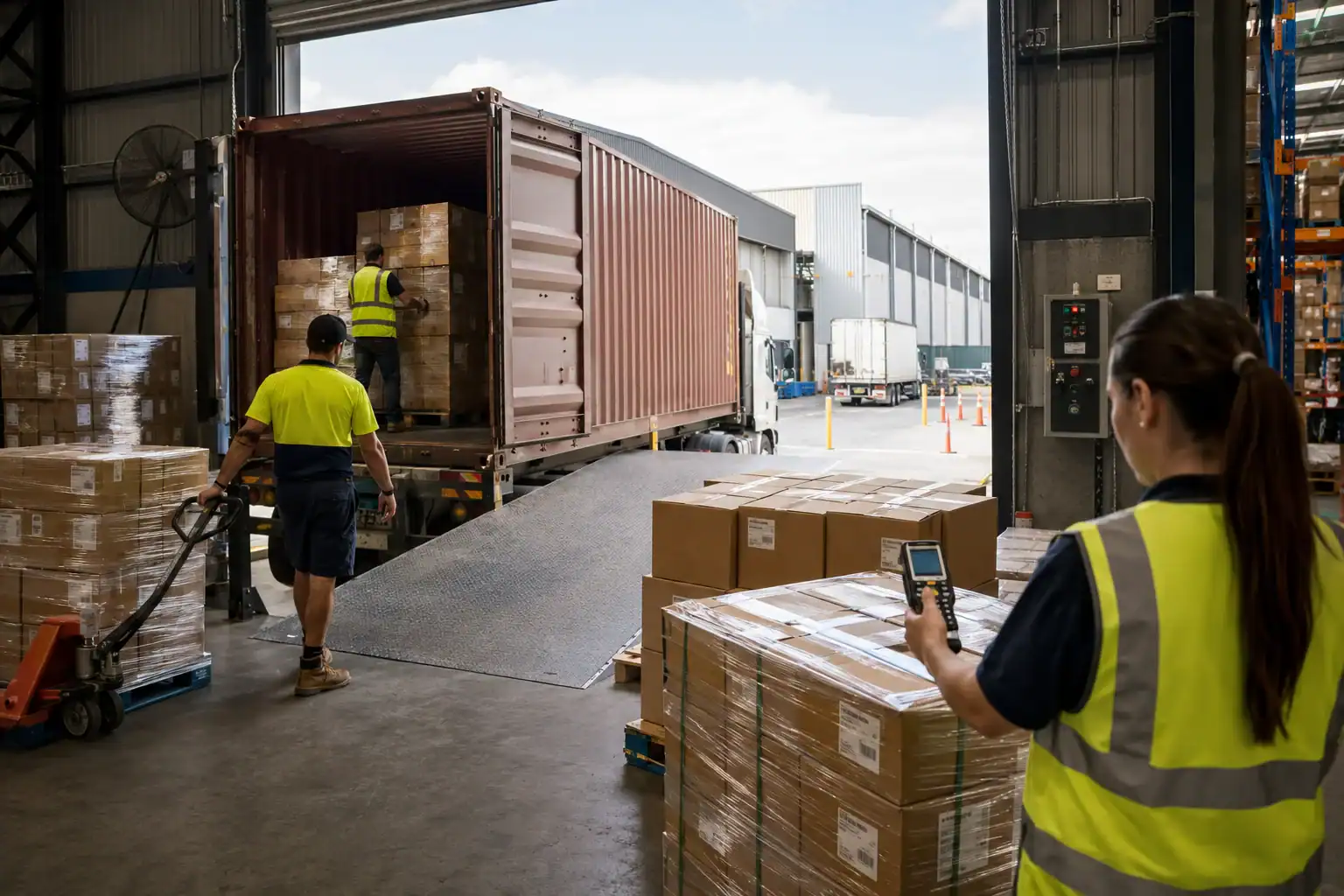
Most Australian importers manage two points and hope about everything in between. They know when the purchase order was confirmed and they know when goods arrived at the warehouse. The eight or nine handovers in the middle happen somewhere offshore, on someone else’s watch, visible only when one of them fails: factory to truck, truck to port, port to vessel, vessel to vessel, port to customs, customs to wharf, wharf to truck, truck to warehouse.
Supplier-to-warehouse logistics is the discipline of managing that middle. Not performing it (your forwarder, carrier, and broker perform it), but managing it: knowing where goods are, who holds responsibility at each stage, what each handover costs, and where the chain tends to break. Importers who manage the chain get fewer surprises, faster recoveries when things slip, and a landed cost they can actually predict.
The Chain: Nine Stages From Factory to Warehouse
A standard sea freight import from Asia to an Australian warehouse passes through nine stages. Each has an owner, a typical duration, and a failure mode worth knowing in advance.
For a full stage-by-stage walkthrough of what happens at each step (compliance checks, customs, biosecurity, port release), see the complete 9-stage import process guide. This article focuses on who owns each stage and where the chain actually breaks.
Stage 1: Ex-Factory, Production Completion and Cargo Readiness
The chain starts when the supplier declares goods ready. The management risk here is the gap between “ready” as the supplier reports it and ready as the freight booking requires it: goods complete, packed for export, palletised or cartonised to the agreed specification, with the packing list and commercial invoice drafted.
Management actions: require a Cargo Ready Date (CRD) on every purchase order, treat CRD changes as formal notifications rather than things you discover, and, for new suppliers or high-value orders, use a pre-shipment inspection (PSI) service to verify quantity and quality before the goods are sealed into a container. A PSI costs USD 200–350 and is the only opportunity to reject defective goods while rejection is still cheap. Once goods are on the water, every remedy is slower and more expensive.
Stage 2: Export Packing and Container Loading
Goods are loaded either at the factory (FCL, supplier-loaded) or at the forwarder’s origin warehouse (LCL consolidation, or FCL consolidated from multiple suppliers). Loading quality determines damage outcomes: cartons crushed by poor stacking, pallets that shift because they weren’t braced, moisture damage from un-desiccated containers on humid-season sailings.
Management actions: specify carton and pallet standards on the PO (double-wall export cartons, ISPM 15 treated timber pallets: untreated timber will fail Australian biosecurity), request loading photos as a standard deliverable, and specify desiccant placement for moisture-sensitive goods. If you consolidate from multiple suppliers, the forwarder’s origin warehouse becomes the quality gate: ask how they receive, check, and report discrepancies.
Stage 3: Origin Port and Export Clearance
The container gates into the origin terminal before the port cut-off, and the supplier or forwarder files the export declaration. For China-origin goods, this stage includes obtaining the ChAFTA Certificate of Origin, which determines whether your goods enter Australia at 0% duty or the general rate. The certificate takes 2–5 business days to issue; a supplier who treats it as an afterthought creates a choice at the Australian end between paying duty or delaying clearance.
Management actions: make the ChAFTA certificate (or the relevant FTA certificate) a standard PO deliverable with the shipping documents, and require document copies (invoice, packing list, B/L draft, certificate) within 48 hours of vessel departure. Documents that travel slower than the vessel are the single most common self-inflicted delay in the import chain.
Stage 4: Ocean Transit
Port-to-port transit from China to Australia’s east coast runs 18–28 days depending on the port pair and routing. For the full breakdown by port pair, peak season ranges, and the events that stretch them, see our guide to freight timelines from China to Australia.
Management actions during transit are light but real: vessel tracking against the planned ETA, and a forwarder relationship in which ETA changes are pushed to you rather than pulled by you. A two-day slip discovered at sea is a planning adjustment; the same slip discovered when the truck doesn’t arrive is an operational failure.
Stage 5: Australian Arrival, Berth and Discharge
Vessels queue for berths at Port Botany and Port of Melbourne during peak periods, typically 0–1 days, stretching to 2–5 days in the October–December quarter. Discharge follows berthing, and the container moves to the terminal stack.
Management action: know the difference between “vessel arrived” (at anchorage) and “container discharged” (available for the next stage). Your inventory plan should key on discharge, not arrival.

Stage 6: Customs and Biosecurity Clearance
Your licensed customs broker lodges the import declaration through the ABF’s Integrated Cargo System, ideally before the vessel arrives, since the ICS accepts pre-arrival lodgement and a pre-cleared container can move the day it discharges. Duty (if any), GST, and any DAFF biosecurity intervention resolve at this stage. Goods with timber packaging, food contact materials, or agricultural content face biosecurity assessment; an inspection adds 2–5 days.
Management actions: send your broker the full document set before vessel departure, not after arrival; classify new products (HS code) with the broker before first shipment rather than at the wharf; and if your goods routinely include timber or organic packaging, build the DAFF pathway into your standard lead time instead of treating each inspection as a surprise. For the duty, GST, and charge stack at this stage, see total landed cost when importing to Australia. For a step-by-step overview of how the shipping process works, see Swift Cargo’s Australia shipping process.
Stage 7: Wharf Release and Transport Booking
After the Release Advice, the container needs a transport slot at the terminal. Australian terminals run vehicle booking systems (1-Stop at most east coast terminals), and slots tighten in peak season: 2–4 days from release to collection is common in November–December against next-day in quiet months. Container detention clocks also start here: the shipping line’s free days for returning the empty container are typically 7–10 days from discharge, and late returns incur daily detention fees.
Management actions: book transport against the projected release date rather than waiting for the release to land, and confirm who is monitoring detention: you, your forwarder, or your transport company. Detention fees are small individually and meaningful annually; they are almost always a coordination failure rather than a necessity.
Stage 8: Delivery and Unloading
The container arrives at your warehouse either for live unload (the truck waits, typically with two free hours, then demurrage per hour) or as a drop-and-collect (the container stays 1–3 days, you unload on your schedule, the transport company retrieves the empty). Drop-and-collect costs more in transport but removes the unload time pressure; live unload is cheaper but punishes an unprepared receiving dock.
Management action: match the unload mode to your actual receiving capacity. A 40ft container is 60–70 CBM of cargo; a two-person team hand-unloading loose-loaded cartons will not finish inside the free window of a live unload.
Stage 9: Receiving, Inspection, and Putaway
The chain ends when goods are checked against the packing list, discrepancies and damage are recorded, and stock is put away and visible in your inventory system. Receiving is where supplier claims are won or lost: shortage and damage claims against suppliers and insurers depend on documentation created at receipt (photographs, counts, and exception notes on the delivery docket), not on discoveries made when the carton is opened for a customer order three weeks later.
Management actions: count and inspect within the claim windows (marine insurance policies commonly require notification of visible damage at delivery and concealed damage within a defined period), and feed the receiving data back into the loop: actual quantities received per supplier per order is the dataset that tells you which suppliers ship what they invoice. For the full receiving playbook (transport booking, the inspection protocol itself, sample rates by goods category, and what to do when the delivery does not match the order), see warehouse and delivery planning after import.

The Responsibility Map: Incoterms Decide Who Owns Each Stage
Which of the nine stages you manage directly depends on the Incoterm you buy on:
- EXW (Ex Works): you own the chain from the factory door. All nine stages. Maximum control, maximum management load.
- FOB (Free On Board): the supplier owns stages 1–3 (to the vessel rail at the origin port); you own the ocean freight and everything in Australia. FOB is the most common term for Australian importers because it pairs supplier-managed export formalities with importer-controlled freight: you choose the forwarder, you see the freight cost.
- CIF (Cost, Insurance, Freight): the supplier controls the freight to the Australian port; you take over at arrival. The freight is inside the supplier’s price, which is convenient. But you can’t see or manage stages 3–4, and destination charges from supplier-nominated carriers are frequently higher.
- DAP/DDP: the supplier delivers to your door, with (DDP) or without (DAP) Australian duty and GST included. Minimum management load, minimum visibility, though DDP creates GST complications for the Australian importer that usually make it the wrong choice.
The practical rule: the stages you own are the stages you can manage; the stages inside someone else’s price are the stages you can only experience. Most importers who get serious about supply chain management migrate toward FOB precisely to bring stages 4–9 under their own forwarder and broker.
The Visibility System: What to Track and When to Act
Managing the chain doesn’t require enterprise software. It requires tracking the right milestones per purchase order and acting on deviations. The minimum viable tracking set:
- PO confirmed: with Cargo Ready Date
- Cargo ready: actual vs CRD; deviation here propagates to every later date
- Container gated in / vessel ETD confirmed: the goods are genuinely moving
- Documents received: invoice, packing list, B/L, FTA certificate, within 48 hours of ETD
- Vessel ETA: updated weekly, pushed by the forwarder
- Customs cleared: Release Advice issued
- Delivered and received: actual receipt quantities vs invoice
Each milestone has a simple management trigger: a missed CRD triggers a revised arrival forecast the same week; missing documents at ETD+48h triggers a chase while the fix is still free; an ETA slip past your Must-Arrive Date triggers the air freight calculation while air freight can still beat the stockout. For how these dates connect to reorder points and safety stock, see how to plan inventory around shipping timelines and how to avoid stockouts when importing goods.
A Worked Timeline: One PO, Shanghai to Sydney
Abstract milestones get real when you put dates on them. Take a single 20ft FCL order of homewares: PO issued to a Shanghai supplier on 5 January, contractual Cargo Ready Date of 6 February. Here is how the seven milestones typically fall, and the part most importers skip: the confidence you can actually attach to each.
- CRD confirmed (6 Feb): high confidence. It is a PO term, and a pre-shipment inspection two days earlier verified quantity and quality.
- Booking and vessel space (9 Feb): firm, booked on a service with a 13 Feb ETD ex-Shanghai.
- ETD Shanghai (13 Feb): roughly 80% likely to hold. Blank sailings and port congestion are the usual reasons it slips a week.
- Ocean transit (18–22 days): this is a range, not a date. A direct service arrives around 3 March; a transshipment via Singapore can push arrival to 7–9 March.
- Vessel arrival and berth (4 Mar): add 1–3 days of uncertainty for the berth queue, the stage that stays invisible on most tracking dashboards.
- Customs and biosecurity release (6–9 Mar): 1–4 days, depending on whether DAFF flags the timber pallets for inspection; an ICS declaration lodged pre-arrival compresses this.
- Delivered to warehouse (11 Mar): allow 2–3 days after release for the wharf release window and transport booking.
Read the whole line and the useful number is not the delivery date: it is the spread. Best case, the goods are on the shelf around 9 March; a realistic bad case is 16 March. That week of uncertainty is exactly what a safety-stock buffer is paid to absorb, and it is why the Must-Arrive Date, not the optimistic ETA, should anchor the reorder decision.
The Three Chronic Failure Points and Their Fixes
1. The Document Lag
Goods move at vessel speed; documents move at supplier speed. When the B/L, invoice, or certificate of origin arrives after the vessel does, clearance waits on paperwork while storage and detention clocks run. Fix: documents within 48 hours of ETD as a contractual PO term, and broker lodgement before arrival as the standard operating mode.
2. The Unowned Handover
Wharf release to transport collection is the stage most often owned by no one: the broker considers their job done at release; the transport company waits to be told; the importer assumes someone booked the truck. Fix: assign the release-to-delivery window explicitly, either to the forwarder (door-to-door scope) or to a named person internally.
3. The Unmeasured Supplier
Importers measure freight performance and forget supplier performance, yet most chain variability originates at stage 1: the CRD that slips two weeks, the carton spec that wasn’t followed, the certificate that wasn’t ordered. Fix: track actual-vs-promised CRD and received-vs-invoiced quantity per supplier. Two numbers, kept per order, are enough to make supplier conversations factual instead of anecdotal, and to tell you which supplier deserves the next big order.

When to Use a 3PL Instead of Your Own Warehouse
The destination end of the chain doesn’t have to be your own shed. Third-party logistics providers (3PLs) receive containers, unload, store, and despatch against your orders. This converts warehouse rent, staff, and equipment into a per-carton or per-pallet fee.
The 3PL case strengthens when: volumes are seasonal (you pay for peak space only when you use it), you’re scaling faster than you can lease and fit out, your goods are standard cartoned products that don’t need specialist handling, or fulfilment speed matters more than handling cost. The own-warehouse case strengthens when: volumes are stable and high (the per-unit 3PL fee exceeds your amortised fixed cost), goods need inspection, rework, or kitting on receipt, or your receiving data is itself a quality control function you don’t want outsourced.
Many importers run both: a 3PL for east coast fulfilment and a small own facility for receiving, QC, and slow-moving stock. The chain management discipline is identical either way: the 3PL simply becomes the stage 8–9 owner, with the same milestone reporting required from them as from any other link.
A caution about how this chain usually gets described in a business plan. “Improve supply chain visibility” and “build a more reliable inbound process” are not choices: they are ambitions, and no importer has ever set out to have worse visibility. Nothing in either statement could turn out to be wrong, which is the tell. A real choice names where you are competing and what you are giving up to win there. Take an importer whose advantage is dependable delivery dates to a small number of large retail accounts: that importer is choosing to carry more safety stock and more expensive expedite options than a competitor selling the same goods on price. That importer is also choosing not to serve the customer who only wants the cheapest landed unit. Both are legitimate positions. What does not work is the plan that claims both, because the nine stages above have to be tuned for one or the other: the Incoterm you accept, the free time you negotiate, and the buffer you fund all follow from that single decision.
Related reading: Verify Supplier: China Australia Import Verification Guide
Frequently Asked Questions
What is the most important single change an importer can make to improve supplier-to-warehouse logistics?
Move document flow ahead of cargo flow: require all shipping documents within 48 hours of vessel departure and have your broker lodge the import declaration before the vessel arrives. This one change removes the most common cause of destination-side delay, eliminates most storage and detention charges, and costs nothing but a clause on the purchase order.
Should I buy FOB or CIF from my Chinese supplier?
FOB, in most cases. Under FOB you nominate the freight forwarder, see the true freight cost, and control the chain from vessel departure onward. CIF hides the freight inside the supplier’s price and routinely produces higher destination charges from supplier-nominated agents. CIF is acceptable for one-off or trial shipments where convenience outweighs control.
What is a pre-shipment inspection and when is it worth it?
A pre-shipment inspection (PSI) is a third-party check of quantity, quality, and packing at the factory before container loading, typically USD 200–350 per man-day. It is worth it for new suppliers, custom-manufactured goods, high-value orders, and any order where a defect discovered in Australia would be expensive to remedy. For established suppliers with a clean receiving history, periodic rather than per-order inspection is a reasonable economy.
Who is responsible if goods are damaged between the supplier and my warehouse?
It depends on where the damage occurred and the Incoterm. Damage before loading is the supplier’s (document it via PSI or loading photos); damage in transit falls to the carrier only up to severe liability limits (roughly USD 500 per package under COGSA, or about SDR 2/kg under Hague-Visby rules), which is why marine insurance, not carrier liability, is the real protection; damage at delivery must be noted on the delivery docket at receipt to support any claim. The practical answer: insure all-risks, photograph at loading and receipt, and record exceptions immediately.
How many days should I allow between vessel arrival and goods available in my warehouse?
With pre-lodged customs documents and no examination: 3–6 business days (discharge, release, transport slot, delivery, receiving). With an ABF or DAFF inspection: 7–12 business days. During the October–December peak, add 2–4 days for berth queues and transport slot scarcity. If your inventory plan assumes vessel ETA equals stock availability, every shipment will look late.