
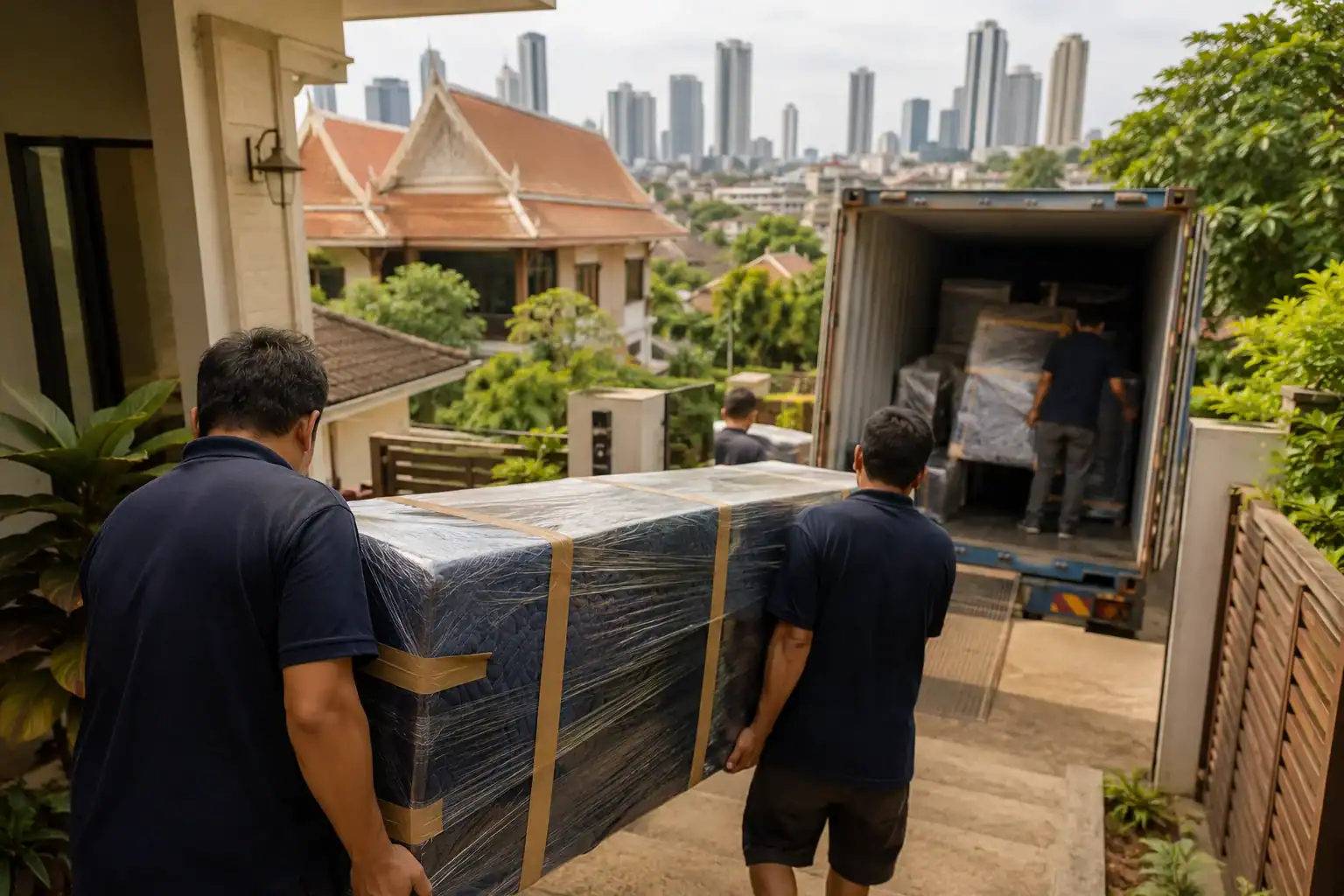
“Door-to-door” is the most quoted and least explained phrase in international removals. Every company offers it. Few explain what actually happens between the two doors: who touches your goods, when responsibility transfers, which charges are inside the quote and which are waiting outside it.
A genuine door-to-door relocation to Thailand is a chain of at least seven distinct services performed by at least five different parties: the origin removals crew, the origin freight forwarder, the shipping line, the Thai customs broker, and the Thai delivery crew. When the service works well, the customer never has to coordinate any of them. When it works badly, the customer discovers the chain only when one link fails, usually at Thai customs, usually with their furniture sitting in a bonded warehouse.
What “Door-to-Door” Actually Includes: The Three Service Levels
Door-to-door is a scope definition, not a service standard. It means the price covers movement from the origin address to the destination address. It says nothing about who packs, who unpacks, or what happens if customs holds the shipment. Within “door-to-door” there are three recognised service levels:
- Door-to-door (standard): the mover collects packed goods at origin and delivers boxes and furniture to the destination address, usually to the ground floor or first accessible room. The customer packs and unpacks, unless those services are added.
- Door-to-door with packing: the origin crew packs everything professionally: export wrapping for furniture, cartons for loose items, an itemised inventory created as they pack. This is the standard recommendation for Thailand moves because Thai customs requires an itemised packing list, and a professionally created inventory meets that standard automatically.
- Full door-to-door (premium): packing at origin, delivery, placement of furniture in rooms, unpacking, and removal of packing debris at destination. Sometimes called “white glove.”
The single most consequential choice is professional packing. It is not only about damage protection. Thai customs scrutinises the packing list before the shipment arrives. The duty-free personal effects concession depends on a list that names items rather than summarising them. A crew-created inventory is exactly the standard Thai customs expects: “Carton 14: kitchen, saucepans x4 (used), dinner plates x12 (used), glassware x18 (used).” A self-packed move where the list says “kitchen items” invites examination. For the full packing list standard and what triggers examination, see our guide on how to avoid customs delays when moving to Thailand.
Stage 1: The Pre-Move Survey
Every genuine door-to-door quote starts with a survey, in person or by video call. The mover assesses the volume of goods, access conditions at the origin property, and any special items such as pianos, artwork, safes and gym equipment. The survey produces the volume estimate in cubic metres (CBM) that determines everything downstream: LCL or FCL, container size, crew size, and price.
A company that quotes a fixed price without a survey is guessing. If they guess low, the shortfall appears later as a revised invoice or a dispute on packing day when the crew discovers a garage full of unmentioned boxes. Volume determines mode: under roughly 13–15 CBM, your goods will travel as LCL in a shared container; above that, a dedicated container becomes economic. See our guide to FCL shipping to Thailand for the crossover arithmetic.
At survey stage, also confirm your destination details: the delivery address, floor level, lift availability, and parking access at the Thai property. Bangkok condominiums frequently require you to book the service lift in advance and the delivery crew to show proof of insurance; a mover who asks about this at survey is one who has delivered in Bangkok before.
Stage 2: Packing and Collection at Origin
On packing day, the crew export-wraps furniture, cartons loose items, and builds the inventory as they go. Export wrapping means a paper blanket plus bubble or corrugated wrap, not the reusable blankets used for domestic moves, which never travel inside containers. Each carton is numbered and its contents recorded. A typical two-bedroom household takes one to two days to pack.
For FCL moves, the container is delivered to the origin address and loaded directly. The goods are handled once between your home and the Thai port. For LCL moves, goods travel by truck to the forwarder’s warehouse, where they are consolidated into a shared container. This difference matters for fragile items: LCL adds handling events, which is why professional export packing pays off even more on smaller moves.
When the crew finishes, you sign the inventory. From this point the inventory is a legal document: it is the basis of the customs declaration, the insurance schedule, and the delivery checklist in Thailand. Review it before signing. Items not on the inventory are not insured and not declared.
Stage 3: Export Formalities and Ocean Transit
The origin forwarder files the export declaration, books the vessel, and issues the Bill of Lading. The export entry itself differs by country: the customs export entry in the UK, the ABF/ICS export declaration in Australia, and an AES/EEI filing in the US for shipments over USD 2,500. For household goods moves, a telex release is standard: no original documents need to travel to Thailand.
Transit times to Laem Chabang, Thailand’s main container port:
- UK (Felixstowe/Southampton): 28–36 days
- Northern Europe (Hamburg/Rotterdam): 26–32 days
- Australia (Sydney/Melbourne): 12–20 days
- USA (Los Angeles/Long Beach): 20–26 days
- Singapore: 3–5 days
During transit, the operator tracks the vessel, updates you on the ETA and, most critically, transmits the document set to the Thai customs broker well before arrival. The customer sees nothing happening; the operator is making sure the Thai side is ready before the vessel berths.

Stage 4: Thai Customs Clearance
This is the stage that makes or breaks the door-to-door experience. The door-to-door operator appoints the Thai customs broker, not you. That broker files the import declaration and, where the shipper qualifies, the personal effects duty-free application.
The duty-free concession requires a qualifying status, goods arriving within six months of your first entry on it, and used household goods for personal use. Thai Customs grants the concession against documented status, not against a long-stay visa in general. The qualifying routes are a one-year Thai work permit (in practice with a Non-Immigrant B), a non-immigrant visa with a confirmed working period of not less than one year, Thai permanent residence, a full one-year Smart Visa, or returning-Thai-national status after 12 or more consecutive months abroad. The document set comprises a passport copy with the entry stamp, status documentation, the itemised packing list, and the Bill of Lading.
Retirement visas do not qualify. A Non-Immigrant O, O-A or O-X holder pays import duty and 7% VAT on the shipment, and Thailand Elite and education visas fall outside the concession on the same basis. Getting this wrong changes what the move costs rather than when it arrives, which makes it the single most expensive assumption a door-to-door customer can carry into a quote. For the qualifying conditions in detail, see duty-free import rules in Thailand.
With complete documents submitted before the vessel arrives, a personal effects shipment typically clears in three to five working days. Clearance must complete inside the free time at Laem Chabang before storage charges begin: 7–14 days for FCL, 3–7 days at the CFS for LCL. A door-to-door operator manages this window properly by collecting your documents at packing stage, rather than asking for them once the vessel arrives.
If customs orders a physical examination, add two to four working days. Examination is usually triggered by packing list quality, not bad luck. That is another reason the professionally created inventory earns its cost.
Stage 5: Delivery, Placement, and the Empty Box Problem
After release, goods travel by truck from Laem Chabang to your Thai address: Bangkok is 90 minutes; Chiang Mai is a 9–10 hour trunk haul; Phuket 10–12 hours. Island and remote destinations may involve a ferry leg and an additional day.
At delivery, service level matters again. Standard door-to-door delivers to the first accessible point. With placement service, the crew positions furniture room by room against the numbered inventory. With full unpacking, the crew empties cartons to surfaces and removes all packing debris. In a full household move that debris fills a surprisingly large volume. Without that service it is yours to dispose of, in a country where you don’t yet know how waste collection works.
Check deliveries against the inventory as they come off the truck. Note any damage or missing items on the delivery receipt at the time of delivery. Marine insurance claims depend on exceptions recorded at delivery, not on damage discovered three weeks later.
Where Responsibility Sits: The Single Point of Contact Test
The defining feature of genuine door-to-door service is a single contract and a single point of accountability. You pay one company; that company subcontracts the chain (origin crew, ocean freight, Thai broker, Thai delivery crew) and remains responsible for all of it. If the Thai delivery crew damages a wardrobe, your claim goes to the company you paid, not to a Thai subcontractor you’ve never heard of.
The alternative is to book origin removals, freight, and destination services separately. That can be cheaper on paper, but it makes you the integrator. Every handover between parties you’ve separately contracted is a gap where responsibility can fall through. For most relocators, the integration premium of a single door-to-door contract is worth paying. For what the full removals process looks like from booking to delivery, see international removals to Thailand.
That 10–20% saving is not free money: it is a job. Self-integrating means quietly hiring yourself as the project manager of a five-party logistics chain across two continents, in a second language, usually while also starting a new life in a new country. The people who regret this are rarely the ones who lost money; they are the ones who lost three weekends chasing a customs broker in a time zone six hours away, or who found out on delivery day that no one had been contracted to carry a sofa up four flights of stairs. The premium a single door-to-door operator charges is insurance against your own future bandwidth. During a move, bandwidth is the scarcest thing you own.

What a Complete Door-to-Door Quote Must Include
What a quote silently excludes is why two quotes for the “same” door-to-door service can differ by thousands. A complete quote includes:
- Professional packing and materials (if selected), including the inventory the crew creates as it packs
- Origin collection, export customs formalities, and origin port charges (THC, documentation)
- Ocean freight including current surcharges (BAF, peak season surcharges where applicable)
- Destination THC and CFS/port handling at Laem Chabang
- Thai customs brokerage including the personal effects duty-free application
- Delivery to the destination address, with the floor level and access conditions stated
- The free storage period and the daily rate after it expires
Ask explicitly about the common exclusions: marine insurance (almost always quoted separately, typically 2.5–3.5% of declared value for all-risks cover), customs examination fees if an inspection is ordered, storage and demurrage if clearance runs past free time, shuttle vehicle fees if a container cannot access the destination street, and stair-carry or long-carry fees at delivery. Their absence from a quote does not mean they will stay off the invoice. For the full anatomy of what freight quotes leave out, see hidden costs of shipping to Thailand.
Indicative Door-to-Door Costs to Thailand
Working ranges for a door-to-door move with professional packing (origin city to Bangkok, 2026 market conditions):
- UK → Bangkok, 1-bedroom (8–12 CBM, LCL): GBP 3,000–4,800
- UK → Bangkok, 3-bedroom (20ft FCL): GBP 5,500–8,000
- Australia → Bangkok, 1-bedroom (LCL): AUD 3,500–5,500
- Australia → Bangkok, 3-bedroom (20ft FCL): AUD 7,000–10,500
- USA → Bangkok, 1-bedroom (LCL): USD 3,500–5,500
- USA → Bangkok, 3-bedroom (20ft FCL): USD 7,500–11,000
Deliveries beyond Bangkok add THB 8,000–25,000 depending on distance and access. These ranges assume duty-free clearance under the personal effects concession; a shipment that doesn’t qualify adds duty and 7% VAT on the assessed value. For a tailored quote based on your volume and origin, see how the shipping process works and request a quote.
The Timeline: Booking to Delivery
A realistic end-to-end door-to-door timeline from a European origin:
- Week 0: survey and quote; book 4–8 weeks ahead of your preferred packing date
- Week 4–6: packing and collection (1–2 days); documents collected by the operator
- Week 5–7: export clearance and vessel departure
- Week 9–11: vessel arrives Laem Chabang; customs clearance (3–5 working days with pre-filed documents)
- Week 10–12: delivery to your Thai address
From Australia, compress the ocean leg: total door-to-door is typically 5–8 weeks. From the US West Coast, 7–10 weeks. The most common timeline failure is not the ocean leg: it is the customer obtaining their qualifying status later than planned, which either delays the shipment or forfeits the duty-free concession. Check first that the status qualifies at all: a retiree on an O-A has no concession to forfeit and should budget duty and VAT from the outset. The status, not the vessel, should anchor your planning. For sequencing the entire move, see the moving to Thailand checklist.
Call it the single point of contact test. Ask your removals company one question: if something goes wrong at any stage, packing, export, ocean transit, Thai customs, final delivery, who do you call? A real door-to-door service has one answer: us. A broker pretending to be a door-to-door service has a different answer depending on which stage broke: that’s the shipping line’s problem, that’s the customs agent’s problem, that’s the local delivery contractor’s problem. The service isn’t defined by how many stages it covers on a sales page. It’s defined by whether accountability survives contact with a problem. Ask the question before you book, not after your shipment is stuck at Laem Chabang and three different companies are pointing at each other.
Related reading: Lire cet article en français
Related reading: Thailand Relocation Costs 2026: Full Budget by Scenario
Frequently Asked Questions
Does door-to-door include Thai customs clearance?
In any legitimate door-to-door service, yes. The operator’s Thai broker files the import declaration and duty-free application, and the brokerage fee is inside the quote. Typically not included: duty and VAT if the shipment doesn’t qualify for the personal effects concession, examination fees, and storage beyond free time.
Do I need to be in Thailand when my shipment arrives?
You need to have entered Thailand on your qualifying status before the shipment clears customs. The concession requires your passport entry stamp. The stamp on its own is not enough: it has to be a stamp on a status that qualifies, which a retirement O/O-A/O-X is not. You do not need to be physically present at the port. Most relocators fly ahead of their goods.
How long does door-to-door delivery to Thailand take in total?
From Europe or the UK: 9–12 weeks from packing day to delivery. From Australia: 5–8 weeks. From the USA: 7–10 weeks. Pre-filed customs documents keep destination-side clearance to 3–5 working days.
What happens if my new Thai address isn’t ready when the shipment arrives?
Operators offer storage at the Thai destination warehouse after clearance, typically THB 150–400 per CBM per month. The goods must still clear customs within your duty-free window, so don’t delay the shipping itself to wait for a lease.
Is door-to-door more expensive than arranging shipping myself?
Component-by-component, self-managing can be 10–20% cheaper on paper, but the saving is frequently consumed by missed cut-offs, clearance delays, or examinations triggered by self-made packing lists. For a full household with the duty-free concession at stake, the door-to-door premium buys integration and single-party accountability.