
A customs hold is not random. It feels that way from the outside: your container is at Port Botany or Webb Dock, it has been there for five days, demurrage is accruing, and nobody has given you a clear timeline. But the holds that cost Australian importers the most money almost always trace back to one of five specific causes, and most are avoidable before the shipment ever leaves the factory. Import customs delays in Australia fall into two queues, because the ABF and DAFF can each hold the same container for different reasons.
The Two Authorities That Clear Australian Imports
Two government agencies assess incoming goods at Australian ports. Which one has flagged your shipment determines both the timeline and your response.
The Australian Border Force (ABF) is responsible for customs clearance. ABF assesses the import declaration, verifies the declared customs value, checks HS code classification, and determines whether any prohibited or restricted goods are present. ABF has the authority to seize goods, require additional documentation, or refer a consignment to another agency. The import declaration (ICS, the Import Declaration for Sea Cargo) must be lodged before goods can be released.
The Department of Agriculture, Fisheries and Forestry (DAFF) is responsible for biosecurity. DAFF assesses whether incoming goods pose a biosecurity risk: contamination with soil, seeds, plant material, live insects, or animal products. DAFF has the authority to direct treatment (fumigation, heat treatment), re-export, or destruction of goods. A biosecurity declaration is separate from the customs ICS.
Both can independently hold the same shipment. A consignment can be cleared by ABF on customs grounds and held by DAFF for biosecurity inspection at the same time. A clean customs declaration does not guarantee that the goods will move.
How ABF Selects Shipments for Examination
ABF uses a risk-based targeting system to select which consignments receive further examination. Not every import is physically inspected. Compliant importers with clean histories face lower examination rates than new importers, goods from high-risk countries, or commodity types that ABF has flagged as compliance risks.
The targeting process produces one of three outcomes:
Permission to Deal (PTD) granted immediately: the import declaration was lodged correctly, no flags were raised, and ABF issued PTD before the vessel berthed. The importer can direct the container to their nominated warehouse immediately after unpack. This is the outcome for well-structured import programs with pre-arrival lodgement.
Documentary examination: ABF requests supporting documentation (commercial invoice, packing list, purchase order, supplier invoices, certificates of origin) and reviews the declared information against the submitted papers. ABF does not physically inspect the goods. Timeline: 1–3 business days.
Physical examination: ABF directs the container or cargo to an examination facility at the port. Officers physically open cartons, verify goods against the packing list, check for undeclared items, and assess whether the declared HS codes match the actual goods. Timeline: 3–7 business days depending on examination facility queue depth. The importer pays the examination fee.
Lab testing is a fourth possible outcome. It follows a physical examination when ABF or DAFF suspects mislabelled chemicals, prohibited substances, or agricultural contamination, and it extends the hold to 7–21 days.
The Five Most Common Causes of Australian Customs Holds
1. Missing or Incorrect Import Documentation
Documentary examination holds most often start with a mismatch between the import declaration and the supporting documents. ABF cross-references the declared value on the ICS against the commercial invoice, and any discrepancy triggers a review.
Common documentation failures that cause holds:
- Commercial invoice with insufficient detail: a vague description such as “sporting goods” without itemised quantities, unit values, and HS codes does not satisfy ABF’s documentary standard
- Missing packing list: the packing list must match the commercial invoice line-for-line. An inconsistent or missing one is among the most common hold triggers for Chinese imports
- Absent permit or import approval: the permit must be in hand before the goods arrive, and you cannot apply for one afterwards. Permit-required categories include certain chemicals, therapeutic goods, telecommunications equipment, and controlled timber species
- Currency or value conversion errors: customs value must be expressed in AUD at the rate applicable on the date of exportation. Incorrect conversion methods trigger value disputes
A licensed customs broker catches most of these when reviewing documents before lodgement. A five-minute invoice check at the supplier stage is cheaper than a three-day documentary hold at the port.
2. HS Code Misclassification
HS code misclassification affects both duty rates and controlled goods flags. Australian importers who use the wrong eight-digit tariff item number face two risks. The first is paying the wrong duty rate, and underpaying creates a compliance liability. The second is importing goods whose correct classification requires a permit they never obtained.
Misclassification is particularly common for goods that sit at the boundary between categories: machinery with embedded software, composite goods that could fall under multiple headings, and goods whose product description differs from their actual function. The ABF National Import Helpdesk and the Australian Customs Tariff are the authoritative references. The practical route is a licensed customs broker familiar with the specific commodity.
When ABF detects misclassification during examination, it issues a Penalty Infringement Notice (PIN) and reclassifies the goods. Reclassification can mean back-paying duty plus a penalty. For repeat misclassification on the same commodity, ABF can issue an Infringement Notice for the full duty liability plus a financial penalty.
3. Under-Declared or Incorrectly Declared Customs Value
Australian customs value is based on the transaction value of the imported goods: the price actually paid or payable for those goods when sold for export to Australia, adjusted for certain additions and deductions. Under-declaration of value is one of ABF’s primary enforcement targets because it directly reduces the duty and GST collected.
ABF’s valuation branch compares declared values against trade databases and historical import records for the same commodity category. Declared prices significantly below those market references trigger a valuation review. The review can extend a documentary hold by 5–10 business days while ABF seeks additional evidence of the transaction value.
The three most common valuation errors that trigger holds:
- Declaring factory price rather than the price paid by the Australian importer (relevant for related-party transactions)
- Omitting commissions, packing costs, or royalties from the customs value where those must be included
- Apportioning freight incorrectly across the consignments in an LCL shipment
4. Prohibited, Restricted, or Permit-Required Goods Not Declared
Australia’s import controls require permits or approvals for some goods and prohibit others outright. Common permit-required categories that importers encounter:
- Industrial chemicals: chemicals not on the AICIS Inventory need an assessment under the Australian Industrial Chemicals Introduction Scheme. Categories range from Introduction Notice to Full Public Assessment depending on hazard and volume
- Therapeutic goods: medicines, medical devices, and complementary health products require TGA listing or registration before import. Personal-import exemptions are narrow
- Telecommunications equipment: only ACMA-compliant devices may enter. Non-compliant devices can be seized and destroyed at the border
- Wildlife and wildlife products: CITES-listed species and their derivatives need permits from both the exporting country and Australia’s DAFF
- Timber products from controlled species: rosewood, ebony, and other CITES Appendix II species require documents proving legal origin
If you do not obtain the required permit before import, the goods are not simply released late. They are held indefinitely until they comply, and goods that cannot be brought into compliance are often destroyed or re-exported at the importer’s cost.
5. Biosecurity Concerns: BMSB, Timber Packing, and Organic Contamination
Biosecurity holds by DAFF operate independently from customs. Three main risk factors trigger them:
Brown Marmorated Stink Bug (BMSB) season: BMSB is a significant biosecurity threat to Australian agriculture. The risk season runs from 1 September to 30 April (inclusive), determined by the shipped-on-board date on the ocean bill of lading. During that window, goods from targeted countries must either arrive with evidence of offshore treatment or undergo mandatory treatment on arrival. Targeted countries include Italy, Germany, France, the USA, Turkey, and other Northern Hemisphere origins. On-arrival treatment happens at approved facilities, at the importer’s expense, and costs range from AUD 800–3,500 depending on consignment volume and facility. DAFF holds untreated goods from targeted countries until treatment is complete. In peak season, when treatment facilities are at capacity, that adds 5–14 days to clearance.
For the full set of triggers behind a DAFF referral, not just BMSB, see our guide to what triggers a DAFF biosecurity inspection.
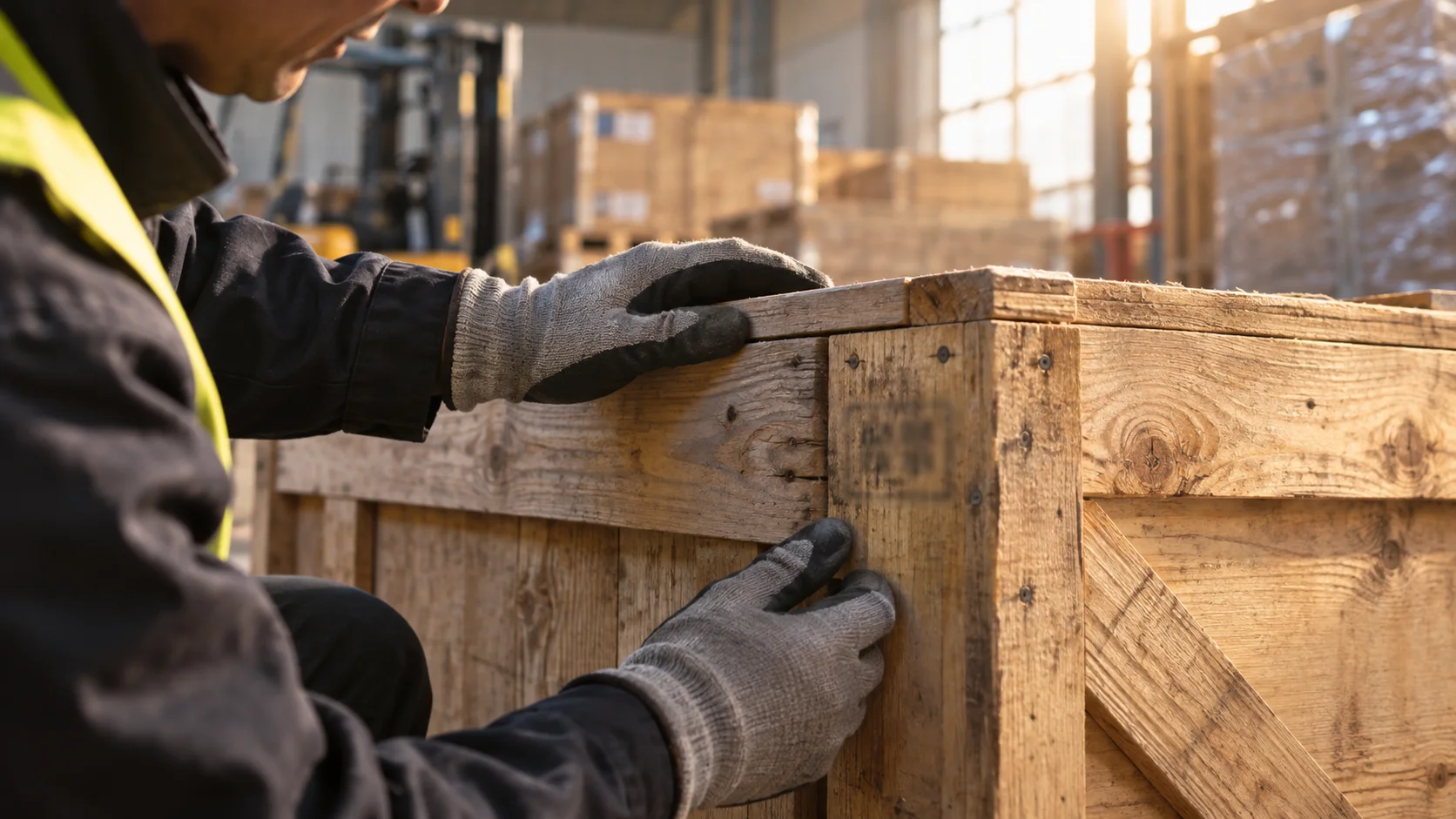
Timber packing material: All timber packaging, dunnage, and pallets must comply with ISPM 15, the International Standard for Phytosanitary Measures No. 15. Non-compliant timber packaging triggers a biosecurity hold and mandatory treatment (fumigation with methyl bromide or heat treatment to 56°C core temperature for 30 minutes). The importer pays for it, and it adds 2–5 business days to clearance time. An international heat treatment symbol on the packaging marks ISPM 15 compliance. Chinese suppliers generally know the requirement, but confirm it on every purchase order.
Organic material contamination: Soil, seeds, plant material, feathers, and other organic matter found in or on shipments trigger DAFF holds. The risk is highest on machinery, used equipment, and goods packed with organic void-fill. DAFF requires contaminated items to be treated or destroyed before release. A pre-shipment inspection (PSI) at origin is the cheapest way to prevent this for goods that carry contamination risk.
What a Hold Actually Costs
The direct cost of a customs hold has three components: port storage fees, container detention fees, and ABF examination fees. Indirect costs are harder to quantify, but for time-sensitive goods they consistently exceed the direct fees. They include expedited inland transport after release, production line delays, and retailer penalty clauses.
Port storage fees are charged by the port or terminal operator from the day the container is available for collection. At major Australian container terminals, storage rates for import containers are approximately:
- Days 1–5: free storage (within the terminal’s free-time allowance)
- Days 6–10: AUD 80–120 per TEU per day
- Days 11+: AUD 120–200 per TEU per day
For a 20ft container held for 10 days during a physical examination, port storage alone adds AUD 400–600 after free time expires.
Container detention fees are charged by the shipping line from the day the free-time period for container return expires. Free-time periods vary by shipping line and trade lane (typically 7–14 calendar days for Australian imports). After free time, detention runs AUD 80–180 per TEU per day depending on the line and equipment type.
ABF examination fees: ABF charges the importer a cost-recovery examination fee for physical inspections. The fee is approximately AUD 340–680 per examination for a standard container. The customs broker invoices it and passes it to the importer.
Full cost scenario for a 7-day physical hold on an AUD 150,000 CIF electronics consignment:
- ABF examination fee: AUD 510
- Port storage (days 6–10, 20ft container): AUD 480
- Container detention (days 8–14): AUD 840
- Customs broker time to manage examination: AUD 350
- Total direct cost of hold: approximately AUD 2,180
A missing permit triggered that AUD 2,180 hold, and the permit itself would have cost nothing if obtained before the purchase order was raised.
Pre-Arrival Lodgement: The Single Most Effective Prevention Tool
Pre-arrival lodgement means submitting the import declaration (ICS) before the vessel arrives at the Australian port, rather than after. Under the standard process, importers can lodge pre-arrival up to 30 days before the vessel’s estimated time of arrival (ETA). Many importers file within the final 48 hours before arrival, or worse, after the container is already sitting at the terminal. Late lodgement is one of the cheapest import customs delays in Australia to prevent, because the declaration can go in up to 30 days before the vessel arrives.
When you lodge early, ABF’s targeting system processes the declaration and either grants Permission to Deal or flags the consignment for examination before the container is even unloaded. For consignments that receive PTD before vessel arrival, the container moves directly from the terminal to the importer’s warehouse on the day of unloading. That removes the 1–3 day wait that applies when PTD arrives only after unloading.
A structured pre-arrival lodgement process requires two things. First, the shipping documents must reach the customs broker at least 3–5 business days before the vessel arrives: bill of lading, commercial invoice, packing list, and certificate of origin where applicable. Second, the commercial invoice must be detailed enough for the broker to classify the goods correctly on first lodgement. Correcting documents and re-lodging resets the targeting queue.
China and Southeast Asia are the short lanes, where transit times are brief enough that documents sometimes arrive after the vessel. If you run regular programs on those routes, ask suppliers to issue documents electronically at the time of loading rather than at the time of payment. That removes the document timing problem.
BMSB Season: The Hold Most Importers Don’t Plan For
The BMSB risk season runs from 1 September to 30 April. That covers the entire Q4 peak shipping period. If you source from BMSB-targeted countries and have not arranged offshore treatment, expect a treatment hold at an Australian port during this window.
Offshore treatment before loading is cheaper and faster than on-arrival treatment. Most Chinese and European suppliers know the BMSB treatment protocol, which is methyl bromide fumigation or heat treatment with a phytosanitary certificate. Specify it on the purchase order and confirm it on the packing list. In peak season (October–November), on-arrival treatment in Australia often means multi-day queues at treatment facilities. Those queues add delay on top of the treatment time itself.
Thailand is not currently on the BMSB targeted countries list. Goods originating in Thailand and transshipped through Singapore therefore avoid BMSB treatment requirements in most cases. That matters for importers weighing Thai suppliers against Northern Hemisphere sources during the BMSB season.
How a Licensed Customs Broker Reduces Hold Risk
A licensed customs broker prevents holds through classification accuracy and document review before lodgement, not through speed. Most import holds start with errors made at the document preparation stage, not at the port. Reviewing the commercial invoice and packing list before lodging the ICS catches these errors while correction is still free.
The specific broker functions that reduce hold risk:
HS code classification: a broker with commodity expertise in your product category applies the correct 8-digit tariff item, checks whether any permit is required, and flags rate-of-duty surprises before the goods ship rather than after they arrive.
Permit pre-check: before you raise a purchase order for a new product type, a customs broker can confirm whether it requires an import permit or additional approval, and can tell you the lead time to obtain one. That conversation takes less than 30 minutes and costs nothing on an established broker relationship. Skipping it has left shipments worth hundreds of thousands of dollars held indefinitely at Australian ports.
Customs value assessment: for related-party transactions or complex pricing structures, a broker can set the correct customs value methodology before the first shipment. That heads off the valuation disputes that trigger extended documentary holds.
ABF compliance history: ABF’s risk targeting takes a broker’s record into account. A broker with a long history of accurate declarations on similar goods presents a lower-risk profile than a new importer lodging self-prepared declarations for the first time.
There are two kinds of cargo arriving at an Australian port right now: surprise cargo and pre-lodged cargo. Surprise cargo is a container ABF has never seen documentation for until it is already on the water, forcing a decision under time pressure. Pre-lodged cargo is the same container, but ABF has had the paperwork for days and already made its call before the ship ties up. Same goods, same value, wildly different odds of a hold, because one of them gives the system time to say yes in advance and the other forces it to decide under uncertainty. If you are still lodging on arrival, you are choosing to be surprise cargo. That is not a customs problem. It is a timing choice, and it is the one lever in this entire guide that costs nothing to pull.
Building a Hold-Free Import Program
Most experienced importers using a structured process achieve Permission to Deal on first lodgement, and they do not get there by luck. They run systems that prevent the five causes of holds before any shipment leaves origin.
Standardised commercial invoice template: issue a required invoice template to every supplier. The template specifies the importer’s ABN, country of origin (per TAFTA or ChAFTA requirements where applicable), country of manufacture, country of export, itemised product descriptions with HS codes, unit prices and total values in the transaction currency, and the Incoterms basis. A supplier who fills in your template cannot produce an invoice that lacks the fields ABF requires.
HS code register: maintain a register of HS codes for every product type you import, with the duty rate, any permit requirement, and the date of last verification. When you add a new product, the broker classifies it before the first PO is raised. Review the register annually against tariff schedule changes.
Permit calendar: maintain a calendar of expiry and renewal dates for any permit-required goods in your range. Most import permits run for a fixed period (typically 12 months) with a specified volume limit. Exceeding the limit or letting a permit lapse mid-program forces a hold.
Biosecurity packing requirement on all POs: include ISPM 15 timber packaging compliance and any BMSB treatment requirement on every purchase order to every supplier, regardless of season. Enforce it every time, and a supplier cannot substitute non-compliant packaging on a single order.
Pre-shipment inspection for new suppliers or new product categories: book a third-party PSI at origin, typically USD 400–800 per inspection. The inspector verifies that the goods match the purchase order description, that the packing list is accurate, and that the shipment carries no visible organic contamination. On a new supplier, a PSI also warns you about quality issues before the container is loaded. One PSI costs substantially less than one day’s container detention plus the examination fee.
Document cut-off date on every order: specify to your supplier that the original bill of lading, commercial invoice, packing list, and any certificates must be issued and transmitted electronically to your customs broker by a set date before vessel ETA. For China-Australia services, that is typically 5 business days before arrival. Tell suppliers who miss the cut-off that the cost of any resulting hold will be charged back under the contract. That concentrates minds.
Full Cost Comparison: Systematic Program vs. Ad-Hoc Approach
Across a 12-month import program of 24 FCL shipments from China to Australia (2 containers per month, AUD 120,000–180,000 CIF each):
Ad-hoc approach (self-prepared declarations, no systematic document review, no HS code register):
- Assumed hold rate: 2 documentary holds + 1 physical examination per year = 3 holds
- Documentary holds: 2 × AUD 1,200 in storage and broker time = AUD 2,400
- Physical examination: 1 × AUD 2,500 in fees, storage, and detention = AUD 2,500
- Total direct hold costs: AUD 4,900 per year
- Indirect costs (production delays, expedited transport, 1 retailer penalty clause at AUD 3,000): AUD 6,000
- Total cost of holds: approximately AUD 10,900 per year
Systematic approach (licensed broker, standardised invoices, HS register, BMSB treatment on POs, pre-arrival lodgement):
- Additional broker cost vs. DIY: AUD 120–180 per shipment × 24 = AUD 2,880–4,320 per year
- BMSB treatment cost on shipments from targeted countries (5 shipments): AUD 800–1,500 each = AUD 4,000–7,500 per year
- PSI for 2 new supplier programs: 2 × AUD 700 = AUD 1,400
- Total systematic program cost (above basic freight): AUD 8,280–13,220 per year
- Assumed hold rate: 0–1 holds per year
- Total cost of holds: AUD 0–1,200 per year
On a 24-container program, the systematic approach adds AUD 8,000–13,000 per year and removes AUD 10,900 in hold-related costs. The net difference is roughly cost-neutral to slightly positive. That calculation also excludes the harder-to-quantify benefit of predictable clearance times, which carries real commercial value for importers supplying retail or manufacturing clients.
The most expensive customs hold is the one you could have prevented for nothing. A seven-day physical examination on an AUD 150,000 container runs about AUD 2,180 in storage, detention, and examination fees before a single carton is opened. Yet the measure that prevents most holds, lodging the import declaration up to 30 days before the vessel arrives, costs an importer nothing but attention. The Australian Border Force clears pre-lodged, correctly documented cargo the way it clears a green-channel wave-through; it stops the shipment that turns up as a surprise. Almost every importer who is held again and again has the same problem underneath the varied symptoms: the paperwork reaches the border at the same moment the container does.
What to Do When Your Shipment Is Already Held
If your shipment has been flagged for documentary or physical examination, do three things immediately:
Engage your customs broker: if you do not have one, appoint one now. The broker can talk directly to ABF, find out what has been requested, and submit the response in a format that meets ABF’s evidentiary requirements. Badly formatted self-lodged responses to ABF queries draw further requests and extend the hold.
Request an examination appointment: ABF schedules physical examinations by appointment availability. Your broker can book the earliest slot and confirm that the facility has access to the container. Every day lost in scheduling adds a day of port storage.
Notify your inland carrier: once the examination outcome is known, your transport provider needs the expected release date to schedule pickup and delivery. Releasing a container on a Friday afternoon without confirming carrier availability can add a weekend of port storage to the total hold cost.
Swift Cargo works with Australian importers on sea freight programs from China, Southeast Asia, and Europe, across a range of commodities and origins. For advice on building a compliant import process for your business, visit swiftcargo.solutions to discuss your program with our team.
Preventing Import Customs Delays in Australia
Lodge the import declaration before the vessel arrives, give every supplier your invoice template, keep an HS code register and permit calendar, and put ISPM 15 packaging and any BMSB treatment requirement on every purchase order. Target goods shipped from BMSB target countries between 1 September and 30 April need treatment evidence, so arrange it offshore before loading.
Frequently Asked Questions
What are the most common causes of customs delays in Australia?
The five most common causes of Australian customs holds are: (1) missing or incorrect import documents such as a commercial invoice with incorrect values or an absent permit; (2) HS code misclassification that triggers a duty rate dispute or a restricted goods flag; (3) under-declared or incorrectly declared customs value; (4) prohibited, restricted, or permit-required goods not declared prior to arrival; and (5) biosecurity concerns including BMSB-risk timber packaging and organic material contamination. Most holds are avoidable with correct documentation and a licensed customs broker.
How long can ABF hold a shipment at Australian customs?
A documentary examination typically takes 1–3 business days. A physical examination adds 3–7 business days depending on examination queue depth at the port. Lab testing extends the hold to 7–21 days, and it is required when goods are suspected of containing prohibited substances, agricultural contamination, or mislabelled chemicals. During this time, the importer is liable for port storage fees (AUD 25–60 per CBM per day at major container terminals) and container detention fees if the shipping line’s free-time window has expired.
What does a physical examination cost at Australian customs?
ABF charges an examination fee for physical inspections: approximately AUD 340–680 per examination depending on the container type and cargo volume. This is separate from port storage fees (AUD 25–60 per CBM per day), container detention fees charged by the shipping line, and any customs broker time for managing the examination process. A 7-day physical hold on a standard LCL consignment can cost AUD 2,000–6,000 in fees before the goods move.
How do I reduce the risk of my shipment being held at Australian customs?
The most effective single action is pre-arrival lodgement of your import declaration (ICS) before the vessel arrives. This allows ABF to assess risk and issue a permission-to-deal before the container is unloaded, rather than selecting it for examination after. Beyond pre-lodgement: use a licensed customs broker for HS code classification, ensure your commercial invoice matches packing list and purchase order, confirm any permit requirements before shipping, and use ISPM 15-compliant timber packaging for all consignments. For BMSB target goods shipped between 1 September and 30 April (judged by the shipped-on-board date), arrange offshore treatment at origin.