
Every freight quote from an overseas supplier comes with three letters that most importers read past without stopping: EXW, FOB, CIF, or one of eight others. Those three letters determine who is responsible for your goods, who pays for what, and who bears the loss if something goes wrong, from the moment the goods leave the factory floor until they arrive at your Australian warehouse.
They are Incoterms: International Commercial Terms published by the International Chamber of Commerce. The current version, Incoterms 2020, took effect on 1 January 2020 and defines 11 standard terms used in international trade contracts worldwide.
Understanding them is not optional. The Incoterm in your purchase order determines your total landed cost, your insurance obligations, whether you are exposed to origin delays before the goods reach port, and, in Australia specifically, how customs duty and GST are calculated on your import.
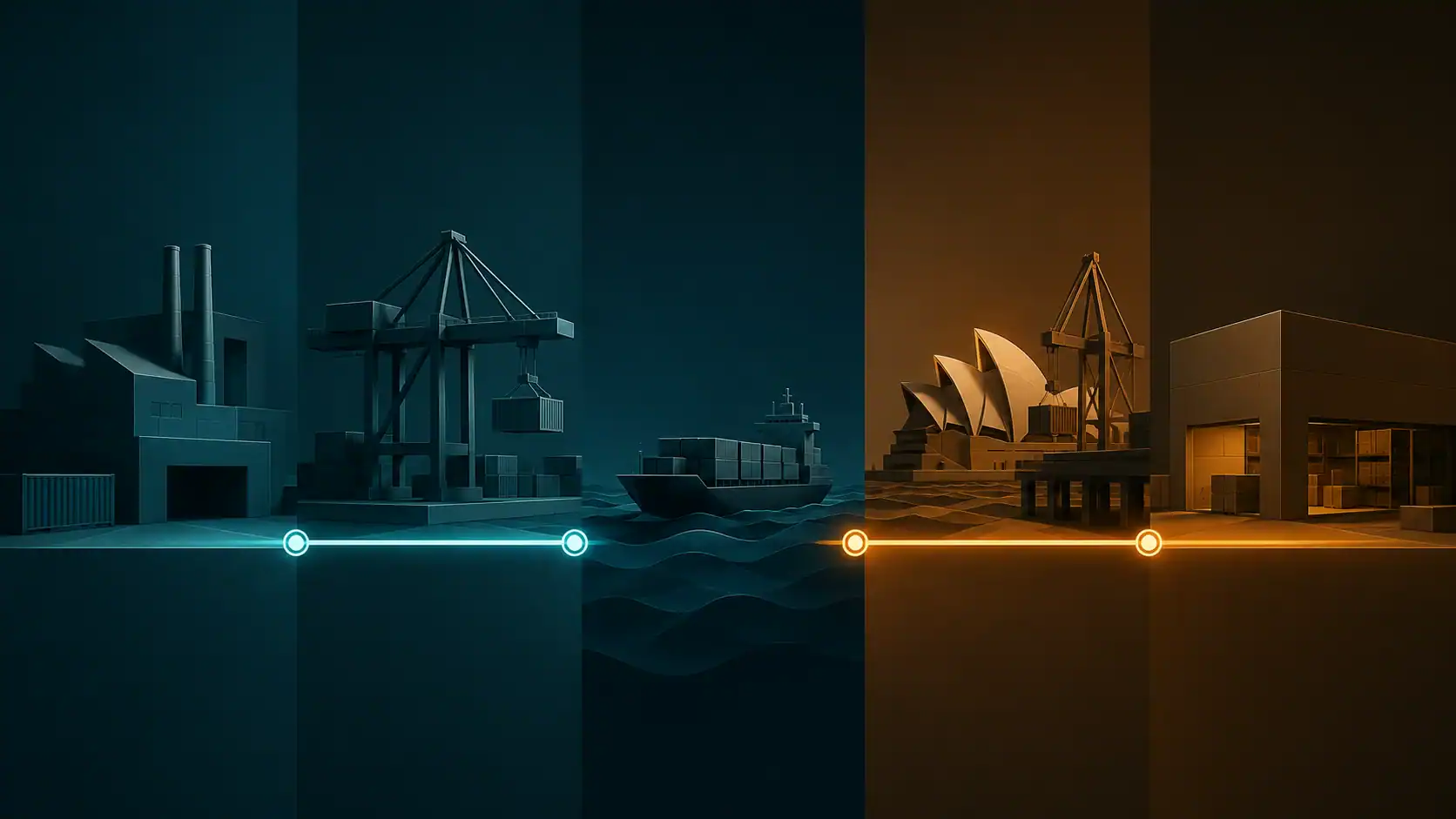
What Incoterms Actually Define
Incoterms define three things in a trade transaction:
- Delivery point: the named place where the seller has completed their obligation and the buyer takes over
- Risk transfer point: the moment at which loss or damage becomes the buyer’s problem, not the seller’s
- Cost allocation: which party pays for freight, insurance, export clearance, import clearance, and associated charges
Incoterms do not define payment terms, title of goods, or what happens when goods are defective. They are purely about delivery logistics and the allocation of transport risk and cost. They also do not override applicable law. If your purchase agreement specifies FOB Shanghai but your contract law says something different about risk, the legal system may override the Incoterm in a dispute.
For Australian importers, the critical addition is that Incoterms interact with Australian Border Force import declaration requirements and the way the ATO calculates GST on taxable importations. Both are discussed below.
The Two Groups: Any Mode vs Sea and Inland Waterway
Incoterms 2020 divides its 11 terms into two groups:
Rules for any mode of transport (7 terms): EXW, FCA, CPT, CIP, DAP, DPU, DDP. These work for sea freight, air freight, road, rail, or multimodal combinations, and are the correct choice for containerised ocean freight.
Rules for sea and inland waterway only (4 terms): FAS, FOB, CFR, CIF. These are designed for bulk cargo or break-bulk shipments loaded directly onto a vessel, not containerised freight. The ICC explicitly recommends against using FOB, CFR, or CIF for containerised shipments, though FOB remains common in Asian export trade and most freight forwarders handle it in practice.
EXW: Ex Works
EXW is the term that places maximum obligation on the importer. The seller’s obligation ends at their factory premises (or another named place). They do not clear the goods for export, do not load the truck, and accept no responsibility once the goods are sitting at their door.
For an Australian importer sourcing from China, EXW means you are responsible for:
- Arranging collection from the factory
- Export customs clearance in China (which typically requires a licensed Chinese customs broker)
- Origin inland transport from factory to port
- All charges from that point forward
Risk transfers to you the moment goods are available at the seller’s premises, before they have been collected, let alone loaded. If the goods are damaged while being loaded onto the truck you arranged, that is your problem.
EXW is rarely the right choice for Australian importers unless you have established carrier relationships in the origin country and are comfortable managing Chinese export compliance. Most importers who request an EXW quote do so to see the “factory price” before freight. That is useful for cost benchmarking, not for actual shipping terms.
FCA: Free Carrier
FCA is the ICC’s recommended replacement for FOB in containerised shipping. The seller delivers goods to a named carrier or freight agent at a named place: either their own premises (in which case they load the goods) or another location (in which case the carrier does the unloading).
Under FCA, the seller handles export clearance. Risk transfers when the goods are handed to the carrier at the named place. From that point, you arrange and pay for ocean freight and insurance.
A 2020 update to FCA allows the buyer to instruct their bank to require the shipping line to issue an on-board bill of lading to the seller, which the seller can then present under a letter of credit. This resolved a longstanding incompatibility between letters of credit and FCA for containerised freight.
If your supplier quotes EXW and you want a better commercial position, ask whether they can quote FCA at their named port. This shifts export clearance cost and responsibility to them, where it belongs.
CPT: Carriage Paid To
CPT means the seller pays freight to a named destination, but risk transfers to the buyer when the goods are handed to the first carrier at origin, not when they arrive. This disconnect matters: the seller is paying for transport they are not responsible for if goods are lost in transit.
For Australian importers, CPT to an Australian port or your warehouse means the seller pays the ocean freight, but your insurance obligation starts from the moment goods leave origin. You need to arrange marine insurance for the ocean leg yourself, and make sure your policy covers the transit from origin carrier handover, not just from the Australian port.
CIP: Carriage and Insurance Paid To
CIP is CPT plus seller-provided insurance. The same risk transfer point applies (risk transfers at origin when goods are handed to the first carrier), but under CIP the seller is obliged to provide Institute Cargo Clauses (A) coverage, the broadest standard cargo insurance, covering all risks unless specifically excluded.
CIP at minimum requires All Risks coverage under CIP 2020, which is a meaningful upgrade from FOB where the seller’s insurance obligation is zero. For high-value goods, CIP with ICC(A) provides stronger protection than the basic coverage sellers often attach to CIF arrangements.
DAP: Delivered at Place
DAP means the seller delivers goods to a named place of destination, ready for unloading, on their own transport. The seller bears all costs and risks to the named destination. Import duty, GST, and Australian customs clearance remain the buyer’s responsibility. The goods are delivered to your door or warehouse, but you handle the regulatory obligations before they can be legally brought in.
Larger Asian manufacturers and some platforms increasingly offer DAP as a managed logistics option. For Australian importers, DAP simplifies the origin logistics burden but leaves DAFF biosecurity requirements and ABF clearance in your hands, as they must be.
DPU: Delivered at Place Unloaded
DPU (formerly DAT: Delivered at Terminal) is DAP plus unloading at destination. The seller is responsible for unloading at the named destination. This is relevant for bulk shipments or where unloading equipment is the seller’s to provide. It is rarely used for standard containerised imports to Australia.
DDP: Delivered Duty Paid
DDP places the maximum obligation on the seller. They handle export clearance, ocean freight, insurance, import duty, and delivery to a named destination. In theory, an Australian importer on DDP terms simply receives their goods. The seller has handled everything.
In practice, DDP is problematic for Australian imports. Australian customs law requires the importer of record to be the party legally responsible for the import declaration. An overseas seller cannot legally act as importer of record in Australia without an Australian Business Number (ABN) and a licensed customs broker arrangement. Most DDP shipments effectively become DAP at the Australian border. The importer still handles clearance, creating a gap between the agreed term and what actually happens operationally.
If a supplier offers DDP, ask them precisely how they handle Australian customs clearance and who their licensed customs broker is. If they cannot answer that specifically, the DDP is likely to fail at the border.
FAS: Free Alongside Ship
FAS is designed for bulk or break-bulk cargo, not containerised freight. The seller delivers goods alongside the named vessel at the origin port. Risk and cost transfer at that point. Export clearance is the seller’s responsibility. FAS is used for commodities like coal, grain, and steel, where goods are loaded directly into the vessel hold. It is not relevant to most Australian importers using standard container services.
FOB: Free On Board
FOB is the most commonly quoted Incoterm in Asian export markets. Under FOB, the seller delivers goods on board the named vessel at the origin port and handles export clearance. Risk transfers to the buyer when goods are on board the vessel.
For containerised shipments, the ICC recommends FCA instead, because under FOB, the risk technically transfers when the container is loaded on the ship, but in practice the container has been in the port terminal (outside the seller’s control) since several days earlier. If something happens to the container in the terminal before loading, who bears that risk is ambiguous under strict FOB. FCA handles this more cleanly by transferring risk at the point where the freight forwarder takes possession.
Despite this, FOB remains the working standard on China-Australia and Vietnam-Australia routes. Forwarders handle it routinely. If your supplier quotes FOB, your Australian freight forwarder handles the ocean freight and insurance leg from the origin port, which is the arrangement most importers want.
Under FOB, the Australian importer arranges and pays for:
- Ocean freight (sea freight rate + bunker surcharges)
- Marine insurance (optional but recommended)
- Destination port charges (THC, document fees)
- Australian customs clearance (ABF import declaration + DAFF biosecurity)
- Inland delivery from port to warehouse
See the supplier-to-warehouse logistics guide for a full nine-stage chain breakdown, including where each of these charges falls and who owns each handover point.
CFR: Cost and Freight
CFR means the seller pays ocean freight to the named destination port, but risk transfers to the buyer when goods are loaded on the vessel at origin, the same disconnect as CPT. The buyer needs marine insurance from that point. CFR is the maritime equivalent of CPT and carries the same practical implication: you insure the transit that the seller is paying for.
CIF: Cost, Insurance and Freight
CIF means the seller pays ocean freight and provides insurance to the named destination port. Risk still transfers at origin when goods are on board the vessel, the same point as FOB. The seller provides Institute Cargo Clauses (C) coverage as a minimum, which covers only named perils (fire, sinking, collision), a narrower policy than CIP’s required ICC(A).
CIF is commonly quoted by Chinese and Vietnamese suppliers. For Australian importers, two issues matter:
Insurance adequacy: ICC(C) coverage excludes many risks that ICC(A) covers, including rough handling, water ingress, and contamination. If your goods are fragile or high-value, CIF’s minimum insurance is often insufficient. You may need to arrange a top-up policy or instruct your forwarder to source ICC(A) coverage.
GST calculation: Under the ATO’s taxable importation rules, GST is calculated on customs value plus duty plus the cost of freight and insurance to the Australian port. Under CIF, the seller’s freight and insurance charges are embedded in the invoice price and become part of your customs value. Under FOB, you control the freight and insurance inputs, which doesn’t reduce the GST base but does make it more transparent and verifiable.
How Incoterms Affect Your Australian Customs Value
The ABF customs valuation methodology uses the transaction value of goods as the primary basis for customs duty calculation, with adjustments for freight and insurance costs. The key points for Incoterm choice are:
- Under FOB, your customs value is generally the FOB invoice price. Freight and insurance from the origin port onward are separately stated and typically added to calculate the taxable importation value for GST but not always for duty (depending on the duty calculation basis)
- Under CIF, the freight and insurance are included in the seller’s invoice price and form part of the customs value directly
In practice, the ATO GST calculation on taxable importations includes “the amount of any applicable duty, and the cost of freight and insurance to the place of consignment in Australia”, so whether you pay FOB or CIF, those transport and insurance costs are part of your GST calculation base. The difference is transparency and control: FOB lets you see exactly what you are paying for each component.
The DAFF Intersection: Biosecurity is Always Your Obligation
FOB or CIF changes what you can see, not what GST you pay.
If you want a second read on how your supplier’s Incoterm affects your landed cost before you sign, our corporate team can walk through it.
Regardless of Incoterm, the importer of record in Australia is always responsible for biosecurity compliance. DAFF biosecurity requirements cover treatment certificates, ISPM 15 timber packaging, and approved treatment providers, and they must all be met before goods clear the border. No seller-side Incoterm obligation changes this. Even under DDP arrangements, the Australian party remains the responsible importer for biosecurity purposes.
Which Incoterm Is Right for Australian Importers?
There is no single answer, but there is a clear hierarchy for most situations:
For most Australian importers sourcing from China or Vietnam: FOB is the most commercially efficient default. You control freight costs (your forwarder shops the market), you choose your insurance provider and coverage level, and your landed cost calculation is transparent. The seller handles export clearance, which is the part of the origin-country process they should own.
If you want full control from the factory gate: FCA at origin port gives you similar control to FOB with cleaner risk transfer. The seller handles export clearance; you handle freight and insurance from the point your forwarder takes possession of the container.
If the seller insists on CIF: Accept it only if you understand what insurance coverage is being provided and can top it up if needed. Confirm the CIF freight rate is competitive. Sellers who arrange freight can mark it up, and you lose the ability to negotiate your ocean freight rate separately.
Avoid EXW unless you have Chinese or Vietnamese freight infrastructure: EXW transfers origin risk and responsibility to you before the goods are even on a truck. Unless you have established relationships with licensed customs brokers and origin-side carriers, the complexity is not worth the marginal pricing transparency.
Approach DDP with extreme caution: Most DDP offers from Asian suppliers effectively become DAP at the Australian border for compliance reasons. If you are considering DDP, get in writing how the supplier handles Australian import clearance, who pays the duty, and who is the licensed customs broker.
For a full breakdown of how your Incoterm choice feeds into your total landed cost calculation (including duty, GST, and destination charges), see how Australian importers plan around shipping timelines and landed cost.
Common Incoterm Mistakes Australian Importers Make
The mistakes are predictable enough to be worth listing explicitly:
Accepting EXW without understanding the full origin cost stack. Importers receive an attractive EXW unit price, then discover the cost of Chinese export clearance, origin inland transport, and origin port charges. They would not pay any of those under FOB, because the seller would handle them. The EXW price looks cheaper until you add those costs back.
Treating CIF insurance as adequate for their cargo. CIF’s minimum ICC(C) coverage is often insufficient for anything other than robust containerised cargo. Electronics, furniture, artworks, and anything sensitive to water damage or rough handling need at minimum ICC(A). Do not assume the seller’s CIF insurance covers your exposure.
Confusing the risk transfer point with the seller’s payment point. Under FOB, the seller stops paying at origin port. Under CIF, the seller stops paying (and you start being exposed to risk) at the same point, the origin port. The CIF freight payment is the seller’s logistical arrangement, not a transfer of ongoing risk. You are exposed from loading, regardless of who paid for the freight.
Not specifying the named place precisely enough. “FOB China” is not a valid Incoterm. “FOB Shanghai Yangshan Deep Water Port” is. The named port determines where the seller’s obligation ends and where your forwarder takes over. Ambiguous named places create disputes when goods are transshipped or when origin inland transport costs arise at an unexpected intermediate point.
Incoterms and Trade Agreements
Australia has free trade agreements with China (ChAFTA), the United States, the ASEAN nations (including Vietnam), and others. These agreements provide preferential tariff rates on qualifying goods, but the preferential rate is only available when the importer holds a valid certificate of origin (Form F for ChAFTA goods, or a Declaration of Origin under AUSFTA for US goods).
The Incoterm does not affect your eligibility for preferential duty rates, but the origin documentation does. Your supplier must provide the certificate of origin regardless of whether the shipment is structured as FOB, CIF, or DDP. If you are buying on CIF terms and the seller controls the freight, make sure your freight forwarder still receives the certificate of origin in time to present it with the ABF import declaration.
Practical Steps: What to Do With This Information
The simplest implementation is a four-step check on every new supplier relationship:
- Ask for both EXW and FOB quotes: the difference reveals the origin cost stack that sits between factory and port, which you can benchmark against your own forwarder’s origin-side capability
- If accepting CIF, request the insurance certificate and confirm the coverage clause (A, B, or C)
- Specify the named place in full, not just the country
- Confirm who handles export customs clearance: under EXW it is you (or your agent), under FCA/FOB/CFR/CIF it is the seller, and this needs to be verified, not assumed
Your freight forwarder is the right partner to help you choose an Incoterm for any given supplier relationship. They can see the freight rate difference between a FOB and CIF arrangement and can tell you whether the seller’s CIF freight rate is competitive or marked up. See the China-to-Australia freight timeline guide for the stages of the import chain where Incoterm decisions have the most impact on your lead time.
For an overview of how Swift Cargo handles freight from origin to Australian warehouse, see the Australia freight page and get a quote.
One principle cuts through all eleven terms: the Incoterm names who is contractually responsible, but the goods are still yours to protect. Choose FOB or CFR and you own the risk the moment cargo crosses the ship’s rail at the origin port, not when it lands in Sydney. Do not treat that as paperwork. Confirm your marine cover starts at that exact point, name your own customs broker, and read the sale contract before you sign it. The importer who assumes the seller has it handled is the one who pays for the gap.
We handle FOB freight and Australian clearance as one step.
Most SMEs receive a detailed, all-inclusive quote within 24 hours, no hidden fees, covering freight, duty and biosecurity clearance.
Frequently Asked Questions
What is the difference between EXW and FOB for Australian importers?
Under EXW, the importer takes risk from the moment goods leave the factory floor. They are responsible for export customs clearance, origin loading, and every cost thereafter. Under FOB, the seller handles export clearance and delivery to the vessel at the named origin port; risk transfers to the importer when goods are on board. For most Australian importers, FOB offers meaningfully better control: your freight forwarder manages ocean freight and insurance from the same point risk transfers to you.
Does the Incoterm affect the GST I pay on imports to Australia?
Yes. Australian GST on imports is calculated on the taxable importation value, which the ATO defines as customs value plus applicable customs duty plus international transport and insurance costs. Under CIF, the seller’s insurance and freight charges are built into the invoice price and therefore into your customs value. Under FOB, you arrange freight and insurance separately. Those costs still form part of your taxable importation value, but you control which freight rate and insurance premium are included.
Can I use DDP when importing to Australia?
You can agree to DDP with a seller, but it creates compliance complications. DDP requires the seller to handle Australian customs clearance and pay import duty. In practice, most overseas sellers cannot act as a licensed customs broker in Australia. Most shipments structured as DDP effectively revert to DAP at the Australian border, with the importer handling clearance, creating a mismatch between the agreed term and what actually happens.
What Incoterm do most Chinese and Vietnamese suppliers quote by default?
Most manufacturers in China and Vietnam quote FOB as their default, often alongside EXW. FOB is the most commonly used Incoterm in Asian export trade because it suits factory-to-port logistics where the seller has established carrier relationships at the origin port. EXW is often quoted but rarely beneficial for Australian importers. It transfers risk to the importer before the goods have even left the factory province.
Which Incoterms are valid for sea freight from Asia to Australia?
All 11 Incoterms 2020 can be used for sea freight, but four terms (FAS, FOB, CFR, and CIF) are specifically designed for maritime transport where goods are loaded directly onto a vessel (not containerised). For containerised sea freight, the preferred equivalents are FCA (for FOB), CPT (for CFR), and CIP (for CIF). In practice, FOB remains widely used for containerised sea freight from China and Vietnam despite the ICC’s guidance, and most freight forwarders handle it accordingly.