
Author: SwiftCargo Team

  • Healthcare and Health Insurance in Portugal for Expats

    Healthcare and Health Insurance in Portugal for Expats

    A couple walking arm in arm along a cobblestone street lined with colourful houses, representing settling into daily life and healthcare in Portugal as expats

    Ask an expat living in Portugal whether healthcare here is free, and the honest answer depends entirely on when you ask them. Before residency, no: Portugal’s own immigration process will not move forward without proof of insurance, and the specific kind of insurance changes twice before you ever see a Portuguese doctor. After residency, the picture flips almost completely: registration is free, most appointments are free, and the public system covers more than most newcomers expect. Both answers are true. Most guides only give you one of them, usually whichever one fits the headline better.

    This article covers the whole timeline, not half of it. It works through how Portugal’s public health service actually functions once you are registered, the exact steps to get registered, why the EHIC and GHIC cards trip up UK citizens specifically, why US citizens face a real gap with no equivalent safety net, and what expat health insurance Portugal actually requires at each stage. None of it is medical, insurance or immigration advice. It is the map of the system, so the decisions you make inside it are informed ones.

    Is Healthcare Really Free in Portugal? The Short Answer and the Real One

    Portugal’s public health service, the Servico Nacional de Saude or SNS, dropped nearly all of its user fees on 1 June 2022, under Decree-Law 37/2022. Family doctor consultations, specialist appointments booked through the SNS, hospital admissions and SNS-arranged surgery now carry no charge for the patient. That single change is the reason so much recent expat commentary calls Portuguese healthcare for expats free, and for registered residents using the system as designed, it largely is.

    The exception is narrower than most articles admit, and worth naming precisely because it is the one place a real bill can still land. A hospital emergency room visit without a prior referral still carries a fee under Decree-Law 113/2011, as amended by the 2022 reform and by Portaria 480-A/2025, in force from the end of December 2025. “Without a prior referral” means walking in rather than being sent by the SNS 24 phone line or a doctor. A long list of people is exempt regardless: pregnant women, minors, anyone with a disability rating of 60 percent or more, people in financial hardship, the unemployed registered with an employment centre, and several smaller categories. Everyone else pays a modest fee for an unreferred emergency visit and nothing for a referred one.

    The free-at-the-point-of-use framing leaves out speed. Portugal’s public system is genuinely inexpensive and real, but a routine specialist referral can take weeks to months depending on the region and the specialty. That gap, not the cost of care itself, is the actual reason so many residents keep a private policy running alongside their SNS registration. The next two sections cover how to get into the free system, and then why so many people pay for a second one anyway.

    How the SNS Actually Works Once You’re a Resident

    Registration gives you a Numero de Utente, a personal user number tied to your name for the rest of your time in the system. It follows you to every appointment, every prescription and every referral, the way a national insurance number or social security number anchors other administrative systems. Alongside it, most residents are assigned a family doctor, a medico de familia, at their local health centre, though assignment can take time in areas where doctors are in short supply.

    Day to day, most residents manage the system through SNS 24, both a phone line (808 24 24 24) and an online portal and app. SNS 24 books appointments, surfaces your prescriptions and health record, and, importantly, is also the correct first call if you are unsure whether a symptom needs an emergency room or a scheduled appointment. That referral keeps a later ER visit free rather than fee-carrying. For anyone weighing portugal healthcare for expats against a private-only plan, this triage layer is worth knowing about before you need it, not after.

    Registering for SNS: NIF, Residence Status, Then the Health Centre

    Three things have to exist before you can register, and they exist in a fixed order. The first is a NIF, Portugal’s tax identification number, which you generally need before you can sign a lease, open a bank account or do almost anything else administrative in the country. Our guide to opening a bank account in Portugal covers the NIF process and the account it unlocks in more detail.

    The second is legal residence, and this is where the path splits by nationality. EU and EEA nationals register a certificate of residence, the CRUE, at their local town hall once they have been in Portugal for the required period. Everyone else needs a valid residence permit or, at minimum, a confirmed application receipt from AIMA, Portugal’s immigration and asylum agency. That includes UK, US, Canadian and Australian nationals, since Brexit removed the UK’s EU status. One added wrinkle since April 2025: AIMA now requires a NISS, a social security number, as part of a complete residence permit application, and files submitted without one are treated as incomplete.

    Only once both of those exist does the third step happen: visiting the Centro de Saude, the local health centre, for the freguesia where you actually live. Bring your NIF, your residence document (or AIMA receipt), proof of address such as a rental contract or utility bill, and your passport. Registration itself is free, and you leave with your Numero de Utente.

    The honest planning note here is timing, not process. AIMA appointment backlogs have run two to four months through 2026, an improvement on the six-plus month waits reported in 2024 but still a real gap between landing in Portugal and holding the residence document that unlocks SNS registration. The next section explains that gap, and exactly why so few expats try to go without any insurance at all during it.

    The EHIC and GHIC Trap for UK Citizens

    The UK Global Health Insurance Card, GHIC, replaced the EHIC for most British travellers after Brexit, and it does something genuinely useful: it gives access to state-provided healthcare in EU countries, Portugal included, at reduced cost or free, for medically necessary treatment during a temporary stay. It is a card valid for five years, easy to apply for, and genuinely helpful on a two-week holiday.

    The trap is using that same card as a stand-in for actual healthcare in portugal for expats who have moved permanently, not visited temporarily. A GHIC does not cover repatriation, does not cover private facilities, and, more fundamentally, is not meant for someone living in the country. Once you become a Portuguese resident, the correct route is SNS registration through the steps above, not repeated use of a card built for tourists. Our guide to moving to Portugal from the UK covers the wider post-Brexit residency picture this connects to.

    One genuine exception applies specifically to UK State Pensioners rather than UK citizens generally. If you receive a UK State Pension and move to an EU country, you may be entitled to register form S1, which entitles you and your dependants to healthcare through Portugal’s public system, funded by the UK rather than by Portugal, on the same basis as an insured Portuguese resident. An S1 is a genuinely different mechanism from a GHIC: it is ongoing, it is tied to your pension entitlement rather than a travel card, and it still needs its own registration with the SNS once you arrive. Confirm your own eligibility directly, since S1 entitlement depends on your specific pension and residence history.

    Why Most Expats Carry Private Insurance Anyway

    If SNS registration is free and largely comprehensive, the natural question is why so many long-term residents still buy expat health insurance Portugal policies on top of it. The honest answer is that private insurance in Portugal is rarely hired to replace the SNS. It is hired to do three narrower jobs the SNS does not do well, or does not do at all, and knowing which job you actually need is a better starting point than comparing headline premiums.

    The first job is bridging the registration gap. Between landing in Portugal and holding a Numero de Utente, which can run several months once the AIMA backlog is factored in, private cover stands between you and a full-price bill if something happens. The second job is speed: private clinics see you in days for a specialist appointment that could take months through the public referral queue, which matters enormously for anything time-sensitive or simply inconvenient to sit on. The third job is language and comfort: larger private hospitals in Lisbon, Porto, Cascais and the Algarve run English-speaking front desks and physicians as standard, which the SNS, a genuinely national and mostly Portuguese-speaking system, cannot promise everywhere.

    None of those three jobs require the same policy. Someone who only wants the registration-gap bridge needs a shorter, cheaper policy than someone who wants ongoing fast-track specialist access for a chronic condition. Sorting out which job you are actually paying for, before comparing prices, is the single most useful filter when shopping for expat medical insurance portugal has to offer.

    What Your Visa Actually Requires

    Insurance shows up twice in most Portuguese visa applications, as two genuinely different products, and conflating them is a common and avoidable mistake. Portugal’s own national visa portal lists travel insurance among the required documentation for a national visa, without stating an exact coverage figure in the public guidance itself.

    In practice, at the consulate stage, consulates commonly require D7, D8 and similar national-visa applicants to carry travel insurance covering the processing window, typically four to six months, valid across the whole Schengen area, and including medical emergencies, hospitalisation and repatriation. Consulates and insurers consistently work to a minimum of around 30,000 euros of coverage, a figure that comes from consular practice rather than a single published law, so confirm the current expectation with your own consulate before buying a policy against an outdated number.

    At the second stage, the AIMA residence permit appointment inside Portugal, that travel policy is no longer accepted. AIMA wants a proper long-term private health insurance policy, issued by a recognised international or Portuguese insurer and valid inside Portugal, not a Schengen travel product. This is the same policy that then does one of the three jobs described above while your SNS registration works its way through the system. Our guide to the Portugal digital nomad visa covers the D7 and D8 routes in more detail, including where their requirements diverge from each other. None of this is immigration advice: visa document requirements shift, and the exact figure and policy type your own consulate or AIMA appointment expects is the one to confirm directly, not the one in this paragraph.

    Swift Cargo moves households to Portugal on the timeline your visa actually sets.

    Insurance sorted, AIMA appointment booked or still pending, we plan the shipment around your real dates, not a generic moving-day guess.

    Get a Portugal moving quote

    Healthcare for US Citizens: No Safety Net Until You’re Resident

    UK citizens have GHIC for short stays and, for pensioners, a real S1 route into the public system. EU citizens have reciprocal EHIC coverage while travelling and a direct path into SNS on residence. US citizens have neither. No bilateral healthcare agreement exists between the United States and Portugal, and the US Embassy in Portugal is direct about what that means: Portugal does not provide free medical treatment to visitors, and the US government does not cover medical costs or medical evacuation for its citizens overseas, regardless of what a domestic US health plan or Medicare covers at home.

    That makes private insurance the only real option for healthcare in portugal for us citizens before residency, not one option among several. Medicare in particular does not travel: it generally does not cover care received outside the United States, so anyone assuming their existing coverage extends to Portugal is planning around a gap that will not close on its own. The practical fix is the same two-stage private insurance path described above: travel insurance for the consulate and processing window, then a Portugal-registered policy for the AIMA stage. Run the two continuously, without a gap between them.

    Once a US citizen becomes a legal resident and completes SNS registration, the position equalises: public healthcare in Portugal is available on the same terms as it is to any other legal resident, nationality no longer matters at that point. The gap is specifically the period before that, and it is real, not a formality to skip past.

    Our guide to moving to Portugal from the US covers the visa, tax and shipping side of the same move.

    Choosing a Private Policy: Pre-Existing Conditions and Waiting Periods

    Two questions decide whether health insurance in Portugal for foreigners actually works for you, and both get glossed over in a lot of comparison content: how the insurer treats a pre-existing condition, and how long you wait before a given type of care is actually covered.

    Treatment of pre-existing conditions varies genuinely by insurer, and “pre-existing” is defined more broadly than most applicants expect: it typically covers anything that has required medical care, medication or monitoring, not just a major diagnosis. Some insurers exclude a pre-existing condition permanently. Others cover it after a waiting period, commonly 12 to 24 months, sometimes with a higher premium attached instead of an outright exclusion. A smaller group of insurers accept any age with no upper cap, useful if you are moving to Portugal later in life, again usually in exchange for a longer waiting period on new conditions. None of this is a fixed industry rule, which is exactly why comparing the actual policy wording matters more than comparing a headline premium.

    Waiting periods apply more broadly than just pre-existing conditions. General outpatient care commonly carries a shorter wait, often 30 to 60 days, while surgery and hospitalisation typically carry a longer one, often around 90 days, and some planned procedures wait considerably longer. If you are moving from a UK, EU or similar policy with continuous prior cover, ask directly whether the new insurer will waive or shorten the waiting period on the strength of that history: some do, and it is not always advertised up front.

    What Health Insurance in Portugal Actually Costs

    Published 2026 rate cards from Portuguese insurers cluster into three rough tiers. Basic plans, with limited outpatient cover and modest hospital limits, run roughly 25 to 60 euros a month. Mid-tier comprehensive plans, covering a broader range of specialists, diagnostics and hospital stays, run roughly 80 to 150 euros. Premium international plans, with wider network access and higher or unlimited hospital cover, start around 150 euros and can run well beyond it. Age, health history, deductible level and family size all move a given quote inside or outside those bands, so the cost of health insurance for expats in Portugal is genuinely a per-person number, not a single published price. No single fair price exists for expat health insurance Portugal buyers should expect to pay, only a quote that matches your own age, history and coverage tier.

    Here is an illustrative case, built only from the rate bands above. Someone who needs just the registration-gap bridge lands in Portugal and waits the two to four months the AIMA backlog has run through 2026. At the basic tier of 25 to 60 euros a month, that bridge costs roughly 50 to 240 euros in total: two months at the bottom of the band, four at the top. The same person on a mid-tier plan at 80 to 150 euros pays roughly 160 to 600 euros over the same wait. Neither total includes the age loading described above. The turn comes at one question, asked before any quote is compared: will you see a private specialist inside those months? If not, the basic bridge covers the job it was bought for, and the extra mid-tier premium buys nothing you will use. If a specialist referral is already on your mind, the mid-tier premium is the real price of skipping the public queue. To run your own check, multiply a quote by the months between your landing date and your AIMA appointment, then ask the insurer whether the policy can be bought for a short term, since a monthly rate only helps if you can stop paying once SNS registration comes through.

    Insurance is one line in a much bigger relocation budget, and it rarely moves that budget as much as housing does. Our cost of living in Portugal guide breaks the fuller picture down region by region, which is worth reading alongside this one before you settle on where in the country to actually live.

    None of this article is medical, insurance or immigration advice, and Swift Cargo is not a licensed insurance broker, healthcare provider or immigration adviser. Compare real policy documents against your own health history, visa timeline and family situation, and get a written opinion from a licensed broker or adviser before you commit to a specific plan or moving date. The cost of that conversation is small next to the cost of an uninsured gap you did not plan for.

    Related Reading

    Frequently Asked Questions

    Is healthcare free in Portugal for expats?

    Once you are a legal resident and registered with the SNS, most care is free at the point of use. Family doctor visits, specialist referrals made through the SNS, and hospital admissions and surgeries arranged through the public system carry no charge. The one common exception is a hospital emergency room visit with no prior referral, which carries a modest fee unless you fall into one of a wide list of exemptions. Before residency, healthcare in Portugal is not free, and you need private or travel insurance.

    Do I need private health insurance to move to Portugal?

    For most visa routes, yes, at least for the gap before your SNS registration is complete. Consulates commonly require travel insurance with at least 30,000 euros of coverage for the visa application stage, then a Portugal-registered private health insurance policy at your AIMA residence appointment. Confirm the exact current requirement with your own consulate, since practice varies and this is not immigration advice.

    Can I use my EHIC or GHIC card once I live in Portugal?

    No, not for day-to-day care. The UK Global Health Insurance Card, which replaced the EHIC for most travellers, is built for temporary stays such as a holiday, not for residents. Once you move to Portugal permanently, you register directly with the SNS instead. The one exception is UK State Pensioners. They may be entitled to an S1 form, funded by the UK, giving ongoing access to Portuguese public healthcare. An S1 works differently from a GHIC and needs its own registration.

    How much does private health insurance cost in Portugal?

    Published rate cards from Portuguese insurers put basic plans at roughly 25 to 60 euros a month, mid-tier comprehensive plans at 80 to 150 euros, and premium international plans at 150 euros or more, all before age loading. Older applicants and anyone with a pre-existing condition typically pay more, and some insurers cap enrolment age or apply a waiting period before covering an existing condition. Get a quote against your own age and health history rather than relying on an average.

    How do I register for Portugal’s public healthcare system (SNS)?

    You need three things first: a NIF, a valid residence document, and proof of address. With those, visit the Centro de Saude for the freguesia where you live, bring your passport too, and register in person at no cost. You will receive a Numero de Utente, the number you use for every SNS appointment afterward, and generally get a family doctor once one becomes available in your area.

    What happens to US citizens’ healthcare coverage in Portugal?

    No reciprocal healthcare arrangement exists between the United States and Portugal, and Medicare does not cover care outside the US. The US Embassy in Portugal advises that visitors and new arrivals carry private insurance, since Portugal does not provide free treatment to non-residents and the US government does not pay medical bills abroad. Once you become a legal resident and register with the SNS, public healthcare becomes available on the same terms as any other resident.

  • Part Load Removals to Thailand: Sailing Dates, Duty and Crates

    Part Load Removals to Thailand: Sailing Dates, Duty and Crates

    A part load to Thailand sails when the removal company’s container is ready to go, not when you are. That one fact explains most of what surprises people about part load removals to Thailand: why the quoted transit is weeks longer than a full container, why the price is lower, and why the booking questions that matter are about dates rather than boxes.

    Part load is the right answer for a lot of moves, especially a small move to Thailand. A one-bedroom flat, a couple of rooms of furniture, or a stack of boxes and a few favourite pieces rarely justifies a 20-foot container of your own. The trade-off is that you give up control of the timetable, and Thai Customs has timing rules of its own that do not bend to suit a shared container.

    Warehouse worker loading a shared shipping container with household crates

    Part Load, Groupage and LCL: Three Names for One Idea

    Removal companies say “part load” or “groupage”. Freight forwarders say “LCL”, less than container load. All three mean the same basic thing: your goods travel in a container shared with other people’s, and you pay for the space you use, measured in cubic metres.

    What differs is how much of the move is wrapped around that shared space. A part load bought from a removal company is usually a door-to-door service. The crew packs your home, collects it, handles the export paperwork, loads it into a shared container, and a partner agent in Thailand clears customs and delivers it. An LCL booking bought from a freight forwarder may cover only the sea freight between two warehouses, leaving packing, Thai clearance and delivery for you to arrange. Our guide to LCL shipping to Thailand explains how the freight side works, stage by stage, and how it is priced.

    When you compare quotes, the name on the service tells you little. Ask what each price includes from your front door to your new one. Our guide to door-to-door relocation to Thailand sets out which parties touch the shipment along the way.

    The Sailing Date Belongs to Someone Else

    A removal company running part loads to Thailand has two ways to get your goods on a ship. It can hold them until it has gathered enough Thailand-bound household goods to fill a container of its own, or it can pass them to a consolidator that runs scheduled shared sailings. Either way, the date your goods leave is set by other people’s volume or by someone else’s timetable.

    That is why UK removal companies commonly quote eight to twelve weeks for groupage to Thailand, against a shorter figure for a full container on the same route. The ship is no slower. The extra weeks are the wait before loading, plus the extra handling at a warehouse at each end while shared containers are packed and unpacked.

    The quiet part of this arrangement is who carries the risk. The removal company’s schedule looks calm on paper, and if the container fills slowly, the company loses nothing. You are the one living out of a suitcase in Bangkok while your furniture waits in a depot at home. So treat the quoted transit as a range with a long tail, and ask the questions that expose the tail before you book, not after:

    • Is there a fixed sailing date, or does the container go when it is full? A named cut-off date is worth more than a lower price.
    • What happens if the date slips? Find out whether storage at the depot is included, and for how long.
    • How often does the service run? A monthly groupage sailing and a weekly one produce very different worst cases.

    Thai Customs Keeps Its Own Clock

    Thailand lets used household goods enter free of duty for people changing residence, and it sets a window around your own arrival. The FIDI customs guide for Thailand says the shipment must arrive no earlier than one month before you and no later than six months after you. Thai Customs’ own household items guidance sets the same window.

    A part load makes the early edge easier to hit by accident. The usual story goes like this: the removal company collects your goods in March to catch a sailing, your own departure slips to June, and the shipment lands more than a month before you do. The six-month edge is harder to miss but not impossible, and our guide to Thailand’s six-month rule for household goods covers what happens then. Fix your own arrival date first, then book the part load backwards from it.

    Whether you qualify at all

    The window only matters if you qualify for the exemption in the first place. Thai Customs’ guidance lists three routes for foreigners: Thai permanent residence, permission to work in Thailand backed by a one-year non-immigrant visa issued for work or a work permit of at least one year, and a government or specialist contract of at least one year. Retirement visas are not among them. The FIDI guide says holders of O and O-A visas, the retirement and guardian categories, “will not be considered for duty-free entry”, and it excludes Elite and education visas on the same basis.

    If you will not qualify, budget for import duty of 10 to 30% on the CIF value of the goods plus Thailand’s 7% VAT. Our retirement visa shipping guide covers this in detail. A retiree who also holds Thai permanent residence qualifies through the permanent residence, never through the retirement visa. For a part load, a duty bill changes the arithmetic sharply, because the most economical small move is often to ship less and buy more locally.

    Ship It Once: The One-Sea-Shipment Rule

    Part load removals to Thailand tempt people to send a move in instalments. Boxes go now, furniture follows when the house sells, and a few more things come later once you know what the new place needs. Thai Customs does not see it that way. The FIDI guide says Thailand allows duty-free entry for one sea shipment and one small air shipment only, and that a second shipment is subject to full import duties. It recommends consolidating shipments before arrival.

    So plan a part load as a single sea shipment. If something must go early, send it as the one small air shipment, and keep that genuinely small. Three smaller rules sit alongside this one, and all three bite harder on a small move where every item counts:

    • Used goods only. The FIDI guide says household effects under six months old are subject to duty. Something bought new for the move, still in its box, will not ride on the exemption.
    • One appliance of each type. Thai Customs allows one of each electrical appliance, or two for a family changing residence, and duplicates pay full duty.
    • Same country of origin. The shipment must come from the country where you last lived or worked.

    Crates, Liftvans and the ISPM 15 Mark

    Some removal companies pack a part load into wooden crates, often called liftvans, before loading them into the shared container. Crates keep one household’s goods together and protect them from being stacked against strangers’ cartons, which is a real advantage in a shared box.

    The catch is the wood. ISPM 15, the international standard for wood packaging material, requires raw-wood packaging to be treated against pests and marked. The standard excludes wood processed to be pest-free, such as plywood. If your removal company crates your goods, ask whether the crates are plywood or treated and stamped timber. An unmarked solid-wood crate risks being held at Laem Chabang for inspection or treatment, and that delay lands on your goods alone.

    When Part Load Stops Being the Cheaper Option

    Part load shipping to Thailand is priced by volume, so it wins while your volume is small and loses once a container of your own becomes cheaper per cubic metre. Where that crossover falls depends on the route, and the site’s cost guides put it at slightly different points:

    As a rough guide, our LCL guide puts a studio at 3 to 6 cubic metres and a one-bedroom apartment at 8 to 12. Our CBM size guide shows what each volume looks like in real furniture. If you are anywhere near the crossover, get both prices. Price is not the only difference, either. The FIDI guide puts Thai clearance at 5 to 7 working days for a shared container against 3 to 5 for a full one, and every extra handling step is another chance for a knock.

    Near the crossover, only two real prices settle it, so start with an estimate for your Thailand move.

    At the other end of the scale, very small shipments are sometimes cheaper by courier. The fixed charges on a part load, such as documentation and the Thai warehouse fees, apply however little you send, and our LCL guide suggests courier or express freight can win below about half a cubic metre.

    How Long a Part Load Takes, Lane by Lane

    The honest answer for part load removals to Thailand is the full-container figure for your route plus the consolidation wait. For the full-container baseline, the site’s cost guides plan on these door-to-door times:

    • Australia: roughly 25 to 40 days door to door from the east coast ports.
    • USA: about 35 to 55 days from the West Coast, longer from the East.
    • Canada: about 8 to 11 weeks door to door for a shared container via Vancouver, longer via Halifax or Montreal.
    • UK: 65 to 90 days for a full container and longer for groupage, with the UK cost guide’s sailings routed around the Cape of Good Hope.

    For a part load, add whatever your removal company tells you about its own sailing frequency. If it cannot tell you, that is the answer to the question of how long a part load takes: nobody knows yet.

    The Paperwork That Travels with a Shared Container

    Paperwork matters more in a shared container, because your goods sit alongside other households’ and must be matched to you at every step. The FIDI guide sets two requirements at origin that cannot be fixed later:

    • Your name, exactly. The shipment must be consigned to your full name as it appears in your passport, with a title such as Mr or Ms, in care of the removal company’s address.
    • The right description. The bill of lading must describe the goods as “Used Personal effects & Household goods”.

    You do not have to attend Thai customs yourself, but your original passport has to be presented. On the export side, rules vary by country. In Australia, the Australian Border Force requires an export declaration unless an exemption applies, and a removal company normally lodges it for you. Our guide to customs paperwork mistakes in Thailand covers the errors that most often hold shipments at the port.

    Six Questions to Ask Before Booking Part Load Removals to Thailand

    Three quotes for groupage to Thailand can look alike and turn out very different. These questions pull the differences into the open:

    1. When does the container sail? A fixed date, a regular schedule, or “when full”?
    2. Is Thai destination handling in the price? Our UK cost guide notes that the Thai warehouse fee for unpacking a shared container is almost never included in UK freight quotes. Ask about customs clearance and delivery too.
    3. Is there a minimum charge? On a small move, a minimum or a set of fixed fees can matter more than the rate per cubic metre.
    4. How will my goods be packed? Cartons, or crates, and if crates, plywood or ISPM 15-stamped timber?
    5. Whose name is on the paperwork? Yours, exactly as in your passport, with the correct goods description.
    6. What if my own date changes? Ask about storage at origin and in Thailand, and what it costs by the week.

    If anything you own will stay behind for a while, our guide to storage options when moving to Thailand compares storing at home with storing in Thailand.

    For the whole removals process from survey to delivery, read our guide to international removals to Thailand.

    We plan small moves to Thailand around your arrival date.

    Share your volume, route and move date. The form takes about 60 seconds, and our team prices a part load against your own container.

    Price my small move

    Frequently Asked Questions

    What is a part load removal to Thailand?

    A part load, also called groupage, is a removal where your household goods share a container with other people’s goods bound for Thailand, and you pay for the space you use. Removal companies usually sell it door to door, including packing, export paperwork, Thai customs clearance and delivery.

    How long does a part load take to reach Thailand?

    Take the full-container time for your route and add the wait while the shared container is filled or its scheduled sailing comes round. UK removal companies commonly quote eight to twelve weeks for groupage to Thailand. Ask for a fixed sailing date before you book.

    Can I send my part load in two shipments?

    Not duty-free. The FIDI customs guide for Thailand says Thai Customs allows one sea shipment and one small air shipment per move, and a second shipment is subject to full import duties. Plan the part load as a single sea shipment.

    Is a part load duty-free if I move to Thailand on a retirement visa?

    No. The FIDI guide states that O and O-A visa holders, the retirement and guardian categories, are not considered for duty-free entry. Budget for import duty of 10 to 30% on the CIF value plus 7% VAT, whether the goods travel as a part load or in a full container.

    When is a full container cheaper than a part load?

    Usually somewhere between about 13 and 20 cubic metres, depending on the route. From Australia the crossover is around 13 to 16 cubic metres, and from the UK both options are worth quoting between 15 and 20. Near the crossover, get both prices.

  • Moving from Melbourne to Thailand: A Victorian Household’s Guide

    Moving from Melbourne to Thailand: A Victorian Household’s Guide

    If you live in Victoria, your Thai visa application does not go to the Thai consulate in Sydney. The Royal Thai Embassy in Canberra handles e-Visa applications from residents of Victoria, and only people living in New South Wales file with the Sydney Consulate-General. That detail matters more than it looks, because when you are moving from Melbourne to Thailand the visa you hold on the day your container lands decides whether your household enters duty-free or pays import duty and VAT on everything in it.

    The shipping itself is well-worn. Your goods leave from the Port of Melbourne, sail to Laem Chabang in roughly two to three weeks with a transhipment in Singapore, and clear Thai customs in about a week if the paperwork is right. The parts of a Melbourne move that go wrong are nearly always on land: the visa sequence, the owners corporation rules in an apartment block, and a shipping date booked before anyone checked when the family would actually arrive.

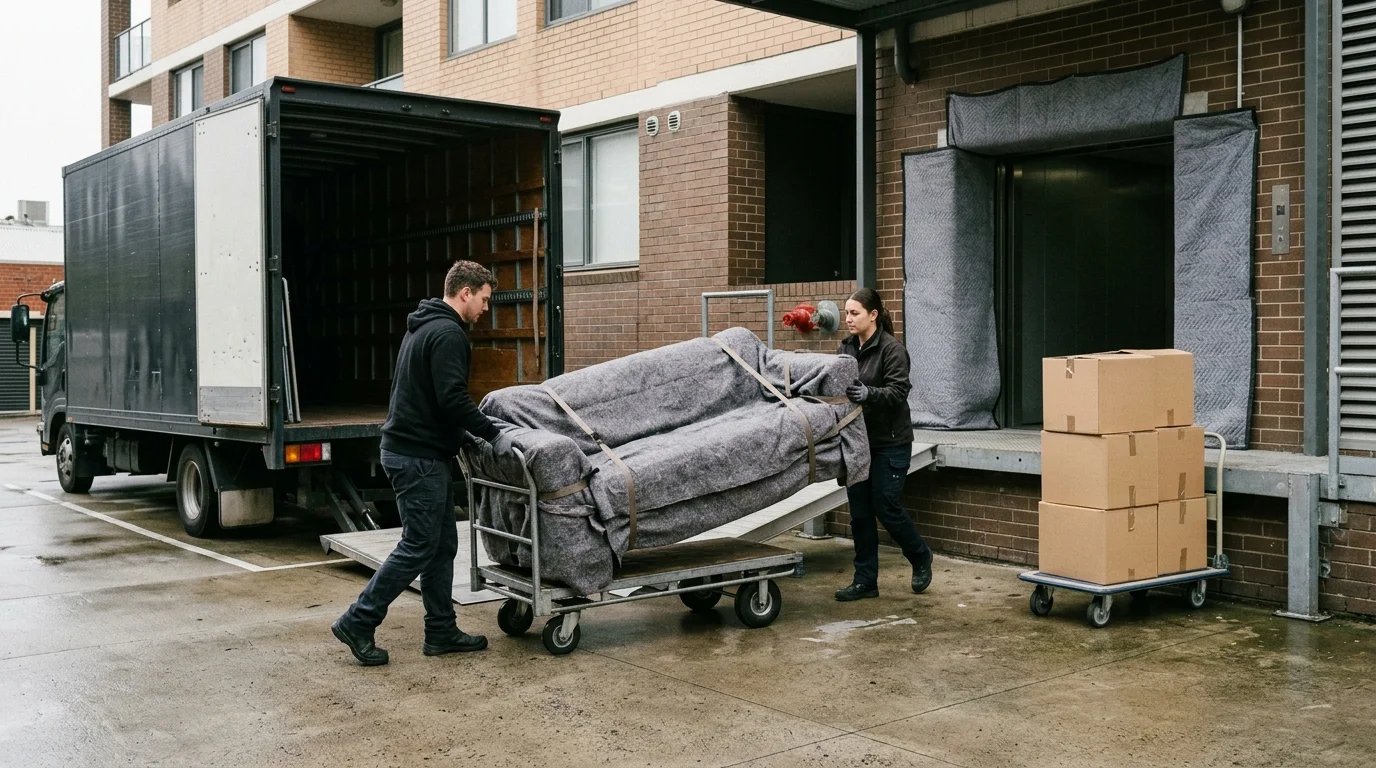
    Movers loading a sofa at an apartment loading dock in Melbourne

    Two Docks, One Port: Where a Melbourne Container Goes to Sea

    The Port of Melbourne is Australia’s largest container and general cargo port. Ports Victoria puts its throughput at more than 3 million TEU a year, which is more than one-third of the nation’s container trade, across three international container terminals.

    Those terminals sit in two places, and it is worth picturing them. Swanson Dock is upriver, a basin cut off the Yarra in West Melbourne and lined with cranes and stacked boxes. Webb Dock is down at the river mouth in Port Melbourne, where the Yarra meets Port Phillip. Our Australia to Thailand cost guide names it as the Melbourne departure point for Thailand services. The port’s own layout runs from Victoria Dock upstream to Webb Dock and Station Pier at the bay.

    When you are shipping household goods from Melbourne, you will not choose between them. The shipping line your forwarder books decides which terminal handles the box, and the truck from your house makes the trip either way. What you can influence is the road leg: a container packed in Brunswick or Footscray reaches either dock quickly, while one packed in the Mornington Peninsula or out past Pakenham spends longer on the Monash or the West Gate, and the packing crew’s start time should allow for it.

    The same cost guide notes that Webb Dock and Sydney’s Port Botany carry the highest frequency of services to Laem Chabang of any Australian port. A Melbourne household therefore has plenty of sailing dates to choose from, and no reason to truck goods interstate to catch a different port.

    Fourteen to Twenty Days at Sea, and the Weeks Either Side

    The cost guide’s port table puts Melbourne to Laem Chabang at 14 to 20 days via Singapore. That is about two days longer at each end than a sailing from Port Botany, which our Sydney to Thailand guide covers, and a little quicker than a Fremantle departure, which our Perth to Thailand guide explains.

    The sailing is only the middle of the timeline. A realistic plan from packing day to delivery at a Thai address has four stages:

    1. Packing and export preparation in Melbourne. The survey, the inventory, packing, loading, and the export paperwork your forwarder lodges before the container reaches the terminal.
    2. The sailing. Melbourne to Singapore, transhipment onto a feeder or mainline service, then Singapore to Laem Chabang.
    3. Thai customs clearance. The FIDI customs guide for Thailand says that with all documents in order, clearance typically takes 3 to 5 working days for a full container and 5 to 7 working days for a shared one.
    4. Delivery. Trucking from the port to your new address, plus unpacking if you have booked it.

    Add those together and our cost guide plans on roughly 25 to 40 days door to door for an Australian move, with Melbourne’s slightly longer sailing putting it toward the upper half of that range. Two things stretch it. A container that lands during Songkran in mid-April can sit in storage for one to two extra weeks while clearance slows, and a shared-container shipment waits at both ends while other people’s goods are loaded and unloaded around it.

    A whole container or a share of one

    Most one- and two-bedroom Melbourne apartments ship in a shared container, where you pay for the cubic metres you use. A family house usually justifies its own 20-foot container. Our guide to shared-container shipping to Thailand covers how the shared option is priced and handled, and the CBM size guide shows how many cubic metres a typical room produces.

    Whether your Melbourne home fills a container or a share of one, a price on your real room count settles it.

    The Visa Decides the Duty Bill

    Every Melbourne household shipping to Thailand is placing a bet on one question: will Thai Customs accept this shipment as the used household effects of someone changing residence? If it does, the goods enter free of duty. If it does not, you pay import duty and VAT on the lot. The size of that bet is set before the container is packed, by the visa you will hold when it lands.

    Thai Customs’ household items guidance sets out three routes for foreigners. The first is a non-immigrant quota, meaning Thai permanent residence. The second is permission to work in Thailand, backed by a one-year non-immigrant visa issued for work or by a work permit of at least one year. The third is a government or specialist contract of at least one year.

    Retirement is not on that list. The FIDI guide says it plainly: holders of an O or O-A visa, the retirement and guardian categories, “will not be considered for duty-free entry.” Our retirement visa shipping guide covers this in full. A retiree who holds Thai permanent residence qualifies through that status, never through the retirement visa.

    If you will be paying, budget for import duty of 10 to 30% on the CIF value of the goods plus Thailand’s 7% VAT, and let that number shape what you ship. A retiree who knows the duty is coming can make a sound decision to ship less. The poor decision is shipping everything on the assumption that someone at the port will be lenient. Sometimes that works out, and it is still the wrong call, because the outcome was never in your hands.

    Timing is the second half of the rule. Thai Customs lets qualifying goods arrive no earlier than one month before you and no later than six months after you. Our guide to Thailand’s six-month rule for household goods covers what happens at each edge.

    Filing the visa from Victoria

    Thailand moved to a stickerless e-Visa in March 2024, and there is no longer a paper application. The Canberra embassy’s visa page lists Victoria among the states it serves, quotes a processing time of 10 business days, and warns that some cases take four to six weeks. Melbourne has a Royal Thai Honorary Consulate, but the visa itself is filed online through the embassy’s portal.

    The practical rule for a Melbourne move: get the visa granted before you book the container. The six-week worst case on the embassy’s own page is longer than the sailing, so a container booked first can reach Laem Chabang before you know which duty treatment it will get.

    Owners Corporations, Lifts and Kerb Space: The Melbourne Apartment Move

    Many Melbourne to Thailand removals start in an apartment in Southbank, Docklands or the CBD, and apartment buildings in Victoria run on owners corporation rules. Consumer Affairs Victoria lists “moving furniture and other objects through common property, where it affects other users” among the things those rules can cover. In practice that is where lift bookings, protective padding and move-time windows come from.

    About a month before packing day, ask the building manager or the owners corporation for four things: the rule on moves through common property, the lift booking process, whether the building has a loading dock and a height limit on it, and any bond or cleaning charge. A removal truck that arrives to find the lift booked by another resident is a lost day, and crews charge for it.

    If there is no dock, the truck needs kerb space. Your local council sets the parking rules for that, so check with the City of Melbourne or your own council before the date is fixed.

    Flights, Clocks and a Pet in the Hold

    Melbourne has nonstop flights to Bangkok. Flightconnections listed seven a week in September 2026, with Thai Airways and Jetstar among the operators and a flight time of about 9 hours 10 minutes.

    If a dog or cat is coming, the airline matters more than the timetable. Our comparison of Australian airports for pet flights to Thailand rates Melbourne’s Thai Airways service as a genuine first choice. It also notes that Jetstar points pet owners to Qantas Freight, so a cheap Jetstar seat for you does not carry the animal. Melbourne is also the usual departure point for Adelaide owners who drive their pets across.

    One more Melbourne fact belongs here, for anyone who might one day come back. Mickleham, on Melbourne’s northern edge, is Australia’s only post-entry quarantine facility for cats and dogs, and our Mickleham quarantine guide explains what a return trip would involve.

    Mind the clock while you plan. Victoria is one of the states that observe daylight saving, as the NSW Government’s daylight saving page notes, and the 2026 to 2027 period runs from 4 October 2026 to 4 April 2027. Thailand has no daylight saving, so Melbourne is 3 hours ahead of Bangkok on standard time and 4 hours ahead in summer. A 9am Melbourne call to a Thai customs broker lands at 5am in Bangkok from October.

    Where the Container Comes Ashore, and the Last Leg

    Almost every Melbourne shipment arrives at Laem Chabang, on the Gulf coast in Chonburi province. From there the last leg depends on where you are going:

    • Bangkok. The port is about 130 km from the city, so moving from Melbourne to Bangkok ends with a same-day truck run once goods are released.
    • Pattaya and Jomtien. The truck stays inside Chonburi province, a short run from the port.
    • Phuket. Goods travel on by road over a long distance, and our Phuket relocation logistics guide covers that leg and the island premium.
    • Chiang Mai. The inland leg is long enough to change the cost of the move. Our comparison of Chiang Mai and Bangkok relocation logistics sets it out.

    What to Ship from Melbourne and What to Leave

    When moving from Melbourne to Thailand, start with the rule that costs people most. Thai Customs allows one electrical appliance of each type, or two for a family changing residence, and the FIDI guide warns that duplicates are charged full duty. Two televisions in a couple’s shipment means one of them pays.

    Power is less of a problem than people expect. Australia and Thailand both run 230 V, 50 Hz mains, so most Australian appliances work with a plug adapter. Large appliances are a different calculation: a fridge or washing machine takes a lot of container space, and Thai rental condos and houses often come with both.

    A useful way to sort the house is by what each item would cost to replace in Thailand against what it costs to ship. Things you cannot replace go: family furniture, art, books you still read. Cheap, bulky things usually stay behind or get sold. Things you want to keep but will not use for a year go on a storage list. Our guide to storage options when moving to Thailand compares keeping them in Melbourne with storing them in Thailand.

    Keep every item used and owned. Thai Customs’ exemption covers goods you have owned and used in your country of residence, so new purchases bought for the move, still boxed, fall outside it.

    Export Paperwork on the Victorian Side

    On the Australian side, the Australian Border Force says you must lodge an export declaration for goods you export unless an exemption applies, and it recommends using a customs broker or agent. A removal company or forwarder normally handles this for household moves, so you only need to supply an accurate inventory.

    Two things on the Thai side are set at origin and cannot be fixed later. The FIDI guide says the shipment must be consigned to your full name exactly as it appears in your passport, and the bill of lading must describe the goods as “Used Personal effects & Household goods”. It also says Thai Customs accepts only one sea shipment and one small air shipment per move, so a second sea load pays full duty. Ship the house once.

    Moving from Melbourne to Thailand in the Right Order

    The order matters more than any single step when moving from Melbourne to Thailand. This sequence keeps the expensive decisions in front of the cheap ones:

    1. Settle the visa first. Know which visa you will hold and file it through the Canberra embassy’s e-Visa portal before anything is booked.
    2. Measure the house. Get a survey or use the CBM guide, and decide between a shared container and your own.
    3. Fix the arrival window. Work backwards from your own flight so the container lands no more than a month before you.
    4. Book the building. Lift, dock or council kerb space, confirmed in writing.
    5. Sort the pet separately. Book the animal’s flight with a carrier that takes pets, on its own timeline.
    6. Pack, export and fly. Keep your passport with you for Thai clearance, which needs the original.

    Get the first three steps in the right order and the sailing becomes the least eventful part of the move. The expensive surprises on this route come from visas and dates, and both are settled in Melbourne before anything is packed.

    Our national guide for Australians moving to Thailand covers life on the other side of the move, from banking to healthcare.

    🇦🇺 Australia → 🇹🇭 Thailand

    We plan Melbourne to Thailand moves around your visa and move date.

    Tell us your rooms, route and date. The form takes about 60 seconds, and our team prices the sailing from the Port of Melbourne.

    Price my Melbourne move

    Estimated Moving Costs: Australia to Thailand

    Home size Estimated cost (AUD)
    2 bedroom AUD 4,180–8,760
    3 bedroom AUD 5,760–12,270
    4 bedroom AUD 8,290–16,470
    5 bedroom AUD 9,300–17,280

    These are door to door estimations, not port to port. They include standard packing and customs clearance on both ends, and assume an origin and destination reasonably near the port on both sides; a move to or from a more remote location may cost more. Treat these as budgets, not final pricing. The final cost depends on the quantity and nature of what you are shipping, service availability, and sea freight rates at the time of your move. These figures are based on average home sizes from past moves and may not reflect your own home. Timing and availability can also materially affect the price, and in some cases whether we are able to complete the job on your preferred timeline. For an accurate quote, contact our team or start our online self service quote, a short survey about your move that takes about four minutes and lets our team provide a real quote based on your specific details.

    Frequently Asked Questions

    How long does shipping from Melbourne to Thailand take?

    Sea freight from the Port of Melbourne to Laem Chabang takes roughly 14 to 20 days, usually with a transhipment in Singapore. From packing day to delivery at a Thai address, plan on roughly 25 to 40 days once export preparation, Thai customs clearance and trucking are added.

    Where do Melbourne residents apply for a Thai visa?

    Residents of Victoria apply online through the Royal Thai Embassy in Canberra’s e-Visa system. Only New South Wales residents file with the Royal Thai Consulate-General in Sydney. The embassy quotes 10 business days for processing and warns that some cases take four to six weeks.

    Can I ship household goods from Melbourne to Thailand duty-free on a retirement visa?

    No. The FIDI customs guide for Thailand states that O and O-A visa holders, the retirement and guardian categories, are not considered for duty-free entry. Budget for import duty of 10 to 30% on the CIF value plus 7% VAT. A retiree who also holds Thai permanent residence qualifies through the permanent residence, not the retirement visa.

    Can my goods arrive in Thailand before I do?

    Yes, but only by up to one month. Thai Customs lets used household goods arrive no earlier than one month before you and no later than six months after you. Goods that land outside that window lose the duty-free treatment.

    Can I fly my dog from Melbourne to Bangkok on Jetstar?

    Jetstar directs pet owners to Qantas Freight rather than carrying animals itself. From Melbourne, Thai Airways operates a direct service to Bangkok that a pet transport agent can book as air cargo.

  • Portugal Visa Requirements for Australian Citizens: D7, Work and Residency Options

    Portugal Visa Requirements for Australian Citizens: D7, Work and Residency Options

    Featured image, 16:9. A documentary desk scene in bright natural light: an Australian passport and a closed folder of visa paperwork (both unreadable, no visible text or

    In October 2025, Portugal quietly removed one of the routes most Australians researching a move had planned around. The general job seeker visa let someone arrive without a job and look for work once they landed. It stopped taking applications on 23 October 2025 under Law No. 61/2025. Its replacement exists in the statute book and nowhere else yet, because the government has not published the regulation needed to open it. Anyone relying on an older guide, or on the general relocation overview most people read first, would not know that.

    This article covers the ground those broader guides leave thin: the actual Portugal visa requirements for Australian citizens who are not retiring, and how to apply for a Portugal visa from Australia once you know which route fits. If pension income and the tax question are what brought you here, the dedicated D7 and pension guide goes deeper on that specific case. What follows is for everyone else weighing a Portugal working visa for an Australian job offer, a business idea, a remote income, or simply the chance to try Portugal for a year before committing to anything permanent.

    The Five Real Ways to Get a Portuguese Residence Visa From Australia

    Every Portugal visa route is designed to do one job: convert something you already have into a legal right to live there past the 90 days a tourist gets automatically. That something might be an income stream, a job offer, a scarce skill, a business plan, or your age.

    Passive Income Already Coming In: The D7 Visa

    The D7 is built for people whose income does not depend on showing up to a job: a pension, dividends, rental income, or a business you own but do not actively run. Portugal’s own visa portal does not use the term D7 anywhere. Officially it is the residency visa for retirement, religious purposes, or people living from passive income, and D7 is industry shorthand that stuck because it is shorter. The 2026 minimum is 920 euros a month for a single applicant, rising 50 percent for a spouse and 30 percent for each dependent child, since the threshold is tied to Portugal’s national minimum wage and moves when the wage does. If a pension or superannuation drawdown is your actual situation, the retirement-specific guide covers the numbers, the tax consequences, and the application timeline in full, rather than repeating them here.

    A Job Offer Already in Hand: The D1 Visa

    The D1 is the ordinary Portugal working visa an Australian uses once a Portuguese employer has already agreed to hire them. It requires a signed employment contract, or a formal promise of one, for at least 12 months and a salary of no less than the national minimum wage of 920 euros a month in 2026. The employer registers the position with Portugal’s social security and tax authorities before the visa stage begins, so this route genuinely cannot start from the applicant’s side alone. Without a job offer from a Portuguese company, the D1 is not available to you yet, regardless of your qualifications.

    A Scarce, Specific Skill: The D3 Visa

    The D3 is Portugal’s version of the EU Blue Card, built for roles the country has decided are worth fast-tracking: management positions, technical specialists, scientists, IT professionals, healthcare workers and senior executives. It needs a contract of at least six months and a salary of roughly 1,612 euros a month in 2026, three times that year’s social support index. Applicants also need either a relevant degree or at least five years of documented professional experience in an unregulated profession. The first grant is a two-year residence permit, renewable for three more, after which permanent residency becomes a realistic next step on the same clock most other routes use.

    A Business Plan Instead of an Employer: The D2 Visa

    The D2 has no fixed minimum investment figure, deliberately, because a one-person consulting business and a small restaurant have nothing in common financially. What it needs instead is a business plan detailed enough to show the activity is real: a description of the model, market analysis, financial projections, and evidence the applicant can fund both the business and their own living costs, generally at or above the annual minimum wage of 11,040 euros. Processing typically runs two to three months once the plan is submitted, and the plan itself, not the applicant’s resume, is what a caseworker is actually evaluating.

    No Job, No Business, Just Under 32: Youth Mobility

    This is the one route on this list that asks for none of the above. Portugal’s youth mobility visa is open to Australians aged 18 to 31 inclusive at the date of application, and it permits a stay of up to 12 months. Work is treated as incidental to the holiday: capped at six months, and never a permanent contract. It does carry its own bar: tertiary qualifications or at least two years of undergraduate study, proof of funds, travel and health insurance, and a functional level of Portuguese, which rules out a pure gap-year impulse trip. But for someone in that age bracket who wants a real year in Portugal without first landing a job or writing a business plan, it is the most direct route available, applied for through the Consulate General in Sydney for around 180 dollars.

    The Visa That Vanished in October 2025

    Before Law No. 61/2025, an Australian with no Portuguese job offer could still apply for a job seeker visa, arrive, and search for work in person for a set window. That option no longer exists in that form. Portugal’s Ministry of Foreign Affairs states plainly that consular offices and visa centres will not accept job seeker visa applications from 23 October 2025 onward, and every appointment scheduled from that date was cancelled outright.

    A replacement was written into the same law: a narrower visa for skilled job seekers in specific in-demand professions. It exists on paper only. Applications cannot be submitted until the government publishes the implementing regulation that defines which professions qualify and how the process works, and as of this article’s research date, that regulation has not appeared. The practical consequence is straightforward, if not exactly welcome: the work-visa process in Portugal now starts with the employer, not the candidate. Anyone planning to move to Portugal for work needs an actual offer in hand before they can apply for anything, unless they qualify for the D2’s self-employment path or the youth mobility visa’s under-32 window instead.

    Remote Work Without a Portuguese Employer

    None of the five routes above cover someone who works remotely for an overseas company or their own overseas clients and simply wants to relocate. That is the D8 digital nomad visa’s job, and it sits apart from this article’s scope because it deserves, and already has, its own detailed treatment. The dedicated D8 guide covers the exact income threshold, currently 3,680 euros a month, how it is calculated, and where it genuinely differs from the D7. The short version, for comparison purposes only, is that the D8 requires roughly four times the D7’s income threshold. That is because the income has to be demonstrably tied to ongoing remote work rather than a passive source that continues whether or not the applicant works at all.

    Which Portuguese Mission Actually Handles Your Application

    The Consulate General of Portugal in Sydney handles applications from residents of New South Wales, Queensland, Victoria, the Northern Territory, Western Australia and South Australia, which covers the large majority of the country by population. Residents of the Australian Capital Territory apply through the Embassy of Portugal in Canberra instead, a separate mission with its own consular section. Western Australian residents have one further option, but it is narrower than it sounds: the Consulate of Italy in Perth can process a short-stay Schengen visa on Portugal’s behalf, not a national long-stay residence visa of the kind every route in this article requires. A D7, D1, D3, D2 or youth mobility application from Perth still goes to Sydney.

    The application itself runs through Portugal’s e-VISA platform, followed by a mandatory in-person interview at whichever mission has jurisdiction, with original supporting documents brought or posted ahead of the appointment. The Sydney consulate’s own published targets are up to 30 days for temporary stay and youth mobility visas, and up to 60 days for residency visas. The consulate itself frames these as timeframes, not guarantees. None of that covers what happens after arrival, when a separate residence permit application begins with AIMA, Portugal’s immigration and asylum agency, and that second stage routinely takes longer than the visa itself.

    The fees are two-stage as well, and worth budgeting for separately rather than assuming one number covers the whole process. The national visa fee itself is 110 euros per applicant at the consulate, most work and residency categories included. That is not the last invoice. Once inside Portugal, the residence permit application with AIMA carries its own charge: 133 euros for temporary residence permit processing under the government’s current fee schedule. Budget on top of that for whatever the mission’s own courier or service charges add. A youth mobility application runs closer to 180 Australian dollars at the Sydney consulate specifically, since it is priced and processed differently from the work and residency categories. None of these figures include mandatory travel or health insurance, which every route requires proof of before an interview is booked.

    Swift Cargo moves households from Australia to Portugal.

    Once you know which visa route applies to you and roughly when it clears, get a real quote for the shipping leg so your move date and your shipment actually line up.

    Get an Australia to Portugal quote

    What Happens After Your Visa Is Approved

    A Portugal visa is an entry ticket, not the residency itself. The actual residence permit application happens inside Portugal with AIMA, within the window the visa grants, generally around four months for the residency-track categories. This is the stage most first-time applicants underestimate on timing. A Portuguese tax number, the NIF, needs to exist before most of this can move forward, including opening a local bank account. The guide to opening a Portuguese bank account covers the practical order for getting both sorted, ideally before landing rather than after. From there, the residence permit renews on its own schedule. After five continuous years on any of these routes, permanent residency becomes a live option, and citizenship follows after ten years of legal residence for Australians, with the specific requirements and the recent changes to the citizenship timeline set out in the citizenship and passport guide.

    Choosing Between Routes When More Than One Fits You

    Some applicants genuinely qualify for two routes at once, most often someone with both a job offer and enough savings to also clear the D2’s bar. In that situation, the honest answer is to pick based on which input is more durable, not which one is faster on paper. A D1 depends entirely on one employer staying committed through a process that can run several months; if that job falls through before the residence permit is granted, the visa’s foundation goes with it. A D2 depends on a business plan that answers to Portuguese immigration officials, not to a single employer’s hiring decisions, which is a different kind of risk, not a smaller one.

    None of this is immigration or migration advice, and Swift Cargo is not a registered migration agent or immigration lawyer. Requirements change, sometimes with as little warning as the job seeker visa got in October 2025, so confirm the current rules for your specific route directly with the relevant Portuguese consulate or a registered migration agent before making any firm plans around a visa timeline.

    Related Reading

    Frequently Asked Questions

    Do I need a job offer before I can apply for a Portugal visa from Australia?

    For most work-based routes, yes. The D1 subordinate work visa and the D3 highly qualified visa both require a signed employment contract or a formal promise of one before you can lodge an application. The general job seeker visa let people search for work after arriving. It was suspended in October 2025. If you do not have a job offer, the realistic non-retirement paths are the D2 entrepreneur visa, built around your own business plan, or the youth mobility visa if you are between 18 and 31.

    What happened to Portugal’s job seeker visa?

    It was removed. Under Law No. 61/2025, Portuguese consulates and visa centres stopped accepting job seeker visa applications from 23 October 2025 onward, and every appointment booked for that date or later was cancelled. A narrower replacement, a skilled job seeker visa for specific in-demand professions, exists in the law but cannot be applied for yet because the government has not published the regulation that would open it.

    How much income do I need for a Portugal work visa as an Australian?

    It depends on the route. An ordinary D1 work visa needs a contract paying at least Portugal’s national minimum wage, 920 euros a month in 2026. A D3 highly qualified visa needs roughly 1,612 euros a month, three times the 2026 social support index, with a contract of at least six months. A D2 entrepreneur visa has no fixed minimum, but you generally need to show personal funds at or above the annual minimum wage, 11,040 euros, on top of a workable business plan.

    Which Portuguese consulate handles a visa application from Australia?

    Most Australians apply through the Consulate General of Portugal in Sydney, which covers New South Wales, Queensland, Victoria, the Northern Territory, Western Australia and South Australia. Residents of the Australian Capital Territory apply through the Embassy of Portugal in Canberra instead. Western Australian residents also have the option of using the Consulate of Italy in Perth, but only for short-stay Schengen visas, not for a national long-stay residence visa.

    Is there a working holiday visa for Australians who want to try Portugal first?

    Yes. Portugal’s youth mobility visa is open to Australians aged 18 to 31 inclusive at the time of application. It permits a stay of up to 12 months with work treated as incidental to the holiday, capped at six months and no permanent contract. It also requires tertiary qualifications or two years of undergraduate study plus a functional level of Portuguese. It does not require a job offer.

    How long does a Portugal residency visa take to process from Australia?

    The Consulate General in Sydney quotes up to 60 days for residency visas and up to 30 days for temporary stay and youth mobility visas. These are processing targets, not guarantees. That figure covers the visa stage only. A separate residence permit application with Portugal’s immigration agency, AIMA, follows after you arrive, and that stage commonly runs longer.

  • Does Property Still Qualify for the Portugal Golden Visa? What Changed

    Does Property Still Qualify for the Portugal Golden Visa? What Changed

    Elderly woman walking down a cobbled Lisbon street lined with azulejo-tiled apartment buildings, a blank estate-agent board mounted on a balcony railing

    The Short Answer: No, Not Since October 2023

    Search “property investment in Portugal” or “Portugal Golden Visa properties” today and a meaningful share of what comes back still assumes the old rules. It is an understandable mix-up. For over a decade, buying a home in Portugal was the fastest, simplest way into the Golden Visa, the residence permit officially called the Autorizacao de Residencia para Investimento, or ARI. That changed on 7 October 2023. Direct real estate purchase, property renovation, and capital transfer into property all stopped qualifying on that date, under a law known as Lei n.o 56/2023, de 6 de outubro, Portugal’s “Mais Habitacao” housing package.

    What Lei n.o 56/2023 Actually Removed

    Before October 2023, three property-linked paths qualified for the Golden Visa. A direct purchase of residential real estate worth 500,000 euros or more was the best known. A renovation route existed too, for properties over 30 years old or sitting in an urban rehabilitation area, at a lower combined threshold of around 350,000 euros. A third route let an investor qualify through a capital transfer of 1.5 million euros or more, which in practice was frequently structured around property as well. Mais Habitacao removed all three at once, and it did so for a stated reason: the government itself framed it this way. Golden Visa property purchases were adding pressure to a housing market Portuguese residents were already struggling to afford. Redirecting the program toward funds, research, culture and job creation served the country better than continuing to subsidize demand for the same homes ordinary buyers were competing for.

    Low-density areas do not bring the property route back either. Before 2023, a reduced threshold applied there too, and reporting on the reform is consistent that this was removed along with everything else. Where a low-density discount survives today, it applies to one of the routes below, the cultural donation, not to any form of real estate purchase.

    What Still Qualifies for the Golden Visa

    Portugal’s immigration authority, AIMA, lists the routes that remain, and our full breakdown of Golden Visa routes and costs covers each one in more depth than this article needs to. Job creation is the most direct: create at least 10 permanent jobs in Portugal and no separate capital minimum applies. A related route lets you incorporate or expand a company with a minimum share capital of 500,000 euros, provided it creates or maintains at least 5 permanent jobs for a minimum of three years. Donations qualify too: 500,000 euros to a public or private scientific research institution, or 250,000 euros toward artistic production or cultural heritage preservation, with that figure commonly reported as reduced to around 200,000 euros for projects in designated low-density areas.

    The route doing most of the volume today is the fifth one: a 500,000 euro investment into a qualifying investment fund.

    One more difference is worth naming, since it is a large part of why the fund route appeals to people who never actually planned to live in Portugal. AIMA’s own physical-presence rule for Golden Visa holders is light: 7 days in the country in the first year and 14 days in each subsequent two-year period, far short of the 183-day threshold that would make you a tax resident. A property purchase used to fit that same low-commitment profile, buy a home, spend a couple of weeks a year in it, keep the visa active. The routes that replaced it do not ask for more physical presence, but they do ask for real, ongoing capital at work in a fund, a company or a research institution rather than a static asset sitting empty. Source current thresholds directly with AIMA before acting on any of these figures. Investment-migration program terms change, and a number that is accurate today is not a guarantee for next year.

    If you are comparing the surviving routes on capital alone, the figures above give a quick ranking. The donation routes carry the smallest outlay: 250,000 euros for culture and heritage, commonly reported as around 200,000 in a designated low-density area, and 500,000 euros for scientific research. Donated money does not come back. The fund and company routes each ask for 500,000 euros, but that money is put to work, so it stays at risk to the fund’s or the business’s results instead of being spent. Job creation sets no separate capital minimum, only at least 10 permanent jobs, so its cost shows up as payroll rather than as a cheque. The catch is that the smallest cheque is also the one you never see again, so compare the routes by what you can afford to lose, not by the headline figure. Next step: decide the amount you could live with never recovering before you compare routes, then take the shortlist to a licensed Portuguese immigration lawyer.

    If You Already Had an Application Moving

    The reform is widely reported as non-retroactive. Applications already submitted before 7 October 2023 are reported to continue processing under the rules that existed when they were filed, real estate route included. That includes ones still sitting at an early stage, such as awaiting a municipal pre-approval. Existing Golden Visa holders kept their status and renewal rights regardless of which route they originally used.

    This is also where a common piece of secondhand evidence gets misread. If you have heard a specific story about someone who used property to get their Golden Visa in 2024 or 2025, that is not proof the route quietly reopened. It almost certainly describes a grandfathered application that was already in the pipeline before the cutoff, working its way through a genuinely large backlog. That backlog was reported at roughly 50,000 pending ARI requests with AIMA as of early 2025. AIMA launched a dedicated digital renewal portal in February 2026 aimed at that backlog specifically, which tells you the queue was still substantial well over two years after the law changed. A real outcome from an old application says nothing about whether a new one filed today could use the same route. Confirm your own case directly with AIMA or a licensed Portuguese immigration lawyer rather than reasoning from someone else’s result, since individual filing dates and stages genuinely change the answer.

    If you are holding one of these grandfathered cases, it is worth knowing that renewal changes the permit’s label too. On renewal, a real-estate-route Golden Visa is reported to convert into a different permit category, one built for immigrant entrepreneurs. That category carries its own updated in-person renewal process and minimum-stay rules. It does not lapse, but it stops being the same product it started as.

    Swift Cargo ships households once a Portugal move is real.

    Whichever route actually gets you there, a Golden Visa fund, a D7, or a D8, moving your household is a separate, practical question, and it is one we handle every day.

    Plan your Portugal move

    The Workaround People Keep Looking For: Funds With Property Inside

    Given how central real estate used to be, it is a reasonable question: can a fund simply hold real estate and let an investor qualify that way regardless? The answer is no. A qualifying fund has to be regulated by Portugal’s securities market regulator, the CMVM, carry a minimum remaining maturity of five years at the time of investment, and commit at least 60 percent of its capital to Portuguese companies rather than property. Direct or indirect real estate exposure disqualifies a fund outright, which rules out property-linked funds, REIT-style vehicles and development funds specifically, not just a straightforward apartment purchase dressed up differently.

    The same logic applies to the company-incorporation route. Qualifying there rests on the 500,000 euros in share capital and the jobs the company creates or maintains, not on anything the company happens to own. A Portuguese company formed under this route could, in principle, hold real estate as a genuine operating asset, run as an actual business, a small hotel, for instance. But the property itself carries no special immigration status and does nothing to reduce the capital or job-creation thresholds. It is an ordinary business asset inside an ordinary company, taxed and regulated the same way any other commercial property in Portugal would be. If the pitch behind a fund or a company structure amounts to “your money still ends up in property,” that structure almost certainly does not qualify, and is worth having independently checked by a licensed advisor before any capital moves.

    Buying Property Still Works. It Does Something Different Now.

    None of this means buying property in Portugal stopped being possible or sensible. Foreigners can still buy Portuguese real estate freely, the same as before 2023. What changed is narrower and more specific than most headlines suggest: that purchase no longer functions as an investment-migration route on its own. It buys you a home, not a residence permit.

    The more relevant visas are the D7 and the D8 for someone whose actual goal is living in Portugal rather than qualifying through a large, largely passive investment. The D7 and D8 comparison we have written covers both in detail, but the short version matters here: both are qualified through income, passive income for the D7, remote employment or freelance income for the D8, not through owning property. A property purchase can support either application, since demonstrating accommodation is part of the paperwork, but it does not substitute for the income test, and it does not shorten the process. The Golden Visa and the D7/D8 routes solve genuinely different problems: the Golden Visa asks for capital and, for most applicants, very little physical presence, while the D7 and D8 ask for income and, in practice, an actual move.

    One More Change That Landed Alongside This: The Citizenship Timeline

    A second, unrelated change is worth flagging here because people researching the Golden Visa often run into both at once and blur them together. Portugal’s nationality law changed under Lei Organica n.o 1/2026, in force since 19 May 2026. It extended the standard path from legal residence to citizenship eligibility from 5 years to 7 years for EU and CPLP nationals, or 10 years for everyone else. This is a citizenship-timeline change, not an investment-rules change. It applies on top of whichever route got you your residence permit in the first place, Golden Visa included, and it has nothing to do with which investment routes currently qualify.

    Where This Leaves Someone Weighing the Golden Visa Today

    None of this is investment, tax or immigration advice, and Swift Cargo is not a licensed advisor in any of those areas. The routes and thresholds above change, individual applications vary, and a decision this size deserves a real conversation with a licensed Portuguese immigration lawyer and, separately, a tax advisor who understands your home country’s rules, before any capital moves or any application gets filed.

    Related Reading

    Frequently Asked Questions

    Can I still buy property in Portugal to get a Golden Visa?

    No. Direct real estate purchase, property renovation and capital transfer all stopped qualifying for the Golden Visa on 7 October 2023, under Lei n.o 56/2023. You can still buy property in Portugal as a foreigner, but the purchase itself no longer earns you a residence permit.

    What investment routes still qualify for Portugal’s Golden Visa?

    Five main routes remain: a 500,000 euro investment in a qualifying, non-real-estate investment fund; creating at least 10 jobs; incorporating or expanding a company with 500,000 euros in capital that creates or maintains at least 5 jobs for 3 years; a 500,000 euro donation to scientific research; or a 250,000 euro donation to arts, culture or heritage preservation, reduced to 200,000 euros in designated low-density areas.

    What happens if I already had a property-route Golden Visa application in progress before October 2023?

    The change is widely reported as non-retroactive. Applications submitted, or already at an early stage such as awaiting municipal pre-approval, before the law took effect are reported to continue processing under the old rules, including the real estate route. Confirm your own application’s status directly with AIMA or a licensed Portuguese immigration lawyer, since individual cases vary.

    Can a Golden Visa investment fund get around the property ban by holding real estate indirectly?

    No. A qualifying fund cannot hold real estate directly or indirectly. It must be regulated by Portugal’s securities regulator, the CMVM, run for a minimum of five years, and put at least 60 percent of its capital into Portuguese companies rather than property. Property-linked funds and real estate investment vehicles do not qualify.

    Does buying property in Portugal help with a D7 or D8 visa instead?

    It can support an application, since owning or renting a home is part of showing you have accommodation, but it is not an investment route and does not reduce the income or documentation requirements. The D7 and D8 are qualified through passive income or remote work income, not through a property purchase.

    Has anything else about the Golden Visa changed recently?

    Yes, separately from the investment rules. Portugal’s nationality law changed under Lei Organica n.o 1/2026, in force since 19 May 2026. It extended the standard path from legal residence to citizenship eligibility from 5 years to 7 years for EU and CPLP nationals, or 10 years for everyone else. This affects the citizenship timeline, not the Golden Visa’s residency rules themselves.

  • Moving Pets from Canada to Thailand: CFIA, Flights and Timing

    Moving Pets from Canada to Thailand: CFIA, Flights and Timing

    Air Canada flight AC65 leaves Vancouver at 23:20 on Mondays, Wednesdays and Saturdays and is scheduled to land at Bangkok’s Suvarnabhumi Airport at 05:15, two calendar days later. Since summer 2026 it has run all year. For anyone moving pets from Canada to Thailand, that single flight changes the planning, because a great deal of pet-travel advice still starts from the assumption that no Canadian flight reaches Thailand without a stop.

    The second surprise sits on the Canadian side. Thailand does not appear on the Canadian Food Inspection Agency’s list of countries with a negotiated pet export certificate. Your dog or cat still needs a certificate signed by a Canadian vet and endorsed by a CFIA veterinarian before it leaves, but nobody has pre-agreed the form. Owners expect to download a Thailand certificate, as they would for Japan or Singapore. They find an empty slot instead, and that discovery is better made in month one than in the final week.

    Two ground handlers in hi-vis vests carrying a golden retriever in an airline travel crate across the tarmac, an aircraft and loading ramp behind them in early morning light

    The Direct Flight Most Pet Guides Say Does Not Exist

    Air Canada announced on 10 September 2025 that its seasonal Vancouver to Bangkok route would become year-round from summer 2026, and called itself the only airline with non-stop, continual service to Thailand from North America. The published schedule is AC65 from Vancouver on Mondays, Wednesdays and Saturdays, and AC66 back from Bangkok at 07:15 on Mondays, Wednesdays and Fridays. Air Canada adds the usual warning that schedules are subject to change, so check the live timetable before you build a plan around it.

    For pet transport from Canada to Thailand, a nonstop matters more for the animal than for its owner. Every connection adds another loading and unloading, another stretch on an apron in whatever weather that airport has, and often another country’s transit rules. One flight removes all of that. It also means one airline’s pet policy governs the whole journey, which is far easier to plan against than two carriers with two rulebooks.

    The nonstop is not a free pass, though. The Air Canada pet policy decides whether your animal can board it, in which compartment and in which month. Thailand has its own rules about when you may land. Toronto, Montreal and Calgary owners also have to choose: connect in Vancouver onto AC65, or take a one-stop route through an Asian or European hub. Whichever they choose, the paperwork sets the earliest date the animal can fly.

    What Canada Requires Before the Animal Leaves

    The CFIA’s pet export certificates page states the rule plainly. Most pets travelling from Canada to another country need an export certificate issued by a licensed veterinarian and endorsed by an official CFIA veterinarian, and the endorsement must happen before the animal leaves Canada. The CFIA cannot endorse a certificate once the animal is gone, and nothing at the Thai end can repair that.

    Thailand is not on the certificate list

    No ready-made CFIA export certificate exists for Thailand. The same page lists the countries for which a certificate exists, alphabetically. Under T it shows Taiwan, Trinidad and Tobago, Türkiye and the Turks and Caicos Islands. Thailand is absent. For a destination with no negotiated certificate, the CFIA tells owners to get the current import requirements from that country’s veterinary authority or embassy. If Thailand has no prescribed format and its requirements can be met, the Canadian International Health Certificate can be used. If not, the requirements go to your local CFIA animal health office for review. The CFIA warns that negotiating a new certificate with another country can take several months.

    In practice that means one early email and one early call. Ask the Suvarnabhumi Animal Quarantine Station what the health certificate must state, and ask your CFIA office whether the Canadian International Health Certificate covers it. Both are easy to postpone, because every other part of the move feels more urgent. It is the one step where a delay is measured in months rather than days.

    The endorsement is by appointment only

    The CFIA’s appointment page sets out how endorsement works. Walk-ins are not accepted. Your own vet completes and signs the certificate first. You then book the CFIA appointment, and a CFIA officer calculates the service fee. You pay it online at least 3 days before the appointment, by credit card or prepaid credit card. Debit cards are not accepted. Once you book the appointment, the fee is non-refundable, although a paid fee carries over if a cancelled or moved flight forces you to reschedule.

    That sequence tightens the schedule. Your vet visit, the CFIA appointment and the payment deadline all have to fit inside the window Thailand accepts for the certificate. An appointment on the exact day you want is not guaranteed. Book the appointment as soon as your flight is confirmed, not when the certificate is signed.

    If you are comparing this with a move to the United States, our guide to moving pets from Canada to the US shows how light the CFIA side is on that border, where the CFIA sets no separate export certificate for a personal pet. Thailand sits at the opposite end of that spectrum.

    What Thailand Requires on Arrival

    Thailand’s Department of Livestock Development publishes one general set of import instructions for dogs, cats and rabbits, and a separate set for pets arriving from the USA. The Thai side is the same whether the animal comes from Vancouver, Sydney or Paris, and it asks for the following.

    • A microchip, with the same number on the permit application, the vaccination record and the health certificate. Officers scan the chip on arrival and compare it with the paperwork.
    • Vaccinations recorded in English. Dogs need rabies, canine distemper, canine hepatitis, canine parvovirus and leptospirosis. Cats need rabies and feline panleukopenia. The record must carry the pet’s breed, sex, date of birth, colour and microchip number, plus the vaccinating vet’s full name, licence number and signature.
    • An import permit on form R1/1. You email the application to the Animal Quarantine Station at your arrival airport, with a copy of your passport and a colour photo showing the pet’s face.
    • An official health certificate from the exporting country’s veterinary authority, endorsed and stamped by that government. For a Canadian pet, that endorsement is the CFIA step above.

    The DLD’s remarks set the timing. After a primary vaccination the animal must wait 21 days before departure. The same wait applies after a vaccination given once an earlier one has lapsed. A primary rabies vaccine only counts if the animal was at least 12 weeks old when it was given. A dog without a valid leptospirosis vaccine needs a negative leptospirosis test within 30 days of departure instead. A booster given while the earlier shot was still valid carries no wait, provided the earlier records go in with the permit request.

    The permit runs on its own clock. For cargo, the DLD requires the application at least 7 working days before arrival, and staff aim to email the permit within 7 working days. It is valid for 60 days, and a rescheduled flight inside those 60 days does not need a new application. For a pet travelling in the cabin or as checked baggage, the DLD also lets you apply for the permit on arrival. It does not recommend that route for passengers with short transits, and it warns that processing time depends on how many pets arrive at once.

    One number from other guides does not belong in a Canadian plan. The 10-day health certificate window that appears in many Thailand checklists comes from the DLD’s instructions for pets from the USA, where it runs from the date the USDA endorses the certificate. The DLD’s general instructions set no Canada-specific window. Ask the Animal Quarantine Station how recent it wants a CFIA-endorsed certificate to be when you apply for the permit, and plan the CFIA appointment backwards from that answer.

    The species detail runs deeper than this corridor guide needs to go. Taking a dog from Canada to Thailand adds breed restrictions and crate engineering, which our guide to taking a dog to Thailand explains. Bringing a cat from Canada to Thailand is simpler on paper, and the cat transport guide untangles the panleukopenia naming problem that catches cats vaccinated under a Canadian FVRCP label.

    The CFIA appointment, the R1/1 permit and the vaccine waits each carry a deadline, and we can sequence your pet’s move so they line up.

    Cabin, Hold or Cargo on the Vancouver Nonstop

    Air Canada carries pets three ways, and the size of the animal usually picks the option for you.

    • In the cabin. One cat or small dog per passenger, in a soft-sided carrier under the seat in front. Hard-sided carriers have been refused in the cabin since 1 June 2025. On Air Canada’s Boeing 777 and 787 aircraft the carrier limit is 40 cm wide, 43 cm long and 20 cm high, with different dimensions in Business Class. Pets are not allowed in Premium Economy or in exit and bulkhead rows.
    • In the baggage compartment. The pet travels in the hold on your ticket, in a hard-sided kennel with no mesh top, up to 45 kg for pet and kennel combined and 292 cm in linear dimensions. Snub-nosed dog breeds cannot travel this way at all.
    • With Air Canada Cargo. Heavier animals, larger kennels and pets travelling without their owner go through the airline’s AC Animals service as cargo.

    For either passenger option, you have to register the pet by phone after you buy your own ticket. Air Canada recommends registering within 24 hours of booking so the fare can be refunded if the pet cannot be accommodated. An unregistered pet is refused at the airport. On the day, you check in with an agent, 30 minutes before the usual recommended time, because online and kiosk check-in are not available with a pet. Air Canada also advises against tranquillisers and other medication unless your vet says otherwise. For the welfare and handling differences between the three modes, read our comparison of cabin and cargo pet travel.

    The minimum age on Air Canada is 10 weeks in most cases. Thailand’s rules make that irrelevant for a first rabies shot: at 12 weeks plus 21 days, a puppy or kitten on its primary vaccination cannot legally fly into Thailand much before 15 weeks old.

    For a hold or cargo kennel, the measuring method in our guide to measuring a pet travel crate applies unchanged. Air Canada states that the kennel must let the animal stand, turn around and lie down, and that staff must refuse transport if it cannot.

    When Your Pet Can Fly: Canadian Winter, Thai Heat

    Most owners expect a winter embargo. The real picture has two seasons, and they pull in opposite directions.

    Winter is the Canadian constraint. From 1 November to 31 March, and at any other time when the temperature is 0 °C or below, Air Canada does not accept cats or dogs under 4.5 kg in the baggage compartment of any of its aircraft. A small cat that could fly in the hold in October cannot in January. It either travels in the cabin or waits. From 18 December to 4 January Air Canada accepts no pets as checked baggage or cargo at all, because of peak holiday loads. A family planning a Christmas move with a large dog is planning against a closed door.

    Summer is the heat constraint. Air Canada says it may not always be possible to accommodate a pet when summer temperatures exceed 29.5 °C, and recommends direct flights and early or late departures when it is hot. Bangkok is not on Air Canada’s list of restricted checked-pet destinations, but the list matters for anyone connecting elsewhere: Air Canada refuses pets in the baggage compartment to Hong Kong, Japan, Korea and China from 1 June to 30 September. A Toronto owner can book an Air Canada flight to Tokyo in July with a dog in the hold, and the dog still cannot take it.

    The Vancouver nonstop helps with the heat. It departs late at night, which Air Canada’s own heat advice favours. It also lands before dawn in Bangkok. Neither fact overrides the policy, and a heat refusal is decided on the day. Keep some slack between the flight and anything that cannot move.

    From Toronto, Montreal or Calgary: One-Stop Routes and Transit Rules

    No airline flies nonstop from Toronto to Bangkok. Owners in Toronto, Montreal or Calgary either fly one-stop through an Asian or European hub or connect onto AC65 in Vancouver, keeping one airline and one pet policy. The Vancouver connection is usually the simpler choice for the animal, because a domestic Air Canada leg stays under the same rules and there is no foreign transit to clear.

    If you do route through another hub, three rules decide whether it works.

    1. Codeshares do not carry pets under Air Canada’s policy. Air Canada states that if an itinerary includes a flight marketed by Air Canada but operated by a codeshare partner, you cannot travel with your pet. The operating carrier’s rules apply, and you must check them directly.
    2. The transit country has its own rules. The CFIA tells owners to contact the veterinary authority of every transit country as well as the destination, because additional certification may apply. Since 15 January 2022 the European Union has required dogs, cats and ferrets transiting its territory to meet specific conditions and be certified, which matters for any routing through a European hub.
    3. Hong Kong needs a permit if the aircraft changes. The Agriculture, Fisheries and Conservation Department’s transshipment rules for dogs and cats require a permit in advance for any transit where the animal changes aircraft, and say the animal may not stay in Hong Kong longer than 24 hours without prior approval. An animal that stays on the same aircraft throughout needs no permit.

    A Thai Airways onward leg from an Asian hub brings its own policy. Thai Airways accepts only escort and assistance dogs in the cabin. Its checked-baggage pet policy takes dogs and cats older than 4 months on international flights, requires a complete request at least 3 working days ahead, and embargoes 34 dog breeds, mostly snub-nosed. Two airlines and a transit country is three sets of rules to reconcile, which is the strongest argument for the Vancouver nonstop when the animal is eligible for it.

    Transit rules for Japan, Korea and Taiwan change and are specific to how the animal moves through the airport. Confirm them with each country’s animal quarantine service for your exact itinerary rather than relying on a summary, including this one.

    Landing at Suvarnabhumi at 05:15

    Because AC65 leaves Vancouver on Mondays, Wednesdays and Saturdays, it arrives on Wednesdays, Fridays and Mondays: always a weekday. That is useful, because the DLD lists the Suvarnabhumi Animal Quarantine Station’s office hours as Monday to Friday, 08:30 to 12:00 and 13:00 to 15:30, excluding Thai public holidays. A 05:15 landing is three hours before that office opens.

    How much that matters depends on how the pet travelled. A pet in manifested cargo is cleared through the cargo side, so expect it to wait until the office opens. Check the Thai public holiday calendar against your arrival date. For a pet in the cabin or checked baggage, officers inspect the animal before you leave the customs hall. Published accounts of the passenger-side desk’s overnight staffing differ, so treat overnight staffing as unconfirmed. Email the station at the address in the DLD instructions before you book and ask whether a 05:15 arrival will be inspected on landing. Our Suvarnabhumi pet arrival guide maps the terminal and the collection process.

    When the documents are in order, the DLD states that the animal is released on the arrival date. The station issues a Notice of Import Approval (R-6) and an Import Licence (R-7) and charges 500 baht per pet plus 10 baht per shipment. When they are not, the DLD’s wording is blunt: the violator may be fined or the animal returned to the country of export at the owner’s expense.

    What Moving Pets from Canada to Thailand Costs

    Only a few numbers on this corridor are published, and they are worth quoting exactly. Air Canada’s one-way charge for a pet in the cabin on an international flight is CA$100 to CA$120, and for a pet in the baggage compartment it is CA$270 to CA$324, both including the taxes that may apply to your itinerary. Thailand charges 500 baht per animal at the Animal Quarantine Station, plus 10 baht per shipment.

    Everything else is priced for your case. The CFIA calculates its endorsement fee when you book the appointment. Air Canada Cargo quotes AC Animals shipments individually. Vet fees for the certificate, vaccinations and any leptospirosis test vary by clinic and province. We are not going to print an average for any of them, because an average would be wrong for most readers.

    The pet is usually the smaller part of the bill. For the household side of the same move, our guide to moving from Canada to Thailand covers the export declaration and the Vancouver or Halifax container question, and the Canada to Thailand moving cost guide breaks the shipment down in Canadian dollars.

    A Schedule Counted Back From Take-Off

    Each party in this move keeps its own calendar. Your vet, the CFIA, Air Canada and the DLD all set deadlines, and none of them checks the others. This order keeps them from colliding for a healthy pet that has never had a rabies vaccine.

    1. Four months or more out: email the Suvarnabhumi Animal Quarantine Station for the health certificate requirements, and call your CFIA animal health office to confirm whether the Canadian International Health Certificate can carry them.
    2. Three to four months out: check that the microchip reads and matches every record, then vaccinate. The rabies shot has to be given at 12 weeks or older, and the 21-day wait starts from the last primary vaccine.
    3. Two to three months out: choose the travel mode and book your own flight, then register the pet with Air Canada within 24 hours. Check the month against the winter, holiday and heat restrictions before you pay.
    4. As soon as the flight is confirmed: book the CFIA endorsement appointment, and start carrier or kennel training.
    5. Four to six weeks out: email the R1/1 permit application. The minimum is 7 working days before arrival, and the permit stays valid for 60 days.
    6. In the window the station specified: have your vet sign the certificate, pay the CFIA fee at least 3 days before the appointment, and get the endorsement.
    7. Flight day: carry the originals of the endorsed certificate, the vaccination record and the permit printout, plus your passport.

    Steps one and four are the easiest to leave late. Neither is difficult. Both have waiting times you cannot compress, and both sit on the Canadian side, where a Thai permit cannot help you.

    Moving pets from Canada to Thailand works when you sequence the paperwork around the one flight that suits the animal. The Vancouver nonstop has made that flight easier to find than it used to be. Air Canada’s seasons, the missing CFIA certificate and a pre-dawn arrival still decide the date. For other corridors, moving pets from the USA to Thailand sets out the USDA sequence and moving dogs and cats from Europe to Thailand explains the European export certificates.

    We move dogs and cats from Canada to Thailand.

    Tell us about your pet and your travel month in a form that takes about 60 seconds, and we plan the CFIA, permit and flight steps.

    Plan my pet’s move

    Frequently Asked Questions

    Is there a direct flight from Canada to Thailand for pets?

    Air Canada flies nonstop from Vancouver to Bangkok, and announced that the route would become year-round from summer 2026. Its pet policy allows a cat or small dog in the cabin and larger pets in the baggage compartment or with Air Canada Cargo, subject to seasonal and breed restrictions. There is no nonstop from Toronto, so owners in Toronto, Montreal or Calgary connect in Vancouver or fly one-stop through another hub.

    Does the CFIA have an export certificate for pets going to Thailand?

    Thailand is not on the CFIA’s list of countries with a negotiated pet export certificate. The CFIA tells owners to get the destination’s current requirements and, where the destination has no prescribed format, to use the Canadian International Health Certificate if it meets them. Either way, a Canadian vet signs the certificate and a CFIA veterinarian must endorse it, by appointment, before the animal leaves Canada.

    What vaccinations does a dog or cat need to enter Thailand from Canada?

    Dogs need rabies, canine distemper, canine hepatitis, canine parvovirus and leptospirosis. Cats need rabies and feline panleukopenia. After a primary vaccination the animal must wait 21 days before departure, and a primary rabies vaccine only counts if the animal was at least 12 weeks old.

    Can my pet fly from Canada to Thailand in winter?

    Often, but with limits. From 1 November to 31 March, Air Canada does not accept cats or dogs under 4.5 kg in the baggage compartment, so a small pet has to travel in the cabin. From 18 December to 4 January Air Canada accepts no pets as checked baggage or cargo at all.

    Does my pet have to go into quarantine in Thailand?

    Not when the documents are in order. The Department of Livestock Development states that a correctly documented dog or cat is released on the arrival date after inspection, for 500 baht per pet plus 10 baht per shipment. If the documents are not in order, the owner can be fined or the animal returned to the country of export at the owner’s expense.

  • Pet Transport from Perth to Thailand: Airline, Arrival and WA Rules

    Pet Transport from Perth to Thailand: Airline, Arrival and WA Rules

    The earliest nonstop flight from Perth to Bangkok lands at 3:25pm Bangkok time. The Suvarnabhumi office that clears pets arriving as air cargo closes at 3:30pm on weekdays. Five minutes separates the two, and that gap sits at the centre of pet transport from Perth to Thailand.

    Perth’s nonstop to Bangkok takes about seven hours, close to three hours less than Sydney’s. That sounds like it should make Perth the easy city to leave from. For the animal in the hold, it is. The paperwork and the booking are another matter. Only one of the two nonstop airlines will carry a pet at all. Even the earliest arrival lands on the quarantine office’s closing hour. And Western Australian law sets its own deadline for telling the council that the dog has gone.

    The rules that sit above all of that are national. Australia’s Department of Agriculture, Fisheries and Forestry (DAFF) signs the pet out, and Thailand’s Department of Livestock Development (DLD) signs it in. Perth changes the aircraft, the clock, the local paperwork and the long way home.

    A dog sitting in a hard-sided airline travel crate on the tarmac, a handler's gloved hands on the crate, an aircraft's nose and open cargo hold in the background

    Two Airlines Fly Perth to Bangkok Nonstop. Only One Can Carry Your Pet.

    Flightconnections lists two airlines on the Perth to Bangkok nonstop: Jetstar and Thai Airways. When we checked in September 2026 it showed five flights a week, departing between 9:20am and 4:35pm Perth time. Owners tend to assume either one can be the Perth to Bangkok pet flight. Read each airline’s own policy and the choice narrows quickly.

    Jetstar carries no pets. Its help page, Can my pet fly with Jetstar?, says the airline does not carry pets in the cabin or in the aircraft hold. The only animals it accepts are accredited service dogs, which travel in the cabin. The same page points pet owners to Qantas Freight instead. A cheap Jetstar fare for the family does nothing for the dog.

    Thai Airways takes pets on Perth flights only as cargo. The airline’s checked-baggage pet policy rules out checked-baggage pets on flights to and from Brisbane, Melbourne, Perth and Sydney, “due to quarantine or other conditions”. For pets as cargo, the policy sends you to THAI Cargo directly. On the nonstop, then, a Perth dog or cat travels only as manifested cargo on the Thai Airways service. It flies once THAI Cargo accepts that particular animal, crate and date, and not before.

    No airline on the route accepts a dog or cat in the cabin either, which our check of cabin rules between Australia and Thailand confirmed. Our cabin versus cargo guide sets out what manifested cargo means in practice.

    Two follow-on points matter for Perth owners:

    • Flat-faced breeds need an answer in writing. Thai Airways’ checked-baggage embargo lists 34 dog breeds, mostly snub-nosed types such as pugs, bulldogs, boxers and Shih Tzus. It refers cargo acceptance to the cargo department. Because a Perth pet can only go as cargo, the cargo department’s answer is the one that counts. Ask by breed name before you book anything else.
    • A connecting route is the fallback. If the nonstop cannot take your pet on the date you need, the alternative is to connect through another hub, which adds a transit and sometimes that country’s own paperwork. Our comparison of Australian departure airports for pet flights to Thailand weighs Perth against Sydney and Melbourne. It concludes that a Perth-based owner is usually best served flying from Perth.

    A 3:25pm Landing Against a 3:30pm Close

    Perth runs on Western Standard Time, eight hours ahead of UTC according to the Bureau of Meteorology. Bangkok is seven hours ahead. Western Australia does not use daylight saving, so Perth sits one hour ahead of Bangkok all year. On Flightconnections, the earliest nonstop departs Perth at 9:20am and lands in Bangkok at 3:25pm, and the latest departs at 4:35pm and lands at 10:30pm.

    The DLD’s instructions for bringing pets into Thailand give the Suvarnabhumi Animal Quarantine Station’s hours as Monday to Friday, 8:30am to 12:00pm and 1:00pm to 3:30pm, excluding Thai public holidays. The station sits in the Customs Export Building in the airport’s Free Zone. A crate still has to come off the aircraft and reach the cargo side before anyone can inspect it. Even the earliest Perth arrival therefore reaches the station after it has closed for the day. The later flights land well into the evening.

    Neither the DLD nor Thai Airways says what happens to a pet that arrives after hours. That makes it a question to settle before booking. The useful version of it is specific:

    • On this flight, on this date, on what day will the pet actually be inspected and released?
    • If release waits until the next working day, where does the pet spend the night, and who gives it water?
    • What changes if the flight lands on a Friday, or on the eve of a Thai public holiday?

    Perth has one real advantage here. Because neither Western Australia nor Thailand changes its clocks, the one-hour gap between Perth and Bangkok is the same in January as in July. A Sydney owner’s gap to Bangkok grows by an hour when daylight saving starts, which our Sydney pet timeline has to plan around. A Perth plan that works once keeps working. Our Suvarnabhumi pet arrival guide describes what the station does once the pet is there.

    Perth Summer Heat and the Hold

    The same departure window meets a second Perth problem in summer. Every Perth nonstop to Bangkok leaves between mid-morning and late afternoon, which is the hottest part of the day on the tarmac. The Bureau of Meteorology’s climate averages for Perth Airport show a mean maximum of 31.9°C in January and 32.1°C in February. The mean 3pm temperature in both months is close to 30°C.

    Airlines that carry live animals apply heat rules to animals waiting to be loaded. Our airport comparison notes that a Perth summer afternoon is more exposed to a heat hold than a cooler departure city. We could not find THAI Cargo’s own threshold published, so ask for it. The practical answer points the same way as the quarantine clock. In summer, try first for the earliest Perth departure of the week, because that flight is cooler on the ground and closer to office hours in Bangkok.

    Heading for Phuket or Pattaya

    Not every Perth move ends in Bangkok, and two common destinations change the plan.

    Phuket. Perth has its own nonstop to Phuket, about six and a half hours. Flightconnections shows Jetstar as the only airline flying it, three times a week. That makes it the obvious route for the family and an impossible one for the pet, since Jetstar carries no animals. Flying from Perth to Phuket with a pet therefore means the Thai Airways nonstop to Bangkok and an onward leg. The pet enters Thailand at Bangkok, and the entry airport also decides where the permit request goes. The DLD’s instructions give separate email addresses for the quarantine stations at Phuket, Chiang Mai and Samui airports, and each request goes to the station where the pet first lands in Thailand.

    Pattaya. On the nonstop, pet transport Perth to Pattaya runs through Suvarnabhumi like a Bangkok move, then continues by road south-east into Chonburi province. That road leg needs a vehicle that can take the crate and keep the animal cool. Book it for the day the pet is released, not the day it lands. Our guide to getting a pet from Bangkok airport to its new home goes through the options. For the household shipment that follows, our guide to moving from Perth to Thailand explains why a Fremantle container bound for Pattaya clears at a port in the same province.

    What Thailand Asks for, and the Vaccine Your Perth Vet May Not Stock

    Thailand’s requirements are identical wherever in Australia the pet starts. The DLD’s instructions ask for these vaccines:

    • Dogs: rabies, canine distemper, canine hepatitis, canine parvovirus and leptospirosis. A dog without a valid leptospirosis vaccination needs a negative leptospirosis test within 30 days before departure instead.
    • Cats: rabies and feline panleukopenia.

    The instructions also ask for each vaccine to be recorded in English, with the pet’s microchip number and the vet’s full name, licence number and signature. After a primary vaccination the pet must wait 21 days before departure. A primary rabies vaccine only counts if the animal was at least 12 weeks old when it was given. The permit application is Form R1/1. Send it by email as a PDF, one animal per file, at least 7 working days before arrival. The station issues the permit by email within 7 working days, and it stays valid for 60 days, including for a flight rescheduled inside that window. Our guide to Thailand’s R1/1, R-6 and R-7 forms walks through each one.

    Rabies is where a Perth owner can lose weeks without noticing. Australia has no rabies, so the vaccine is not a routine product. The one used for export, Nobivac Rabies, is unregistered in Australia. It is supplied under APVMA permit PER14236, which runs to 31 October 2027 and covers dogs and cats intended for export. The permit also requires the animal to be microchipped before it is vaccinated. Ask your Perth clinic early whether it vaccinates for export, and have the microchip scanned at the same visit. The vaccination date, plus 21 days, is the earliest your pet can fly.

    Taking a dog from Perth to Thailand means the longer vaccine list and, often, the breed question. Our guide to taking a dog to Thailand covers both. For a cat from Perth to Bangkok, ask the vet to write “feline panleukopenia” on the record by name. Our guide to cat transport to Thailand covers the crate and breed detail.

    Only one Perth nonstop can carry the pet, and even its earliest arrival meets closing time, so we plan your pet’s flight and arrival before anything is booked.

    The Australian Paperwork, Lodged in Western Australia

    On the export side, a Perth departure means Western Australian offices. The Notice of Intention to Export goes to DAFF’s regional office for the departure state, which for a Perth flight is Western Australia. It is due at least 10 working days before departure. Our Notice of Intention guide shows the form. Within about 72 hours of the flight, the vet examines the pet one last time and DAFF then endorses the export health certificate. Our export health certificate guide describes both.

    One office you will not need is the Thai consulate. The DFAT protocol list shows an honorary Royal Thai Consulate-General in West Perth, open by appointment, with Western Australia as its jurisdiction. Its own notice says it stopped issuing visas and certifying documents on 28 May 2021 and refers administrative matters to the Royal Thai Embassy in Canberra. The pet process does not run through a consulate anyway: the import permit comes from the DLD by email, and the health certificate is endorsed by DAFF.

    Pet Transport From Perth to Thailand, Week by Week

    For pet transport from Perth to Thailand on the Thai Airways nonstop, this order suits a healthy pet that has never had a rabies vaccination:

    WhenWhat happensThe Perth detail
    Three months or more outVet visit: microchip scan, rabies and the other vaccines Thailand listsAsk whether the clinic stocks the export rabies vaccine or has to order it
    Ten to twelve weeks outChoose the flight and get cargo acceptance in writingTHAI Cargo for the nonstop; confirm the breed, the crate and the summer heat rule
    Six to eight weeks outBuy the crate and start crate trainingSize it with our crate measuring guide before the cargo booking is final
    Four to six weeks outEmail the R1/1 application to the quarantine station at the arrival airportSuvarnabhumi for Bangkok and Pattaya, and for a Phuket move that enters through Bangkok
    At least 10 working days outLodge the Notice of Intention and book the final vet examDAFF’s Western Australian office
    Within about 72 hoursFinal vet exam, then DAFF endorsement of the health certificateKeep the flight fixed; this window has almost no slack
    Flight dayPet checked in as cargo, original documents with the crateEarliest departure of the week if you can get it

    The weeks before the permit application are where delays can be absorbed. The last 72 hours cannot absorb anything, so a flight change after the certificate is endorsed means redoing that step. Our guide to what happens when pets fly cargo follows the crate from drop-off to loading.

    Before You Leave WA: Tell the Council and the Microchip Registry

    Western Australia puts a legal deadline on the step most owners forget. Section 26D of the Dog Act 1976 gives a dog’s owner 7 days to give written notice of a change to the recorded details. The notice goes to two places: the local government the dog is registered with, and the dog’s microchip database company. The maximum penalty is a $5,000 fine.

    Those are two separate records, and updating one does not update the other. The City of Rockingham, for example, asks owners who move to tell it in writing by email. Councils such as the Shire of Harvey publish a matching change-of-details process for registered cats. Before you fly, update both records with your new address and a contact who stays reachable in Australia. A microchip scan only finds you if the database can reach you.

    Coming Home to Perth Means Landing in Melbourne

    Some families bring the pet back. Plan for that before you leave, because the route home ends on the other side of the country.

    Thailand is not on Australia’s list of approved countries for cat and dog imports, so a pet cannot fly straight from Bangkok to Perth. It first needs a qualifying stay in an approved country. Our guide to why pets cannot fly directly from Thailand to Australia sets out the 180-day rule. Returning cats and dogs then arrive at Melbourne for post-entry quarantine at Mickleham, the country’s only facility. A Perth household collects its pet in Victoria and arranges the last leg west. The rabies titre test for that return is easiest to arrange before you go. Before the vet draws blood, read our guide to preparing a pet’s return to Australia before leaving.

    What It Costs From Perth

    The price of pet transport from Perth to Thailand moves with the crate size, the season and whether the pet fits the nonstop or needs a connection. The Australia to Thailand pet transport cost guide breaks the bill into its layers. The crate is the biggest single driver. Air cargo is charged on the crate’s dimensional weight, so a large dog costs far more to fly than a cat.

    If the household is moving too, the Australia to Thailand moving cost guide prices the container, and our guide for Australians moving to Thailand compares the visa routes.

    The Short Version for Perth Owners

    Book the pet on the Thai Airways nonstop as cargo, since Jetstar will not carry it, with THAI Cargo’s acceptance confirmed for your breed and crate. Start the rabies vaccination early, because your clinic may have to order it and it sets the earliest flight. Aim for the earliest departure of the week, which helps with both the summer heat in Perth and the 3:30pm close in Bangkok. Get in writing how an after-hours arrival is released. Tell the council and the microchip registry within 7 days of moving, and plan any return through Melbourne.

    Most of that is settled before the first booking. One question decides the rest: which Perth flight will your pet actually be on, and what happens when it lands?

    We plan your pet’s move from Perth to Thailand around one flight.

    Tell us about your dog or cat and your travel month in about 60 seconds, and we line up the vet, DAFF and Thai permit steps around it.

    Plan my pet’s move

    Frequently Asked Questions

    Which airlines can fly my pet from Perth to Bangkok?

    Jetstar and Thai Airways fly the route nonstop, but Jetstar does not carry pets in the cabin or the hold. Thai Airways does not accept pets as checked baggage on Perth flights, so a dog or cat on the nonstop travels as manifested cargo on the Thai Airways service, subject to THAI Cargo accepting the animal, crate and date. Our airport comparison sets Perth against the other departure cities.

    Can my pet fly on the Perth to Phuket nonstop?

    No. Jetstar is the only airline flying Perth to Phuket nonstop, and Jetstar does not carry pets. A Phuket-bound pet on the Thai Airways nonstop enters Thailand at Bangkok, and the import permit request goes to the quarantine station at the airport where the pet enters.

    What time do Perth flights land in Bangkok, and why does it matter for my pet?

    The earliest Perth nonstop lands at about 3:25pm Bangkok time and the latest at about 10:30pm. The Suvarnabhumi Animal Quarantine Station’s published weekday hours end at 3:30pm, so confirm with your agent before booking how and on which day an after-hours arrival is inspected and released.

    Do I need to tell my WA council before moving my dog to Thailand?

    Yes. Section 26D of the Dog Act 1976 requires written notice of a change to a dog’s recorded details within 7 days, both to the local government the dog is registered with and to its microchip database company. Update both before you fly.

    Can I bring my pet back from Thailand to Perth later?

    Yes, but not directly and not to Perth first. Thailand is not on Australia’s approved country list, so the pet must first complete a qualifying stay in an approved country. Returning cats and dogs arrive at Melbourne for quarantine at Mickleham, so a Perth household collects the pet in Victoria.

  • Portugal Income Tax Calculator and Rates Guide for Expats

    Portugal Income Tax Calculator and Rates Guide for Expats

    Photorealistic cinematic, 16:9 featured image

    Search “Portugal tax calculator” and most of what loads is a lead form wearing a calculator’s clothes: three fields, an email address, and a promise to send your “personalised results” later. That is not actually a calculator. It is a contact form with better branding, and it is not what someone trying to compare a UK payslip against a Portuguese one actually needs first.

    What that person needs is the real 2026 bracket table, the formula Portugal’s own tax authority uses to apply it, and a few worked examples at realistic income levels so the abstract rates turn into an actual number. This guide gives you all three, plus the parts a bracket table cannot capture on its own: the residency test that decides which system applies to you at all, the solidarity surcharge most calculators forget to mention, and where the old “Portugal is tax-free” claims stopped being true.

    This is general tax information, not personalised advice, and Swift Cargo is not a licensed tax advisor. If you are planning a UK-to-Portugal move, our guide to moving to Portugal from the UK covers the wider relocation; if you are coming from Australia, the Australia-to-Portugal guide does the same, and our separate guide to Portugal’s retirement visa, pension and tax rules goes deeper on the pension-specific version of this question.

    Who Portugal Actually Taxes, and on What

    Before any bracket applies, Portugal has to decide whether you are a tax resident at all, and that single decision changes which rules govern your entire income, not just the part earned in Portugal.

    Under Article 16 of the Código do IRS, you become a Portuguese tax resident if you spend more than 183 days, consecutive or interpolated, in Portugal within any 12-month period, or if you keep a home there under conditions suggesting you intend to use it as your habitual residence, even with fewer days physically present. Meet either test and Portugal taxes your worldwide income: salary, pension, rental income, dividends, wherever it is actually paid from. Miss both and you are a non-resident, taxed at a flat 25 percent, but only on income genuinely sourced inside Portugal.

    That 183-day line is where a calculator’s smooth curve stops telling the whole story. The tax brackets themselves are forgiving: earn one euro more and only that euro moves to the higher rate, never your whole income. Residency status is not like that. Spend 184 days in Portugal instead of 182 and your entire income, not just the Portugal-sourced slice, can flip from a flat 25 percent to the full progressive scale below. The bracket table rewards careful math. The day count rewards careful counting, and it is the more consequential number of the two.

    If you have moved from the UK, it is worth knowing separately: leaving does not automatically switch off UK tax residence either. HMRC applies its own Statutory Residence Test, and GOV.UK’s own guidance on retiring or living abroad is the place to confirm your UK-side status changes when you become tax resident in Portugal, not something either country’s system assumes for you automatically.

    The 2026 IRS Tax Bands

    The Portugal income tax rate runs across nine progressive brackets under Article 68 of the Código do IRS. For 2026, the thresholds were adjusted upward by 3.51 percent under Lei n.º 73-A/2025, de 30 de dezembro, the law approving Portugal’s 2026 state budget, specifically to stop inflation-driven pay rises from pushing people into a higher bracket without a real increase in purchasing power. The table below reflects those updated thresholds, verified directly against the official Article 68 table on Portal das Finanças, Portugal’s tax authority.

    Every bracket applies to your taxable income, what Portugal calls rendimento coletável, not your gross salary or gross pension. Taxable income is what is left after the deductions specific to your income category, whether that is the standard employment deduction, social security contributions, or business expenses for self-employed income. Two people earning the same gross amount can land in different brackets once their own deductions are applied, which is exactly why a genuine calculator needs your taxable figure, not your payslip total.

    Taxable income Rate Fixed deduction
    Up to €8,342 12.5% €0
    €8,342 – €12,587 15.7% €266.94
    €12,587 – €17,838 21.2% €959.23
    €17,838 – €23,089 24.1% €1,476.53
    €23,089 – €29,397 31.1% €3,092.76
    €29,397 – €43,090 34.9% €4,209.85
    €43,090 – €46,566 43.1% €7,743.23
    €46,566 – €86,634 44.6% €8,441.72
    Above €86,634 48.0% €11,387.28

    The fixed deduction column is the part most explainer articles leave out, and it is the actual shortcut. Portugal’s own quick-calculation method is taxable income multiplied by your bracket’s rate, minus that bracket’s fixed deduction. That single subtraction already accounts for the fact that only the income inside each lower bracket was ever taxed at that bracket’s own rate, so you do not have to sum eight partial slices separately to get the right number. It looks like one flat calculation. It produces the same result as the full marginal breakdown, because the deduction figure is built to cancel out the difference exactly at every bracket boundary.

    Portugal also protects a minimum income floor. For 2026 the “mínimo de existência” sits at 12,880 euros, matching the annual minimum wage. Broadly, if the standard bracket formula would push your after-tax income below that floor, the law caps your tax so you keep at least that amount, which mainly affects taxpayers whose income sits just above the tax-free threshold. It is a real mechanism, not a rounding footnote, and the worked example below shows exactly where it changes the answer.

    What You Would Actually Owe, by Income Level

    Rates on their own do not tell you much. Here is the same formula applied to six realistic taxable-income levels, all for a single filer with no dependents under the standard rules, no NHR or IFICI applied. Every figure is taxable income, not gross salary, and every number is the result of the exact formula above, not a rounded estimate.

    Taxable income Tax owed Effective rate
    €15,000 €2,120 (mínimo de existência floor applied) 14.1%
    €25,000 €4,682 18.7%
    €40,000 €9,750 24.4%
    €60,000 €18,318 30.5%
    €90,000 €32,063 (includes solidarity surcharge) 35.6%
    €150,000 €62,363 (includes solidarity surcharge) 41.6%

    The 15,000-euro row is the one worth reading twice. Run it through the bracket formula alone and the result is 2,220.77 euros of tax, leaving 12,779.23 euros after tax, which sits below the 12,880-euro floor. The mínimo de existência rule overrides that outcome and caps the tax at exactly the amount that leaves 12,880 euros in hand: 2,120 euros, a lower bill than the plain bracket math would produce. A calculator that only implements the nine brackets and skips this rule will quietly overcharge anyone in this position, and several of the free online versions we checked while researching this guide do exactly that.

    Notice, too, how the effective rate lags well behind the marginal rate at every level. Someone with 90,000 euros of taxable income sits in the 48 percent bracket, but their actual effective rate is 35.6 percent, because the 48 percent only applies to the slice above 86,634 euros, not the whole amount. Reading a bracket table and assuming your whole income gets taxed at your top rate is the single most common mistake we see people make when they estimate this themselves, and it is consistently wrong in the more alarming direction.

    The Solidarity Surcharge, and Where It Actually Bites

    Above the nine standard brackets sits a separate solidarity rate, and it is easy to miss because it is not listed in the main Article 68 table at all. It adds 2.5 percent on the slice of taxable income between 80,000 and 250,000 euros, and 5 percent on anything above 250,000 euros, on top of whatever the standard brackets already produce. Combined with the 48 percent top bracket, the highest possible marginal rate on income above 250,000 euros is 53 percent.

    It is genuinely separate from the nine-bracket table, not a tenth row hiding inside it, which is exactly why the 90,000-euro and 150,000-euro examples above show it as an added line rather than folding it into the bracket calculation. A calculator that stops at Article 68 and never checks the 80,000-euro threshold will understate anyone’s bill past that point, and the gap only grows as income rises.

    What a Basic Bracket Table Cannot Capture

    The nine-bracket table and the worked examples above get you a genuinely accurate planning estimate, not a filed tax return, and several real factors sit outside what any calculator built purely from Article 68 can account for.

    The most searched of these is Portugal’s old NHR scheme, which closed to new applicants on 1 January 2025. Its replacement, IFICI, offers a 20 percent flat rate, but only on Portugal-sourced income from a defined list of scientific, academic, and qualifying innovation-sector roles. Critically, it does not extend the old regime’s tax-free treatment to foreign pension income the way NHR once did. If your income in Portugal will mostly be a pension, our separate guide on Portugal’s retirement visa and pension tax rules works through that specific case in more depth than a general bracket table can.

    Married couples and de facto partners have a further choice most single-filer calculators skip entirely: filing jointly with income-splitting, which can lower the effective rate for households where one partner earns significantly more than the other, or filing separately. Which option produces a smaller bill depends on both incomes together, not either one alone, and it is a genuine calculation rather than a rule of thumb.

    None of this is tax, financial, or immigration advice, and Swift Cargo is not a licensed advisor in any of those areas. The figures above are accurate general planning numbers, not a substitute for a return prepared by someone who knows your specific deductions, dependents, income categories, and any special regime you might actually qualify for. Get that opinion before you commit to a moving date built around an assumed tax outcome.

    Free international tax advice comes with your move.

    Our wealth team can walk through how your specific income will actually be taxed once you are Portuguese tax resident, as part of planning your shipment.

    Plan your Portugal move

    Getting Your NIF Before You Need It

    Every tax calculation in this guide assumes you have a NIF, Portugal’s tax identification number, because nothing else works without one: not a bank account, not a lease, not a payslip, not a filed IRS return. Applying for a NIF is usually the first real administrative step of a move, often arranged through a Portuguese tax representative before you have even booked flights, specifically to avoid it becoming the bottleneck that holds up everything else. Our guide to opening a bank account in Portugal walks through that process and what typically comes next.

    Once you are a tax resident, Portugal’s annual filing window, the Modelo 3 declaration, generally runs from April to June for the previous calendar year’s income, filed through the Portal das Finanças. Anyone with foreign income should expect this to take real preparation rather than a same-day form. That covers most expats in their first years.

    Self-Employed and Remote Income Follow Different Math

    Everything above assumes straightforward employment or pension income. Self-employed and freelance income, what Portugal calls Category B, is taxed differently at the calculation stage: under the simplified regime, only a percentage of gross receipts actually counts as taxable income before the same nine brackets apply, with the exact coefficient depending on the specific activity. For most service activities, the commonly used coefficient is 75 percent. That single difference explains why a freelancer and an employee earning identical gross amounts can land in genuinely different brackets once their taxable income is calculated.

    This distinction matters most for anyone weighing Portugal’s digital nomad route. If your income comes from remote work or freelance clients rather than local employment, our guide to Portugal’s digital nomad visa covers the specific income threshold and visa mechanics for that route, which run on different numbers again from the tax brackets in this guide.

    One mechanism sits outside the bracket math entirely, and for self-employed movers it is usually the larger of the two numbers. Social security is assessed separately from IRS: self-employed contributors pay 21.4 percent, applied not to gross receipts but to a relevant-income base set at 70 percent of service income, and declared quarterly rather than once a year. That lands near 15 percent of gross on top of whatever the nine brackets produce. The 75 percent IRS coefficient reads like a discount right up until the contribution arrives, at which point the freelancer whose bracket position looked better than an employee’s is carrying a second bill the employee’s payroll had already settled. First-time registrants get a twelve-month exemption from contributions, and that window is the one genuinely worth planning a start date around.

    What Your After-Tax Income Actually Buys

    A tax rate on its own is an abstraction until it meets an actual cost of living, and Portugal’s regional variation is wide enough that the same after-tax income stretches very differently depending on where you settle. Someone clearing 60,000 euros after tax in a Lisbon-adjacent suburb is making a different real-world trade-off than the same person in the Algarve or a smaller inland city, and our cost of living in Portugal guide breaks that difference down city by city rather than leaving it as one national average.

    Related Reading

    Frequently Asked Questions

    What is the fastest way to estimate my Portugal income tax?

    Find your taxable income’s bracket in the 2026 IRS table, multiply your full taxable income by that bracket’s rate, then subtract the fixed deduction listed for that bracket. That single calculation replaces adding up eight separate partial slices by hand and gives the same result. Add the solidarity surcharge separately if your taxable income is above 80,000 euros.

    What income tax rate will I pay in Portugal as an expat?

    It depends on your taxable income and your residency status, not a single flat number. Portuguese tax residents pay progressive rates across nine brackets for 2026, from 12.5 percent to 48 percent, on worldwide income. Non-residents pay a flat 25 percent, but only on income actually sourced in Portugal. Most people who have genuinely relocated end up as residents, taxed on the progressive scale.

    Is there a real online Portuguese tax calculator I can use?

    Several private sites publish IRS calculators, and the underlying bracket math is public, so you can also do it yourself with the official table and formula in this guide. Treat any calculator’s output as a planning estimate rather than a filed return: it will not know your specific deductions, dependents, marital filing choice, or whether a special regime like IFICI applies to you.

    Does NHR or IFICI still let me pay a flat rate on my income?

    The old NHR scheme closed to new applicants on 1 January 2025. Its replacement, IFICI, offers a 20 percent flat rate, but only on Portugal-sourced income from a narrow list of qualifying scientific, academic, and innovation-sector activities. It does not extend the old regime’s favourable treatment to foreign pension income. Most expats moving for a general career change, retirement, or remote work do not qualify.

    What is the difference between Portugal’s resident and non-resident tax rates?

    A tax resident pays progressive rates on worldwide income, up to 48 percent. That generally describes someone who spends more than 183 days a year in Portugal or keeps a home there as a habitual residence. A non-resident pays a flat 25 percent, but only on income sourced in Portugal. Crossing the residency threshold changes which system applies to your entire income, not just the Portugal-sourced part.

    Is this article personalised tax advice?

    No. This is general information about how Portugal’s income tax system works, and Swift Cargo is not a licensed tax, financial, or immigration advisor. Your actual liability depends on deductions, income category, filing status, and any special regime you may or may not qualify for. Get an opinion from a qualified accountant who works across both your home country’s system and Portugal’s before you rely on any figure here.

  • NHR Portugal Tax Guide: What the IFICI Successor Regime Means

    NHR Portugal Tax Guide: What the IFICI Successor Regime Means

    Type “NHR Portugal” into a search bar today and most of what comes back describes a scheme that no longer exists for anyone becoming a Portuguese tax resident now. That is not a scam or an SEO trick. It is a timing problem. Portugal’s Non-Habitual Resident regime, NHR, closed to new applicants on 1 January 2025. The search volume behind those three letters never got the memo, and plenty of the pages ranking for it were written before the closure and simply never updated.

    What actually replaced NHR is IFICI, the Tax Incentive for Scientific Research and Innovation, informally called NHR 2.0. It is a real regime with a real tax benefit, and this guide explains exactly what it covers. But IFICI answers a narrower question than the one most people typing “NHR Portugal” are actually asking. If you are moving to Portugal for a job in research, technology or a certified startup, keep reading: this regime may genuinely apply to you. If you are retiring on a pension, working remotely for a foreign employer with no qualifying role, or simply relocating for a normal job, IFICI most likely does not, and this guide explains what does.

    A closed passport resting on a document wallet in a sunlit Lisbon apartment

    What NHR Actually Was, and Why the Name Still Dominates Search Results

    The Non-Habitual Resident regime launched in 2009 to attract new tax residents to Portugal. For ten years, qualifying applicants paid a flat 20 percent rate on certain Portuguese-source income. For most of the scheme’s life, they also received a broad exemption on foreign-source income, pensions included. That last part is what made NHR famous well beyond Portugal: a European Union country effectively let a foreign pension arrive largely untaxed, and word travelled fast through British, Scandinavian and other expat retirement communities.

    It did not stay that generous. Finland and Sweden formally complained that the pension exemption, combined with certain bilateral tax treaties, produced an effective zero percent tax rate on some foreign pensions. Portugal’s 2020 budget responded with a flat 10 percent charge on foreign pension income for anyone applying for NHR after 31 March 2020. NHR kept its broad eligibility (almost any new tax resident could apply, regardless of profession) but the pension exemption itself was already gone years before the regime closed entirely.

    That broad eligibility is the real reason “NHR Portugal” and “Portugal NHR” both still generate so much search volume. Unlike IFICI, NHR never asked what you did for a living. A retiree, a remote employee, a property investor and a research scientist could all apply on the same terms, which is exactly why so many guides, forum threads and relocation blogs built entire retirement narratives around it.

    NHR Closed to New Applicants on 1 January 2025

    Portugal’s 2024 state budget law began winding NHR down, with IFICI created alongside it as the intended replacement, effective from 1 January 2024. A transitional window let some people who could show they were already committed to moving still register for the old NHR terms into 2024, for example through an existing employment contract, property purchase or school enrolment made before the cutoff. That transitional door closed for good on 31 December 2024. From 1 January 2025 onward, nobody registers for NHR itself. The only route into a broadly comparable tax position is IFICI, and only if your situation actually fits its narrower categories.

    Anyone who already held NHR status before the closure keeps their existing benefits, including the older pension terms that applied when they registered, for the remainder of their original ten year term. If that describes you, this article’s IFICI eligibility rules do not apply to your existing status. If you are researching a move that has not happened yet, they do.

    IFICI, Explained: What Article 58-A Actually Offers

    IFICI’s legal basis is Article 58-A of Portugal’s Tax Benefits Statute, regulated in detail by Portaria n.º 352/2024/1 of 23 December 2024 and updated by Portaria n.º 52-A/2025/1 of 25 February 2025. Stripped of the legal citations, the benefit itself is straightforward: qualifying employment or self-employment income earned in Portugal is taxed at a flat 20 percent rate, well below the top marginal rate a comparable salary would otherwise face. Most foreign-source income is exempt from Portuguese tax for the same ten year period, provided it does not originate from a blacklisted low-tax jurisdiction: dividends, interest, royalties, rental income and capital gains among them.

    Foreign pensions are the one deliberate, well-publicised exception. Where old-style NHR eventually settled on a flat 10 percent charge on foreign pensions, IFICI does not treat pensions specially. A foreign pension received by an IFICI beneficiary is taxed under Portugal’s ordinary progressive rates, the same rates that would apply without any special regime. That single design choice is the clearest signal that IFICI was never built with retirees in mind.

    The benefit runs for ten consecutive tax years from the year of registration, and can pause and later resume if you temporarily stop being a Portuguese tax resident partway through. Confirm the exact current terms directly with Portugal’s tax authority or a licensed advisor before relying on any of these figures for your own planning, since Portugal has already amended IFICI’s implementing rules once since it launched and may do so again.

    Who IFICI Is Actually Built For

    Article 58-A defines six eligible categories, and every one of them ties to a specific kind of work, not to income level or nationality:

    • Teaching positions at Portuguese higher-education institutions and research roles within the national science and technology system.
    • Highly qualified roles at companies benefiting from Portugal’s contractual investment support regime.
    • Highly qualified employees, though generally not board members, at companies where exports account for at least half of turnover.
    • Board-level and qualified positions at companies recognised by AICEP or IAPMEI as economically significant to Portugal.
    • Research and development roles whose costs qualify under Portugal’s SIFIDE innovation tax incentive.
    • Employment, self-employment or board positions within companies certified under Portugal’s Startup Law.

    On top of fitting one of those six categories, an applicant generally needs an EQF Level 6 qualification (broadly, a bachelor’s degree) plus three years of relevant professional experience, or an EQF Level 8 qualification (a doctorate). They must also not have been a Portuguese tax resident at any point in the five calendar years before applying. Someone who lived in Lisbon a decade ago and has been genuinely non-resident since would satisfy that test. Someone who filed a Portuguese tax return at any point in the last five years, even briefly, generally would not.

    Swift Cargo moves households into Portugal from the UK, Australia and the US.

    Once your residency status and moving date are settled, whichever visa or tax route got you there, get a real quote for the shipping leg so it lines up with your actual timeline.

    Get a Portugal moving quote

    Who Searches “NHR Portugal” and Doesn’t Actually Qualify for IFICI

    Most people who land on this page after searching some variant of “NHR Portugal” or “Portugal non habitual resident regime” fall into one of three groups, and IFICI was not built for any of them.

    Retirees moving on a pension or superannuation drawdown are the largest group. If that is you, IFICI’s foreign-pension carve-out leaves you with nothing over Portugal’s ordinary tax rules, and the six eligible categories above lack any retirement or passive-income route. Our dedicated guide to retiring to Portugal from Australia covers the D7 visa, pension taxation and the application timeline in full, and the same underlying tax reality applies whichever country you are retiring from.

    Remote workers and freelancers earning from clients or employers outside Portugal are the second group. Unless that work happens to fall inside one of IFICI’s six defined categories, most remote income does not qualify. Portugal’s separate D8 visa route, built specifically for this profile, has its own income threshold and its own considerations. Our guide to Portugal’s digital nomad visa covers both in full.

    Ordinary employees and business owners moving for a standard job are the third group, one that is not research, teaching, a certified startup or export-focused highly qualified work. This is by far the largest slice of everyone moving to Portugal. For most people relocating for a normal job or to start a normal business, no special income tax regime applies, old NHR terms included. Portugal’s ordinary tax system, described below, is what actually governs your situation.

    How to Apply for IFICI, Step by Step

    If your work genuinely fits one of the six categories, the application itself is administrative rather than complicated. You register through the Portal das Finanças, Portugal’s tax authority portal, using an official form. The deadline is 15 January of the year following the year you become a Portuguese tax resident, not the year you arrive if that differs from your tax-residence start date. Miss it, and the benefit is lost for that tax year with no retroactive fix; Portugal treats this deadline strictly.

    The application itself requires supporting documentation: proof of the qualifying activity (an employment contract, a startup certification, a grant or research appointment), evidence of the relevant qualification and experience, and, depending on the category, a declaration from the employer or the recognising body such as IAPMEI or AICEP. The competent entity for your category reviews the request, and Portugal’s tax authority publishes the outcome in your online tax account by 31 March. You can generally correct and resubmit a rejected application for a later year, but not retroactively for the year you missed.

    If IFICI Doesn’t Apply to You: How Portugal Actually Taxes You

    Whether or not any special regime applies, Portugal’s tax system runs on one basic split: tax residents are taxed differently from non-residents, and that split, not NHR or IFICI, is what actually determines most people’s bill.

    Portugal tax residency itself is based on habitual residence, generally triggered by spending more than 183 days a year in the country or by making it your habitual home, whichever comes first. Once you cross that line, Portugal taxes your worldwide income at progressive rates. Those Portuguese tax rates, for 2026, run across nine brackets, from roughly 13 percent at the bottom to 48 percent on income above approximately 81,000 euros, with a solidarity surcharge of 2.5 to 5 percent applying above 80,000 euros. Treat the exact bracket thresholds as figures to confirm at filing time, since Portugal typically adjusts them annually.

    A non-resident is someone who has not crossed the residency threshold. They are taxed only on Portuguese-source income, generally at a flat 25 percent rate on employment, self-employment or pension income actually earned or paid in Portugal. Nothing earned outside Portugal is taxed by Portugal at all under non-resident status. This is the closest thing to a genuinely simple answer in this entire guide: no special regime, no application, no eligibility test, just a flat rate on Portuguese-source income only, for as long as you stay under the residency threshold.

    Capital gains on Portuguese property are worth a specific correction, since a meaningful amount of older content, including some still-ranking guides, gets this wrong. Non-residents used to pay a flat 28 percent on the entire gain from selling Portuguese property, a materially worse position than residents, who only paid tax on half the gain at progressive rates. Following a sequence of European Court of Justice rulings that found the gap discriminatory, Portugal changed the law in 2023: non-residents now generally receive the same 50 percent exclusion as residents, calculated using the same progressive-rate logic. For most non-resident sellers, that change lowers the effective rate meaningfully. Reinvestment relief for a primary residence, however, generally still requires Portuguese tax residency to claim, so a non-resident selling a Portuguese property should not assume every resident-side benefit now applies equally.

    NHR vs IFICI at a Glance

    Three differences explain almost everything that changed between the two regimes. First, eligibility: NHR accepted essentially any new tax resident; IFICI accepts only people working in six defined categories tied to research, education, startups and export-linked or economically significant employment. Second, foreign pensions: NHR eventually settled on a flat 10 percent charge; IFICI does not exempt pensions at all, taxing them at ordinary progressive rates. Third, everything else largely rhymes: both offer a flat 20 percent rate on qualifying Portuguese-source income, both run for ten years, and both generally exempt most other foreign-source income from Portuguese tax.

    The practical result is that IFICI is not a worse version of NHR. It is a differently targeted one. For the specific population it was built for, it offers a real, comparable benefit: researchers, certified startup employees, highly qualified staff at export-focused or economically significant companies. For the much larger population that used to qualify for NHR simply by moving to Portugal, IFICI offers nothing, because that population was never who the regime was rebuilt to serve.

    There is a second asymmetry inside the ten-year window that the headline rate hides. The window runs on the calendar, from the year you become resident, and not on the years you actually use. The 20 percent rate applies only in a year in which your income genuinely comes from a qualifying activity, so a move out of a certified startup or an eligible research post in year four does not pause the clock. Those years are spent, and they do not come back if you later return to a qualifying role. That matters most for exactly the people the regime was built for, because a ten-year run in one eligible position is not the normal shape of a research or startup career. Whoever advised you that you qualify is not the party carrying that risk. Confirm what happens to the benefit if your role changes, before the role changes.

    Before You Build a Plan Around Either Regime

    None of this is tax, financial or immigration advice, and Swift Cargo is not a licensed advisor in any of those areas. Every figure in this guide is accurate as of publication and sourced against Portugal’s own tax authority and its implementing legislation, but Portugal has already amended IFICI’s rules once since it launched: the 20 percent rate, the six categories, the January deadline, the progressive brackets. Treat every number here as a starting point for a conversation with a qualified Portuguese tax advisor, not as the final word on your own situation.

    The honest test before committing to a moving date around either regime is not whether the headline rate looks attractive. It is whether your actual employment, qualifications and residency history genuinely satisfy the specific category you think you fit, confirmed against the current rules rather than a rate you read somewhere and assumed still applied. A well-reasoned plan that turns out to be wrong about eligibility is still a plan built on the wrong number. Confirm the category, the deadline and your own five-year residency history directly, in writing, before you rely on any of it.

    Related Reading

    Frequently Asked Questions

    What replaced Portugal’s NHR tax scheme?

    IFICI, formally the Tax Incentive for Scientific Research and Innovation, replaced it. It’s sometimes called NHR 2.0, and it offers a flat 20 percent rate on qualifying Portuguese-source income and a partial exemption on foreign income, but it is built around six defined categories of scientific, research and innovation-linked work, not the broad population of incoming residents the original NHR scheme covered.

    Is NHR still available in Portugal in 2026?

    No. NHR closed to new applicants on 1 January 2025. Anyone who already held NHR status before that date keeps their existing benefits for the remainder of their original ten year term. Anyone becoming a Portuguese tax resident now applies for IFICI instead, if they qualify, not NHR.

    What is the IFICI tax rate, and does it make Portugal tax free?

    IFICI applies a flat 20 percent rate to qualifying Portuguese-source employment or self-employment income, and generally exempts most foreign-source income such as dividends, interest and rental income. It does not make Portugal tax free, and foreign pensions specifically are excluded from that exemption and taxed at Portugal’s ordinary progressive rates. This is not tax advice; confirm your own situation with a qualified advisor.

    Do retirees qualify for IFICI?

    Generally no. IFICI is built around active work in defined research, teaching, startup or innovation-linked roles, not pension or investment income. Someone retiring to Portugal on a pension or superannuation drawdown, without one of those qualifying roles, does not fit the regime, whatever older articles about NHR and retirement may suggest.

    How is capital gains tax different for non-residents selling property in Portugal?

    It changed in 2023. Non-residents used to pay a flat 28 percent on the full gain from selling Portuguese property, while residents only paid tax on half the gain at progressive rates. Following European Court of Justice rulings against that gap, non-residents now generally get the same 50 percent exclusion as residents, which lowers most non-resident sellers’ effective rate. Confirm current treatment with a Portuguese accountant before relying on it, since exemptions and reinvestment relief still differ by residency status.

    What is the difference between a Portugal tax resident and a non-resident?

    A tax resident is someone who spends more than 183 days a year in Portugal or makes it their habitual residence. They are generally taxed on worldwide income at progressive rates up to 48 percent. A non-resident is taxed only on Portuguese-source income, generally at a flat 25 percent on employment or pension income actually earned or paid in Portugal. Neither NHR nor IFICI change this basic split; they only adjust the rate a qualifying resident pays.

  • Pet Transport from Sydney to Thailand: Timeline, Flights and Paperwork

    Pet Transport from Sydney to Thailand: Timeline, Flights and Paperwork

    A dog that leaves Sydney on a morning flight to Bangkok spends close to ten hours in a pressurised hold and lands in the Thai afternoon, around the time the airport’s animal quarantine office is finishing for the day. That timing is one of several details that make pet transport from Sydney to Thailand its own planning problem, separate from the national rules that every Australian owner follows.

    The rules themselves are shared. Two governments sign off on the move: Australia’s Department of Agriculture, Fisheries and Forestry (DAFF) clears the pet to leave, and Thailand’s Department of Livestock Development (DLD) clears it to enter. What Sydney changes is the schedule around them, the vaccine your clinic may need to order in, the paperwork NSW expects from pet owners who leave, and the route your pet takes if it ever comes home.

    A veterinary nurse scanning the microchip of a brindle dog standing on a clinic exam table, the owner's hand resting on the dog's back

    Two Governments, Two Clocks, One Flight

    The mistake that costs Sydney owners the most is treating the move as one sequence. It is two, running in parallel, and both have to finish before the same take-off time.

    • The Australian export file. A Notice of Intention to Export goes to DAFF’s regional office for the state the animal departs from, which for a Sydney flight means New South Wales. The notice is due at least 10 working days before departure. Our guide to the Notice of Intention sets out the form. The final vet examination and the DAFF certifying officer appointment then fall within roughly 72 hours of the flight, as our export health certificate guide explains.
    • The Thai import file. The Thailand pet import permit starts with the R1/1 application. The DLD’s import instructions ask for it by email at least 7 working days before arrival, issue the permit within 7 working days, and keep it valid for 60 days. Our guide to Thailand’s R1/1, R-6 and R-7 forms walks through each one.

    Neither government checks the other’s dates. A certificate endorsed in Sydney three days out and a Thai permit issued five weeks earlier can both be perfect and still fail together if the flight moves. Build one calendar with both files on it, and put the flight date at the bottom.

    The Rabies Shot Your Sydney Vet May Need to Order

    Australia has no rabies, so most Sydney dogs and cats have never had a rabies vaccination. Thailand requires one for both species, and in Australia it is not an ordinary vaccine sitting in the clinic fridge.

    The vaccine used here, Nobivac Rabies, is an unregistered product. The APVMA permit that allows its supply, PER14236, is in force until 31 October 2027 and permits its use in dogs and cats intended for export, alongside a few specialist and emergency uses. The same permit requires the animal to be microchipped before it is vaccinated, with the chip and vaccination details kept on file by the vet.

    Three consequences follow for a Sydney owner:

    • Ask early whether your clinic gives the rabies vaccine for export. A clinic that rarely prepares pets for export may need time to source the vaccine, or may refer you to one that does.
    • Check the microchip first. A chip that fails to scan, or a chip implanted after the rabies shot, puts the vaccination out of order.
    • Start the 21-day clock on purpose. The DLD requires a 21-day wait after a primary vaccination before departure, and a primary rabies vaccine only counts if the animal was at least 12 weeks old. For a pet that has never had the shot, the vaccination date sets the earliest possible flight.

    If there is any chance the pet will return to Australia, the rabies vaccination is also the start of a much longer return pathway, with a blood test that has to be timed correctly. Read our guide to preparing a pet’s return to Australia before you leave before the vet draws any blood.

    The other vaccines Thailand asks for

    The Royal Thai Consulate-General in Sydney’s notice on bringing pets into Thailand lists rabies, leptospirosis, distemper, hepatitis and parvovirus for dogs, and rabies and feline panleukopenia for cats. Australian cats usually carry panleukopenia protection inside the F3 vaccination, which the RSPCA describes as covering enteritis (feline panleukopaenia). If you are flying a cat from Sydney to Bangkok, ask the vet to write “feline panleukopenia” on the record where Thailand’s officers will look for it. Taking a dog from Sydney to Thailand means that longer list plus an optional leptospirosis test, which our guide to taking a dog to Thailand explains. Our guide to cat transport to Thailand covers the cat side in the same depth.

    The rabies date, the NSW export appointments and the Thai permit each run on their own clock, and we can sequence your pet’s move around one flight.

    Pet Transport From Sydney to Thailand, Counted Back From Take-Off

    Deadlines that depend on each other break in chains. One late step does not cost a day. It pushes every step after it past its window. The protection is slack in the schedule, placed where a delay is most likely. This order works for a healthy pet that has never been vaccinated against rabies:

    1. Three months or more out. Choose the airline route, usually through a pet transport agent, confirm the airline accepts your breed, and see your vet: microchip scan, rabies vaccination, and the other vaccines Thailand lists.
    2. Six to eight weeks out. Buy the travel crate and start crate training. Confirm the vaccination record names every disease in English with the microchip number.
    3. Four to six weeks out. Email the R1/1 application to the Suvarnabhumi Animal Quarantine Station. This lands comfortably inside the DLD’s 7-to-60-day window without crowding its end.
    4. At least 10 working days out, ideally more. Lodge the Notice of Intention with DAFF’s New South Wales office and book the final vet examination at the same time.
    5. Within about 72 hours of the flight. Final vet examination, then the DAFF certifying officer appointment, which produces the endorsed export health certificate.
    6. Flight day. The pet is checked in at the cargo terminal hours before departure, with original documents travelling with the crate. Our guide to what happens when pets fly cargo follows the crate from drop-off to loading.

    The slack sits in steps three and four, where both governments’ offices can ask questions. The 72-hour window in step five has almost none, which is why a flight change after the certificate is endorsed is a real problem rather than a rebooking. If the airline moves your pet’s flight, call your agent the same day.

    Flights Out of Sydney

    Sydney to Bangkok pet flights use the same nonstop services people fly. Flightconnections lists them as Qantas and Thai Airways, about 16 flights a week, with a flying time of roughly 9 hours 50 minutes. Our comparison of Australian airports for pet flights to Thailand rates Sydney as having the most direct capacity to Bangkok of any Australian city. For a pet owner, frequency is a safety margin: if a booking slips, there is usually another nonstop within days.

    The airline decides how the pet travels, not you. None of the airlines flying between Australia and Thailand allows a dog or cat in the cabin, as our Australia route check found, so pets leaving Sydney generally fly in the hold as manifested cargo. Our cabin versus cargo guide spells out the difference.

    Two airline rules catch owners of particular breeds.

    • Flat-faced breeds. Thai Airways’ checked pet policy does not offer checked baggage for pets on flights to or from Sydney at all. Its checked-baggage embargo names 34 dog breeds, mostly brachycephalic types such as bulldogs, pugs and boxers. For cargo acceptance the policy points to the airline’s cargo department. For a flat-faced dog leaving Sydney as cargo, the answer has to come from the airline’s cargo side, so ask by breed name before booking anything else.
    • Crate size. IATA’s container rules require a crate 10% larger for snub-nosed breeds, on top of the standard sizing formula. Our crate measuring guide shows how to measure.

    One more rule covers every breed, and it is the one owners most want to break. After weeks of paperwork, the thought of your dog awake and frightened for ten hours in the hold is hard to sit with, and asking the vet for something to knock it out feels like kindness. Ask for the opposite. The Australian Veterinary Association’s policy is that dogs and cats should not be sedated for air transport: holds are pressurised to roughly 8,000 feet, sedation strains breathing and circulation at that altitude, and a sedated animal cannot brace itself when the crate is moved. If your pet is anxious, ask about a non-sedating anti-anxiety medicine and trial it at home well before the flight. The crate training in the timeline above will do more for a nervous dog than anything given on the day.

    Landing in Bangkok Late in the Thai Day

    The Sydney-specific catch is arrival timing. Flightconnections lists the Sydney nonstops departing between about 9:50am and 3:35pm Sydney time. Add close to ten hours in the air and take off the time difference, and those flights reach Bangkok from mid-afternoon into the evening, Bangkok time. NSW daylight saving runs from 4 October 2026 to 4 April 2027, the NSW Government says. During those months Sydney is four hours ahead of Bangkok instead of three, so the same departure lands an hour earlier by the Thai clock.

    For a pet arriving as cargo, the DLD’s current instructions list the Suvarnabhumi Animal Quarantine Station’s office hours as 8:30 to 12:00 and 13:00 to 15:30 on weekdays, excluding Thai public holidays. The Sydney consulate’s notice, last updated in July 2022, lists 8:30am to 4:30pm for the station at the cargo terminal. Both put most Sydney arrivals at or past closing time.

    Neither source says how an arrival outside those hours is handled, so you have to confirm the evening clearance arrangement before you book, not discover it on arrival. Ask your agent three things:

    • How will this specific flight’s arrival be inspected and released, and on which day?
    • Where will the pet be held, and who checks on it, if release waits until the next working day?
    • Does a Friday arrival, or one before a Thai public holiday, change the answer?

    An earlier Sydney departure narrows the gap. So does avoiding a Friday. Our Suvarnabhumi pet arrival guide describes what happens at the station once the pet is there.

    What Thailand Says About Age and Breeds

    The Sydney consulate’s notice sets a minimum age of 4 months for imported pets, names the Pit Bull Terrier and American Staffordshire Terrier as prohibited, and states that pets showing no sign of illness are not quarantined. The DLD adds the check that matters on arrival: officers scan the microchip and compare it with the permit, the vaccination record and the health certificate. If the documents are not in order, the DLD says the owner can be fined or the animal returned to the country of export at the owner’s expense. Our dog guide goes further into the breed rules.

    Before You Leave NSW: Update the Pet Registry

    NSW has one step no other part of the move reminds you about. Dogs and cats in NSW are recorded on the NSW Pet Registry, and the Office of Local Government requires owners to notify changes within 14 days, online through the registry or with the C3C change of details form.

    Update the address and phone details before you fly, and add a contact who stays reachable in Australia. If the pet ever returns and its microchip is scanned in Sydney, the registry is how you can be found.

    The Way Home Runs Through Melbourne

    Most families moving to Thailand mean to stay a while. Some bring the pet back. Plan for that possibility now, because the route home does not end in Sydney.

    Thailand is not on Australia’s approved list of countries for cat and dog imports, so a pet cannot fly directly from Bangkok back to Sydney. It needs a stay in an approved country first, and our guide to why pets cannot fly directly from Thailand to Australia sets out the 180-day rule. When it does return, DAFF requires cats and dogs to arrive at Melbourne International Airport for transfer to the Mickleham post-entry quarantine facility, the only one in the country. A Sydney household collects its pet in Victoria and books a separate trip home.

    What It Costs From Sydney

    Sydney prices move with crate size, season and flight availability, so a quote on your own pet is the only reliable number. Our Australia to Thailand pet transport cost guide breaks the bill into its layers and includes a Sydney cat scenario. The largest single driver is the crate: airfreight is charged on the crate’s dimensional weight, so a large dog’s crate costs far more to fly than a cat’s.

    If the whole household is moving with the pet, our guide to moving from Sydney to Thailand covers the Port Botany container and the duty rules. The Australia to Thailand moving cost guide breaks down the household bill, and our guide for Australians moving to Thailand compares the visa routes.

    The Short Version for Sydney Owners

    Start with the rabies vaccination, because in Sydney it may have to be ordered and it sets the earliest flight. Keep the Australian and Thai files on one calendar. Choose a departure that lands early enough in Bangkok to be cleared that day, or confirm in writing how an evening arrival is handled. Update the NSW Pet Registry before you go, and plan any return through Melbourne rather than Sydney.

    The route is well travelled. The failures on it are almost always timing failures, and timing is the part you can plan before anything is booked.

    We plan your pet’s move from Sydney to Thailand around one date.

    Tell us about your dog or cat and your travel month in about 60 seconds, and one coordinator lines up the vet, DAFF and Thai permit steps.

    Plan my pet’s move

    Frequently Asked Questions

    How long does pet transport from Sydney to Thailand take to arrange?

    Allow about three months for a pet that has never had a rabies vaccination. The vaccine must be given at least 21 days before departure, the Thai import permit must be requested at least 7 working days before arrival, the Notice of Intention goes to DAFF at least 10 working days before the flight, and the final vet and DAFF certification happen within about 72 hours of departure.

    Can my Sydney vet give the rabies vaccine needed for Thailand?

    A registered vet can give it, but ask early. Rabies vaccine is not routinely used in Australia. Nobivac Rabies is supplied under an APVMA permit for dogs and cats intended for export, and the animal must be microchipped before it is vaccinated, so a clinic may need to order it or refer you to a practice that prepares pets for export.

    Can my dog or cat fly in the cabin from Sydney to Bangkok?

    No. The airlines flying between Australia and Thailand do not accept dogs or cats in the cabin, so pets leaving Sydney generally travel in the hold as manifested cargo on the Qantas or Thai Airways nonstop services.

    Will my pet be quarantined when it arrives in Thailand?

    Not if it is healthy and its documents are in order. The Royal Thai Consulate-General in Sydney states that pets showing no sign of illness are not quarantined. Because Sydney nonstop flights land in Bangkok from mid-afternoon into the evening, confirm with your agent how and when an evening arrival is inspected and released.

    Can I bring my pet back from Thailand to Sydney later?

    Yes, but not directly. Thailand is not on Australia’s approved country list, so the pet must first live in an approved country for at least 180 days. Cats and dogs returning to Australia must arrive at Melbourne International Airport for quarantine at Mickleham, so a Sydney family collects the pet in Victoria.