
France to Australia is one of the longer-haul international cargo routes. It sits at roughly 17,000 kilometres by sea, which means the transit time, the paperwork, and the biosecurity requirements are all scaled up compared to shorter regional routes. If you are planning a shipment (whether it is a household container, a commercial cargo, a few pallets of wine, or personal effects being sent ahead of a move), understanding what this route actually costs and how it works will save you both money and weeks of avoidable delay.
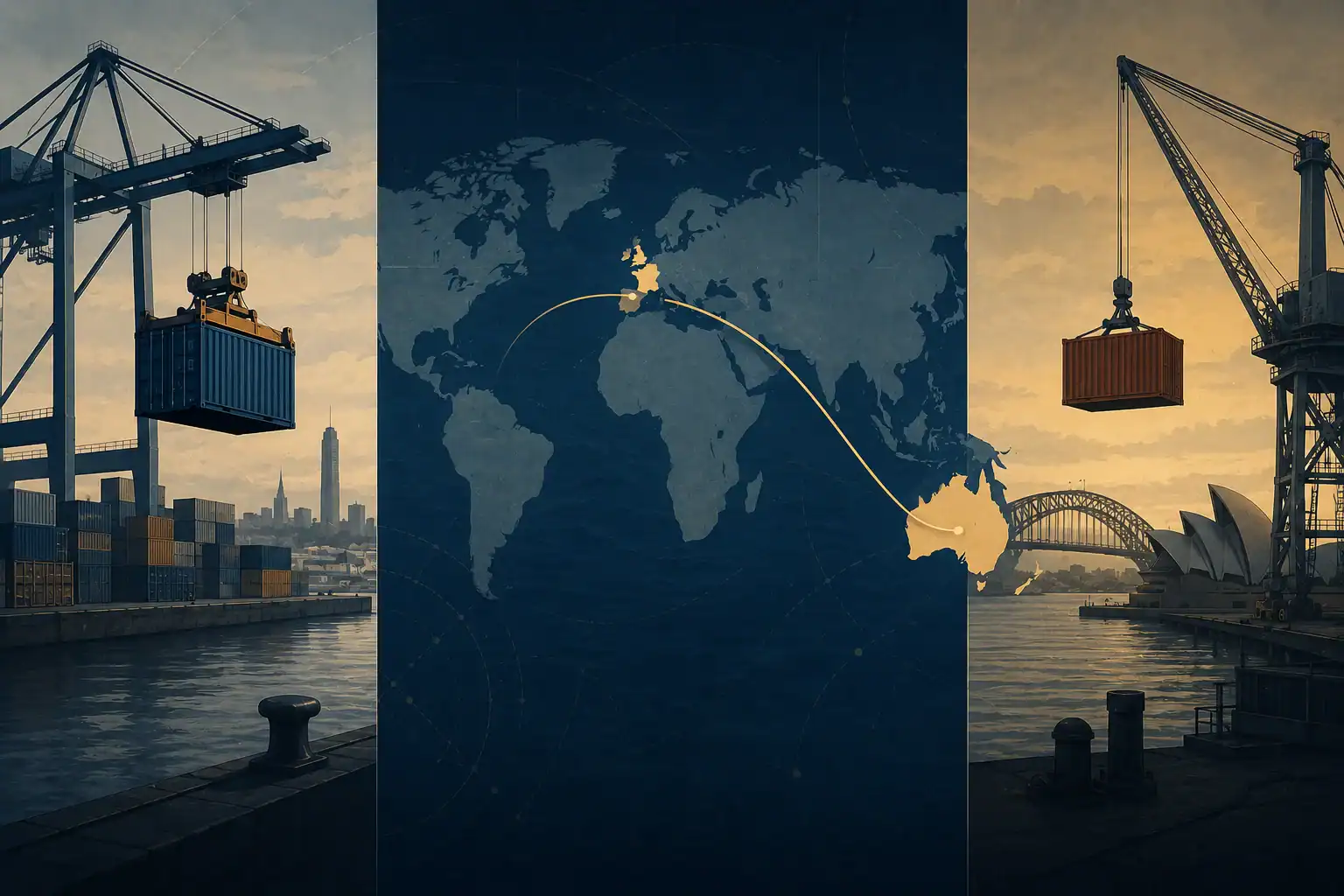
Sea Freight or Air Freight: The Basic Trade-off
The route choice for France to Australia is straightforward in principle but depends entirely on the nature of your cargo. Sea freight handles volume and weight efficiently. Air freight is fast but expensive, and on a route of this distance the cost gap is substantial.
Sea freight from France to Australia runs 30 to 45 days port to port. The main departure points in France are Le Havre (on the Atlantic coast, serving Paris and northern France) and Marseille (on the Mediterranean, handling southern France and transit from Southern Europe). Both ports have regular services to Australian gateways: Sydney, Melbourne, Brisbane, and Fremantle.
Air freight cuts transit to 2 to 4 days but carries a cost premium that makes it viable mainly for high-value goods, urgent shipments, or consignments where volume is low and time is the governing constraint.
For a detailed comparison of how to choose between sea and air freight for shipments into Australia, the analysis at air freight vs sea freight for Australian importers covers the decision framework in full.
France to Australia: Realistic Cost Ranges
Cost estimates on France-to-Australia shipping vary widely because carriers, seasons, fuel surcharges, and congestion charges all move independently. The numbers below reflect market rates as of mid-2026 and should be treated as planning ranges, not fixed prices. Any specific shipment will need a current quote based on actual cargo details.
Full Container Load (FCL)
A 20-foot container from France to Australia currently costs between AUD 3,800 and AUD 6,500 for the ocean freight component. A 40-foot container typically runs AUD 5,500 to AUD 9,200. These figures cover the sea leg only. On top of that, expect:
- Origin charges in France: packing, cartage to port, origin documentation: typically EUR 600 to EUR 1,400
- Destination charges in Australia: terminal handling, port authority fees, quarantine fees: typically AUD 800 to AUD 1,400
- Customs broker fees for import entry: AUD 350 to AUD 700
- Delivery from Australian port to your address: AUD 400 to AUD 900 depending on distance from port
A 20-foot container move from Paris to Sydney, door to door, typically lands between AUD 7,000 and AUD 12,000 all-in depending on packing choice, seasonal surcharges, and delivery address. Peak season surcharges (typically October to January for the Australia-inbound direction) can add 15 to 25% to the base ocean freight rate.
Less Than Container Load (LCL)
LCL (where your cargo shares space in a container with other shippers’ goods) is the practical choice when your shipment does not fill a 20-foot container. For France to Australia, LCL rates run from approximately AUD 280 to AUD 420 per cubic metre (CBM), including basic origin consolidation charges. A minimum charge of 2 to 3 CBM typically applies, so very small consignments pay for more space than they physically occupy.
For context on how to calculate your shipment’s cubic volume, the CBM guide for moving shipments explains how to measure and estimate container space accurately.
LCL adds time compared to FCL because consolidation at the origin depot and de-consolidation at the Australian depot each add 3 to 7 days. A door-to-door LCL shipment from France to Australia realistically takes 45 to 60 days.
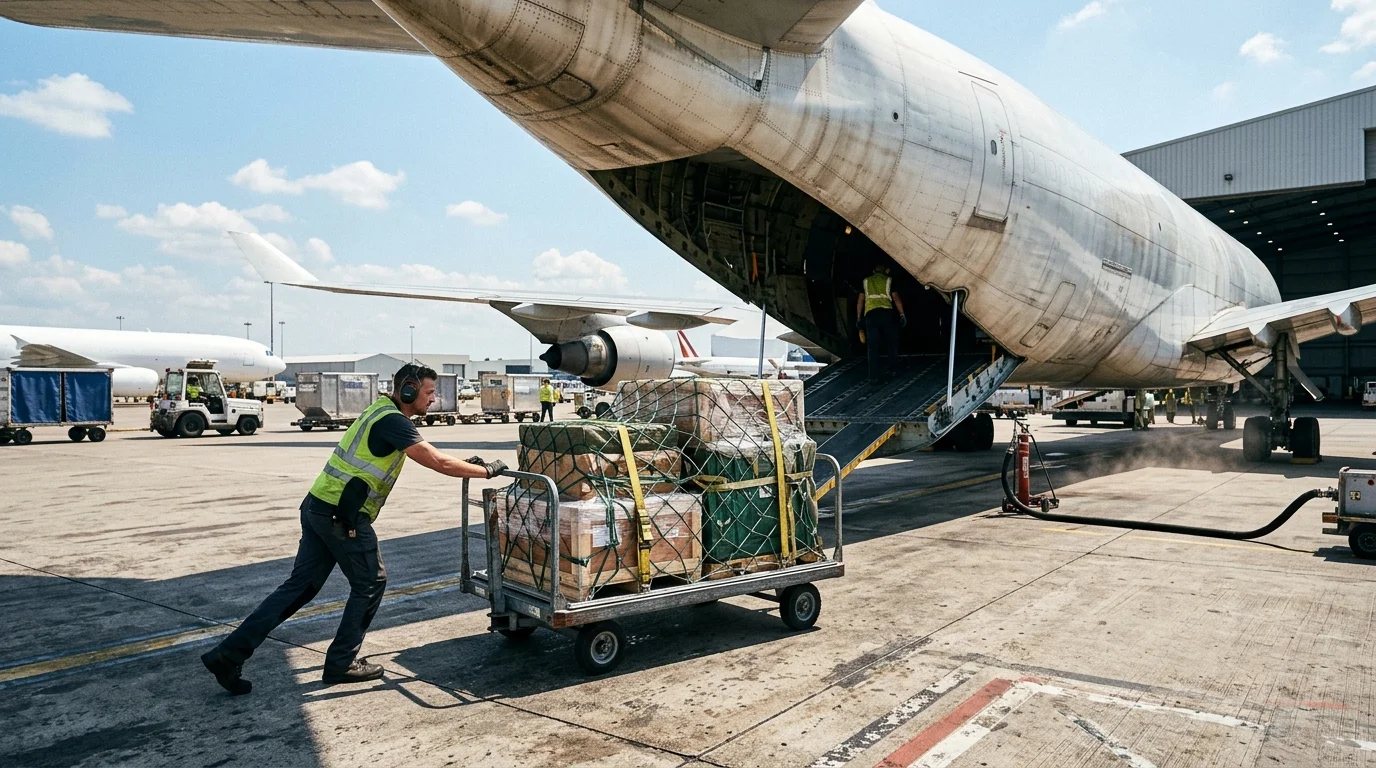
Air Freight
Air freight from France to Australia is priced by the higher of actual weight or volumetric weight (volume in centimetres divided by 6,000 for most carriers). Rates range from AUD 8 to AUD 18 per kilogram depending on urgency, carrier, and season. A 100 kg shipment might cost AUD 1,200 to AUD 1,800 in freight alone: on top of origin handling, fuel surcharges, destination charges, and delivery.
Air freight makes sense for goods worth several hundred dollars per kilogram or more, or when a shipping delay would cost more than the premium. It is not the right mode for household furniture, a container of wine, or anything that can tolerate five or six weeks at sea.
How Long Does France to Australia Shipping Take?
Transit time estimates on this route require some care. Port-to-port times are one number. The actual time from your French address to your Australian address is a different number, and that is what matters for planning.
Port-to-Port Times
Le Havre to Sydney: approximately 28 to 35 days on direct or single-transshipment services. Most services route through Singapore or Port Klang.
Le Havre to Melbourne: approximately 30 to 38 days.
Marseille to Sydney or Melbourne: similar times, typically 30 to 40 days.
Carriers operating on this lane include CMA CGM (the French shipping group with strong France-Australia coverage), Maersk, and MSC. Service frequency from Le Havre is generally weekly on the main services.
Door-to-Door Time
Add the following to port-to-port estimates:
- Pickup in France and delivery to the port or consolidation depot: 2 to 5 days
- Export customs in France: same day to 2 days for standard shipments
- Australian customs clearance and biosecurity: 1 to 5 days for a clean shipment, longer if selected for inspection
- Delivery from Australian port to your address: 1 to 5 days depending on location
Under normal conditions, a door-to-door FCL shipment takes 37 to 52 days. LCL adds 7 to 14 days for consolidation. A shipment delayed at Australian biosecurity or customs adds further. Planning for 50 to 60 days from pickup in France to delivery in Australia is a sensible working assumption.
Most planning assumptions treat transit time as a single number. It is a range. The median case for France to Australia might be 45 days, but a biosecurity inspection, a carrier schedule change, or a port congestion event can push the 90th-percentile case to 65 days or more. Bookings, lease starts, and delivery windows that require a precise date on this route consistently come unstuck. Build a buffer.
Australian Customs: What Applies to Goods from France
Australia does not have a broad free trade agreement with France or the European Union that significantly reduces import duties on goods. Most commercial goods from France enter under Australia’s general tariff, with a 5% duty rate applying to many categories. Some product categories (electronics, certain machinery, raw materials) have zero or reduced rates. The actual duty rate for your specific goods depends on the tariff classification under the ABF (Australian Border Force) tariff classification.
In addition to duty, a 10% GST applies to the customs value plus duty plus insurance and freight charges (the “CIF + duty” basis). For most commercial importers, the GST paid at the border is claimable as an input tax credit if you are GST-registered.
Import Threshold
Australia’s low-value import threshold is AUD 1,000. Shipments with a customs value below AUD 1,000 can be cleared informally and are not subject to import duty or GST at the border. Above AUD 1,000, full formal entry is required: an import declaration lodged through the ABF’s ICS (Integrated Cargo System), supported by commercial invoice, packing list, and bill of lading or airway bill. A licensed customs broker typically lodges this on the importer’s behalf.
Key Documents Required
- Commercial invoice (accurate description of goods, country of origin, value in AUD or foreign currency with exchange rate)
- Packing list (itemised, with weights and dimensions)
- Bill of lading (sea freight) or airway bill (air freight)
- Import declaration (lodged by a licensed customs broker with ABF)
- Any applicable permits: required for restricted goods categories (food, plants, animal products, chemicals, firearms, medicines)
Errors in the commercial invoice are the most common cause of delays and additional charges. The description must match what is in the container. The value must be declared accurately: customs authorities use the transaction value as defined under the WTO Customs Valuation Agreement, and ABF auditors can and do check declared values against market pricing for known categories.
Biosecurity: The Layer Most Shippers Underestimate
Australia’s biosecurity rules apply to every shipment entering the country, regardless of where it comes from. France is not a high-risk origin in the same way as some agricultural exporters, but the categories of goods that attract mandatory inspection are the same for all origins.
The Department of Agriculture, Fisheries and Forestry (DAFF) is the agency responsible for biosecurity border management. Its BICON database holds the import conditions for every category of goods.
The categories that most frequently cause problems for France-to-Australia shipments include:
Used Household Goods and Personal Effects
Used items (furniture, bedding, garden equipment, sports gear, tools) are treated as biosecurity risk regardless of origin. Items with soil contamination, plant material, or signs of pest activity will be held for treatment or destroyed. The key requirement is thorough cleaning before packing. Clean, dry items with no organic material attached typically clear without issue. Items that have been in outdoor storage or garden areas are higher risk.
For a full understanding of what Australian biosecurity inspectors look for at the border, the detailed guide at Australia’s biosecurity rules explained covers the history, logic, and practical implications of the inspection regime.

Food, Wine, and Organic Products
French wine can be imported commercially, but requires compliance with the Wine Australia framework, the ABF tariff and excise obligations, and biosecurity import conditions for bottled wine. Personal imports of wine are subject to the same import duty and GST as commercial imports above the AUD 1,000 threshold. For personal quantities (less than AUD 1,000 customs value) in unaccompanied baggage or postal channels, different rules apply.
Food products from France (cheese, charcuterie, confectionery, dried goods) have varying biosecurity risk levels. Commercially produced, shelf-stable packaged food typically clears with a standard declaration. Meat products, dairy, and items containing plant material are higher risk and may require permits. Fresh produce cannot be imported without specific permits and treatment.
Wooden Items and Packing Materials
Solid wood items (furniture, pallets, crates) may require heat treatment or fumigation under ISPM 15 requirements. France as an EU member state applies ISPM 15-compliant treatment to commercial wooden packaging, but antique furniture, handmade items, or goods in non-compliant wood packaging may be flagged. Disclosing timber contents in the packing list is essential.
What Happens When Customs or Biosecurity Delays Your Shipment
Most delays on the France-to-Australia route fall into predictable patterns. Understanding them before you ship avoids surprises and allows you to plan mitigation.
Documentation inconsistency (a mismatch between the commercial invoice description and the actual goods) is the most common cause of customs holds. Once held, the importer must provide additional documentation or attend an examination. Storage charges accrue at the Australian container terminal while the hold is in place. These charges are typically AUD 80 to AUD 150 per day per container depending on terminal.
Biosecurity inspection (a random or targeted physical inspection of container contents) adds 2 to 7 days and incurs biosecurity levy charges. Goods found to contain prohibited items may be treated (at the importer’s cost), re-exported, or destroyed. For a household container from France, thorough pre-shipment cleaning and an accurate packing list are the main risk controls.
For more on what triggers customs examination and how delays accumulate, the guide to customs delays for Australian imports explains the inspection triggers and how to reduce your risk profile.
Specific Cargo Types: What to Know Before You Ship
Household Goods and Personal Effects
Families and individuals relocating from France to Australia are the largest category of non-commercial shippers on this route. The typical move involves 20 to 40 CBM of household contents: enough for a 20-foot container, often a little more.
Used household goods from France pay standard import duty unless the importer qualifies for the Unaccompanied Personal Effects (UPE) concession. Under the UPE concession, Australian residents (or new arrivals settling in Australia) can import used household goods duty-free and GST-free, provided the goods have been owned and used abroad for at least 12 months. Documentation requirements include proof of prior ownership and a completed Unaccompanied Personal Effects Statement (Customs Form B534). For the full eligibility conditions, what constitutes acceptable proof of prior use, and how the statutory declaration works, the Unaccompanied Personal Effects concession guide for Australia has the detailed breakdown.
Goods that have been purchased new in France and shipped to Australia do not qualify for the UPE concession and attract standard import duty and GST.

Antiques and Art
Antiques more than 100 years old qualify for a zero or reduced duty rate in many categories under the Australian tariff schedule. Art (paintings, sculptures, original prints) is also zero-rated for duty. GST still applies unless the importer is the original creator. Accurate classification and supporting documentation (certificate of authenticity, valuation) matter for antique and art shipments because duty savings are real and audits of declared values in this category do occur.
Commercial Cargo
Businesses importing from France typically handle wine, luxury goods (fashion, cosmetics, accessories), industrial components, and machinery. Each category carries its own tariff classification and potentially its own specialist requirements:
- Wine: tariff + excise-equivalent charge; Wine Australia compliance for commercial quantities
- Cosmetics and personal care: TGA (Therapeutic Goods Administration) may apply to borderline products; ACCC labelling requirements
- Machinery: often zero-rated for duty; biosecurity for used machinery (must be clean and free of soil/biological material)
- Fashion and textiles: duty rate typically 10%; GST at 10%; labelling requirements under Australia’s mandatory standards
Choosing a Freight Forwarder for France to Australia
On a route as long and document-intensive as France to Australia, the freight forwarder’s role covers the full chain: pickup in France, export customs declaration (the export must be declared to French customs for goods over EUR 1,000 leaving the EU), booking and documentation with the carrier, import entry with ABF in Australia, biosecurity management, and delivery to final address.
Key questions when evaluating freight forwarders for this route:
- Do they have an office or established agent in France, or are they quoting a price they will subcontract?
- Which carriers do they use on the France-Australia lane, and what is their typical booking lead time?
- Do they handle Australian customs entry in-house (licensed customs broker) or outsource it?
- What is their track record with biosecurity issues: do they understand the inspection categories and help clients prepare documentation?
Ask these four questions before you book, not after a shipment stalls at the border: that ordering is the entire point. A forwarder’s answers here are a filter, not small talk: a vague answer on the France office, a shrug on carrier lead times, or no clear owner for the customs entry is information you can act on now, while switching costs nothing. The same gaps, discovered three weeks into a stalled clearance, cost storage fees and a scramble. The four questions don’t get easier to ask later; they just get more expensive to have skipped.
Swift Cargo handles France-to-Australia shipments as a specialist on this lane: sea freight (FCL and LCL), air freight for urgent cargo, household moves, and commercial consignments. Request a current quote specific to your cargo.

Practical Tips Before You Ship
Book early in the lead-up to peak season. November to January is high demand for the Australia-inbound lane, driven by the Australian Christmas and New Year period combined with consumer goods restocking. Rates and available space both tighten. Booking 8 to 10 weeks ahead of a target December arrival is practical risk management, not excessive caution.
Clean all used goods before packing. Australian biosecurity inspectors are looking for soil, seeds, plant material, insects, and biological residues. A single contaminated item in a household container can trigger full-container examination. Clean each item individually, inspect garden and outdoor equipment particularly carefully, and document the cleaning in your packing list notes.
Declare accurately. The most expensive customs outcome is not paying a duty rate. It is underdeclaring value and having ABF query it. The duty on a EUR 5,000 declared-value shipment is small compared to the cost of a customs hold, examination fees, and storage charges while a discrepancy is resolved.
Get cargo insurance. France to Australia involves multiple handoffs, weeks at sea, and the possibility of biosecurity treatment that could damage goods. Cargo insurance is not a significant cost relative to the value of a typical household or commercial shipment. Cargo that is damaged, treated, or delayed without insurance exposes the shipper to the full replacement cost.
A pattern worth naming: the documentation errors that cause customs holds on France-to-Australia shipments fall into a small number of predictable categories. Mismatch between the invoice description and what is actually in the container is the most common. A wine case listed as “12 bottles assorted” does not match a packing list that shows specific appellations and declared values per bottle, and when ABF auditors query the value of a declared wine shipment, they do it routinely, not randomly. Accurate documentation is not a formality. It is the document that ABF and DAFF use to decide whether your container goes to examination or clears the terminal. For most commercial importers, the cost of a one-hour delay in transit is acceptable. The cost of a five-day examination hold at AUD 120 per day storage is a different number. The shippers who avoid it consistently are the ones who get the paperwork right at origin, not the ones who plan to fix it at the Australian end.
For individuals planning a relocation from France rather than a commercial shipment, the companion guide on moving from France to Australia covers the full household-goods process: UPE concession, biosecurity preparation, container sizing, and what happens at each stage from packing in France to delivery in Australia.
Frequently Asked Questions
How long does shipping from France to Australia take by sea?
Sea freight from France to Australia takes 30 to 45 days port to port. Add inland pickup in France and Australian customs clearance and you are looking at 40 to 55 days door to door under normal conditions. LCL (shared container) shipments take longer due to consolidation handling.
How much does it cost to ship from France to Australia?
A 20-foot container (FCL) runs approximately AUD 3,800 to AUD 6,500 for ocean freight. LCL rates run AUD 280 to AUD 420 per CBM. Air freight is AUD 8 to AUD 18 per kilogram. Door-to-door costs are higher: add origin charges, destination charges, customs broker fees, and local delivery.
What does Australian customs require for shipments from France?
A commercial invoice, packing list, bill of lading or airway bill, and an import declaration lodged with ABF. Goods over AUD 1,000 in value require formal entry. Standard import duty applies to most French goods; GST at 10% applies to the customs value plus duty.
Does Australia have duty-free thresholds for goods from France?
Australia does not have a free trade agreement with France. Goods below AUD 1,000 customs value qualify for informal entry without duty or GST. Above AUD 1,000, standard rates apply. Used household goods may qualify for the Unaccompanied Personal Effects concession if eligibility conditions are met.
Can I ship wine or food products from France to Australia?
Yes, with the right compliance. Wine attracts import duty and excise-equivalent charges. Food requires biosecurity declarations. Meat products, fresh produce, and items with soil or plant material are higher biosecurity risk and may require permits or treatment.
Do I need a freight forwarder to ship from France to Australia?
For anything beyond a small courier parcel, yes. A licensed freight forwarder handles export documentation in France, booking, Australian customs entry (a licensed customs broker is required for formal import entries), biosecurity management, and delivery. Attempting to manage an international shipment from France without a forwarder introduces significant documentation risk and potential delays.