
Moving from France to Thailand is not a small decision. It is a full reconstruction: a new city, a new language, a new pace. And somewhere in the middle of it all sits a practical question that most people leave too late: what do I do with my belongings?

Shipping household goods internationally is manageable when you know the rules. In Thailand, those rules have a particular feature that surprises many French expats: your visa status, and nothing else, determines whether your belongings come in duty-free. It does not turn on how long you have lived in Thailand, how much you are bringing, or whether the items are genuinely used and personal.
The Visa Question First
Before you book a moving company or pack a box, clarify your visa situation. Thai customs draws a sharp line between visa categories when it comes to household goods.
| Visa Type | Duty-Free Eligibility | Notes |
|---|---|---|
| Non-Immigrant B (work permit) | Yes, with conditions | Must have 1-year work permit; shipment arrives within 6-month window |
| Retirement (O-A, O-X) | No | Does not qualify; duties of 10–30% + 7% VAT apply |
| Thai Elite | No | Lifestyle visa, not a work permit, so no exemption |
| Long-Term Resident (LTR) | Partial | Seek specific customs ruling before shipping |
| Education (ED) | No | Student visa does not qualify |
| Tourist visa / visa-exempt | No | No qualifying status for personal effects exemption |
| Returning Thai national | Yes, with conditions | Must prove 12+ months residence abroad |
This distinction matters enormously. A large proportion of French expats move to Thailand on a retirement visa, and in that case your household goods will be subject to standard import duties. That changes the economics of what is worth shipping. Shipping a sofa for €800 and then paying 20% duty on its declared value is a different calculation from clearing that same sofa duty-free.
If you are moving for work and hold a valid one-year Non-Immigrant B visa with a work permit, you may qualify for the full duty-free exemption, but specific conditions attach.

The Duty-Free Exemption: Exact Conditions
For those who qualify, the Thai Customs Department duty-free exemption for household goods applies under these conditions:
- Visa: Valid one-year Non-Immigrant B visa at time of shipment arrival
- Work permit: Valid one-year Thai work permit, issued before the shipment arrives at port
- Residency: You must have resided in France (or your origin country) for a continuous period of at least 12 months before your move
- Window: Your shipment must arrive no earlier than one month before your first Thailand entry and no later than six months after the date your work permit was first issued
- One shipment: One sea freight shipment and one air freight shipment may qualify, but not multiple sea shipments
- Used goods only: Items must be genuinely used and personally owned, which typically means being in your possession for at least six months
- Appliances: One unit of each appliance type qualifies; duplicate units (two TVs, two washing machines) are dutiable
The timing condition is the one that most often causes problems. If your shipment arrives outside the six-month window, you lose the exemption entirely. A delayed freight booking or a vessel schedule change is enough to do it. Plan your shipment booking to arrive well within the window, not at the edge of it.
Sea Freight from France to Thailand: The Route
The vast majority of household moves from France to Thailand go by sea. Air freight is practical only for urgent or very light items, because the cost per kilogram makes it prohibitive for anything above roughly 100kg.
Departure ports from France:
- Le Havre is France’s largest container port, in Normandy, and the primary departure point for most France-Thailand shipments. Direct weekly services run to major Asian hubs.
- Marseille is the main southern France container port, better positioned for shippers in the south (Provence, Côte d’Azur, Languedoc). Its Mediterranean head start often makes transit to Asia slightly faster.
Arrival port in Thailand: Laem Chabang Port in Chonburi province is Thailand’s primary deep-sea container terminal, approximately 130km southeast of Bangkok city centre and 80km from Pattaya. Virtually all sea freight household moves into Thailand arrive here.
Transit time: 30–46 days from Le Havre or Marseille to Laem Chabang. Routing is typically via Singapore or Port Klang (Malaysia). Add 5–10 working days for Thai customs clearance after vessel arrival.
Total door-to-door timeline: Plan for 6–8 weeks from packing day to delivery at your Bangkok or Chiang Mai apartment.
LCL or FCL: What Most Expats Actually Need
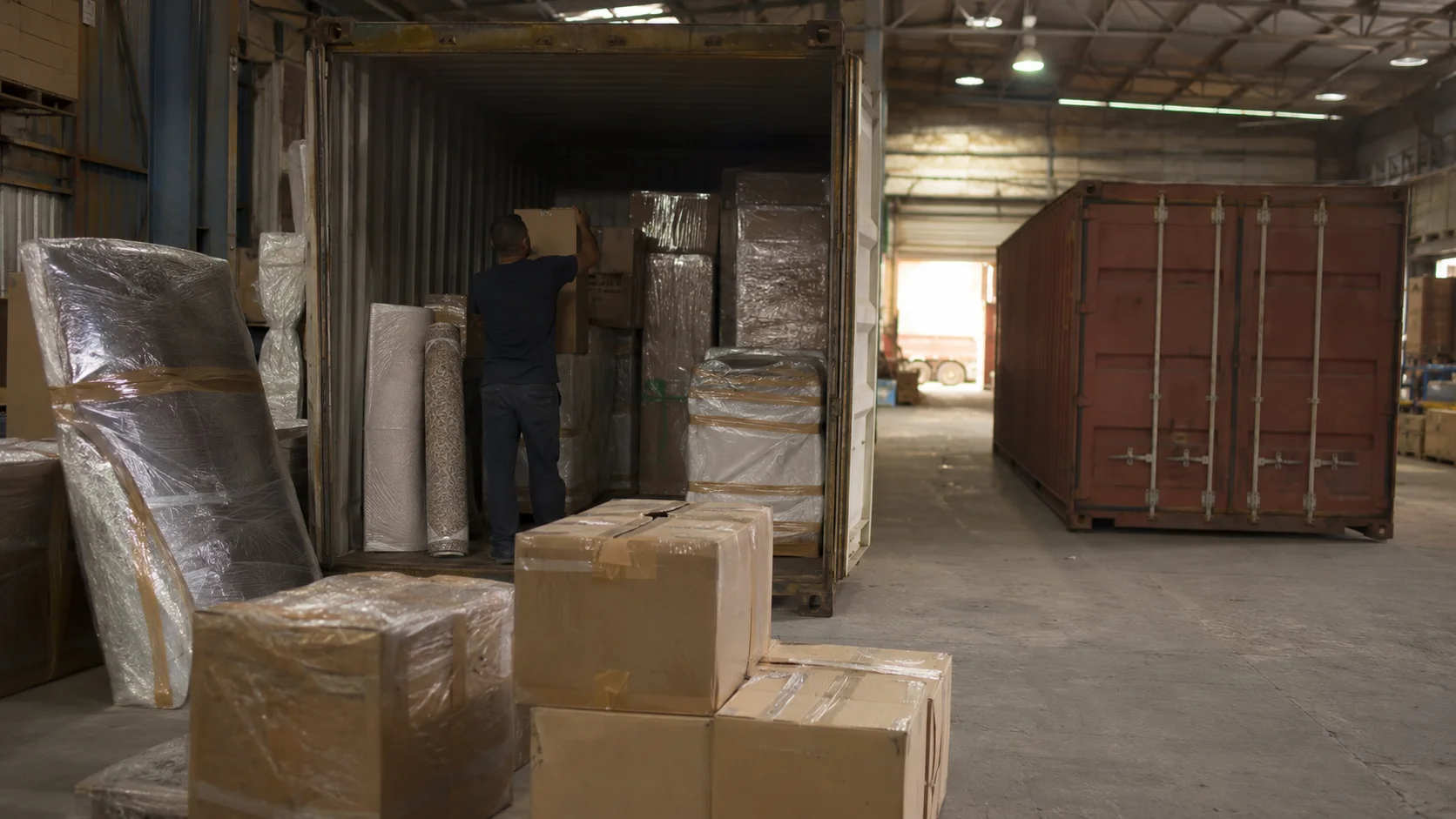
A typical French expat moving to Thailand out of a furnished Paris apartment has 5–15 cubic metres genuinely worth shipping. That puts you squarely in LCL territory.
LCL (groupage / shared container): Your goods share a container with other importers’ shipments, and you pay per cubic metre rather than booking a full box. Transit may be slightly longer than FCL due to consolidation handling at both ends.
FCL 20ft: Your own container, holding approximately 25–28 CBM. Suitable for a 2–3 bedroom household. Clearance at destination is faster, because fewer hands touch your goods.
FCL 40ft: Full house move, approximately 55–60 CBM. Rarely necessary unless you are shipping a large family home’s worth of belongings, which most experienced expats advise against for Thailand.
Estimated Moving Costs: France to Thailand
| Home size | Estimated cost (EUR) |
|---|---|
| 2 bedroom | EUR 3,590–8,310 |
| 3 bedroom | EUR 4,340–9,040 |
| 4 bedroom | EUR 5,380–10,700 |
| 5 bedroom | EUR 7,740–14,740 |
These are door to door estimations, not port to port. They include standard packing and customs clearance on both ends, and assume an origin and destination reasonably near the port on both sides; a move to or from a more remote location may cost more. Treat these as budgets, not final pricing. The final cost depends on the quantity and nature of what you are shipping, service availability, and sea freight rates at the time of your move. These figures are based on average home sizes from past moves and may not reflect your own home. Timing and availability can also materially affect the price, and in some cases whether we are able to complete the job on your preferred timeline. For an accurate quote, contact our team or start our online self service quote, a short survey about your move that takes about four minutes and lets our team provide a real quote based on your specific details.
What to Bring, and What to Leave Behind
Most household furniture is not worth shipping to Thailand. Honest moving companies will tell you this. Online quote tools never surface it.
Good candidates for shipping:
- Clothing and personal wardrobe
- Books, artworks, and objects with sentimental value
- Specific electronics (high-end audio, camera equipment, specialist tools)
- Custom-made or irreplaceable furniture pieces
- Children’s items (toys, books, comfort objects)
- Professional equipment
Commonly not worth shipping:
- Standard flat-pack furniture (IKEA-equivalent pieces are available in Thailand at similar or lower prices)
- Large white goods such as washing machines, fridges and tumble dryers (voltage compatibility issues; Thai apartments often include appliances)
- Large sofas and dining tables (Thai apartments are typically smaller; Thai-made furniture is excellent quality)
- Bulky storage systems and shelving
The honest calculation is simple. If the shipping cost plus any applicable duty exceeds 60–70% of the item’s replacement cost in Thailand, leave it. The furniture markets in Bangkok and Chiang Mai in particular offer good quality at prices that make most European furniture economically indefensible to ship.
There is a perception effect hiding in that calculation, and it works in your favour. Paying duty on your own sofa feels like an insult in a way that paying for a new one never does. The same 20,000 baht reads as a penalty in the first case and as a pleasure in the second. Behavioural economists call it a framing effect; furniture dealers in Bangkok simply benefit from it. If you are on a retirement visa, the exemption is not available to you at all, so use the bias deliberately: let the dutiable sofa go and put the money toward its Thai-made replacement. The arithmetic barely changes, but the move stops feeling like a tax and starts feeling like furnishing a new life. For most people, that is worth more than the sofa was.

Prohibited and Restricted Items
Thai customs maintains a strict list of prohibited and restricted goods. Some items are prohibited outright; others require special permits obtained before the shipment arrives.
Prohibited (will not clear, will be seized or destroyed):
- Narcotics and controlled substances
- Pornographic material
- Counterfeit goods
- Counterfeit currency
- Endangered wildlife and CITES-restricted products
Restricted (permit required before shipment):
- Religious objects including Buddha images: Antique or sacred Buddhist objects require a Fine Arts Department permit. This surprises many Western expats who purchase Thai artefacts before leaving France. If you have purchased Thai Buddha images, research the export and re-import requirements carefully.
- Alcohol: Subject to excise duty even under the duty-free personal effects scheme. Beer and wine may be brought in limited quantities; spirits require specific approval. Do not pack a cellar.
- Plants and seeds: Require phytosanitary certification from the French NPPO (ANSES). Most expats simply do not ship plants.
- Firearms: Require a Royal Thai Police permit. The process is lengthy and complex.
- Pharmaceuticals: Personal medication in reasonable quantities is generally tolerated; controlled substances require advance documentation.
Required Documents for Thai Customs Clearance
Your freight forwarder or moving company will coordinate the paperwork, but you need to supply:
- Passport copy (with current valid visa)
- Work permit copy (if claiming duty-free exemption)
- Detailed packing inventory (inventaire détaillé), with every item listed by description and estimated value
- Bill of Lading (issued by the shipping line)
- Proof of residence in France for 12+ months (for work permit exemption claimants)
The inventory is not a formality. Thai customs uses it to verify that your goods match the declaration. A complete document set is the single most important factor in whether your clearance is smooth or delayed.
For household goods clearance, your customs broker submits the import declaration through the Thai National Single Window (NSW) digital system. A licensed Thai customs broker must handle this submission. You cannot lodge it yourself.
What Happens at Thai Customs
Household goods shipments go through the Red Line, which means physical inspection. This is standard, not a sign that something has gone wrong. A customs officer reviews the shipment against your declared inventory.
If the goods match the documents and your visa/work permit eligibility is established, clearance typically takes 5–10 working days after the vessel arrives at Laem Chabang. If there are document issues or if your goods include restricted items without the required permits, clearance is suspended and your goods begin accruing bonded storage costs.
Bonded storage in Thailand accrues quickly. After 45 days without an import entry submission, Thai customs may auction unclaimed goods. This is not a hypothetical risk. Documentation gaps are the primary cause of prolonged customs holds. Have everything in order before your vessel departs France.
Why the Outcome Is Decided Before You Leave France
Trace it back and the outcome turns out to be decided surprisingly early. Most movers tell themselves that customs happens at the end, on arrival, a formality to be handled when the container lands. The record says otherwise. The duty-free claim stands or falls on documents assembled in France: the valued inventory, the dated work permit, the proof of twelve months’ residence, all in order long before the vessel clears Le Havre. By the time an officer at Laem Chabang is comparing a packing list against the contents of a container, there is nothing left to assemble. There is only what was prepared, and what was not. The space between “I’ll deal with it when I get there” and what Thai customs actually requires is exactly where shipments end up in bonded storage, accruing daily costs nobody budgeted for.
Here is the practical version of that, for the week you are already overwhelmed with everything else. You do not need to have the whole move figured out in France. You need three specific documents in a folder before you fly: the valued inventory, the dated work permit or visa approval, and whatever proves your twelve months of residence. Everything else on this page can wait until you land. Get those three things right while you still have easy access to French bureaucracy and can fix a mistake in an afternoon rather than by international courier. That is the one piece of homework that actually protects the rest of the move.
Zoom out far enough and the pattern here is an old one: societies have always granted freer passage to people and possessions that were expected and documented in advance than to whatever simply turns up at the border. A twelve-month residency requirement and a dated work permit are a modern, bureaucratic version of a much older test, proof that you belong to the place you’re arriving in, not just a claim that you do. What changes with digitization is not the underlying logic, only its speed and its unforgivingness: an officer at Laem Chabang comparing a packing list against a container’s contents has, in effect, always been asking the same question a village gate once asked, just with less patience for a story assembled after the fact than for one prepared in France months before the vessel ever sailed.
Related reading: Shipping a car from France to Thailand and moving dogs and cats from Europe to Thailand.
Related reading: Moving from Europe to Thailand: The Six-Layer Cost
Frequently Asked Questions
Can I import my belongings duty-free when moving from France to Thailand?
Only if you hold a qualifying visa. Non-Immigrant B visa holders with a valid one-year work permit are eligible. Retirement visa (O-A, O-X) holders are excluded from the standard relocation-exemption criteria and do not qualify. Tourist visa holders, Thai Elite members, and education visa holders are not eligible at all. Without it, import duties of 10–30% plus 7% VAT apply to the declared value of your goods.
How long does sea freight take from France to Thailand?
Typically 30–46 days from Le Havre or Marseille to Laem Chabang port, depending on the transshipment routing, usually via Singapore or Port Klang, Malaysia. Add 5–10 working days for Thai customs clearance after arrival.
What is the 6-month rule for importing household goods into Thailand?
Your shipment must arrive no earlier than one month before your initial Thailand entry and no later than six months after the date your work permit was first issued. Shipments arriving outside this window lose eligibility for the duty-free exemption, even if your visa and work permit are valid.
Is it worth shipping furniture from France to Thailand?
Rarely. Large furniture is expensive to ship, may not fit Thai-style apartments, and Thai-made equivalents are good quality and significantly cheaper. Most experienced expats ship personal items, clothing, books, sentimental objects, and specific electronics, and furnish locally.
Do I need to declare my belongings to French customs before leaving?
For standard household goods, France does not require an export customs declaration below standard thresholds. However, you will need a detailed inventory for Thai customs clearance: a comprehensive list of your goods with estimated values. Your moving company or freight forwarder will help prepare this.
Planning Your Move with Swift Cargo
Swift Cargo handles household goods and personal effects shipments from France to Thailand, including customs broker coordination, eligibility assessment, and end-to-end clearance at Laem Chabang. If you are planning a move from France and want to confirm your visa eligibility, timing, and document requirements before you book freight, request a freight quote here.