
The Five Stages of a Vietnam-Australia Freight Timeline
The shipping time from Vietnam to Australia is not a fixed number. It is the combined output of five variable stages, each with its own delay profile. An importer who plans around the vessel transit time alone will consistently encounter delivery windows that are 30–50% longer than expected, because the transit is only the middle portion of the timeline.
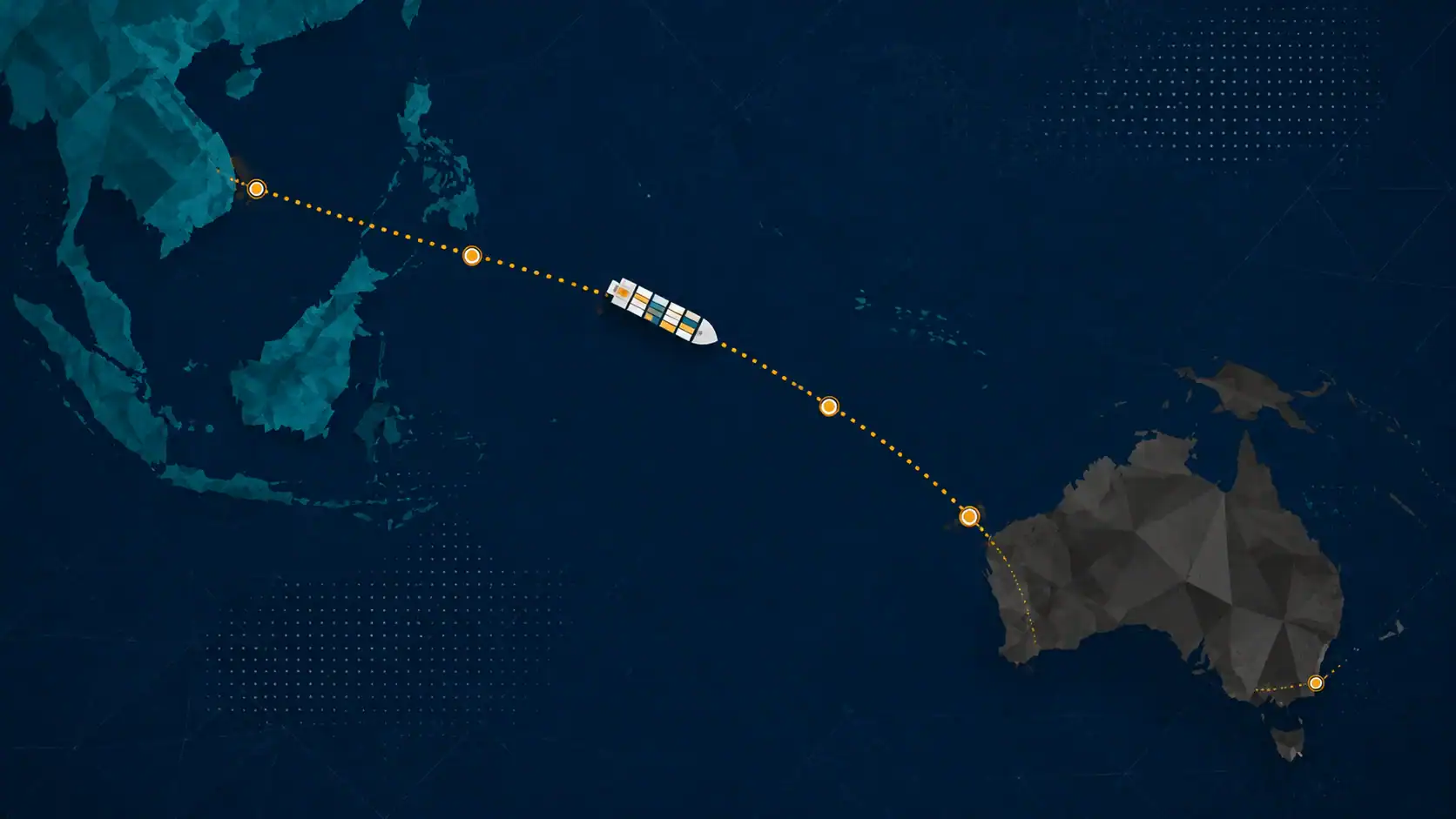
The five stages for Vietnam sea freight are: Vietnamese factory to port of loading (1–3 days for HCMC, 2–5 days for Hai Phong or regional suppliers); Vietnamese port dwell before feeder departure (1–3 days); Singapore or Port Klang transhipment (2–4 days for the connection window, longer if the feeder misses the mainline vessel); ocean transit Singapore to Australian discharge port (7–12 days depending on destination); and Australian port discharge, customs clearance, and last-mile delivery (3–9 days). The total factory-gate-to-warehouse timeline for a Ho Chi Minh City supplier delivering to Sydney runs 19–30 days under normal conditions, and 26–40 days during Tết congestion or when a DAFF biosecurity examination is triggered.
The segment that surprises most importers is the Singapore transhipment window. Unlike direct services from the US West Coast, the Vietnam-Australia lane operates primarily on a hub-and-spoke model: Vietnam feeder vessels bring cargo to Singapore or Port Klang, where it is transhipped onto the mainline Australia-bound vessel. A feeder that arrives late (due to weather, port congestion in HCMC, or vessel delays) may miss the connecting vessel’s cut-off by hours, rolling the cargo to the next available mainline sailing 5–7 days later. This transhipment risk is not visible in the headline transit time published by the carrier and is the primary source of transit time variance on the Vietnam-Australia lane.
Vietnamese Ports of Export: Ho Chi Minh City and Hai Phong
Vietnam’s export geography is divided between two major port clusters, the south, centred on Ho Chi Minh City, and the north, centred on Hai Phong, with a smaller secondary cluster around Da Nang in central Vietnam. The choice of export port is determined by supplier location, not by the importer: a furniture supplier in Binh Duong province ships via HCMC; a garment factory in Hanoi’s industrial corridors ships via Hai Phong. Understanding the transit profile of each origin cluster is necessary for accurate delivery planning.
Ho Chi Minh City: Cat Lai and Cai Mep
Ho Chi Minh City is Vietnam’s primary export hub, handling approximately 60–65% of the country’s containerised export volume. Two terminals serve the majority of Australian-bound cargo: Cat Lai Terminal, operated by Saigon Newport Corporation in the city’s eastern industrial zone, which handles the highest container throughput of any terminal in Vietnam; and Cai Mep International Terminal (CMIT) approximately 80 km south of HCMC in Ba Ria-Vung Tau province, which handles larger vessels and some direct deep-sea services.
From HCMC (Cat Lai) to Sydney via Singapore, the standard vessel transit runs 12–16 days. To Melbourne, 14–18 days. These figures include the Singapore transhipment leg. Services via Port Klang run 1–2 days longer due to the additional Malaysia routing. Cai Mep-origin cargo on services that tranship at Singapore has a similar transit profile, with some direct Vietnam-Australia services on the Cai Mep rotation reducing the transit to 10–13 days on specific weekly sailings.
Hai Phong: Lach Huyen and Green Port
Hai Phong is the primary export hub for northern Vietnam, serving the manufacturing corridors of Hanoi, Hung Yen, Bac Ninh, and Quang Ninh provinces, the cluster responsible for much of Vietnam’s electronics, garment, and industrial component output. Hai Phong’s main container terminals are Lach Huyen International Container Terminal (LHICT) and Green Port, both in the outer harbour area that accommodates larger vessels than the older inner harbour.
Transit from Hai Phong to Sydney via Singapore runs 14–19 days. The additional 2–3 days compared with HCMC reflects the longer Singapore feeder leg from northern Vietnam. For importers sourcing from both northern and southern Vietnamese suppliers in the same shipment (a common scenario for garment importers who consolidate multiple factories) Hai Phong cargo typically needs to be loaded onto a consolidation vessel before the HCMC cut-off, or sourced from each cluster separately for independent shipment. Mixing Hai Phong and HCMC cargo in a single LCL consolidation without careful planning can result in the overall shipment being delayed to the slower origin port’s schedule.

Da Nang and Central Vietnam
Da Nang handles cargo from central Vietnamese manufacturers: primarily garments, seafood, and processed agricultural products. Container volumes at Da Nang are smaller than HCMC and Hai Phong, and fewer direct feeder services operate to the Singapore hub from Da Nang. For importers sourcing from central Vietnam, transit to Australian east coast ports typically runs 15–21 days, and the feeder frequency from Da Nang to Singapore means less departure date flexibility than HCMC or Hai Phong suppliers.
Carrier Services and Sailing Frequency on the Vietnam-Australia Lane
The Vietnam-Australia sea freight lane is served by the major global carriers (Evergreen, CMA CGM, MSC, Maersk, Hapag-Lloyd, and Yang Ming) primarily through their Asia-Oceania loop services that connect multiple Southeast Asian ports before calling at Australian east coast gateways. The practical implication for importers is that the sailing schedule from Ho Chi Minh City or Hai Phong to Australia is constrained by which rotation the carrier runs, and not all carriers offer the same service frequency from both Vietnamese port clusters.
From Ho Chi Minh City, most carriers offer at least one weekly sailing on services that connect to Singapore before the Australian mainline. This gives importers reasonable flexibility in cargo cut-off timing: if a shipment misses one week’s cut-off by a day or two, the next departure is typically 5–7 days away rather than two weeks. From Hai Phong, the feeder frequency to the Singapore hub is lower, and in some periods there may be only one or two services per week that connect efficiently to Australia-bound mainline vessels. This lower frequency amplifies the consequence of missing a cut-off: a missed Hai Phong feeder means a delay of 5–10 days before the next viable connection, compared with 5–7 days from HCMC.
Transit time variance between carriers on the Vietnam-Australia lane is meaningful. Services that route via Singapore with a tight transhipment window (24–36 hours) have the shortest total transit but also the highest transhipment miss risk. Services with a longer Singapore dwell (48–72 hours) have slightly longer headline transit times but are more robust to minor feeder delays. For importers with firm delivery commitments (a retail distribution centre receiving window, a seasonal product arrival deadline) choosing a service with a longer transhipment buffer is often more reliable than choosing the headline-fastest transit option. Your freight forwarder should be comparing transit time versus reliability for each carrier on the lane, not quoting the minimum transit as the planning figure.
There is a predictable reason importers get Vietnam transit planning wrong, and it is not carelessness. It is a mismatch between two mental models. The importer’s model is the one the quote encourages: transit time is a single number, and smaller is better. The forwarder’s model is the operational one: what matters is the reliable arrival window, and most of its variance is hidden inside a Singapore transhipment step the importer never sees on a booking. A service advertised at fourteen days on a tight feeder connection can miss its mainline and land at twenty-one; a sixteen-day service with a longer Singapore dwell almost never does. Planning well on this lane means designing to the window a forwarder can actually hold, not the headline a spreadsheet finds most attractive.

Air Freight Timelines: Vietnam to Australia
Air freight from Vietnam to Australia is faster than from most other Asian origins and more cost-competitive than US or European air freight, making it a viable mode for time-sensitive replenishment of high-value goods. Ho Chi Minh City (Tan Son Nhat International) and Hanoi (Noi Bai International) both have direct services to Sydney and Melbourne, and Hanoi has direct services to Brisbane and Perth.
Standard commercial airfreight from HCMC or Hanoi to Sydney or Melbourne runs 3–5 days from airside handoff to delivery. Express courier services (DHL, FedEx, UPS, TNT) deliver in 2–3 days from any Vietnamese major city to Australian metropolitan addresses. Australian customs clearance for air freight adds 1–4 hours for green channel releases and 1–3 days for documentary or DAFF examinations. Unlike sea freight, air freight DAFF examinations for most Vietnamese goods (excluding fresh produce and certain agricultural categories) are typically completed within 24–48 hours.
The cost of air freight from Vietnam to Australia is AUD 5–12 per kilogram for commercial airfreight, compared with the sea freight equivalent of AUD 0.40–1.20 per kilogram at FCL volumes. The differential is meaningful for heavy, low-value goods (furniture, ceramics, textiles in volume) where sea freight is the only economically viable option. For goods with high value-to-weight ratios (electronics components, garments, footwear) the air freight cost as a percentage of landed value is small enough that the transit time saving justifies the mode premium for urgent replenishment or sample delivery.
AANZFTA and Customs Duty Treatment
The ASEAN-Australia-New Zealand Free Trade Agreement has eliminated tariffs on the vast majority of goods traded between Vietnam and Australia. The AANZFTA tariff schedule shows most manufactured goods categories at 0% for Vietnamese origin, compared with MFN rates that would typically be 5%. Those categories include furniture (HS Chapter 94), garments (Chapters 61–62), footwear (Chapter 64), seafood (Chapter 3) and electronics (Chapters 84–85).
AANZFTA duty preference requires a Form AANZ Certificate of Origin, issued by Vietnamese authorities (the Ministry of Industry and Trade or an authorised body), confirming that the goods qualify as Vietnamese-origin under the applicable AANZFTA Rules of Origin. The Rules of Origin test varies by product category, either a Change in Tariff Classification test or a Regional Value Content test of typically 40%, and must be met at the time of CoO issuance. A supplier whose goods are assembled in Vietnam from imported components must confirm that their production process satisfies the applicable test before the CoO is issued. An ABF CoO rejection at the Australian border reverts the duty to the MFN rate and can trigger a post-clearance audit covering prior shipments. For how AANZFTA duty treatment flows through to the total import cost model, see the total landed cost guide.
Pre-Arrival Lodgement and Clearance Timelines
Pre-arrival lodgement (submitting the import declaration to ABF before the vessel berths at the Australian port) is the primary mechanism for reducing the customs clearance component of the Vietnam-Australia timeline. Under the Integrated Cargo System, a pre-lodged declaration that receives a green channel determination allows container collection on the day of vessel discharge, saving 1–2 working days compared with post-arrival lodgement. For a green channel clearance, this means the container is available within 4–8 hours of vessel berth, compared with 2–3 working days without pre-arrival lodgement.
Pre-arrival lodgement requires the full shipping document set (commercial invoice, packing list, Bill of Lading, Form AANZ Certificate of Origin) to be in the customs broker’s hands before the vessel’s estimated arrival date at the Australian port. For Ho Chi Minh City to Sydney freight with a 12–16 day transit, documents should be submitted to the customs broker by the time the vessel departs Singapore, that is, approximately 7–10 days before Australian arrival. The constraint that typically prevents pre-arrival lodgement is the supplier’s document lead time: a supplier who issues the final commercial invoice and packing list 2–3 days before vessel departure leaves insufficient time for the customs broker to lodge before arrival. Including document cut-off dates in purchase orders is the structural fix. For the full clearance channel breakdown and what triggers DAFF examination by product category, see the Australian customs clearance timeline guide.

Vietnam-Specific Delay Risks
Tết and Vietnamese Public Holidays
Tết Nguyên Đán, Vietnamese Lunar New Year, is the most significant supply chain disruption event in the Vietnam-Australia freight calendar. Tết falls in late January to mid-February depending on the lunar calendar: in 2026 it fell on February 17; in 2027 it falls January 29. The factory closure window around Tết is typically 7–14 days, but the supply chain disruption extends well beyond the closure itself. Port congestion at Ho Chi Minh City and Hai Phong builds 3–4 weeks before Tết as factories rush to complete and ship orders ahead of the shutdown. Vessel booking availability tightens in November and December for the February-arrival window, and freight rates spike as demand exceeds available vessel capacity.
After Tết, production normalisation takes longer than the nominal factory reopening date suggests. Workers return from their home provinces over 2–4 weeks rather than on a single day; raw material supply chains restart on their own schedules; and the backlog of post-holiday orders competes with new orders for production slot allocation. In practice, a Vietnamese factory that officially reopens on Day 1 after Tết is typically running at 50–70% of pre-Tết capacity for the first 2–3 weeks. Post-Tết orders placed in February should not be expected to ship until late March at the earliest for most product categories. Tết is the single event most likely to stretch the shipping time from Vietnam to Australia beyond a normal planning buffer.
The Tết planning calendar for importers: orders needed in Australia by mid-February should ship from Vietnam before January 10; production must be completed and goods booked by late December. Orders placed after January 1 for pre-Tết delivery are unlikely to make it. Post-Tết replenishment orders should be placed by early March to expect April-May Australian arrival.
DAFF Biosecurity Examination for Vietnamese Goods
Vietnam is classified by DAFF as a high-biosecurity-risk origin for several major export categories, primarily due to the presence of wood-boring insects, bark, and soil contamination associated with Vietnamese timber and agricultural exports. The practical effect for Australian importers is an elevated biosecurity examination rate compared with some other Asian origins, and for goods in the high-risk categories, examination should be treated as a baseline assumption rather than an exceptional outcome.
The highest-risk Vietnamese export categories for DAFF examination are: timber and wooden goods of all kinds (furniture, decorative items, structural timber, craft goods) due to wood-boring insect risk from Vietnam’s timber origin; natural fibre garments and textiles (cotton, linen, silk, jute) due to soil and insect contamination risk; fresh produce and seafood (subject to quarantine permit requirements and arrival inspection); and goods with visible soil, plant material, or organic matter contamination. A DAFF BICON check for the specific HS code and Vietnamese origin will indicate the biosecurity conditions that apply and whether examination or treatment is mandatory at the border. For the full biosecurity requirements framework for Australian imports, see the biosecurity requirements guide.

ISPM 15 Timber Treatment Compliance
All timber and wooden goods imported into Australia must comply with ISPM 15, the International Standard for Phytosanitary Measures for Wood Packaging Material and Timber, regardless of whether they are finished goods or raw material. ISPM 15 requires that timber has been heat-treated to a core temperature of 56°C for 30 minutes, or fumigated with methyl bromide to approved concentration levels, and marked with the official ISPM 15 certification mark.
Vietnam’s furniture export industry is well-established in ISPM 15 compliance, and reputable Vietnamese furniture exporters will provide ISPM 15 documentation as standard. However, smaller workshops, craft exporters, and secondary suppliers who produce wooden goods as part of a broader product range may not have consistent ISPM 15 treatment infrastructure. A wooden item, even a simple decorative frame or a product with minor wooden components, that arrives in Australia without ISPM 15 certification will be detained by DAFF, treated at the importer’s cost (typically AUD 2,000–5,000 per container for heat treatment), or destroyed if treatment is not feasible. Confirming ISPM 15 compliance documentation as part of the purchase order is not optional for any Vietnamese shipment containing wood.
Full Timeline Model: HCMC Factory to Sydney Warehouse
The following model illustrates the complete end-to-end timeline for a representative Ho Chi Minh City to Sydney sea freight shipment under normal operating conditions: pre-arrival lodgement submitted, documents complete, no DAFF examination triggered.
Ho Chi Minh City (Cat Lai) to Sydney, Sea freight FCL, normal conditions: Factory cut-off to Cat Lai terminal 1–2 days; HCMC port dwell before feeder departure 1–2 days; feeder transit HCMC to Singapore 1–2 days; Singapore transhipment window 2–3 days; mainline vessel transit Singapore to Port Botany 9–11 days; Australian port discharge and customs clearance (pre-lodged, green channel) 1–2 days; last-mile Sydney metropolitan 1–2 days. Total: 16–24 days.
Ho Chi Minh City to Sydney, with DAFF biosecurity examination (timber/furniture): Add 3–7 days to the Australian clearance stage. Total: 19–31 days. For LCL (Less than Container Load) shipments, add 2–4 days for the deconsolidation process at the Sydney freight station before the goods are available for collection. LCL total: 21–35 days.
Tết disruption scenario (vessel departure HCMC in first two weeks of January): HCMC port congestion adds 3–5 days to port dwell; Singapore may be congested with pre-Tết volume adding 1–3 days to the transhipment window. Total: 22–33 days for an otherwise normal FCL shipment.

Inventory Buffer Planning for Vietnam Import Programs
The inventory buffer for a Vietnam import program should be sized against the realistic worst-case timeline rather than the nominal transit figure. An importer who holds 20 days of safety stock for a Ho Chi Minh City to Sydney supply line will experience stockouts whenever the timeline extends beyond the base case, which, accounting for transhipment misconnections, DAFF examinations, and document delays, occurs in a meaningful proportion of shipments.
A practical buffer model for monthly order cycles from Ho Chi Minh City to Sydney: 30 days of inventory on hand at time of order placement. For Hai Phong origin or Melbourne delivery, extend to 35 days. For product categories with high DAFF examination probability (timber, furniture, textiles), add 10 days to these base figures. For the Tết window (orders shipped in November through January) add a further 7–14 days to account for congestion and post-Tết production disruption.
Swift Cargo coordinates Vietnam-to-Australia freight from Ho Chi Minh City and Hai Phong, with customs brokerage at Sydney, Melbourne, and Brisbane. For a transit timeline and landed cost estimate for your import program, visit swiftcargo.solutions/australia.
Importers managing multiple Vietnamese suppliers across different product categories should consider separating their inventory planning by origin cluster (HCMC vs Hai Phong) and by DAFF risk category, since these variables produce materially different timeline distributions. A furniture importer who averages the transit time for garments and timber in a single safety stock figure will understock on timber and overstock on garments, a poor outcome in both directions.
For importers who use air freight as a replenishment mode between sea freight cycles (particularly for fast-moving garment or footwear SKUs) the air freight safety stock is 7–10 days from order trigger to warehouse receipt under normal conditions. For the freight mode decision framework and when LCL consolidation makes sense relative to FCL for Vietnam volume levels, see the LCL vs FCL guide for Australian importers.
There is a pattern here that looks paradoxical until you name it: as Vietnam’s manufacturing base has matured, shipping options have got faster and more reliable, yet many importers still plan on timelines built for a smaller, less-developed export market. That’s not a coincidence; it’s the standard lag between a country’s actual logistics capability and the assumptions its trading partners carry about it. The same pattern shows up whenever a manufacturing hub scales quickly: buyers keep pricing in the friction of the earlier, less mature version of the market long after the friction has been engineered out. Importers who periodically re-check the current sailing frequency and clearance data, rather than relying on what the route looked like two or three years ago, are the ones capturing the actual improvement instead of just paying for a buffer nobody needs anymore.
Planning Around the Shipping Time from Vietnam to Australia
Plan to the factory-gate-to-warehouse window, not the vessel transit: 19 to 30 days from Ho Chi Minh City to Sydney in normal conditions, and longer from Hai Phong or with a DAFF examination. Choose services with a transhipment buffer at Singapore, put document cut-off dates in purchase orders, and ship before 10 January for mid-February arrivals.
Frequently Asked Questions
How long does sea freight from Vietnam to Australia take?
Sea freight transit from Ho Chi Minh City (Cat Lai terminal) to Sydney runs 12–16 days on services routing via Singapore. From Ho Chi Minh City to Melbourne, allow 14–18 days. From Hai Phong (north Vietnam) to Sydney, the typical transit is 14–19 days, also via Singapore or Port Klang. These are vessel transit times only. Add 1–3 days for Vietnamese port dwell before departure, 2–4 days for the Singapore transhipment window, 1–4 days for Australian customs clearance, and 1–3 days last-mile delivery to build the complete factory-gate-to-warehouse timeline. Total end-to-end from Ho Chi Minh City factory to Sydney warehouse runs 19–30 days under normal conditions.
Does most Vietnam-Australia cargo route through Singapore?
Yes. The majority of Vietnam-Australia sea freight transits Singapore (PSA terminals) or Port Klang (Malaysia) as the primary transhipment hub. Direct Vietnam-Australia services exist on some carrier rotations (CMA CGM, Evergreen, and others) but are limited in frequency. For most importers, the Vietnam-Australia routing is Vietnam origin port → Singapore transhipment → Australian discharge port. The Singapore transhipment window adds 2–4 days to the total transit and introduces a missed-connection risk: if the Vietnam feeder arrives late, the connecting vessel may already have departed, rolling the cargo to the next available service 5–7 days later.
How does Tết affect Vietnam freight timelines?
Tết (Vietnamese Lunar New Year) is the single largest supply chain disruption in the Vietnam-Australia freight calendar. Vietnamese factories typically close for 1–2 weeks around Tết, which falls in late January to mid-February depending on the year. Port congestion at Ho Chi Minh City and Hai Phong builds 3–4 weeks before Tết as factories rush to clear orders before the shutdown. After Tết, production normalisation takes 3–5 weeks as workers return and raw material supply chains restart. Importers who need goods to arrive in Australia before the February window should target vessel departure from Vietnam by mid-January at the latest. Post-Tết replenishment orders placed in February will not typically arrive in Australia until April.
What duty rate applies to goods imported from Vietnam under AANZFTA?
The ASEAN-Australia-New Zealand Free Trade Agreement (AANZFTA) has eliminated tariffs on the vast majority of manufactured goods imported from Vietnam to Australia. Most HS chapters applicable to Vietnamese export categories (furniture, garments, footwear, electronics, seafood, and general manufactured goods) carry an AANZFTA rate of 0% compared with the MFN rate that would otherwise apply (typically 5%). AANZFTA preferential duty requires a Form AANZ Certificate of Origin confirming that the goods meet the applicable Rules of Origin: either the Regional Value Content test or the Change in Tariff Classification test depending on the goods category. Verify the specific AANZFTA rate and Rules of Origin requirement for the HS subheading before the first shipment.
Which Vietnamese goods face the highest DAFF biosecurity examination risk in Australia?
Timber and wood products from Vietnam (including furniture, wooden crafts, and structural timber) face the highest DAFF biosecurity examination rate due to Vietnam’s status as a high biosecurity risk origin for wood-boring insects and bark. All timber and wooden goods from Vietnam must comply with ISPM 15 (heat treatment or methyl bromide fumigation) before export. Untreated timber will be detained, treated at the importer’s cost, or destroyed. Vietnamese natural fibre garments, fresh produce, and goods with soil contamination risk also carry elevated inspection probabilities. For products in these categories, add 3–7 days to the baseline Australian clearance timeline as a Biosecurity inspection buffer.