
Why Carrier Liability Is Not the Same as Cargo Insurance
When a container arrives in Australia with 300 kg of damaged goods, many importers assume that the shipping carrier is responsible for the loss. Under Australian law, the carrier is responsible, but the amount they are liable for is frequently a fraction of the actual loss, and recovering even that amount requires the importer to prove carrier negligence rather than mere delivery of damaged goods. A properly structured commercial cargo insurance: Australia policy removes that burden of proof entirely, since it pays out on physical loss or damage regardless of who caused it.
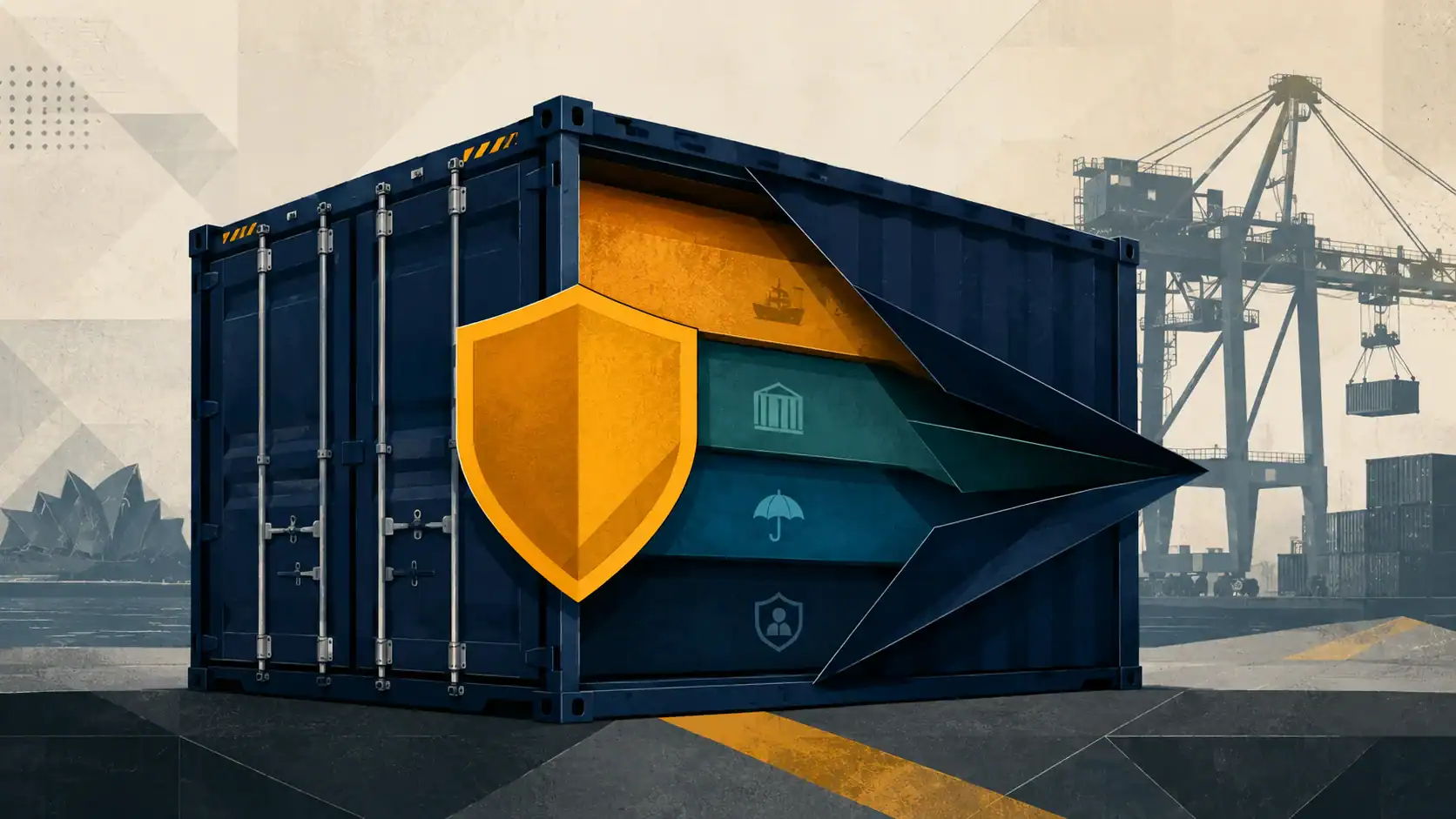
Under the Carriage of Goods by Sea Act 1991, which incorporates the Hague-Visby Rules into Australian law, a sea carrier’s liability is capped at the higher of 2 SDR per kilogram or 666.67 SDR per package or unit. At current Special Drawing Right rates, this equates to approximately AUD 4–5 per kilogram or AUD 1,300–1,700 per package. For a 200 kg shipment of electronics with an invoice value of AUD 80,000 (approximately AUD 400 per kilogram), the maximum carrier liability under the Hague-Visby cap is approximately AUD 800 to AUD 1,000. An importer carrying no cargo insurance receives the carrier liability amount as their total recovery, leaving AUD 79,000 in loss uncompensated.
Cargo insurance operates independently of carrier liability. It covers loss or damage to the goods regardless of carrier fault, and it covers the full insured value, not a statutory cap set by an international maritime convention from 1968. The decision not to carry cargo insurance is not a risk reduction. It is the transfer of the entire loss risk to the importer’s own balance sheet, mitigated only by the thin carrier liability cap.
Institute Cargo Clauses: Understanding Clause A, B, and C
Commercial cargo insurance in Australia and internationally is governed by the Institute Cargo Clauses, published by the International Underwriting Association in London. There are three standard coverage levels (A, B, and C) that differ primarily in how broadly they define covered perils. The choice between them determines what events trigger a valid claim.
Clause A: All Risks Coverage
Institute Cargo Clause A provides the broadest available coverage. It is an “all risks” policy, meaning that any loss or damage to the cargo is covered unless it falls within an enumerated exclusion. The standard exclusions under Clause A are: wilful misconduct of the insured; ordinary leakage, loss in weight or volume, and ordinary wear and tear; loss from inherent vice or the nature of the subject matter (cargo that deteriorates by its own process); loss caused by delay, even where the delay results from an insured risk; loss from insolvency of the carrier; loss from the use of nuclear, biological, or chemical weapons; and war and strike risks, which are excluded by default but can be covered by endorsement at additional premium.
For general manufactured goods, Clause A is the appropriate coverage level. The premium differential between Clause A and Clause C for a standard commercial shipment is typically 0.05%–0.15% of insured value, a small additional cost against a significantly broader coverage profile.
Clause B: Named Perils Including Water Damage
Institute Cargo Clause B is a named-perils policy: it covers loss or damage caused by specific events enumerated in the clause, rather than all risks with exceptions. Clause B covers: fire or explosion; vessel or craft stranding, grounding, sinking, or capsizing; overturning or derailment of land conveyance; collision of vessel, craft, or conveyance with any external object other than water; discharge of cargo at a port of distress; earthquake, volcanic eruption, or lightning; general average sacrifice; jettison or washing overboard; entry of sea, lake, or river water into vessel, craft, hold, conveyance, container, or place of storage; total loss of any package lost overboard or dropped while loading or unloading.
Clause B provides meaningful protection against the major physical perils of sea freight but does not cover theft, damage from improper stowage by the carrier, or damage from water other than sea/river/lake entry. For higher-risk cargo categories (consumer electronics, goods susceptible to rain damage, goods shipped through high-theft ports), Clause B is typically insufficient, and Clause A is the appropriate minimum.
Clause C: Major Casualties Only
Institute Cargo Clause C is the minimum coverage level and the default under CIF Incoterms. It covers only major casualty events: fire or explosion; vessel or craft stranding, grounding, sinking, or capsizing; overturning or derailment of land conveyance; collision of vessel with external object; discharge of cargo at a port of distress; and general average sacrifice and jettison. Clause C does not cover water damage, theft, damage during loading and discharge, or any form of partial physical damage to the cargo that does not arise from one of the listed catastrophic events.
Clause C is appropriate for bulk commodities and raw materials where the primary risk is catastrophic loss of the vessel rather than partial damage to the goods during handling. For most manufactured goods in commercial import programs, Clause C provides inadequate coverage: a container that is dropped during discharge, goods that are wet-damaged by rain during port operations, or cargo that is partially stolen at a port facility are all uninsured events under Clause C.

Calculating the Correct Cargo Insurance Value
The standard insured value for commercial cargo is CIF + 10%. The formula (Cost of goods plus Insurance premium plus Freight charges, with a 10% uplift) is specified in the Institute Cargo Clauses as the industry standard for commercial shipments and reflects the purpose of cargo insurance: to place the importer in the same financial position they would have been in if the goods had arrived undamaged.
The 10% uplift represents the anticipated profit or commercial benefit that the importer expected to derive from the goods: the margin on the sale, or the cost of disruption to the business if the goods are lost. Without the uplift, an insurance claim on the CIF value recovers only the cost of the goods and the freight; it does not compensate for the sales opportunity lost while waiting for a replacement shipment.
A worked example: an importer purchases AUD 120,000 FOB of consumer electronics from a Chinese supplier. Freight to Sydney costs AUD 6,500. The cargo insurance premium at 0.3% of insured value is calculated as follows: CIF value = AUD 126,500 ÷ 0.997 = approximately AUD 126,878. CIF + 10% = AUD 139,566. Insurance premium = 0.3% × AUD 139,566 = AUD 419. The insured value is AUD 139,566, not the invoice value of AUD 120,000. Insuring for the invoice value only, the most common underinsurance error, leaves AUD 19,566 in uninsured exposure.
For goods purchased on CIF terms from the supplier, the importer should verify the insurance value in the supplier’s policy before relying on it. Suppliers purchasing CIF coverage routinely insure at invoice value without the 10% uplift, and at Clause C level, meaning the coverage is inadequate both in amount and scope from the importer’s perspective. The safest approach is for the importer to purchase their own open marine cargo policy covering all shipments and arrange CIF terms on a FOB basis instead.
What Cargo Insurance Excludes
Even under Clause A all-risks coverage, there are standard exclusions that void or reduce claims. Understanding these exclusions before a claim arises, not after, is how importers avoid the common situation of discovering that a significant loss is uninsured.
Inadequate Packaging
Loss or damage caused by packaging that was insufficient to withstand the ordinary conditions of transit is excluded under all Institute Cargo Clauses. The standard applied is whether the packaging was adequate for the type of transit undertaken, not whether it passed through the specific handling event that caused the damage. A fragile item shipped in insufficient cushioning that is damaged during normal container handling does not have a valid insurance claim, because the damage resulted from the packaging failure rather than an insured peril. The importer bears responsibility for specifying adequate packaging in their purchase orders.
Inherent Vice and Delay
Inherent vice, the tendency of goods to deteriorate by their own natural process, is excluded under all clause levels. Fresh produce that spoils, goods with a limited shelf life that expire during transit, or materials that react chemically with their own packaging are standard examples. Delay is also excluded across all clause levels, including Clause A: if goods arrive late and the importer suffers a commercial loss because the goods missed a selling season, that loss is not covered regardless of whether the delay resulted from an insured peril such as a vessel diversion. The cargo insurance policy covers physical loss or damage to the goods; it does not cover consequential commercial loss from late arrival.
What Voids a Claim in Practice
Beyond the standard exclusions, cargo insurance claims are commonly voided or significantly reduced by procedural failures at the time of delivery. The most common voiding failures are: failing to notify the carrier of damage at the time of delivery and obtaining a signed receipt noting the damage; failing to commission an independent surveyor’s report within 24–48 hours of discovering damage; failing to preserve the damaged goods and packaging for inspection; and failing to notify the insurer within the required timeframe, typically 7 days for visible damage and 30 days for concealed damage. Once goods have been accepted at delivery without notation and their original packaging destroyed or discarded, establishing that the damage occurred during transit rather than during handling at the importer’s warehouse becomes extremely difficult, and claims are frequently rejected on this basis.
Incoterms and Insurance Responsibility
The allocation of insurance responsibility between the buyer and seller is determined by the Incoterm agreed in the sale contract. Two Incoterms impose an insurance obligation on the seller: CIF (Cost, Insurance, Freight) and CIP (Carriage and Insurance Paid To). Under all other Incoterms (including FOB, EXW, FCA, CPT, DAP, DDP), the seller has no contractual obligation to insure the goods, and the buyer purchases insurance independently if they want coverage.
Under CIF, the seller’s minimum insurance obligation is Institute Cargo Clause C. As discussed, Clause C covers only major casualty events and is typically inadequate for manufactured goods in normal transit. An importer accepting CIF terms with Clause C coverage is insured against vessel sinking but not against the far more common risks of cargo damage during handling, theft, or water ingress. Buyers who accept CIF terms should either negotiate Clause A coverage in the contract or purchase a supplementary policy for their own account.
Under FOB terms, the most common arrangement for Chinese and Vietnamese manufacturing sourcing, the seller delivers goods loaded on the vessel at the origin port, and risk transfers to the buyer at that point. The buyer arranges freight and insurance. An open marine cargo policy, which covers all shipments automatically as they are declared, is the standard tool for importers on FOB terms managing multiple active shipments. For a detailed breakdown of how Incoterms affect the total landed cost calculation, see the Incoterms guide for Australian importers.
Making a Cargo Insurance Claim
The claim process has a defined sequence that must be followed in the correct order for the claim to be valid. Deviating from this sequence, particularly by skipping the surveyor step or failing to notify the carrier, is the most common cause of valid claims being rejected on procedural grounds. Insurers underwriting commercial cargo insurance: Australia policies expect this sequence to be followed exactly, and treat a skipped step as grounds to dispute the claim.

The Claim Process Step by Step
Step 1: At delivery, inspect the goods and packaging before signing the delivery receipt. If there is visible damage, note it on the delivery receipt (“received with visible damage, extent to be assessed”) and retain the carrier’s signed copy. If the driver refuses to allow inspection before signature, note this on the receipt as well. A clean delivery receipt with no notation of damage significantly complicates a subsequent claim.
Step 2: Notify your insurer immediately, even before the full extent of the damage is known. Most policies require notification within 7 days of delivery for visible damage and within 30 days for concealed damage discovered after unpacking. Call the insurer rather than waiting to complete a written notification. The notification obligation is triggered by discovery of loss, not by completion of your assessment of it.
Step 3: Commission an independent cargo surveyor to inspect and report on the damage. The surveyor’s report establishes the nature, cause, and extent of the damage and is the primary evidentiary document for the claim. The surveyor should inspect the damaged goods in their original packaging before any unpacking or processing. Retain all original packaging material, because the surveyor will assess whether the packaging was adequate as part of their investigation.
Step 4: Preserve the damaged goods and do not dispose of them, repair them, or sell them at a reduced price without the insurer’s written consent. If the insurer subsequently inspects and determines that goods you disposed of were not as damaged as claimed, the claim will be voided.
Step 5: Simultaneously notify the carrier in writing of your intention to claim, even if you do not yet know the full extent of the claim or the cause. Carrier notification preserves your right to subrogation: the insurer, after paying your claim, may pursue the carrier for recovery if the damage resulted from carrier negligence.
Time Limits
Claims must be lodged with the insurer within the policy’s specified time limit, typically 12 months from the date of the loss event. A claim lodged after the limitation period expires is time-barred regardless of its merits. The surveyor’s report and the carrier’s notification should be obtained well within this limit, because assembling documentation takes time and the limitation period runs from the loss event, not from when the importer became aware of the full extent of their loss.
For disputes with an insurer over claim settlement (including denied claims, disputed amounts, or delays in settlement), the Australian Financial Complaints Authority (AFCA) provides a free external dispute resolution service for insurance products regulated under the Insurance Contracts Act 1984. Most commercial marine cargo policies are regulated under this Act and fall within AFCA’s jurisdiction.
Cargo Insurance for Specific Cargo Types
Dangerous Goods
Dangerous Goods (DG) cargo classified under the IMDG Code or IATA DGR requires specialist cargo insurance that covers DG-specific risks, including segregation failures, containment incidents, and DG-related vessel diversions. Standard marine cargo policies frequently contain explicit DG exclusions or sublimits. Importers of Class 9 lithium battery goods, Class 3 flammable liquids, or other regulated DG categories should confirm with their insurer that their policy covers DG cargo without exclusion and that the insured value properly reflects the DG goods category.
High-Value Goods
Goods above a specified value threshold (often AUD 250,000–500,000 per shipment) typically require specific declaration to the insurer rather than automatic coverage under an open policy. High-value goods may also attract additional survey requirements, specific packing instructions as a condition of coverage, and enhanced documentation obligations. An importer of high-value electronics, jewellery, or luxury goods should review their open policy’s per-shipment limit and confirm that each shipment is adequately declared before loading.
Perishables
Perishable goods (fresh food, pharmaceuticals, temperature-sensitive products) require specialist refrigerated cargo insurance that covers reefer failure, power failure at the vessel, and temperature excursions. Standard Institute Cargo Clauses exclude inherent vice, which means that a perishable that deteriorates due to its own nature rather than an insured mechanical failure is not covered. Reefer cargo insurance must specifically cover equipment breakdown and temperature excursion, and many policies require temperature monitoring data to be preserved as a claim condition.

Subrogation: Preserving Your Claim Against the Carrier
When a cargo insurer pays a claim, they are entitled by subrogation to pursue the party whose negligence caused the loss, typically the sea carrier, road carrier, or terminal operator, in the insured’s name. Subrogation allows the insurer to recover what they paid from the responsible party, which reduces the insurer’s net loss and, over time, keeps cargo insurance premiums lower than they would otherwise be. For the importer, the practical implication is that their own actions at delivery can either preserve or destroy the insurer’s subrogation rights, and destroying those rights can affect future claims and policy renewals.
To preserve subrogation rights, the importer must: note damage on the delivery receipt at the time of delivery (not retrospectively); issue a written notice of claim to the carrier within three days of delivery for sea freight under the Hague-Visby Rules; and not release the carrier from liability, whether explicitly in writing or implicitly by accepting goods without notation. An importer who signs a clean delivery receipt, unpacks the goods, processes them into stock, and then discovers damage a week later has significantly damaged both their own claim and the insurer’s recovery position.
The time limit for claims against sea carriers under the Hague-Visby Rules is one year from the date the goods were delivered or should have been delivered. This limitation period cannot be extended by agreement. An importer whose cargo insurance claim is being investigated past the one-year mark may lose the ability to pursue the carrier independently, meaning the insurer’s subrogation recovery is also lost. Notifying the carrier promptly and in writing within the three-day period is the correct protection against this outcome.
Common Cargo Insurance Mistakes Australian Importers Make
The most costly cargo insurance mistake is insuring for invoice value only, without freight, without the 10% uplift, and often without reviewing whether the CIF coverage provided by the supplier under CIF terms is adequate for the importer’s exposure. Many importers who believe they are insured discover at the time of a claim that their coverage was approximately 30–40% below the loss they have actually sustained.
The second most common mistake is assuming that the carrier or forwarder’s liability provides meaningful coverage for large losses. Freight forwarders operating under standard trading conditions, typically the Australian Freight Council’s standard terms, may limit their liability to even lower amounts than the Hague-Visby cap. An importer who believes their forwarder’s liability covers a significant cargo loss is typically mistaken by an order of magnitude.
A third common mistake is treating cargo insurance as a per-shipment decision rather than a standing open policy. An importer who arranges insurance shipment-by-shipment (when they remember, at the freight rate they happen to get that week) routinely has uncovered shipments, insufficient insured values, and no leverage to negotiate a competitive premium. An open policy removes the per-shipment decision entirely: all shipments are covered automatically, the rate is negotiated once a year, and the administrative burden is a monthly declaration of actual shipment values rather than individual voyage applications.

Selecting a Cargo Insurance Policy
For importers with regular shipment volumes (more than 6–8 FCL or LCL shipments per year), an open marine cargo policy (also called a floating policy) is more cost-effective than individual voyage policies. An open policy covers all shipments automatically as they are declared; the premium is calculated on actual shipment values declared monthly or quarterly rather than per-voyage. The policy also removes the administrative burden of arranging insurance for each individual shipment, and it ensures no shipment is accidentally uninsured due to an administrative gap.
The premium rate for an open policy is negotiated based on: the annual volume of shipments, the product categories and their risk profile, the origins and routing, the clause level required, and the insured’s claims history. A standard commercial importer of general manufactured goods from China or Vietnam, shipping 10–20 FCL per year at Clause A, can typically negotiate rates of 0.15%–0.30% of CIF value. Specialist goods categories (electronics, pharmaceuticals, DG, high-value goods) attract higher rates reflecting the increased risk profile.
Swift Cargo’s Australia import service includes cargo insurance coordination alongside freight and customs brokerage. To request a freight quote that includes all-in landed cost modelling, visit swiftcargo.solutions/australia.
Cargo insurance is a component of the total landed cost of goods and should be budgeted as a fixed percentage of the CIF value of each shipment. For the complete breakdown of all cost components in an Australian import program, see the guide to total landed cost importing to Australia. For how cargo insurance interacts with LCL consolidation risk, where goods are handled more times than FCL, see the LCL vs FCL guide.
Commercial Cargo Insurance: Australia Buying Checklist
Insure at full commercial invoice value plus freight and a margin for duty, choose Institute Cargo Clause A for anything but the lowest-risk cargo, and confirm who holds insurable interest under your Incoterm before goods leave the supplier. Getting commercial cargo insurance: Australia importers actually rely on right, rather than accepting whatever the freight forwarder bundles in by default, is what makes a claim payable instead of disputed.
Frequently Asked Questions
What is the difference between Institute Cargo Clauses A, B, and C?
Institute Cargo Clauses A provides the broadest coverage: all risks of loss or damage except for a defined list of exclusions (delay, inherent vice, wilful misconduct, war, and strike unless separately endorsed). Clause B covers named perils including fire, explosion, sinking, stranding, earthquake, washing overboard, and water ingress, broader than Clause C but narrower than Clause A. Clause C covers major casualties only: fire, explosion, sinking, stranding, collision, and general average sacrifice. Most commercial importers purchasing goods on CIF terms should carry Clause A coverage, since the premium differential over Clause C is small relative to the additional protection provided.
What does carrier liability cover under Australian sea freight law?
Under the Carriage of Goods by Sea Act 1991 (incorporating the Hague-Visby Rules), a sea carrier’s liability is limited to the higher of 2 SDR per kilogram or 666.67 SDR per package or unit of cargo. At current SDR rates, this equates to approximately AUD 4–5 per kilogram or AUD 1,300–1,700 per package. For goods with a high value-to-weight ratio (electronics, medical devices, fashion), this cap covers only a fraction of the actual loss. Carrier liability also requires the importer to prove the carrier was negligent; a claim is not automatic on delivery of damaged goods. Cargo insurance covers loss independently of carrier fault and is not subject to the SDR cap.
How do I calculate the correct cargo insurance value?
The standard insured value for commercial cargo is CIF + 10%: that is, the Cost of goods, plus Insurance premium, plus Freight charges, with a 10% uplift for anticipated profit. This formula, used in the Institute Cargo Clauses as standard practice, ensures the insured amount covers not just the replacement cost of the goods but also the lost margin if the goods cannot be replaced in time for a sales cycle. For goods purchased on FOB terms, the importer adds the freight cost and 10% uplift to arrive at the CIF equivalent. Underinsuring, meaning insuring for invoice value only without freight and uplift, is the most common claim shortfall.
What can void a cargo insurance claim?
The most common causes of cargo insurance claim voidance are: inadequate packaging (damage caused by packaging that was insufficient to withstand normal transit conditions is excluded under all Institute Cargo Clauses); inherent vice (goods that deteriorate by their own natural processes: fresh produce, certain chemicals); delay (loss of value due to late arrival is excluded across all clause levels); wilful misconduct of the insured; and failure to notify the insurer and carrier within the required timeframe after discovering damage. Many claims are also reduced or rejected because the insured did not obtain a surveyor’s report promptly after delivery, removing the ability to establish that the damage occurred during transit rather than before loading or after delivery.
Who is responsible for cargo insurance under CIF Incoterms?
Under CIF (Cost, Insurance, Freight) Incoterms, the seller is required to obtain insurance and deliver the policy to the buyer. However, the minimum insurance required under CIF is Institute Cargo Clause C, the narrowest coverage available. An importer receiving goods on CIF terms who needs broader coverage should either negotiate Clause A in the sale contract or purchase a separate open policy for their own account covering all shipments. Incoterms transfers risk to the buyer when goods are loaded on the vessel at origin. From that point, any loss or damage above the CIF minimum coverage is the buyer’s exposure. Never assume that CIF means the seller’s insurance provides adequate coverage for the buyer’s full loss.