Author: SwiftCargo Team

  • Bicycles Are a Simple Australia Import, E-Bikes Are Not

    Bicycles Are a Simple Australia Import, E-Bikes Are Not

    Australia builds almost no bicycles. A handful of boutique frame builders aside, effectively every bike sold in the country (around 1.4 million units in a typical year) arrives in a container. That makes the bicycle trade one of the purest import businesses there is: no local manufacturing lobby, no anti-dumping duties, a flat 5% tariff that FTAs mostly erase, and a product the market never stops buying.

    Then e-bikes happened. Electric bike sales in Australia have grown at rates the regulators never planned for, and the rulebook shows it. A pedal bike is governed by a consumer product safety standard written decades ago. An e-bike is simultaneously a consumer product, a road vehicle subject to state power limits, and a Class 9 dangerous good under international transport law because of its battery. Three regulatory regimes, one product, and an importer who often discovers the second and third regimes only after the container has sailed.
    Bicycles Are a Simple Australia Import, E-Bikes Are Not

    Layer one: the mandatory safety standard for pedal bicycles

    Pedal bicycles are one of a small list of products with a mandatory safety standard under Australian Consumer Law, administered by the ACCC. The standard is based on parts of AS/NZS 1927, and it applies to bicycles as supplied to the consumer. That phrase is worth reading twice, because it determines who carries the obligation and in what state the bike must comply.

    The core requirements cover:

    • Braking. The bike must have compliant front and rear braking systems capable of meeting specified performance requirements. Fixed-wheel track bikes and some kids’ bikes have specific provisions, but a general-market adult bike needs two working brakes.
    • Reflectors. Front, rear, wheel and pedal reflectors, fitted or supplied, meeting visibility requirements. This is the requirement factories most often get wrong for the Australian market, because reflector specs differ between destination markets and a factory running a European order alongside yours will happily fit the wrong set.
    • Sharp edges and protrusions. No exposed sharp edges, protruding bolts beyond specified limits, and chain guard requirements on certain configurations.
    • Assembly. If the bike is sold partially assembled (which almost every boxed direct-to-consumer bike is), it must come with adequate assembly instructions, and the bike as assembled per those instructions must comply. If your instructions are a photocopied generic sheet in mangled English, and a consumer assembles the brakes wrongly because of it, the compliance failure is yours.

    Two boundary notes. First, the bicycle standard and the helmet standard are separate mandatory standards. If you bundle a helmet with a bike, the helmet needs its own compliance (AS/NZS 2063 basis) and its own certification trail. Do not assume a CE-marked helmet passes; European conformity does not automatically satisfy the Australian standard. Second, the standard applies at the point of supply to consumers. If you import semi-knocked-down bikes and your warehouse does final assembly, the compliant configuration is your responsibility end to end, including what your assemblers torque and fit.

    The enforcement mechanism is Australian Consumer Law: the ACCC can compel recalls, and non-compliant supply attracts penalties per contravention, per bike, in the worst reading. For a 300-bike container, that is not a rounding error.

    Layer two: e-bike power classes (the mistake that cannot be fixed after arrival)

    Here is the number that governs the entire Australian e-bike market: 250 watts continuous rated power, pedal-assist, cutting out at 25 km/h. That is the EN 15194 framework (the European “pedelec” standard), which Australian states have adopted as the definition of a “power-assisted pedal cycle” that can be ridden without registration, licence or compulsory insurance. There is also an older 200W class that permits a throttle, but the EN 15194 pedal-assist framework is where the market lives.

    The threshold logic is binary, and it is worth being precise because the consequences are asymmetric:

    • ≤250W pedal-assist, 25 km/h cutout: a bicycle. Ride it anywhere a bike can go. No registration, no licence.
    • Above that: a motor vehicle under state road law. And here is the trap: it is a motor vehicle that cannot be registered, because it was never designed or certified to Australian Design Rules for motor vehicles. It has no compliance pathway. It is legal to own, legal to ride on private property, and illegal to ride on any road or road-related area, which in most states includes footpaths and shared paths.

    This is how importers destroy inventory without touching it. In Australia, the 500W and 750W “e-bikes” that dominate US marketplace listings are unregistrable motor vehicles. An importer who orders 200 of them from a Chinese factory lands a container of product that cannot lawfully be sold for road use, perhaps because the factory’s default export spec is built for the American market. There is no fine to pay and move on; there is no retrofit certificate. The realistic options are re-export, sale into a tiny off-road niche at a loss, or a very awkward conversation with a customs broker about what “recreational use only” labelling actually protects you from (approximately nothing, once the ACCC considers how the product is marketed and foreseeably used).

    The throttle question deserves its own sentence: a throttle that propels the bike without pedalling pushes an EN 15194-class bike out of the pedelec definition in most state frameworks (the small 200W class and low-speed start-assist provisions aside). Factories fit throttles casually. Your purchase order should prohibit them explicitly, and your pre-shipment inspection should check for them, including “hidden” throttle connectors left in the loom for the dealer to activate, a genuine factory habit.

    Practical rule: specify EN 15194 compliance in the purchase contract, require the test report from a recognised lab naming your model, and verify the motor’s rated power plate and controller firmware behaviour at inspection. Check with the state road authority in your primary market if your product sits anywhere near an edge case; the frameworks are aligned but not identical between states.

    Layer three: the lithium battery (Class 9 dangerous goods)

    Every e-bike battery worth selling is lithium-ion, typically 400–700 Wh. Anything above 100 Wh is fully regulated dangerous goods for transport, so every e-bike battery in commerce is a Class 9 dangerous good. This layer catches more first-time importers than the other two combined, because it is invisible on the product listing and unforgiving at the port.

    UN 38.3: ask before you order, not before you ship

    Before any lithium battery may be transported by any mode, the cell and battery design must have passed the UN 38.3 test series: altitude simulation, thermal cycling, vibration, shock, external short circuit, impact/crush, overcharge and forced discharge. The manufacturer must be able to produce a test summary, a standardised document identifying the battery, the testing body, and the tests passed.

    The sequencing matters enormously. If you ask for the UN 38.3 test summary after production, and the supplier cannot produce one, you have a warehouse full of batteries in Shenzhen that no compliant carrier will load. Testing a battery design takes weeks and costs real money, which is precisely why the cheapest quotes skip it. So the question goes in the RFQ, before the deposit: provide the UN 38.3 test summary for this exact battery model, plus the MSDS/SDS. A supplier who responds with a certificate for a different capacity, a different cell brand, or a suspiciously generic document has answered your real question, which was “should I buy from you at all.”

    Sea freight mechanics: UN 3480 vs UN 3481

    Under the IMDG Code (the sea freight dangerous goods regime), the classification splits by how the battery travels:

    • UN 3481: lithium-ion batteries contained in equipment or packed with equipment. A battery installed in the e-bike frame, or boxed alongside its bike, ships under this entry. Packing provisions are more forgiving because the equipment itself protects the battery.
    • UN 3480: lithium-ion batteries shipped alone. Spare batteries, replacement stock, or batteries consolidated in their own cartons. Stricter packing (typically PI 965 equivalents under IMDG packing provisions), stricter state-of-charge expectations for some carriers, and higher DG surcharges.

    Either way, the shipment needs a dangerous goods declaration, compliant UN-spec or provision-compliant packaging, Class 9 labels and lithium battery marks, and a carrier who has been told the truth on the booking. Air freight (IATA regime) is far more restrictive again: standalone lithium-ion batteries are effectively cargo-aircraft-only with tight state-of-charge limits, which is one reason e-bike logistics is a sea freight business.

    The catastrophic version of getting this wrong is the undeclared shipment. A forwarder or carrier who discovers undeclared lithium batteries will at minimum refuse the cargo and at worst report it. Carriers do check, especially anything invoiced as “bicycle parts” from an e-bike factory. Fines for undeclared DG are severe, your marine insurance is void for the shipment (insurers do not cover cargo shipped in breach of the IMDG Code), and your name goes on a list at the shipping line. Ships have been lost to lithium battery fires. The industry’s patience for undeclared batteries is zero and falling.

    The paper trail is a commercial asset, not just a compliance cost

    Follow the documents downstream and the picture changes from burden to moat. The UN 38.3 test summary, the battery MSDS, the EN 15194 report, and the charger’s electrical safety approval make up that stack. RCM marking is part of that approval: the charger is regulated electrical equipment in its own right and needs certification to the relevant electrical safety standard, a whole parallel obligation. The stack is what your product liability insurer asks for when quoting you, what a marketplace demands before your listing goes live, and what your defence looks like if a battery ever does ignite in a customer’s apartment stairwell. The major Australian platforms have all tightened e-bike and battery listing requirements after well-publicised fires.

    This is also the honest explanation of the price gap on Alibaba. The e-bike that costs US$180 less than its lookalike is usually cheaper because the battery uses uncertified cells, skips UN 38.3, and carries a BMS (battery management system) chosen by price alone. Battery fires are the e-bike industry’s reputational overhang, and nearly all of them trace to exactly this corner-cutting, plus incompatible aftermarket chargers. The certified paper trail is what separates your product from the fire statistics, and increasingly, it is what separates products that can be insured, listed and sold from products that cannot.

    Duty, GST and FTA preference

    The tariff picture is simple by Australian standards:

    • Bicycles (including e-bikes): 5% general duty on customs value (FOB basis in practice).
    • GST: 10% on the VoTI: customs value + duty + international freight and insurance. Recoverable as an input tax credit if you are GST-registered, so treat it as cash flow, not cost.
    • China origin: 0% under ChAFTA with a valid Certificate of Origin or Declaration of Origin. Most volume e-bike production is Chinese; the CoO costs the supplier little and saves you the full 5%. Make it a documentary condition of payment.
    • Vietnam origin: 0% under AANZFTA (or RCEP), same documentary discipline. Vietnam has absorbed significant bike assembly volume, partly as factories diversified out of China.
    • Taiwan: no FTA with Australia. Taiwan builds much of the world’s best mid-to-high-end bike volume (the giants of the industry assemble there), and the 5% simply stands. Factor it into the comparison honestly: a Taiwanese bike at US$400 FOB carries US$20 of duty that its Chinese competitor does not. Sometimes the build quality is worth twenty dollars. Run the number rather than assuming.

    Origin rules have teeth here: a bike assembled in Vietnam from a Chinese frame and Chinese groupset must still satisfy AANZFTA’s rules of origin (regional value content or tariff-shift tests) to claim preference. The Australian Border Force audits FTA claims, and the importer, not the supplier who issued the certificate, repays the duty if the claim fails. If your supplier’s origin story is complicated, get the CoO reviewed before you rely on it.

    Freight mechanics: bikes are a volumetric cargo

    Bikes are light and bulky, which makes them a cubic-metre business. The unit economics run off three numbers:

    • Carton volume: ~0.25–0.35 CBM per boxed bike. A standard adult bike carton runs roughly 140 × 25 × 80 cm ≈ 0.28 CBM with the front wheel off, bars turned and pedals removed (the standard “85% assembled” export state). Kids’ bikes come in under 0.2; fat-tyre e-bikes with racks and fenders push 0.35+.
    • Container loading: ~250–300 boxed bikes per 40ft high cube. A 40HC offers ~76 CBM nominal; bike cartons stack imperfectly, so plan on 68–72 usable. At 0.28 CBM per carton, that is ~250 bikes comfortably, ~280–300 with tight cartons and a good loading plan. Weight is never the constraint: 280 bikes at ~22 kg boxed is barely 6.2 tonnes against a 26+ tonne limit.
    • Assembly state: CBU vs SKD. Completely built up (85% assembled) is the consumer-carton standard: worst density, simplest downstream, and factory-verified compliance in near-final configuration. Semi-knocked-down (frames, wheels and components packed densely for local assembly) can cut per-unit volume 30–40% and lift a 40HC toward 400+ units. The trade: you now run an assembly operation, and the mandatory standard’s “as supplied to the consumer” test lands entirely on your assembly bench. Brake setup, reflector fitment, torque specs, instruction sheets: all yours. SKD suits importers with genuine workshop capacity and volume to amortise it; for a first container, ship CBU and let the factory’s production line carry the compliance configuration.

    One e-bike-specific freight note: because the shipment is declared dangerous goods, expect a DG surcharge per container (commonly US$300–800 on the ocean leg depending on carrier and lane), DG documentation fees from the forwarder, and a smaller pool of carriers willing to take the booking, which itself costs you negotiating leverage on the base rate.

    Quality and spec control: the spec-sheet-versus-delivered problem

    Bikes are assembled from dozens of components, and the export trade has a well-worn trick: quote the spec sheet, deliver the substitution. The sample bike arrives with the name-brand derailleur, the branded hydraulic brakes, the 6061 alloy frame. The production run arrives with an unbranded clone derailleur, cable-actuated brakes of the same lever shape, and a frame that weighs suspiciously more. Each substitution saves the factory two to eight dollars; across a 280-bike container they add up to a margin transfer from you to them, and on brakes, a compliance and liability problem.

    Countermeasures, in order of leverage:

    • Contract at component level. The PO annex lists every component with brand and model number: drivetrain, brakes, battery cells (cell brand matters more than pack brand), controller, charger, tyres. “Or equivalent” is deleted wherever it appears.
    • Verify the frame claim. “Alloy” covers a wide spectrum; weigh the sample frame, and if frame material is central to your positioning, pay to verify the material on the sample.
    • Sample bike, retained. The approved sample stays with you (or your inspection agency) as the golden reference. Production is compared against it, not against the spec sheet the factory wrote.
    • Pre-shipment inspection with a bike-literate checklist. A generic inspection confirms carton counts and takes photos. You want an inspector who will pull five bikes, check component model numbers against the PO annex, test brake function, confirm reflector fitment for the Australian standard, verify the motor rating plate and absence of throttle hardware, and match battery labels against the UN 38.3 documentation. That is a half-day of a specialist’s time per container and it is the cheapest insurance in this entire guide.

    Warranty logistics: the container after the container

    A bike importer’s reputation is made in month seven, when the warranty claims arrive and the question becomes whether you stocked parts. The failure pattern is predictable, so provision for it in the first order:

    • Derailleur hangers: the sacrificial part that bends in every shipping mishap and garage tip-over, and it is frame-specific. Order 5–10% of unit volume. They cost cents at the factory and a customer relationship each when you do not have them.
    • Controllers and displays (e-bikes): the most common electronic failure. 3–5% of volume, plus wiring looms.
    • Batteries: the expensive one, and the strategic one. A spare battery shipment is UN 3480 standalone DG freight: higher surcharge, stricter packing, minimum sensible order quantities. You cannot air-freight one replacement battery to a customer economically or, in many cases, legally. So the battery replacement channel must be designed upfront: a DG-rated domestic courier arrangement, batteries held in Australia from the original sea shipment (packed-with-equipment on the way in, which travelled under the friendlier UN 3481 entry), and a plan for taking failed batteries back that accounts for B-cycle, the national battery recycling scheme, and the state rules that increasingly constrain how end-of-life lithium is handled.
    • Chargers: fail constantly, cheap to stock, and must be the certified original: an aftermarket charger on a warranty replacement is how you convert a goodwill gesture into a fire risk.

    Rule of thumb: budget 2–3% of landed cost for spare parts provisioning on pedal bikes, 4–6% on e-bikes, shipped in the same container as the bikes.

    Put a number on that before the first purchase order goes out. A frame-specific derailleur hanger costs about a dollar at the factory and thirty to forty dollars to courier to a customer in Perth eight months later, assuming the factory is still tooling that shape, which it frequently is not after a model-year change. Two per cent of landed cost buys the parts up front. Not having them costs a refund, a return leg and a review that outlives the model. The spare-parts line is the cheapest item in the entire landed cost and the first one a first-time importer strikes out to make the container fit the budget. Order the hangers.

    Worked example: 200 e-bikes vs 200 pedal bikes from China

    Same factory region, same sailing, Shenzhen/Yantian to Melbourne. E-bikes at US$620 FOB (EN 15194, UN 38.3-certified 500 Wh battery installed in frame; UN 3481). Pedal bikes at US$210 FOB. Exchange rate US$1 = A$1.52. Both orders fill one 40HC each (e-bike cartons ~0.34 CBM plus spares; pedal bikes at 200 units are under-utilising the box; noted below).

    Cost line 200 e-bikes 200 pedal bikes
    FOB goods (200 units) US$124,000 → A$188,480 US$42,000 → A$63,840
    Spare parts (batteries, controllers, hangers / hangers, wheels) A$9,400 (5%) A$1,600 (2.5%)
    Ocean freight 40HC A$4,100 A$4,100
    DG surcharge + DG docs A$1,050 n/a
    Marine insurance (0.4% / 0.3% CIF basis) A$810 A$210
    Duty (ChAFTA CoO held) A$0 A$0
    Port, customs brokerage, delivery order, transport to 3PL A$2,950 A$2,750
    Compliance file (EN 15194 report verification, PSI with DG/throttle checks) A$1,900 A$850 (PSI + standard checks)
    Landed cost ex-GST A$208,690 A$73,350
    Per unit A$1,043 A$367
    GST paid at border (recoverable) A$20,240 A$7,020

    Three observations from the table. First, the DG layer costs surprisingly little in cash (roughly A$15 per e-bike in surcharges and paperwork) but only because everything was certified and declared; the uncertified version of this shipment costs somewhere between “cargo refused” and “insurance void plus fine.” The battery’s real cost is embedded in the FOB price of a certified pack, roughly US$60–90 above the uncertified lookalike, or about A$100–140 per bike landed. That is the number the cut-price competitor is “saving.” Second, freight per unit is trivial on both (A$20–26 a bike for the ocean leg), which is why bike importing rewards volume: the pedal-bike container at 200 units is wasting ~15 CBM; at 280 units the same fixed costs drop per-unit landed cost by ~4%. Third, if these bikes had been Taiwanese, add 5% duty: A$9,400 on the e-bike order. Real money, and still frequently worth paying for the build quality tier.

    Retail context: that A$1,043 e-bike sells in the A$1,900–2,400 range through direct channels; the A$367 pedal bike at A$650–850. Margins are healthy precisely because the compliance stack deters casual entrants. For the full costing method, see our total landed cost guide. Get a corporate freight quote before you order to confirm DG surcharges and container costs for your specific lane and battery spec.

    Common mistakes

    • No UN 38.3 documentation. The single most expensive omission. Batteries without the test summary cannot legally ship, full stop. Ask in the RFQ, verify the document names your exact battery model, and keep it on file for insurers and marketplaces.
    • Importing the wrong power class. 500W/750W US-market spec e-bikes are unregistrable motor vehicles in Australia. There is no retrofit fix. Specify EN 15194 (250W/25 km/h pedal-assist) in the contract and verify at inspection, including hidden throttle connectors.
    • Batteries undeclared as dangerous goods. “Bicycle parts” on a commercial invoice covering battery packs is fraud against the carrier under the IMDG regime: cargo refusal, voided insurance, fines, and a blacklisted shipper profile.
    • No spare parts provisioning. Derailleur hangers and controllers cost cents in the container and cost customers when they are back-ordered from China for eight weeks. Provision 2–6% of landed cost in the original shipment.
    • Trusting the spec sheet over the delivered bike. Component substitution is endemic. Component-level PO annex, retained golden sample, and a bike-literate pre-shipment inspection.
    • Assuming the CE mark or a European report covers Australia. The Australian pedal cycle standard, the helmet standard and electrical safety (RCM) for chargers are separate obligations with their own requirements.

    Related Reading

    Related reading: Lire cet article en français

    Frequently Asked Questions

    What is the duty rate for importing bicycles to Australia?

    5% general rate, plus 10% GST on the VoTI. ChAFTA (China) and AANZFTA/RCEP (Vietnam) reduce the duty to zero with valid origin documentation. Taiwan has no FTA with Australia, so Taiwanese-built bikes pay the full 5%. Factor it into any China-vs-Taiwan sourcing comparison.

    Are e-bikes legal to import into Australia?

    Yes, if they meet the road-legal class: 250W continuous rated pedal-assist with assistance ceasing at 25 km/h, per the EN 15194 framework adopted by the states. Higher-power models are motor vehicles that cannot be registered (legal to own, illegal to ride on roads and paths), so importing them commercially is importing unsaleable stock.

    Do e-bike batteries count as dangerous goods for shipping?

    Yes: lithium-ion batteries are Class 9 dangerous goods. Installed in or packed with the bike, they ship as UN 3481; shipped separately (spares, replacement stock), they are UN 3480 with stricter packing and higher surcharges. Both require a dangerous goods declaration and IMDG-compliant packing and marking for sea freight.

    What is UN 38.3 certification and do I need it before ordering?

    UN 38.3 is the mandatory transport test series every lithium battery design must pass: altitude, thermal, vibration, shock, short circuit, impact, overcharge and forced discharge. Request the test summary during the quoting stage, before paying a deposit. A supplier who cannot produce one for your exact battery model has batteries that cannot legally be transported.

    How many bicycles fit in a 40ft container?

    Plan on 250–300 boxed bikes per 40ft high cube at the standard ~0.28 CBM carton, with weight never the binding constraint. SKD packing can lift that past 400 units but transfers final assembly (and the compliance state of the bike as supplied) onto your own operation.

    Do imported bicycles need to meet an Australian safety standard?

    Yes. Pedal bicycles are subject to a mandatory consumer safety standard (AS/NZS 1927 basis) covering brakes, reflectors, sharp edges and assembly instructions, enforced by the ACCC under Australian Consumer Law. The importer is the supplier and carries the obligation; helmets, if bundled, need separate compliance to the helmet standard.
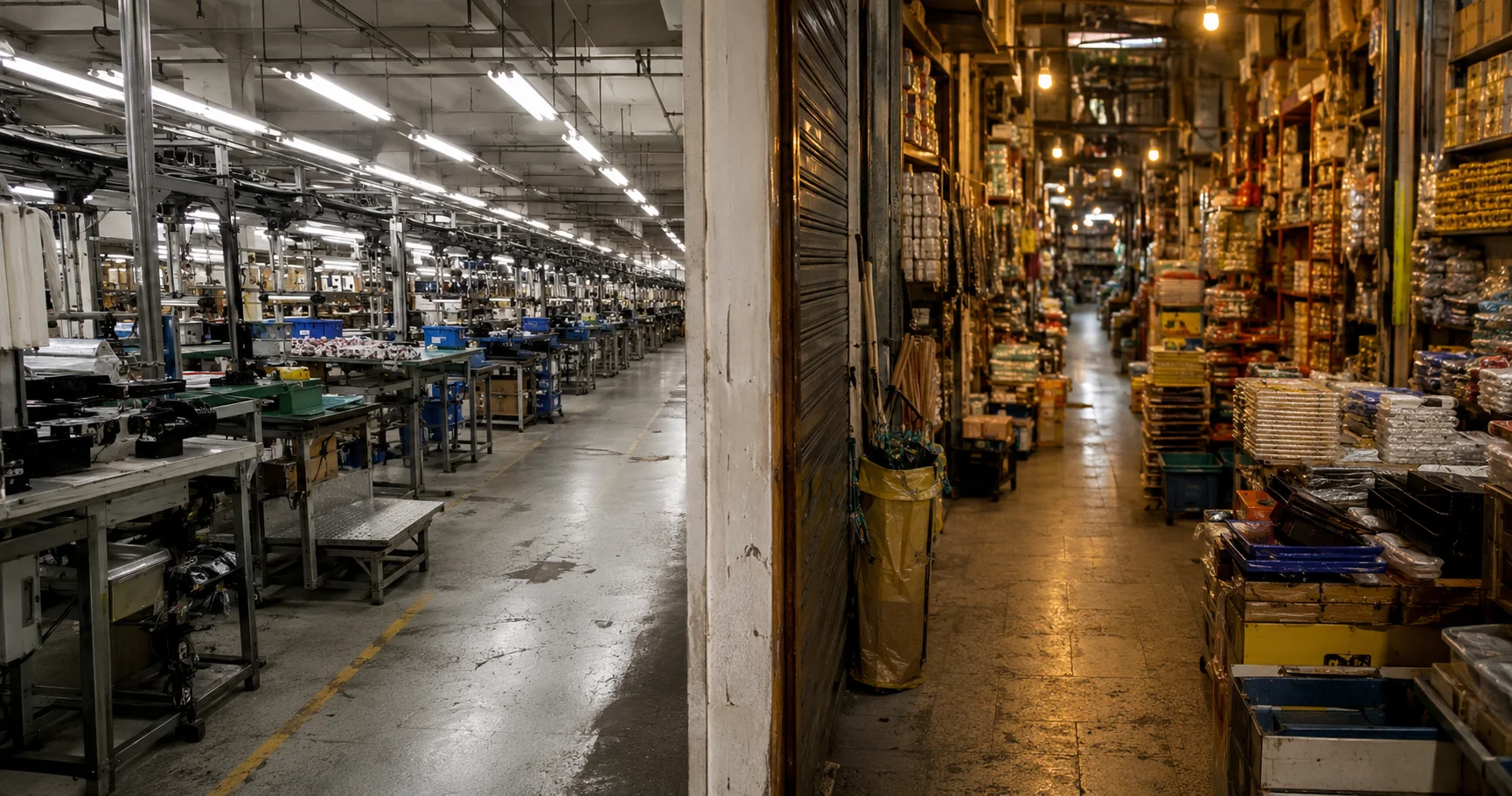

  • Guangzhou Manufactures Products While Yiwu Sells What Already Exists

    Guangzhou Manufactures Products While Yiwu Sells What Already Exists

    Ask ten importers where to source in China and you’ll hear Guangzhou and Yiwu mentioned more than any other names. They sit 1,100 kilometres apart, serve completely different jobs, and yet first-time buyers routinely treat them as interchangeable: book a flight to whichever came up first on a forum, walk around for three days, and come home confused about why the prices, minimums and paperwork looked nothing like what they’d read. That trip usually happens because Guangzhou vs Yiwu sourcing gets treated as a choice of destination rather than a choice of supply chain.

    The confusion is understandable. Both cities move staggering volumes of export goods. Both are full of suppliers eager to quote. But they are structurally different machines. Guangzhou is the front door to the Pearl River Delta’s factory economy: the place you go to have things made. Yiwu is the world’s largest small-commodities wholesale market: the place you go to buy things that already exist. Once you frame the choice that way, most of the decision makes itself.

    Guangzhou Manufactures Products While Yiwu Sells What Already Exists

    What Guangzhou Actually Is

    Guangzhou is the capital of Guangdong province and the commercial anchor of the Pearl River Delta: the densest manufacturing region on earth. Within a two-hour drive sit Foshan (furniture, ceramics, appliances), Dongguan (electronics, toys, footwear), Shenzhen (electronics, hardware), Zhongshan (lighting), and Guangzhou itself (apparel, leather goods, cosmetics, auto parts). When people say “sourcing from Guangzhou,” they usually mean sourcing from this entire ecosystem, with Guangzhou as the base.

    It is also home to the Canton Fair, China’s largest trade exhibition, which runs twice a year in three phases: electronics and machinery first, consumer goods and home products second, textiles and apparel third. The fair matters because it is where factories, not traders, come to exhibit. A booth at the Canton Fair is a reasonable (though not infallible) signal that you are talking to a manufacturer with export experience.

    The Guangzhou model runs on factory-direct access. You identify a factory, negotiate a specification, agree an MOQ and a unit price, pay a deposit, and the factory produces your order. That opens the full menu of customisation: your materials, your dimensions, your branding moulded or stitched into the product rather than stickered onto it. OEM (they build your design) and ODM (you adapt their design) both live here.

    What Yiwu Actually Is

    In Zhejiang province, about 300 kilometres south of Shanghai, Yiwu is a different animal entirely. Yiwu International Trade City (the “Futian Market”) is the largest wholesale market complex in the world: five interconnected districts, more than 75,000 booths, an estimated 400,000-plus distinct product lines. If you spent one minute at each booth for eight hours a day, you would need most of a year to see it all.

    Each booth is a small showroom, typically ten to twenty square metres, stacked floor to ceiling with one narrow category: hair accessories, umbrellas, socks, photo frames, party supplies, phone cases, Christmas decorations (an entire district, trading year-round). The person behind the counter is usually a trader or a factory’s sales agent, not the manufacturer. Stock sits in warehouses around the city, and goods sell by the carton.

    Around the market has grown a dense service ecosystem: buying agents who escort you booth to booth, consolidation warehouses that receive cartons from dozens of sellers, inspection services, and export agents who handle the customs paperwork for mixed shipments. More than the market itself, this ecosystem is Yiwu’s real competitive advantage.

    The Fundamental Difference: Factory-Direct vs Market-Stall Wholesale

    Strip away the geography and the choice is between two supply-chain structures.

    Guangzhou (factory-direct): fewer intermediaries, so fewer price layers. High minimums, because a factory has to justify a production run. Full customisation. Lead times of 30 to 60 days from deposit to ex-factory, because your goods don’t exist until they’re made. The ability to audit the actual production site.

    Yiwu (market wholesale): one extra price layer (the booth’s margin, typically 5 to 15 per cent over factory price). Low minimums, often a single carton. Customisation limited to logo stickers, printed cards and packaging. Lead times of days to two weeks, because the goods already exist. A structural blind spot: the booth is not the factory, so you inspect stock, not production.

    A useful way to decide between them is to ask what job you’re hiring the hub to do. If the job is “manufacture my product to my specification at a per-unit cost that works at scale,” that’s a Guangzhou job. No Yiwu booth can be hired for it. If the job is “assemble a wide, shallow range of general merchandise quickly without committing serious capital to any single SKU,” that’s a Yiwu job. Hiring a Guangdong factory for it commits you to factory MOQs on twenty products you haven’t validated, which is how importers end up with a garage full of slow movers.

    In practice: Guangzhou for hero products, OEM/ODM work, electronics, furniture, apparel programs, and anything where the product itself is your differentiation. Yiwu for accessories, promotional items, packaging inserts, seasonal merchandise, giftware, and range-fillers where speed and low commitment matter more than uniqueness.

    MOQ Economics: Where the Crossover Sits

    The numbers make the trade-off concrete. Take a stainless-steel insulated water bottle, a category available in both hubs.

    A Yiwu booth might quote ¥14 per unit (about A$3.00) with a one-carton minimum of 50 units and a realistic working minimum of 200 units across colours. Total commitment for a 200-unit test: roughly A$600 in product. A Foshan factory making the equivalent bottle might quote ¥10.5 per unit (about A$2.25), but with a 3,000-unit MOQ. Total commitment: roughly A$6,750, plus a longer wait and more upfront work on specification.

    The per-unit saving from going factory-direct is A$0.75, or 25 per cent. So when does the factory route win? Not simply “when you need 3,000 units.” The honest comparison includes the cost of being wrong. If there’s a meaningful chance the product doesn’t sell, the Yiwu route lets you spend A$600 to find out; the factory route makes that same lesson cost A$6,750. Run the expected-value maths: if you assign even a 30 per cent probability that a new SKU underperforms and has to be cleared at cost, the factory’s per-unit advantage evaporates on order one and only shows up on the reorders. That is why experienced importers describe the sequence as validate in Yiwu, scale in Guangdong: the first order is market research you happen to be able to sell; the third order is where factory pricing earns its keep.

    As a rough rule across general-merchandise categories: below about 1,000 units per SKU, Yiwu almost always wins on total economics. Above 5,000 units of a proven seller, factory-direct almost always wins. Between those lines, the deciding factors are customisation need and your confidence in demand, not price alone.

    Quality Control: Two Different Risk Profiles

    The QC conversation differs between hubs, and importers who apply the wrong playbook get burned.

    In the Guangzhou model, you can audit the factory before you order: walk the production line, check certifications, review their existing export clients, confirm the machinery matches the product they claim to make. During production you can commission an in-process inspection, and before shipment a final random inspection against an agreed AQL standard. The risk profile is front-loaded: pick the wrong factory and everything downstream suffers. But the tools to manage it are mature. Our guide on vetting Chinese suppliers covers the audit process in detail.

    In the Yiwu model, you inspect what exists. The sample on the shelf looks fine; the question is whether the 40 cartons that arrive at the consolidation warehouse match it. Batch consistency is the specific weakness: market stock may come from different production runs, or even different factories supplying the same booth, so material weight, colour calibration and finish can drift between cartons. And because the booth owner is a trader, your recourse when a batch disappoints is weaker: there’s no production line to correct, only a negotiation over replacement stock.

    Mitigating the risk is unglamorous but effective: a pre-shipment inspection at the consolidation warehouse, sampling cartons from every booth in the order, before anything is loaded. It costs a few hundred dollars for a day of inspection. The most expensive sentence in Yiwu sourcing is “it’s just cheap goods, inspection isn’t worth it”: on a A$15,000 mixed container, a 10 per cent defect rate uncaught is A$1,500 of landfill plus the freight you paid to ship it.

    One more trap deserves its own flag: the booth is not the factory. Booth staff will happily say “we are the manufacturer” because it closes sales. Sometimes it’s true: many Zhejiang factories run booths as sales offices. Often it isn’t. If the answer matters to you (for customisation, for compliance documentation, for reorder stability), verify it the same way you’d verify any supplier claim: business licence, factory address, and ideally a visit.

    Consolidation and Logistics: How Goods Actually Leave Each Hub

    Here Yiwu plays its strongest card. Buying from twenty booths creates twenty small deliveries, a logistics nightmare anywhere else. In Yiwu it’s a solved problem. Your buying agent gives every booth the same consolidation warehouse address; cartons arrive over one to two weeks; the warehouse checks quantities against your purchase list, arranges inspection if you’ve booked it, and books the container. Twenty suppliers become one shipment. This is the machinery that makes mixed-SKU importing viable at all, and it’s the reason a Yiwu order of 25 different products can be less operational work than a single factory order elsewhere. If you’re combining suppliers into shared containers regularly, our piece on freight consolidation for Australian imports walks through the mechanics.

    Geography helps too. Yiwu sits roughly two hours by truck from the port of Ningbo-Zhoushan, one of the world’s largest container ports, with an established Yiwu–Ningbo corridor of bonded trucking and even a customs-supervised rail link. Drayage is cheap, frequent and predictable.

    Guangzhou-area cargo exits through Nansha (Guangzhou’s own deep-water port), Shenzhen’s Yantian or Shekou terminals, or Hong Kong, all well within two hours of most Pearl River Delta factories. For a single-factory FCL order this is as smooth as export logistics gets: the factory loads the container at their own dock and it trucks straight to the terminal.

    The shipment profiles differ accordingly. Guangzhou sourcing tends to produce FCL shipments of one or few SKUs from one supplier. Yiwu sourcing tends to produce either LCL shipments (for smaller test orders) or a single mixed FCL assembled at the consolidation warehouse. Neither profile is better; they simply match the sourcing model that produced them.

    Export Mechanics: Yiwu’s 1039 Regime

    A quieter but real Yiwu advantage is regulatory. Standard Chinese exports require VAT invoices and export declarations tied to each supplier: manageable when you buy from one factory, painful when you buy from twenty booths, most of which are small traders not set up to issue export paperwork.

    Yiwu’s answer is market procurement trade mode 1039, a simplified export regime created specifically for the small-commodities trade. Under 1039, an authorised export agent consolidates goods purchased from multiple market sellers onto a single customs declaration, without needing VAT invoices from each individual booth. The agent acts as exporter of record; you buy the goods, the agent handles the border. It’s the administrative twin of the physical consolidation warehouse, and together they make the twenty-booth container not just possible but routine.

    From Guangzhou, exports run through the standard regime: the factory or a licensed export agent declares the goods, issues export documentation, and claims any VAT rebate. That means more paperwork per supplier, but with one or two suppliers per shipment it’s a non-issue. The documentation trail is also cleaner, which matters for products needing compliance certificates or detailed origin records.

    Australian Importer Specifics

    Transit times are nearly identical. Ningbo to Melbourne, Sydney or Brisbane runs about 14 to 18 days on direct services; South China ports to the same destinations sit in the same band. Port choice should not drive your sourcing decision.

    ChAFTA applies equally. The China–Australia Free Trade Agreement‘s tariff preferences depend on the goods’ Chinese origin and correct documentation, not on the city of purchase. Your export agent (Yiwu) or factory (Guangzhou) arranges the Certificate of Origin either way. The broader compliance picture is identical from both hubs (GST, import declarations, ACCC product safety standards); our guide to importing from China to Australia covers it end to end.

    Freight cost differences are noise; product cost differences are signal. A per-container ocean freight difference between Ningbo and Nansha departures might be one or two hundred dollars in a given month, and it flips direction with market conditions. The product-cost difference between the two sourcing models on a full container is measured in thousands. Optimise the sourcing, not the port. For Australian importers, the Guangzhou vs Yiwu sourcing decision should rest on product cost, customisation and MOQ, with the port left to follow.

    Samples still travel the same way. Whichever hub you choose, get physical samples to Australia before committing: a courier satchel of samples is the cheapest insurance in the trade. See our guide on shipping samples from China for the practical options.

    Trade Fair Strategy: Canton Fair vs Yiwu Fair

    If you’re planning a sourcing trip, the fairs anchor the calendar. The Canton Fair (Guangzhou, April and October) runs in three phases over roughly three weeks: Phase 1 electronics, machinery and hardware; Phase 2 consumer goods, gifts and home décor; Phase 3 textiles, apparel, shoes and office supplies. Attend the phase matching your category, collect factory contacts, then use the following days to visit factories within the Delta. The fair-to-order workflow (meet at the fair, sample by courier, audit the shortlisted factory, place the order) typically spans six to ten weeks.

    The Yiwu International Commodities Fair (October) is smaller and more trader-heavy, but honestly, Yiwu’s permanent market makes the fair semi-optional: the Futian Market is effectively a trade fair that never closes. Many importers structure a single trip around Canton Fair Phase 2, then take the high-speed rail up to Yiwu (about 6.5 hours, or a short flight) to fill out the accessory end of their range the same week. One trip, both models.

    Worked Example: A 30-SKU Homewares Range Split Across Both Hubs

    Consider an Australian homewares importer building a 30-SKU range: 6 hero products (a signature ceramic dinnerware set, glass storage jars, an acacia serving-board line) and 24 range-fillers (silicone utensils, napkin rings, placemats, candles, drawer organisers, and similar general merchandise).

    The all-Guangzhou version: the 6 hero SKUs suit factory sourcing perfectly: say 3,000 units each at an average US$2.60, about US$46,800. But pushing all 24 fillers through factories commits US$22,800 to unvalidated SKUs, even at a lenient 1,000-unit MOQ and US$0.95 average, plus the coordination burden of a dozen-plus factory relationships. Total product spend: roughly US$69,600, with heavy inventory risk on the tail.

    The all-Yiwu version: the 24 fillers work beautifully: 300 units each at US$1.10 average is US$7,920, consolidated by one agent into a part-container. But the hero SKUs suffer: market-stock dinnerware at US$3.40 equivalent with no custom glaze, no branding beyond a sticker, and batch-consistency risk on the product your brand stands on. The range loses its differentiation exactly where differentiation pays.

    The hybrid: hero SKUs factory-direct from Foshan/Chaozhou factories: 3,000 units each at US$2.60, US$46,800, shipped FCL from Nansha with a proper production inspection. The 24 fillers from Yiwu: 300 units each at US$1.10, US$7,920 plus roughly US$650 agent fee and US$400 consolidation/inspection, shipped LCL or part-FCL from Ningbo under trade mode 1039. Total product spend about US$55,770: US$13,800 less cash committed than all-Guangzhou, with the savings concentrated precisely in the SKUs most likely to be replaced next season. Filler SKUs that prove themselves get promoted to factory orders in the next cycle; the crossover maths from earlier tells you when. Two shipments instead of one is a modest freight penalty (typically under US$1,500 all-in) against a five-figure reduction in inventory risk. When reorder volumes grow, the same structure scales cleanly; our article on scaling imports for an Australian business picks up that thread. Before committing to either split, a corporate freight quote from Swift Cargo shows the real landed-cost gap between a single-factory FCL and a mixed Guangzhou–Yiwu shipment.

    This comparison points toward something more structural. The trading-company layer in Yiwu has always sold two things: access to a fragmented supplier base, and the ability to consolidate small orders into one shipment. The second is a genuine logistics service and it is not going anywhere. The first is information: knowing which booth is the factory and which is a reseller. The cost of acquiring that information yourself has fallen steadily as supplier verification, video factory audits and cheap sample logistics have improved. That is a cost curve, not an opinion about middlemen. As it keeps falling, intermediaries lose the only advantage they had: a margin that depended on you being unable to check. The buyers who build their own verification habit capture that margin instead.

    Common Mistakes

    Using Yiwu for products that need customisation. If your product requires a structural change (different material, different dimensions, a moulded logo), the booth will quote it enthusiastically and then pass it back to a factory with factory MOQs and factory lead times. You’ve added a margin layer and lost direct communication for nothing. Go to the factory.

    Committing to factory MOQs before validating demand. The 25 per cent per-unit saving is real, but it’s paid for with a 10x larger commitment. On unproven SKUs, the expected cost of dead stock usually exceeds the unit saving. Test small, then scale.

    Skipping inspection because “it’s just Yiwu goods.” Cheap goods still cost full freight, full duty and full reputation when they arrive wrong. Batch consistency is Yiwu’s known weak point; a warehouse inspection is the cheap fix.

    Assuming the booth owner is the manufacturer. Sometimes true, often not, always worth verifying if reorder stability or compliance documentation depends on it.

    Treating the hubs as rivals instead of a system. The strongest importers we work with don’t choose Guangzhou or Yiwu. They route each SKU to the hub whose structure matches the job, and let the freight plan follow the sourcing plan, not the other way around.

    A Rule of Thumb for Guangzhou vs Yiwu Sourcing

    Below about 1,000 units per SKU, or when you need a wide range quickly, Yiwu usually wins on total cost; above about 5,000 units of a proven seller, or whenever the product needs structural customisation, go factory-direct in Guangdong. Validate new SKUs in Yiwu, then move the ones that sell to a factory when you reorder.

    Related Reading

    Frequently Asked Questions

    Is Guangzhou or Yiwu cheaper for sourcing products?

    It depends on volume. Yiwu booths sell by the carton with working minimums of 100–500 units, so total cash outlay is lower for small orders. Guangdong factories require 1,000–5,000+ unit MOQs but per-unit prices typically run 15–30 per cent lower at volume. For most general-merchandise categories the crossover sits somewhere between 1,000 and 5,000 units per SKU: below that, Yiwu’s flexibility wins; above it, factory pricing does.

    Can I get custom or private-label products in Yiwu?

    Only lightly. Booths can usually add logo stickers, printed inserts or custom packaging to existing stock. Anything structural (materials, dimensions, moulded branding) goes back to a factory, with factory MOQs attached. Genuine OEM/ODM work belongs in the Guangzhou and wider Guangdong ecosystem.

    What is Yiwu’s market procurement trade mode (1039)?

    A simplified export regime built for small-commodity trade. An authorised export agent consolidates purchases from many booths onto one customs declaration without collecting VAT invoices from each seller. It’s the administrative machinery that makes a twenty-booth mixed container routine rather than a paperwork ordeal.

    Which port do Yiwu goods ship from, and does it affect transit to Australia?

    Yiwu cargo exits through Ningbo, about two hours away by truck. Guangzhou-area cargo ships via Nansha, Shenzhen or Hong Kong. Transit to Australian east-coast ports runs a similar 14–18 days from both regions, so the port question rarely decides the sourcing question.

    Do ChAFTA tariff preferences apply equally to both hubs?

    Yes. ChAFTA preferences depend on Chinese origin and correct documentation (a Certificate of Origin arranged by your factory or export agent), not on the city where you bought the goods.

    Should I inspect goods bought in Yiwu?

    Yes. Batch consistency is market sourcing’s specific weakness: shelf samples and warehouse cartons can differ in weight, colour and finish. A pre-shipment inspection at the consolidation warehouse costs a few hundred dollars and routinely pays for itself on the first container.

  • Tariff Concession Orders (TCOs): The Duty-Free List Most Importers Never Check

    Tariff Concession Orders (TCOs): The Duty-Free List Most Importers Never Check


    Ask a hundred Australian importers whether they checked the TCO register before their last shipment and you will get a lot of blank looks. Most have never heard of it. Yet the register is a public list of goods the government has already agreed should enter Australia duty-free, with no free trade agreement required, no certificate of origin, no negotiation. If your goods match a Tariff Concession Order, the 5% general duty rate simply disappears. Checking whether a tariff concession order in Australia already covers your goods takes about an hour with the register.

    Invert the usual question for a moment. Importers spend enormous energy asking “how do I reduce my duty?”, chasing FTA paperwork, arguing classifications, restructuring supply chains. The better question is often “has someone already eliminated this duty, and did I bother to look?” For thousands of tariff lines, the answer to the first half is yes. The answer to the second half, for most importers, is no. That gap is where real money sits.

    Tariff Concession Orders (TCOs): How Australian Importers Legally Pay Zero Duty

    What a Tariff Concession Order Actually Is

    A Tariff Concession Order is a legal instrument, administered by the Australian Border Force (ABF), that makes a specifically described good duty-free when imported into Australia. Not reduced duty. Zero.

    The logic behind the scheme is refreshingly clean. Tariffs exist to protect local industry: a 5% duty on imported widgets makes Australian-made widgets relatively cheaper, shielding local manufacturers from foreign competition. But what if nobody in Australia makes widgets, or anything substitutable for them? Then the tariff protects no one. It is just a tax on Australian businesses that have no choice but to import. The TCO system exists to remove exactly that dead-weight tax: where no Australian manufacturer produces substitutable goods in the ordinary course of business, a concession can be made and the duty falls away.

    That single test, no substitutable Australian-made goods in the ordinary course of business, is the spine of the entire system. It determines whether a new TCO can be granted, and it determines whether an existing one survives. Everything else is mechanics.

    A few structural points worth fixing in your head early:

    • TCOs attach to goods, not importers. Once a TCO exists, any importer whose goods match it can use it. You do not need to be the applicant. Most TCOs in the register were applied for by someone else years ago, and they sit there available to anyone who checks.
    • TCOs are origin-independent. Unlike FTA preferences, a TCO does not care where the goods were made. Germany, India, Brazil, anywhere: if the goods match, the concession applies.
    • TCOs are made under a specific tariff classification. Each TCO hangs off a tariff code. Your declared classification must match the TCO’s classification, or the concession cannot be claimed at all. More on this trap later.
    • The register is public. Thousands of TCOs are in force at any time, searchable by anyone, for free.

    Note what a TCO does not remove: GST is still payable on the import (though most registered businesses claim it back as an input tax credit), and other charges such as import processing charges still apply. The TCO eliminates customs duty, which, at the general rate of 5% of customs value, is usually the number that matters.

    Finding an Existing TCO: Searching the Register

    The starting point is your tariff classification. Every TCO is made under a specific tariff code, so you cannot search meaningfully until you know, with confidence, how your goods classify. If your classification is shaky, fix that first; a TCO search built on a wrong code will either miss the concession that exists or find one you cannot lawfully use.

    With the code in hand, you search the TCO register (published by the ABF) by tariff classification. The search returns every concession in force under that code, each with a TCO number, an operative date, and, critically, a description of the goods covered.

    The wording is the whole game

    Here is the part that catches people. A TCO does not cover “goods of heading 8479” or “machinery like the applicant’s.” It covers goods matching a precise verbal description, and your goods must match that description exactly. Not approximately. Not in spirit. The words of the concession are decisive, and customs tribunals have spent decades confirming that the description means what it says: no more, no less.

    Consider a realistic TCO text, structured the way real ones are:

    MACHINES, LABELLING, self-adhesive label, having ALL of the following: (a) label application speed exceeding 200 labels per minute; (b) programmable logic controller; (c) label sensor with automatic web-break detection

    Read this the way a customs officer will. The head noun is MACHINES, LABELLING, so the goods must be labelling machines, full stop. The qualifier “self-adhesive label” narrows it: a machine applying glue-applied labels is outside the concession. Then “having ALL of the following” imposes three cumulative conditions. A machine that applies self-adhesive labels at 180 per minute fails condition (a) and gets nothing, even though it is in every commercial sense the same kind of machine. Each condition is a gate; miss one and the concession does not apply.

    Some TCOs run the other way and use expansive drafting. You will see descriptions ending in phrases like “including” lists, or conditions framed as “having EITHER of the following,” or the word “other” doing quiet work, as in PUMPS, centrifugal, other than submersible. That “other than” is an exclusion: submersible centrifugal pumps are carved out. Meanwhile a description like PARTS, machine, being ANY of the following followed by a list operates as a menu: matching any single item is enough. The drafting conventions (ALL / ANY / EITHER in capitals, exclusions flagged with “other than” or “excluding”) are consistent, and learning to read them takes twenty minutes that can be worth twenty thousand dollars.

    Practical search habits that pay off:

    • Search the full code and the neighbouring codes. If your classification is arguable between two headings, check the register under both, partly to find concessions, partly because a TCO under a neighbouring code may hint at where similar goods have been classified before.
    • Read every concession under the code, not just the first plausible one. Multiple TCOs often exist under one classification, with different scopes. The third one down may fit when the first does not.
    • Match your goods’ actual specifications against each condition in writing. Get the technical datasheet, put it next to the TCO text, and tick each element. If you cannot tick every element of an “ALL of the following” concession with documentary support, do not claim it.
    • Check the concession is still in force. The register shows operative and (where relevant) revocation dates. A revoked TCO helps you only for imports before the revocation date.

    Using an Existing TCO: The Mechanics of the Claim

    Claiming an existing TCO is almost anticlimactic. On the import declaration, against the relevant line, you (or in practice your customs broker) quote a treatment code indicating a tariff concession and cite the TCO number. Duty on that line is calculated at zero. There is no application, no approval letter, no waiting. The concession already exists; you are simply invoking it.

    The broker’s role here deserves a frank word. A good broker will proactively check the register for every new product a client imports and will flag candidate TCOs. Many brokers do exactly this. But brokers process high volumes at thin margins, and a register check for a client who has not asked for one is unbilled diligence. It is entirely possible, common even, for goods with a valid TCO available to be entered at the full 5% for years because nobody looked. The importer assumes the broker checks; the broker assumes the importer would have mentioned it. Do not let the concession fall into that gap. Ask your broker directly: has the TCO register been checked against our tariff classifications, and when?

    The classification-must-match trap

    One mechanical trap disqualifies otherwise perfect claims: the TCO can only be used if your goods are classified to the same tariff code the TCO is made under.

    Suppose a TCO for your exact machine exists under heading 8422, but you and your broker have concluded the machine properly classifies to 8438. You cannot quote the 8422 TCO against an 8438 entry. The system will not marry them, and lawfully they do not marry. Your options are to revisit the classification (perhaps the TCO’s existence under 8422 reflects a considered ABF view of where such goods belong, which is evidence worth weighing), to seek a formal tariff advice from the ABF to settle the classification, or to apply for a new TCO under the classification you believe is correct.

    What you must not do is bend the classification to reach the concession. Classifying goods to a code you know is wrong, in order to access a TCO under that code, is a false statement on a customs declaration. The duty saving is not worth the exposure. Classification first, honestly determined; then see which concessions live there.

    Applying for a New TCO

    If no existing TCO fits, and you import the goods regularly, applying for a new one is a genuine option, and less daunting than most importers assume. The scheme is designed to be used.

    The eligibility test

    The core criterion: on the day the application is lodged, no Australian manufacturer produces substitutable goods in the ordinary course of business. Unpack the phrases:

    • Substitutable goods means Australian-made goods with a use corresponding to a use of the imported goods. It is a use-based test, not an identity test. The local product does not need to be identical, the same quality, or even the same price. If it can be put to a corresponding use, it is substitutable and the TCO fails. This is deliberately broad and it is where most contested applications are fought.
    • Ordinary course of business filters out theoretical capability. A local firm that could make the goods if someone asked, or made them once in 2019, is generally not producing them in the ordinary course of business. But a firm that makes them to order as part of its normal activities may well be.

    Certain goods are excluded from the TCO system regardless: broadly, foodstuffs, clothing, and passenger motor vehicles sit outside the scheme, reflecting industries where tariff policy is handled differently. If your goods are industrial equipment, components, instruments, or specialised inputs, you are in the scheme’s heartland.

    Process and timeline

    The sequence runs like this:

    1. Lodge the application with the ABF, including a precise proposed description of the goods (you are drafting the very wording future importers will live with, so draft it carefully), the tariff classification, and evidence supporting the claim that no substitutable local goods exist.
    2. Gazette publication. Valid applications are published, putting Australian industry on notice.
    3. Objection window. Local manufacturers have a defined period (50 days from gazettal) to object on the ground that they produce substitutable goods. An objection turns the application into a contest of evidence.
    4. Decision. The ABF must decide within the statutory timeframe. In practice, budget roughly 150 days end to end from lodgement to decision.

    Two timing features make the economics better than they first appear. First, if granted, a TCO generally operates from the date the application was lodged, so imports made while you waited can have their duty refunded. Lodge, keep importing, and treat the duty paid in the interim as a recoverable deposit rather than a sunk cost. Second, once made, the TCO is public: your competitors can use it too. Some applicants find that galling; the arithmetic rarely supports waiting for someone else to do the work instead.

    The evidence burden

    The application stands or falls on market research. You are proving a negative, that no substitutable Australian-made goods exist, which means demonstrating you looked properly. Strong applications typically show:

    • Searches of Australian manufacturer directories and industry association member lists for firms plausibly making comparable goods;
    • Direct enquiries to any candidate local manufacturers, with their responses documented (“we do not manufacture this class of equipment” in writing is gold);
    • Technical analysis explaining why superficially similar local products do not have a corresponding use, which is where engineering detail earns its keep;
    • Evidence of how the goods are actually procured in the Australian market (if every buyer imports, that itself says something).

    Skimping here is the classic false economy. A thin application invites objection and refusal; a thorough one often deters objection entirely, because a local manufacturer reading a well-evidenced gazettal can see the objection would fail.

    The Revocation Risk

    A TCO is not a permanent entitlement. The premise of every concession is the absence of local manufacture, and premises can stop being true.

    If an Australian manufacturer begins producing substitutable goods in the ordinary course of business, they can apply to have the TCO revoked. The ABF assesses the claim on the same substitutability test used at grant. If the revocation succeeds, the revocation dates back to the request: it takes effect from the day the revocation request was lodged, not the decision date, so entries made while the request was assessed can lose the concession. Entries before the request keep it. Treat every tariff concession order in Australia that your margins depend on as a concession to monitor, not a permanent rate.

    The warning that does exist comes through gazette notices. Revocation requests and decisions are published, just as applications are. Which creates a simple operational rule for any importer whose margins lean on a TCO:

    • Keep a live list of every TCO number you rely on, with the tariff code and annual duty saving attached to each, so you know what is at stake per concession.
    • Monitor gazette notices for revocation activity touching those TCOs or their tariff codes. This is a five-minute periodic check, easily delegated to your broker as a standing instruction.
    • Model your landed costs both ways. If a AUD 20,000-a-year saving would break the business case for a product line, you want to know before the revocation notice, not after. Treat the TCO as a probability-weighted saving, not a birthright.

    ABF can also revoke a TCO on its own initiative in some circumstances, for instance where the concession was made in error or the goods description has been overtaken by tariff changes. Rare, but another reason the standing gazette check is worth having.

    TCOs vs FTAs: Which Tool, When

    Australia has free trade agreements covering most major trading partners, and FTA preference is the duty-saving route importers hear about constantly. So where does a TCO fit alongside them?

    The first thing to say: you use one or the other on a given line, not both. Duty is either zero via TCO or zero (or reduced) via FTA preference; there is nothing to stack. The question is which claim to make, and sometimes only one is available.

    The TCO’s structural advantage is origin-independence. An FTA preference requires the goods to originate in the partner country under that agreement’s rules of origin (RoO), evidenced by origin documentation. A TCO asks only one question: do the goods match the description? Where they were made is irrelevant. That gives the TCO a clear win in three situations:

    • No FTA with the origin country. Germany and the wider EU are the headline example for machinery importers. At the time of writing there is no in-force Australia–EU trade agreement, so German, Italian, and Swiss-adjacent equipment pays the general 5% rate unless a TCO covers it. The same is true for goods from Taiwan, Brazil, South Africa, edge cases in the UK’s non-covered categories, and plenty of others. For these origins, the TCO register is effectively the only zero-duty route.
    • FTA exists but the goods fail rules of origin. Goods shipped from an FTA partner do not automatically qualify. RoO tests (change of tariff classification, regional value content) trip up goods with heavy third-country inputs. A Chinese-assembled machine full of Japanese and German components may not qualify as Chinese-originating under ChAFTA. If a TCO covers the goods, the origin question evaporates.
    • FTA paperwork is not worth the friction. Even where preference is available, it comes with certificates of origin, supplier declarations, and audit exposure if the origin claim is ever tested. A valid TCO makes all of that unnecessary: no certificate, no RoO analysis, no dependence on a supplier’s paperwork discipline. For goods covered by both routes, many brokers will claim the TCO precisely because it is the cleaner instrument.

    The FTA wins, conversely, when no TCO matches your goods and none is realistically grantable, most commonly because an Australian manufacturer does make substitutable goods. Consumer products, food, apparel, and generic industrial goods usually live in FTA territory. Specialised capital equipment lives in TCO territory. Many importers need both tools across their catalogue; the mistake is knowing only one exists. For the FTA side of the decision, see our companion guide on Australia’s free trade agreements for importers.

    Worked Example 1: German Machinery, Existing TCO, AUD 20,000 Saved

    An Adelaide food processor orders a specialised depositing and filling line from a German manufacturer. Numbers:

    • Machine price (customs value after adjustments): AUD 400,000
    • Origin: Germany, with no FTA, so the default duty rate is the general 5%
    • Duty at 5%: AUD 20,000
    • GST is payable on the value-of-taxable-importation either way and is recoverable as an input credit, so we set it aside; note only that duty itself inflates the GST base slightly, so killing the duty trims the GST cashflow too.

    The importer’s broker classifies the machine and, as a matter of routine, searches the TCO register under that code. A concession exists, applied for years earlier by a different importer of similar equipment, describing depositing machines with specifications the German line meets on every element. The broker matches the manufacturer’s datasheet against each condition of the TCO text, confirms the classification on the entry is the code the TCO is made under, and quotes the TCO number on the import declaration.

    Result: duty AUD 0 instead of AUD 20,000. Time cost: perhaps an hour of register search and datasheet matching. There was no application, no waiting period, no dependence on German origin paperwork. The concession was sitting in a public register, available to anyone who looked. On a machine this size the saving is 5% of the capital cost, which for many equipment purchases is the difference between the business case clearing its hurdle rate or not. If you’re importing capital equipment like this line, a corporate freight quote folds the TCO saving straight into your landed-cost comparison before the PO is placed.

    Run the counterfactual, because it is the common case: the importer who never checks pays the AUD 20,000 without ever knowing it was optional. No error message, no missed-savings alert on the declaration. The system will happily take full duty forever. If you are importing capital equipment, pair this check with our guide to importing machinery to Australia, which covers the classification and compliance groundwork the TCO claim sits on.

    Worked Example 2: The Exact-Wording Failure

    Now the cautionary mirror image. A Melbourne importer brings in industrial mixing equipment and finds a TCO under the right tariff code describing, in substance: MIXERS, planetary, having a bowl capacity exceeding 150 L. Their machines are high-capacity industrial mixers, so surely this is the one. The broker, on the client’s assurance, quotes the TCO.

    The problem surfaces in a post-clearance compliance check eighteen months later. The imported machines are spiral mixers, not planetary mixers: a different mixing action, a different variant of the product class. The client had read “MIXERS” and stopped reading; the qualifying word “planetary” did the deciding. The goods do not match the concession’s wording, so the concession never lawfully applied.

    The consequences arrive as a bundle:

    • Back-duty on every entry that claimed the TCO, at 5% of the customs value of eighteen months of shipments, demanded in one assessment;
    • Potential penalties for false or misleading statements on the declarations, with the outcome depending heavily on whether the error looks careless or considered, and on whether the importer discovered and disclosed it voluntarily;
    • Compliance attention going forward, since an importer found claiming concessions loosely can expect their future entries to be looked at harder.

    The lesson is not “avoid TCOs”. It is that the wording is the instrument. “Close enough” is a category error: a TCO is not a discount for goods of roughly that kind. It is a precise legal description with a binary outcome. The five-minute fix is the discipline from earlier: datasheet beside concession text, every element ticked with evidence, and where any element is genuinely arguable, get a formal ruling or written advice before claiming rather than after. A voluntary disclosure regime exists for importers who find their own errors, and using it early is dramatically cheaper than being found.

    Who Benefits Most From TCOs

    The substitutability test shapes exactly who the scheme serves. TCOs cluster where Australian manufacturing is absent, which means specialised, technical, low-volume goods:

    • Machinery and capital equipment importers. The deepest seam. Food processing lines, packaging machinery, printing equipment, CNC and machine tools, textile machinery. Australia manufactures little of this, and the register under machinery headings is thick with concessions.
    • Specialised and niche equipment. The more specific the goods, the more likely no local substitute exists and the easier a new application is to evidence. Oddly, being niche, a commercial disadvantage, is a TCO advantage.
    • Medical and scientific equipment importers. Analytical instruments, laboratory systems, diagnostic and imaging equipment. Many such goods also have concessional treatment through other instruments, but TCOs remain a significant route for the categories that duty still touches.
    • Manufacturers importing niche inputs. A local producer whose process depends on an imported specialty component, chemical intermediate, or material with no Australian source is precisely who the scheme was built for, removing a tax on an input nobody local sells.

    Conversely, if you import consumer goods, apparel, food, or anything with healthy Australian production, the register will mostly be silent for you and applications will fail the substitutability test. Your duty-reduction toolkit is FTAs and valuation discipline. See our guides on customs valuation in Australia and reducing shipping costs on Australian imports.

    Common Mistakes

    Never checking the register at all. This is the number one mistake by an enormous margin, because you cannot lose money more silently than by not claiming a concession you did not know existed. Most importers have simply never heard of TCOs. The fix costs nothing: for every product you import regularly, confirm the tariff classification and search the register under it once, then make it a standing instruction to your broker for every new product line. An hour of checking against years of 5% is one of the most asymmetric bets in importing.

    Assuming close-enough wording works. As Worked Example 2 shows, a TCO description is read literally: head noun, qualifiers, every ALL/ANY condition, every “other than” exclusion. If your goods are a variant the words do not cover, the concession does not apply, and claiming it anyway converts a duty saving into back-duty plus penalties. Match datasheet to text element by element, in writing, before the first claim.

    Claiming a TCO against the wrong tariff classification. The concession lives under a specific code; your declaration must classify the goods to that code for the TCO to attach. Classification errors therefore fail twice: wrong duty treatment and an invalid concession claim. Settle classification first, honestly, with a formal tariff advice where it is genuinely arguable.

    Missing revocation notices. A revoked TCO does not send you a letter. If local manufacture starts and the concession is revoked, your next shipment pays 5% and your costings are wrong until someone notices, often at margin-review time, months later. Keep a register of the TCOs you rely on and have gazette notices monitored as a standing arrangement.

    Not applying when no TCO exists. A softer mistake, but real. Importers who find no matching concession often stop there, when their goods (specialised, no local substitute) are strong candidates for a new application. Roughly 150 days, an evidence-gathering exercise, and duty relief that reaches back to the lodgement date: for a recurring import paying five figures of annual duty, the arithmetic usually says apply.

    Treating the TCO saving as separate from landed cost. Duty is one line in a bigger equation that also holds freight, insurance, GST cashflow, and port and broker charges. A TCO claim should feed into a single landed-cost model so you can see what each product truly costs delivered. Our walkthrough of total landed cost when importing to Australia shows where the duty line sits among the rest.

    The Checklist

    1. Confirm the tariff classification for each product you import regularly.
    2. Search the ABF’s TCO register under each classification (and arguable neighbours).
    3. For each candidate TCO, match your goods’ datasheet against every element of the wording: ALL conditions, exclusions, qualifiers.
    4. Verify the concession is in force and made under the code you will declare.
    5. Instruct your broker to quote the TCO number on the declaration; keep the matching evidence on file.
    6. No match? Assess a new application: substitutability research, ~150-day timeline, relief operative from lodgement.
    7. Log every TCO you rely on and monitor gazette notices for revocation activity.
    8. Re-run the register check whenever a product’s specification or classification changes.

    When a Tariff Concession Order in Australia Pays Off

    It pays off when you import specialised equipment or inputs with no substitutable Australian-made equivalent, because it removes the 5% general rate whatever the country of origin. It fails when the wording, the tariff classification or a later revocation does not line up, so keep datasheet evidence for every element of the concession and monitor the gazette.

    Related Reading

    Related reading: Lire cet article en français

    Frequently Asked Questions

    What is a Tariff Concession Order in Australia?

    A TCO is a legal instrument administered by the Australian Border Force that makes a specifically described good duty-free on import. It exists where no Australian manufacturer produces substitutable goods in the ordinary course of business. No local industry means no protection rationale, so the tariff is removed. Any importer whose goods match the concession’s wording can use it, regardless of origin country.

    How do I find out if a TCO exists for my goods?

    Search the ABF’s public TCO register by tariff classification code. Read every concession under your code and match your goods against the wording element by element. The description is decisive, and “close enough” does not qualify. If your goods are a variant the words do not cover, the concession does not apply.

    How do I claim an existing TCO on an import?

    Quote the TCO number on the import declaration against the relevant line, normally via your customs broker. Your declared tariff classification must be the same code the TCO is made under; keep the technical evidence showing your goods match the concession wording in case of a post-clearance check.

    How long does a new TCO application take?

    Budget roughly 150 days from lodgement to decision. The application is gazetted, local manufacturers have a 50-day objection window, and the ABF then decides. If granted, the TCO generally operates from the lodgement date, so duty paid on imports during the wait can typically be refunded.

    Can a TCO be revoked, and what happens to my imports?

    Yes. If an Australian manufacturer starts producing substitutable goods in the ordinary course of business, the TCO can be revoked. Revocation takes effect from the day the revocation request was lodged, so entries made while it is assessed can lose the concession. Monitor gazette notices for revocation activity on any TCO your costings rely on.

    Should I use a TCO or an FTA preference?

    One or the other per line, since they do not stack. A TCO is origin-independent, so it is the route when no FTA covers your origin (for example EU-made machinery) or when your goods fail rules of origin. Where both are available, the TCO is usually simpler because it removes certificates of origin and RoO analysis entirely.

  • Importing Wine to Australia: WET Tax, Labelling and Compliance

    Importing Wine to Australia: WET Tax, Labelling and Compliance

    Featured image for a wine-import compliance guide (WET tax, labelling, customs)

    The Landed Cost Formula That Doesn’t Work for Wine

    A Melbourne importer we worked with priced her first wine shipment the same way she’d priced three years of imported homewares: landed cost equals customs value, plus 5 percent duty, plus 10 percent GST. She built her retail pricing around that number and confirmed the container booking. The actual bill from her customs broker came in almost 22 percent higher than her estimate. Nothing had gone wrong with the shipment. She had simply applied the wrong tax model, because wine does not run on the duty-plus-GST formula that governs almost everything else this site covers.

    Wine carries a third charge that most first-time importers have never heard of: the Wine Equalisation Tax, or WET. It is not a customs duty, and it is not GST. It is a separate, value-based tax that applies specifically to wine, and it compounds with GST in a way that catches people who assume “tax” means one line item. Get the mechanics wrong and your landed cost estimate will be wrong by a predictable, calculable amount, every single time.

    Three Regulators, Three Separate Jobs

    Importing wine into Australia means satisfying three agencies that do not talk to each other and do not share a compliance checklist. The Australian Border Force (part of the Department of Home Affairs) handles customs valuation, collects duty, and collects WET and GST at the border. The Department of Agriculture, Fisheries and Forestry (DAFF) handles biosecurity through the Biosecurity Import Conditions system (BICON). Its concern is pests and contamination risk, not tax. Food Standards Australia New Zealand (FSANZ) sets the labelling content rules under the Food Standards Code. FSANZ is a separate body from Wine Australia, the statutory authority that regulates label truthfulness for wine made in Australia specifically. Most compliance gaps start with confusing these bodies, or with assuming one of them covers ground it doesn’t.

    The Wine Equalisation Tax, Properly Explained

    WET is a tax of 29 percent of the wholesale value of wine. That single sentence hides two things that matter. WET is calculated on value, not on a per litre or per case basis like the excise that applies to beer and spirits. And the “wholesale value” it taxes is not simply your invoice price.

    For a domestic wholesaler selling wine they’ve already imported and cleared, the taxable value is whatever they actually sell it for at wholesale. If they sell direct to the public instead of through a wholesale channel, the law deems a notional wholesale value: 50 percent of the retail selling price, with WET calculated on that halved figure. Neither of those methods is what applies at the point of import, though, because there usually isn’t an arm’s length wholesale sale happening at the exact moment a shipment clears customs.

    For an importer, the taxable value is what the Australian Taxation Office defines as the GST importation value: the customs value of the wine, plus the cost of international transport and insurance, plus any customs duty payable on the shipment. WET at 29 percent is calculated on that combined figure, not on your supplier invoice and not on your intended retail price. This is also why WET on imported wine is collected differently to how it works domestically. Home Affairs collects it directly at the border, at the time of importation, rather than the importer self-assessing it on a later Business Activity Statement. Import WET is payable regardless of your GST registration status, unlike domestic WET, which generally only applies if you’re registered or required to be registered for GST. Every wine importer pays it, every time, on every consignment.

    Why the Order of Calculation Changes the Final Number

    The sequencing is what trips up importers who’ve only ever budgeted duty and GST. Duty, WET and GST do not sit side by side as three independent percentages of the same invoice value. They stack, in a fixed order, and each one changes the base the next one is calculated on.

    Customs duty is calculated first, on the customs value of the goods. WET is calculated second, at 29 percent, on the customs value plus transport and insurance plus that duty amount. GST is calculated last, at 10 percent, on a base that by then already includes the WET you just paid. Practically, that means you pay GST on a base that already includes another tax, not on the goods value alone. This is what our general guide to import duty and GST does not cover, because almost nothing else this site’s readers import carries a third compounding tax layer between duty and GST. Wine does, and it is the single biggest reason a wine landed-cost estimate goes wrong when someone reuses the mental model from an apparel or electronics shipment.

    Wine differs from nearly every other product category in one more way. The AUD 1,000 low value threshold exempts small parcels from duty and GST, but it does not apply to alcohol: there is no minimum shipment value below which wine clears free. A single bottle shipped as a personal gift attracts duty, WET and GST on exactly the same basis as a full container.

    A Worked Example: The Same Wine, Two Origins

    Numbers show the compounding more clearly than the formula does. Take a shipment of 600 bottles (50 cases) of premium red, with a customs value of AUD 24,000 and international transport and insurance of AUD 2,200. Compare an origin that qualifies for a free trade agreement against one that doesn’t.

    Step US origin (AUSFTA, 0% duty) Non-FTA origin (5% duty)
    Customs value AUD 24,000 AUD 24,000
    Transport and insurance AUD 2,200 AUD 2,200
    Customs duty AUD 0 AUD 1,200 (5%)
    WET base (CV + T&I + duty) AUD 26,200 AUD 27,400
    WET payable (29%) AUD 7,598 AUD 7,946
    GST base (WET-inclusive) AUD 33,798 AUD 35,346
    GST payable (10%) AUD 3,379.80 AUD 3,534.60
    Total landed cost AUD 37,177.80 AUD 38,880.60
    Cost per bottle AUD 61.96 AUD 64.80

    The duty difference between the two scenarios is AUD 1,200. The actual landed cost difference is AUD 1,702.80, because the WET and GST layers both apply proportionally to that duty amount as well. A free trade agreement doesn’t just save you the duty line. It also saves the WET and GST that would otherwise have been charged on top of that duty. That compounding effect is worth building into your supplier negotiations and your landed cost model, not just your duty line. For the full mechanics of everything else that feeds into a landed cost figure, see our total landed cost guide. It covers freight, insurance, port charges and handling.

    Where Free Trade Agreements Actually Change the Number

    The general customs duty rate on wine (HS code 2204) is 5 percent. Australia’s free trade agreements can reduce that to zero for qualifying origins with valid proof of origin documentation. Wine imported from the United States, for example, enters duty free under the Australia-United States Free Trade Agreement, which removed the remaining tariffs on wine trade between the two countries. Whether your specific origin qualifies, and what documentation proves it, depends on the agreement in force with that country. Check the current rate against your HS classification and origin before you quote a landed cost to a customer, rather than assuming the general rate or assuming a preferential one.

    What a free trade agreement does not do is touch WET. WET applies at 29 percent regardless of where the wine came from. There is no FTA that reduces or removes it, because it isn’t a customs duty and isn’t negotiated as part of tariff schedules. An importer who assumes “FTA wine” means “low tax wine” across the board will still owe the full WET and GST layers on top of a zero duty rate, as the worked example above shows.

    The real error is treating “customs duty” and “total tax burden” as the same category of thing, when they are structurally different mechanisms. A tariff is a negotiated border price, something two governments agreed to lower and can renegotiate. An excise like WET is a domestic revenue instrument, applied to the product wherever it originates, with no trade-agreement lever anywhere in its design. Zero duty from an FTA is a real, negotiated win. It is not evidence that the rest of the tax structure is negotiable too. Assuming otherwise is where a landed-cost quote quietly stops being accurate.

    The WET Producer Rebate Doesn’t Work the Way Most Importers Assume

    Australian wine producers can claim a WET producer rebate, currently capped at AUD 350,000 per financial year and rising to AUD 400,000 from 1 July 2026. For a small winery selling direct, that rebate changes the economics. The rebate is not available to an importer bringing in wine someone else made. To qualify, you must have made the wine yourself, you must have owned at least 85 percent of the source product (the grapes) throughout the winemaking process, and you must package the wine for retail sale in containers of 5 litres or less. If you buy finished, bottled wine from an overseas winery, you fail the ownership-of-source-product test by definition. You didn’t grow the grapes or make the wine; you bought it after the fact.

    There is one narrow exception. Since 1 July 2005, eligible New Zealand wine producers exporting their own wine to Australia can claim the equivalent rebate themselves, under the same ownership and retail packaging tests. That eligibility sits with the New Zealand producer, not with the Australian business importing and distributing their wine. If a supplier or broker tells you the rebate can be structured to benefit your import business directly, get that claim checked before you build it into your pricing.

    Labelling: What the Label Integrity Program Actually Covers

    Wine Australia’s Label Integrity Program is the piece of the regulatory landscape most importers misread, usually by assuming its name means it’s the general “wine labelling law” that applies to their shipment. It isn’t. The Label Integrity Program is legislated under Part VIA of the Wine Australia Act 2013, and its specific purpose is verifying that claims about vintage, grape variety and geographical indication on a wine label are true, for wine manufactured in Australia. It exists to protect the reputation of Australian-labelled wine in export markets. Every party in the local supply chain must keep records substantiating those claims for seven years. An imported bottle of French Bordeaux or Californian Cabernet was not manufactured in Australia, so this specific program is not the mechanism that governs whether its label is compliant here.

    What does apply to an imported wine label is the Australia New Zealand Food Standards Code, together with the Country of Origin Food Labelling Information Standard 2016. Between them, they require: the brand and product name; alcohol content expressed as a percentage by volume; a standard drinks statement showing how many standard drinks the container holds; ingredient and allergen declarations, most commonly a sulphite or preservative (220) declaration on wine; a country of origin statement; and the name and Australian business address of the importer, plus batch or lot identification for traceability. None of that is optional, and none of it is covered by the Label Integrity Program.

    The program’s name suggests one thing and its legislated scope covers another. That mismatch illustrates a broader pattern in compliance work: the person writing the rule and the person reading the rule are often working from different mental models of what the name covers. Someone building a compliance checklist sees “Label Integrity Program” and assumes it’s the top-level control for label truthfulness generally, because that’s what the words suggest. The person who wrote the legislation was solving a narrower, specific problem: protecting Australian wine’s reputation for accurate vintage and origin claims. The checklist that actually governs an imported label was never called anything as reassuringly comprehensive-sounding, which is exactly why importers miss it.

    The Pregnancy Warning Label

    The pregnancy warning requirement was gazetted in July 2020 and took effect after a three year transition period. Since 1 August 2023, every packaged alcoholic beverage above 1.15 percent ABV sold in Australia must carry a mandatory pregnancy warning label. The label has a fixed format: the signal words “PREGNANCY WARNING” in red, the statement “Alcohol can cause lifelong harm to your baby” in black sentence case, and a pictogram of a pregnant figure with a drink inside a red circle and strikethrough. The whole label sits within a border of a prescribed size.

    DAFF has confirmed this requirement applies fully to imported alcoholic beverages, not just domestic production. Importers can comply in two ways. Either your overseas supplier applies the label before the wine ships, printing or affixing it as part of the original packaging, or you apply it after the wine arrives in Australia, using an approved sticker or back label, before you offer the wine for retail sale. What isn’t available is a third option where it doesn’t apply because the wine was made overseas. Compliance in the market has been uneven since the rule took effect: one recent audit found only around 65 percent of wine products carried the label correctly, the lowest compliance rate of any beverage category checked apart from spirits. That gap is a real commercial risk, not a theoretical one, since retailers are increasingly checking for it before they’ll stock a new import.

    Importing Wine to Australia: WET Tax, Labelling and Compliance: Biosecurity: Why the Cork Matters More Than the Wine

    Biosecurity: Why the Cork Matters More Than the Wine

    Wine sits in an unusual position in Australia’s biosecurity system compared to almost everything else this site covers. Commercially produced, sealed, packaged wine is generally treated as low risk and does not face a specific import ban, because a sealed bottle of fermented, filtered liquid carries little pest or disease risk. Most commercial wine consignments with accurate paperwork clear without a full physical inspection. Wine can look deceptively simple next to our broader guide to biosecurity requirements for importing to Australia, which covers plenty of product categories where the goods themselves are the risk.

    That simplicity stops at the cork. Unprocessed cork means raw or unshaped cork material, and it can carry insect pests. DAFF tightened the import conditions around it in 2022 because of that risk: unprocessed cork and large cork pieces may now require an import permit before they can enter. Processed cork carries lower risk. Processed means cut and shaped from virgin cork sheets, or agglomerated from bonded cork granules, which describes the overwhelming majority of actual wine bottle stoppers. You still need documentary evidence proving your cork closures meet that definition, rather than assuming they’re automatically exempt. Wooden cases and pallets carrying the wine are subject to the same ISPM 15 international treatment and marking standard as any other timber packaging entering the country. Straw or other plant-based dunnage packed around bottles can trigger the same scrutiny as any other plant material.

    None of that is a reason to relax the paperwork because “it’s just wine.” Extreme ownership is the right posture here: you don’t get to blame your supplier’s packaging choices at the border, because the declaration is yours, not theirs. Check the BICON conditions for your specific product and packaging combination before you book the shipment, not after it’s sitting at the wharf waiting on a permit you didn’t know you needed. A ten minute BICON search before you confirm a purchase order costs nothing. A held container waiting on a retrospective cork import permit costs weeks and demurrage. Discipline on the small, boring checks is what keeps a wine shipment moving at the same speed as everything else in the container.

    Getting the Paperwork Right

    A wine shipment touches more regulatory surface area per container than most of what this site’s readers import: customs valuation and duty, WET calculation, GST, a BICON biosecurity check that depends on your specific packaging materials, and a labelling check against the Food Standards Code and the pregnancy warning requirement, all before the wine can legally sit on a shelf. Most of the expensive mistakes in this guide happen on a first shipment, when nobody on the importer’s side has run that sequence before.

    This is exactly the kind of shipment where a licensed customs broker earns their fee well before the container arrives, not after something goes wrong. A broker who works wine regularly will know to check your cork classification against BICON before booking, confirm your FTA origin claim has the paperwork to survive an audit, and flag a missing pregnancy warning label before the shipment leaves the exporting country rather than after it’s sitting in an Australian bonded warehouse. If you’re choosing who handles that side of the import, our guide to working with a freight forwarder in Australia covers what to check before you commit to one. The same diligence applies whether the freight forwarder is handling clearance directly or coordinating with a licensed broker on your behalf.

    Separately, selling the wine once it’s landed requires a state or territory liquor licence. That is a different application to anything covered here, and it varies by state. Confirm the requirement early rather than assuming import clearance alone gets you to a retail shelf.

    Common Mistakes First-Time Wine Importers Make

    The same handful of errors account for most of the expensive surprises on a first wine shipment. Budgeting duty and GST only, then discovering WET when the invoice arrives, is the mistake this guide exists to prevent. It is still the most common. Assuming a free trade agreement origin makes the wine broadly “tax advantaged” causes almost as much damage: the FTA only ever touches the duty line, and WET still applies in full regardless of origin. Treating the Label Integrity Program as the labelling box to tick leaves the Food Standards Code unchecked, and that is the box that actually matters. Deferring the pregnancy warning label to “later” is easier than deferring any other item on a compliance checklist, right up until a retailer’s buyer catches the gap and rejects the stock. Waving cork and wooden packaging through, on the assumption that low risk wine means low risk everything, misses a permit requirement the packaging can carry independent of the liquid inside it. And more than one importer has priced a deal assuming a WET producer rebate would soften the tax, only to find the rebate was never available to them in the first place, because it belongs to the producer, not the business that bought the finished wine.

    “The rebate should apply to us too” is a bet dressed up as a fact, and it’s worth naming the confidence level actually being claimed when a supplier says it. The WET producer rebate has a specific, narrow eligibility test: you made the wine, you owned at least 85 percent of the source product throughout production, you packaged it yourself. An importer who bought finished, bottled stock from an overseas winery fails that test by definition, not by bad luck or an unlucky audit. If a broker tells you the rebate can be passed through or claimed on their behalf, that’s not a fact you can rely on, it’s a claim with a specific, checkable answer, and the checkable answer here is no. Confirm eligibility against the actual test before it enters a landed-cost projection, not after a BAS filing assumes it.

    Related reading: Two Different Import Regimes for Green and Roasted Coffee Beans

    Frequently Asked Questions

    What is the Wine Equalisation Tax and how is it calculated on imported wine?

    WET is a value-based tax of 29 percent that applies to wine, separately from customs duty and GST. For imported wine, it is calculated on the customs value of the wine plus international transport and insurance plus any customs duty payable. It is collected by the Department of Home Affairs at the time of importation, and it applies regardless of your GST registration status.

    Does GST apply on top of WET, or are they calculated separately?

    GST is calculated on a value that already includes WET, not on the goods value alone. Customs duty is applied first, WET is calculated second on the duty-inclusive value, and GST is calculated last on the WET-inclusive total. All three charges compound rather than sitting side by side as separate percentages of the same base figure.

    Do I need a biosecurity import permit to bring wine into Australia?

    Commercially packaged, sealed wine is generally low risk and doesn’t face a specific import ban. The packaging is where permit requirements can attach: unprocessed cork may require an import permit, wooden cases and pallets need ISPM 15 treatment marking, and you should check BICON for your specific product and packaging combination before shipping rather than assuming the wine’s low risk status covers everything around it.

    Does the Wine Australia Label Integrity Program apply to imported wine?

    No. The Label Integrity Program is legislated to verify vintage, variety and geographical indication claims for wine manufactured in Australia. Imported wine’s labelling is instead governed by the Australia New Zealand Food Standards Code and the Country of Origin Food Labelling Information Standard 2016, which set separate, mandatory requirements for brand name, alcohol content, standard drinks, ingredients, origin and importer details.

    Is the pregnancy warning label mandatory on imported wine?

    Yes. Since 1 August 2023, any packaged alcoholic beverage above 1.15 percent ABV sold in Australia, including imported wine, must carry the mandatory pregnancy warning label. Importers can have it applied by the overseas supplier before export, or apply an approved label after the wine arrives in Australia, before it is offered for retail sale.

    Can I claim the WET producer rebate as an importer?

    Generally no. The rebate is reserved for the actual producer of the wine, who must have owned at least 85 percent of the grapes used throughout the winemaking process and package the wine for retail sale in containers of 5 litres or less. An importer buying finished wine from an overseas winery doesn’t meet the ownership test, with a narrow exception for eligible New Zealand producers exporting their own wine to Australia.

    If working through the WET/GST stack and biosecurity paperwork isn’t how you want to spend your week, Swift Cargo handles customs clearance for wine and other regulated imports into Australia. See how customs clearance into Australia works before your next order ships.

    Sources

    • Australian Taxation Office, Wine Equalisation Tax, imported wine and how much to pay: ato.gov.au/wine-equalisation-tax
    • Australian Border Force, cost of importing goods, GST and other taxes: abf.gov.au
    • Department of Agriculture, Fisheries and Forestry, Biosecurity Import Conditions system (BICON): agriculture.gov.au/bicon
    • Department of Agriculture, Fisheries and Forestry, industry advice on import conditions for cork and cork products: agriculture.gov.au
    • Food Standards Australia New Zealand, pregnancy warning labels on alcoholic beverages: foodstandards.gov.au
    • Wine Australia, Label Integrity Program: wineaustralia.com
    • Australian Government Department of Health, Disability and Ageing, pregnancy warning labels for alcoholic beverages: health.gov.au
  • Moving from Canada to Thailand: Freight, Customs and Visa Guide

    Moving from Canada to Thailand: Freight, Customs and Visa Guide

    A professional spent eleven years in Toronto before her employer’s Bangkok office offered her a transfer she couldn’t turn down. She did what any careful person does before an international move: she got three moving quotes. All three, without being asked, priced her container out of Halifax. It made sense on a map. Halifax is roughly an eighteen-hour drive from Toronto. Vancouver is closer to forty.

    Then she checked the sailing schedules herself, and the map had lied to her. A container leaving Vancouver for Laem Chabang, Thailand’s main container port, was averaging 25 to 29 days at sea. A container leaving Halifax or Montreal for the same port was averaging 46 to 54 days, nearly double, before anyone accounted for the rail backlog Halifax has been fighting since late 2024. The extra day and a half of trucking to reach Vancouver was buying her three to four fewer weeks waiting for her kitchen to arrive.

    Moving from Canada to Thailand teaches two things early. First, the obvious choice and the correct choice are not always the same, and the gap between them is measured in weeks. Second, your visa, not your intentions or your paperwork elsewhere, decides whether Thai customs waves your container through duty-free or taxes it at up to 30 percent plus VAT. For the full picture of what the move involves, from visas to what to ship, see our Thailand relocation guide 2026.

    Moving from Canada to Thailand relocation guide

    Step One: Settle Your Exit From Canada Before You Book a Container

    Canada does not have a residency deregistration office the way some European countries do. No single form tells the government you have left. Instead, your non-resident status is a conclusion the Canada Revenue Agency draws from the ties you keep or cut, and getting this wrong is expensive in a way that has nothing to do with freight.

    The CRA looks first at your significant residential ties: a home in Canada, a spouse or common-law partner who stays behind, dependants who stay behind. If those are gone, it moves to secondary ties: a Canadian driver’s licence, provincial health coverage, personal property, bank accounts and credit cards, memberships and subscriptions. Keeping several secondary ties active does not automatically make you a resident, but it gives the CRA a case to make if your file is ever reviewed. If you are not confident where you land, the CRA’s own Form NR73, Determination of Residency Status, exists specifically for this, and the CRA will issue a written opinion based on what you submit.

    Two items belong on your list well before packing day:

    • Departure tax. When you cease to be a Canadian resident, the CRA generally treats you as having sold most types of property at fair market value on that date, a rule commonly called departure tax. It does not apply to everything (principal residences and some pension assets are treated differently). It is also a tax question rather than a shipping one. Talk to an accountant before your departure date, not after. The CRA’s own guidance for people leaving the country is a reasonable starting point: Individuals, leaving or entering Canada and non-residents.
    • Provincial health coverage. Every province sets its own rule for how long you can be out of the country before coverage lapses. The clock usually starts from your departure date, not your official non-resident date. Confirm the specific threshold with your provincial health ministry and arrange private international health insurance to start before, not after, your provincial coverage ends. This detail matters twice: once for your own peace of mind, and again because it is one of the secondary ties the CRA looks at.

    One piece of Canadian export paperwork catches almost everyone out, because it is built around a word most movers never stop to define: emigrant.

    Non-restricted personal and household effects leaving Canada are normally exempt from formal export reporting. That is true for a Canadian shipping golf clubs to a vacation condo, or sending gifts abroad. It is not true for you. Canada Border Services Agency’s own reporting rules carve out one specific exception to that exemption: emigrants, meaning people leaving the country permanently to settle elsewhere. Their personal and household effects do not qualify (see CBSA Memorandum D20-1-1, Exporter Reporting).

    In practice, this means your shipment needs to be reported as an export. The standard electronic route is the Canadian Export Reporting System (CERS), which was built for commercial exporters and generally assumes a business number, something an individual moving house does not have. This is exactly the kind of paperwork a properly accredited international mover handles as part of the shipment, rather than something you should try to file yourself the week you are also packing a kitchen. The mover files it either directly or through a licensed customs service provider. Ask your mover whether they handle this reporting and get the answer in writing before you book.

    Moving from Canada to Thailand: Freight, Customs and Visa Guide: The Two-Coast Question: Vancouver, or Halifax and Montreal?

    The Two-Coast Question: Vancouver, or Halifax and Montreal?

    Canada has the advantage most of this site’s European readers do not: an actual coastline, in fact two of them. That advantage is smaller than it looks once you check sailing times instead of driving times.

    A container from Vancouver to Laem Chabang sails a trans-Pacific route and is not affected by the Red Sea disruptions that have complicated European shipping since 2024. Carriers including Yang Ming and other trans-Pacific operators run this lane with sailings roughly every one to two weeks. For 2026, 25 to 29 days port to port is a realistic planning figure.

    A container from Halifax or Montreal has a longer trip ahead of it. These ports typically route Asia-bound cargo eastward. Under normal conditions, that cargo commonly transits the Suez Canal. Since the Red Sea disruptions began in late 2023 and 2024, a meaningful share of that capacity has shifted to the longer Cape of Good Hope routing instead. This site has documented the same rerouting for European sailings out of Hamburg and Rotterdam. Whichever way the routing falls in a given month, real-world transit figures for the Halifax or Montreal to Thailand lane run 46 to 54 days port to port, close to double the Vancouver figure.

    On top of the routing distance, Halifax has been managing a separate, more immediate problem: import rail dwell times at the port have averaged around 18 days since late 2024, with some containers held for as long as 30 days. The terminal is working through a rail productivity and modernization program.

    None of this makes Halifax or Montreal the wrong choice. If you live in Atlantic Canada, Quebec, or Ontario, the shorter trucking leg is real and the cost difference can be meaningful. It does mean you should ask for door-to-door timelines from both coasts before you assume the closer port is the faster one, because on this specific lane it usually is not.

    Origin port Typical routing Port-to-port transit Affected by Cape of Good Hope rerouting?
    Vancouver Trans-Pacific, direct 25–29 days No
    Halifax Eastbound, typically via Suez or Cape of Good Hope 46–54 days Yes, depending on carrier and month
    Montreal Eastbound, typically via Suez or Cape of Good Hope 46–54 days Yes, depending on carrier and month

    Add one to two weeks on either end for packing, pre-carriage to port, and Thai customs clearance, and a realistic door-to-door window is 8 to 11 weeks from Vancouver, or 11 to 15 weeks from Halifax or Montreal. Build your visa and departure timeline around whichever number applies to you, not the shorter one you would prefer.

    Thai Customs: The Duty-Free Personal Effects Rules

    Thailand allows genuine transferees, people actually relocating their residence, to bring in used household goods and personal effects free of import duty and VAT. The rules are specific and enforced at the counter, not just on paper. The Thai Customs Department sets out the core conditions for this relief on its own site (see Thai Customs Department, personal effects conditions):

    • Used, owned, and used by you. Items generally need to have been owned and used before the move, not bought new for the trip. A five-year-old sofa qualifies. A sofa still in its delivery plastic does not.
    • The arrival window. Your shipment has to land in Thailand within a set window measured from your own arrival, commonly described as no earlier than one month before and no later than six months after. Miss it and the exemption is gone even if everything else about your file is clean. We cover this window, and what actually happens if you miss it, in a dedicated guide: Thailand’s 6-month rule for household goods.
    • A qualifying long-stay visa status, not just any visa. This is where most Canadian movers trip. Two routes reliably support the exemption: a one-year Non-Immigrant B visa with a work permit, or Thailand’s Long-Term Resident (LTR) visa. A tourist visa does not come close. A retirement-route Non-Immigrant O or O-A entry does not qualify: Thailand’s published relocation criteria exclude retirement and O-A visa holders from the household-effects exemption. If you are moving on a retirement basis, read our dedicated breakdown before you ship anything: Retirement visa to Thailand: what you can and can’t ship duty-free.
    • Reasonable household quantities, once. The relief covers one household’s worth of goods, not a resale inventory, and it is generally a once-in-a-lifetime concession per person.
    • Vehicles are a separate system entirely. Cars and motorbikes do not qualify for the personal-effects exemption under any visa and are taxed under Thailand’s vehicle import rules instead, which run considerably higher. Sell the car in Canada.

    Your Bangkok clearance agent will want a detailed English-language packing list, your passport with entry stamp and visa, and the bill of lading. Prepare the packing list while the container is being loaded, while every box is in front of you, not from memory afterward.

    Visa Options for Canadians: Which Ones Actually Unlock the Exemption

    Canadians relocating to Thailand generally choose from a handful of long-stay routes, and they are not interchangeable at the customs counter.

    • Non-Immigrant B (work permit). If a Thai employer or your own company’s Thai entity is sponsoring you, this is the most straightforward path to the duty-free exemption, because it produces exactly the one-year work permit Thai customs wants to see.
    • Long-Term Resident (LTR) visa. A ten-year track aimed at wealthy retirees, remote professionals employed by substantial foreign companies, and highly skilled workers, with meaningful income or asset thresholds. LTR holders comfortably satisfy the customs residence test and clear immigration on a fast track as part of the package.
    • Non-Immigrant O-A (retirement). Available from age 50, requiring roughly THB 800,000 held in a Thai bank account or a qualifying monthly income, along with mandatory health insurance meeting Thailand’s minimum coverage levels. Canada is also on the list of nationalities eligible for the longer Non-Immigrant O-X version, a five-plus-five-year track. The O-A and O-X carry no household-goods duty exemption: Thai Customs grants that relief against a work permit, a confirmed one-year working period, permanent residence or a full Smart Visa, and visa types O and O-A are excluded by name. Budget duty and 7% VAT on the shipment, as covered in our retirement visa guide above.
    • DTV (Destination Thailand Visa). A five-year multiple-entry visa for remote workers, freelancers, and people pursuing recognised soft-power activities, requiring proof of roughly THB 500,000 in funds. It permits stays of up to 180 days per entry, extendable once for up to another 180 days. It is useful for digital nomads, and it is not, by itself, a guarantee of duty-free household goods clearance. Our dedicated guide walks through why: DTV visa shipping to Thailand.

    The Royal Thai Embassy in Ottawa publishes current visa categories, fees, and application steps for Canadian applicants, and DTV applications specifically run through Thailand’s official e-Visa portal. Confirm your visa category before you book a shipping date. A container can be delayed at the dock. A visa application generally cannot be rushed to match one.

    What to Ship, What to Leave in Canada

    Most guides either skip the electronics question or oversimplify it. Canada runs on 120 volts. Thailand runs on 220 volts. The plugs themselves are not the problem: Thailand’s outlets commonly accept the same two-pin and three-pin plug shapes Canada uses, so you will not necessarily need a shape adapter. The voltage is the actual problem. Check the label on anything you plan to bring. If it says something like “100 to 240V,” it is dual voltage and will work fine as long as the plug fits. If it says only “120V,” plugging it into a Thai outlet without a step-up transformer can damage it outright. For anything that generates heat, like a hair dryer or a space heater, it is also a real fire risk. Laptops, phone chargers, and most modern electronics are dual voltage. Countertop appliances, older tools, and anything with a simple motor or heating element often are not. When in doubt, check the label before it goes in the container, not after it arrives.

    Beyond electronics, a few categories need specific planning on a Canada-to-Thailand move:

    • Winter gear. Skis, snowboards, and heavy winter coats have no functional use in Thailand. If you plan trips home or to regional ski destinations, they are light and cheap to ship inside an already-booked container. On their own in an LCL move, they are expensive to justify. Storage with family is often the better call for a smaller shipment.
    • New goods in original packaging. Anything that still looks like a retail purchase invites full duty and, in volume, can flag the whole shipment for inspection. Unbox it and use it before packing day.
    • Lithium batteries as standalone cargo. Loose batteries are restricted as dangerous goods in sea freight under IMDG rules. That includes spare laptop batteries, power banks, and tool batteries. Keep them out of the container and carry them in the cabin instead.
    • Vehicles. As covered above, cars and motorbikes sit outside the personal-effects exemption entirely. Most Canadians come out ahead financially by selling before departure, once Thai vehicle import duty is priced in.

    LCL or FCL: A Volume Guide for Canadian Households

    Matching your household to the right shipping method saves real money. Volume decides it, not distance.

    Household size Approximate volume Recommended method
    Studio or 1-bedroom, boxes and personal items only Under 8 m³ LCL (shared container)
    1 to 2-bedroom apartment, some furniture 8–15 m³ LCL, or a 20ft FCL if you are near the top of the range
    3-bedroom house, full furnishing 15–28 m³ 20ft FCL
    4+ bedroom house, full furnishing 28–58 m³ 40ft FCL, standard or high-cube

    LCL (less than container load) means your goods share space with other shipments. That is cost-effective for smaller volumes, but it adds handling at consolidation and deconsolidation points on both ends, generally a few extra days of transit compared with FCL on the same lane. FCL (full container load) costs more as a flat rate, but the container is sealed once at origin and not opened again until Thai customs. That usually means faster, more predictable handling and a lower risk of damage or loss for higher-value households.

    What It Costs: Indicative Ranges in CAD

    Freight rates move with fuel prices, capacity, and season, so treat the figures below as planning numbers rather than quotes. They assume a standard door-to-door move including export handling, ocean freight, Thai destination charges, and customs clearance support.

    Shipment Via Vancouver Via Halifax/Montreal Typical door-to-door
    LCL, 5–8 m³ CAD 2,800–4,200 CAD 3,200–4,800 8–11 weeks (Vancouver) / 11–15 weeks (East Coast)
    20ft FCL CAD 5,800–7,600 CAD 6,400–8,400 8–10 weeks (Vancouver) / 11–14 weeks (East Coast)
    40ft FCL CAD 7,900–10,200 CAD 8,600–11,300 8–10 weeks (Vancouver) / 11–14 weeks (East Coast)

    The Vancouver route generally costs less as well as arriving faster, since it avoids both the longer sailing distance and current Halifax terminal congestion. The gap narrows for households already close to Vancouver and widens for households in Atlantic Canada weighing a long domestic truck haul against a much longer ocean leg either way. For the full layer-by-layer cost breakdown, see Shipping cost to Thailand: every layer explained. It covers fuel surcharges, peak-season pricing, and terminal handling fees.

    Common Mistakes Canadians Make, and the Correct Sequence

    1. Booking freight before the visa is confirmed. If your visa application is delayed or comes back with a different status than expected, a booked container becomes a storage bill. Fix: visa approval first, shipping booking second.
    2. Assuming a DTV covers duty-free clearance. It is a good visa for remote workers and does nothing on its own to guarantee the personal-effects exemption. Fix: confirm your specific eligibility before cargo departs, not after it lands at Laem Chabang.
    3. Not knowing the CBSA emigrant export rule exists. Your household goods feel like “just personal effects,” so the exemption feels automatic. It stops applying the moment you are classified as an emigrant. Fix: confirm in writing that your mover handles this reporting.
    4. Choosing a port by driving distance alone. As this professional discovered, the closer Canadian port is not the faster Thailand arrival. Fix: compare full door-to-door timelines from both coasts before booking.
    5. Letting Canadian provincial health coverage lapse with no international policy in place. People get hurt financially in the gap between “still technically covered” and “actually covered if something happens in Thailand.” Fix: buy international coverage that starts before your provincial coverage definitely ends.
    6. Packing single-voltage 120V appliances without checking the label. Best case, it does not work in Thailand. Worst case, it is a fire risk. Fix: check every label before it goes in the container.

    The correct master sequence, in one line: confirm visa eligibility and duty-free status → apply for the visa → get shipping quotes from both coasts → book the container once the visa is granted → settle Canadian residency and health-coverage details → pack and ship → land in Thailand → clear customs within the arrival window.

    Related reading: Cost of Moving from Canada to Thailand: CAD Costs by Move Size · Moving Pets from Canada to Thailand: CFIA, Flights and Timing

    Frequently Asked Questions

    How long does shipping from Canada to Thailand take?

    It depends heavily on which coast you ship from. Vancouver to Laem Chabang runs 25 to 29 days port to port, for a realistic door-to-door window of 8 to 11 weeks. Halifax or Montreal to Thailand runs 46 to 54 days port to port, closer to 11 to 15 weeks door to door, partly due to longer routing and partly due to current Halifax rail congestion. Get quotes from both coasts before assuming the closer Canadian port is the faster option.

    Can I import my household goods into Thailand duty-free from Canada?

    Only if you meet Thai Customs’ relocation conditions: the goods must be used and previously owned by you, your shipment must arrive within the standard window around your own arrival date, and you must hold a qualifying status such as a one-year Thai work permit (in practice with a Non-Immigrant B), a confirmed one-year working period, Thai permanent residence or a full one-year Smart Visa. Tourist visas do not qualify, and neither do retirement-route entries: visa types O and O-A are excluded by name, so an O-A or O-X holder pays duty and VAT in full. Without a qualifying basis, import duty of roughly 10 to 30 percent plus 7 percent VAT applies to the assessed value of your goods.

    Do I need to declare my personal effects when exporting them from Canada?

    Usually personal and household effects leaving Canada are exempt from formal export reporting, but Canada Border Services Agency specifically excludes from that exemption the belongings of an emigrant, someone permanently leaving the country. In practice this means your shipment needs to be reported as an export, which is normally handled through your moving company’s export documentation process rather than something you file yourself. Confirm with your mover in writing that this is part of their service.

    Does a DTV visa let me ship my belongings to Thailand duty-free?

    Not automatically. The DTV is a genuinely useful five-year visa for remote workers and digital nomads, but it does not by itself establish the long-stay residence status Thai customs looks for when deciding duty-free eligibility. If duty relief matters to your budget, confirm your specific eligibility with a customs broker before your cargo departs, and plan for duties as the baseline if you cannot confirm it in advance.

    What happens to my Canadian tax residency when I move to Thailand?

    This is a logistics checklist item, not tax advice, but the practical steps are consistent: the CRA assesses your residency based on the ties you keep, starting with a home, spouse, or dependants in Canada, then secondary ties like a driver’s licence, health coverage, and bank accounts. If you are unsure where you stand, the CRA’s Form NR73 exists specifically to get a written opinion. Departure tax is a deemed sale of most property at fair market value on the date you become non-resident. It is a separate issue worth discussing with an accountant before you set a departure date.

    Will my Canadian appliances work in Thailand?

    The plug shape is rarely the issue since Thai outlets commonly accept the same plug types Canada uses. The voltage is the real issue: Canada runs 120V and Thailand runs 220V. Check the label on each device. Anything marked for a range like 100 to 240V works fine, and that covers most modern electronics. Anything marked only 120V needs a step-up transformer or should stay in Canada, since plugging it in directly can damage it or, for heat-generating devices, create a fire risk.

    Planning Your Move From Canada With Swift Cargo

    Swift Cargo coordinates Canadian-origin household goods shipments to Thailand. That includes export documentation and Bangkok customs clearance. If you’re moving the other way, goods arriving into Canada rather than leaving it, the CBSA rules that apply are different: see our guide to BSF186 and BSF186A, Canada’s goods to follow forms.

    Get a quote for your Canada–Thailand move →

  • Shipping Sports Equipment to Thailand: Golf, Diving, Bikes and More

    Shipping Sports Equipment to Thailand: Golf, Diving, Bikes and More

    In March a forty-foot container out of Southampton sat at Laem Chabang for eleven days. Not because of paperwork, not because of a valuation dispute, but because an X-ray operator spotted a cylindrical shadow in a crate marked “sporting goods” and flagged it. It was a scuba tank. Still charged to about 100 bar, valve closed, packed lovingly in a duvet by an owner who thought he was being careful. The tank was treated as undeclared dangerous goods, the container was pulled for full devanning, and every other family with goods in that consolidation waited while one man’s dive kit was processed. Total cost to him: a fine, storage charges, and a tank he never got back.

    That story is the whole reason this guide exists. Sports equipment looks like the easiest category in a relocation (no food, no medicine, no vehicles), and ninety percent of it genuinely is easy. But the remaining ten percent contains pressurised cylinders, lithium batteries and duty traps that catch more people than almost anything else we move to Thailand.

    A packer wraps a bicycle frame in foam tubing beside a boxed golf bag and an open padded bag of diving regulators.

    The Rule That Governs Everything: Personal Effects and the One-Year Test

    Before the categories, the framework. Thai Customs extends a personal effects concession to eligible arrivals (typically returning Thai nationals and foreigners taking up residence on qualifying visas) covering used household and personal goods. The operating standard is ownership and use: gear you have owned and genuinely used for around a year reads as personal effects. Sports equipment gets no special carve-out and no special penalty. A scuffed set of irons, a bike with worn brake pads, a surfboard with pressure dings: all of it slots into the concession alongside your sofa and your books.

    What breaks the concession is newness. A driver still in shrink wrap, a bike in its original manufacturer box with zero miles, a treadmill with the console film still on: these are imports of new goods regardless of what the packing list says, and Thai Customs officers have seen every version of the “it’s mine, honestly” argument. New goods attract duty at the applicable tariff rate plus 7% VAT on the duty-inclusive value. The practical rule is blunt: use it before you ship it, or buy it after you arrive. There is rarely a sensible middle position.

    Condition evidence helps at the margin. Photos of you using the gear, purchase receipts showing dates a year or more back, service records for bikes: none of it is formally required, but when an officer is deciding whether your mountain bike is “used personal property” or “undeclared commercial import,” a Strava-scarred frame with a two-year-old receipt settles the question in seconds. For the broader mechanics of the concession, our guide to the Thailand duty-free import rules covers eligibility in detail.

    Golf Clubs: Thailand’s Favourite Import Question

    Thailand has more than 250 golf courses and green fees that make expats from Surrey or Singapore laugh out loud, so golf clubs are the single most common sports item in our Thailand shipments. The good news: clubs are about as friction-free as sports equipment gets. Used clubs are personal effects, full stop. No permit, no inspection drama, no battery, no pressure vessel. A standard cart bag with fourteen clubs packs into roughly 0.15 cubic metres and weighs 15 to 20 kilograms with a travel case.

    The real question with golf is not “can I ship them” but “should I”, and here the arithmetic deserves attention. Thai pro-shop prices for new premium clubs run notably higher than US prices and roughly comparable to UK/European retail once you account for import duty baked into local pricing; a current-generation driver that retails at USD 600 in the States commonly lists at 25,000–28,000 baht (roughly USD 700–780) in Bangkok. The second-hand market in Thailand is decent but thinner than in Japan or the US. So the buy-versus-ship maths lands firmly on ship for anyone with clubs they like:

    • Ship within a relocation container: marginal cost effectively nil: 0.15 cbm inside a shipment you are paying for anyway.
    • Ship standalone by sea (LCL): uneconomic: minimum charges, handling and clearance fees mean a lone golf bag by LCL costs USD 250–400 all-in and takes six to ten weeks.
    • Fly as sports baggage: most full-service carriers into Bangkok either include a golf bag in the checked allowance or charge USD 100–200 as excess. For a bag alone, this beats cargo every time.
    • Replace in Thailand: only sensible if your current set is due for replacement anyway. You will pay a premium over Western retail for new gear.

    Packing standard: a hard travel case is adequate inside a container; a soft bag should go inside a cardboard golf box at minimum. For a genuinely valuable set (tour-spec irons, a collectible putter), a dedicated timber crate costs USD 60–100 and removes the crush risk entirely. Stuff towels around the club heads, tape the bag’s rain hood down, and pull the adjustable driver head off and box it separately if you can.

    A gloved hand presses down the padded lining of an open hard case, a scuba cylinder standing on the bench behind.

    Diving Gear: The Tank Is the Problem, Nothing Else Is

    Thailand is one of the world’s great diving economies (Koh Tao alone certifies tens of thousands of divers a year), so dive kit rides along in a large share of our shipments. Here is the clean split:

    Ships freely: regulators, BCDs, wetsuits, fins, masks, torches (batteries removed or per lithium rules below), dive computers, cameras, weight belts without weights or with them (lead is heavy but harmless). Pack regulators and dive computers as you would electronics: padded, boxed, kept away from anything that can crush a hose or crack a screen. A first stage with a bent hose fitting is a costly service job.

    The tank. A pressurised scuba cylinder is dangerous goods under both the IATA Dangerous Goods Regulations for air and the IMDG Code for sea. It cannot travel charged, and “I let most of the air out” does not count. The compliant procedure is specific:

    • Drain the cylinder completely to ambient pressure.
    • Remove the valve, or leave it fully open, so an inspector can physically verify zero pressure. An opened cylinder is no longer a pressure vessel. It is a metal tube.
    • Keep the hydrostatic test documentation with the packing paperwork, and note the empty/valve-open state on the inventory.

    Even done correctly, ask yourself whether it is worth it. A standard aluminium 80 costs 8,000–12,000 baht new in Thailand, every dive operation rents them for pennies, and a cylinder that has travelled in a sea container will need a visual inspection (and possibly a hydro test) before any Thai fill station touches it. Most divers we move ship the regulator and BCD and leave the tanks behind. The Laem Chabang story at the top of this article is what the alternative looks like.

    Bicycles: Used Is Free, New Is a Trap, Electric Is Complicated

    Three bikes, three completely different customs outcomes.

    The used personal bike is the easy case. A road or mountain bike you have owned and ridden for a year travels as personal effects within a qualifying relocation. Officers know what a used bike looks like (chain wear, tyre scrub, cable stretch), and it will not raise an eyebrow.

    The new bike is the trap. Bicycles attract meaningful Thai import duty (the tariff on complete bicycles has historically sat in the double digits, and 7% VAT stacks on top of the duty-inclusive value). A new bike in its OEM box inside your container is not personal effects; it is a dutiable import that happens to be travelling with your furniture, and it is exactly the kind of thing an X-ray flags. On a USD 3,000 carbon road bike, the duty-plus-VAT bill can run to several hundred dollars, plus the delay while it is assessed. If you have just bought the bike of your dreams before moving: build it, ride it for months, let it acquire honest wear, and ship it as what it will then genuinely be: your used bicycle.

    The e-bike adds a lithium problem to whichever of the above applies. The frame and motor are just a bicycle for customs purposes. The battery (typically 400–750 watt-hours) is squarely over the thresholds that make lithium-ion cells regulated dangerous goods. By air, a battery that size travels only as declared cargo under the IATA DGR with UN-spec packaging, and never in a household-effects consolidation. By sea, it can move, but it must be declared, and many consolidators simply refuse loose e-bike batteries in groupage containers. The workable options are: ship the bike without the battery and buy a replacement battery in Thailand; or route the battery through a proper DG channel as a separate declared piece. What you must never do is leave the battery on the bike and say nothing. An undeclared lithium battery discovered in a container triggers the same undeclared-DG cascade as that scuba tank: fines, delays, and consequences for every other shipper in the box.

    Disassembly protocol (applies to every bike, electric or not): pedals off (left pedal is reverse-threaded, and the number of sheared crank arms we have seen from people forcing it the wrong way is genuinely impressive), bars rotated or removed, rear derailleur unbolted and zip-tied inside the rear triangle or removed entirely and wrapped, seatpost dropped or pulled, tyres deflated to soft (not flat: some pressure protects the rims), frame padded with pipe lagging or foam at every tube. A proper bike box or a hard bike case, then into the container. A bike thrown in whole “because there’s room” arrives with a bent hanger and scratched everything.

    Gym Equipment: The Economics of Dense Freight

    Gym gear is where sea freight’s pricing logic works in your favour. Ocean freight charges primarily by volume, and nothing on earth is more volume-efficient than iron. A 150 kg set of plates, bars and dumbbells occupies perhaps 0.3 cubic metres. By sea, that is one of the cheapest-per-kilo things you will ever ship. If you own a good barbell set or a power rack you like, shipping it within a container is close to free at the margin, and equivalent equipment in Thailand (where serious strength equipment is a niche import market) often costs more than Western retail.

    Two caveats. First, weight distribution: dense items must be floor-loaded and spread, never stacked over furniture, and your mover needs the weights declared honestly so the container floor loading and the delivery crew are planned for it. Second, powered machines: check the voltage plate before you ship a treadmill or a smart bike. Thailand runs 220V/50Hz, so UK, European and Australian machines plug straight in with at most a plug adapter (Thai sockets take both flat and round two-pin). A US 110V treadmill, by contrast, needs a step-down transformer rated well above the motor’s peak draw. For a 2-horsepower treadmill motor that means a bulky 3kVA+ transformer costing more than the hassle is usually worth. US-spec cardio machines are frequently the right thing to sell before moving; everything unpowered ships.

    Kayaks, Surfboards, SUPs and Windsurfers: Paying for Air

    Boards and boats invert the gym-equipment economics: they are light and enormous, and freight pricing punishes that. A 9-foot longboard or a 3.5-metre kayak triggers oversized/long-length surcharges in LCL shipping, and by air the dimensional weight makes standalone shipment absurd. The honest guidance:

    • Inside your own container (FCL): ship them. The space is yours. Boards travel nose-and-tail protected (foam blocks or purpose-made nose/tail guards), in padded board bags, and for two or more boards a single lightweight timber crate with foam separators is worth the USD 100–150 it costs. Fins off, leashes off, wax scraped (softens in tropical heat and glues everything together).
    • In groupage/LCL: get the length surcharge quoted before committing. A single mid-size board is usually fine; a sea kayak may cost more to ship than to replace.
    • Windsurf/wing kits: masts and booms bundle into a padded tube bag; sails roll, never fold hard. The board follows surfboard rules.

    Thailand’s board market is real but thin outside Phuket. Decent used shortboards circulate, but specific shapes, big-volume boards and touring kayaks are hard to source. If you ride something particular, ship it.

    Ski Gear, Fishing Tackle and Fight Kit: The Easy Shelf

    Ski equipment in a Thailand shipment sounds like a punchline until you look at flight schedules: Bangkok to Sapporo and Tokyo is one of the busiest expat leisure corridors in Asia, and a Thailand-based family that skis Japan every January is a completely ordinary pattern. Skis, boots and poles ship as personal effects without any issue. The only genuine consideration is storage at destination. Boot liners and skins do not love a year in a non-climate-controlled Thai storage room; keep soft goods in the air-conditioned part of the house and store skis flat, not leaning.

    Fishing gear is straightforward: rods in tubes (PVC pipe with capped ends is the gold standard), reels boxed and padded, tackle in its own sealed boxes. No permits for ordinary tackle. The one adjacent trap is spearguns, which fall under Thai weapons regulation, not sporting goods. Leave them out of the shipment entirely unless you have specific clearance.

    Muay thai and martial arts equipment (gloves, pads, shin guards, gis, even a heavy bag) ships without restriction. Given that half the people moving to Thailand plan to train, the funnier point is that this is the one category where buying locally is unambiguously better: Thailand manufactures the world’s best muay thai equipment at local prices. Ship your broken-in gloves if they are dear to you; buy everything else at a Bangkok fight shop for half what you paid at home.

    A Word on Drones (Because Everyone Asks)

    Drones are not sports equipment, but they live in the same mental drawer (the “hobby gear” box), so here is the flag: Thailand regulates drones far more tightly than most sports gear. Every drone flown in Thailand must be registered with the NBTC (the National Broadcasting and Telecommunications Commission). The operator needs registration too, and insurance is mandatory. Flying unregistered carries genuinely severe penalties. The drone itself can be shipped (its lithium battery follows the same DG size rules as any other: most consumer drone batteries under 100Wh are manageable, but declare them), but budget time for the NBTC registration process after arrival and before the first flight. Do not treat a drone like a frisbee with a camera.

    Worth pausing on a pattern running through the last few sections. Look at what actually stops a sports-gear consignment, and it is almost never the big, awkward, expensive thing. Nobody’s container gets held for a kayak. The kayak is just a surcharge on the invoice. What stops it is a cylinder with pressure still in it, or a battery nobody wrote down, or a drone packed in a sock drawer, items you could carry under one arm. The reason is not that customs cares more about small objects. It is that the categories carrying real regulatory weight in Thailand happen to be small ones: pressure vessels, lithium cells, radio transmitters. Small things are also the things people forget to mention. Declare the light items carefully. The heavy ones mostly look after themselves.

    Air vs Sea for Sports Gear: The Actual Numbers

    The decision tree for sports equipment has three branches, and which one you are on matters more than any rate card.

    Branch one: you are relocating and have a container or groupage shipment anyway. Put the sports gear in it. Three items round to zero at the margin inside a 20-foot container you have already paid for: a golf bag (0.15 cbm), a boxed bike (0.35 cbm) and a dive bag (0.1 cbm). This is the single most useful sentence in this article. Details on baseline shipment pricing are in our shipping cost to Thailand guide.

    Branch two: you are travelling, not relocating. Airline sports allowances beat cargo. A golf bag as excess baggage costs USD 100–200 each way; the same bag as standalone air cargo costs a similar amount in freight but then adds airline terminal fees, airport handling, customs brokerage at Suvarnabhumi and delivery (typically another USD 150–250) and arrives days after you do, as freight, requiring clearance. Excess baggage clears customs with you at the green channel. For anything you can check on your own flight, check it.

    Branch three: you are shipping gear alone, with no move attached. This is the awkward branch. Sea LCL minimum charges mean anything under about 1 cbm costs nearly the same whether it is one golf bag or four; air cargo makes sense only for compact, valuable, urgent items. If you find yourself pricing a standalone shipment of a bike and a dive bag, first ask whether a friend’s container, a delayed shipment consolidation, or simply flying with it might not be smarter. Our air freight to Thailand guide walks the chargeable-weight arithmetic in detail.

    Worked Example: Golf Set + Road Bike + Dive Kit

    Meet a composite client: moving from Manchester to Bangkok on a one-year-plus work assignment, shipping a two-bedroom household in a 20-foot container, and owning a full golf set (three years old), a carbon road bike (18 months old, well used), and a complete dive kit including one steel 12-litre cylinder.

    Within the relocation:

    • Golf set in hard travel case: 0.15 cbm, personal effects, marginal freight cost effectively £0. Packing materials: £15.
    • Road bike, disassembled into a cardboard bike box: 0.35 cbm, personal effects (18 months of documented use), marginal cost £0. Professional disassembly and boxing by a bike shop: £40. Cheap insurance against a bent derailleur hanger.
    • Dive kit minus tank: 0.1 cbm, £0 marginal. The cylinder: drained, valve removed, technically shippable, but he sells it in Manchester for £120 and will rent or buy in Thailand. Correct call.
    • Insurance: clubs declared as a set at £1,400 replacement, bike at £2,800, dive kit at £900. At a typical 2.5–3% premium rate, the sports gear adds roughly £130–150 to the policy. Declared. Worth it.
    • Total incremental cost of moving £5,100 of sports equipment: about £200.

    The same gear standalone (no container, hypothetically shipped separately): roughly 0.6 cbm of LCL sea freight at minimum-charge rates, origin handling, destination THC, customs clearance and Bangkok delivery: a realistic all-in of £450–650, six to nine weeks, plus the same £150 insurance. Or by air: chargeable weight around 60–70 kg volumetric, call it £500–700 in freight before clearance fees. The container inclusion is not slightly better. It is five to ten times cheaper. If a relocation is happening at all, sports gear rides free; the mistake is shipping it separately later because “the container was already full of furniture decisions.” Plan the gear into the survey from day one, and request a quote for your own shipment and watch for the destination-side charges covered in our hidden costs guide.

    Packing Standards, Category by Category

    • Golf clubs: hard case or boxed soft bag; towels around heads; adjustable heads removed; crate only for high-value sets.
    • Bikes: full disassembly protocol (pedals, bars, derailleur, seatpost), frame padding, bike box or hard case. Note the frame number on the inventory. It is the serial for insurance.
    • Boards: nose/tail guards, padded bags, wax off, fins off; crate multiples together with foam separation.
    • Dive electronics and regulators: pack as electronics, padded, boxed, top-loaded, never under weight. Dive computers with user-replaceable batteries travel installed (they are small lithium coin/AA cells, unregulated at that size); note them on the inventory anyway.
    • Gym equipment: floor-loaded, weight declared, bars sleeved in pipe lagging, plates in small double-walled boxes (a 25 kg plate destroys a big box from the inside).
    • Everything: photograph before packing. Condition photos date-stamp the “used” claim and anchor any insurance conversation.

    For how sports gear fits into the wider packing and inventory process, see our full guide to shipping household goods to Thailand.

    Five Mistakes That Actually Happen

    1. The charged dive tank in the container. The opening story. Undeclared dangerous goods, container pulled, everyone’s shipment delayed, fine issued. Drain it, open it, document it, or sell it.
    2. The new bike in its OEM box. Zero miles is zero exemption. It will be assessed as a new import with duty and VAT, and it advertises itself on X-ray. Use it first or buy it there.
    3. The undeclared e-bike battery. Left on the bike, wrapped in a jumper, not on the inventory. This is the lithium version of the dive tank and consolidators are actively looking for it. Declare it, DG-route it, or replace it in Thailand.
    4. The whole bike thrown in unboxed. It arrives with a bent derailleur hanger, scratched frame and a snapped brake lever, and the insurance claim fails on inadequate packing. Forty pounds of bike-shop boxing prevents all of it.
    5. Insuring the bag, not the set. Clubs get declared as “golf bag: £300” when the contents are £1,400 of matched irons. When two clubs from a set are damaged, a proper pairs-and-sets declaration pays on the set’s diminished value; a vague declaration pays on almost nothing.

    Related Reading

    Most people shipping sports gear treat it as one decision: air or sea, pick a mode, done. The three-branch structure above shows why that’s the wrong frame. A golfer relocating with a container has already paid for the cubic metres a golf bag needs, so the “decision” is really just remembering to pack it, not a shipping choice at all. A traveler flying for a two-week trip is optimizing an entirely different problem, airline excess-baggage allowance against standalone air cargo, where the answer almost always favors checking it on the flight. Someone shipping gear alone, no move and no flight attached, is solving a third problem again. The best-prepared movers don’t apply one rule to all three situations. They correctly identify which branch they’re actually on before they price anything, because the right answer changes completely depending on the question being asked.

    Related reading: Lire cet article en français

    Frequently Asked Questions

    Can I ship a full scuba tank to Thailand?

    No. A charged cylinder is dangerous goods and cannot travel in a household shipment. Drain it completely, remove or open the valve so zero pressure is verifiable, and document it, or, more sensibly, sell it and rent tanks in Thailand, where every dive operation supplies them. Regulators, BCDs, wetsuits and dive computers ship without restriction.

    Will my bicycle be duty-free as part of a relocation?

    A used bike you have owned and ridden for around a year qualifies as personal effects for eligible arrivals. A new bike in its original box is a dutiable import (Thai duty plus 7% VAT) regardless of intent. Put honest miles on it before shipping, or buy after arrival.

    Can I ship an e-bike to Thailand?

    The bike itself, yes. The lithium battery is regulated dangerous goods under the IATA DGR (air) and IMDG Code (sea) and usually must be declared and shipped through a DG channel or replaced at destination. Never leave it undeclared on the bike. It can stop the whole container.

    Is it cheaper to fly golf clubs as baggage or ship them as cargo?

    For a trip: baggage, always. USD 100–200 in excess fees beats cargo freight plus handling, brokerage and delivery. For a move: neither. Put them in the relocation shipment, where a golf bag’s 0.15 cbm costs essentially nothing.

    Do I need permits for sports equipment in Thailand?

    Ordinary gear needs none. The exceptions adjacent to sports gear: drones require NBTC registration and mandatory insurance before flying in Thailand, and spearguns fall under weapons rules. Everything from muay thai pads to kayaks clears as normal goods.

    How do I insure a golf set or a bike properly?

    Itemise, declare replacement values, and declare sets as sets so the pairs-and-sets principle applies if part of a matched set is damaged. Record the bike’s frame number and photograph everything before packing. Condition photos support both the used-goods claim at customs and any later claim.

  • Packing Declaration Accuracy, Not Cargo, Triggers DAFF Biosecurity Inspections

    Packing Declaration Accuracy, Not Cargo, Triggers DAFF Biosecurity Inspections

    This guide also covers how to reduce your inspection risk and clear a DAFF referral faster once your container is selected.

    Two containers of flat-pack furniture leave the same factory in Semarang on the same vessel. Both clear customs valuation without a murmur. One is on a truck to the importer’s warehouse two days after discharge. The other sits for eleven days and its owner pays AUD 1,900 in inspection fees, fumigation and storage before it moves a metre.

    Nothing about the cargo was different. The difference was one document: a packing declaration that didn’t match what was in the box.

    Biosecurity is the part of Australian importing that punishes casual paperwork harder than any other. Customs duty errors get amended. GST gets deferred. But when the Department of Agriculture, Fisheries and Forestry (DAFF) refers your container for inspection, you enter a queue you cannot skip, governed by a process you cannot negotiate, at a facility you don’t control. The only meaningful influence you have was exercised weeks earlier, when the documents were prepared at origin.

    If you want product-by-product import conditions (what’s allowed, what needs permits), that’s covered in our separate biosecurity requirements guide. This one is about the process.

    Packing Declaration Accuracy, Not Cargo, Triggers DAFF Biosecurity Inspections

    How DAFF Screening Actually Works

    Every full import declaration lodged in Australia is profiled electronically against the import conditions held in BICON, DAFF’s biosecurity import conditions database. This happens to 100 percent of declarations. There is no shipment that skips screening. What varies is what the profile does with yours.

    Three broad outcomes come out of that screening:

    • Clear. The system finds no biosecurity concern in the declared goods, origin, packaging declarations or importer history. The consignment is released from a biosecurity perspective without human involvement. The majority of low-risk manufactured goods travel this path.
    • Documentary assessment. A biosecurity officer reviews the documents (packing declaration, treatment certificates, phytosanitary certificates, manufacturer’s declarations) without seeing the cargo. If the paper stack is complete, internally consistent and matches the declaration, the goods are released. If not, the officer either requests corrected documents or escalates to physical inspection.
    • Physical inspection. The container or cargo is directed for examination: a tailgate look at the doors, or a full unpack. This is the tier that costs real time and real money.

    The critical thing to understand: documentary assessment is a filter, not a formality. A large share of physical inspections are not triggered by the goods themselves. They’re triggered by documents that failed the paper review. An officer has one tool left when they can’t verify from your packing declaration that the container is free of straw, bark and soil: opening the doors. Every gap in the paperwork converts directly into a probability of physical intervention.

    The Six Trigger Categories

    Referral isn’t random, or at least mostly isn’t. It falls into six identifiable categories, and knowing which ones apply to your cargo tells you what your realistic baseline inspection rate looks like.

    1. Commodity-based triggers

    Some goods are auto-referred by their tariff classification and BICON conditions regardless of who imports them or how good the paperwork is. Food and beverages, timber and articles made of timber, plants and plant products, animal products, seeds, and used machinery all sit in this bucket. If you import solid-timber furniture, expect DAFF involvement on essentially every consignment. The question is only whether it stops at documentary assessment or goes physical. Importers of goods in this category should treat biosecurity as a permanent line in the landed-cost model, not an occasional surprise.

    2. Packaging-based triggers

    Cargo that would otherwise clear untouched gets referred because of what it’s packed in or on:

    • Timber packaging without valid ISPM 15 treatment. Pallets, crates and dunnage must carry the ISPM 15 mark showing heat treatment or fumigation. Missing, illegible or suspect stamps are one of the most common referral causes in general cargo. A single unstamped pallet can hold up a container of otherwise clean electronics.
    • Prohibited packing material, declared or found. Straw, rice hulls, bark, peat and similar organic materials are effectively banned as packing. If your packing declaration admits to them, referral is automatic. If they’re found during a random or tailgate check and were not declared, you now have both a treatment problem and a compliance-history problem.

    3. Country-and-season-based triggers

    The flagship here is the brown marmorated stink bug (BMSB) seasonal measures, running 1 September to 30 April each year for goods shipped from target risk countries, a list centred on Europe, parts of Asia and North America. During the season, target high risk goods from those countries require mandatory offshore treatment before shipment; target risk goods face heightened onshore intervention. We’ll come back to BMSB in depth below because it deserves its own section. Other country-based profiles exist too: origins associated with specific pests (giant African snail pathways, khapra beetle countries) carry elevated referral rates for relevant cargo year-round.

    4. Container-based triggers

    The box itself is a risk vector independent of its contents. External contamination (soil caked in the underframe, plant material in the corner castings, snail egg masses on the door seals) can be flagged at the terminal or during any inspection and triggers a wash or treatment direction against the container. Containers destined for rural delivery addresses attract a specific measure: the rural tailgate inspection, on the logic that a pest escaping in a paddock is far harder to contain than one escaping in an industrial estate. If your warehouse is outside the metropolitan boundary, budget for tailgates as routine.

    5. Random verification

    A baseline percentage of consignments that would otherwise clear are pulled for verification inspection. This is deliberate: it keeps the profiling honest, measures how much undeclared risk is slipping through the clear pathway, and means no importer’s rate ever reaches zero. You cannot document your way out of the random pool. What you can do is make sure that when your number comes up, the inspection finds exactly what the declaration said, because that result feeds trigger category six.

    6. History-based triggers

    The profiling system knows who you are. New importers (new ABNs, new supplier relationships, first-time users of a pathway) are inspected at materially higher rates until a track record exists. Past failures raise your rate; a run of clean results lowers it. This is the trigger category that compounds, in both directions. An importer who fails an inspection through a sloppy packing declaration isn’t just paying for that container. They’re paying elevated inspection rates on the next dozen.

    The Document Quality Lever

    Here is the operational doctrine, stated plainly: the packing declaration is the single highest-leverage document in Australian importing. Not the commercial invoice, not the bill of lading. The packing declaration.

    It’s the document a biosecurity officer uses to decide whether they need to see your cargo. It states, for the specific consignment, whether timber packaging was used and how it was treated, and whether prohibited materials like straw and bark are present. When it’s accurate, complete, on the current template, and consistent with everything else in the file, a documentary assessment closes in minutes. When it’s missing, stale, on an outdated format, or contradicted by another document, the officer escalates. There is no third option.

    A clean documentation set for a containerised consignment looks like this:

    • Packing declaration: current DAFF-acceptable format, consignment-specific (or a valid annual declaration properly referenced), answering the timber-packaging and prohibited-materials questions explicitly, signed and dated by the packing party.
    • Treatment certificates: where fumigation or heat treatment was performed, the certificate must be issued by an approved provider and, critically, the AEI number on the certificate must match an approved entity and the details must match the consignment: container number, dates, treatment rates, duration. A methyl bromide certificate showing the wrong container number is worth nothing, and an AEI mismatch during BMSB season means the treatment is treated as not having happened.
    • Commercial documents that agree with each other. Invoice, packing list and declaration should describe the same goods in the same quantities. Officers cross-check; discrepancies read as unreliability, and unreliable paper gets physical inspection.
    • Any commodity-specific certificates (phytosanitary certificates, manufacturer’s declarations) matching BICON’s stated conditions for the goods.

    Treat this like a pre-flight checklist, because that’s what it is. The discipline isn’t complicated. It’s just relentless: every consignment and every document is checked against the same standard, before the vessel sails, because after arrival, fixing paper means fixing it from the back of an inspection queue.

    Inside the Inspection: What Happens When You’re Referred

    The booking queue

    Physical inspections must be booked, and the queue is the first cost. Wait times vary by region and season: a few business days in a quiet period at a major metro, stretching to a week or more in peak season or at regional locations with fewer officers. This variation matters commercially: the same referral costs an importer in one city three days and an importer elsewhere eight, before anyone has looked at anything. During the pre-Christmas BMSB crunch, queues at every major port lengthen simultaneously.

    This queue is one of the biggest swing factors in overall clearance time. See our guide to customs clearance time in Australia for how the DAFF queue interacts with the ABF clearance timeline.

    Tailgate versus full unpack

    A tailgate inspection is the lighter direction: the container is presented (often at the wharf or an approved premises), the doors are opened, and the officer examines the exposed face of the cargo, the floor, door seals and whatever is visible, looking for insects, soil, plant material, undeclared straw or bark, and checking ISPM 15 stamps on visible timber. If the risk resolves at the doors, the container is released. If the officer sees something, or can’t see enough, the direction escalates.

    A full unpack means the container is transported to an approved arrangement premises and completely unloaded so the goods and packaging can be examined throughout. This adds transport legs, unpack labour, storage and significantly more officer time. For rural-delivery containers, the rural tailgate is the standard variant: the tailgate happens before the container is allowed to travel to the rural address.

    Fees and who attends

    Officer time is charged in quarter-hour increments, as a working figure in the AUD 30–60 per quarter hour band depending on location and hours, plus assessment and booking charges. The importer doesn’t attend; the container is presented by the depot or approved premises, and your customs broker or forwarder manages the booking and receives the outcome. What you pay for beyond DAFF’s fees is everything around the inspection: container detention if the box overstays its free days, storage at the premises, and the transport legs a full unpack requires. The DAFF invoice is often the smallest line on the total.

    These charges belong in the same landed cost model as duty, GST, and freight. Our total landed cost framework shows where inspection fees fit alongside the other variables that determine what a shipment actually costs to land.

    Outcomes: Release, Treatment, or Worse

    Every inspection ends in a direction. Three families follow:

    Release. The goods matched the declaration. No risk material was found. The biosecurity status is resolved. The container moves. If your documents were clean and your supplier packed clean, this is the overwhelmingly likely outcome, and it’s also a deposit into your compliance history.

    Treatment direction. Risk material was found or couldn’t be ruled out, and it’s treatable. The goods are directed to an approved facility for fumigation (methyl bromide or sulfuryl fluoride), heat treatment, or, for some goods, gamma irradiation. Working ranges: a container fumigation typically lands somewhere between AUD 400 and 1,200 depending on volume, gas and location, and the cycle of transport-treat-ventilate-reinspect adds anywhere from three to seven-plus days depending on facility queues. Heat-sensitive or gas-sensitive cargo narrows your options and can push costs higher.

    Export or destruction order. When contamination can’t be resolved by treatment (live pest infestations in untreatable goods, prohibited items, khapra beetle detections in certain pathways), the direction is to re-export the consignment or destroy it, at the importer’s expense. This is rare for mainstream commercial cargo with honest documentation, but it is the ceiling of the risk, and it’s worth knowing the ceiling exists.

    The BMSB Deep-Dive

    The brown marmorated stink bug seasonal measures are the single largest structural biosecurity event in the Australian import calendar, so they warrant their own treatment. (We’ve written a full BMSB season explainer; here’s the inspection-mechanics view.)

    The season runs for goods shipped on board between 1 September and 30 April, from target risk countries. The shipped-on-board date is the trigger, not the arrival date: a container loaded 30 August sails outside the measures even if it arrives in October.

    Two tiers of goods. Target high risk goods, defined by tariff chapters covering things like machinery, vehicles, parts, stone, ceramics and timber articles, must be treated offshore by a treatment provider approved under DAFF’s offshore BMSB treatment providers scheme before or at the point of shipment (with narrow exceptions for some flexible arrangements). Untreated target high risk goods from a target country in season face the harshest options on arrival: deny discharge, export, or in limited cases onshore treatment, and shipping lines will often simply refuse the booking. Target risk goods don’t require mandatory treatment but are subject to increased onshore intervention, meaning higher inspection probability, which is trigger category three doing its work.

    The AEI match matters most here. A BMSB treatment certificate from a provider not on the approved list, or with an AEI number that doesn’t verify, is the same as no treatment. This is the highest-stakes version of the document quality lever: importers have paid for genuine fumigations that were disallowed because the certificate’s details didn’t match.

    The December-arrival crunch. The season’s cruellest feature is timing: it opens 1 September, exactly when pre-Christmas peak shipping ramps up. Containers loaded September–October arrive October–December into a system where treatment facilities, inspection queues and already-congested ports are all saturated at once. A referral that costs four days in July costs ten in November. If your goods are in scope, the planning answer is unglamorous: book offshore treatment early with a verified approved provider, and pad December arrival schedules by a week minimum.

    Reducing Your Exposure Long-Term

    Short-term, you manage documents. Long-term, you manage the profile. Three programs follow, in ascending order of formality:

    Supplier packing SOPs. Most inspection failures are created at origin, on the factory floor, by people who will never see the invoice for the consequences. Fix it there. Give every supplier a one-page packing standard: ISPM 15-stamped pallets only, stamp photographed; no straw, bark, peat or soil-contaminated material anywhere in the container; floor swept before stuffing; photos of the packed container (doors open, cargo face visible, floor visible) sent with the shipping documents on every consignment. The photos serve double duty: they let you verify the packing declaration is true before you sign anything, and they’re evidence if a dispute arises. This is standard-issue discipline, not sophistication, and it’s the highest-return program on this list.

    Container inspection at origin. Before stuffing, the empty container gets checked: floor for soil and spills, walls and ceiling for insects and egg masses, underframe externally if accessible, door seals. A contaminated box rejected at origin costs a phone call to the depot. The same box detected in Australia costs a treatment direction. Some importers make this a supplier obligation; higher-volume operations pay a third-party surveyor a modest fee per container, which pays for itself the first time it catches something.

    Compliance-based intervention schemes. For established importers on eligible pathways, DAFF operates arrangements under which demonstrated compliance earns formally reduced intervention, with lower inspection rates for participants who maintain approved procedures and clean records. Eligibility is pathway-specific and the details evolve, but the strategic point is stable: compliance history is an asset that can be converted into lower inspection rates, and it’s built one clean consignment at a time. Ask your broker which schemes your commodity pathway supports once you have volume and a track record.

    A caution about how a clean record gets read internally. An importer who has gone three years without a referral will describe the operation as low-risk, and will quietly start trimming the things that produced the record: the origin container check, the photo set, the surveyor fee. A run of clean consignments is not evidence that the exposure went away. It is evidence that the exposure has not yet been sampled, which is a weaker claim and a very different one. Biosecurity risk is not spread evenly across your shipments; it sits in the tail, in the one container stuffed on a wet afternoon by a crew nobody briefed. The treatment direction lands on your account, not on theirs. Price the tail, not the average.

    Worked Example: Two Identical Furniture Shipments

    Back to the two containers from Semarang, say mixed timber and rattan furniture bound for Melbourne, the pathway covered in our Indonesia furniture import guide. Same factory, same vessel, same commodity referral (timber furniture is a category-one trigger; both were always going to see DAFF).

    Container A: clean file. Packing declaration on the current template, consignment-specific, declaring ISPM 15-treated pallets and no prohibited materials. Fumigation certificate from the origin treatment provider with AEI, container number and dates all matching. Supplier photos of the stuffed container in the document pack. Documentary assessment closes without escalation; the profile directs a routine tailgate given the commodity. Tailgate is booked promptly, the officer sees a swept floor and stamped pallets matching the declaration, and releases. Elapsed: 2 days from discharge. Cost: roughly AUD 180 in assessment and inspection fees. One more clean result on the importer’s history.

    Container B: one bad document. The packing declaration, recycled from a previous shipment, declares no timber packaging. The packing list mentions wooden crates. The documentary assessment officer spots the contradiction: escalation to full inspection, day 1. The inspection booking takes 4 business days in the pre-Christmas queue. At tailgate, the officer finds the crates, one bearing an illegible ISPM 15 stamp, plus wood shavings used as void fill: direction to full unpack and fumigation. Transport to the approved premises, unpack, methyl bromide treatment, ventilation, re-inspection, release: 5 more days. Elapsed: 11 days. Cost: AUD 1,900, covering inspection time across two attendances (~AUD 420), transport and unpack/repack (~AUD 560), fumigation (~AUD 640), storage and admin (~AUD 280), plus container detention charged separately by the shipping line, plus a compliance-history entry that raises the inspection rate on the next several shipments.

    The spread between A and B was authored weeks earlier, at a desk in Semarang, by whoever filled in the declaration. That’s the lesson in one sentence: you don’t get through inspections faster by managing the inspection. You get through faster by managing the file that decides whether the inspection happens at all.

    Common Mistakes

    • Recycling packing declarations between shipments. The exact failure in Container B. Declarations must describe this consignment.
    • Using outdated declaration templates. DAFF updates acceptable formats; an old template can fail documentary assessment even when its contents are true.
    • Not verifying treatment provider AEI numbers, especially for BMSB offshore treatment, where an unapproved provider’s certificate is void.
    • Assuming the forwarder checks packing. Nobody at origin opens your supplier’s container unless you pay them to. The packing declaration is signed on the supplier’s say-so, so verify it with photos.
    • Ignoring the container as a risk vector. Soil on the underframe fails you even when the cargo is perfect.
    • Timing BMSB-scope arrivals into December without padding the schedule for saturated treatment and inspection queues.
    • Treating a failed inspection as a one-off cost. It isn’t. It reprices your inspection probability for months. Conversely, boring, clean, repetitive compliance is a discount that compounds.
    • Confusing biosecurity holds with customs holds. Different agencies, different queues, different fixes: a shipment can clear one and sit in the other. See our customs delays guide for the other half of the picture.

    Swift Cargo clears Australian imports with the packing declaration and treatment-certificate discipline this guide describes built into every consignment. Get a quote for shipping to Australia and we’ll flag your commodity’s likely inspection triggers before you book.

    Sources

    • Department of Agriculture, Fisheries and Forestry (DAFF), Biosecurity Import Conditions system (BICON): agriculture.gov.au
    • Department of Agriculture, Fisheries and Forestry (DAFF), Brown marmorated stink bug (BMSB) seasonal measures: agriculture.gov.au

    Related Reading

    Frequently Asked Questions

    What percentage of import shipments does DAFF inspect?

    There’s no single published rate, because there isn’t one. DAFF screens every declaration electronically, and what actually varies is the referral rate by commodity, origin, season and importer history. Timber, food and plant-product shipments are referred at rates approaching 100 percent; clean-file manufactured goods may see only the random verification pool. If your cargo sits in a flagged commodity pathway, plan for physical inspection on your first several consignments. Treat it as the baseline, not the exception.

    What’s the difference between a tailgate and a full unpack inspection?

    A tailgate opens the doors and inspects what’s visible (cargo face, floor, seals, visible timber packaging) without unloading. A full unpack empties the container at an approved premises so goods and packaging can be examined throughout. Tailgates typically resolve in one attendance; full unpacks add transport, labour, storage and days. Containers headed to rural delivery addresses get a mandatory rural tailgate before they’re allowed to travel.

    What happens if my container is referred, and what does that actually cost?

    One of three directions follows. Release, if the goods match the declaration, costs nothing beyond the inspection fee and is also a deposit into your compliance history. Treatment, for risk material that can be resolved, usually means fumigation, heat treatment or gamma irradiation at an approved facility: budget AUD 400–1,200 for a container fumigation and three to seven-plus days added to your schedule. Export or destruction, at your cost, is the direction when the risk can’t be treated (an untreatable infestation, prohibited material); it’s rare for honest commercial documentation but it is the real ceiling. A routine tailgate referral on its own typically totals under AUD 200 in officer time and fees. It’s the escalation path that gets expensive, not the base check, and every referral feeds the compliance history that sets your future inspection rate.

    Does BMSB season apply to my goods?

    Only if three things line up: a shipped-on-board date between 1 September and 30 April, an origin on DAFF’s target risk country list, and goods on the target risk or target high-risk list for that tariff chapter. The shipped-on-board date is what counts, not the arrival date. Target high-risk goods need certified treatment from a DAFF-approved provider, with an AEI number that verifies, or they face deny-discharge or export on arrival; for the current 2026/27 season, that treatment can be ethyl formate fumigation done onshore as well as offshore, DAFF’s newer alternative to methyl bromide, so offshore is no longer your only compliant path. Target risk goods, the lower tier, face increased onshore inspection instead of mandatory treatment. DAFF also discontinued its Safeguarding Arrangement Scheme for this season, so a prior-season approval will not carry over. Check the current country and goods lists before every booking in the window, not last season’s.

    Can I reduce how often my shipments get inspected?

    Yes, but it compounds rather than switches off. Accurate, consignment-specific packing declarations, verified treatment certificates whose details match the consignment exactly, supplier packing SOPs with photo evidence, and your own pre-load container checks all feed the history-based profiling that lowers future referral rates. Established importers on eligible pathways can formalise this through DAFF’s compliance-based intervention schemes for reduced inspection rates. There’s no one-time fix. There’s a compounding discount for sustained documentation discipline.

  • Moving Back from Thailand to Europe: The Return Relocation Guide

    Moving Back from Thailand to Europe: The Return Relocation Guide

    Nobody writes the guide for going home. Search for “moving to Thailand” and you’ll drown in checklists, visa explainers, and packing lists. Search for the reverse journey and you get almost nothing, which is strange, because return moves make up somewhere between 20 and 30 percent of all expat relocations. Every year, thousands of people who arrived in Bangkok or Chiang Mai or Phuket with a modest shipment pack up and head back to Europe. And nearly all of them are surprised by the same thing.

    They arrived with 40 boxes. They’re leaving with 70.

    Thailand does that to a household. Five years in, you own a teak dining table you had made in Chiang Mai, two rattan armchairs from Chatuchak, a wardrobe of tailored suits and shirts from a shop on Sukhumvit that knows your measurements by heart, framed art from a gallery in Charoenkrung, ceramics from Lampang, and (this is the one that causes trouble) perhaps a Buddha image or two picked up along the way. The outbound move was about fitting your old life into a container. The return move is about deciding what your Thai life becomes, and then getting it past two sets of customs authorities who care about very different things.

    Moving Back from Thailand to Europe: The Return Relocation Guide

    Why a Return Move Is Not an Outbound Move in Reverse

    It’s tempting to assume the return trip is just the arrival movie played backwards. It isn’t, for three structural reasons.

    First, the volume problem. Households grow in Thailand. Custom furniture is affordable enough that people commission it. Tailoring is a lifestyle. Art and handicrafts accumulate. A couple who shipped 8 cubic metres to Bangkok routinely ships 12 to 15 cubic metres home. That changes your container mathematics, your quote, and sometimes your LCL-versus-FCL decision entirely.

    Second, the duty question flips. On the way out, you were fighting Thailand’s used-household-goods rules and the infamous conditions attached to duty-free import. On the way home, the question becomes whether the UK or your EU country will let your goods in without VAT and duty. The good news: both the UK and the EU operate personal property relief schemes for returning residents. The bad news: they come with paperwork, deadlines, and prior-use requirements, and the UK version must be applied for before your shipment sails.

    Third, the pressure moves to the paperwork, not the calendar. Moving to Thailand, many people raced a six-month import window tied to their visa and arrival date. Leaving Thailand, there’s no equivalent countdown on the Thai side: you can export personal effects more or less whenever you like. But that looseness is deceptive. Export documentation still needs to be right, and two categories of goods need permits that take weeks to obtain. The clock on a return move is set by the Fine Arts Department and by HMRC, not by your flight date.

    The Thai Export Side: Easier Than You Think, With Three Big Exceptions

    Let’s start with the reassuring part. For the ordinary contents of a home, exporting used personal and household effects from Thailand is straightforward. Thai Customs wants a packing list, a copy of your passport, and export declarations handled by your forwarder or moving company. Used clothing, books, kitchenware, standard furniture, electronics: none of it attracts export duty, and none of it needs special permission. Compared with the import gauntlet you may remember from your arrival, the exit is calm.

    Then come the exceptions. These are not small-print exceptions. They are seize-your-shipment exceptions.

    1. Buddha images and religious artifacts, the big trap

    This is the single most common serious problem in Thailand-to-Europe household shipments, so let’s be blunt about it: Buddha images require an export permit from the Fine Arts Department, full stop. Not just antique Buddhas. Not just valuable ones. The law covers Buddha images and religious artifacts generally, and Thai authorities treat the export of Buddha images without a licence as a criminal matter, not an administrative one.

    The practical reality has some texture. Small amulets worn for personal protection are generally tolerated in personal luggage. But that carved Buddha head you bought at a riverside market? The seated bronze figure on your bookshelf? If it’s packed into your sea shipment and the container is inspected (and household-goods containers do get X-rayed and inspected), the image can be seized and you can face fines or prosecution. Your entire shipment sits in limbo while it’s sorted out, racking up storage charges.

    What to do instead, in sequence:

    • Inventory every religious item in your home before your survey. Statues, images, temple rubbings, shrine pieces, anything depicting the Buddha.
    • Apply to the Fine Arts Department for an export licence for each piece you intend to ship. The process involves an application, photographs, and physical inspection of the items. Budget four to six weeks.
    • If a permit is refused (which happens for pieces judged to be genuine antiquities or of religious significance), the item stays in Thailand. Gift it, sell it locally, or donate it to a temple. Do not “bury it in a box of linens.” Movers are asked to do this constantly and reputable ones will refuse, because they carry the liability too.
    A pair of hands wrapping a small carved wooden antique in acid-free tissue and bubble wrap on a padded packing table inside a Bangkok export-packing w

    2. Antiques and objects of art

    Separately from religious items, antiques and objects of art over specified ages require Fine Arts Department export permits. If you’ve collected Ayutthaya-period ceramics, old Lanna woodcarving, or anything a dealer described as “genuine antique,” assume it needs a permit until the Fine Arts Department says otherwise. Reproductions and contemporary handicrafts are fine (and this covers most of what expats actually own), but the burden is on you to demonstrate it. Keep purchase receipts that describe items as reproductions. Some sellers of quality reproductions provide certificates for exactly this reason; if yours did, pack those certificates in your document file, not in the container.

    3. Wildlife, plants, and CITES-listed materials

    The third trap is anything made from protected species or restricted woods. CITES (the Convention on International Trade in Endangered Species) governs this internationally, and both Thailand (export) and the EU/UK (import) enforce it. The items that catch returning expats:

    • Ivory, in any form, including old carved pieces and inlay. Effectively unmovable, don’t attempt it.
    • Certain rosewoods and protected timbers. Siamese rosewood (phayung) is heavily protected. Most commercial teak furniture is fine (plantation teak is not CITES-restricted), but exotic hardwood pieces deserve a check.
    • Orchids and live plants. Wild-collected orchids are CITES-listed; even nursery plants face phytosanitary rules on the EU side. The practical answer for houseplants is almost always: rehome them in Thailand.
    • Anything with animal parts: horn, shell, certain feathers, taxidermy, some traditional medicine ingredients.

    The rule of thumb: if an item’s charm comes from what it’s made of rather than who made it, check before you pack it.

    The European Import Side: Relief Schemes That Reward the Organised

    Here’s where the return move gets genuinely valuable to plan properly. Both the UK and every EU member state allow returning residents to import their household goods free of duty and VAT, but only if you qualify, apply correctly, and can prove it.

    UK: Transfer of Residence (ToR1), apply BEFORE you ship

    If you’re returning to the UK, the mechanism is HMRC’s Transfer of Residence relief, applied for via the ToR1 form. Get this right and your household shipment enters free of import duty and VAT. Get it wrong and you’re looking at 20% VAT on the assessed value of everything in the container: on a £30,000 household, that’s £6,000 for a paperwork failure.

    The sequencing matters more than anything else, so here it is stripped to essentials:

    The wrong order: book the movers → pack → ship → land at Felixstowe → discover you need a ToR reference number to clear customs → apply → wait weeks while the container sits in storage at £40–£80 a day → pay storage, possibly pay VAT anyway if the application stumbles.

    The right order: apply for ToR1 online with HMRC as soon as your return is confirmed → receive your unique reference number (allow several weeks; processing times vary with season) → give the number to your forwarder → ship → the shipment clears against your reference with no VAT, no duty, minimal drama.

    The qualifying conditions echo rules you’ll remember from Thailand, which makes them easy to internalise:

    • You must have lived outside the UK for at least 12 consecutive months.
    • You must have owned and used the goods for at least 6 months before the move, so that dining table commissioned a month before departure doesn’t qualify, even though everything else does. (Non-qualifying items can still be shipped; they’re just declared and taxed separately.)
    • You must be transferring your normal place of residence to the UK and import the goods within 12 months of arrival.
    • You cannot sell or dispose of the relieved goods within 12 months of import without telling HMRC.

    Alcohol and tobacco are excluded from the relief. Vehicles have their own rules within ToR. And note the pleasing symmetry: Thailand asked for evidence you’d used goods abroad before letting them in duty-free; the UK asks for exactly the same thing in the opposite direction.

    The relief works identically whichever country you leave from. For the four qualifying clocks sequenced against the shipment itself, see our guide to ToR1 relief on a Hong Kong to UK move.

    A moving truck reversing up to a European townhouse in soft grey daylight, its ramp partly lowered, a stack of moving blankets visible just inside the

    EU: returned-resident and transfer-of-residence schemes, country by country

    Every EU member state implements the same underlying EU customs relief for people transferring their normal residence from outside the EU, but the administration is national. Moving to the Netherlands, you’ll deal with Dutch customs’ household-effects procedure; Germany, France, Spain, and the rest each have their own forms and quirks. The common skeleton:

    • 12 months’ residence outside the EU (your Thai years qualify comfortably).
    • 6 months’ prior ownership and use of the goods.
    • Import within 12 months of establishing residence in the EU.
    • No sale of relieved goods for 12 months after import.
    • Full exemption from customs duty and import VAT when conditions are met.

    Unlike the UK’s pre-approval model, several EU countries process the relief at the point of import rather than in advance, but you should never treat that as permission to wing it. Ask your destination country’s customs authority (or have your forwarder confirm) exactly which documents are needed and whether any pre-registration applies. The Netherlands, for example, expects a completed household-effects declaration and evidence of deregistration abroad; France wants a detailed inventory in French with a declared-value column and a certificate of change of residence.

    The evidence file: build it before you leave Thailand

    Whichever destination, the relief stands or falls on proving you actually lived in Thailand. This is the step people skip because it feels bureaucratically paranoid. It isn’t. Customs officers reviewing a relief claim want documents, and Thai documents are hard to obtain retroactively from a sofa in Surrey.

    Before you leave, scan and file:

    • Your lease agreements or condo ownership papers covering the full period.
    • Work permit and employment contract, or business registration.
    • Visa pages and extension stamps: photograph every relevant passport page.
    • 90-day report receipts, TM30 records if you have them.
    • Thai bank statements and utility bills spanning the years: a sample per year is fine.
    • Receipts for major possessions, especially anything bought in the last two years, to demonstrate the 6-month use condition.

    One returning couple we worked with kept a single A4 folder labelled “Proof We Lived Here” from year one of their Thai posting. Their ToR1 application was approved without a single follow-up question. The counter-example: a client who had binned his old leases during a Marie Kondo phase spent six weeks reconstructing his residence history through embassy letters and employer statements while his container waited.

    Ship It or Sell It? The Honest Audit of a Thai Household

    Now the emotional part. Not everything that made sense in a Thonglor condo makes sense in a Manchester terrace or an Amsterdam apartment, and shipping costs mean every cubic metre should earn its passage.

    Before the category detail, it is worth noticing that most people never actually make this decision. “Bring what matters and sell the rest” can never be proved wrong, only left unmet, so it defers every hard call to the week the packers are standing in the living room. A real choice has two halves. The first is what you are deliberately not taking, named in advance and specifically: the veneered wardrobe, the second sofa, the rice cooker that costs €40 to replace. The second is what the volume you do keep is buying you: a house that feels like yours in week two rather than month four. If your list could not turn out to be wrong on either count, it is not a plan yet, and the container will end up sized by inertia.

    Furniture: the reverse humidity shock

    Everyone worries about tropical humidity ruining furniture on the way to Thailand. Fewer people think about the reverse problem, which is real: furniture built and acclimatised in 70–80% humidity now lives in a centrally heated European home running at 30–40% humidity in winter. Wood loses moisture, shrinks, and (if it was built with tight joinery for a tropical climate) cracks.

    • Solid teak: generally ships well. Teak is dimensionally stable and oily; it’s the reason it survives on boat decks. Quality teak pieces are worth shipping and worth more in Europe than you paid in Thailand. Expect minor movement; keep pieces away from radiators for the first winter and consider a room humidifier.
    • Rattan and wicker: fine. Light, durable, and increasingly fashionable in Europe. Its low weight also makes it cheap to ship per piece.
    • Veneered and MDF-core furniture: sell it. Tropical-spec veneer work is the most likely category to delaminate or crack in dry heated air, and its resale value in Europe doesn’t justify the freight.
    • Custom pieces with sentimental value: ship them, but tell your mover. A good packer will crate high-risk items and advise on acclimatisation.

    Electronics: the easy direction

    Here the return move is kind to you. Thailand runs 220V/50Hz; the UK and EU run 230V/50Hz. Practically everything electrical you bought in Thailand works in Europe with nothing more than a plug adapter or a changed plug head. (UK-bound movers: Thai two-pin plugs need adapters or rewiring for UK sockets, a five-minute job.) The exceptions to think about are region-locked media gear and any appliance nearing end of life: freight cost versus replacement cost still applies to a seven-year-old TV.

    Folded textiles and tailored garments being layered into a cardboard moving carton on a Bangkok apartment floor, warm domestic lamp light mixed with f

    Tailoring and textiles

    Ship all of it. Custom clothing is featherweight in freight terms and irreplaceable in value terms: the Bangkok tailor who has your patterns is not coming with you. Same for Thai silk, bedding, and textiles. Pack with silica desiccant and ensure everything is bone dry before wrapping; a damp cotton shirt in a sealed carton for seven weeks is how mildew stories start.

    The sell-in-Thailand market: better than you’d expect

    Bangkok has a permanently churning expat second-hand market: Facebook groups for departing-expat sales, consignment dealers, and the incoming cohort of arrivals furnishing condos. Quality Western-brand appliances, gym equipment, and furniture sell fast and at respectable prices, precisely because imported goods are expensive locally. The practical play: list your sell pile six to eight weeks before your pack date, sell the big-ticket items early, and live lightly for the last month. Every 1,000 baht you recover is paired with a cubic metre you don’t pay to ship.

    Routes, Timing, and Why Westbound Is the Cheap Direction

    Your shipment will almost certainly load at Laem Chabang, Thailand’s main deep-sea container port, about 90 minutes southeast of Bangkok. From there, westbound services run to the major North European gateways: Felixstowe and London Gateway for the UK, Rotterdam for the Netherlands and much of the continent, plus Hamburg and Antwerp.

    Transit time: the Cape adds the same 10–14 days in both directions

    With mainline services still routing around the Cape of Good Hope rather than through the Suez Canal, plan on 45 to 60 days port to port from Laem Chabang to North Europe. The Cape detour adds roughly 10 to 14 days versus the old Suez schedules, and it penalises both directions equally: your return takes about as long as your outbound move did under the same routing. Door to door, add a week or two at each end for packing, export formalities, import clearance, and delivery: call it 9 to 11 weeks for FCL, and up to 12 to 14 weeks for LCL once consolidation time is counted.

    The backhaul economics: why your return quote may pleasantly surprise you

    Here’s a piece of freight economics that works in your favour. The Asia–Europe trade is structurally imbalanced: the heavy money flow is manufactured goods moving from Asia to Europe, so carriers price the headhaul (Asia→Europe) at a premium and reposition capacity accordingly. You might think that makes your direction the expensive one, but household goods pricing doesn’t track raw container spot rates one-to-one. What a returning expat actually buys is a door-to-door move, and on the personal-effects side the westbound lane is deep, competitive, and well-served: every major mover and consolidator runs regular Thailand→Europe groupage because the returning-expat flow is constant.

    The practical upshot, seen across years of quotes: a Thailand-to-Europe household move frequently prices at or below the equivalent Europe-to-Thailand move, sometimes by 10–20%, particularly for LCL where westbound consolidations depart weekly rather than fortnightly. Destination charges in Europe (port fees, customs handling, delivery labour) are higher than Thai destination charges were, which claws some of that back, but the freight leg itself is rarely the pain point people expect. Moral: get real quotes rather than assuming your outbound invoice, and get them from at least three movers.

    LCL or FCL for a return move?

    Return moves skew smaller than outbound ones in one specific way: many returners sell heavily before leaving. The typical return volume lands between 8 and 15 cubic metres, squarely in the awkward zone.

    • Under ~12 m³: LCL usually wins. You pay per cubic metre in a shared container. Weekly consolidations from Bangkok to the UK and Rotterdam keep waits short, but remember your goods are handled more (packed into and out of a groupage container) and transit is longer.
    • Above ~13–15 m³: price a 20ft container (33 m³ capacity). FCL gives you a sealed box, less handling, faster transit, and a flat rate, and because of the backhaul dynamics above, 20ft westbound rates are often close enough to a large LCL charge that the container wins on value.
    • Consolidation timing matters for ToR. If you’re UK-bound and your ToR1 approval is pending, an LCL shipment’s flexible departure can actually help: you can hold your goods a week or two for the reference number without paying container demurrage. Coordinate this with your mover explicitly.
    A relaxed cat resting inside an open, IATA-style travel carrier positioned beside a half-packed suitcase in a Bangkok apartment, soft late-afternoon l

    Pets: The Long Lead Item on the Whole Move

    If a dog or cat is coming home with you, start here, because the pet timeline is longer than the freight timeline.

    Thailand is an unlisted country under both EU and UK pet travel rules, which triggers the full high-rabies-risk protocol:

    1. Microchip (ISO standard), then rabies vaccination after chipping.
    2. Rabies antibody titer test (blood draw) at least 30 days after vaccination, processed by an EU-approved laboratory.
    3. A mandatory 3-month wait from the date of the successful blood draw before the pet may enter the EU or UK.
    4. Export health certification from Thailand, issued via the Department of Livestock Development, with the final vet checks and paperwork done in Bangkok in the days before the flight. Use a Bangkok vet who does export work weekly, not occasionally; the certificate choreography is unforgiving.
    5. For the UK: entry via approved routes with a tapeworm treatment for dogs 24–120 hours before arrival. Pets from Thailand generally travel as manifest cargo, not in-cabin.

    Add it up and the minimum realistic runway is four months from “we’re moving” to wheels-down, and that’s if the titer test passes first time. If your previous EU pet passport lapsed while in Thailand (rabies boosters missed), the clock restarts; a still-valid passport with unbroken boosters can shorten the process, but for most multi-year Thailand stays, assume the full protocol. Budget €1,500–€3,000 per pet for testing, certification, an IATA crate, and cargo freight.

    Worked Example: A Bangkok-to-London Return Move

    Meet a composite but realistic case: a couple returning to London after six years in Bangkok. They’ve sold the veneered bedroom set and the old appliances, and they’re shipping 14 m³: teak dining set, rattan lounge furniture, books, kitchenware, clothing including a serious tailoring collection, art, and boxes of the life you accumulate. They chose a 20ft FCL after LCL quotes came in close.

    • Pre-move sale proceeds (appliances, bedroom set, motorbike): recovered ~£1,800
    • Professional export packing, materials, origin handling (Bangkok): £1,400
    • Fine Arts Department permit for two Buddha images (agent-assisted): £150
    • Ocean freight, Laem Chabang → London Gateway, 20ft: £1,700
    • UK destination charges (port, terminal, customs clearance handling): £950
    • Customs duty and VAT with approved ToR1: £0 (without ToR relief, VAT alone on a £28,000 household: ~£5,600)
    • Delivery and unpacking, London Zone 3, normal access: £650
    • Transit insurance at 2.5% of £28,000 declared value: £700

    Total: roughly £5,550 door to door (about £3,750 net of the pre-move sales) over a door-to-door timeline of about ten weeks. The same shipment to Amsterdam prices similarly on freight (Rotterdam destination charges run slightly lower than UK), with the Dutch household-effects relief replacing ToR1. And notice the single biggest line item on the whole sheet is the hypothetical one: the £5,600 of VAT that a timely ToR1 application made vanish. Paperwork is where the money is on a return move.

    The Return-Move Timeline: Working Back from Moving Day

    4 months out: Pets: vaccination status check, titer test booked. Decide destination country and confirm which relief scheme applies.

    3 months out: Apply for UK ToR1 with HMRC (or confirm your EU country’s procedure and document list). Inventory religious items and antiques; lodge Fine Arts Department permit applications. Get three moving quotes and book a surveyor.

    2 months out: Build the residence-evidence file: scan leases, work permits, visa pages, bank statements. Start selling the not-shipping pile. Confirm ToR reference received or chase it.

    1 month out: Finalise inventory with the mover, flag high-risk wood pieces for crating. Final pet vet appointments scheduled. Sell the last big items; arrange condo handover.

    Pack week: Documents (permits, ToR reference, evidence file, passports) travel with you, never in the container. Photograph everything as it’s packed.

    Arrival + 10 weeks: Delivery. Keep relieved goods for 12 months before selling; keep the humidifier running near the teak for the first heated winter.

    A single unlabeled moving box sitting alone in an otherwise empty, echoing room with bare walls and a lone extension cord coiled on the floor, cool la

    Five Mistakes That Define Bad Return Moves

    1. The unpermitted Buddha in box 47. The classic. An image packed “because it’s just decorative” gets flagged at export inspection; the container is held, storage charges mount, and the owner faces a legal process in a country they’ve already left. Permit it or leave it: there is no third option.
    2. ToR1 gets applied for after the ship has already sailed. The container arrives at Felixstowe before the reference number exists. Quayside storage at £40–£80 per day turns a free relief into a four-figure bill, and a rushed application invites rejection. Apply the week your return is confirmed.
    3. Shipping tropical-spec furniture into central heating. The veneered cabinet that survived seven weeks at sea splits open in February beside a radiator in Leeds. Audit wood furniture honestly: solid teak and rattan yes, tropical veneer and MDF no.
    4. No evidence of residence abroad. Leases binned, work permits returned, passport renewed with the old stamps inside it. The relief claim then rests on reconstruction: slow, stressful, sometimes unsuccessful. Scan everything before you fly.
    5. Buying furniture for the new home from Thailand, then claiming relief on it. That gorgeous table commissioned two months before departure fails the 6-month use test. Ship it by all means, but declare it honestly as a new item; hiding it inside a relieved shipment risks the relief on everything else.

    Swift Cargo runs the westbound Thailand-to-Europe lane regularly, including the Fine Arts Department and ToR1 paperwork this guide walks through. Get a quote for shipping from Thailand to France and we’ll confirm your relief eligibility before you book.

    Sources

    • HMRC, Transfer of Residence relief (ToR1) guidance: gov.uk
    • Council Regulation (EC) No 1186/2009, EU system of reliefs from customs duty: eur-lex.europa.eu
    • UK CITES import/export permit guidance (ivory, rosewood, antiques): gov.uk

    Related Reading

    Give the constraint above a name and it gets easier to plan around: call it the pet clock, not the freight clock. Everything else in a return move, the container, the customs relief scheme, even the house search, can compress under pressure if it has to. Three things cannot compress at all: a rabies antibody titer test, the mandatory three-month wait after a successful blood draw, and export certification timed to a Bangkok vet who does this work every week. Four months, minimum, and that’s the optimistic version. Most people plan a move by asking “when do we want to arrive,” then working backwards. A move with a pet needs the opposite question asked first: when does the pet clock start, because that date, not your preferred moving day, is the one that actually sets the calendar for everyone else.

    Frequently Asked Questions

    Do I pay import duty when moving back from Thailand to the UK or EU?

    Usually not, if you qualify for relief. The UK’s Transfer of Residence (ToR1) scheme and the EU’s returned-resident provisions both exempt household goods from duty and VAT, provided you lived abroad at least 12 months, owned and used the goods for at least 6 months, and import within 12 months of returning. The UK application must be lodged before your goods ship.

    Can I export a Buddha image or statue from Thailand?

    Only with an export permit from the Thai Fine Arts Department. This applies to images regardless of age or value, not just antiques. Small personal amulets are generally tolerated, but statues and images in a container without a permit risk seizure and prosecution. Allow four to six weeks for the permit.

    Is shipping from Thailand to Europe cheaper than the other way?

    Often yes, particularly for LCL. The westbound personal-effects lane is deep and competitive, with weekly consolidations, and return-move quotes frequently come in 10–20% below the equivalent eastbound move. European destination charges claw some of that back, so always compare full door-to-door quotes.

    How long does a sea shipment from Bangkok to London or Amsterdam take?

    With Cape of Good Hope routing, plan on 45–60 days port to port, or roughly 9–11 weeks door to door for a full container and 12–14 weeks for LCL once consolidation is included.

    What documents prove I lived in Thailand for duty relief?

    Leases or condo papers, work permits, visa and extension stamps, 90-day report receipts, Thai bank statements, and utility bills covering your years abroad. Scan everything before departure: these documents are very difficult to reconstruct from Europe.

    Can my dog or cat fly back to Europe from Bangkok?

    Yes, but Thailand’s unlisted status means the full protocol applies: microchip, rabies vaccination, a titer test at least 30 days later, then a 3-month wait from the blood draw before entry, plus Thai export certification. Start at least four months before your flight.

  • Importing Auto Parts to Australia: Duty Depends on the Part

    Importing Auto Parts to Australia: Duty Depends on the Part


    Australia stopped building mass-market cars in October 2017, when the last Holden Commodore rolled off the Elizabeth line in South Australia. The national appetite for parts did not stop. Around 21 million vehicles remain registered and on the road, their average age creeping past eleven years, and nearly every brake pad, filter, headlight and control arm that keeps them moving now arrives by ship or aircraft. If you sell, fit or distribute automotive components in Australia, you are in the import business whether you think of yourself that way or not.

    That makes importing auto parts to Australia one of the more reliable freight categories going: steady demand, repeat orders, predictable seasonality. It is also a category with more regulatory trapdoors than most first-time importers expect. Safety standards apply to some parts and not others. Duty rates swing from 5% to zero depending on a single certificate. A used engine with a teaspoon of soil in the sump can hold a whole container at the wharf. And an undeclared airbag inflator in a mixed carton is not a paperwork problem; it is a dangerous goods offence.

    How to Import Auto Parts to Australia: Compliance, Duty and Freight Guide

    The market: everything is imported now

    Two channels dominate the parts trade. Original equipment (OEM) parts, sourced from the same factories that supply the assembly lines mostly in Japan, Thailand, Korea and China, flow through the vehicle manufacturers’ own distribution networks (Toyota parts through Toyota’s warehouse system, and so on). The aftermarket channel is everything else: independent brands, remanufacturers, performance suppliers and the vast catalogue of pattern parts made to fit popular models at a lower price point.

    Independent importers almost always play in the aftermarket. The economics are attractive because the OEM channel prices for dealership servicing, leaving a wide margin corridor underneath it. But the aftermarket is also where compliance, counterfeit and quality risk concentrates, because there is no manufacturer’s distribution agreement standing between you and whatever a factory in Guangzhou or Rayong chooses to put in a box.

    Thailand deserves particular attention. It is Southeast Asia’s automotive manufacturing hub, the production base for the utes that dominate Australian sales charts, including the Toyota HiLux and Ford Ranger, and its component ecosystem is deep, mature and export-oriented. For an Australian parts importer, Thai origin also carries a duty advantage we will quantify shortly. The broader lane is mapped out in importing from Thailand to Australia.

    Compliance: which parts are regulated, and how

    This is the distinction that trips people up. The Australian Design Rules (ADRs), administered by the Department of Infrastructure, are vehicle standards: they govern what a road vehicle must comply with to be supplied to the Australian market. Loose replacement parts crossing the border are not, in general, individually type-approved against ADRs the way a complete vehicle is. Customs does not test your brake pads against ADRs, but ABF can require asbestos sampling and testing, because goods containing asbestos are prohibited imports.

    That does not mean safety-critical parts are unregulated. It means the regulation bites later, and in ways that matter more to your business:

    • Brakes, lighting, glazing, seatbelts. These components have applicable standards (ADR-referenced or Australian Standards equivalents), and a vehicle fitted with non-compliant versions can fail inspection, be defected, or void insurance. A workshop that fits them, and the importer that supplied them, carry the liability chain. Lighting is a common failure point: cheap LED headlight assemblies with the wrong beam pattern or no compliant markings are widespread in the aftermarket and are not legal for road use.
    • Child restraints. This is the hard exception. Child car seats and booster seats must comply with the mandatory standard based on AS/NZS 1754, enforced by the ACCC under Australian Consumer Law. Overseas restraints, including well-regarded American and European seats built to FMVSS 213 or ECE R44/R129, do not comply and cannot legally be sold in Australia. Importing a container of them is importing a container of unsellable stock.
    • Everything else. Non-safety parts (trim, panels, filters, sensors, cooling components, most engine parts) face no product-specific standard at import. But the Australian Consumer Law’s guarantees still apply to everything you sell: goods must be of acceptable quality and fit for purpose. If your pattern radiators fail at 18 months, the ACL does not care that radiators are “unregulated.”

    The practical read: the border is permissive, the market is not. Build your compliance thinking around what happens after the part is fitted, not around whether customs will stop it.

    A pair of brake pads rests side by side on a workshop inspection bench, one clearly genuine-looking with consistent wear patterns, a technician's hand holding a caliper

    Counterfeits: the risk that can end the business

    Counterfeit auto parts are not a fringe problem. Industry testing programs run by vehicle manufacturers have repeatedly bought counterfeit brake pads, oil filters, wheels and airbag components from online marketplaces and found them catastrophically below specification: brake pads containing compressed grass clippings and asbestos, filters with no filtration media, counterfeit airbag modules that fire shrapnel or do not fire at all. This is the investigative record, not marketing hyperbole.

    For an importer the exposure is threefold:

    • Safety and liability. If a counterfeit brake pad you imported contributes to a collision, you are the Australian entity in the liability chain. Your overseas marketplace seller is, for practical purposes, unreachable.
    • Border seizure. Trademark and copyright owners lodge a Notice of Objection with the Australian Border Force. Once lodged, ABF can seize imported goods bearing infringing marks. The major automotive brands maintain active notices. Seized goods are forfeited or destroyed, you lose the stock and the freight cost, and you are now on a record.
    • Commercial destruction. A counterfeit finding poisons relationships with workshop customers instantly, and rightly so.

    The defence is boring and procedural, which is exactly why it works. Buy from manufacturers or authorised distributors, not from general marketplaces where the seller of record is a trading company you cannot audit. Verify the factory exists: business licence, export history, a video call on the production floor. Insist on traceable part numbering and packaging consistent with the brand’s genuine format. Test-order and physically inspect before committing volume: weight, materials, markings, packaging print quality. Counterfeiters cut corners you can feel. And treat pricing that is dramatically below the market as evidence, not opportunity: genuine friction material, filtration media and pyrotechnics have floor costs that a legitimate factory cannot conjure away.

    Duty and FTA treatment: where the 5% goes to zero

    Most automotive parts entering Australia carry a general customs duty rate of 5%, calculated on the customs value (broadly, the price paid, FOB). GST of 10% then applies to the value of taxable importation: customs value plus duty plus international transport and insurance. GST is recoverable for registered businesses through input tax credits, so duty is the number that actually changes your cost base.

    And duty is highly negotiable, though not with the Australian Border Force, but through origin. Australia’s free trade agreements with the major parts-producing nations all deliver 0% on most automotive components:

    • ChAFTA (China): tariffs on auto parts phased to zero; China is the volume origin for aftermarket parts.
    • JAEPA (Japan): covers the OEM heartland for the Japanese brands that dominate the Australian carparc.
    • KAFTA (Korea): covers the Hyundai/Kia parts ecosystem, plus a strong independent component sector.
    • TAFTA (Thailand): in force since 2005, keeping essentially all parts duty-free with origin evidence; it is the natural fit for ute and pickup components.

    The catch in every case is proof. Preferential rates require origin documentation (a Certificate of Origin or, under some agreements, an origin declaration) held at the time of entry and meeting that agreement’s rules of origin. The part must genuinely qualify: a component assembled in Thailand from mostly Chinese inputs must satisfy TAFTA’s regional value content or tariff-change rules to count as Thai. Your supplier’s word is not evidence; the certificate is. Missing paperwork means paying the 5% and pursuing a refund later, which is possible but slow and never guaranteed.

    Used versus new parts: duty treatment is the same. The tariff classification does not care about age. What changes with used parts is valuation (customs value must still be defensible, which for used goods means a documented transaction price or a reasonable alternative basis) and, far more significantly, biosecurity.

    One more caution while we are on duty: certain steel and aluminium products attract anti-dumping measures in Australia, and some parts categories brush against them: wheels have been a notable case. If your product is essentially a fabricated metal article, check the measures list before you price the deal; anti-dumping duties in Australia explains how those measures work and how to check exposure.

    Used parts and biosecurity: where DAFF gets interested: Importing Auto Parts to Australia: Duty Depends on the Part

    Used parts and biosecurity: where DAFF gets interested

    The Department of Agriculture, Fisheries and Forestry (DAFF) treats used machinery and used vehicle parts as biosecurity risk goods, and the logic is straightforward: an engine that has lived under a car for ten years has collected soil, seeds, plant matter, insects and animal residue in every recess. Australia’s biosecurity regime exists to keep exactly that material out.

    The operating rules for used engines, gearboxes, diffs, suspension assemblies and body parts:

    • Clean means clean. Free of soil, plant material, seeds and insect contamination, inside and out, including sump exteriors, mounting faces, and the undersides nobody photographs. Steam cleaning or pressure washing at origin, documented with photos, is standard practice for serious exporters.
    • Drain the fluids. Oils, coolant and fuel residue should be drained. Beyond biosecurity presentation, residual fuel creates a dangerous goods question of its own.
    • Expect inspection. Used machinery lines are routinely directed for inspection. If contamination is found, the options are treatment or cleaning at an approved facility, or re-export, all at the importer’s cost, all while the goods sit accruing storage.

    Used tyres are their own category and the short version is: don’t. Tyres hold pockets of water, which makes them a breeding vector for exotic mosquitoes, and the import conditions reflect that: permits, mandatory treatment, and scrutiny that makes commercial-scale used tyre importing uneconomic for almost everyone. If your business model involves second-hand tyres, redesign the business model.

    For the fuller picture on how the biosecurity system works (BICON, inspection triggers, packaging risks like bark-infested timber crates), see biosecurity requirements when importing to Australia. Note that the packaging rules apply to new parts too: a container of brand-new alternators packed on untreated timber pallets fails at the same barrier.

    Dangerous goods hiding in the parts catalogue

    Auto parts is one of the categories where importers most often ship dangerous goods without realising it. Three families to know:

    • Airbag inflators and seatbelt pretensioners. These contain pyrotechnic charges: they are, literally, small explosive devices engineered to fire on command. They ship as Class 9 dangerous goods (typically UN 3268, “safety devices, electrically initiated”) with specific packaging, marking and declaration requirements. Shipping them undeclared in a mixed carton is one of the most common and most serious DG offences in the parts trade, and carriers screen for it. Air freight options are limited; sea freight with proper DG declaration is the standard route.
    • Batteries. Wet lead-acid batteries are Class 8 corrosive dangerous goods. Lithium-ion batteries, increasingly relevant as EV and hybrid parts enter the aftermarket, are among the most heavily regulated cargo in existence, particularly by air, where standalone lithium batteries are banned from passenger aircraft entirely and tightly restricted on freighters. State of charge limits, UN38.3 test summaries, and packaging certification all apply.
    • Gas struts and pressurised components. Bonnet and tailgate struts, some suspension components and air-conditioning parts contain compressed gas and may classify as Class 2.2. Refrigerant gases themselves add licensing questions on top of DG rules.

    The rule of thumb: before you order anything that stores energy (chemical, pyrotechnic, pressure or electrical) ask your forwarder the DG question explicitly and get the answer in writing. Undeclared DG discovered at a terminal does not just delay your box; it exposes you to prosecution and to liability for whatever the carrier must do about it.

    The EV transition: a younger, spikier supply chain

    Australia’s EV fleet is growing faster than the parts infrastructure supporting it. The internal-combustion aftermarket had decades to mature; the EV parts channel is young, thinly stocked, and concentrated with manufacturers. That is an opportunity for importers, and a compliance minefield.

    Battery modules and packs are the obvious example. They combine every hard problem in this guide at once: Class 9 lithium DG treatment, near-total exclusion from air freight at pack scale, thermal-event risk that makes carriers and insurers cautious, high unit values that magnify any customs valuation error, and warranty ecosystems in which vehicle manufacturers actively resist third-party battery parts channels. Damaged or defective lithium batteries face even stricter transport rules than healthy ones, relevant if your model involves salvage packs.

    The realistic near-term plays for independents are the periphery: charging hardware, cooling components, brake parts (EVs still wear pads, if slowly), suspension components for heavier EV platforms, and diagnostic equipment. Whole-pack importing is a specialist DG logistics exercise, not a container-of-cartons trade.

    A pallet of stacked steel brake discs and cast engine components is lowered into a shipping container by forklift, the container's floor already showing several similar

    Freight mechanics: dense cargo changes the maths

    Auto parts are weight-dense. Brake discs, engine components, steel wheels and cast parts hit a container’s payload ceiling long before they fill its cubic space. A 20ft container offers roughly 28 tonnes of payload but only about 33 cubic metres; load it with brake discs and you will weigh out at perhaps half the volume used. This flips the usual freight logic:

    • FCL planning is weight-first. Plan container loads around road weight limits at destination too: a maxed-out 20ft box can exceed what a standard side-loader or truck configuration can legally carry to your warehouse. Your forwarder should flag this before booking, not after arrival.
    • Mixed orders want disciplined palletisation. A typical aftermarket replenishment order mixes dense items (rotors, hubs) with light bulky ones (bumper covers, radiator supports). Load dense freight low and central, use the light bulky items to fill cube, and palletise consistently so devanning at destination is hours rather than days. ISPM 15-compliant pallets, always.
    • Panels need racking. Body panels, doors and bonnets travel badly loose. Steel racking or purpose-built stillages prevent the scratch-and-dent losses that quietly destroy panel margins: a door that arrives creased is worth its scrap value.
    • LCL suits the long tail. Slow-moving SKUs ordered in small quantities travel as LCL, but weight-dense LCL gets charged by weight ratio, and repeated small shipments erode margin through fixed per-shipment costs. Which leads to inventory strategy.

    Inventory strategy: the long-tail SKU problem

    Parts retailing is a long-tail business. A viable range might span 5,000 SKUs of which 300 turn weekly and the rest turn quarterly or slower, but customers judge you on availability across the whole tail. Air freighting slow movers on demand destroys margin; holding a year of everything destroys cash flow.

    The pattern that works for most independent importers is a consolidation cycle: a fixed rhythm of consolidated shipments (monthly FCL or fortnightly LCL from each origin) into which every SKU’s replenishment is batched. Fast movers get safety stock sized to cover the cycle plus transit (allow five to six weeks door-to-door from Thailand or China by sea, longer around Lunar New Year and peak season); slow movers are ordered to the cycle in minimum quantities. The discipline is refusing off-cycle orders except for genuine emergencies, because every ad-hoc shipment carries the full fixed cost stack (documentation, customs entry, delivery) that the consolidation exists to amortise.

    Multi-origin sellers can go further by consolidating suppliers at origin: three Thai component makers into one Laem Chabang container beats three separate LCL shipments on cost and on arrival predictability.

    The importers who hold this rhythm differ from the ones who only mean to in something rarely dramatic. Set two parts importers side by side: comparable SKU counts, comparable Thai and Chinese supplier bases, comparable credit lines. One holds the consolidation cycle through every quarter, including the ones where a good regional customer is shouting for a caliper that is three weeks out. The other keeps the cycle in principle and breaks it twice a month for reasons that are individually defensible. Neither is making a decision that looks significant on the day. Four years on, the first is carrying a materially lower freight and entry cost per line item, and the difference reads as scale or luck from outside. It was the same unglamorous refusal, repeated until it compounded.

    Worked example: brake components from Thailand vs China

    Numbers make the origin decision concrete. Suppose you are importing a mixed brake components order (discs, pads and calipers for popular ute platforms) with an FOB value of AUD 40,000, travelling as a weight-limited 20ft FCL. Freight and insurance to an Australian east coast port: AUD 3,500 from Laem Chabang (Thailand), AUD 3,200 from Shanghai (China). Assume both suppliers can document origin, but compare the cost of the Thai supplier failing to provide the TAFTA Certificate of Origin.

    Cost line Thailand (TAFTA, CoO held) Thailand (no CoO) China (ChAFTA, CoO held)
    FOB value AUD 40,000 AUD 40,000 AUD 40,000
    Freight + insurance AUD 3,500 AUD 3,500 AUD 3,200
    Customs duty 0% = AUD 0 5% = AUD 2,000 0% = AUD 0
    GST base (VoTI) AUD 43,500 AUD 45,500 AUD 43,200
    GST 10% (recoverable) AUD 4,350 AUD 4,550 AUD 4,320
    Customs brokerage + port + delivery (est.) AUD 1,800 AUD 1,800 AUD 1,800
    Landed cost (ex-GST) AUD 45,300 AUD 47,300 AUD 45,000

    Three observations. First, with origin paperwork in order, Thailand and China land within AUD 300 of each other on this order: the decision then turns on product fit, quality control and supplier reliability, not duty. Second, the missing Thai Certificate of Origin costs AUD 2,000 on a single container, 5% of FOB, straight off the margin, for a document that costs the supplier almost nothing to arrange. Over a monthly container cycle that is AUD 24,000 a year of avoidable duty. Third, GST is cash-flow, not cost, but on the no-CoO line even the GST is higher, because duty inflates the GST base.

    The lesson generalises: for auto parts, origin documentation is the single highest-leverage piece of paper in the file. Build it into your purchase order terms (“TAFTA/ChAFTA Certificate of Origin to be provided before shipment”) and make payment milestones enforce it. The full method behind these calculations lives in one place: total landed cost when importing to Australia.

    Common mistakes (and what each one costs): Importing Auto Parts to Australia: Duty Depends on the Part

    Common mistakes (and what each one costs)

    • The uncleaned used engine. A used JDM engine arrives with soil in the sump guard. DAFF orders treatment: cleaning at an approved facility, re-inspection, storage while it waits. Cost: hundreds to thousands of dollars and two to four weeks, often more than the engine’s margin. Prevention costs a steam clean and photos at origin.
    • Undeclared airbags. A carton of airbag modules dropped into a mixed general-cargo shipment “because it’s just parts.” When discovered (and carriers do discover them) the consignment is stopped, the importer faces DG non-compliance action, and the freight relationship is damaged. Declare, pack and document as Class 9 from the outset.
    • Counterfeit exposure from unvetted marketplace suppliers. The cheap brake pads from an unauditable marketplace seller are seized under a trademark Notice of Objection, or worse, they clear and fail in service. Either way the loss lands on you. Vet the factory, not the listing.
    • The missing TAFTA CoO. As the worked example shows: AUD 2,000 per container, entirely avoidable. Chase the certificate before the vessel sails, not after the entry is lodged.
    • Weighing out a container nobody can deliver. A brilliantly cost-efficient 27-tonne box of brake discs that no legal truck configuration can carry down your street. Confirm destination delivery limits during load planning.
    • A container of unsellable child seats. Imported European child restraints that do not meet AS/NZS 1754 and cannot lawfully be sold. Total loss. Check the mandatory standards list before ordering anything a child touches.

    Swift Cargo runs compliance-checked freight into Australia from Thailand, China, Japan and Korea. Get a quote for shipping auto parts to Australia and we’ll walk the FTA and biosecurity paperwork with you before it ships.

    Sources

    • Department of Infrastructure, Transport, Regional Development, Communications and the Arts, Australian Design Rules: infrastructure.gov.au
    • Department of Foreign Affairs and Trade, Australia’s free trade agreements in force: dfat.gov.au

    Related Reading

    Frequently Asked Questions

    What is the import duty on auto parts into Australia?

    Most automotive parts attract a 5% general duty rate, plus 10% GST on the value of taxable importation. Parts originating in China, Japan, Korea or Thailand typically qualify for 0% under ChAFTA, JAEPA, KAFTA or TAFTA respectively, but only with valid origin documentation held at the time of customs entry.

    Do imported auto parts need ADR approval?

    Australian Design Rules apply to vehicles rather than to loose replacement parts at the border, but safety-critical components (brakes, lighting, glazing, seatbelts) must meet the relevant standards to be legally fitted to road vehicles and to withstand liability scrutiny. Child restraints are the hard exception: the mandatory AS/NZS 1754 standard applies and non-compliant seats cannot be sold in Australia.

    Can I import used engines or used auto parts to Australia?

    Yes, provided they are clean. Used engines and parts are biosecurity risk goods: they must be free of soil, plant material and insects, with fluids drained, and DAFF routinely inspects them. Contaminated goods face treatment, cleaning or re-export at the importer’s cost. Used tyres are effectively impractical for commercial import because of mosquito vector controls.

    Are airbags and batteries dangerous goods when shipped?

    Yes. Airbag inflators and pretensioners are Class 9 dangerous goods (UN 3268) containing pyrotechnic charges. Lithium batteries for EVs and hybrids are among the most heavily regulated cargo in air and sea freight, and wet lead-acid batteries are Class 8 corrosives. All must be declared, packed and documented as dangerous goods.

    How do I avoid counterfeit auto parts from overseas suppliers?

    Buy from manufacturers or authorised distributors rather than general marketplaces, verify the factory directly, insist on traceable part numbers and genuine-format packaging, and physically inspect a test order before committing volume. Brake pads, filters and airbags are the highest-risk categories, and ABF can seize infringing goods at the border under a trademark owner’s Notice of Objection.

    Is sea or air freight better for auto parts?

    Sea freight suits planned replenishment: parts are weight-dense, so containers often reach weight limits before volume limits, rewarding careful load planning. Air freight works for urgent, lightweight, high-value items, but airbag inflators and most lithium batteries are excluded or heavily restricted by air, so safety components generally travel by sea with proper DG declaration.

  • Chinese New Year 2027 Freight Planning: The Importer’s Countdown Calendar

    Chinese New Year 2027 Freight Planning: The Importer’s Countdown Calendar

    Chinese New Year 2027 falls on Saturday 6 February. Write that date somewhere you will see it every week between now and then, because it is quietly the most important date in your 2027 supply chain, and the decisions that determine whether it hurts you get made in October and November 2026, not in January.

    The pattern repeats every year, and every year a fresh cohort of importers gets caught. The official holiday is about a week. The real disruption is three to five weeks of production impact, bracketed by a freight market that misbehaves on both sides of the date. If you have been importing from China for a decade, you have your own countdown calendar already. If you have been importing for two or three years (long enough to feel confident, not long enough to have been properly burned), this article is for you.

    Chinese New Year 2027 Freight Planning: The Importer's Countdown Calendar

    What Actually Happens at Chinese New Year

    Start with the human reality, because everything else follows from it. Chinese New Year is the largest annual human migration on the planet. Hundreds of millions of workers travel from manufacturing hubs in Guangdong, Zhejiang and Jiangsu back to home provinces, often a day or more away by train. They do not leave on the eve of the holiday. They leave when they can get tickets, which in practice means factories begin losing workers one to two weeks before 6 February.

    So the shutdown is not a clean switch. It is a taper. Through the second half of January 2027, your factory will be running with a shrinking workforce, compressing an over-full order book into fewer and fewer productive days. This is why January is consistently the highest defect-rate month of the year for goods made in China. Rushed production, temporary workers filling gaps, QC staff stretched thin, and a management team whose priority is shipping everything out the door before the holiday, not shipping it out perfectly.

    Then the holiday itself: roughly a week officially, often stretched by factories to two.

    The restart is the part importers consistently underestimate. Workers do not all come back. Return rates of 80 to 90 percent are typical in the first fortnight after the holiday; some workers take a new job closer to home, some simply take longer to return. The factory hires replacements, and replacements need training. A production line running with 15 percent new staff produces more slowly and with more defects than the December line did. Realistically, most factories are not back to full capacity and normal quality until early March 2027: three to four weeks after a holiday that officially lasted seven days.

    Add it up: taper from late January, closure through mid-February, degraded restart into early March. That is your three-to-five-week production impact window, and it is remarkably consistent year to year.

    The Freight Market Cycle Around CNY

    Production is only half the story. The freight market runs its own cycle around the holiday, and it punishes importers at two separate points.

    The pre-CNY rate spike: December 2026 to late January 2027

    Every importer shipping from China wants their cargo on the water before the factories close. Demand for vessel space surges from early December, and carriers respond exactly as you would expect: peak season surcharges appear on top of base rates, space tightens, and the risk of rolled cargo (your booked container bumped to a later sailing) climbs sharply. In a tight pre-CNY market, rate increases of 20 to 50 percent above the autumn baseline are common, and in constrained years they have gone well beyond that. Bookings made late, at spot rates, with flexible routing, are the first to get rolled.

    The final sailings that arrive before or during the holiday window fill first. For cargo out of South China ports heading to Australia, plan on booking pre-CNY sailings by mid-January 2027 at the absolute latest, and treat the last week of January as already gone. Carriers will still take bookings in that final week; whether your container actually loads is another matter.

    The post-CNY trap: blank sailings in February and March

    This is the part of the cycle that even reasonably experienced importers forget. Once the pre-CNY rush ends, demand collapses: the factories are closed; there is nothing to ship. Carriers do not sail half-empty vessels at a loss. They cancel sailings. These blank sailings typically remove a meaningful slice of capacity from Asia–Australia and other trades for four to six weeks after the holiday. The scale is real, not anecdotal: industry tracking of one recent Chinese New Year period put the typical baseline at 67 to 73 blank sailings across major trades in the weeks around the holiday: a pattern so consistent that even an unusually quiet year for cancellations still saw a dozen.

    The consequence: when your factory reopens in mid-February and finishes your post-holiday order in late February, you go to book a container and discover that the sailing you wanted does not exist. The next one is full, because everyone else’s post-CNY cargo is competing for a reduced schedule. Cargo that was “only two weeks late” out of the factory becomes four weeks late to your warehouse. February and March 2027 will be a space problem even though they are a demand trough. That is the trap.

    Rates themselves usually soften after the holiday, bottoming somewhere in late February or March before recovering as capacity and demand rebalance. If you have the inventory position to ship into the trough deliberately, it is the cheapest window of the first half of the year. That is a strategy available only to importers who planned their stock cover in advance, which brings us to the calendar.

    Chinese New Year 2027 Freight Planning: The Importer's Countdown Calendar: The Countdown Calendar: Working Back from 6 February 2027

    The Countdown Calendar: Working Back from 6 February 2027

    Everything in CNY planning is a back-calculation from the date. The calendar below works backwards, with the reasoning attached.

    Deadline Action Why
    By 31 October 2026 Final POs for complex or customised goods (multi-component products, custom tooling, long-lead materials) 8–12 week production lead times plus subsupplier dependencies must clear before the January taper
    By mid-November 2026 Written confirmation of your supplier’s exact closure and reopening dates; confirmation they have ordered raw materials Closure dates vary by factory and region; subsuppliers close too
    By 30 November 2026 Final POs for simple, fast-turn goods (30–45 day production) Production must finish by mid-January to make a pre-CNY sailing
    By early December 2026 Book pre-shipment inspection slots for all January-completing orders Third-party QC firms book out weeks ahead of CNY; late booking means no inspection
    By mid-December 2026 Book freight for late-January sailings; lock rates where possible PSS and space crunch intensify through January; late bookings carry the highest roll risk
    By mid-January 2027 Last realistic pre-CNY booking window; cargo gated in at origin Final pre-holiday sailings fill first; the last week of January is not dependable
    Late Jan – mid Feb 2027 Factory closure window (varies by factory) CNY is 6 February; taper before, holiday after
    Mid-Feb – early March 2027 Expect slow restart, 80–90% worker return, blank sailings, tight post-CNY space Plan inventory to cover this whole window, not just the holiday week
    Early March 2027 Factories near full capacity; freight rates near trough: cheapest booking window if you have stock cover Capacity restored, demand still recovering

    Two dates on that table matter more than the rest: the two final-PO deadlines. Miss the freight booking window and you pay more or wait longer. Miss the PO window and there is no cargo to book at all. Nothing you do in January can conjure production capacity that no longer exists.

    The calendar’s real value is not the information; you could reconstruct most of it from first principles. Its value is as a pre-commitment device. Decide in September what your final order dates are, write them into your purchasing calendar, and tell your suppliers. When late November arrives and a sales team asks whether you can squeeze in one more SKU, the answer is already made: by a calmer version of you who did the math without a deadline breathing on them. Importers who improvise their CNY response in January consistently make worse decisions than importers who committed to a calendar in spring, not because they are less capable, but because January offers only bad options.

    Ship-before or ship-after: a decision framework

    For each product line, you face a genuine choice, and the right answer differs by SKU:

    • Ship before CNY when the product sells steadily, a stockout is costly, or quality risk is manageable (established product, trusted factory, inspection booked). You pay peak freight rates but you protect revenue. For most core SKUs this is the correct call.
    • Ship after CNY when the product is slow-moving, margin-thin, or genuinely quality-sensitive with a factory you do not fully trust in a January crunch. You accept a March arrival in exchange for trough freight rates and production done at normal pace by a full workforce.
    • Split the difference for high-volume SKUs: ship the volume you need through mid-March before the holiday, and place a second order for post-CNY production that arrives into the cheap freight window. This is the most capital-efficient structure, but only if the pre-CNY leg is ordered early enough not to be rushed.
    A warehouse aisle with noticeably fuller racking than usual, cartons stacked slightly higher along one section.

    Inventory Strategy: How Many Weeks of Cover?

    The inventory question is where the countdown calendar meets your balance sheet. The disruption window you are covering is roughly: two weeks of degraded pre-CNY production you should not rely on, two weeks of closure, three weeks of slow restart, plus post-CNY blank-sailing delay on the first replenishment order. For most importers that translates to eight to twelve weeks of cover held as of early February 2027, against a normal steady-state of perhaps four to six.

    A worked example

    Take an importer selling 400 units a month of a product landing at $30 per unit, deciding to build ten weeks of cover into the holiday.

    • Ten weeks of demand at 400 units/month ≈ 1,000 units (400 × 10 ÷ 4.33).
    • Normal steady-state position of five weeks ≈ 500 units, so the CNY build requires an extra 500 units.
    • Extra capital tied up: 500 × $30 = $15,000, committed from roughly December 2026 (deposit and balance payments) and not fully recovered until the buffer sells down in March–April 2027 (call it three to four months of carry).
    • Cost of that carry at, say, 10% annual cost of capital: $15,000 × 10% × 4/12 ≈ $500, plus a few hundred dollars of extra storage.

    Now the other side of the ledger. If the product retails such that each unit contributes $25 of gross margin, a stockout lasting four weeks costs roughly 370 units of lost sales: about $9,250 in gross margin, before you count customers who bought elsewhere and never came back, or a marketplace listing whose ranking decays while it shows out of stock. The buffer costs well under $1,000 to hold; the stockout it prevents costs five figures. For most healthy-margin products, the math is not close. Where it does get close (very low-margin goods, bulky items with heavy storage costs, products with real obsolescence risk), that is precisely the ship-after category from the framework above.

    One caveat on how importers actually learn this lesson. The buffer decision gets judged after the fact by whether a stockout happened, which is the wrong test. An importer who carried four weeks of cover into 2026 and got away with it (the factory reopened early, the first sailing was not blanked) reads that year as proof the buffer was over-cautious, and carries even less into 2027. That is grading the decision by the result rather than by what was knowable in November. A cleaner way to size cover is to name the confidence you are actually claiming: eight weeks implies you think a longer disruption is unlikely, not impossible, and you should be able to say roughly how unlikely. If you cannot put a number on it, you have not made the decision yet. You have postponed it and called the delay a judgement call.

    If your cash position cannot fund the full build across every SKU, rank SKUs by stockout cost and cut cover from the bottom, not evenly across the range. Protecting 100 percent of your best sellers and 50 percent of your tail beats protecting 80 percent of everything. We cover the general mechanics of buffer sizing in our guides on inventory planning around shipping lead times and avoiding stockouts as an importer. CNY is those principles with the volume turned up.

    Quality Risk: January Is Not the Month to Trust

    Recall the January dynamics: compressed schedules, departing workers, temporary replacements, distracted management. Every structural driver of defects is elevated at once. This has two practical consequences.

    First, pre-shipment inspection is non-negotiable for January-completing orders. If you inspect nothing else all year, inspect these. A third-party inspection typically costs around US$300 per man-day, trivial against the cost of a container of defective goods that cannot be reworked because the factory is closed for three weeks and your customers are waiting. And note the second-order problem: everyone else has the same idea, so inspection firms’ January slots book out weeks in advance. Reserve your slots by early December 2026, keyed to confirmed production completion dates.

    Second, use golden-sample comparison, not just spec-sheet checking. A golden sample is a production-approved reference unit (sealed, signed by both parties) that the inspector physically compares against the shipment. In January, the failure mode is rarely “factory ignored the spec.” It is drift: a substituted component because the usual subsupplier closed early, a finish applied by a new worker, packaging from an alternative printer. Spec sheets miss drift; a physical reference unit catches it. If you do not have signed golden samples with your key factories, set them up in the autumn, well before the crunch.

    One more January rule: resist the temptation to accept “we can still fit your order in” from a factory in December. A factory that says yes to everything in December is telling you how your goods will be made in January.

    A Chinese factory floor manager standing at an open doorway looking out toward a loading yard where a truck is being loaded, captured from behind at a respectful

    Supplier Communication Protocol

    Most CNY damage is not caused by the holiday. It is caused by assumptions about the holiday. A short written protocol with each supplier, completed by mid-November 2026, removes most of them:

    • Confirm their exact closure and reopening dates in writing. Factories do not all close on the same day. Some stop taking new production two weeks before CNY; some run skeleton crews longer; reopening dates vary even more than closures. “Around the holiday” is not a date. Get the two dates in an email or a stamped notice, per factory, and build your calendar on those, not on the public holiday schedule.
    • Confirm raw material ordering. Your factory’s subsuppliers close too: often earlier, since component makers finish their pre-CNY books before assemblers do. A factory that has not secured materials by early December may be unable to produce your January order even with workers on the floor. Ask the direct question: “Have you ordered and received all materials for our PO?” This is the second-order dependency that quietly kills more January orders than anything on the factory’s own floor.
    • Agree deposit timing explicitly. Factories want deposits in before the holiday: cash for worker bonuses and material purchases. Paying a deposit on production that will not start until after CNY is sometimes fine and sometimes a red flag, particularly with a newer supplier. At minimum, tie deposits to confirmed material receipt or a production start date, and be cautious about large pre-holiday payments to factories you have not yet visited or verified.

    After the Holiday: Re-engagement

    The weeks after reopening carry their own agenda, and it pays to walk in prepared rather than surprised.

    Post-CNY is annual price renegotiation season. Factories reset labour costs after the holiday (returning workers negotiate raises; replacements are hired at current market wages), and material contracts often reprice. Expect your supplier to open the year with a price-increase conversation in late February or March. You do not have to accept the first number; you do have to expect the conversation. Importers who place their first post-CNY order without asking sometimes discover the increase on the invoice.

    Watch for staff turnover on the supplier side. The same migration that thins the factory floor thins the sales office. If your longtime sales contact does not return, the relationship knowledge they held (your tolerances, your packaging quirks, the verbal agreement about carton markings from two years ago) may not have been written down anywhere. First order after CNY with a new contact: treat it like a first order with a new supplier. Re-send full specs, reference the golden sample, inspect the shipment. The single most common post-CNY quality failure is an old spec executed from memory by a new person.

    And if your stock cover allows it, remember the rate trough. Late February and March 2027 will likely offer the cheapest ocean freight of the half-year. The importers who built ten weeks of cover get to book into it deliberately. For context on how seasonal rate cycles work on the Australia trade generally, see our guide to seasonal freight pricing to Australia.

    The Vietnam Caveat: Tet Is the Same Week

    A tempting hedge appears in every CNY planning conversation: “We’ll shift some volume to Vietnam.” For 2027, examine that idea carefully before relying on it.

    Vietnam celebrates Tet (its own Lunar New Year), and because both holidays follow the same lunar calendar, Tet 2027 falls in the same week as Chinese New Year 2027. Vietnamese factories shut down for a comparable period, exhibit the same slow-restart pattern, and sit in the same regional freight market that carriers blank-sail after the holiday. Worse, a large share of Vietnamese manufacturing depends on Chinese raw materials and components, so a Vietnamese factory feels the Lunar New Year twice: once through its own closure and once through its Chinese supply lines.

    Alternative-origin sourcing is a legitimate hedge against tariffs, single-country concentration, and capacity constraints. It is not a hedge against the Lunar New Year. If Q1 continuity is the goal, the answer is the calendar and the inventory buffer, not a different flag on the certificate of origin. (Origins outside the lunar calendar zone, such as India, Bangladesh, Turkey, and Mexico, do sidestep the holiday, but shifting production there is a year-long project, not a Q1 tactic.)

    A single pallet of cartons sitting alone on an otherwise empty loading dock.

    Five Common CNY Planning Mistakes

    1. Planning around the official holiday week instead of the real window. Budgeting one week of disruption when the true production impact is three to five weeks. This single error explains most CNY stockouts.
    2. Forgetting the post-CNY blank sailings. Importers plan meticulously for the pre-holiday rush, then assume normal freight service resumes on reopening day. February–March space is constrained by design; build it into your replenishment lead time.
    3. Skipping inspection on rushed January orders. The orders produced under the worst conditions of the year are precisely the ones that get shipped uninspected “because there wasn’t time.” There was time: in early December, when the slot should have been booked.
    4. Assuming the factory’s closure dates without written confirmation. Every factory closes on its own schedule, and subsuppliers close earlier. The importer who confirms dates in writing in November is working with facts; everyone else is working with folklore.
    5. Treating Vietnam as the escape hatch. Tet is the same week. The hedge does not hedge.

    A sixth, honourable mention: forgetting that the countdown calendar is only useful if you obey it. The whole point of setting final-PO dates in September is that late November arrives with the decision already made.

    Putting It Together

    Chinese New Year 2027 is not a surprise. The date has been known for years; the market cycle around it repeats with unusual reliability. Complex-goods POs by the end of October 2026. Simple-goods POs by the end of November. Closure dates and material confirmations in writing by mid-November. Inspection slots by early December. Freight booked by mid-January. Eight to twelve weeks of cover on the SKUs that matter, sized by stockout cost rather than habit. Then let February happen to other people. If you would rather hand the countdown to someone who runs it every year, that is exactly what a corporate freight partner is for: booking the pre-CNY sailings, watching the blank-sailing schedule, and flagging the trough window when it opens.

    If you are still building your baseline understanding of the China–Australia lane, start with our guides on importing from China to Australia and realistic shipping times from China. The CNY calendar sits on top of those fundamentals, it does not replace them.

    Related Reading

    It’s worth stepping back to notice what’s actually happening here: a calendar system devised in China millennia ago, tracking lunar cycles that have nothing to do with container shipping, still determines when factories across an entire modern manufacturing region go quiet, and takes Vietnam down with it through nothing more than shared timing and shared Chinese-sourced inputs. Global freight scheduling looks, on the surface, like a purely economic system: rates, capacity, carrier decisions. Underneath, it’s still keeping time by an agricultural calendar that predates the shipping container by thousands of years. The lesson for an importer isn’t mystical. It’s practical: the lunar new year isn’t a market event you can diversify away from by shifting a purchase order to a neighboring country that answers to the same calendar. It’s closer to a season, and seasons apply to everyone standing under the same sky.

    Frequently Asked Questions

    When is Chinese New Year in 2027?

    Chinese New Year 2027 falls on Saturday 6 February 2027. The official holiday runs about a week, but the practical production impact spans three to five weeks, from the late-January wind-down to the early-March return to full capacity.

    When should I place my final orders before CNY 2027?

    Late November 2026 for simple, fast-turn goods; October 2026 for complex or customised products with long lead times or subsupplier dependencies. Later orders compete for shrinking capacity in the January crunch and carry elevated defect risk.

    How long do Chinese factories take to recover after the holiday?

    Plan on full capacity by early March 2027, not mid-February. Worker return rates of 80–90 percent, new-hire training, and material pipeline restarts mean the first two to three post-holiday weeks run slow and rough.

    Do freight rates rise before Chinese New Year?

    Yes: peak season surcharges, tight space, and rolled-cargo risk build from December through late January. After the holiday, rates soften into a February–March trough, but blank sailings keep space tight even as prices fall.

    Can I dodge CNY by sourcing from Vietnam?

    No. Tet falls in the same week as CNY in 2027, Vietnamese factories follow the same shutdown pattern, and many rely on Chinese raw materials. The reliable hedges are the countdown calendar and inventory cover, not a change of origin.

    How many weeks of stock should I hold going into February 2027?

    Eight to twelve weeks for most importers, sized by stockout cost per SKU. Ten weeks is a sound default: it covers the closure, the slow restart, and the post-CNY blank-sailing delay on your first replenishment shipment.