
Chinese New Year 2027 falls on Saturday 6 February. Write that date somewhere you will see it every week between now and then, because it is quietly the most important date in your 2027 supply chain, and the decisions that determine whether it hurts you get made in October and November 2026, not in January.
The pattern repeats every year, and every year a fresh cohort of importers gets caught. The official holiday is about a week. The real disruption is three to five weeks of production impact, bracketed by a freight market that misbehaves on both sides of the date. If you have been importing from China for a decade, you have your own countdown calendar already. If you have been importing for two or three years (long enough to feel confident, not long enough to have been properly burned), this article is for you.
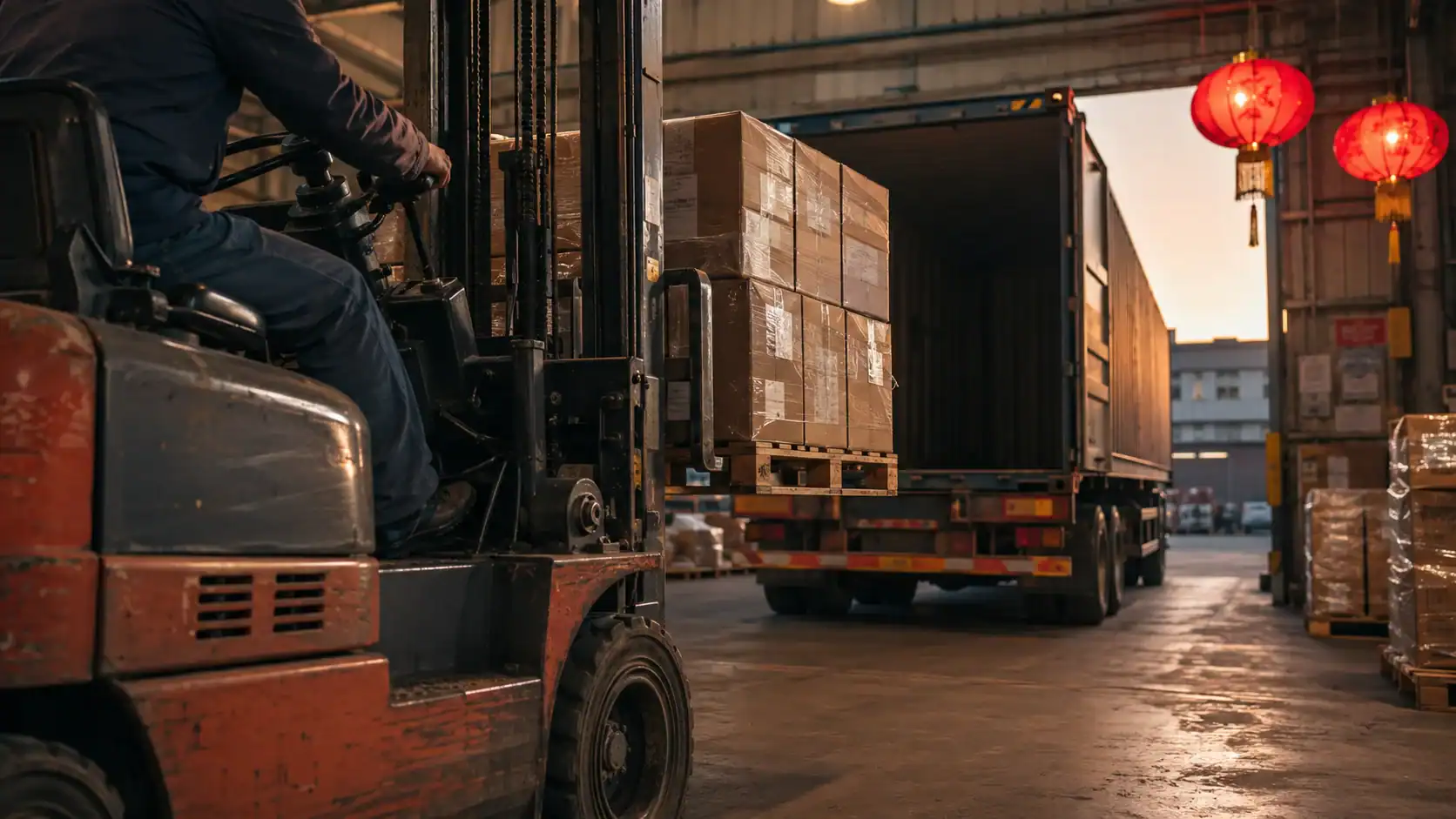
What Actually Happens at Chinese New Year
Start with the human reality, because everything else follows from it. Chinese New Year is the largest annual human migration on the planet. Hundreds of millions of workers travel from manufacturing hubs in Guangdong, Zhejiang and Jiangsu back to home provinces, often a day or more away by train. They do not leave on the eve of the holiday. They leave when they can get tickets, which in practice means factories begin losing workers one to two weeks before 6 February.
So the shutdown is not a clean switch. It is a taper. Through the second half of January 2027, your factory will be running with a shrinking workforce, compressing an over-full order book into fewer and fewer productive days. This is why January is consistently the highest defect-rate month of the year for goods made in China. Rushed production, temporary workers filling gaps, QC staff stretched thin, and a management team whose priority is shipping everything out the door before the holiday, not shipping it out perfectly.
Then the holiday itself: roughly a week officially, often stretched by factories to two.
The restart is the part importers consistently underestimate. Workers do not all come back. Return rates of 80 to 90 percent are typical in the first fortnight after the holiday; some workers take a new job closer to home, some simply take longer to return. The factory hires replacements, and replacements need training. A production line running with 15 percent new staff produces more slowly and with more defects than the December line did. Realistically, most factories are not back to full capacity and normal quality until early March 2027: three to four weeks after a holiday that officially lasted seven days.
Add it up: taper from late January, closure through mid-February, degraded restart into early March. That is your three-to-five-week production impact window, and it is remarkably consistent year to year.
The Freight Market Cycle Around CNY
Production is only half the story. The freight market runs its own cycle around the holiday, and it punishes importers at two separate points.
The pre-CNY rate spike: December 2026 to late January 2027
Every importer shipping from China wants their cargo on the water before the factories close. Demand for vessel space surges from early December, and carriers respond exactly as you would expect: peak season surcharges appear on top of base rates, space tightens, and the risk of rolled cargo (your booked container bumped to a later sailing) climbs sharply. In a tight pre-CNY market, rate increases of 20 to 50 percent above the autumn baseline are common, and in constrained years they have gone well beyond that. Bookings made late, at spot rates, with flexible routing, are the first to get rolled.
The final sailings that arrive before or during the holiday window fill first. For cargo out of South China ports heading to Australia, plan on booking pre-CNY sailings by mid-January 2027 at the absolute latest, and treat the last week of January as already gone. Carriers will still take bookings in that final week; whether your container actually loads is another matter.
The post-CNY trap: blank sailings in February and March
This is the part of the cycle that even reasonably experienced importers forget. Once the pre-CNY rush ends, demand collapses: the factories are closed; there is nothing to ship. Carriers do not sail half-empty vessels at a loss. They cancel sailings. These blank sailings typically remove a meaningful slice of capacity from Asia–Australia and other trades for four to six weeks after the holiday. The scale is real, not anecdotal: industry tracking of one recent Chinese New Year period put the typical baseline at 67 to 73 blank sailings across major trades in the weeks around the holiday: a pattern so consistent that even an unusually quiet year for cancellations still saw a dozen.
The consequence: when your factory reopens in mid-February and finishes your post-holiday order in late February, you go to book a container and discover that the sailing you wanted does not exist. The next one is full, because everyone else’s post-CNY cargo is competing for a reduced schedule. Cargo that was “only two weeks late” out of the factory becomes four weeks late to your warehouse. February and March 2027 will be a space problem even though they are a demand trough. That is the trap.
Rates themselves usually soften after the holiday, bottoming somewhere in late February or March before recovering as capacity and demand rebalance. If you have the inventory position to ship into the trough deliberately, it is the cheapest window of the first half of the year. That is a strategy available only to importers who planned their stock cover in advance, which brings us to the calendar.

The Countdown Calendar: Working Back from 6 February 2027
Everything in CNY planning is a back-calculation from the date. The calendar below works backwards, with the reasoning attached.
| Deadline | Action | Why |
|---|---|---|
| By 31 October 2026 | Final POs for complex or customised goods (multi-component products, custom tooling, long-lead materials) | 8–12 week production lead times plus subsupplier dependencies must clear before the January taper |
| By mid-November 2026 | Written confirmation of your supplier’s exact closure and reopening dates; confirmation they have ordered raw materials | Closure dates vary by factory and region; subsuppliers close too |
| By 30 November 2026 | Final POs for simple, fast-turn goods (30–45 day production) | Production must finish by mid-January to make a pre-CNY sailing |
| By early December 2026 | Book pre-shipment inspection slots for all January-completing orders | Third-party QC firms book out weeks ahead of CNY; late booking means no inspection |
| By mid-December 2026 | Book freight for late-January sailings; lock rates where possible | PSS and space crunch intensify through January; late bookings carry the highest roll risk |
| By mid-January 2027 | Last realistic pre-CNY booking window; cargo gated in at origin | Final pre-holiday sailings fill first; the last week of January is not dependable |
| Late Jan – mid Feb 2027 | Factory closure window (varies by factory) | CNY is 6 February; taper before, holiday after |
| Mid-Feb – early March 2027 | Expect slow restart, 80–90% worker return, blank sailings, tight post-CNY space | Plan inventory to cover this whole window, not just the holiday week |
| Early March 2027 | Factories near full capacity; freight rates near trough: cheapest booking window if you have stock cover | Capacity restored, demand still recovering |
Two dates on that table matter more than the rest: the two final-PO deadlines. Miss the freight booking window and you pay more or wait longer. Miss the PO window and there is no cargo to book at all. Nothing you do in January can conjure production capacity that no longer exists.
The calendar’s real value is not the information; you could reconstruct most of it from first principles. Its value is as a pre-commitment device. Decide in September what your final order dates are, write them into your purchasing calendar, and tell your suppliers. When late November arrives and a sales team asks whether you can squeeze in one more SKU, the answer is already made: by a calmer version of you who did the math without a deadline breathing on them. Importers who improvise their CNY response in January consistently make worse decisions than importers who committed to a calendar in spring, not because they are less capable, but because January offers only bad options.
Ship-before or ship-after: a decision framework
For each product line, you face a genuine choice, and the right answer differs by SKU:
- Ship before CNY when the product sells steadily, a stockout is costly, or quality risk is manageable (established product, trusted factory, inspection booked). You pay peak freight rates but you protect revenue. For most core SKUs this is the correct call.
- Ship after CNY when the product is slow-moving, margin-thin, or genuinely quality-sensitive with a factory you do not fully trust in a January crunch. You accept a March arrival in exchange for trough freight rates and production done at normal pace by a full workforce.
- Split the difference for high-volume SKUs: ship the volume you need through mid-March before the holiday, and place a second order for post-CNY production that arrives into the cheap freight window. This is the most capital-efficient structure, but only if the pre-CNY leg is ordered early enough not to be rushed.

Inventory Strategy: How Many Weeks of Cover?
The inventory question is where the countdown calendar meets your balance sheet. The disruption window you are covering is roughly: two weeks of degraded pre-CNY production you should not rely on, two weeks of closure, three weeks of slow restart, plus post-CNY blank-sailing delay on the first replenishment order. For most importers that translates to eight to twelve weeks of cover held as of early February 2027, against a normal steady-state of perhaps four to six.
A worked example
Take an importer selling 400 units a month of a product landing at $30 per unit, deciding to build ten weeks of cover into the holiday.
- Ten weeks of demand at 400 units/month ≈ 1,000 units (400 × 10 ÷ 4.33).
- Normal steady-state position of five weeks ≈ 500 units, so the CNY build requires an extra 500 units.
- Extra capital tied up: 500 × $30 = $15,000, committed from roughly December 2026 (deposit and balance payments) and not fully recovered until the buffer sells down in March–April 2027 (call it three to four months of carry).
- Cost of that carry at, say, 10% annual cost of capital: $15,000 × 10% × 4/12 ≈ $500, plus a few hundred dollars of extra storage.
Now the other side of the ledger. If the product retails such that each unit contributes $25 of gross margin, a stockout lasting four weeks costs roughly 370 units of lost sales: about $9,250 in gross margin, before you count customers who bought elsewhere and never came back, or a marketplace listing whose ranking decays while it shows out of stock. The buffer costs well under $1,000 to hold; the stockout it prevents costs five figures. For most healthy-margin products, the math is not close. Where it does get close (very low-margin goods, bulky items with heavy storage costs, products with real obsolescence risk), that is precisely the ship-after category from the framework above.
One caveat on how importers actually learn this lesson. The buffer decision gets judged after the fact by whether a stockout happened, which is the wrong test. An importer who carried four weeks of cover into 2026 and got away with it (the factory reopened early, the first sailing was not blanked) reads that year as proof the buffer was over-cautious, and carries even less into 2027. That is grading the decision by the result rather than by what was knowable in November. A cleaner way to size cover is to name the confidence you are actually claiming: eight weeks implies you think a longer disruption is unlikely, not impossible, and you should be able to say roughly how unlikely. If you cannot put a number on it, you have not made the decision yet. You have postponed it and called the delay a judgement call.
If your cash position cannot fund the full build across every SKU, rank SKUs by stockout cost and cut cover from the bottom, not evenly across the range. Protecting 100 percent of your best sellers and 50 percent of your tail beats protecting 80 percent of everything. We cover the general mechanics of buffer sizing in our guides on inventory planning around shipping lead times and avoiding stockouts as an importer. CNY is those principles with the volume turned up.
Quality Risk: January Is Not the Month to Trust
Recall the January dynamics: compressed schedules, departing workers, temporary replacements, distracted management. Every structural driver of defects is elevated at once. This has two practical consequences.
First, pre-shipment inspection is non-negotiable for January-completing orders. If you inspect nothing else all year, inspect these. A third-party inspection typically costs around US$300 per man-day, trivial against the cost of a container of defective goods that cannot be reworked because the factory is closed for three weeks and your customers are waiting. And note the second-order problem: everyone else has the same idea, so inspection firms’ January slots book out weeks in advance. Reserve your slots by early December 2026, keyed to confirmed production completion dates.
Second, use golden-sample comparison, not just spec-sheet checking. A golden sample is a production-approved reference unit (sealed, signed by both parties) that the inspector physically compares against the shipment. In January, the failure mode is rarely “factory ignored the spec.” It is drift: a substituted component because the usual subsupplier closed early, a finish applied by a new worker, packaging from an alternative printer. Spec sheets miss drift; a physical reference unit catches it. If you do not have signed golden samples with your key factories, set them up in the autumn, well before the crunch.
One more January rule: resist the temptation to accept “we can still fit your order in” from a factory in December. A factory that says yes to everything in December is telling you how your goods will be made in January.

Supplier Communication Protocol
Most CNY damage is not caused by the holiday. It is caused by assumptions about the holiday. A short written protocol with each supplier, completed by mid-November 2026, removes most of them:
- Confirm their exact closure and reopening dates in writing. Factories do not all close on the same day. Some stop taking new production two weeks before CNY; some run skeleton crews longer; reopening dates vary even more than closures. “Around the holiday” is not a date. Get the two dates in an email or a stamped notice, per factory, and build your calendar on those, not on the public holiday schedule.
- Confirm raw material ordering. Your factory’s subsuppliers close too: often earlier, since component makers finish their pre-CNY books before assemblers do. A factory that has not secured materials by early December may be unable to produce your January order even with workers on the floor. Ask the direct question: “Have you ordered and received all materials for our PO?” This is the second-order dependency that quietly kills more January orders than anything on the factory’s own floor.
- Agree deposit timing explicitly. Factories want deposits in before the holiday: cash for worker bonuses and material purchases. Paying a deposit on production that will not start until after CNY is sometimes fine and sometimes a red flag, particularly with a newer supplier. At minimum, tie deposits to confirmed material receipt or a production start date, and be cautious about large pre-holiday payments to factories you have not yet visited or verified.
After the Holiday: Re-engagement
The weeks after reopening carry their own agenda, and it pays to walk in prepared rather than surprised.
Post-CNY is annual price renegotiation season. Factories reset labour costs after the holiday (returning workers negotiate raises; replacements are hired at current market wages), and material contracts often reprice. Expect your supplier to open the year with a price-increase conversation in late February or March. You do not have to accept the first number; you do have to expect the conversation. Importers who place their first post-CNY order without asking sometimes discover the increase on the invoice.
Watch for staff turnover on the supplier side. The same migration that thins the factory floor thins the sales office. If your longtime sales contact does not return, the relationship knowledge they held (your tolerances, your packaging quirks, the verbal agreement about carton markings from two years ago) may not have been written down anywhere. First order after CNY with a new contact: treat it like a first order with a new supplier. Re-send full specs, reference the golden sample, inspect the shipment. The single most common post-CNY quality failure is an old spec executed from memory by a new person.
And if your stock cover allows it, remember the rate trough. Late February and March 2027 will likely offer the cheapest ocean freight of the half-year. The importers who built ten weeks of cover get to book into it deliberately. For context on how seasonal rate cycles work on the Australia trade generally, see our guide to seasonal freight pricing to Australia.
The Vietnam Caveat: Tet Is the Same Week
A tempting hedge appears in every CNY planning conversation: “We’ll shift some volume to Vietnam.” For 2027, examine that idea carefully before relying on it.
Vietnam celebrates Tet (its own Lunar New Year), and because both holidays follow the same lunar calendar, Tet 2027 falls in the same week as Chinese New Year 2027. Vietnamese factories shut down for a comparable period, exhibit the same slow-restart pattern, and sit in the same regional freight market that carriers blank-sail after the holiday. Worse, a large share of Vietnamese manufacturing depends on Chinese raw materials and components, so a Vietnamese factory feels the Lunar New Year twice: once through its own closure and once through its Chinese supply lines.
Alternative-origin sourcing is a legitimate hedge against tariffs, single-country concentration, and capacity constraints. It is not a hedge against the Lunar New Year. If Q1 continuity is the goal, the answer is the calendar and the inventory buffer, not a different flag on the certificate of origin. (Origins outside the lunar calendar zone, such as India, Bangladesh, Turkey, and Mexico, do sidestep the holiday, but shifting production there is a year-long project, not a Q1 tactic.)

Five Common CNY Planning Mistakes
- Planning around the official holiday week instead of the real window. Budgeting one week of disruption when the true production impact is three to five weeks. This single error explains most CNY stockouts.
- Forgetting the post-CNY blank sailings. Importers plan meticulously for the pre-holiday rush, then assume normal freight service resumes on reopening day. February–March space is constrained by design; build it into your replenishment lead time.
- Skipping inspection on rushed January orders. The orders produced under the worst conditions of the year are precisely the ones that get shipped uninspected “because there wasn’t time.” There was time: in early December, when the slot should have been booked.
- Assuming the factory’s closure dates without written confirmation. Every factory closes on its own schedule, and subsuppliers close earlier. The importer who confirms dates in writing in November is working with facts; everyone else is working with folklore.
- Treating Vietnam as the escape hatch. Tet is the same week. The hedge does not hedge.
A sixth, honourable mention: forgetting that the countdown calendar is only useful if you obey it. The whole point of setting final-PO dates in September is that late November arrives with the decision already made.
Putting It Together
Chinese New Year 2027 is not a surprise. The date has been known for years; the market cycle around it repeats with unusual reliability. Complex-goods POs by the end of October 2026. Simple-goods POs by the end of November. Closure dates and material confirmations in writing by mid-November. Inspection slots by early December. Freight booked by mid-January. Eight to twelve weeks of cover on the SKUs that matter, sized by stockout cost rather than habit. Then let February happen to other people. If you would rather hand the countdown to someone who runs it every year, that is exactly what a corporate freight partner is for: booking the pre-CNY sailings, watching the blank-sailing schedule, and flagging the trough window when it opens.
If you are still building your baseline understanding of the China–Australia lane, start with our guides on importing from China to Australia and realistic shipping times from China. The CNY calendar sits on top of those fundamentals, it does not replace them.
Related Reading
- How Seasonal Cycles Drive Freight Pricing to Australia
- Importing from China to Australia: The Complete Guide
- Shipping Times from China to Australia for Business
- Inventory Planning Around Shipping Lead Times
- Start Vetting Chinese Suppliers With Three Free Checks
It’s worth stepping back to notice what’s actually happening here: a calendar system devised in China millennia ago, tracking lunar cycles that have nothing to do with container shipping, still determines when factories across an entire modern manufacturing region go quiet, and takes Vietnam down with it through nothing more than shared timing and shared Chinese-sourced inputs. Global freight scheduling looks, on the surface, like a purely economic system: rates, capacity, carrier decisions. Underneath, it’s still keeping time by an agricultural calendar that predates the shipping container by thousands of years. The lesson for an importer isn’t mystical. It’s practical: the lunar new year isn’t a market event you can diversify away from by shifting a purchase order to a neighboring country that answers to the same calendar. It’s closer to a season, and seasons apply to everyone standing under the same sky.
Frequently Asked Questions
When is Chinese New Year in 2027?
Chinese New Year 2027 falls on Saturday 6 February 2027. The official holiday runs about a week, but the practical production impact spans three to five weeks, from the late-January wind-down to the early-March return to full capacity.
When should I place my final orders before CNY 2027?
Late November 2026 for simple, fast-turn goods; October 2026 for complex or customised products with long lead times or subsupplier dependencies. Later orders compete for shrinking capacity in the January crunch and carry elevated defect risk.
How long do Chinese factories take to recover after the holiday?
Plan on full capacity by early March 2027, not mid-February. Worker return rates of 80–90 percent, new-hire training, and material pipeline restarts mean the first two to three post-holiday weeks run slow and rough.
Do freight rates rise before Chinese New Year?
Yes: peak season surcharges, tight space, and rolled-cargo risk build from December through late January. After the holiday, rates soften into a February–March trough, but blank sailings keep space tight even as prices fall.
Can I dodge CNY by sourcing from Vietnam?
No. Tet falls in the same week as CNY in 2027, Vietnamese factories follow the same shutdown pattern, and many rely on Chinese raw materials. The reliable hedges are the countdown calendar and inventory cover, not a change of origin.
How many weeks of stock should I hold going into February 2027?
Eight to twelve weeks for most importers, sized by stockout cost per SKU. Ten weeks is a sound default: it covers the closure, the slow restart, and the post-CNY blank-sailing delay on your first replenishment shipment.