
There is a CNC spindle motor sitting in a bonded shed at Suvarnabhumi right now (cleared the aircraft eleven hours ago, still waiting on a customs broker to lodge one form), and 900 kilometres away in Rayong a production line is standing still at a cost of roughly 40,000 baht an hour. The factory paid about 60,000 baht to fly that part from Stuttgart instead of the 9,000 baht it would have cost by sea. Nobody in that building thinks the premium was a mistake. The mistake would have been the six-week ocean transit.
That is what air freight to Thailand is actually for. Not “faster shipping” in the abstract. It is a tool you hire to make a specific, expensive wait disappear. Yet most people pricing a shipment to Thailand have never been shown the arithmetic that separates the cases where air is brilliant from the cases where it is a way to set fire to money.
The Real Cost Gap: Air vs Sea, Honestly Stated
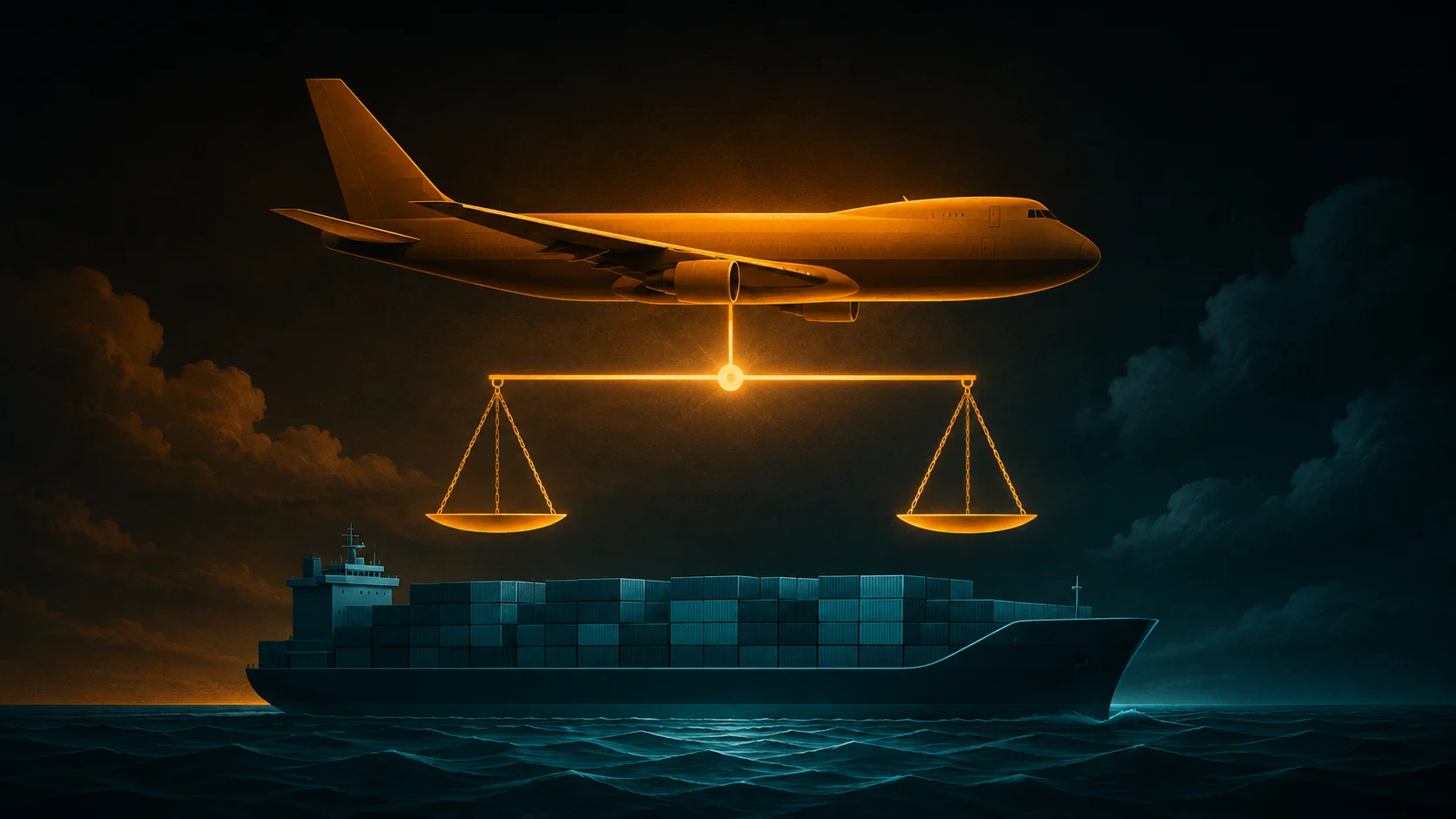
Strip away the marketing and the per-kilogram gap is stark. On the Europe–Thailand and North America–Thailand lanes, consolidated air freight typically prices somewhere between $7 and $18 per chargeable kilogram once fuel and security surcharges are folded in. Sea freight on the same lanes, measured per kilogram of reasonably dense household cargo, works out around $0.80 to $1.50. Call it eight to fifteen times more expensive per kilo, and you will rarely be wrong by much.
But per-kilo comparisons mislead at the small end, because sea freight carries a heavy fixed-cost floor. A less-than-container-load (LCL) shipment attracts origin handling, documentation fees, destination terminal charges at Laem Chabang or Bangkok Port, and Thai destination agent fees. Together these can run $300–$600 before a single cubic metre moves. Air freight has fixed charges too, but they are smaller. The practical consequence: below roughly 100–150kg of dense cargo, air and sea total bills converge, and air sometimes wins outright. A 40kg box of documents and clothes might cost $280 by air, door to door in a week, and $350 by LCL sea, door to door in two months. At that size, sea is the irrational choice.
The gap explodes as volume grows. At 1,000kg / 5 cubic metres (a modest one-bedroom relocation), sea might total $1,800–$2,500 door to door, while air would land somewhere between $7,000 and $18,000. At a full household, 25–30 cubic metres, air freight stops being a price and becomes a punchline.
Chargeable Weight: The Mechanics That Decide Your Bill
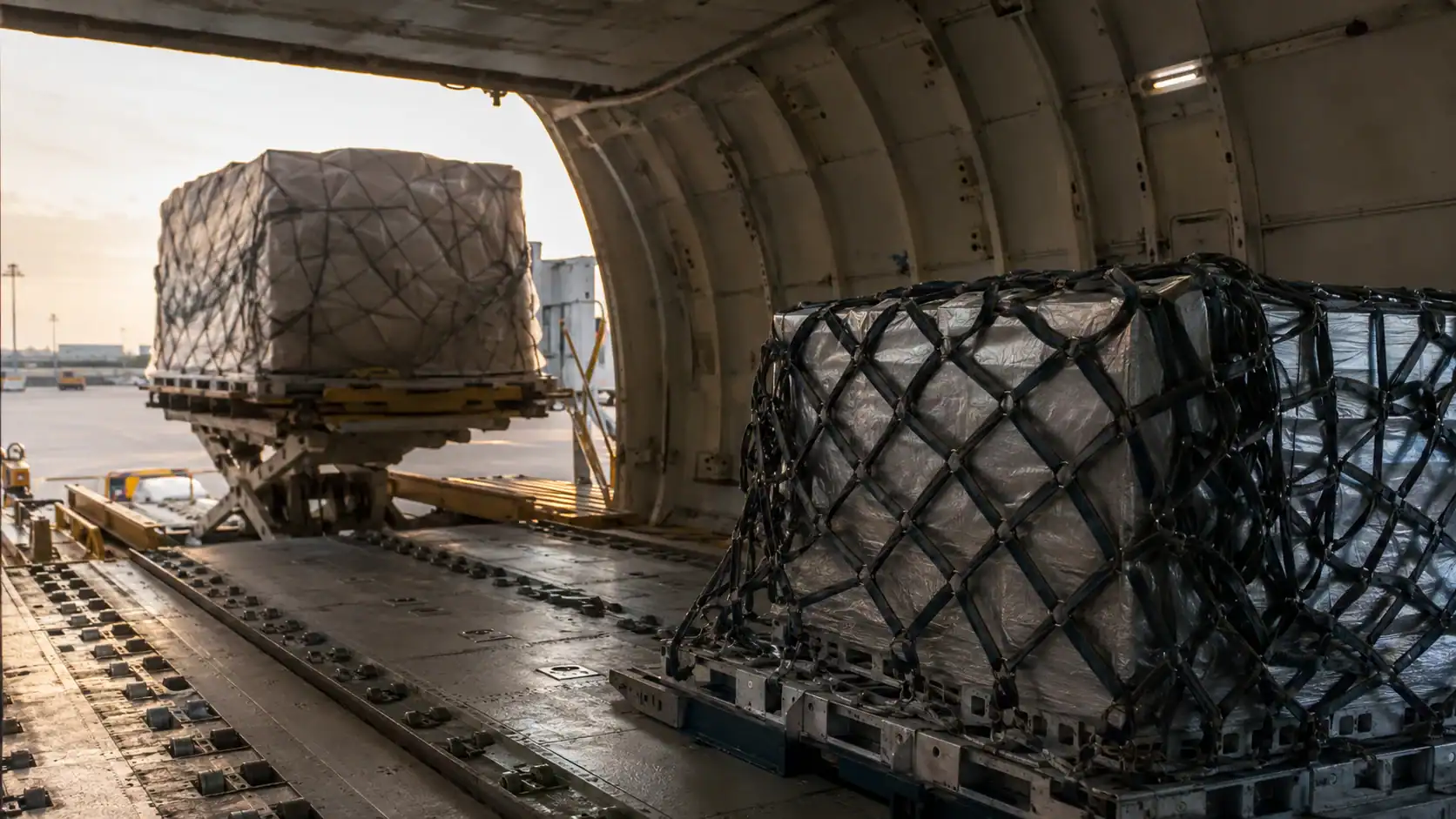
Air freight does not charge you for what your shipment weighs. It charges for what your shipment weighs or for the space it occupies, whichever produces the bigger number. This is chargeable weight. Misunderstanding it is the single most common source of air freight sticker shock.
The formula is fixed across the industry. Volumetric weight (in kilograms) equals length × width × height in centimetres, divided by 6,000. Equivalently, one cubic metre of space is billed as 167kg regardless of what is inside it. The carrier compares volumetric weight against actual scale weight and bills the greater of the two.
A worked example
Say you are flying three boxes to Bangkok, each 75cm × 55cm × 45cm, and each weighing 18kg on the scale: clothes, bedding, some books at the bottom.
- Volume per box: 75 × 55 × 45 = 185,625 cubic centimetres
- Volumetric weight per box: 185,625 ÷ 6,000 = 30.9kg
- Actual weight per box: 18kg
- Chargeable weight per box: 30.9kg (volumetric wins)
- Total chargeable weight: 92.8kg, versus 54kg on the scale
At $12 per chargeable kilogram, that shipment bills at roughly $1,114, not the $648 you might have estimated from the bathroom scale. You are paying 72% more than your naive estimate, purely because bedding is fluffy. Pack those same boxes with books and tools until each weighs 35kg and actual weight wins instead: 105kg chargeable, but now every billed kilogram is a real kilogram of goods.
Air freight rewards density. Vacuum-bag the soft goods, fill voids, and never air-freight anything that is mostly air: pillows, duvets, empty suitcases, lampshades. Each of those is a volumetric-weight tax you volunteered to pay.
What Job Are You Hiring Air Freight to Do?
Here is a more useful question than “air or sea?”: what job needs doing? People do not want air freight; they hire it to eliminate a wait that costs more than the freight premium. Frame it that way and the decision usually makes itself.
When air wins clearly
Urgent replacements and production-line parts. The Rayong spindle motor is the archetype. When downtime is billed in tens of thousands of baht per hour, a 50,000-baht air premium pays for itself before the aircraft leaves the runway. Any scenario where the cost of waiting is measurable and large belongs on a plane.
High value-to-weight goods. Electronics, camera equipment, medical devices, jewellery and prototypes all qualify. When a 20kg shipment is worth $15,000, the difference between $150 sea and $140–$360 air is noise. Air also shortens your goods’ exposure to handling, transhipment and humidity. Insurance premiums on air moves often price lower per declared value for exactly this reason.
Documents, samples and small commercial consignments. Below the fixed-cost floor of LCL sea freight, air is frequently cheaper in absolute terms as well as faster.
Perishables. Anything with a shelf life measured in days moves by air or does not move. Thailand’s food-export machine runs on this in the outbound direction; inbound, it applies to specialty foods, some pharmaceuticals and temperature-sensitive lab goods.
The first 100kg of a relocation. This is the most underused case: the essentials that make an empty Bangkok apartment livable while the container crosses two oceans.
When air never wins
Furniture. A three-seat sofa occupies about 2.5 cubic metres. That is 417kg of volumetric weight: $5,000 or more in air charges for an item you could replace new in Bangkok for a third of that. No sofa on earth justifies a cargo hold.
Bulk household goods. Kitchenware, wardrobes of clothing, children’s toys and boxes of miscellany are individually light, collectively voluminous, and never needed within 48 hours of arrival. This cargo exists to go by sea, and every kilogram of it you put on an aircraft is a decision you will regret at invoice time.
Anything you have not priced against local replacement. For every borderline item, ask the honest question: would flying this cost more than buying it again in Thailand? Bangkok is not a hardship posting. IKEA, HomePro and a deep secondhand market will resupply most of a household for less than the air freight on the original.

Suvarnabhumi vs Don Mueang: Where Your Cargo Actually Lands
Bangkok has two international airports, both operated under Airports of Thailand, and they play very different roles in cargo.
Suvarnabhumi (BKK) is the freight gateway, one of Southeast Asia’s larger cargo hubs. Its Free Zone cargo terminals handle well over a million tonnes a year. Virtually all long-haul freighter services and widebody bellyhold capacity land here, whether from Europe, North America, the Middle East or Northeast Asia. The customs house is large, brokers are on site in numbers, and the clearance machine runs seven days a week. If you book consolidated air freight to Thailand, this is almost certainly where it lands.
Don Mueang (DMK) is dominated by low-cost passenger carriers and handles a small fraction of the cargo volume, mostly regional narrowbody bellyhold from within Asia. Cargo facilities are modest and broker coverage thinner. You would rarely choose it deliberately for an intercontinental shipment. It matters mainly if a regional consolidation routes through it, in which case expect slightly slower handling because the ecosystem is smaller.
Chiang Mai and Phuket receive international cargo too, but for anything beyond small regional consignments the economics usually favour clearing at BKK and trucking domestically: the road leg to Chiang Mai adds a day; the direct-air alternative adds cost and often routes through Bangkok anyway.
Transit Realities: The Flight Is the Fast Part
Airport-to-airport, Europe or North America to Bangkok is one to three days: a direct freighter or bellyhold flight, or one transhipment through a hub such as Doha, Dubai, Singapore or Hong Kong. That number is what gets quoted. It is not what you should plan around.
Door to door, a realistic window is five to nine days, and it decomposes like this:
- Origin: 1–3 days for collection, export packing, security screening, and (crucially for consolidated freight) waiting for the consolidation to close. Consolidators fly when the pallet is full or the weekly cut-off hits, not when your box arrives.
- Flight: 1–3 days including any hub transhipment and the occasional offload-and-roll to the next flight when bellyhold space tightens.
- Thai customs and terminal: 1–2 days in the normal case, while documents are lodged, duty assessed or exemption applied, and cargo released from the Free Zone. Add a day or two if an inspection is called or paperwork is queried, and note that a shipment landing Friday evening may not clear until Monday.
- Final delivery: 1 day within greater Bangkok; two or more upcountry.
Air freight compresses the transport leg to near zero, but it does nothing to compress paperwork, consolidation schedules or weekends. Anyone promising “three days door to door” on consolidated freight is quoting the best case as the base case. What actually drives timing on both modes is broken down in full in our shipping times to Thailand guide.

Thai Customs by Air: Faster Queue, Same Rules
A persistent myth holds that air shipments somehow face lighter customs treatment. They do not. Thai Customs applies exactly the same tariff schedule, the same valuation rules and the same personal effects provisions at Suvarnabhumi as at Laem Chabang. What differs is throughput: the airport clearance cycle is measured in hours to a couple of days, against several days at the seaport, because volumes per shipment are smaller and the Free Zone process is built for speed.
The details that matter:
- The used personal effects exemption applies equally by air. You qualify on identical terms to a sea shipment if you are relocating to Thailand with an eligible visa or work permit and your goods are used household items imported within the qualifying window around your arrival. Same documentation: passport, visa evidence, packing list, and arrival within the prescribed timeframe.
- New goods are dutiable by air just as they are by sea. Air waybills with recent retail invoices attached undermine “used personal effects” claims. Boxes of shrink-wrapped new items invite assessment.
- Valuation disputes cost more by air in one narrow sense. Airport storage charges accrue quickly, so a shipment stuck in a query for a week can rack up meaningful terminal fees. Clean, consistent paperwork matters more, not less.
- Restricted items are restricted regardless of mode. Medicines beyond personal quantities, food supplements, radio equipment and anything requiring an FDA or NBTC permit all need one whether they fly or float.
Duty surprises at destination are the classic budget-wrecker on Thai imports, and they hit air shippers harder psychologically because everything else moved so fast. Check the full list of charges that appear after the freight quote in our rundown of the hidden costs of shipping to Thailand.
The same duty rules and personal effects conditions decide an air shipment and a sea one, and our Thailand customs and duty breakdown sets out what Thai Customs asks for either way.
Dangerous Goods: What Cannot Fly
Aircraft are less forgiving environments than ships. The IATA Dangerous Goods Regulations govern what may travel in air cargo. For household and personal shippers, more everyday items count as formally dangerous goods than most people expect:
- Lithium batteries: the big one. Loose or spare lithium-ion and lithium-metal batteries are forbidden in consolidated air cargo shipped as general goods. That covers power banks, spare camera and drone batteries, and loose laptop batteries. Batteries installed in equipment are permitted only within strict watt-hour limits and only if you declare them. A power bank buried in a box of clothes is exactly how consolidations get offloaded and shippers get fined.
- Aerosols: deodorant, hairspray, spray paint, insect repellent, cooking spray. Pressurised containers are DG, full stop.
- Flammables: perfume and cologne in quantity, nail polish and remover, alcohol-based sanitisers, lighter fluid, camping-stove fuel, paints, thinners.
- Miscellaneous surprises: magnets above certain field strengths, some fire extinguishers, bleach and pool chemicals, airbag modules, and self-inflating life jackets with CO₂ cartridges.
The rule of thumb: if it can burn, spray, leak, or hold a charge, declare it to your forwarder before packing. Undeclared DG discovered at screening does not just delay your boxes: it can ground an entire consolidation and expose you to penalties. Almost all of these items are either cheap to replace in Thailand or perfectly happy travelling by sea, where the restrictions are far looser. For a relocation, DG-adjacent items go in the sea shipment or the bin, never the air shipment.
The Split-Shipment Strategy: Air for the First Month, Sea for the Household
For relocations, the smart question is not “air or sea?” but “which 5% of my belongings is worth flying?” The split-shipment pattern is how experienced movers hire air freight: as a precision instrument, not a mode choice. Essentials go by air, the household goes by sea.
What goes in the air shipment
Aim for fifty to a hundred kilograms, dense-packed: work equipment (laptop, monitors; batteries installed, declared), two weeks of clothing for the climate you are landing in, essential documents, children’s immediate needs, basic kitchen kit, prescription medicines with paperwork, and the two or three personal items that make a rented apartment feel less like a hotel. Nothing fluffy, nothing pressurised, nothing replaceable at HomePro for less than its freight cost.

A worked cost example
Take a two-bedroom relocation from London to Bangkok, roughly 15 cubic metres, 2,500kg of household goods.
- Option A, everything by sea: ~$3,800 door to door, 8–10 weeks. Total: $3,800, plus two months of buying duplicates or living out of suitcases.
- Option B, everything by air: 15 cbm = 2,505kg volumetric; chargeable weight ~2,505kg at $12/kg ≈ $30,000+. Not a real option; shown only to kill the idea.
- Option C, the split: 80kg of essentials by air (three dense boxes, ~0.4 cbm, chargeable weight ~80kg actual) at $12/kg plus fixed fees ≈ $1,150, arriving in a week. The remaining ~14.6 cbm by sea ≈ $3,700, arriving in week nine. Total: $4,850.
Option C costs about 28% more than pure sea and buys back two months of livability. The alternative to that $1,050 premium is two months of replacement purchases, or worse, two months of airfreighting things ad hoc by courier as you discover you need them. Set the premium against those and it is usually the cheapest comfortable path through a relocation. Bulky household cargo belongs in the sea shipment described in our shipping household goods to Thailand guide, with the air component as a bolt-on rather than the main event.
One coordination note: your personal effects exemption paperwork should cover both shipments, and you should declare them as parts of one removal. A competent forwarder handles this routinely; a shipper juggling two unrelated providers sometimes discovers the second shipment’s exemption claim is questioned because the first already “used” it. Same rules, one story, told consistently.
How Air Freight Pricing Is Built
An air freight quote to Thailand is a stack, and knowing the layers lets you compare quotes honestly:
- Base per-kg rate: the price per chargeable kilogram, tiered by weight break. The rate per kilo falls at 45kg, 100kg, 300kg and 500kg thresholds. Sometimes a heavier declared weight at a cheaper break costs less overall; forwarders call this “rating up” and do it automatically.
- Fuel surcharge (FSC): a per-kg add-on that floats with jet fuel prices, often 20–40% of the base rate. Any quote that omits it is not a quote.
- Security fee: per-kg screening charge, small but universal since screening became mandatory for cargo on passenger aircraft.
- Origin fees: pickup, export handling, airline terminal fee, export documentation, AWB fee.
- Destination fees: Suvarnabhumi terminal handling, customs brokerage, duty and VAT where applicable, delivery order fee, final-mile trucking. This is the layer most often missing from headline quotes, and it is why a “$7/kg all-in” number should trigger scepticism, a gap our door-to-door shipping to Thailand guide sets out handoff by handoff.
When comparing providers, force every quote to door-to-door on the same chargeable weight, and ask explicitly whether Thai duty, VAT and destination terminal fees are included or estimated. The cheapest airport-to-airport rate regularly becomes the most expensive door-to-door bill. The sea-side equivalent of this exercise runs the identical discipline for ocean quotes; see it in our cost of shipping to Thailand breakdown.
Express Courier vs Air Freight: Same Aircraft, Different Product
One distinction trips up almost everyone pricing small shipments. “Air freight” and “express courier” both put your goods on a plane, but they are different products with different economics.
Express courier is a premium retail product: in these integrated door-to-door parcel networks, one company owns the pickup van, the aircraft, the Bangkok clearance operation and the delivery scooter. Transit is 2–5 days door to door, tracking is granular, customs brokerage is bundled, and the per-kg price is high, often two to three times consolidated air freight rates. Rate cards turn punitive above about 30–70kg. It is unbeatable for documents, single boxes and anything under roughly 30kg where the fixed costs of freight forwarding would swamp the shipment.
Consolidated air freight is a wholesale product: a forwarder aggregates many shippers’ cargo onto pallets, buys bellyhold or freighter space at wholesale rates, and hands clearance to a broker at Suvarnabhumi. Transit is the 5–9 day door-to-door window described above, tracking is milestone-based rather than live, and the per-kg cost drops sharply with weight. Above roughly 50–70kg it is nearly always cheaper than courier; above 150kg it is not close.
The crossover zone (roughly 30 to 70kg) is where it pays to price both. Below it, use a courier and do not overthink it. Above it, courier convenience is costing you real money, and a forwarder’s consolidated service does the same job for less. Parcel networks build their clearance pipeline for e-commerce, not relocations, so they routinely clear personal effects as standard dutiable imports. That is a quiet way to pay duty you were exempt from.

The Decision, Compressed
Air freight to Thailand makes sense when the cost of waiting exceeds the freight premium, when value-to-weight is high, when the shipment is small enough that sea’s fixed costs erase its per-kg advantage, or when it is the fast half of a split relocation. It never makes sense for furniture, bulk household goods, or anything cheaper to rebuy in Bangkok than to fly. The chargeable-weight formula (centimetres cubed over 6,000, billed against actual weight, whichever is greater) decides your invoice, so pack dense and keep the fluffy things in the sea container. Customs at Suvarnabhumi is faster than the seaport but no cheaper: same duty rules, same exemptions, same paperwork discipline. And keep the dangerous goods list taped to the packing table, because one forgotten power bank can cost you a week.
Run the numbers on your own shipment before anyone quotes you. Weigh it, measure it, compute both weights, and price the wait. The answer usually announces itself.
We work out whether air or sea is right for your Thailand move.
Fill in the route and the size, about 60 seconds of work, and our team comes back with a free estimate built from lanes we already run.
“Chargeable weight” sounds like a technical detail. It is actually the whole ballgame, and most explanations of it are needlessly confusing. Here is the plain version: air freight is priced on whichever is bigger, actual weight or volumetric weight, the number you get from measuring the box and applying a standard formula. A box of clothes is heavy for its size, so actual weight wins. A box of empty suitcases and pillows is light for its size, so volumetric weight wins, often by a wide margin. Nobody explains this before people pack, which is exactly backward. Pack dense items in small boxes and bulky, light items in the fewest boxes possible, and the chargeable weight drops without a single extra step at the airport. That is not a trick. That is just understanding what you are actually being charged for.
Related Reading
- Shipping Cost to Thailand: The Complete Pricing Breakdown
- Shipping Time to Thailand: Realistic Transit Windows by Mode
- Hidden Costs of Shipping to Thailand
- Door-to-Door Shipping to Thailand: What Each Quote Really Covers
- Shipping Household Goods to Thailand
- Air Freight vs. Sea Freight to Thailand: When Speed Beats Cost
Personal effects duty-free conditions applying equally by air are set by the Thai Customs Department.
Frequently Asked Questions
How much more expensive is air freight to Thailand than sea freight?
Per kilogram, air freight typically costs four to eight times more than sea freight, comparing chargeable weights with all surcharges included. But sea freight’s fixed handling and destination charges mean that below roughly 100–150kg of dense cargo the total bills converge, and for very small shipments air can be cheaper outright. The gap widens brutally with volume: a full household by air would cost four times the sea price or more.
What is chargeable weight and how do I calculate it?
Air carriers bill the greater of actual weight and volumetric weight. Volumetric weight equals length × width × height in centimetres, divided by 6,000: equivalently, 167kg per cubic metre. Measure each box, run both numbers, and budget on the larger. Light, bulky cargo like bedding always bills volumetric; books and tools bill actual.
How long does air freight to Thailand really take?
One to three days airport to airport, but plan on five to nine days door to door. Origin consolidation cut-offs, security screening, Thai customs clearance at Suvarnabhumi and final delivery all sit outside the flight time, and weekends do not clear cargo.
Does the Thai personal effects duty exemption apply to air freight?
Yes, on identical terms to sea freight. Thai Customs applies the same tariff and exemption rules at the airport as at the seaport. Eligible residents importing used household effects within the qualifying window around arrival can claim the exemption whether the goods fly or sail, with the same documentation requirements either way.
What items are banned or restricted in air freight?
Anything classified as dangerous goods under the IATA Dangerous Goods Regulations: loose lithium batteries and power banks, aerosols, perfume and nail polish in quantity, flammable liquids, pressurised containers, strong magnets and various chemicals. Declare anything doubtful to your forwarder; undeclared DG can offload an entire consolidation. Send these items by sea or replace them in Thailand.
Is a split shipment worth it for a relocation to Thailand?
Usually. Flying 50–100kg of essentials while the household goes by sea typically adds 10–20% to the total move cost and removes the two-month wait for the things you need immediately. Coordinate both shipments under one personal-effects declaration so the exemption paperwork tells a single consistent story.