
This guide also covers how to reduce your inspection risk and clear a DAFF referral faster once your container is selected.
Two containers of flat-pack furniture leave the same factory in Semarang on the same vessel. Both clear customs valuation without a murmur. One is on a truck to the importer’s warehouse two days after discharge. The other sits for eleven days and its owner pays AUD 1,900 in inspection fees, fumigation and storage before it moves a metre.
Nothing about the cargo was different. The difference was one document: a packing declaration that didn’t match what was in the box.
Biosecurity is the part of Australian importing that punishes casual paperwork harder than any other. Customs duty errors get amended. GST gets deferred. But when the Department of Agriculture, Fisheries and Forestry (DAFF) refers your container for inspection, you enter a queue you cannot skip, governed by a process you cannot negotiate, at a facility you don’t control. The only meaningful influence you have was exercised weeks earlier, when the documents were prepared at origin.
If you want product-by-product import conditions (what’s allowed, what needs permits), that’s covered in our separate biosecurity requirements guide. This one is about the process.
How DAFF Screening Actually Works
Every full import declaration lodged in Australia is profiled electronically against the import conditions held in BICON, DAFF’s biosecurity import conditions database. This happens to 100 percent of declarations. There is no shipment that skips screening. What varies is what the profile does with yours.
Three broad outcomes come out of that screening:
- Clear. The system finds no biosecurity concern in the declared goods, origin, packaging declarations or importer history. The consignment is released from a biosecurity perspective without human involvement. The majority of low-risk manufactured goods travel this path.
- Documentary assessment. A biosecurity officer reviews the documents (packing declaration, treatment certificates, phytosanitary certificates, manufacturer’s declarations) without seeing the cargo. If the paper stack is complete, internally consistent and matches the declaration, the goods are released. If not, the officer either requests corrected documents or escalates to physical inspection.
- Physical inspection. The container or cargo is directed for examination: a tailgate look at the doors, or a full unpack. This is the tier that costs real time and real money.
The critical thing to understand: documentary assessment is a filter, not a formality. A large share of physical inspections are not triggered by the goods themselves. They’re triggered by documents that failed the paper review. An officer has one tool left when they can’t verify from your packing declaration that the container is free of straw, bark and soil: opening the doors. Every gap in the paperwork converts directly into a probability of physical intervention.
The Six Trigger Categories
Referral isn’t random, or at least mostly isn’t. It falls into six identifiable categories, and knowing which ones apply to your cargo tells you what your realistic baseline inspection rate looks like.
1. Commodity-based triggers
Some goods are auto-referred by their tariff classification and BICON conditions regardless of who imports them or how good the paperwork is. Food and beverages, timber and articles made of timber, plants and plant products, animal products, seeds, and used machinery all sit in this bucket. If you import solid-timber furniture, expect DAFF involvement on essentially every consignment. The question is only whether it stops at documentary assessment or goes physical. Importers of goods in this category should treat biosecurity as a permanent line in the landed-cost model, not an occasional surprise.
2. Packaging-based triggers
Cargo that would otherwise clear untouched gets referred because of what it’s packed in or on:
- Timber packaging without valid ISPM 15 treatment. Pallets, crates and dunnage must carry the ISPM 15 mark showing heat treatment or fumigation. Missing, illegible or suspect stamps are one of the most common referral causes in general cargo. A single unstamped pallet can hold up a container of otherwise clean electronics.
- Prohibited packing material, declared or found. Straw, rice hulls, bark, peat and similar organic materials are effectively banned as packing. If your packing declaration admits to them, referral is automatic. If they’re found during a random or tailgate check and were not declared, you now have both a treatment problem and a compliance-history problem.
3. Country-and-season-based triggers
The flagship here is the brown marmorated stink bug (BMSB) seasonal measures, running 1 September to 30 April each year for goods shipped from target risk countries, a list centred on Europe, parts of Asia and North America. During the season, target high risk goods from those countries require mandatory offshore treatment before shipment; target risk goods face heightened onshore intervention. We’ll come back to BMSB in depth below because it deserves its own section. Other country-based profiles exist too: origins associated with specific pests (giant African snail pathways, khapra beetle countries) carry elevated referral rates for relevant cargo year-round.
4. Container-based triggers
The box itself is a risk vector independent of its contents. External contamination (soil caked in the underframe, plant material in the corner castings, snail egg masses on the door seals) can be flagged at the terminal or during any inspection and triggers a wash or treatment direction against the container. Containers destined for rural delivery addresses attract a specific measure: the rural tailgate inspection, on the logic that a pest escaping in a paddock is far harder to contain than one escaping in an industrial estate. If your warehouse is outside the metropolitan boundary, budget for tailgates as routine.
5. Random verification
A baseline percentage of consignments that would otherwise clear are pulled for verification inspection. This is deliberate: it keeps the profiling honest, measures how much undeclared risk is slipping through the clear pathway, and means no importer’s rate ever reaches zero. You cannot document your way out of the random pool. What you can do is make sure that when your number comes up, the inspection finds exactly what the declaration said, because that result feeds trigger category six.
6. History-based triggers
The profiling system knows who you are. New importers (new ABNs, new supplier relationships, first-time users of a pathway) are inspected at materially higher rates until a track record exists. Past failures raise your rate; a run of clean results lowers it. This is the trigger category that compounds, in both directions. An importer who fails an inspection through a sloppy packing declaration isn’t just paying for that container. They’re paying elevated inspection rates on the next dozen.
The Document Quality Lever
Here is the operational doctrine, stated plainly: the packing declaration is the single highest-leverage document in Australian importing. Not the commercial invoice, not the bill of lading. The packing declaration.
It’s the document a biosecurity officer uses to decide whether they need to see your cargo. It states, for the specific consignment, whether timber packaging was used and how it was treated, and whether prohibited materials like straw and bark are present. When it’s accurate, complete, on the current template, and consistent with everything else in the file, a documentary assessment closes in minutes. When it’s missing, stale, on an outdated format, or contradicted by another document, the officer escalates. There is no third option.
A clean documentation set for a containerised consignment looks like this:
- Packing declaration: current DAFF-acceptable format, consignment-specific (or a valid annual declaration properly referenced), answering the timber-packaging and prohibited-materials questions explicitly, signed and dated by the packing party.
- Treatment certificates: where fumigation or heat treatment was performed, the certificate must be issued by an approved provider and, critically, the AEI number on the certificate must match an approved entity and the details must match the consignment: container number, dates, treatment rates, duration. A methyl bromide certificate showing the wrong container number is worth nothing, and an AEI mismatch during BMSB season means the treatment is treated as not having happened.
- Commercial documents that agree with each other. Invoice, packing list and declaration should describe the same goods in the same quantities. Officers cross-check; discrepancies read as unreliability, and unreliable paper gets physical inspection.
- Any commodity-specific certificates (phytosanitary certificates, manufacturer’s declarations) matching BICON’s stated conditions for the goods.
Treat this like a pre-flight checklist, because that’s what it is. The discipline isn’t complicated. It’s just relentless: every consignment and every document is checked against the same standard, before the vessel sails, because after arrival, fixing paper means fixing it from the back of an inspection queue.
Inside the Inspection: What Happens When You’re Referred
The booking queue
Physical inspections must be booked, and the queue is the first cost. Wait times vary by region and season: a few business days in a quiet period at a major metro, stretching to a week or more in peak season or at regional locations with fewer officers. This variation matters commercially: the same referral costs an importer in one city three days and an importer elsewhere eight, before anyone has looked at anything. During the pre-Christmas BMSB crunch, queues at every major port lengthen simultaneously.
This queue is one of the biggest swing factors in overall clearance time. See our guide to customs clearance time in Australia for how the DAFF queue interacts with the ABF clearance timeline.
Tailgate versus full unpack
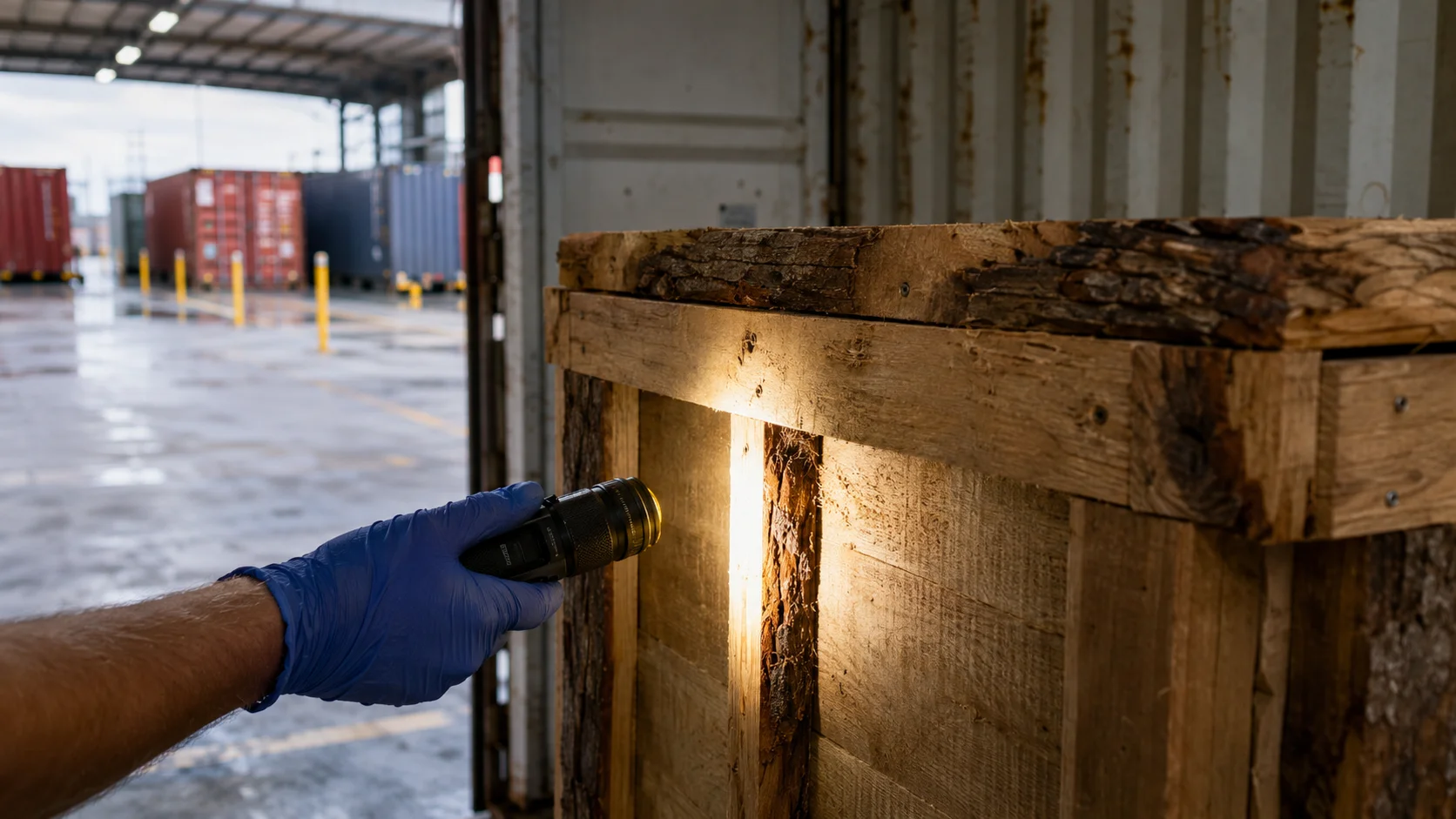
A tailgate inspection is the lighter direction: the container is presented (often at the wharf or an approved premises), the doors are opened, and the officer examines the exposed face of the cargo, the floor, door seals and whatever is visible, looking for insects, soil, plant material, undeclared straw or bark, and checking ISPM 15 stamps on visible timber. If the risk resolves at the doors, the container is released. If the officer sees something, or can’t see enough, the direction escalates.
A full unpack means the container is transported to an approved arrangement premises and completely unloaded so the goods and packaging can be examined throughout. This adds transport legs, unpack labour, storage and significantly more officer time. For rural-delivery containers, the rural tailgate is the standard variant: the tailgate happens before the container is allowed to travel to the rural address.
Fees and who attends
Officer time is charged in quarter-hour increments, as a working figure in the AUD 30–60 per quarter hour band depending on location and hours, plus assessment and booking charges. The importer doesn’t attend; the container is presented by the depot or approved premises, and your customs broker or forwarder manages the booking and receives the outcome. What you pay for beyond DAFF’s fees is everything around the inspection: container detention if the box overstays its free days, storage at the premises, and the transport legs a full unpack requires. The DAFF invoice is often the smallest line on the total.
These charges belong in the same landed cost model as duty, GST, and freight. Our total landed cost framework shows where inspection fees fit alongside the other variables that determine what a shipment actually costs to land.
Outcomes: Release, Treatment, or Worse
Every inspection ends in a direction. Three families follow:
Release. The goods matched the declaration. No risk material was found. The biosecurity status is resolved. The container moves. If your documents were clean and your supplier packed clean, this is the overwhelmingly likely outcome, and it’s also a deposit into your compliance history.
Treatment direction. Risk material was found or couldn’t be ruled out, and it’s treatable. The goods are directed to an approved facility for fumigation (methyl bromide or sulfuryl fluoride), heat treatment, or, for some goods, gamma irradiation. Working ranges: a container fumigation typically lands somewhere between AUD 400 and 1,200 depending on volume, gas and location, and the cycle of transport-treat-ventilate-reinspect adds anywhere from three to seven-plus days depending on facility queues. Heat-sensitive or gas-sensitive cargo narrows your options and can push costs higher.
Export or destruction order. When contamination can’t be resolved by treatment (live pest infestations in untreatable goods, prohibited items, khapra beetle detections in certain pathways), the direction is to re-export the consignment or destroy it, at the importer’s expense. This is rare for mainstream commercial cargo with honest documentation, but it is the ceiling of the risk, and it’s worth knowing the ceiling exists.
The BMSB Deep-Dive
The brown marmorated stink bug seasonal measures are the single largest structural biosecurity event in the Australian import calendar, so they warrant their own treatment. (We’ve written a full BMSB season explainer; here’s the inspection-mechanics view.)
The season runs for goods shipped on board between 1 September and 30 April, from target risk countries. The shipped-on-board date is the trigger, not the arrival date: a container loaded 30 August sails outside the measures even if it arrives in October.
Two tiers of goods. Target high risk goods, defined by tariff chapters covering things like machinery, vehicles, parts, stone, ceramics and timber articles, must be treated offshore by a treatment provider approved under DAFF’s offshore BMSB treatment providers scheme before or at the point of shipment (with narrow exceptions for some flexible arrangements). Untreated target high risk goods from a target country in season face the harshest options on arrival: deny discharge, export, or in limited cases onshore treatment, and shipping lines will often simply refuse the booking. Target risk goods don’t require mandatory treatment but are subject to increased onshore intervention, meaning higher inspection probability, which is trigger category three doing its work.
The AEI match matters most here. A BMSB treatment certificate from a provider not on the approved list, or with an AEI number that doesn’t verify, is the same as no treatment. This is the highest-stakes version of the document quality lever: importers have paid for genuine fumigations that were disallowed because the certificate’s details didn’t match.
The December-arrival crunch. The season’s cruellest feature is timing: it opens 1 September, exactly when pre-Christmas peak shipping ramps up. Containers loaded September–October arrive October–December into a system where treatment facilities, inspection queues and already-congested ports are all saturated at once. A referral that costs four days in July costs ten in November. If your goods are in scope, the planning answer is unglamorous: book offshore treatment early with a verified approved provider, and pad December arrival schedules by a week minimum.
Reducing Your Exposure Long-Term
Short-term, you manage documents. Long-term, you manage the profile. Three programs follow, in ascending order of formality:
Supplier packing SOPs. Most inspection failures are created at origin, on the factory floor, by people who will never see the invoice for the consequences. Fix it there. Give every supplier a one-page packing standard: ISPM 15-stamped pallets only, stamp photographed; no straw, bark, peat or soil-contaminated material anywhere in the container; floor swept before stuffing; photos of the packed container (doors open, cargo face visible, floor visible) sent with the shipping documents on every consignment. The photos serve double duty: they let you verify the packing declaration is true before you sign anything, and they’re evidence if a dispute arises. This is standard-issue discipline, not sophistication, and it’s the highest-return program on this list.
Container inspection at origin. Before stuffing, the empty container gets checked: floor for soil and spills, walls and ceiling for insects and egg masses, underframe externally if accessible, door seals. A contaminated box rejected at origin costs a phone call to the depot. The same box detected in Australia costs a treatment direction. Some importers make this a supplier obligation; higher-volume operations pay a third-party surveyor a modest fee per container, which pays for itself the first time it catches something.
Compliance-based intervention schemes. For established importers on eligible pathways, DAFF operates arrangements under which demonstrated compliance earns formally reduced intervention, with lower inspection rates for participants who maintain approved procedures and clean records. Eligibility is pathway-specific and the details evolve, but the strategic point is stable: compliance history is an asset that can be converted into lower inspection rates, and it’s built one clean consignment at a time. Ask your broker which schemes your commodity pathway supports once you have volume and a track record.
A caution about how a clean record gets read internally. An importer who has gone three years without a referral will describe the operation as low-risk, and will quietly start trimming the things that produced the record: the origin container check, the photo set, the surveyor fee. A run of clean consignments is not evidence that the exposure went away. It is evidence that the exposure has not yet been sampled, which is a weaker claim and a very different one. Biosecurity risk is not spread evenly across your shipments; it sits in the tail, in the one container stuffed on a wet afternoon by a crew nobody briefed. The treatment direction lands on your account, not on theirs. Price the tail, not the average.
Worked Example: Two Identical Furniture Shipments
Back to the two containers from Semarang, say mixed timber and rattan furniture bound for Melbourne, the pathway covered in our Indonesia furniture import guide. Same factory, same vessel, same commodity referral (timber furniture is a category-one trigger; both were always going to see DAFF).
Container A: clean file. Packing declaration on the current template, consignment-specific, declaring ISPM 15-treated pallets and no prohibited materials. Fumigation certificate from the origin treatment provider with AEI, container number and dates all matching. Supplier photos of the stuffed container in the document pack. Documentary assessment closes without escalation; the profile directs a routine tailgate given the commodity. Tailgate is booked promptly, the officer sees a swept floor and stamped pallets matching the declaration, and releases. Elapsed: 2 days from discharge. Cost: roughly AUD 180 in assessment and inspection fees. One more clean result on the importer’s history.
Container B: one bad document. The packing declaration, recycled from a previous shipment, declares no timber packaging. The packing list mentions wooden crates. The documentary assessment officer spots the contradiction: escalation to full inspection, day 1. The inspection booking takes 4 business days in the pre-Christmas queue. At tailgate, the officer finds the crates, one bearing an illegible ISPM 15 stamp, plus wood shavings used as void fill: direction to full unpack and fumigation. Transport to the approved premises, unpack, methyl bromide treatment, ventilation, re-inspection, release: 5 more days. Elapsed: 11 days. Cost: AUD 1,900, covering inspection time across two attendances (~AUD 420), transport and unpack/repack (~AUD 560), fumigation (~AUD 640), storage and admin (~AUD 280), plus container detention charged separately by the shipping line, plus a compliance-history entry that raises the inspection rate on the next several shipments.
The spread between A and B was authored weeks earlier, at a desk in Semarang, by whoever filled in the declaration. That’s the lesson in one sentence: you don’t get through inspections faster by managing the inspection. You get through faster by managing the file that decides whether the inspection happens at all.
Common Mistakes
- Recycling packing declarations between shipments. The exact failure in Container B. Declarations must describe this consignment.
- Using outdated declaration templates. DAFF updates acceptable formats; an old template can fail documentary assessment even when its contents are true.
- Not verifying treatment provider AEI numbers, especially for BMSB offshore treatment, where an unapproved provider’s certificate is void.
- Assuming the forwarder checks packing. Nobody at origin opens your supplier’s container unless you pay them to. The packing declaration is signed on the supplier’s say-so, so verify it with photos.
- Ignoring the container as a risk vector. Soil on the underframe fails you even when the cargo is perfect.
- Timing BMSB-scope arrivals into December without padding the schedule for saturated treatment and inspection queues.
- Treating a failed inspection as a one-off cost. It isn’t. It reprices your inspection probability for months. Conversely, boring, clean, repetitive compliance is a discount that compounds.
- Confusing biosecurity holds with customs holds. Different agencies, different queues, different fixes: a shipment can clear one and sit in the other. See our customs delays guide for the other half of the picture.
Swift Cargo clears Australian imports with the packing declaration and treatment-certificate discipline this guide describes built into every consignment. Get a quote for shipping to Australia and we’ll flag your commodity’s likely inspection triggers before you book.
Sources
- Department of Agriculture, Fisheries and Forestry (DAFF), Biosecurity Import Conditions system (BICON): agriculture.gov.au
- Department of Agriculture, Fisheries and Forestry (DAFF), Brown marmorated stink bug (BMSB) seasonal measures: agriculture.gov.au
Related Reading
- Biosecurity Requirements for Importing into Australia: Product-by-Product Guide
- Brown Marmorated Stink Bug Shipping Season, Explained
- Customs Delays on Australian Imports: Causes and Fixes
- Port Delays in Australia: What’s Driving Them
- Importing Furniture from Indonesia to Australia
- Australia BICON Import Conditions: What Shippers Need to Check
Frequently Asked Questions
What percentage of import shipments does DAFF inspect?
There’s no single published rate, because there isn’t one. DAFF screens every declaration electronically, and what actually varies is the referral rate by commodity, origin, season and importer history. Timber, food and plant-product shipments are referred at rates approaching 100 percent; clean-file manufactured goods may see only the random verification pool. If your cargo sits in a flagged commodity pathway, plan for physical inspection on your first several consignments. Treat it as the baseline, not the exception.
What’s the difference between a tailgate and a full unpack inspection?
A tailgate opens the doors and inspects what’s visible (cargo face, floor, seals, visible timber packaging) without unloading. A full unpack empties the container at an approved premises so goods and packaging can be examined throughout. Tailgates typically resolve in one attendance; full unpacks add transport, labour, storage and days. Containers headed to rural delivery addresses get a mandatory rural tailgate before they’re allowed to travel.
What happens if my container is referred, and what does that actually cost?
One of three directions follows. Release, if the goods match the declaration, costs nothing beyond the inspection fee and is also a deposit into your compliance history. Treatment, for risk material that can be resolved, usually means fumigation, heat treatment or gamma irradiation at an approved facility: budget AUD 400–1,200 for a container fumigation and three to seven-plus days added to your schedule. Export or destruction, at your cost, is the direction when the risk can’t be treated (an untreatable infestation, prohibited material); it’s rare for honest commercial documentation but it is the real ceiling. A routine tailgate referral on its own typically totals under AUD 200 in officer time and fees. It’s the escalation path that gets expensive, not the base check, and every referral feeds the compliance history that sets your future inspection rate.
Does BMSB season apply to my goods?
Only if three things line up: a shipped-on-board date between 1 September and 30 April, an origin on DAFF’s target risk country list, and goods on the target risk or target high-risk list for that tariff chapter. The shipped-on-board date is what counts, not the arrival date. Target high-risk goods need certified treatment from a DAFF-approved provider, with an AEI number that verifies, or they face deny-discharge or export on arrival; for the current 2026/27 season, that treatment can be ethyl formate fumigation done onshore as well as offshore, DAFF’s newer alternative to methyl bromide, so offshore is no longer your only compliant path. Target risk goods, the lower tier, face increased onshore inspection instead of mandatory treatment. DAFF also discontinued its Safeguarding Arrangement Scheme for this season, so a prior-season approval will not carry over. Check the current country and goods lists before every booking in the window, not last season’s.
Can I reduce how often my shipments get inspected?
Yes, but it compounds rather than switches off. Accurate, consignment-specific packing declarations, verified treatment certificates whose details match the consignment exactly, supplier packing SOPs with photo evidence, and your own pre-load container checks all feed the history-based profiling that lowers future referral rates. Established importers on eligible pathways can formalise this through DAFF’s compliance-based intervention schemes for reduced inspection rates. There’s no one-time fix. There’s a compounding discount for sustained documentation discipline.