

Most people moving to Thailand book international removals the same way they book a domestic move: find a company, get a quote, hand over the keys. The first surprise comes two weeks after the cargo leaves, when the questions start. Where is it now? What does that document mean? Why is there an extra charge? When will it actually arrive?
International removals to Thailand are not complicated, but they are unfamiliar. The process runs through seven sequential stages, each handled by a different party. It crosses two regulatory systems, your origin country’s export rules and Thailand’s import rules, and it includes a sea voyage that runs from under a week out of Singapore to about ten weeks from northern Europe. Understanding each stage before the move starts is the difference between a process that feels managed and one that feels out of control.
Total cost depends on origin and volume, but it is far from an afterthought: a UK move of this kind typically runs from about £1,754 for a studio-sized shipment to roughly £4,491 for a two-bedroom household. See the full UK to Thailand removals cost breakdown for all six cost layers and three scenarios. Our real cost of shipping to Thailand guide breaks down the multi-origin picture. For what door-to-door service covers at each stage, see the door-to-door shipping to Thailand explainer.
Removals Company vs Freight Forwarder: Understanding Who You Are Booking
Most movers do not realise their first decision is who they book the move with. International removals companies and international freight forwarders both handle cargo from your origin country to Thailand. They are not the same service.
An international removals company is a full-service provider: they send staff to your home to inventory and pack goods, supply specialist packing materials (wardrobe boxes, dish packs, custom crating for fragile items), load the truck, manage the export process, arrange the sea freight, clear Thai customs on arrival, and deliver to your new address in Thailand. The service is designed for household goods, including furniture, and the team understands the handling requirements. FIDI-accredited removals companies operate to international quality standards across the full chain.
An international freight forwarder handles the logistics of moving cargo: booking vessel space, managing customs documentation, arranging port handling. They typically require goods to arrive at their warehouse or depot already packed, and their service often terminates at the destination port rather than the final address. Freight forwarders are efficient and cost-effective for commercial cargo and for movers who are comfortable with self-packing and local last-mile arrangements in Thailand.
Neither is inherently better. The right choice depends on how much of the process you want managed versus how much you want to coordinate yourself. Know which one you have booked before the move starts, so you are clear on which stages are covered and which you need to arrange independently.
Stage 1: The Pre-Move Survey
Every professional international removal starts with a pre-move survey, either a video call or a home visit. The survey produces an accurate inventory and volume estimate, which drives the freight quote.
Volume is measured in cubic metres (CBM). A single room in a furnished apartment typically yields 3–7 CBM of packed goods. A full two-bedroom apartment might be 18–28 CBM. A four-bedroom house can reach 50+ CBM. These numbers matter because they determine whether your move is shipped as LCL (less than container load, consolidated with other shippers’ cargo) or FCL (full container load, a dedicated container). Not sure what your volume is? The CBM size guide shows what 3, 8, 12 and 18 CBM look like room by room.
The LCL/FCL crossover is typically 15–18 CBM: below this threshold, LCL is usually more economical; above it, an FCL container becomes cost-competitive and you get better handling control, because your goods are the only cargo in the container. See our full explanation of shipping household goods to Thailand for the volume and service level analysis.
At the survey stage, flag any items that require special handling: antiques, artwork, pianos, motorcycles, wine collections, high-value electronics. These require custom crating, specialist packing, or in some cases separate customs declarations. Flagging them at survey prevents problems at packing and customs.
At this stage, also confirm the destination address in Thailand. Removal companies need to know whether delivery is to a Bangkok apartment building (requiring elevator access coordination), a villa in Phuket (truck access), or a provincial address (requiring local sub-contractor coordination in Thailand). Access conditions affect cost and scheduling.
Stage 2: Packing
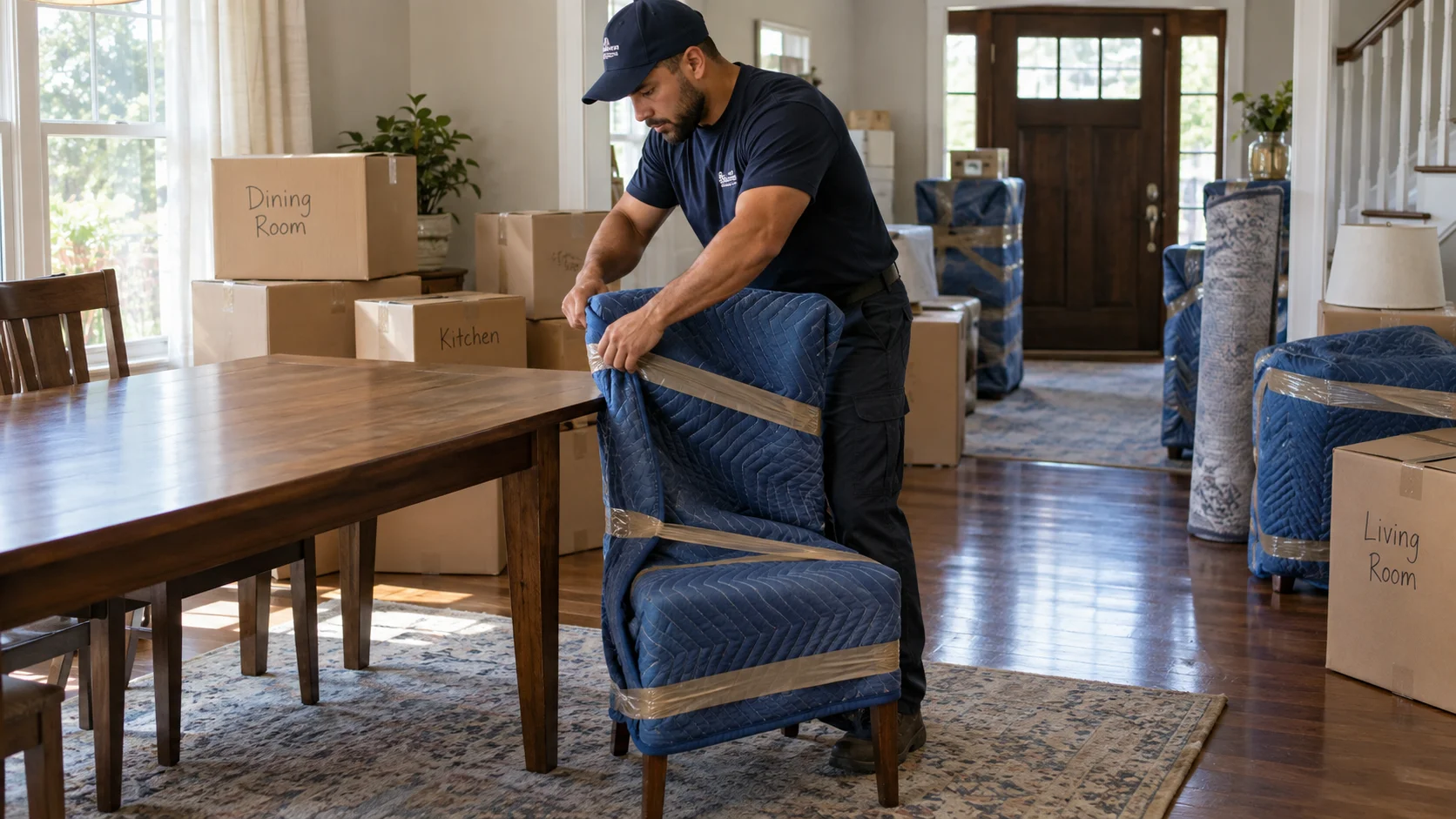
For full-service removals, the packing team arrives one to two days before the agreed collection date. Packing a typical two-bedroom apartment takes one day with a team of three packers. A four-bedroom house typically takes two days.
Professional international packing uses double-walled cartons, tissue and foam wrapping for fragile items, and specialist materials for specific categories: mirrored boxes for framed art and mirrors, wardrobe boxes for hanging clothing, mattress bags, and custom timber crates for high-value or oversized items.
Every carton is inventoried by the packing team and assigned a number that matches the packing list, the document that accompanies the shipment and that Thai customs will review. The packing list describes what is in each box. A packing list that says “household miscellaneous” is less useful at Thai customs than one that says “kitchen utensils, ceramic dishes, glass tumblers × 12.” The more specific the description, the less likely a customs officer is to request an examination.
Items you cannot ship to Thailand include firearms and ammunition (without specialist permits), illegal drugs, and certain plant and animal products. Prescription medications in quantity may require documentation. If you are unsure about a specific item, confirm with your removals company before packing day. Removing a problematic item from a packed container is expensive.
Stage 3: Collection and Export
Once packed, goods are loaded onto the removal truck and transported to the freight station or container loading facility. For FCL moves, the container may be loaded directly at your property if access allows. For LCL moves, goods go to the consolidation warehouse where they are combined with other shippers’ cargo into a shared container.
The goods clear export customs at this stage. In most origin countries, an export customs entry is required. This is a government declaration of what is leaving the country and its value. In the UK, for example, the post-Brexit customs regime requires a full export declaration for household goods leaving for Thailand, including a commodity code (HS code) for the main categories of goods. Your removals company or freight forwarder handles this, but they need your passport, address details, and in some cases a packing list approved by you. UK movers will find full GBP cost scenarios in the UK to Thailand international removals cost guide.
Export documentation for household goods typically includes:
- Commercial invoice or inventory (describing the goods and their value)
- Packing list (itemising every carton)
- Bill of lading (the title document for the cargo, issued by the ocean carrier)
- Export customs declaration (country-specific)
- Certificate of origin (if needed for Thai customs preferential duty purposes)
The full documentation checklist lives in our required documents for shipping to Thailand guide.
Every stage above assumes a typical move, but real transit times, customs treatment and total cost all shift with your actual route and volume, and pricing your own Thailand move starts with those real numbers.
Stage 4: Sea Freight, the Ocean Transit
Once goods are loaded and export cleared, the container or LCL consolidation is handed to the ocean carrier. This is the longest stage of the move and the one with the most variability.
The table below gives typical transit times from common origin countries to Thailand (Laem Chabang port), current as of the Cape of Good Hope rerouting:
| Origin | Main departure port | Transit time (port to port) | Notes |
|---|---|---|---|
| United Kingdom | Felixstowe / Southampton | 35–48 days | Via Cape of Good Hope (Red Sea rerouting since late December 2023) |
| Germany / Netherlands | Hamburg / Rotterdam | 36–49 days | Via Cape of Good Hope |
| France | Marseille / Le Havre | 33–45 days | Via Cape of Good Hope |
| Australia | Sydney / Melbourne | 12–18 days | Direct or via Singapore transshipment |
| Singapore | Singapore | 3–5 days | Direct feeder service |
| China | Shanghai / Shenzhen | 8–14 days | Via Singapore or direct |
| USA (West Coast) | Los Angeles / Long Beach | 20–28 days | Trans-Pacific + transshipment |
The Cape of Good Hope rerouting for Europe-origin cargo is a structural change introduced in late December 2023 following Houthi attacks on Red Sea shipping. BIMCO analysis confirms this adds 10–14 days to Europe–Asia transits compared to the historical Suez Canal route. The added fuel cost is passed through to shippers as a War Risk Surcharge and increased BAF. The Cape route is now the standard for most European carriers on the Asia trade lane.
During the ocean transit, your goods are not accessible. The bill of lading is the legal title document. The carrier will only release the container to the holder of the original B/L or to a party with a telex release or express B/L. Keep a copy of the B/L number. You will need it for tracking and for Thai customs.
Vessel tracking is available through the carrier’s website using the container number or B/L number. Most removals companies send weekly updates during the transit period. For a full overview of how Swift Cargo manages Thailand shipments, see the Thailand shipping process.
Stage 5: Arrival at Laem Chabang
The great majority of international removals to Thailand arrive at Laem Chabang, Thailand’s main deep-water port, approximately 130 km south of Bangkok in Chonburi province. A smaller volume arrives at Bangkok Port (Klong Toey), which handles smaller vessels and some LCL cargo.
When the vessel arrives at Laem Chabang, your Thai agent or the Thai branch of your removals company is notified by the shipping line. The arrival triggers a sequence of events that must be completed before goods can be released:
- The Thai agent receives the arrival notice and confirms documents are in order
- The original bill of lading is surrendered to the shipping line (or a telex release is confirmed)
- The Thai licensed customs broker prepares a customs import entry
- Thai customs processes the entry, either Green Lane (automatic release) or Red Lane (physical examination)
- Duty and VAT are assessed and paid (see Stage 6 for personal effects duty relief)
- The container or LCL cargo is released from port
- Goods are transported to the delivery address
The time from vessel arrival to cargo delivery in Bangkok is typically 5–10 working days under normal conditions. This extends to 10–20 days if goods are examined, if documents require correction, or if the arrival coincides with the Songkran period (mid-April).
Stage 6: Thai Customs, Personal Effects and Duty Relief
How Thai customs treats your removal goods depends on whether the shipment qualifies for personal effects duty relief.
Personal effects that qualify for duty-free entry must meet all of the following conditions:
- Qualifying status: The importer must hold a qualifying status at the time the goods arrive at Thai customs, not at the time of booking or shipment departure. Thai Customs grants the relief against documented status: a one-year Thai work permit (in practice with a Non-Immigrant B visa), a non-immigrant visa with a confirmed working period of not less than one year, Thai permanent residence, a full one-year Smart Visa, or returning-Thai-national status after 12 or more consecutive months abroad. A retirement visa is not one of them: Non-Immigrant O, O-A and O-X holders are excluded by name and pay duty plus VAT on the whole shipment.
- Six-month residency window: The goods must arrive within six months before or after the importer establishes residence in Thailand.
- Used goods only: Goods must be demonstrably used personal effects. New or near-new goods, particularly electronics, appliances, and clothing, may be assessed at their commercial value with duty applied.
- One shipment only: The duty relief applies to one shipment per change of residence.
- Owner or broker present at clearance: The Thai customs declaration for personal effects requires the importer or their authorised broker to be present.
Goods that do not qualify for duty relief are assessed at their CIF (cost + insurance + freight) value, with import duty (typically 10–30% for household goods categories, per the Thai Customs Department) and 7% VAT applied. What qualifies, and the paperwork it requires, is explained in our duty-free import rules in Thailand guide.
The practical implication is this: if you are moving to Thailand on a retirement visa, a tourist visa or a visa-exempt entry (30 days for UK, US, Australian and most EU passports since 15 September 2026), your goods do not qualify for duty-free entry at customs. Retirees are the largest group caught by this. The qualifying status must be in place at the time of customs clearance, not at the time of arrival in Thailand as a person.
Your Thai customs broker will prepare and present the entry. However, the broker needs your passport copy, your visa/residency documentation, the bill of lading, the packing list, and the commercial invoice or inventory. Providing these documents before the vessel arrives prevents delays at the port stage.
Whether your move qualifies for duty-free entry comes down to timing.
The residency-permit timing condition catches more movers than any other rule in Thailand’s personal effects allowance.

Stage 7: Delivery in Thailand
After customs release, goods are transported from Laem Chabang to the delivery address. For Bangkok addresses, this is typically a same-day or next-day truck move. For addresses in Chiang Mai, Phuket, Koh Samui, or other provinces, the delivery adds 1–3 days and a higher transport cost.
For apartment buildings in Bangkok, the removals team coordinates with building management for truck access, elevator reservation, and move-in time slots. Many Bangkok buildings restrict deliveries to weekday daytime hours and require advance notice of 24–48 hours.
Unpacking service (where the removals team removes goods from cartons and places furniture) is available from full-service removals companies at additional cost. Carton removal is typically included. Confirm in advance who disposes of the packing materials, boxes and wrapping, as Thai apartment buildings have variable rules.
With the logistics mapped, build the full picture of what this move costs: the Thailand relocation cost breakdown maps every financial commitment from visa fees to first-year living costs so the shipping decision fits inside a real budget rather than sitting isolated from it. And before goods leave port, confirm marine cargo insurance for the Thailand transit. A personal effects shipment on a 55-to-70-day Cape route without coverage is a gamble on a high-stakes voyage.
What Surprises First-Time Movers
Five things consistently catch people off-guard on their first international removal to Thailand:
1. The gap between the freight quote and the total cost
The quote from a removals company typically covers packing, collection, ocean freight, and delivery. It often excludes destination port charges (THC), customs duty and VAT if goods do not qualify for relief, customs broker fee, and final-mile delivery within Thailand if the quote terminates at the port. Request an itemised all-in quote that names each cost layer before confirming the booking.
2. The transit time
Europe to Thailand currently takes 35–49 days port-to-port on Cape of Good Hope routing, plus packing and delivery time. Total door-to-door from the UK or Germany is typically 70–85 days. The wide port-to-port spread is mostly rotation position: the same carrier can publish 36 days from Rotterdam on one service and 49 on another in the same week, depending on whether Rotterdam is the last European call before the ocean leg or an early one. Ask which service the booking is on.
3. The visa timing requirement for duty relief
Many movers arrive in Thailand on a tourist visa or visa-exempt entry, intending to convert to a long-term visa once settled. If their goods arrive at customs during this period, they do not qualify for personal effects duty relief. The goods are assessed commercially. This is not correctable after the fact. The fix is to ensure the long-term visa is in place before the goods arrive in Thailand, which means applying before departure or at the Thai consulate in the origin country.
4. Songkran delays in April
Goods arriving at Laem Chabang between approximately 10 and 18 April encounter extended clearance times due to reduced port and customs staffing during Thailand’s Songkran festival. A move timed to arrive in April may wait 14–21 days for customs clearance instead of the typical 5–10 days. Avoid planning arrivals in this window if possible.
5. The prohibited and restricted items list
Thai import restrictions cover a wider range of goods than most origin countries. Beyond the obvious prohibitions (firearms, drugs), items that cause problems include soil or earth attached to plant pots, certain wooden items without phytosanitary certificates, high-value alcohol in commercial quantities, and certain electronic items without Thai regulatory approval. Review the Thai Customs prohibited goods list on the Thai Customs Department website before you move. It takes 20 minutes and prevents costly problems at the border.

Timeline Summary: What to Do and When
| Timeline before Thailand arrival | Action |
|---|---|
| 12+ weeks before | Book removals company or freight forwarder. Schedule pre-move survey. Confirm visa status and type required for duty relief. |
| 8–10 weeks before | Complete pre-move survey. Receive and confirm quote. Arrange marine cargo insurance. Apply for Thai long-term visa if not already in hand. |
| 4–6 weeks before | Packing and collection. Export clearance. Cargo departs on vessel. Receive B/L number and container tracking details. |
| During transit (3–70 days, by origin) | Provide documents to Thai agent: passport copy, visa/residency documentation, B/L, packing list, inventory. Confirm delivery address access with building management. |
| On vessel arrival at Laem Chabang | Thai broker files customs entry. Duty assessed. Payment arranged. Typical release: 5–10 working days. |
| After customs release | Delivery to address. Unpacking (if service included). Carton removal. |
Related reading: Part Load Removals to Thailand: Sailing Dates, Duty and Crates
Frequently Asked Questions
How long does an international removal to Thailand take?
Total door-to-door time depends on the origin country. From the UK or Europe, allow 70–90 days from packing day to delivery in Thailand. The ocean transit from UK/European ports is 35–49 days via the Cape of Good Hope route (the current standard since the Red Sea rerouting of late December 2023), plus packing, export clearance, Thai customs (typically 5–10 working days after vessel arrival), and last-mile delivery. From Australia, the total is typically 25–40 days. From Singapore, 10–18 days. Build in additional buffer if your arrival coincides with Thai Songkran (mid-April) when customs clearance is slower.
Do I need to pay customs duty on my household goods when moving to Thailand?
Used personal effects may qualify for duty-free entry under Thai customs regulations, but specific conditions must all be met: you must hold a qualifying status at the time the goods reach Thai customs (a one-year Thai work permit, a non-immigrant visa with a confirmed working period of at least one year, Thai permanent residence, a full one-year Smart Visa, or returning-Thai-national status after 12 or more consecutive months abroad); retirement visas (Non-Immigrant O, O-A, O-X), tourist visas and visa-exempt entries do not qualify; the goods must arrive within six months before or after you establish residence; they must be demonstrably used goods (not new); and this is a one-time relief per change of residence. Goods that do not qualify are assessed for import duty (typically 10–30% for household goods categories) plus 7% VAT on the CIF value. Holding the wrong status, not missing the timing window, is the most common source of unexpected duty charges for retirees.
What is the difference between an international removals company and a freight forwarder?
An international removals company provides an end-to-end household goods service: a team packs your home, loads the truck, manages export customs, arranges sea freight, handles Thai customs clearance, and delivers and unpacks at your new Thailand address. A freight forwarder focuses on the logistics of moving cargo: booking vessel space, managing documentation, and arranging port handling. But a forwarder typically requires goods to arrive at their depot already packed, and their service may terminate at the destination port rather than the final address. Both can handle moves to Thailand; the choice depends on how much of the process you want managed versus self-coordinated.
Can I ship a car or motorcycle with my household goods to Thailand?
Importing a vehicle to Thailand is technically possible but subject to high import duty. Thai import duty on passenger vehicles is typically 80% of CIF value, with additional excise tax and VAT (see Thai Excise Department rates). The total tax burden on a mid-range European car can exceed 200–300% of the vehicle’s value. For motorcycles, duty is similarly high. Most movers find it economical to sell the vehicle at origin and purchase locally in Thailand. RHD (right-hand drive) vehicles from Australia are somewhat more practical as Thailand drives on the left, but the duty burden remains prohibitive for most. Confirm current rates with a Thai customs broker before making this decision.
What documents do I need for my international removal to Thailand?
The core document set for a personal effects removal to Thailand includes a detailed packing list (itemising every carton by contents), a commercial invoice or household goods inventory with declared values, the bill of lading (issued by the ocean carrier), your passport copy, your Thai visa or residency permit documentation, and your origin country export declaration. If goods include any plant-based items, wooden furniture, or used machinery, additional phytosanitary certificates or treatment documentation may be required. Your removals company or freight forwarder will advise on country-specific export requirements, but the Thai residency documentation must come from you.