
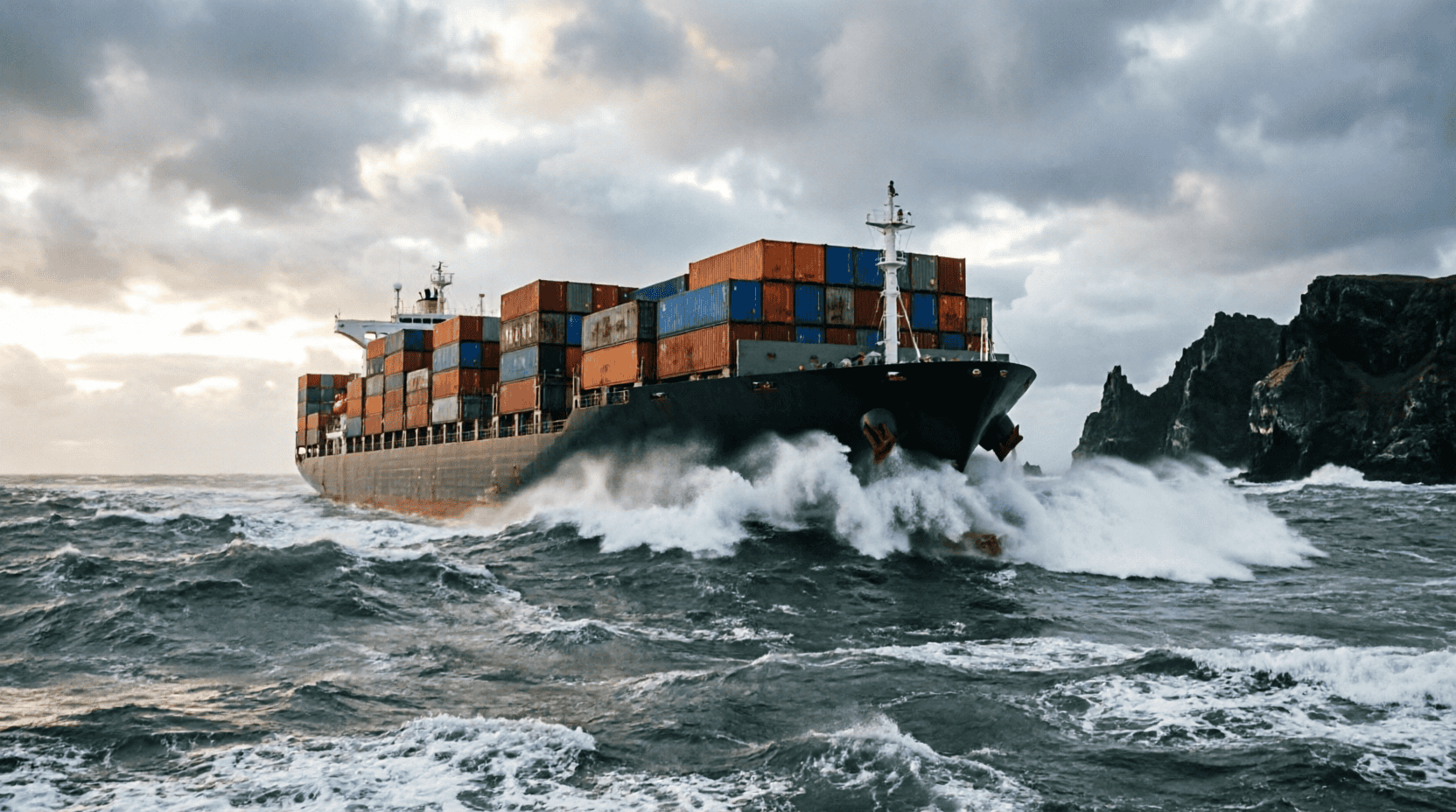
Europe to Thailand is not a short move. The sea route from Rotterdam to Laem Chabang covers roughly 19,000 kilometres via the Cape of Good Hope, a distance that shapes almost every decision you will make about what to ship, how to ship it, and how long to wait for it.
If you are planning the move itself, not just the freight, our Thailand relocation guide 2026 covers visa categories, duty-free personal effects rules, and the full customs process at Laem Chabang.
The Thailand-side process (customs clearance, duty assessment, delivery) is covered in full in our step-by-step guide to shipping household goods to Thailand.
The Route: What Actually Happens Between Your Front Door and Thailand
Since the Houthi attacks on Red Sea shipping that began in late 2023, virtually all Europe-to-Asia container traffic has rerouted via the Cape of Good Hope. The Cape route adds roughly 7–11 days to the sea transit compared to the Suez route and meaningfully increases fuel costs, which carriers pass through as surcharges.
The voyage itself breaks down as follows from major European ports to Laem Chabang:
- Rotterdam / Antwerp / Hamburg: 28–35 days sea transit via Cape
- Felixstowe / Southampton (UK): 30–37 days sea transit
- Le Havre: 29–35 days sea transit
- Genoa / La Spezia: 27–33 days sea transit
- Barcelona / Valencia: 27–32 days sea transit
These are vessel transit figures. Your goods are not on the vessel for this entire period. Before the vessel departs, three steps happen: a collection and packing window (5–10 days), a container loading window at the CFS or container yard (3–5 days for LCL), and customs export clearance. At the Thailand end, port handling, customs clearance, and delivery typically add 7–14 days. The realistic door-to-door timeline for a European relocation to Thailand is 10 to 16 weeks under current Cape routing conditions.
Nearly all routes stop at one or two transshipment ports. Tanjung Pelepas (Malaysia), Port Klang (Malaysia), and Singapore are the most common intermediate stops for Europe-to-Thailand cargo. Each transshipment point is a point of damage risk: the container is lifted off one vessel and onto another, sometimes after a period of storage in the yard.
European Departure Ports: Which One Is Right for You
Use the major container port that serves your region; the freight cost difference between adjacent ports is rarely large enough to justify repositioning your goods.
| Country / Region | Primary Port(s) | Notes |
|---|---|---|
| Netherlands, Belgium, Germany (North) | Rotterdam, Antwerp, Hamburg | Rotterdam is Europe’s largest container port. Excellent LCL consolidation frequency to Southeast Asia. |
| UK, Ireland | Felixstowe, Southampton | Post-Brexit: goods leave as non-EU exports. EU-standard exit documents no longer required. |
| France (North) | Le Havre | Major consolidation hub. Good direct service to Singapore/Laem Chabang. |
| France (South), Monaco | Marseille, Fos | Shorter access to Mediterranean feeder services connecting to Cape route vessels. |
| Italy, Switzerland, Austria | Genoa, La Spezia, Livorno | Genoa and La Spezia serve as gateway for central Europe. Livorno for Tuscany. |
| Spain, Portugal | Barcelona, Valencia, Algeciras | Algeciras is the southernmost major port, with a marginally shorter Cape route. Barcelona and Valencia have more frequent consolidation services. |
| Germany (South), Austria, Czechia | Hamburg or inland to Rotterdam | Hamburg is often preferred for landlocked central European origins due to rail/road connections. |
| Scandinavia | Gothenburg, Copenhagen, feeder to Rotterdam | Smaller volumes often feed via Rotterdam rather than direct services. |
LCL vs FCL: The Crossover Calculation for European Shipments
For most personal relocations from Europe, LCL (less than container load) is the default. A one-bedroom European apartment typically yields 10–18 cubic metres of household goods; a three-bedroom home might reach 25–35 CBM. The LCL-to-FCL crossover on European routes sits at approximately 15–20 CBM, slightly higher than on shorter China-to-Australia routes because the fixed FCL costs (port handling, container hire, destination THC at Laem Chabang) are spread over a longer voyage with higher base rates.
If your volume is firmly below 12 CBM, LCL is almost certainly the right answer. If you are at 20+ CBM, a 20-foot container (which holds approximately 25–28 CBM of household goods once packed) is worth pricing. Above 28 CBM, a 40-foot high-cube container (up to 76 CBM capacity, though household goods rarely fill more than 40–50 CBM of this) becomes relevant for larger moves.
Three things shift the calculation toward FCL even at lower volumes:
- High-value fragile goods. Art, antiques, musical instruments, and certain furniture pieces benefit from sole-occupancy container environments: no co-loading, no intermediate handling at the CFS deconsolidation facility. The fewer times your goods are touched, the lower the damage risk. This is worth paying a FCL premium for at volumes that would otherwise be LCL on cost.
- Delivery timing. LCL on European routes adds a consolidation scheduling cut-off delay at origin (typically 5–10 days to the next sailing after your goods arrive at the CFS) and a deconsolidation delay at destination (Laem Chabang or Bangkok CFS adds 3–7 days). If you need goods to arrive by a hard date, FCL gives you direct vessel booking control that LCL does not.
- Peak season rate spikes. Q3-Q4 sees significant rate increases across European routes as northbound/southbound flows compete for vessel space. During peak periods, LCL rates per CBM can approach FCL cost-per-CBM at volumes well below the theoretical crossover.
Thai Customs Duty-Free for European Nationals: What Is Actually Required
Thai Customs allows used personal and household effects to enter duty-free under a personal effects exemption. The rules are the same regardless of which European country you are relocating from, but the documents you need to supply as proof differ by country of origin.
The Thai Customs requirements are:
- Goods must be used, not new in original packaging
- The owner must be entering Thailand to reside (the exemption is not available for holiday or tourist trips)
- The shipment must arrive within 6 months of the owner’s arrival in Thailand, and no earlier than one month before it
- A valid non-immigrant visa is required, and it must be work-based (a one-year visa with a work permit of at least one year) or Thai permanent residence; O and O-A retirement visas, tourist visas and most short-stay entries do not qualify
- The owner must be able to demonstrate they have departed their country of origin as a resident (not a visitor leaving for a holiday)
That last requirement is where European country-specific documents become critical. Thai Customs commonly requests residence deregistration evidence (proof that you have officially ended your residence in your home country) as supporting documentation for the duty-free claim.
Country-Specific Deregistration Documents
| Country | Deregistration Process | Document for Thai Customs |
|---|---|---|
| Germany | Abmeldung at the Einwohnermeldeamt (local registration office), mandatory by law when leaving Germany | Abmeldebestätigung (deregistration confirmation) |
| Netherlands | Aangifte van emigratie: file with the BRP (Basisregistratie Personen) at your local gemeente | Uittreksel BRP (personal data extract confirming emigration) or the emigration confirmation letter |
| France | No mandatory deregistration from the Mairie, but tax residence departure must be declared to the tax authority | Attestation de changement de résidence or a combination of rental contract termination, utility final bills, and French tax authority correspondence confirming non-resident status |
| Spain | Baja consular (deregistration from the Padrón municipal at your Ayuntamiento): submit Certificado de Empadronamiento as proof of prior residence, then deregister | Certificado de baja padronal or equivalent deregistration confirmation |
| Italy | Cancellazione anagrafica at your comune (municipal registry), required when establishing permanent residence abroad | Certificato di residenza with emigration notation, or cancellazione confirmation from the comune |
| UK | No formal resident deregistration system. Deregister from electoral roll, close National Insurance record contributions, notify HMRC of non-resident tax status | HMRC P85 (Leaving the UK form) confirmation, electoral roll removal letter, and/or council tax deregistration as supporting evidence |
| Sweden / Nordic | Folkbokföring deregistration at Skatteverket (Swedish Tax Agency): notify of emigration | Skatteverket emigration confirmation or Personbevis (person record extract) confirming deregistered status |
| Belgium | Deregistration at the commune / gemeente | Commune deregistration confirmation or radiation des registres de population |
Obtain these documents before your goods are collected. Thai Customs will not wait for paperwork to arrive after the shipment clears.
If you want the complete country-specific guide rather than just the deregistration step, see our full write-ups for Germany, the Netherlands, France, Italy, Spain, Austria, Ireland, or the UK.

What Is Not Worth Shipping from Europe to Thailand
The length of the voyage and the Thai import duty structure together make several categories of goods economically irrational to ship. Working through this list before packing saves both money and container space.
Wine and spirits. Thailand charges duty of 330% or more on imported wine and spirits and requires an import permit. A case of wine or whisky that cost EUR 200 in France or Scotland can attract EUR 500–1,000+ in duty and taxes on arrival. The household effects duty-free exemption does not extend to alcohol. Leave it behind, sell it, or drink it before you leave.
Cars and motorcycles. Thai import duty on passenger vehicles ranges from 80% to 328% of the vehicle’s CIF value depending on engine size, and this applies regardless of how long you have owned the vehicle. A EUR 25,000 European car will cost EUR 20,000–80,000+ in Thai import duty alone, before any local registration. No meaningful personal effects exemptions apply to vehicles. Under the Ministry of Commerce notifications effective 10 December 2019, used cars and motorcycles are also import-prohibited (exceptions cover used ambulances and fire trucks), so most used European vehicles cannot be imported at any duty.
E-bikes with lithium batteries. Lithium-ion batteries above a certain watt-hour threshold are classified as dangerous goods under IATA DGR Class 9 and are prohibited or strictly regulated on sea freight consolidations. Most e-bikes are ineligible for standard household goods shipping. The bike itself can sometimes be shipped separately as a lithium-battery-free frame with the battery purchased new in Thailand. But this is usually not worth the hassle for a single bike.
Large appliances at 220V/50Hz. Thailand runs on 220V/50Hz, the same as most of Europe. European appliances will generally work electrically. However, warranty and service support for European-branded appliances in Thailand is limited, and the cost of shipping a washing machine or refrigerator in a consolidation often approaches or exceeds the cost of buying new in Thailand. Appliances with residual value worth noting: premium European brands (Miele, AEG) retain enough value to sometimes justify the decision. Basic appliances do not.
Flat-pack furniture. The shipping cost per kilogram for flat-pack furniture rarely makes economic sense on a 10,000+ km route. IKEA operates in Thailand. Higher-quality solid European furniture (oak dining tables, quality upholstered sofas) is a different calculation, particularly if it has personal or sentimental value that makes replacement in Thailand impossible.
Packing Standards for a Long-Haul Route
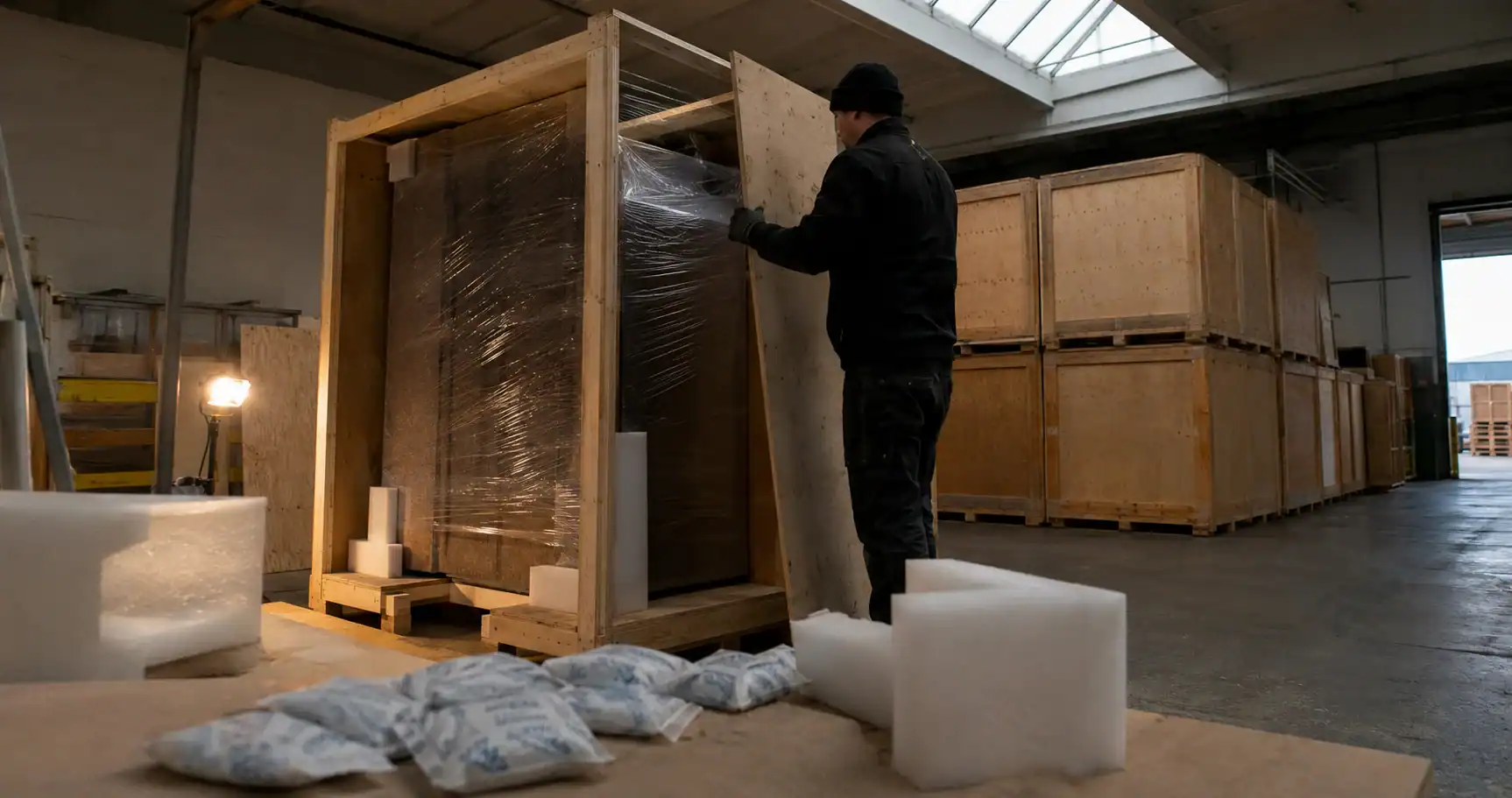
Three factors create higher physical stress on cargo than shorter routes: multiple vessel transshipments, Cape weather exposure (swells in the Southern Ocean can exceed 10 metres), and extended voyage duration.
The International Maritime Organization’s CTU Code (Code of Practice for Packing of Cargo Transport Units, produced jointly by IMO, ILO, and UNECE) is the relevant packing benchmark. For personal effects on this route, the key principles are:
- Desiccant placement: container sweat is a real phenomenon on long voyages through tropical and sub-tropical temperature transitions. Moisture absorbers (silica gel desiccant bags, sized to the container volume) prevent condensation damage to wooden furniture, electronics, books, and fabrics.
- Double-boxing fragile items: a box inside a box with foam padding on all six faces, not just bottom and top. Transshipment crane operations generate vertical shock; padding on vertical faces matters.
- Stow plan adherence: heavy items (books, tools, ceramics) on the floor of the container, lighter items above. Weight stacked on top of furniture causes compression damage over 30+ days of vibration.
- Void fill in all cartons: any movement inside a carton during the voyage becomes cumulative abrasion damage. Fill every carton to its rated capacity.
If your freight forwarder or removals company packs your goods, ask to see their packing methodology for long-haul routes specifically. “Standard packing” varies significantly between operators.
Cargo Insurance on the Europe-to-Thailand Route
The Hague-Visby Rules cap carrier liability at approximately USD 2.70 per kilogram of cargo lost or damaged, equivalent to roughly 4–5% of the typical replacement value of household electronics or quality furniture. On a long-haul route with multiple transshipment points and Cape weather exposure, relying on carrier liability is not a defensible position.
Institute Cargo Clauses (A), the “all risks” policy, is the appropriate cover for household goods on this route. ICC (B) and ICC (C) both exclude important perils that are directly relevant: rain damage, condensation, and physical handling damage in transshipment yards are typically only covered under ICC (A). The full insurance decision framework, including premium ranges and the insufficient packing exclusion you need to be aware of, is covered in our cargo insurance guide for Thailand shipping.
One specific point for European relocations: war and strikes (SRCC) add-on cover is worth considering given current Cape routing exposes your goods to additional political and maritime risk zones. This add-on is typically nominal in cost relative to the base premium.

The Realistic Timeline, Assembled
| Phase | Duration | Notes |
|---|---|---|
| Collection, packing, and delivery to port / CFS | 5–10 days | Depends on removals/freight forwarder collection schedule in your city |
| Consolidation and loading (LCL) / Container stuffing (FCL) | 3–10 days | LCL: next available sailing from CFS after goods arrive. FCL: your booked sailing date. |
| Sea transit via Cape of Good Hope | 27–37 days | Varies by departure port. Current Cape routing adds 7–11 days vs Suez. |
| Transshipment waiting time (if applicable) | 0–7 days | Depends on port of transshipment and connecting service schedule |
| Arrival at Laem Chabang / Bangkok port | 2–4 days | Port handling and documentation lodgement |
| Thai customs clearance | 3–14 days | Duty-free personal effects: 3–7 days if documents are complete. Inspection or duty assessment: can extend to 14+ days. |
| Domestic delivery in Thailand | 1–5 days | Bangkok metropolitan: 1–2 days. Provincial: 3–5 days. |
| Total door-to-door | 10–16 weeks | Plan for the upper end under current Cape routing conditions |
One practical implication: if you are relocating to Thailand on a fixed date (a job start, a school term, a lease beginning), your household goods will not be waiting for you when you arrive unless you shipped them 3–4 months in advance. Most Europeans arriving in Thailand live out of suitcases for the first 6–10 weeks while their shipment is in transit. Planning for furnished temporary accommodation for this period is standard practice.

Getting an Accurate Quote
Most international removals companies quote door-to-door to a single Thai delivery address. This is the simplest arrangement for personal relocation. The quote should itemise:
- Origin packing and collection
- Freight (sea, LCL or FCL, origin port to Laem Chabang or Bangkok port)
- Origin customs export clearance
- Destination charges (destination THC, terminal handling, port delivery order)
- Thai customs brokerage and clearance
- Cargo insurance (usually quoted separately or as an add-on)
- Domestic delivery in Thailand
Items that are sometimes excluded from removals quotes and should be asked about explicitly: storage in Thailand if your accommodation is not ready on arrival, re-delivery fees if customs clearance is delayed, and customs inspection fees if Thai Customs opens the container. Get the full scope in writing before accepting any quote.
If you are using a freight forwarder rather than a removals company (more common for part-container or business-goods shipments), the scope typically excludes origin packing and domestic delivery. You arrange those separately.
One document decides whether a container that has already arrived can actually be released, and most quotes never mention it: the bill of lading. If your forwarder issues an original B/L, the Thai agent needs that paper, endorsed, in Bangkok before the delivery order is cut. Couriered from Europe after sailing, it can arrive later than the goods, and the port starts charging storage while an envelope is in transit. Ask at booking for a telex (express) release or a sea waybill instead, so release is electronic and tied to the shipper’s instruction rather than to a physical document. On a 30-day Cape voyage, the paper should never be the slowest thing on the route.
Swift Cargo quotes door-to-door Europe-to-Thailand household goods moves across LCL and FCL from all major European departure ports.
In late 2023, a 23-cubic-metre household goods shipment from Rotterdam bound for Laem Chabang was rolled at a Singapore transshipment terminal. The vessel had berthed on schedule. Rolling meant the container sat in a yard for eleven days before the next available service. Notification reached the shipper’s broker on day four. The duty-free documentation package, timed to a specific arrival window, needed to be resubmitted with revised dates. Additional storage and rebooking costs came to approximately EUR 600. Cape routing is not the risk. It remains the primary practical option for most European household goods moving to Thailand. The risk is the assumption that the container will move on the timeline the forwarder quoted at booking. Build notification requirements into the forwarder agreement before the goods leave. Hold the duty-free documentation on a planning buffer, not a fixed arrival deadline.
Frequently Asked Questions
Can I ship goods from any European country to Thailand duty-free?
Yes, from any European country, if you qualify. The key requirements are that goods are used, the owner holds a qualifying status (a one-year work-based visa or work permit, or Thai permanent residence; O and O-A retirement visas do not qualify), and the shipment arrives between one month before and six months after the owner’s entry. The country-specific deregistration documents required vary, but the Thai customs rules are the same regardless of origin.
How long does shipping from Europe to Thailand take?
Allow 10–16 weeks door-to-door under current Cape of Good Hope routing. Sea transit alone is 27–37 days depending on the departure port. Add pre-shipment preparation, consolidation, Thai customs clearance, and domestic delivery for the full timeline.
Is it better to use a removals company or a freight forwarder for European relocations to Thailand?
For personal household goods, a removals company with door-to-door service is typically easier to manage: one contract, one point of accountability. A freight forwarder is more appropriate if you are shipping commercial goods, if you are managing packing yourself, or if volume is large enough (20+ CBM) that you want direct control over the container booking and customs brokerage. Both can handle the same physical goods; the difference is scope of service and who coordinates what.
What happens if Thai Customs decides to inspect my shipment?
Customs may open and inspect any shipment. For personal effects, inspection typically adds 3–10 days and may incur inspection fees (which your customs broker can advise on before clearance). Having complete, accurate documentation (including the packing list with clear item descriptions, origin deregistration documents, and visa paperwork) significantly reduces both the likelihood and duration of inspection. Vague packing lists (“miscellaneous household goods”) are a common inspection trigger.
Does the Thai personal effects exemption cover electronics?
Yes. Used personal electronics (laptops, televisions, cameras, audio equipment) qualify as personal effects if they are genuinely used and not in commercial quantities. One laptop, one television, and personal audio equipment are straightforward. Six televisions or ten laptops will attract scrutiny. No per-item limit is published, but Thai Customs applies a reasonableness test to quantities.
Can I ship alcohol as part of my household goods?
Alcohol is excluded from the personal effects duty-free exemption in Thailand and attracts excise duty at rates that make shipping economically unviable in almost all cases. Wine and spirits face duty of 330% or more. Do not include alcohol in your household goods shipment.