
Every import declaration lodged in Australia hangs off one field: the tariff classification. Get that ten-digit code right and the duty rate, the free trade agreement claim, the biosecurity screening and the permit checks all resolve the way they should. Get it wrong and you can underpay duty for four years without knowing, claim an FTA preference you were never entitled to, or pay 5% on goods that should have entered free. Classification is not paperwork trivia. It is the single decision that prices your goods at the border, and it is a decision the law says belongs to you, the importer, even when a broker fills in the box.
What the Harmonized System Is (and Where Australia Adds Its Own Digits)
The Harmonized Commodity Description and Coding System, run by the World Customs Organization (WCO), is a structured catalogue of everything that can be traded. It is organised into 21 sections and 97 chapters, moving broadly from raw materials (live animals, chapter 1) to complex manufactures (works of art, chapter 97). Within each chapter, four-digit headings describe product groups and six-digit subheadings narrow them. Those first six digits are international: a knitted cotton T-shirt is 6109.10 whether it lands in Sydney, Rotterdam or Los Angeles. More than 200 countries and territories classify on this common base, and the WCO revises it roughly every five years, most recently in the HS 2022 edition.
Beyond six digits, each country goes its own way. Australia extends the code to eight digits in Schedule 3 of the Customs Tariff Act 1995, published as the Working Tariff, and the eighth-digit level is where the Australian duty rate is actually set. A further two-digit statistical code is added for Australian Bureau of Statistics trade data, which is why the code you report on a full import declaration runs to ten characters. This layering matters for one practical reason: a code your supplier uses in China or Vietnam is only guaranteed to match Australia’s for the first six digits. The last four are Australian, and they are the ones that decide what you pay.
Why One Code Drives Everything
It is tempting to think of the HS code as a label for statistics. In practice, at least five separate consequences key off it.
Duty rate. Australia’s general rates are low by world standards, mostly Free or 5%, but the difference between those two on a $400,000 annual import program is $20,000 a year, before GST is calculated on the duty-inclusive value. Some lines carry different rates again, and concessional items in Schedule 4 depend on classification too.
FTA eligibility. Every free trade agreement Australia has signed defines its preferences and its rules of origin by HS code. Change the code and you may change the applicable rule of origin, the required change-in-tariff-classification test, and sometimes whether a preference exists at all. An FTA claim made against the wrong classification is not a small error; it is an invalid claim, and the duty saved becomes duty owed. How origin rules attach to codes is explained in full in Australia’s free trade agreements for importers.
Anti-dumping exposure. Dumping and countervailing measures are published against specific tariff classifications from specific countries. Aluminium extrusions, certain steel products, some glass and chemicals from particular origins carry additional duties that can run from a few percent to well over 50%. Whether your goods fall inside a measure is determined first by the code you declare, so misclassification can either drop you into a dumping net you did not expect or, worse, look like an attempt to slide out of one. See our article on anti-dumping duties in Australia for how measures are scoped.
Biosecurity referral. The Department of Agriculture’s profiles that decide whether a consignment gets referred for documentary assessment or inspection are keyed to tariff codes. Declare timber furniture under the right code and the system asks the right biosecurity questions; declare it under a generic code and you either miss a treatment requirement (a problem at the wharf) or get referred for goods that never needed it (a problem for your lead time).
Permits and prohibitions. Import permit requirements, restrictions and outright prohibitions are likewise mapped to classifications. Therapeutic goods, certain chemicals, weapons-adjacent items and dozens of other categories trigger controls through the code.
One field, five consequences. That is why classification deserves more attention than the thirty seconds it usually gets.
How Classification Actually Works: The Six General Interpretive Rules
Classification is not a vibe. It is governed by six General Interpretive Rules (GIRs), applied in order, and they resolve almost every argument if you work through them honestly. Here they are without the legalese.
Rule 1: the words of the headings and the legal notes decide. Section and chapter notes have legal force; the chapter titles do not. This rule settles the overwhelming majority of classifications on its own. If a chapter note says “this chapter does not cover X”, no amount of common sense about where X “belongs” overrides it. Always read the notes before the headings.
Rule 2(a): incomplete and unassembled goods count as the finished article. A flat-packed bookshelf is a bookshelf, not a bundle of timber panels and screws. A car body without an engine, if it has the essential character of a car, classifies as a car. This is the rule that stops importers splitting a product into “parts” shipments to chase a lower rate.
Rule 2(b) and Rule 3: mixtures and multi-material goods. When goods are made of more than one material, or when two or more headings each describe the product, Rule 3 gives a three-step tiebreak, applied strictly in order:
First, 3(a): the most specific description wins. “Electric shavers” beats “electro-mechanical domestic appliances”. A heading that names the product beats a heading that names its material or its general class.
Second, 3(b): essential character. If two headings are equally specific, ask what gives the product its essential character: which component drives its bulk, value, weight, or the role it plays in why anyone buys the thing. A gift hamper of cheese, crackers and a small wooden board classifies with the food, not the board, because the board is along for the ride. Retail sets are handled here too: goods put up together for retail sale, meeting a need together, classify as a set under the component that gives the set its character. A hairdressing set of scissors, comb and brush in a case classifies under the scissors.
Third, 3(c): last in numerical order. If specificity and essential character both fail to separate the candidates, the heading that appears last in the tariff wins. It feels arbitrary because it is; it exists so that every product has exactly one answer.
Rule 4: goods that fit nowhere classify with what they are most akin to. Genuinely rare in practice; new-to-world products usually still fit an existing heading.
Rule 5: packing classifies with the goods. Camera cases with cameras, instrument cases with instruments, ordinary cartons with whatever is inside them, unless the packaging is suitable for repetitive independent use or is clearly the more valuable article.
Rule 6: repeat the whole process at subheading level. Once you have the four-digit heading, the same logic runs again to pick the six- and eight-digit lines, comparing only subheadings at the same level.
Two habits make these rules workable. Read the legal notes first, every time. And when you invoke essential character, write down why: value share, weight share, function. “It felt like a speaker” is not reasoning the ABF will accept in an audit; “the audio components are 78% of the ex-works cost and the product is marketed and bought as a speaker” is.
If you have run product decisions in any other context, Rule 3(b) will feel familiar: it is asking the same question a “jobs to be done” framework asks about a product before you ever get to a tariff schedule: not what is this thing made of, but what job is a customer actually hiring it to do. The Bluetooth speaker with a light show is bought to play music; the light is a feature riding along on that job, not a competing product. The moment the light becomes the reason someone buys it, as in the mood-light reversal case below, the job the product does has changed, and so has its classification. Essential character is not a technicality bolted onto the tariff schedule. It is the same question good product thinking already asks, applied by customs.
Common Classification Traps
Parts versus accessories versus articles in their own right. “Parts” provisions only capture goods identifiable as parts of a specific machine and not excluded by a note. Many things importers call parts are classified elsewhere as articles: bolts are bolts (7318) even if they only ever go into your machine; rubber belts, gaskets and seals frequently classify as rubber articles, not machine parts. Accessories are narrower still, and several chapters have no accessory provision at all.
Multi-function devices. A device that measures, records and transmits, or cooks and blends, forces a principal-function analysis (Section XVI note 3 for machinery) or a Rule 3 tiebreak. The marketing name is irrelevant; the function analysis is everything.
Materials versus articles of material. Fabric on a roll and a finished garment sit in different chapters. Aluminium profile and an aluminium door frame are different classifications with different anti-dumping exposure. The moment a material is cut, shaped or worked past a threshold described in the notes, it changes identity.
The “it’s obviously X” error. The classic is the phone case. It is obviously a phone accessory, so importers hunt around heading 8517 with the phones. The tariff disagrees: a phone case is a container, classified in heading 4202 or as a plastics article by its constituent material, with a different duty outcome than the phone itself. Association with a product does not classify you with that product. The tariff classifies what the article is, not what it is for in your catalogue.
Worked Example 1: A Bluetooth Speaker With a Light Show
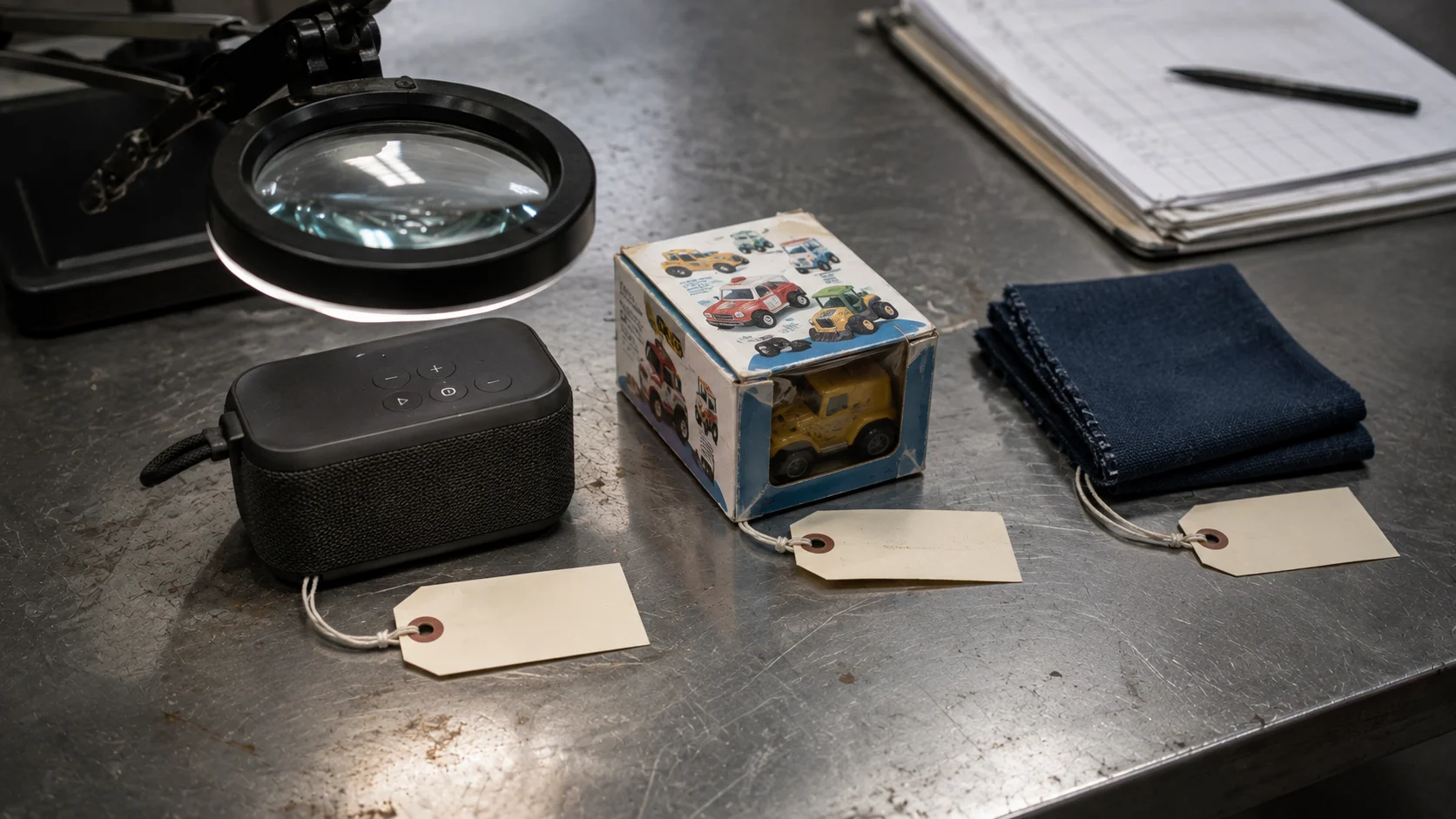
The product: a portable Bluetooth speaker with a translucent dome that projects rotating coloured light patterns, sold heavily on the light feature. Two candidate headings: 8518 (loudspeakers and audio-frequency electric amplifiers) and 9405 (luminaires and lighting fittings). Rule 3(a) does not resolve it cleanly, since each heading describes one function specifically. So we go to 3(b), essential character.
Pull the numbers. In a typical build, the audio components (driver, amplifier board, Bluetooth module, battery sized for playback) represent roughly 70 to 80% of component cost; the LED array and motor perhaps 10%. The product is unusable as a lamp in any practical sense (the light show is decorative, not illuminating) but fully functional as a speaker with the lights off. Essential character: speaker. Classification lands in 8518 as a loudspeaker, and in Australia most 8518 lines are duty Free.
Why it matters: heading 9405 lines commonly carry 5%. On a $180,000 annual program, arguing yourself into “it’s a novelty lamp” costs $9,000 a year in duty that was never owed, plus the GST cascade on top. This trap runs both ways: a “mood light with built-in speaker”, where the audio is a tinny afterthought and the LED and diffuser assembly dominates cost and marketing, flips the essential-character analysis toward 9405 and picks up the 5%. Same shelf in the shop, opposite classification, and the deciding evidence is a component cost breakdown you should have on file.
Worked Example 2: The Wooden Toy Box
The product: a pine storage box, 80cm wide, lid on a soft-close hinge, sold as a “kids’ toy box” with a jungle animal decal. Candidates: 9403 (other furniture) at 5%, or 9503 (toys) at Free. The importer wants 9503, obviously; it is called a toy box.
Read the notes. Chapter 95 covers articles designed for amusement. A toy box does not amuse anyone; it stores things that do. Its function is storage, its construction is furniture construction, and children playing near it does not convert it. The decal is decoration, not play value. Classification: 9403, furniture, 5% duty. The name on the carton has zero legal weight.
Contrast the genuine edge case: a toy box built as a sit-in pirate ship, where the storage cavity is incidental to a product a child physically plays with. Now there is a real Rule 3 argument, and the outcome turns on evidence about design intent, marketing and how the thing is actually used. The lesson generalises: within a single product category, small design changes move goods across a duty boundary, and the importer who documents the analysis holds the defensible position. On a container of 600 toy boxes at $38 FOB, the difference between Free and 5% is about $1,140 per container before GST amplification: small enough to ignore once, large enough to hurt when the ABF back-assesses 26 containers across four years and adds penalties.
Worked Example 3: The Cotton-Poly Blend Garment
Textiles are where classification gets genuinely unforgiving, because Section XI’s notes classify blended goods by the fibre that predominates by weight, and nothing else. Take a knitted T-shirt. At 60% cotton / 40% polyester it is a cotton T-shirt: 6109.10. Drop the cotton to 45% and polyester to 55%, and the identical-looking garment moves to 6109.90 as a T-shirt of other textile materials. At exactly 50/50, no fibre predominates, Rules 3(b) and then 3(c) kick in, and the last-occurring subheading wins, which is why a 50/50 blend classifies as if synthetic, not cotton.
Move upstream to the fabric itself and the shift is bigger: a cotton-dominant woven fabric sits in chapter 52, while the same construction with polyester predominating moves to chapter 55. Different chapter, different statistical regime, and critically, different treatment under several FTA rules of origin, which for textiles frequently require a change of chapter or specific yarn-forward processing. A 5% swing in blend ratio at the mill can silently invalidate the origin claim your duty-free entry depends on.
The practical consequence: for apparel, the fibre composition on the care label is a declaration input, not marketing copy. Mills drift. A supplier who re-sources yarn and moves your fabric from 52% to 48% cotton has changed your classification without telling you, and if your FTA preference relied on a chapter-change rule, they may have changed your duty rate from Free to 5% as well. Serious apparel importers test composition on a schedule and tie the classification to the tested spec, not the label.
We review contestable classifications before you lodge.
The corporate form asks whether you want a full quote or only indications, so a blend-ratio question need not arrive dressed as a shipment booking.
What Getting It Wrong Costs
Errors run in both directions and neither is free.
Underpaid duty. The ABF can demand unpaid duty on declarations going back four years. On top of the back-assessment sit penalties for false or misleading statements under the Customs Act, which apply on a strict-liability basis: you do not need to have intended anything. An importer who underpaid 5% on $2 million of goods over four years faces a $100,000 demand before penalties, arriving as one letter. Voluntary disclosure before the ABF finds the error dramatically improves the penalty position, which is one of the strongest arguments for periodic self-review.
Overpaid duty. Pay 5% on goods that should be Free and nobody sends you a letter; the money just leaves. The refund window mirrors the assessment window: you can generally apply for refunds of overpaid duty for up to four years. We routinely see importers recover five-figure sums after a classification review, but everything older than four years is simply gone, along with the margin or the pricing headroom it represented. Duty also feeds the GST base and your landed cost model, so a wrong rate quietly distorts pricing decisions too; see our breakdown of total landed cost for Australian imports.
Voided FTA claims. This is the sharpest edge. Preference claims are made against a specific classification, and origin documentation (certificates of origin, declarations) states the HS code. If the classification was wrong, the origin evidence often fails with it, and the ABF’s position is straightforward: no valid claim, full general duty owed, four years back. An importer who “saved” 5% under a preference on the wrong code did not save anything; they deferred the bill and added penalty exposure.
When to Ask the ABF: The Tariff Advice System
For any classification that is genuinely arguable and commercially material, Australia gives you a way to remove the uncertainty entirely: a Tariff Advice (TA) from the Australian Border Force. You apply with a full product description, specifications, composition data, images and your proposed classification with reasoning. The ABF issues a written ruling that binds it: enter the goods under the advised classification and it will not be disputed later.
Three practical parameters. It is free. The ABF generally aims to decide within around 30 days of receiving a complete application, so build it into your pre-shipment timeline rather than requesting it with a container on the water. And an issued TA is generally honoured for five years, unless the legislation changes underneath it or your product changes, in which case it lapses with the change.
When is a TA worth it? Our rule of thumb: request one when the classification is contestable and at least one of these is true: the duty difference between candidate codes exceeds a few thousand dollars a year; an anti-dumping measure sits on one candidate code; an FTA claim depends on the classification; or the product is a long-term repeat line. For a one-off $8,000 shipment where both candidates are Free, documentation of your own reasoning is proportionate. For a permanent SKU with a 5%-versus-Free question, the TA is a month of waiting in exchange for years of certainty.
Your Broker Classifies. You Are Responsible.
A common and expensive misunderstanding: “my broker does the classification, so errors are their problem”. Under Australian customs law, the owner of the goods is responsible for the accuracy of the import declaration. Licensed customs brokers bring real expertise and a good one is worth every dollar, but the broker acts as your agent. When the ABF back-assesses, the demand goes to the importer. Whatever recourse you may have against a negligent broker is a separate commercial matter, and it will not cover strict-liability penalties or the disruption of an audit.
This means operationally: never treat classification as fully outsourced. Give your broker complete product information (composition, function, specifications, photos), not just an invoice description like “electronic device”. Ask them to record the reasoning for anything non-obvious. And keep the classification database in your hands, product by product, so that a broker change does not mean starting from zero. For the declaration process itself, and where classification sits in it, see import process for Australia.
A Practical Workflow for Classifying a New Product
The sequence we use before a new product’s first shipment:
1. Take the supplier’s code as a hint, never an answer. Your supplier classifies for their export regime. Chinese ten-digit codes, for instance, serve Chinese export controls and VAT rebate schedules, and suppliers have been known to select codes that maximise their own rebate. Only the first six digits even claim to be international, and supplier errors at six digits are common.
2. Establish what the product actually is. Composition by weight and value, function, how it is put up for sale, whether it ships complete or unassembled. Most classification failures are really product-knowledge failures.
3. Work the Australian Working Tariff. Identify candidate chapters, read the section and chapter notes first, then apply the GIRs in order down to the eight-digit line. Check Schedule 4 for concessions and the FTA schedules if a preference is in play.
4. Check the consequences of the candidate code. Duty rate, dumping measures, biosecurity profile, permit triggers. If two defensible codes have materially different outcomes, that is your signal to escalate.
5. Document the reasoning. One page: product spec, candidate headings considered, which GIR decided it, why. This is what turns an audit finding of “reckless” into “reasonable care”, and it is what makes a voluntary disclosure credible if you ever need one.
6. Escalate genuinely contestable calls. Broker opinion first; Tariff Advice for anything material and arguable, per the thresholds above.
When to Re-Review a Classification
Classification is not a set-and-forget decision. Three triggers should reopen it. First, an annual review of your top lines by duty value: an hour with your import data catches drift, and catching your own errors first transforms the penalty conversation. Second, any product specification change: a new blend ratio, a material substitution, an added function, a shift from assembled to knock-down. The physical goods changed, so the classification question changed. Third, external events: a new FTA entering into force can make a previously academic classification distinction worth 5%, a new dumping measure can put your code inside scope, and each five-yearly WCO revision renumbers lines and occasionally moves products.
Common Mistakes We See
Copying the supplier’s code straight onto the declaration. Classifying from the product’s marketing name instead of its objective characteristics. Ignoring section and chapter notes and arguing from heading titles. Claiming “parts” classifications for goods that are articles in their own right. Assuming a 6-digit code found on a US or EU website settles the Australian 8-digit line. Making FTA claims without confirming the classification the origin rule depends on. Never reviewing old classifications, so a 2019 decision quietly misprices four years of imports. And treating the value declared and the code declared as separate worlds, when the ABF audits them together; if valuation is your weak spot instead, customs valuation in Australia is where to start.
The pattern behind all of these is the same: classification handled as an afterthought at declaration time instead of a decision made once, properly, with the reasoning on file. The tariff rewards importers who do the boring work early. It back-assesses everyone else.
We move commercial imports into Australia.
Give us the goods, origin and volume, and our team works up a free estimate. The origin drives both your rate and your rule of origin.
Related Reading
- Customs Valuation in Australia: How the ABF Decides What Your Goods Are Worth
- Anti-Dumping Duties in Australia: What Importers Need to Know
- Australia’s Free Trade Agreements: A Practical Guide for Importers
- Total Landed Cost: What Importing to Australia Really Costs
- The Import Process in Australia, Step by Step
An importer who has classified the same product the same way for four years without a challenge has not proven the classification correct. They’ve proven it untested. The ABF’s four-year assessment window means that calm is not evidence of safety, it’s evidence the audit simply hasn’t happened yet, and the $100,000 demand on $2 million of underpaid duty in the example above arrives as one letter precisely because nobody was checking in the meantime. Notice, too, who carries the exposure. The broker who filed the code doesn’t pay the back-assessment or the strict-liability penalty; the importer does, years later, for a decision someone else made on their behalf. That asymmetry, not the years of quiet, is the thing worth pricing before you decide a classification is settled. A periodic self-review costs a fraction of what one wrong code compounds into after four years of not looking.
Frequently Asked Questions
What is the difference between a 6-digit HS code and an Australian 8-digit tariff code?
The first six digits are the international Harmonized System code, maintained by the World Customs Organization and shared by more than 200 countries. Australia adds two more digits in the Working Tariff to set the duty rate, plus a two-digit statistical code for ABS trade data. Your import declaration uses the full Australian code, so a 6-digit code from a supplier is never enough on its own.
Can I just use the HS code my supplier puts on the invoice?
Treat it as a starting hint only. Your supplier classifies for their export regime, and codes diverge between countries beyond six digits. Suppliers also sometimes pick codes that suit their own export rebate position rather than accuracy. Verify the classification against the Australian Working Tariff yourself or through your broker, and document the reasoning.
Who is legally responsible if the HS code on my declaration is wrong: me or my customs broker?
The importer. Under Australian customs law the owner of the goods is responsible for the accuracy of the import declaration, even when a licensed broker prepared it. A broker error may give you a commercial argument with the broker, but the ABF back-assessment, interest and any penalties land on the importer.
What is a Tariff Advice from the ABF and how long does it last?
A Tariff Advice is a free, written, binding classification ruling from the Australian Border Force for a specific product. The ABF generally aims to issue one within around 30 days of a complete application. Once issued it is generally honoured for five years, unless the tariff legislation changes or the product itself changes.
How far back can the ABF go if I have been using the wrong HS code?
Underpaid duty can generally be demanded for imports going back four years, plus the ABF can pursue penalties for false or misleading statements. The same four-year window works in your favour if you overpaid: you can apply for refunds of duty on past declarations once you establish the correct classification.
Does the HS code affect anything other than the duty rate?
Yes, almost everything downstream keys off it. The code determines whether a free trade agreement preference is available and which rule of origin applies, whether anti-dumping or countervailing duties attach, whether the consignment is referred for biosecurity assessment, and whether an import permit or prohibition applies. A wrong code can quietly break all of these at once.