
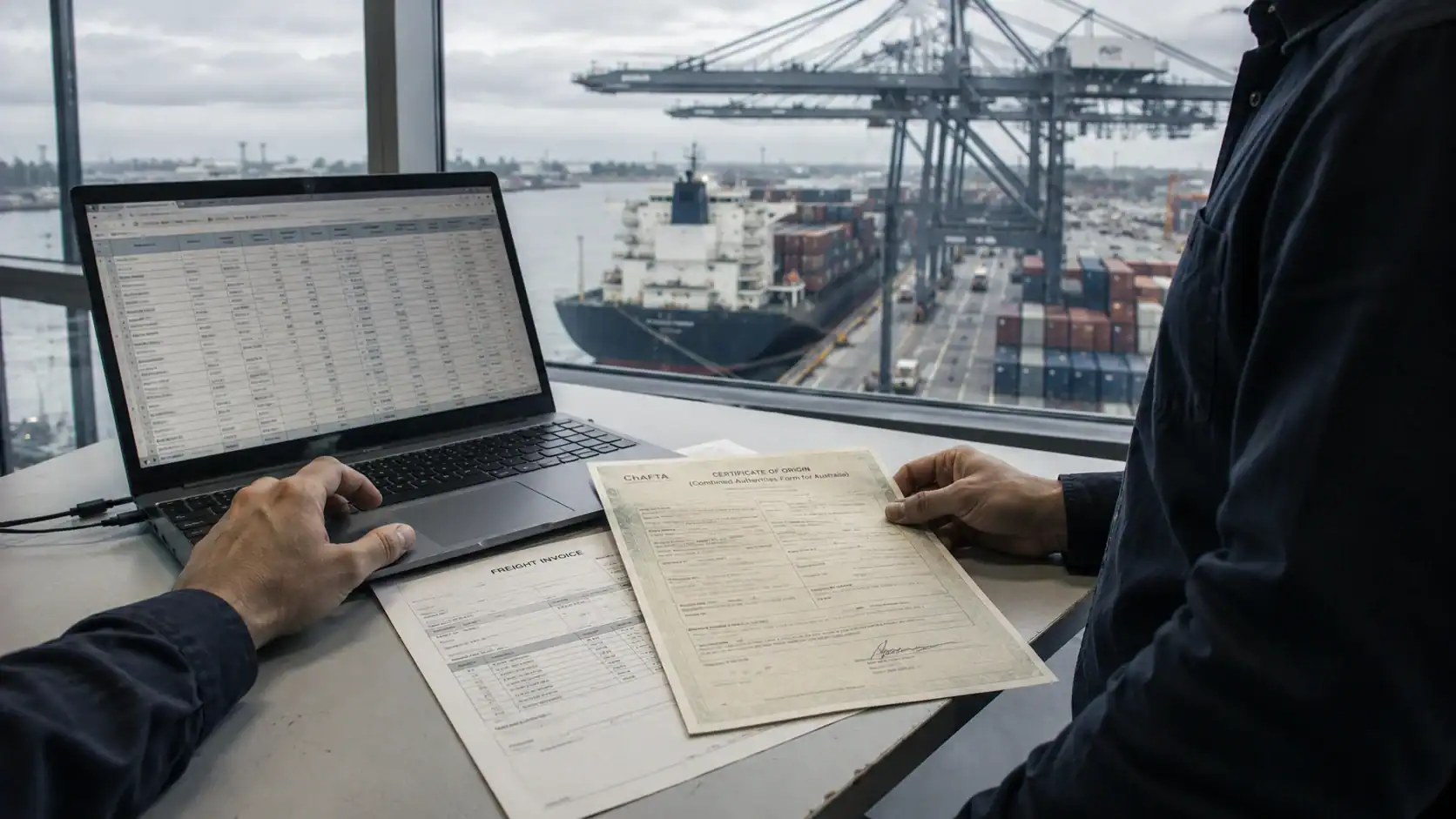
How to Reduce Freight Costs When Importing to Australia
Freight cost reduction has a counterintuitive property: most of the easy gains come from decisions made before the booking, not from negotiating the booking itself.
The shipper who sends five separate 3-CBM LCL shipments per month and then negotiates hard on the freight rate per CBM is optimising the wrong variable. The same goods moved as one 15-CBM LCL shipment, or as an FCL if the volume warrants it, would carry lower total freight cost before any rate negotiation occurs. The per-shipment fixed costs (origin handling, destination handling, customs brokerage, DAFF biosecurity levy) get paid once instead of five times.
The Cost Reduction vs Cost Shifting Distinction
Not every action that reduces your freight invoice reduces your total landed cost. Several common “freight cost reduction” strategies are actually cost-shifting strategies. They move the cost from the freight line to another line.
Buying on FOB instead of CIF. CIF terms mean your supplier arranges and pays for freight and insurance to the destination port, and you pay for it indirectly through the invoice price. FOB terms mean you arrange and pay for freight and insurance directly. Switching from CIF to FOB does not automatically reduce freight costs. It transfers freight control to you. Whether this produces a saving depends entirely on whether you can source freight more competitively than your supplier’s forwarder. For large importers with established carrier relationships, FOB often does produce savings. For smaller importers buying at relatively low volumes, the supplier’s forwarder may have scale advantages that you cannot match. The comparison must be made on a fully-landed basis, including cargo insurance that you may now need to purchase separately.
Reducing insurance coverage. Removing or reducing cargo insurance reduces the freight-related invoice. It does not reduce costs. It self-insures the risk. If a loss occurs, the uninsured portion is a cost that was deferred rather than avoided. This is a risk management decision, not a cost reduction.
Choosing a cheaper freight forwarder. Rate is not the only variable in forwarder selection. A cheaper quote that comes with slower transit, less reliable customs clearance performance, or inadequate documentation support may cost more in total than a slightly more expensive provider with better operational outcomes. Evaluate total landed cost and operational reliability, not just the freight rate line. Our guide on freight mode selection covers the cost and service variables across shipping options.
Consolidation: The Highest-Leverage Action
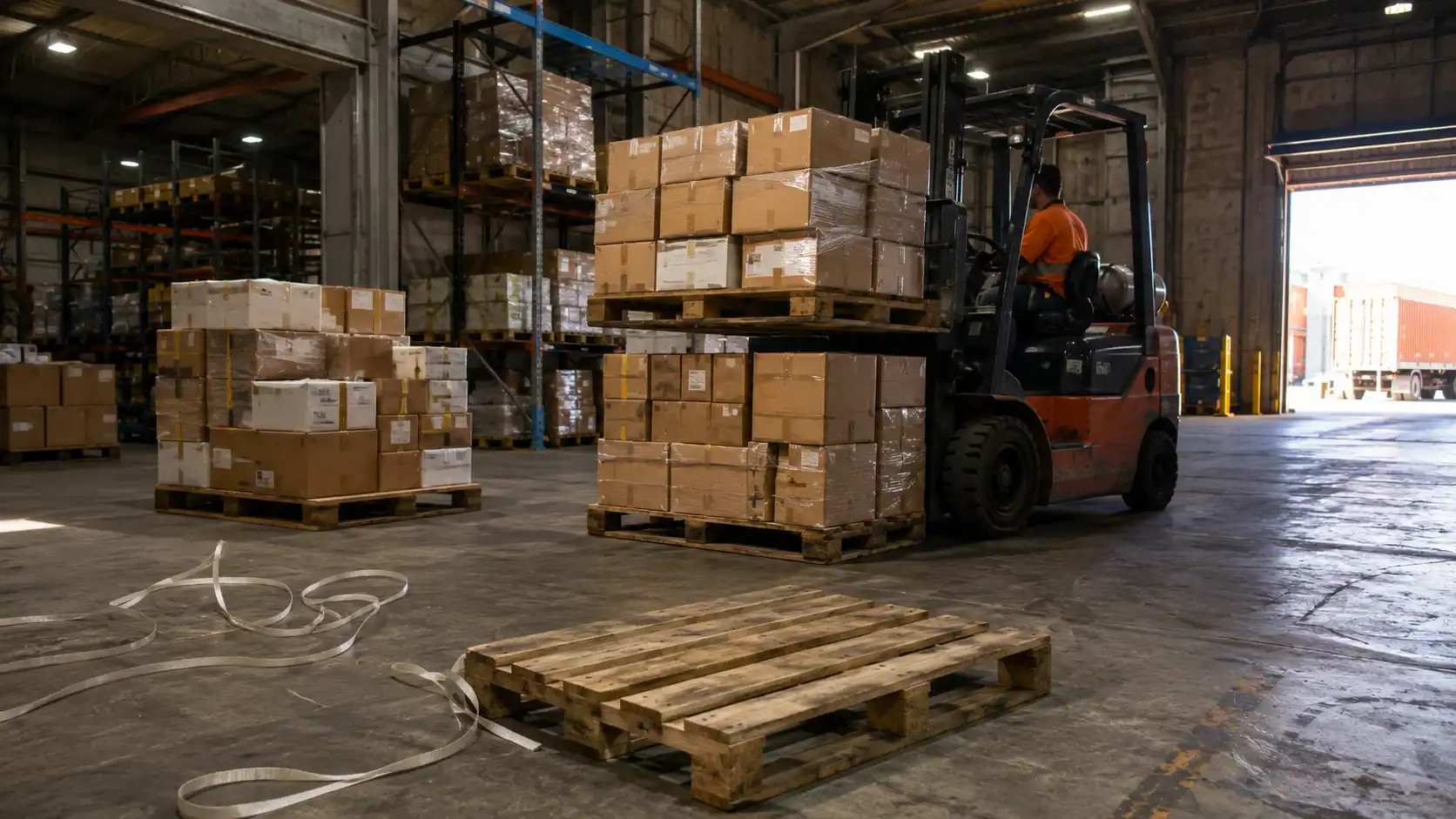
For most Australian importers, the single highest-leverage freight cost reduction is consolidating more volume into fewer, larger shipments.
The reason is fixed per-shipment costs. Every shipment incurs the following, regardless of size:
- Origin handling and documentation fees (typically AUD 100–300 per shipment)
- Destination handling and deconsolidation (typically AUD 150–400 per shipment for LCL)
- Australian customs brokerage (typically AUD 200–500 per import declaration)
- DAFF biosecurity levy (AUD 49.20 per import declaration as of 2025–26, plus any inspection costs)
- Cargo insurance premium base (per policy)
If you are shipping 3 CBM per order and placing four orders per month, you are paying these fixed costs four times to move 12 CBM. Consolidating to one 12-CBM shipment per month pays these costs once. The freight rate per CBM may be slightly higher for the consolidated shipment (because the consolidation is larger and requires a longer wait), but the total cost is almost always lower.
The trade-off is inventory: consolidating into fewer shipments means holding more stock between deliveries. For importers with consistent demand and reliable supplier lead times, the inventory carrying cost is typically lower than the freight cost saving. For importers with unpredictable demand or variable lead times, the calculation is more nuanced.
FTA Duty Savings: The Overlooked Lever
Australia has free trade agreements with its major import partners that eliminate or significantly reduce import duty on a wide range of goods. The agreements in force that matter most to Australian importers:
- ChAFTA (China): Eliminates duty on the vast majority of manufactured goods. MFN rates of 5–10% on many product categories are reduced to 0% with a valid Certificate of Origin (CoO) issued by CCPIT or CIQ in China.
- AANZFTA (ASEAN, including Vietnam): Eliminates or significantly reduces duty on goods from Vietnam, Thailand, Indonesia, Malaysia, and other ASEAN members. Particularly relevant for apparel, footwear, furniture, and electronics.
- AUSFTA (USA): Eliminates duty on most US-origin goods, with self-certification by the exporter or importer rather than a third-party CoO.
- A-UKFTA (UK): Eliminates duty on most UK-origin goods following implementation post-Brexit.
The duty saving is calculated on the CIF value of the goods. On a AUD 100,000 shipment of goods with a 5% MFN duty rate, a valid ChAFTA CoO saves AUD 5,000 in duty, plus the GST that would have been applied to that duty (another AUD 500). Over a year of regular imports, these savings compound.
The common failure is not claiming the FTA rate when you are entitled to it, because the CoO was never obtained, was obtained incorrectly, or was not presented at the time of customs lodgement. The CoO must be issued before or at the time of loading (for ChAFTA) and presented to the Australian Border Force at or before the time of the import declaration. A retrospective CoO does not qualify. (ChAFTA rules of origin, DFAT) For a detailed overview of how ChAFTA and other FTAs affect the total landed cost calculation, see our total landed cost guide for Australian importers.
Container Optimisation: Using the Space You Are Paying For
For importers moving FCL, the container is a fixed cost. The rate does not change whether the container is 60% full or 100% full. Every unused CBM in a container you have booked is money you cannot recover.
Container optimisation means maximising the usable volume in each FCL, and it is an operational discipline that reduces cost per unit directly. Four levers do most of the work:
- Carton size standardisation. Irregular carton sizes create voids in the container. Standardising carton dimensions across a product range, and choosing dimensions that stack efficiently to the container’s internal height, can improve fill rates by 10–20%.
- Load planning. A detailed load plan (ideally using container loading software or a 3D packing calculation) identifies the theoretical maximum fill rate for your cargo mix and gives the packing team a target to hit.
- Product mix optimisation. If you have flexibility in which products move in which container, pairing high-density goods (which hit the weight limit before the volume limit) with low-density goods (which hit the volume limit first) can maximise both volume and weight utilisation.
- 40HC vs 20ft selection. A 40-foot High Cube container (60–67 CBM) costs less per CBM than two 20-foot containers (50–56 CBM combined) at most rate levels. If your volume justifies a 40HC, the unit cost is lower than splitting into smaller boxes.
Timing: Freight Rate Seasonality
Freight rates on Australia-bound routes are not constant. They follow a seasonal pattern driven by retail demand cycles and manufacturing calendars:
- Peak rate period: Q3–Q4 (July–October). Australian retailers build Christmas inventory, which drives demand for container space sharply up. Rates and surcharges are typically highest during this window.
- Secondary peak: Post-CNY (February–March). Chinese factories resume production after the Lunar New Year holiday just as shippers clear backlogged orders, and the two together produce a temporary demand spike.
- Softer rate periods: Late Q2 (May–June) and Q1 post-CNY backlog clearance. Rates typically soften as the post-CNY rush clears and pre-Q3 demand has not yet built.
Shifting even a portion of annual import volume from peak to off-peak periods can produce meaningful freight savings, either by holding higher inventory through peak seasons or by pulling purchases forward. The constraint is the inventory cost of the additional stock held to enable the timing shift. For some importers, the freight saving exceeds the carrying cost; for others, the reverse is true. Running the numbers on your specific inventory turns, storage cost, and freight rate differential is the way to decide.
Incoterms: FOB vs CIF as a Strategic Decision
The choice of Incoterms with your supplier is not purely an administrative decision. It determines who arranges freight, who bears the risk of loss, and who has negotiating leverage with the carrier.
Under CIF, the supplier arranges and pays for freight and insurance to the destination port. The freight cost is embedded in the invoice price. You have no visibility into the actual freight rate and no ability to negotiate it directly. The supplier’s forwarder relationship may or may not produce competitive rates.
Under FOB, you take control of the freight from the port of loading. You negotiate directly with your freight forwarder, you see the freight rate, and you can compare it against alternatives. If you have volume across multiple suppliers, you can consolidate their shipments into your freight program rather than having each supplier’s forwarder arrange separate bookings at potentially higher rates.
The CIF to FOB switch produces real savings when the importer’s freight buying power exceeds the supplier’s. A buyer consolidating twenty suppliers’ shipments through a single forwarder relationship typically has more buying power than any individual supplier. Importers who have not yet evaluated this transition should run the comparison, particularly anyone importing significant volumes from China, Vietnam, or the USA.
The caveat: FOB shifts risk to you from the port of loading. That requires cargo insurance arranged on your account, which may not have been required under CIF. Factor this into the comparison. Our guide to importing from China to Australia covers Incoterms in the context of the China supply chain specifically.
Port Selection: Does It Matter?
For most Australian importers, port selection is determined by geography, because you import through the port closest to your warehouse or distribution centre. But where the choice is not obvious, port economics matter.
Melbourne (Port of Melbourne) and Sydney (Port Botany) handle the largest volumes and typically attract the most competitive ocean freight rates due to carrier network competition. Brisbane and Fremantle have higher per-unit costs for most commodity freight at equivalent volumes, but lower last-mile delivery costs for importers whose customers are concentrated in Queensland or Western Australia.
The correct comparison is total landed cost to the warehouse, not ocean freight rate. An importer with a Melbourne warehouse may import through Sydney to access a marginally lower ocean freight rate, then pay interstate trucking to move the goods to Melbourne, and end up paying more in total. Run the full calculation: ocean freight + destination THC + customs brokerage + DAFF levy + last-mile delivery to warehouse.

What Not to Cut
Some cost lines in the freight invoice are not good targets for reduction:
- Customs brokerage. A licensed customs broker who knows your product range, your HS classifications, and your FTA eligibility is worth their fee. The cost of an incorrect import declaration, counting penalties, delays, and redelivery, typically exceeds the brokerage saving many times over.
- DAFF biosecurity compliance. Attempting to avoid or minimise DAFF declaration costs by misdescribing goods or omitting biosecurity-relevant items is a compliance failure with significant potential consequences. The levy exists because biosecurity inspection is a cost-recovery system for real government expenditure.
- Cargo insurance on high-value shipments. As discussed above, reducing the insurance premium by reducing coverage is cost-shifting, not cost reduction. For goods of material value, the insurance premium is a cost of doing business, not a discretionary line item.
The structural levers in this guide work most reliably before the current freight rate feels normal. Freight costs are subject to what behavioural economists call the adaptation level effect: the rate paid at month twelve becomes the reference point for month thirteen. An AUD 4,200 FCL rate that started at AUD 3,100 eighteen months ago registers as “the rate” rather than as a 35% increase over a benchmark that exists and is findable. The implication is not that negotiation always works. It is that the window for applying these levers narrows gradually as the current rate becomes the psychological floor. A quarterly freight cost review works not only because it identifies variance but because it resets the comparison. The question is not “is our rate fair?” but “what would a new importer pay for this volume today?” Those are different questions. The second one is more useful.
The tempting cuts are the ones whose value only shows up when they fail. Customs brokerage looks like an administrative fee until a tariff code is entered wrong, the Australian Border Force reclassifies the consignment at a higher duty rate, and a penalty lands on top of the corrected duty. The DAFF biosecurity inspection looks like a pure levy until an uninspected pallet of timber-packed goods is found to carry a pest and the whole container is held, fumigated, or in the worst case destroyed at the importer’s expense. Each of these line items is inexpensive precisely because it is doing its job quietly; the saving from removing it is real right up until the shipment where it would have earned its cost back many times over.
Frequently Asked Questions
What is the single most effective way to reduce freight costs when importing to Australia?
For most importers, consolidating more volume into fewer, larger shipments. This spreads fixed per-shipment costs (origin handling, destination handling, customs brokerage, DAFF levy) across more cargo, so the total cost per CBM falls. The second-highest leverage point is consistently using valid FTA Certificates of Origin to access preferential duty rates.
How much can ChAFTA save on duties when importing from China?
Most Chinese-origin manufactured goods are now at 0% under ChAFTA vs MFN rates of 5–10%. On AUD 100,000 of goods at 5% MFN duty, a valid ChAFTA CoO saves AUD 5,000 in duty plus approximately AUD 500 in GST on that duty. Compounded across a year of regular imports, the savings are significant.
Does buying on FOB terms instead of CIF reduce my freight costs?
Not automatically. FOB transfers freight control to you; it only saves money if you can source freight more competitively than your supplier’s forwarder. For large importers consolidating multiple suppliers’ shipments, FOB often produces savings. For smaller importers, not necessarily. Compare on a fully-landed basis including cargo insurance.
What is peak season for freight rates to Australia and how do I avoid it?
Rates peak in Q3–Q4 (July–October) as retailers stock Christmas inventory, and again post-Chinese New Year (February–March). Rates soften in late Q2 and post-CNY clearance. Shifting import volume to off-peak periods requires higher inventory levels but can produce meaningful freight savings for importers with predictable demand.
Can I reduce costs by using a different Australian port?
Possibly. Melbourne and Sydney carry the most competitive rates due to volume. Brisbane and Fremantle have higher ocean freight costs but lower last-mile costs for Queensland and WA-based importers. Always compare total landed cost to your warehouse (ocean freight + THC + brokerage + DAFF levy + last-mile), not just the ocean freight rate.
Freight cost reduction for Australian importers is mostly a structural exercise. It happens in how you organise your import program, not in how you negotiate individual shipments. If you would like a review of your current import program, covering consolidation opportunities, FTA eligibility, container optimisation, and Incoterms strategy, request an Australia import freight review. We work with Australian importers to structure freight programs that reduce total landed cost, not just freight invoice cost.