Author: SwiftCargo Team

  • Indonesian Furniture Imports to Australia

    Indonesian Furniture Imports to Australia


    AANZFTA brings the duty to zero, but Indonesian teak still has to clear illegal-logging due diligence, biosecurity treatment, and a moisture-content spec that determines whether it survives Australia’s climate.

    Walk through the furniture workshops of Jepara on Java’s north coast and you can smell the trade before you see it: teak sawdust, sweet and faintly leathery, drifting out of open-fronted workshops where carvers have been working the same golden-brown hardwood since the Dutch colonial era. Jepara alone holds several thousand furniture workshops. Add Cirebon’s rattan weavers and Bali’s design-led studios working mango wood, suar and reclaimed teak, and you have one of the great furniture-making regions of the world, two weeks’ sailing from Australia’s east coast.

    That proximity, plus a free trade agreement that zeroes out duty, makes Indonesia one of the most attractive furniture sourcing origins for Australian retailers, stylists and importers. But timber furniture is also one of the most heavily regulated things you can put in a container bound for Australia. Between the Illegal Logging Prohibition Act, biosecurity treatment requirements and the physics of tropical hardwood drying out in an air-conditioned Sydney apartment, there is more that can go wrong on this trade lane than almost any other consumer product.

    How to Import Furniture from Indonesia to Australia

    Why Indonesia: The Timber and the Craft

    Indonesia’s furniture advantage starts with the trees. Java grows plantation teak (Tectona grandis) under Perhutani, the state forestry company, on rotations of 40 to 80 years. Teak’s natural oils make it dimensionally stable and resistant to rot and insects, which is why it has been the timber of choice for ships’ decks and outdoor furniture for centuries. Grain runs straight and tight in older plantation stock; younger, fast-grown teak is paler, softer and more prone to movement, which matters when you’re specifying quality.

    Beyond teak, the palette is broad. Mango wood, a byproduct of orchard replanting that is dense and warmly figured, has become a staple of mid-market casegoods. Suar (rain tree) yields the dramatic live-edge slabs that anchor statement dining tables. Mindi (white cedar) takes stain evenly for painted and limed finishes. And rattan, the climbing palm harvested from Sumatran and Kalimantan forests, supports an entire weaving industry centred on Cirebon in West Java, which has supplied woven furniture to Europe and Australia for over a century.

    The craft geography is specific:

    • Jepara (Central Java): the heartland of carved and solid teak furniture. Deep benches of skilled labour, competitive pricing, quality ranging from export-grade to rough. Ships via Semarang, about 90 minutes away.
    • Cirebon (West Java): rattan and natural-fibre weaving. Ships via Jakarta’s Tanjung Priok or Cirebon’s smaller port.
    • Bali: design-forward studios, reclaimed teak, boat-wood pieces, higher price points, strong for boutique retailers. Ships via Surabaya (trucked across on the ferry) or Benoa consolidation services.
    • Solo and Semarang: larger factories doing indoor casegoods and contract volumes.

    Compared with Chinese or Vietnamese sourcing, Indonesia trades some factory-scale consistency for material authenticity and craft depth. You buy from Indonesia when the timber itself is the product (solid teak, real rattan, a slab of suar) rather than veneered board furniture. That is also exactly why the compliance burden is heavier: everything below turns on the fact that you are importing solid tropical hardwood.

    Duty and AANZFTA: Getting the Rate to Zero

    Most furniture entering Australia classifies under Chapter 94 of the tariff: heading 9401 for seats, 9403 for other furniture (tables, cabinets, bed frames). The general duty rate is 5% of the customs value.

    Under the ASEAN-Australia-New Zealand Free Trade Agreement (AANZFTA), qualifying goods of Indonesian origin enter at 0% duty. On a AUD 40,000 order, that’s AUD 2,000 back in your pocket, but only if the paperwork is right. To claim the preferential rate you need:

    • Proof of origin: historically a Certificate of Origin (Form AANZ) issued by the Indonesian authorities; since the AANZFTA upgrade, a Declaration of Origin from an eligible exporter is also accepted. Your supplier or their forwarder arranges this at export.
    • Origin qualification: the furniture must meet the agreement’s rules of origin. For furniture made in Indonesia from Indonesian timber this is straightforward; it can get murkier where hardware, foam or fabric is imported, so the regional value content calculation occasionally matters on upholstered pieces.
    • Consistency: the goods description, HS codes and shipper details on the certificate must match the commercial invoice and bill of lading. The Australian Border Force (ABF) rejects preference claims over mismatched paperwork more often than over substantive origin problems.

    Two things the concession does not remove. GST of 10% applies to the value of taxable importation (customs value + duty + international transport and insurance) regardless of origin. And the import processing charge applies to every consignment over AUD 1,000. Note also that Australia and Indonesia have a separate bilateral agreement (IA-CEPA); your broker will claim under whichever agreement is cleanest for your goods, and in practice AANZFTA documentation is the well-worn path for furniture.

    A hard-hatted inspector at a tropical timber yard checks a blank tag wired to a stack of sawn wood.

    Illegal Logging Laws: Your Due Diligence Obligations

    Here is the part of Indonesian furniture importing that most first-timers have never heard of, and it carries real penalties.

    Australia’s Illegal Logging Prohibition Act 2012 makes it a criminal offence to import illegally logged timber, and, critically, places a positive due diligence obligation on importers of “regulated timber products.” Wooden furniture under headings 9401 and 9403 is regulated. If your consignment’s value exceeds AUD 1,000, the obligation is yours, personally, as the importer. Not your supplier’s. Not your freight forwarder’s. Yours.

    Due diligence has to happen before the goods are imported, and it has four steps:

    1. Gather information. Product description, timber species (common and scientific name), country of harvest, supplier details, and documentation evidencing legal harvest. For a Jepara teak order this means asking your supplier for the species declaration and legality documents for the timber inputs.
    2. Assess risk. Evaluate the likelihood the timber was illegally logged, considering the species, harvest country, complexity of the supply chain and the credibility of the evidence provided.
    3. Mitigate risk. If the risk is anything other than low, take steps (obtain more documentation, use a different supplier, commission third-party verification) until it is.
    4. Keep records. Retain your due diligence records for five years. The Department of Agriculture, Fisheries and Forestry (DAFF) audits importers, and at customs entry you declare that due diligence has been conducted (a Community Protection Question on the import declaration).

    SVLK: Indonesia’s Shortcut Through the Risk Assessment

    Indonesia is actually the easiest tropical origin in the world on this front, because it built a national timber legality system precisely to answer these questions. SVLK (Sistem Verifikasi Legalitas Kayu) is Indonesia’s mandatory timber legality assurance system: every legal timber exporter is audited and certified, and export shipments of timber products carry a V-Legal document (now issued as FLEGT-style legality documentation) confirming the timber’s legal chain of custody from forest to factory.

    Australia’s illegal logging framework recognises this through a Country Specific Guideline for Indonesia: if your consignment is covered by valid SVLK/V-Legal documentation and nothing else raises a red flag, you may treat that as satisfying the risk assessment. In practice, your pre-import checklist is:

    • Confirm your supplier (or their exporter of record) holds current SVLK certification, and ask for the certificate and check its validity dates.
    • Require the V-Legal document for your shipment and reconcile it against the invoice and packing list (species, volume, exporter).
    • File it with your species and origin information as your due diligence record.

    Importers get burned when they buy from a small workshop that isn’t itself SVLK-certified and exports through an aggregator, with no clear legality trail for reclaimed or “recycled boat wood” timber. Reclaimed teak is a wonderful product, but “reclaimed” is also the classic laundering story for illegally harvested timber. If a supplier can’t document where recycled timber came from, that is precisely the “not low risk” scenario the Act requires you to mitigate, and “everyone sells it as reclaimed” is not mitigation.
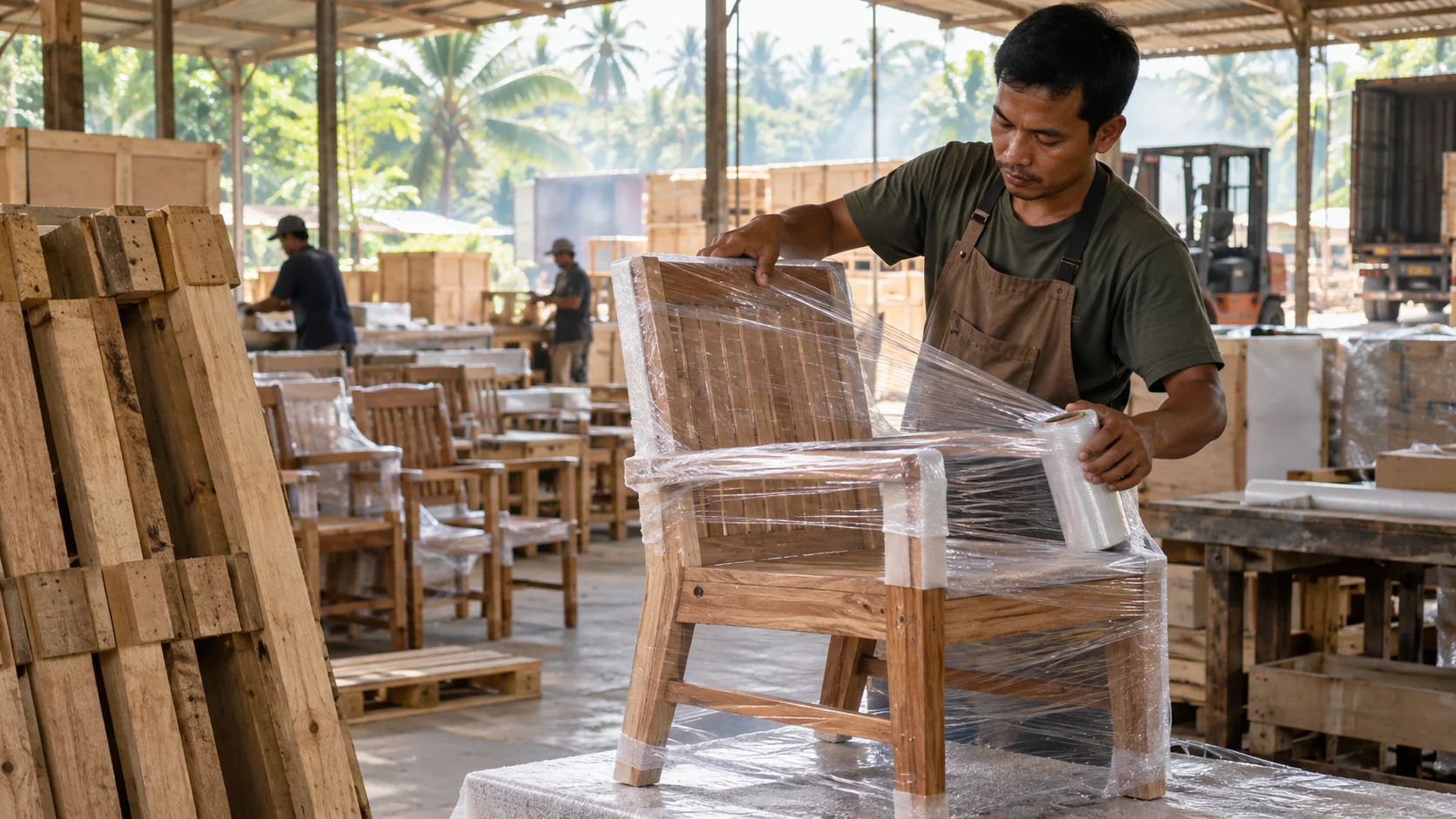
    A worker wraps a wooden chair frame in plastic film at an open-air furniture packing shed.

    Biosecurity: Treating the Packaging and the Furniture

    Australia’s biosecurity regime treats a container of tropical hardwood furniture as exactly what it is: a potential Trojan horse for wood-boring insects. Two separate layers of requirements apply.

    ISPM 15: the packaging

    All timber packaging (pallets, crates, dunnage, bracing) must be treated and marked to the ISPM 15 standard (heat treatment to 56°C core temperature for 30 minutes, or methyl bromide fumigation) and stamped with the IPPC mark. Non-compliant packaging is ordered for treatment, export or destruction at the importer’s expense, and it will hold your whole consignment hostage while it’s dealt with. Insist in your purchase order that all packaging timber is ISPM 15 marked, and have your pre-shipment inspector photograph the stamps.

    The furniture itself

    ISPM 15 says nothing about the goods inside the crate. Wooden furniture is assessed under DAFF’s import conditions (check BICON for the current requirements for your product), and the practical risk profile is this: untreated or air-dried hardwood, bark inclusions, and natural fibres like rattan and seagrass can harbour live borers. Powderpost beetles (Lyctus species) love the starchy sapwood of tropical hardwoods, and auger beetle larvae can sit dormant in a table leg for months before the tell-tale pinholes and frass appear in an Australian warehouse.

    Managing this comes down to what you can evidence:

    • Kiln drying at the right schedule kills insect life stages in the timber and doubles as your moisture control (next section). Furniture made wholly from kiln-dried, bark-free timber presents a much lower risk profile.
    • Fumigation: methyl bromide treatment of the packed container at origin, evidenced by a treatment certificate from an approved provider (DAFF maintains rules on acceptable providers and treatment parameters, including that fumigation must occur within a set window before shipment). Common for mixed loads, rattan and anything with an uncertain drying history.
    • Heat treatment of the goods where fumigation is unsuitable.

    Onshore, if goods arrive with evidence of live infestation (exit holes, frass), DAFF directs treatment, export or destruction. Fumigating a container in Australia costs multiples of the same treatment in Indonesia, plus storage while you wait. Treat at origin, keep the certificates, and make treatment a supplier obligation in the purchase order.

    One seasonal note: the Brown Marmorated Stink Bug (BMSB) measures apply to goods shipped from designated risk countries between 1 September and 30 April. Indonesia is not currently a BMSB target risk country, but if your furniture tranships through or consolidates with cargo from risk origins, or DAFF’s seasonal measures change, your forwarder needs to flag it. BMSB treatment requirements catch importers by surprise every season on other lanes, and the policy list is reviewed annually.

    Furniture workshop craftsman fitting a wooden chair leg joint by hand, with timber stock, mallets and hand tools on the workbench

    Quality Control at Origin: Moisture Is the Whole Game

    Biosecurity failures cost you money once. Moisture failures cost you customers for years.

    Timber is hygroscopic: it continuously exchanges moisture with the air around it, swelling as it absorbs and shrinking as it releases. In Jepara’s climate, air-dried teak settles at roughly 15–20% moisture content. Inside an Australian home, air-conditioned in Brisbane or heated through a Melbourne winter, timber’s equilibrium moisture content sits around 8–12%. Ship furniture at 18% moisture into that environment and the timber will spend its first six months in Australia drying out and shrinking. Wide tabletops cup and split along the grain. Mitred joints open. Doors bind, then rattle. The complaints arrive around month four, long after you’ve paid the supplier.

    A 900 mm solid teak tabletop that leaves Jepara at 18% moisture and settles at 10% in a Brisbane dining room can lose around 10 to 15 mm of width. Flat-sawn teak shrinks roughly 5 to 6% across the grain between green and oven-dry, about 0.2% for every point of moisture it gives up, and eight points is a lot of points. On a top screwed rigidly to its frame, that movement has nowhere to go except into a split. Nothing is wrong with the teak. The moisture reading was simply taken too late to change the order, which is why the fix below belongs in the purchase order and not the warranty file.

    The fix is contractual, not hopeful:

    • Specify kiln drying to 8–12% moisture content in the purchase order, as a written specification with rejection rights, not a verbal assurance. Reputable Jepara exporters run kilns; smaller workshops often don’t, and will say yes to anything. Beware over-drying too: teak kilned below about 8% for the European market can absorb moisture and swell in humid Queensland. The 8–12% band is the target.
    • Verify with a pre-shipment inspection. A third-party inspection in Indonesia typically costs USD 250–350 per man-day. The inspector checks a sample of pieces with a pin or capacitance moisture meter (readings taken at the core of thick sections, not just the surface), verifies joinery, finish quality, hardware, dimensions against the spec, ISPM 15 stamps on packaging, and packing method, all before the goods are sealed in a container. On a AUD 40,000 order, a USD 300 inspection is 1% of order value insuring the other 99%.
    • Design for movement. Good makers allow for it: floating tabletop fixings, frame-and-panel construction, breadboard ends done properly. A pre-production sample tells you whether your maker understands this.

    The payment schedule is where a small buyer actually has leverage. To a Jepara exporter, one Brisbane importer ordering five dining settings is a marginal customer, and the workshop has little reason to move on price for you. It does care when the money lands. Make the final payment due on a passed inspection report rather than on the goods being ready, and the moisture specification above gains teeth: a workshop already paid in full has no commercial reason to re-dry a failed batch before the container closes.

    Freight Mechanics: Java to Australia

    Indonesian furniture exports move through three main gateways, and which one you use is dictated by where your maker sits:

    • Tanjung Priok (Jakarta): Indonesia’s largest port, best service frequency, serves Cirebon and West Java suppliers.
    • Semarang (Tanjung Emas): the natural port for Jepara and Central Java. Slightly thinner direct schedules than Jakarta; some services relay via Singapore.
    • Surabaya (Tanjung Perak): East Java and the usual exit for Bali-made goods trucked across.

    Direct services to Australian east coast ports (Brisbane, Sydney, Melbourne) run 12–16 days port to port. Transhipment routings via Singapore or Port Klang add 5–10 days and a handling event, which matters for fragile furniture, since every extra lift is a damage opportunity. Fremantle-bound cargo often routes via Singapore. Door to door, budget 4–6 weeks from ex-works handover: export customs and treatment at origin, ocean transit, Australian clearance (including any DAFF intervention) and delivery.

    A broker who already lodges AANZFTA claims correctly on Jepara-origin cargo is worth pricing against your own order volume before you commit to LCL or FCL.
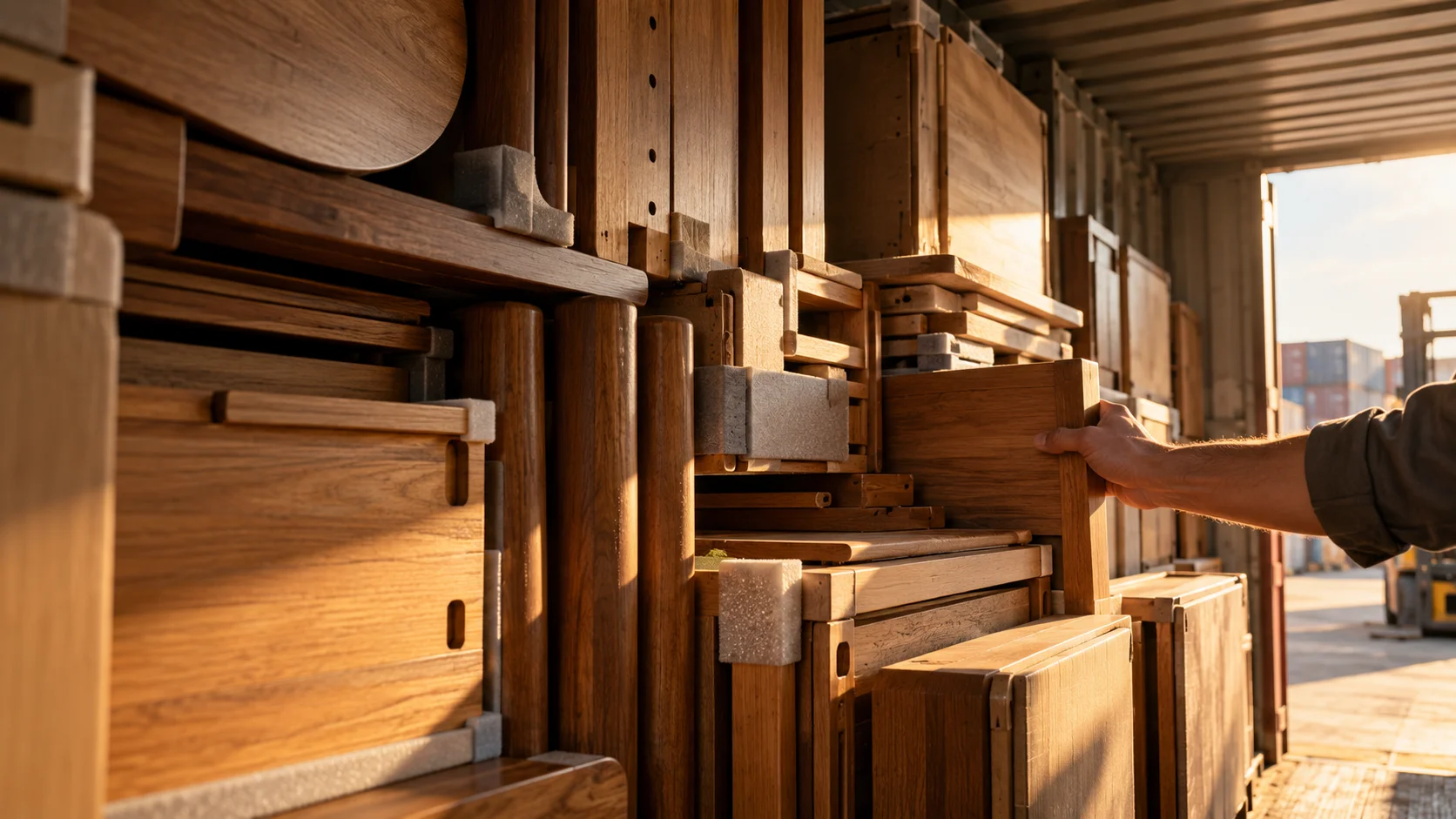
    Inside a part-loaded container, disassembled wooden furniture pieces, table legs, flat-packed panels, are stacked and interlocked tightly against each other with

    LCL vs FCL: the cube problem

    Furniture is the classic volume-heavy, weight-light cargo. A crated teak dining table might occupy 1.5 cubic metres and weigh 120 kg. Sea freight on this lane charges by the cubic metre, and furniture always bills on volume. That shapes the LCL/FCL decision:

    • Under ~8 cbm: LCL wins. Expect roughly USD 45–75 per cbm ocean freight plus origin/destination LCL fees (which are substantial, with destination charges of AUD 60–90 per cbm being normal). Furniture in LCL must be export-crated properly, because it will be handled at a CFS at both ends alongside whatever else is in the container.
    • ~8–15 cbm: the grey zone. Price both. LCL per-cbm fees stack up fast; a 20ft container on this lane has often been in the USD 900–1,600 range depending on market conditions, and rates move, so treat any figure as a quote-me prompt rather than gospel.
    • Over ~15 cbm: FCL wins almost every time. A 20ft box gives you about 28 usable cbm; a 40ft high cube about 68 cbm. Your goods are loaded at the factory, sealed, and untouched until your premises: no co-load handling damage, no risk of sharing a box with leaking cargo, and full control of packing quality.

    Packing for the tropics-to-temperate voyage

    A container crossing from equatorial Java to southern Australia experiences large temperature swings, and warm humid air trapped at loading condenses on the coldest surfaces as the box cools: “container rain.” On furniture, that means water-marked finishes and, worse, mould blooming on timber and rattan during two weeks in a sealed steel box. The standard defences:

    • Desiccants: container-grade calcium chloride desiccant poles or blankets hung inside the container (typically 4–8 units in a 20ft box, sized to the cargo’s moisture load). Cheap insurance, maybe USD 60–120 per container.
    • Ship dry. The single biggest mould driver is moisture already in the cargo. Kiln-dried furniture at 8–12% MC carries far less water into the box than air-dried stock; another reason the moisture spec pays for itself twice.
    • Breathable wrapping: paper or breathable foam wrap on finished surfaces rather than sealed plastic film, which traps condensation against the finish. Corner protection and crating or cell-packing for legs, carved elements and glass.
    • Don’t load wet: no rain-soaked packaging, no freshly lacquered pieces still off-gassing solvent, no green timber dunnage.

    A worker unwraps a teak dining chair beside a row of already-unwrapped matching chairs in a bright showroom.

    Worked Example: Landed Cost on a 20-Piece Teak Dining Order

    Numbers make this concrete. Say you’re a furniture retailer ordering from a Jepara exporter: 5 teak dining tables and 15 matching chairs, call it 5 dining settings’ worth of stock, FOB Semarang, destined for your Brisbane warehouse.

    • Order value: 5 tables @ USD 850 + 15 chairs @ USD 160 = USD 4,250 + USD 2,400 = USD 6,650 FOB
    • Volume: tables crated at 1.4 cbm each (7.0 cbm) + chairs at 0.35 cbm each (5.25 cbm) = 12.25 cbm, roughly 1,450 kg
    • At 12.25 cbm we’re in the grey zone. Priced both ways, the 20ft FCL came out marginally ahead of LCL once destination LCL fees were counted, so this moves as a 20ft FCL.

    Using an exchange rate of AUD 1 = USD 0.65 (USD 6,650 ≈ AUD 10,230):

    • Goods (FOB): AUD 10,230
    • Pre-shipment inspection (1 man-day): USD 300 ≈ AUD 460
    • Origin fumigation + certificate: USD 320 ≈ AUD 490
    • Desiccants and export packing upgrade: USD 90 ≈ AUD 140
    • Ocean freight, 20ft Semarang–Brisbane: USD 1,250 ≈ AUD 1,920
    • Marine insurance (~0.4% of CIF value): AUD 50
    • Australian port and terminal charges, container handling: AUD 750
    • Customs brokerage + import declaration processing charge: AUD 350
    • Import duty: 5% general rate would be ~AUD 512, but with the AANZFTA Certificate of Origin, AUD 0
    • GST: 10% × (customs value AUD 10,230 + duty 0 + freight & insurance ~AUD 1,970) = AUD 1,220 (creditable if you’re GST-registered)
    • Transport, port to warehouse (Brisbane metro) incl. container detention buffer: AUD 480

    Total landed: approximately AUD 16,090, or about AUD 14,870 net of creditable GST. That’s roughly AUD 2,970 per dining setting against typical Australian retail for solid teak settings of AUD 5,500–8,000. The AANZFTA certificate saved ~AUD 512 on this modest order; on a 40ft container of higher-value stock the same one-page document is worth several thousand dollars. And note what the compliance line items cost in total: inspection, fumigation, desiccants come to about AUD 1,090, under 7% of landed cost. One cracked-table warranty season or one onshore fumigation order would cost more.

    For a deeper method on building these calculations yourself, see our total landed cost guide.

    Common Mistakes (and How Importers Actually Get Hurt)

    • Skipping illegal logging due diligence. The declaration on the import entry asks whether you’ve done it. Answering yes without records is the worst position available: DAFF audits, and penalties under the Act scale up to criminal liability for knowingly importing illegally logged timber. The fix costs an afternoon: SVLK certificate, V-Legal document, species list, filed.
    • No moisture specification in the purchase order. “Kiln dried” as a verbal assurance is worthless. Write “kiln dried to 8–12% MC, verified at core by pre-shipment inspection, rejection rights on failure” into the PO. This one sentence prevents the single most common Indonesian furniture disaster.
    • Under-declaring value. Some suppliers offer, cheerfully, to invoice low “to save you tax.” Since the duty is already 0% under AANZFTA, you’d be committing customs fraud to dodge GST you could likely claim back anyway. ABF data-matches values against payment records; penalties and the loss of trusted-trader standing are not worth a 10% cash-flow timing benefit. Declare the real price.
    • Treating ISPM 15 as covering the furniture. The stamp on the pallet says nothing about the borer in the chair leg. Packaging compliance and product treatment are separate obligations; you need both.
    • Buying “reclaimed teak” with no provenance. If the legality story is a shrug, walk away. That’s your risk assessment failing in real time.
    • Choosing LCL by default for repeat orders. Once volumes are consistent, consolidating two months of orders into one FCL usually beats monthly LCL on cost and damage rates. Model it both ways annually.
    • No allowance for delay. Fumigation windows, DAFF inspections and transhipment slippage happen. Promise customers arrival dates with two weeks of air in them.
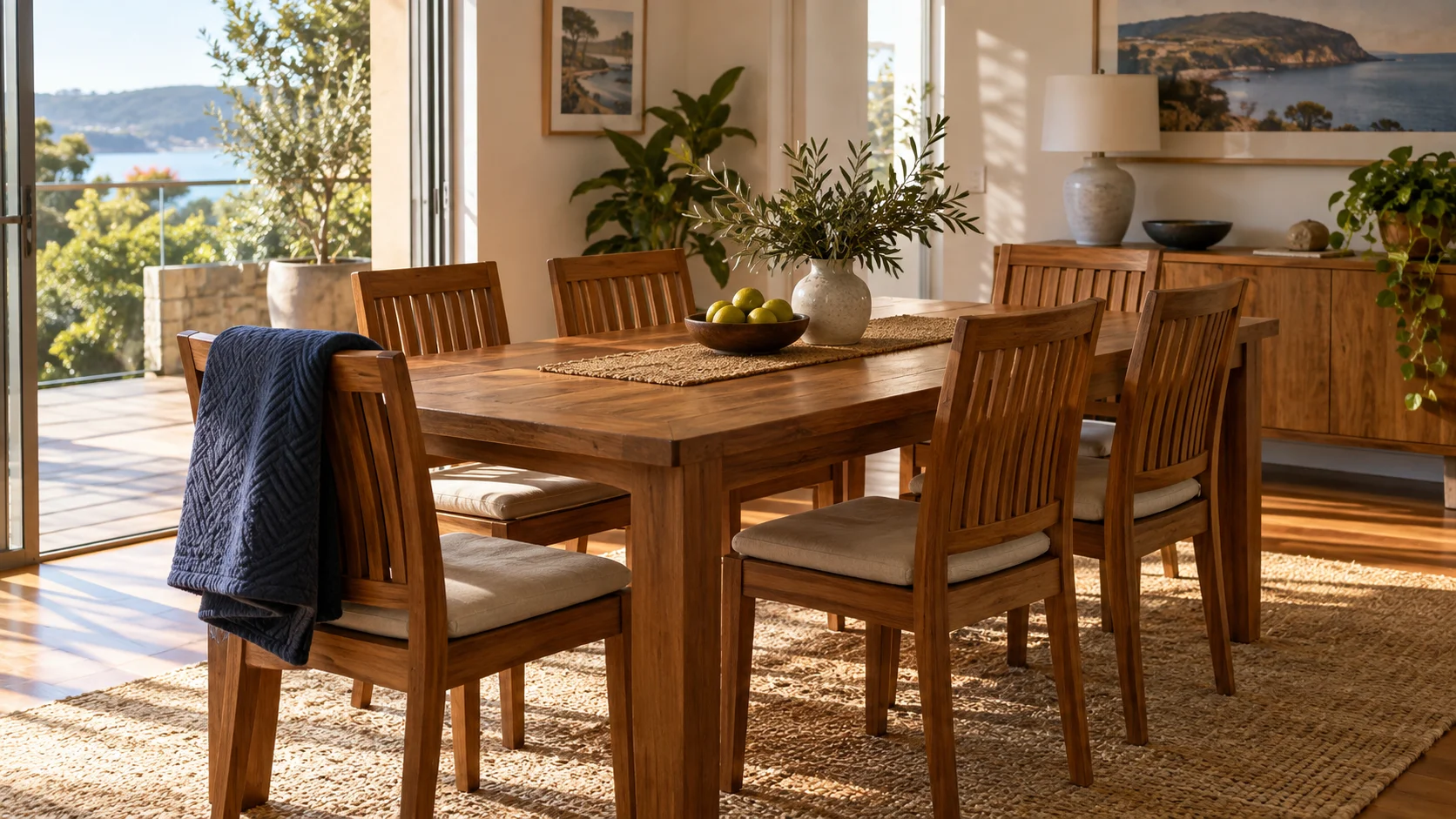
    A fully set teak dining table and chairs sit in a sunlit coastal home, a folded blanket draped over one chair.

    Bringing It Together

    Indonesian furniture is a trade lane that rewards importers who respect the material. The timber that makes a Jepara table worth importing (dense, oily, tropical, solid) is the same timber that triggers illegal logging due diligence, biosecurity scrutiny and moisture management. None of it is hard once systematised: a PO template with a moisture spec and treatment clause, a standing pre-shipment inspection arrangement, an SVLK document file, and a broker who lodges the AANZFTA claim correctly. Set that up on order one and every subsequent container is routine: 0% duty, 12–16 days on the water, and furniture that still looks right five Australian summers later.

    If you’re weighing Indonesia against other origins or planning your first container, the related guides below cover the neighbouring lanes and the compliance regimes in more depth.

    We lodge the AANZFTA claim and quote the container in the same breath.

    Most SMEs get a detailed, all-inclusive quote within 24 hours, duty, DAFF handling and clearance included.

    Price your furniture order

    Related Reading

    Illegal logging due diligence obligations are set out by the Department of Agriculture, Fisheries and Forestry under the Illegal Logging Prohibition Act.

    Frequently Asked Questions

    Is there import duty on Indonesian furniture coming into Australia?

    The general rate on most furniture is 5%, but qualifying Indonesian furniture enters at 0% under AANZFTA with a valid Certificate or Declaration of Origin. GST of 10% still applies regardless.

    Do I need to do illegal logging due diligence on furniture from Indonesia?

    Yes. Wooden furniture is a regulated timber product under the Illegal Logging Prohibition Act, and consignments over AUD 1,000 trigger the importer’s due diligence obligation: gather information, assess risk, mitigate, and keep records for five years. Valid SVLK/V-Legal documentation from Indonesia can satisfy the risk assessment under the Country Specific Guideline.

    Does the furniture itself need fumigation, or just the packaging?

    Both layers matter. ISPM 15 covers timber packaging only. The furniture is separately assessed for pest risk. Kiln-dried, bark-free timber lowers it, and methyl bromide fumigation or heat treatment at origin (with certificates) covers the rest. DAFF orders treatment, export or destruction of infested goods at your cost.

    How long does shipping take from Indonesia to Australia?

    Direct sailings from Tanjung Priok, Semarang or Surabaya to east coast ports run 12–16 days; transhipment via Singapore adds 5–10 days. Plan 4–6 weeks door to door.

    What moisture content should I specify for Australian conditions?

    Kiln dried to 8–12% moisture content, verified at the core with a moisture meter during pre-shipment inspection. Air-dried Indonesian timber at 15–20% MC will shrink and crack in Australian interiors.

    LCL or FCL for a furniture order?

    Furniture bills on volume. Under ~8 cbm, LCL; over ~15 cbm, a 20ft container is cheaper and safer; in between, price both, since destination LCL fees often tip the balance to FCL earlier than expected.

  • Air Freight to Thailand: When It Actually Makes Sense

    Air Freight to Thailand: When It Actually Makes Sense

    There is a CNC spindle motor sitting in a bonded shed at Suvarnabhumi right now (cleared the aircraft eleven hours ago, still waiting on a customs broker to lodge one form), and 900 kilometres away in Rayong a production line is standing still at a cost of roughly 40,000 baht an hour. The factory paid about 60,000 baht to fly that part from Stuttgart instead of the 9,000 baht it would have cost by sea. Nobody in that building thinks the premium was a mistake. The mistake would have been the six-week ocean transit.

    That is what air freight to Thailand is actually for. Not “faster shipping” in the abstract. It is a tool you hire to make a specific, expensive wait disappear. Yet most people pricing a shipment to Thailand have never been shown the arithmetic that separates the cases where air is brilliant from the cases where it is a way to set fire to money.

    Air Freight to Thailand: When It Actually Makes Sense

    The Real Cost Gap: Air vs Sea, Honestly Stated

    Strip away the marketing and the per-kilogram gap is stark. On the Europe–Thailand and North America–Thailand lanes, consolidated air freight typically prices somewhere between $7 and $18 per chargeable kilogram once fuel and security surcharges are folded in. Sea freight on the same lanes, measured per kilogram of reasonably dense household cargo, works out around $0.80 to $1.50. Call it eight to fifteen times more expensive per kilo, and you will rarely be wrong by much.

    But per-kilo comparisons mislead at the small end, because sea freight carries a heavy fixed-cost floor. A less-than-container-load (LCL) shipment attracts origin handling, documentation fees, destination terminal charges at Laem Chabang or Bangkok Port, and Thai destination agent fees. Together these can run $300–$600 before a single cubic metre moves. Air freight has fixed charges too, but they are smaller. The practical consequence: below roughly 100–150kg of dense cargo, air and sea total bills converge, and air sometimes wins outright. A 40kg box of documents and clothes might cost $280 by air, door to door in a week, and $350 by LCL sea, door to door in two months. At that size, sea is the irrational choice.

    The gap explodes as volume grows. At 1,000kg / 5 cubic metres (a modest one-bedroom relocation), sea might total $1,800–$2,500 door to door, while air would land somewhere between $7,000 and $18,000. At a full household, 25–30 cubic metres, air freight stops being a price and becomes a punchline.

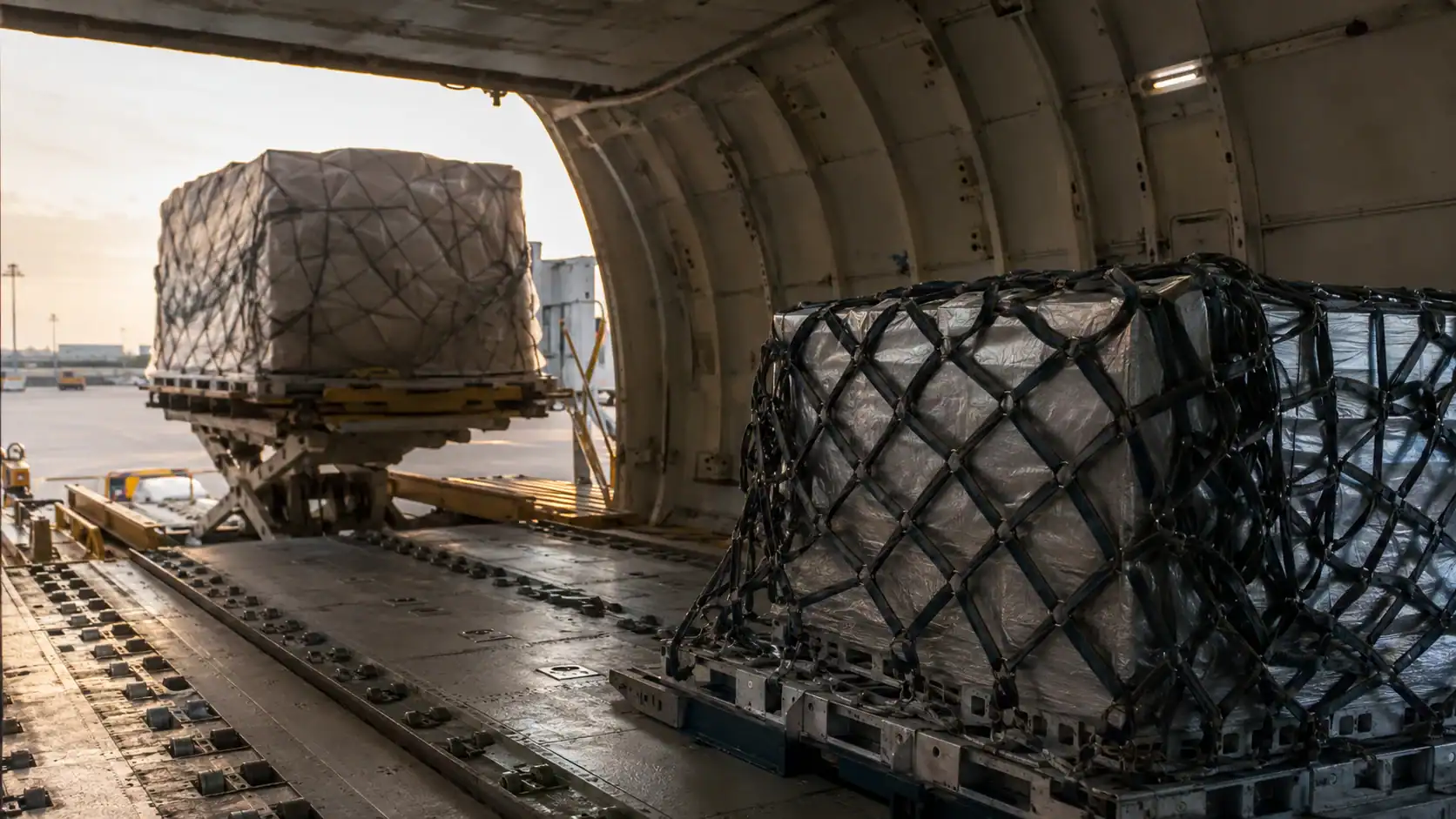
    Two large netted air cargo pallets inside an aircraft's cargo hold, one positioned on a loader at the open door ready for transfer

    Chargeable Weight: The Mechanics That Decide Your Bill

    Air freight does not charge you for what your shipment weighs. It charges for what your shipment weighs or for the space it occupies, whichever produces the bigger number. This is chargeable weight. Misunderstanding it is the single most common source of air freight sticker shock.

    The formula is fixed across the industry. Volumetric weight (in kilograms) equals length × width × height in centimetres, divided by 6,000. Equivalently, one cubic metre of space is billed as 167kg regardless of what is inside it. The carrier compares volumetric weight against actual scale weight and bills the greater of the two.

    A worked example

    Say you are flying three boxes to Bangkok, each 75cm × 55cm × 45cm, and each weighing 18kg on the scale: clothes, bedding, some books at the bottom.

    • Volume per box: 75 × 55 × 45 = 185,625 cubic centimetres
    • Volumetric weight per box: 185,625 ÷ 6,000 = 30.9kg
    • Actual weight per box: 18kg
    • Chargeable weight per box: 30.9kg (volumetric wins)
    • Total chargeable weight: 92.8kg, versus 54kg on the scale

    At $12 per chargeable kilogram, that shipment bills at roughly $1,114, not the $648 you might have estimated from the bathroom scale. You are paying 72% more than your naive estimate, purely because bedding is fluffy. Pack those same boxes with books and tools until each weighs 35kg and actual weight wins instead: 105kg chargeable, but now every billed kilogram is a real kilogram of goods.

    Air freight rewards density. Vacuum-bag the soft goods, fill voids, and never air-freight anything that is mostly air: pillows, duvets, empty suitcases, lampshades. Each of those is a volumetric-weight tax you volunteered to pay.

    What Job Are You Hiring Air Freight to Do?

    Here is a more useful question than “air or sea?”: what job needs doing? People do not want air freight; they hire it to eliminate a wait that costs more than the freight premium. Frame it that way and the decision usually makes itself.

    When air wins clearly

    Urgent replacements and production-line parts. The Rayong spindle motor is the archetype. When downtime is billed in tens of thousands of baht per hour, a 50,000-baht air premium pays for itself before the aircraft leaves the runway. Any scenario where the cost of waiting is measurable and large belongs on a plane.

    High value-to-weight goods. Electronics, camera equipment, medical devices, jewellery and prototypes all qualify. When a 20kg shipment is worth $15,000, the difference between $150 sea and $140–$360 air is noise. Air also shortens your goods’ exposure to handling, transhipment and humidity. Insurance premiums on air moves often price lower per declared value for exactly this reason.

    Documents, samples and small commercial consignments. Below the fixed-cost floor of LCL sea freight, air is frequently cheaper in absolute terms as well as faster.

    Perishables. Anything with a shelf life measured in days moves by air or does not move. Thailand’s food-export machine runs on this in the outbound direction; inbound, it applies to specialty foods, some pharmaceuticals and temperature-sensitive lab goods.

    The first 100kg of a relocation. This is the most underused case: the essentials that make an empty Bangkok apartment livable while the container crosses two oceans.

    When air never wins

    Furniture. A three-seat sofa occupies about 2.5 cubic metres. That is 417kg of volumetric weight: $5,000 or more in air charges for an item you could replace new in Bangkok for a third of that. No sofa on earth justifies a cargo hold.

    Bulk household goods. Kitchenware, wardrobes of clothing, children’s toys and boxes of miscellany are individually light, collectively voluminous, and never needed within 48 hours of arrival. This cargo exists to go by sea, and every kilogram of it you put on an aircraft is a decision you will regret at invoice time.

    Anything you have not priced against local replacement. For every borderline item, ask the honest question: would flying this cost more than buying it again in Thailand? Bangkok is not a hardship posting. IKEA, HomePro and a deep secondhand market will resupply most of a household for less than the air freight on the original.

    An air-cargo apron at a Thai international airport in early morning, a ground tug towing a loaded cargo-dolly train toward a distant terminal building.

    Suvarnabhumi vs Don Mueang: Where Your Cargo Actually Lands

    Bangkok has two international airports, both operated under Airports of Thailand, and they play very different roles in cargo.

    Suvarnabhumi (BKK) is the freight gateway, one of Southeast Asia’s larger cargo hubs. Its Free Zone cargo terminals handle well over a million tonnes a year. Virtually all long-haul freighter services and widebody bellyhold capacity land here, whether from Europe, North America, the Middle East or Northeast Asia. The customs house is large, brokers are on site in numbers, and the clearance machine runs seven days a week. If you book consolidated air freight to Thailand, this is almost certainly where it lands.

    Don Mueang (DMK) is dominated by low-cost passenger carriers and handles a small fraction of the cargo volume, mostly regional narrowbody bellyhold from within Asia. Cargo facilities are modest and broker coverage thinner. You would rarely choose it deliberately for an intercontinental shipment. It matters mainly if a regional consolidation routes through it, in which case expect slightly slower handling because the ecosystem is smaller.

    Chiang Mai and Phuket receive international cargo too, but for anything beyond small regional consignments the economics usually favour clearing at BKK and trucking domestically: the road leg to Chiang Mai adds a day; the direct-air alternative adds cost and often routes through Bangkok anyway.

    Transit Realities: The Flight Is the Fast Part

    Airport-to-airport, Europe or North America to Bangkok is one to three days: a direct freighter or bellyhold flight, or one transhipment through a hub such as Doha, Dubai, Singapore or Hong Kong. That number is what gets quoted. It is not what you should plan around.

    Door to door, a realistic window is five to nine days, and it decomposes like this:

    • Origin: 1–3 days for collection, export packing, security screening, and (crucially for consolidated freight) waiting for the consolidation to close. Consolidators fly when the pallet is full or the weekly cut-off hits, not when your box arrives.
    • Flight: 1–3 days including any hub transhipment and the occasional offload-and-roll to the next flight when bellyhold space tightens.
    • Thai customs and terminal: 1–2 days in the normal case, while documents are lodged, duty assessed or exemption applied, and cargo released from the Free Zone. Add a day or two if an inspection is called or paperwork is queried, and note that a shipment landing Friday evening may not clear until Monday.
    • Final delivery: 1 day within greater Bangkok; two or more upcountry.

    Air freight compresses the transport leg to near zero, but it does nothing to compress paperwork, consolidation schedules or weekends. Anyone promising “three days door to door” on consolidated freight is quoting the best case as the base case. What actually drives timing on both modes is broken down in full in our shipping times to Thailand guide.

    An air-cargo customs clearance shed interior, stacked unit-load device containers queued for release under bright even ceiling lighting.

    Thai Customs by Air: Faster Queue, Same Rules

    A persistent myth holds that air shipments somehow face lighter customs treatment. They do not. Thai Customs applies exactly the same tariff schedule, the same valuation rules and the same personal effects provisions at Suvarnabhumi as at Laem Chabang. What differs is throughput: the airport clearance cycle is measured in hours to a couple of days, against several days at the seaport, because volumes per shipment are smaller and the Free Zone process is built for speed.

    The details that matter:

    • The used personal effects exemption applies equally by air. You qualify on identical terms to a sea shipment if you are relocating to Thailand with an eligible visa or work permit and your goods are used household items imported within the qualifying window around your arrival. Same documentation: passport, visa evidence, packing list, and arrival within the prescribed timeframe.
    • New goods are dutiable by air just as they are by sea. Air waybills with recent retail invoices attached undermine “used personal effects” claims. Boxes of shrink-wrapped new items invite assessment.
    • Valuation disputes cost more by air in one narrow sense. Airport storage charges accrue quickly, so a shipment stuck in a query for a week can rack up meaningful terminal fees. Clean, consistent paperwork matters more, not less.
    • Restricted items are restricted regardless of mode. Medicines beyond personal quantities, food supplements, radio equipment and anything requiring an FDA or NBTC permit all need one whether they fly or float.

    Duty surprises at destination are the classic budget-wrecker on Thai imports, and they hit air shippers harder psychologically because everything else moved so fast. Check the full list of charges that appear after the freight quote in our rundown of the hidden costs of shipping to Thailand.

    The same duty rules and personal effects conditions decide an air shipment and a sea one, and our Thailand customs and duty breakdown sets out what Thai Customs asks for either way.

    Dangerous Goods: What Cannot Fly

    Aircraft are less forgiving environments than ships. The IATA Dangerous Goods Regulations govern what may travel in air cargo. For household and personal shippers, more everyday items count as formally dangerous goods than most people expect:

    • Lithium batteries: the big one. Loose or spare lithium-ion and lithium-metal batteries are forbidden in consolidated air cargo shipped as general goods. That covers power banks, spare camera and drone batteries, and loose laptop batteries. Batteries installed in equipment are permitted only within strict watt-hour limits and only if you declare them. A power bank buried in a box of clothes is exactly how consolidations get offloaded and shippers get fined.
    • Aerosols: deodorant, hairspray, spray paint, insect repellent, cooking spray. Pressurised containers are DG, full stop.
    • Flammables: perfume and cologne in quantity, nail polish and remover, alcohol-based sanitisers, lighter fluid, camping-stove fuel, paints, thinners.
    • Miscellaneous surprises: magnets above certain field strengths, some fire extinguishers, bleach and pool chemicals, airbag modules, and self-inflating life jackets with CO₂ cartridges.

    The rule of thumb: if it can burn, spray, leak, or hold a charge, declare it to your forwarder before packing. Undeclared DG discovered at screening does not just delay your boxes: it can ground an entire consolidation and expose you to penalties. Almost all of these items are either cheap to replace in Thailand or perfectly happy travelling by sea, where the restrictions are far looser. For a relocation, DG-adjacent items go in the sea shipment or the bin, never the air shipment.

    The Split-Shipment Strategy: Air for the First Month, Sea for the Household

    For relocations, the smart question is not “air or sea?” but “which 5% of my belongings is worth flying?” The split-shipment pattern is how experienced movers hire air freight: as a precision instrument, not a mode choice. Essentials go by air, the household goes by sea.

    What goes in the air shipment

    Aim for fifty to a hundred kilograms, dense-packed: work equipment (laptop, monitors; batteries installed, declared), two weeks of clothing for the climate you are landing in, essential documents, children’s immediate needs, basic kitchen kit, prescription medicines with paperwork, and the two or three personal items that make a rented apartment feel less like a hotel. Nothing fluffy, nothing pressurised, nothing replaceable at HomePro for less than its freight cost.

    A small parcel and a larger crate placed side by side on a warehouse scale for comparison, the scale's digital display turned away from camera.

    A worked cost example

    Take a two-bedroom relocation from London to Bangkok, roughly 15 cubic metres, 2,500kg of household goods.

    • Option A, everything by sea: ~$3,800 door to door, 8–10 weeks. Total: $3,800, plus two months of buying duplicates or living out of suitcases.
    • Option B, everything by air: 15 cbm = 2,505kg volumetric; chargeable weight ~2,505kg at $12/kg ≈ $30,000+. Not a real option; shown only to kill the idea.
    • Option C, the split: 80kg of essentials by air (three dense boxes, ~0.4 cbm, chargeable weight ~80kg actual) at $12/kg plus fixed fees ≈ $1,150, arriving in a week. The remaining ~14.6 cbm by sea ≈ $3,700, arriving in week nine. Total: $4,850.

    Option C costs about 28% more than pure sea and buys back two months of livability. The alternative to that $1,050 premium is two months of replacement purchases, or worse, two months of airfreighting things ad hoc by courier as you discover you need them. Set the premium against those and it is usually the cheapest comfortable path through a relocation. Bulky household cargo belongs in the sea shipment described in our shipping household goods to Thailand guide, with the air component as a bolt-on rather than the main event.

    One coordination note: your personal effects exemption paperwork should cover both shipments, and you should declare them as parts of one removal. A competent forwarder handles this routinely; a shipper juggling two unrelated providers sometimes discovers the second shipment’s exemption claim is questioned because the first already “used” it. Same rules, one story, told consistently.

    How Air Freight Pricing Is Built

    An air freight quote to Thailand is a stack, and knowing the layers lets you compare quotes honestly:

    • Base per-kg rate: the price per chargeable kilogram, tiered by weight break. The rate per kilo falls at 45kg, 100kg, 300kg and 500kg thresholds. Sometimes a heavier declared weight at a cheaper break costs less overall; forwarders call this “rating up” and do it automatically.
    • Fuel surcharge (FSC): a per-kg add-on that floats with jet fuel prices, often 20–40% of the base rate. Any quote that omits it is not a quote.
    • Security fee: per-kg screening charge, small but universal since screening became mandatory for cargo on passenger aircraft.
    • Origin fees: pickup, export handling, airline terminal fee, export documentation, AWB fee.
    • Destination fees: Suvarnabhumi terminal handling, customs brokerage, duty and VAT where applicable, delivery order fee, final-mile trucking. This is the layer most often missing from headline quotes, and it is why a “$7/kg all-in” number should trigger scepticism, a gap our door-to-door shipping to Thailand guide sets out handoff by handoff.

    When comparing providers, force every quote to door-to-door on the same chargeable weight, and ask explicitly whether Thai duty, VAT and destination terminal fees are included or estimated. The cheapest airport-to-airport rate regularly becomes the most expensive door-to-door bill. The sea-side equivalent of this exercise runs the identical discipline for ocean quotes; see it in our cost of shipping to Thailand breakdown.

    Express Courier vs Air Freight: Same Aircraft, Different Product

    One distinction trips up almost everyone pricing small shipments. “Air freight” and “express courier” both put your goods on a plane, but they are different products with different economics.

    Express courier is a premium retail product: in these integrated door-to-door parcel networks, one company owns the pickup van, the aircraft, the Bangkok clearance operation and the delivery scooter. Transit is 2–5 days door to door, tracking is granular, customs brokerage is bundled, and the per-kg price is high, often two to three times consolidated air freight rates. Rate cards turn punitive above about 30–70kg. It is unbeatable for documents, single boxes and anything under roughly 30kg where the fixed costs of freight forwarding would swamp the shipment.

    Consolidated air freight is a wholesale product: a forwarder aggregates many shippers’ cargo onto pallets, buys bellyhold or freighter space at wholesale rates, and hands clearance to a broker at Suvarnabhumi. Transit is the 5–9 day door-to-door window described above, tracking is milestone-based rather than live, and the per-kg cost drops sharply with weight. Above roughly 50–70kg it is nearly always cheaper than courier; above 150kg it is not close.

    The crossover zone (roughly 30 to 70kg) is where it pays to price both. Below it, use a courier and do not overthink it. Above it, courier convenience is costing you real money, and a forwarder’s consolidated service does the same job for less. Parcel networks build their clearance pipeline for e-commerce, not relocations, so they routinely clear personal effects as standard dutiable imports. That is a quiet way to pay duty you were exempt from.

    A freight route splitting at a warehouse dispatch area, one path leading toward a truck bound for a seaport and the other toward a van bound for the airport.

    The Decision, Compressed

    Air freight to Thailand makes sense when the cost of waiting exceeds the freight premium, when value-to-weight is high, when the shipment is small enough that sea’s fixed costs erase its per-kg advantage, or when it is the fast half of a split relocation. It never makes sense for furniture, bulk household goods, or anything cheaper to rebuy in Bangkok than to fly. The chargeable-weight formula (centimetres cubed over 6,000, billed against actual weight, whichever is greater) decides your invoice, so pack dense and keep the fluffy things in the sea container. Customs at Suvarnabhumi is faster than the seaport but no cheaper: same duty rules, same exemptions, same paperwork discipline. And keep the dangerous goods list taped to the packing table, because one forgotten power bank can cost you a week.

    Run the numbers on your own shipment before anyone quotes you. Weigh it, measure it, compute both weights, and price the wait. The answer usually announces itself.

    We work out whether air or sea is right for your Thailand move.

    Fill in the route and the size, about 60 seconds of work, and our team comes back with a free estimate built from lanes we already run.

    Get a Thailand shipping quote

    “Chargeable weight” sounds like a technical detail. It is actually the whole ballgame, and most explanations of it are needlessly confusing. Here is the plain version: air freight is priced on whichever is bigger, actual weight or volumetric weight, the number you get from measuring the box and applying a standard formula. A box of clothes is heavy for its size, so actual weight wins. A box of empty suitcases and pillows is light for its size, so volumetric weight wins, often by a wide margin. Nobody explains this before people pack, which is exactly backward. Pack dense items in small boxes and bulky, light items in the fewest boxes possible, and the chargeable weight drops without a single extra step at the airport. That is not a trick. That is just understanding what you are actually being charged for.

    Related Reading

    Personal effects duty-free conditions applying equally by air are set by the Thai Customs Department.

    Frequently Asked Questions

    How much more expensive is air freight to Thailand than sea freight?

    Per kilogram, air freight typically costs four to eight times more than sea freight, comparing chargeable weights with all surcharges included. But sea freight’s fixed handling and destination charges mean that below roughly 100–150kg of dense cargo the total bills converge, and for very small shipments air can be cheaper outright. The gap widens brutally with volume: a full household by air would cost four times the sea price or more.

    What is chargeable weight and how do I calculate it?

    Air carriers bill the greater of actual weight and volumetric weight. Volumetric weight equals length × width × height in centimetres, divided by 6,000: equivalently, 167kg per cubic metre. Measure each box, run both numbers, and budget on the larger. Light, bulky cargo like bedding always bills volumetric; books and tools bill actual.

    How long does air freight to Thailand really take?

    One to three days airport to airport, but plan on five to nine days door to door. Origin consolidation cut-offs, security screening, Thai customs clearance at Suvarnabhumi and final delivery all sit outside the flight time, and weekends do not clear cargo.

    Does the Thai personal effects duty exemption apply to air freight?

    Yes, on identical terms to sea freight. Thai Customs applies the same tariff and exemption rules at the airport as at the seaport. Eligible residents importing used household effects within the qualifying window around arrival can claim the exemption whether the goods fly or sail, with the same documentation requirements either way.

    What items are banned or restricted in air freight?

    Anything classified as dangerous goods under the IATA Dangerous Goods Regulations: loose lithium batteries and power banks, aerosols, perfume and nail polish in quantity, flammable liquids, pressurised containers, strong magnets and various chemicals. Declare anything doubtful to your forwarder; undeclared DG can offload an entire consolidation. Send these items by sea or replace them in Thailand.

    Is a split shipment worth it for a relocation to Thailand?

    Usually. Flying 50–100kg of essentials while the household goes by sea typically adds 10–20% to the total move cost and removes the two-month wait for the things you need immediately. Coordinate both shipments under one personal-effects declaration so the exemption paperwork tells a single consistent story.

  • Australian Port Delays Have Seven Distinct Causes, Each Needing a Different Fix

    Australian Port Delays Have Seven Distinct Causes, Each Needing a Different Fix

    The container arrived on time. The vessel berthed on schedule. And the box still sat at the terminal for nine days, quietly accruing charges the whole time. If you import through Australian ports regularly, some version of this story has happened to you, and the frustrating part is that “the port is congested” was probably the only explanation you got.

    That explanation is nearly useless, because port delays in Australia are not one problem. They are at least seven distinct problems, each with its own cause, its own typical duration, its own cost profile and, critically, its own correct response. Treating a biosecurity hold like a berth congestion problem wastes days. Treating a VBS slot shortage like a customs issue wastes money on the wrong fix.

    Australian Port Delays Have Seven Distinct Causes, Each Needing a Different Fix
    Elevated view of a densely packed container terminal yard with a gantry crane, cargo ships visible on the horizon under overcast skies

    The seven causes, at a glance

    Before the detail, the map. Every port-side delay you will encounter in Australia falls into one of these buckets:

    Cause Typical delay Frequency Direct daily cost exposure
    Vessel bunching / berth congestion 1–5 days Seasonal, peaks Oct–Dec Schedule slip, usually no charges
    Industrial action 2–14 days Episodic, bargaining cycles Storage + detention once free time burns
    ABF customs hold 1–10 days Low per-shipment, rises with risk profile Storage AUD 100–400/day + exam fees
    DAFF biosecurity hold 2–21 days Seasonal (BMSB, shipped Sep–Apr) + random Storage + treatment AUD 300–1,500+
    VBS slot shortage / landside congestion 1–3 days Weekly at peak terminals Storage risk + futile trip fees AUD 150–350
    Empty container park congestion 1–4 days (on dehire) Chronic in Sydney/Melbourne Detention AUD 80–250/day
    Weather closures 0.5–3 days Sporadic, worst in east coast lows Schedule slip, occasionally storage

    Notice the pattern. The dramatic causes (strikes, customs exams) are rare but long. The mundane causes (truck slots, empty parks) are short but constant. Over a year of steady importing, the mundane causes usually cost more in aggregate. Now, cause by cause.

    Vessel bunching and berth congestion

    Container terminals run on berth windows: each shipping service holds a contracted slot, say Tuesday 06:00 at Port Botany. When a vessel misses its window (weather in the Tasman, a slow turnaround in Singapore, congestion at a previous port), it arrives “off-window” and waits for the next available berth. One late ship is manageable. The problem is bunching: three or four vessels from different services arriving in the same 48-hour period, all competing for the same cranes and labour.

    Bunching is worst in the pre-Christmas import surge from roughly October to December, when Port Botany and Melbourne both run near capacity and any weather disruption cascades. A vessel that would berth immediately in March can wait 2–4 days at anchor in November. Fremantle and Brisbane see the same mechanics with less intensity.

    Typical delay: 1–5 days of schedule slip. Cost: usually nothing direct, because the delay happens before discharge: your free time clock hasn’t started. The real cost is downstream: missed delivery bookings, warehouse labour rostered for cargo that isn’t there, and safety stock burn.

    Response playbook: You cannot fix berth congestion, so the play is entirely informational. Track the vessel, not the ETA on the booking. Carrier ETAs at Australian ports routinely lag reality by 1–2 days during peak. Rebook delivery slots and warehouse labour as soon as the berth window slips, not when the container is discharged. If you run tight replenishment cycles, treat October–December ETAs as ranges, not dates, and pad inbound plans by 3–4 days.

    Industrial action

    Australian stevedoring is covered by enterprise agreements that come up for renegotiation on multi-year cycles. When bargaining stalls, protected industrial action becomes available to the workforce, and it rarely takes the form of a full walkout. The more common instruments are work bans (no overtime, no crane intensification), rolling stoppages of a few hours per shift, and go-slows. Each of these cuts terminal throughput by 20–50% without closing the gate, which means containers keep arriving while the rate of discharge and truck servicing drops.

    The effect compounds. A week of 30% reduced throughput at a major terminal creates a backlog that takes two to three further weeks to clear after the action ends, because terminals have little spare capacity to catch up. So the delay you experience often outlasts the action itself.

    Typical delay: 2–14 days depending on where your container sits in the backlog. Cost: this is where free time becomes dangerous. Storage waivers during industrial action are inconsistent: some stevedores extend free time during declared disruptions, some do not, and detention clocks at the shipping line generally keep running regardless. Expect exposure of AUD 100–400/day storage plus AUD 80–250/day detention on boxes caught mid-cycle.

    Response playbook: Bargaining cycles are public: your forwarder should know when a terminal’s enterprise agreement expires and flag the risk window months out. During action: request free-time extensions in writing early (waivers granted retroactively are rarer), prioritise collecting boxes already available over ones still on vessel, and consider routing new bookings via an unaffected port if the action is terminal-specific rather than national. After action ends, expect two more weeks of degraded VBS slot availability while the backlog clears.

    A customs examination bay at an Australian container terminal, a single opened shipping container under an inspection canopy with a forklift positione

    ABF customs holds

    The Australian Border Force holds containers for three broad reasons, and they behave differently.

    Documentary query. Something in your import declaration doesn’t reconcile: valuation looks low against the goods description, tariff classification is questionable, origin claims need substantiation. The container physically stays put while paper moves. Resolved in 1–3 business days if you respond same-day with commercial invoices, packing lists, bank remittance evidence or supplier correspondence. Every day you take to respond is a day added.

    Community protection / trade compliance exam. The container is directed to an examination facility for a physical unpack. This targets prohibited imports, undeclared goods and revenue risk. The exam itself might take hours, but the queue, transport to the facility, unpack, inspection and repack typically add 3–7 days end to end. You pay the unpack/repack and transport costs (commonly AUD 800–2,500 depending on port and container size) even when nothing is found.

    X-ray. The lighter-touch version: the box goes through a container x-ray facility. Adds 2–4 days depending on queue depth. If the image raises questions, it escalates to a physical exam and the clock extends.

    Storage exposure during any ABF hold: the stevedore’s free time (usually around 3 days from availability) keeps burning unless a hold-specific arrangement applies, so a 7-day exam cycle can mean 4+ days of storage at AUD 100–400/day on top of exam costs.

    Response playbook: Speed of response is the single controllable variable. Keep a document pack ready per shipment (invoice, packing list, proof of payment, product literature) so a documentary query gets answered in hours, not days. Make sure your broker has authority to respond without waiting for you. If exams recur, look at the pattern: new importers, new supply chains, cash-adjacent goods categories and inconsistent declarations all raise selection likelihood. A clean, consistent declaration history is the long-term fix; it is exactly how risk-based targeting works. For more on the clearance side specifically, see our guide to customs delays on Australian imports.

    DAFF biosecurity holds

    The Department of Agriculture, Fisheries and Forestry runs the biosecurity regime, and it generates the longest tail of delay durations of any cause on this list. Three mechanisms matter for containerised freight.

    BMSB seasonal measures. Cargo shipped on board between 1 September and 30 April each year faces mandatory treatment requirements if it ships from designated brown marmorated stink bug risk countries (much of Europe, plus other listed origins) and falls into target high-risk goods categories (machinery, vehicles, parts, and similar). Treatment is heat, methyl bromide or sulfuryl fluoride, ideally performed offshore before loading. Get this wrong (untreated cargo, treatment by an unapproved provider, certificate errors) and the options on arrival narrow to onshore treatment (where capacity is limited and queues form), re-export, or destruction. Delays run from 4 days for a smooth onshore treatment to several weeks in peak season. Treatment plus handling commonly costs AUD 300–1,500+, before storage.

    Random and profile-based inspections. A percentage of containers are directed for inspection based on commodity risk, origin and importer history. If documents are in order and the goods are clean, this adds 2–5 days.

    Rural tailgate inspections. Containers destined for rural delivery addresses get an external/door inspection for soil, seeds, insects and plant material on the container itself. Usually quick (1–3 days added) unless contamination is found, at which point the container is directed for washing or treatment and the delay extends by another 3–7 days.

    Response playbook: Biosecurity delays are the most preventable category on this list, because almost all the long ones trace back to documentation and offshore preparation. During BMSB season: confirm your supplier’s treatment provider is on the approved list before the goods ship, and get the treatment certificate checked by your broker before the vessel arrives, not after. Year-round: clean containers, accurate commodity descriptions, and packing declarations that are complete and current. If you import anything organic, timber-packed or rural-bound, read our detailed piece on biosecurity requirements when importing to Australia. The failure modes are specific and avoidable.

    A queue of freight trucks waiting in a landside marshalling yard at an Australian port, shot from a slight elevation showing orderly lanes and stacked

    Stevedore landside issues: VBS, truck slots and empty parks

    This is the unglamorous category that costs steady importers the most money over a year, precisely because it never makes the news.

    How the VBS works. Trucks cannot simply turn up at an Australian container terminal. Carriers book timeslots through the terminal’s Vehicle Booking System. Slots are released in windows (typically the day before), are zone- and time-specific, and are finite. When import volumes surge, slot demand exceeds supply: your transport company logs in at release time and the slots are gone in minutes. Your container is discharged, available, cleared, and physically uncollectable because there is no legal way to get a truck to it.

    The free-time squeeze. Here’s the mechanism that turns a slot shortage into an invoice. Free storage time (around 3 days) starts when the container becomes available, not when a slot becomes bookable. Two days of slot scarcity consumes two-thirds of your free time before anyone has done anything wrong. Add a weekend and you’re into storage charges at AUD 100–400/day through no fault of your own. Stevedores are, to put it gently, not eager to waive charges caused by the scarcity of their own slots. This dynamic has drawn ACCC attention in its monitoring of stevedore landside charges, but for now it remains the importer’s cost to manage.

    Futile trips. The mirror-image failure: a truck arrives on a valid booking and the container isn’t servable, whether because it’s still under hold, buried in a stack, or the terminal is running behind. The trucking company charges a futile trip fee, typically AUD 150–350, and you rejoin the slot queue.

    Empty container park congestion. The delay doesn’t end at delivery. The empty container must be dehired to a container park nominated by the shipping line, and Sydney and Melbourne empty parks periodically refuse redeliveries when full. Meanwhile the line’s detention clock keeps running on a box you are actively trying to give back, at AUD 80–250/day once detention free time expires. Redirection notices add transport cost on top: the box gets dehired to a different park, often farther away.

    Response playbook: Book early and book everything. Good transport companies book slots the moment the release window opens; ask yours what their slot-capture process actually is. Give your carrier the full picture (availability date, hold status, delivery constraints) before slots release, so they book the right day rather than a speculative one. For empties, insist on same-week dehire and get any park redirection notice in writing, because detention incurred after a documented redirection is disputable. And build the free-time maths into your planning: if your terminal’s slot market is tight, the effective planning window from availability to storage charges is not 3 days, it’s 1–2. Our article on warehouse delivery planning for imports covers the receiving-end half of this coordination problem.

    An intermodal rail siding beside a container terminal at dusk, a rake of container wagons partly loaded under sodium-vapor yard lighting mixing with t

    Rail versus road: the dwell difference

    Around a fifth of containers at some Australian ports move by rail shuttle to intermodal terminals rather than by truck from the waterfront, and the delay mathematics differ in ways worth understanding.

    Rail adds scheduled dwell: the container waits for the next train, travels to the intermodal terminal, and waits again for the final truck leg. In normal conditions that’s 1–2 days slower than a direct truck movement. But rail dwell is predictable dwell: trains run to timetable, and rail bypasses the VBS slot lottery entirely. During slot shortages, industrial-action backlogs, or peak season, rail-routed containers frequently come out ahead: a scheduled 2-day dwell beats an unscheduled 3-day slot famine plus storage charges.

    The decision rule: if your delivery point is within economic trucking distance of an intermodal terminal and your cargo is planned rather than urgent, rail routing is cheap insurance against landside congestion. If the shipment is time-definite, road retains the flexibility to move the moment a slot exists.

    Managing the VBS, rail and free-time clocks yourself is a job on top of your job, worth handing to a partner who tracks them.

    Weather closures

    This is the shortest section, because the response options are the fewest. High winds stop crane operations (most terminals suspend above sustained winds around 70–80 km/h at crane height), heavy swell closes pilotage, and east coast lows can shut Port Botany and Brisbane for 1–3 days at a stretch. Fog closes river ports like Brisbane for hours at a time. Delays are usually 0.5–3 days of pure schedule slip, and because everything shifts together, the aftermath looks like a mild bunching event: 2–4 days of degraded slot availability while the terminal catches up.

    Response: the same as bunching. Track, rebook, pad. The one active play: if a named weather system is forecast and your container is already available, pull it forward. Collecting a day early beats being 401st in the queue when the terminal reopens.

    Worked example: anatomy of a 9-day delay cost stack

    Here is how these causes combine on one real-world-shaped shipment. A 40ft container of machinery parts from Germany arrives at Port Botany in late October, during BMSB season and peak import period.

    • Days 1–2: vessel bunching. The vessel arrives off-window into a congested berth queue. Two days at anchor. Cost: AUD 0 direct, but the delivery booking and warehouse labour scheduled off the original ETA are now wrong.
    • Days 3–6: BMSB documentation hold. On discharge, DAFF flags the treatment certificate: the offshore provider’s details don’t match the approved list format. Four days to resolve: one day lost because the broker had to chase the supplier in Germany across time zones, then verification and release. Storage free time (3 days) expires on day 5. Cost: 2 days storage at AUD 185/day = AUD 370, plus a biosecurity documentation assessment fee of AUD 190.
    • Day 7: futile trip. Working off the expected release time, the transport company books a slot for the morning of day 7. Release actually posts at 14:00. The truck arrives, the box isn’t servable. Cost: futile trip fee AUD 240, plus another day of storage, AUD 185.
    • Days 8–9: VBS slot shortage. Peak season. Next available slot is day 9 afternoon. Two more days of storage, and Botany’s storage rate steps up after day 3 of charges: day 8 at AUD 185, day 9 at AUD 370 on the higher tier. Subtotal: AUD 555.
    • Days 12–14: empty park congestion (epilogue). Delivered day 9, unpacked day 10, empty ready day 11. The nominated empty park is refusing redeliveries; a redirection notice arrives day 13, dehire completes day 14, three days past the line’s detention free time. Cost: 3 days detention at AUD 145/day = AUD 435, plus AUD 110 extra cartage to the redirected park.

    Total delay cost: AUD 2,085 in direct charges (storage AUD 1,110, detention AUD 435, futile trip AUD 240, biosecurity fee AUD 190, extra cartage AUD 110) plus roughly AUD 900–1,200 in soft costs (rebooked labour, expedited local freight to cover the stock gap), for a true cost north of AUD 3,000. Nine days late, and no single party “at fault” for more than two of them.

    Now run the counterfactual. Suppose the BMSB certificate is checked against the approved-provider list before the vessel sails: days 3–6 collapse to a routine 1-day assessment, storage never starts, the futile trip never happens because release timing isn’t a scramble, and the box is collected inside free time before the peak slot crunch. The empty-park delay is the only cost that survives. Total: roughly AUD 545. One pre-departure document check was worth about AUD 2,500. That ratio, cheap prevention against expensive dwell, recurs across every cause in this taxonomy.

    A small customs-broker operations office glimpsed through an open door, a desk with a monitor turned away from camera and a wall calendar visible only

    Reducing exposure: the standing defences

    Individual playbooks aside, four standing practices cut delay exposure across every cause simultaneously.

    1. Pre-clear before arrival. Australia allows import declarations to be lodged and processed before the vessel berths. A shipment that is customs-cleared and biosecurity-assessed at the moment of discharge starts its free-time clock with zero regulatory risk remaining. Every documentary issue found pre-arrival is resolved on free time that hasn’t started; every issue found post-discharge burns paid days. If your broker isn’t routinely lodging 3–5 days pre-arrival, ask why. Our breakdown of customs clearance times in Australia shows exactly where those days go.

    2. Book transport early, with full information. The VBS rewards speed and punishes ambiguity. Carriers who receive availability data, hold status and delivery windows before slot release capture good slots; carriers working from stale ETAs book futile trips.

    3. Avoid the peak import windows where you can. October–December arrivals at Port Botany and Melbourne face the worst combination on this list: bunching, slot scarcity, stepped-up storage exposure and BMSB season all at once. Orders that can ship to arrive in September or can wait until late January face materially lower delay probability on identical goods. Not every supply chain has that flexibility, but many have more than they use.

    4. Know your free-time clocks, all of them. At least three exist: stevedore storage free time (from availability), shipping line detention free time (from gate-out), and in some cases plug/monitoring free time for reefers. They start at different moments and are held by different parties. Most surprise invoices trace to an importer who was watching one clock while another expired. Put all three on the shipment record, per container, with dates, not “3 days free” as an abstraction.

    The underlying discipline: diagnose before responding

    The unifying failure mode in port delays is category error: responding to one cause with another cause’s playbook. Escalating with your forwarder is the right move for a documentation hold and a pointless one for a berth queue. Paying for premium transport is rational during a slot shortage and wasted money during a customs exam. Rerouting via another port is a strong play against terminal-specific industrial action and an expensive overreaction to weather.

    So the first question when a container stalls is never “how do we speed this up?” It is “which of the seven is this?”, because duration, cost exposure and the correct response all follow from the answer. A forwarder who can tell you the cause, the expected duration range and the clock exposure within hours of a hold appearing is doing the job; one who tells you “the port is congested” is not. If you’re staring at a stalled shipment right now, our step-by-step guide to handling a delayed import shipment in Australia walks the diagnostic sequence in detail.

    It is worth asking why “the port is congested” survives as the standard explanation when it tells you so little. The phrase suits almost everyone who uses it: it assigns the delay to no one, and it can never be disproved on the day, because some congestion always exists somewhere on the waterfront. The importer is the exception, since the storage, detention and futile trip fees arrive on the importer’s invoice whoever caused them. So treat the phrase as a prompt rather than an answer. Ask which of the seven causes applies and which free-time clock has already started. A forwarder who is watching the shipment can answer both in a sentence; if the answer takes a day, that tells you how closely it was being watched.

    Delays at Australian ports are not going away: the volumes are growing faster than the landside infrastructure, and the regulatory screening that causes holds exists for good reasons. But delay costs are substantially optional. They accrue to importers who find out about problems after the free-time clocks start; they largely bypass importers whose documents, bookings and clocks are managed before the vessel arrives. The nine-day example above wasn’t bad luck. It was AUD 2,500 of preventable cost wearing bad luck as a disguise.

    We track your free-time clocks before you find out one expired.

    Most SMEs get a detailed, all-inclusive quote within 24 hours, with booking and clearance managed end to end.

    Price your next shipment

    Related Reading

    Import clearance and biosecurity hold procedures are published by the Australian Border Force and the Department of Agriculture, Fisheries and Forestry.

    Frequently Asked Questions

    What is the most common cause of container delays at Australian ports?

    Landside congestion is the most frequent cause: truck slot shortages in the stevedore Vehicle Booking System (VBS) and empty container park congestion delay more boxes, more often, than customs or biosecurity holds. These delays are usually short (1–3 days) but they occur weekly at Port Botany and Melbourne, whereas a customs exam or biosecurity hold is rarer but longer (3–10+ days).

    How much does wharf storage cost when a container overstays free time?

    Australian stevedores typically allow around 3 days of free storage after a container is discharged, then charge escalating storage of roughly AUD 100–400 per container per day. Rates step up in tiers, so a box sitting 6 days past free time can accrue AUD 1,000–2,000 in storage alone, before container detention or futile truck trip fees are counted.

    How long do ABF customs holds usually last?

    A documentary query is often resolved in 1–3 business days if you respond the same day. A community protection or trade compliance exam typically adds 3–7 days including unpack and repack. An x-ray inspection alone usually adds 2–4 days depending on the queue at the container examination facility.

    What is BMSB season and why does it delay containers?

    The brown marmorated stink bug (BMSB) season covers cargo shipped from designated risk countries between 1 September and 30 April, judged by the shipped-on-board date rather than the arrival date. Target high-risk goods must be treated (heat, methyl bromide or sulfuryl fluoride) before or on arrival, and untreated or incorrectly documented cargo can be held for onshore treatment, re-export or destruction. These delays run from 4 days to several weeks.

    Can I avoid VBS slot delays by using rail instead of road?

    Partly. Rail shuttles to intermodal terminals bypass the truck VBS queue at the waterfront entirely, but rail adds its own scheduled dwell, typically 1–2 extra days versus a direct truck leg in normal conditions. Rail wins when road slots are scarce or the delivery point is near an intermodal terminal; road wins for urgent, time-definite deliveries.

    Who pays for delay costs like storage and detention, the importer or the forwarder?

    Almost always the importer. Wharf storage, container detention, biosecurity treatment fees and futile truck trip charges are passed through at cost by forwarders and transport companies. The exceptions are delays caused by a carrier’s or stevedore’s own error, which can sometimes be disputed. Keep timestamped records of bookings, availability notices and hold notifications to support a waiver claim.

  • Moving from Belgium to Thailand: Freight, Customs and Relocation Guide

    Moving from Belgium to Thailand: Freight, Customs and Relocation Guide

    Dries lived in Berchem, eleven minutes by bike from the edge of the Port of Antwerp. On clear evenings he could see the gantry cranes from the window of his flat: the second-largest port complex in Europe, moving more than twelve million containers a year, with direct weekly sailings to Laem Chabang. When he and his Thai partner decided to move to Chiang Mai, shipping should have been the easy part. He was, quite literally, closer to a departing Asia-bound container than almost anyone else on the continent.

    He still got it wrong. Not the freight: the sequence. Dries deregistered from his commune in March, full of momentum, before his Thai Non-Immigrant O visa had been approved. The visa took longer than expected. For six weeks he was a man with no official residence in Belgium, a bank that suddenly wanted a foreign address he didn’t have, and a mutuelle that had quietly stopped covering him. His boxes, meanwhile, sat packed in a friend’s garage in Wilrijk because he had booked the shipment to land in Bangkok before he could legally clear it duty free.
    Moving from Belgium to Thailand: Freight, Customs and Relocation Guide

    Why Antwerp Is a Genuine Advantage: If You Use It

    Start with the good news, because it is substantial. The Port of Antwerp-Bruges is one of the two largest container ports in Europe, and it has direct deep-sea services to Laem Chabang, Thailand’s main container gateway about 130 km southeast of Bangkok. Bangkok Port (Khlong Toei) is not on those services: the Port Authority of Thailand limits ships using its river channel to 172 metres in length and 8.2 metres draught. “Direct” matters. A direct service means your container is loaded in Antwerp and discharged in Thailand without transshipment at an intermediate hub like Singapore or Tanjung Pelepas. Every transshipment adds handling, a few days of dwell time, and a small but real chance of a rolled connection.

    The pre-carriage advantage is just as concrete. If you live in Antwerp, Ghent, Mechelen, Brussels or anywhere in Flanders, your goods travel between 10 and 60 km to reach the terminal. Compare that with a family in Munich or Vienna, whose container rides a truck or a barge for two or three days and several hundred euros before it even smells salt water. For a Belgian shipper, the trucking leg of an FCL move is often under EUR 300; for much of inland Europe it can be EUR 700–1,200. On an LCL shipment, Belgian addresses feed straight into consolidation warehouses in the port zone itself, so cut-off deadlines are more forgiving and origin handling is cheaper.

    Wallonia is only slightly worse off. From Liège or Namur, Antwerp is still a same-day truck run, and some forwarders will quote Rotterdam as an alternative. The difference is usually marginal, and Antwerp’s Asia schedules are dense enough that there is rarely a reason to look north.

    So use the advantage. But understand what it does not buy you: it does not shorten the ocean, and it does not fix your paperwork. Those are the next two sections.

    Ship-to-shore gantry cranes working a container vessel at a European port terminal on an overcast day, with stacked containers in the foreground

    Transit Times in 2026: The Cape of Good Hope Reality

    Here is the number most people carry in their heads: Europe to Thailand, about 30 days. That number is out of date.

    Since the Red Sea security crisis began in late 2023, the major container lines have kept most Asia–Europe services routing around the Cape of Good Hope rather than through the Suez Canal. The detour around southern Africa adds roughly 3,500 nautical miles and 10 to 14 days each way. In practical terms:

    • Antwerp to Laem Chabang, port to port: plan on 40–50 days on most current schedules, versus roughly 28–33 days on the old Suez routing.
    • Door to door: add 1–2 weeks on top for export formalities, Thai customs clearance and inland delivery. A realistic all-in figure is 8 to 10 weeks.
    • Schedule reliability: longer rotations mean fewer buffer days in carrier schedules, so a missed berth window in Algeciras or Singapore ripples further than it used to.

    Some services have trialled a return to Suez as conditions fluctuate, and if the situation normalises, transit times will compress again. But you cannot plan a house move on a geopolitical maybe. Book against the Cape routing, and treat any earlier arrival as a bonus. If your shipment turns up in week six instead of week nine, the worst outcome is that your things wait in your new home a little sooner than expected, provided your customs paperwork is ready. That readiness is what the next section is about: the single most important set of rules in this entire move.

    For a deeper look at how rerouting affects planning, see our guide on shipping delays and Thailand relocations.

    Thai Customs: The Duty-Free Rules That Decide Everything

    Thailand does allow foreigners to import used household effects duty free, but the concession is narrow, conditional, and enforced. The rules, set out by the Thai Customs Department, come down to four tests:

    1. Your visa. You need a non-immigrant visa valid for at least one year: Non-Immigrant B (work) and the Long-Term Resident (LTR) visa qualify under Thai Customs’ standard criteria. A Non-Immigrant O based on marriage or on retirement is excluded from that standard list per Thailand’s official relocation criteria. Neither route qualifies for duty-free eligibility, so budget for duty and 7% VAT. Tourists and visa-exempt entries do not qualify at all. No qualifying visa, no concession, full stop.
    2. Ownership and use. Items must have been owned and used by you for at least one year before import. This is the “used household effects” test. A three-year-old washing machine passes. A television bought in the January sales for the move does not.
    3. The six-month window. Your shipment must arrive in Thailand no earlier than one month before and no later than six months after your first entry into the country on the qualifying visa. Miss the window and the duty-free treatment lapses.
    4. One shipment per family. The concession covers a single consignment. If you split your move into two sea shipments six months apart, only one clears duty free.

    Read those four tests against the Cape of Good Hope transit times and the trap becomes visible. If you enter Thailand in January and only book your shipment in April, a 9–10 week door-to-door timeline puts arrival right at the edge of the six-month window. The safe pattern is to enter Thailand on your visa, and have the shipment sail within four to six weeks of that first entry. In turn, that means having your packing, survey and booking done before you fly.

    Documentation-wise, Thai Customs will want your passport (showing the visa and the entry stamp), the visa itself, a detailed packing list in English, the bill of lading, and (for work visa holders) often the work permit or evidence it is in process. Your destination agent handles the submission, but the quality of your packing list is your job. “Box 14: miscellaneous” is an invitation to inspection. “Box 14: used kitchen utensils, used baking trays, used cookbooks (12)” is a cleared box.

    Two more Thai-side realities worth knowing. First, even a technically perfect shipment can attract duty on individual items a customs officer judges to be new, excessive in quantity, or outside the household-effects definition: the concession is granted item by item, not shipment by shipment. Second, duty assessments in Thailand carry a degree of officer discretion that Belgians, used to rule-bound administration, sometimes find unsettling. A clean, honest, well-documented shipment sails through far more often than not. A shipment with six sealed boxes of “gifts” does not. For the full framework, see our detailed guide to duty-free imports into Thailand.

    Here is a question worth settling before you book anything. Why can a container that reaches Laem Chabang two weeks before you land still clear duty free, when an identical one that arrives six weeks early cannot? The difference is the calendar. The customs window is measured from your first entry stamp on the qualifying visa, and it opens only one month before that date. Six weeks early falls outside the opening, and no amount of honest paperwork moves it back in. So on a 40 to 50 day Cape routing, plan backwards from the day you will actually enter Thailand: the sailing date is the variable you control, and the entry stamp is the date everything is measured against.

    A Belgian removalist carefully setting aside a small crate of glass bottles on a felt-lined packing bench in a bright warehouse.

    What Not to Ship from Belgium

    Every country’s movers have a national blind spot. For Belgians moving to Thailand, there are three.

    The beer collection

    This one hurts, so let’s be direct. Thailand’s duty-free alcohol allowance is one litre per arriving adult, carried with you, not shipped. Alcohol inside a household-goods consignment is excluded from the duty-free effects concession entirely and attracts import duty plus Thai excise tax plus VAT, a stack that routinely multiplies the value of the goods several times over. A EUR 400 cellar of Westvleteren, Rochefort and vintage gueuze can generate a tax bill north of EUR 1,000, plus a licensing headache, plus a flagged shipment that now gets a slower, more suspicious inspection. And that is the good outcome; the bad outcome is seizure.

    The maths never works. Host a farewell tasting, gift the rare bottles, sell the rest. Your one litre of carry-on allowance is enough for a single bottle of something special to open on your first night in Thailand. That is the whole beer plan.

    Chocolate and perishables

    A container spends six to seven weeks crossing the equator twice on the Cape routing. Internal container temperatures in tropical waters regularly exceed 50°C. Belgian chocolate does not survive this; it blooms, melts, resets into grey slabs, and (worse) melted chocolate migrates. It finds books, linen, the inside of your printer. The same logic applies to speculoos spread, cheeses, cured meats (which are also an agricultural import problem on the Thai side) and anything else edible. Thailand imports Belgian chocolate commercially in refrigerated containers; the good supermarkets in Bangkok and Chiang Mai stock it. Buy it there.

    New goods in original packaging

    The temptation is rational: electronics are cheaper in a Belgian sale than in a Thai mall, so why not buy the new laptop, air fryer and espresso machine before leaving and ship them? Because Thai Customs reads unopened OEM packaging as exactly what it is (new goods), and new goods fail the one-year ownership-and-use test. Best case, you pay duty and VAT on the invoice value. Worse case, a few obviously-new items colour the officer’s view of the entire consignment. If you must bring new purchases, unbox them, use them for a genuine period before packing, keep no pristine retail boxes, and accept that “used, six months” is still a judgement call you might lose. If the numbers matter, carry the laptop in hand luggage instead. Accompanied personal effects for personal use are a different, gentler conversation.

    Beyond the Belgian trio, the standard prohibited list applies: no e-cigarettes or vaping equipment (banned in Thailand outright), no drones without prior NBTC permission, and no weapons. Think hard before shipping medicines beyond a personal supply, and carry the prescriptions for what you do bring.

    Plugs, Voltage and Appliances: Type E Meets Thailand

    The pleasant surprise of a Belgium–Thailand move is electrical compatibility. Belgium runs 230V at 50Hz on type E sockets (the ones with the protruding earth pin). Thailand runs 220V at 50Hz on a mix of type A and B (the flat-pin American style), type C (the ungrounded europlug) and the newer type O standard. The voltage is close enough to Belgium’s that every Belgian appliance works without a transformer.

    What this means in practice:

    • Ungrounded two-pin europlugs (type C), the kind on phone chargers, lamps and small appliances, push straight into most Thai sockets. No adapter needed.
    • Earthed type E plugs, the kind on washing machines, dishwashers, kettles and anything with a chunky round plug, need an adapter or a replacement plug head. The Thai socket has no receptacle for the French-style earth pin.
    • Buy adapters before you fly. A bag of ten universal adapters costs little in Belgium; hunting for E-to-Thai adapters in a provincial Thai town is a small unnecessary adventure.

    Whether to ship large appliances at all is a volume question, not an electrical one, which is the next section. The short version: a washing machine is usually worth its cubic metre in an FCL move and rarely worth it in a small LCL shipment, given that decent machines in Thailand cost EUR 250–400 new and most rentals include one.

    Palletized household cartons being loaded into a shared consolidation container at Antwerp.

    LCL or FCL: Volume Guide and Antwerp–Thailand Costs in EUR

    Sea freight from Belgium comes in two flavours. LCL (less-than-container-load) means your boxes share a container with other shippers’ cargo and you pay per cubic metre. FCL (full-container-load) means you take a whole 20ft or 40ft box at a flat rate. The crossover point, and typical 2026 pricing from Antwerp to Bangkok/Laem Chabang, looks like this:

    Shipment size Typical contents Best mode Indicative door-to-door cost (EUR)
    1–3 m³ Boxes only: books, clothes, kitchenware, keepsakes LCL €600 – €1,100
    4–8 m³ Boxes plus some furniture: bed, desk, bikes LCL €1,100 – €1,900
    9–13 m³ Small apartment, partial household LCL (approaching crossover) €1,800 – €2,800
    14–28 m³ Full 1–2 bedroom household FCL 20ft €3,200 – €4,500
    29–55 m³ Full family house, 3+ bedrooms FCL 40ft €4,800 – €6,800

    Treat these as planning bands, not quotes. Rates move with carrier capacity, the Red Sea situation, and season. But the structure is stable, and three Belgian-specific notes apply.

    First, the crossover sits around 12–13 m³. LCL pricing from Antwerp runs roughly €150–220 per cubic metre all-in once origin charges, ocean freight, Thai destination handling and delivery are counted. At 13 m³ you are paying 20ft FCL money for a shared box that gets handled more times, at higher damage risk, on a slower consolidation schedule. If your survey comes in at 11 m³ or more, price both options and lean FCL.

    Second, Belgian origin charges are genuinely low. Because pre-carriage is so short, the Antwerp advantage shows up as €200–500 of savings versus an equivalent move from inland Europe, and as flexibility: a missed vessel costs you a week, not a re-booked cross-continental truck.

    Third, watch the destination side of LCL quotes. Thai destination charges on LCL are where cheap headline rates go to die: CFS fees, documentation, delivery order fees. Insist on a genuinely all-in door-to-door quote naming every Thai-side charge. A worked example illustrates the point:

    Worked example: couple, Ghent to Chiang Mai, 7 m³ LCL. Origin packing and pickup in Ghent plus haulage to the Antwerp CFS: €550. Origin handling, export customs and documentation: €280. Ocean freight, Antwerp–Laem Chabang: €490. Thai destination CFS and clearance: €430. Delivery Laem Chabang to Chiang Mai (a 700 km inland leg: this is what long-haul delivery inside Thailand costs): €480. Marine insurance at 2.5% of a €12,000 declared value: €300. Total: €2,530, or about €360 per cubic metre, with the Chiang Mai delivery leg pushing it above the Bangkok-delivery norm. Door-to-door time on current routings: about nine weeks. The same shipment delivered to Bangkok instead would land nearer €2,150.

    For broader European benchmarks, our cost guide for moving from Europe to Thailand breaks down each line item in more detail.

    The Ghent-to-Chiang-Mai numbers above are one household, worth running against your own volume and destination city.

    Visas: Non-O, LTR and Why the Visa Comes First

    This guide is about freight, not immigration law, but the visa sits so squarely on the critical path that it needs a section. The two routes most Belgian movers use:

    Non-Immigrant O. The workhorse. Covers marriage to a Thai national, retirement (age 50+, with financial requirements of THB 800,000 in a Thai bank or THB 65,000 monthly income for the O-A retirement route), and dependants. Applied for at the Royal Thai Embassy in Brussels, typically issued as a 90-day entry that you convert and extend in-country to a one-year stay. The one-year extension pathway matters for customs purposes, but the marriage and retirement routes are excluded from Thai Customs’ standard qualifying list, as covered above, so neither qualifies for the duty exemption.

    Long-Term Resident (LTR). Thailand’s ten-year visa for wealthy pensioners, remote workers employed by significant foreign companies, and highly-skilled professionals. Higher financial bar (typically USD 80,000 annual income, with variants), but it comes with real perks: ten-year validity, fast-track immigration, a flat 17% income tax rate for the skilled-professional category, and unambiguous qualification for duty-free household effects. If you meet the criteria, it is worth the extra paperwork.

    Work visa holders (Non-Immigrant B) usually have an employer or their HR provider driving the process. The same customs logic applies: shipment timing keys off your first entry on the visa.

    Whichever route you take, the sequencing rule is absolute: the visa is approved before you deregister from Belgium, and your first Thai entry on that visa starts the six-month customs clock. Everything else in your timeline hangs from those two events.

    A modest Belgian rowhouse at dusk with a moving van parked outside, its rear doors open and a ramp extended.

    Leaving Belgium Properly: Commune, Model 8 and the Mutuelle

    Belgium is unusual in Europe in how formal the exit is. You do not simply leave; you deregister, and the deregistration has consequences that reward getting the order right.

    The commune deregistration (model 8)

    Before departure, you report to your commune (gemeente) and declare your move abroad: the “model 8” declaration (aangifte van vertrek naar het buitenland / déclaration de départ pour l’étranger). The commune strikes you from the population register and issues the certificate of deregistration: the attestation de radiation in French, bewijs van schrapping in Dutch. You will want copies of this document for years: Belgian banks ask for it, the tax administration references it, and it is your proof of the date Belgian residence ended.

    The timing rule bears repeating because it is the single most common Belgian-specific mistake: deregister only after your Thai visa is secured, in the last two to four weeks before departure. Deregistration ends your official Belgian address. Do it early (before the visa is approved), and a visa delay leaves you in administrative limbo: no registered address, complications with your bank and mutuelle, and awkward questions if you need to renew anything at a commune where you no longer exist. The commune will process a model 8 quickly; there is no benefit to doing it months in advance and considerable downside.

    While at the commune, ask about consular registration: once in Thailand, you can register with the Belgian Embassy in Bangkok, which keeps you findable for elections, passport renewal and emergencies. Not mandatory, but sensible.

    The mutuelle and social security

    Your Belgian mutuelle (ziekenfonds) coverage is tied to your residence and social security status, and Belgium has no bilateral social security agreement with Thailand covering healthcare. In plain terms: once you deregister and your Belgian social security affiliation lapses, your mutuelle stops covering you, and Thai hospitals will neither know nor care what a mutuelle is.

    The sequencing here mirrors the commune logic, in reverse: arrange your Thai-side health cover before your Belgian cover ends, not after. Options are private international health insurance (the usual choice, and mandatory at specified coverage levels for the O-A retirement visa). Employees of Thai companies can instead use the Thai social security system plus employer group cover. Notify your mutuelle of your departure date rather than ghosting it. Some funds offer transitional or voluntary continuation arrangements worth asking about, and a clean exit avoids clawback letters later. If you have been paying into a hospitalisation insurance through an employer, ask about individual continuation rights before your last working day; the window to exercise them is short.

    Also on the Belgian federal checklist: notify the tax administration (you will file a final “special” return for the year of departure), tell your pension fund the country you are moving to (Belgian statutory pensions are payable in Thailand), and review whether your Belgian bank will keep serving a Thai-resident customer. Some will, some will quietly close accounts, and finding out from a letter forwarded three months late is not the way to learn.

    A shipment reference folder, closed and unlabeled, resting on a warehouse desk beside a small model shipping container used as a paperweight.

    The Five Mistakes Belgians Make, and the Sequence That Avoids Them

    Across Belgian moves to Thailand, the same failures recur. Named, so you can check yourself against them:

    1. The premature deregistration. Dries’s mistake from the opening: model 8 filed before the visa exists. Consequence: administrative limbo, banking friction, lapsed mutuelle cover during the gap. Fix: visa first, commune last.
    2. The early shipment. Booking the container to arrive before (or more than six months after) your first entry on the qualifying visa. Consequence: loss of the duty-free concession, and duty assessed on the whole shipment. Fix: shipment sails after your visa is issued, timed to land inside the window, ideally in months two to four after first entry.
    3. The beer-and-chocolate box. Shipping excise goods and perishables. Consequence: taxes exceeding the goods’ value, flagged consignments, melted chocolate in the linen. Fix: consume, gift, sell; carry one special litre by hand.
    4. The pre-move shopping spree. New electronics in OEM boxes inside a “used household effects” shipment. Consequence: duty and VAT on invoice value, plus a suspicious officer. Fix: buy it in Thailand, or buy early, unbox and genuinely use it.
    5. The Suez-era timeline. Planning around a 30-day transit that no longer exists. Consequence: two months in an empty Thai apartment, or a blown customs window. Fix: plan on 40–50 days port to port, 8–10 weeks door to door, and build the rest of the sequence around it.

    And the correct sequence, in one list:

    1. Secure the Thai visa (Non-O, LTR or B) via the Royal Thai Embassy in Brussels.
    2. Get your pre-move survey done and book the shipment, but do not ship yet.
    3. Arrange Thai-side health insurance to start on arrival.
    4. File the model 8 at your commune two to four weeks before departure; collect the attestation de radiation; notify mutuelle, tax administration, pension fund and bank.
    5. Fly to Thailand; your first entry starts the six-month customs clock.
    6. Shipment sails from Antwerp within four to six weeks of your entry.
    7. Clear customs with passport, visa, packing list and bill of lading; goods delivered 8–10 weeks after sailing.

    Seven steps. None of them difficult. All of them order-dependent.

    Getting a Quote That Means Something

    When you approach forwarders, come armed with three things: an honest volume estimate (or better, a video survey), your visa status and expected first-entry date, and your destination city in Thailand. As the worked example showed, Bangkok delivery and Chiang Mai delivery are different prices. Ask every quoter to itemise Thai destination charges and to confirm the routing assumption (Cape or Suez) behind the quoted transit time. A forwarder who quotes “30–35 days” in 2026 without explaining how is telling you something about the rest of their quote too.

    Belgians start this move with the best origin logistics in Europe. Pair that with the right sequence: visa, booking, insurance, model 8, entry, sailing, clearance, and the move from the Scheldt to the Chao Phraya is about as smooth as intercontinental relocation gets.

    🇧🇪 Belgium → 🇹🇭 Thailand

    We itemise Thai destination charges, the way this guide says to ask.

    The form takes about 60 seconds. Fixed pricing, no hidden costs, routing assumption stated up front.

    Price your Thailand move

    Related Reading

    The Thai Customs Department publishes current duty-free personal effects rules.

    Frequently Asked Questions

    How long does sea freight take from Belgium to Thailand?

    On current Cape of Good Hope routings, allow 40–50 days port to port from Antwerp to Bangkok or Laem Chabang, roughly 10–14 days longer than the old Suez schedules. Door to door, plan on 8–10 weeks including export formalities, Thai clearance and inland delivery.

    Can I import my household goods into Thailand duty free?

    Only on a qualifying visa: a Non-Immigrant B (work) or a Long-Term Resident (LTR) visa valid for at least a year. A Non-Immigrant O based on marriage or retirement does not qualify, so budget for duty and 7% VAT. On a qualifying visa, the conditions are items owned and used for at least a year, arrival within six months of your first entry on that visa, and one shipment per family. New goods in original packaging are assessed for duty individually.

    When should I deregister from my Belgian commune?

    After the Thai visa is approved, in the final two to four weeks before departure. The model 8 declaration ends your official Belgian residence and produces the attestation de radiation; filing it before the visa exists risks weeks of administrative limbo if the visa is delayed.

    Is LCL or FCL cheaper for this route?

    Below about 12–13 cubic metres, LCL from Antwerp (roughly €150–220 per m³ all-in) is cheaper. Above that, a 20ft container at €3,200–4,500 door-to-door usually wins on price, speed and handling risk.

    Can I ship my Belgian beer collection to Thailand?

    Realistically no. Alcohol is excluded from the duty-free effects concession, Thailand’s carry allowance is one litre per adult, and duty plus excise plus VAT can exceed the beer’s value several times over. Drink it, gift it or sell it before you go.

    Do Belgian plugs work in Thailand?

    Voltage is compatible (230V vs 220V, both 50Hz), so appliances work. Ungrounded europlugs fit most Thai sockets directly; earthed type E plugs need adapters. Bring a bag of adapters from Belgium.

  • Australian Freight Quotes Vary Because Forwarders Sell Different Products

    Australian Freight Quotes Vary Because Forwarders Sell Different Products

    Ask three freight forwarders to quote the same shipment (same supplier in Ningbo, same 10 cubic metres, same delivery address in Sydney) and you will get three numbers that look like they belong to three different shipments. A 40% spread between the cheapest and dearest headline figure is not unusual. It is close to normal.

    Most importers react to this in one of two ways. Some conclude the industry is a racket and grab the cheapest number. Others conclude it is all too hard and stay loyal to whichever forwarder they used first. Both responses cost money, because both misread what a freight quote actually is.

    Australian Freight Quotes Vary Because Forwarders Sell Different Products

    The same shipment is not the same product

    Start with a distinction that sounds pedantic but drives everything else: your shipment is the same, but what each forwarder is selling you is not.

    Forwarder A might be quoting a direct service on a carrier they hold a volume contract with. Forwarder B might be quoting a transshipment routing via Singapore on spot rates bought this morning. Forwarder C might not be buying from a carrier at all: they might be buying from another forwarder, who bought from a co-loader, who bought from the carrier. Three different products. Three legitimately different prices.

    Once you accept that quotes differ because the underlying services differ, the comparison problem changes. You are no longer asking “who is cheapest?” You are asking “cheapest for what, exactly?”. And that question has to be answered line by line.

    Buy rates: forwarders pay different prices for the same space

    Every forwarder has a buy rate (what they pay the carrier) and a sell rate, which is what you see. Buy rates vary enormously between forwarders on the same trade lane, for reasons that have nothing to do with efficiency or honesty.

    Carriers negotiate contracts based on committed volume. A forwarder moving 5,000 TEU a year on the China–Australia trade gets a materially better contract rate than one moving 300. Large forwarders also get priority allocation when space tightens, which matters more than price in peak season. A small forwarder can still beat a large one on your specific shipment (perhaps they have a strong niche contract on that exact port pair, or a co-load arrangement that suits your volume), but the starting positions are genuinely different.

    This is the first reason a wide quote spread does not mean anyone is gouging. Two forwarders applying an identical margin to different buy rates will hand you different numbers. You cannot see the buy rate, and no forwarder will show it to you. What you can do is stop treating the spread as a moral signal and start treating it as an information problem.

    A warehouse worker in a hi-vis vest pushes a wrapped pallet toward an open truck trailer at sunset while other pallets wait staged nearby.

    Spot versus contract pricing

    Ocean rates move constantly. Forwarders manage that volatility in two ways, and which way they choose shapes your quote.

    Spot pricing is bought close to sailing at whatever the market bears. When the market is soft, spot beats contract and spot-heavy forwarders look brilliant. When the market spikes (a Suez disruption, a pre-Chinese New Year rush, a capacity withdrawal), spot rates can double in weeks and those same forwarders come back to you with a very different number.

    Contract pricing is locked in for a period, typically with volume commitments. It smooths the ride: you pay a little over the market in soft periods and well under it in spikes, and your space is protected when vessels roll cargo.

    Here is the catch for quote comparison: a spot quote and a contract quote captured on the same day are snapshots of different films. The spot quote tells you about this week. The contract quote tells you about the next quarter. If you import monthly, the forwarder quoting $80 more on contract rates may be dramatically cheaper across the year, and far less likely to leave your cargo on the wharf in October.

    All-in versus base-plus-surcharges: the structure game

    Now we get to presentation, and presentation is where quotes are engineered rather than calculated. There are two broad quoting structures:

    • All-in: one figure covering freight plus surcharges, sometimes even origin and destination charges. Simple to read, hard to interrogate.
    • Base plus surcharges: a low ocean freight line, followed by BAF, CAF, terminal handling, documentation, port security and whatever else the forwarder chooses to itemise.

    Neither structure is dishonest. But they exploit a reliable quirk of human attention: we anchor on the first big number and skim the rest. A quote led by “USD 380 per shipment” feels cheaper than one led by “USD 610 all-in” even when the itemised version totals USD 700 once every surcharge lands. The forwarder quoting all-in at 610 is cheaper and will lose the business anyway, because the comparison happened in the first three seconds, on the wrong line.

    This is worth being blunt about: quote structure is a design decision, and it is designed around how importers actually read, not how they should read. The defence is mechanical, not psychological. Never compare quotes as presented. Decompose both into the same structure first: the table later in this guide does exactly that.

    A logistics coordinator in a hi-vis vest glances up at a wall clock while holding a tablet in a warehouse corridor.

    Validity windows: 7-day quotes versus 30-day quotes

    Every quote has a use-by date, usually printed in small type near the bottom. Spot quotes commonly hold for 7 to 14 days. Contract-backed quotes may hold for 30 days or to the end of a rate period.

    Validity interacts with price in a way importers routinely miss. A forwarder quoting aggressively on a 7-day spot rate is taking almost no market risk: if rates move, they re-quote. A forwarder holding a price for 30 days is absorbing a month of market risk on your behalf, and prices that risk in. So the short-validity quote will often look cheaper precisely because it is promising you less.

    Check the validity date against your cargo-ready date before you compare anything else. If your goods will not be ready for five weeks, a 7-day quote is not a quote. It is an advertisement.

    Direct services versus transshipment

    Routing is the next hidden variable. A direct service from Ningbo to Sydney and a routing via Singapore or Port Klang can both be quoted for “Ningbo–Sydney”, and the transshipped option is often cheaper on paper.

    The trade-offs are real. Transshipment adds transit time: sometimes 5 days, sometimes 15 when connections are missed. It adds a handling event, which for LCL cargo means another devanning and reloading, and another opportunity for damage or delay. It adds schedule risk, because your cargo’s arrival now depends on two vessels keeping time instead of one.

    None of this makes transshipment wrong. For non-urgent cargo it is frequently the rational choice. But a quote based on a 14-day direct service and a quote based on a 24-day transshipment are not competing on price; they are competing on different products. Your comparison table needs a transit-time row, and it needs the routing in writing.

    A hand comparing figures across multiple printed freight quotes laid side by side on a desk

    LCL co-load chains: how margin layers stack up

    Less-than-container-load freight has a wholesale market most importers never see. Very few forwarders consolidate their own containers on every lane. Instead, a wholesale co-loader buys the container, fills it with cargo from multiple forwarders, and sells space by the cubic metre. Sometimes there is a co-loader buying from another co-loader.

    Each link in that chain adds a margin, and (more importantly) each link may add its own charges at destination, where the cargo has to pass through a depot chosen by someone you have never dealt with. This is why LCL destination charges vary so wildly between quotes: they depend on whose consolidation the forwarder bought into, and the depot’s tariff is set by the co-loader, not by your forwarder.

    A forwarder with their own weekly consolidation on your lane can quote lean and control the destination depot experience. A forwarder co-loading through two intermediaries is quoting on a longer, more expensive chain. Ask directly: “Is this your own consolidation, and which depot will the cargo be delivered to in Sydney?” The answer tells you a great deal about both the price and the risk.

    Currency spreads on USD-denominated rates

    Ocean freight on the Asia–Australia trade is priced in US dollars. Your invoice arrives in Australian dollars. Somewhere between those two facts, an exchange rate gets applied, and the rate is chosen by the forwarder.

    Some use the prevailing interbank rate plus a modest spread. Others apply a house rate that can sit 2–4% above the market. On a shipment with USD 2,000 of freight and surcharges, a 3% currency spread is AUD 90-odd of invisible margin. It appears on no quote line. It simply shows up as a slightly worse conversion when the invoice lands.

    Two defences. First, ask what exchange rate mechanism applies: which reference rate, on what date, plus what margin. A forwarder with a clean answer will give it in one sentence. Second, when comparing quotes, convert every USD line yourself at a single reference rate so the currency assumption is identical across all three quotes. Otherwise you are comparing exchange-rate policies as much as freight rates.

    Destination charges: where the low headline gets paid for

    Here is the oldest structural trick in the freight pricing playbook, described mechanically because the mechanics are what protect you.

    An importer compares quotes on the origin-plus-freight figure, because that is what the quote leads with. So the seller has an incentive to push cost out of that figure and into destination charges (port service charges, depot fees, delivery order fees, documentation at destination), which are billed after the cargo has arrived, when your goods are sitting in a bonded depot accruing storage and your negotiating leverage is precisely zero. On LCL this is amplified by the co-load chain: sea freight on some lanes is sold near or below cost, with the economics recovered through destination charges per cubic metre.

    The pattern is recognisable in the quote itself, before you commit. Destination charges shown as “at cost”, “as per agent tariff” or simply absent. A headline sea freight rate that seems impossibly low for the lane. Per-CBM destination fees without a stated depot. The Australian Competition and Consumer Commission has looked at terminal and port charging practices over the years, and misleading quoting can engage Australian Consumer Law, but regulation is not your working protection here. Your protection is refusing to treat any quote as complete until destination charges are itemised, in dollars, in writing.

    A worker's hands tighten a ratchet strap over a stretch-wrapped pallet with a cardboard corner protector.

    BAF, CAF and the surcharge alphabet

    Two surcharges deserve their own paragraphs because they move quotes materially and are calculated differently by different sellers.

    BAF (Bunker Adjustment Factor) passes through fuel cost movements. Carriers publish BAF formulas, but forwarders may quote BAF as a separate floating line, bake it into an all-in rate, or quote a fixed BAF that they true-up later. A quote with BAF “subject to change at time of shipment” carries risk that a fixed all-in quote does not.

    CAF (Currency Adjustment Factor) compensates carriers for exchange movements between their cost and revenue currencies, typically applied as a percentage of base freight. Because it is a percentage, a quote with a low base rate and high CAF can total the same as a high base rate with low CAF, another reason base-rate comparisons mislead.

    Add terminal handling charges, port congestion surcharges, peak season surcharges, emergency bunker surcharges and low sulphur fuel surcharges, and you have an alphabet designed for legitimate cost recovery that also happens to be an excellent place to park margin. You will not out-analyse the surcharge sheet. You do not need to. You only need every surcharge expressed as a dollar amount inside a total, which is what normalisation forces.

    Insurance: included, excluded, or quietly assumed

    Marine cargo insurance is the quiet variable. Some quotes include it, some exclude it, some say nothing, and “nothing” means excluded. Without insurance, your recourse against a carrier is limited by international liability conventions to amounts that rarely approach the value of modern cargo, and general average (where all cargo owners share the cost of a vessel casualty) can leave uninsured importers posting security to release their own goods.

    For comparison purposes the rule is simple: if one quote includes insurance and the others do not, add a realistic insurance line (typically a small percentage of CIF value) to the quotes that exclude it. Whether you ultimately buy insurance through the forwarder or independently is a separate decision, but the comparison must price like against like.

    A quote already broken into the same rows you would rebuild by hand skips the exercise: request one itemised against your lane.

    Two wrapped pallets stand side by side, one bound with neat corner boards and straps, the other more loosely wrapped.

    How to normalise quotes: the comparison table

    Everything above collapses into one discipline: rebuild every quote into the same table before you compare anything. The table is not sophisticated. Its power is that it refuses to let any quote hide a charge in the structure.

    Use rows like these, in one currency, converted at one reference rate:

    • Origin charges: export customs, origin handling, cartage to CFS, origin documentation
    • Ocean/air freight: the base rate, with routing and transit time noted
    • Surcharges: BAF, CAF, and every other surcharge, each as a dollar figure
    • Destination charges: port/terminal charges, depot fees, delivery order fee, destination documentation, per-CBM LCL fees
    • Customs and compliance: customs brokerage, any quarantine/inspection handling fees (duty and GST are the same regardless of forwarder, so exclude them or include them identically)
    • Delivery: cartage from depot/terminal to your door, including any fuel levy
    • Insurance: included or added at a consistent rate
    • Non-price rows: validity date, routing (direct/transshipment), transit time, own consolidation or co-load, named destination depot

    Then the operating rules. Any line a quote omits, you chase in writing: “Please confirm the destination charges for this shipment in AUD.” Any line answered with “at cost” gets a written estimate and a cap. Any quote whose seller will not complete the table is disqualified, not as punishment, but as information. A forwarder who cannot tell you the destination charges either does not control them or does not want you to see them, and both answers matter.

    This takes perhaps forty minutes the first time and fifteen once you have the template. On a shipment where the true spread is $600, that is the best hourly rate in your business.

    Worked example: three quotes for 10 CBM LCL, Ningbo to Sydney

    Here is how it plays out with realistic numbers. Three quotes for the same 10 CBM, 1,800 kg LCL shipment, Ningbo to a Sydney metro address, converted to AUD at a single reference rate.

    Quote A: the cheap headline. Sea freight USD 15/CBM. Headline: about AUD 230 for the freight leg. Origin charges AUD 310. Destination charges “at agent’s tariff”. Chased in writing, they come back at AUD 95 per CBM plus AUD 120 delivery order fee: AUD 1,070. Customs brokerage AUD 180. Delivery AUD 260. Insurance excluded; add AUD 90. Transshipment via Singapore, 24–28 days, 7-day validity. True total: AUD 2,140.

    Quote B: the mid-market itemiser. Sea freight USD 45/CBM (about AUD 690), BAF and CAF itemised at AUD 140 combined. Origin charges AUD 290. Destination charges itemised: AUD 48/CBM plus AUD 95 delivery order fee: AUD 575. Brokerage AUD 165. Delivery AUD 250. Insurance excluded; add AUD 90. Direct service, 14–16 days, 14-day validity. True total: AUD 2,200.

    Quote C: the all-in. One figure: AUD 2,350 door-to-door including insurance and all destination charges, own weekly consolidation, named Sydney depot, direct service 14 days, 30-day validity. True total: AUD 2,350.

    Now look at what the headline comparison said versus what the table says. On headlines, A looked roughly 90% cheaper than C: AUD 230-odd against AUD 2,350, an absurd comparison that importers make every day because the numbers sit side by side in an inbox. Normalised, the spread between all three is about AUD 210, or under 10%. And the ranking changes character entirely: A is cheapest by AUD 60 but rides a co-load chain through a transshipment port with uncapped destination exposure and a quote that expires before most cargo is ready. C is AUD 210 dearer than A for a controlled depot, a direct service ten days faster, insurance included, and a price that holds for a month.

    Whether C is worth AUD 210 depends on your cargo and your calendar. The point is that this is now a real decision about a AUD 210 difference, instead of a fake decision about a 90% one.

    A single plastic-wrapped pallet sits near a warehouse bay door with more thoroughly wrapped pallets visible behind it.

    Red flags in a suspiciously cheap quote

    Some patterns should slow you down regardless of how good the number looks:

    • Destination charges missing or “at cost”. The single most reliable tell. This is where the headline gets paid for.
    • Sea freight below plausible wholesale. If the rate is under what co-loaders sell space for on that lane, the economics live somewhere else in the quote.
    • No named carrier, routing or transit time. “Ningbo–Sydney” is not a routing; it is a pair of nouns.
    • Unstated currency or exchange mechanism on USD-denominated lines.
    • Very short validity mismatched to your cargo-ready date.
    • Vague line items (“documentation”, “handling”, “admin”) with no amounts.
    • Silence on insurance. Silence means no.
    • Reluctance to complete your comparison table. A seller who resists itemisation is telling you where the margin is hiding.

    None of these individually proves bad faith. Three of them together usually does.

    Questions that expose quote games

    Finish every quote conversation with a short interrogation. Good forwarders answer these quickly; the questions are only uncomfortable for quotes built on ambiguity.

    • “Is this rate spot or contract, and what happens to it if the market moves before sailing?”
    • “Is this your own consolidation or a co-load? Which depot in Sydney?”
    • “What are the total destination charges in AUD for this exact shipment, itemised, and will you cap them in writing?”
    • “Direct or transshipment? Where, and what is the door-to-door transit including the connection?”
    • “What exchange rate applies to the USD lines, set on what date?”
    • “Is BAF fixed in this quote or floating at time of shipment?”
    • “Is marine insurance included, and on what basis of value?”
    • “What is the quote validity, and can you hold it to my cargo-ready date of [date]?”

    Keep the answers with the quote. When the invoice arrives, the file settles arguments in minutes. For the customs side of the equation, the Australian Border Force publishes duty and import processing charges that are identical whoever forwards your freight, which is precisely why they should never appear as a point of difference between quotes.

    A worker walks down a long warehouse aisle lined with wrapped pallets on tall racking, lit by warm late-afternoon sun.

    The discipline that pays

    Freight quotes vary because forwarders buy differently, route differently, structure differently and present differently, and because presentation is engineered around the way busy importers read. You will not change any of that. What you control is the comparison: one table, one currency, every charge in a row, every “at cost” converted to a written number, every quote forced to compete on totals instead of headlines.

    Do it once and the exercise pays for itself on the first shipment. Do it every time and something better happens: forwarders learn how you buy, the games stop appearing in your inbox, and the quotes you receive start out honest because dishonest ones stopped working on you.

    We itemise the quote so you never have to rebuild it yourself.

    Most SMEs get a detailed, all-inclusive quote within 24 hours, freight and destination charges named up front.

    Get an itemised quote

    Related Reading

    The Australian Competition and Consumer Commission monitors container stevedoring and terminal charging practices: see the ACCC for current guidance.

    Frequently Asked Questions

    Why do freight quotes for the same shipment differ so much in Australia?

    Because forwarders are not selling the same thing. They hold different carrier contracts and buy rates, quote spot or contract pricing, route direct or via transshipment, sit at different points in LCL co-load chains, and include or exclude different charges. A 40% headline spread often narrows to under 10% once quotes are normalised, and sometimes the ranking reverses.

    What is the difference between an all-in quote and a base-plus-surcharges quote?

    An all-in quote gives one bundled figure; a base-plus-surcharges quote leads with a low freight rate and itemises BAF, CAF, terminal and documentation fees separately. Neither is inherently better, but they cannot be compared as presented. Decompose both into the same line-by-line structure before comparing totals.

    How long is a freight quote valid for?

    Spot quotes usually hold 7–14 days; contract-backed quotes may hold 30 days or longer. Short-validity quotes often look cheaper because they carry less market risk for the seller. Always match the validity date against your cargo-ready date: an expired quote is not a price, it is bait for a re-quote.

    What are the biggest red flags in a suspiciously cheap freight quote?

    Destination charges missing or listed “at cost”, sea freight priced below plausible wholesale for the lane, no named carrier or routing, unstated exchange rates on USD lines, vague unpriced line items, silence on insurance, and resistance to itemising the quote. Any three together is a strong signal the headline is being recovered elsewhere.

    How do I compare freight quotes properly?

    Build a table with a row for every charge category (origin, freight, surcharges, destination, customs, delivery, insurance) plus non-price rows for validity, routing and transit time. Convert everything to AUD at one reference rate, chase every gap in writing, and compare totals only. Disqualify any quote whose seller will not complete the table.

    Are destination charges regulated in Australia?

    Largely no: they are commercial charges, though the ACCC has scrutinised terminal charging practices and misleading quoting can raise Australian Consumer Law issues. Your practical protection is contractual: require destination charges itemised in AUD and capped in writing before booking, while your leverage still exists.

  • Shipping a Motorcycle to Thailand: Import Rules, Costs and What Actually Works

    Shipping a Motorcycle to Thailand: Import Rules, Costs and What Actually Works

    There is a Ducati Multistrada sitting in a bonded warehouse at Laem Chabang right now. It arrived in a plywood crate eleven weeks ago, freight fully paid, paperwork stapled in the right order. Its owner, a British engineer who moved to Chonburi for a two-year contract, has visited it twice. He cannot clear it. The Customs Department wants an import licence he does not have, the Department of Foreign Trade has no interest in issuing one to a private individual, and the storage meter runs at roughly 400 baht a day. The bike cost him £14,000 in 2022. Re-exporting it will cost another £1,800. Abandoning it means customs auctions it. Every option is bad, and every one of them was avoidable.

    This article exists so you never become that engineer. Thailand runs one of the most restrictive motorcycle import regimes in the world (deliberately, to protect a large domestic assembly industry), and most of the “ship your bike to Thailand” advice online is either written by freight brokers who profit whether or not you clear customs, or by forum posters describing loopholes that closed years ago. Below is what the rules actually say, what the taxes actually total (with a worked example), which narrow scenarios still make sense, and what the smarter move is for almost everyone else.

    Shipping a Motorcycle to Thailand: Import Rules, Costs and What Actually Works

    The Short Version

    If you want the conclusion up front: for a private individual, permanently importing a motorcycle into Thailand is close to impossible on the licensing side and financially punishing on the tax side even when it is possible. Temporary import works for genuine touring (riding in and riding out) but not as a back door to keeping a bike in the country. The rational play for nearly every expat is to sell the bike at origin and buy in Thailand, where an unusually deep big-bike market, fed by local assembly plants, makes replacement cheaper than you would guess. The rest of this guide is the evidence for those three sentences, plus the mechanics for the rare cases where shipping is genuinely the right call.

    Why Thailand Is Different: The Licence Problem

    Most countries make vehicle imports expensive. Thailand makes them expensive and gated. Those are separate barriers, and the gate matters more than the money.

    Used motorcycles are a controlled import under Thai trade law. Before the Customs Department will even begin assessing duty, you need an import licence from the Department of Foreign Trade, a unit of the Ministry of Commerce. This is not a formality like an ITN number or a packing declaration. It is a discretionary permission, and the Department’s working posture for used vehicles is refusal. Licences are issued to specific categories of applicant: franchised manufacturers and their authorised importers, certain government and diplomatic cases, research and exhibition imports with re-export bonds. And “expat who is fond of his Triumph” is not on the list. Australian-Thai Chamber of Commerce: enforcement of the used-motorcycle import prohibition

    New motorcycles are less gated but no less taxed, and a private individual importing a single new unit still faces homologation: the bike must be certified against Thai Industrial Standards Institute requirements and pass Department of Land Transport inspection before it can be registered. Franchised importers do this by model line, spreading the cost across hundreds of units. You would be doing it for one.

    Here is the sequence a compliant permanent import would require, laid end to end. Read it as a process narrative and notice where each step can stall.

    1. Import licence application to the Department of Foreign Trade, before shipment. For a used bike owned by a private individual, expect refusal or silence. Without this document, nothing downstream exists.
    2. Shipment and arrival at a Thai port: Laem Chabang for most containerised freight, Bangkok Port for some LCL. The bike enters a bonded warehouse and storage charges begin accruing from the free-time expiry, typically within days.
    3. Customs valuation. The Customs Department assesses value on a CIF basis, and crucially, it uses its own reference pricing, not your purchase receipt. Depreciated book value for your model, plus freight, plus insurance. Officers have discretion, and undervaluation attempts are treated as smuggling.
    4. Duty and tax assessment. The stack described in the next section, calculated in cascade.
    5. TISI conformity and DLT inspection. Emissions, lighting, noise. A bike built for the UK or US market may need physical modification.
    6. Registration. Only after all of the above does the Department of Land Transport issue a green book and a plate.

    Step one kills most attempts. The engineer in the opening paragraph shipped first and asked second, which is the single most common (and most expensive) mistake in this entire category. If you take nothing else from this article: no licence, no shipment.

    A motorcycle strapped upright inside an open wooden shipping crate on a port apron, gantry cranes and stacked containers visible in the background at dusk

    The Tax Stack: A Worked Example

    Now the money, because even readers who could somehow obtain a licence should see this arithmetic before committing. Thailand does not levy a single import tax on motorcycles. It levies four, and they compound: each tax is calculated on a base that includes the taxes before it. This cascade is why the casual summary “duty is about 60%” wildly understates the real burden.

    The components:

    • Import duty: 60% of CIF value for motorcycles from non-FTA origins (the general rate; some trade-agreement origins differ, but a used personal bike from the UK, EU pre-agreement stock, or the US pays the full rate).
    • Excise tax: levied by the Excise Department, rate banded by engine displacement: larger bikes pay more. Big bikes over 1,000cc sit in the top band. The excise calculation uses a grossed-up formula on the duty-paid value.
    • Interior tax (local tax): 10% of the excise tax amount, remitted to local government.
    • VAT: 7%, applied to the sum of everything above: CIF value plus duty plus excise plus interior tax.

    Let’s run a realistic case: a 2021 BMW R 1250 GS shipped from the UK.

    Line Basis Amount (THB)
    Customs-assessed value of bike Customs reference book, not your receipt 520,000
    Freight + insurance Crated ocean freight UK–Laem Chabang 60,000
    CIF value Tax base 580,000
    Import duty @ 60% 60% × 580,000 348,000
    Excise tax (top displacement band, grossed-up formula) ≈ effective 20% on duty-paid value of 928,000 ≈ 185,600
    Interior tax @ 10% of excise 10% × 185,600 18,560
    VAT @ 7% 7% × (580,000 + 348,000 + 185,600 + 18,560) ≈ 79,250
    Total tax and duty ≈ 631,400

    Total landed tax: roughly 631,000 baht, about 109% of the CIF value. At 45 baht to the pound, that is around £14,000 of tax on a bike whose UK trade-in value is perhaps £11,500. And that figure excludes the freight itself, crating, destination handling, the customs broker’s fee, TISI testing, any required modifications, and registration. All-in, our R 1250 GS costs its owner something like 2.3 times what simply buying the equivalent bike in Thailand would cost. We will get to that comparison shortly.

    Two features of this system deserve emphasis. First, the cascade: because excise is computed on the duty-paid value and VAT on the excise-paid value, a one-point change in any upstream rate multiplies downward. Second, the valuation discretion: customs officers work from their own reference tables, and appeals are slow. Budgeting from your eBay purchase price is a category error.

    Temporary Import: The One Route That Genuinely Works

    Everything above concerns permanent import, bringing a bike in to keep. Temporary import is a different legal animal, and it works, within strict limits, because it is designed for tourism rather than settlement.

    Riding in at a land border

    Overlanders riding down from Malaysia or across from Laos and Cambodia use the tourist temporary import procedure. At the border checkpoint you present the bike’s registration in your name, your passport, and complete a Simplified Customs Declaration; customs issues a temporary import permit recording the chassis and engine numbers. The bike is admitted duty-free against your undertaking to re-export it. Thailand.go.th: temporary importing and exporting foreign vehicles by land

    The operative constraints:

    • Duration: the permit is tied to your permitted stay, capped at 30 days per entry as the baseline. Extensions are possible at a customs office but discretionary and finite. This is not a mechanism for keeping a bike in Thailand for a year.
    • Guarantee: customs may require a cash deposit or bank guarantee proportional to the assessed duty, particularly for high-value bikes. Overstay the permit and the guarantee is forfeited; the fine accrues per day.
    • Foreign-plated riding rules: since the mid-2010s, foreign-registered vehicles touring beyond border provinces are expected to arrange advance permission through the Department of Land Transport, typically via a licensed Thai tour operator or guide arrangement for non-ASEAN plates. ASEAN-registered bikes (Malaysian plates, most commonly) move more freely under regional agreements.
    • The bike leaves when you leave. The permit is matched to your passport at exit. Fly home “for a quick visit” while your bike sits in Chiang Mai and you have a problem.

    Thailand is not a carnet country in the strict sense (the Customs Department runs its own temporary import paperwork rather than honouring the CPD carnet as the primary instrument), but riders on multi-country routes usually carry a carnet anyway for the neighbours, and the Thai permit slots into the same rhythm: document in, document out, numbers must match.

    What temporary import is not

    Every year, a cohort of expats convinces itself that serial temporary imports (border runs with the bike) amount to de facto ownership in Thailand. Customs has seen this movie. Repeated re-entries attract scrutiny, permits get refused, and a bike inside the country on an expired permit is contraband: subject to seizure, with fines assessed against the duty that was never paid. As a residency strategy, temporary import is a slow-motion confiscation.

    A motorcycle staged inside a bonded compliance warehouse in Thailand, its chassis area angled toward an inspection light with no readable characters visible.

    The Grey Market: Why “Somebody Can Sort It” Ends Badly

    Because the legal route is gated, an informal one exists, and you will encounter it within a week of asking around any expat riding group. Bikes arrive as “parts” in several boxes and are reassembled; frames acquire numbers from written-off local bikes; a green book from a scrapped machine is married to an imported one. Invoices are massaged. Someone knows someone at a provincial registration office.

    Treat all of it as radioactive, for three practical reasons beyond the obvious legal one.

    First, the registration never truly cleans. The Department of Land Transport verifies chassis and engine numbers against the green book at transfer and can re-inspect at any renewal. A mismatched or re-stamped frame surfaces at exactly the wrong moment (usually when you try to sell), and the bike’s value collapses to parts.

    Second, insurance evaporates when you need it. Thai insurers investigate large claims. A bike whose registration history does not survive scrutiny gives the insurer a clean contractual exit after your crash, not before it.

    Third, enforcement is periodic but real. Thai authorities run recurring crackdowns on illegally imported big bikes; each round produces seizures of exactly these Frankenstein registrations, sometimes years after the import. The buyer of a grey bike inherits the exposure with the keys. If a used big bike in Thailand is priced dramatically below the market for its model, the discount is the seller transferring that risk to you.

    The Comparison Nobody Runs: Sell at Origin, Buy in Thailand

    Here is the calculation that should precede any freight quote, using our R 1250 GS case and round numbers.

    Ship the bike Sell and rebuy
    UK trade-in / private sale proceeds – +£11,500
    Crating, freight, insurance, handling −£2,400 –
    Thai duty and tax stack −£14,000 –
    Broker, TISI testing, modifications, registration −£1,500 –
    Buy equivalent used R 1250 GS in Thailand (green book, dealer) – −£13,500
    Net position −£17,900 and you still own an ageing bike −£2,000 and you own a Thai-registered equivalent

    The sell-and-rebuy rider is roughly £16,000 better off, holds a bike that is legal, insurable and resellable, and never spends an afternoon in a bonded warehouse. The numbers move around by model and market, but the shape of the result does not. It is not close.

    Why is the Thai side of the ledger so reasonable when imports are taxed at 100%+? Because the big manufacturers responded to the tariff wall by jumping over it. Honda and Kawasaki have built big bikes in Thailand for decades; Triumph’s Chonburi plant supplies the world, not just the region; BMW assembles the GS line locally from kits; Ducati and Harley-Davidson have run Thai assembly for regional supply. Locally assembled bikes pay no import duty, so a Thai-built Triumph Tiger or BMW GS retails at prices comparable to Europe, occasionally below. The used market inherits that pricing. Bangkok’s big-bike dealer rows and the major online classifieds carry deep inventory in exactly the categories expats ride.

    Here is the question worth asking before any of the arithmetic above: what exactly is the £16,000 buying? If the bike is one of a kind (a race machine, a build nobody else has), the tax stack is at least purchasing something the market cannot replace, and the exceptions later in this article cover that case honestly. But the R 1250 GS in the worked example is not one of a kind. BMW built tens of thousands of them, and a nearly identical unit is sitting on a Bangkok dealer’s floor right now for a fraction of the import cost. Paying scarcity pricing to import a commodity is the actual mistake, not the tax rate. The useful question is not “how do I get my bike here”. It is “does this particular bike have any property the Thai-market equivalent lacks.” For the overwhelming majority of mass-produced motorcycles, the honest answer is no.

    Buying locally: the green book is the transaction

    A quick operational guide, because this is the path most readers should actually take. Every registered motorcycle in Thailand has a green book (lem khiao) issued by the Department of Land Transport, the registration document recording owner, chassis number, engine number, and annual tax history. When buying used:

    • Match the numbers yourself. Chassis and engine numbers on the bike must match the book exactly. No book, or a “book coming later,” means no sale.
    • Check the tax stamps. Annual road tax history is recorded in the book; long gaps invite questions and back-payment.
    • Do the transfer at the DLT office, together. Ownership transfer is a same-day procedure at the local Department of Land Transport office with both parties (or a properly executed power of attorney), the book, ID, and a transfer fee of a few hundred baht. The bike gets a physical inspection against the book. Pay the balance when the book shows your name.
    • Foreigners can own bikes. You need a passport plus proof of address in Thailand: a certificate of residence from immigration or your embassy, or a work permit. No Thai partner or nominee arrangement is required, and using one creates the exact ownership ambiguity you were trying to avoid.
    A crated motorcycle being lifted by a small warehouse hoist into a wooden freight crate built to its frame dimensions.

    When Shipping Is Genuinely the Right Call

    Fairness requires the exceptions. There are scenarios where putting a motorcycle on a ship to Thailand is rational:

    • Transit cargo. The bike is landing in Thailand only to continue overland, an expedition rider starting a Southeast Asia leg. This is temporary import by sea instead of by land: same permit logic, arranged through a customs agent at the port, with the re-export commitment doing the legal work. Thailand.go.th: temporary importation of personal vehicles by sea It functions, though land-border entry is administratively smoother.
    • Genuinely irreplaceable machines. A bike with provenance (a race history, a build with sentimental weight no market substitute touches) where the owner accepts the tax stack as the price of keeping it, has secured the licensing answer in writing, in advance, or structures the stay as a bonded exhibition/temporary arrangement.
    • Corporate and exhibition imports. Manufacturers, film productions and event organisers move bikes in under bond routinely. Different legal category, professional brokers, re-export guarantees.

    If you are in one of these lanes, the physical mechanics matter, so here they are. Swift Cargo handles crated motorcycle freight into Thailand for riders in these exception categories: see how the shipping process works before you book a crate.

    Crated container vs RoRo

    For motorcycles, a crate inside a container beats roll-on/roll-off in almost every case. RoRo pricing for a bike is rarely much cheaper than a crated LCL shipment, and RoRo exposes the bike to handling by riders at both ports, weather on the vehicle deck approach, and casual theft of anything detachable. A proper motorcycle crate (steel or heavy plywood, front wheel chocked, bars strapped to the frame rails at four points, no strap over a fairing panel) turns the bike into anonymous general cargo. Shared-container LCL from Europe or North America to Laem Chabang typically runs USD 900–2,500 for the freight depending on crate volume and origin, plus USD 300–600 in destination charges. Get the crate built by someone who does bikes, not furniture: the difference is where the compression straps land.

    Dangerous goods prep

    A motorcycle with fluids is dangerous goods. Ocean carriers and consolidators will require, at minimum:

    • Fuel drained to near-dry: run the engine down, then siphon; a cupful of residue in the lines is generally tolerated, a quarter tank is a rejected booking or a fine at inspection.
    • Battery disconnected, terminals taped; some forwarders require removal and separate declaration, and lithium starter batteries trigger their own DG classification: declare them, always.
    • Alarm and tracker fobs deactivated or packed accessibly; a bike chirping inside a sealed container in a ship’s hold gets attention of the wrong kind.
    • No personal effects in the crate. Helmets and luggage packed around the bike look efficient and read, to a customs inspector, as undeclared cargo. It is the classic trigger for a full devan inspection at Laem Chabang.

    Insurance in transit

    Your road policy stops at the crate. You need marine cargo insurance: all-risks, agreed value, covering the door-to-door journey including the port storage windows at both ends. Premiums run roughly 1.5–2.5% of declared value for a crated motorcycle. Read the exclusions: many marine policies exclude scratching and cosmetic damage unless the bike is professionally crated, which is one more argument for the proper crate. And insure to the replacement value at destination only if you have genuinely secured the right to import; otherwise insure the origin value plus freight, because that is what you stand to lose.

    Returning Thai Residents: No, There Is No Side Door

    A persistent piece of forum folklore holds that Thai citizens returning after years abroad may bring back a vehicle duty-free as household effects. The household-effects concession is real (returning Thai residents who have been abroad a year or more can import used personal and household items with duty relief), but it explicitly excludes motor vehicles. A returning Thai national faces the same Department of Foreign Trade licence wall and the same four-layer tax stack as a foreigner. The one historical channel that resembled an exception (concessions tied to specific diplomatic or official postings) is narrow, personal, and not something a returning private citizen can invoke. If you are a Thai national riding in Europe and heading home: the sell-and-rebuy arithmetic above is your arithmetic too.

    A closed, strapped motorcycle shipping crate sitting on a pallet at the edge of a container loading bay, late-afternoon sun raking across the timber slats and casting long directional shadows, a forklift softly blurred in motion in the middle distance.

    The Decision, Compressed

    Run these questions in order:

    1. Is the bike leaving Thailand with you within weeks? Temporary import. Land border if practical, port with a customs agent if not. Paperwork in, paperwork out, numbers matching.
    2. Do you hold, in writing, an import licence or a confirmed licensing pathway from the Department of Foreign Trade? If yes (rare air), budget the full cascade honestly (assume ~100–110% of customs-assessed CIF in tax alone), crate properly, insure all-risks, and use a broker who clears vehicles at Laem Chabang weekly.
    3. Everything else? Sell at origin. Buy in Thailand with a clean green book, transfer at the DLT office, and spend the £16,000 you just saved on fuel and guesthouses. The riding up north is the reason you wanted the bike there in the first place, and it does not care what plate you arrived on.

    The Ducati in Laem Chabang eventually went home. Re-export cleared after fourteen weeks; storage, re-crating and return freight consumed a little over £3,400, and the engineer bought a Thai-registered Tiger 900 the following month for less than the round trip had cost him. He rides the Mae Hong Son loop most cool seasons now. The Multistrada sold in Manchester to a man who has never had to learn what a bonded warehouse charges by the day, which is, in the end, the correct amount of knowledge to have about bonded warehouses.

    Related Reading

    Ask five different people whether you can just ship your motorcycle to Thailand and get it registered, and there is a good chance you get five different answers, because the grey-market world around vehicle imports here runs on rumour more than on documented process. The cousin-sorted-it story always has a missing middle: what actually happened at the registration office, what it cost beyond the number anyone remembers, and what has changed since. That inconsistency is not bad luck with sources. It is the actual texture of an unofficial process, where everyone’s version is true for their specific case and nobody’s version is a reliable guide for yours. The way through is not finding the right rumour. It is checking the current rule yourself, the way this guide does, before trusting anyone’s story.

    Frequently Asked Questions

    Can I permanently import my motorcycle to Thailand?

    In theory yes, in practice almost never. Permanent import of a used motorcycle requires an import licence from the Department of Foreign Trade, and these are rarely granted to private individuals. Even with a licence, the combined duty, excise, interior tax and VAT typically add 100% or more to the bike’s customs-assessed value, before freight, testing and registration costs.

    How much does it cost to ship a motorcycle to Thailand?

    The freight itself is the small number: crated ocean shipping from Europe or the US typically runs USD 900–2,500 plus USD 300–600 in destination handling. The real cost is the tax stack, which can exceed the bike’s value. Always run the full landed calculation (and the sell-and-rebuy comparison) before requesting a freight quote.

    Can I ride my own motorcycle into Thailand temporarily?

    Yes. Temporary import at a land border (or by sea with a customs agent) admits the bike duty-free against a re-export undertaking, usually for up to 30 days per entry with limited extensions, sometimes against a deposit or bank guarantee. The bike must leave when you do. Non-ASEAN-plated bikes touring beyond border provinces generally need advance Department of Land Transport permission arranged through a licensed operator.

    Is it cheaper to buy a big bike in Thailand instead of importing one?

    Almost always, by a wide margin. Honda, Kawasaki, Triumph, BMW, Ducati and Harley-Davidson all assemble big bikes in Thailand, so locally built models avoid import duty and retail near Western prices. In our worked example, selling a BMW R 1250 GS in the UK and buying its Thai-registered twin locally came out roughly £16,000 ahead of shipping and clearing the original.

    What is a green book and why does it matter?

    The green book is the motorcycle’s registration document from the Department of Land Transport, recording owner, chassis number, engine number and tax history. Ownership transfers happen at the DLT office with both parties present and a physical inspection against the book. A bike without a clean, matching, transferable green book cannot legally become yours, the defining trap of grey-market imports.

    Do returning Thai residents get duty relief on a motorcycle?

    No. Thailand’s household-effects concession for returning residents excludes motor vehicles, motorcycles included. Returning Thai nationals face the same import licence requirement and the same duty cascade as everyone else, so selling abroad and buying locally is usually the right answer for them as well.

  • Freight Pricing to Australia Hides Costs in Five Buckets

    Freight Pricing to Australia Hides Costs in Five Buckets

    An importer in Melbourne recently sent us two quotes for the same 20ft container out of Shanghai. One said USD 780. The other said USD 1,450. She wanted to know why she shouldn’t just take the cheap one.

    The answer took a spreadsheet. The USD 780 quote, once every charge landed, came to AUD 4,310 at her door. The USD 1,450 quote came to AUD 3,780. The “expensive” forwarder was 12% cheaper. The “cheap” one was 14% dearer, and she’d only have discovered that after the container was on the water, when the destination invoice arrived and there was nothing left to negotiate.

    This is not an unusual story. It is, in a structural sense, how a meaningful slice of the freight market prices itself. Freight quoting is one of the few consumer-facing pricing environments where the headline number and the actual number can differ by 40% or more, entirely legally, and where the buyer routinely finds out the true price after the point of no return. If you import into Australia and you don’t know how to decompose a freight quote, you are, statistically speaking, overpaying.

    Freight Pricing to Australia Hides Costs in Five Buckets
    Laptop showing a freight rate spreadsheet beside printed invoices spread across an office desk in warm afternoon light, illustrating an itemized cost breakdown

    The Five Buckets of Every Freight Quote

    Every sea freight quote into Australia, however it’s formatted, decomposes into five buckets. If your quote doesn’t show all five, some of them are hiding.

    1. Base ocean freight: the port-to-port carriage itself.
    2. Origin charges: everything that happens between the factory and the vessel.
    3. Surcharges: carrier-imposed adjustments layered on the base rate.
    4. Destination charges: everything that happens between the vessel and the gate of the Australian port, plus clearance.
    5. Inland cartage: the truck from the port to your premises.

    On a typical Shanghai–Melbourne 20ft shipment in a mid-cycle market, the base ocean freight is only 35–45% of the all-in cost. That single fact explains most of the games played with freight quotes: the number everyone shops on is a minority of the number everyone actually pays.

    Bucket 1: Base Ocean Freight (Buy Rate Plus Margin)

    The base ocean rate is what the shipping line charges to move a container from port A to port B. Your forwarder does not pay the rate you see. They pay a buy rate (negotiated with the carrier or bought through a consolidator) and quote you a sell rate. The difference is their margin on the ocean leg.

    That margin is normal and legitimate; forwarders carry credit risk, handle exceptions, and buy volume you can’t buy alone. On Asia–Australia lanes, ocean-leg margins typically run USD 50–200 per TEU for straightforward FCL business. What matters is not whether a margin exists (it always does) but where in the quote it’s collected. A forwarder taking USD 100 on the ocean leg and quoting destination charges at cost is a very different proposition from one taking USD 0 on the ocean leg and tripling it back at destination.
    How carriers set the rate: contract versus spot

    Carriers sell capacity two ways:

    • Contract rates: fixed rates for a period (commonly 3–12 months) negotiated with large forwarders and BCOs. These buy stability: the rate holds whether the spot market halves or doubles.
    • Spot rates: the price for space on the next available sailing, repriced weekly or even daily. Spot is where volatility lives.

    Roughly speaking, contract rates sit above the spot floor and below the spot peak. In a falling market, spot buyers win. In a rising market, they get hurt, sometimes badly. A forwarder with real contract coverage on your lane can hold your rate through a spike; a forwarder quoting pure spot cannot, however confident the salesperson sounds.

    Capacity management and blank sailings

    Here’s the part importers consistently underestimate: carriers actively manage supply. When demand softens and rates fall, carriers don’t simply accept lower prices: they withdraw capacity. A blank sailing is a scheduled voyage the carrier cancels, removing a vessel’s worth of space from the market for that week. Blank a few sailings on a lane and the supply-demand balance shifts; rates stabilise or rise.

    For you, a blank sailing means two things. First, your cargo may roll to the next vessel, adding 7–14 days to transit. Second, the “market rate” you were quoted last week may no longer buy space this week. Blank sailings are why freight rates can rise even when nobody is shipping more.

    A port crane stands under a sky split between clear sunset light and storm clouds, a container ship docked below.

    Volatility: 100–300% across a cycle

    Spot rates on Asia–Australia routings are not gently variable. They are violently cyclical. Across recent cycles, spot rates on this trade have swung between roughly USD 700 and USD 2,800+ per 20ft, a 300% range peak-to-trough. Moves of 100%+ inside a single year are unremarkable. The pandemic period was more extreme still, but even “normal” years see swings that would be considered chaos in any other input cost a business buys.

    The practical consequence: a quote is a snapshot, not a promise. Most quotes carry a validity of 14–30 days, and even inside that window, surcharges (below) can move. Comparing a quote you received in March against one you received in June tells you almost nothing about the two forwarders. It mostly tells you what the market did between March and June.

    Bucket 2: Origin Charges (What Happens Before the Ship)

    Origin charges cover the work between your supplier’s factory gate and the vessel’s deck. On a Chinese export they typically include:

    • Export customs clearance: lodging the export declaration with China Customs. Usually USD 30–60 per shipment.
    • Origin Terminal Handling Charge (OTHC): the port’s fee for receiving, moving, and loading your container. Around USD 120–180 for a 20ft at major Chinese ports.
    • CFS / stuffing charges (LCL only): if you’re shipping less than a container load, the container freight station charges to consolidate your cargo into a shared container, priced per cubic metre.
    • Documentation / bill of lading fee: issuing the transport documents. USD 40–80 per set is typical.
    • VGM and manifest fees: small administrative charges for verified gross mass declaration and manifest lodgement, usually USD 15–40 combined.

    Two things to know about origin charges. First, under FOB terms your supplier pays them (they’re built into your goods price); under EXW or FCA terms you pay them directly, so you must hold Incoterms constant when comparing quotes. Second, origin charges are the most standardised bucket: they don’t move much, and wildly divergent origin charges between two quotes usually mean the quotes assume different Incoterms, not different efficiency.

    Bucket 3: Surcharges (The Alphabet Soup)

    Surcharges are carrier-imposed adjustments that float on top of the base rate. They exist partly for genuine cost-recovery reasons and partly, let’s be honest, because unbundling lets a carrier advertise a lower base rate while collecting the same revenue. The main ones on an Australia-bound quote:

    • BAF (Bunker Adjustment Factor): the fuel surcharge, adjusted quarterly or monthly against bunker fuel prices. On Asia–Australia, commonly USD 100–300 per TEU. Since low-sulphur fuel rules took effect, some carriers split out an additional LSS (Low Sulphur Surcharge).
    • PSS (Peak Season Surcharge): applied when demand surges, classically August–October ahead of Christmas retail stock builds, and again before Chinese New Year. USD 200–500 per TEU is common; in hot markets it goes higher. PSS is announced with short notice and can appear on cargo you booked before the announcement, depending on your rate agreement.
    • GRI (General Rate Increase): not strictly a surcharge but a mechanism: carriers announce an across-the-board increase (often USD 200–500/TEU) effective from a set date, usually with 30 days’ notice. Whether it sticks depends entirely on demand. In soft markets, GRIs erode within a fortnight; in tight markets they compound monthly. Watching which GRIs hold is the single best free indicator of where the market is heading.
    • EIS / CIC (Equipment Imbalance Surcharge): charged when containers pile up where they’re not needed. Australia is structurally imbalanced (we import far more containerised cargo than we export), so repositioning empties is a real cost carriers periodically pass through.
    • War risk / rerouting surcharges: when conflict or disruption forces vessels onto longer or riskier routings, carriers apply contingency surcharges. Red Sea diversions around the Cape of Good Hope were the recent textbook case: even Australia-bound cargo that never goes near Suez felt the effect, because diverted capacity elsewhere tightened global vessel supply and lifted rates everywhere.

    The psychology of surcharges deserves a paragraph of its own. A base rate of USD 700 plus USD 650 of surcharges feels different from a base rate of USD 1,350, even though it’s the same money. The unbundled version lets the seller anchor you on the small number and attribute the rest to forces beyond anyone’s control: fuel, season, war. It’s the airline baggage-fee model applied to forty tonnes of steel box. The defence is simple: never compare base rates. Only compare all-in totals.

    Comparing all-in totals is easiest when the quote was itemised that way from the start, worth requesting one with every bucket named.

    A shipping container still sits on its wheeled chassis just inside a destination port gate, freshly arrived, a ground crew member walking around it on a visual

    Bucket 4: Destination Charges (Where Quotes Go to Hide)

    Destination charges are what you pay once the vessel arrives in Australia. They include:

    • Destination Terminal Handling Charge (DTHC): the Australian terminal’s fee for discharging and handling your container. At Melbourne, Sydney or Brisbane, expect AUD 380–480 for a 20ft. Stevedores also levy terminal access/infrastructure charges that are passed through to cartage.
    • Delivery order / CMR fee: the fee to release the cargo to you: issuing the delivery order that lets your carrier collect the container. Typically AUD 90–150 per shipment when priced honestly.
    • Port service and documentation fees: arrival notice fees, ISPS security, handling fees. Individually small; collectively AUD 100–250.
    • Customs brokerage: the professional fee for preparing and lodging your import declaration with the Australian Border Force. AUD 150–300 for a straightforward entry; more for multi-tariff-line or complex entries. (Duty and GST themselves are payable to the government and sit outside the freight quote; see our total landed cost guide for that layer.)
    • DAFF processing: the Department of Agriculture, Fisheries and Forestry charges for biosecurity document assessment, and, where directed, inspection and treatment. Document assessment is modest (tens of dollars); a directed inspection runs into the hundreds, and fumigation or treatment more again. Good quotes state clearly that inspection and treatment are charged if incurred, at cost, because nobody can know in advance whether your container gets flagged.

    The cheapest-headline-rate trick

    Now here’s how the trap from our opening story works. Because most importers shop on the ocean rate, a provider can quote an ocean rate at (or even below) their buy rate, win the booking, and recover their margin at destination, where three conditions favour them:

    1. You’ve already committed. The cargo is on the water. You cannot re-tender the destination handling of a container that’s mid-Pacific.

    2. The charges arrive itemised and official-looking. A destination invoice with nine line items reads like port bureaucracy, not margin. Which items are genuine pass-throughs and which are marked up 300% is invisible unless you know the benchmark numbers above.
    3. Cargo can be held until payment. The delivery order isn’t issued until the invoice is settled, and every day of dispute risks storage and detention charges that dwarf the amount in dispute. Rational importers pay.

    The signature of this model is a delivery order fee at AUD 400 instead of AUD 120, “handling” lines that duplicate the THC, and documentation fees appearing at both origin and destination for the same documents. None of it is illegal. All of it is predictable, if you demand the destination charges in writing, in AUD, before booking. Which is the entire defence: a forwarder who publishes their destination tariff up front cannot play this game, and a forwarder who says destination charges “will be advised on arrival” has told you exactly how they price.

    A truck driver merges onto a highway leaving a container port, cranes visible in the side mirror.

    Bucket 5: Inland Cartage

    The final leg is the truck. Container cartage from the Port of Melbourne to a metro warehouse typically runs AUD 350–550 for a standard 20ft sideloader or trailer delivery. Fuel levies, booking fees, and terminal infrastructure charges add to that. Several factors move the number: distance, delivery window constraints, whether you need a sideloader (so the container can be dropped and unpacked over days) versus a wait-and-unload trailer (unpack in 2–3 hours or pay waiting time), and container weight. Regional deliveries scale up quickly: cartage to a regional Victorian town can exceed the ocean freight in a soft market, which surprises people the first time and never again.

    Worked Example: Decomposing an AUD 3,800 Shanghai–Melbourne Quote

    Here’s a realistic all-in quote for a 20ft FCL container, Shanghai to a Melbourne metro warehouse, FOB terms, mid-cycle market, converted to AUD:

    Line item Bucket AUD % of total
    Base ocean freight (sell rate) Ocean 1,480 38.9%
    BAF / fuel surcharge Surcharge 270 7.1%
    Peak season surcharge (PSS) Surcharge 0 (off-peak) 0%
    Origin charges (FOB, paid by supplier) Origin 0 0%
    Destination THC, Melbourne Destination 430 11.3%
    Delivery order / release fee Destination 120 3.2%
    Arrival notice, ISPS, port docs Destination 165 4.3%
    Customs brokerage (single-line entry) Destination 220 5.8%
    DAFF document assessment Destination 65 1.7%
    Cartage, port to metro warehouse (sideloader) Cartage 520 13.7%
    Fuel levy + booking + infrastructure fees on cartage Cartage 210 5.5%
    Forwarder handling / agency fee Margin (visible) 320 8.4%
    All-in total 3,800 100%

    Read what this table actually says:

    • The ocean leg plus fuel (the part people shop on) is AUD 1,750, or 46% of the total. More than half the money is in charges that never appear in a headline rate.
    • Destination charges alone (AUD 1,000, 26%) exceed two-thirds of the ocean freight. This is the bucket where a low-headline operator would recover margin: push the delivery order to AUD 420, add a AUD 180 “destination handling” line, and mark brokerage to AUD 350. The same shipment then quietly costs AUD 640 more, even while the headline ocean rate still undercuts ours by USD 300.
    • The forwarder’s visible margin here is the AUD 320 handling fee plus whatever spread sits inside the AUD 1,480 sell rate; call it AUD 420–470 total, around 11–12% of the shipment. That’s the honest shape of the economics. Any quote implying the forwarder works for less is collecting the difference somewhere you haven’t looked yet.
    • Not shown: duty and GST (payable to the ATO/ABF on your goods value; see landed cost), and contingent costs like DAFF inspection (AUD 300–600 if flagged), storage (if the container overstays free time at the terminal), and detention (if the empty goes back late). A complete quote names these as contingencies with indicative rates, even though it can’t include them.

    Now run the volatility scenario: in a peak market the AUD 1,480 ocean line can become AUD 3,500–4,500 with a PSS of AUD 450 on top, while every other line in the table barely moves. This is why the same importer’s per-container cost can go from AUD 3,800 to AUD 7,000 in eight months without anyone doing anything wrong, and why timing your shipments around seasonal patterns has real money attached to it.

    How to Read and Compare Quotes Line by Line

    The itemisation habit is what separates importers who consistently pay less. It has nothing to do with negotiating harder or finding a secretly cheaper forwarder: most Asia–Australia forwarders are drawing from the same pool of carrier capacity and the same set of Australian port charges. The habit is refusing to accept a total that is not itemised, every time, even from a forwarder you trust. Not because the trust is misplaced, but because an itemised quote is the only format that reveals overcharging before it is booked. Importers who build the habit early save money for a boring, structural reason: they have made it impossible for margin to hide.

    A repeatable method, five minutes per quote:

    1. Force everything into one currency and one total. Quotes mix USD ocean legs and AUD local charges. Convert everything to AUD at the same rate and compute a single all-in figure per quote. Never compare before this step.
    2. Hold the scope constant. Same Incoterms, same origin point, same delivery point, same container type, FCL vs LCL. A door-to-door quote will always “lose” to a port-to-port quote until you add the missing legs. (If you’re near the FCL/LCL boundary, that comparison has its own traps.)
    3. Map every line to one of the five buckets. Anything you can’t map is a question to ask, because unmappable lines are where margin hides. Typical offenders: “handling,” “admin,” or “processing” with no referent.
    4. Benchmark the destination bucket, using the ranges in this article: DTHC 380–480, delivery order 90–150, brokerage 150–300, DAFF docs under 100. Any line at 2× benchmark needs explaining. One inflated line can be a genuine cost quirk; three is a pricing model.
    5. Check what’s fixed, what’s estimated, and until when. Validity date, which surcharges float, and whether destination charges are guaranteed in AUD or “subject to change.” A quote that fixes 90% of its lines beats a nominally cheaper quote that fixes 50%.
    6. Price the contingencies. Ask for the rate card for storage, detention, DAFF inspection attendance, and waiting time. You hope to never pay them; you want to know the numbers before you’re captive.

    Do this three or four times and it becomes automatic. It is the single highest-return fifteen minutes in importing, and the foundation for every other cost-reduction tactic, because you can’t reduce what you can’t see.

    A staff member in a hi-vis vest gestures while walking a visiting client through an active warehouse aisle.

    Questions to Ask a Forwarder About Their Pricing

    Send these before you book. Transparent operators answer them in one email; the other kind get vague.

    1. “Can you give me a fully itemised all-in quote to my door, in AUD, including all destination charges?” The word “all” is doing the work. Get it in writing.
    2. “Which lines are fixed and which are estimates? What’s the validity?” You want the floating lines named, not discovered.
    3. “What is your delivery order/release fee and your destination handling tariff?” You now know the benchmarks. Asked with the numbers in hand, this question ends most games before they start.

    4. “Is this rate spot or contract-backed? What happens to my booking if there’s a GRI or blank sailing before departure?” It tests both honesty and actual carrier relationships.
    5. “If DAFF directs an inspection, what do you charge for attendance, and are treatment costs passed through at cost?” Contingency pricing reveals character precisely because the forwarder assumes you’ll never check it.
    6. “What are your storage and detention terms, and how much free time do I get?” The cheapest quote with 3 days’ free time can lose to a dearer quote with 7, in one congested week.
    7. “Can you show me a sample destination invoice from a recent similar shipment?” The single most clarifying request on this list. A forwarder proud of their pricing shows you immediately.

    Notice what these questions have in common: none of them is “what’s your rate?” The rate is the answer everyone volunteers. The structure is the answer you have to extract, and the structure is where the money is. If you’d rather have a partner who leads with the structure, that’s essentially the whole argument for using a good freight forwarder in the first place.

    A delivery worker wheels a wrapped item on a hand truck from a moving truck toward an open home garage at sunset.

    The Bottom Line

    Freight pricing looks opaque because it’s presented opaquely, not because it’s genuinely complex. Five buckets. The ocean leg is under half the money and carries nearly all the volatility. Surcharges are unbundled base rate. Destination charges are where cheap headlines recover their margin, and they’re only negotiable before you book. The all-in, itemised, AUD-denominated total is the only number that means anything, and the importer who insists on it, every time, reliably pays less than the importer who chases the lowest headline rate. Usually hundreds of dollars less per container. Sometimes, as our Melbourne importer discovered, more than five hundred.

    We quote all five buckets up front, not just the ocean leg.

    Most SMEs get a detailed, all-inclusive quote within 24 hours, in AUD, with destination charges named.

    Get your all-in quote

    Related Reading

    The Australian Border Force publishes import duty and processing charge schedules.

    Frequently Asked Questions

    What is included in a freight quote to Australia?

    A full freight quote covers five buckets: base ocean freight, origin charges (export customs, origin terminal handling, documentation), carrier surcharges (fuel, peak season, equipment imbalance), destination charges (Australian port THC, delivery order fees, customs brokerage, DAFF processing), and inland cartage to your door. Any quote missing one of these buckets is not comparable to one that includes it.

    Why do freight rates to Australia change so much?

    Ocean freight is priced on a spot market driven by vessel capacity and demand. Carriers manage capacity through blank sailings and general rate increases, so spot rates on Asia–Australia lanes have historically swung 100–300% across a cycle. Contract rates smooth this out but usually sit above the spot floor and below the spot peak.

    What is a GRI in shipping?

    A GRI (General Rate Increase) is a carrier-announced across-the-board increase to base ocean rates on a trade lane, typically announced 30 days ahead. Whether a GRI sticks depends on demand: in soft markets carriers often roll back part or all of it within weeks.

    Why is the cheapest freight quote often more expensive in the end?

    Some quotes show a low headline ocean rate but recover margin through inflated destination charges, delivery order fees, or handling fees you only see after the cargo has shipped. Because you cannot switch providers mid-voyage, those charges are effectively non-negotiable. Always compare the all-in landed figure line by line, not the headline rate.

    How much does it cost to ship a 20ft container from Shanghai to Melbourne?

    In a mid-cycle market, an all-in door-to-port figure around AUD 3,500–4,500 for a 20ft container is typical, of which base ocean freight is often only 35–45%. The remainder is origin charges, surcharges, Australian destination charges, customs brokerage, DAFF processing and cartage. In peak markets the ocean component alone can double or triple.

    What questions should I ask a freight forwarder about pricing?

    Ask for a fully itemised quote in AUD, confirmation of which charges are fixed versus estimated, the validity period, what destination charges will apply on arrival, how DAFF inspection or storage costs are handled if they occur, and whether the rate is spot or contract-backed. A forwarder who cannot answer these quickly is telling you something.

  • Moving from Switzerland to Thailand: Freight, Customs and Relocation Guide

    Moving from Switzerland to Thailand: Freight, Customs and Relocation Guide

    The removal crew arrived in Wallisellen at 07:58, two minutes early, which in Zurich counts as on time. By 08:15 they had inventoried the Sigg bottles, the fondue set nobody had used since 2023, and a Nespresso machine wearing its serial number like a passport. The client (a pharmaceutical project manager with a Non-Immigrant O visa freshly glued into his passport) had a spreadsheet with 214 line items, each one weighed, valued and photographed. Seven weeks later that same spreadsheet sat on a plastic desk at Bangkok Port while a customs officer worked through it with a highlighter, unhurried, air conditioning fighting a losing battle against April. Two systems, both bureaucratic, both thorough, running at entirely different clock speeds. The move worked because he had planned for both of them. Most people plan for only one. Moving from Switzerland to Thailand runs on those two clocks at once: the Swiss exit paperwork and the Thai customs window.

    Thai Customs confirms the duty-free personal effects mechanics directly: see Thai Customs Department for current personal-effects conditions and required documentation.

    Moving from Switzerland to Thailand: Freight, Customs and Relocation Guide

    The Swiss exit: Abmeldung, and why the order matters more than the paperwork

    Leaving Switzerland permanently means deregistering with your Gemeinde or commune, the Abmeldung. It is a short appointment. You present your passport or ID, state your destination country, hand back your residence permit if you hold one, and receive a deregistration confirmation (Abmeldebestätigung / attestation de départ). Ten minutes, a modest fee, done.

    The trap is not the appointment. It is the sequence around it.

    Abmeldung is the switch that turns off your Swiss administrative life. It ends your obligation to hold Swiss health insurance, and usually your right to keep your current policy. It changes your tax status, often triggering a departure tax assessment (and, for foreign nationals in some cantons, a final withholding settlement). Banks may reclassify or close accounts once you are a non-resident. Your pension situation changes: Pillar 2 and Pillar 3a payout options for leaving Europe are only available once you have actually deregistered and left.

    Here is the before-and-after that matters. One client (call her the early bird) deregistered in Bern eight weeks before her flight because the commune office was near her work and she wanted it “done.” Her health insurer terminated cover at the end of that month. She then spent six uninsured weeks in Switzerland, her bank froze a payment because her registered address no longer existed, and her forwarder had to redo the export declaration because the address on it was now invalid. The after version, done correctly: Thai visa approved first, shipping booked second, Abmeldung about ten to fourteen days before departure, insurance run to the door of the plane.

    The correct sequence, in one place:

    • 1. Thai visa first. Apply for and receive your Non-Immigrant O, O-A, LTR or Business visa before anything else. On a qualifying visa (Non-Immigrant B with a work permit, or LTR; retirement and marriage-based visas are excluded), the Thai duty-free window (more below) starts counting from your first entry on that visa, so the visa, not the Abmeldung, is the master clock.
    • 2. Book the shipment. Survey, quote, book, typically 6–10 weeks before your intended pack date in peak season.
    • 3. Swiss export declaration. Your forwarder lodges the export of used household goods with the Federal Office for Customs and Border Security (BAZG/OFDF). Used personal effects export duty-free from Switzerland; the declaration mainly exists so the truck can cross into the EU without VAT problems, since your goods transit EU territory to reach Rotterdam, Hamburg or Genoa.
    • 4. Abmeldung last. Most communes accept deregistration up to 30 days before departure and require it no later than your actual leaving date. Ten to fourteen days out is the sweet spot: late enough that nothing breaks, early enough to collect the confirmation you will need for pension withdrawals and tax paperwork.

    Keep multiple copies of the Abmeldebestätigung. Thai banks, Swiss pension funds and the cantonal tax office will all ask for it at different moments over the following year, and it is tedious to obtain remotely.

    Moving from Switzerland to Thailand: Freight, Customs and Relocation Guide: Getting a container to sea from a landlocked country

    Getting a container to sea from a landlocked country

    Switzerland has world-class logistics and zero coastline. Every sea shipment starts with an inland leg, and where that leg points shapes your cost and your calendar.

    Three ports dominate Swiss export moves:

    Rotterdam. The workhorse. Reached by truck or, cheaply, by Rhine barge and rail from Basel: the Basel rail and barge corridor exists almost precisely for this. Rotterdam offers the most frequent Asia sailings of any European port, which matters when you have a six-month customs window ticking. Inland distance from Zurich: roughly 700 km.

    Hamburg. Similar story, slightly different carrier mix. Strong rail links from Basel and Zurich. Sometimes wins on price when a carrier is filling a specific service; otherwise interchangeable with Rotterdam for planning purposes. Roughly 850 km from Zurich.

    Genoa. The one people forget. From Zurich it is about 350 km through the Gotthard; from Lugano, under 250 km. For anyone in Ticino, Valais or the Lake Geneva arc, Genoa is often the shortest and cheapest inland haul by a wide margin. It also sits on the Mediterranean, which mattered more when ships used Suez: a Genoa departure skipped the whole northern European loop. With Cape routing (next section) the sea-time advantage narrows, because ships from Genoa now exit via Gibraltar and go the long way south anyway. But the inland saving stands, and Genoa’s Asia services have kept reasonable frequency.

    The comparison, honestly stated: northern ports win on sailing frequency and often on ocean freight rates, because volume is enormous and carriers compete hard. Genoa wins on inland cost and pack-to-port speed for the southern half of the country. For a full container from Geneva or Lugano, ask your forwarder to quote both: the spread can run several hundred euros either way depending on the month. For LCL (shared container) shipments, the consolidation point usually decides for you: most Swiss LCL freight consolidates in Basel or directly at Rotterdam.

    One Swiss-specific note: because your goods cross EU territory in transit, they move under a transit procedure (T1) from the Swiss border to the port. Your forwarder handles this. You will never see the paperwork, but it is the reason step 3 above (the Swiss export declaration) cannot be skipped or improvised at the border.

    The Cape of Good Hope problem: your calendar just grew

    Since the Red Sea crisis began, most major carriers have kept Europe–Asia services routed around the Cape of Good Hope rather than through Suez, and as of mid-2026 that remains the default for the services household movers actually use. The detour adds roughly 10 to 14 days each way.

    Practical numbers for planning:

    • Port to port, Rotterdam/Hamburg to Laem Chabang: 40–50 days, where 28–35 was once normal.
    • Genoa to Laem Chabang: similar band now: the Gibraltar exit erases most of the Mediterranean head start.
    • Door to door, Swiss address to Bangkok address: 8–10 weeks is a sane promise. 7 weeks happens; 11 happens too, usually because of transhipment (many services relay via Singapore or Port Klang) or port congestion rather than the ocean leg itself.

    This is not just an annoyance; it interacts with Thai customs law. The duty-free exemption requires your shipment to arrive within six months of your first visa entry into Thailand. Fifty days of sailing plus inland time plus clearance eats a third of that window before you have unpacked a single box. If you fly to Bangkok in January to house-hunt on your new Non-Immigrant B or LTR visa, fly back to pack up Zurich, and only get the container gone in April: you are now racing the clock. Sequence the packing before, or immediately after, that first entry. We cover the delay mechanics in more depth in our guide to shipping delays when relocating to Thailand.

    Moving from Switzerland to Thailand: Thai customs: the duty-free rules and their two clocks
    A single pallet of household goods sitting in a Thai customs holding area as an officer's stamp comes down onto a shipping document just out of sharp focus, motion-blurred mid-stamp to suggest a specific moment in time rather than a static scene.

    Thai customs: the duty-free rules and their two clocks

    Thai Customs allows returning Thais and qualifying foreigners to import used household effects free of duty and VAT. For a foreigner, qualifying means, in practice:

    • You hold a non-immigrant visa with at least one year of validity. Non-Immigrant B (work permit) and LTR visas qualify under Thai Customs’ standard criteria; a retirement visa (Non-Immigrant O, O-A or O-X) or a marriage-based Non-Immigrant O is excluded from that standard test and does not qualify; tourist visas and visa exemptions do not qualify either.
    • The goods are used household effects, owned and used by you for roughly a year. This is the first clock, running backwards: a sofa bought two months before packing looks like new goods, and new goods pay duty.
    • The shipment arrives in Thailand within six months of your first entry on that visa. Second clock, running forwards. Extensions are possible at customs discretion, but plan as if they are not.
    • One shipment, one mode. One duty-free consignment per family per relocation. A sea shipment plus a later air shipment means one of them pays.

    The Swiss habit of documentation is, for once, a superpower here. That 214-line inventory from the opening? The Bangkok officer processed it in a single afternoon because every line had a description, an age and a realistic secondhand value. Shipments arrive with “box, misc, CHF 500” inventories and sit for two weeks while customs asks questions. Write the inventory the way you would want to read it. Values should be honest used values, not insurance replacement values: inflated numbers invite duty assessments on anything that falls outside the exemption.

    What falls outside the exemption even when everything else qualifies:

    • Alcohol. Covered properly below, but the short version is: do not ship wine.
    • New goods in original packaging. That boxed espresso machine you bought as a moving-to-Thailand present to yourself is a dutiable import, full retail assessment. Unbox it, use it for a few months, or carry it in luggage.
    • Vehicles. Cars and motorcycles are never household effects and face import duties that can exceed 200 percent. Sell the car in Switzerland.
    • More units than a household plausibly uses. Three televisions for a couple invites questions; customs may allow one or two duty-free and assess the rest.

    Full detail on the exemption mechanics, including the returning-Thai rules, lives in our duty-free Thailand import guide.

    What not to ship: wine, boxes with shrink-wrap, and other expensive mistakes

    Wine and spirits. Switzerland has one of Europe’s great private-cellar cultures, and Thailand has one of the world’s most punishing alcohol tax regimes. Wine imports attract import duty, excise tax, interior tax and VAT that compound: the effective burden on declared value commonly lands above 400 percent, and commercial quantities need an import licence from the Excise Department besides. A CHF 8,000 cellar can generate a tax bill larger than the wine’s value, assuming customs releases it at all. Sell it, gift it to the friends helping you pack, or put it in bonded storage in Switzerland and drink it on visits home. Any of those beats watching it sit in a hot customs shed pending an assessment.

    Anything in OEM packaging. Repeated because it is the single most common own-goal: shrink-wrap reads as “new” to a customs officer regardless of your explanation. If you own it, use it before you ship it, and bin the retail box.

    Medications beyond personal supply, drones, e-cigarettes. Vaping products are banned in Thailand outright. Radio equipment and drones need permits. Prescription meds beyond a 30–90 day personal supply need Thai FDA paperwork. Keep all of these out of the sea shipment.

    A detailed household inventory being conducted inside a partially packed Swiss apartment, a packer kneeling to wrap a piece of stemware in protective paper inside an open crate, alpine daylight through a tall window softening across the room.

    The Swiss-specific inventory questions

    Ski equipment. The honest question is not “can I ship skis” (you can, easily; they are used sporting goods and clear fine) but “should I.” Thailand has no skiing; the nearest real snow is Japan. Skis, boots and winter kit occupy about half a cubic metre per person, roughly EUR 40–70 of LCL cost: trivial. The real cost is storage in a Bangkok condo with no basement, in 90 percent humidity that is unkind to boot liners and bindings. The pattern that works for most: ship the skis if you will keep doing an annual Japan or Alps trip and have somewhere dry to keep them; otherwise store them with family in Switzerland (or a small storage unit: CHF 30–60/month buys enough space for a family’s winter kit) and collect them en route to the snow. Boots, at minimum, travel better as airline luggage on the actual ski trip than as sea freight into the tropics.

    Watches. A Swiss household disproportionately often includes a watch collection, and this is where casual packing becomes genuinely expensive. Three rules. First, high-value watches generally should not travel in the container at all: a sea shipment passes through many hands over ten weeks, and standard transit insurance either caps valuables per item or excludes them unless specifically scheduled. Wear one, carry the rest in hand luggage, and declare them. Second, declaration: personal effects you carry are fine, but a collection that looks commercial in quantity can be questioned on arrival: carry purchase receipts or an insurance valuation to establish they are yours, used, and not for resale. Third, insurance: whatever travels by sea must be itemised on the transit policy at agreed value, with photos and serial numbers recorded before packing. “General contents” cover will not make you whole on a Rolex.

    Plugs and voltage. Good news, for once. Switzerland: 230 V, 50 Hz, Type J plugs. Thailand: 220 V, 50 Hz, sockets that accept Type A, B and (increasingly, the official standard) Type O. The voltages are compatible: no converters, no leaving appliances behind for electrical reasons. But the Swiss three-pin Type J does not fit any Thai socket. Buy a bag of adapters before you leave (they are harder to find in Bangkok than you would hope), or have an electrician swap plugs on the appliances you use daily. Note that Thai Type O and Swiss Type J look similar at a glance and are not the same: check before forcing anything.

    LCL or FCL: volume, cost, and a table in currencies you can use

    The break-even logic is simple. LCL (less than container load) means paying per cubic metre to share a container; FCL (full container load) means paying a flat rate for the whole box. LCL wins for small volumes, FCL wins once you pass roughly 12–15 m³, because LCL per-m³ rates carry consolidation and deconsolidation fees at both ends. For a two-bedroom flat moving from Switzerland to Thailand, that break-even usually sits close to the actual volume, so quote both.

    Volume rules of thumb: a studio or one-bedroom flat packs to 5–10 m³; a two-bedroom to 12–18 m³; a family house to 25–35 m³. A 20 ft container holds about 28 m³ usable; a 40 ft about 58 m³.

    Indicative door-to-door pricing, Swiss city to Bangkok, mid-2026, professional pack included (rates move with the market: treat these as planning bands, not quotes):

    Shipment Typical volume EUR (approx.) THB (approx.)
    LCL: studio 5 m³ EUR 1,800–2,600 THB 70,000–100,000
    LCL: 1–2 bed flat 10 m³ EUR 3,000–4,200 THB 115,000–160,000
    FCL: 20 ft up to 28 m³ EUR 5,500–7,500 THB 210,000–290,000
    FCL: 40 ft up to 58 m³ EUR 7,500–10,500 THB 290,000–400,000

    Add transit insurance at 1.5–3 percent of declared value, and Thai destination charges (port fees, delivery, sometimes a customs inspection fee) which are usually inside a door-to-door quote but worth confirming line by line.

    A worked example. A couple in Winterthur, two-bedroom flat, decide to ship 14 m³ after selling the bulky furniture. LCL at that volume quotes around EUR 4,900; a 20 ft FCL quotes EUR 6,200. They take the FCL anyway, and this is the part people miss. FCL gives them the whole box: no co-loading with strangers’ cargo, no waiting at the consolidation warehouse for the container to fill, typically one to two weeks faster, and a cleaner customs story because the container holds exactly one family’s exemption claim. The EUR 1,300 premium buys them back most of a month against the six-month window. Their full cost stack: EUR 6,200 freight + EUR 700 insurance (on CHF ~45,000 declared) + EUR 250 adapter/plug/electrician trivia + CHF 40 Abmeldung fee. Call it EUR 7,200 / roughly THB 275,000 all-in. For deeper benchmarks see our cost of moving from Europe to Thailand breakdown, or request a quote for your own Switzerland-to-Thailand move once you know your volume.

    A relocating couple at a kitchen table in a Swiss apartment reviewing a laptop and a visa document together, the screen and paper both angled away from camera, morning

    Visas: the document that runs the whole timetable

    Your visa is not just permission to live in Thailand; it is the trigger for the customs exemption and therefore the first domino: retirement and marriage-based entry are the exceptions, and neither qualifies for the exemption, as covered above. The common routes:

    • Non-Immigrant O. The family and retirement workhorse: marriage to a Thai national, dependants, or retirement at 50+ (with the O-A long-stay variant issued from Switzerland requiring proof of funds, health insurance and a clean record). Apply through the Royal Thai Embassy in Bern.
    • Non-Immigrant B. Employment or business. Usually driven by the Thai employer’s paperwork; the work permit follows after arrival.
    • LTR (Long-Term Resident). The 10-year visa for wealthy pensioners, remote workers for large foreign companies, and high-skill professionals, administered by Thailand’s Board of Investment. Income thresholds apply (broadly USD 80,000/year for the remote-worker and pensioner categories, with lower thresholds if other conditions are met). Check the current figures before applying, as BOI has adjusted category thresholds before. For qualifying Swiss retirees and senior remote employees this is often the best option: ten years, one-stop service at the Board of Investment, and 90-day reporting reduced to annual.

    Documentation to prepare in Switzerland while everything is easy to obtain: bank statements (get them stamped: Thai officialdom likes stamps), an extract from the Swiss criminal records register (Strafregisterauszug: order online, allow two weeks, then apostille if required), marriage and birth certificates with apostilles, pension statements for O-A/LTR income proof, and health insurance certificates meeting Thai minimums. Every one of these is dramatically harder to source once you have left and deregistered.

    Five named mistakes, and the sequence that avoids all of them

    1. The Early Abmeldung. Deregistering weeks or months before departure, orphaning your health insurance, bank relationship and export paperwork. Fix: Abmeldung comes last, 10–14 days out.

    2. The Scouting-Trip Clock-Start. Entering Thailand on your new non-immigrant visa for a January house-hunting trip, then shipping in May. Your six-month window opened in January; the container lands with weeks to spare or not at all. Fix: either scout on a tourist entry before the visa is issued, or pack and ship around the same time as that first visa entry.

    3. The Boxed-New-Goods Gift to Customs. Filling the container’s spare space with new purchases in retail packaging. Each one is assessed at full duty and slows clearance of everything else. Fix: nothing shrink-wrapped goes in the container, ever.

    4. The Cellar in the Container. Shipping wine inside the household goods, discovered at inspection, taxed at 400-plus percent or seized. Fix: alcohol never ships; sell, gift or bond it in Switzerland.

    5. The Split Shipment. Sending a sea container and a follow-up air shipment and expecting both duty-free. The exemption covers one consignment by one mode. Fix: decide the mode once; anything that misses the container flies as excess baggage on your own ticket, which is treated as accompanied personal effects.

    The sequence that avoids all five, compressed: visa approved → first Thai entry planned against the shipping date → survey and booking → pack (no new boxes, no bottles) → Swiss export declaration → Abmeldung → fly → container arrives inside the window → one clean clearance. For the failure modes on the Thai side, our guide to avoiding customs delays when moving to Thailand goes deeper.

    A delivery van parked outside a Bangkok condominium loading bay at golden hour, a driver wheeling a single wrapped crate toward the building entrance on a hand trolley, warm directional sunset light catching the van's side panel.

    A realistic timeline, working backwards from Bangkok

    • T minus 5–6 months: visa application in Bern; forwarder surveys (video survey is normal now); decide LCL vs FCL; order the criminal record extract and apostilles.
    • T minus 3–4 months: visa in hand; booking confirmed; start selling what does not go: Swiss secondhand platforms move furniture surprisingly fast, and every m³ sold is EUR 300–400 unshipped.
    • T minus 6–8 weeks: pack date. Inventory built line by line, photos of valuables, watches scheduled on the insurance policy or moved to hand luggage.
    • T minus 2 weeks: Abmeldung; final utility readings; redirect mail to a Swiss friend or a mail service.
    • T zero: fly. Enter on the non-immigrant visa. The six-month clock is running but your container is already three weeks into its voyage.
    • T plus 5–7 weeks: container reaches Laem Chabang; broker lodges the exemption claim with your passport, visa and inventory; clearance in 3–10 working days; delivery to your Bangkok or Chiang Mai address.

    Compare this against the broader European baselines in our Europe to Thailand shipping time guide: the Swiss version simply adds the inland leg and the paperwork above.

    Strip away the travel-blog framing and a move to Thailand from Switzerland is a strategic choice with a specific, durable advantage: the cost gap between Swiss and Thai retirement living is large enough, and stable enough, that it survives currency swings most other destination comparisons don’t. That’s closer to a structural cost advantage than a lifestyle preference, and it’s worth being precise about the difference. A cheaper country isn’t automatically a defensible choice. A country where the cost gap holds even after healthcare, housing, and duty-free shipping thresholds are all priced in Swiss francs, is. Movers who evaluate Thailand only on rent and weather are comparing the wrong variable. The ones who run the full cost comparison, francs in, baht out, tend to find the advantage is real and larger than the tourist-brochure version suggests.

    The Order of Operations for Moving from Switzerland to Thailand

    Get the Thai visa approved, book the survey and shipping, then pack without new boxes or bottles and file the Swiss export declaration. Deregister with your Gemeinde about 10 to 14 days before departure, and time your first Thai entry so the container lands inside the six-month window.

    Related Reading

    Frequently Asked Questions

    How long does shipping from Switzerland to Thailand take in 2026?

    Plan for 40 to 50 days port to port. Red Sea disruption means most carriers still route around the Cape of Good Hope, adding 10 to 14 days versus the old Suez routing. Add one to two weeks on top for the inland leg from Switzerland to the load port and for Thai customs clearance, so door to door is realistically 8 to 10 weeks.

    Can I import my household goods into Thailand duty free?

    Yes, if you qualify. Thai Customs grants a duty-free allowance on used household effects for people arriving on a non-immigrant visa valid for at least one year. In practice that means a Non-Immigrant B with a work permit or an LTR visa; retirement visas (Non-Immigrant O, O-A, O-X) and marriage-based Non-Immigrant O visas do not qualify. Items must have been owned and used for roughly a year, and the shipment must arrive within six months of your first entry into Thailand on that visa. One shipment per family, by one mode of transport.

    Which port should my Swiss shipment leave from: Rotterdam, Hamburg or Genoa?

    It depends on where in Switzerland you live and which sailing your forwarder can book. Genoa is often the shortest inland haul for southern and central Switzerland (roughly 350 km from Zurich, under 250 km from Lugano) and skips the Cape detour’s northern leg. Rotterdam and Hamburg offer more frequent departures and are sometimes cheaper per cubic metre despite the longer truck or rail leg via the Rhine corridor.

    Should I ship my wine collection from Switzerland to Thailand?

    Almost never. Alcohol is excluded from the household-effects exemption and Thai excise, import duty and VAT stack up to well over 400 percent of declared value on wine, plus an import licence requirement. Most Swiss movers sell the cellar, gift it, or leave it in bonded storage in Switzerland.

    When should I deregister (Abmeldung) with my Swiss Gemeinde?

    After your Thai visa is approved and no more than about 14 days before departure (many communes allow up to 30 days before, and require notice no later than your leaving date). Deregistering too early can complicate health insurance, banking and the export declaration for your household goods, and you need your visa in hand because the Thai six-month duty-free window starts from your first entry, not from Abmeldung.

    Do Swiss appliances work in Thailand?

    Mostly yes. Switzerland runs 230 V / 50 Hz and Thailand runs 220 V / 50 Hz, close enough for almost all appliances. The catch is the plug: Swiss Type J plugs do not fit Thai Type A, B or O sockets, so you need adapters or new plugs, not voltage converters.

  • Importing for Retail Stores in Australia: Freight and Logistics Guide

    Importing for Retail Stores in Australia: Freight and Logistics Guide

    A retail store that imports its own stock runs a fundamentally different freight operation from an eCommerce seller, even when both buy from the same factory in Guangdong. The eCommerce importer replenishes continuously and lives or dies on stockout rates. The retailer buys in seasonal blocks, commits cash to a whole range months before a single unit sells, and has to land that range on the shop floor by a date the trading calendar does not move. Get the freight plan wrong and you are not slightly late. You are discounting Christmas stock in January.

    Importing for Retail Stores in Australia: Freight and Logistics Guide

    Retail importing vs eCommerce importing: two different problems

    Start with the structural difference, because it drives every downstream freight decision.

    An eCommerce importer typically runs continuous replenishment: smaller, more frequent shipments sized to keep 6-10 weeks of cover on a rolling basis. Demand is relatively smooth, SKU counts are often deep on a narrow range, and a late shipment costs a few weeks of lost sales on specific lines. The freight profile that suits this is regular LCL or small FCL on a fixed cadence. We cover that model in detail in our eCommerce importing guide.

    A retail store importer runs seasonal block buying. A homewares retailer might place two to four major range buys a year: autumn/winter, spring/summer, Christmas, and perhaps a mid-season top-up. Each buy is wide (many SKUs, shallow depth per SKU), date-critical (the range launches on a set week), and cash-heavy (you pay for the entire season’s stock 60-120 days before it starts selling). The consequences differ too. If an eCommerce replenishment order is three weeks late, you lose three weeks of sales on some SKUs. If a retailer’s Christmas container is three weeks late, the whole seasonal range misses its selling window and the residual value of that stock drops 30-50% almost immediately.

    Three practical differences follow:

    • Shipment size: retailers ship fewer, larger consignments. A single seasonal buy of 18-25 CBM is common where an eCommerce equivalent might ship 5 CBM monthly.
    • Schedule tolerance: retailers need buffer built into the plan, not speed bought at the last minute. Air freight rescue on a full seasonal range is rarely affordable: 20 CBM of homewares by air would cost more than the goods.
    • Distribution tail: the eCommerce importer’s freight job ends at the fulfilment warehouse. The retailer still has to split the consignment across stores.
    The seasonal buying calendar: work backwards from the floor date: Importing for Retail Stores in Australia: Freight and Logistics Guide

    The seasonal buying calendar: work backwards from the floor date

    Every retail import plan should be built backwards from the date stock must be on the shop floor. Here is the arithmetic for a typical China-to-Australia sea freight buy:

    • Floor date to DC arrival: allow 7-14 days for receiving, ticketing and store distribution.
    • Port-to-door transit: 30-40 days including origin cutoffs, sailing (14-18 days Shanghai to Melbourne or Sydney), customs clearance and delivery. Port congestion or a quarantine inspection can add 5-10 days.
    • Production: 30-60 days from order confirmation, longer for custom or private-label goods, and longer again if your production window collides with Chinese New Year (roughly late January to mid-February, when factories close for 2-4 weeks and take another 2 weeks to return to full output).
    • Buffer: 15-20 days. Not optional. This is the difference between a delay being absorbed and a delay being a crisis.

    Total: 100-130 days from purchase order to shop floor. That produces a calendar most new retail importers find uncomfortably early:

    • Christmas range (floor by early November): orders confirmed by late June/July, shipping September/October.
    • Autumn/winter range (floor by late February): orders confirmed by October, which means the order must be placed before Christmas trading results are known, and production must finish before Chinese New Year or wait until March.
    • Spring/summer range (floor by early September): orders confirmed by May.

    The Chinese New Year trap deserves emphasis. An autumn/winter buy ordered in November with a 45-day production lead time finishes in early January. Fine. Order the same goods in mid-December and production now straddles the factory shutdown, pushing completion to March and your floor date to May. The order date moved three weeks; arrival moved ten. Retailers who map factory calendars, not just shipping schedules, avoid this entirely.

    Planogram-driven quantities: buy to the shelf, not to the price break

    Retail order quantities should start from the planogram (the physical shelf plan), not from the supplier’s MOQ or the price break table. The logic runs:

    1. Facings per store: the planogram says SKU A gets 4 facings, 6 units deep = 24 units on display per store.
    2. Backroom cover: add 1-2 replenishment cycles, say another 24-48 units.
    3. Multiply by store count: 6 stores × 60 units = 360 units.
    4. Season sell-through: sanity-check against expected weekly rate of sale × weeks in season. If SKU A sells 8 units/store/week over a 14-week season, that is 672 units of demand against 360 bought: increase the buy or plan a top-up shipment.

    Then, and only then, negotiate with the supplier’s carton quantities and MOQs. Rounding 360 units up to 400 to hit a carton multiple is fine. Buying 1,000 because the per-unit price drops 8% is how retailers end up with 400 units of dead stock that consumes the entire 8% saving in markdowns and backroom space. A useful discipline: any quantity above planogram-plus-sell-through needs a written exit plan (second season, online channel, planned promotion) before the PO is signed.

    The freight consequence of planogram buying is that your consignment volume becomes predictable early. Once the range plan is locked, you can estimate CBM within 10-15% months before the goods exist, which means you can book freight space and choose your container strategy deliberately instead of reactively.

    FCL vs LCL for seasonal ranges: Importing for Retail Stores in Australia: Freight and Logistics Guide

    FCL vs LCL for seasonal ranges

    The container decision for retail buys is mostly arithmetic. The full framework is in our LCL vs FCL comparison, but here is the retail-specific version.

    LCL (less than container load) pricing from Chinese main ports to Sydney or Melbourne typically runs AUD $45-75 per CBM for the ocean leg, but the real cost is in the fixed and per-CBM destination charges: deconsolidation, CFS fees, documentation, delivery. A realistic all-in LCL cost is often AUD $110-160 per CBM door-to-door. A 20ft FCL container (about 28 CBM usable, 25-26 CBM practical for mixed retail cartons) might cost AUD $2,800-4,200 all-in door-to-door depending on the season and destination.

    Run the numbers at three volumes:

    • 8 CBM: LCL ≈ $880-1,280. FCL ≈ $2,800+. LCL wins clearly.
    • 14 CBM: LCL ≈ $1,540-2,240. FCL ≈ $2,800-3,500. Getting close, and FCL arrives 4-7 days faster (no deconsolidation queue) with less handling.
    • 20 CBM: LCL ≈ $2,200-3,200. FCL ≈ $2,800-3,500. FCL wins on cost or ties, and wins outright on transit time, damage risk and pilferage.

    The break-even lands around 13-15 CBM for most lanes. But retail buys carry two thumb-on-the-scale factors that push toward FCL below the pure cost break-even:

    • Handling damage: retail goods travel in their retail packaging. Every extra touch in a consolidation warehouse is a chance to crush the box the customer sees on the shelf. A 2% damage rate on shelf-ready packaging is not a 2% loss: those units either sell at markdown or need repacking at $1-2 per unit.
    • Date certainty: FCL skips origin consolidation cutoffs and destination unpack queues. When the whole season depends on one arrival date, 4-7 days of removed variability is worth real money.

    For retailers whose seasonal buy sits stubbornly at 8-12 CBM, two options beat shipping small LCL forever: consolidate multiple suppliers’ goods into one container at an origin consolidation warehouse (see our guide to freight consolidation for Australian imports), or coordinate order timing so two seasonal categories share a box. A homewares retailer combining a 7 CBM textiles order and a 9 CBM ceramics order from different factories into one 16 CBM FCL via a Shenzhen consolidator typically saves 15-25% versus two LCL shipments, and gets one arrival to manage instead of two.

    Inside a distribution centre's dispatch bay, several smaller palletized orders sit staged in a row, each wrapped and ready for a different delivery run, while a larger

    Distribution after the wharf: central DC vs direct-to-store

    The container has cleared customs. Now the retail-specific problem starts: 6,000 units across 80 SKUs need to become six accurate store deliveries.

    Model 1: central DC (or 3PL) distribution. The container delivers to one location. Goods are received, counted against the packing list, ticketed if needed, picked into store allocations, and dispatched by domestic carrier. Costs look like: container unpack $350-600, receiving/put-away $8-15 per pallet, pick and pack $0.15-0.40 per unit, domestic carton freight $15-40 per store consignment depending on distance. For a 6-store retailer this adds perhaps $1,500-3,000 per seasonal buy, but it buys one customs entry, one QC checkpoint before stock scatters, and the ability to hold back reserve stock for mid-season replenishment to whichever stores are selling fastest.

    Model 2: direct-to-store. The consignment is split at origin into store-specific cartons and delivered separately, or the container is unpacked at the wharf transport depot and multi-dropped. This removes the DC handling cost but adds multi-delivery transport fees ($150-300 per additional drop from most container depots), removes the central QC step, and locks the store allocation at origin: months before you know which store is trading strongest. A short shipment or damaged carton now shows up as a hole in one store’s range with no reserve pool to fill it.

    Decision rule: with 1-2 stores, direct delivery to the store (or the larger store acting as informal DC) is fine. With 3+ stores, central distribution wins in almost all cases; the flexibility of post-arrival allocation alone is worth the handling cost, because actual sales always deviate from forecast. The exception is bulky goods (furniture, large outdoor items) where double-handling costs more than multi-drop delivery.

    One practical refinement: have the factory pack store-friendly cartons even when shipping to a DC: solid cartons per SKU, no mixed cartons, carton quantities that divide cleanly across your store count. A carton of 24 splits across 6 stores; a carton of 50 does not. This is negotiated for free at PO time and expensive to fix at the DC. Our warehouse delivery planning guide covers the receiving side in more depth.

    GS1 barcoding and labelling: origin vs Australia: Importing for Retail Stores in Australia: Freight and Logistics Guide

    GS1 barcoding and labelling: origin vs Australia

    Every product on an Australian retail shelf needs a scannable barcode, and if you wholesale to other retailers or ever want to, it needs to be a proper GS1-allocated GTIN, not a made-up number. GS1 Australia membership starts around $600-1,200 per year depending on turnover and barcode volume, and allocates the company prefix your GTINs are built from.

    The freight question is where labels get applied:

    • At origin (factory): supply the factory with your GTIN artwork or pre-printed labels. Typical cost: USD $0.03-0.10 per unit, often absorbed into FOB price above modest volumes. The factory applies barcodes during packing, and goods arrive shelf-ready.
    • In Australia (3PL/DC): relabelling runs AUD $0.35-0.80 per unit including label stock and handling, plus 2-5 days of added dwell time in the DC: time you may not have in a seasonal window.

    On a 10,000-unit seasonal buy, origin labelling saves roughly AUD $3,000-7,500 and a week of lead time. Default to origin labelling, with three exceptions: artwork or compliance wording not finalised at production time; stock that may be split between retail and online channels with different labelling requirements; and first orders from an unproven factory, where a label error replicated across 10,000 units at origin is worse than paying to label locally once. Whatever you choose, put barcode placement, size (standard EAN-13 at 80-100% magnification scans reliably; below 80% many POS scanners struggle) and verification into the PO as an inspectable requirement. A pre-shipment inspection that scans 30 random units costs about USD $250-350 and has saved more than one retailer from a container of unscannable stock.

    Carton-level labelling matters too: SSCC or at minimum clear carton labels showing SKU, quantity and PO number make DC receiving take hours instead of days. Factories do this for nothing if asked at order time.

    Compliance: ACL, country of origin, and mandatory standards

    Retail imports face three compliance layers, and the importer (not the overseas factory) carries the liability for all of them.

    Australian Consumer Law. The consumer guarantees under the ACL (acceptable quality, fit for purpose, match description) apply to everything you sell, and as the importer you are treated as the manufacturer for many purposes, including safety liability, when the actual manufacturer has no Australian presence. There is no “it came from the factory like that” defence. Practical consequence for freight planning: build a QC step (pre-shipment inspection at origin or receiving inspection at the DC) into the timeline, because discovering a defect rate after store distribution multiplies the recall cost by the number of stores.

    Country of origin. For food, country of origin labelling is mandatory under the Country of Origin Food Labelling Information Standard. For general merchandise, origin labelling is not universally mandatory, but any claim you do make (“Australian designed”, “Made in Italy”) must be accurate under the ACL’s misleading conduct provisions, and the ACCC actively enforces this. Origin markings are cheapest applied at the factory: another item for the PO, not the DC.

    Mandatory standards and bans. The ACCC administers mandatory safety and information standards for specific categories: toys for children under 3 (small parts), products containing button batteries (secure compartments plus warnings: this one catches many general-merchandise importers), sunglasses, children’s nightwear flammability, cots, bunk beds, prams, bicycles, treadmills and more. Some products are banned outright. The check takes an hour on the Product Safety Australia website and belongs at range-planning stage, before the PO. Retailers who discover a mandatory standard after the container lands face testing delays (2-4 weeks and $500-3,000 per product for accredited testing), relabelling, or in the worst case destruction of stock. Separately, goods with timber, bamboo, or other biosecurity-relevant materials may attract DAFF inspection: declare accurately and allow buffer days.

    A compliance check that runs before the PO, not after the container lands, pairs well with a quote built around your floor date.

    Landed cost and retail margin: keystone vs actual

    Retail pricing tradition says keystone: retail price = 2× cost, a 50% gross margin. The trap is what “cost” means. Price off the FOB invoice and your margin is fiction. Here is a worked example for a homewares retailer importing 2,400 ceramic serving bowls from Guangzhou, retailing at $34.95.

    • FOB price: USD $6.10/unit × 2,400 = USD $14,640 ≈ AUD $22,520 (at 0.65)
    • Sea freight, 20ft FCL door-to-DC (goods occupy the container solo at 22 CBM): AUD $3,400
    • Customs duty at 5% of customs value: AUD $1,126 (many goods from China are duty-free under ChAFTA with valid certificates of origin: worth checking per tariff line, this example assumes no COO obtained)
    • Customs brokerage, entry fees, port charges: AUD $520
    • Marine insurance at 0.35% of CIF: AUD $92
    • DC unpack, receiving, ticketing, store distribution (6 stores): AUD $2,150
    • GST: 10% on value of taxable importation ≈ AUD $2,760 (claimable as an input tax credit for a GST-registered retailer, so excluded from landed cost but very much included in the cash flow section below; see ABF’s GST and other taxes guidance for current rates)

    Total landed cost: AUD $29,808, or $12.42 per unit (32% above the naive FOB conversion of $9.38). (Full methodology in our total landed cost guide.)

    Now the margin maths at a $34.95 retail price:

    • Ex-GST selling price: $31.77
    • Gross margin per unit: $31.77 − $12.42 = $19.35, or 60.9%
    • Priced off FOB “cost” of $9.38, the retailer would believe margin is 70.5%: an overstatement of nearly 10 points

    The overstatement compounds in markdown planning. If 20% of the buy (480 units) sells at 40% off, the real blended margin drops to about 55%; the retailer pricing off FOB thinks it is still 65% and plans the next season’s buy on numbers that were never real. The discipline: every SKU in the range plan gets a landed cost estimate before the PO, using per-CBM freight allocation (this bowl at 0.0092 CBM per unit carries $1.42 of freight and DC cost; a lightweight textile SKU in the same container carries $0.30). Flat-percentage freight loading systematically under-costs bulky items and over-costs dense ones, which quietly distorts which products look profitable.

    Cash flow: the part that breaks seasonal importers

    Seasonal importing front-loads cash like almost nothing else in retail. Map the same bowl order:

    • Day 0: 30% deposit on PO (AUD $6,756)
    • Day 50: 70% balance at shipment (AUD $15,764)
    • Day 78: freight, duty, brokerage, GST at import (AUD $7,900, of which $2,760 GST comes back at the next BAS, potentially 1-4 months later)
    • Day 85: DC costs (AUD $2,150)
    • Day 95: stock hits the floor. First revenue.
    • Day 95-190: the season sells through

    Peak cash exposure is around $32,500 on a single mid-size order, held for roughly 95 days before the first dollar returns, and 140-plus days before cumulative sales cover the outlay. A retailer running four seasonal categories can easily have $150,000-300,000 committed to stock that has not yet sold, with the Christmas buy peaking exactly when Q1 BAS and rent fall due. Three levers help:

    • Payment terms: moving from 30/70 deposit/shipment to 30% deposit with 70% at 30 days after bill of lading shifts $15,000 of the example order past the arrival date. Factories offer this to proven repeat buyers more often than new importers assume: usually from the third or fourth order.
    • Staggered shipping: splitting a large seasonal buy into a main FCL plus a smaller top-up LCL 4-5 weeks later costs perhaps $600-900 in extra freight but delays 25-30% of the cash outflow and lets the top-up allocation follow actual early-season sales. That trade-off gets a full treatment in our guide to shipping frequency for Australian imports.
    • GST timing: retailers with strong compliance history can apply to the ATO for the deferred GST scheme, which moves import GST from a cash payment at the wharf to a book entry on the BAS. On the example order that is $2,760 of cash that never leaves. On an annual import program of $500,000, deferral is worth $50,000 of permanently smoothed cash flow, one of the highest-return pieces of paperwork in Australian importing.
    A decision framework to close on: Importing for Retail Stores in Australia: Freight and Logistics Guide

    A decision framework to close on

    Compressed to the choices that matter, retail import logistics comes down to five commitments made in the right order:

    1. Calendar first. Fix floor dates, subtract 100-130 days, map Chinese New Year and peak-season freight (September-November rates run 20-50% above the annual average). POs late by choice, never by surprise.
    2. Buy to the planogram. Facings × depth × stores × sell-through, then negotiate cartons. Price breaks fund markdowns; they do not fund profit.
    3. Choose the container deliberately. Above ~14 CBM or when the date is critical, FCL. Below it, LCL or origin consolidation across suppliers.
    4. Centralise distribution at 3+ stores, keep allocation flexible, and make the factory pack cartons that divide across your store count.
    5. Land the compliance and the cost before the PO. Mandatory standards checked, origin labelling specified, GS1 barcodes applied at the factory, landed cost per SKU calculated per-CBM, and cash flow mapped through to the BAS.

    We quote seasonal buys against your floor date, not a generic transit.

    Most SMEs get a detailed, all-inclusive quote within 24 hours, DC or direct-to-store distribution included.

    Price your seasonal buy

    Related Reading

    A retail buyer who orders a seasonal quantity that sells out completely in the first two weeks usually gets treated as having made the right call. That is not obviously true. Selling out fast can mean the order was sized correctly for demand, or it can mean the order was sized too small and the retailer left real margin on the table in lost sales it will never see in the numbers. The opposite mistake, ordering too much and marking down the surplus in January, is visible and gets scrutinised. The invisible mistake of ordering too little never shows up as a loss on any report, which is exactly why it keeps recurring. Judging the buying decision by whether the shelf emptied, rather than by what demand data actually supported at order time, misreads the signal every season.

    Frequently Asked Questions

    How far in advance should a retail store order imported stock for a season?

    Work backwards from your floor date. For sea freight from China, allow 30-40 days port-to-door, 30-60 days factory production, plus a 2-3 week buffer for customs, quarantine or vessel delays. That means placing purchase orders 100-130 days before the season launch. Christmas stock that needs to be on shelves by early November should be ordered by June or July.

    Should a retailer use FCL or LCL for seasonal import buys?

    The break-even sits around 13-15 CBM. Below roughly 13 CBM, LCL is usually cheaper despite per-CBM handling fees. Above 15 CBM, a 20ft FCL container (28 CBM usable) typically costs less in total, arrives faster because it skips deconsolidation, and reduces handling damage on retail-packaged goods. Seasonal buys across multiple stores often justify FCL even if a single store’s volume would not.

    Is it better to ship imports to a central DC or direct to each store?

    For most retailers with 3 or more stores, a central distribution point wins. One customs entry, one delivery, then domestic carton distribution at $15-40 per store consignment. Direct-to-store only makes sense with 2 stores in different states, or when each store’s volume independently justifies its own LCL consignment. Splitting one import across multiple delivery addresses adds fees and multiplies the chance of a short delivery to one store.

    Should GS1 barcodes be applied at the factory or in Australia?

    At origin, almost always. Factory labelling typically costs USD $0.03-0.10 per unit built into the FOB price, versus AUD $0.35-0.80 per unit for relabelling in an Australian 3PL. On a 10,000-unit seasonal buy that difference is $3,000-7,500. The exception is when artwork or compliance wording is not finalised at production time, or when the same stock may be redirected between retail and online channels with different labelling.

    What compliance rules apply to imported retail products in Australia?

    Three layers: Australian Consumer Law (guarantees apply regardless of where goods were made), country of origin labelling (mandatory for food under the Country of Origin Food Labelling Information Standard, and any origin claims on other goods must not mislead), and mandatory product standards administered by the ACCC for categories such as toys, sunglasses, cots, bunk beds, treadmills and button-battery products. Check the Product Safety Australia register before ordering, not after the container lands.

    How does landed cost affect retail pricing and margin?

    Keystone pricing (retail = 2x cost) only works if “cost” means full landed cost: FOB price plus freight, duty, GST treatment, port charges, transport and labelling. A unit with a USD $6 FOB price can easily land at AUD $13-14 once everything is counted. Price off FOB and your real margin can be 15-20 points below what you think it is.

  • Importing for Your eCommerce Business in Australia: A Freight and Compliance Guide

    Importing for Your eCommerce Business in Australia: A Freight and Compliance Guide

    An eCommerce business importing 200 SKUs from China for resale in Australia faces a freight problem that has almost nothing in common with a traditional importer buying 200 SKUs for a retail chain. The product range might overlap exactly. The supplier origin might be identical. But the freight architecture (how you size shipments, how often you order, how you think about safety stock, where you hold inventory) is different in almost every dimension that matters to your landed cost.

    eCommerce Importing to Australia

    How eCommerce Importing Differs From Traditional Retail

    The most significant structural difference is replenishment frequency vs order volume. A traditional importer might order 3–4 times per year in large volumes: seasonal buys that fill containers. An eCommerce business typically needs to replenish more frequently in smaller quantities to avoid tying up capital in slow-moving inventory while keeping fast-moving SKUs in stock.

    This creates a fundamental tension with freight economics. Sea freight is efficient when you fill a container. LCL (shared container) freight is efficient when you have consistent, predictable volumes. Neither mode is ideal for a business whose per-SKU order quantity fluctuates weekly based on sales velocity, customer reviews, and the latest algorithm change on the marketplace where you sell.

    The second difference is return rates. Physical retail returns run at 8–12% for most categories. eCommerce returns run at 15–30%, and for categories like clothing and footwear, returns can reach 40%. Every returned unit represents a duty and freight cost that has already been incurred. At 25% return rates on a high-volume SKU, the return cost becomes a meaningful component of true landed cost that most eCommerce importers underestimate at the planning stage.

    The third difference is demand volatility. eCommerce sales can spike dramatically during sale events (EOFY, Click Frenzy, Black Friday, Christmas) and the timing of those spikes can shift by weeks from year to year. The standard safety stock formula (safety stock = Z × σ × √L, where Z is the service level factor, σ is demand standard deviation, and L is lead time in the same unit) uses historical demand standard deviation. For an eCommerce business running its first EOFY sale, there is no historical peak data to calibrate against.

    GST on Imported Goods: What Changed in 2018

    Before 1 July 2018, goods imported into Australia with a customs value below AUD 1,000 were exempt from customs duty and GST. This threshold, called the low-value imports threshold, meant that overseas retailers selling directly to Australian consumers had a cost advantage over local businesses that paid GST on all sales.

    The ATO’s own guidance confirms the mechanics: GST applies to low-value imported goods, with the collection point shifting from the border to the point of sale for consignments valued at or under the low-value threshold. See the ATO’s GST and imported goods guidance for current thresholds.

    From 1 July 2018, GST applies to imported goods regardless of value. The threshold itself survives for customs duty: a consignment of AUD 1,000 or less still clears free of duty, and GST on it is collected by the overseas seller or marketplace at point of sale instead of at the border (ABF, GST and other taxes). For eCommerce importers bringing goods in commercially, meaning goods intended for resale rather than personal use, the change affects two things:

    1. Your import cost structure. You pay 10% GST on the customs value plus the cost of freight and insurance at import. This GST is recoverable as an input tax credit through your Business Activity Statement, provided you are registered for GST. The net cost after GST recovery is nil, but you need the working capital to pay it at the border and recover it quarterly.

    2. Your competitive position. Overseas retailers selling directly to Australian consumers now face the same GST obligation you face when you import for resale. The 10% price disadvantage that offshore competitors previously enjoyed is structurally reduced. This levels the playing field, but it does not eliminate the landed cost gap. Overseas competitors may still undercut on base price.

    Customs duty rates are set by product HS code and are unaffected by the 2018 change. A clothing item at 10% duty pays 10% duty before and after 2018.

    Electrical safety testing of imported consumer goods before they reach Australian online shoppers

    Product Safety and Compliance for Online Retailers

    Under the Australian Consumer Law (ACL), if you import goods into Australia for supply, you are the importer of record and bear full product safety responsibility. This applies whether you sell through your own website, a marketplace like Amazon Australia, or a combination of channels. The platform does not assume your product safety obligations. You do.

    The consequences of non-compliance are significant:

    • The ACCC can issue a compulsory recall that requires you to stop supply within 2 business days
    • You are personally liable for any injury or property damage caused by a non-compliant product
    • Marketplace channels (Amazon, eBay) increasingly require importers to demonstrate compliance through uploaded test reports before products are listed or during account audits

    The most common compliance requirements for eCommerce imports:

    Electrical goods: Must carry the Regulatory Compliance Mark (RCM) and comply with the applicable AS/NZS electrical safety standard. The RCM replaced the previously separate C-Tick and A-Tick marks in 2016. Goods without RCM cannot be legally supplied in Australia. For eCommerce importers sourcing electrical goods from China, the CE mark (European standard) is not a substitute for RCM.

    Children’s products: Mandatory safety standards apply to a wide range of children’s products including toys (age group 0–36 months must meet AS/NZS 8124.1), children’s nightwear (flammability requirements under AS/NZS 1249), and certain furniture items. The ACCC maintains a current list of mandatory standards by product category.

    Cosmetics and personal care: Regulated under the Industrial Chemicals Act 2019. You may need to notify the Australian Industrial Chemicals Introduction Scheme (AICIS) before importing certain chemical constituents. Some ingredient categories require registration at AICIS before the goods can be lawfully imported.

    Country of origin labelling: For food products, Australian Consumer Law requires country of origin claims to be displayed using the mandatory standard mark (the kangaroo logo system). For non-food products like clothing, mandatory country of origin labelling does not apply, but false or misleading country of origin claims are prohibited. If your supplier labels goods “Made in China” and you relabel them, the original labelling must be accurate.

    eCommerce Importing to Australia: The SKU Proliferation Problem in eCommerce Freight

    The SKU Proliferation Problem in eCommerce Freight

    A traditional Australian importer bringing in one product category from China might have 10–30 SKUs. They consolidate all SKUs into one container, order seasonally, and the math works cleanly: at 15 CBM they ship LCL; at 28 CBM they convert to FCL.

    An eCommerce business in the same product category might have 150 SKUs, ranging from hero products (500 units per cycle) to long-tail items (12 units per cycle). The aggregate volume might reach 30 CBM per month, enough for an FCL. But the long-tail SKUs are problematic: you cannot hold 6 months of stock in your warehouse to hit FCL thresholds on those SKUs, because demand for a long-tail SKU can go to zero if a competitor with a better review score takes over the buy box.

    The practical solution most experienced eCommerce importers use is supplier consolidation with a fixed order cycle:

    1. Designate a fixed order cut-off date (e.g., the 1st of every month)
    2. All POs to the same supplier, regardless of SKU, are submitted on that date
    3. All goods from that supplier ship in one consolidated LCL or FCL consignment
    4. Long-tail SKUs with low volume are included in the consolidated consignment without waiting to reach individual FCL thresholds

    The trap is circular: full containers, negotiated rates and predictable customs handling only pay off at volume, and you do not reach volume until you have been ordering to a fixed structure long enough to build it. Nobody would run a rigid monthly cut-off as a permanent system. But it is what takes a 50-SKU importer from scattered, uneconomical 2-CBM shipments to a consolidation program with real freight leverage, and after roughly six months suppliers start planning around the cut-off rather than fighting it.

    For a business with 150 SKUs across 3 Chinese suppliers in Guangdong, Zhejiang, and Fujian, this approach typically generates 3 monthly consolidations. If the aggregate volume per consolidation exceeds 25–28 CBM, each shipment converts to FCL. Below that threshold, each ships as LCL.

    A worked example: an eCommerce business with 50 SKUs across one Guangdong supplier, monthly order cycle, average 0.15 CBM per SKU per order = 7.5 CBM total per month. At LCL rates of AUD 220–280 per CBM Melbourne, that is AUD 1,650–2,100 per month in ocean freight. Doubling the order cycle to bimonthly (15 CBM) halves the shipment frequency with the same freight cost per unit, and if the longer cycle can be extended to every 8 weeks, the 20 CBM volume starts approaching crossover with FCL options.

    A part-filled shipping container showing why LCL consolidation suits smaller eCommerce volumes

    LCL vs FCL for eCommerce Importers

    The LCL-to-FCL crossover for eCommerce importers follows the same economics as for any importer, but the decision has additional complexity because of demand volatility. When demand is predictable, the standard crossover analysis applies: compare LCL at market rates (typically AUD 200–300 per CBM Melbourne from China, with origin handling and destination charges on top) against FCL at all-in rates (AUD 3,200–4,500 for a 20ft container, Melbourne, from South or East China).

    The actual crossover for a Melbourne importer from Guangdong is approximately 18–22 CBM. Below 18 CBM, LCL is almost always cheaper. Above 25 CBM, FCL is almost always cheaper. The 18–25 CBM band is ambiguous and requires a comparison of actual quotes for the shipment, including origin CFS handling and destination port charges which can vary significantly between LCL services.

    The eCommerce-specific complication is transit time reliability. LCL shipments have cut-off dates: your cargo must arrive at the origin CFS by a specific date or it misses the vessel. If your supplier is late by 2 days, you miss the vessel and wait for the next one, typically 7–14 days later. For a fast-moving SKU going out of stock, that delay is costly in lost sales and potentially in marketplace ranking.

    FCL shipments avoid this problem. Your container departs when it is ready, not on a fixed vessel schedule. You control the vessel departure date by instructing the freight forwarder when the container is full and ready. This flexibility has real value for eCommerce importers managing unpredictable production timelines.

    The key is to structure your PO cycles to group sufficient volume into each LCL consignment rather than shipping multiple small LCL consignments of 2–5 CBM each, which erodes the cost benefit of sea freight vs air.

    Lead Time Planning for Demand-Volatile eCommerce

    Sea freight transit times from China to Australia run 14–22 days depending on origin port and Australian destination port. Add origin preparation time (7–21 days from PO to ready-to-ship, depending on whether goods are in stock at the supplier or require production), origin customs and loading (3–5 days), and Australian customs clearance and delivery (3–7 days), and the end-to-end cycle is typically 27–55 days.

    Standard inventory management would set a reorder point when on-hand stock equals demand during lead time plus safety stock. But eCommerce demand during peak sale periods is not predictable from average demand. A product selling 100 units per week at baseline might sell 400 units per week during a Black Friday campaign. If you set your reorder point using 100 units per week × 6 weeks lead time + safety stock, you will be out of stock for the Black Friday period if you haven’t placed a special pre-peak order.

    The practical approach for eCommerce lead time planning:

    Identify your peak sale calendar. These are typically EOFY (mid-June to mid-July), Click Frenzy (November), Black Friday/Cyber Monday (late November), and Christmas (dispatch by December 15). These dates are fixed and known well in advance.

    Work backwards from each peak. If goods need to be in your warehouse by 1 November for Black Friday, and total lead time is 40 days, the purchase order must be placed by 22 September. If you are already ordering in the standard cycle, you may need an additional pre-peak order placed 12–14 weeks before the peak to ensure stock arrives in time.

    Estimate peak demand separately. For your first peak, use a conservative multiplier on current velocity (e.g., 3× baseline for a strong promotional event). For subsequent peaks, use prior-year peak data. Set safety stock for the peak period using peak velocity, not average velocity.

    Avoid the temptation to over-stock in anticipation of peaks. Inventory holding costs for an eCommerce business using a 3PL are typically AUD 0.80–2.50 per unit per month depending on product size and 3PL pricing structure. Holding 6 months of stock to cover demand uncertainty costs more in storage fees than the airfreight to replenish if you underestimate demand.

    A 3PL that already knows how to receive a full container changes this maths, worth pricing your peak-season volume against the alternative.

    A third-party logistics warehouse aisle racked with eCommerce inventory

    3PL vs In-House Warehouse for eCommerce Importers

    Most eCommerce importers in Australia use a third-party logistics provider (3PL) for warehousing and fulfilment rather than leasing their own warehouse space. The economics generally support this at volumes below 200–400 orders per day. Above that threshold, in-house logistics often becomes cheaper per unit.

    The main freight-related consideration when choosing between 3PL and in-house is container delivery. When you import in FCL quantities, your container needs to be delivered to a facility that can receive it: typically a site with a loading dock, container-rated concrete, and a forklift or container ramp. Most commercial 3PLs have these capabilities. Many smaller in-house warehouses do not.

    If your in-house warehouse cannot receive a full container directly, the alternative is to have the freight forwarder deliver to a nearby container devanning facility (CFS), unload the container, and cart the palletised goods to your warehouse on a truck. This adds AUD 300–600 to the delivery cost per container and adds 1–3 days to the delivery timeline.

    For eCommerce importers shipping LCL, 3PL delivery is simpler. LCL cargo typically arrives as pallets or loose cartons on a standard curtain-sider truck, deliverable to any commercial address. The container delivery complexity is only relevant for FCL importers.

    When evaluating 3PLs for eCommerce, the questions specific to importing logistics:

    • Can the 3PL receive a 20ft or 40ft container directly at their dock?
    • What is their receiving inspection process: do they check quantities and visible damage against the packing list, or unload and scan without checking?
    • Can they return goods to your supplier for replacement if a quantity discrepancy or damage is found at receiving?
    • What is their on-hand stock reporting frequency and can the report be connected to your eCommerce platform via API?

    Calculating True Landed Cost for eCommerce

    True landed cost for an eCommerce business includes all costs from supplier to customer-ready stock. Most importers calculate: product cost + freight + duty + GST (recoverable) + customs broker fee + destination cartage. For eCommerce, two additional components are material:

    Returns cost: At a 20% return rate on a product with a landed cost of AUD 35 per unit, the returns-related cost per unit sold is AUD 7 (0.20 × AUD 35). This assumes returned goods are not resaleable, so they are either disposed of, relabelled and resold at a discount, or returned to the supplier. If returns are returned to the supplier, duty drawback may recover part of the import duty paid (see below). If returns are disposed of locally, the full landed cost of the returned unit is lost.

    Compliance cost: For categories requiring mandatory safety testing (electrical goods, children’s products), the cost of obtaining Australian-compliant test reports from a NATA-accredited laboratory is typically AUD 800–2,500 per product model, depending on the complexity of testing required. This is a one-time cost per model that is amortised across all units imported under that model. At 1,000 units, a AUD 1,500 test cost adds AUD 1.50 to landed cost per unit. At 10,000 units, the same cost adds AUD 0.15.

    A complete landed cost calculation for a typical eCommerce imported product (example: electronic accessory, Guangdong origin, Melbourne destination):

    • Product cost: AUD 8.00 per unit
    • Ocean freight LCL (5 CBM consignment): AUD 250/CBM × 5 = AUD 1,250 ÷ 500 units = AUD 2.50 per unit
    • Origin charges (CFS handling, documentation): AUD 450 ÷ 500 units = AUD 0.90 per unit
    • Customs duty (10% on customs value): AUD 0.80 per unit
    • Customs broker fee: AUD 350 ÷ 500 units = AUD 0.70 per unit
    • Destination cartage: AUD 300 ÷ 500 units = AUD 0.60 per unit
    • Compliance testing amortisation: AUD 1,500 ÷ 5,000 units annual = AUD 0.30 per unit
    • Returns provision (18% return rate at full landed cost): AUD 13.80 × 0.18 = AUD 2.48 per unit
    • True landed cost per unit: AUD 16.28

    Without the returns provision, the importer might calculate AUD 13.80 and price accordingly. The 18% return rate adds AUD 2.48, a 15% underestimation in landed cost that erodes margin on every unit sold.

    A returns bench where goods are scanned and logged before a duty drawback claim is lodged

    Duty Drawback on Returned Goods

    Australian Border Force allows duty drawbacks on goods that are re-exported within 12 months of the original import entry. The application must be lodged within 4 years of import. Drawback is available for customs duty paid at import, not for GST, which is recovered through the normal BAS input tax credit process.

    For an eCommerce business returning defective goods to an overseas supplier, the process is:

    1. The returned goods are declared to ABF at export as a drawback claim
    2. ABF matches the export to the original import entry
    3. Duty paid on the original import is refunded, less ABF processing deductions

    In practice, duty drawback is economically worthwhile only if your return volumes are material. If you are returning 500 units per quarter and duty per unit is AUD 3, the quarterly drawback is AUD 1,500. The compliance cost of processing a drawback claim (customs broker time, documentation) typically runs AUD 400–600 per claim. At low duty rates and low volumes, the drawback may cost more to process than it recovers.

    The calculation threshold: if duty per unit × returned units per period > AUD 800–1,000, drawback is worth pursuing. Below that, absorb the duty as a cost of the returns program.

    Choosing the Right Customs Broker for eCommerce

    eCommerce importers have different requirements from a customs broker than traditional commercial importers. The key differences:

    Product classification volume: A traditional importer might import 5–10 HS codes per year. An eCommerce business adding new product categories regularly might need new HS code classifications quarterly. A broker experienced with high-volume classification work is preferable to one that handles a small number of large importers.

    Communication speed: When an ABF query holds a consignment, the response window is often 24–48 hours. For an eCommerce business with a stock-out on a fast-moving SKU, every day of delay has a calculable revenue cost. A broker who responds within hours is worth more than a cheaper broker who responds within days.

    Australian Business Register and AICIS familiarity: For eCommerce businesses in cosmetics, personal care, or chemical-adjacent categories, the broker should be familiar with AICIS notification requirements. Getting caught with an AICIS-required notification after you have already imported and sold the goods creates a significant compliance problem.

    Ask any prospective customs broker for their average response time to ABF queries and their process for handling HS code classification requests. A broker who can’t answer both questions specifically is not set up to serve an eCommerce importer well.

    We quote replenishment cycles, not just single containers.

    Most SMEs get a detailed, all-inclusive quote within 24 hours, LCL consolidation and broker handoff included.

    Price your next cycle

    Related Reading

    Every eCommerce brand celebrates hitting a thousand SKUs like it is a growth milestone worth a press release. Almost none of them price what that milestone actually costs in freight and customs complexity: a thousand SKUs means a thousand HS code classifications to get right, a thousand chances for a labelling or safety-standard mismatch, and a landed-cost calculation that gets harder to trust with every new product line added. The brands that scale profitably are not the ones that added the most SKUs fastest. They are the ones that quietly kept classification and compliance overhead flat while the catalogue grew, usually by standardising a small number of supplier relationships instead of chasing every trending product. Nobody puts that discipline in a founder interview. It is the actual reason some eCommerce importers stay profitable at scale and most do not.

    Frequently Asked Questions

    Do I pay customs duty when importing goods to sell online in Australia?

    Yes, on any consignment valued above AUD 1,000. Customs duty applies at the standard rate for your product’s HS code, regardless of whether you sell the goods in a physical store or online, plus 10% GST and any applicable surcharges (WET, excise). The AUD 1,000 low-value threshold still exists and was not removed in 2018; what changed that year was GST, not duty. In practice a commercial replenishment consignment almost always exceeds AUD 1,000, so duty applies.

    What is the GST low-value import rule and does it affect my import costs?

    Since 1 July 2018, GST applies to imported goods regardless of value. The change was to GST only: consignments of AUD 1,000 or less remain free of customs duty at the border, and GST on them is collected by the overseas seller or marketplace at point of sale. On a consignment above AUD 1,000 you pay 10% GST on the customs value plus freight and insurance at import, which you can then claim back as an input tax credit if you are registered for GST.

    How does SKU proliferation affect my freight strategy?

    A business with 200 SKUs replenishing on a six-week cycle might only need 0.05–0.12 CBM per SKU per cycle. The solution is consolidation: group all SKUs from one supplier into a single LCL consignment or, above the 25–28 CBM threshold, a full FCL. Ordering SKUs from multiple suppliers in the same geographic cluster on the same PO cycle is the most effective way to reach consolidation thresholds.

    What product safety obligations do I have as an eCommerce importer?

    Under the Australian Consumer Law, if you import goods into Australia for supply, you are the importer and bear full product safety responsibility. You must ensure goods comply with any applicable mandatory safety standards before they enter Australia. For electrical goods, this means RCM and applicable AS/NZS standards; for children’s products, specific mandatory standards set by the ACCC apply.

    Can I claim a duty drawback if customers return imported goods?

    Yes, if the goods are re-exported within 12 months of import and you apply within 4 years. ABF refunds duty paid on the original import, less processing deductions. GST is recovered separately through your BAS. The threshold for it being worth pursuing: if duty per unit × returned units per period exceeds AUD 800–1,000.

    How should I plan lead times for eCommerce given demand volatility?

    Use your peak-period demand velocity (not average) to calculate safety stock. Schedule a special pre-peak shipment 12–14 weeks before your key sale events (EOFY, Black Friday, Christmas). Work backwards from the date goods need to be in your warehouse and place the PO at least 40–55 days ahead of that date to allow for standard sea freight lead times from China.