
Most guides to importing into Australia are written for the business placing its first order from an overseas supplier. The concerns at that stage (which freight terms to accept, how the clearance process works, what duty rates apply) are real and important. But they describe a fundamentally different operation from what a wholesale distributor runs.
A distributor importing regular FCL volumes, managing dozens of active SKUs, maintaining a supplier network across multiple origins, and supplying distribution centres with strict receiving requirements faces a different set of decisions. The economics are different. The compliance exposure is different. The freight conversation is different. And the failure modes are different.
What Makes Wholesale Import Different
The distinction isn’t just volume. A business importing one container per year and a business importing twenty containers per year are not just doing the same thing more frequently. The structure of the operation changes qualitatively at scale.
At single-order scale, the importer is managing an event: place the order, track the shipment, clear customs, receive the goods. Each shipment gets individual attention. Decisions are made case by case.
At wholesale scale, the importer is managing a system. The question is not “what do I do with this shipment?” but “what rules govern all my shipments?” Freight rate agreements replace spot quotes. Standing customs broker arrangements replace individual clearance engagements. Supplier auditing replaces per-order quality review. DC receiving schedules replace ad-hoc delivery bookings.
The operational model that works at ten shipments per year fails at forty. Distributors who scaled without changing their operating model typically find it in the failure: a customs examination that delays a key line, a demurrage bill from an unplanned port hold, a DC receiving rejection because packing specifications weren’t met. The fixes are structural, not tactical.
The Economics of Wholesale Volume: MOQ, FCL, and the Inventory Cost
The commercial logic of wholesale importing runs through three numbers: minimum order quantity (MOQ), container economics, and the cost of capital tied up in transit.
MOQ and container crossover. Most manufacturers set MOQs that reflect their production economics: a minimum run that justifies a setup cost or occupies a meaningful share of a production shift. For finished consumer goods from China, a common MOQ lands between USD 3,000 and USD 15,000 per SKU per order. At that range, a multi-SKU order can fill an FCL before a single SKU reaches FCL volume on its own.
The crossover point from LCL to FCL typically falls around 15–20 CBM of cargo. Below that threshold, LCL is cost-effective: you pay per CBM and avoid the fixed cost of chartering a full container. Above 20 CBM, FCL rates become cheaper on a per-CBM basis, particularly on high-volume lanes like China-Australia where the FCL economics are well-established. A 40-foot container at AUD 3,000–4,500 freight works out to roughly AUD 55–80 per CBM, typically half the LCL rate on the same lane once you’re filling the box.
Cash flow tied up in transit. A 20–28 day ocean transit from China to Australia means a distributor’s inventory is in motion for nearly a month before it can be sold. On a USD 100,000 order at 90-day payment terms, the distributor has paid for the goods before they’ve cleared Australian customs. At 14% annual cost of capital (a reasonable figure for a mid-sized distributor financing from a trade credit facility), that transit period costs approximately AUD 1,100 on a AUD 100,000 shipment, roughly 1.1% of the order value just for the time in transit, before freight, duty, and clearance.
This is why distributors at volume negotiate supplier payment terms aggressively. Moving from 30-day to 60-day terms on a AUD 100,000/month import program saves roughly AUD 1,150 per month in financing cost at 14% annualised. Over a year, that’s AUD 13,800, meaningful against freight costs on the same volume.
There is a threshold most distributors do not see until they have crossed it. The freight and supplier setup that runs smoothly at ten containers a year quietly becomes the bottleneck at forty: not because any single shipment got harder, but because the coordination cost between shipments scales faster than the volume does. Importers who handle this well tend to make one deliberate switch: they stop treating each container as a fresh negotiation and start running a standing system of fixed lane rates, suppliers pre-qualified by tier, and DC-ready documentation templates that are not rebuilt from scratch every order. The point to systematise is one order before the chaos, not one after. By the time the demurrage invoices and repack charges arrive, you are already paying the cost of having waited.
How Distributors Structure Their Supplier Network
Single-origin concentration is the most common structural risk in wholesale importing. A distributor with 80% of volume sourced from one supplier in one country is exposed to production disruption, exchange rate movement, and supply chain events (port congestion, raw material shortages, regulatory changes) with no fallback.
Mature wholesale importers typically develop a tiered supplier structure:
- Primary supplier: highest volume, most established relationship, best pricing, first call for regular replenishment orders.
- Secondary supplier: alternative source for the same or equivalent product, audited and approved, capable of stepping in at 4–6 weeks notice. May be a different origin country, deliberately so, to diversify regulatory and logistics risk.
- Development supplier: being qualified for a future category, receiving trial orders, undergoing factory audit. Not yet in regular rotation.
Supplier qualification for a wholesale program involves more than a sample and a quotation. The distributor’s due diligence typically includes a factory audit (either self-conducted or via a third-party inspection firm), a financial stability review, a review of the supplier’s export compliance record, and verification that the supplier can produce the required compliance documentation: Certificates of Origin, test reports, country-of-origin declarations for ChAFTA or AANZFTA purposes.
For categories subject to Australian product safety standards, the supplier must be able to produce the specific test reports required. A supplier who cannot produce an AS/NZS 4268 test report for a padlock, or an EN 1078 test report for a bicycle helmet, is not a viable supplier for a distributor selling into Australian retail, regardless of price.
Freight Structure at Wholesale Volume
Spot rates are expensive. Distributors importing at meaningful volume (typically AUD 500,000+ per year in import value, or 5+ containers annually) have enough freight mass to negotiate standing rate agreements.
A standing rate agreement (sometimes called an annual freight contract) locks a per-container rate or per-CBM rate on a specific lane for a 12-month period. In exchange for the volume commitment, the forwarder provides a fixed rate that is typically 10–25% below current spot. The distributor gets cost certainty; the forwarder gets predictable volume.
The negotiating variables on a freight contract include:
- Origin and destination ports: more specific contracts cover named port pairs; broader agreements cover a lane.
- Minimum volume commitment: the threshold below which the spot rate applies. Setting this too high ties the distributor to a volume level they may not consistently meet.
- Equipment type: standard dry 20-foot, 40-foot, or 40-foot high-cube. If the distributor ships mixed equipment, they need rates for each type.
- Free time at origin and destination: the days the container can sit at port before demurrage accrues. Negotiating free time on the destination side (typically 7–14 days) is important for distributors whose DCs have inbound booking lead times.
Beyond ocean freight, the full cost reduction lever set for a wholesale importer includes customs brokerage consolidation (one broker, consistent classification, lower per-entry cost), consolidation of shipments from the same origin region, and pre-arrival lodgement of import declarations to eliminate port storage on clearance.
Distribution Centre Receiving Requirements
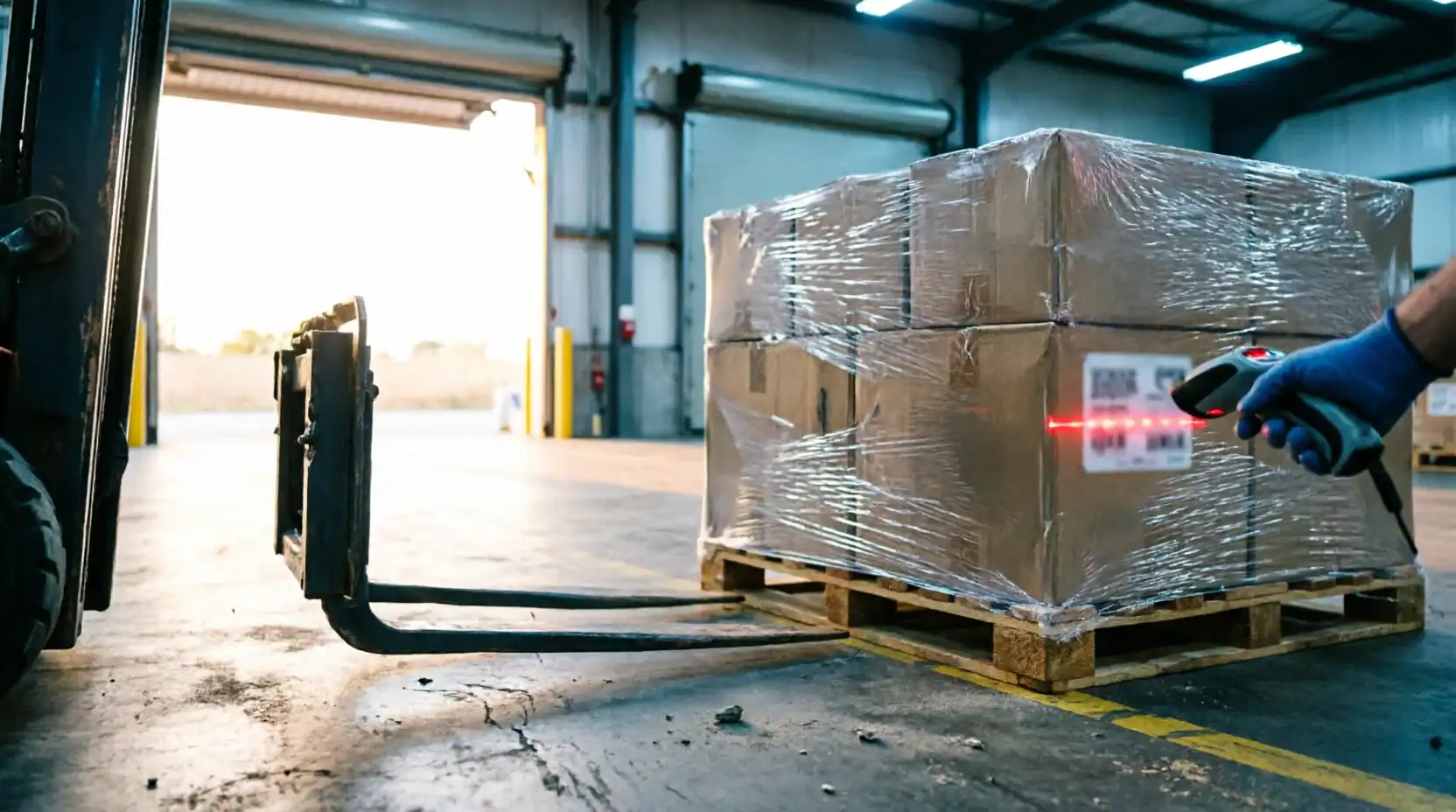
Wholesale importers don’t typically receive goods at their own facility: they deliver into a distribution centre, either their own DC or a 3PL. DCs operate on inbound booking systems, and they have explicit packing and labelling specifications that must be met for an inbound delivery to be accepted.
A DC receiving rejection is among the most expensive failure modes in wholesale importing. The container has been freighted from overseas, cleared customs, and drayaged to the facility, typically costing AUD 3,000–6,000 in freight and clearance before a single unit is touched. A rejection for non-compliant packing or missing carton labels sends the container to a third-party repack facility, adding AUD 800–2,500 in rework cost and 3–7 days of delay.
The DC specification must therefore be incorporated into the supplier purchase order, not appended after the fact. The standard elements of a DC packing specification include:
- Carton dimensions and weight: maximum carton dimensions (typically 60 × 40 × 40 cm) and maximum carton weight (typically 20 kg) for manual handling compliance.
- Barcoding: outer carton barcode (typically ITF-14 or GS1-128), inner unit barcode (EAN-13 or UPC-A), and barcode placement position and minimum print quality.
- Pallet configuration: pallet dimensions (standard Australian pallet: 1165 × 1165 mm), maximum stacking height, whether the goods must be slip-sheeted between layers.
- SSCC labels: Serial Shipping Container Code labels on each pallet, pre-generated by the supplier and tied to an ASN (Advanced Shipment Notification) transmitted before the container arrives.
- Country of origin: required on the outer carton where the DC system records it for downstream traceability.
Large retail DCs (major grocery chains, hardware retailers, pharmacy chains) may have GS1-compliant EDI requirements that go further still. A distributor supplying into these channels should budget for EDI integration or a managed EDI service as part of the distribution cost structure.
Compliance as the Importer of Record
The importer of record is the entity legally responsible for the import declaration lodged with the Australian Border Force. The IOR is responsible for the accuracy of the declaration (the correct HS classification, the declared customs value, the claimed preferential tariff treatment if applicable) and is liable for any underpayment of duty identified in a post-clearance audit.
For a wholesale distributor, the IOR obligation is ongoing and cumulative. Each import declaration creates a record. Systematic classification errors (a product consistently classified under a lower-duty HS code, or preferential tariff claimed without a valid Certificate of Origin) create a pattern that the ABF’s post-clearance audit program is designed to find. The risk is not just duty recovery; ABF can apply penalties for negligent or reckless underpayment.
Distributors managing high import volume should conduct periodic internal audits of their HS classifications, particularly after:
- Introducing new product categories where the classification is not straightforward.
- A supplier change where the country of manufacture changes (affecting preferential tariff eligibility).
- A regulatory change to the tariff schedule (Australia updates its tariff schedule periodically; the ABF Schedule 3 is the current reference).
Some distributors engage their customs broker to conduct an annual classification review. This is not standard practice but pays for itself if it identifies a systematic error. Duty is a fixed cost in the landed cost model: accurate classification ensures you’re not overpaying, and not creating audit exposure by underpaying.
Product Compliance When Reselling
As the importer of record and the entity selling goods into the Australian supply chain, the distributor bears compliance responsibility for the products they import. The relevant framework depends on the product category.
The ACCC administers a range of mandatory safety standards and product bans under the Australian Consumer Law. These include standards for electrical equipment (requiring the Regulatory Compliance Mark, or RCM), bicycle helmets (AS/NZS 2063), children’s toys (ACCC Mandatory Safety Standard for Toys), portable swimming pools (AS/NZS 4864), and many other consumer product categories. The ACCC Product Safety website lists current mandatory standards and bans.
A product sold in Australia that doesn’t meet its mandatory standard is not just a customs issue: it’s a post-sale recall risk. Distributors who import without verifying product compliance, and whose goods subsequently fail in the field or are found non-compliant in market surveillance, face ACCC enforcement action, mandatory recall notices, and the direct cost of collecting and destroying non-compliant stock.
The due diligence model for a wholesale distributor differs from a retailer importing a single product range. A distributor who changes suppliers for an existing SKU must re-verify compliance for the new supplier’s production: a test report from the previous supplier does not transfer. Biosecurity clearance requirements for applicable product categories (timber, animal products, plant material) add another compliance layer for distributors in relevant sectors.
A freight partner who already knows ACCC product-safety and DC-receiving rules catches these gaps before the container leaves origin, worth pricing a dedicated freight partnership against what you pay now.
Country of Origin Labelling
For food products, Australia’s Country of Origin Food Labelling Information Standard (enforced by the ACCC) is mandatory and prescriptive. The standard requires a bar chart displaying the proportion of Australian content and a text statement of the country of origin. Non-food distributors are not subject to this standard but remain subject to the ACL’s prohibition on misleading representations.
The practical implication for a non-food distributor is: if the packaging says “Designed in Australia,” “Assembled in Australia,” or any other qualified origin claim, that claim must accurately reflect the production process. The ACL’s origin claims guidance states that “Made in Australia” requires that the product was substantially transformed in Australia and that the significant process of its manufacture occurred in Australia. For goods manufactured entirely overseas, neither standard is met.
Distributors who want to make origin claims about products that incorporate Australian processing or inputs should take legal advice before making those claims in marketing materials or on packaging. The safest approach for a distributor of wholly imported goods is to make no origin claim and rely on the mandatory product standard compliance (RCM, AS/NZS certification, etc.) as the quality signal.
Multi-SKU Container Management
A wholesale distributor typically imports mixed SKU containers: multiple product lines consolidated into a single FCL to reach the FCL volume threshold. Mixed-SKU containers introduce complexity at every stage: the commercial invoice must correctly describe all line items, the packing list must be accurate at the carton level, and the customs declaration must separately classify each distinct product.
Classification of mixed loads is done line by line. A container holding 300 cartons of electrical tools (HS 8467), 150 cartons of hand tools (HS 8205), and 80 cartons of safety gloves (HS 6116) requires three separate tariff line entries. If any of those categories qualify for ChAFTA duty reduction, each must have its own Certificate of Origin entry. A customs broker handling mixed-SKU entries for a regular client typically templates the classification by SKU rather than re-classifying per shipment, which is another reason why standing customs broker relationships are more efficient than per-shipment engagement for wholesale importers.
Packing list accuracy is critical in a mixed container. If the customs broker cannot reconcile the commercial invoice against the packing list, ABF will flag the discrepancy. And if a post-clearance audit identifies that the quantities actually received differed from those declared, the distributor bears the compliance liability.
Seasonal Planning and Lead Time Management
Wholesale distributors typically plan their import program six to twelve months forward, mapping purchase orders against retail replenishment cycles, promotional calendars, and known shipping windows.
The key planning inputs are:
- Production lead time: the time from purchase order to goods-ready at the supplier’s factory. For manufacturing-to-order products, this is typically 30–60 days. For stocked goods, it may be 7–14 days.
- Booking lead time: ocean carriers typically require booking confirmation 7–14 days before vessel departure on China-Australia lanes.
- Transit time: 20–28 days ocean transit plus 1–5 days for port processing at destination.
- Clearance and delivery lead time: 1–5 days for customs clearance (assuming pre-arrival lodgement; longer if an examination is triggered), plus DC receiving booking lead time (typically 2–5 business days for a major DC).
Adding these components: a distributor placing a purchase order today for manufacturing-to-order goods from China should expect stock to be available for distribution in approximately 70–100 days, before any buffer for production delays, vessel space availability, or clearance holds. Against a retail promotional calendar with hard replenishment deadlines, this means planning windows that most distributors extend to 90–120 days from PO to DC receipt.
Chinese New Year creates an annual disruption window: factories typically close for 2–3 weeks in late January to mid-February, and production delays in the weeks before closure are common. The corresponding peak at Chinese ports in January (as factories front-load shipping before closure) creates vessel space pressure. Distributors who need stock available in February–March must place orders no later than November to safely clear the CNY window.
Negotiating as a Volume Importer
Volume creates leverage, but leverage only converts to rate improvement if it’s visible to the counterparty. A distributor who places spot bookings through multiple forwarders fragments their volume across the market and appears to be a smaller shipper than they are. Consolidating volume through one primary freight partner (even if the consolidation doesn’t cover 100% of shipments) makes the distributor’s freight mass visible and negotiable.
The negotiation is not just about freight rate. For a wholesale distributor, the more valuable concessions are often operational: extended free time at destination (avoiding demurrage on containers waiting for a DC booking slot), priority handling on bookings in peak season, and a dedicated operations contact who knows the distributor’s cargo profile and DC requirements.
Distributors importing AUD 2 million or more per year in freight value are typically working with forwarders who have dedicated account management. Below that threshold, the relationship is transactional. The upgrade happens when the distributor is willing to commit volume, and the freight partner’s rate and service level reflect that commitment.
We quote wholesale-volume freight the way distributors run it.
Most SMEs get a detailed, all-inclusive quote within 24 hours, covering DC compliance and mixed-container handling.
Most new distributors assume the path to better wholesale pricing is negotiating harder on unit cost. It usually isn’t. The distributors who actually get better economics are the ones who worked backwards from container utilization first, structuring orders so a full container clears at a lower per-unit freight cost, and treated the supplier price negotiation as the second lever, not the first. That’s backwards from how most people approach it, and it sounds backwards until you run the numbers: a modest per-unit discount on FOB price is often smaller than the freight-per-unit saving from filling a container properly instead of shipping half-empty at MOQ. The question worth sitting with isn’t “how do I get a better price.” It’s “why am I solving the freight-efficiency problem last, when it’s usually the bigger lever.”
Frequently Asked Questions
What is the minimum volume needed to justify a full container from China?
For most consumer goods, FCL becomes cost-effective at roughly 15–20 cubic metres. Below that threshold, LCL is typically cheaper. Above 20 CBM on China-Australia lanes, the per-CBM rate inside a 40-foot FCL is usually significantly below LCL rates.
Who is the importer of record when a distributor brings goods in on behalf of a retailer?
The importer of record is the entity lodging the import declaration with ABF and legally responsible for duty payment and compliance. When a distributor imports on its own account and resells to retailers, the distributor is the IOR. If a retailer arranges their own import and uses the distributor only for warehousing and distribution, the retailer may be the IOR.
What country of origin labelling applies to imported goods resold in Australia?
For food products, the Country of Origin Food Labelling Information Standard mandates a bar chart and origin statement. For non-food goods, there is no mandatory origin label, but the ACL prohibits misleading origin claims. If packaging makes an origin claim, it must be accurate.
Can a distributor pass duty and GST costs through to retailers?
Yes. Duty becomes part of the distributor’s landed cost and is incorporated into the wholesale price. GST is recoverable by registered businesses through the BAS input tax credit mechanism. Duty is a permanent cost and is not recoverable for commercial importers.
How do distributors handle slow-moving SKUs that tie up container space?
Most wholesale importers apply ABC analysis: A-class (high-velocity) SKUs ship in FCL quantities on schedule; B-class SKUs are consolidated with A-class in mixed containers; C-class SKUs are ordered LCL or on-demand. Some distributors negotiate vendor-managed inventory with offshore suppliers to shift slow-moving stock storage offshore.