Author: Andy Kane

  • Moving from Europe to Thailand: The Six-Layer Cost

    Moving from Europe to Thailand: The Six-Layer Cost

    Moving from Europe to Thailand: The Six-Layer Cost

    The Cost of Moving from Europe to Thailand: A Complete Breakdown

    Almost everyone who moves from Europe to Thailand receives one freight quote and budgets around it. The quote covers the sea freight. It does not cover the six other invoice lines that arrive separately: the packing at origin, the destination handling charge at Laem Chabang, the customs broker fee, the port storage charge if paperwork is not ready, the final delivery to the Thai address, and sometimes a duty assessment from Thai customs that nobody told them to plan for. The real cost of moving from Europe to Thailand is the total of every one of those invoices, not the freight line alone.
    Cost comparison of moving from Europe to Thailand

    The total cost of moving household goods from Europe to Thailand is not a single number. It is a range with inputs. Those inputs are shipping volume in CBM, the departure city and port, whether the move happens in April or November, whether professional packing is used, and whether the goods qualify for Thai personal effects duty relief. Understand those inputs and the cost becomes predictable. Ignore them and the final invoice arrives in pieces, each one a surprise.

    The Six Cost Layers

    A Europe-to-Thailand move has six distinct cost layers. Most freight quotes cover one or two of them. Understanding the full stack before the first quote arrives gives a reference point for evaluating what is and is not included in any given proposal.

    1. Origin charges: packing materials and labour, collection from the European address, loading into a container or LCL consolidation trailer, and transport to the port or container freight station (CFS) at the departure port.
    2. International sea freight: the port-to-port or door-to-port rate, either LCL (per CBM in a shared container) or FCL (a dedicated 20ft or 40ft container). This is the line item most people treat as the total cost.
    3. Destination port handling and CFS charges: for LCL shipments, the deconsolidation fee at Laem Chabang where the shared container is unpacked, the Thai port terminal handling charge, and any customs examination fee if goods are selected for physical inspection.
    4. Thai customs clearance: the licensed customs broker fee, the import declaration filing cost, and any duty assessed on the goods. Personal effects that qualify for the Thai change-of-residence duty relief are assessed at 0%, but the broker fee and filing cost apply regardless of duty status.
    5. Final delivery: transport from the Laem Chabang port area to the Thai destination address. Bangkok is approximately 130 km from the port. Chiang Mai is approximately 780 km. Phuket is approximately 900 km. The delivery cost scales accordingly.
    6. Marine insurance (optional but strongly recommended): Standard carriers operate under the Hague-Visby Rules, which cap their liability at approximately SDR 2 per kg of gross weight, roughly EUR 1.7 per kg at current exchange rates. On a 500 kg personal effects shipment, that is approximately EUR 850 of total cover, regardless of what the goods are actually worth. Marine cargo insurance fills the gap at a cost of 2–3.5% of declared value for household goods, which is written on new-for-old replacement value and priced well above commercial containerised cargo.

    Each of these can appear on a separate invoice, from a separate party, at different points in the move. A freight forwarder offering a full door-to-door service consolidates them, but the scope of what is included needs to be confirmed in writing before any contract is signed.

    Here is the trap worth naming: the single-quote reflex. You ask three forwarders for a price, compare the three freight numbers, pick one, and feel diligent. But you have only compared the first of six invoices. Forwarders who quote low on freight are often the ones who unbundle the other five layers and let them arrive later, separately, from parties you never chose. The question that actually protects your budget is whether the quote already puts all six layers in writing. Ask that one, and the cheapest-looking freight rate frequently stops looking cheap.

    A warehouse worker in a hi-vis vest crouches to measure a stack of cardboard boxes on a pallet with a tape measure near an open loading bay.

    Freight Cost by Volume: The LCL Rate Table

    For most European movers to Thailand, the international freight rate is charged per cubic metre under an LCL arrangement until the shipment volume reaches approximately 15–18 CBM, at which point a dedicated FCL container often becomes more economical on a total-cost basis.

    Current market rates for LCL Europe-to-Thailand range from USD 80 to USD 180 per CBM, depending on the departure port, the routing, the season, and the forwarder’s consolidation relationships. The rate has a floor set by fuel surcharges and handling costs, and a ceiling set by demand during peak periods. Since the Cape of Good Hope rerouting took effect in mid-2024 following Red Sea security disruptions, the rate floor has stayed approximately USD 15–30 per CBM higher than pre-2024 levels on a typical LCL basis.

    Move scenario Approximate CBM LCL freight estimate (USD) What this represents
    Essentials-only / personal effects 3–5 CBM USD 240–900 Bags, boxes, compressed linens, small electronics. No furniture.
    Studio or minimal 1BR 6–10 CBM USD 480–1,800 Furniture minimal or none. Books, electronics, clothing, kitchen essentials.
    Full 1-bedroom apartment 10–15 CBM USD 800–2,700 Bed, sofa, dining set, 20–30 boxes. Most personal goods.
    LCL/FCL crossover zone 15–18 CBM USD 1,200–3,240 At this volume, compare LCL total vs 20ft FCL quote; FCL may win on total cost.
    Full 2-bedroom or growing family 20–30 CBM FCL 20ft recommended 20ft FCL: USD 2,800–5,000 door-to-port from North European ports.
    Full 3-bedroom home 30–45 CBM FCL 40ft recommended 40ft FCL: USD 4,000–7,000 door-to-port. Most economical for large-volume moves.

    Freight estimates represent sea freight only. Origin charges, destination handling, Thai customs, final delivery, and insurance are additional. Rates vary by departure port, season, and routing. For a full door-to-door estimate, request a full door-to-door quote.

    The CBM size guide for international moves gives item-by-item breakdowns at each volume milestone: how many boxes, which furniture, and what a 5 CBM or 15 CBM move physically contains.

    What Moves the Freight Rate Up or Down

    The LCL rate range of USD 80–180 per CBM is not random. Specific variables determine where a shipment lands within it, and understanding them is the difference between getting a realistic quote and being surprised by a higher one.

    Departure port and routing

    Northern European ports (Hamburg, Rotterdam, Antwerp) have high consolidation frequency to Singapore and Port Klang, with well-established LCL services to Laem Chabang. Rates are competitive because volume is high. Mediterranean ports (Marseille, Barcelona, Genoa) offer lower origin collection costs for southern European movers, but direct consolidation to Thailand is less frequent. Shipments sometimes need transshipment via Singapore or Port Klang, which adds both time and cost. A shipment from Barcelona may cost EUR 150 less in origin collection but USD 200 more in freight than the same volume from Rotterdam.

    Season

    April is the most expensive month to clear customs in Thailand. Songkran, the Thai New Year running 13–15 April, shuts commercial operations at Laem Chabang for the surrounding week. Shipments that arrive between late March and late April face port storage charges after the terminal’s free storage period expires (typically 5–7 days for LCL). Storage runs approximately THB 500–1,500 per CBM per week. A 10 CBM shipment held for two weeks in April accumulates THB 10,000–30,000 (approximately USD 280–850) in storage charges alone, on top of any demand-driven freight surcharge.

    The most cost-effective freight windows for Europe-to-Thailand departures are May–June and September–early October. The most expensive windows are March–April (Songkran) and November–January (Chinese New Year consolidation pressure on Asia-originating return loads, which influences space availability on the Europe-Asia leg).

    A mover kneels in a sunlit living room wrapping a framed landscape painting in bubble wrap while a golden retriever rests nearby among moving boxes.

    Packing service vs self-pack

    A professional packing service at origin costs approximately EUR 300–800 for a studio or minimal 1BR and EUR 800–2,000 for a full 3BR. Self-packing with purchased materials typically costs EUR 100–300 in materials and takes considerably more time. The financial difference is real. The non-financial difference is also real: a professionally packed shipment is easier to insure at full declared value, and some marine insurers require professional packing for fragile or high-value items as a condition of covering them.

    Three currencies, one move

    A Europe-to-Thailand move is invoiced across three currencies: origin costs arrive in EUR (or GBP for UK movers), international freight in USD, and destination and Thai customs charges in THB. The final total in any single currency depends on exchange rates at the time of each invoice. A move budgeted in EUR at one exchange rate can cost meaningfully more if the EUR weakens against the USD between deposit and final invoice. Building a 10–15% currency buffer into the total budget is a reasonable hedge against this.

    The Cape of Good Hope Factor

    Since Houthi attacks on Red Sea shipping escalated in mid-2024, the great majority of container traffic between Europe and Asia has rerouted via the Cape of Good Hope, adding approximately 3,500–4,000 nautical miles to the voyage. For Europe-to-Thailand shipments, the practical consequences are two: additional transit time and an elevated freight rate floor.

    Transit time from North European ports to Laem Chabang now runs 36–49 days port-to-port, compared to the 25–35 days quoted on most pre-2024 moving company websites. The Cape routing has become the baseline. Add origin packing and loading (3–7 days), Thai customs clearance (5–15 days), and final delivery, and the realistic door-to-door timeline is 50–80 days. Budget 90 days as a planning anchor if a fixed move-in date, job start, or school enrolment date cannot slip.

    The fuel and surcharge premium from the Cape routing has been absorbed into all-in LCL rates quoted by most forwarders. It is not always broken out as a separate line. When comparing quotes, confirm whether the rate is inclusive of all surcharges or whether bunker adjustment factors (BAF) and emergency equipment surcharges (EES) are added at invoicing.

    The Europe-to-Thailand shipping time guide covers the current post-rerouting picture by departure port: departure ports, transshipment ports, and what each stage actually takes.

    Thai Customs and Personal Effects Duty Relief

    This is the cost category most European movers to Thailand either overlook entirely or misunderstand until the customs broker calls. Thai customs duty on imported goods is real. On a household goods shipment assessed without duty relief, it can add 10–30% of assessed value plus 7% VAT to the total cost. But goods shipped as part of a genuine change of residence can qualify for duty-free import, bringing that line to zero.
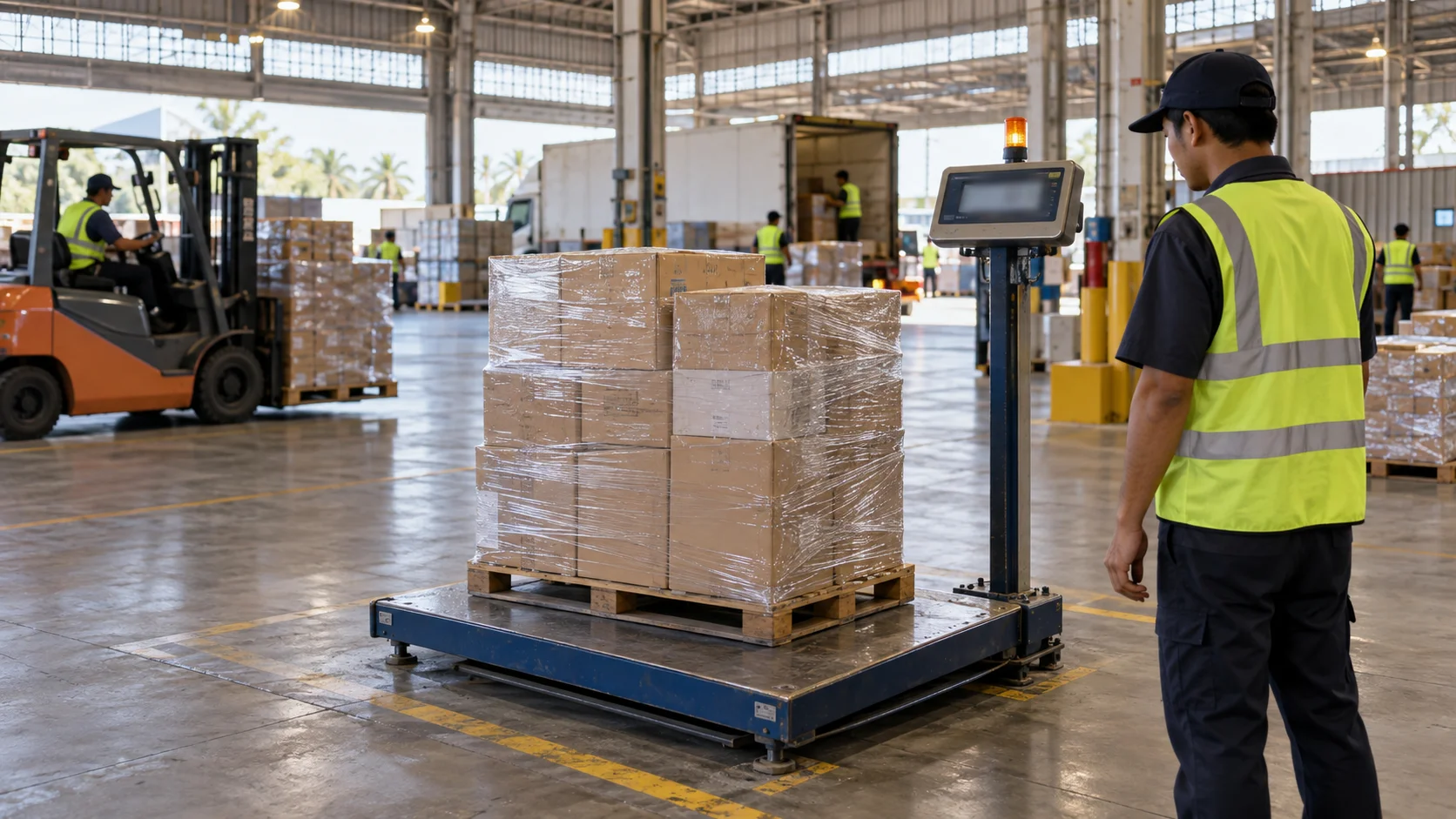
    A warehouse staff member in a hi-vis vest stands beside a shrink-wrapped pallet resting on a large industrial floor scale in an open-sided tropical warehouse.

    The duty relief conditions

    Under Thai customs regulations governing the import of personal effects for change of residence, duty relief applies when:

    • A qualifying status exists. Thai Customs grants the relief against documented status: a work permit valid for one year or more (in practice with a Non-Immigrant B visa), a non-immigrant visa with a confirmed working period of at least one year, Thai permanent residence, a full one-year Smart Visa, or returning-Thai-national status after 12 or more continuous months abroad. A retirement or marriage-based Non-Immigrant O visa (including O-A and O-X) does not qualify, and neither does a tourist visa or visa exemption.
    • The goods arrive within six months of the qualifying status being granted. The date of the first permission, not the date of renewal or extension, is the clock start. Shipments arriving after the six-month window may be assessed for full duty.
    • The goods are used personal effects. Thai customs interprets this as items that show evidence of use prior to shipment. New goods purchased in Europe specifically for the move (a new television, a new appliance) may be assessed at the standard import duty rate rather than the personal effects relief rate, even if shipped in the same container as used items.
    • Only one shipment qualifies. The personal effects duty relief exemption applies to a single shipment as part of a single change of residence. A second shipment of remaining goods, even if genuinely personal items, may be assessed for duty as if it were a standard commercial import.

    The Thai customs authority making these determinations is the Customs Department under the Ministry of Finance. The relevant regulations are set out in the Thai Customs Department under the Customs Act B.E. 2560 (2017) and its implementing notifications. In practice, the customs officer at Laem Chabang determines whether goods qualify at the time of entry. That is why a licensed Thai customs broker who knows the Laem Chabang clearance officers and documentation requirements is worth the fee.

    What happens when duty applies

    A shipment can fail to qualify for duty relief for four reasons: the owner holds a status that never qualifies (a retirement or marriage visa, for example), the qualifying status was not finalised before the goods arrived, it is a second shipment, or some items fall outside the personal effects definition. When that happens, Thai import duty applies at rates that vary by HS code. Household furniture and furnishings: typically 10–20%. Consumer electronics: 0–10% (many categories are already zero-rated under ASEAN FTA agreements). Textiles and clothing: 10–20%. Wine and spirits: 54–60% plus excise tax plus VAT, which is why wine is near the top of every “do not ship” list for Thailand moves.

    The duty is assessed on the CIF value (cost, insurance, and freight as declared and as assessed by Thai customs), not on your purchase price or declared value. Thai customs can, and do, refer to reference values for common goods categories when they believe a declared value is understated.

    The customs broker fee

    Whether a shipment qualifies for duty relief or not, a licensed Thai customs broker is required to file the import declaration at Laem Chabang. The broker fee typically runs THB 3,000–8,000 (approximately USD 85–230 at current rates). Full door-to-door freight forwarders generally include this within their service; forwarders quoting port-to-port or door-to-port will arrange the broker separately, with the cost appearing on a destination agent invoice.

    The Destination Cost Stack

    For LCL shipments, the destination cost stack, separate from the international freight rate, typically comprises the following charges, which arrive from the Thailand-side destination agent or freight station:

    • CFS deconsolidation fee (Laem Chabang): THB 5,000–15,000 (approximately USD 140–430). This is charged by the container freight station that unpacks the shared container and makes individual consignments available for customs examination and collection. It scales with volume: a 5 CBM shipment attracts a lower fee than a 15 CBM shipment, but the floor cost keeps the per-CBM rate high for small volumes.
    • Port terminal handling charge: Typically USD 50–150, usually included in freight quotes but worth confirming.
    • Customs examination fee: Applied only if the shipment is selected for physical inspection by Thai customs, either at random or because the declaration triggers a review. THB 2,000–6,000 depending on scope of examination.
    • Final delivery from Laem Chabang:
      • Eastern Seaboard / Pattaya area: THB 2,000–5,000 (USD 55–140)
      • Bangkok: THB 4,000–9,000 (USD 115–260)
      • Hua Hin / Prachuap: THB 5,000–10,000 (USD 140–285)
      • Chiang Mai: THB 9,000–16,000 (USD 260–460)
      • Phuket: THB 11,000–20,000 (USD 315–575)

    The destination cost stack for an LCL shipment typically adds USD 400–1,200 to the total before any duty assessment, a number that can equal or exceed the international freight cost on a small move.
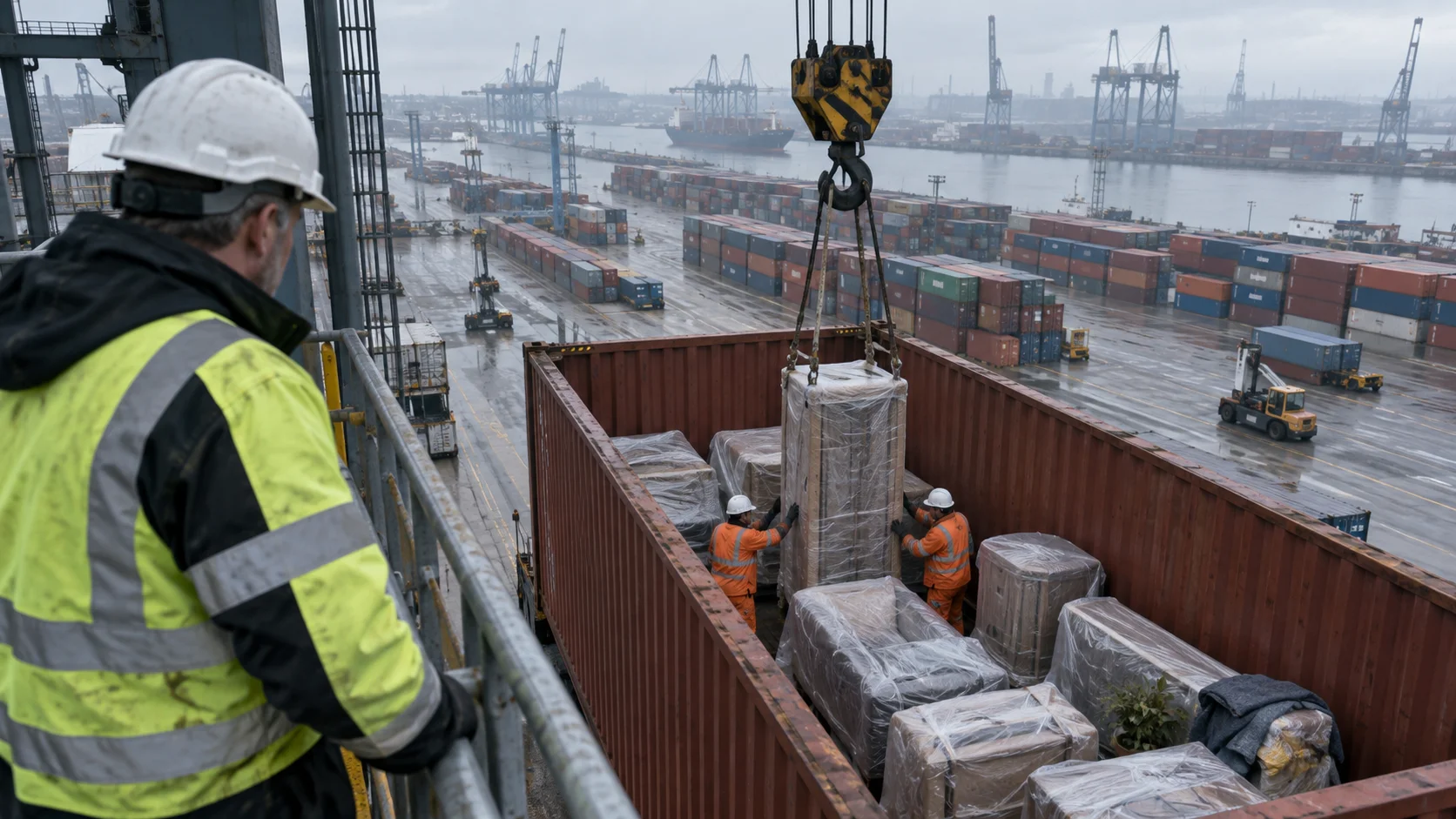
    Viewed from an elevated gantry, a worker watches a crane lower wrapped furniture into an open shipping container at an overcast European container port.

    LCL vs FCL: When the Crossover Matters

    The decision between LCL and FCL for a Europe-to-Thailand move is, at its core, a volume arithmetic question, with one practical consideration that sometimes overrides the arithmetic.

    At approximately 15 CBM, the total LCL cost (freight at the upper end of the rate range, plus the Laem Chabang CFS deconsolidation fee) reaches parity with a 20ft FCL rate from most North European ports. Above 18 CBM, FCL is almost always cheaper in total. An FCL container is sealed at origin and opened only at Thai customs, with no intermediate deconsolidation, so it avoids the CFS deconsolidation fee entirely. Below 12 CBM, LCL will be more economical for the freight component, though the CFS floor cost still applies to the destination side. Volume is therefore the input that moves the cost of moving from Europe to Thailand most, because it sets both the freight mode and the CFS charge.

    The practical consideration: FCL gives full control over the container. No other shipper’s goods share the space. The container is sealed at the door in Europe and opened at Thai customs. Fragile items, antiques, high-value goods, and anything at real risk of other cargo shifting or leaking onto it benefit most from FCL’s control. The reduced handling can justify the cost premium even at volumes below the strict mathematical break-even point.

    For an in-depth framework on the LCL vs FCL decision (economics, timing, fragility, and when FCL makes sense below the volume crossover), the LCL vs FCL guide covers the analysis that applies equally to moves destined for Thailand as those destined for Australia.

    Three Complete Cost Scenarios

    Drawing the six cost layers together, here are three representative total-cost scenarios. These are estimates based on current market rates and should be used as planning anchors rather than precise quotes. The actual total depends on your specific origin address, departure port, chosen service level, and Thai destination. They are useful for identifying which layer of cost requires the most attention for your particular move.

    Scenario A: Essentials-only move, 5 CBM, Hamburg to Bangkok

    Cost layer Estimate
    Origin charges (self-pack, packing materials, collection to CFS) EUR 250–400
    International LCL freight (5 CBM × USD 130 midpoint) USD 650
    Destination CFS + terminal handling (Laem Chabang) USD 250–450
    Thai customs broker fee USD 90–150
    Final delivery to Bangkok USD 115–230
    Marine insurance (EUR 8,000 declared value, 2–3.5%) EUR 160–280
    Total estimate (all layers combined) Approx. USD 1,650–2,550 equivalent

    At this volume, the destination cost stack (CFS + broker + delivery) accounts for approximately 30–40% of the total, a significant share given it receives the least attention in most online freight quotes.

    Scenario B: Full 1-bedroom apartment, 14 CBM, Rotterdam to Bangkok

    Cost layer Estimate
    Origin charges (professional pack and wrap, collection) EUR 600–900
    International LCL freight (14 CBM × USD 130 midpoint) USD 1,820
    Destination CFS + terminal handling (Laem Chabang) USD 350–650
    Thai customs broker fee USD 120–200
    Final delivery to Bangkok USD 115–260
    Marine insurance (EUR 22,000 declared value, 2–3.5%) EUR 440–770
    Total estimate (all layers combined) Approx. USD 3,950–5,900 equivalent

    Scenario C: Full 3-bedroom family relocation, 38 CBM FCL 40ft, Felixstowe to Chiang Mai

    Cost layer Estimate
    Origin charges (professional pack, container loading at door) GBP 900–1,800
    International FCL freight, 40ft (Felixstowe to Laem Chabang, door-to-port) USD 5,000–7,500
    Destination port handling + customs examination USD 300–700
    Thai customs broker fee USD 120–230
    Final delivery Laem Chabang to Chiang Mai USD 260–460
    Marine insurance (GBP 38,000 declared value, 2–3.5%) GBP 760–1,330
    Total estimate (all layers combined) Approx. USD 8,250–13,750 equivalent

    Currency conversions use European Central Bank reference rates of 27 August 2026 (EUR 1 = USD 1.16, GBP 1 = USD 1.36). All three scenarios assume personal effects duty relief is claimed. Duty on non-qualifying goods would be additional, and on retirement or marriage visa routes, which do not qualify for the relief, the whole shipment attracts 10–30% import duty plus 7% VAT on assessed value. The FCL scenario avoids the Laem Chabang CFS deconsolidation fee, which is a meaningful saving at this volume.
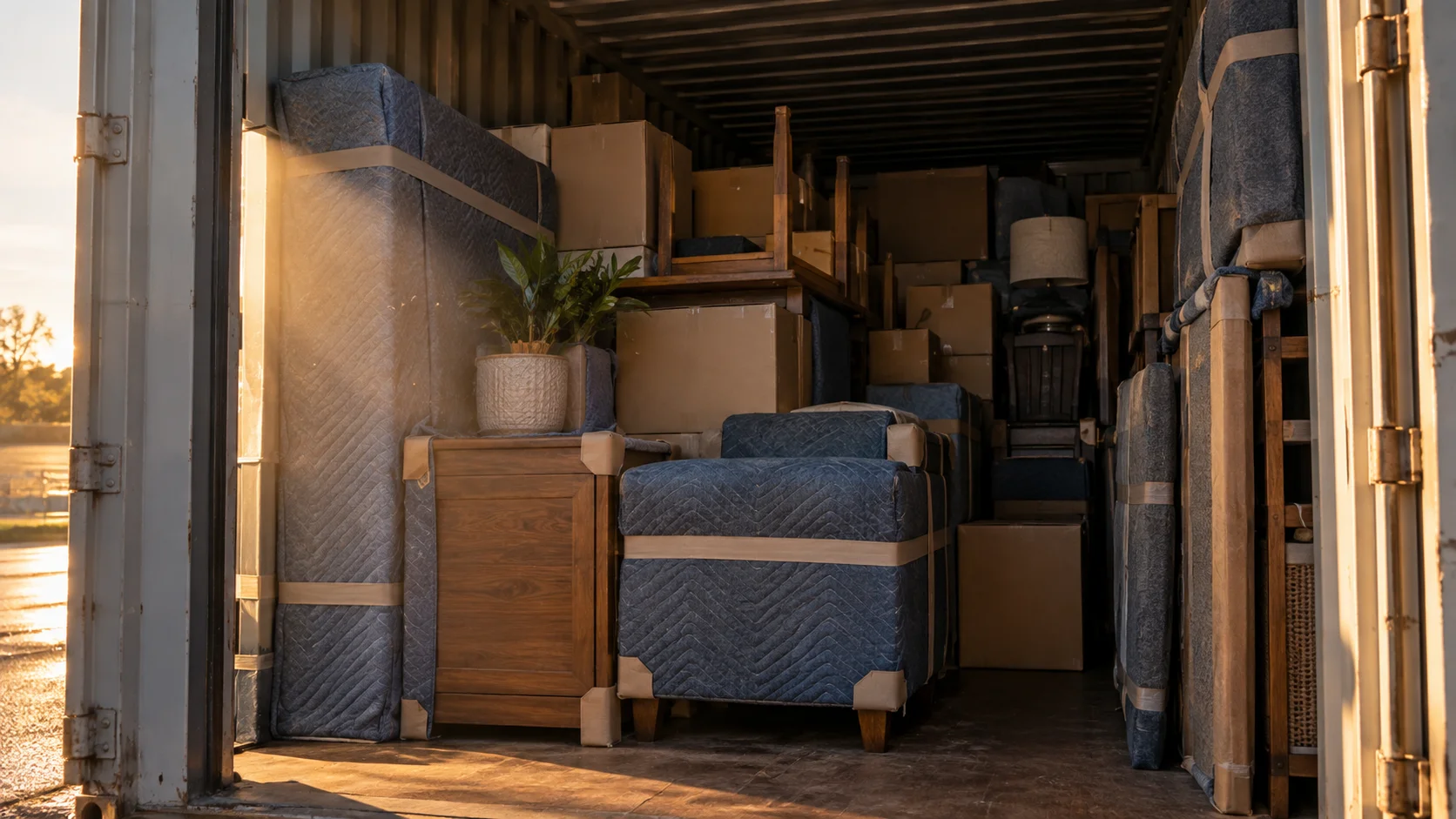
    Warm late-afternoon light spills into a shipping container tightly packed with quilt-wrapped furniture, boxes, and a potted plant.

    How to Reduce the Total Cost

    Five levers meaningfully reduce the total cost of a Europe-to-Thailand move. Not every lever is available in every situation, but identifying which ones apply is the first step toward a smarter budget.

    1. Reduce CBM before the quote. Every cubic metre removed reduces freight cost by USD 80–180 and reduces the Laem Chabang CFS fee proportionally. The items that consume the most CBM with the least value in transit are: cheap flat-pack furniture (replace at destination for less than the freight cost), old mattresses (better replaced at destination than shipped), large garden furniture, bulk books (dense: they hit weight limits before volume limits on LCL), and bulky household appliances that are better sold and replaced. The CBM size guide identifies each category with specific reasoning.
    2. Time the arrival to miss Songkran. Aim for goods to arrive at Laem Chabang either before 10 March or after 20 April. A two-week shift in departure date can eliminate port storage charges and Songkran-period surcharges worth USD 300–800 on a typical move. Work back from the required Laem Chabang arrival date. Given 36–49 days of sea transit, plan the packing and departure date from Europe deliberately, not by convenience.
    3. Finalise Thai residency documentation before shipment. The personal effects duty relief requires a qualifying status, such as a one-year work permit, to exist at the time of customs entry, not at the time of departure from Europe. A shipment that arrives at Laem Chabang before that status is finalised faces two bad options: store the goods in a bonded warehouse (at cost) until the documentation is ready, or clear customs without relief and pay duty. Getting the Thai documentation sorted before the ship leaves European waters is worth whatever it costs in administrative effort.
    4. Compare LCL and FCL at volumes above 12 CBM. Request both quotes at any volume above 12 CBM. At 15–18 CBM, the FCL total (which already avoids the CFS deconsolidation fee) may be within a few hundred dollars of the LCL total. Above 18 CBM, FCL is almost always the better choice in total cost terms.
    5. Use a single forwarder for the full door-to-door service. When origin, freight, and destination are split across separate providers arranged independently, the cost gaps between them can be significant. Destination agents arranged separately from the freight forwarder typically charge 20–40% more for the same services than a pre-arranged door-to-door rate. A single accountable forwarder for the full service reduces this risk and gives a single point of contact when paperwork problems arise, which happens occasionally on a Thailand customs clearance.

    If you only have time to work one of these five levers properly, work the first one. Reducing CBM before you even request a quote compounds through every layer that follows: a smaller shipment costs less to freight, less to consolidate at the CFS, less to insure, and less to clear. The other four levers save money on a fixed shipment; the CBM lever shrinks the shipment itself, which is why it typically returns more than any single one of the others on its own. Spend one hour auditing what is actually worth shipping before you optimise anything downstream of it.

    Getting an Accurate Quote

    An accurate quote for a Europe-to-Thailand move requires three inputs: your shipping volume in CBM (or a room-by-room inventory from which CBM can be estimated), your pickup address and preferred departure port, and your Thai destination address. With those three inputs, a forwarder can give a full door-to-door cost across all six layers, not just the freight line.

    For French and European movers, the France to Thailand shipping cost overview gives indicative EUR pricing for the full door-to-door service. The most efficient way to generate a CBM estimate without an in-person survey is a video walkthrough, a 5–10 minute video of every room showing each item clearly. Swift Cargo’s relocation team will assess the video and return a CBM estimate and full cost breakdown, including all destination charges, within 48 hours. For the full process from inventory to Laem Chabang delivery, the household goods shipping guide for Thailand covers every stage.

    Request a full cost breakdown from Swift Cargo with your European pickup city, estimated volume or room count, and Thai destination. The team will return a complete breakdown (origin charges, freight, Thai handling, customs, delivery, and insurance) as a single document.

    A woman stands at a floor-to-ceiling office window overlooking a busy container port with multiple cargo ships and gantry cranes.

    Country-Specific Guides

    The cost mechanics above apply across Europe, but ports, routing and paperwork differ by origin. Dedicated guides per country:

    The Cape of Good Hope shift above isn’t a temporary disruption that reverses once shipping lines feel confident again. It’s a threshold that got crossed: Red Sea risk made the Suez route uninsurable at the rates carriers were willing to accept, so the industry rerouted around Africa, and that rerouting added 3,500 to 4,000 nautical miles that don’t disappear even if conditions in the Red Sea improve tomorrow, because the vessels, the schedules, and the rate structures built around the Cape routing don’t unwind overnight. Anyone still planning around the 25 to 35 day transit times quoted on older moving-company pages is pricing a mechanism that no longer applies. Budget the current 36 to 49 day port-to-port reality, and treat the old numbers as historical, not as a floor you might get lucky and hit again.

    What Drives the Cost of Moving from Europe to Thailand

    Shipping volume, departure port and season set the freight line, destination handling adds USD 400 to 1,200 on an LCL move, and Thai duty applies unless your status qualifies for personal effects relief. Ask for all six cost layers in one written quote before you commit.

    Frequently Asked Questions

    How much does it cost to move from Europe to Thailand?

    Total door-to-door cost ranges from approximately USD 1,650–2,550 for a small (3–5 CBM) essentials-only move, USD 3,950–5,900 for a full 1-bedroom apartment (12–15 CBM), and USD 8,250–13,750 or more for a full 3-bedroom family relocation using a dedicated 40ft container. These figures include all six cost layers: origin charges, international freight, Thai destination handling, customs broker fee, final delivery, and marine insurance. Thai customs duty, if it applies, is additional: retirement and marriage visa routes do not qualify for personal effects relief, so on those routes add 10–30% import duty plus 7% VAT.

    Do I pay import duty when moving household goods to Thailand?

    Personal effects shipped as part of a genuine change of residence qualify for duty-free import under Thai customs regulations, provided four conditions are met: a qualifying status exists at the time of customs entry (a work permit valid for one year or more, a non-immigrant visa with a confirmed working period of at least one year, Thai permanent residence, a full one-year Smart Visa, or returning-Thai-national status after 12 or more continuous months abroad; a retirement or marriage-based Non-Immigrant O visa does not qualify); the goods arrive within six months of that status being granted; the goods are demonstrably used personal effects (not new items purchased for the move); and this is the first and only shipment under the exemption. Goods that do not qualify are subject to import duty of 10–30% of assessed CIF value, plus 7% VAT on top. The customs broker fee applies in all cases.

    How long does shipping take from Europe to Thailand?

    Since the Red Sea rerouting in mid-2024, sea transit from Northern European ports to Laem Chabang runs 36–49 days port-to-port via the Cape of Good Hope, up from the 25–35 days quoted on most pre-2024 moving company websites. Total door-to-door time, including packing, loading, Thai customs clearance (5–15 days), and final delivery, is typically 50–80 days. Budget 90 days from the packing date for any move with a fixed arrival deadline.

    Is LCL or FCL cheaper for a Europe-to-Thailand move?

    LCL is typically more economical for moves under 15 CBM. At 15–18 CBM, the total costs often reach parity when the Laem Chabang CFS deconsolidation fee is included in the LCL total. Above 18 CBM, FCL (a dedicated container) is almost always cheaper in total and eliminates the CFS deconsolidation fee entirely. Anyone moving 20 CBM or more should request both LCL and FCL quotes before committing.

    What is Songkran and how does it affect my moving costs?

    Songkran is the Thai New Year, celebrated 13–15 April, which effectively closes commercial operations at Laem Chabang port for the surrounding week. Shipments arriving at Laem Chabang in late March or April face port storage charges after the free storage period expires, typically THB 500–1,500 per CBM per week, plus demand-driven freight surcharges. A 10 CBM shipment held for two weeks in the Songkran period can accumulate USD 300–800 in storage charges alone. Timing the shipment to arrive before 10 March or after 20 April avoids this entirely.
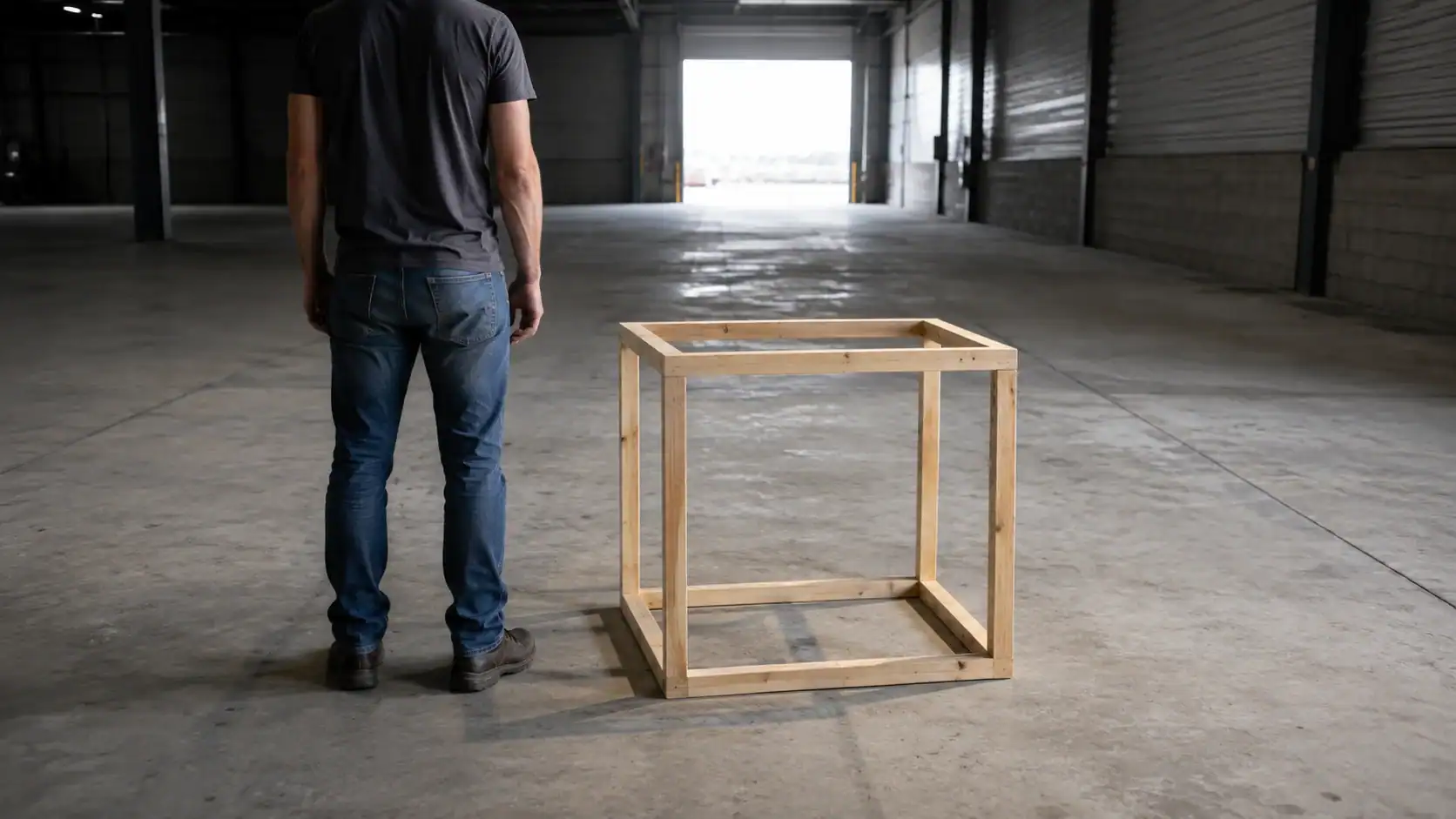

  • 1 CBM: A Size Guide for International Moves

    1 CBM: A Size Guide for International Moves

    1 CBM: A Size Guide for International Moves

    How Much Is a CBM? A Practical Size Guide for International Moves

    When you ask a freight forwarder for a quote, the first question they ask is: how many CBM? And almost everyone gets it wrong.

    Not because people are careless. Because volume is genuinely hard to visualise. You look around a home you have lived in for years and you think: it won’t be much. A few boxes. Some furniture. Maybe 8 CBM? Then the removal crew turns up, starts wrapping and stacking, and you discover (as many people do the day before departure) that you have more than you thought.

    This guide gives you the reference points you need before that moment. Real examples. Room-by-room breakdowns. The cubic feet equivalents. And a clear picture of what 3, 8, 12, 18, and 25 CBM actually look like when you are standing in front of your belongings trying to decide what is worth shipping across the world.

    First: What Is a CBM?

    CBM stands for cubic metre. One CBM is a cube that measures one metre on each side: 1m × 1m × 1m. In practical freight terms, it is the standard unit used to calculate volume for sea freight shipments, particularly LCL (shared container) moves.

    For those who think in imperial measurements, 1 CBM equals 35.3 cubic feet. A standard large moving box (the kind used by most international removal companies, typically around 65cm × 45cm × 45cm) has a volume of approximately 0.13 CBM. So one cubic metre holds roughly seven to eight large moving boxes, stacked neatly.

    That is the practical anchor. Everything else follows from it.

    A standard large international removal box (65×45×45cm): one CBM holds 7 to 8 boxes like this
    One standard large removal box ≈ 0.13 CBM. Seven to eight of these fill 1 CBM.

    CBM to Cubic Feet: Conversion Reference

    CBM Cubic Feet (ft³) Approx. Large Moving Boxes Practical shorthand
    1 35 7–8 A large wardrobe’s worth of clothes + boxes
    3 106 21–24 Essentials only: no furniture
    5 177 35–40 Studio apartment, selective
    8 283 56–64 Studio or 1BR with a few key pieces of furniture
    10 353 70–80 1BR apartment, most contents, light furniture
    12 424 84–96 1BR apartment, most furniture + contents
    15 530 105–120 Large 1BR or small 2BR, selective
    18 636 126–144 2BR apartment or house, most rooms
    20 706 140–160 2BR home with study, full contents
    25 883 175–200 3BR home, selective: approaching 20ft container territory

    Note: box counts assume standard international removal boxes (approx. 0.13 CBM each). Furniture items occupy space differently from boxes. A double mattress alone is approximately 1.0–1.2 CBM; a sofa is 1.5–2.5 CBM depending on size. The box equivalents above are a guide for contents only, not furniture.

    The At-a-Glance CBM Table

    Every tier on this page, in one reference table. Bookmark this section if you are estimating on a call:

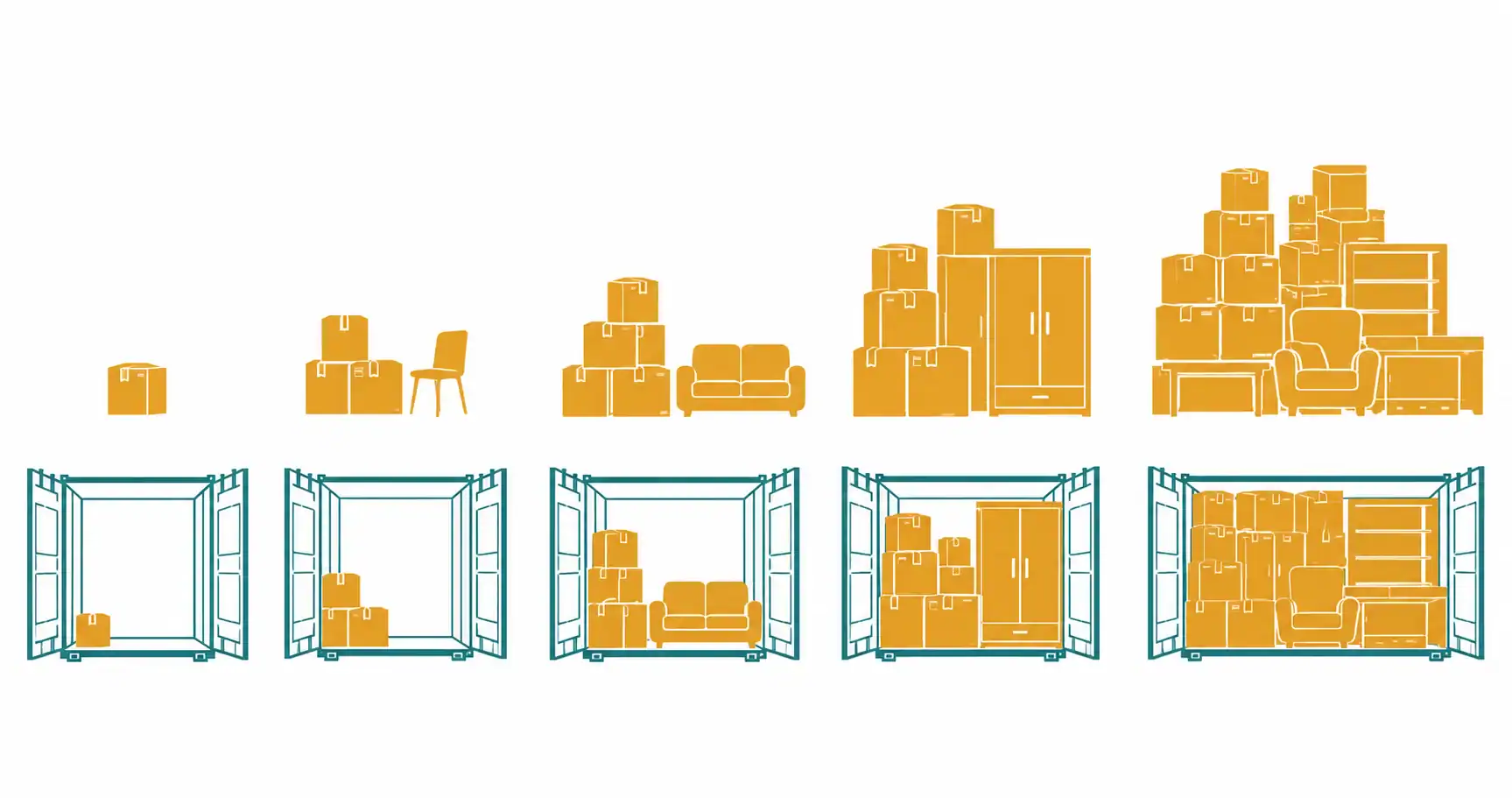
    Visual comparison of shipment sizes from a few boxes to a full container
    Volume ≈ Cubic feet ≈ Large boxes Typical move Shipping mode
    1 CBM 35.3 ft³ 7–8 A few boxes of personal effects LCL
    3 CBM 106 ft³ 20–24 Essentials-only move, no furniture LCL
    8 CBM 282 ft³ 55–65 Studio or selective 1-bedroom LCL
    12 CBM 424 ft³ 85–95 1-bedroom apartment, most contents LCL
    18 CBM 636 ft³ N/A 2-bedroom home LCL/FCL crossover zone
    25 CBM 883 ft³ N/A 3-bedroom home, selective FCL: 20ft container
    ≈28 CBM ≈989 ft³ N/A Maximum usable 20ft container FCL: 20ft container
    ≈67 CBM ≈2,366 ft³ N/A Maximum usable 40ft high-cube FCL: 40ft container

    Box counts assume standard large moving boxes of roughly 0.13 CBM each. Furniture-heavy moves are volume-driven by the furniture, not the box count, which is why the box column stops mattering above 12 CBM.

    3 CBM: The Essentials-Only Move

    Three CBM is 106 cubic feet, roughly 21 to 24 large moving boxes. This is the shipment of someone who has made a deliberate choice: I am taking only what I cannot replace, and I will start fresh with everything else.

    Three CBM typically means: no furniture. Maybe a mattress topper. Definitely not a sofa or a dining table. At 3 CBM, every item earns its place twice over: once when you pack it, and again when you pay per CBM to ship it across the world.

    What realistically fits in 3 CBM:

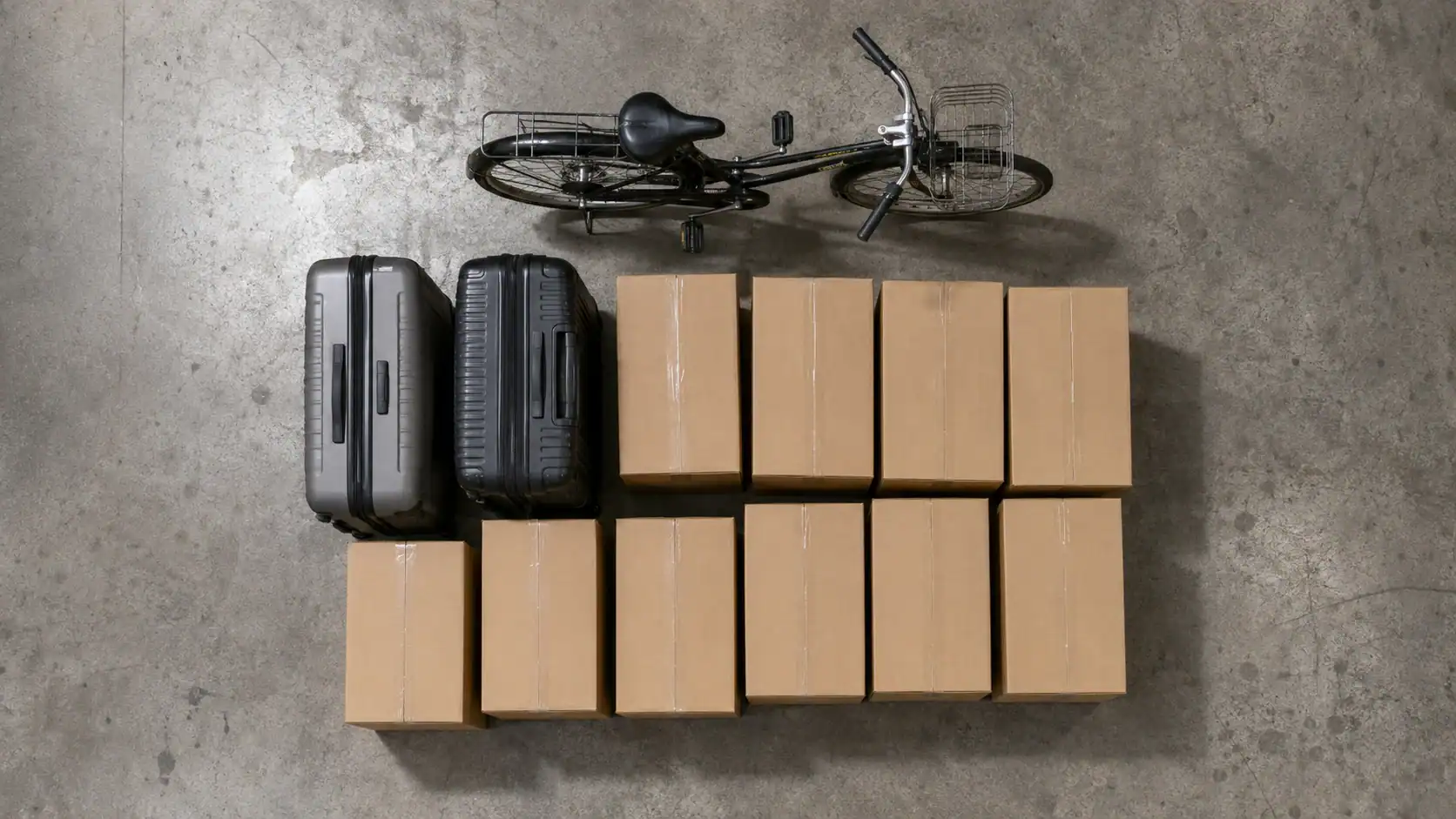
    • 2 large suitcases or duffel bags packed with clothes (approximately 0.4–0.6 CBM total)
    • 8–12 medium boxes of personal effects: books, keepsakes, kitchenware you cannot replace, framed photos
    • Bedding: pillows, a duvet, and some linens in a vacuum-compression bag (0.3–0.4 CBM compressed)
    • A small number of meaningful items: a lamp, a few artworks, a guitar, a bicycle helmet
    • Documents, electronics (laptops, camera equipment), and valuables in a carry-on or personal bag (not included in CBM: these travel with you)

    Who ships at 3 CBM: The person moving to furnished accommodation at their destination. The digital nomad who has already been living out of bags for a year. The person whose partner is already at the destination with a fully furnished home. The minimalist who has spent the last three months consciously reducing.

    Three CBM is not a small shipment. It is a meaningful one, and for many people, it is the right size. The temptation to add more is real. Resist it unless the item genuinely cannot be found or replaced at your destination.

    An essentials-only 3 CBM move: 2 suitcases, 10 to 12 boxes, a vacuum-compressed duvet, and framed photos. No furniture.
    3 CBM: two suitcases, 10–12 boxes, compressed bedding, and a few irreplaceable items. No furniture.

    8 CBM: The Studio or Selective 1-Bedroom Move

    Eight CBM is 283 cubic feet, roughly 56 to 64 large moving boxes in volume, though by this point furniture is doing most of the work.

    At 8 CBM, you are taking the pieces that defined your living space, not every piece in it. You are making choices. The sofa: yes. The second armchair: probably not. The bed: yes. The bulky divan base: maybe not, if the mattress alone saves volume.

    What realistically fits in 8 CBM:

    • Bedroom: Queen or double mattress (1.0–1.2 CBM), bed frame if flat-pack (0.4–0.6 CBM) or headboard only, bedside table × 1, clothes in 3–4 wardrobe boxes or suitcases
    • Living room: 2-seater sofa (1.5–2.0 CBM) or armchair, small coffee table, TV up to 65″ (0.3–0.5 CBM in box)
    • Kitchen: 4–6 boxes: pots, pans, glassware, coffee machine, small appliances you use daily
    • Study/office: Laptop and accessories in carry-on; perhaps a monitor, desk lamp, external drive in a padded box
    • Miscellaneous: 8–12 boxes of books, clothes, personal items, art, and things that don’t fit elsewhere

    Who ships at 8 CBM: A single professional leaving a studio apartment and keeping the pieces that matter. A couple moving together where one partner’s furniture stays and the other’s comes along. Someone who has rented furnished accommodation for years but accumulated a layer of personal possessions on top.

    Eight CBM is LCL territory. You are sharing a container with other shippers. That is entirely normal at this volume. The per-CBM cost at 8 CBM is very similar to the per-CBM cost at 5 or 12 CBM. You are not penalised for being in the middle.

    12 CBM: The 1-Bedroom Apartment Move

    Twelve CBM is 424 cubic feet. This is where most single-person and couple moves from a 1-bedroom apartment end up when they are taking the majority of their contents, furniture included.

    At 12 CBM, the forwarder is no longer asking what you are taking. They are asking what you are leaving behind.

    What realistically fits in 12 CBM:

    • Bedroom: Queen mattress + base or bed frame (1.5–2.0 CBM total), headboard, 2 bedside tables, chest of drawers or small wardrobe (1.0–1.5 CBM), 5–6 wardrobe boxes or suitcases of clothes
    • Living room: 3-seater sofa (2.0–2.5 CBM), armchair (0.8–1.0 CBM), coffee table, TV up to 75″ (0.4–0.6 CBM in box), TV unit or bookshelf (0.5–0.8 CBM)
    • Dining area: Table for 4 (0.5–0.8 CBM folded or dismantled) + 4 chairs (0.8–1.0 CBM stacked)
    • Kitchen: 6–8 boxes: full kitchen contents including stand mixer, coffee machine, cookware, pantry items you are keeping
    • Miscellaneous: 12–16 boxes of books, clothing, personal effects, art, and plants (note: some plants are restricted by destination country biosecurity rules)

    Who ships at 12 CBM: A person or couple leaving a 1-bedroom apartment after two or more years, enough time to accumulate a full set of furniture and a meaningful layer of possessions. People who are comfortable and settled, not minimalists.

    Twelve CBM sits comfortably in LCL. A shared container at this volume is both economical and practical. The shipment will share space with other freight heading to the same destination, which is entirely standard and does not affect your goods’ handling or insurance coverage.

    A 1-bedroom apartment packed for an international move: mattress leaning against wall, sofa wrapped in moving blankets, 20 to 25 boxes stacked.
    12 CBM: a 1-bedroom apartment packed and ready, with mattress, wrapped sofa, dining set, and 20–25 boxes of contents.

    18 CBM: The 2-Bedroom Home

    Eighteen CBM is 636 cubic feet, the volume of a 2-bedroom apartment or house being moved with most of its contents. At this point, the challenge is not whether everything fits in a shared container. It is deciding which of the many perfectly good items in your home are worth the per-CBM cost of shipping versus the cost of buying new at the destination.

    An 18 CBM move almost always involves a genuine sorting conversation. The spare bedroom furniture: worth shipping? The dining table that seats six: will it fit the new place? The books: all of them, or just the irreplaceable ones?

    What realistically fits in 18 CBM:

    • Master bedroom: King or queen mattress + base (1.8–2.2 CBM), bed frame, 2 bedside tables, chest of drawers, wardrobe if flat-pack or panels (1.5–2.0 CBM), 6–8 boxes of clothes and personal items
    • Second bedroom: Single or double mattress + base (0.8–1.2 CBM), bed frame, small wardrobe or chest, 4–5 boxes of contents
    • Living room: 3-seater sofa + 2-seat sofa or armchairs (3.0–4.0 CBM total), coffee table, TV + unit, bookcase, floor lamp
    • Dining room: Table for 6 (0.8–1.2 CBM) + 6 chairs (1.2–1.5 CBM stacked)
    • Kitchen: 8–10 boxes: full kitchen contents
    • Study/home office: Desk (0.4–0.6 CBM), office chair (0.3–0.5 CBM), monitor and equipment, files and books
    • Miscellaneous: 10–15 boxes of personal effects, art, linen, seasonal items, children’s items

    Who ships at 18 CBM: A couple or small family moving from a 2-bedroom home. People who have lived in the same place for several years and accumulated the furniture of a functioning household. Parents moving with a young child where the second bedroom is a nursery or child’s room.

    25 CBM: The 3-Bedroom Home (Selective)

    Twenty-five CBM is 883 cubic feet, roughly 175 large moving boxes in volume, though at this scale, large furniture items are doing much of the work. This is the volume of a 3-bedroom home where someone has decided carefully what to take: yes to the master suite, yes to the children’s rooms, yes to the living room furniture, but a harder eye on the third bedroom’s study furniture, the garage items, and the garden collection.

    At 25 CBM, something important happens: you are approaching the volume where a full 20-foot container (typically 25–28 CBM usable packing volume) becomes cost-competitive with LCL. If your shipment is 22 CBM or above, it is worth getting a quote for both LCL and FCL. At this volume, FCL often costs the same as LCL per CBM, and adds chain-of-custody security, with no shared handling at origin or destination warehouses.

    What realistically fits in 25 CBM:

    • Master bedroom: King bed complete (2.0–2.5 CBM), bedside tables × 2, large wardrobe (2.0–2.5 CBM), chest of drawers, 8–10 boxes of clothes and personal items
    • Bedroom 2: Double or queen bed + base (1.5–2.0 CBM), wardrobe, 4–6 boxes
    • Bedroom 3 / children’s room: Single bed + base (0.8–1.2 CBM), bookcase, desk, 4–6 boxes of children’s books/toys/clothes
    • Living room: Large sofa suite (4.0–5.0 CBM), TV + entertainment unit, bookshelves, floor lamps, art and décor
    • Dining room: Table for 8 (1.0–1.5 CBM) + 8 chairs (1.5–2.0 CBM stacked)
    • Kitchen: 10–12 boxes: full contents including appliances
    • Study/office: Desk, chair, equipment, files: 5–8 boxes
    • Miscellaneous: 12–18 boxes of linen, seasonal clothing, sporting goods, garden items, and art

    Who ships at 25 CBM: A family of three or four making a full international relocation. People who have owned a home and accumulated the furniture and possessions that go with it. The move where the question is no longer “how much?” but “what stays behind?”

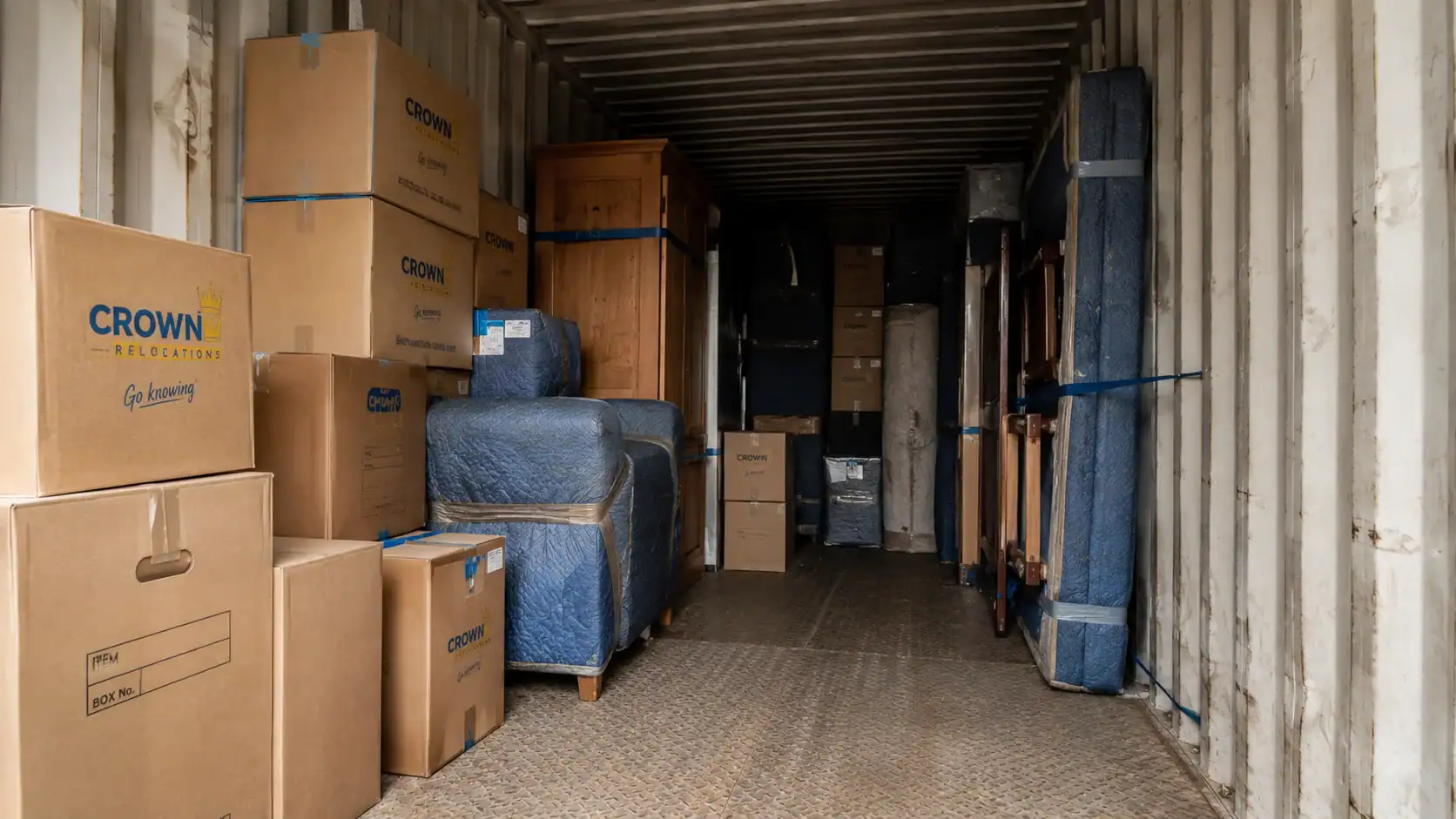
    Removal container packed floor-to-ceiling with furniture and boxes from a 3-bedroom home
    A 3-bedroom family move packed into a single container, every cubic metre accounted for. At 25 CBM, the difference between LCL and FCL becomes a real financial decision.

    Things That Add CBM Without Adding Value

    Before estimating your volume, identify the items that consume space disproportionately relative to what they would cost to buy new at your destination.

    The items most people regret shipping internationally:

    • Cheap flat-pack furniture. An IKEA Billy bookcase costs approximately AUD 80 to replace. To ship it from Europe costs more per CBM. Leave it.
    • Large appliances. Washing machines, dryers, large refrigerators, and dishwashers are expensive to ship, and voltage/frequency compatibility must be verified. The cost of equivalent appliances at most destinations is usually lower than the combined cost of freight, insurance, and installation.
    • Mattresses. A queen mattress is 1.0–1.2 CBM. A quality replacement mattress at most destinations costs less than the freight cost of shipping the old one. Exception: genuinely high-specification mattresses (orthopaedic, custom-size) where replacement cost is high.
    • Garden equipment. Lawnmowers, outdoor furniture, and garden tools are subject to biosecurity restrictions in many countries (DAFF in Australia; Thai biosecurity for soil residue on equipment). The replacement cost is almost always lower than the combined freight, insurance, and potential biosecurity treatment cost.
    • Alcohol and wine. They are subject to high import duty and excise in many destinations. Thai import duty on spirits exceeds 400% combined when all charges are included. Not worth shipping.
    • Books: all of them. Books are heavy (heavy LCL shipments can exceed weight limits before volume limits), and weight can create additional freight charges on sea freight at high densities. Ship the irreplaceable ones. Donate the rest.

    How CBM Affects What You Pay

    For LCL (shared container) shipments, freight is priced per CBM, so the accuracy of your volume estimate directly affects the accuracy of your quote. An underestimate leads to a surprise invoice when the shipment is measured at origin. An overestimate means you budgeted for more than you needed.

    Once your CBM estimate points toward a full container, the 20ft vs 40ft container guide for Thailand covers what actually fits in each size and the full cost breakdown.

    The per-CBM rate varies by route, season, and market conditions. On a Europe-to-Thailand route as an example, LCL freight rates (ocean component only, before port charges, customs, and local handling) typically range from USD 80–180 per CBM depending on origin port, season, and consolidation availability. At 12 CBM, that is USD 960–2,160 in ocean freight alone, before the other charges that make up the full cost.

    At approximately 15–18 CBM and above, it is always worth requesting an FCL quote alongside the LCL quote. A 20-foot container has approximately 25–28 CBM of usable packing volume. If your shipment is 18 CBM and the FCL rate is competitive, the additional 7–10 CBM of unused space may cost less than paying LCL per-CBM on the shipment you have.

    A 20ft container has roughly 25-28 CBM of usable space, worth pricing an FCL quote against that before you commit to LCL.

    For a full breakdown of what shipping costs (and how volume is just one of the components), see our guide to the real cost of shipping to Thailand. For the LCL vs FCL decision in depth, including the crossover volume calculation, see our LCL vs FCL guide. For the full household goods shipping process (documents, customs, and what to expect), see our step-by-step guide to shipping household goods to Thailand.

    For current LCL and FCL rates on the Thailand route with full cost breakdown by shipment size, see Swift Cargo’s Thailand shipping overview.

    When Your Estimate Is Wrong: What Happens on Moving Day

    This is the part most volume guides skip, and it is the number-one source of friction between movers and their forwarder. Your quote is priced on your estimated CBM. The number you are actually charged on is the volume measured after packing, at the origin warehouse or Container Freight Station, by the people consolidating the container.

    If the measured volume comes in higher than your estimate, the shipment does not stop, but the invoice changes. The additional CBM is charged, usually at the per-CBM rate on your quote, and a significant gap can push you past an LCL/FCL crossover point, which changes the pricing structure entirely. A 10–15% overrun on a 10 CBM estimate is an annoyance; discovering on packing day that your “12 CBM” is actually 19 CBM is a re-quote.
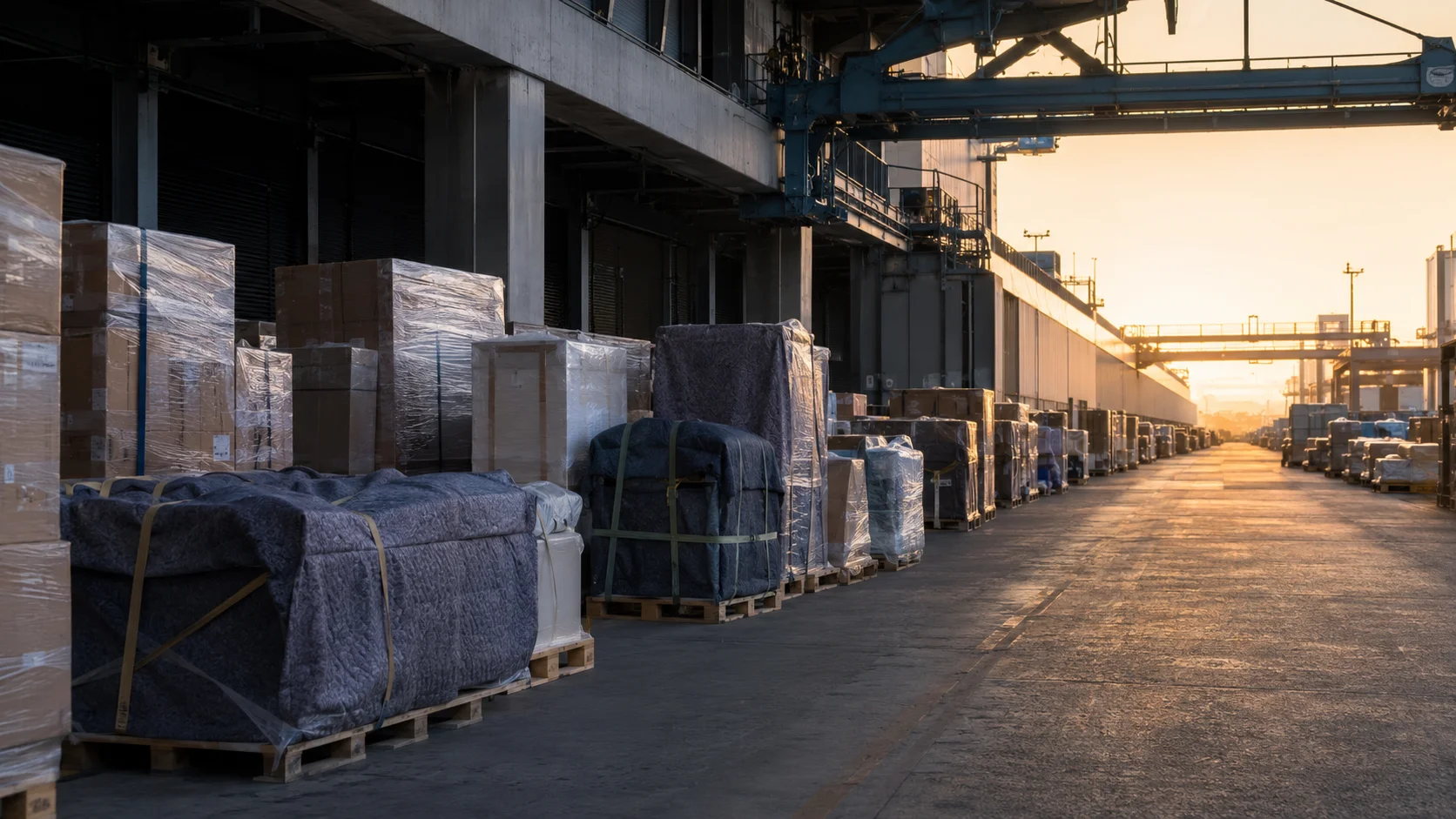
    If it comes in lower, reputable forwarders charge the measured volume, not the estimate. Ask any forwarder you are comparing whether they invoice on actual measured CBM. It is a fair-dealing litmus test.

    Three habits keep the estimate honest:

    • Estimate packed volume, not furniture volume. Boxes never tessellate perfectly and packing materials add bulk. The 5–10% margin this guide recommends exists for this reason.
    • Do not shave the estimate to get a nicer-looking quote. The measured volume wins in the end; an optimistic estimate only moves the surprise to moving day.
    • Use a video survey. A 15-minute walkthrough with a surveyor produces a far tighter estimate than self-measuring, and it is standard practice for any serious forwarder, ours included.

    The 5–10% margin is not a rounding habit. It is a calibrated buffer against a specific, predictable error. Self-measured estimates from furniture dimensions systematically undercount, because packed volume always exceeds furniture volume by a fairly consistent margin: boxes, wrapping, and the dead space around irregular shapes reliably add somewhere in that same 5–10% range. Padding the estimate further than that does not make it more accurate; it just inflates the quote you are comparing against other forwarders. The useful skill here is not being cautious in general. It is knowing the size and direction of the specific bias your estimate is prone to, and correcting for exactly that.

    How to Estimate Your CBM Before You Quote

    A rough estimate made at the start of the planning process is useful. A precise estimate made before the freight is booked is essential. Here is how to move from rough to precise:

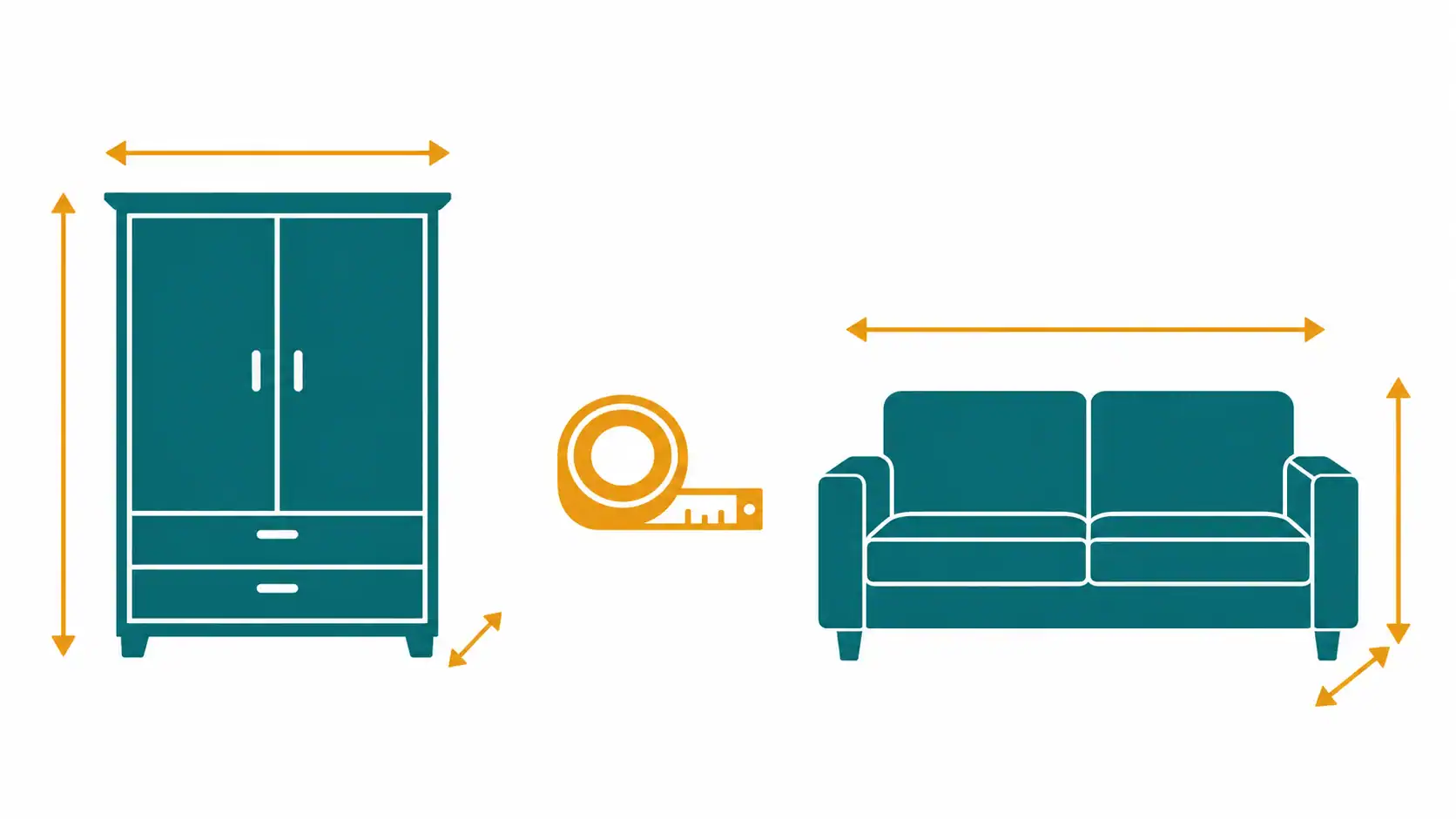
    How to measure furniture dimensions to calculate CBM

    Step 1: List all furniture items with dimensions. Measure each large item (beds, sofas, wardrobes, tables) or look up the standard dimensions. Calculate length × width × height in metres = CBM per item. Add them up.

    Step 2: Count your boxes and estimate their volume. If you have not packed yet, walk through each room and count how many boxes the contents would fill. Standard large removal box = 0.13 CBM. Medium box = 0.065 CBM. Wardrobe box (for hanging clothes) = approximately 0.25–0.35 CBM.

    Step 3: Add 10–15% packing inefficiency. Items do not pack perfectly. Furniture has awkward shapes. Fragile items need extra protection. Multiply your calculated volume by 1.1–1.15 to account for packing inefficiency.

    Step 4: Send a video walkthrough to your freight forwarder. A 5-minute phone video walking slowly through every room (opening wardrobes, showing the garage, panning across bookshelves) allows an experienced forwarder to estimate volume accurately from remote. This is the most reliable method short of an in-home survey, and most established freight forwarders will request it for any shipment above 8–10 CBM.

    Step 5: Request a pre-move survey for large shipments. For shipments above approximately 15 CBM, ask your forwarder whether they can arrange a pre-move survey, either in person (if local) or via video call with a structured room-by-room assessment. A surveyed volume estimate is more accurate than a self-calculated one, and a more accurate estimate protects you from invoice surprises.

    A predictable gap separates how a room feels from how much it holds. You live in your home as open space. You notice the air, the walkways, the light. A packed container is the inverse: dense, gap-free, measured by the cubic metres your belongings displace once they are boxed and stacked. So the estimate that comes back often feels too high, not because it is wrong, but because daily life in a room quietly hides how much volume the room actually contains. The fix is not a better guess; it is measuring the objects rather than trusting the impression of the space.

    That displaced volume is also the single biggest driver of what you pay, which is why it sits at the centre of any realistic Thailand relocation cost breakdown.

    Swift Cargo estimates your shipment volume from a video walkthrough, no obligation, no fee. Get a volume assessment and quote for your international move.

    Frequently Asked Questions

    How many cubic metres do I need for a 1-bedroom apartment?

    A 1-bedroom apartment being moved with most of its contents, furniture included, typically falls in the 10–14 CBM range. At the lower end (10–11 CBM), you are taking the essentials and leaving behind anything bulky or easily replaced. At the higher end (13–14 CBM), you are taking most furniture and the majority of your possessions. The exact volume depends on the size of your furniture, how many boxes your contents fill, and how selective you are with what you include.

    What is 1 CBM in cubic feet?

    1 CBM (cubic metre) equals 35.315 cubic feet. A standard large international moving box (approximately 65cm × 45cm × 45cm) has a volume of about 0.13 CBM, so 1 CBM holds roughly 7 to 8 large boxes stacked neatly, or the equivalent volume in furniture and mixed items.

    How many CBM for a 3-bedroom house?

    A 3-bedroom house being moved selectively (taking the main furniture from all three bedrooms, the living room suite, and full kitchen contents) typically comes to 22–30 CBM. A full, unsorted 3-bedroom home where nothing is left behind can reach 35–45 CBM. At 25 CBM and above, it is worth comparing LCL (shared container) rates with FCL (full container) rates, as a 20-foot container becomes cost-competitive at volumes above approximately 15–18 CBM depending on the route.

    What is the difference between LCL and FCL, and which one applies to me?

    LCL (less than container load) means your goods share a container with other shippers. You pay only for the CBM you use. FCL (full container load) means your goods occupy a container exclusively. You pay a flat rate for the whole container regardless of how full it is. LCL makes sense for most moves up to approximately 15–18 CBM. Above that, the FCL rate for a 20-foot container often becomes cost-competitive. For very large moves (25+ CBM), a 20-foot container is often cheaper per CBM than LCL on the same route.

    How do I calculate the CBM of a piece of furniture?

    Measure the length, width, and height of the item in metres. Multiply the three figures together. Example: a sofa measuring 2.2m long × 0.9m wide × 0.85m high = 2.2 × 0.9 × 0.85 = 1.68 CBM. For items that are an irregular shape or that will be dismantled for shipping, use the dimensions of the largest assembled configuration or the dimensions of the packed crate/box.

    What happens if my actual volume is higher than my quoted CBM?

    Your shipment still moves, but you are invoiced on the volume measured after packing, not the estimate. The extra CBM is normally charged at your quoted per-CBM rate. A large gap can also push you across the LCL/FCL crossover, which changes the pricing structure. That is why a video survey before quoting is worth 15 minutes of your time.

    Is CBM measured on my items or on the packed boxes?

    The packed, loaded volume: boxes, wrapping, and protective packaging included. This is why a room that ‘looks like 8 CBM’ of furniture often ships as 9–10 CBM. Estimate from packed cartons and wrapped furniture, then add the 5–10% packaging margin.

    How many CBM fit in a 20ft and 40ft container?

    A 20ft container has roughly 25–28 CBM of usable capacity once real-world loading is accounted for; a 40ft high-cube holds roughly 60–67 CBM. If your estimate lands near 15 CBM or above, ask for both LCL and FCL pricing. The crossover is closer than most people expect.

    Does disassembling furniture reduce my CBM?

    Significantly, for the right items. A bed frame, dining table, or wardrobe shipped flat can occupy half the volume of its assembled form. Sofas and upholstered items barely compress at all. If your quote is near a pricing threshold, disassembling flat-packable furniture is the cheapest way to reduce CBM.

    How accurate are online volume calculators?

    Good ones get a typical household within 15–20%, useful for a ballpark, not for a booking. They systematically miss packing materials, awkward-shaped items, and the contents of cupboards people forget to count. Use a calculator to decide whether you are a ’10 CBM household’ or a ’25 CBM household’, then confirm with a video survey before you book.

  • Europe to Thailand Shipping Time: 50–75 Days by Route

    Europe to Thailand Shipping Time: 50–75 Days by Route

    If you are planning a move from Europe to Thailand, the question “how long will my shipment take?” is one of the first things you ask and one of the hardest to get a straight answer on. Carrier websites quote port-to-port times that are often two or three years out of date. Freight forwarders quote ranges wide enough to be almost useless. And almost nobody mentions the things that actually determine whether your belongings arrive in six weeks or twelve.

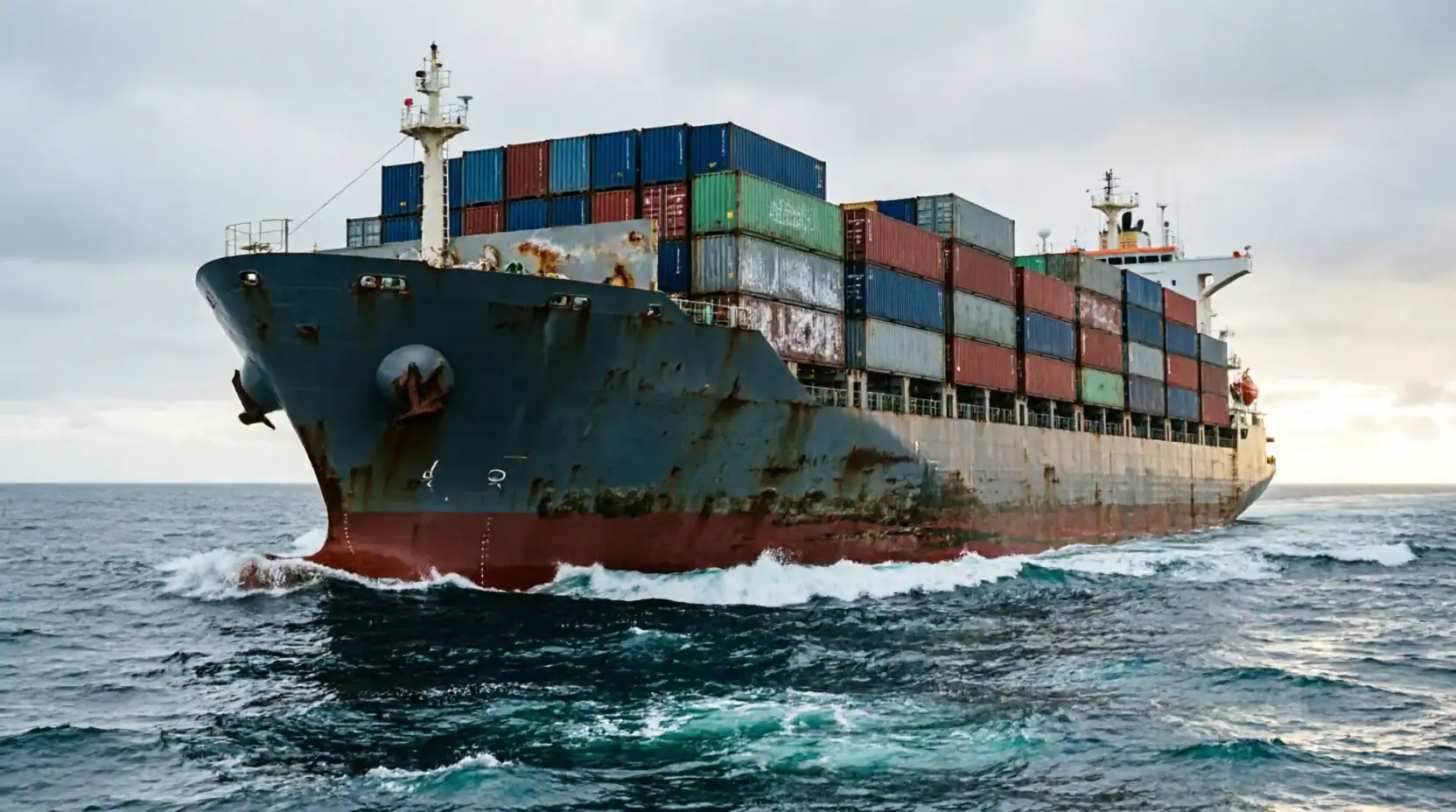
    A loaded container ship underway at sea, the current Cape of Good Hope routing most Europe-to-Thailand sea freight now follows

    Why Quoted Transit Times Are Often Wrong

    Two things have added weeks to the Europe-Thailand timeline since 2023, and most published information has not caught up with either of them.

    The first is Red Sea rerouting. Since late 2023, Houthi attacks on commercial shipping in the Red Sea have caused most major ocean carriers to reroute Europe-Asia voyages via the Cape of Good Hope, adding the southern tip of Africa to a route that previously transited the Suez Canal. Independent transport-policy analysis puts the added transit time at roughly 10–14 days depending on the specific corridor. Source: ITF/OECD, The Red Sea Crisis: Impacts on Global Shipping. A voyage quoted as 25 days via Suez is now typically 35–42 days via the Cape. Many carrier websites, freight calculators, and online guides still quote Suez transit times. They are out of date.

    The second is the door-to-door vs port-to-port distinction. Ocean transit time measures vessel departure to vessel arrival. It is only one part of the total journey. Origin packing, collection, export customs clearance, and the port cut-off window all happen before the vessel sails. Port discharge, Thai customs clearance, and domestic delivery all happen after it arrives at Laem Chabang. These stages add 20–30 days in total. A relocation that is quoted as “28 days ocean transit” is rarely under 55 days door to door.

    Ocean Transit Times: Europe to Thailand by Origin Region

    Europe is not one origin. Where you are shipping from matters. All times below are via Cape of Good Hope (current routing for most services).

    Northwest Europe (UK, Netherlands, Belgium, Germany)

    These are the highest-volume European origins for Thailand shipping, with frequent direct services and good LCL consolidation options.

    • Port-to-port (sea): 35–42 days via Cape of Good Hope
    • Door-to-door (sea, FCL): 50–62 days
    • Door-to-door (sea, LCL): 55–70 days (consolidation cut-off adds 5–10 days at origin; deconsolidation adds 3–5 days at destination)
    • Door-to-door (air): 6–9 days
    • Main transshipment ports: Singapore, Port Klang (Malaysia), Tanjung Pelepas (Malaysia)

    Southern Europe (France, Spain, Italy)

    Southern European ports (Marseille, Barcelona, Valencia, Genoa, La Spezia, Livorno) are closer to the Cape route than northwest European ports, so the ocean leg is marginally shorter.

    Italian-origin moves add their own requirements: visa-based duty exemptions, exact Genoa and La Spezia routing, and the Thai customs documents required at Laem Chabang. See moving from Italy to Thailand.

    • Port-to-port (sea): 32–40 days via Cape of Good Hope
    • Door-to-door (sea, FCL): 47–60 days
    • Door-to-door (sea, LCL): 52–68 days
    • Door-to-door (air): 6–9 days
    • Main transshipment ports: Singapore, Port Klang, Colombo (Sri Lanka)

    Scandinavia and Northern Europe (Sweden, Denmark, Norway, Finland)

    Shipments from Scandinavian origins typically truck or feeder-vessel to Rotterdam or Hamburg first, adding 2–5 days before the main ocean leg.

    • Port-to-port (sea, from main hub): 37–45 days via Cape of Good Hope
    • Door-to-door (sea, FCL): 55–68 days
    • Door-to-door (sea, LCL): 60–75 days
    • Door-to-door (air): 7–10 days

    Central and Eastern Europe (Poland, Czech Republic, Austria, Hungary)

    Central and Eastern Europe has no direct container port access. All freight moves by road to Hamburg, Rotterdam, Gdansk, or Trieste before the ocean leg. Add 3–7 days for the inland transport leg.

    • Port-to-port (sea, from gateway port): 35–43 days via Cape of Good Hope
    • Door-to-door (sea, FCL): 52–68 days
    • Door-to-door (sea, LCL): 58–75 days
    • Door-to-door (air): 7–11 days

    The Full Door-to-Door Breakdown

    The ocean transit is the stage most people focus on. It is not the variable that determines whether your move goes smoothly. The complete timeline runs in six stages.

    Stage 1: Packing, Collection, and Origin Handling (3–7 days)

    A professional packing crew packs and wraps your household goods. The container or LCL shipment is collected and moved to the port or CFS (container freight station). Export customs documentation is prepared and lodged. This stage takes 3–7 days from your agreed packing date to cargo reaching the port. It can stretch to 10 days if documentation is not ready when packing begins. That is the most common cause of avoidable origin delay.

    Stage 2: Port Cut-Off and Vessel Departure (3–10 days)

    Once cargo is at the port, it must be loaded before the vessel’s cut-off date. For FCL (full container load), the container is sealed at collection and rolled onto the vessel. For LCL (shared container), your cargo sits at the CFS until enough freight from multiple shippers has accumulated to fill a consolidation container. That consolidation cycle adds 5–10 days at origin before the vessel sails. The vessel then sails on a fixed schedule; if you miss the cut-off, the next sailing is typically 7–14 days away.

    Stage 3: Ocean Transit (32–45 days, Cape-routed)

    The vessel travels from Europe to Laem Chabang (the main deep-water container port near Bangkok) via the Cape of Good Hope. Most services make one or two transshipment stops, most commonly at Singapore or Port Klang. Each of those stops adds a port call of 1–3 days. The total ocean leg, including transshipment, is 32–45 days depending on origin and specific service.

    Stage 4: Port Arrival and Discharge at Laem Chabang (2–4 days)

    After the vessel berths, containers are unloaded and moved to the terminal yard. LCL shipments are moved to a CFS for deconsolidation, where your cargo is separated from the other shippers’ freight in the same container. This deconsolidation adds 2–5 days compared to FCL, which can move directly from the terminal to customs. Port congestion during peak periods can add additional yard dwell time.

    Stage 5: Thai Customs Clearance (3–21 days)

    This is the most variable stage of the entire journey, and the one most people underestimate.

    For commercial cargo, Thai customs clearance under standard procedures takes 3–7 days when all documentation is correct and complete. Documentation problems can trigger a customs hold that extends this to 2–4 weeks. The usual culprits are values that do not match the commercial invoice, packing lists that do not match the physical cargo, and missing origin certificates.

    Household goods relocations claiming the personal effects duty-free exemption under Thai Customs Department regulations need a Customs Form 130/1 (the personal effects declaration), supported by evidence of foreign residence: typically a foreign passport with entry/exit stamps, a residence cancellation certificate from your home country, and evidence of employment or property in Thailand. When all documentation is in order and submitted in advance, clearance takes 5–10 days. When documentation is incomplete, Thai customs can request additional evidence and hold the shipment for 10–21 days while the importer obtains the missing documents from overseas.

    The single most effective way to cut clearance time is to have your Thai customs broker review the documentation before the vessel arrives, not after it berths.

    Timing also matters. Shipments arriving at Thai customs during Songkran (Thai New Year, 13–15 April and surrounding days) face reduced clearance throughput due to government holiday staffing. Clearance that normally takes 5–7 days can extend to 14–21 days for shipments that arrive in the Songkran window. Plan vessel arrival dates to avoid early-to-mid April at Laem Chabang.

    Stage 6: Domestic Delivery in Thailand (1–3 days)

    Once customs releases the cargo, it is transported from Laem Chabang to your delivery address. Bangkok and the greater Bangkok metropolitan area take 1 day. Chiang Mai, Phuket, Pattaya, and Hua Hin take 1–2 days by road. Remote or island destinations take 2–5 days, with additional ferry or local logistics required for island deliveries.

    Total Door-to-Door Summary

    Origin Region Sea (FCL) Sea (LCL) Air
    Northwest Europe (UK, NL, BE, DE) 50–62 days 55–70 days 6–9 days
    Southern Europe (FR, ES, IT) 47–60 days 52–68 days 6–9 days
    Scandinavia (SE, DK, NO, FI) 55–68 days 60–75 days 7–10 days
    Central/Eastern Europe (PL, CZ, AT, HU) 52–68 days 58–75 days 7–11 days

    All sea times via Cape of Good Hope (current routing). Times assume Thai customs clearance proceeds without document delays. Songkran window (mid-April) adds 7–14 days to Thai clearance.

    The Planning Timeline: Working Backwards from Move-In Date

    The most common mistake European relocators make is starting the logistics process too late. The timeline is counterintuitive: eight weeks feels like a long time in almost every other context. In Europe-to-Thailand freight, eight weeks is cutting it fine.

    Here is the backwards planning framework for a sea freight household goods relocation from northwest or southern Europe:

    • Move-in date in Thailand: your anchor
    • Minus 1–3 days: domestic delivery from Laem Chabang
    • Minus 7–14 days: Thai customs clearance (use 14 days as your planning buffer)
    • Minus 2–4 days: port discharge and deconsolidation at Laem Chabang
    • Minus 35–45 days: ocean transit via Cape of Good Hope
    • Minus 5–10 days: port cut-off window and LCL consolidation at origin
    • Minus 5–7 days: packing, collection, and export customs at origin

    Total planning lead time from origin packing to Thailand delivery: 55–83 days.

    For a move-in date of 1 September, packing should begin no later than 20 June. For a move-in date of 1 April, factor in the Songkran clearance delay and extend the Thai clearance buffer to 21 days, which pushes the packing start to late January.

    Air freight reduces the ocean and cut-off stages to approximately 5–7 days total, bringing door-to-door to 15–22 days. Air is the correct mode for time-critical items: documents, electronics, essential personal effects. But the cost per kilogram is 5–10 times higher than sea, which rules it out for household goods volumes.

    The Transshipment Variable

    Direct vessel services from Europe to Thailand do not exist in the way that direct China-Thailand services do. Every European-origin shipment transships, typically at Singapore, Port Klang, or Colombo. The transshipment port is where your container is physically transferred from the main-haul vessel to a feeder vessel for the final leg to Laem Chabang.

    What matters about transshipment for timing:

    • Each transshipment adds 1–3 days of port time, during which the container is handled, positioned, and reloaded
    • If a vessel is delayed on the main haul and misses the feeder connection at the transshipment port, the next feeder may be 5–10 days away, and that delay lands on your total
    • Transshipment is the point of highest cargo handling intensity and the highest damage risk in the entire journey, which matters most for fragile household items and high-value electronics

    When choosing a freight forwarder for a European-origin relocation to Thailand, ask specifically which transshipment port and which feeder service your shipment will use, and what the connection window is. A forwarder who cannot answer this question in detail lacks the route expertise you need.

    A route with zero transshipment points and a route with one transshipment point are not the same risk with slightly different numbers attached. They are structurally different bets. The direct leg either sails or it doesn’t; the transshipment leg has a second failure mode stacked on top of the first, because a delayed main-haul vessel doesn’t just arrive late, it can miss its feeder connection entirely and wait five to ten days for the next one. That second failure mode is invisible in a quoted 32-to-45-day range, which reads as one smooth number, not as two dependent probabilities multiplied together. A forwarder who cannot tell you which transshipment port and which feeder service your shipment will use is not withholding a minor detail. They are asking you to accept a hidden second point of failure without pricing it. Ask the question before you book, not after the connection is missed and the answer arrives as five extra days you didn’t plan for.

    What Slows Down European Shipments Specifically

    Beyond the universal causes of delay (documentation issues, port congestion, customs holds), European-origin shipments to Thailand face two specific delay risks worth planning around.

    Export customs in Europe. European Union export clearance requires an Export Accompanying Document (EAD). For household goods relocations it often also requires proof of residence change, the same evidence that Thai customs will later require for the duty-free exemption. Get this documentation in order before packing begins rather than scrambling to assemble it after the shipment has left. That prevents both European export delays and Thai import delays.

    ISPM 15 phytosanitary requirements. Thailand requires all wooden packaging materials to be ISPM 15 treated. Pallets, crates, and wooden frames used in packing must be heat-treated or fumigated and marked with the internationally recognised treatment mark. Professional removal companies use ISPM 15-compliant materials as standard. If you arrange your own packing or use materials sourced outside a professional removal context, verify ISPM 15 compliance before the shipment departs. A shipment arriving at Laem Chabang with non-compliant wooden packaging faces on-arrival treatment (cost and 5–10 days) or destruction of the packaging material.

    Air Freight from Europe to Thailand

    For items that cannot wait 55–75 days, air freight from European airports to Suvarnabhumi Airport (Bangkok) takes 2–3 days flight time. Door-to-door is typically 8–14 days, including origin handling, airline cut-off, Thai customs clearance at Suvarnabhumi, and domestic delivery.

    Thai customs clearance for air freight operates through the Cargo Clearance Centre at Suvarnabhumi. Standard clearance for commercial goods takes 2–5 days; personal effects clearance takes 3–7 days. Prohibited items (restricted under Thai Customs Act and the Narcotics Act B.E. 2522) are subject to longer hold or confiscation. Confirm the admissibility of any borderline items before shipping by air. The handling speed of air freight makes customs examination faster in both directions.

    The cost of air freight from Europe is typically USD 7–18 per kilogram all-in, versus USD 0.50–1.20 per kilogram for LCL sea freight. For a 500kg household effects shipment, air is approximately USD 3,000–8,000 more expensive than sea, but delivers in 10 days rather than 60. The calculation depends entirely on what those 50 days of delay cost you.

    Getting the Timeline Right from the Start

    The most important thing to understand about Europe-to-Thailand freight timing is that three things decide the date your belongings arrive at your door: when you start, how complete your documentation is, and whether your Thai clearance avoids the Songkran window. The ocean transit is the longest single stage but also the most predictable. The variation sits on either side of it, in origin handling, documentation, and Thai customs, and that is where early preparation has the highest return.

    For the full picture of what shipping from Europe to Thailand costs, see our breakdown of shipping costs to Thailand. For the step-by-step household goods process that feeds into this timeline, see our guide to shipping household goods to Thailand. For how to read the Thai customs duty-free rules that determine your clearance process, see our guide to how long shipping takes to Thailand from all origins.

    Ready to Plan Your Move from Europe to Thailand?

    Swift Cargo handles sea and air freight from all major European origins to Thailand, including customs broker coordination at both ends, ISPM 15-compliant packing materials, and Songkran-aware scheduling. Request a quote for a route-specific timeline and price for your move. For route pricing detail from your specific European origin, see how the Thailand shipping process works.

    Frequently Asked Questions

    How long does sea freight from the UK to Thailand take?

    Door-to-door, UK to Thailand by sea freight currently takes 50–70 days. The ocean transit via Cape of Good Hope (the current routing for most services) is 35–42 days. Origin packing, export customs, and port cut-off add 8–17 days at the UK end. Thai customs clearance and domestic delivery add 7–14 days at the Thailand end. Quoted times of 25–28 days typically refer to port-to-port via Suez, which is no longer the standard routing.

    Does freight still go through the Suez Canal from Europe to Thailand?

    Most major carriers rerouted away from the Suez Canal in late 2023 due to Houthi attacks on commercial shipping in the Red Sea. The majority of Europe-to-Thailand services currently sail via the Cape of Good Hope, adding 10–14 days versus the Suez route. Some carriers have returned to Suez routing with additional security measures; confirm the current routing with your freight forwarder at the time of booking, as the situation continues to evolve.

    What is the fastest way to ship from Europe to Thailand?

    Air freight is the fastest option, with door-to-door times of 8–14 days from major European airports to Bangkok. Sea freight via the Cape of Good Hope is 47–75 days door-to-door depending on European origin. Air freight costs approximately 5–10 times more per kilogram than sea freight. It is practical for urgent documents, electronics, or small high-value items but not for household goods volumes.

    Does Songkran affect how long my shipment takes to clear customs in Thailand?

    Yes. Songkran (Thai New Year, 13–15 April with surrounding public holidays) reduces Thai customs throughput. Shipments arriving at Laem Chabang during the Songkran window, roughly 10–20 April, commonly experience customs clearance delays of 7–14 additional days. For household goods relocations planning an April move-in date, schedule your vessel arrival before 8 April or after 22 April to avoid the clearance backlog.

    Do I need an ISPM 15 certificate for shipping household goods from Europe to Thailand?

    Thailand requires all wooden packaging materials (pallets, crates, wooden frames) to comply with ISPM 15 phytosanitary standards: heat-treated or fumigated and marked with the official treatment mark. Professional removal companies use ISPM 15-compliant materials as standard. If any wooden packaging in your shipment is not ISPM 15 compliant, Thai customs can require on-arrival treatment (cost and 5–10 day delay) or destruction of the non-compliant material. Verify compliance with your removal company before departure.

  • Shipping Household Goods from Europe to Thailand

    Shipping Household Goods from Europe to Thailand

    Shipping household goods from Europe to Thailand via Cape of Good Hope route

    Europe to Thailand is not a short move. The sea route from Rotterdam to Laem Chabang covers roughly 19,000 kilometres via the Cape of Good Hope, a distance that shapes almost every decision you will make about what to ship, how to ship it, and how long to wait for it. European relocations to Thailand are structurally different from a European house move in almost every way. Most of the frustration comes from applying the wrong mental model to the journey.

    If you are planning the move itself, not just the freight, our Thailand relocation guide 2026 covers visa categories, duty-free personal effects rules, and the full customs process at Laem Chabang.

    The Thailand-side process (customs clearance, duty assessment, delivery) is covered in full in our step-by-step guide to shipping household goods to Thailand.

    The Route: What Actually Happens Between Your Front Door and Thailand

    Since the Houthi attacks on Red Sea shipping that began in late 2023, virtually all Europe-to-Asia container traffic has rerouted via the Cape of Good Hope. No meaningful exceptions apply to household goods consolidations. The Cape route adds roughly 7–11 days to the sea transit compared to the Suez route and meaningfully increases fuel costs, which carriers pass through as surcharges.

    The voyage itself breaks down as follows from major European ports to Laem Chabang:

    • Rotterdam / Antwerp / Hamburg: 28–35 days sea transit via Cape
    • Felixstowe / Southampton (UK): 30–37 days sea transit
    • Le Havre: 29–35 days sea transit
    • Genoa / La Spezia: 27–33 days sea transit
    • Barcelona / Valencia: 27–32 days sea transit

    These are vessel transit figures. Your goods are not on the vessel for this entire period. Before the vessel departs, three steps happen: a collection and packing window (5–10 days), a container loading window at the CFS or container yard (3–5 days for LCL), and customs export clearance. At the Thailand end, port handling, customs clearance, and delivery typically add 7–14 days. The realistic door-to-door timeline for a European relocation to Thailand is 10 to 16 weeks under current Cape routing conditions.

    Nearly all routes stop at one or two transshipment ports. Tanjung Pelepas (Malaysia), Port Klang (Malaysia), and Singapore are the most common intermediate stops for Europe-to-Thailand cargo. Each transshipment point is a point of damage risk: the container is lifted off one vessel and onto another, sometimes after a period of storage in the yard. This matters for both insurance decisions and packing standards.

    European Departure Ports: Which One Is Right for You

    The decision is mostly made for you by geography. Use the major container port that serves your region; the freight cost difference between adjacent ports is rarely large enough to justify repositioning your goods.

    Country / RegionPrimary Port(s)Notes
    Netherlands, Belgium, Germany (North)Rotterdam, Antwerp, HamburgRotterdam is Europe’s largest container port. Excellent LCL consolidation frequency to Southeast Asia.
    UK, IrelandFelixstowe, SouthamptonPost-Brexit: goods leave as non-EU exports. EU-standard exit documents no longer required.
    France (North)Le HavreMajor consolidation hub. Good direct service to Singapore/Laem Chabang.
    France (South), MonacoMarseille, FosShorter access to Mediterranean feeder services connecting to Cape route vessels.
    Italy, Switzerland, AustriaGenoa, La Spezia, LivornoGenoa and La Spezia serve as gateway for central Europe. Livorno for Tuscany.
    Spain, PortugalBarcelona, Valencia, AlgecirasAlgeciras is the southernmost major port, with a marginally shorter Cape route. Barcelona and Valencia have more frequent consolidation services.
    Germany (South), Austria, CzechiaHamburg or inland to RotterdamHamburg is often preferred for landlocked central European origins due to rail/road connections.
    ScandinaviaGothenburg, Copenhagen, feeder to RotterdamSmaller volumes often feed via Rotterdam rather than direct services.

    LCL vs FCL: The Crossover Calculation for European Shipments

    For most personal relocations from Europe, LCL (less than container load) is the default. A one-bedroom European apartment typically yields 10–18 cubic metres of household goods; a three-bedroom home might reach 25–35 CBM. The LCL-to-FCL crossover on European routes sits at approximately 15–20 CBM, slightly higher than on shorter China-to-Australia routes because the fixed FCL costs (port handling, container hire, destination THC at Laem Chabang) are spread over a longer voyage with higher base rates.

    If your volume is firmly below 12 CBM, LCL is almost certainly the right answer. If you are at 20+ CBM, a 20-foot container (which holds approximately 25–28 CBM of household goods once packed) is worth pricing. Above 28 CBM, a 40-foot high-cube container (up to 76 CBM capacity, though household goods rarely fill more than 40–50 CBM of this) becomes relevant for larger moves.

    Three things shift the calculation toward FCL even at lower volumes:

    1. High-value fragile goods. Art, antiques, musical instruments, and certain furniture pieces benefit from sole-occupancy container environments: no co-loading, no intermediate handling at the CFS deconsolidation facility. The fewer times your goods are touched, the lower the damage risk. This is worth paying a FCL premium for at volumes that would otherwise be LCL on cost.
    2. Delivery timing. LCL on European routes adds a consolidation scheduling cut-off delay at origin (typically 5–10 days to the next sailing after your goods arrive at the CFS) and a deconsolidation delay at destination (Laem Chabang or Bangkok CFS adds 3–7 days). If you need goods to arrive by a hard date, FCL gives you direct vessel booking control that LCL does not.
    3. Peak season rate spikes. Q3-Q4 sees significant rate increases across European routes as northbound/southbound flows compete for vessel space. During peak periods, LCL rates per CBM can approach FCL cost-per-CBM at volumes well below the theoretical crossover.

    Thai Customs Duty-Free for European Nationals: What Is Actually Required

    Thai Customs allows used personal and household effects to enter duty-free under a personal effects exemption. The rules are the same regardless of which European country you are relocating from, but the documents you need to supply as proof differ by country of origin.

    The Thai Customs requirements are:

    • Goods must be used, not new in original packaging
    • The owner must be entering Thailand to reside (the exemption is not available for holiday or tourist trips)
    • The shipment must arrive within 6 months of the owner’s visa-backed entry into Thailand (bring the goods with you or ship them close to your arrival date)
    • A valid non-immigrant visa is typically required; tourist visas and most short-stay entries do not qualify
    • The owner must be able to demonstrate they have departed their country of origin as a resident (not a visitor leaving for a holiday)

    That last requirement is where European country-specific documents become critical. Thai Customs commonly requests residence deregistration evidence (proof that you have officially ended your residence in your home country) as supporting documentation for the duty-free claim.

    Country-Specific Deregistration Documents

    CountryDeregistration ProcessDocument for Thai Customs
    GermanyAbmeldung at the Einwohnermeldeamt (local registration office), mandatory by law when leaving GermanyAbmeldebestätigung (deregistration confirmation)
    NetherlandsAangifte van emigratie: file with the BRP (Basisregistratie Personen) at your local gemeenteUittreksel BRP (personal data extract confirming emigration) or the emigration confirmation letter
    FranceNo mandatory deregistration from the Mairie, but tax residence departure must be declared to the tax authorityAttestation de changement de résidence or a combination of rental contract termination, utility final bills, and French tax authority correspondence confirming non-resident status
    SpainBaja consular (deregistration from the Padrón municipal at your Ayuntamiento): submit Certificado de Empadronamiento as proof of prior residence, then deregisterCertificado de baja padronal or equivalent deregistration confirmation
    ItalyCancellazione anagrafica at your comune (municipal registry), required when establishing permanent residence abroadCertificato di residenza with emigration notation, or cancellazione confirmation from the comune
    UKNo formal resident deregistration system. Deregister from electoral roll, close National Insurance record contributions, notify HMRC of non-resident tax statusHMRC P85 (Leaving the UK form) confirmation, electoral roll removal letter, and/or council tax deregistration as supporting evidence
    Sweden / NordicFolkbokföring deregistration at Skatteverket (Swedish Tax Agency): notify of emigrationSkatteverket emigration confirmation or Personbevis (person record extract) confirming deregistered status
    BelgiumDeregistration at the commune / gemeenteCommune deregistration confirmation or radiation des registres de population

    Obtain these documents before your goods are collected. Thai Customs will not wait for paperwork to arrive after the shipment clears.

    If you want the complete country-specific guide rather than just the deregistration step, see our full write-ups for Germany, the Netherlands, Spain, Austria, Ireland, or the UK.

    An open box of small electricals with a blank sticker sits on a side table near a sofa wrapped in packing paper.

    What Is Not Worth Shipping from Europe to Thailand

    The length of the voyage and the Thai import duty structure together make several categories of goods economically irrational to ship. Working through this list before packing saves both money and container space.

    Wine and spirits. Thailand applies excise duty of approximately 400% of CIF value on imported spirits, plus VAT and health surcharges. A case of wine or whisky that cost EUR 200 in France or Scotland can attract AUD 500–1,000+ in duty and taxes on arrival. Thai customs does not distinguish between personal effects and commercial alcohol imports for duty calculation purposes. The household effects duty-free exemption does not extend to alcohol. Leave it behind, sell it, or drink it before you leave.

    Cars and motorcycles. Thai import duty on passenger vehicles ranges from 80% to 328% of the vehicle’s CIF value depending on engine size, and this applies regardless of how long you have owned the vehicle. A EUR 25,000 European car will cost EUR 20,000–80,000+ in Thai import duty alone, before any local registration. No meaningful personal effects exemptions apply to vehicles. This is not a close call.

    E-bikes with lithium batteries. Lithium-ion batteries above a certain watt-hour threshold are classified as dangerous goods under IATA DGR Class 9 and are prohibited or strictly regulated on sea freight consolidations. Most e-bikes are ineligible for standard household goods shipping. The bike itself can sometimes be shipped separately as a lithium-battery-free frame with the battery purchased new in Thailand. But this is usually not worth the hassle for a single bike.

    Large appliances at 220V/50Hz. Thailand runs on 220V/50Hz, the same as most of Europe. European appliances will generally work electrically. However, warranty and service support for European-branded appliances in Thailand is limited, and the cost of shipping a washing machine or refrigerator in a consolidation often approaches or exceeds the cost of buying new in Thailand. Appliances with residual value worth noting: premium European brands (Miele, AEG) retain enough value to sometimes justify the decision. Basic appliances do not.

    Flat-pack furniture. The shipping cost per kilogram for flat-pack furniture rarely makes economic sense on a 10,000+ km route. IKEA operates in Thailand. Higher-quality solid European furniture (oak dining tables, quality upholstered sofas) is a different calculation, particularly if it has personal or sentimental value that makes replacement in Thailand impossible.

    Shipping Household Goods from Europe to Thailand: Packing Standards for a Long-Haul Route

    Packing Standards for a Long-Haul Route

    The Europe-to-Thailand route is among the longest regular household goods routes in the world. Three factors create higher physical stress on cargo than shorter routes: multiple vessel transshipments, Cape weather exposure (swells in the Southern Ocean can exceed 10 metres), and extended voyage duration.

    The International Maritime Organization’s CTU Code (Code of Practice for Packing of Cargo Transport Units, produced jointly by IMO, ILO, and UNECE) is the relevant packing benchmark. For personal effects on this route, the key principles are:

    • Desiccant placement: container sweat is a real phenomenon on long voyages through tropical and sub-tropical temperature transitions. Moisture absorbers (silica gel desiccant bags, sized to the container volume) prevent condensation damage to wooden furniture, electronics, books, and fabrics.
    • Double-boxing fragile items: a box inside a box with foam padding on all six faces, not just bottom and top. Transshipment crane operations generate vertical shock; padding on vertical faces matters.
    • Stow plan adherence: heavy items (books, tools, ceramics) on the floor of the container, lighter items above. Weight stacked on top of furniture causes compression damage over 30+ days of vibration.
    • Void fill in all cartons: any movement inside a carton during the voyage becomes cumulative abrasion damage. Fill every carton to its rated capacity.

    If your freight forwarder or removals company packs your goods, ask to see their packing methodology for long-haul routes specifically. “Standard packing” varies significantly between operators.

    Cargo Insurance on the Europe-to-Thailand Route

    The Hague-Visby Rules cap carrier liability at approximately USD 2.70 per kilogram of cargo lost or damaged, equivalent to roughly 4–5% of the typical replacement value of household electronics or quality furniture. On a long-haul route with multiple transshipment points and Cape weather exposure, relying on carrier liability is not a defensible position.

    Institute Cargo Clauses (A), the “all risks” policy, is the appropriate cover for household goods on this route. ICC (B) and ICC (C) both exclude important perils that are directly relevant: rain damage, condensation, and physical handling damage in transshipment yards are typically only covered under ICC (A). The full insurance decision framework, including premium ranges and the insufficient packing exclusion you need to be aware of, is covered in our cargo insurance guide for Thailand shipping.

    One specific point for European relocations: war and strikes (SRCC) add-on cover is worth considering given current Cape routing exposes your goods to additional political and maritime risk zones. This add-on is typically nominal in cost relative to the base premium.

    A distant container ship crosses open ocean under a glowing orange sunset sky.

    The Realistic Timeline, Assembled

    PhaseDurationNotes
    Collection, packing, and delivery to port / CFS5–10 daysDepends on removals/freight forwarder collection schedule in your city
    Consolidation and loading (LCL) / Container stuffing (FCL)3–10 daysLCL: next available sailing from CFS after goods arrive. FCL: your booked sailing date.
    Sea transit via Cape of Good Hope27–37 daysVaries by departure port. Current Cape routing adds 7–11 days vs Suez.
    Transshipment waiting time (if applicable)0–7 daysDepends on port of transshipment and connecting service schedule
    Arrival at Laem Chabang / Bangkok port2–4 daysPort handling and documentation lodgement
    Thai customs clearance3–14 daysDuty-free personal effects: 3–7 days if documents are complete. Inspection or duty assessment: can extend to 14+ days.
    Domestic delivery in Thailand1–5 daysBangkok metropolitan: 1–2 days. Provincial: 3–5 days.
    Total door-to-door10–16 weeksPlan for the upper end under current Cape routing conditions

    One practical implication: if you are relocating to Thailand on a fixed date (a job start, a school term, a lease beginning), your household goods will not be waiting for you when you arrive unless you shipped them 3–4 months in advance. Most Europeans arriving in Thailand live out of suitcases for the first 6–10 weeks while their shipment is in transit. Planning for furnished temporary accommodation for this period is standard practice.

    Let’s be honest about what that 10-to-16-week window actually feels like: you’ll be living out of two suitcases in a rented apartment, missing your good kitchen knife, wondering why you packed the winter coat you definitely will not need in Thailand. That’s normal. Nobody plans their move around “I will feel slightly unmoored for two months,” but that’s the real experience most Europeans have, not the tidy version where the container magically arrives the same week you do. The useful thing to do with that feeling isn’t ignore it. It’s plan the furnished temporary accommodation before you leave, the same way you’d plan the shipment itself, instead of assuming you’ll sort it out once you land. You wouldn’t book a flight without knowing where you’re sleeping that night. Don’t ship your life without knowing where you’re sleeping for the ten weeks after it arrives.

    It helps to read that 10-to-16-week range for what it actually is. The lower bound is not the plan; it is the best case, and the best case is the least likely single outcome on a route with this many independent delay points: sailing schedule, Cape weather, transshipment connection, customs inspection. Each one is usually fine on its own. But “usually fine” stacked across four or five stages compounds, and the odds that every stage lands at its optimistic end are genuinely low. The honest number to plan around is the upper half of the range, with the very top held in reserve. People underestimate that tail because each individual delay looks small in isolation.

    A man carrying a laptop inspects a living room's sofa and shelving while a homeowner waits in the doorway.

    Getting an Accurate Quote

    Most international removals companies quote door-to-door to a single Thai delivery address. This is the simplest arrangement for personal relocation. The quote should itemise:

    • Origin packing and collection
    • Freight (sea, LCL or FCL, origin port to Laem Chabang or Bangkok port)
    • Origin customs export clearance
    • Destination charges (destination THC, terminal handling, port delivery order)
    • Thai customs brokerage and clearance
    • Cargo insurance (usually quoted separately or as an add-on)
    • Domestic delivery in Thailand

    Items that are sometimes excluded from removals quotes and should be asked about explicitly: storage in Thailand if your accommodation is not ready on arrival, re-delivery fees if customs clearance is delayed, and customs inspection fees if Thai Customs opens the container. Get the full scope in writing before accepting any quote.

    If you are using a freight forwarder rather than a removals company (more common for part-container or business-goods shipments), the scope typically excludes origin packing and domestic delivery. You arrange those separately.

    Swift Cargo quotes door-to-door Europe-to-Thailand household goods moves across LCL and FCL from all major European departure ports.

    In late 2023, a 23-cubic-metre household goods shipment from Rotterdam bound for Laem Chabang was rolled at a Singapore transshipment terminal. The vessel had berthed on schedule. Rolling meant the container sat in a yard for eleven days before the next available service. Notification reached the shipper’s broker on day four. The duty-free documentation package, timed to a specific arrival window, needed to be resubmitted with revised dates. Additional storage and rebooking costs came to approximately EUR 600. Cape routing is not the risk. It remains the primary practical option for most European household goods moving to Thailand. The risk is the assumption that the container will move on the timeline the forwarder quoted at booking. Build notification requirements into the forwarder agreement before the goods leave. Hold the duty-free documentation on a planning buffer, not a fixed arrival deadline. Both decisions happen before the container is sealed.

    Frequently Asked Questions

    Can I ship goods from any European country to Thailand duty-free?

    Yes. The Thai personal effects duty-free exemption applies to all nationalities and all countries of origin. The key requirements are that goods are used, the owner holds a valid non-immigrant visa, and the shipment arrives within 6 months of the owner’s entry. The country-specific deregistration documents required vary, but the Thai customs rules are the same regardless of origin.

    How long does shipping from Europe to Thailand take?

    Allow 10–16 weeks door-to-door under current Cape of Good Hope routing. Sea transit alone is 27–37 days depending on the departure port. Add pre-shipment preparation, consolidation, Thai customs clearance, and domestic delivery for the full timeline.

    Is it better to use a removals company or a freight forwarder for European relocations to Thailand?

    For personal household goods, a removals company with door-to-door service is typically easier to manage: one contract, one point of accountability. A freight forwarder is more appropriate if you are shipping commercial goods, if you are managing packing yourself, or if volume is large enough (20+ CBM) that you want direct control over the container booking and customs brokerage. Both can handle the same physical goods; the difference is scope of service and who coordinates what.

    What happens if Thai Customs decides to inspect my shipment?

    Customs may open and inspect any shipment. For personal effects, inspection typically adds 3–10 days and may incur inspection fees (which your customs broker can advise on before clearance). Having complete, accurate documentation (including the packing list with clear item descriptions, origin deregistration documents, and visa paperwork) significantly reduces both the likelihood and duration of inspection. Vague packing lists (“miscellaneous household goods”) are a common inspection trigger.

    Does the Thai personal effects exemption cover electronics?

    Yes. Used personal electronics (laptops, televisions, cameras, audio equipment) qualify as personal effects if they are genuinely used and not in commercial quantities. One laptop, one television, and personal audio equipment are straightforward. Six televisions or ten laptops will attract scrutiny. No per-item limit is published, but Thai Customs applies a reasonableness test to quantities.

    Can I ship alcohol as part of my household goods?

    Alcohol is excluded from the personal effects duty-free exemption in Thailand and attracts excise duty at rates that make shipping economically unviable in almost all cases. Spirits face duty rates that can reach 400%+ of CIF value including all applicable taxes. Do not include alcohol in your household goods shipment.

  • Moving from Spain to Thailand: The Complete Relocation Freight Guide

    Moving from Spain to Thailand: The Complete Relocation Freight Guide

    Spain and Thailand share more than sunshine and a reputation for good food. For a growing number of Spanish nationals they are the two ends of a significant life transition: one chapter ending in Madrid, Barcelona, or Valencia, and the next beginning in Bangkok, Chiang Mai, or the islands. What sits between those two points, practically and logistically, is a 12,000-kilometre ocean route, a shipping container, and a Thai customs process that rewards preparation and punishes omission. Moving from Spain to Thailand usually takes 35 to 48 days door to door for an FCL shipment via Suez, so the planning starts well before the flight.

    Moving from Spain to Thailand relocation freight

    The Spain-to-Thailand Shipping Route

    Spain is the westernmost major freight origin for Australia-Asia trade lanes, and the routing to Thailand from Barcelona, Bilbao, or Valencia reflects that geography. There are two main routing options for sea freight, each with different transit times and risk profiles.

    Suez Canal route (standard, when available): Barcelona or Valencia → through the Strait of Gibraltar → Mediterranean → Suez Canal → Red Sea → Indian Ocean → Strait of Malacca → Singapore → Laem Chabang. This is the standard routing for Europe-to-Asia freight when the Suez Canal is operating normally. Ocean transit: approximately 25–33 days from Barcelona to Laem Chabang. Total door-to-door for an FCL move is approximately 35–48 days once Thai customs processing and inland delivery are included.

    Cape of Good Hope route (alternative, Suez disruption): When Red Sea security conditions or Canal disruptions redirect services around Africa, the Cape routing adds approximately 10–14 days to the Suez transit time. Barcelona to Laem Chabang via the Cape: approximately 38–47 days ocean transit. During the periods of elevated Red Sea risk in 2024, most European carriers temporarily moved to Cape routing; as of mid-2026, services are operating via a mix of both routes depending on carrier and vessel. Confirm the routing with your freight forwarder when booking, because it affects both the transit time and the insurance pricing.

    For LCL (Less than Container Load) shipments, add the consolidation and deconsolidation time at the origin and destination CFS: typically an additional 5–9 days above the FCL ocean transit time.

    Spanish Port Options: Barcelona vs. Bilbao vs. Valencia

    Spain has three main container ports used for international furniture and household goods export, each with different trade lane strengths and LCL consolidation frequency for Thailand-bound cargo.

    Barcelona: Spain’s largest container port by volume and the primary origin for household goods moves from Catalonia and southern Europe. Good frequency of consolidation services for Thailand-bound LCL cargo. Most freight forwarders with Spain-Thailand experience have agents or offices in Barcelona. FCL services from Barcelona to Laem Chabang are available on regular sailings (approximately weekly depending on the carrier).

    Valencia: Spain’s second-largest container port by volume, with strong trade connections to Asia. For expats relocating from the Valencia region or southeastern Spain, Valencia origin is often more cost-effective than trucking to Barcelona. LCL consolidation frequency for Thailand is slightly lower than Barcelona, so expect an additional 3–5 days waiting time for the next departure.

    Bilbao: The primary container port for northern Spain (Basque Country, Navarra, La Rioja, and goods from Portugal that move north). For expats relocating from Madrid, the choice between Bilbao and Barcelona depends on the volume and the trucking distance; Madrid is roughly equidistant between the two. Barcelona typically has better direct Laem Chabang service frequency. That makes it the default recommendation for Madrid-origin moves.

    Gantry crane lifting a full shipping container from a cargo vessel at a Spanish port at sunset, with wrapped pallets of boxed freight staged on the dock for LCL consolidation

    FCL vs. LCL: What Volume Threshold Matters

    The decision between a full container (FCL) and a shared consolidation (LCL) for a Spain-Thailand household goods move is primarily a volume and cost calculation.

    FCL 20ft container: Holds approximately 25–28 CBM of household goods (or up to 33 CBM if the container is loaded to roof height). Suitable for a 1–2 bedroom apartment’s worth of furniture and personal effects. A studio apartment with selected furniture and boxes typically fills 15–20 CBM, too little for a 20ft FCL without paying for empty space. The FCL rate from Barcelona to Laem Chabang (ocean freight only, ex works Barcelona) is approximately EUR 1,800–3,200 for a 20ft container depending on season and carrier selection. Q4 peak (October–December) adds 25–40% to these rates.

    FCL 40ft container: Holds approximately 55–65 CBM of household goods. Suitable for a 3–4 bedroom home or when shipping a full household including large furniture. The FCL rate from Barcelona for a 40ft general-purpose container is approximately EUR 2,800–4,800. If you are shipping vehicles (motorcycles, not cars: see below on car import duty) or oversized furniture, the 40ft high-cube provides additional headroom.

    LCL: Charged by the cubic metre (CBM) of your shipment. Rate from Barcelona to Laem Chabang: approximately EUR 120–220 per CBM (ocean freight + origin charges). For volumes below 10 CBM, LCL is typically more cost-effective than FCL. For volumes of 10–15 CBM, the comparison depends on how quickly LCL consolidations are available for your departure timing. Above 15 CBM, a 20ft FCL is usually competitive. For LCL, add the destination CFS deconsolidation fee at Laem Chabang: approximately THB 800–2,500 per CBM (AUD 35–110/CBM), which is billed separately from the ocean freight and is the most commonly absent charge in initial freight quotes.

    Thai Customs: Personal Effects Duty-Free Exemption

    Thailand’s duty-free personal effects exemption lets most incoming residents clear their household goods without paying the standard import duty rates, which run to 30% for furniture, 80% for vehicles, and 0–20% for electronics depending on category.

    Current personal-effects rules and required forms are published by the Thai Customs Department.

    The exemption applies only when all four conditions below are met. Miss any one of them, or have one disputed by Thai Customs, and the goods will be assessed at standard rates.

    Condition 1: The goods must be used, not new. New items are assessed at commercial import rates regardless of whether an individual is importing them. Thai Customs reads an item as new when it is still in manufacturer’s packaging, carries retail price stickers, or shows unfaded colour. Thai Customs officers have discretion in determining whether goods are “used.” Items that have clearly been owned and used (furniture with wear, appliances with use marks, clothing that has been washed) pass this test easily. A new flat-screen television still in the factory-sealed box does not. Ship it used, or buy it in Thailand.

    Condition 2: You must be relocating to Thailand. The exemption applies to goods of a person changing their residence to Thailand, not to goods imported during a tourist visa or short-term visit. Your long-term visa status supports the exemption claim for a Non-Immigrant B (work permit) or LTR visa. A retirement visa (O-A) does not qualify under Thai Customs’ standard criteria, which turn on documented work or residence status rather than on the fact of relocating. Budget for duty and 7% VAT. Tourist visa holders cannot claim the personal effects exemption.

    Condition 3: The goods must arrive within six months of your first arrival in Thailand. If you arrive in Thailand in February and your container departs Spain in September, it will arrive in October or November, potentially outside the six-month window. Plan the shipping to arrive before the deadline. The date is measured from your first arrival in Thailand as a new resident, not from your first visa. Keep your passport entry stamp as documentation.

    Condition 4: Excluded categories do not qualify regardless of the other conditions. Alcohol, tobacco products, motor vehicles (including motorcycles and motorised watercraft), and commercial quantities of any category are excluded from the personal effects exemption. A reasonable personal supply of wine packed in your container will still be assessed at duty (approximately THB 155–600 per litre depending on type), because the exemption does not cover it.

    For most of human history, moving to build a new life on the other side of the world meant walking, sailing, or riding for months with whatever you could physically carry. No customs form decided what counted as “yours.” The six-month duty-free window Thai customs offers newly arrived residents is, in that light, a remarkably recent invention: a bureaucratic recognition that a household migrating a continent away still deserves to bring its accumulated life with it, within limits a modern state can audit. The four conditions gating that exemption are not arbitrary friction. They are the compromise a nation makes between welcoming its new residents and preventing its ports from becoming an unregulated duty-free trade route. Seeing that trade-off clearly, rather than resenting it, is usually what separates the relocation that clears smoothly from the one that gets stuck in a customs shed.

    A pallet of household cartons from a European shipment being checked at a Thai customs bonded warehouse, natural skylight mixed with warm interior lighting.

    What Happens at Thai Customs

    The personal effects clearance process at Thai Customs at Laem Chabang proceeds as follows when documentation is complete and goods are eligible for the exemption:

    Your customs broker in Thailand files the BAI TAAN KHONG ISAN (บัญชีของอยู่อาศัย, household goods declaration) along with supporting documentation: your passport copy showing entry stamps, your long-term visa, a packing list in both English and Thai (or translated), and proof of the shipping arrangement (bill of lading or air waybill). The declaration is submitted before or at the time of container arrival.

    Thai Customs assigns the declaration to one of three examination channels:

    • Green channel: no physical examination, documentary check only. Goods are released within 1–3 business days. Approximately 60–70% of well-documented personal effects declarations go through green channel.
    • Yellow channel: documentary examination, in which an officer reviews the packing list against the declaration in detail. Additional documents may be requested. Release typically follows within 3–6 business days.
    • Red channel: physical examination of the container contents. Officers open cartons, verify goods against the packing list, and assess whether any items fail the exemption conditions. Adds 5–12 business days and incurs an examination fee. Red channel is triggered by incomplete documentation, discrepancies between the packing list and declaration, or a flag in the risk assessment system.

    The single most effective way to get green channel is a detailed, accurate packing list that uses clear category descriptions: “oak dining table (used, 8 years old)” and “Samsung 55-inch television (used, 3 years old)”, not “furniture” and “electronics.” Vague descriptions invite yellow or red channel.

    What Not to Ship from Spain to Thailand

    Several categories of goods create problems at Thai customs. Some are prohibited or restricted, some attract high duty even under the personal effects regime, and some are simply not worth the logistical and cost friction next to buying in Thailand.

    Motor vehicles: Thailand’s import duty on passenger vehicles is 80% of the customs value, plus excise taxes. Together they price a European car out of Thailand for all but the highest-value vehicles. A vehicle worth EUR 20,000 in Spain would face approximately THB 2,000,000–2,500,000 (roughly EUR 50,000–65,000) in duty and taxes before it can be registered in Thailand. The personal effects exemption explicitly excludes motor vehicles. Sell your car in Spain; buy or lease in Thailand.

    Motorcycles: Motorcycles carry the same duty structure as passenger vehicles, at 80% import duty. Motorcycle culture in Thailand is strong, and local prices undercut European equivalents for the same specifications. Shipping a motorcycle from Spain to Thailand rarely makes economic sense.

    Alcohol: Alcohol is excluded from the personal effects duty-free exemption. A reasonable personal supply of wine, beer, or spirits packed in your container will be assessed at import duty (typically THB 155 per litre for beer; THB 600 per litre for wine; spirits assessed at higher rates) plus excise taxes and VAT. For small quantities (a case of wine you are particularly attached to), the duty may be acceptable. For large quantities, it is not worthwhile. Thailand has an excellent selection of imported wines available locally at reasonable prices.

    New electronics still in original packaging: Any electronics item that appears to be commercially new will be assessed at commercial import rates rather than under the personal effects exemption. A sealed box, unopened accessories, or intact factory stickers are enough to trigger that assessment. If you must bring new electronics, unbox them, set them up, use them once, and pack them without factory packaging. Or purchase them in Thailand, where electronics are competitively priced due to the regional supply chain. The same logic applies to most bulky appliances when moving from Spain to Thailand: measure them and compare local prices before you ship.

    Prescription medications beyond 30 days: Thailand allows incoming residents to bring a 30-day personal supply of prescription medications. Larger quantities require documentation from a licensed physician and import approval. If you take regular medication, bring a 30-day supply and arrange a Thai physician consultation for continuity of prescription.

    Items of cultural or historical significance: Thai law restricts the import of certain religious objects, antiques, and items classified as cultural property. Antique Buddha images and Thai religious artefacts require export permits from Thailand’s Fine Arts Department if being re-imported. Spanish antiques may require documentation of origin and value for customs assessment.

    A small stack of travel folders and a passport-sized wallet resting on a sunlit kitchen table in a Spanish apartment mid-packing.

    Documentation Checklist for Spanish Expats

    The following documents are required for a personal effects clearance at Thai Customs for a shipment from Spain:

    Personal identity and visa documents:

    • Passport copies: all pages with relevant stamps, including the entry stamp for your first arrival in Thailand as a new resident
    • Current Thai visa: retirement visa (Non-Immigrant O-A), Non-Immigrant B, LTR visa, or Thailand Elite card documentation
    • Proof of Thai address: rental agreement or property title showing Thai residential address

    Shipping documents:

    • Original Bill of Lading (for sea freight) or Air Waybill (for air freight)
    • Commercial Invoice: for personal effects, this is a valuation list showing estimated current value of goods, not a sale invoice, with total value typically declared at replacement cost
    • Packing List: itemised list in English (and ideally Thai), showing carton number, contents, quantity, and condition (used/new) for each item
    • Certificate of Origin: not required for personal effects; required if any commercial goods are included

    Spanish documentation for tax and administrative purposes (not customs, but needed for your move):

    • Spanish tax residency change: notification to Agencia Tributaria of change of fiscal residency if you are establishing Thai tax residency
    • Empadronamiento de baja (deregistration from Spanish municipal register)
    • DNI or NIE: ensure your Spanish identification documents are valid for the expected period abroad

    Transit Times and Full Cost Estimate

    20ft FCL move from Barcelona to Bangkok (via Suez):

    • Packing and origin loading: 1–2 days
    • Barcelona port processing: 2–3 days
    • Ocean transit Barcelona to Laem Chabang: 28–33 days
    • Thai customs clearance (green channel, complete documentation): 3–5 business days
    • Inland delivery Laem Chabang to Bangkok: 1–2 days
    • Total door-to-door: approximately 35–45 days

    Approximate freight cost breakdown (FCL 20ft, standard season):

    • Origin packing service (professional): EUR 600–1,200
    • Origin port charges (Barcelona): EUR 250–400
    • Ocean freight Barcelona to Laem Chabang: EUR 1,800–2,800
    • Destination port charges at Laem Chabang (THC, container handling): THB 4,500–7,500 (approximately EUR 120–200)
    • Destination CFS / container return: EUR 100–180
    • Thai customs broker fee: THB 3,000–8,000 (approximately EUR 80–215)
    • Inland delivery Bangkok: THB 4,500–9,000 (approximately EUR 120–240)
    • Total estimated range: EUR 2,950–5,035 (approximately AUD 4,900–8,400)

    These figures exclude cargo insurance (recommended: ICC-A All Risk, approximately 0.3–0.5% of declared value) and exclude any customs duty payable on items not qualifying for the personal effects exemption.

    Healthcare, Costs and the Spanish Pension in Thailand

    The logistical questions around what to ship are inseparable from the broader question of where and how you will live in Thailand. A few areas require early planning for Spanish nationals in particular.

    Healthcare: Spain’s national health system (Sistema Nacional de Salud) does not cover you once you have established residency abroad. Thai private health insurance is the standard for foreign residents. Comprehensive plans from major Thai or international insurers (Bupa Thailand, AXA, Cigna regional plans) cost a healthy 50-year-old approximately THB 40,000–80,000 per year (roughly EUR 1,000–2,000). Private hospital care in Bangkok is internationally accredited and high quality; costs are substantially lower than equivalent care in Spain for most procedures. Spain and Thailand do not have a bilateral social security agreement, so SEGSS entitlement does not transfer to Thailand-based healthcare coverage.

    Spanish pension abroad: Spain’s national pension (pensión de jubilación from the INSS) continues to be paid to beneficiaries living outside Spain, including Thailand. You must renew your proof of life (fe de vida) annually through the Spanish consulate in Bangkok. Spain and Thailand have a double taxation treaty (in force 1998). Under that treaty, Spanish-source pension income is generally taxable in Spain, but confirm your specific pension category with a Spanish fiscal advisor. Agencia Tributaria requires notification of change of tax residence; failure to deregister as a Spanish tax resident while living in Thailand creates dual-taxation exposure.

    Cost of living comparison: For Spanish expats accustomed to mid-size city living (Valencia, Seville, Bilbao), Bangkok offers a comparable or lower cost of living in most categories. Rent for a modern 2-bedroom apartment in a Bangkok inner suburb runs THB 20,000–35,000 per month (EUR 500–875); equivalent quality in Madrid or Barcelona would be EUR 1,200–2,000+. Food, utilities, and domestic services are meaningfully cheaper in Bangkok. Imported European products such as wine and certain foods cost more, because of Thai import duty. Healthcare is lower cost than Spain for equivalent private hospital care.

    A Spanish family's living room mid-move, furniture partially wrapped in protective blankets and a rolled rug leaning against the wall.

    Practical Tips for Spanish Expats Shipping to Thailand

    Somewhere in the last month before you leave Spain, the logistics will stop being the hard part. You will be standing in an empty room that used to be your kitchen, and it will hit you that this is real in a way that reading about container volumes never quite was. That feeling is normal, and it does not mean you are making a mistake. What actually helps, when the leaving gets heavier than the shipping, is having the practical pieces already handled so your attention is free for the parts that are genuinely hard: saying goodbye, not chasing a missing document. Here is what makes that possible.

    Start the process 8–10 weeks before your intended departure from Spain. Booking the container, packing, local port processing, ocean transit, Thai clearance, and inland delivery all require lead time. Moving to Thailand in January? Book your freight in early November to ensure arrival before the Chinese New Year factory shutdown period (which affects Laem Chabang handling throughput in February).

    Spanish power plugs and voltage. Spain operates at 220V 50Hz, as does Thailand, so the voltage is compatible. However, Spain primarily uses Type F (Schuko) round-pin plugs, while Thailand uses a mix of Type A (flat-pin, US-style) and Type B sockets. Your Spanish appliances will need plug adapters. High-powered appliances in large European formats, such as washing machines, dryers, and refrigerators, may also fail to fit Thai kitchen or bathroom layouts. Measure before shipping.

    Mattress dimensions. European mattress sizes (90×200cm single, 160×200cm Queen equivalent, 180×200cm King equivalent) are close but not identical to Thai mattress sizes available locally. If your Spanish bed frame accommodates standard European mattresses, shipping the mattress is worthwhile. If you plan to buy a Thai bed frame, buy the mattress locally to ensure compatibility.

    Timing relative to your Thai visa start. The personal effects exemption’s six-month window runs from your first entry into Thailand as a resident. Some people arrive in Thailand and then return to Spain for several weeks before their goods ship, a common pattern for anyone managing a property sale. Your first Thai entry starts the clock, not the date your goods arrive. Plan the shipping timeline accordingly.

    Consider a pre-shipment survey. For a full container of household goods with significant antiques, art, or high-value items, a pre-shipment survey by an independent assessor documents the condition of goods before loading. That documentation supports any insurance claim and shows that the damage occurred in transit rather than before loading. The cost is EUR 300–600; for valuable shipments, it is worthwhile.

    Moving from Spain to Thailand is a significant logistical undertaking, but the freight component is well-served by established trade lanes with regular service. The variables that cause problems are the same ones you can manage or eliminate before the container is packed: customs documentation gaps, new items shipped under the personal effects claim, and vehicles or alcohol included in the load.

    Swift Cargo handles Spain-to-Thailand household goods shipments including customs brokerage at Laem Chabang, packing coordination, and cargo insurance. Visit swiftcargo.solutions to discuss your move with our team.

    Before Moving from Spain to Thailand

    Book freight 8 to 10 weeks before departure, choose Barcelona, Valencia or Bilbao by distance and sailing frequency, and confirm whether your carrier is routing via Suez or the Cape. Leave vehicles and alcohol out of the container, ship used goods only, and prepare a detailed English packing list for Thai customs.

    Frequently Asked Questions

    How long does shipping from Spain to Thailand take?

    Sea freight from Barcelona or Bilbao to Laem Chabang (Thailand’s main container port) takes approximately 28–38 days via the Suez Canal route, or 38–50 days via the Cape of Good Hope when the Suez routing is disrupted. The total door-to-door timeline is typically 35–55 days for FCL containers and 42–62 days for LCL shipments, counting packing, port loading, ocean transit, Thai customs clearance (3–7 days for personal effects with correct documentation), and inland delivery to your Thai destination. Air freight from Madrid or Barcelona to Suvarnabhumi or Don Mueang airports takes 1–3 days transit, with door-to-door delivery in 5–10 days including Thai customs clearance.

    Do I need to pay import duty on my household goods moving to Thailand from Spain?

    Used household goods and personal effects may enter Thailand duty-free under the personal effects exemption, provided four conditions are met: the goods are used (not new), you are relocating to Thailand (not a holiday), the goods arrive within six months of your first arrival in Thailand, and the goods do not include alcohol, tobacco products, or motor vehicles. If these conditions are met, you file a BAI TAAN KHONG ISAN (personal effects declaration) with Thai Customs. Items that are new, arrive after the six-month window, or exceed a reasonable quantity for personal use will be assessed for customs duty at the standard rate for the relevant category.

    What should I not ship from Spain to Thailand?

    Items that should not be included in a Thailand-bound shipping container from Spain: alcohol (restricted import, high duty if not exempted under personal effects rules), tobacco (same restriction), motor vehicles (Thailand import duty on passenger vehicles is 80%), firearms and ammunition (require Thai import permit; generally not permitted for most non-residents), prescription medications beyond a 30-day personal supply (require documentation from a licensed physician), certain plants and plant products (biosecurity inspection required), and any goods prohibited under Thai law. European electrical appliances operating at 220V 50Hz are compatible with Thailand’s power supply, but the plug format differs. Type A/B and type C sockets are used in Thailand depending on the installation.

    Can I ship my car from Spain to Thailand?

    Technically yes, but rarely financially worthwhile. Thailand imposes an 80% import duty on passenger vehicles plus excise taxes, making the total landed cost of a European vehicle approximately double or more the vehicle’s original purchase price. A vehicle worth EUR 25,000 in Spain would cost approximately AUD 120,000–150,000 (or equivalent in THB) to land legally in Thailand after all duties and taxes. The personal effects duty-free exemption does not apply to motor vehicles. Most expats relocating from Spain to Thailand sell their vehicle in Spain and purchase a Thai-registered vehicle locally, or use ride-hailing and public transport in Bangkok.

  • Italy to Thailand: Visa Duty Relief, Ports and Freight Costs

    Italy to Thailand: Visa Duty Relief, Ports and Freight Costs

    Leaving Italy for Thailand poses a particular kind of packing problem. Italy is not a country where people travel light: decades of accumulated furniture, kitchen equipment, art, ceramics, books, clothing built for a climate you’re about to leave behind. The move, whether for work or retirement or simply for the life, forces you to decide what comes with you, what gets sold, and what gets stored. Moving from Italy to Thailand also means deciding how much Thai duty those goods will attract, which depends on your visa.

    Italian expat packing boxes or loading a removal van in front of a northern Italian building or Genoese port, with a Thai street scene or Laem Chabang terminal softly in the background

    The freight side of those decisions is more structured than it might feel. The questions that matter most have specific answers: whether your visa qualifies you for the duty-free import exemption, how long the journey actually takes from Genoa or La Spezia to Laem Chabang, what your shipment volume implies about container type, and what Thai customs will examine when it arrives. The Thailand relocation guide 2026 covers the broader relocation context: visas, timelines, and what to ship.

    Visa Type Determines Your Customs Position

    Before booking a cubic metre of space in a container, confirm which Thai visa you’re arriving on. Thai customs’ duty-free personal effects exemption is visa-based, not nationality-based, not value-based, and not based on how long you intend to stay.

    Visa / Status Duty-Free Eligible? Notes
    Non-Immigrant B (work permit) Yes One-year work permit required; 6-month shipment arrival window applies
    Retirement (O-A / O-X) No Excluded from the standard criteria; Thai Customs does not accept a retirement visa as a qualifying status
    Thai Elite / Privilege Card No Lifestyle visa with no work permit, so no exemption
    Long-Term Resident (LTR) Seek ruling Conditions vary by LTR sub-category
    Education (ED) No No exemption
    Tourist / visa-exempt No No qualifying status
    Returning Thai national Yes Must demonstrate 12+ consecutive months abroad

    The retirement visa is a common choice, given Thailand’s appeal to European retirees. Italian nationals arriving on it do not qualify for duty-free import of household goods. Import duties of 10–30% and 7% VAT will apply to the declared CIF value of the entire shipment. This changes the economics of what is worth shipping. A €15,000 shipment CIF value at 20% duty plus 7% VAT generates approximately THB 120,000–150,000 in Thai import costs. Factor that into the decision before packing the dining table.

    For those arriving on a Non-Immigrant B visa with a valid one-year work permit, the exemption conditions are:

    • Work permit must be issued and valid before your shipment arrives at Laem Chabang
    • You must have resided in Italy (or your origin country) for at least 12 consecutive months
    • Shipment must arrive no earlier than one month before your initial Thailand entry, no later than 6 months after your work permit issue date
    • One sea and one air shipment qualify; not multiple sea consignments
    • All goods must be demonstrably used and personally owned, and the exemption covers one of each appliance type

    Full Thai customs duty-relief conditions are published at Thai Customs Department: personal effects exemption.

    Container ship departing Genoa port bound for Laem Chabang, Thailand

    Italian Departure Ports and the Route to Laem Chabang

    Italy’s main container ports for international household goods departures:

    • Genova (Genoa): Italy’s busiest container port and the primary departure point for most international removal shipments originating in northern and central Italy. Multiple weekly services to Asian ports via Mediterranean carriers.
    • La Spezia: a significant container port 100 km southeast of Genoa, well-connected to Asian shipping routes. Often used for groupage/LCL consolidation for Emilia-Romagna and Liguria-origin shipments.
    • Livorno (Leghorn): the port for Tuscany, Umbria, and central Italy. LCL consolidation services with feeder connections to main Asia routes.

    From Italian ports, the routing to Laem Chabang:

    Via Suez Canal: Eastern Mediterranean, Suez Canal, Red Sea, Indian Ocean, transshipment at Singapore or Port Klang (Malaysia), onward to Laem Chabang. Ocean leg approximately 34–42 days from Italian ports, shorter than from northern European ports because of the Mediterranean head start.

    Via Cape of Good Hope: around southern Africa, across the Indian Ocean, transshipment, Laem Chabang. Ocean leg approximately 44–56 days, 10–14 days more than Suez. This has been the default routing for most carriers since 2024, and it is now written into 2026 network planning rather than treated as a temporary detour, per 2026 Suez Canal routing analysis. Confirm current routing with your freight forwarder before setting a timeline.

    Realistic door-to-door from Italy:

    • Collection and packing in Italy: 1–3 days
    • Italian port handling and vessel loading: 5–10 days
    • Ocean transit (Suez routing): 34–42 days
    • Ocean transit (Cape routing): 44–56 days
    • Thai customs clearance at Laem Chabang: 5–10 working days
    • Last-mile delivery in Thailand: 1–3 days

    Total: 7–9 weeks (Suez) or 9–11 weeks (Cape). Italy is geographically better placed than northern European ports. The Mediterranean entry point shaves several days off the vessel leg compared to Hamburg or Felixstowe. But door-to-door from Italy to Thailand is still measured in weeks, not days.

    Removals van is parked outside an Italian apartment building with shuttered windows and warm terracotta-toned walls

    LCL or FCL: Sizing an Italian Household Move

    Italian homes tend to be well-furnished. What you ship depends on both the volume and the visa-driven duty calculation.

    Property Type / Volume Estimated CBM Recommended Mode Approximate Cost (EUR)
    Monolocale / studio (personal items) 5–12 CBM LCL groupage €600–€1,800
    Bilocale / 2-room (selective) 12–28 CBM LCL or 20ft FCL €1,800–€4,200
    Trilocale or larger / family home 28–55 CBM 20ft or 40ft FCL €2,800–€7,000+

    Freight costs shown are approximate and exclude Thai import duty, VAT, and local delivery. LCL (grupaggio) is cost-effective for smaller moves but adds consolidation handling at origin and deconsolidation at the Laem Chabang CFS. FCL gives better physical protection and often faster customs clearance at destination, because your goods travel in a sealed container with no co-loading.

    What Is Worth Shipping from Italy

    Good candidates for the container:

    • Quality Italian furniture: solid timber dining tables, leather sofas, handcrafted pieces. These are often difficult or prohibitively expensive to replicate in Thailand. They are worth shipping when the replacement cost significantly exceeds the shipping cost, including any import duty.
    • Clothing, particularly winter and business attire, and Italian-made items that are expensive or unavailable in Thailand
    • Books, artwork, ceramics, and objects with sentimental or monetary value
    • Professional and specialist equipment: camera gear, musical instruments, tools
    • Children’s belongings and comfort items for families relocating with children

    Generally not worth shipping:

    • Standard IKEA-equivalent furniture, available in Thailand at comparable prices
    • Large white goods such as washing machines, fridges, and dishwashers, since Thai apartments are typically smaller and local replacements are affordable
    • Wine in any significant quantity, for the duty reasons set out in the FAQ below
    • Bulky items (heavy sectional sofas, large wardrobes) where the shipping cost approaches replacement value
    • Items with only sentimental value that could be photographed and stored or given to family

    A Simple Rule for the Ship-or-Sell Decision

    The lists above tell you what tends to be worth shipping in general, but the actual decision on any single item comes down to one comparison: what would it cost to buy an equivalent replacement in Thailand, versus what it costs to ship the one you already own. As a working threshold, if replacement cost in Thailand is less than roughly 1.5 to 2 times your per-item shipping share (rough total freight cost divided by CBM used), sell or leave it behind. If replacement cost is 3 times or more, ship it. The 2 to 3 times range is genuinely borderline. In that band, let sentimental or practical value decide rather than the arithmetic alone: a piece that fits your specific space, an item whose quality you already know.

    Run this calculation before packing day, not during it. Italian movers consistently report that the hardest packing decisions happen under time pressure with the truck already booked, when everything starts to feel worth shipping because the alternative is deciding fast. Do the ship-or-sell math for your major items two to three weeks ahead, while you can still research Thai replacement prices and get a real freight quote. That turns a rushed emotional call into a five-minute spreadsheet exercise.

    Prohibited and Restricted Items

    Remove these before packing, because Thai customs Red Line inspection will find them:

    Prohibited (will be seized):

    • Lithium batteries of any type: power banks, e-bike batteries, laptop batteries, tool batteries, even those installed in devices. They are prohibited from sea freight containers under IMDG regulations. Remove all batteries before packing and carry them in your cabin luggage.
    • Flammable substances, aerosols, gas canisters, paint, solvents
    • Narcotics and controlled substances
    • Weapons and firearms (without Thai police permit)
    • Pornographic material
    • Counterfeit goods
    • CITES-protected wildlife and derivatives (ivory, certain leathers)

    Restricted (documentation or customs assessment required):

    • Wine and spirits: subject to Thai excise duty. Small personal quantities may be accepted, but the personal effects exemption does not cover them in full
    • Buddha images and religious antiques: a Fine Arts Department permit is required
    • Plants and plant material: a phytosanitary certificate from the Italian NPPO (National Plant Protection Organisation) is required, and they are easier to leave behind
    • Prescription medication in quantities beyond personal use: carry documentation

    Italian Export: What You Don’t Need to Worry About

    Italy remains part of the EU customs union, so personal household effects leaving for a non-EU country like Thailand are technically an export under EU customs procedures. In practice, your Italian removal company (spedizioniere) handles a relocation’s household goods and personal effects under simplified export procedures. Personal effects within normal thresholds generally do not need a formal Dichiarazione Doganale di Esportazione (export customs declaration) under the standard commercial goods process. That leaves the Thai side as the real paperwork burden when moving from Italy to Thailand.

    Your spedizioniere or international removal company will manage the Italian export documentation. Thai customs cares about the detailed packing inventory (lista colli / inventario) in English: a complete itemised list of every item in the shipment, with descriptions and estimated values. Thai customs compares your physical goods against this list during the Red Line inspection at Laem Chabang.

    Shipment of household goods sits partially unwrapped inside a Thai bonded receiving area

    Required Documents for Thai Customs

    • Passport copy: all pages including current valid Thai visa
    • Work permit copy: valid one-year Thai work permit (if claiming duty-free exemption)
    • Detailed packing inventory in English: item description, quantity, estimated value for every packed item
    • Bill of Lading: issued by the shipping line
    • Proof of Italian residence for 12+ months: utility bills, certificato di residenza, rental contract or property ownership documents covering the relevant period

    The complete document checklist for shipping to Thailand covers the full set including the electronic import declaration your Thai customs broker submits via the National Single Window system.

    All household goods at Laem Chabang enter the Red Line, a physical inspection against the declared inventory. With complete, accurate documents, clearance takes 5–10 working days. Incomplete or inconsistent documents mean bonded storage and daily fees. Documentation gaps are the primary cause of clearance delays at Laem Chabang.

    Here’s a question worth sitting with: why does the ship-or-sell math above feel optional right up until the truck is booked, and then suddenly feel too late to do? The arithmetic itself is simple, replacement cost against your per-item share of freight, and it doesn’t get harder to calculate as moving day approaches. What changes is the cost of doing it. Two weeks out, checking a Thai retail price is a five-minute search. The night before, with boxes half-packed and decisions piling up, the same five minutes feels like a luxury you don’t have, so everything defaults to “just ship it,” which is the expensive answer disguised as the easy one. The good version of this decision was never hard. It just had to happen on a day when it was still cheap to be careful.

    Before Moving from Italy to Thailand

    Confirm your visa before booking, because retirement visa holders pay 10 to 30% duty plus 7% VAT on the whole shipment. Allow 7 to 9 weeks door to door via Suez or 9 to 11 via the Cape, prepare an English packing inventory, and run the ship-or-sell math two to three weeks before packing day.

    Frequently Asked Questions

    Can Italian nationals import household goods duty-free when moving to Thailand?

    Yes, if you arrive on a qualifying visa. A Non-Immigrant B visa with a one-year work permit qualifies. Retirement visa (O-A, O-X) holders are excluded from the standard criteria and do not qualify. Full duties of 10-30% plus 7% VAT apply. The rule is visa-based, not nationality-based.

    How long does sea freight take from Italy to Thailand?

    Door-to-door: approximately 7–9 weeks via Suez Canal, or 9–11 weeks via Cape of Good Hope (current routing for many carriers since 2024). Ocean leg from Genoa or La Spezia: 34–42 days (Suez) or 44–56 days (Cape). Add Italian port handling and Thai customs clearance at each end.

    Which Italian ports do household goods to Thailand depart from?

    Genoa and La Spezia are the primary departure points. Livorno serves central Italy. Your removal company will advise the most suitable port based on your location and the available carrier services.

    Is Italian furniture worth shipping to Thailand?

    Solid timber, leather and designer furniture are often worth shipping when replacement cost in Thailand significantly exceeds total shipping cost including any import duty. Standard or mid-market furniture is generally not worth shipping. The retirement visa duty calculation (10–30% duty + 7% VAT on CIF value) changes the economics materially for non-qualifying visa holders.

    Can I ship wine from Italy to Thailand?

    Wine is not covered by the personal effects duty-free exemption in the same way as household goods. Thai excise duty and import taxes apply. Small personal quantities (a case or two of valued bottles) may be accepted, but high-value cellar collections are economically impractical to ship given the duty burden. Consult your removal company and Thai customs broker before including wine in your shipment.

    Planning Your Italy-to-Thailand Freight

    The step-by-step guide to shipping household goods to Thailand covers eligibility confirmation, volume planning, document preparation, and Laem Chabang clearance in full. Swift Cargo manages European-origin household goods shipments to Thailand, including Italian-origin removal coordination, customs brokerage, and delivery to your Thai address.

    Thai customs requirements and duty-relief conditions are set out in full on the Swift Cargo Thailand page. For a freight assessment specific to your move from Italy, request a quote for your Italy-to-Thailand shipment.

  • Moving from the UK to Thailand: Post-Brexit Relocation Guide

    Moving from the UK to Thailand: Post-Brexit Relocation Guide

    Since January 2021, UK nationals have been navigating a different relationship with international borders. Freedom of movement within the EU is gone. This is a physical relocation: the contents of a Hackney flat or a Surrey semi-detached, shipped to Bangkok or Chiang Mai. For that kind of move, post-Brexit status affects the UK departure side in specific ways. What it does not change is how Thai customs treats your household goods when they arrive. Thailand never applied EU rules at Laem Chabang; it applies Thai customs rules, uniformly, to everyone. Moving from the UK to Thailand therefore turns on the Thai side of the paperwork more than the British one.

    UK expat packing boxes or loading a removal van, with a British passport and Thai visa paperwork visible, and Felixstowe port or a Laem Chabang terminal softly in the background

    The Thai side matters more: which visa you arrive on determines whether your goods qualify for duty-free import. That question catches a significant proportion of UK nationals moving to Thailand, because the most accessible route (the retirement visa) does not qualify under the standard criteria at all.

    The Visa Decision: Thai Customs Rules Haven’t Changed

    Thai customs’ duty-free personal effects exemption has never been nationality-dependent. It is visa-dependent. The rules are the same for a UK national as for any other nationality:

    Visa / Status Duty-Free Eligible? Notes
    Non-Immigrant B (work permit) Yes One-year work permit required; 6-month shipment window applies
    Retirement (O-A / O-X) No Excluded from the standard criteria; Thai Customs does not accept a retirement visa as a qualifying status
    Thai Elite / Privilege Card No Lifestyle visa; no work permit, no exemption
    Long-Term Resident (LTR) Seek ruling Conditions vary by LTR sub-category
    Education (ED) No No exemption
    Tourist / visa-exempt No No qualifying status
    Returning Thai national Yes Must prove 12+ consecutive months abroad

    The retirement visa case is the one that matters most for UK movers. A large proportion of British nationals relocating to Thailand do so on the O-A retirement visa (available from age 50, well-understood, and renewable). It does not qualify for the duty-free household goods exemption. Import duties of 10–30% and 7% VAT will apply to the declared CIF value of everything in your shipment. If your household contents are valuable, this materially changes the cost calculation for what is worth shipping from the UK.

    For those moving on a Non-Immigrant B visa with a valid work permit, the qualifying conditions are:

    • A valid one-year Thai work permit, issued before your shipment arrives at Laem Chabang
    • Proof of 12+ consecutive months of residence in the UK (or country of origin) before the move
    • Shipment arriving no earlier than one month before your initial Thailand entry and no later than 6 months after your work permit issue date
    • One sea shipment and one air shipment, not multiple sea consignments
    • All goods demonstrably used and personally owned; one unit of each appliance type

    What Brexit Changed on the UK Departure Side

    Before January 2021, personal effects departing the UK to a non-EU destination like Thailand were already subject to standard international removal procedures. Brexit changed the UK’s relationship with the EU but had little practical effect on UK-to-Thailand removal shipments, which were always international rather than intra-EU.

    The specific changes to be aware of:

    No more TOR (Transfer of Residence) relief via EU mechanisms: UK nationals who had lived in an EU country before moving to Thailand previously had access to EU Transfer of Residence relief when passing goods through EU member states. Post-Brexit, if your removal transits an EU port (say, Antwerp or Rotterdam for consolidation), additional documentary steps may apply. A UK-accredited removal company with post-Brexit experience will manage this.

    UK export documentation for household goods: The UK is now a third country for EU customs purposes. However, when household goods and personal effects are permanently exported as part of a relocation, licensed removal companies generally handle them under simplified procedures. HMRC governs UK export customs requirements. See gov.uk’s export goods guidance. For personal effects below commercial thresholds, your removal company will manage the UK-side documentation using established HMRC procedures.

    The British Association of Removers (BAR): For UK origin removals, a BAR-accredited company (the UK equivalent of Germany’s BAVC) has the export procedures and insurance required for international household goods shipments.

    A gantry crane lifting a shipping container onto a container vessel at a rain-wet UK port terminal

    UK Departure Ports and the Route to Laem Chabang

    Felixstowe (Port of Felixstowe, Suffolk) is the UK’s largest and busiest container port. The majority of UK containerised exports, including household goods and groupage shipments, depart from here. Well-served by major carriers operating Asia routes.

    Southampton (Port of Southampton, Hampshire) handles significant household goods and removal volumes, particularly from the South and South-West of England. For movers in that region, Southampton may offer faster inland transit to port.

    Tilbury (London Gateway, Thames Estuary) is an alternative for movers based in London and the Home Counties, with direct feeder services to Felixstowe and deep-sea routes.

    From any of these departure ports, the routing to Laem Chabang follows one of two paths:

    Via Suez Canal: Through the English Channel, Mediterranean, Suez Canal, Red Sea, Indian Ocean, transshipment at Singapore or Port Klang (Malaysia), then Laem Chabang. Ocean leg approximately 28–33 days.

    Via Cape of Good Hope: Around southern Africa, across the Indian Ocean, transshipment, then Laem Chabang. This is still the routing most carriers use on this lane, following the 2024 Houthi disruptions in the Red Sea. The return to Suez that began in 2026 is happening service by service, and the carriers running direct Laem Chabang calls have not made the switch yet. Ocean leg approximately 35–45 days, adding 10 to 14 days versus the Suez route. Yang Ming’s published June 2026 schedule puts Southampton at 40 days to Laem Chabang on a single vessel with no transshipment.

    Door-to-door timeline from the UK:

    • Collection and packing in the UK: 1–3 days
    • UK port handling and vessel loading: 5–10 days
    • Ocean transit (Suez routing): 28–33 days
    • Ocean transit (Cape routing): 35–45 days
    • Thai customs clearance at Laem Chabang: 5–10 working days
    • Delivery to Thai address: 1–3 days

    Total: 6–9 weeks (Suez) or 8–11 weeks (Cape). Plan to the upper end of whichever applies: global schedule reliability ran 62.6% in June 2026, and vessels that arrived late averaged 5.3 days behind. As with all Europe-to-Thailand routes, any quote giving a 30-day figure is vessel transit only. Plan to the door-to-door number. Given the 6-month qualifying window for the duty-free exemption, book freight promptly after your work permit is issued.

    LCL or FCL: Sizing Your Shipment from a UK Property

    UK properties range from London studio flats to large detached houses. Most UK-to-Thailand relocators ship a curated selection rather than the entire household. Furniture is generally cheaper to buy in Thailand than to ship from the UK, and the cost of shipping large items over 10–12 weeks is rarely justified unless the piece has significant monetary or sentimental value. For most households moving from the UK to Thailand, a curated selection is the realistic shipment, not the whole house.

    Property Type / Volume Estimated CBM Recommended Mode Approximate Cost
    Studio / 1-bed flat (personal items) 5–15 CBM LCL groupage £600–£2,200
    2–3 bed flat or small house (selective) 15–35 CBM LCL or 20ft FCL £2,000–£5,000
    Large house / full family move 35–60+ CBM 20ft or 40ft FCL £3,500–£8,000+

    Costs shown are approximate freight-only ranges; they exclude Thai import duty, VAT, and local delivery in Thailand. See the full breakdown of hidden costs in Thailand shipping.

    LCL (groupage): Your goods consolidated with others in a shared container. Charged per CBM. Practical for studio to 2-bed flat volumes. Adds handling steps at origin and destination CFS: marginally higher inspection risk and slightly longer clearance time at Laem Chabang.

    FCL: Your container, your goods only. Better handling security. Right for 2–3 bed house volumes once CBM exceeds 15. Faster port clearance. UK-based removal companies with Asia operations typically handle both. Choose based on volume.

    What to Ship and What to Leave

    This is the part that keeps people up at night, and it is rarely about logistics. You’re standing in a Surrey hallway, deciding whether the bookshelf your father built comes with you. That’s not a shipping question. It’s a question about what you’re willing to let go of. Here is the honest answer: ship the things you would grieve, and be ruthless about the rest. A UK three-piece suite that cost £400 is not worth its share of a container: the same money buys new in Bangkok. The battered kitchen table your children did their homework at is worth it, because you cannot buy that back at any price. Decide on that basis first. The cubic metres will sort themselves out afterwards.

    Worth shipping from the UK:

    • Clothing, particularly cold-weather and business attire
    • Books and professional libraries
    • Artworks, heirlooms, and items of monetary or sentimental value
    • Specialist equipment (musical instruments, photography gear, professional tools)
    • Children’s belongings and comfort items
    • Custom-built or high-quality furniture not easily replaced

    Typically not worth shipping:

    • Standard flatpack or mid-market furniture, available throughout Thailand at competitive prices
    • Large white goods (fridge, washing machine, dishwasher): Thai apartments typically have these or the local equivalent; UK plugs and voltages differ
    • Bulky sofas and dining sets
    • Electronics running on UK-only frequencies or power profiles
    A mover setting down a car battery beside a part-used tin of paint in a UK home, with packed cartons stacked alongside

    Prohibited and Restricted Items

    Prohibited (remove before packing, or these will be seized at Laem Chabang):

    • Lithium batteries of all types: installed in devices or standalone (power banks, e-bike batteries, tool batteries). Prohibited from sea freight containers under IMDG dangerous goods regulations. Carry them in your cabin luggage.
    • Flammable substances, aerosols, gas canisters, paint
    • Narcotics and controlled substances
    • Pornographic material
    • Counterfeit goods
    • Weapons and firearms (without Thai police permit)
    • CITES-protected wildlife and derivatives

    Restricted (documentation or permit required):

    • Alcohol: limited personal quantities accepted; excise duty may apply even under the personal effects exemption
    • Buddha images and religious antiques: Fine Arts Department permit required
    • Plants and plant material: phytosanitary certificate required; easier to leave behind
    • Prescription medication in excess of personal use quantities: carry documentation

    Required Documents for Thai Customs

    Your removal company coordinates most documentation, but you must supply:

    • Passport copy: all pages including current valid visa stamps
    • Work permit copy: valid one-year Thai work permit (if claiming duty-free exemption)
    • Detailed packing inventory: every item listed in English with description, quantity, and estimated value. Thai customs compares against this during physical inspection.
    • Bill of Lading: issued by the shipping line
    • Proof of UK residence for 12+ months: utility bills, bank statements, or council tax documents covering the relevant period

    The complete document checklist for shipping to Thailand covers the full set, including the electronic import declaration your Thai customs broker files through the National Single Window system.

    All household goods enter the Red Line at Laem Chabang: physical inspection against the declared inventory. With complete, accurate documents, clearance takes 5–10 working days. Missing or inconsistent documents mean bonded storage and daily fees. Documentation gaps are the primary cause of clearance delays.

    Here is the part that catches British movers off guard, and it has nothing to do with packing. Two households leave the UK in the same month, ship comparable goods out of Felixstowe on the same service, and use competent agents at both ends. One clears Thai customs with personal effects relief granted. The other pays duty and VAT on the lot. The difference is that the second household arrived in Thailand on a tourist entry and intended to convert to a longer visa once they had found somewhere to live. That’s a completely reasonable plan for the move, and the wrong plan for the container. Thai duty relief is assessed against the importer’s status at the time of clearance, not against their intentions. Nobody in the UK removals chain is paid to notice that. The removal company is paid to get the crate to the port, the shipping line to move the box, and the Thai agent inherits whatever visa position the customer turns up with. The gap between those responsibilities is where the duty bill lives, and it is the single most expensive thing on a UK-to-Thailand move that no one quotes for.

    Before Moving from the UK to Thailand

    Confirm your visa first, because retirement visa holders pay 10 to 30% duty plus 7% VAT on the whole shipment, and book freight promptly once a work permit is issued so the goods land inside the 6-month window. Plan to the door-to-door figure, not the vessel transit time alone.

    Frequently Asked Questions

    Can UK nationals import household goods duty-free when moving to Thailand?

    Yes, if arriving on a qualifying visa. A Non-Immigrant B visa with a one-year work permit qualifies. Retirement visa (O-A, O-X) holders are excluded from the standard criteria and do not qualify; full duties of 10-30% plus 7% VAT apply. Thai customs rules are visa-based, not nationality-based; Brexit had no effect on these Thai regulations.

    How long does sea freight take from the UK to Thailand?

    Door-to-door: 8–10 weeks via Suez, 10–12 weeks via Cape of Good Hope (current 2024–2026 routing for many carriers due to Red Sea disruptions). Don’t plan around the vessel-transit-only figure of 35–45 days, which excludes UK collection, port handling, Thai customs, and last-mile delivery.

    Do I need a UK export declaration for my household goods?

    For personal household effects exported as part of a permanent relocation, formal HMRC export declarations are generally handled by your removal company using established procedures. Thai customs requires a detailed packing inventory in English, not a UK export declaration.

    Which UK port do household goods to Thailand depart from?

    Felixstowe is the primary departure point for most UK-to-Thailand container shipments. Southampton and Tilbury/London Gateway are alternatives depending on your location in the UK. Your removal company will advise which port their consolidation and carrier arrangements favour.

    What is the 6-month rule for importing household goods into Thailand?

    Your shipment must arrive at Laem Chabang no earlier than one month before your initial Thailand entry and no later than 6 months after your work permit was first issued. With UK-to-Thailand transit of 8–12 weeks, book immediately after your work permit is issued. The window can fill without much slack.

    The step-by-step guide to shipping household goods to Thailand covers eligibility verification, volume assessment, document preparation, and Laem Chabang clearance in full. Swift Cargo manages UK-origin household goods shipments to Thailand, including customs broker coordination and delivery to your Thai address.

    Contact Swift Cargo for a UK-to-Thailand freight assessment →

  • Moving from Germany to Thailand: Visa, Customs and Freight

    Moving from Germany to Thailand: Visa, Customs and Freight

    Moving from Germany to Thailand is a straightforward decision to make and a complex one to execute. The clarity comes in the lifestyle: the weather, the cost of living, the food, the pace. The complexity comes in the details. Which visa you’re arriving on determines whether your belongings clear customs duty-free or attract duties of up to 30%. The routing your container takes determines whether your goods arrive in seven weeks or eleven. And the documents your removal company prepares in Hamburg determine whether Thai customs releases your shipment within a week of arrival or holds it in bonded storage at daily cost. For a full overview of what the move to Thailand actually involves, the Thailand relocation guide 2026 covers visas, customs and what to ship.

    German expat packing boxes or loading a removal van, with Hamburg port or a Bremerhaven container terminal softly visible in the background and a Thai street sc

    Visa Type Determines Everything at Thai Customs

    Before you book a removal company or pack a box, confirm your visa status. Thai customs grants a duty-free personal effects exemption based on visa type, not on how long you’ve lived in Thailand, not on the value of your goods, and not on your intention to reside permanently.

    Visa / Status Duty-Free Eligible? Notes
    Non-Immigrant B (work permit) Yes One-year work permit required; 6-month shipment window applies
    Retirement (O-A / O-X) No Excluded from the standard criteria; Thai Customs does not accept a retirement visa as a qualifying status
    Thai Elite / Privilege Card No Lifestyle visa: no work permit, no exemption
    Long-Term Resident (LTR) Seek ruling Conditions vary by LTR sub-category
    Education (ED) No Student visa, so no exemption
    Tourist / visa-exempt No No qualifying status
    Returning Thai national Yes Must prove 12+ consecutive months abroad

    The retirement visa case is the one that catches German expats most often. A significant number of Germans relocating to Thailand do so on the O-A retirement visa. It is accessible, renewable, and requires no employer sponsorship. But it does not qualify for the duty-free household goods exemption. Duties of 10–30% plus 7% VAT will apply to the declared CIF value of everything you ship. This materially changes the economics of what is worth bringing.

    For those moving on a work-related Non-Immigrant B visa with a valid one-year work permit, the exact conditions for the exemption are:

    • The work permit must be issued and valid before your shipment arrives at port
    • You must have resided in Germany (or your origin country) for at least 12 consecutive months before the move
    • Your shipment must arrive no earlier than one month before your Thailand entry and no later than six months after your work permit issue date
    • One sea shipment and one air shipment qualify, but not multiple sea consignments
    • All goods must be demonstrably used and personally owned. Items in original packaging risk reclassification
    • One unit of each appliance type qualifies; duplicate units are dutiable
    A shipping container hangs from a gantry crane above a container ship's deck at a hazy, overcast port.

    The Route: Hamburg or Bremerhaven to Laem Chabang

    Germany’s two main container ports for household goods departures are Hamburg and Bremerhaven. Hamburg is the country’s largest deep-sea port. Bremerhaven handles significant volumes of consolidated household goods (groupage/LCL) shipments. Your removal company will advise which is operationally better for your specific move and volume.

    From either port, the route to Thailand runs through one of two paths:

    Via Suez Canal (standard routing): Through the Mediterranean, Suez Canal, Red Sea, Indian Ocean, with transshipment at Singapore or Port Klang (Malaysia), then onward to Laem Chabang. Ocean leg: approximately 28–33 days.

    Via Cape of Good Hope (in effect since early 2024 due to Houthi disruptions in the Red Sea): Around southern Africa, across the Indian Ocean, transshipment at Singapore or Port Klang, then Laem Chabang. Ocean leg: approximately 36–49 days, which adds 10–14 days versus the Suez route.

    As of mid-2026, many carriers continue to use Cape routing depending on security conditions. Your freight forwarder or removal company should confirm the current routing before you book, and any transit-time estimate should reflect it honestly.

    Realistic door-to-door timeline:

    • Collection and packing in Germany: 1–3 days
    • Port handling and vessel loading at Hamburg/Bremerhaven: 5–10 days
    • Ocean transit (Suez routing): 28–33 days
    • Ocean transit (Cape routing): 36–49 days
    • Thai customs clearance at Laem Chabang: 5–10 working days
    • Delivery to your Thai address: 1–3 days

    Total: 7–10 weeks (Suez) or 9–11 weeks (Cape). Any quote promising 30-day delivery refers to vessel-only transit time, not door-to-door. Plan accordingly, particularly given the 6-month exemption window. Book freight immediately after your work permit is issued, not weeks later.

    One week in this process almost no one plans for, and it is easy to miss because nothing about it looks like logistics. It is the week the work permit is finally stamped. A relocator in Stuttgart, say, has spent months on the visa, found an apartment in Chiang Mai, and given notice on the flat. Then the permit issues, and a quiet six-month clock starts that has nothing to do with how ready anyone feels. The container that leaves Hamburg in March will spend five or six weeks at sea before it reaches Laem Chabang, where an officer opens it and reads the inventory line by line against what is actually inside. Run the arithmetic backward from that inspection and the booking date is not “soon.” It is now.

    The six-month window opens the day the permit is stamped, so matching your volume to a sailing is worth doing that week rather than a month later.

    A worker stands back to assess a household's furniture and boxes arranged inside a taped floor outline.

    LCL or FCL: Matching Your Volume to the Right Option

    German apartments are typically well-furnished. But shipping an entire German apartment to Thailand rarely makes financial sense. Most experienced Germany-Thailand relocators ship a curated selection and source the rest locally in Thailand. That selection usually covers personal effects, clothing, books, specific furniture with sentimental value, and specialist equipment.

    Typical Move Volume Estimated CBM Best Option Approximate Cost
    Studio / 1-room (personal items) 5–15 CBM LCL groupage €600–€2,100
    2–3 room apartment (selective) 15–35 CBM LCL or 20ft FCL €1,800–€4,500
    Full apartment / family move 35–60 CBM 20ft or 40ft FCL €2,500–€6,000+

    LCL (Sammelcontainer / groupage): Your goods share container space with other exporters. You pay per CBM. It is cost-effective for smaller moves. Consolidation and deconsolidation at origin and destination add handling time and marginally increase inspection risk at Thai customs.

    FCL 20ft (approximately 25–28 CBM usable): You get your own container, and your goods travel alone in it. Clearance at Laem Chabang is faster. Fragile or high-value items fare better because there is no co-loading. This is the right option for most 2–3 room apartment moves once volume exceeds 15 CBM.

    FCL 40ft HC (approximately 55–60 CBM usable): This takes a full family home. It is rarely necessary for Thailand-specific relocations, given that most expats ship selectively.

    What to Bring, and What to Leave Behind

    Good candidates for shipping from Germany:

    • Clothing, particularly winter items if you plan to travel back to Europe
    • Books and professional libraries
    • Artworks and objects of sentimental or monetary value
    • Specialist tools or professional equipment
    • Custom-made or high-quality furniture not easily replaced
    • Children’s toys and comfort items

    Typically not worth shipping:

    • Standard IKEA-equivalent furniture: available in Thailand at comparable prices
    • Large white goods (washing machine, dishwasher, large fridge): Thai apartments are smaller, plumbing differs, and local replacements are affordable
    • Bulky sectional sofas and large dining tables
    • Bicycles and outdoor sports equipment unless specifically used and valuable
    • Flammable substances, aerosols, paint: these are prohibited by shipping regulations anyway
    Shipping route from German ports to Thailand

    Prohibited Items

    Remove these before packing. They will be found during the Red Line inspection at Laem Chabang.

    Prohibited (will be seized or destroyed):

    • Lithium batteries of any kind (laptops, power banks, e-bike batteries, tool batteries, portable speakers). These are classified as dangerous goods under IMDG regulations and may not travel as sea freight cargo. Remove all batteries before packing and carry them in your cabin luggage.
    • Flammable substances, gas canisters, aerosols, paint
    • Narcotics and controlled substances
    • Pornographic material
    • Counterfeit goods
    • Weapons, firearms (without Thai police permit)
    • CITES-protected wildlife and derivatives

    Restricted (permit or documentation required):

    • Alcohol: subject to Thai excise duty even under the personal effects exemption; limited personal quantities accepted
    • Buddha images and religious antiques: Fine Arts Department permit required
    • Plants and plant material: phytosanitary certificate from German NPPO required; easier to leave behind
    • Prescription medication in quantities beyond personal use: carry documentation

    Required Documents for Thai Customs

    Your removal company will coordinate most of the documentation, but you need to supply:

    • Passport copy: including all visa-stamp pages showing your current valid visa
    • Work permit copy: your valid one-year Thai work permit (if claiming duty-free exemption)
    • Detailed packing inventory (Packliste): every item listed in English with description, quantity, and estimated value. Thai customs compares your physical goods against this list during inspection.
    • Bill of Lading: issued by the shipping line
    • Proof of residence in Germany for 12+ months: utility bills, Meldebescheinigung, or rental contracts covering the relevant period

    The complete document checklist for shipping to Thailand covers the full set including the electronic import declaration your Thai customs broker submits through the National Single Window system.

    All household goods shipments enter the Red Line, which means physical inspection. A Thai customs officer reviews the goods against the declared inventory. With complete, accurate documents, clearance typically takes 5–10 working days after vessel arrival. Incomplete documents mean bonded storage, and bonded storage accrues daily fees. Document issues are the primary cause of clearance delays at Laem Chabang.

    For the German departure side: a formal Ausfuhrzollanmeldung (EU export customs declaration) is generally not required for personal household effects below commercial thresholds. Your BAVC-accredited removal company will handle departure documentation. The inventory prepared for German departure also serves as the foundation for your Thai customs declaration.

    The Packliste you write for German departure and the inventory Thai customs inspects against are meant to be the same document, not two documents that happen to agree. That reuse is the detail worth building your process around. Every mismatch between them is a mismatch an officer at Laem Chabang can flag on inspection day: an item description that changed, a value that got rounded differently, a quantity that shifted after a last-minute repack. Write the Packliste once, in English, to the standard the Thai side expects, and let it travel unchanged through both customs processes rather than being redrafted at either end.

    One honest thing before the FAQs: the hardest part of a Germany-to-Thailand move is rarely the freight. Once the container is booked it more or less takes care of itself. What trips people up is the small print they meet in a new language (a Frachtbrief here, a customs form there) at exactly the moment they are also trying to find a flat and a working SIM card. So do the boring thing early. Get your documents translated and your visa dates pinned down before the packers arrive, and the shipping half of the move becomes the part you worry about least.

    🇩🇪 Germany → 🇹🇭 Thailand

    We handle the Hamburg sailing and the Laem Chabang clearance

    Tell us your volume and your permit date and we come back with a free estimate: fixed pricing, no hidden costs.

    Price your Thailand shipment

    Frequently Asked Questions

    Can I import my household goods duty-free when moving from Germany to Thailand?

    Only if you hold a qualifying visa. A valid one-year Non-Immigrant B visa with a one-year work permit makes you eligible. Retirement visa (O-A, O-X) holders are excluded from the standard relocation-exemption criteria and do not qualify. Thai Elite members, education visa holders, and tourist arrivals are not eligible at all. Without eligibility, import duties of 10–30% plus 7% VAT apply to the CIF value of your goods, per the Thai Customs Department personal effects conditions.

    How long does sea freight take from Germany to Thailand?

    Door-to-door, plan for 7–11 weeks. The ocean leg from Hamburg or Bremerhaven to Laem Chabang takes 28–33 days via Suez, or 36–49 days via the Cape of Good Hope (in use since 2024 Red Sea disruptions). Add collection, port handling, and 5–10 days Thai customs clearance.

    Do I need a German customs export declaration before shipping?

    For personal household effects below commercial thresholds, a formal Ausfuhrzollanmeldung is generally not required. Your BAVC-accredited removal company handles export documentation. The detailed packing inventory (Packliste) is what Thai customs requires.

    Can I ship lithium batteries in my household goods to Thailand?

    No. Lithium batteries of any kind, including those installed in devices, are prohibited from sea freight containers under IMDG dangerous goods regulations. Remove all batteries before packing and carry them in your cabin luggage.

    What is the 6-month window for importing household goods into Thailand?

    Your shipment must arrive in Thailand no earlier than one month before your initial entry and no later than six months after your work permit was first issued. Given realistic transit times of 7–11 weeks, book freight immediately after your work permit is issued. The window can fill quickly.

    A sunlit living room shows a sofa draped with a folded blanket, sheer curtains, and a wooden coffee table.

    Planning Your Move from Germany with Swift Cargo

    The step-by-step process for shipping household goods to Thailand covers eligibility confirmation, volume calculation, document preparation, and customs clearance in full. Swift Cargo manages European-origin household goods shipments to Thailand including customs broker coordination and Laem Chabang clearance.

    Get a quote for your Germany–Thailand move →

  • Moving from France to Thailand: Customs, Freight and Timing

    Moving from France to Thailand: Customs, Freight and Timing

    Moving from France to Thailand is not a small decision. It is a full reconstruction: a new city, a new language, a new pace. And somewhere in the middle of it all sits a practical question that most people leave too late: what do I do with my belongings?

    French expat packing boxes or loading a removal van near Paris or Le Havre port, with a Thai street scene or Laem Chabang terminal softly in the background

    Shipping household goods internationally is manageable when you know the rules. In Thailand, those rules have a particular feature that surprises many French expats: your visa status, and nothing else, determines whether your belongings come in duty-free. It does not turn on how long you have lived in Thailand, how much you are bringing, or whether the items are genuinely used and personal.

    The Visa Question First

    Before you book a moving company or pack a box, clarify your visa situation. Thai customs draws a sharp line between visa categories when it comes to household goods.

    Visa Type Duty-Free Eligibility Notes
    Non-Immigrant B (work permit) Yes, with conditions Must have 1-year work permit; shipment arrives within 6-month window
    Retirement (O-A, O-X) No Does not qualify; duties of 10–30% + 7% VAT apply
    Thai Elite No Lifestyle visa, not a work permit, so no exemption
    Long-Term Resident (LTR) Partial Seek specific customs ruling before shipping
    Education (ED) No Student visa does not qualify
    Tourist visa / visa-exempt No No qualifying status for personal effects exemption
    Returning Thai national Yes, with conditions Must prove 12+ months residence abroad

    This distinction matters enormously. A large proportion of French expats move to Thailand on a retirement visa, and in that case your household goods will be subject to standard import duties. That changes the economics of what is worth shipping. Shipping a sofa for €800 and then paying 20% duty on its declared value is a different calculation from clearing that same sofa duty-free.

    If you are moving for work and hold a valid one-year Non-Immigrant B visa with a work permit, you may qualify for the full duty-free exemption, but specific conditions attach.

    A mover kneels in an ornate French hallway wrapping a lamp base in paper beside other bubble-wrapped items.

    The Duty-Free Exemption: Exact Conditions

    For those who qualify, the Thai Customs Department duty-free exemption for household goods applies under these conditions:

    • Visa: Valid one-year Non-Immigrant B visa at time of shipment arrival
    • Work permit: Valid one-year Thai work permit, issued before the shipment arrives at port
    • Residency: You must have resided in France (or your origin country) for a continuous period of at least 12 months before your move
    • Window: Your shipment must arrive no earlier than one month before your first Thailand entry and no later than six months after the date your work permit was first issued
    • One shipment: One sea freight shipment and one air freight shipment may qualify, but not multiple sea shipments
    • Used goods only: Items must be genuinely used and personally owned, which typically means being in your possession for at least six months
    • Appliances: One unit of each appliance type qualifies; duplicate units (two TVs, two washing machines) are dutiable

    The timing condition is the one that most often causes problems. If your shipment arrives outside the six-month window, you lose the exemption entirely. A delayed freight booking or a vessel schedule change is enough to do it. Plan your shipment booking to arrive well within the window, not at the edge of it.

    Sea Freight from France to Thailand: The Route

    The vast majority of household moves from France to Thailand go by sea. Air freight is practical only for urgent or very light items, because the cost per kilogram makes it prohibitive for anything above roughly 100kg.

    Departure ports from France:

    • Le Havre is France’s largest container port, in Normandy, and the primary departure point for most France-Thailand shipments. Direct weekly services run to major Asian hubs.
    • Marseille is the main southern France container port, better positioned for shippers in the south (Provence, Côte d’Azur, Languedoc). Its Mediterranean head start often makes transit to Asia slightly faster.

    Arrival port in Thailand: Laem Chabang Port in Chonburi province is Thailand’s primary deep-sea container terminal, approximately 130km southeast of Bangkok city centre and 80km from Pattaya. Virtually all sea freight household moves into Thailand arrive here.

    Transit time: 30–46 days from Le Havre or Marseille to Laem Chabang. Routing is typically via Singapore or Port Klang (Malaysia). Add 5–10 working days for Thai customs clearance after vessel arrival.

    Total door-to-door timeline: Plan for 6–8 weeks from packing day to delivery at your Bangkok or Chiang Mai apartment.

    LCL or FCL: What Most Expats Actually Need

    LCL or FCL: What Most Expats Actually Need

    A typical French expat moving to Thailand out of a furnished Paris apartment has 5–15 cubic metres genuinely worth shipping. That puts you squarely in LCL territory.

    LCL (groupage / shared container): Your goods share a container with other importers’ shipments. You pay per cubic metre. Cost: approximately €150–€300 per CBM France-Thailand, depending on volume and current rates. A 10 CBM move: roughly €1,500–€3,000 all-in. Transit may be slightly longer than FCL due to consolidation handling.

    FCL 20ft: Your own container, holding approximately 25–28 CBM. Suitable for a 2–3 bedroom household. Total cost: approximately €2,500–€4,500. Clearance at destination is faster, because fewer hands touch your goods.

    FCL 40ft: Full house move, approximately 55–60 CBM. Cost: €3,500–€6,500. Rarely necessary unless you are shipping a large family home’s worth of belongings, which most experienced expats advise against for Thailand.

    What to Bring, and What to Leave Behind

    Most household furniture is not worth shipping to Thailand. Honest moving companies will tell you this. Online quote tools never surface it.

    Good candidates for shipping:

    • Clothing and personal wardrobe
    • Books, artworks, and objects with sentimental value
    • Specific electronics (high-end audio, camera equipment, specialist tools)
    • Custom-made or irreplaceable furniture pieces
    • Children’s items (toys, books, comfort objects)
    • Professional equipment

    Commonly not worth shipping:

    • Standard flat-pack furniture (IKEA-equivalent pieces are available in Thailand at similar or lower prices)
    • Large white goods such as washing machines, fridges and tumble dryers (voltage compatibility issues; Thai apartments often include appliances)
    • Large sofas and dining tables (Thai apartments are typically smaller; Thai-made furniture is excellent quality)
    • Bulky storage systems and shelving

    The honest calculation is simple. If the shipping cost plus any applicable duty exceeds 60–70% of the item’s replacement cost in Thailand, leave it. The furniture markets in Bangkok and Chiang Mai in particular offer good quality at prices that make most European furniture economically indefensible to ship.

    There is a perception effect hiding in that calculation, and it works in your favour. Paying duty on your own sofa feels like an insult in a way that paying for a new one never does. The same 20,000 baht reads as a penalty in the first case and as a pleasure in the second. Behavioural economists call it a framing effect; furniture dealers in Bangkok simply benefit from it. If you are on a retirement visa, the exemption is not available to you at all, so use the bias deliberately: let the dutiable sofa go and put the money toward its Thai-made replacement. The arithmetic barely changes, but the move stops feeling like a tax and starts feeling like furnishing a new life. For most people, that is worth more than the sofa was.

    A small taped cardboard box sits alone on a table in a French kitchen surrounded by packed boxes and copper pots.

    Prohibited and Restricted Items

    Thai customs maintains a strict list of prohibited and restricted goods. Some items are prohibited outright; others require special permits obtained before the shipment arrives.

    Prohibited (will not clear, will be seized or destroyed):

    • Narcotics and controlled substances
    • Pornographic material
    • Counterfeit goods
    • Counterfeit currency
    • Endangered wildlife and CITES-restricted products

    Restricted (permit required before shipment):

    • Religious objects including Buddha images: Antique or sacred Buddhist objects require a Fine Arts Department permit. This surprises many Western expats who purchase Thai artefacts before leaving France. If you have purchased Thai Buddha images, research the export and re-import requirements carefully.
    • Alcohol: Subject to excise duty even under the duty-free personal effects scheme. Beer and wine may be brought in limited quantities; spirits require specific approval. Do not pack a cellar.
    • Plants and seeds: Require phytosanitary certification from the French NPPO (ANSES). Most expats simply do not ship plants.
    • Firearms: Require a Royal Thai Police permit. The process is lengthy and complex.
    • Pharmaceuticals: Personal medication in reasonable quantities is generally tolerated; controlled substances require advance documentation.

    Required Documents for Thai Customs Clearance

    Your freight forwarder or moving company will coordinate the paperwork, but you need to supply:

    • Passport copy (with current valid visa)
    • Work permit copy (if claiming duty-free exemption)
    • Detailed packing inventory (inventaire détaillé), with every item listed by description and estimated value
    • Bill of Lading (issued by the shipping line)
    • Proof of residence in France for 12+ months (for work permit exemption claimants)

    The inventory is not a formality. Thai customs uses it to verify that your goods match the declaration. A complete document set is the single most important factor in whether your clearance is smooth or delayed.

    For household goods clearance, your customs broker submits the import declaration through the Thai National Single Window (NSW) digital system. A licensed Thai customs broker must handle this submission. You cannot lodge it yourself.

    What Happens at Thai Customs

    Household goods shipments go through the Red Line, which means physical inspection. This is standard, not a sign that something has gone wrong. A customs officer reviews the shipment against your declared inventory.

    If the goods match the documents and your visa/work permit eligibility is established, clearance typically takes 5–10 working days after the vessel arrives at Laem Chabang. If there are document issues or if your goods include restricted items without the required permits, clearance is suspended and your goods begin accruing bonded storage costs.

    Bonded storage in Thailand accrues quickly. After 45 days without an import entry submission, Thai customs may auction unclaimed goods. This is not a hypothetical risk. Documentation gaps are the primary cause of prolonged customs holds. Have everything in order before your vessel departs France.

    A mover stands at the open rear door of a loaded truck outside a stone French home at dusk, a street lamp glowing.

    Why the Outcome Is Decided Before You Leave France

    Trace it back and the outcome turns out to be decided surprisingly early. Most movers tell themselves that customs happens at the end, on arrival, a formality to be handled when the container lands. The record says otherwise. The duty-free claim stands or falls on documents assembled in France: the valued inventory, the dated work permit, the proof of twelve months’ residence, all in order long before the vessel clears Le Havre. By the time an officer at Laem Chabang is comparing a packing list against the contents of a container, there is nothing left to assemble. There is only what was prepared, and what was not. The space between “I’ll deal with it when I get there” and what Thai customs actually requires is exactly where shipments end up in bonded storage, accruing daily costs nobody budgeted for.

    Here is the practical version of that, for the week you are already overwhelmed with everything else. You do not need to have the whole move figured out in France. You need three specific documents in a folder before you fly: the valued inventory, the dated work permit or visa approval, and whatever proves your twelve months of residence. Everything else on this page can wait until you land. Get those three things right while you still have easy access to French bureaucracy and can fix a mistake in an afternoon rather than by international courier. That is the one piece of homework that actually protects the rest of the move.

    Zoom out far enough and the pattern here is an old one: societies have always granted freer passage to people and possessions that were expected and documented in advance than to whatever simply turns up at the border. A twelve-month residency requirement and a dated work permit are a modern, bureaucratic version of a much older test, proof that you belong to the place you’re arriving in, not just a claim that you do. What changes with digitization is not the underlying logic, only its speed and its unforgivingness: an officer at Laem Chabang comparing a packing list against a container’s contents has, in effect, always been asking the same question a village gate once asked, just with less patience for a story assembled after the fact than for one prepared in France months before the vessel ever sailed.

    Frequently Asked Questions

    Can I import my belongings duty-free when moving from France to Thailand?

    Only if you hold a qualifying visa. Non-Immigrant B visa holders with a valid one-year work permit are eligible. Retirement visa (O-A, O-X) holders are excluded from the standard relocation-exemption criteria and do not qualify. Tourist visa holders, Thai Elite members, and education visa holders are not eligible at all. Without it, import duties of 10–30% plus 7% VAT apply to the declared value of your goods.

    How long does sea freight take from France to Thailand?

    Typically 30–46 days from Le Havre or Marseille to Laem Chabang port, depending on the transshipment routing, usually via Singapore or Port Klang, Malaysia. Add 5–10 working days for Thai customs clearance after arrival.

    What is the 6-month rule for importing household goods into Thailand?

    Your shipment must arrive no earlier than one month before your initial Thailand entry and no later than six months after the date your work permit was first issued. Shipments arriving outside this window lose eligibility for the duty-free exemption, even if your visa and work permit are valid.

    Is it worth shipping furniture from France to Thailand?

    Rarely. Large furniture is expensive to ship, may not fit Thai-style apartments, and Thai-made equivalents are good quality and significantly cheaper. Most experienced expats ship personal items, clothing, books, sentimental objects, and specific electronics, and furnish locally.

    Do I need to declare my belongings to French customs before leaving?

    For standard household goods, France does not require an export customs declaration below standard thresholds. However, you will need a detailed inventory for Thai customs clearance: a comprehensive list of your goods with estimated values. Your moving company or freight forwarder will help prepare this.

    Planning Your Move with Swift Cargo

    Swift Cargo handles household goods and personal effects shipments from France to Thailand, including customs broker coordination, eligibility assessment, and end-to-end clearance at Laem Chabang. If you are planning a move from France and want to confirm your visa eligibility, timing, and document requirements before you book freight, request a freight quote here.

  • The Hidden Cost of Moving Abroad for Work Isn’t Money. It’s Your Life.

    The Hidden Cost of Moving Abroad for Work Isn’t Money. It’s Your Life.

    Illustration of the forces shaping a decision to relocate abroad for work

    Every year, millions of professionals face a deceptively simple decision: whether to move for work. It often arrives quietly. A recruiter calls about a role in another office, a promotion appears in a different country, or an industry hub offers opportunities that simply do not exist where someone currently lives.

    In workforce surveys, more professionals than ever report they would relocate for the right opportunity. Companies often read that willingness as ambition. Mobility signals adaptability, commitment, and a readiness to pursue growth wherever it appears. For employees, the attraction is obvious: larger projects, higher compensation, and proximity to industries shaping global markets.

    Yet relocation decisions rarely unfold on a spreadsheet. Accepting a role in another country alters far more than a career trajectory. Friendships become long‑distance relationships. A partner’s professional momentum may stall or need to be rebuilt. Children must reconstruct their social world inside unfamiliar schools. Even the quiet routines that make daily life feel stable disappear the moment a plane ticket is booked: grocery stores, doctors, and neighbors who recognize you.

    Some people discover that the move becomes the most rewarding decision they ever make. They remain abroad for decades, build new communities, and realize that distance from home expanded their lives in ways they never expected. Others experience the opposite outcome. Culture shock, loneliness, or logistical friction accumulate faster than anticipated, and the return flight arrives within a year. Between those two extremes are countless professionals who move abroad, achieve the career acceleration they were seeking, and eventually return home with lives that are unmistakably different from the ones they left.

    The difference between those outcomes rarely comes down to luck. Relocation consistently exposes the same pressures: career opportunity, financial trade‑offs, family dynamics, social disruption, cultural adaptation, and the personal readiness to rebuild daily life somewhere unfamiliar. Some people navigate those forces thoughtfully, while others underestimate them entirely.

    The Hidden Cost of Moving Abroad for Work Isn’t Money. It’s Your Life.

    Key Factors to Consider Before Moving Abroad for Work

    Geography Still Shapes Career Opportunity

    The most immediate advantage of relocating for work is also the one people talk about the least carefully: geography determines opportunity. Entire industries still cluster in a handful of cities, and professionals who limit themselves to a single country inevitably limit their exposure to those ecosystems.

    A software engineer in a smaller regional market may be extraordinarily talented, yet the most ambitious companies in their field might be concentrated thousands of miles away. Finance professionals often encounter the same gravitational pull toward cities like New York, London, or Singapore. Media careers orbit a different set of hubs. Energy, shipping, consulting, and venture capital each revolve around their own geographic networks. At a certain level of seniority, proximity to those environments still matters.

    Over the past two decades this pattern has repeated itself across the technology industry. Engineers who began their careers in smaller national markets often discovered that the most ambitious product teams were clustered in places like Silicon Valley or Seattle. Many eventually faced the same calculation: remain close to home and work on the periphery of the industry, or relocate to the center where venture capital, senior talent, and leadership networks intersected every day. For those who moved, the change was rarely just geographic. It altered the speed and scale of their careers.

    When someone becomes willing to move, they widen the market in which their career competes. Recruiters suddenly view them differently. Roles that once felt inaccessible become plausible. Exposure to new teams, new mentors, and larger projects often follows quickly after.

    Relocation therefore appears frequently in career success stories. Being physically present in an industry’s center of gravity creates a density of opportunity that is difficult to replicate remotely. Informal conversations, leadership visibility, and the subtle signals of trust that develop through in‑person collaboration still shape how careers evolve.
    Workforce mobility research reinforces how common this calculation has become. Roughly 70% of professionals say they would consider relocating internationally for the right opportunity, according to LinkedIn workforce surveys. At the same time, OECD migration reports estimate that tens of millions of people cross borders each year for work or education, reflecting how strongly modern careers remain tied to geographic opportunity.

    The same dynamic that creates opportunity also introduces a different form of pressure. Moving into a global hub means entering a labor market filled with equally ambitious professionals who have made the same calculation. The competition becomes sharper, the pace faster, and the expectation of constant performance higher.

    Relocation, in that sense, does not simply expand a career. It moves the individual into an environment where the stakes of that career are often far greater than before.

    Career relocation moving an individual into a higher-stakes environment

    The Financial Upside of Relocating for a Job

    For many professionals, the financial argument for relocation appears straightforward. Move to a larger economy, join a company operating on a global pay scale, and the numbers often improve quickly. Salaries in global business hubs can be dramatically higher than those in smaller regional markets, particularly in sectors like finance, consulting, technology, and energy.


    This is one reason international assignments remain attractive to both employees and companies. Employers frequently package relocation offers with incentives designed to reduce friction: housing stipends, relocation bonuses, schooling support, or tax equalization agreements that protect employees from unfavorable tax differences between countries.

    In some cases the financial effect is even more pronounced. Professionals relocating into cities such as Singapore, Dubai, or London may suddenly find themselves operating inside a different compensation structure than the one that existed at home. Global pay bands, international allowances, and exposure to multinational organizations can shift a career’s financial trajectory in ways that would have been difficult to replicate domestically. One consultant who relocated from a mid-sized European market to Singapore described the experience as entering a different professional universe. Within two years she was managing regional projects across three countries and earning compensation that would have taken far longer to reach in her home market. The move did not simply increase her salary. It exposed her to a scale of business that had never existed in her previous environment.

    Why Higher Salaries Abroad Don’t Always Mean Higher Wealth

    But the financial story rarely ends with the salary. Global cities that offer the highest compensation also tend to carry some of the world’s highest living costs. Housing, childcare, healthcare, and transportation can reshape the economic equation quickly. A salary that looks extraordinary when converted into a familiar currency can begin to feel far more ordinary once rent, international school fees, and daily expenses are calculated.

    This is where relocation narratives often oversimplify the story. Articles celebrating international career moves frequently focus on the income increase without examining the complete financial ecosystem surrounding the move. Yet expatriates regularly discover that the true outcome depends not only on what they earn, but also on how their cost structure changes once they arrive.

    Large expatriate surveys reinforce this mixed picture. Many professionals do report higher earnings after relocating internationally, a finding HSBC’s Expat Explorer research has returned repeatedly. Yet cost‑of‑living comparisons compiled by organizations such as Mercer consistently rank cities like Singapore, London, and New York among the most expensive places in the world to live. The same move that expands income can therefore reshape spending just as dramatically.

    In the end, relocation can absolutely transform someone’s financial position. For some professionals, the move becomes the moment their career begins operating on a different economic scale. But money rarely operates in isolation from the rest of life. A higher salary can make relocation possible. It cannot determine whether the move ultimately feels worthwhile.

    In a temporary apartment, one person works at a laptop by the window while another looks out at the city skyline, moving boxes in the corner.

    When One Career Move Affects Two Careers

    For professionals in relationships, relocation decisions rarely belong to one person alone. A job offer may arrive addressed to a single employee, but the consequences of accepting it ripple across an entire household. Modern careers are increasingly built inside dual‑income partnerships, which means that one person’s promotion can quietly require the other to dismantle years of professional momentum.

    This dynamic has been studied for decades in international mobility research and is often described as the “trailing spouse” problem. The term itself is slightly misleading. It suggests passive accompaniment, when in reality the second partner often absorbs the most complicated adjustments. Credentials that carried weight at home may not transfer easily abroad. Professional networks disappear overnight. Licensing rules, visa restrictions, or language barriers can delay the process of rebuilding a career for months or even years.

    For couples who navigate this transition successfully, the move can become a shared reinvention. Some partners discover entirely new professional paths once they are exposed to a different market. Others take advantage of the disruption to pivot careers, pursue further education, or step temporarily into roles that would have been difficult to consider in their previous environment. In those circumstances, relocation becomes something the relationship experiences together rather than something one person sacrifices for the other.

    A senior finance executive who relocated from Paris to New York described the experience as a negotiation rather than a decision. His promotion placed him inside the headquarters of a global bank, but his partner had spent a decade building a legal career in France. The couple ultimately agreed to move on the condition that the relocation be treated as a three‑year experiment rather than a permanent shift. That framing reduced the pressure on both careers and made the transition feel like a joint project rather than a sacrifice. But the balance is fragile.

    A relocation framed as an exciting opportunity can quietly evolve into a structural imbalance if one partner’s career accelerates while the other’s stalls. Over time, this asymmetry can produce a subtle tension inside the relationship. The partner who moved for work may feel pressure to justify the decision. The partner who relocated in support may struggle with a sense that their own ambitions were temporarily placed on hold.

    Global mobility research consistently highlights this dynamic. Studies of international assignments frequently report that partner dissatisfaction ranks among the most common reasons overseas postings end earlier than planned. Companies may design generous relocation packages around salary, housing, and tax equalization, but the long‑term success of the move often depends on whether both careers can regain momentum in the new environment.

    In practice, couples who handle relocation well tend to treat it less like a single career decision and more like a joint life project. They discuss what each partner needs professionally, what compromises might be temporary, and how both careers can eventually regain momentum.

    Here’s a number that rarely makes it into the relocation brochure: across international assignments, partner dissatisfaction is one of the most common reasons an overseas posting ends earlier than planned, more common than the employee’s own performance, more common than cultural fatigue. Companies spend enormous effort designing the piece of the move that predicts success least reliably: the salary, the housing stipend, the tax equalization. Meanwhile the real failure point is quietly sitting with whichever partner didn’t get the job offer. That’s not a footnote. It’s the mechanism behind a large share of relocations that looked perfect on paper and ended eighteen months early. The relocation package answers the wrong question. The right one, whether both careers can regain momentum in the new country and not just the one that got the offer, is the one almost nobody asks before signing.

    Because in the long run, a relocation that advances only one life rarely feels like a success for very long.

    A relocation that only advances one person's career, not the whole family's life

    The Hidden Social Cost of Moving Abroad

    Leaving a country means losing the social architecture that quietly holds everyday life together. Most adult friendships are not formed through dramatic moments. They emerge through repetition: the colleague who becomes a confidant after years of working together, the friends who appear at the same bar every Friday, the neighbors whose small conversations slowly accumulate into familiarity. None of them feels significant on its own, but together they create the sense that life is anchored somewhere.

    When someone relocates internationally, that infrastructure disappears almost immediately. The routines that once made social life effortless vanish overnight. A dinner invitation now requires a plane ticket. Casual coffee becomes a scheduled video call. Even the friends who care deeply about staying connected eventually drift into different rhythms simply because daily proximity no longer exists.

    Surveys of expatriate life consistently identify the first year abroad as the most socially difficult phase of relocation. Careers may progress quickly during this period, but friendships rarely develop at the same pace. Professional networks form through work almost immediately, while deeper personal relationships require time, trust, and repeated encounters. For many professionals the contrast is surprising: their careers expand while their social world temporarily contracts.

    Over time, most people rebuild a sense of community. New friendships form, often with other expatriates navigating similar transitions. Local networks gradually expand. But the process rarely happens as quickly as relocation narratives suggest.

    Career advice columns tend to frame mobility as a purely professional calculation. In reality, relocation also requires rebuilding the human connections that make life feel stable. That work happens slowly, one relationship at a time, long after the excitement of the move has faded.

    A woman pauses on a busy European street corner looking up at ornate architecture as blurred pedestrians pass.

    Culture Shock Is Usually Quieter Than People Expect

    Even when a destination country appears outwardly similar to home, everyday life often operates according to entirely different assumptions. These differences rarely appear in the dramatic cultural stereotypes people imagine before moving abroad. Instead, they emerge through the quiet mechanics of daily life.

    Opening a bank account might require paperwork that feels unfamiliar. Renting an apartment may involve legal structures that do not exist in someone’s home country. Healthcare systems, tax reporting, and even customer service expectations can follow rules that feel unintuitive at first. None of these tasks are especially difficult on their own, but together they form a steady stream of small adjustments that define the early months of living abroad.

    Language differences intensify this experience. Even professionals who relocate into countries where English is widely spoken quickly discover that informal conversations, humor, and bureaucratic language often operate at a level that textbooks never fully prepare people for. Misunderstandings are rarely catastrophic, but they are frequent enough to remind newcomers that they are operating slightly outside the rhythm of the society around them.

    Some people thrive in this environment. For them, cultural friction becomes a form of intellectual curiosity. Each unfamiliar interaction reveals something about how another society organizes trust, authority, and everyday cooperation. Over time, navigating those differences can deepen empathy and broaden perspective in ways that rarely happen without leaving home.

    Others experience the same process as a form of quiet exhaustion. When every small administrative task requires extra attention, the cumulative effect can be surprisingly draining. Researchers studying expatriate adjustment often note that cultural adaptation unfolds in phases rather than all at once. Cross‑cultural adaptation research consistently puts full adjustment to a new social environment at somewhere between six months and two years, with the earliest part of that span the most intense.

    The romantic version of moving abroad often highlights travel, discovery, and new cultural experiences. The lived version usually involves something more mundane: learning, one system at a time, how another society actually functions. Those who approach that process with patience and curiosity often adapt well. Those who expect life to operate exactly as it did at home can find the transition far more difficult than they anticipated.

    Adjusting to daily life after relocating abroad for work

    Why Identity Often Changes After Relocation

    Relocating to another country does more than change someone’s address. It quietly reshapes the way they understand who they are, because so much of identity is reinforced by context. At home, people rarely notice how often they are being mirrored back to themselves. Abroad, that mirror is missing, and the absence can feel strange before it feels freeing.

    In a familiar environment, identity is reinforced constantly in small, ordinary ways. Your professional reputation travels ahead of you into meetings, so you do not have to reintroduce your competence from scratch every week. Cultural references land easily in conversation because you share the same background assumptions with the people around you. Friends and colleagues already understand your history, your humor, and the unspoken signals that communicate credibility. Over time, that accumulated recognition becomes almost invisible, but it is the foundation for how most adults move through their daily lives without friction.

    International relocation removes much of that scaffolding at once, and people feel it in places they did not expect. A respected job title may not carry the same weight in another labor market, especially if the company, industry, or credentials are unfamiliar locally. Educational qualifications might require explanation, translation, or formal recognition. Cultural shorthand stops working, which can make even casual conversation feel slightly effortful. And the unwritten rules of social interaction shift too: how direct you are, how you disagree, how you build trust. The smallest moments can then leave someone wondering whether they are being read correctly.

    For some people, that anonymity is exhilarating. Freed from the expectations attached to their previous environment, they experiment with new professional directions, new communities, and even new versions of themselves. The distance from old assumptions creates room to choose what to keep and what to discard. This is often part of the appeal, particularly for women who have carried years of social roles that were never fully negotiated but always expected.

    Professionals often notice this shift most clearly in moments that once felt effortless. A manager who led large teams at home may suddenly find themselves re-explaining their experience in every meeting. An entrepreneur whose reputation carried weight in one market may need to rebuild credibility from the beginning in another. None of this reflects a loss of ability. It reflects the reality that identity travels more slowly than people do.

    A marketing director who relocated from Toronto to Berlin once described the adjustment bluntly: “Back home I walked into meetings and people already knew what I had built. In Germany I spent the first year explaining my entire career to every new client.” The experience was not humiliating, but it was humbling. Reputation, she realized, had a geography.

    Over time, belonging usually returns, but it rarely arrives on the same timeline as career progress. People find their places, learn the cultural cues, and rebuild social confidence one relationship at a time. Yet the deeper sense of “I fit here” tends to lag behind the practical milestones of visas, apartments, and promotions. Career success abroad can arrive relatively quickly. The deeper experience of belonging almost always takes longer.

    It helps to remember how new this kind of move actually is. For almost the whole of human history, the average person died within a few miles of where they were born, and belonging was not a choice you made but a fact you inherited. A modern career relocation quietly asks you to manufacture, in a year or two, the sense of home that older societies spent generations building into a place. That is a remarkable freedom and a real cost wearing the same coat. The question worth sitting with before you accept the offer is not whether you can afford to go, but which version of belonging you are willing to trade for the one waiting at the other end.

    What Moving Abroad Means for Children

    For families with children, relocation introduces a set of questions that extend far beyond career opportunity. Adults may evaluate a move through the lens of salary, professional visibility, or long‑term ambition. Children experience the same decision through an entirely different framework: stability, friendships, school environments, and the routines that quietly make their world feel predictable.

    Changing countries often means changing educational systems at the same time. A child who was comfortably integrated into one curriculum may suddenly find themselves navigating a different structure, different expectations, and sometimes an entirely new language. International schools are designed to soften this transition, yet even within those environments the adjustment can take time. New classmates must become friends, teachers must learn personalities and strengths, and a sense of belonging has to be rebuilt gradually.

    Children adjusting to a new school and friendships after relocating abroad


    Developmental psychology research suggests that major relocations can temporarily disrupt children’s academic and social stability. New educational systems, unfamiliar peer groups, and different cultural expectations all arrive at once, which can challenge the continuity many children rely on while forming friendships and confidence at school. When moves happen repeatedly or without careful preparation, children may begin to experience their social world as temporary, as though friendships and routines could disappear just as soon as they become comfortable. For parents, the decision therefore becomes less about whether children can adapt and more about whether the timing of the move respects the stability children need while growing up. Most children do eventually adapt.

    This tension is one reason relocation decisions involving families tend to unfold more slowly than those involving single professionals. Parents often weigh not only whether the move benefits their career, but whether the timing aligns with their child’s developmental stage. A relocation that feels manageable for a young child may become far more disruptive during adolescence, when social identity and peer relationships carry greater emotional weight.

    These realities do not suggest that families should avoid moving abroad. Many children ultimately describe international childhoods as formative and deeply enriching. But they do mean that the decision cannot be evaluated purely through professional ambition. When families relocate, the career opportunity belongs to the parent. The adjustment, however, belongs to the entire household.

    A family weighing the career opportunity against the household adjustment

    The Practical Logistics of Relocating Internationally

    Once someone actually decides to relocate abroad, the conversation stops being theoretical and becomes practical very quickly. Career opportunity, cultural curiosity, and financial projections suddenly collide with a far simpler question: what exactly are you going to do with everything you own?

    People often underestimate how much of their lives they have accumulated until they begin preparing to move. Furniture collected over years, books that once seemed insignificant, kitchen equipment, documents, photographs, childhood items, and gifts from friends and family all appear in the inventory at once. Each object forces a small decision. Does it travel with you, remain in storage, get sold, or quietly disappear into a donation box before departure?

    The scale of that decision changes dramatically depending on the stage of life someone happens to be in. A young professional moving out of a studio apartment may discover their entire household fits into a handful of boxes and a small shipment. In those cases, relocation can feel almost liberating. The financial cost is manageable, the logistics are simple, and the emotional attachment to physical belongings is relatively light.

    For families further along in life, the equation becomes far more complicated. Years of accumulated furniture, children’s belongings, personal archives, and sometimes pets transform relocation into a significant logistical operation. Decisions multiply quickly: what should be shipped overseas, what should remain in storage, and what might be cheaper to replace once the family arrives. Even the timeline of the move becomes a strategic choice, especially if housing has not yet been secured in the destination country.

    At this stage, many professionals begin working with international relocation specialists who coordinate packing, shipping inventories, and customs documentation. The process usually starts with cataloguing an entire household into a detailed inventory before belongings are packed into containers for sea or air transport. Depending on the distance involved and customs clearance timelines, international household shipments commonly take several weeks to multiple months before arriving in the destination country.

    The mechanics are rarely mysterious, but they do require planning. Professional relocation companies absorb most of that work, and none of it is fundamentally different from moving between cities within the same country. What changes is the scale and the timing, and those two things introduce layers of coordination a domestic move never demands.

    For many professionals, this is the moment when relocation stops feeling abstract. Career opportunity may have initiated the move, but logistics make the decision real. A life that once existed comfortably in one place is gradually packed into crates, containers, and paperwork, preparing to reappear somewhere else.

    It is also the stage where expectations tend to recalibrate. Moving abroad is rarely as impossible as people fear, yet it is rarely as simple as relocation brochures suggest. The practical act of transferring an entire household across borders reminds people that career mobility is not just a professional decision. It is the physical relocation of a life that has been built piece by piece over many years.

    Most people who move abroad for work set a two-year window before they leave. A surprising number stay seven. The ones who return on schedule often describe the move as a genuine success: they got what they came for and came home with something new in their careers. The ones who extend rarely regret the extension either, but the decision to stay happened so gradually they didn’t quite notice it forming. The interesting part is not the outcome, since both groups tend to end up fine. It is that both groups set the same initial timeline, and the timeline was equally wrong for both of them. A two-year window is less a plan than a way of making a large decision feel manageable. It gets renegotiated. The more useful framing might be: what would have to be true for the move to be worth a longer commitment? People who answer that question before they leave tend to handle that renegotiation with more clarity when it comes, and it almost always comes.

    Small keepsake boxes are grouped on a kitchen table near an open suitcase and a shelf, morning light streaming in.

    Why Defining a Timeline Matters When You Move Abroad

    One of the most common mistakes professionals make when relocating abroad is failing to define how long they expect the move to last. Recruiters often frame international assignments as exciting opportunities, but the timeline behind those opportunities is frequently left ambiguous. Without some sense of duration, people can drift into life decisions that were never consciously planned.

    Many relocations begin with a simple premise: stay for two or three years, gain international experience, and then decide what comes next. On paper that framework seems straightforward. In practice, careers, relationships, and opportunities evolve quickly once someone becomes embedded in a new environment. Promotions appear, networks expand, and the idea of leaving can become harder than originally expected.

    Corporate mobility data shows that this assumption is common. International assignments are frequently structured around two‑to‑three‑year time horizons, yet a significant number of professionals ultimately remain abroad far longer once new opportunities emerge inside the destination market. What begins as a temporary move often evolves into a much longer chapter of someone’s life.

    For many expatriates, a move that was initially described as temporary quietly becomes permanent. A professional might arrive for what was meant to be a two‑year assignment, only to find themselves still abroad a decade later. The career momentum created by proximity to global markets can be difficult to abandon once it begins accelerating.

    Yet the opposite outcome also occurs frequently. Some relocations reveal unexpected friction: cultural fatigue, family challenges, or simply the realization that the place never quite feels like home. Without a clear framework for reassessing the decision, individuals may remain longer than they should simply because reversing the move feels complicated.

    Establishing a time horizon does not require absolute certainty. Few people can predict exactly how a relocation will unfold. But periodic checkpoints allow people to revisit the decision deliberately rather than drift through it: two years, five years, or after a specific professional milestone.

    The question is therefore not only whether the move creates opportunity today. It is also whether the future version of yourself will still feel that the trade‑offs were worth making. A relocation that begins with curiosity and ambition should ideally remain a choice, not become a circumstance that feels difficult to unwind.

    What we actually know about moving abroad for work arrives in three layers of confidence. Some claims are well-supported by data: the wage premium for working abroad in the same role is genuinely substantial in certain industries, and the cost-of-living arbitrage is real in specific country pairs. Others are only partially supported: career-progression outcomes after an international move are heterogeneous and depend heavily on industry, level, and host country. A third group is essentially folk wisdom, and the clearest example is the idea that “working abroad makes you more employable when you return,” which is empirically much weaker than people assume. Most career advice on this topic flattens those three layers into a single confident narrative. A more honest reading would separate them: high confidence on the immediate financial picture, moderate confidence on the medium-term career arc, low confidence on the long-term return-home premium. The decision to move abroad for work is better made against the calibrated picture than the confident one. Confidence asymmetry is where most career mistakes live.

    In the end the choice is rarely as complicated as it feels in the moment. Strip away the variables and one binding constraint usually remains: the partner’s career, the children’s schooling, or the financial runway. That constraint determines whether the move is viable before any of the other analysis matters. Get clear on the actual bottleneck first, and the rest of the decision tends to resolve itself.


    A family's silhouette is visible through sheer curtains in a warmly lit window at golden hour.

    The Most Important Factor in a Successful Relocation: Timing

    If there is one factor that quietly determines whether a relocation succeeds or fails, it is rarely the destination city or even the job itself. The deeper variable is the stage of life the person moving happens to be in when the opportunity appears. A relocation amplifies whatever is already present, whether that is ambition, curiosity, exhaustion or uncertainty, and carries it into a new environment.

    Some people reach a point where the idea of rebuilding life somewhere else genuinely excites them. They are curious about unfamiliar cultures, open to new friendships, and comfortable with the idea that routines will temporarily disappear. For those individuals, relocation often feels less like disruption and more like expansion. The unfamiliar becomes energizing rather than destabilizing.

    Others confront the same decision while already carrying a different emotional landscape. Careers may already feel overwhelming, relationships may be under strain, or the simple fatigue of modern professional life may have accumulated quietly in the background. In that context, moving abroad does not remove pressure. It multiplies it. The very changes that make relocation attractive on paper can intensify stress rather than relieve it: new systems, new networks, new expectations.

    This is why two professionals can accept nearly identical relocation offers and experience radically different outcomes. One person may describe the move as the most transformative chapter of their life. The other may spend the same year counting the months until they can return home. The external circumstances appear similar, yet the internal readiness for change was never the same.

    Psychologists who study major life transitions often note that adaptability and openness to new experiences strongly influence how individuals adjust to disruption. Relocation is exactly that: a controlled disruption of nearly every daily pattern a person has built over years. When someone approaches that disruption with curiosity and resilience, the transition can unlock growth that would have been difficult to achieve otherwise.

    But relocation cannot function as an escape from an already unstable situation. Moving countries does not resolve burnout, uncertainty, or unresolved personal pressures. More often, it exposes them. Distance from familiar support systems can make those pressures feel sharper rather than smaller.

    For this reason, the most important question behind relocation is rarely about geography. It is about timing. Opportunity may open the door to moving abroad, but personal readiness determines whether walking through that door leads to reinvention or regret.

    Understanding that difference requires a level of honesty that career decisions rarely demand. It means asking not only whether the opportunity is impressive, but whether the person accepting it is genuinely prepared to rebuild their life around it.

    Sources