

At some point in planning a move to Thailand, the question shifts from “how do I ship my things?” to “do I need a whole container?” That shift happens around 15 CBM, when a less-than-container-load (LCL) shipment gets large enough that a dedicated container becomes competitive on cost and meaningfully better on service.
A shipping container is not just a bigger box. It changes the logistics in ways that matter. Your goods share no space with anyone else’s. There is no Container Freight Station (CFS) handling: no third-party packing team breaking down a shared container and sorting your cartons from others. The container is loaded at origin, sealed, and opened at your Thailand destination. For large moves, this is the right tool.
For specific cost breakdowns by origin country, see our guide to the real cost of shipping to Thailand, or the UK to Thailand container cost guide if you are shipping from the UK.
LCL vs FCL: When a Container Becomes the Right Choice
Every international shipment to Thailand travels either as LCL (less than container load: your goods consolidated with other shippers in a shared container) or FCL (full container load: a container dedicated entirely to your shipment).
LCL is efficient for small and mid-sized shipments. But it involves a consolidation step at origin and a deconsolidation step at the destination CFS. Those are two additional handling events that add time, cost, and damage risk. For larger volumes, these extra steps start to outweigh LCL’s cost advantage.
The crossover point is typically 15–17 CBM for a Thailand-bound shipment, the volume at which FCL becomes competitive or preferable. Below this volume, LCL is almost always cheaper per CBM. Above it, request both LCL and 20ft FCL quotes before deciding. The total cost difference at the crossover is often smaller than expected, and the FCL handling advantages are real.
FCL makes clear sense when:
- Volume exceeds 18–20 CBM and a 20ft container will not be overpacked
- The shipment includes furniture that is difficult to pack in an LCL environment (sofas, bed frames, wardrobes, dining tables)
- High-value items are in the shipment and the reduced handling exposure of FCL justifies the cost
- Volume exceeds 26–28 CBM, which exceeds the practical load limit of a 20ft container and requires a 40ft
- The move is a whole-family relocation with a full household contents
The 15-CBM crossover is a rule of thumb, not your number, and the only way to know whether FCL beats LCL for your actual volume is pricing both side by side.
Container Sizes: 20ft vs 40ft
Two container sizes handle the great majority of residential international moves to Thailand:
20ft Standard Container
- External dimensions: 6.1m × 2.4m × 2.6m (L × W × H)
- Internal dimensions: 5.9m × 2.35m × 2.39m
- Usable load volume: 25–28 CBM
- Practical moving load: 18–22 CBM of packed household goods
- Right for: Two-bedroom apartment move, three-bedroom apartment with selective packing, small house
40ft Standard Container
- External dimensions: 12.2m × 2.4m × 2.6m
- Internal dimensions: 12.0m × 2.35m × 2.39m
- Usable load volume: 55–67 CBM
- Practical moving load: 35–55 CBM of packed household goods
- Right for: Three-bedroom house, four-bedroom house, large family move with all furniture
40ft High Cube Container
- External height: 2.9m (30cm taller than standard)
- Usable load volume: 65–76 CBM
- Practical moving load: 45–60 CBM
- Right for: Large furniture items, tall wardrobes, artwork, items that benefit from the extra height clearance
The most important principle in container selection is not to underestimate your volume. An overpacked 20ft container is a damage event waiting to happen over a 60-day ocean transit, because goods cannot be properly braced and secured. If your volume estimate is close to the 20ft limit, request a 40ft quote. The cost premium is real but smaller than the cost of replacing damaged furniture.
What Fits in a 20ft Container: A Practical Guide
Volume estimates for common household goods (packed, with packing materials):
| Item | Approximate packed CBM |
|---|---|
| Double mattress (bagged) | 0.8–1.0 |
| King mattress (bagged) | 1.0–1.3 |
| 3-seater sofa (wrapped) | 2.5–3.5 |
| Dining table (wrapped) | 0.8–1.5 depending on size |
| 4 dining chairs (wrapped, stacked) | 0.8–1.2 |
| Double wardrobe (flat-packed or wrapped) | 1.5–2.5 |
| 55-inch TV (crated) | 0.4–0.6 |
| Washing machine (wrapped) | 0.4–0.6 |
| Refrigerator (double-door, wrapped) | 0.6–0.9 |
| Standard moving carton (medium) | 0.07–0.09 each |
| Wardrobe box (hanging clothes) | 0.15–0.20 each |
| 2-bedroom apartment total (furnished) | 18–24 CBM |
| 3-bedroom house total (furnished) | 28–42 CBM |
A well-packed 20ft container typically accommodates: one master bedroom set (bed, wardrobe, bedside tables), one second bedroom set, a living room (sofa, coffee table, TV), dining table and four to six chairs, kitchen goods and appliances, and 40–60 medium cartons of books, clothing, and household items. This maps to a well-equipped two-bedroom apartment or a selectively packed three-bedroom apartment where large or low-value furniture is left behind.
The Container Journey to Thailand
Step 1: Container Loading
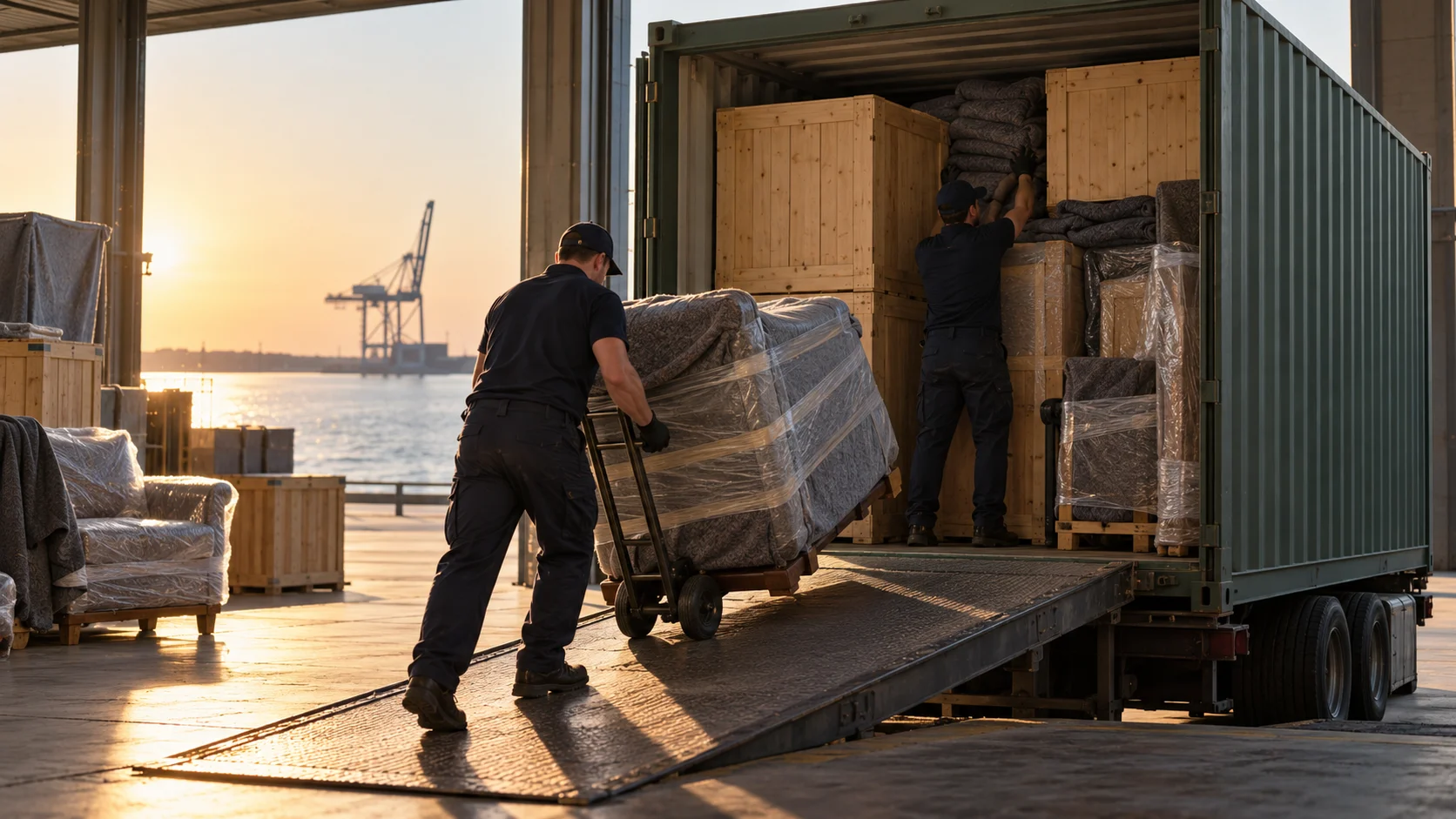
For a full-service removals move, the container is either delivered to your property (if truck access and road width allow) or goods are loaded at the removals company’s depot. Loading for a 20ft container typically takes 4–6 hours with a professional crew; a 40ft takes 6–10 hours.
Proper loading is critical for a 60-day ocean voyage. Furniture is stood on its strongest axis. Heavy items are placed on the floor, fragile items on top. Cartons are stacked tightly to prevent shift. Void spaces are filled with blankets, foam, or airbag bracing. A poorly loaded container loses a significant proportion of its contents to damage over the transit, not from dramatic events but from the constant low-frequency motion of a vessel at sea.
Step 2: Export Customs and Container Sealing
Once loaded, the container is sealed with a customs seal. The seal number is recorded on the bill of lading. The export customs declaration is filed (in the UK, this is an HMRC CDS submission; in EU countries, an equivalent national customs declaration). The ocean carrier issues the bill of lading, which identifies the container, its seal, and the consignee details.
Step 3: Origin Port and Vessel Loading
The container is transported to the origin port and staged for vessel loading. That port is Felixstowe, Rotterdam, Hamburg, Sydney, Singapore, or wherever the move originates. The ocean carrier books space on a vessel for the container; for large containers on popular routes (e.g. UK to Asia), vessel space is usually available within 1–2 weeks of booking.
Step 4: Ocean Transit
From the origin port, the container travels as part of a vessel’s cargo. For Thailand-bound shipments, the primary destination port is Laem Chabang, Thailand’s main deep-water port. Most containers transship once before the feeder service to Laem Chabang, typically at Port Klang (Malaysia) or Singapore.
Current transit times (port to port, 2026):
| Origin port | Transit to Laem Chabang | Route |
|---|---|---|
| Southampton (UK) | 35–45 days | Cape of Good Hope; direct Laem Chabang call on some services |
| Felixstowe / London Gateway (UK) | 38–50 days | Cape of Good Hope + Singapore or Tanjung Pelepas |
| Hamburg / Rotterdam (Europe) | 36–49 days | Cape of Good Hope; varies with rotation position |
| Melbourne / Sydney (Australia) | 12–18 days | Direct or via Singapore |
| Singapore | 3–5 days | Direct feeder |
| Los Angeles / Long Beach (US) | 20–28 days | Trans-Pacific + transshipment |
The spread inside those European figures is driven by rotation position rather than carrier choice. The same carrier can publish 36 days from Rotterdam on one service and 49 on another in the same week, because Rotterdam is the last European call before the ocean leg on one and an early call on the other. Yang Ming’s published June 2026 schedule puts Southampton at 40 days to Laem Chabang on a single vessel with no transshipment.
Europe-origin containers are currently routed via the Cape of Good Hope following the 2024 Red Sea disruption. This adds 10–14 days over the historic Suez route and introduces a War Risk Surcharge and higher BAF. Cape routing remained the default for Asia-Europe services through 2026, with carriers reverting to the Cape even after brief Suez test voyages.
Step 5: Arrival at Laem Chabang
When the vessel arrives at Laem Chabang, the container is unloaded and staged in the port yard. The shipping line issues an Arrival Notice to the consignee or their Thai agent. From this point, the sequence runs:
- The original bill of lading (or telex release confirmation) must be surrendered to the shipping line
- The Thai customs broker prepares and files the import customs entry
- Thai customs processes the entry (Green Lane = automatic; Red Lane = physical examination)
- Duty and VAT are assessed and paid (or duty relief is granted for qualifying personal effects)
- The container is released from port
FCL containers have a key advantage over LCL at this stage: no CFS deconsolidation. The container is released directly from the port yard and transported by truck to the delivery address. The CFS deconsolidation fee (typically THB 400–900 per CBM for LCL) does not apply.
Step 6: Delivery and Unloading
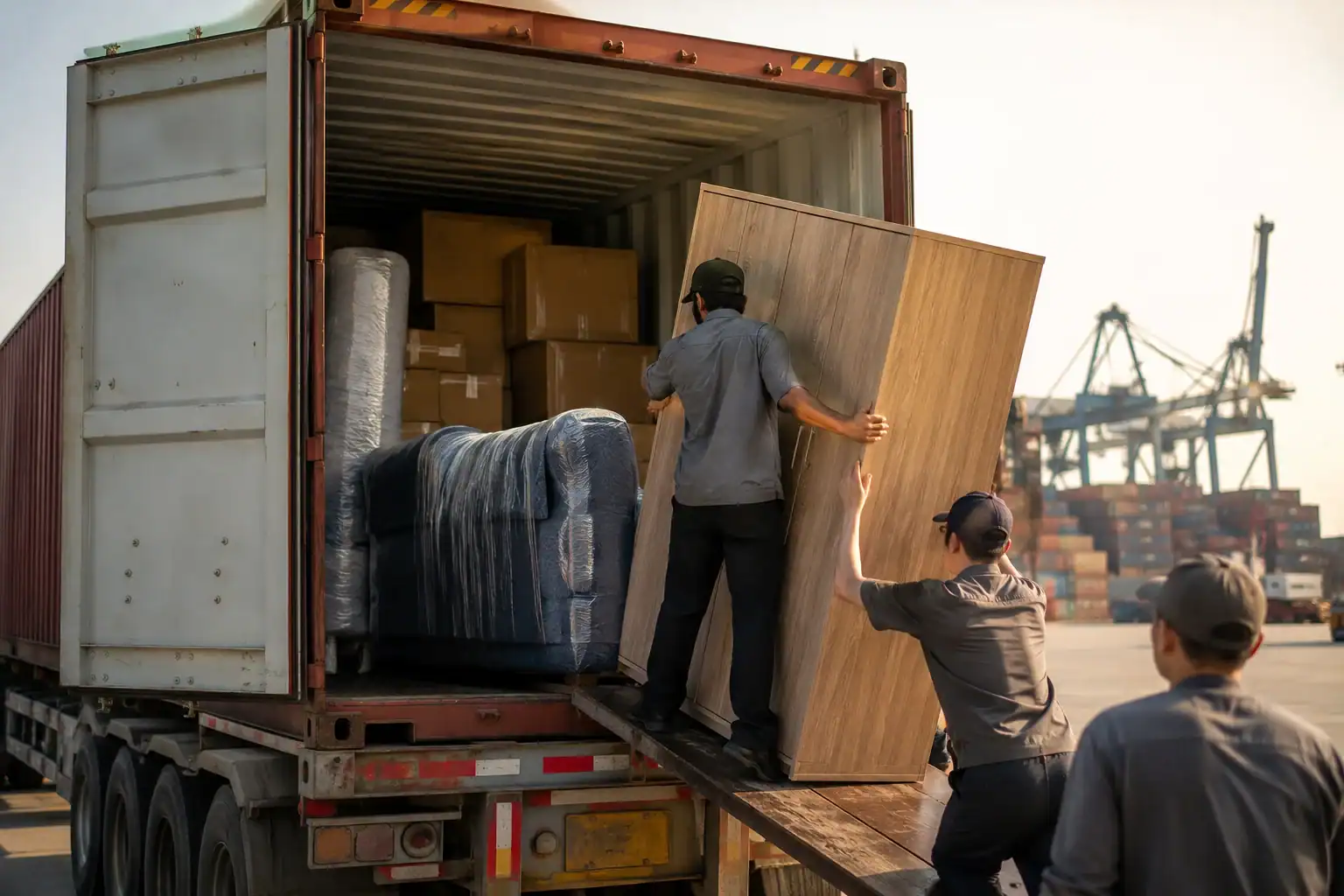
The container truck arrives at the destination address. For Bangkok apartments, this requires advance coordination with building management for truck access, elevator reservation, and delivery time slots. For houses with direct road access, the container can sometimes be positioned at the property entrance for direct unloading.
Unloading a 20ft container typically takes 4–6 hours; a 40ft takes 6–10 hours. The container must be returned to the shipping line’s depot after unloading, typically within 3–5 days of delivery. Keeping a container beyond the allowed free time generates container detention charges (separate from port demurrage): THB 800–2,000 per day beyond the free period.
FCL Container Costs to Thailand
Container shipping costs cover several layers. The ocean freight quote is usually the first number seen, but the all-in cost includes destination port charges, Thai customs, and last-mile delivery. A summary of typical cost ranges for FCL moves to Thailand:
| Cost category | 20ft FCL | 40ft FCL |
|---|---|---|
| Origin charges (THC, export clearance, B/L) | USD 300–600 | USD 400–750 |
| Ocean freight (base) | USD 1,200–2,500 | USD 1,800–3,500 |
| Surcharges (BAF, LSS, WRS/Cape if applicable) | USD 400–900 | USD 600–1,400 |
| Marine insurance (2–3.5% of goods value) | Depends on value | Depends on value |
| Destination THC (Laem Chabang) | THB 3,500–5,500 | THB 5,500–8,000 |
| Thai customs broker fee | THB 4,000–8,000 | THB 5,000–10,000 |
| Import duty + VAT | Waived if duty relief granted; 10–30% + 7% VAT if not | Same |
| Last-mile delivery, Bangkok | THB 5,000–9,000 | THB 7,000–14,000 |
For UK-origin containers specifically, the Cape of Good Hope War Risk Surcharge adds USD 200–500 per container. For a full quote on container shipping to Thailand, request a freight assessment from Swift Cargo. For a full UK-to-Thailand FCL cost breakdown with two full scenarios in GBP, see our UK to Thailand FCL cost breakdown.
Thai Customs for FCL Containers
FCL containers are processed through Thai customs in the same way as LCL shipments. The duty relief conditions are identical. What differs is the physical inspection process.
Most guides stop at “FCL clears the same way as LCL.” The more useful point is why a sealed FCL box usually carries less inspection risk to begin with. An FCL container goes to a single consignee and is never deconsolidated at a container freight station. CFS deconsolidation breaks a groupage shipment down and cross-checks it box by box, and that is where a large share of physical examinations actually originate. FCL skips that step entirely. Your container can still be pulled for the Red Lane described below, but the default path for a clean, single-consignee declaration is a documentary check. The containers that do get held are usually the ones whose declared value or packing list doesn’t survive that check.
For FCL containers selected for physical examination (Red Lane), Thai customs may require the container to be unstuffed at a nominated examination facility. The entire contents of the container are unloaded, inspected, and then repacked. Container transport, unstuffing, restuffing, and the examination fee together typically run THB 8,000–18,000 for a 20ft container. This is one reason accurate and detailed packing lists matter: a well-described shipment is less likely to be selected for full examination.
For personal effects duty relief on FCL moves, all the standard conditions apply: valid Thai long-term residency permit at the time of customs clearance, goods must be used personal effects, goods must arrive within six months of establishing Thai residence, and this is a one-time relief per change of residence. See our full guide to duty-free import rules in Thailand for the complete conditions and documentation list.
A sealed FCL box still lives or dies on the packing list.
If you are not sure your declared value and item descriptions would survive a documentary check, that is worth confirming before the container is sealed.

Five Practical Points for FCL Container Moves to Thailand
1. Get a home survey, not a self-estimate
Self-estimated volumes are almost always underestimates. A professional removals surveyor who has loaded hundreds of containers will give you a reliable CBM figure. Underestimating the volume means the container has to be repacked at the depot, which costs more in time and money than booking a slightly larger container upfront.
2. Declare goods accurately on the packing list
Thai customs uses the packing list to decide which containers to examine. A packing list that says “household effects: 200 items” tells the customs officer nothing. A packing list that says “bedroom furniture, kitchenware, clothing (used), electronics, books” gives the officer enough information to assess risk. Accurate, specific descriptions reduce the probability of a full container examination, which adds cost and delay.
3. Confirm your Thai visa before the container sails
For personal effects duty relief, the Thai residency permit must be in place when the goods arrive at Thai customs. For Europe-origin moves, there are roughly 45–60 days between container sailing date and Thai customs clearance. If you are in the process of obtaining a Thai visa, confirm with your Thai agent whether the timing works. If there is any risk the visa will not be in place by the time the container arrives, factor potential duty costs into your budget.
4. Plan the delivery address access before the vessel arrives
A 20ft container truck is approximately 13 metres in total length. Not all Bangkok streets can accommodate this vehicle, and not all provincial locations can either. If there is a road access question at your destination address, confirm with your Thai agent before the container arrives. Otherwise, goods have to be transferred from the container to a smaller vehicle at a depot, which adds cost and time.
5. Allow for container return time
After delivery and unloading, the shipping line’s container must be returned to a nominated depot. Free time for container return is typically 3–5 days after delivery in Thailand. Beyond this, container detention charges apply (THB 800–2,000 per day). Plan the unloading date with enough buffer to return the container within the free period.
We price your container layer by layer, the way this guide does.
Tell us your route and container size and our team prices the full stack. The form takes about 60 seconds, and we come back with a free estimate.
So why does one 20ft container clear Laem Chabang in three days while the one behind it, carrying almost the same furniture, sits for a fortnight? It is almost never the contents. Thai customs assigns every entry to a lane before an officer has looked inside anything, and that assignment runs off the declaration: who the importer is, what visa status was claimed, whether the duty relief application was filed ahead of arrival, and how specific the packing list is. Green Lane means the entry clears on the paperwork alone. Red Lane means the container is moved to an examination area and opened, which costs days and yard charges. The practical consequence is worth being blunt about: by the time your container is on the water, you have already decided which lane it is going to get. The paperwork you filed weeks earlier is the shipment’s clearance speed. Nothing you do at the port changes it.
Related reading: FCL to Thailand: Container Costs, Sizes, and the LCL Break-Even
Frequently Asked Questions
How much does it cost to ship a container to Thailand?
The all-in cost of shipping a container to Thailand depends on the origin country, container size, and whether Thai customs duty applies. For a 20ft FCL from the UK to Bangkok, the total all-in cost (origin charges, Cape of Good Hope ocean freight and surcharges, Thai destination THC, customs broker, last-mile delivery) is typically USD 3,500–6,000 (approximately £2,800–4,800), assuming personal effects duty relief is granted. A 40ft FCL from the UK runs USD 5,500–9,000 all-in. From Australia, costs are significantly lower, because the ocean transit is shorter and surcharges are smaller. The specific total depends on the origin port, departure month (peak season surcharges apply July–September), and Bangkok or provincial delivery destination.
What is the difference between a 20ft and 40ft shipping container?
A 20ft container has approximately 25–28 CBM of usable space, sufficient for a two-bedroom apartment move (18–22 CBM of packed goods). A 40ft container has approximately 55–67 CBM, suitable for a three-to-four bedroom house (35–55 CBM). The 40ft container is roughly 40–50% more expensive than a 20ft on ocean freight and surcharges, but the per-CBM cost is lower once volume exceeds 25 CBM. A 40ft High Cube container adds 30cm of internal height, useful for tall wardrobes, artwork, or other items that benefit from the extra clearance.
How long does a container take to reach Thailand?
Port-to-port transit times to Laem Chabang, Thailand: from UK/Europe (via Cape of Good Hope), 35–50 days; from Australia, 12–18 days; from Singapore, 3–5 days; from the US West Coast, 20–28 days. Add 5–15 working days for Thai customs clearance after vessel arrival, and 1–3 days for last-mile delivery within Thailand. Total door-to-door for a UK-origin move is typically 65–90 days from packing day to Bangkok delivery.
Can I pack a container myself, or do I need a removals company?
You can pack a container yourself (known as an owner-packed or “said to contain” container), but this affects your marine insurance coverage. Most marine cargo insurers apply restrictive conditions or exclude claims for owner-packed containers unless a professional packing certificate is provided. For a 60-day ocean transit, professional packing and loading significantly reduces the risk of transit damage through proper furniture wrapping, carton stacking, and void-fill bracing. The cost of professional packing is small relative to the potential replacement cost of damaged furniture and personal items.
Does a full container go through Thai customs the same way as a small shipment?
Yes. The customs entry process and duty relief conditions are the same for FCL and LCL. The Thai customs broker files an import declaration, customs assesses the entry, and either Green Lane (automatic release) or Red Lane (physical examination) is assigned. The key operational difference is that for FCL containers selected for physical examination, the entire container may need to be unstuffed and inspected at a customs examination facility, a process that adds THB 8,000–18,000 in cost and 2–5 additional days. Accurate and detailed packing lists reduce the probability of Red Lane selection.