
Leaving Italy for Thailand poses a particular kind of packing problem. Italy is not a country where people travel light: decades of accumulated furniture, kitchen equipment, art, ceramics, books, clothing built for a climate you’re about to leave behind. The move, whether for work or retirement or simply for the life, forces you to decide what comes with you, what gets sold, and what gets stored. Moving from Italy to Thailand also means deciding how much Thai duty those goods will attract, which depends on your visa.

The freight side of those decisions is more structured than it might feel. The questions that matter most have specific answers: whether your visa qualifies you for the duty-free import exemption, how long the journey actually takes from Genoa or La Spezia to Laem Chabang, what your shipment volume implies about container type, and what Thai customs will examine when it arrives. The Thailand relocation guide 2026 covers the broader relocation context: visas, timelines, and what to ship.
Visa Type Determines Your Customs Position
Before booking a cubic metre of space in a container, confirm which Thai visa you’re arriving on. Thai customs’ duty-free personal effects exemption is visa-based, not nationality-based, not value-based, and not based on how long you intend to stay.
| Visa / Status | Duty-Free Eligible? | Notes |
|---|---|---|
| Non-Immigrant B (work permit) | Yes | One-year work permit required; 6-month shipment arrival window applies |
| Retirement (O-A / O-X) | No | Excluded from the standard criteria; Thai Customs does not accept a retirement visa as a qualifying status |
| Thai Elite / Privilege Card | No | Lifestyle visa with no work permit, so no exemption |
| Long-Term Resident (LTR) | Seek ruling | Conditions vary by LTR sub-category |
| Education (ED) | No | No exemption |
| Tourist / visa-exempt | No | No qualifying status |
| Returning Thai national | Yes | Must demonstrate 12+ consecutive months abroad |
The retirement visa is a common choice, given Thailand’s appeal to European retirees. Italian nationals arriving on it do not qualify for duty-free import of household goods. Import duties of 10–30% and 7% VAT will apply to the declared CIF value of the entire shipment. This changes the economics of what is worth shipping. A €15,000 shipment CIF value at 20% duty plus 7% VAT on CIF plus duty generates approximately THB 160,000 in Thai import costs, at about 37.6 baht to the euro. Factor that into the decision before packing the dining table.
For those arriving on a Non-Immigrant B visa with a valid one-year work permit, the exemption conditions are:
- Work permit must be issued and valid before your shipment arrives at Laem Chabang
- You must have lived in Italy (or your origin country) before the move, with the goods owned, possessed and used there
- Shipment must arrive no earlier than one month before your arrival in Thailand, no later than 6 months after it
- One sea and one air shipment qualify; not multiple sea consignments
- All goods must be demonstrably used and personally owned, and the exemption covers one of each appliance type (two for a family move)
Full Thai customs duty-relief conditions are published at Thai Customs Department: personal effects exemption.

Italian Departure Ports and the Route to Laem Chabang
Italy’s main container ports for international household goods departures:
- Genova (Genoa): Italy’s busiest container port and the primary departure point for most international removal shipments originating in northern and central Italy. Multiple weekly services to Asian ports via Mediterranean carriers.
- La Spezia: a significant container port 100 km southeast of Genoa, well-connected to Asian shipping routes. Often used for groupage/LCL consolidation for Emilia-Romagna and Liguria-origin shipments.
- Livorno (Leghorn): the port for Tuscany, Umbria, and central Italy. LCL consolidation services with feeder connections to main Asia routes.
From Italian ports, the routing to Laem Chabang:
Via Suez Canal: Eastern Mediterranean, Suez Canal, Red Sea, Indian Ocean, transshipment at Singapore or Port Klang (Malaysia), onward to Laem Chabang. Ocean leg approximately 34–42 days from Italian ports, shorter than from northern European ports because of the Mediterranean head start.
Via Cape of Good Hope: around southern Africa, across the Indian Ocean, transshipment, Laem Chabang. Ocean leg approximately 44–56 days, 10–14 days more than Suez. This has been the default routing for most carriers since 2024, but carriers are now returning to Suez in phases: the 2026 Suez Canal routing analysis expects a phased return, and Alphaliner counted 63% of Far East to Europe capacity back on Suez-routed services between 15 September and 15 October 2026. Confirm current routing with your freight forwarder before setting a timeline.
Realistic door-to-door from Italy:
- Collection and packing in Italy: 1–3 days
- Italian port handling and vessel loading: 5–10 days
- Ocean transit (Suez routing): 34–42 days
- Ocean transit (Cape routing): 44–56 days
- Thai customs clearance at Laem Chabang: 5–10 working days
- Last-mile delivery in Thailand: 1–3 days
Total: 7–9 weeks (Suez) or 9–11 weeks (Cape). Italy is geographically better placed than northern European ports. The Mediterranean entry point shaves several days off the vessel leg compared to Hamburg or Felixstowe. But door-to-door from Italy to Thailand is still measured in weeks, not days.
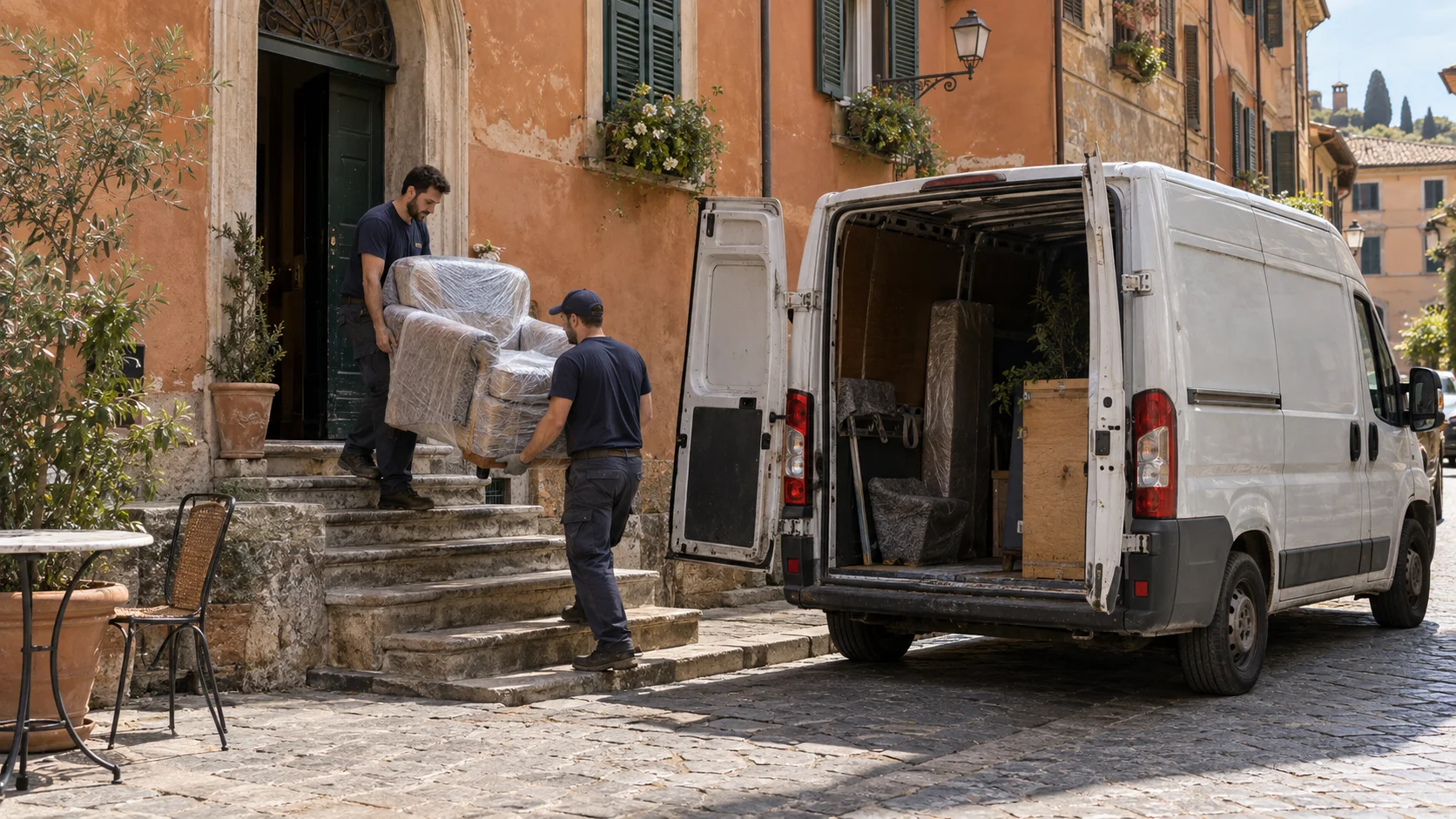
LCL or FCL: Sizing an Italian Household Move
Italian homes tend to be well-furnished. What you ship depends on both the volume and the visa-driven duty calculation.
| Property Type / Volume | Estimated CBM | Recommended Mode | Approximate Cost (EUR) |
|---|---|---|---|
| Monolocale / studio (personal items) | 5–12 CBM | LCL groupage | €600–€1,800 |
| Bilocale / 2-room (selective) | 12–28 CBM | LCL or 20ft FCL | €1,800–€4,200 |
| Trilocale or larger / family home | 28–55 CBM | 20ft or 40ft FCL | €2,800–€7,000+ |
Freight costs shown are approximate and exclude Thai import duty, VAT, and local delivery. LCL (grupaggio) is cost-effective for smaller moves but adds consolidation handling at origin and deconsolidation at the Laem Chabang CFS. FCL gives better physical protection and often faster customs clearance at destination, because your goods travel in a sealed container with no co-loading.
What Is Worth Shipping from Italy
Good candidates for the container:
- Quality Italian furniture: solid timber dining tables, leather sofas, handcrafted pieces. These are often difficult or prohibitively expensive to replicate in Thailand. They are worth shipping when the replacement cost significantly exceeds the shipping cost, including any import duty.
- Clothing, particularly winter and business attire, and Italian-made items that are expensive or unavailable in Thailand
- Books, artwork, ceramics, and objects with sentimental or monetary value
- Professional and specialist equipment: camera gear, musical instruments, tools
- Children’s belongings and comfort items for families relocating with children
Generally not worth shipping:
- Standard IKEA-equivalent furniture, available in Thailand at comparable prices
- Large white goods such as washing machines, fridges, and dishwashers, since Thai apartments are typically smaller and local replacements are affordable
- Wine in any significant quantity, for the duty reasons set out in the FAQ below
- Bulky items (heavy sectional sofas, large wardrobes) where the shipping cost approaches replacement value
- Items with only sentimental value that could be photographed and stored or given to family
A Simple Rule for the Ship-or-Sell Decision
The lists above tell you what tends to be worth shipping in general, but the actual decision on any single item comes down to one comparison: what would it cost to buy an equivalent replacement in Thailand, versus what it costs to ship the one you already own. As a working threshold, if replacement cost in Thailand is less than roughly 1.5 to 2 times your per-item shipping share (rough total freight cost divided by CBM used), sell or leave it behind. If replacement cost is 3 times or more, ship it. The 2 to 3 times range is genuinely borderline. In that band, let sentimental or practical value decide rather than the arithmetic alone: a piece that fits your specific space, an item whose quality you already know.
Run this calculation before packing day, not during it. Italian movers consistently report that the hardest packing decisions happen under time pressure with the truck already booked, when everything starts to feel worth shipping because the alternative is deciding fast. Do the ship-or-sell math for your major items two to three weeks ahead, while you can still research Thai replacement prices and get a real freight quote. That turns a rushed emotional call into a five-minute spreadsheet exercise.
Prohibited and Restricted Items
Remove these before packing, because Thai customs Red Line inspection will find them:
Prohibited (will be seized):
- Lithium batteries of any type: power banks, e-bike batteries, laptop batteries, tool batteries, even those installed in devices. They are prohibited from sea freight containers under IMDG regulations. Remove all batteries before packing and carry them in your cabin luggage.
- Flammable substances, aerosols, gas canisters, paint, solvents
- Narcotics and controlled substances
- Weapons and firearms (without Thai police permit)
- Pornographic material
- Counterfeit goods
- CITES-protected wildlife and derivatives (ivory, certain leathers)
Restricted (documentation or customs assessment required):
- Wine and spirits: subject to Thai excise duty. Small personal quantities may be accepted, but the personal effects exemption does not cover them in full
- Buddha images and religious antiques: a Fine Arts Department permit is required
- Plants and plant material: a phytosanitary certificate from the Italian NPPO (National Plant Protection Organisation) is required, and they are easier to leave behind
- Prescription medication in quantities beyond personal use: carry documentation
Italian Export: What You Don’t Need to Worry About
Italy remains part of the EU customs union, so personal household effects leaving for a non-EU country like Thailand are technically an export under EU customs procedures. In practice, your Italian removal company (spedizioniere) handles a relocation’s household goods and personal effects under simplified export procedures. Personal effects within normal thresholds generally do not need a formal Dichiarazione Doganale di Esportazione (export customs declaration) under the standard commercial goods process. That leaves the Thai side as the real paperwork burden when moving from Italy to Thailand.
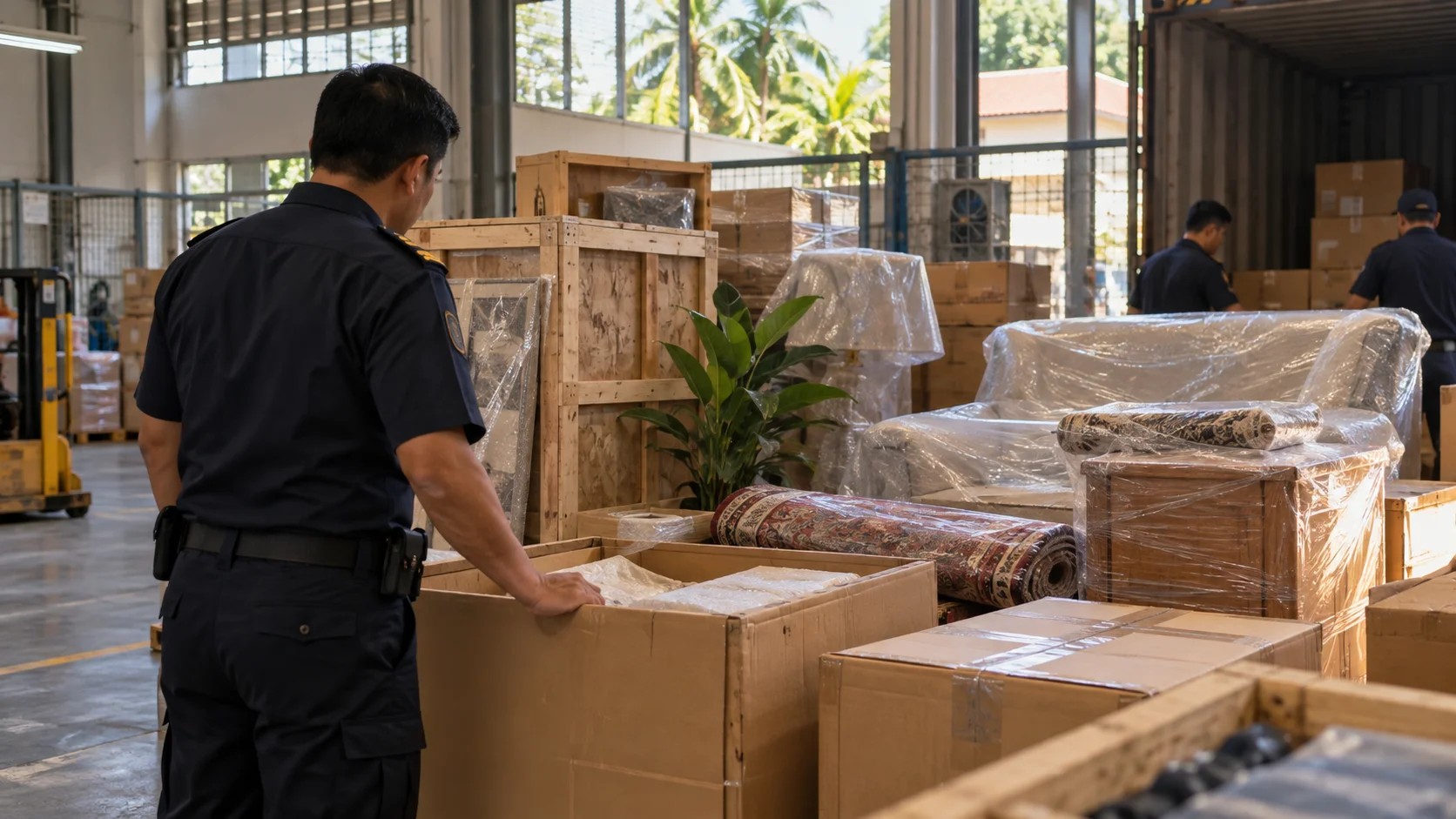
Your spedizioniere or international removal company will manage the Italian export documentation. Thai customs cares about the detailed packing inventory (lista colli / inventario) in English: a complete itemised list of every item in the shipment, with descriptions and estimated values. Thai customs compares your physical goods against this list during the Red Line inspection at Laem Chabang.
Required Documents for Thai Customs
- Passport copy: all pages including current valid Thai visa
- Work permit copy: valid one-year Thai work permit (if claiming duty-free exemption)
- Detailed packing inventory in English: item description, quantity, estimated value for every packed item
- Bill of Lading: issued by the shipping line
- Proof of Italian residence: utility bills, certificato di residenza, rental contract or property ownership documents
The complete document checklist for shipping to Thailand covers the full set including the electronic import declaration your Thai customs broker submits via the National Single Window system.
All household goods at Laem Chabang enter the Red Line, a physical inspection against the declared inventory. With complete, accurate documents, clearance takes 5–10 working days. Incomplete or inconsistent documents mean bonded storage and daily fees. Documentation gaps are the primary cause of clearance delays at Laem Chabang.
Here’s a question worth sitting with: why does the ship-or-sell math above feel optional right up until the truck is booked, and then suddenly feel too late to do? The arithmetic itself is simple, replacement cost against your per-item share of freight, and it doesn’t get harder to calculate as moving day approaches. What changes is the cost of doing it. Two weeks out, checking a Thai retail price is a five-minute search. The night before, with boxes half-packed and decisions piling up, the same five minutes feels like a luxury you don’t have, so everything defaults to “just ship it,” which is the expensive answer disguised as the easy one. The good version of this decision was never hard. It just had to happen on a day when it was still cheap to be careful.
Before Moving from Italy to Thailand
Confirm your visa before booking, because retirement visa holders pay 10 to 30% duty plus 7% VAT on the whole shipment. Allow 7 to 9 weeks door to door via Suez or 9 to 11 via the Cape, prepare an English packing inventory, and run the ship-or-sell math two to three weeks before packing day.
Frequently Asked Questions
Can Italian nationals import household goods duty-free when moving to Thailand?
Yes, if you arrive on a qualifying visa. A Non-Immigrant B visa with a one-year work permit qualifies. Retirement visa (O-A, O-X) holders are excluded from the standard criteria and do not qualify. Full duties of 10-30% plus 7% VAT apply. The rule is visa-based, not nationality-based.
How long does sea freight take from Italy to Thailand?
Door-to-door: approximately 7–9 weeks via Suez Canal, or 9–11 weeks via Cape of Good Hope (current routing for many carriers since 2024). Ocean leg from Genoa or La Spezia: 34–42 days (Suez) or 44–56 days (Cape). Add Italian port handling and Thai customs clearance at each end.
Which Italian ports do household goods to Thailand depart from?
Genoa and La Spezia are the primary departure points. Livorno serves central Italy. Your removal company will advise the most suitable port based on your location and the available carrier services.
Is Italian furniture worth shipping to Thailand?
Solid timber, leather and designer furniture are often worth shipping when replacement cost in Thailand significantly exceeds total shipping cost including any import duty. Standard or mid-market furniture is generally not worth shipping. The retirement visa duty calculation (10–30% duty + 7% VAT on CIF value) changes the economics materially for non-qualifying visa holders.
Can I ship wine from Italy to Thailand?
Wine is not covered by the personal effects duty-free exemption in the same way as household goods. Thai excise duty and import taxes apply. Small personal quantities (a case or two of valued bottles) may be accepted, but high-value cellar collections are economically impractical to ship given the duty burden. Consult your removal company and Thai customs broker before including wine in your shipment.
Planning Your Italy-to-Thailand Freight
The step-by-step guide to shipping household goods to Thailand covers eligibility confirmation, volume planning, document preparation, and Laem Chabang clearance in full. Swift Cargo manages European-origin household goods shipments to Thailand, including Italian-origin removal coordination, customs brokerage, and delivery to your Thai address.
Thai customs requirements and duty-relief conditions are set out in full on the Swift Cargo Thailand page. For a freight assessment specific to your move from Italy, request a quote for your Italy-to-Thailand shipment.