
The removals surveyor stood in Anders’s living room in Frederiksberg with a laser measure and a clipboard, and he kept coming back to the chair. A CH24: the Wegner Wishbone, bought at auction in 2011, paper cord seat worn to the colour of weak tea. “You know,” the surveyor said, “this chair is worth more than everything else going in the container. Combined.” He wasn’t exaggerating. The sofa was ten years old. The bed was from a Danish flat-pack chain. The kitchen table had a water ring shaped like Fyn. But the Wishbone, the pair of PH 5 pendants over the table, and a teak sideboard from Anders’s grandmother would each have cost more to replace in Bangkok than the entire sea freight bill from Copenhagen to Laem Chabang.
The Thai Customs Department publishes current personal-effects conditions and required documents.
That is the Danish version of the moving-to-Thailand problem, and it is genuinely different from the Swedish, German or British version. Danes tend to own a small number of very good things. The economics of shipping them are unusually favourable, and the economics of shipping everything else are unusually poor. Meanwhile, the bureaucratic side of leaving Denmark runs through one system, the CPR register, and if you touch it in the wrong order you can cut yourself off from services you still need. This guide covers both halves: the paperwork sequence that keeps Danish authorities and Thai immigration happy, and the freight decisions (Aarhus or Copenhagen, direct call or Hamburg trucking, LCL or FCL) that determine what you pay and how long you wait.

Start with the sequence, not the boxes
Here is the single most useful lesson from Danish families who have done this move: the order of operations matters more than any individual task. Get the sequence right and every step supports the next one. Get it wrong and you create gaps: a cancelled health card while you still live in Denmark, a shipment that lands in Bangkok before you have the visa that makes it duty free.
The correct high-level order looks like this:
- Secure the Thai visa first. Non-Immigrant O, Non-Immigrant B, LTR, whichever fits your situation. Everything downstream depends on it.
- Book freight second. Time the sailing so the shipment arrives after you do, and within six months of your first entry on the new visa.
- Notify your kommune of fraflytning third, shortly before departure: borger.dk accepts the notification up to four weeks before you leave.
- Handle Danish tax exit questions in parallel, with advice, because full tax liability does not automatically end the day you fly.
- Fly, enter Thailand on the correct visa, then clear the shipment.
Each of those steps gets its own section below. But keep the skeleton in mind, because most of the expensive mistakes we see are sequencing mistakes, not paperwork mistakes.
CPR deregistration: the fraflytning notification, done at the right moment
Denmark’s CPR register is the spine of Danish administrative life, and leaving it is a formal act. If you move abroad for more than six months, you are obliged to report your departure (the fraflytning) to your kommune, which you do digitally through borger.dk. The rules allow you to submit the notification up to four weeks before your actual departure date. Shorter stays abroad, under six months, generally do not require deregistration if you keep a home in Denmark, but a genuine relocation to Thailand is squarely in mandatory-notification territory.
The timing question is where people go wrong. Deregistering from the CPR register is not a neutral database update. It switches off, or complicates, a long list of CPR-linked services:
- Your yellow health insurance card (sundhedskort) stops covering you, and your assignment to a general practitioner lapses.
- Your entitlement to Danish public healthcare while abroad becomes limited; travel outside the EU is not covered the way EU travel can be.
- MitID generally continues to work, but some services that check for an active Danish address will start behaving differently.
- Banks, insurers and pension providers will eventually ask about your residency status, and some products are conditional on a Danish address.
So the plain-language rule: do not deregister until your Thai visa is approved and your departure date is fixed. Deregistering early has no advantage and carries real disadvantages. Someone who deregisters three months before flying, “to get it out of the way,” spends three months in their own country with a lapsed health card and a string of confused letters from institutions. Someone who deregisters two weeks before departure, visa in passport, tickets booked, experiences none of that.
One more CPR-adjacent point: keep documentation of your deregistration date. Thai banks, Danish pension providers, and your kommune, if you ever move back, will all at some point want to know exactly when your Danish residence ended. Borger.dk gives you a confirmation; save it somewhere better than an email inbox.

Danish tax exit: know the shape of the problem before you fly
This guide is about freight, not tax advice, so treat this section as a map of the terrain rather than a route. But you need to know the terrain exists, because it interacts with your timing.
Denmark distinguishes between full tax liability (fuld skattepligt) and limited tax liability, and moving abroad does not automatically end full liability. Skattestyrelsen looks at the substance of your ties: whether you keep a home available in Denmark, where your family lives, where your economic interests sit. Selling or letting out your Danish home on a long, non-terminable lease matters. Keeping a summerhouse you can live in matters in the other direction.
Two things every Denmark-to-Thailand mover should do:
- Tell Skattestyrelsen you are leaving and provide the exit information they request. This is separate from the CPR fraflytning, even though the two feel like one event.
- Ask a professional about exit taxation on assets: Denmark has rules that can treat certain shares and financial assets as disposed of when full tax liability ends. Pension taxation for non-residents is its own topic. The current status of tax arrangements between Denmark and Thailand is exactly the sort of thing to confirm with an adviser rather than a blog, because it affects how Danish pensions paid to a Thai resident are taxed.
None of this needs to delay your container. It does need to be in motion before you deregister, because unwinding a badly sequenced tax exit from a condo in Bangkok is nobody’s idea of a good first month abroad.
Origin logistics: Aarhus, Copenhagen, or a truck to Hamburg?
Denmark has two container ports that matter for a household move: Aarhus, the country’s largest container port, and Copenhagen–Malmö. Here is the honest picture of how your shipment actually reaches Thailand from either one.
Very little cargo sails directly from a Danish port to Southeast Asia on a main-line vessel. The big Asia–Europe loops call at the North Sea hubs (Hamburg, Bremerhaven, Rotterdam, Antwerp) and Danish ports connect to those hubs by feeder vessel. So a container loaded in Aarhus typically rides a feeder to Hamburg or Bremerhaven, transships onto a main-line service, and then sails for Asia. The feeder leg adds a few days and one handling event, but it is routine, high-frequency and priced into the through rate.
That creates a genuine choice for movers in Jutland and on Zealand alike:
- Ship via a Danish port (feeder to Hamburg). Simplest at origin: the container is loaded at your home, trucked a short distance to Aarhus or Copenhagen, and the ocean carrier handles the rest. Export customs formalities are done in Denmark. One quote, one chain of custody.
- Truck directly to Hamburg and load there. Hamburg is about 350 km from Copenhagen and roughly 330 km from Aarhus by road. Trucking the container straight to the German hub skips the feeder leg and its transshipment. For LCL shipments, the packed goods travel by truck instead. It can shave three to six days off the door-to-door time and, depending on rate conditions in a given month, save a few hundred euros on an FCL move. The trade-off is a longer road leg and export formalities handled through Germany.
Which wins? For FCL, get both routings quoted; the answer moves with the market, and neither is consistently cheaper by a wide margin. For LCL, the question mostly answers itself: consolidation for Southeast Asia happens at the hubs anyway, so your two cubic metres of boxes are going to Hamburg one way or another. Choose on price and pickup convenience, not geography pride.
One practical note for people outside the big cities: if you live in, say, Aalborg or Esbjerg, the trucking distance to Aarhus is far shorter than to Hamburg, and the feeder routing usually wins on total cost. The Hamburg-direct option is most attractive for households in the Copenhagen area and southern Jutland.
Transit time: the Cape of Good Hope is still the default
Set your expectations now, because this is the number that shapes everything else: plan on 40 to 50 days port to port from Northern Europe to Laem Chabang or Bangkok.
The reason is routing. Most main-line services between Europe and Asia continue to sail around the Cape of Good Hope rather than through the Suez Canal, a rerouting that adds roughly 10 to 14 days compared with the old Suez schedules. Carriers have rebuilt their networks around the longer route, so schedules are reliable, but they are reliably long. A container that leaves Hamburg in mid-August is a container you unpack in Thailand in October.
Build the schedule backwards from that fact:
- Door to door, expect 8 to 11 weeks once you add origin packing and haulage, the feeder leg if any, destination customs clearance, and delivery upcountry or into Bangkok.
- Ship before you fly, but not too long before. The Thai duty-free window (next section) runs from your first entry, and you must be in Thailand, visa stamped, before the shipment clears. The comfortable pattern: container ships two to four weeks before your flight, you land, you activate the visa, the shipment arrives three to six weeks later, you clear it duty free.
- Do not ship things you will need in the first two months. Work equipment, school documents, medication, the good rain jacket for arriving in monsoon season: all of that flies with you or goes air freight.
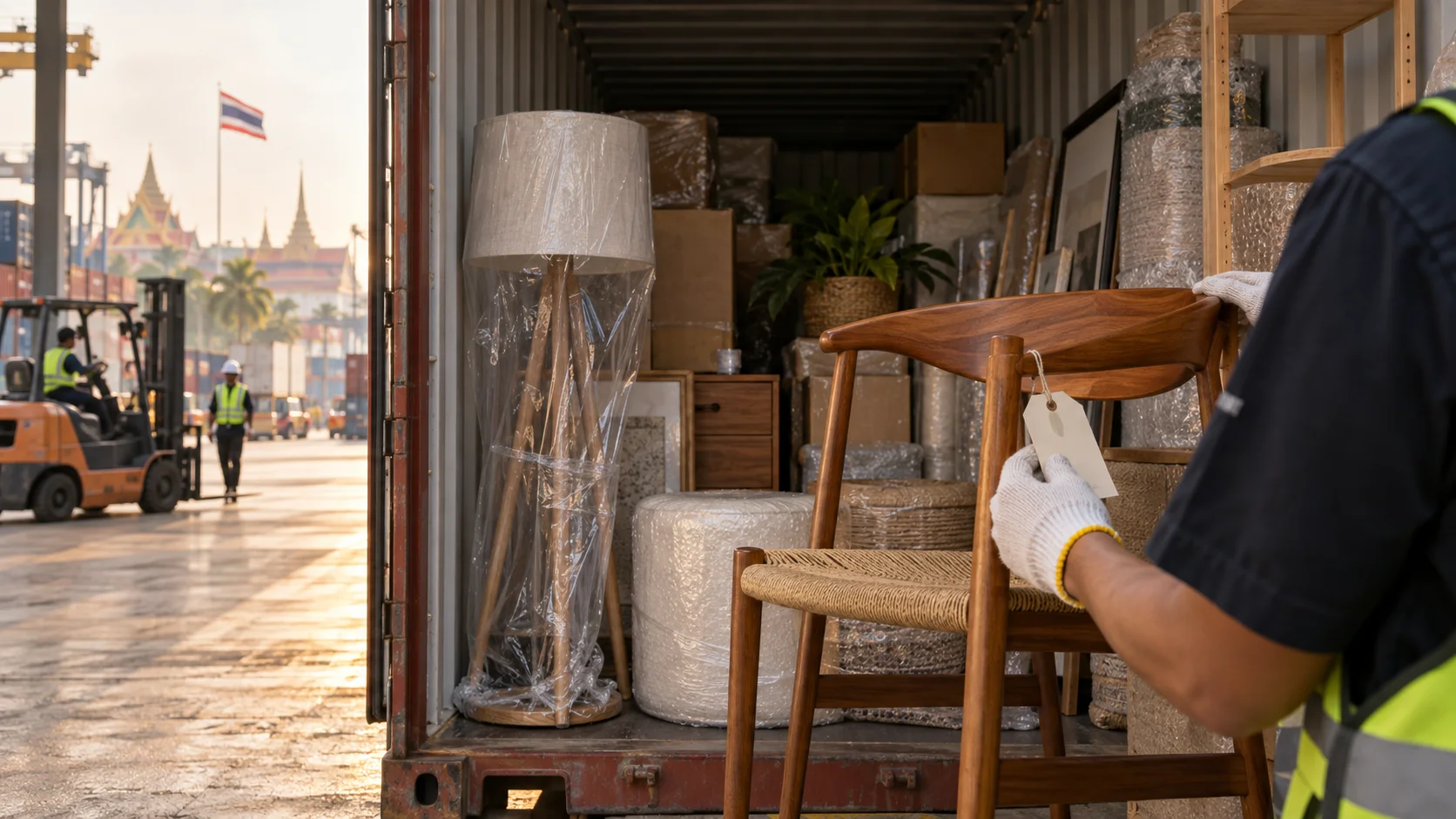
Thai customs: the duty-free rules that decide what your move costs
Thai Customs allows qualifying foreign nationals to import used household effects free of duty. The conditions are specific, and every one of them is enforced:
- Visa status. Thai Customs grants the concession against documented status, not length of stay: a Non-Immigrant B with a work permit valid for a year or more, or an LTR visa, qualifies. A Non-Immigrant O on a retirement or marriage basis does not, and neither does a tourist entry.
- Ownership and use before the move. Items must have been owned and used by you before the move. This is the rule that kills “I’ll just buy everything new in Denmark and ship it”. New goods are dutiable.
- Six-month arrival window. The shipment must arrive in Thailand within six months of your first entry on the qualifying visa. Miss the window and the duty-free concession is gone, which is why the sequencing above puts the visa first and the sailing second.
- One shipment per person is the working assumption; a married couple relocating together should plan the consignment accordingly.
Thai Customs officers assess whether goods look used. A sofa with life in it, kitchenware with scratches, clothes that have been worn: no issue. Anything in original retail packaging, with tags, or in obviously untouched condition invites duty assessment on that item, and sometimes closer inspection of the whole container. We cover the inspector’s-eye view in more depth in our guide to how Thai duty-free import rules work for household goods.
Certain categories sit outside the household-effects concession entirely:
- Alcohol. Your wine collection does not ride free in the container. Alcohol is excisable, licensed and heavily dutied in Thailand; shipping cases of wine or spirits inside a household consignment is a reliable way to get the whole shipment pulled for inspection. Drink it, gift it, or sell it before you leave. The personal allowance you can carry when flying in is one litre.
- Vehicles. Cars and motorcycles are a separate, punitive import regime. Sell the car in Denmark.
- Restricted goods. Weapons (including ornamental ones), drones above certain specs, certain communications equipment, and anything resembling e-cigarettes are all barred. Thailand bans vaping products outright. Leave all of it out.
The six-month clock runs from your first entry, so the sailing date and the visa date are one decision. An early estimate for the Denmark leg shows how much of that window freight will use.
What to ship and what to sell: the Danish design question
Now back to Anders’s Wishbone chair, because this is where a Danish move differs from almost every other European origin.
The default advice for Europe-to-Thailand movers is brutal and mostly right: sell your furniture, because Thai furniture is inexpensive and freight is not. But Danish households frequently own pieces that invert the calculation: original Wegner, Finn Juhl, Børge Mogensen, Kaare Klint; PH lamps and other Louis Poulsen classics; a Montana system; a good teak sideboard from the 1960s. In Thailand these are imported luxury goods, when you can find them at all. A new Wishbone chair at a Bangkok design retailer costs dramatically more than in Denmark, and vintage pieces essentially cannot be sourced locally at Danish prices.
So run the maths item by item. Effective freight cost lands around DKK 1,500–2,500 per cubic metre once packing, handling and delivery are averaged in. A lounge chair occupies well under one cubic metre when professionally wrapped. If replacing the item in Thailand would cost more than a few thousand kroner, it earns its place in the container. For real design pieces, the replacement cost is often ten times that.
The reverse list, the things that do not earn their place:
- Flat-pack and mid-market furniture. It is cheap to replace, expensive to ship, and often not built for a second assembly anyway.
- Large appliances. Thai kitchens are configured differently, condos come equipped, and warranty service for Danish-market appliances does not exist locally.
- Bicycles: with an asterisk. An ordinary city bike, sell. A high-end road bike or a Christiania-style cargo bike you love, ship; the replacement cost in Bangkok justifies it, though be honest about how much you will ride in the heat.
- Winter wardrobe beyond one good layer. You will visit Denmark in December eventually; keep one warm outfit and store or give away the rest.
The spreadsheet makes this sound easy. It is not. Selling the sofa is fine; what stops people is the kitchen drawer of odd utensils, the children’s drawings, the bike you rode to work for a decade. You will list something on DBA for 200 kroner, and when a stranger arrives to collect it you will want to take the listing down. That feeling is normal, and it is not a reason to pay for a cubic metre of freight. Keep the few things you would grieve, photograph the rest before it goes, and let the container carry what you will actually use in a Bangkok flat. The move gets lighter the week you stop negotiating with your own furniture.

The hygge audit: candles, wool and the things that make a Thai condo feel Danish
A lighter section, but a real one, because these are the questions Danish clients actually ask.
Candles ship fine. Denmark’s per-capita candle consumption is famously the highest in Europe, and no, Thai Customs has no objection to used or opened household candles packed among your effects. Pack them in the middle of the container, not against a hot steel wall: a container crossing the equator gets warm enough to soften wax. Boxed, brand-new candles in retail multipacks read as “new goods,” so keep those to a sensible personal quantity.
Wool textiles, sheepskins and throws ship fine too. Declare them correctly as used household textiles. Clean everything before packing: Thai (and Danish export) inspectors care about soil and organic residue, not about wool as such. Also use breathable wrapping rather than sealed plastic for the sea journey.
The PH lamp question: yes, ship the lamps, but have an electrician fit them at destination. Which brings us to plugs.
Type K meets Thailand. Denmark uses the type K plug, the cheerful three-pin design that looks like a surprised face. Thailand uses types A, B, C and O outlets. Your Danish plugs will not fit Thai sockets, but the electricity itself is compatible: Denmark supplies 230V at 50Hz, Thailand 220V at 50Hz, and effectively every modern appliance tolerates that difference without noticing. So the fix is trivial: adapters for the transition period, then replacement plugs or Thai power strips for anything permanent. Buy a handful of adapters in Denmark before you go; type-K-to-Thai adapters are easier to find in Copenhagen than in Chiang Mai.
LCL or FCL: matching the container to a Danish household
The volume decision, in plain terms:
- Under ~3 m³: think hard about whether you should ship at all, or fly with extra baggage and buy locally. Fixed charges dominate small LCL shipments.
- 3–12 m³: LCL (groupage). Your professionally packed goods share a container with other consignments, consolidated at Hamburg. You pay per cubic metre. This fits a one-bedroom household or a “design pieces plus books plus kitchen” curated move, the most common Danish profile, in our experience.
- 12–28 m³: 20ft FCL. Your own sealed container, loaded at your Danish address. Fits a typical two-to-three-bedroom apartment. Above roughly 12–14 m³, the flat container rate beats LCL per-cubic-metre pricing, and you gain speed (no consolidation wait) and security (one seal, door to door).
- 28 m³ and up: 40ft FCL. A full family house. If you are filling a 40-footer for a Thailand move, revisit the sell-versus-ship section first; most families who think they need one actually need a well-packed 20ft.

What it costs: DKK and EUR budget table, Copenhagen/Hamburg to Laem Chabang
Indicative door-to-port and door-to-door figures for 2026 planning. Ocean rates move month to month: treat these as budgeting anchors, not quotes.
| Shipment | Ex Copenhagen (via feeder) | Ex Hamburg (trucked) | Door-to-door time |
|---|---|---|---|
| LCL 3 m³ | DKK 9,500–14,000 (€1,270–1,880) | DKK 9,000–13,500 (€1,210–1,810) | 9–11 weeks |
| LCL 6 m³ | DKK 15,000–22,000 (€2,010–2,950) | DKK 14,500–21,000 (€1,940–2,820) | 9–11 weeks |
| LCL 10 m³ | DKK 22,000–32,000 (€2,950–4,290) | DKK 21,000–30,500 (€2,820–4,090) | 9–11 weeks |
| 20ft FCL (~28 m³ max) | DKK 38,000–55,000 (€5,100–7,380) | DKK 36,000–52,000 (€4,830–6,980) | 8–10 weeks |
| 40ft FCL (~58 m³ max) | DKK 55,000–80,000 (€7,380–10,730) | DKK 52,000–76,000 (€6,980–10,200) | 8–10 weeks |
Figures assume professional export packing, standard origin haulage within ~50 km, ocean freight to Laem Chabang, destination port charges, customs clearance under the duty-free concession, and delivery within greater Bangkok. Upcountry delivery (Chiang Mai, Phuket, Hua Hin) adds DKK 2,500–6,000 depending on volume. Marine insurance, typically 2–3% of declared value, is extra and worth every øre for a container full of Wegner.
A worked example
Take Anders and his partner, moving from Frederiksberg to Bangkok with a curated 8 m³ LCL shipment: the Wishbone and three other chairs, two PH lamps, the teak sideboard, twelve boxes of books and kitchen things, clothes, and a road bike.
- Professional packing and pickup in Frederiksberg: included in through rate
- LCL Copenhagen → Hamburg (feeder) → Laem Chabang, 8 m³ at ~DKK 2,300/m³ all-in: DKK 18,400
- Destination clearance and Bangkok delivery: included
- Marine insurance on DKK 220,000 declared value at 2.5%: DKK 5,500
- Type K adapters, documentation copies, sundries: DKK 600
Total: roughly DKK 24,500 (about €3,290), against a replacement cost for the design pieces alone that comfortably exceeds DKK 150,000 in Thailand. The shipment left Copenhagen three weeks before their flight, arrived in week seven of their stay, and cleared duty free inside the six-month window with weeks to spare.
For the broader cost picture across European origins, see our cost guide for moving from Europe to Thailand.
Visa options: the two routes most Danes actually use
Your visa is the keystone of the duty-free concession, so choose it before you book anything.
Non-Immigrant O. The workhorse for retirees (O with retirement extension, age 50+, with the bank-deposit or income requirements) and for those married to a Thai national. Typically issued for 90 days and extended in-country to one year at a time. Thailand’s own guidance excludes both retirement-based and marriage-based entrants from the household-effects concession, so budget for duty and 7% VAT on the household shipment.
LTR (Long-Term Resident). Thailand’s ten-year visa for wealthy pensioners, remote workers employed by substantial foreign companies, and high-income professionals. The financial thresholds are meaningful (income or asset tests, health insurance requirements), but for Danes who qualify, the LTR offers ten years of certainty, a flat personal income tax treatment for some categories, and painless airport lanes. A Copenhagen tech salary paid remotely often clears the work-from-Thailand category. It is the cleanest possible foundation for a duty-free household import.
Non-Immigrant B with a work permit serves those with a Thai employer; education visas and the various “soft” long-stay options generally do not support the duty-free concession, and you should not rely on them for a container-scale move.
Five common mistakes, and the sequence that avoids them
1. The Early Deregistrator. Notifies the kommune of fraflytning months before departure “to be organised,” then spends a Danish autumn without a valid health card, fielding letters from institutions that believe they have left. Fix: borger.dk accepts the notification up to four weeks before departure. Use week three or four. Never earlier.
2. The Window Misser. Enters Thailand in January on a qualifying visa, flies home, dithers, and ships the container in June. It arrives in August (past the six-month mark from first entry), and the duty-free concession has evaporated. Fix: the clock runs from your first entry on the visa. Ship within the first two to three months of that entry and the 40–50 day transit still lands you comfortably inside the window. If the schedule slips anyway, our shipping delays and Thailand relocation timelines guide sets out the fallback options.
3. The Suez Optimist. Plans around a 30-day transit remembered from a colleague’s 2022 move, books a short-term rental accordingly, and spends three extra weeks sleeping on an inflatable mattress. Fix: Cape of Good Hope routing is the planning default: 40–50 days port to port, 8–11 weeks door to door. Book accommodation and deliveries against the pessimistic end.
4. The Wine Cellar Smuggler. Tucks eighteen bottles of Barolo into the sideboard “because it’s personal use.” Customs finds it, duties it at Thai alcohol rates, and inspects everything else with new enthusiasm. This adds storage days at the port. Fix: alcohol does not go in the container. Full stop. One litre in your suitcase is the allowance; the rest gets a farewell party in Denmark.
5. The Retail Packager. Buys a new mattress, new kitchen machine and new monitor the week before packing, ships them boxed and pristine. Thai Customs assesses every one as a new import; duty and VAT follow. Fix: the concession covers goods owned and used before the move. Buy new things in Thailand, where the mattress will suit the climate and the warranty will actually work.
Notice that four of the five are timing errors. The correct sequence (visa, then freight booking, then fraflytning, then flight, then clearance) is the whole game.

Your Denmark-to-Thailand checklist
- 4–6 months out: choose and apply for the visa (Non-O or LTR). Start the sell-versus-ship audit; value the design pieces honestly. Talk to a tax adviser about your exit from full Danish tax liability.
- 3 months out: get freight quotes both via Danish ports and via Hamburg trucking, LCL and FCL variants. Book the sailing so arrival falls inside the six-month window and after your own arrival.
- 6–8 weeks out: sell, gift and dispose. Drink or rehome the wine. Buy type K adapters. Photograph and inventory everything for insurance and customs.
- 4 weeks out: submit the fraflytning notification on borger.dk. Notify Skattestyrelsen. Packing crew comes; container or LCL consignment departs.
- Departure: fly, enter on the correct visa, complete any in-country extension promptly.
- Weeks 3–8 in Thailand: shipment arrives; your agent clears it under the household-effects concession; the Wishbone chair goes by the window where the light is good.
Shipping from Denmark to Thailand rewards the planner. The freight itself is routine (Danes have been sending containers through Hamburg for as long as there have been containers), and the Thai rules are strict but predictable. Follow the steps in order, ship only what earns its cubic metre, and the move costs less and hurts less than almost anyone expects. For the wider route context, see our overview of shipping from Europe to Thailand.
🇩🇰 Denmark → 🇹🇭 Thailand
We make moving a Danish household to Thailand straightforward.
Give us the route, rough volume and target arrival month. The form takes about 60 seconds, then our team works up a free estimate from real shipping history.
Related Reading
- Shipping from Europe to Thailand: routes, times and options
- Thailand’s duty-free import rules for household goods
- What it costs to move from Europe to Thailand
- Moving from Sweden to Thailand: the Nordic comparison
- Shipping delays and your Thailand relocation timeline
- Thailand Relocation Guide 2026
- Part Load Removals to Thailand: Sailing Dates, Duty and Crates
Frequently Asked Questions
How long does shipping from Denmark to Thailand take?
Plan on 40 to 50 days port to port, because main-line services from Northern Europe currently route around the Cape of Good Hope, adding 10 to 14 days over the old Suez schedules. Door to door, with packing, the Hamburg feeder or trucking leg, Thai clearance and delivery, budget 8 to 11 weeks.
Can I import my household goods into Thailand duty free?
Only if your status qualifies: a Non-Immigrant B with a work permit valid for a year or more, or an LTR visa. A Non-Immigrant O on a retirement or marriage basis does not qualify, so budget for duty and 7% VAT. On a qualifying status, the goods must have been owned and used by you before the move, and the shipment must arrive within six months of your first entry on that visa. New items and goods in retail packaging are dutiable.
Do I need to deregister from the CPR register before moving?
Yes. A move abroad exceeding six months must be reported to your kommune via borger.dk, no earlier than four weeks before departure. Because deregistration ends your health card coverage and other CPR-linked services, do it last, after the visa is secured and the departure date is fixed.
Should I ship my Danish design furniture or sell it?
Genuine design pieces (Wegner chairs, PH lamps, vintage teak) almost always justify shipping, because replacement cost in Thailand is many multiples of the freight cost. Flat-pack and mid-market furniture almost never does. Compare each item’s Thai replacement cost against roughly DKK 1,500–2,500 per cubic metre of freight.
Will my Danish plugs and appliances work in Thailand?
Appliances yes, plugs no. Denmark’s 230V/50Hz supply is compatible with Thailand’s 220V/50Hz, so equipment works fine. But type K plugs do not fit Thai type A, B, C or O outlets: bring adapters from Denmark and refit plugs on anything permanent.
Is it cheaper to ship via Copenhagen or truck to Hamburg?
The gap is usually small. Danish ports feed the Hamburg and Bremerhaven main-line services anyway, so an FCL move saves at most a few days and a few hundred euros by trucking direct; LCL consolidates at the hubs regardless. Quote both routings and decide on price and pickup convenience.