
Author: SwiftCargo Team

  • Singapore Isn’t the Only Staging Option for a Pet Move to Australia

    Singapore Isn’t the Only Staging Option for a Pet Move to Australia

    Map of approved staging countries pets can reside in before import to Australia from Thailand

    Ask five different pet relocation agents which country to stage a Thailand-departing pet in before Australia, and four of them will say Singapore without pausing. The fifth will ask a better question first: how long can the owner realistically stay away from Bangkok, and does that answer actually point somewhere else? Singapore wins by default, not because it is uniquely correct: it is simply the option most people hear about first, an hour and a half from Bangkok by air. Once the four other criteria that actually decide a good staging country are laid out side by side, the picture gets more interesting, and occasionally the default is not the best answer.

    This is a genuinely different decision from the 180-day rule itself. The residency length is fixed by Australia regardless of where a pet stages. What changes country to country is everything around that fixed period: how fast the local paperwork moves, what a pet’s day-to-day life looks like for six months, what it costs, and how easily the family can be involved. Those variables are where a real choice exists, and where most first-pass research stops one step too early.

    What Makes a Staging Country Usable in the First Place

    Not every country a pet could physically fly to qualifies as a staging option. A usable staging country has to satisfy four separate conditions at once: it needs to sit on Australia’s approved-country list, it needs its own legal pathway for accepting a pet arriving directly from Thailand, it needs a competent government veterinary authority able to complete the identity verification DAFF requires (plus the RNATT declaration in a Group 3 country), and it needs a realistic Melbourne-bound flight for when the 180 days are finished. Miss any one of the four, and the country is not a real option, regardless of how convenient its geography looks on a map.

    This is why “just go somewhere rabies-free for six months” is not quite the right framing. The country also has to be willing and equipped to import a pet from Thailand in the first place, and that is a separate question from Australia’s own approval list.

    Australian Approved Status: The Non-Negotiable Filter

    Every candidate has to clear this filter before anything else matters. DAFF sorts recognised countries into three risk-based groups: Group 1 for a small number of countries treated as effectively rabies-free with tight border control of their own (New Zealand chief among them), Group 2 for a longer list of rabies-free or tightly rabies-controlled countries and territories that includes Singapore and Japan, and Group 3 for countries where rabies is present but formally managed, which includes South Korea, the United States, the United Kingdom, and most of the European Union. A country outside all three groups (Thailand, Malaysia, most of mainland Southeast Asia) cannot serve as the final departure point for export to Australia no matter how long a pet lives there.

    The Negotiated Health Certificate

    Approved-country status alone is not sufficient. Australia’s import system also relies on a country-specific veterinary health certificate, negotiated directly between DAFF and the approved country’s own veterinary authority, that lays out exactly which declarations that country’s government vets are authorised to make. This is a slower-moving piece of diplomatic and technical infrastructure than most owners realise: it is why the approved-country list does not simply expand whenever a country asks, and why not every rabies-free country in the world is automatically usable, even if its disease status would otherwise qualify it.

    Legal Import From Thailand: The Step Before Australia’s Rule Even Applies

    Before Australia’s 180-day requirement becomes relevant at all, the pet has to legally leave Thailand and legally enter the staging country under that country’s own import rules. Australia’s approval list says nothing about whether Singapore, Japan, or South Korea will actually accept an animal arriving directly from Bangkok. Each of those countries runs its own separate import process, with its own paperwork, its own timing rules, and its own risk classification of Thailand as an exporting country. A staging country being Group 2 or Group 3 for Australia’s purposes does not automatically mean it has a simple, fast pathway for pets arriving from Thailand specifically.

    Quarantine Before the 180 Days Even Starts

    This is the detail that most comparisons of staging countries skip entirely, and it can add real time to a plan built only around Australia’s rule. Some staging countries impose their own quarantine or isolation period on arrival, separate from and prior to the 180-day residency period Australia requires. That local quarantine is not wasted time exactly, but it is additional time, on top of the 180 days, and it needs to be budgeted for in the overall relocation timeline rather than discovered after the flight to the staging country is already booked.

    The practical way to handle this is to ask the staging country’s own import authority directly (not a general relocation forum) whether a pet arriving from Thailand specifically faces any local isolation or observation period before its normal residence can begin, and to add that figure explicitly to the total timeline rather than assuming the 180 days is the only clock running.

    Competent-Authority Capability

    In a Group 2 country such as Singapore, the 180-day clock starts at an identity verification carried out by the staging country’s own competent government veterinary authority; in a Group 3 country it starts when an approved laboratory receives the RNATT blood sample drawn after that verification, as covered in detail in SwiftCargo’s guide to the 180-day rule. Not every approved country has equally accessible, equally fast government veterinary infrastructure for this specific process. Singapore and Japan both have well-established systems built around high pet-relocation traffic; a smaller or less pet-transit-focused approved country may involve more back-and-forth to get the same paperwork completed correctly.

    Singapore: The Default, and Why It Earns the Position

    Singapore has been officially rabies-free since 1953, sits in DAFF’s Group 2, and is roughly ninety minutes to two hours by air from Bangkok: the shortest realistic first leg of any approved option. Its Animal & Veterinary Service (AVS) processes a high volume of pet imports and exports every year, which translates into a system that is comparatively fast and predictable for owners used to less pet-relocation-literate bureaucracies. Exporting a pet from Singapore requires an AVS export licence, valid for 90 days from issue, timed to align with the planned Australia-bound flight rather than applied for too early.

    The advantages compound: short flight, established process, strong direct connectivity on to Melbourne, and an English-speaking regulatory environment that reduces translation risk in paperwork that has zero tolerance for date or spelling errors.

    Singapore’s Real Limitations

    None of that makes Singapore free of trade-offs. It is also one of the most expensive cities in the world for six months of pet boarding or rental accommodation that allows pets, and that cost accumulates over a much longer stay than a typical relocation budget assumes. Singapore’s own import risk-tiering of Thailand as a source country should be checked directly with AVS rather than assumed, since requirements for pets arriving from Thailand specifically can differ from a general Group 2 summary. Owners who assume Singapore is automatically the cheapest or simplest option purely because it is the most commonly mentioned one sometimes discover otherwise only after landing.

    Japan: The Less Obvious Alternative

    Japan also sits in DAFF’s Group 2. Run by the Ministry of Agriculture, Forestry and Fisheries (MAFF), Japan’s Animal Quarantine Service handles a well-documented, English-language-supported import and export process. The detail that catches owners out is timing: Japan’s own import requirements call for advance notification at least 40 days ahead of the pet’s arrival: a planning requirement that has nothing to do with Australia’s rule and everything to do with Japan’s own quarantine administration. Miss that window and the arrival itself gets delayed before the 180-day Australia clock has even started.

    Japan is worth genuine consideration for owners who are not purely optimising for the shortest possible flight from Bangkok: it offers a comparably robust bureaucratic process to Singapore, generally lower six-month accommodation and boarding costs, and strong onward flight connectivity to Melbourne through several carriers.

    South Korea: Usable, But a Different DAFF Tier

    South Korea is not Group 2 like Singapore and Japan: DAFF classifies it as a Group 3 country, the tier for places where rabies is present but formally controlled rather than absent. That distinction does not disqualify Korea as a staging option, but it does mean the pathway follows the Group 3 sequence rather than the Group 2 one, with its own identity-verification and RNATT timing requirements. Korea’s own Animal and Plant Quarantine Agency (APQA) manages import and export, with a process broadly comparable in rigor to Singapore’s and Japan’s.

    It is a legitimate option for owners already weighing a Group 3 country for other reasons, such as a work posting, family ties, or simply preferring Korea’s cost of living over Singapore’s, provided the Group 3 pathway and its specific documentation sequence are followed exactly rather than assumed to mirror the Group 2 process.

    New Zealand: The Best Tier, Rarely the Practical Answer

    On paper, New Zealand is the strongest possible staging country: it sits in Group 1, DAFF’s top tier, and pets moving from New Zealand to Australia face no import permit requirement and no quarantine period at all on the Australian side, provided they meet standard conditions. For a pet that is already resident in New Zealand for unrelated reasons, this is clearly the easiest final leg into Australia that exists.

    What New Zealand is not, in practice, is a realistic staging destination for a pet starting in Thailand. It solves Australia’s side of the equation perfectly while adding a longer, more expensive, more complicated first leg out of Bangkok than Singapore, Japan, or Korea, none of which offsets the benefit of skipping Australian quarantine. It belongs on this comparison for completeness, and for the rare case where a family’s own relocation happens to route through New Zealand anyway, not as a genuine default recommendation for a Thailand departure.

    Europe or North America: Only If the Owner Is Already Going There

    The United States, the United Kingdom, and most of the European Union sit in Group 3, and any of them can technically serve as a staging country. In practice, none of them make sense purely as a staging choice for a Thailand-based pet: the flight distance and cost from Bangkok dwarf any Southeast Asian or North Asian option, and there is no proximity advantage to offset it. These countries become relevant only when the owner’s broader relocation plan already has them living there for the interim period regardless of the pet, in which case the pet’s 180-day Group 3 residency simply runs in parallel with the family’s own time there.

    Why Malaysia Should Not Be Assumed

    Malaysia’s proximity to Thailand makes it an intuitive guess, and it is the wrong one. DAFF suspended the direct importation of cats and dogs from Malaysia to Australia, which removes it from consideration as a final approved-country departure point entirely: a pet cannot complete its export to Australia directly from Malaysia regardless of how long it has lived there. Owners who default to Malaysia on geographic convenience alone risk building an entire staging plan around a country that cannot actually complete the journey, without first checking its current DAFF status.

    Boarding, Housing and Owner Access During the Stay

    Whichever country is chosen, the 180 days is a real stretch of the animal’s life, not a logistics abstraction. It is not quarantine: the pet can live with the owner, a trusted carer, or in boarding, and the choice matters for welfare as much as for cost. Owners who can relocate with the pet for the full period get the most stable outcome; owners who cannot need to vet boarding providers on licensing, veterinary access, climate control, and staff continuity with the same seriousness they would apply to choosing Mickleham-adjacent care in Australia, since six months in substandard boarding is a considerably longer welfare risk than a short holiday kennel stay.

    A trial stay of a week or two before committing to a full six-month booking is worth the extra effort it takes to arrange. It surfaces problems (noise levels, staff turnover, how the facility actually handles a distressed animal at 2am) while there is still time to change providers, rather than after the pet has already been resident for four months and switching means another disruption on top of everything else the animal is adjusting to. Owners staying in the country themselves should also weigh whether pet-friendly rental housing is realistically available and affordable for the full period, since that materially changes the true cost comparison between countries.

    Nobody plans for how six months of somebody else feeding your dog actually feels, and then it’s month three and you’re checking a boarding facility’s photo updates before your own morning coffee. That’s not a sign anything went wrong: it’s the honest cost of the timeline nobody warns you about when they’re explaining the paperwork. If regular video calls or in-person visits are logistically possible with your chosen provider, ask for them upfront and build them into the plan; if they’re not possible from your situation, that’s worth weighing as its own real cost when you’re comparing staging countries, not just an afterthought once the decision is already made.

    The Melbourne Flight: The Stage Everyone Forgets to Plan

    Every one of these staging countries eventually needs a flight to Melbourne, since Mickleham is Australia’s only pet quarantine facility regardless of the family’s actual destination city. Singapore and Japan both have well-served, relatively direct connections to Melbourne through major carriers; Korea’s options are workable but generally involve more connection planning. This flight should be booked around the confirmed end of the 180-day residency period and the completed import permit, not fixed to a date first and worked backward from, which is the single most common way families end up racing an incomplete 180-day timeline against an already-purchased ticket.

    Decision Matrix: Weighing the Real Options

    Staging countryDAFF groupFlight from BangkokOwn entry processSix-month cost profileBest fit
    SingaporeGroup 2Shortest (under 2 hrs)Fast, high-volume, English-languageHigh boarding/rental costOwners prioritising speed and process predictability over cost
    JapanGroup 2Moderate (6–7 hrs)Robust but requires 40-day advance noticeGenerally lower than SingaporeOwners who can plan well ahead and want lower ongoing costs
    South KoreaGroup 3Moderate (5–6 hrs)APQA-managed, Group 3 sequenceModerateOwners with an independent reason to be based in Korea
    New ZealandGroup 1Long, expensive, few direct routesStraightforward once arrivedModerate to highOnly if relocation plans already involve New Zealand
    Europe / North AmericaGroup 3Longest, most expensiveEstablished but distantVaries widelyOnly if the owner is already relocating there
    MalaysiaNot usableShortest on paperDirect import suspended by DAFFN/ANot a valid staging option under current rules

    The weighting that matters most is rarely the flight time from Bangkok: it is whichever combination of cost, process speed, and the family’s own broader relocation plans actually fits the six-plus months the pet will spend there. Singapore wins on speed and predictability. Japan often wins on total cost for owners willing to plan 40 days ahead. Korea suits families with an independent reason to be there. The other three are correct answers only in narrower circumstances than most first-pass research suggests.

    It helps to rank the criteria before ranking the countries. An owner should weight flight time and process speed highest if they value getting the process started with the least friction and can absorb Singapore’s cost. An owner managing a tighter relocation budget over a longer runway should weight six-month cost highest and accept Japan’s 40-day notice requirement as a planning input rather than an obstacle. Neither owner is wrong: they are optimising for different constraints, and the “best” staging country genuinely changes depending on which constraint binds hardest for that particular family.

    Because Thailand itself sits outside all three of Australia’s approved groups, staging through one of these countries is not optional: the legal reason no direct flight exists covers why this two-leg structure is unavoidable for a Thailand-origin pet. Once a staging country is chosen, the clock and paperwork sequence described in the 180-day rule guide apply, following the Group 2 or Group 3 sequence of whichever approved country the pet lands in first.

    SwiftCargo’s pet transport team compares staging-country options against a family’s actual budget, timeline, and destination plans before recommending one: the right answer changes household to household, and it is rarely worth locking in Singapore purely because it was the first country anyone mentioned.

    Related reading: Australia’s Pet Import Country Groups Explained

    Frequently Asked Questions

    Is Singapore the best staging country for a pet moving from Thailand to Australia?

    It is the fastest and most predictable option for most owners, thanks to its short flight from Bangkok, high-volume import and export system, and Group 2 status with Australia. It is not automatically the cheapest, since six months of Singapore boarding or pet-friendly rental accommodation is expensive relative to alternatives like Japan.

    What are the alternatives to Singapore for staging a pet before Australia?

    Japan and South Korea are the two realistic alternatives for a Thailand-based owner. Japan sits in the same Group 2 tier as Singapore but requires 40 days’ advance notice under its own import rules. South Korea is a Group 3 country under Australia’s system, which means a different documentation sequence, but is workable for owners with an independent reason to be based there.

    Can I use six-month pet boarding in Singapore instead of a longer stay?

    Six months is not a flexible target: it is the minimum under Australia’s 180-day rule, calculated in Singapore from the date of the pet’s official identity check, not from the day boarding begins. Booking exactly six months of boarding without that buffer risks falling short if the identity check is not completed in the first days of the stay.

    What is the “approved country route” for a pet leaving Thailand?

    It is the umbrella term for the entire staged pathway: legally exporting the pet from Thailand into a DAFF-approved Group 1, 2, or 3 country, completing at least 180 continuous days of documented residence there, and only then exporting on to Australia. Thailand itself is not an approved country, so this staged route (through Singapore, Japan, South Korea, or another approved country) is the only legal pathway that exists, not one option among several.

    Why can’t I stage my pet in Malaysia even though it’s closer to Thailand?

    DAFF suspended direct importation of cats and dogs from Malaysia to Australia, which removes Malaysia as a valid final departure point regardless of how long a pet has lived there. Owners should confirm a staging country’s current DAFF status before committing to it, rather than assuming geographic proximity to Thailand is sufficient.

    Does New Zealand avoid Australia’s quarantine requirement entirely?

    For pets already resident in New Zealand, yes: it is Australia’s top-tier Group 1 country, with no import permit and no quarantine period required on arrival. It is rarely a practical staging choice for a Thailand-departing pet specifically, since the flight and logistics from Bangkok are longer and more expensive than staging through Singapore, Japan, or South Korea.

  • The 180-Day Approved-Country Rule for Pets Entering Australia

    The 180-Day Approved-Country Rule for Pets Entering Australia

    Editorial dual-timeline graphic comparing the Group 2 and Group 3 pathways side by side: identity verification, RNATT blood draw and lab-receipt date,

    Most guides on this topic will tell you the wait is “about six months.” That phrasing is close enough to be dangerous, because six calendar months and 180 consecutive days are not always the same number, and the department administering this rule counts days, not months. Most of the owners who end up delaying their pet’s arrival by weeks did not misunderstand the rule in principle: they miscounted it in practice, usually by trusting the wrong start date.

    This matters most for anyone staging a pet through Singapore, Japan, or another approved country on the way from Thailand to Australia, because Thailand’s absence from Australia’s approved-country list makes this specific rule the longest single stage of the entire relocation. Everything else in the process (the flights, the crate, the Mickleham stay) is measured in days. This is the one stage measured in months, and it is also the stage most owners plan the least carefully, because it looks like simple waiting rather than a sequence with real deadlines inside it.

    Why the 180-Day Rule Exists

    The number is not an arbitrary bureaucratic hurdle. Rabies has an incubation period that, in rare but documented cases, has stretched beyond four months from exposure to the first clinical signs. A country-approval and residency system built around a shorter window would leave a real gap: an animal could pass every paperwork check and still be incubating a disease that had not yet become detectable. Australia remains one of the few rabies-free countries on earth, and the 180-day figure is set with enough margin above the longest realistically documented incubation periods that the residual risk of an undetected case entering the country is negligible rather than merely unlikely, once vaccination and a confirmed antibody response are factored in.

    That framing matters because it explains why the rule has no exceptions for good behaviour, prior travel history, or an owner’s certainty that their pet is healthy. It is not assessing your pet’s health today. It is closing a specific disease-timing window that no amount of paperwork speed or owner confidence can shorten.

    It also explains why the rule is built around country-level risk tiers rather than individual pet testing alone. A single negative test on the day of travel cannot rule out a very recent, still-incubating exposure: only time can do that. By layering vaccination, a confirmed antibody response, and a long observation window inside a country with its own strong rabies controls, Australia can accept pets without the older, much longer quarantine periods it used decades ago. The 180-day rule is, in effect, the modern, evidence-based replacement for that older approach.

    Residence, Not Quarantine

    The single most common misreading of this rule is assuming the 180 days is quarantine time, some extended version of the Mickleham stay, just conducted overseas. It is not. During the 180-day period, the pet lives normally: with the owner, with a carer, or in a boarding arrangement, in an approved Group 1, 2, or 3 country. There are no cages, no isolation, and no facility requirement. The only thing the department is tracking is where the animal legally resided, continuously, for that stretch of time, not how it was housed day to day.

    This distinction is worth internalising early, because it changes the planning problem. The 180 days is not something to be endured in a facility; it is a normal stretch of life that happens to have strict geographic and continuity conditions attached to it, and those conditions are what the rest of this guide is about.

    What “Continuous” Actually Means

    Continuous residence means exactly what it sounds like: 180 consecutive days in an approved country, immediately before export, with no gap. DAFF’s own guidance is explicit that this applies to any cat or dog that has not been resident in the approved country since birth or since a prior import from Australia. In other words, almost every pet arriving from a non-approved country like Thailand starts this clock from zero, regardless of how long the owner has personally lived overseas.

    The requirement is framed around residence “in an approved country,” not residence in one specific named country. That structure implies a pet could, in principle, spend part of the 180 days in one Group 2 country and the remainder in another, provided the residence stays continuously within approved-country territory throughout. Owners considering this kind of split-country arrangement should treat it as a genuine edge case rather than a default plan: confirm the specific sequencing with DAFF or an experienced pet transport provider before relying on it, since the documentation trail needs to hold together as cleanly as a single-country stay would.

    Group 2: Where the Clock Starts

    For a pet moving through a Group 2 country (Singapore is the most common choice for Bangkok-based owners), the 180-day clock is tied to the Group 2 import pathway, and specifically to the pet’s official identity check by the staging country’s competent authority. Group 2 countries are rabies-free, so Australia requires no rabies antibody (RNATT) test from them. It is not the day the pet’s flight lands in Singapore, and it is not the day the vaccination was given. It is the date of the official identity check.

    This detail catches owners who assume the clock starts the moment the pet is physically inside an approved country. A pet could sit in Singapore for three weeks before the identity check happens, and every one of those days is dead time as far as the 180-day count is concerned: the clock had not started yet.

    Group 3: The Same Discipline, a Slightly Different Path

    Pets moving through a Group 3 country (the United States, the United Kingdom, most of the European Union) follow the equivalent Group 3 step-by-step process, with the same underlying mechanic: the 180-day period is calculated from the date the RNATT blood sample is received by the testing laboratory, not from arrival or vaccination. Group 3 also carries its own identity-verification sequence, which needs to be completed before that blood draw, not after it: get the order wrong and the timing calculation the department relies on no longer holds.

    For a Thailand-based owner, Group 3 staging is less common than Group 2 purely on geography and cost (a flight to Singapore or Japan is a shorter, cheaper first leg than a flight to Europe or North America), but the underlying rule is identical in structure, which matters if a family’s relocation plans already involve a Group 3 country for other reasons.

    In Group 3, the RNATT Laboratory Date Is the Date That Counts

    For a Group 3 staging country, the 180-day countdown begins on the date an approved laboratory receives the blood sample, not the date the blood was drawn, not the date the vet’s clinic posted it, and not the date the result comes back. DAFF’s RNATT guidance anchors the entire calculation to that one receipt date. A courier delay of even two or three days between the blood draw and the laboratory’s intake desk pushes the earliest possible export date back by the same two or three days: nothing about the vet’s diligence changes that.

    This is also why booking the blood draw the moment a pet arrives in the staging country, rather than a comfortable few weeks later, is the highest-leverage single decision in the entire relocation. Every day of delay before that sample reaches the lab is a day added directly onto the total time before the family is reunited in Australia.

    Moving Between Approved Countries Mid-Clock

    A related question owners ask: if the residence requirement is about approved-country status rather than one named country, can a pet relocate from, say, Singapore to Japan partway through the 180 days without resetting the clock? Structurally, the rule’s own wording (continuous residence in an approved country) suggests it can, since both are Group 2. In practice, this is not a well-trodden path, and the documentation burden of proving uninterrupted approved-country residence across two jurisdictions is real: boarding records, veterinary visit records, and any local registration in each country all need to line up cleanly enough for an assessing officer to accept the continuity claim.

    Unless there is a genuine reason to split the stay (a job relocation partway through, for instance), most pet transport providers recommend keeping the entire 180 days in a single approved country. It removes an entire category of documentation risk for no real benefit.

    What Breaks the Residence Period

    The most consequential planning mistake is treating the staging period as an extended holiday rather than a genuine, one-way relocation for the pet. A single trip back to Thailand (or to any other non-approved country) during the 180 days breaks continuous residence, and the clock restarts from zero once the pet re-establishes residence in an approved country (from a new identity check in Group 2, or a new RNATT sample in Group 3). There is no partial credit for the days already served before the interruption.

    This rule surprises families more often than any other part of the process, because the instinct to bring a stressed or homesick pet back for a short visit is genuinely understandable, and genuinely costly. A “quick trip home” during month four of a five-and-a-half-month stay does not cost a few days. It costs the entire remaining balance of the clock, restarted from scratch.

    Evidence of Residence: What Actually Gets Checked

    Continuous residence is not simply asserted on the application form. The import permit process requires two pieces of supporting documentation. The first is an official identity declaration, endorsed by a government veterinarian in the approved country and matching the microchip number on the export paperwork. The second is the country-specific veterinary health certificate DAFF requires for the relevant approved country. Boarding facility records, veterinary visit history, and any local pet registration during the stay all help substantiate the residence claim if a gap or inconsistency needs explaining.

    The practical implication is to keep records deliberately rather than assume they will exist if needed. A boarding facility invoice showing continuous dates, a vet visit or two during the stay, and consistent microchip scans across every document are the kind of paper trail that turns a routine application into an uneventful one.

    Owners sometimes assume a passport stamp or a lease agreement is sufficient proof on its own. Neither is the primary evidence the department relies on (the identity declaration and country-specific health certificate carry that weight), but a consistent secondary paper trail is what an assessing officer reaches for if any date on the primary documents needs corroborating. Treat the 180 days as a period worth documenting as it happens, not reconstructing afterward from memory.

    Australian-Origin Pets Get No Shortcut

    An Australian-born dog that later travelled to Thailand does not get a reduced version of this rule. DAFF’s guidance on pets returning to Australia is direct on this point: once an animal has spent time in a non-approved country, it must be prepared for export from an approved country under the same conditions as any other pet, with the same 180-day residency requirement. Prior Australian residency, an existing Australian microchip, and prior Australian export paperwork are all irrelevant to this specific requirement once the animal has visited Thailand.

    The one place prior Australian origin can help is on the quarantine side, not the 180-day side: evidence of Australian origin can support eligibility for the shorter Mickleham quarantine pathway, provided the identity-verification sequence is completed correctly. It does not touch the residency clock itself.

    The Import Permit Has Its Own Clock Too

    The 180-day residency period is not the only deadline running in parallel. The import permit itself has its own validity window, and getting the sequencing wrong here can undo careful planning elsewhere. A permit issued against a Group 2 country is valid for 12 months from issue. A permit issued against a Group 3 country is valid only until the RNATT result it relies on expires (12 months from the blood draw), which means the permit and the antibody test are locked together rather than independent of each other.

    Owners can ask the department to set a permit’s validity to begin on a specific future date, up to six months ahead, which is useful for locking in a permit early without wasting months of its validity window before the 180-day residency period is even finished. What does not work is applying for the permit at the last minute and assuming standard processing will keep pace with an already-tight export date. Most standard applications process within 20 business days, but the department’s own maximum allowance is considerably longer. A permit application is not something to leave until the residency period is nearly complete.

    Worked Example: Two Timelines

    The clearest way to see how this plays out is side by side. Both examples assume a Bangkok-based dog staging in Singapore (Group 2).

    • Timeline A: identity check booked immediately. The dog arrives in Singapore on 1 February. The owner books the official identity check the same week, and it is completed on 10 February. The 180-day clock starts 10 February and completes 9 August, just over six months after arrival, with almost no dead time between landing and the clock starting.
    • Timeline B: identity check delayed six weeks. The same dog arrives in Singapore on 1 February, but the owner waits to “let the dog settle” before booking the appointment. The identity check does not happen until 24 March. The 180-day clock starts 24 March and completes 20 September, six weeks later than Timeline A, purely because of when one appointment was booked, not because of anything about the dog, the paperwork, or the destination.

    The gap between these two owners is a single scheduling decision made in the first two weeks of the stay. Nothing else in either timeline differs.

    Timeline C: permit applied for too late. A third dog follows Timeline A exactly, with the identity check completed on 10 February and the 180 days completing 9 August. But the owner waits until early August to submit the import permit application, assuming it will be processed in time for a booked flight on 12 August. Standard processing alone can run close to a month, so the permit (not the residency period) becomes the constraint that delays the actual export date, even though the 180-day clock itself was managed perfectly. The permit application should be lodged well before the residency period finishes, not after it.

    Common One-Day Errors

    A handful of small miscalculations account for most of the “why is my export date wrong” questions pet transport agents field:

    • Counting from the blood draw instead of the lab receipt date. These can differ by several days depending on courier speed, and only the receipt date counts.
    • Counting calendar months instead of days. Six calendar months from a given date is not reliably 180 days: depending on which months are included, it can be a day or two short.
    • Assuming the export date is the 180th day itself. DAFF requires the residence period to be completed before export, so booking a flight for exactly day 180 with no buffer leaves zero margin for any processing delay.
    • Forgetting the RNATT’s own validity window (Group 3 only). The test result is valid for 12 months from the blood draw, but it must also have been taken between 12 months and 180 days before export: a test taken too early relative to the planned export date can expire before the residency period even finishes.

    None of these errors are dramatic on their own. Each one just quietly adds days, weeks, or in the validity-window case, an entire repeat blood test, onto a timeline that was already the longest-lead item in the relocation.

    Why “Six Months in Singapore” Undersells the Real Requirement

    “Six months in Singapore” is the phrase most owners land on after a first pass of research, and it is not wrong so much as incomplete. It compresses three separate, sequential requirements into a single soundbite that makes the process sound like a waiting game rather than a sequencing problem: an official identity check in Singapore, 180 continuous days of documented approved-country residence starting from that check, and an import permit application timed around all of it.

    Treated as a waiting game, the natural instinct is to relax for the first few weeks and tighten up closer to the export date. Treated as a sequencing problem (which is what it actually is), the instinct flips: the highest-value work happens in the first fortnight, when the identity check either gets booked immediately or quietly costs the family weeks later.

    The staged Thailand-to-Australia route exists precisely because Thailand does not appear on Australia’s approved-country list, which makes this residency period unavoidable rather than optional for Thailand-origin pets. Once the staging country stay is complete, the same pet still has Mickleham quarantine ahead of it in Melbourne, a separate stage with its own timeline covered in full detail separately. From a Group 2 country such as Singapore that stay is a minimum of 10 days; in a Group 3 country, identity verification before the RNATT decides whether it runs 10 days or 30. Owners still deciding where to stage the 180 days can compare the realistic options in SwiftCargo’s staging-country comparison: Singapore, Japan, and South Korea all satisfy this rule, but they are not interchangeable on cost or process speed. The same DAFF risk-tiering framework that drives this pet timeline also governs how commercial goods move through Australian customs, covered in SwiftCargo’s wider biosecurity import guide.

    SwiftCargo’s pet transport team plans the identity-verification date, the RNATT booking, and the 180-day countdown as one schedule from the day the staging country is confirmed. This is the single most effective way to avoid losing weeks to exactly the kind of one-day errors covered above.

    Related reading: Identity Verification Timing Decides 10 or 30 Days of Australian Pet Quarantine

    Frequently Asked Questions

    When does the 180-day clock start for a pet entering Australia?

    It depends on the staging country’s group. In a Group 2 country such as Singapore, it starts on the date of the pet’s official identity check. In a Group 3 country, it starts on the date the rabies neutralising antibody titre test (RNATT) blood sample is received by an approved laboratory. In neither case is it the day the pet arrives in the staging country or the day the vaccination was given.

    Does quarantine count toward the 180 days?

    No. The 180-day period happens before export, while the pet lives normally in an approved country. Mickleham quarantine in Melbourne is a separate stage that happens after the 180 days and after the flight to Australia, with its own 10-to-30-day timeline determined by different criteria.

    Can my pet visit Thailand during the 180-day period?

    No. A trip back to Thailand, or to any other non-approved country, breaks continuous residence and resets the clock to zero once the pet re-establishes residence in an approved country. There is no partial credit for days already completed before the interruption.

    Is the 180-day rule the same as “six months in Singapore”?

    Not exactly. Six calendar months and 180 consecutive days are not always the same number of days, and the rule itself bundles several sequential requirements (identity verification, a correctly timed RNATT sample in Group 3 countries, 180 continuous days of documented residence, and a permit application) rather than a single flat waiting period.

    Does an Australian-born pet still need to complete 180 days?

    Yes. Once a pet has spent time in a non-approved country like Thailand, it must be prepared for export from an approved country under the same 180-day residency requirement as any other pet. Prior Australian residency or an existing Australian microchip does not create an exemption from this specific rule.

    What happens if I get the 180-day count wrong by a single day?

    The export cannot proceed until the full 180 consecutive days are completed, so an export booked even one day early is not eligible and typically needs to be rebooked. Building a buffer of at least several days beyond the earliest theoretical export date protects against exactly this kind of miscount.

  • Inside Mickleham Pet Quarantine: What Really Happens, Day by Day

    Inside Mickleham Pet Quarantine: What Really Happens, Day by Day

    Diagram of the Mickleham quarantine process from Melbourne Airport transfer through admission and accommodation to release, showing the 10-day and 30-day branch point

    Somewhere between 10 and 30 days. That is the honest answer to how long a dog or cat spends at Mickleham, and the width of that range is the first thing that unsettles most owners, because nobody wants to hand their pet over to a government facility without knowing which number applies to them. The number is not random and it is not decided at the gate. It is decided months earlier, by paperwork most owners never see completed.

    Mickleham is Australia’s only Post Entry Quarantine (PEQ) facility for cats and dogs. Regardless of whether the family is settling in Melbourne, Sydney, Perth, or Cairns, every pet legally imported into Australia passes through this one government-run site outside Melbourne before it is released to its owner. There is no alternative port of entry and no way to route around it.

    Where Mickleham Is, and Why There Is Only One

    The facility sits at 135 Donnybrook Road, Mickleham, Victoria, roughly 30 kilometres north of Melbourne Airport, reached via Polaris Road. It is a purpose-built government animal biosecurity site, not a converted kennel or a contracted private facility, and it handles more than cats and dogs: horses, birds, hatching eggs, bees, and ruminants also pass through parts of the same complex under DAFF’s Post Entry Quarantine program.

    Centralising every cat and dog import into a single site is a deliberate biosecurity decision, not a service limitation. It lets DAFF apply one consistent standard of monitoring, veterinary access, and disease control to every animal entering the country, rather than splitting oversight across multiple state-based or private facilities with varying standards. The trade-off is geographic: a family relocating to Perth or Brisbane still routes their pet through Melbourne first, with a domestic leg to follow.

    The Transfer From Melbourne Airport

    Pets do not clear through a regular passenger terminal. Under DAFF’s quarantine arrival process, animals are collected directly from the aircraft’s cargo hold or the airline’s live-animal handling area at Melbourne International Airport and transported straight to the Mickleham facility by an approved transport provider. This is also why Melbourne is non-negotiable as the port of entry: domestic transfers from other Australian international airports are not permitted for cats and dogs, so the flight itself has to terminate in Melbourne, even when the family’s real destination is somewhere else entirely.

    The transfer itself is short (under an hour on the road), but it is the first point where import paperwork gets tested against the actual animal in front of a biosecurity officer, which leads directly into admission.

    Admission and Document Review

    On arrival at Mickleham, a biosecurity officer checks the animal against its import permit and supporting paperwork before it is assigned accommodation. This is where the identity verification and rabies neutralising antibody titre test (RNATT) records completed months earlier in the country of export actually get used: the officer is confirming that the microchip number scanned at the door matches the number on the permit, the vaccination record, and the RNATT declaration, not re-deciding the pet’s eligibility from scratch.

    A clean match against consistent paperwork is what allows the shorter end of the quarantine range to apply. A mismatch, a missing identity-verification step, or a gap between what the permit says and what the microchip scanner reads is a documented reason for the longer pathway, which is covered in detail further down.

    This step is also where multi-animal shipments get sorted individually rather than as a group. Each animal’s documents are reviewed on their own merits, so one pet in a household shipment can qualify for the shorter pathway while a sibling pet with a slightly different preparation history does not. That is worth knowing before assuming a whole family of pets will be released together.

    Accommodation: Individual, Climate-Controlled, Monitored

    Every animal at Mickleham is housed individually, in climate-controlled accommodation rather than communal runs. Dogs and cats are kept apart from each other and from other species on site. Individual housing is not an upgrade or a paid option. It is the standard configuration, because it lets staff track exactly how much each animal is eating and drinking and respond quickly if something changes.

    Cats are housed in indoor suites for the duration of their stay. Dogs have kennel accommodation with access to the daily exercise routine described below. The facility is staffed within daylight hours, generally 0800 to 1600, when animals are fed, exercised, medicated, and checked by biosecurity and veterinary staff; outside those hours, animals are settled in their individual accommodation rather than actively supervised in person.

    Feeding: What Your Pet Actually Eats

    Mickleham provides nutritionally balanced commercial food as standard, and because every animal is housed and fed individually, staff can see immediately if a normally enthusiastic eater goes off its food, often the earliest sign something needs a veterinary look. Food sent with the animal is destroyed on arrival, though owners can supply Australian-sourced food if the facility’s food does not suit a special diet.

    For pets with a prescribed veterinary diet or a specific medical feeding requirement, that needs to be flagged through the import documentation and the transport agent well before arrival, not discovered at the admission desk.

    Exercise: Daily Movement, Not a Static Holding Pen

    Dogs are walked and exercised daily by facility staff. This is a routine part of the stay, not an occasional courtesy. It matters for welfare, and it also matters mechanically: a dog held in a small space with no outlet for ten to thirty days is a harder animal to manage safely, and DAFF’s own operational approach treats daily exercise as standard care rather than an add-on.

    Cats, kept in their indoor suites, get their activity and enrichment needs met within that space rather than through leash walks, a difference in method, not a difference in the facility’s basic welfare standard, which applies to both species. Owners of high-energy working or sporting breeds sometimes assume Mickleham will be harder on their dog than a smaller, lower-energy breed; the daily exercise routine is the same regardless of breed or size.

    Medication: Getting It Into the Facility Correctly

    Pets on ongoing medication (thyroid treatment, joint support, insulin, anticonvulsants) do not stop treatment because they are in quarantine. Facility staff administer prescribed medication under the treating veterinarian’s direction, but the medication must be labelled in English by that veterinarian and declared on an Animal medical declaration at booking.

    This is one of the most common preparation gaps for older or medically managed pets: owners pack the medication but not a clear enough dosing schedule, or assume verbal instructions passed to the freight agent will reach quarantine staff. They should not assume that. A written schedule, in English, attached to the animal’s paperwork, is the only reliable way to guarantee continuity of a specific dosing regime through admission and the full length of the stay.

    Veterinary Care During the Stay

    Government veterinarians check animals for diseases of biosecurity concern, and staff actively monitor animals for signs of illness throughout their stay, including targeted testing for exotic diseases where relevant to the animal’s origin and risk profile. This is the practical purpose of the quarantine period from a biosecurity standpoint: not punitive confinement, but an observation window long enough that specific diseases would become detectable if present, with veterinary staff positioned to catch and act on anything that develops.

    If a genuine health issue arises during the stay, owners are notified, and treatment is arranged through a private veterinarian at the owner’s expense. Costs for anything beyond standard care are billed as additional fees, which is worth budgeting for as a contingency rather than assuming the flat quarantine fee covers every possible outcome.

    Visiting Rules: Why You Cannot Just Drop By

    This is the rule that catches people emotionally, not just logistically: in-person visits during the quarantine stay are not permitted, for any owner, for any reason.

    The reasoning is not arbitrary. Biosecurity control is the primary driver: every person and item that enters the facility is a potential pathway for contamination, which is precisely what the quarantine period exists to prevent. But there is a welfare argument sitting alongside it that is easy to miss: a dog or cat that sees its owner walk in, and then walk back out again without them, does not process that as a nice visit. It processes it as abandonment, repeated. The kindest thing an owner can do during this stretch is stay away and let the animal settle into a predictable routine with the same handful of staff, rather than experience a confusing, unresolved reappearance partway through.

    Communication With Owners

    Absence of visits does not mean absence of information. Owners or their nominated transport agent are notified once the animal has arrived safely, typically within 24 hours of admission. Beyond that initial confirmation, the facility contacts owners directly if there is a welfare concern significant enough to warrant it: a health issue, a behavioural concern, anything that needs an owner decision or simply needs the owner to know.

    Routine, no-news updates are not the standard model; the working assumption is that no contact means the animal is eating, resting, and moving through its scheduled stay without incident. Owners who want more frequent reassurance should ask their transport or import agent what update cadence they can realistically expect, since agents managing the booking sometimes have a more direct line to facility staff than an individual owner does.

    Same-Family Pets: Housed Together or Apart?

    Here is the detail that surprises almost everyone moving with more than one animal: even pets from the same household are housed individually, not in a shared enclosure. It is not a cost-saving separation and it is not an oversight. It is the same principle that governs every animal’s accommodation at Mickleham. Individual housing is how staff track each animal’s food intake, water consumption, and general condition without one animal’s behaviour masking a problem in another.

    Two cats that have shared a bed every night of their lives, or two dogs from the same litter, will each get their own climate-controlled space, positioned near each other where the facility’s layout allows it, but not sharing one enclosure. Owners planning a multi-pet move should expect this rather than be caught off guard by it at admission, and should also expect it as a separate line item in the total quarantine cost, since fees are calculated per animal, not per family.

    Release Appointments: How Collection Actually Works

    Release is not an open walk-in once the minimum stay is complete. Owners or their authorised agent collect the animal, along with its travel crate, at a scheduled release appointment on the eligible release date. For the general public, collection hours run between 10:00 and 12:00; registered pet transport companies acting as an authorised agent can sometimes collect outside that window.

    Two details trip people up here. First, only two parties can collect the animal: the person named as the importer on the permit, or a specifically authorised agent whose details have been provided to facility staff in advance of the release date. A friend or family member turning up unannounced will not be handed the pet. Second, photo identification is required at the point of collection, every time, no exceptions for a familiar face. If a transport agent is doing the collection on the owner’s behalf, that authorisation needs to be confirmed with the facility ahead of time, not assumed.

    Why Release Gets Delayed

    The 10-day and 30-day figures are minimums, not guarantees, and the single biggest driver of an extended stay traces back to paperwork completed long before the flight, specifically whether the exporting country’s competent authority verified the animal’s identity by scanning its microchip before the RNATT blood sample was drawn, at least 180 days ahead of export. Get that sequence right, and the animal qualifies for the shorter 10-day pathway. Skip it, complete it out of order, or arrive without clean documentation of it, and the 30-day minimum applies instead, since DAFF cannot verify identity retroactively once the animal has already travelled. The identity-verification and RNATT sequence itself, including exactly when the 180-day residency clock starts and how a single missed step affects it, is covered in full in SwiftCargo’s guide to the 180-day approved-country rule.

    Beyond that structural difference, a stay can also extend past its expected endpoint because of a health issue detected during monitoring, an inconsistency between the permit and the animal presented at admission, or incomplete paperwork that needs to be resolved before release can be authorised. None of these are things a transport agent can expedite by paying more; they are compliance checkpoints, and the fastest route through all of them is getting the underlying documentation right the first time, which is why identity verification and RNATT timing deserve attention months before departure, not the week of it.

    Onward Transport: Melbourne Is a Stop, Not Necessarily the Destination

    Because Mickleham is the only PEQ facility in the country, release happens in Melbourne regardless of where the family actually lives. A household relocating to Sydney, Brisbane, Perth, or a regional centre needs a domestic onward leg booked separately (either a further flight or ground transport), and that leg should be planned around the release appointment window, not booked speculatively before the release date is confirmed, since the exact date depends on how cleanly the earlier paperwork resolves.

    Some pet transport providers handle this onward leg as part of a single coordinated booking; others treat Melbourne collection as the end of their service. Confirming which model applies before the pet even leaves its country of origin avoids a scramble to arrange interstate transport for a disoriented animal on short notice.

    Worth building into the plan deliberately: a pet coming off ten to thirty days in a quarantine kennel is not at its best for a same-day connecting flight or a long highway drive. Owners who can build in an overnight buffer near Melbourne before the final domestic leg, rather than scheduling collection and a connecting flight for the same afternoon, generally see an easier transition than those who treat the domestic leg as a formality bolted onto the release appointment.

    What to Prepare Before Your Pet Arrives

    The stay itself runs more smoothly, and the shorter pathway becomes realistic, when a handful of things are locked down well before the flight:

    • Confirm the identity-verification sequence happened correctly. Microchip scan and confirmation by the exporting country’s competent authority, completed before the RNATT blood draw. This single detail decides between a 10-day and 30-day stay.
    • Provide a written medication schedule for any pet on ongoing treatment, attached to the import paperwork rather than communicated verbally to a freight agent.
    • Register the authorised collector (yourself or a named transport agent) with the facility ahead of the expected release date, and bring photo identification to the appointment.
    • Book onward transport flexibly rather than fixed to a specific date, since the exact release date depends on how the admission review goes.
    • Budget beyond the base fee for the possibility of extended stay costs, additional veterinary care, or multi-pet per-animal charges, since the facility’s published fee schedule covers standard care, not every contingency.
    • Prepare yourself, not just the paperwork. No visits are allowed during the stay. Deciding in advance that this is the right call for your pet’s stress levels, not a barrier put up to inconvenience you, makes the waiting period considerably easier to sit through.

    Mickleham is also the final stop for pets arriving from Thailand by way of an approved staging country, since Thailand itself is not on Australia’s approved-country list: why no direct flight exists explains the legal reason behind that staged route in full, the 180-day approved-country rule guide covers the residency period that comes before Mickleham, and SwiftCargo’s staging-country comparison weighs up where to spend that residency period. Families relocating from other origins face a related process worth cross-checking against: SwiftCargo also covers moving pets from the USA to Thailand and moving pets from Europe to Thailand for the reverse direction, and the same government risk-tiering system that drives pet import timing also shapes commercial cargo, covered in SwiftCargo’s guide to Australia’s biosecurity import conditions and the wider product-by-product biosecurity guide.

    SwiftCargo’s pet transport team coordinates the identity-verification timing, the import permit, and the Mickleham booking as one schedule rather than three separate bookings owners have to manage themselves. The paperwork sequence described above is exactly where a coordinated booking earns its cost back, since it is the difference between a 10-day and a 30-day stay.

    Frequently Asked Questions

    What happens at Mickleham pet quarantine?

    Mickleham is Australia’s only government Post Entry Quarantine facility for cats and dogs. On arrival, a biosecurity officer checks the animal against its import permit and identity records, then the pet is placed in individual climate-controlled accommodation for a minimum of 10 or 30 days, depending on whether identity verification was completed correctly before departure. During the stay, animals are fed, exercised, monitored for illness, and given any prescribed medication, before being released to the owner or an authorised agent at a scheduled appointment.

    Can I visit my pet in quarantine at Mickleham?

    No. In-person visits are not permitted for any owner during the quarantine stay, for biosecurity reasons and because an unresolved visit, where the owner leaves again without the pet, can add stress rather than reduce it. Owners are notified when their pet arrives safely and contacted directly if any welfare concern arises during the stay.

    What does my pet eat during quarantine at Mickleham?

    The facility provides nutritionally balanced commercial food as standard care, and because every animal is housed and fed individually, staff can quickly notice and respond to any change in appetite. Food sent with the animal is destroyed on arrival; for a special diet, owners can supply Australian-sourced food by arrangement with the facility.

    Does my dog get exercise during quarantine at Mickleham?

    Yes. Dogs are walked and exercised daily by facility staff as a standard part of care, regardless of breed or size. Cats are housed in indoor suites, where their activity and enrichment needs are met within that space rather than through leash walks.

    Can my pet’s medication be administered during quarantine?

    Yes. Facility staff administer prescribed medication under the treating veterinarian’s direction, but the medication must be labelled in English and declared on an Animal medical declaration at booking. Verbal instructions to a freight agent are not a reliable substitute.

    How long does pet quarantine take in Melbourne?

    Between 10 and 30 days, and the figure is set months before the flight, not decided at the facility. Pets whose identity was verified by the exporting country’s competent authority before the RNATT blood sample was taken qualify for the shorter 10-day minimum; pets without that verification completed in advance face the 30-day minimum instead.

  • Thailand’s Missing Approved-Country Status Blocks Direct Pet Flights to Australia

    Thailand’s Missing Approved-Country Status Blocks Direct Pet Flights to Australia

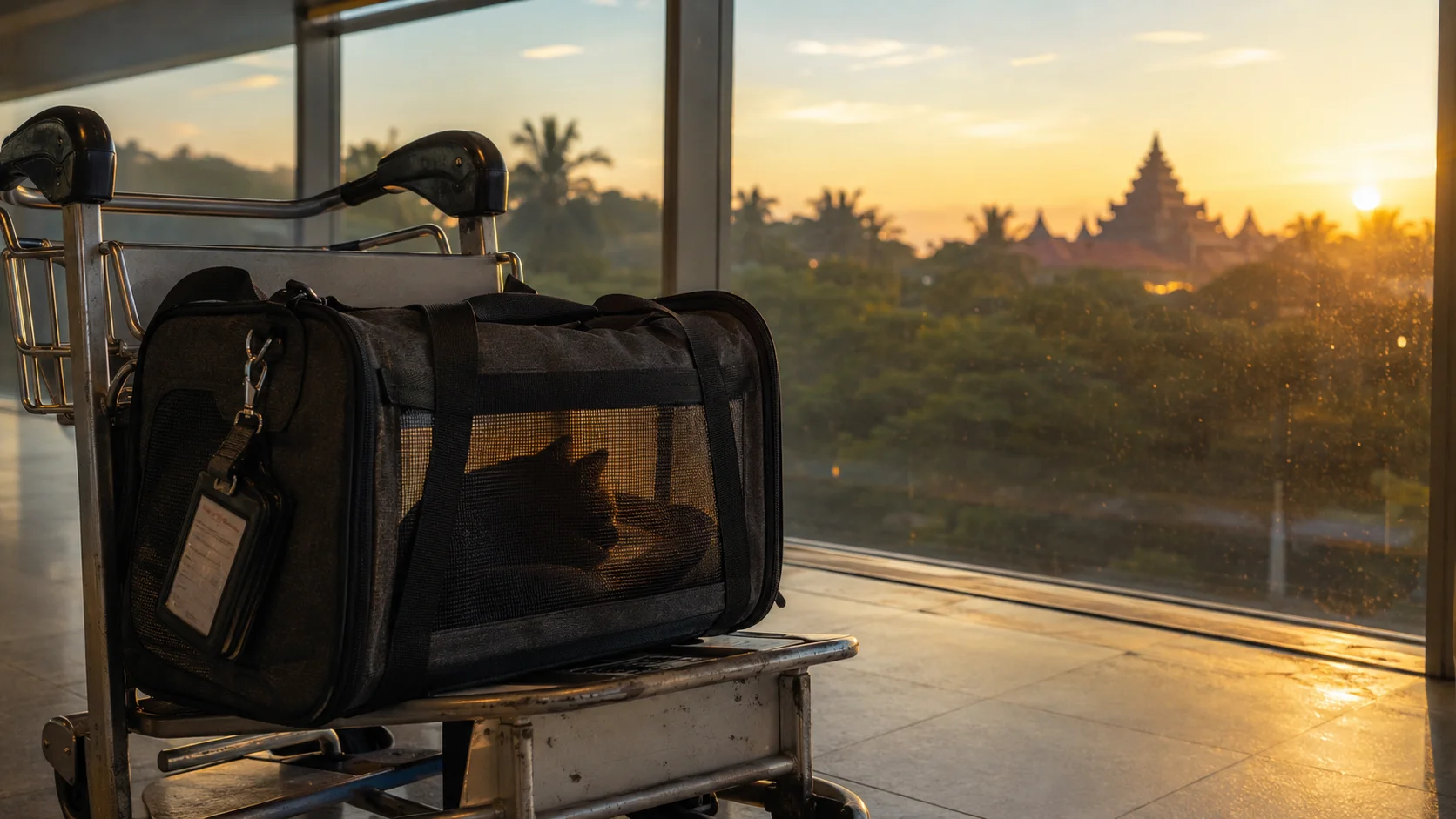
    Pet travel carrier prepared for international relocation, representing the staged journey pets make between Thailand and Australia

    Suvarnabhumi Airport in Bangkok has cargo capacity to Melbourne, Sydney, and every other major Australian gateway. None of those routes can legally carry a dog or cat straight through: not as manifest cargo, not in an owner’s cabin, not aboard a chartered private jet. The obstacle has nothing to do with capacity, weather, or airline policy. It comes down to one line in Australian biosecurity law: Thailand does not appear on the list of countries Australia’s Department of Agriculture, Fisheries and Forestry (DAFF) recognises as safe recent history for an incoming pet.

    That single fact rewrites the relocation plan for anyone moving a cat or dog from Thailand to Australia: expats heading home, Australians who adopted a street dog in Bangkok, families relocating for work. The pet does not fly Bangkok to Melbourne. It flies Bangkok to somewhere else first, lives there for six months under conditions Australia recognises, and only then continues to Australia. Knowing why closes off the shortcuts that waste people’s time and money before they have even booked a flight.

    The Flight Exists. The Legal Pathway Doesn’t

    “Direct flight” and “legal pathway” are two different questions, and mixing them up is where most owners get stuck first. A flight from Bangkok to Sydney is a scheduling and freight-capacity question, and airlines solve that every day for cargo, mail, and manifest freight generally. Importing a live animal into Australia is a biosecurity licensing question, and DAFF decides it, not any airline, freight forwarder, or charter operator.

    DAFF’s import system for cats and dogs does not ask whether a pet can physically reach Australia. It asks whether that specific animal has spent enough of its recent life somewhere Australia trusts to be free of the diseases the country is trying to keep out, principally rabies, which Australia does not have and Thailand does. The country a pet is departing from at the moment of export is the condition DAFF actually checks against its approved list. Thailand is not on it. Once that is true, no logistics arrangement changes it, because the constraint sits in the export country’s classification, not in the aircraft.

    Australia’s Approved-Country System, Explained

    DAFF sorts every country and territory it will accept a pet from into one of three risk tiers, based on that place’s own rabies status and how rigorously it enforces its own animal-health controls:

    • Group 1: countries DAFF treats as effectively rabies-free with tight border control of their own, currently New Zealand, Norfolk Island, and the Cocos (Keeling) Islands. Pets arriving directly from Group 1 skip quarantine entirely.
    • Group 2: a longer list of approved rabies-free or tightly rabies-controlled countries and territories, including Singapore, Japan, Fiji, and Papua New Guinea. Pets from Group 2 need an import permit and a minimum quarantine stay on arrival.
    • Group 3: countries where rabies is present but formally managed, including the United States, the United Kingdom, and most of the European Union. Group 3 pets go through the same import permit process as Group 2, with a longer minimum quarantine stay.

    Thailand sits outside all three groups. That is not an oversight in the paperwork. It reflects that rabies remains endemic in Thailand’s domestic dog population, and DAFF’s approved-country list only expands when a government applies for a formal risk reassessment and is granted it, not automatically as pet-travel demand grows.

    For a pet whose only travel history is Thailand, there is no group to certify the animal from. That is a harder problem than “extra paperwork”: it means no direct import pathway currently exists, which is why the staged route below is the only route that works.

    Why Owner Nationality Doesn’t Matter

    It is a reasonable assumption that an Australian passport should count for something here. It does not. DAFF’s cat and dog import conditions attach to the animal (its vaccination history, its rabies antibody result, and above all the country it has actually been living in), not to the owner’s citizenship, visa status, or how long the family has lived in Thailand. An Australian citizen’s dog gets exactly the same approved-country and 180-day requirement as a Thai national’s dog or a British expat’s dog leaving from the same city. The rule is a disease-risk filter on the animal’s recent geography, and geography does not change because the passport in the owner’s bag is maroon.

    Why an Australian-Born Pet Still Can’t Fly Home Directly

    This is the assumption that catches out the most people, and it is worth stating plainly: a pet that was born in Australia, grew up in Australia, and only later travelled to Thailand with its owner does not get a shortcut back. DAFF’s guidance on pets returning to Australia is explicit that an animal which has visited a non-approved country must be prepared for export from an approved country, the same as any other pet. There is no exception for prior Australian residency, prior Australian export documentation, or an existing Australian microchip record. Once a dog or cat has spent time in Thailand, its next flight cannot be to Australia. It has to be to an approved country first, and the clock resets from there.

    Owners who assumed re-entry would be simpler because the pet is “already Australian” are usually the ones who lose the most time. They discover the 180-day requirement only after their relocation date is already fixed, rather than while there was still room to plan around it.

    What the Staged Route Actually Looks Like

    In practice, the staged route from Thailand to Australia runs through a Group 2 or Group 3 country, most commonly Singapore given its proximity to Bangkok and its Group 2 status. The pet leaves Thailand, is admitted into the staging country under that country’s own import rules, and then lives there, under Australian-recognised conditions, for the full 180-day residency window before its export flight to Australia is booked.

    That means the move happens in two distinct legs with an extended pause between them, not one flight with a stopover. Owners who are also moving their household need to plan the pet’s timeline separately from the container, the visa, or the lease: the pet’s clock is the longest-lead item in the entire relocation, and it is usually the one people start last.

    The 180-Day Rule, in Plain Terms

    The residency requirement is 180 consecutive days in an approved country immediately before export, and DAFF applies it with no exceptions for origin, breed, or owner circumstances. The detail that trips people up is where the clock actually starts: it is not the day the pet lands in the staging country, and it is not the day flights get booked. In Singapore and other Group 2 countries, it starts on the date of the pet’s official identity check; in a Group 3 country, it starts when the pet’s rabies neutralising antibody titre test (RNATT) blood sample arrives at an approved laboratory. Any delay in scheduling that appointment is a delay added directly onto the relocation date.

    Because the 180 days has to be continuous, a pet cannot pop back to Thailand for a visit partway through the staging period without breaking the residency clock and starting again. Owners planning the move should treat the staging period as a genuine one-way relocation for the pet, not an extended holiday with the option of a quick trip home.

    The Paperwork That Makes the Approved-Country Stay Official

    The 180-day stay only counts if it is documented the way DAFF expects. Three pieces carry the weight:

    • Identity verification. The staging country’s competent authority checks the pet’s microchip against its records. In a Group 2 country such as Singapore, this check starts the 180-day clock. In a Group 3 country it has to come before the RNATT blood draw; complete it afterwards and the consequence shows up later, as a longer quarantine stay, not as a rejected form today.
    • The RNATT and its declaration (Group 3 staging only). The blood test confirms the rabies vaccine produced an adequate antibody response, and the result has to be formally declared by a government-approved veterinarian in the country where the test was drawn. In a Group 3 country, this is the document that starts the 180-day clock, per DAFF’s own import permit glossary.
    • The import permit itself. Applied for through DAFF ahead of the planned export date, using the group-specific step-by-step process that matches whichever approved country the pet is staging in.

    None of these three steps can be compressed by paying more for a faster service. They are sequential government checkpoints, not freight logistics, and each one has to be completed correctly before the next can start.

    Melbourne Is the Last Stop, Not the Only One

    Every cat and dog entering Australia from a Group 2 or Group 3 country clears through the same government-run Post Entry Quarantine facility at Mickleham, roughly thirty minutes from Melbourne Airport. After the staging period, that includes pets that started their journey in Thailand. There is no alternative port of entry for live animals into Australia, regardless of which Australian city the family is actually relocating to. A pet flying to a Sydney-based household still lands, quarantines, and clears in Melbourne first.

    The quarantine stay itself runs from a minimum of 10 days for a pet staged in a Group 2 country such as Singapore, and 10 or 30 days from a Group 3 country depending on whether identity verification came before the RNATT. Either way it is driven largely by how cleanly the staging paperwork was completed months earlier. A pet whose documentation is exact typically clears at the shorter end, while any inconsistency in the earlier paperwork tends to push the stay toward the longer end or beyond it.

    Private Jets, Priority Freight, and Other Shortcuts That Don’t Work

    Every relocation agent covering this route eventually gets asked some version of “what if we just charter a plane.” The honest answer is that it does not change anything, because the constraint was never about transport. A private charter, a first-class cabin booking, or a premium pet-freight service can make the physical journey more comfortable, but none of them can issue an Australian import permit, waive the approved-country requirement, or shorten the 180-day residency clock. The people who eventually get their pet home faster are the ones who start the staging-country paperwork earlier, not the ones who spend more on the flight.

    The same applies to “just declaring” the pet as accompanied baggage, routing through a third country for a few days rather than 180, or asking a Thailand-based vet to backdate paperwork. DAFF cross-checks the identity verification date, the RNATT laboratory date where one applies, and the approved-country residency period against each other; a mismatch is a documented reason for a longer quarantine hold, not a route around one.

    Follow the question to where it actually comes from and the pattern gets clearer: the shortcuts that don’t work keep circulating because the businesses profiting from a faster-sounding option have every incentive to suggest one, and no obligation to check whether DAFF’s records-matching would catch it. A premium pet-freight company sells speed and comfort; it does not sell import permits. Nobody selling a private charter is the party who has to explain, months later, why a mismatched lab date triggered an extended quarantine hold that a slower, correctly-sequenced plan would have avoided entirely. The reliable signal is simple: if an option changes when you fly without changing what DAFF checks, it was never actually a shortcut.

    The Decisions to Make Before You Book Anything

    For anyone whose relocation planning has just run into this rule, the useful next steps are the ones that protect the 180-day timeline rather than fight it:

    • Pick the staging country early. Singapore is the default for most Bangkok-based owners on proximity and Group 2 status alone, but the right choice depends on boarding costs, flight frequency back to the pet’s current city, and how long the family’s own visa or lease timeline allows.
    • Start the staging-country paperwork before the move date is fixed, not after. Because the 180 days is a floor and not a target, working backward from a fixed relocation date is the single most common cause of an unplanned extra six months.
    • Decide whether the pet travels on its own timeline. In most households the pet’s approved-country clock runs far longer than the human visa, lease, or job-start timeline, which means the family and the pet frequently arrive in Australia months apart by design, not by accident.
    • Get the identity check right the first time. In Singapore it starts the 180-day clock, and in a Group 3 country its timing against the RNATT has more influence over the eventual Mickleham quarantine length than anything that happens after the pet lands in Australia.

    Families relocating with pets arriving from other origins face a related but different process: SwiftCargo also covers moving pets from the USA to Thailand and moving pets from Europe to Thailand for the reverse direction. The same government risk-tiering that governs pet imports also shapes commercial cargo. SwiftCargo’s guide to Australia’s biosecurity import conditions and the wider product-by-product biosecurity guide both explain how the same DAFF framework applies outside pet imports specifically.

    SwiftCargo’s pet transport team plans the staging-country booking, the RNATT timeline, and the Australian import permit application as one coordinated schedule rather than three separate bookings. Get in touch early, since the biggest cost of this rule is time, not money, and time is the one thing a late start cannot buy back.

    Related reading: Australia’s Pet Import Country Groups Explained

    Frequently Asked Questions

    Can I bring my dog directly from Thailand to Australia?

    No. Thailand is not on Australia’s list of DAFF-approved countries for cat and dog imports, so there is no permit pathway for a pet flying straight from Thailand to Australia, regardless of airline, cabin class, or charter arrangement. The dog must first complete at least 180 consecutive days of residence in an approved Group 1, 2, or 3 country before it can be exported to Australia.

    Can I bring my cat directly from Thailand to Australia?

    No, for the same reason as dogs. Australia’s import rules for cats and dogs both run on the same country-approval and 180-day residency system, and Thailand sits outside all three approved groups. A cat leaving Thailand needs the same staged approved-country stay before it is eligible for export to Australia.

    Does it matter if my pet or I am an Australian citizen?

    No. DAFF’s import conditions attach to the animal’s disease-risk history, not to the owner’s or the pet’s nationality. An Australian citizen’s pet and an Australian-born pet both face the identical approved-country and 180-day requirements as any other animal leaving Thailand. There is no citizenship-based exemption in the current policy.

    Why isn’t Thailand an approved country for pet imports to Australia?

    DAFF’s country groupings are based on each country’s own rabies status and animal-health surveillance systems. Rabies is present in Thailand’s domestic dog population, so it does not meet the criteria applied to Group 1, 2, or 3 countries. A country moves onto the approved list only after its government applies for a formal DAFF risk assessment and is granted approval. It does not happen automatically as travel demand increases.

    How long does a pet have to stay in the staging country?

    A minimum of 180 consecutive days of residence in an approved country immediately before export, with no exceptions. In a Group 2 country such as Singapore, the clock starts on the date of the pet’s official identity check; in a Group 3 country, it starts when the rabies neutralising antibody titre test (RNATT) blood sample reaches an approved laboratory. It is not the day the pet arrives in the staging country or the day the flight is booked.

    Can a private jet or charter flight skip the approved-country requirement?

    No. The constraint is a biosecurity import permit issued by the Australian government, not a transport limitation. No airline, freight forwarder, or charter operator can issue that permit or waive the underlying country-approval and residency rule, regardless of how the pet travels or what it costs.

  • Shipping Electronics and Your Home Office to Thailand: The Remote Worker’s Guide

    Shipping Electronics and Your Home Office to Thailand: The Remote Worker’s Guide

    The setup took four years to assemble. Three 27-inch monitors on a gas-spring triple arm, a tower with a GPU that cost more than the first car its owner ever drove, a sit-stand desk that remembers two height presets, and a Herman Miller Aeron bought secondhand from a startup liquidation in Kreuzberg. Now there is a Destination Thailand Visa approval PDF in the downloads folder, a lease ending in Berlin in nine weeks, and one genuinely difficult question: which parts of this battlestation deserve a sea voyage, and which should be sold, carried, or rebought on the other side?

    Open wooden crate holding a bubble-wrapped monitor, foam padding, and coiled cables packed for shipping electronics.

    Think of Your Setup as Three Tiers, Not One Shipment

    The single most useful mental model: your home office is not one thing. It is three tiers with completely different logistics profiles.

    Tier one: flies with you. Laptop, phone, power banks, backup drives, and anything containing a lithium battery. This tier is not optional: the battery rules covered below make it mandatory. It is also your work-continuity insurance, because it means you can earn from day one in Thailand regardless of what the container is doing.

    Tier two: ships by sea. Monitors, the desktop tower (drives removed), mechanical keyboards, microphones, audio interfaces, monitor arms, the premium chair, cable spaghetti in labelled bags. This is the bulk of the value and the bulk of the volume, and it tolerates a 6–10 week transit because tier one keeps you working in the meantime.

    Tier three: sell or rebuy. Cheap desks, budget chairs, UPS units, surge strips, most furniture-grade items where Thai retail prices are equal or lower and shipping cost per kilo exceeds replacement cost. Sentiment aside, an ocean crossing is an expensive thing to give a AUD 180 desk.

    Sort the tiers wrong and you either pay to ship things you should have sold, or arrive to discover your income-critical gear is six weeks out at sea.

    What Ships Well: The Item-by-Item Breakdown

    Monitors

    Monitors ship well but claim badly. The panel is the vulnerability: a cracked LCD or OLED panel is effectively a written-off monitor, and cracked panels are the single most common electronics claim in household shipments. The problem for the owner is evidential. A hairline panel crack often shows no external box damage at all, and the impact that caused it may have been a compression load rather than a drop, which makes the claim harder to attribute and slower to settle. Prevention beats litigation here.

    If you kept the original boxes with their moulded foam end-caps, use them; they were engineered for exactly this journey. If not, double-box: wrap the monitor in a soft layer (no bubble wrap directly against the panel, because the nubs can pressure-mark some coatings), add rigid corner protection on all four corners, place it in a snug inner box, then float that inner box inside a larger outer box with 5+ centimetres of cushioning on every face. Mark it fragile, keep it vertical, and photograph the working screen (with the date visible on-screen) before packing. That photo is your condition evidence if a claim is ever needed.

    Desktop PCs

    Towers travel better than most people fear, with three preparation disciplines.

    Drives. Back up everything to the cloud and to at least one portable drive that flies with you, then ideally remove the drives from the tower entirely. NVMe sticks and 2.5-inch SSDs are small, robust, and carry your entire digital life; there is no reason for them to spend two months in a container when they fit in a jacket pocket. If the tower is lost or crushed, hardware is replaceable. Un-backed-up data is not. Do the backup before the packers arrive, not the night before: a full backup of a multi-terabyte workstation takes longer than people expect.

    The GPU. Modern graphics cards are heavy, with some flagship cards exceeding two kilograms, and they hang cantilevered off a PCIe slot designed decades ago for cards a fraction of that mass. Weeks of vibration in transit can crack the slot or the card’s own PCB. Either remove the card and pack it separately in its original anti-static box, or brace it in place: an anti-sag bracket, or the time-honoured method of filling the case’s internal voids with closed-cell foam so nothing can flex. Expanding packing air pillows inside the case work in a pinch. An unbraced flagship GPU in a shipped tower is a claim waiting to happen.

    Water cooling. An all-in-one (AIO) cooler is sealed and travels fine as-is. A custom loop must be drained completely before shipment. Coolant sloshing through a container’s temperature swings, against fittings that were hand-tightened at a desk in a heated flat, is how you get a tower that arrives internally rained-on. Drain the loop, leave fittings cracked open to vent, bag the tower in plastic against humidity, and plan to refill with fresh coolant in Thailand, since concentrate travels and pre-mix is mostly water and not worth its weight.

    Keyboards, Peripherals and the Small Stuff

    Mechanical keyboards, mice, webcams, microphones, audio interfaces, stream decks, monitor arms and desk mounts are the easy category: dense, robust, high value-per-kilo, and often bought at prices Thai retail will not match. Ship all of it. Bag and label cables by device. Future-you, unpacking in a Bangkok condo at 34 degrees, will be grateful. The only caveat is wireless peripherals with built-in lithium batteries; small embedded cells in a mouse are a different risk class from loose power banks, but if you can carry the wireless gear and ship the wired, do so.

    The Sit-Stand Desk Question

    This one is a genuine calculation rather than a rule. The electronics are not the problem: sit-stand desk motors and control boxes sold in Europe, the UK and Australia are built for 220–240V and run happily on Thai power; even most US-market desks use universal-input control boxes, though check the label. The problem is mass. A quality sit-stand frame plus desktop runs 30–50 kilograms of awkward, dense freight.

    Against that, weigh Thai availability. Bangkok has IKEA (two large stores in the metro area), plus local and regional brands selling electric sit-stand desks at prices broadly comparable to, and sometimes below, European retail. A mid-range desk is straightforwardly replaceable for THB 8,000–15,000 (roughly AUD 350–650). The honest calculus: if your desk is a premium unit with a desktop you love, and it is going into a shared container where marginal volume is cheap, ship it disassembled with the hardware bagged and taped to the frame. If it is an entry-level desk, or you are paying by volume on a tight groupage rate, sell it and rebuy in Bangkok during your first week. Shipping a cheap desk across an ocean is the most common furniture mistake in this category of move.

    Ergonomic Chairs: The Herman Miller Calculus

    Premium chairs invert the desk logic. A Herman Miller Aeron or Embody, a Steelcase Leap or Gesture, retails in Thailand for substantially more than in the US, UK or Australia, and the secondhand market for them is small. A chair you could replace at home for AUD 1,800 might cost the equivalent of AUD 2,500–3,000 to source in Bangkok, if the model and size you want is in stock at all. Meanwhile its share of a groupage shipment is typically AUD 150–300. For premium chairs, ship: remove the base and arms if the design allows, bag the castors, and wrap the mesh or upholstery against abrasion.

    Mid-range chairs flip back the other way. The THB 5,000–12,000 segment in Thailand is well served by regional brands, and a AUD 300 chair does not justify AUD 200 of freight plus the risk of transit damage. Buy local, and treat it as an upgrade opportunity.

    Voltage, Plugs and the Thai Grid

    Thailand runs 220V at 50Hz. For a modern IT setup this is almost a non-event: laptop chargers, monitor supplies, PC PSUs, docks, routers, NAS units and console power bricks are nearly all universal-input, marked 100–240V, 50/60Hz on the label. Check each label once, which takes ten minutes for a whole office, and anything marked 100–240V needs only a plug solution, not a transformer.

    The plug question has two answers. Thai sockets are hybrid types that accept flat two-pin (US-style) and round two-pin (Euro-style) plugs, with three-pin earthed variants common in newer buildings. Option one is adapters: fine for travel, mildly annoying permanently, and each adapter is one more loose connection in the chain. Option two, better for a permanent setup, is replacing the detachable power leads. Most IT gear uses standard IEC C5, C7 or C13 leads, and Thai-plug versions of all three cost a couple of hundred baht each at any electronics mall or online. Replace the leads, keep the originals in a drawer, and your desk has no adapters in it at all.

    UPS units deserve their own paragraph. A UPS is a box built around a large battery, and that shapes both the shipping and the buying decision. Lead-acid UPS batteries are heavy, age poorly, and while sealed lead-acid is less restricted than lithium, an old UPS is often near battery replacement anyway, so shipping one frequently means paying freight on a battery you will replace within a year. Lithium-based UPS models are squarely inside the dangerous goods rules discussed below. And a 110V-only US-market UPS will not run on Thai power at all. The practical answer for most movers: sell or recycle the UPS at origin and buy one in Thailand, where 220V models are cheap and plentiful.

    And you will want one. This is the part of Thai power that actually matters: not voltage, but stability. Brownouts, momentary outages during tropical storms, and voltage sags in older buildings are a routine part of the wet season in much of the country. A remote worker whose income depends on a desktop PC should treat a UPS plus a decent surge protector as day-one purchases, not eventual upgrades. Arriving with a AUD 4,000 workstation and plugging it straight into a bare wall socket ahead of storm season is one of the classic mistakes in the closing section of this article.

    Lithium battery drawer packing for shipping home office electronics to Thailand

    The Lithium Battery Layer: The One Non-Negotiable

    Whether in laptops, phones, tablets, power banks, camera batteries, drone packs, cordless tool batteries or e-reader and headphone cells, lithium batteries are classified dangerous goods in both air and sea transport. A damaged or defective lithium cell can enter thermal runaway, and a fire in a sealed container at sea has no fire brigade coming. The industry rules exist for that reason, and the rule for private shippers is simple:

    Lithium batteries do not go in your sea freight. Ever. Undeclared lithium in a household goods container is the big no. It is not a grey area or a “everyone does it” zone: it can void your marine insurance for the entire shipment, expose you to penalties, and in the worst case contributes to exactly the kind of container fire that keeps rewriting the rulebook. Reputable forwarders and origin packers will ask; answer honestly and pull the items.

    The correct home for lithium is with you on the plane, in the cabin. Airline rules, which follow the IATA Dangerous Goods Regulations, put devices with installed batteries (laptops, phones, tablets) in either cabin or checked baggage, with cabin preferred, but require spare batteries and power banks in carry-on only, terminals protected against short circuit. Quantity limits apply: power banks up to 100Wh (the overwhelming majority of consumer units) are generally fine in reasonable personal quantities, typically capped around 15–20 devices depending on the airline; 100–160Wh units usually need airline approval and are limited to two; above 160Wh does not fly as baggage at all. Check your specific airline’s published limits before you fly with a drawer full of power banks.

    The strategy that falls out of this: consolidate. Sell or give away surplus power banks and orphaned batteries before the move. Fly with the batteries you actually use: laptop, phone, one or two power banks, camera batteries in their cases. If something battery-powered genuinely cannot fly with you (an e-bike battery, a large tool ecosystem), it must move as declared dangerous goods with a forwarder licensed to handle them, priced accordingly. For consumer gear that price almost always says “sell it and rebuy.”

    Planning Around the Gap: Work Continuity and Thai Internet

    Sea freight from Europe, the UK or Australia to Thailand takes roughly 6–10 weeks door to door once transit, consolidation, customs clearance and delivery are counted. A remote worker cannot treat that as downtime, so the plan writes itself: fly with a core kit that constitutes a complete, if minimal, working office, and let the container carry the comfort.

    The core kit that works for most people: laptop, its charger, a dock or USB-C hub, backup drives, one monitor if feasible (a lightweight portable USB-C monitor travels easily, or a carefully packed 24–27-inch panel can fly as checked baggage in a hard case if you accept the risk), plus keyboard, mouse, and headset. That kit fits in a carry-on plus one checked bag and supports full-time work from day one. The battlestation, meaning the other two monitors, the tower, the arms and the chair, rides the sea. If the tower itself is income-critical (3D rendering, video editing, ML workloads), consider air freighting just the tower and working from cloud instances or the laptop until it lands; air freight on a single 15-kilogram box is a defensible business expense against six weeks of lost capability.

    On arrival, internet is the other half of continuity. Thailand’s urban fibre is genuinely good, with gigabit-class plans in Bangkok, Chiang Mai and the major provincial cities costing a fraction of equivalent Western plans, but installation is not instant. A new fibre install to a house or a condo without an existing drop typically takes several days to a couple of weeks depending on provider workload and building wiring, and condo buildings sometimes limit which providers service them, so ask the building office before signing anything. Bridge the gap the way Thai residents do: an unlimited-data SIM or a 5G home-broadband box will comfortably carry video calls for the first fortnight. No single provider is the right answer for every building or province, so the durable advice is simply to sort the fibre appointment in week one, not week four.

    Sea freight is priced on the volume left once the core kit flies, so an estimate against your real boxed volume is what turns a shipping plan into a budget.

    Customs: How Thailand Treats a Shipped Home Office

    Used personal electronics arriving as part of a household goods shipment are assessed under Thai Customs’ personal effects framework. The working principles that matter for a home office:

    The ownership test. Thai Customs’ concessions for used household effects centre on items owned and used for a reasonable period, with the commonly applied benchmark around one year, imported in connection with a genuine change of residence and within the eligible window around your arrival: no more than a month before the qualifying entry, and within six months after it. Gear that is clearly used, configured, and consistent with one person’s home office fits this picture naturally. Note that duty-free personal effects treatment is tied to eligibility rules that not every visa category satisfies automatically; even where duty is assessed on electronics, it is assessed on depreciated used value, not what you paid new. Budget for the possibility rather than being surprised by it, and see our duty-free Thailand import guide for the framework in detail.

    The quantity question. Customs officers pattern-match. One laptop, three used monitors of different ages, one tower, one printer: a home office. Six sealed identical monitors or four current-generation laptops: commercial quantity, and the burden shifts to you to explain why this is not merchandise. If your legitimate setup is unusually large, and some developers and traders genuinely run four or six screens, support it with evidence: dated purchase invoices, photos of the equipment installed and in use at your origin home, and a packing list with serial numbers. Honest, specific declarations clear; vague ones invite inspection.

    New-in-box is new goods. The temptation before a move is to buy the upgrades now, the new monitor and the new GPU, and ship them with everything else. Understand the consequence: new, unused, boxed goods are not used personal effects and are dutiable as ordinary imports regardless of what surrounds them in the container. If you buy pre-move, unbox it, set it up, use it for real, keep the invoice, and ship it as what it now is: your used equipment. Shipping sealed retail boxes and declaring them as personal effects is misdeclaration, and it is exactly what inspection regimes exist to catch.

    Insuring a High-Spec Setup Properly

    Standard household transit insurance treats “electronics” as a line item. A remote worker’s office needs better than that, because the value is concentrated: a single tower can carry AUD 4,000–6,000 of components inside an anonymous black case.

    Three practices make the difference between a smooth claim and an argument. First, an itemised schedule: list every significant item separately with make, model, serial number and declared value, rather than lumping “computer equipment” at a round figure. Second, photographic condition evidence: each item working, powered on where relevant, photographed before packing, with serials legible. Third, the valuation basis: indemnity or depreciated-value policies pay the used market value of your three-year-old GPU, which may be a fraction of replacement cost; agreed-value or replacement-cost cover costs more in premium but pays what it actually costs to rebuild the machine. For a high-spec build, agreed value on the schedule’s key items is usually worth it. For the general framework of general average, valuation methods and claim mechanics, see our full guide to cargo insurance for Thailand shipping. And note the interaction with the battery rules above: undeclared dangerous goods in your shipment can void cover for everything, which turns one forgotten power bank into an uninsured container.

    The DTV Context

    Thailand’s Destination Thailand Visa (DTV) gives remote workers and digital nomads a five-year multi-entry framework, and its holders are precisely the people moving battlestations instead of suitcases. Nothing about the DTV changes the logistics here, because the lithium rules, the voltage facts and the packing physics are identical for every visa, but the customs eligibility questions around personal-effects concessions and import windows do interact with visa category and length of stay, and DTV holders should read the specifics in our DTV holder’s guide to shipping belongings to Thailand before assuming any particular duty outcome. The ownership and honest-declaration principles above apply the same either way.

    Worked Example: Ship the Battlestation or Fly Core and Rebuy?

    Take a representative setup, Berlin (or equally, Melbourne) to Bangkok: three 27-inch monitors, a high-spec tower, a sit-stand desk, a Herman Miller Aeron, mechanical keyboard, microphone and boom arm, monitor arms, and a box of peripherals and cables. Call the replacement value AUD 9,500 and the used value AUD 5,800. Two strategies:

    Strategy A, ship the full office (groupage sea freight). Volume around 1.5–2.0 cubic metres once the desk is disassembled and the monitors boxed. In a shared container with professional packing, budget roughly AUD 900–1,400 for that volume’s share of freight and handling, plus AUD 150–250 for agreed-value insurance on an itemised schedule, plus modest packing materials. Say AUD 1,100–1,700 all-in, with a 6–10 week gap bridged by the flown core kit. Duty exposure: minimal to none if everything is genuinely used, owned over a year, and eligibility criteria are met. Outcome: your exact chair, your exact desk height presets, your exact machine, roughly THB 25,000–38,000 in total cost.

    Strategy B, fly the core and rebuy the rest in Bangkok. Fly with laptop, drives, dock, keyboard and one portable monitor (excess baggage cost roughly AUD 100–200). Rebuy in Thailand: two decent 27-inch monitors at THB 7,000–9,000 each; a sit-stand desk at THB 10,000–15,000; the chair is the pain point, because a comparable premium ergonomic chair runs THB 60,000–75,000 new in Thailand, or you compromise on a regional brand at THB 12,000–20,000; monitor arms and sundries, THB 5,000. With the chair compromise, Strategy B lands around THB 45,000–60,000 (AUD 2,000–2,600) and you have a working full office within days. Matching the original chair like-for-like pushes it past THB 100,000 (AUD 4,400+), roughly triple Strategy A.

    The verdict most setups reach: a hybrid. Ship the chair, the tower and anything premium or beloved (Strategy A logic wins on high value-per-kilo items); sell the cheap desk and budget peripherals and rebuy locally (Strategy B logic wins below the price floor where Thai retail is competitive); fly everything with a battery and everything income-critical. The worked numbers also show why the desk question and the chair question resolve oppositely: the desk is cheap to replace and expensive to move; the chair is expensive to replace and cheap to move. For broader context on the container itself, see our guide to shipping household goods to Thailand, and if part of your kit cannot wait for the sea, air freight to Thailand covers the fast lane.

    The Five Mistakes That Actually Happen

    1. Lithium in the container. The forgotten power bank in a desk drawer, the drone in its case, the cordless drill with its battery clicked in. It voids insurance, breaches dangerous goods rules, and is entirely preventable with one dedicated sweep: before the packers arrive, walk the office and physically remove everything containing a battery into a “flies with me” box.

    2. No backup before the drives ship. If the tower goes into the container with its drives installed and no verified backup exists elsewhere, you have wagered your entire digital working life on a container’s safe arrival for the price of skipping one weekend chore. Back up twice, to the cloud and to a carried drive, and verify the backup restores before anything is packed.

    3. Shipping a cheap desk across an ocean. Freight cost above replacement cost is the definition of a bad shipping decision, and the AUD 180 desk paying AUD 250 in freight is its purest form. Run the number per item; sentiment gets a vote, but it should know what it costs.

    4. No surge protection on arrival. The workstation lands, the desk goes up, and the tower gets plugged into a bare wall socket in October, storm season. Buy the surge protector and the UPS in week one, before the container arrives, so protection is waiting for the gear rather than the other way around.

    5. Sealed boxes declared as personal effects. The pre-move shopping spree shipped in retail packaging is the customs mistake that converts a routine clearance into an assessment and, at worst, a misdeclaration problem. Unbox, use, keep invoices, declare honestly.

    We price the sea leg of a home office move to Thailand.

    Our team prices your lane against shipments we have already run and sends a free estimate, so Strategy A stops being a range you guessed at.

    Price your Thailand shipment

    Related Reading

    Frequently Asked Questions

    Can I ship a desktop PC to Thailand by sea freight?

    Yes, and it usually arrives fine if prepared: back up everything and carry the drives with you, brace or remove a heavy GPU so it cannot flex against its slot, drain any custom water-cooling loop, and pack the tower double-boxed with proper cushioning. A tower owned and used for over a year is generally treated as used personal effects by Thai Customs.

    Can lithium batteries go in a sea freight container to Thailand?

    Not undeclared, ever. Laptops, phones, power banks and any spare batteries fly with you, spares and power banks in the cabin specifically, per IATA Dangerous Goods Regulations as applied by airlines. Undeclared lithium in a container can void your insurance for the whole shipment. Anything that truly cannot fly with you must move as declared dangerous goods, which for consumer items rarely makes financial sense versus rebuying.

    Will my monitors and computer equipment work on Thai power?

    Thailand is 220V/50Hz, and nearly all modern IT gear is universal-input 100–240V, so check each device’s label to confirm. You then only need plug adapters or, better, replacement IEC power leads with Thai plugs. The genuine exceptions are 110V-only UPS units and motorised devices without universal input.

    Is it worth shipping a premium ergonomic chair to Thailand?

    For a genuine premium chair (Herman Miller, Steelcase and peers), usually yes: Thai retail prices for these brands run well above Western prices and the selection is thin, while the chair’s share of a shared container is modest. Mid-range chairs are better sold at origin and rebought in Thailand, where that segment is well covered locally.

    Will Thai Customs question multiple monitors or laptops?

    Quantity and condition drive the assessment. A few used screens of mixed ages read as a home office; multiples of identical new-in-box units read as commercial goods. Declare honestly, keep invoices and dated photos with serial numbers, and unbox and use anything bought shortly before the move.

    How long will I be without my full setup?

    Budget 6–10 weeks door to door for sea freight including clearance and delivery. Fly with a core working kit (laptop, dock, drives, one monitor if feasible) so your income never depends on the container, and book your Thai fibre installation in your first week to close the connectivity side of the gap.

  • Freight Forwarders Move Cargo; Customs Brokers Clear It Through the ABF

    Freight Forwarders Move Cargo; Customs Brokers Clear It Through the ABF

    A freight forwarder and a customs broker do fundamentally different jobs, and whether you need one, the other, or both depends on how much control you want over customs risk.

    Somewhere right now, an importer is discovering that the company moving their container never planned to clear it through customs. The container has arrived in Melbourne. It is sitting at the wharf. The forwarder’s job, as the forwarder sees it, is done. The importer assumed “freight forwarding” meant “everything until the goods reach my warehouse.” Nobody lied. The two parties simply meant different things by the same words.

    This confusion is not a fringe problem. “Freight forwarder” and “customs broker” get used interchangeably in casual conversation, in sales calls, and sometimes, unhelpfully, in the marketing copy of companies that do both. The result is that importers routinely buy the wrong service, or half a service, and only find out when a shipment is stuck.

    Warehouse split between an open loading dock with a truck and a secured, caged storage area.

    Why the Confusion Exists in the First Place

    Three things blur the boundary.

    First, most freight forwarders in Australia offer customs brokerage as part of their service, either through licensed brokers on their own payroll or through a partner firm they subcontract to. From the customer’s side, one company appears to do everything, so the roles collapse into one word: “my forwarder.”

    Second, the two roles touch the same shipment, the same documents, and often the same deadline. The commercial invoice your supplier issues feeds both the forwarder’s booking and the broker’s declaration. When the same PDF flows to both parties, it is easy to assume they are the same party.

    Third, industry jargon does not help. “Clearance,” “agent,” “customs agent,” “shipping agent,” “logistics provider”: these terms get thrown around loosely, and some of them mean different things in different countries. In Australia, though, the legal distinction is sharp, and it matters, because one of these roles is a licensed profession and the other is not.

    The forwarder moves the goods; the broker clears them. One deals with carriers. The other deals with the government.

    What a Freight Forwarder Actually Does

    Think of a freight forwarder as the general contractor of the physical move. Forwarders rarely own the ships or aircraft that carry your cargo, just as a building contractor rarely pours their own concrete. Their value is architecture: designing the route, buying capacity from the companies that do own the assets, and coordinating every handoff from your supplier’s loading dock to your door.

    That breaks down into six jobs.

    Carrier booking and rate negotiation. Forwarders hold contracts with ocean carriers and airlines, and because they aggregate volume across many customers, they buy space at rates an individual importer could not touch. When you accept a quote, the forwarder books the vessel or flight and manages the carrier relationship, including the less glamorous parts, like rebooking when a sailing is blanked or a flight is bumped.

    Origin pickup and consolidation. The forwarder’s overseas office or agent collects the goods from your supplier, or receives them at a warehouse. If you are shipping less than a container load, this is where consolidation happens: your cargo is grouped with other importers’ freight into a shared container, which is what makes LCL economics work.

    Export formalities at origin. Before goods leave China, Vietnam, Germany, or anywhere else, the exporting country’s paperwork must be done: export declarations, any origin-side inspections, and the handover documentation the carrier requires. The forwarder’s origin agent handles this. Note the asymmetry: forwarders routinely handle export customs at origin as part of the freight service, which further muddies importers’ expectations about who handles import customs at destination.

    The main leg. Ocean or air, port to port or airport to airport. The forwarder tracks the shipment, manages transhipments, and issues its own transport document, a house bill of lading or house air waybill, which is your title and tracking reference for the move.

    Arrival coordination. When the vessel berths or the flight lands, the forwarder’s destination office receives the cargo notification, manages the deconsolidation of shared containers, and coordinates timing between the terminal, the transport company, and, critically, whoever is doing the customs clearance.

    Delivery cartage. The final truck leg from wharf or airport to your premises, usually subcontracted to a local transport company but arranged and scheduled by the forwarder.

    Import customs clearance is not on that list. A freight forwarder is not automatically clearing your goods through Australian customs unless clearance is explicitly part of what you bought. Many forwarders will do it through their in-house brokers or a partner, but it is a distinct service line, separately priced, and it does not happen by default. If your booking confirmation does not name a party responsible for the import declaration, assume nobody is doing it, and ask. We cover what to look for in a provider in our guide to choosing a freight forwarder in Australia.

    What a Customs Broker Actually Does

    If the forwarder is your interface to the transport industry, the customs broker is your interface to the government. Everything a broker does exists because the Australian Border Force (ABF) requires certain things to happen before imported goods can legally enter home consumption, and because getting those things wrong is expensive.

    Tariff classification. Every product entering Australia must be classified under the tariff: a code that determines the duty rate, whether a free trade agreement applies, and whether permits are needed. Classification sounds mechanical and is anything but. Is a smartwatch a watch or a communication device? Is a marinated chicken product “meat” or a “prepared food”? These distinctions can swing duty from zero to five per cent or more, and they are the core intellectual skill of the profession. If you want to see how deep this rabbit hole goes, our guide to HS code classification for Australian imports walks through it.

    Valuation. Duty is calculated on the customs value of the goods, and determining that value is a legal exercise: which costs count, how related-party pricing is treated, how discounts, royalties, and assists are handled. The broker establishes a defensible customs value, one that survives an ABF audit.

    Duty and GST calculation. From classification and valuation flow the numbers: import duty at the applicable rate, GST at 10 per cent on the value of the taxable importation, and any other charges. The broker calculates these, advises whether a free trade agreement reduces or eliminates duty, and can set up GST deferral for eligible importers so tax is accounted for on the activity statement instead of paid at the border.

    Lodging the import declaration. The formal act: an electronic declaration to the ABF stating what the goods are, what they are worth, and what is owed. The broker lodges it in your name, responds to any queries or holds the ABF raises, and sees the entry through to release.

    Permits and biosecurity. Many goods need more than a customs entry. Food, timber, plant and animal products, some machinery, and anything with soil or organic residue triggers biosecurity requirements: lodgements, inspections, sometimes treatment. Other goods need import permits. The broker identifies these requirements before the goods ship, which is the only time identifying them is cheap.

    Refunds, drawbacks, and concessions. The retrospective work: recovering duty overpaid through misclassification, claiming duty drawback on goods that are re-exported, and pursuing Tariff Concession Orders, instruments that remove duty on goods with no Australian manufacturer. For established importers, a sharp broker’s concession work can be worth far more than their declaration fees.

    One more thing, and it is not a detail. Customs brokerage in Australia is a licensed profession. Individual brokers must be licensed under Part XI of the Customs Act 1901, and earning that licence requires formal study of customs law, tariff, and valuation, plus relevant experience. When a broker lodges a declaration, they act as your legal representative to the government, and errors carry consequences for you and for their licence. There is no equivalent licence for freight forwarding. Anyone can call themselves a forwarder tomorrow. Nobody can call themselves a customs broker without the ABF’s say-so. That asymmetry tells you something about how the two roles are regarded in law.

    Overlap and Bundling: One Company or Two?

    So far, clean separation. In the market, the picture is messier. Most Australian forwarders of any size offer customs brokerage, either with licensed brokers on staff or via a standing arrangement with a brokerage firm. You get one quote, one invoice, one point of contact, and the phrase “door to door, customs cleared” on the proposal.

    The case for bundling rests on one word: accountability. When the same company books the freight and lodges the declaration, there is no handoff gap. The documents the broker needs are already inside the building. Timing coordination between vessel arrival and clearance happens between colleagues, not between companies. And when something goes wrong, there is exactly one phone number to call and no possibility of two providers pointing at each other. For most importers, and for nearly all importers on their first several shipments, this is decisive.

    The case for separation is sharper than most people expect, and it applies in three situations. First, complex classification: if your product sits in genuinely ambiguous tariff territory, or a classification ruling could be worth six figures a year to you, you want a broker chosen purely for expertise in your category, not whichever broker happens to work for your forwarder. Second, high volume: an importer lodging hundreds of declarations a year has real negotiating power on brokerage rates, and can only use it if brokerage is priced on its own rather than folded into a freight bundle. Third, independence: a standalone broker has no incentive to smooth over a forwarder’s document delays, and their advice on duty minimisation is not entangled with someone selling you freight.

    An inversion test makes the decision easier. Do not ask “should I bundle?” Ask “what would make bundling a mistake for me?” If your goods are ordinary, your volumes modest, and your priority is that shipments simply arrive without drama, none of the separation arguments apply, and bundling is correct. If any of the three do apply, take brokerage out of the bundle and buy it on its own merits.

    Whichever you choose, ask one question before signing: is the brokerage in-house or subcontracted? Both can work. But if it is subcontracted, you are already running a two-company handoff. You just were not told, and you should know who the second company is and hold your forwarder accountable for managing them.

    A stalled container illustrating where handoffs fail between freight forwarder and customs broker

    Where Handoffs Fail (And Who Pays)

    Nearly every customs-related disaster in ordinary importing is a handoff failure. Not incompetence, not fraud, but a task falling into the gap between two parties who each assumed the other had it. Two patterns account for most of the damage.

    Failure one: the documents arrived late because everyone assumed someone else sent them. A broker cannot classify, calculate, or lodge without the commercial invoice, the packing list, and the bill of lading. Those documents originate with your supplier and typically travel through the forwarder. When you use separate providers, there is a specific, boring, catastrophic question with no default answer: who sends the documents to the broker, and by when? The forwarder assumes the importer engaged the broker directly and is feeding them documents. The importer assumes the forwarder passes everything along, since the forwarder has it all anyway. The broker sits waiting, unaware a vessel is four days out. Nobody is wrong about their own role. The shipment is stuck anyway.

    Failure two: the clearance delay each side blames on the other. A container that cannot leave the terminal starts generating storage charges within days, and if it ties up the shipping line’s container past the free period, demurrage and detention on top. These fees accrue daily and stop for no one’s excuses. Now the forwarder says the broker lodged late; the broker says the documents came late; and the invoice for the wharf storage lands on you, because you are the importer and these costs are always, ultimately, the importer’s. Fault is genuinely unclear, which is exactly why relying on after-the-fact fault-finding is a losing strategy.

    The fix for both is the same and costs nothing: settle accountability before shipment one. In writing, however brief: who transmits documents to the clearing party, by what deadline relative to arrival, who monitors the vessel schedule, and who pays storage if clearance runs late for a reason within a provider’s control. Providers who handle this well agree readily. Providers who get vague when you raise it are telling you how the blame conversation will go later.

    One Move Manager at Swift Cargo books the freight and lodges the declaration, so on your next import you can hand both jobs to a single team.

    How Each One Gets Paid

    The forwarder earns in two layers. The first is freight margin: the forwarder buys space from carriers at wholesale rates and sells it to you with a markup, which is invisible on your invoice, where you simply see a freight rate. The second is the fee schedule: itemised charges for documentation, handling, origin services, delivery, and a dozen other line items that vary by forwarder. The practical consequence is that a forwarder’s quote is hard to compare line-by-line against another’s, because the margin hides in different places. Where exactly these costs live is dissected in our breakdown of freight pricing for Australian imports.

    The broker earns fees for professional work, more like an accountant than a transport company. Expect roughly AUD 150–400 per import declaration for a straightforward entry, with the range driven by shipment complexity and the number of tariff lines. Complex work (classification advice, valuation questions, refund and drawback applications, TCO research, audit support) is typically billed hourly. Duty and GST are never the broker’s money; they pass through to the ABF.

    Where do margins hide in a bundle? In the aggregation. A bundled “customs clearance” line on a forwarder’s invoice may carry a margin over what the in-house or subcontracted broker actually costs, and ancillary charges, document handling fees on both the freight and clearance side, can quietly double up. None of this makes bundling bad. It makes itemisation worth requesting. A provider confident in its pricing will show you the lines.

    Here is something that seems backwards about all of this. Most importers engage a broker believing they are moving risk off their own books. They are not. Under the Customs Act the importer carries the legal responsibility for the accuracy of the declaration, whoever actually lodged it. A misclassification surfaced in an ABF audit three years later produces a demand addressed to you, not to the broker who typed the tariff line. Read the broker’s own terms of engagement and the point sharpens, because liability there is typically capped at a figure tied to the fee for the job, which on a 250 dollar declaration is not a sum that absorbs a duty reassessment. So what is the engagement actually buying? Competence, and the documented reasoning that competence leaves behind, which is genuinely valuable and is a different thing from indemnity. Worth asking which of the two you assumed you were paying for.

    So, Do You Need Both?

    Both functions, almost always: goods must be moved and goods must be cleared. The real question is how to buy them. It depends on which of four importer profiles you fit.

    Personal effects and household moves. Bundled, almost without exception. Personal effects have their own concessional customs treatment, the values are modest, and specialist movers run this as a single integrated service. Splitting providers here adds coordination risk and saves nothing.

    First commercial import. Bundled, but ask the question out loud: “Who is lodging my import declaration, and is that included in this quote?” Make the salesperson answer in a sentence. The single most common first-shipment disaster is discovering at the wharf that clearance was never in scope. One question prevents it. If this is you, two of our walkthroughs map out the surrounding ground: starting an import business in Australia and the Australian import process.

    Scaling importer. Evaluate separately, even if you conclude by staying bundled. Once you are shipping regularly, run the numbers: what is the bundled clearance line costing per declaration? Would a standalone broker beat it at your volume? Is there classification or concession work a specialist would find that a generalist has not looked for? Many scaling importers stay bundled after this exercise, but now it is a decision, not a default.

    The self-clearance temptation. Legal, yes: an owner can lodge their own declaration with the ABF. For most importers it is a false economy wearing a high-vis vest. The saving is a few hundred dollars per shipment. The exposure is misclassification (overpay duty forever, or underpay and face penalties plus back-duty when audited), missed biosecurity requirements, and clearance delays that convert directly into storage and demurrage. Any one of these can erase years of saved broker fees in a single shipment. Self-clearance makes sense for a narrow band of importers with genuinely simple, repetitive entries and the appetite to learn customs law properly. If you are reading an article to find out what a customs broker does, you are not yet in that band.

    Choosing Each One Well

    The selection criteria differ because the jobs differ, and using one checklist for both is how people end up with a charming forwarder who cannot answer a tariff question.

    Choosing a forwarder is about lane strength, communication, and pricing transparency. Does this company have real volume on your trade lane, do they tell you about problems before you discover them, and will they itemise? We keep a full checklist in the freight forwarder guide, so here we will simply note that “do you also handle customs, in-house or subcontracted?” belongs on that checklist too.

    Choosing a broker turns on three things. First, category expertise: a broker who classifies electronics all day is not automatically strong on food, textiles, or machinery, so ask what share of their work is in your category, and ask for an example of a classification call they got right that a generalist would have missed. Second, responsiveness to ABF queries: when the ABF holds an entry with a question, every day of silence is a day of storage; ask how holds are handled and how quickly. Third, deferred-GST setup experience: for a GST-registered importer, deferral is one of the highest-value pieces of administration a broker can run, and a broker who handles the setup smoothly is signalling general competence with the tax-and-customs machinery you are hiring them to operate.

    One Shipment, Start to Finish: Who Owns What

    The table below traces a single realistic shipment, a Brisbane retailer importing a 20-foot container of homewares from a supplier in Ningbo, China, task by task with the owner of each step. This assumes a forwarder with bundled in-house brokerage; where a standalone broker would change the owner, the table says so.

    Stage Task Owner Notes
    Pre-shipment Confirm goods are permitted; identify permits and biosecurity requirements Customs broker Done before booking. Cheap now, expensive at the wharf.
    Pre-shipment Preliminary tariff classification and landed-cost estimate Customs broker Feeds your pricing decisions before you commit to the order.
    Booking Quote route and rates; book vessel space with the carrier Freight forwarder Forwarder contracts with the ocean carrier; you never deal with the line.
    Origin Collect goods from the Ningbo factory; container loading Freight forwarder (origin agent)
    Origin Chinese export declaration and origin formalities Freight forwarder (origin agent) Export customs at origin, part of the freight service.
    Documents Issue commercial invoice and packing list Supplier The importer must chase quality here; every later step consumes these.
    Documents Issue house bill of lading; transmit full document set to the clearing broker Freight forwarder The classic gap. With a standalone broker, agree in writing whether forwarder or importer sends these, and by when.
    Transit Ocean leg, tracking, transhipment management Freight forwarder
    Pre-arrival Final classification, valuation, duty and GST calculation Customs broker Should be done days before the vessel berths, not after.
    Arrival Lodge import declaration with the ABF; pay duty and GST on importer’s behalf Customs broker The broker acts as your representative to the government.
    Arrival Respond to any ABF query, hold, or inspection; biosecurity lodgements Customs broker Response speed here is a broker-selection criterion.
    Arrival Terminal coordination, deconsolidation timing, cartage booking Freight forwarder Forwarder must know clearance status to book the truck: the second handoff point.
    Delivery Wharf-to-warehouse cartage; empty container return within free days Freight forwarder Late container return means detention charges, billed to you.
    Post-entry Records retention; refund, drawback, or TCO opportunities Customs broker + importer Importers must keep records; brokers find the money going back.

    The forwarder owns everything that involves a vehicle, a warehouse, or a carrier contract. The broker owns everything that involves the tariff, a declaration, or the ABF. The two rows marked as handoff points, documents to the broker and clearance status to the forwarder, are where the roles must talk to each other, and they are exactly where the failures described earlier live.

    Common Mistakes to Avoid

    Assuming the forwarder cleared it. The classic. “Door to door” describes a route, not a scope of services, and clearance is not implied by it. Never infer clearance from a phrase. Get the sentence “we will lodge your import declaration” (or “you will need to arrange clearance”) explicitly, in writing, before the goods ship.

    No named accountable party for the handoff. If you cannot answer “who sends the documents to the clearing broker, and by when?” then the answer is nobody, and you will discover this while a container generates storage fees. Settle it before shipment one; it takes one email.

    Hiring the cheapest broker for complex classification. For a simple, repetitive entry, price-shopping brokers is fine, because the work is commoditised. For ambiguous classification, a broker who saves you $150 on the fee and costs you two percentage points of duty on every future shipment is the most expensive professional you will ever hire. Match the spend to the stakes.

    Not asking whether brokerage is in-house or subcontracted. The bundle’s core promise is single accountability. If the brokerage is quietly subcontracted, that promise is thinner than it looks. You have a two-company handoff wearing a one-company invoice. Subcontracting can still be fine; not knowing about it is not.

    Treating self-clearance savings as free money. The broker’s fee buys classification accuracy, biosecurity compliance, and speed at the border. Waive it and you still carry all three risks, just personally, without training, with demurrage running while you learn.

    Swift Cargo moves the freight and clears it through the ABF.

    Every quote states what is included, customs clearance and biosecurity handling among it, so the scope is in writing before anything ships.

    Get a corporate freight quote

    Related Reading

    Frequently Asked Questions

    Is a freight forwarder the same as a customs broker?

    No. The forwarder arranges the physical movement of cargo: carriers, consolidation, pickup, delivery. The broker is your legal representative to the Australian Border Force: classification, valuation, duty and GST, and the import declaration itself. Many forwarders bundle brokerage, which is why the terms blur, but the functions are distinct and only one of them requires a government licence.

    Do I need both to import into Australia?

    Both functions, yes: the goods must be moved and they must be cleared. Whether you need two separate companies depends on your situation: most importers bundle both through one forwarder, while complex classification or high volumes justify a standalone broker.

    How much does a customs broker charge in Australia?

    Roughly AUD 150–400 per import declaration for straightforward entries, with hourly billing for complex work such as tariff advice, refunds, or TCO applications. Duty and GST are additional and go to the ABF, not the broker.

    Can I clear customs myself without a broker?

    Legally, yes. Owner self-clearance is permitted in Australia. Practically, it is a false economy for most importers: misclassification, missed biosecurity requirements, and wharf storage from delays each carry costs that dwarf the broker fee saved.

    Who is responsible if my shipment is delayed at customs?

    Whoever caused the delay, whether late documents, late lodgement, or an unanswered ABF query. Storage and demurrage bills land on the importer regardless of fault. That is why accountability for document handoffs should be agreed in writing before your first shipment, not litigated after it.

    Should I use my forwarder’s in-house broker or a separate one?

    Bundle for convenience and single accountability; separate for complex classification, high-volume rate negotiation, or independent duty-minimisation advice. In every case, ask whether the brokerage is genuinely in-house or subcontracted, because the answer changes what “single accountability” actually means.

  • Moving to Thailand with Children: The Family Relocation Logistics Guide

    Moving to Thailand with Children: The Family Relocation Logistics Guide

    Ask any freight forwarder to describe the difference between moving a single professional to Bangkok and moving a family of five, and you’ll get the same answer: it isn’t one move. It’s three moves stacked on top of each other, all chained to a date nobody can negotiate. The single professional ships eight cubic metres whenever the rates look good. The family ships thirty, and the whole operation pivots around a Tuesday in August when a child needs to walk through a school gate in the right uniform.

    A sunlit living room filled with moving boxes, including one holding a child's stuffed toy, representing moving to Thailand with children

    Why a Family Move Is a Different Logistics Problem

    Two things change when children enter the shipment.

    The first is volume. A couple moving to Thailand typically ships 15–20 cubic metres. Add two children and you’re routinely at 30–40 cubic metres, often a full 20-foot container instead of shared groupage space. Children’s rooms are dense with stuff: beds, desks, wardrobes of clothes in three sizes, toy collections that have compounded over years, bikes, scooters, sports kit, and the sentimental layer: the artwork, the first shoes, the boxes labelled “memories” that nobody will ever cull. That changes your quote, your container choice, and how seriously you need to take the sorting phase.

    The second change matters more: the calendar stops being yours.

    A solo mover optimises for price. Sea freight rates to Southeast Asia move through the year, and if you read our guide on the best time to move to Thailand, you’ll know the cheap windows and the crunch periods. A family doesn’t get to use that information the same way. The school calendar replaces the shipping calendar. If your children start at an international school in mid-August, the price-optimal sailing in late September is worthless to you. You will pay peak-season rates if the term dates demand it, and the correct response is to accept that early and plan around it, rather than trying to shave costs by gambling with your child’s first day.

    The School-Timing Spine: Enrolment, Arrival, Container

    Thailand’s international schools mostly run on a Northern Hemisphere calendar: the academic year begins in August or September, with a second, smaller intake in January at many schools (and a few following an Australian-style calendar with January as the main start). Once you have an offer letter, you have your fixed point. Every other date works backwards from it.

    The sequence looks like this:

    Enrolment first. School places at the popular Bangkok, Phuket, and Chiang Mai internationals fill early, and assessment visits can take weeks to arrange. Secure the place before you book anything with a moving company. A confirmed start date is the anchor for the whole project; a hoped-for start date is not.

    Arrival second. Most families aim to land two to four weeks before the first day of school. That’s enough time to recover from the flight, find your feet in the neighbourhood, walk the school run once or twice, and buy the things you deliberately didn’t ship. Less than two weeks feels rushed with children; more than six starts to burn money on temporary accommodation.

    Container third, and booked long before either. Sea freight from Europe to Thailand takes six to ten weeks door to door once you account for packing, sailing, transhipment, customs clearance, and delivery. Add survey and booking lead time and the practical rule is this: book your move 12 to 14 weeks before the school start date. For an August start, that means the removal company is confirmed by early-to-mid May, and the packers are in your house by June.

    Miss that window and you don’t lose the move. You lose the sequencing. The container arrives in October instead of September, and your furnished-gap plan (more on that below) stretches from a manageable six weeks to a wearying ten.

    Arriving Before the Container: The 4–8 Week Furnished Gap

    In almost every well-run relocation, the family arrives before the furniture does. The container is still on the water while you’re doing the first school run. This isn’t a planning failure; it’s the normal shape of the move. The failure is not planning for it.

    The gap typically runs four to eight weeks: you fly in late July or early August, the container that was packed in June clears Laem Chabang in September. During that window you live furnished: a serviced apartment, a furnished rental, or a landlord-furnished condo. Bangkok and the major expat hubs make this easy; furnished stock is abundant and monthly terms are standard.

    The planning question is: what has to fly with the family, because it can’t wait on the water?

    The air-luggage list:

    • Comfort items, one per child, non-negotiable. The specific bear, the specific blanket. If it went in the container by mistake, no replacement fixes it. Pack these yourself; don’t leave them in a room the packers are working.
    • School uniforms and shoes. Ordered from the school outfitter before you fly, or carried from home if the school allows generics. A child cannot start school out of the container.
    • Devices and chargers. Tablets, laptops for older kids, the chargers and adapters. Schools increasingly assume a device from week one.
    • A thin slice of books and games. Enough for six weeks of evenings, not the whole shelf.
    • Medications and documents. Prescriptions with headroom, vaccination records, school paperwork, birth certificates.
    • One familiar bedtime setup per child. A pillowcase from home, the nightlight, the audiobook player. Small mass, large effect on the first fortnight.

    Everything else waits on the water, and children handle that far better than parents expect, provided the short list above made the flight.

    Sorting a children's inventory item by item for a move to Thailand

    Ship or Buy: The Kids’ Inventory, Item by Item

    The sorting phase of a family move is where the money is won or lost. Every cubic metre you ship costs real freight; every cubic metre of the wrong stuff costs freight and arrives as clutter in a new home. Here are the calls, category by category.

    Children’s furniture: ship quality, skip phases

    The rule that cuts through most furniture dilemmas: will the child still be using this piece a year after it arrives? Furniture packed in June is unpacked in September. For a seven-year-old’s solid-wood bed and desk, the answer is yes for years; ship them. For a toddler’s cot, the answer may already be no by the time the container docks. Younger children outgrow phase furniture (cots, toddler beds, changing tables, high chairs) on a schedule that doesn’t pause for sea freight. The single most common furniture mistake families make is paying to ship a cot the child will have outgrown before arrival.

    Thailand’s answer to the gap is good: IKEA in Bangkok, strong local furniture makers, and a deep second-hand market among the expat community where outgrown kids’ furniture circulates constantly. Buy the transitional pieces there; ship the keepers.

    Toys: anchor items, not archives

    This is the cull conversation, and it’s easier to have honestly than most parents fear. Children don’t need their whole toy history to feel at home. They need their anchor items: the current favourites, the building sets in active use, the things they’d notice missing within a week. What they don’t need is the cubic metres of outgrown plastic: the age-3 toys in an age-8 bedroom, the broken sets, the party-bag sediment. Shipped at sea-freight rates, that material costs more to move than it ever cost to buy.

    Involve the children in the sort where age allows. A useful frame is three piles: comes on the plane (the comfort shortlist), comes in the container (anchor items and genuinely loved things), and stays behind (donated, gifted, sold). Children who chose what travels adjust faster than children whose toys simply vanished into boxes.

    Bikes, scooters, and outdoor kit

    Bikes and scooters ship well. They’re used personal effects, they pack efficiently (handlebars turned, pedals off), and a bike a child loves and has sized into is worth its space. Ship them. The exception is anything the child will outgrow within the transit-plus-six-months window. A balance bike for a nearly-four-year-old is a donate, not a ship.

    Trampolines are the opposite call. Bulky, awkward, cheap to buy new in Thailand, and often weathered anyway. Sell or leave the trampoline; buy one in Bangkok for less than its freight would have cost.

    Books: heavy, and worth it

    Books are the densest thing in your shipment and the strongest argument against a purely weight-based cull. English-language children’s books in Thailand are available but expensive and limited outside Bangkok. A settled shelf of familiar books does disproportionate work in making a new bedroom feel like their bedroom. Ship the reading collection; cull only the genuinely outgrown board books.

    Car seats

    Many families ship their known-good car seats, and there’s no barrier to doing so for personal use, because a used car seat is a personal effect like any other. You know its history (never crashed, correctly stored), which is exactly what you can’t verify about a second-hand seat bought on arrival. If you’ll need a seat during the furnished gap, starting with the airport transfer, either carry one as airline baggage (most carriers take car seats free with a child ticket) or arrange one through your transfer provider, and let the spare travel in the container.

    Once the three-pile sort is done, the volume left is what decides between shared groupage and a container of your own. An estimate against your real room count settles which side you land on.

    The Baby Edge Case: Nursery Timing Against a 6–10 Week Transit

    Moving with a baby or a child due mid-move compresses every timing problem in this guide. A nursery packed in June is a different nursery by September: the newborn who fit the crib insert is now rolling; the three-month clothing bank is obsolete on arrival. The transit window is a meaningful fraction of an infant’s whole life.

    The practical adjustments: fly with more and ship less for the under-twos. The travel cot, the sling, the core clothing in the next two sizes up and the feeding equipment all belong in airline baggage, not sea freight. Treat the shipped nursery as the six-months-from-now nursery: the full-size cot the baby grows into, the storage, the glider chair, the toy library for the year ahead. And lean on the Thai market for the consumable layer: nappies, formula brands, and baby basics are widely available in every city with an international school, so nothing in that category needs to cross an ocean.

    Family Visas, Kept Simple

    Visa strategy deserves its own guide, but the logistics-relevant shape for families is straightforward. One parent typically holds the primary visa, whether a Non-Immigrant B with work permit, an LTR (Long-Term Resident) visa, or similar, and the spouse and children follow as dependents: Non-Immigrant O dependent visas in the classic setup, or family inclusion under the LTR programme, which covers a spouse and children as part of the main application. Thai Immigration processes the dependent applications against the primary holder’s status, so the primary visa always leads the sequence.

    Why this matters to your container: Thailand’s duty-free household-effects window runs from the visa holder’s qualifying entry. Your shipment’s duty-free treatment is anchored to the person whose visa qualifies the import, and the clock of six months from that qualifying arrival starts when they enter on the qualifying status. Families often arrive in waves: one parent flies ahead to start work and receive keys, the other follows with the children closer to school start. That’s a perfectly good plan, but make sure the qualifying visa holder’s entry date and the container’s arrival sit correctly inside the window, and that the shipment is consigned to that person. If the lead parent entered months early on a different status before the proper visa was issued, get advice before the container sails. We cover the mechanics in detail in our duty-free Thailand import guide. For families, the summary is: decide early whose visa the shipment rides on, and sequence that person’s arrival deliberately.

    One check sits underneath every one of those visa applications: the passports. Thailand expects a passport to have at least six months of validity on entry, and children’s passports run out faster than adults’: Australian, British and US passports issued to children under 16 last five years, not ten. A child’s passport that expires eighteen months into a three-year posting means a renewal through your embassy in Bangkok, followed by a trip to Thai Immigration to have the visa or extension transferred into the new passport. The system is built around the adult’s documents, and the child’s cycle is the one that slips out of step. Line up every family member’s expiry date against the length of the posting, and renew any that fall inside it before you leave.

    Customs and the Kids’ Boxes

    Thai Customs treats children’s belongings the same way it treats yours: used household and personal effects, owned and used for the qualifying period (the familiar one-year ownership rule), imported within the eligible window, duty-free for qualifying visa holders. The Thai Customs personal-effects rules put that window at no more than one month before the qualifying arrival and within six months after it. A shipped bedroom of used furniture, ridden bikes, read books, and played-with toys clears as personal effects without drama.

    The trap is new goods hiding in the children’s boxes, and family moves generate them in a very specific way: leaving gifts. The farewell parties in the last month before a family move produce a wave of brand-new toys, often still shrink-wrapped in their original boxes. To Thai Customs, a sealed, new-in-box item is not a used personal effect; it’s a new good, and new goods attract duty regardless of whose bedroom they’re destined for. The fix costs nothing: unbox them. Open the packaging, let the child play with the gift before the packers arrive, discard the retail box. The same logic applies to any back-to-school shopping haul: buy it, use it, and ship it as what it now genuinely is: a used possession. Don’t ship a container that looks like a toy-shop delivery.

    Landing Speed: Why Families Buy the Full Service

    A single professional can live out of boxes for a month, assembling furniture on weekends. A family starting school in five days cannot. The difference shows up in what service level families book.

    The door-to-door full service (packing at origin, customs clearance both ends, delivery to residence, unpacking, furniture assembly, and debris removal on delivery day) is where family moves earn their premium. When the container finally lands, you want one long day in which beds are assembled, wardrobes stood up, boxes unpacked into the right rooms, and the cardboard gone by evening, not a garage of flat-packs you’ll work through over a month of weekends you don’t have.

    Within that day, experienced crews run a beds-first protocol, and it’s worth requesting explicitly: children’s beds assembled and made before anything else comes off the truck. Whatever chaos the rest of the house is in, the children sleep in their own beds, on their own pillows, that first night. It’s a small sequencing choice with an outsized effect on how quickly a house full of boxes starts feeling like home, and it costs the crew nothing but ordering.

    Label for landing speed, too. Boxes marked by room and child (“Container 12, Mia’s room, books”) turn delivery day from an archaeology project into a sorting exercise.

    The Family Pet Flies with the Family

    One sequencing point that surprises people every year: the pet is not freight. Animals never travel in a shipping container. The family dog or cat flies, either as excess baggage on the family’s own flights or as manifest cargo on a pet-safe routing, timed to land within days of the family’s arrival.

    That means pet relocation runs as its own parallel project with its own unforgiving timeline: rabies vaccinations and titre timing, health certificates dated within days of departure, Thai import permits, and airline crate bookings that fill in peak season. Start it alongside the container booking, not after: some of the veterinary lead times are longer than the sea transit. For children, the pet arriving with the family (not weeks later) is often the single biggest emotional stabiliser of the whole move, which makes the sequencing worth getting right. The full process is in our guide to moving pets from Europe to Thailand.

    The pet move books separately from the container, and it starts with the animals rather than the address. You can arrange the dog or cat’s travel while the vaccination clock is still on your side.

    The Worked Timeline: An August Start, Backwards

    Assume: a family of four moving from Europe, two children starting at a Bangkok international school on Monday 17 August, full 20-foot container, one dog.

    • January–February (T−7 to −6 months): School applications and assessments. Offer accepted; 17 August is now the anchor date. Begin the dog’s rabies/titre sequence, the longest veterinary lead item.
    • March (T−5 months): Primary visa application underway (employer-sponsored Non-B or LTR with family inclusion). Decide whose visa the shipment will be consigned to. Request moving surveys from two or three international movers.
    • Early May (T−14 weeks): Book the mover. Confirm packing dates for mid-June and a full-container sailing. Book the dog’s flight and crate.
    • Late May (T−12 weeks): The great sort. Three-pile system in every child’s room: plane, container, stays. Sell the trampoline. Order uniforms from the school outfitter.
    • Early June (T−10 weeks): Unbox and play with all leaving gifts. Final purchases finished and in use, with nothing new-in-box remaining. Pull the plane pile out of the packers’ reach and into suitcases.
    • Mid-June (T−9 weeks): Packing days; container collected and sails. Dependent visa applications complete against the primary holder’s status.
    • Late July (T−3 weeks): Lead parent flies on the qualifying entry, so the duty-free clock starts correctly ahead of the container. Keys to the furnished apartment.
    • 1 August (T−16 days): Family and dog fly. Sixteen days to settle: school-run rehearsal, buy-on-arrival basics, jet lag burned off.
    • 17 August: First day of school: uniforms from the suitcase, container still at sea, exactly as planned.
    • Early–mid September (T+3 to +4 weeks): Container clears customs and delivers. Full-service unpack, beds-first. Children come home from school to their own bedrooms.

    Every date in that schedule was generated by one input, 17 August, and one rule: work backwards. For a fuller month-by-month version covering the non-family elements, see our Thailand relocation timeline.

    The Five Mistakes Families Actually Make

    1. Shipping outgrown-by-arrival furniture. The cot, the toddler bed and the balance bike, packed in June for a child who’s grown past them by September. Apply the one-year-of-future-use test to every phase item, and remember the transit is part of the ageing.

    2. Timing the container to the price, not the term dates. Chasing a cheaper October sailing against an August school start turns a six-week furnished gap into a ten-week one and puts the family’s hardest month at the mercy of a saved few hundred pounds. The school calendar is the calendar. Pay the season.

    3. Comfort items in the container. The single most painful, most preventable error. The specific bear sealed into box 47 of 180, six weeks from port. Pull the comfort shortlist before the packers arrive and keep it physically away from anything being wrapped.

    4. New toys in their original boxes. A container-load of shrink-wrapped leaving gifts reads as new goods to Thai Customs, not used effects. Unbox, use and discard the packaging before packing day, not at the port.

    5. Treating the pet as an afterthought. Veterinary lead times can exceed the sea transit. A pet whose paperwork started late lands weeks after the family: hard on the animal, harder on the children. Start the pet project the week the school place is confirmed.

    We plan family moves to Thailand around the school date.

    Send your school date and rough volume and our team works up a free estimate. Planning 12 to 14 weeks ahead keeps the furnished gap nearer six weeks than ten.

    Plan your move to Thailand

    Related Reading

    Frequently Asked Questions

    How far in advance should a family book their move to Thailand?

    Work backwards from the school start date. For an August or September start, book the international mover 12–14 weeks ahead, committed by early May, to cover survey, packing, a 6–10 week door-to-door transit, and customs clearance with buffer. January intakes push the booking into late September or October of the previous year.

    Should we ship our children’s furniture or buy new in Thailand?

    Ship quality pieces with at least a year of use left in them: solid beds, proper desks, bookshelves. Skip phase furniture such as cots, toddler beds and changing tables that younger children may outgrow before the container docks. Thailand’s furniture market, new and second-hand, covers the transitional stages well and cheaply.

    What should fly with the family instead of going in the container?

    The first 4–8 weeks’ essentials: each child’s comfort item, school uniforms and shoes, devices and chargers, a small stack of books and games, medications, documents, and one familiar bedtime setup per child. The test: if losing it for two months would cause real distress, it flies.

    Do children’s belongings qualify for duty-free import into Thailand?

    Yes. Used children’s furniture, toys, bikes, and books are personal effects under the same rules as adult belongings, including the one-year ownership expectation. The exception is anything new-in-box, typically leaving-gift toys, which Thai Customs can treat as new goods. Unbox and use them before packing.

    Can our family pet travel in the shipping container?

    Never. Pets fly, either as excess baggage with the family or as manifest cargo on a pet-safe route, timed to land within days of the family’s arrival. Pet relocation has its own long lead times for vaccinations, titres, and Thai import permits, so start it as early as the container booking.

    What if the container arrives after school starts?

    It almost certainly will, and that’s the plan working, not failing. Families live a 4–8 week furnished gap in a serviced apartment or furnished rental, with school essentials and comfort items in the air luggage. Children adjust well to the gap when the short list of things that matter travelled with them.

  • LED Lighting Imports to Australia Require RCM and EESS Compliance

    LED Lighting Imports to Australia Require RCM and EESS Compliance

    Lighting is where Australian electrical compliance gets serious. A phone charger has one regulatory conversation to survive. A recessed LED downlight has four: electrical safety under the EESS, EMC under ACMA arrangements, energy efficiency under GEMS where applicable, and the building-and-insulation rules that grew out of a genuinely bad chapter in Australian housing history. Importers who order, ship and list lighting like any other electronics category discover this the hard way, usually when a marketplace delisting email or an ERAC compliance query arrives.

    An open shipping box reveals a glowing LED light fixture cushioned in foam packaging, representing LED lighting imports

    The Regulatory Stack: RCM, EESS and Who Answers for the Product

    Start with the mark everyone recognises. The RCM, the Regulatory Compliance Mark, is the tick inside a triangle and the visible tip of Australian electrical compliance. It signifies that the product meets both electrical safety requirements and ACMA’s EMC and radiocommunications requirements. One mark, two regulatory regimes underneath it.

    The safety regime is the EESS: the Electrical Equipment Safety System, administered through ERAC (the Electrical Regulatory Authorities Council) and adopted by Queensland, Victoria, South Australia, Western Australia, Tasmania and the ACT, with New South Wales running a closely aligned scheme. The EESS does two things that matter to an importer:

    First, it requires anyone who imports in-scope electrical equipment for sale to register as a responsible supplier on the national database. This is an annual registration tied to your Australian business entity. Note the word carefully: the responsible supplier is the Australian importer or manufacturer, the first entity in the supply chain that Australian regulators can actually reach. Your factory in Zhongshan is not the responsible supplier, no matter what its sales team tells you. When something goes wrong with a fitting, the doorbell that rings is yours.

    Second, the EESS sorts equipment into three risk levels, and lighting sits disproportionately at the sharp end:

    • Level 1 (low risk): no certification required, but you must hold evidence the product is electrically safe and meets the relevant standard. You still register as a responsible supplier and can voluntarily register the equipment.
    • Level 2 (medium risk): you must hold a compliance folder of test reports demonstrating conformity with the applicable standard, and produce it on demand.
    • Level 3 (high risk): the product must hold a current Certificate of Conformity from a recognised certifier before sale, and the equipment must be registered on the national database. Selling unregistered Level 3 equipment is an offence, full stop.

    Here is the part that catches lighting importers: many household lighting products are Level 3. Self-ballasted LED lamps, the ordinary screw-in and bayonet bulbs, are classified as high risk. So are portable luminaires, the table and floor lamps with a plug and a flex. Decorative lighting outfits such as fairy lights sit there too. The categories consumers touch most casually are the ones regulators treat most seriously, which is not a coincidence: they are the products handled by people in bare feet at two in the morning.

    Check the current classification list on the EESS website before every new product line, because classifications get reviewed. Do not rely on what applied to a product you imported three years ago.

    The Standards Layer: AS/NZS 60598 and Friends

    Registration is the administrative shell. Inside it sits the technical question: which standard must the product actually meet?

    For luminaires, meaning fittings as opposed to lamps, the backbone is the AS/NZS 60598 series. Part 1 covers general requirements and tests for all luminaires; the Part 2 series adds particular requirements by type: 60598.2.1 for fixed general-purpose luminaires, 60598.2.2 for recessed luminaires (your downlights), 60598.2.4 for portable luminaires, and so on. Self-ballasted LED lamps are tested to their own lamp standards. AS/NZS 4417 governs the RCM marking itself: how the mark is applied and what records stand behind it.

    Then there is EMC, and this deserves its own paragraph because LED lighting is one of the worst-behaved categories on the EMC bench. The problem is the driver. Every LED product contains a switched-mode power supply chopping mains current thousands of times a second, and a cheaply designed driver radiates and conducts interference like a small transmitter. ACMA’s EMC arrangements require lighting products to meet the applicable emissions limits, and LED drivers fail EMC testing more often than almost any other consumer electronics subsystem. Two practical consequences:

    • The driver inside the fitting matters as much as the fitting. A luminaire is certified as a combination: housing plus driver plus wiring. Swap the driver and you have arguably created a different product.
    • Factories substitute drivers constantly. Component shortages, cost-downs, a purchasing manager who found the same wattage two cents cheaper. Your certificate names a driver model; your production run may contain another. This is the single most common way lighting importers end up holding paperwork that does not describe the goods in the container.

    Write driver make and model into your purchase order and require notification of any substitution. It is one sentence of contract language that prevents the most expensive category of surprise.

    Category by Category: What Each Lighting Type Demands

    LED bulbs and lamps

    Self-ballasted lamps, the retrofit bulbs, are Level 3. Certification by a recognised certifier, national-database registration, RCM marking, all before the first unit sells. They also intersect with energy-efficiency regulation (more on GEMS below). The good news is that bulbs are a mature category: reputable factories hold genuine certifications and the testing pathway is well-trodden. The bad news is that the category is flooded with certificates that don’t say what sellers claim they say.

    Recessed downlights

    Downlights carry historical baggage. Through the late 2000s, Australia’s home-insulation boom put ceiling insulation into hundreds of thousands of roof spaces that already contained hot halogen downlights, and house fires followed. The regulatory response reshaped the category: recessed luminaires must be tested to AS/NZS 60598.2.2 and classified for insulation contact. An IC-rated fitting may be abutted by insulation; IC-4 (tested with the fitting completely covered, including with the transformer/driver) is the classification builders and electricians actually want; a non-IC fitting requires a mandated clearance from insulation.

    LEDs run cooler than halogens, which lulls importers into complacency, but the driver still generates heat, and an incorrectly claimed IC rating on a product page is exactly the kind of thing that surfaces in an incident investigation. The classification must come from the test report, appear in the product marking, and match what your listing claims. Nothing about IC ratings is a marketing decision.

    Decorative and pendant fittings

    This is the aesthetic end of the market, and the end where compliance conversations get granular. Pendants and chandeliers are assemblies: lampholders, flex, cord grips, terminal blocks, suspension hardware. Certifiers care whether the critical components are themselves approved components, because a beautiful fitting with an unapproved lampholder is an unapprovable product. You will also strike the rewireable-versus-sealed question: fittings designed for connection by an electrician versus plug-in items, and whether the flex can be replaced without destroying the fitting. Get your certifier involved before you commit to tooling, not after the container ships. Component swaps at the design stage cost nothing; at the certification stage they cost a re-test.

    Portable lamps

    Table lamps, floor lamps and clip lights: anything with a plug and a flexible cord that a consumer moves around. These sit in a different risk posture from fixed fittings precisely because they get handled, knocked over, and used near beds and children. Portable luminaires are Level 3 territory under the EESS. Cord anchorage, stability testing and plug compliance (the plug itself must meet AS/NZS 3112) all come into play. A fitting that certifies easily as a fixed pendant can need genuine redesign to pass as a portable.

    Outdoor and garden lighting

    Outdoor splits into two very different products. 230V outdoor fittings such as wall lights, floods and bollards carry the full luminaire compliance load plus ingress-protection claims. If the box says IP65, the test report must say IP65; overstated IP ratings are one of the commonest accuracy failures in the category, and water ingress into a mains-voltage fitting is a safety issue, not a durability quibble. Extra-low-voltage garden systems, 12V or 24V downstream of a transformer, are a lighter regulatory lift for the fittings themselves, but the transformer or driver that feeds them is very much in scope, and it is usually the component your supplier thought about least.

    Smart lighting

    Add a radio and you add a regulator. Wi-Fi bulbs, Zigbee downlights, Bluetooth strips and their hubs must meet ACMA’s radiocommunications requirements on top of everything above, with the RF layer sitting alongside safety and EMC under the same RCM. Hub-based systems mean two products to think about: the fitting and the hub, each with its own compliance profile. The RF modules themselves are usually pre-certified, which helps, but the integration still has to be covered by your records, and firmware that changes radio behaviour is a compliance event, not just a software update.

    Commercial highbays and panels

    B2B lighting plays by the same legal rules with different commercial enforcement. An electrical wholesaler or a tier-one contractor will ask for your certificates, photometric files, and increasingly for flicker performance and photobiological safety data (the IEC 62471 blue-light-hazard classification) before a spec sheet gets near a project. Nobody is putting your highbay above a warehouse workforce on a handshake. The compliance folder that satisfies a regulator is the entry ticket; the folder that satisfies a specifier is thicker.

    Solar garden lights

    The stake-in-the-lawn solar light is genuinely low-risk electrically: no mains connection, small battery, sealed unit. The compliance exposure here is claims accuracy rather than electrocution: lumen outputs that exist only in marketing, “weatherproof” claims without an IP basis, and lithium cells that bring their own transport and quality questions. The ACCC’s consumer-law lens applies even where the electrical-safety lens barely does. Cheap category, cheap testing, no excuse for fiction on the packaging.

    Photorealistic cinematic. A single LED downlight fitting opened on a clean workbench with its driver module lifted out and set beside it, both in sharp focus, warm task

    The Certificate Reality Check

    Every lighting supplier in Guangdong will tell you the product “has SAA.” Treat that sentence as the beginning of a verification process, not the end of one. Here is the discipline:

    1. Get the actual certificate, not a screenshot. A certificate of conformity has an issuing body, a certificate number, an expiry date, a named certificate holder, and a schedule of covered models.
    2. Check the certifier is recognised. Certificates for the Australian market must come from a recognised external approvals scheme or JAS-ANZ-accredited certifier. There is a live trade in certificate-shaped documents from bodies no Australian regulator recognises: certificate mills produce paperwork that looks superb and covers nothing.
    3. Verify the number on the database. Certificates issued under the EESS are searchable on the national certification database. Thirty seconds of searching has saved importers five-figure mistakes.
    4. Match the model, exactly. Does the certificate schedule list your model number, your voltage, and above all your driver? A certificate covering the fitting with driver model A is silent about the same fitting shipped with driver model B. This is where most “certified” lighting quietly isn’t.
    5. Check the test reports behind it. Reports should come from a laboratory accredited by NATA or a lab recognised under the ILAC mutual-recognition arrangement. An unaccredited lab report is a nicely formatted opinion.
    6. Check who holds the certificate. If the factory holds it, confirm you are entitled to rely on it and that your name goes on the equipment registration. If a competing importer holds it, you cannot ride on it at all.

    What does doing it properly cost? For a product family, meaning a group of variants sharing the same electrical design, expect roughly AUD 2,000 to 6,000 covering safety testing, EMC testing and certification, with the spread driven by product complexity and how much valid factory test data can be reused. That number frightens small importers until they do the amortisation: AUD 4,000 across a conservative 5,000-unit family lifetime is 80 cents a unit. Across 20,000 units it is 20 cents. Meanwhile the downside of skipping it is unsellable stock, marketplace delisting, penalties, and, in the genuinely bad scenarios, a recall with your company’s name on it. Certification is the cheapest insurance in your cost stack.

    Energy Efficiency: MEPS and GEMS

    Safety is not the only register. Australia runs Minimum Energy Performance Standards under the GEMS Act (Greenhouse and Energy Minimum Standards), administered through the Energy Rating framework, and lighting has been squarely in its sights since the incandescent phase-out. LED lamps are regulated products: where GEMS determinations apply to your lamp category, the models must be registered on the GEMS registry and meet the efficiency, lumen-maintenance and quality thresholds before sale. That is a separate registration from your EESS obligations, with its own fees and its own test evidence.

    Fittings are less uniformly captured than lamps, but the direction of travel is clear and the determinations get updated; check the Energy Rating registration requirements for your specific category rather than assuming luminaires are out of scope. If you import both bulbs and fittings, budget administrative time for two registries, not one.

    The Freight Profile: Fragile Meets Voluminous

    Lighting freight is a tale of two densities. A carton of LED drivers is dense and robust. A carton of glass pendant shades is bulky air wrapped around heartbreak. Most lighting ranges mix both, which makes the freight planning genuinely interesting:

    • Glass shades and decorative fittings demand real packaging engineering: moulded pulp or foam inserts, shade separated from hardware, cartons rated for the stacking load of an actually-full container. Budget a packaging prototype round with your supplier and drop-test it. Insurance claims for broken glassware are miserable to run and rarely make you whole; prevention is the strategy.
    • LED panels are thin and rectangular, and they flat-stack beautifully, the container-utilisation dream. But their diffuser faces scratch and their corners crush, so edge protection and face films matter more than cube efficiency suggests.
    • Drivers and transformers are your weight. A range heavy in magnetic transformers (some garden and architectural systems still use them) can push cartons toward weight limits before volume limits. Distribute them through the container plan rather than nose-loading a tonne of iron.
    • Volumetric reality: pendants and floor lamps are low-density cargo, so sea freight is almost always right and your landed-cost model should key on cubic metres, not kilograms. A 500-unit pendant order can easily be 25–30 CBM.

    For a broader treatment of the sea-freight mechanics, our China-to-Australia importing guide covers the routing, timing and documentation fundamentals that apply to lighting as much as to anything else.

    Duty, GST and ChAFTA

    Most luminaires and LED lamps attract a general customs duty rate of 5% on customs value. But the overwhelming majority of imported lighting is Chinese-origin, and under ChAFTA it enters duty-free with a valid Certificate of Origin. For a category with thin margins and high volumes, the ChAFTA preference is the easiest 5% you will ever save. GST of 10% applies on the value of the taxable importation either way. Classification within Chapter 85 and Chapter 94 has enough traps (lamps versus luminaires versus parts versus signage) that a licensed customs broker earns their fee; the Australian Border Force tariff rulings are the backstop when a classification is genuinely arguable. If FTA paperwork is new territory, see our guide to Australia’s free trade agreements for importers.

    Worked Example: Launching a Three-Family Decorative Range

    Meet a hypothetical importer launching a decorative range: a pendant family (six colourways, one electrical design), a table lamp family (three sizes, shared driver and lampholder design), and a fairy-light family (two lengths, one controller). First order: 1,200 pendants, 900 table lamps, 2,400 fairy-light sets.

    Compliance costs (one-off)

    • EESS responsible-supplier registration: AUD 400 (indicative annual fee; confirm the current schedule on the EESS site)
    • Pendant family, fixed luminaire, Level 2 posture: safety + EMC testing, compliance folder: AUD 2,800
    • Table lamp family, portable luminaire, Level 3: full testing + certification + national-database equipment registration: AUD 5,200
    • Fairy-light family, decorative lighting outfit, Level 3: testing + certification + registration: AUD 3,600
    • Compliance subtotal: AUD 12,000

    Notice the shape: the “simple” products (a string of fairy lights, a table lamp) cost more to bring to market than the design-led pendant, because risk level, not retail price, drives certification burden.

    Landed cost (first shipment)

    • FOB value: pendants 1,200 × USD 18 = 21,600; table lamps 900 × USD 14 = 12,600; fairy lights 2,400 × USD 3.20 = 7,680 → USD 41,880 ≈ AUD 63,500
    • Freight: ~34 CBM → one 20ft container underfoot, so a 40ft part-utilised or LCL split; assume FCL 40ft all-in with local charges: AUD 5,800
    • Insurance: AUD 480
    • Duty: AUD 0 (ChAFTA, CoO in hand; would be ~AUD 3,300 without it)
    • GST: 10% of (customs value + freight + insurance) ≈ AUD 6,980, creditable for a registered business
    • Broker and port charges: AUD 750

    Cash out the door ≈ AUD 77,500 including creditable GST; true cost base ≈ AUD 70,530 plus the AUD 12,000 compliance layer. Amortised across the 4,500 units of order one alone, compliance adds AUD 2.67 a unit, and falls with every repeat order, because the families are certified once. Per-unit landed: pendants ≈ AUD 26.10, table lamps ≈ AUD 21.60, fairy lights ≈ AUD 5.60 before compliance amortisation. Against typical decorative-lighting retail multiples, the range works, and it works legally, which is the version of working that survives a regulator’s email.

    Common Mistakes That End Badly

    • Selling unregistered Level 3 gear. The most serious failure, and the most common among new importers who assumed “the factory has certificates” closed the matter. It is your registration or no sale.
    • Certificates for a different driver. The paperwork names driver A; the container holds driver B. Legally you are selling uncertified product. Contractually forbid silent substitutions and spot-check incoming stock against the certificate schedule.
    • Wrong IC-rating claims on downlights. Claiming IC-4 because the supplier said so, without it appearing in the test report and on the marking. In a category with a fire history, this is the claim you least want to be wrong about.
    • No responsible-supplier registration at all. Some importers do the testing and skip the register, treating it as paperwork. The register is the system; unregistered suppliers of in-scope equipment are non-compliant regardless of how good their test file is.
    • Overstated IP ratings on outdoor product. An IP44 fitting sold as IP65 is a consumer-law problem on a dry day and a safety problem on a wet one.
    • Forgetting GEMS on lamps. EESS registration does not discharge energy-efficiency registration. Two regimes, two registrations.

    The Sequence That Works

    The order of operations for a lighting import that goes right: classify each product against the EESS risk levels and the GEMS determinations, then register as a responsible supplier. Verify or commission certification per family with the exact driver locked in the purchase order, then apply the RCM under your registration. Engineer the packaging for the fragile items and the container plan around the density mix, claim ChAFTA at the border, and keep the compliance folder where you can produce it in a day, because the day you are asked for it is not a day for searching.

    Australian retailers, marketplaces and specifiers are getting steadily better at telling genuine compliance files from decorative ones, which is why the regulatory load doubles as a barrier to the competition that skips it. Swift Cargo handles the freight leg, packaging review, consolidation, customs clearance and delivery into Australia, every week.

    Related Reading

    Frequently Asked Questions

    Do I need EESS registration to import LED lighting to Australia?

    In most cases, yes. If you import in-scope electrical equipment for sale, you must register as a responsible supplier on the EESS national database. Level 3 items, including many household lighting products such as mains-voltage LED lamps, portable luminaires and decorative lighting outfits, additionally require certification and equipment registration before sale. The importer, not the overseas factory, carries the obligation.

    What is the RCM and who can apply it to lighting products?

    The RCM is the single mark covering both electrical safety and ACMA EMC/radio compliance. Only a registered responsible supplier, an Australian or New Zealand entity, can authorise its use. Your factory applies it on behalf of your registration, backed by your records; it cannot lawfully apply it on its own account.

    My supplier says the product already has an SAA certificate. Is that enough?

    Not on its own. Confirm the certifier is recognised, the certificate is current, and the schedule covers your exact model including the specific LED driver fitted. Verify the certificate number on the EESS database and check the underlying test reports come from a NATA or ILAC-accredited laboratory. Certificates covering a different driver revision are the most common failure in the category.

    How much does certifying a lighting product family cost?

    Roughly AUD 2,000–6,000 per family for testing and certification, varying with complexity and how many variants share one electrical design. Amortised over realistic volumes it is typically well under a dollar per unit, dramatically cheaper than delisting, penalties or a recall.

    What import duty applies to LED lighting from China?

    The general rate for most lighting is 5%, but ChAFTA reduces Chinese-origin lighting to duty-free with a valid Certificate of Origin. GST of 10% applies regardless. Confirm classification with a licensed customs broker, with Australian Border Force tariff rulings as the backstop for arguable cases.

    Do LED downlights need special certification for insulation contact?

    Yes. Recessed downlights must be tested and marked for their insulation-contact classification (IC, IC-4 or non-IC with mandated clearances). Given the history of insulation-related downlight fires in Australian homes, the IC claim must come from the test report and appear in the product marking, never from a supplier’s assurance.

  • Moving to Phuket: The Relocation Logistics Guide

    Moving to Phuket: The Relocation Logistics Guide

    There is a teak dining table in a Bangkok showroom on Sukhumvit priced at THB 42,000. The same table, same maker, same finish, sits in a Phuket showroom near Cherngtalay for THB 51,500. Nothing about the table changed on its way south. What changed is that it crossed 850 kilometres of road, a bridge, and several margins to get to an island where almost everything arrives the same way. That 22 percent gap is the single most useful number in this guide, because it quietly rewrites the biggest decision of your move: not how little can you ship to Phuket, but how much.

    Most relocation advice is written for city moves, and it leans hard on one instruction: downsize. Sell the furniture, ship the minimum, buy locally. For Bangkok that logic mostly holds. For Phuket it frequently fails, and it fails for reasons that are pure logistics. This guide follows the freight: how a container actually reaches the island, what the inland leg costs, why island prices run high, and how the marine climate and monsoon calendar should shape what goes in the box. By the end you will be able to make the ship-versus-buy call with numbers instead of instinct.

    Moving to Phuket: The Relocation Logistics Guide

    How Freight Actually Reaches Phuket

    Start with a mild surprise: your sea freight to Phuket almost certainly does not sail to Phuket.

    Phuket has a deep sea port at Ao Makham on the island’s southeast coast. It exists, it works, and it handles cruise ships, bulk cargo, and a limited rotation of regional feeder services. It does not have the dense, frequent container connectivity of Thailand’s main gateway. Laem Chabang, the deep-water complex southeast of Bangkok, is where the mainline vessels from Europe, North America, and East Asia actually call, and it is where the vast majority of household-goods containers bound for Phuket first touch Thai soil.

    From there, two paths exist on paper:

    Path one: Laem Chabang plus road haul. Your container clears Thai Customs at the port, is loaded onto a truck chassis, and drives roughly 850 kilometres south along Route 4 through Chumphon, Ranong province’s edge, and Phang Nga, before crossing the Sarasin Bridge onto the island. This is the default. It is how your sofa, your neighbour’s motorbike, and the showroom’s teak table all made the trip. The road leg typically adds two to four days to the door-to-door schedule, longer in heavy monsoon weather.

    Path two: regional feeder into Phuket Deep Sea Port. A small number of feeder services connect Phuket to regional hubs, chiefly for specific commercial cargo. For a household shipment this path is rarely quoted, rarely faster, and often not cheaper once you account for the thinner schedules and double handling at a transhipment hub. Unless your forwarder has a specific, current service that fits your dates, treat the feeder option as a footnote rather than a plan.

    So the practical route for your goods is: origin port, ocean leg to Laem Chabang, customs clearance, then the long drive south. Understanding this one fact explains almost everything else about moving to Phuket: the costs, the delays, and above all the prices in that Cherngtalay showroom.

    The Inland Leg: What 850 Kilometres Costs

    The road haul from Laem Chabang to Phuket is a real, separately priced leg of your move, and it is where Phuket quotes diverge from Bangkok quotes.

    For a full container load, expect the inland haul to add roughly THB 25,000 to 45,000 on top of what the same container would cost delivered to a Bangkok address. The range depends on container size, fuel surcharges at the time of the move, whether the trucker gets a return load, and how awkward the final delivery address is. A 20ft box to a villa with clean access sits at the lower end; a 40ft box to a hillside estate in green-season rain drifts toward the top.

    For less-than-container (LCL) shipments, the premium shows up as a per-cubic-metre surcharge on the destination side. Because LCL cargo for Phuket is deconsolidated near Bangkok and then trucked south as groupage, each cubic metre carries its share of the haul. If you are comparing LCL quotes, look specifically at the destination charges section: that is where a Phuket move hides its extra cost, and where a quote that looked cheap on the ocean leg becomes expensive at the door.

    Time-wise, add two to four days beyond an equivalent Bangkok delivery. That covers truck scheduling out of the port, the drive itself, and delivery booking on the island. It is not dramatic. But it matters for one planning reason: if you are targeting a villa handover date, count backwards from Phuket delivery, not from vessel arrival at Laem Chabang.

    The Island Premium: Why You Should Probably Ship More, Not Less

    This is the spine of this article, and it is worth stating bluntly: on Phuket, the standard downsizing advice is often wrong.

    Every imported item sold on the island (furniture, appliances, quality mattresses, building materials, fittings) has already paid for the same journey your container would make. The importer paid ocean freight to Laem Chabang or Bangkok. Then the distributor paid the road haul south. Then the island retailer added a margin sized for a captive audience, operating with higher rents per square metre of showroom and a smaller competitive market than Bangkok’s. The result is consistent: imported goods on Phuket typically retail 10 to 25 percent above Bangkok prices for the same items, with bulky items (the exact things movers tell you to sell before you leave) at the top of that range, because bulk is what makes the road haul expensive.

    Run the arithmetic on a real decision. Suppose you own THB 400,000 worth of good furniture and appliances at replacement value. The Bangkok playbook says sell it for THB 120,000 second-hand and rebuy on arrival. In Bangkok, rebuying costs about THB 400,000 and the maths of selling is at least arguable. On Phuket, rebuying the same quality costs THB 440,000 to 500,000. Meanwhile the marginal cost of shipping those goods is often THB 60,000 to 100,000 all-in, including the inland leg: the difference between the small container you were going to book and the larger one that fits everything. Ship the goods and you come out THB 150,000 or more ahead, and you skip six weekends of showroom visits at island prices.

    The rule of thumb that falls out of this: for a Phuket move, the break-even point for shipping an item is lower than for any mainland Thai destination. Items that are borderline for Bangkok (the decent sofa, the two-year-old washing machine, the solid-wood wardrobe) tip clearly into “ship it” territory for Phuket. Some items still do not travel well: cheap flat-pack furniture that will not survive handling, anything the salt air will destroy quickly (more on that below), and 220-volt-incompatible electronics if you are coming from a 110-volt country.

    This is the insight to hold onto while every generic checklist tells you to purge. Purging is a Bangkok strategy. Phuket rewards the full container.

    Housing Patterns: Villas, Sois, and Gate Protocols

    The second reason Phuket favours shipping more is what you will be moving into. Bangkok expat life happens overwhelmingly in condominium towers: freight elevators to book, loading bays with time slots, strict building rules, and floor plans that punish large furniture. Phuket expat life happens overwhelmingly in villas and houses: standalone homes in Rawai and Chalong, pool villas around Cherngtalay and Bang Tao, family houses in the Thalang interior.

    For the delivery crew this is mostly good news. A villa means the truck parks at or near the door, no elevator booking, no condo juristic office signing off on your move date, and no sofa jammed in a service lift. Delivery days at houses run faster and damage rates run lower.

    Two island-specific caveats, though. First, soi width. Many Phuket homes sit down narrow lanes that a full-size container truck cannot enter. The standard solution is a shuttle: the container is worked at the mouth of the soi or a nearby yard, and a smaller truck runs the goods the final few hundred metres. It is routine, but it costs extra and it should appear on your quote before delivery day, not as a surprise invoice after. When you confirm your address with your mover, send photos of the lane and the gate: thirty seconds of effort that prevents the single most common Phuket delivery dispute.

    Second, gated-estate protocols. The managed estates that dominate the Cherngtalay–Bang Tao corridor run their own delivery rules: advance vehicle registration, driver ID, working-hour windows, sometimes a deposit against road damage for heavy trucks. None of it is difficult; all of it takes lead time. Have your landlord or agent connect the mover with estate management a week ahead.

    And note the compounding effect on the shipping decision: a villa has more rooms, more floor area, and outdoor living space to furnish. More space means more furniture, and more furniture at island prices means the container case gets stronger still.

    The Marine Climate: Salt, Damp, and What Survives It

    Phuket is a tropical island, and your goods will live in marine air for as long as you do. This deserves a place in your packing decisions, not just your postcard expectations.

    Salt air corrodes. Anything with exposed metal or contacts (electronics, appliance circuit boards, air-conditioner heat exchangers, door hinges, tools, bicycle drivetrains) ages measurably faster within a few kilometres of the coast than it would in inland Bangkok. Plan for it three ways. Ship electronics sealed, with desiccant packs, and unpack them into air-conditioned rooms rather than sea-facing verandas. When you buy fittings for the house (hinges, rails, outdoor hardware), specify stainless or marine-grade, which the island’s suppliers stock precisely because everyone learns this lesson. And adjust the ship-versus-buy calculus for lifespan: an appliance that would give you eight Bangkok years may give you five or six on the coast, which argues for shipping the good three-year-old machine you own rather than buying new at a 20 percent island premium only to watch the sea tax it anyway.

    The green season is damp in a way that gets into things. From May to October, humidity sits high for weeks at a stretch. The practical kit list is unglamorous: a proper dehumidifier for at least one storage room, silica tubs in wardrobes, leather goods kept ventilated and checked monthly, books and documents in sealed boxes rather than open shelves. Mould prevention on Phuket needs to be a notch more deliberate than in Bangkok, where sealed condo towers and constant air-conditioning do some of the work for you. In a villa with rooms you do not air-condition around the clock, the climate takes its share of anything neglected.

    None of this argues against shipping. It argues for packing intent: wrap the vulnerable goods properly at origin, and land with the dehumidifier in the shipment rather than on a shopping list.

    Timing the Move: Monsoon, High Season, and the Festival Calendar

    Phuket runs on a two-season clock, and your delivery date will land somewhere on it.

    Green season, May to October. The southwest monsoon brings rain that arrives in bursts, rarely all-day, often intense. For logistics it means three things: the road haul south can slow when weather closes in on Route 4’s hillier stretches; delivery days need rain contingency, especially for villas on unpaved sois that soften in a downpour; and crews will want covered unloading arranged where possible. Deliveries absolutely happen all green season (the island does not stop), but schedules deserve slack. If your vessel docks at Laem Chabang in September, pad the delivery window by a few days and do not book the handover of your old accommodation against the optimistic date.

    High season, November to April. Dry, reliable, and busy. Tourism at full tilt means more traffic on the island’s roads, fuller schedules for every service business including movers, and delivery slots that book out further ahead. Conditions are better; competition for them is stiffer. Book earlier, expect punctuality.

    See Swift Cargo’s peak shipping months for Thailand for the mainland side of this calendar before booking your Laem Chabang departure.

    Two calendar notes worth flagging. Songkran in mid-April effectively pauses Thai logistics for the better part of a week: ports slow, trucking stops, and the days either side are congested; do not schedule a clearance or delivery across it. And Phuket’s Vegetarian Festival (usually late September or October, dates follow the lunar calendar) fills the island’s roads, particularly around Phuket Town, with processions and closures. It is a marvellous thing to witness and a poor week to steer a 40ft container through.

    Arrival Logistics: The Advance Party and the Storage Question

    A sea shipment to Phuket takes the ocean transit plus clearance plus the road haul: from Europe, realistically nine to twelve weeks door to door. You will be living on the island for most of that time, which makes the arrival sequence worth engineering.

    Excess baggage as the advance party. The reliable pattern: fly with the maximum airline baggage you can sensibly book (clothing for the first months, work equipment, children’s essentials, the kitchen basics that make a rental feel operational). Air freight a small consignment if the gap demands it. Let the sea container carry everything whose absence you can tolerate for a season. This is standard for any Thailand move; the longer Phuket timeline just raises the stakes on getting the split right.

    The duty-free window applies here as anywhere. Thai Customs’ rules do not change at the Sarasin Bridge: qualifying importers (returning Thai nationals and foreigners arriving on eligible long-stay visas) can bring used household effects in duty-free within six months of arrival, one sea shipment per person, with the goods matching a genuine household in kind and quantity. The clearance happens at the port of entry before the truck ever turns south, so have your visa status, passport stamps, and packing list aligned before the vessel arrives. If your visa class does not qualify, budget for duty and tax on the declared value and get that assessment estimated in writing early.

    Storage: think origin, not island. This is a quiet asymmetry that catches people. Bangkok has a deep market of professional storage: climate-controlled units, document storage, household lots, competitive pricing. Phuket’s storage market is thin: limited stock, higher prices per square metre, and less climate control in a climate that punishes its absence. If your villa is not ready when your goods are, the better lever is usually at the other end of the pipeline (hold the shipment in storage at origin, or delay the vessel booking) rather than paying island rates to store a container’s contents in humid sheds. Time the dispatch so the goods land when the house can receive them.

    Families and Practicalities, Through the Logistics Lens

    Two non-freight facts shape Phuket freight plans enough to earn a line each.

    Schools cluster in the north. Phuket’s international schools concentrate in the Thalang and Cherngtalay area, which is why relocating families overwhelmingly land in the island’s northwest, and why the gated-estate delivery protocols described above will apply to most family moves. If you are choosing a house by school run, you are also choosing your delivery logistics; the two decisions arrive together.

    Immigration is local and busy. The Phuket Immigration office in Phuket Town handles the island’s large expat population, and 90-day reporting, extensions, and residence certificates all queue through it. The logistics relevance: your visa status underpins your duty-free eligibility, so get the immigration paperwork moving before the shipment sails, not after it lands.

    Worked Example: The Same 20ft Container, Two Destinations

    Numbers make the argument better than adjectives. Below is an illustrative comparison for the same 20ft container of household goods shipped from the UK: once to a Bangkok condominium, once to a Phuket villa. Ocean-leg pricing is identical because the vessel does not care where you sleep; the divergence is entirely on the destination side. Figures are planning-grade estimates in Thai baht; your quotes will vary with the season and the address.

    Cost component UK → Bangkok condo UK → Phuket villa Notes
    Origin packing & UK haulage THB 95,000 THB 95,000 Identical: same crew, same container
    Ocean freight to Laem Chabang THB 120,000 THB 120,000 Identical: same vessel, same port
    Thai customs clearance & port charges THB 18,000 THB 18,000 Cleared at port of entry in both cases
    Inland haul to destination THB 8,000 THB 35,000 ~130 km to Bangkok vs ~850 km to Phuket
    Delivery access costs THB 6,000 THB 4,000 Condo elevator booking & long carry vs direct villa access
    Shuttle / restricted access contingency N/A THB 6,000 Narrow-soi shuttle if the big truck cannot reach the gate
    Door-to-door total THB 247,000 THB 278,000 Phuket premium ≈ THB 31,000 (~13%)
    Extra transit time N/A +2 to 4 days Road haul south of Laem Chabang
    Replacing the same goods locally instead ≈ THB 400,000 ≈ THB 440,000–500,000 Island premium of 10–25% on imported goods

    Read the bottom two rows together and the decision frames itself. The Phuket surcharge for shipping a full container is about THB 31,000 in this example. The Phuket surcharge for not shipping (for buying the same household on the island instead) is THB 40,000 to 100,000 on top of already-full Bangkok replacement prices. The road haul is the cheapest way your possessions will ever cross those 850 kilometres, because everything you would buy in a Phuket showroom crossed them too, with more margins stacked on top.

    The Samui and Krabi Footnote

    Phuket’s pattern is not unique; it is just the largest example of it. Koh Samui takes everything above and adds a ferry or barge leg from Donsak: another transfer, another charge, another point where weather can slip the schedule, and retail prices on the island that reflect all of it. The smaller islands amplify further still. Krabi, being mainland-connected, skips the ferry but shares the long road haul and the elevated prices for imported goods across the Andaman coast. The portable rule: the more legs between Laem Chabang and your front door, the higher local prices run, and the stronger the case for putting more, not less, in the container.

    Five Mistakes Phuket Movers Make

    1. Budgeting with Bangkok delivery rates. An ocean quote to “Thailand” that was priced against a Bangkok delivery will grow by tens of thousands of baht when the destination becomes a Phuket villa. Get the quote to the island address from the start, with the inland leg itemised, so the road haul is a line item and not a shock.

    2. Downsizing as if moving to a city. The purge-everything instinct is the expensive mistake here. Selling good furniture at second-hand prices to rebuy it at island prices is paying twice for the same road haul. Inventory what you own at Phuket replacement value before deciding what stays behind. The answer will surprise you.

    3. Ignoring the green season in the schedule. A delivery planned to the day in September, against a villa handover, with no slack for monsoon delays on the haul south, is a plan built to fail politely. Pad green-season windows and keep your accommodation overlap generous.

    4. Shipping salt-vulnerable goods unprotected. Electronics loose-wrapped, tools bare, leather unventilated. The marine climate finds all of it. Specify export wrapping with desiccant for sensitive items and tell your packers the destination is coastal; good crews pack differently for it.

    5. Leaving the paperwork behind the freight. The duty-free window is generous but conditional. A shipment that arrives before your qualifying visa status is settled clears expensively or waits expensively. Sequence immigration first, vessel second.

    Related Reading

    Frequently Asked Questions

    How does sea freight actually get to Phuket?

    Almost all of it lands at Laem Chabang near Bangkok and travels the final 850 km by road, crossing the Sarasin Bridge onto the island. Phuket’s own deep sea port at Ao Makham handles limited regional feeder traffic and is rarely the practical route for household shipments. Budget THB 25,000–45,000 for the inland leg on a full container and 2–4 extra days.

    Is it cheaper to ship furniture to Phuket or buy it there?

    Usually to ship it. Imported goods on the island run 10–25% above Bangkok prices because they made the same road journey your container would, with retail margins added on top. Phuket is the rare destination where shipping more, not less, is often the financially sound call.

    Does the 6-month duty-free window apply to Phuket moves?

    Yes, Thai Customs applies the same rules island-wide. Qualifying importers on eligible long-stay visas can bring used household effects in duty-free within six months of arrival, one shipment per person, with clearance completed at the port of entry before the road haul south begins.

    When is the best time to schedule delivery to Phuket?

    The dry high season (November–April) is the most reliable but busiest; book slots early. The green season (May–October) works fine with slack built in for monsoon delays on the road haul and rain contingency on delivery day. Avoid scheduling across Songkran in April and Phuket’s Vegetarian Festival in the September–October window.

    How do I protect electronics and appliances from the salt air?

    Ship them sealed with desiccant, unpack into air-conditioned rooms, specify stainless or marine-grade fittings around the house, and run a dehumidifier through the green season. Coastal air shortens appliance lifespans, which is another reason to ship the good machines you own rather than buy new at island prices.

    Do Koh Samui and Krabi work the same way?

    Same pattern, amplified. Samui adds a ferry leg with its own cost and schedule risk; Krabi skips the ferry but shares the long road haul and elevated Andaman-coast prices. The more legs between Laem Chabang and your door, the stronger the case for the fuller container.

  • Trade Finance for Australian Importers: How to Fund the Gap Between Paying Suppliers and Getting Paid

    Trade Finance for Australian Importers: How to Fund the Gap Between Paying Suppliers and Getting Paid

    Here is the uncomfortable arithmetic of importing: you pay for goods months before your customers pay you. Importers stall not from lack of profit but from lack of cash while the profit is in transit.

    This is educational content about categories of finance, not a recommendation of any product or provider. Get advice on your own situation from a qualified professional before signing anything.

    Trade Finance for Australian Importers: How to Fund the Gap Between Paying Suppliers and Getting Paid

    The Anatomy of the Import Cash-Flow Gap

    Take a typical sea-freight import of general merchandise from Asia to an Australian east-coast port, paid on the standard 30/70 deposit-balance structure.

    Day 0: deposit at order. You wire 30% of the order value to confirm production. Cash out.

    Day 35: balance at shipment. Production takes four to six weeks. When goods are ready and the bill of lading is about to issue, you pay the remaining 70%. By day 35, 100% of the goods cost has left your account, and you own inventory that is sitting in a container yard in Shenzhen or Ho Chi Minh City.

    Day 55: duty and GST at the border. The vessel takes two to three weeks; your goods arrive and the Australian Border Force will not release them until import duty and GST are settled (or GST is deferred, more on that shortly). GST alone is 10% of the customs value plus duty plus international transport and insurance, so on a meaningful order this is a five-figure cash event landing at exactly the moment you are most stretched.

    Day 60: stock in your warehouse. You can finally sell. But “can sell” and “have sold” are different planets.

    Days 60 to 180: stock sells through. Realistic sell-through for imported inventory runs 60 to 120 days depending on the product and channel. And if you sell wholesale on 30-day terms, add another month between invoice and payment: the goods are gone but the cash still isn’t yours.

    From the day the deposit leaves your account to the day the last of the sales revenue arrives, your capital is locked for somewhere between 90 and 180 days. On a AUD 50,000 order with a typical duty and freight load, that is roughly AUD 60,000 of cash (goods, freight, duty, GST) committed for up to six months before the cycle completes.

    Why Growth Makes It Worse, Not Better

    Growth creates the trap that catches profitable importers: it means placing the next order before the last one has finished paying you back. If your cycle is 150 days and you order quarterly, you always have at least two orders’ worth of capital locked at once, and each bigger order commits more capital before the previous, smaller order has returned its cash. A business doubling its import volume can be growing profit on paper while its bank balance walks steadily toward zero. (If you’re at that scaling stage, the operational side of that same squeeze gets a full treatment in our scaling an import business in Australia piece.)

    The Funding Instrument Menu

    There is no single product called “import funding.” There is a menu, and each item suits a different situation. Roughly in order of cost, cheapest first:

    Supplier Credit: The Cheapest Finance That Exists

    If your supplier agrees to payment terms (say, 30 or 60 days after the bill of lading date), you have just borrowed at 0% per annum. Nothing else on this list comes close. Sixty-day terms after B/L means the goods are on the water, possibly already in your warehouse, before you pay a cent of the balance. Your cash-flow gap shrinks by two months with no application, no fees and no personal guarantee.

    So why doesn’t everyone have it? Because supplier credit is earned, not applied for. Suppliers extend terms on two things: relationship age and order volume. A new customer pays a deposit up front, full stop. The supplier is carrying production risk on a stranger. After four or six clean cycles of paying exactly when you said you would, the conversation changes: a supplier who wants to keep your growing volume has a commercial incentive to say yes. Ask at the annual price negotiation, ask when you increase order size, and ask in stages: 30% deposit with balance at 30 days after B/L is an easier first yes than 60-day open account. Many importers never ask at all, which means paying for finance they could be getting free.

    Trade Finance Facilities: Buying Time by the Day

    This is the instrument most people mean by “trade finance.” The generic structure: a lender (bank or non-bank) pays your supplier on your behalf (or reimburses you at shipment), and you repay 90 to 120 days later, after the goods have landed and begun selling. The facility revolves: repay one drawdown and the limit is available for the next order.

    Indicative cost across the Australian market works out to an equivalent of roughly 8–15% per annum, typically charged only on drawn funds for the days drawn. Banks sit at the lower end with harder security requirements; non-bank lenders price higher but move faster and lean more on the transaction than the balance sheet. On top of the rate, watch for establishment fees, per-drawdown fees and minimum utilisation charges. On small facilities the fixed fees can matter more than the rate.

    The facility aligns payment with sales: your obligation moves from “when the supplier ships” to “when the stock has sold.” It costs margin, though, and the arithmetic is below.

    Letters of Credit: Old Instrument, Specific Job

    The letter of credit is the oldest tool in this kit and has become unfashionable: paperwork-heavy, bank fees at both ends. But an LC still earns its keep in two situations: large orders where a failed shipment would seriously wound you, and new suppliers where trust hasn’t been built. Under an LC, your bank commits to pay the supplier’s bank only against presentation of compliant documents: bill of lading, commercial invoice, packing list, inspection certificate if you specify one. The supplier gets certainty of payment; you get certainty that money moves only when documents prove shipment happened as agreed.

    Cost components: an issuance fee (commonly a percentage of the LC value), negotiation and document-checking fees on the supplier’s side (which the supplier prices into your goods), and amendment fees if anything changes. On small orders the fixed costs are prohibitive. But there is hidden value that rarely makes the cost comparison: documentary discipline. An LC forces both parties to specify, in writing and up front, exactly which documents will exist and what they will say. Anyone burned by a missing fumigation certificate or a bill of lading with the wrong consignee knows what that is worth.

    Inventory and Stock Finance: Borrowing Against What’s Landed

    Once goods have cleared the border and are in your warehouse, they are an asset, and some lenders will advance against it, typically a percentage of landed cost or resale value. Stock finance suits importers whose gap problem is on the sell-through side: goods land fine, but 90 days of inventory holding strains the account. The lender’s whole risk is the stock itself, so expect scrutiny of what the goods are, how fast they turn, and what they would fetch in a forced sale. Staple goods with steady demand finance well; anything seasonal, perishable or trend-driven finances badly or not at all.

    Invoice Finance: Completing the Cycle on the Sales Side

    If you sell to other businesses on 30 or 60-day terms, the last stretch of your cash gap is your own receivables ledger. Invoice finance advances most of an invoice’s value (commonly 70–85%) at issue, with the balance less fees when your customer pays. It doesn’t touch the import side at all, but paired with a trade facility it compresses the total cycle dramatically: the facility bridges order-to-landing, invoice finance bridges sale-to-payment, and your own cash covers only the stretch in the middle.

    The Deferred GST Scheme: Free Relief Hiding in Plain Sight

    One instrument on this menu costs nothing, and it comes from the tax office. The ATO’s deferred GST scheme lets approved importers defer the GST payable on imported goods from the moment of customs clearance to their next business activity statement. Instead of finding 10% of the landed value in cash at the border (right at the worst point of the cycle), the GST becomes an accounting entry on a BAS where it is typically offset by the matching input tax credit. The net cash effect on an ordinary import approaches zero.

    Eligibility requires, among other things, monthly BAS lodgment, electronic lodgment and payment, and ATO approval. For an importer bringing in AUD 500,000 of goods a year, deferral keeps roughly AUD 50,000 from ever transiting the border-payment pinch point. Check the current requirements on the ATO website. (GST is only one line of the border bill; our total landed cost guide walks through all of them.)

    Matching the Instrument to the Situation

    Three variables do most of the deciding:

    Order size. Below roughly AUD 20–30k per order, fixed fees eat formal facilities alive. An LC or trade facility can cost more in fixed charges than in interest. At that scale, supplier terms, deferred GST and your own working capital are usually the whole toolkit. Formal facilities start making sense as orders grow and the interest component dominates the fees.

    Supplier relationship age. New supplier, large order: LC territory, or at minimum a trade facility so the structure at risk is the lender’s rather than your last dollar. Supplier of three years with clean history: negotiate terms first. Don’t pay a lender 12% for time your supplier might give you free.

    Margin thickness. This is the variable that gets ignored and shouldn’t be. Finance cost comes straight out of gross margin, and thin-margin goods simply cannot carry it. If your landed gross margin is 20% and a four-month facility costs 4% of order value, you have handed a fifth of your margin to the lender before a single other cost. If your margin is 45%, the same 4% is a rounding decision. As a rough framework: under about 25% gross margin, financed importing needs a very good reason; over 35%, it is usually just a maths question.

    Seasonality cuts across all three. A steady monthly cycle can often self-fund its steady state and reserve a facility for growth steps. A seasonal business (stock peaking for summer or Christmas) has a structural spike no steady-state cash flow can cover, which is exactly the shape a revolving facility is built for: drawn hard for the peak build, repaid flat in the off-season, costing nothing while undrawn. (Seasonal peaks are also a shipping-calendar problem, one our inventory planning around Australian shipping timelines guide addresses directly.)

    What Lenders Actually Assess

    Four items dominate lender assessment:

    Trading history. Lenders want completed cycles, typically 12 to 24 months of importing, selling and collecting. A trade facility funds a repeating process, and the evidence the process repeats is your history of it repeating. First-time importers are largely outside this market, worth knowing before building a launch plan that assumes finance. (If you’re at day zero, our starting an import business in Australia guide is the place to start. The funding conversation comes later.)

    Margins. The lender reads your margin the same way we did above: it’s the buffer that absorbs their interest and still leaves you a reason to repay. Thin margins don’t just make finance expensive for you; they make you a worse credit, because one mis-priced order wipes out the cushion.

    The goods as security. In transactional trade finance, the stock itself is a large part of the lender’s comfort. That means the lender is quietly asking: if this all goes wrong, what do we recover? Staple goods with a liquid resale market score well. Perishable goods and fashion-seasonal stock are often flatly unfinanceable. Food that expires and summer stock in June recover cents on the dollar. Highly customised or branded-to-you goods sit in the same bucket: worth plenty to your business, worth little to anyone else.

    Concentration risk. One supplier providing 90% of your stock, or one customer taking 70% of your sales, means one relationship failure collapses the repayment story. Lenders price this or decline it. Diversification isn’t just resilience strategy. It’s cheaper credit.

    The assumption everyone in this market shares is that supplier credit and lender finance are independent, so you can simply stack both. Often you cannot, at least not cleanly. An Australian lender advancing against stock will register a security interest over your inventory on the Personal Property Securities Register (PPSR). An overseas supplier who has granted you terms may, through a retention-of-title clause in its sale contract, claim an interest in the same goods until you have paid for them. Two parties then assert priority over one container, and the lender will usually want to read the supplier’s terms before approving the facility. Sequence the two deliberately: negotiate terms first, add registered finance second, and read the retention clause before assuming the stock is yours to pledge.

    Landed cost and transit timing are the two freight inputs a lender wants stated, worth pricing before the lender conversation.

    The FX Interaction: Double Exposure and How to Kill It

    Financed orders and currency risk multiply each other. Draw a trade facility to pay a USD invoice and you owe the lender a fixed AUD repayment schedule while your cost of goods still floats with the AUD/USD rate until settlement. If the Aussie dollar falls 6% between drawdown and settlement, your landed cost rises 6%, but your repayment obligation and sale prices don’t move. The margin you did the finance maths on has been silently re-cut.

    This is double exposure: leverage on top of currency risk. The standard defence is a forward contract locked at the moment the finance is drawn: today’s rate fixed for the date the supplier payment falls due, so the landed cost in your approval maths is the landed cost you actually get. The forward isn’t free (the rate embeds the interest differential between currencies) but it converts an unknown into a known, and financed positions are precisely where unknowns are least affordable. An unhedged financed order is a leveraged currency bet you probably didn’t mean to place. And the rate matters twice: commercial settlement uses the market rate, while customs value uses the exchange rate on the day of export, two numbers moving on two different days.

    The Honest Cost-Benefit: Run It Both Ways

    Take a facility at 12% p.a. equivalent, drawn for a four-month cycle:

    12% p.a. × 4 months = 4% of order value.

    Now the case for. Suppose a AUD 50,000 order sold at a 35% gross margin on landed cost of AUD 60,000. Call it AUD 21,000 of gross profit per cycle. Without the facility you can’t fund this order until the previous cycle completes; with it, you can. Finance cost: 4% of AUD 50,000 = AUD 2,000, spent to unlock AUD 21,000 of gross profit that otherwise didn’t happen this quarter. Not a close decision. When the alternative is stock you couldn’t otherwise buy, the comparison is finance cost versus the entire margin on the incremental order, and thick margins win it easily.

    Now the case against, run just as honestly. Same facility, but the goods carry a 22% margin: AUD 13,200 gross profit on the same order. The AUD 2,000 finance cost is now 15% of gross profit before storage, marketing, returns or your own time. Then let one thing go wrong: sell-through takes six months instead of four (finance cost now AUD 3,000), or you clear the last 20% of stock at cost (gross profit falls to roughly AUD 10,600), or the currency moves against an unhedged position. Stack two of those entirely ordinary outcomes and the financed order made you almost nothing while adding a liability with your personal guarantee under it. Same instrument, same maths, different starting margin: one is a growth engine, the other a slow leak. The discipline is running the failure case before drawing down, not after.

    Red Flags in Finance Offers

    Three clauses deserve special suspicion in any facility document, whoever offers it:

    Personal guarantee scope. Almost every SME facility wants a director’s guarantee. That alone isn’t a red flag, it’s the market. The flag is scope: does the guarantee cap at the facility limit or is it unlimited? Does it cover this facility or all present and future obligations? Does it survive repayment until formally released? An uncapped, evergreen guarantee turns a AUD 60,000 stock facility into an open-ended claim on your house.

    All-monies clauses. These make the security granted for one facility cover every amount you ever owe that lender, under any agreement, now or later. Take a small trade facility today and an equipment loan next year, and a default on either lets the lender enforce against everything securing both. Ask the plain question: does this security secure only this facility?

    Cross-default triggers. A cross-default clause puts you in default on this facility the moment you default on any other obligation, anywhere, sometimes including overdue trade creditors above a threshold. One late payment on an unrelated loan can cascade into every lender calling in facilities at once. Know your triggers, and get any facility document reviewed by your own adviser before signing.

    Worked example of trade finance scaling from AUD 30k to AUD 100k orders

    Worked Example: Scaling From AUD 30k to AUD 100k Orders

    Meet a hypothetical importer: three years in, bringing homewares from Vietnam at a 38% gross margin on landed cost, currently ordering AUD 30,000 of goods per cycle (landed cost about AUD 37,000 with freight and duty; GST deferred). Demand supports a step up to AUD 100,000 orders. Cycle: 35 days production, 20 days transit, 100 days average sell-through. 155 days deposit-to-cash-collected.

    The problem, quantified. At AUD 30k orders the business self-funds: roughly AUD 37k locked per cycle, covered by retained cash. At AUD 100k orders the lock becomes about AUD 123,000 per cycle, and because the next order must be placed around day 90 to avoid a stock gap, peak exposure hits roughly AUD 190,000 across two overlapping cycles. The business has maybe AUD 80,000 of genuinely spare cash. Gap to fund: AUD 110,000 at peak.

    The structure. A sensible layered approach, cheapest instrument first:

    • Supplier terms: after three years and a doubling of volume as the carrot, the supplier agrees to 30% deposit, balance 30 days after B/L. That moves AUD 70,000 of payment 30 days later in the cycle. Free.
    • Deferred GST: already approved; about AUD 11,000 per order stays out of the border pinch. Free.
    • Trade facility: AUD 120,000 revolving limit at an equivalent ~11% p.a., used to pay the balance payments, drawn roughly 100 days per cycle. Interest cost per order: about AUD 2,100. Call it 2.1% of order value against a 38% margin. The facility carries a director’s guarantee capped at the limit, no all-monies clause (they asked).
    • Forward contracts: each drawdown is matched with a forward on the USD invoice amount, so the landed-cost assumption in the maths above is locked, not hoped for.

    The outcome. Gross profit per cycle rises from about AUD 14,000 to about AUD 47,000. Total finance cost per cycle is about AUD 2,100 plus forward points, under 5% of the gross profit it enables. Peak cash exposure for the business’s own funds stays near AUD 70,000, inside its buffer. The step-up is funded, hedged and capped.

    Common Mistakes

    Financing thin-margin stock. The most common and most fatal. If the margin can’t carry the finance cost through the failure case, the facility isn’t fuel, it’s a countdown. Run the both-ways maths from the cost-benefit section on every financed order, not just the first one.

    No FX hedge on financed orders. Unhedged plus leveraged is a currency position, not an import. If you drew the facility, lock the rate.

    Personal guarantee blindness. Signing the guarantee page without reading the scope, then discovering years later that it was unlimited, all-monies, and survives repayment. Five minutes with your adviser at signing is the cheapest insurance in this industry.

    Overdraft rates for trade-length funding. Funding a predictable 120-day import cycle on an overdraft or, worse, unsecured short-term business credit means paying rates designed for emergencies on a need that is entirely foreseeable. If the gap is structural, fund it with a structural instrument.

    Every business’s numbers differ: take your specific situation to a qualified finance or accounting professional before committing to any facility.

    We quote the freight side while your finance stack gets arranged.

    Most SMEs get a detailed, all-inclusive quote within 24 hours, a fixed landed-cost number for the lender conversation.

    Price your next order

    Related Reading

    Frequently Asked Questions

    What is trade finance for importers?

    Trade finance is short-term funding that bridges the gap between paying an overseas supplier and receiving cash from selling the goods. A lender typically pays the supplier (or reimburses you at shipment) and you repay 90 to 120 days later, once stock has landed and started selling. It sits alongside supplier credit terms, letters of credit, inventory finance and invoice finance as one of several instruments for funding the import cash-flow cycle.

    How much does trade finance cost in Australia?

    Indicative pricing from banks and non-bank lenders generally works out to an equivalent of roughly 8 to 15 percent per annum, charged only for the days the facility is drawn. On a four-month funding cycle, a 12 percent per annum rate costs about 4 percent of the order value. Establishment fees, drawdown fees and minimum charges vary between lenders, so always compare the total cost over your actual cycle length rather than the headline rate.

    What is the cheapest way to fund imports?

    Negotiated supplier credit terms are almost always the cheapest finance available. If a supplier agrees to 30 or 60-day payment terms after the bill of lading date, you are effectively borrowing at zero percent. Suppliers grant terms based on relationship length and order volume, so it usually takes several clean payment cycles before terms are on the table. The ATO deferred GST scheme is the other free lever: it moves import GST from a border payment to your BAS.

    Do I need a letter of credit to import goods into Australia?

    No. Most small and mid-sized Australian importers pay by telegraphic transfer using a deposit-and-balance structure. Letters of credit still make sense for large orders with new suppliers, because the bank only releases payment against compliant shipping documents. LCs carry issuance and negotiation fees, but the documentary discipline they impose (correct bills of lading, packing lists and certificates) has real value on high-stakes shipments.

    What do lenders look at before approving trade finance?

    Lenders assess trading history (usually 12 to 24 months of consistent import-and-sell cycles), gross margins thick enough to absorb finance costs, the resale quality of the goods as security, and concentration risk on both the supplier and customer side. Perishable, fashion-seasonal or highly customised goods are often unfinanceable because the lender cannot recover value from them if the deal goes wrong.

    Should I hedge currency on a financed import order?

    In most cases, yes. A financed order that is not hedged carries double exposure: you owe the lender a fixed repayment while your cost of goods floats with the exchange rate. A forward contract locked at the time you draw the finance fixes your landed cost so the finance maths you approved at order time still holds at repayment time. Speak to a qualified adviser about your specific situation before committing to either instrument.