Author: SwiftCargo Team

  • Moving to Portugal from Australia: Complete Relocation Guide

    Moving to Portugal from Australia: Complete Relocation Guide

    Most people who eventually move from Australia to Portugal do not start with a spreadsheet. They start on a rented terrace in the Algarve, or scrolling a real estate listing at 11pm, one they have no plan to buy, doing the quiet arithmetic of what a normal life might cost somewhere else. Nobody wakes up one day certain. What actually happens is smaller and slower: a long-haul flight home from a European holiday that felt worse than usual, a retirement fund that would stretch three times further outside Australia, a remote job that no longer cares which time zone you work in. The doubt is real and it doesn’t fully go away before you book the flight. It settles into something you carry rather than something you solve.

    What follows isn’t a pep talk about following your instincts. It’s the specific, practical information: which visa route actually applies to an Australian passport, what happens to your household goods on one of the longest personal moves in international relocation, and what daily life looks like when your family is seven or more hours ahead and a hemisphere away.

    A stevedore checking a container seal by hand at a Southern Hemisphere export port at golden dawn, evoking the Australia-to-Portugal shipping corridor

    Why Australians Are Actually Moving to Portugal

    Ask a Portugal relocation consultant in London why their British clients are moving and you’ll hear about residency status: the rights that shrank when the UK left the EU, and a specific anxiety about what happens if the rules tighten again. Ask the same question about Australian clients and the answer is a different shape entirely. Australians were never EU citizens with something to lose by leaving. The people making this move are mostly weighing a different set of numbers: an Australian pension or investment income that stretches measurably further against Portugal’s lower cost of living, a European base within a few hours of a dozen other countries instead of Australia’s own hours-long domestic flights, and a lifestyle case built on climate, safety and pace of life rather than a legal status being taken away.

    If you’re still at the stage of weighing whether any international move is worth the disruption, our research-based guide to relocating abroad and this honest look at what moving abroad for work actually costs you are worth reading before the visa specifics below.

    None of this makes the decision itself easier, just clearer. The calculation usually comes down to three things: how far an Australian income or pension stretches in Portugal compared with at home, how much distance from family and friends a person is genuinely willing to accept, and whether the visa pathway available to an Australian passport actually fits their situation. The third one surprises people the most, because it isn’t obvious from outside.

    Visa and Residency Pathways for Australians

    Start with what doesn’t require a visa at all. As a non-EU passport holder, an Australian citizen can enter Portugal and the rest of the Schengen Area visa-free for stays of up to 90 days in any rolling 180-day period, confirmed on both the Australian Government’s Smartraveller advisory and the Australian Embassy in Lisbon’s own guidance. That covers a scouting trip, even a long one. It does not cover an actual move. Anyone planning to live in Portugal past that 90-day window needs a national visa arranged before departure. Australia’s own diplomatic missions are explicit that they can’t advise on it: the embassy page states plainly that Australian missions “cannot provide you with information on tourist, working or residence visas,” and directs anyone extending their stay to deal with Portugal’s immigration authority directly.

    The language online gets genuinely confusing at this point, and it’s worth naming why. Almost every relocation blog talks about the “D7 visa” and the “D8 visa” as if those were their official names. They aren’t. Portugal’s Ministry of Foreign Affairs, on its own national visa portal, organises long-stay visas by purpose: categories for retirement, digital nomad and remote work, family reunification, and study, among others, not by a letter-and-number code. The “D7” and “D8” labels are industry shorthand that stuck because they’re shorter to say than “the visa for people living on foreign pension or investment income.” Once you know that, most of the confusion in other guides stops being confusing: they’re describing the same handful of official purpose categories, just using a nickname the government itself doesn’t use on its own portal.

    For most Australians relocating to Portugal, two of those purpose categories do almost all the work. The first, commonly called the D7, is for people whose income arrives from outside Portugal without active local employment: a pension, share dividends, rental income, superannuation drawdowns. It asks for proof of a stable, regular passive income above a minimum threshold that moves with Portugal’s minimum wage each year, commonly cited at around €920 a month as of the 2026 adjustment (the exact figure should be confirmed at application time, since it changes annually). It also requires proof of accommodation in Portugal and a clean criminal record from Australia and anywhere else you’ve lived for more than a year. The second, the D8, is built for people who kept their income but changed their address: remote employees and freelancers earning from clients or employers outside Portugal. Its income bar sits considerably higher, commonly cited around four times the minimum wage, because the visa assumes an active earner rather than someone living on savings and pensions.

    There’s a third route that gets outsized attention relative to how many people actually use it: the Golden Visa, Portugal’s investment-based residency programme. It’s worth knowing what it isn’t anymore. Until October 2023, the dominant path into the Golden Visa was buying Portuguese real estate, the route roughly three-quarters of applicants used. Portugal’s parliament eliminated that option along with a capital-transfer option under the Mais Habitação housing reform law (Lei n.º 56/2023), in force from 7 October 2023. What’s left is narrower and more specialised: qualifying investment funds, job-creation investment, and cultural or heritage donations, each with its own minimum and its own risk profile. For most Australians reading this, it’s not the relevant route, but it’s worth knowing that the real-estate version people still ask about no longer exists.

    None of this replaces advice from a registered migration agent, and the requirements above shift with Portuguese and Australian policy changes that no blog can guarantee to catch the moment they happen. Treat this section as the map, not the final word.

    What Happens to Your Tax Residency, and the NHR Question

    If you’ve searched anything about Portugal and money, you’ve almost certainly run into “NHR,” the Non-Habitual Resident tax regime that once let new arrivals pay sharply reduced tax on foreign income for ten years. Searches for it are still common among Australians researching this move, and that’s exactly the problem: the scheme those searches are looking for closed to new applicants on 1 January 2024. Building a financial plan around the old NHR means building it around a programme that no longer exists for anyone moving now.

    What replaced it is called IFICI, sometimes nicknamed “NHR 2.0,” and it’s a genuinely different, narrower programme rather than a renamed continuation. Where NHR was broadly available to almost any new tax resident, IFICI targets people working in specific fields, largely scientific research, higher education, and qualifying innovation or technology roles. It offers a flat 20% rate on qualifying Portuguese-source income for up to ten years. Critically for a lot of the Australians researching this move, it generally does not extend to retirees living on pension or investment income, which is exactly the profile of many people searching for it. If your plan for Portugal is retirement rather than continued specialised work, the tax question you actually need answered is different from the one most search results are trying to answer.

    This is genuinely regulated territory, not a place for a logistics company to freelance an opinion. Nothing in this section is tax or financial advice, and Swift Cargo is not a licensed tax advisor. Before making any decision that depends on how Portugal taxes your specific income, talk to an accountant or migration lawyer who works across both the Australian and Portuguese systems.

    The Actual Move: Shipping a Household from Australia to Portugal

    This is the part almost every visa-focused guide skips entirely. A British household moving to Portugal can put a van on a ferry and be unpacking within a few days. An Australian household is looking at one of the longer personal-effects shipments in international relocation, and underestimating that at the planning stage is how people end up living out of suitcases for two extra months.

    Start with the honest number: a sea freight move from Australia to Portugal typically runs somewhere around 6 to 10 weeks port to port, depending on the origin port, the destination port, and how your shipment gets routed. That’s a wide window on purpose. Portugal doesn’t sit on the shipping lanes Australian trade uses most, the well-worn corridors to North Asia, Southeast Asia and North America, so Australia-Portugal freight usually transits through a hub port in the Mediterranean or Northern Europe before a final feeder leg to Lisbon, Leixões or Sines. Add in the periodic Red Sea rerouting that’s added one to two weeks to Australia-Europe sailings on the traditional route in recent years, and the honest answer to “how long will it take” is: longer than you’d guess, so build in a buffer.

    The volume of what you’re shipping shapes the next decision: LCL or FCL. Most households moving overseas ship less-than-container-load, sharing a container with other consolidated shipments, which is cheaper per cubic metre but ties your departure date to the consolidator’s schedule rather than yours. On a high-volume corridor, that schedule runs weekly or better. On a thinner corridor like Australia to Portugal, consolidation windows can run longer, which matters if you’re planning around a lease end date or a visa appointment. A full container gives you control over your own departure date at a materially higher price, and starts making financial sense once a household’s volume gets close to filling one on its own.

    Whatever you ship by sea, plan for the gap between your last day in an Australian home and the day a container clears customs at Sines or Leixões. Most people flying out ahead of their goods book a small air freight shipment for what they genuinely can’t live without for two months: documents, a few weeks of clothing, any medication, a laptop. The sea shipment carries the furniture and everything that can wait. It’s a smaller, faster, more expensive shipment layered on top of the main one, not a replacement for it.

    The paperwork side is more forgiving than the visa process, but it isn’t nothing. You’ll need an accurate, itemised inventory for both the Australian export side and Portuguese customs on arrival. A freight forwarder handles the physical movement of your goods, while customs clearance is a separate job that gets your goods legally released at the Portuguese end, two distinct functions that are easy to conflate until something gets held up. Get the scope of what you’re actually paying for in writing before anything ships.

    Swift Cargo ships households from Australia to Portugal.

    Every quote covers the full sea leg and the real transit window, not just a headline rate, so you know the honest timeline before you commit to a moving date.

    Get an Australia to Portugal quote

    Living in Portugal as an Australian

    The visa and the shipping container are both solvable problems. The part that catches people off guard is smaller and harder to plan for: what it actually feels like to be seven to eleven hours behind everyone you know, depending on the season and which Australian state you left.

    Portugal sits in the UTC+0/+1 time zone. Most of Australia doesn’t. The gap runs somewhere between seven and eleven hours, depending on daylight saving in both countries and which Australian state you’re calling from. In practice, that means your evening is your family’s early morning, and a real-time phone call with someone back home becomes a scheduled event rather than a habit. People adjust to it. Almost everyone who’s made this specific move mentions the time difference as the thing they underestimated, not the thing that stopped them.

    The upside cuts the other way. From a base in Portugal, most of Western Europe is a two-to-four-hour flight rather than the twenty-plus hours it takes to get almost anywhere from Australia. For someone used to treating an overseas trip as a once-a-year, once-in-a-decade event, that changes the actual shape of a life: weekend trips to other countries become normal in a way they structurally can’t be from Australia.

    Culturally, the adjustment is gentler than the distance suggests. English is widely spoken in Lisbon, Porto, Cascais and the Algarve specifically, the areas with the largest existing expat concentrations, and considerably less so once you move inland or into smaller towns. An established, English-speaking expat and Australian community already exists in those coastal hubs, which softens the first year in a way that moving somewhere with no existing community doesn’t. Portugal is also consistently ranked among the calmer, safer countries in Western Europe, part of what draws people who are optimising for pace of life over career acceleration.

    Practical Logistics: Healthcare, Banking and Schools

    Three things need sorting early, and none of them are optional.

    Healthcare. Once you hold a valid Portuguese residence permit, you’re entitled to register with the public health system, the SNS. This includes the retirement and digital nomad categories most Australians use. According to Portugal’s own government migrant services portal, any foreigner legally resident in the country can obtain an SNS user number, the número de utente, at their local health centre on presentation of proof of residence and identification. It’s the single number you’ll use to book appointments and access subsidised care from that point on. Many people moving from Australia’s Medicare system find the SNS a real downgrade in speed for non-urgent care, which is part of why a lot of expats also carry private health insurance in parallel, especially in the first year while an SNS registration is still being processed.

    Banking. You cannot open a Portuguese bank account, or do much of anything administratively in Portugal, without a NIF, the Número de Identificação Fiscal, your Portuguese tax number. Per Portugal’s official gov.pt guidance for migrants, the NIF is requested at a tax office (Finanças) with your passport and entry visa, plus either your Portuguese residence permit or, if you are not yet resident, a tax representative who lives in Portugal. It’s genuinely one of the first things to sort out on arrival, since it gates the bank account, the phone contract, and the lease you’ll need to register your residence permit against. Some Australians use a local tax representative to arrange a NIF, and even a Portuguese bank account, before they land, specifically to remove this bottleneck from the first week.

    Schools. If you’re relocating with children, Portugal’s international school options cluster heavily around the same coastal hubs as the expat community itself: Lisbon, Cascais, Porto and the Algarve, offering British, American and International Baccalaureate curricula. Places at the more established schools fill well before the Portuguese academic year starts in September, so this is worth researching in parallel with the visa application, not after you land.

    Estimated Moving Costs: Australia to Portugal

    Home size Estimated cost (AUD)
    2 bedroom AUD 4,630–9,400
    3 bedroom AUD 5,520–11,140
    4 bedroom AUD 7,930–15,050
    5 bedroom AUD 10,460–19,280

    These are door to door estimations, not port to port. They include standard packing and customs clearance on both ends, and assume an origin and destination reasonably near the port on both sides; a move to or from a more remote location may cost more. Treat these as budgets, not final pricing. The final cost depends on the quantity and nature of what you are shipping, service availability, and sea freight rates at the time of your move. These figures are based on average home sizes from past moves and may not reflect your own home. Timing and availability can also materially affect the price, and in some cases whether we are able to complete the job on your preferred timeline. For an accurate quote, contact our team or start our online self service quote, a short survey about your move that takes about four minutes and lets our team provide a real quote based on your specific details.

    Related Reading

    Frequently Asked Questions

    Do Australians need a visa to move to Portugal?

    Not for a short visit. Australians can enter Portugal and the wider Schengen Area visa-free for up to 90 days in any 180-day period. Anyone planning to actually live in Portugal past that window needs a national long-stay visa arranged before departure, since Australia’s own diplomatic missions don’t handle residence visa applications.

    What’s the difference between Portugal’s D7 and D8 visas?

    Neither is an official government name, both are shorthand for purpose-based visa categories. The D7 is for people living on foreign passive income such as a pension, dividends or rental income. The D8 is for remote workers and freelancers who kept their overseas income but changed their address, and it carries a considerably higher minimum income threshold than the D7.

    Is the Portugal Golden Visa still open to Australians?

    Yes, but not in the form most people remember. The real estate and capital-transfer routes that once made up most applications were removed under the Mais Habitação housing law in October 2023. What remains are narrower routes: qualifying investment funds, job-creation investment, and cultural or heritage donations.

    Does Portugal’s NHR tax scheme still exist?

    No, not for new applicants. NHR closed on 1 January 2024. Its successor, IFICI, is considerably narrower, aimed mainly at scientific research, higher education and qualifying innovation roles, and it generally does not apply to retirees living on pension or investment income. This is not tax advice; confirm your specific position with a qualified advisor.

    How long does it take to ship household goods from Australia to Portugal?

    Sea freight typically takes around 6 to 10 weeks port to port, since Portugal sits off Australia’s main trade lanes and shipments usually transit through a Mediterranean or Northern European hub before a final feeder leg. Many people supplement this with a small air freight shipment of essentials to cover the gap.

    Can Australians access Portugal’s public healthcare system?

    Yes, once you hold a valid Portuguese residence permit. Any legally resident foreigner can register for an SNS user number, the número de utente, at their local health centre. Many expats also carry private health insurance alongside SNS access, particularly in the first year.

    Do I need a Portuguese bank account before I arrive?

    You don’t need the account before arrival, but you do need a NIF, Portugal’s tax identification number, to open one. Some Australians arrange a NIF and a bank account remotely through a local tax representative before landing, specifically to avoid a first-week bottleneck once other administrative steps depend on having both.

  • Moving to Portugal from the UK: Complete Relocation Guide

    Moving to Portugal from the UK: Complete Relocation Guide

    No one stamps a warning into your passport at Lisbon airport. You land, customs waves you through the way it always has, and for the first three months everything about moving to Portugal feels exactly like it did before 2021, when a British retiree could turn up with a suitcase and sort the rest out later. Then day ninety-one arrives, and if you have not applied for a residence visa, you are in the country illegally. Nobody warns you at the border. The system assumes you already know.

    Brexit turned Portugal from an open door into a country requiring paperwork before you go, not after. That single fact is the piece of the move most UK households get wrong first. Everything else on this page sits downstream of that one change: the visa routes, the shipping process, where to live, how healthcare works. Get the sequencing right and Portugal is one of the more forgiving relocations available to a British household. Get it backwards and you spend your first year in the country fixing avoidable problems instead of living there.

    A mover wheeling wrapped furniture into a loading truck on a British terraced street, the practical departure moment for a UK-to-Portugal relocation

    Why UK Households Are Choosing Portugal

    The pull is not complicated, which is part of why so many people underestimate the paperwork behind it. Portugal offers a mild climate, roughly 3,000 hours of sunshine a year on the Algarve coast against London’s 1,600 or so. It offers a cost of living meaningfully below the UK’s for housing, dining and everyday services outside the most fashionable pockets of Lisbon. It offers a culture that a British visitor generally finds easy to settle into, with a strong coffee culture and a large, long-established English-speaking expat community. And it offers direct flights of two and a half to three hours from most UK airports, rather than the long haul most relocation destinations require.

    None of that is unique to Portugal among southern European destinations. What differs is scale and maturity. Britons make up one of the largest foreign resident groups in the country, concentrated in Lisbon, Porto and the Algarve, and the accompanying infrastructure is more developed here than in most comparable destinations, from English-speaking solicitors to international schools to Facebook groups with a decade of accumulated troubleshooting in them. That maturity matters more than people expect. A first move abroad is easier where thousands of people have already made the same mistakes and written them down.

    For city-by-city budgeting, see our cost of living guide.

    The Post-Brexit Reality: You Now Need a Visa

    Before 1 January 2021, a UK national could move to Portugal on the same terms as any EU citizen: turn up, register locally, done. That right ended with Brexit. UK nationals are now third-country nationals under Portuguese and EU law, subject to exactly the same visa requirements as an Australian, American or Canadian citizen. There is no legacy carve-out for being British specifically, only for people who had already established residence before the cutoff.

    The mechanism that catches people is the Schengen 90/180 rule. If you hold a Portuguese residence card or long stay visa, time spent in Portugal stops counting against your 90 day Schengen allowance, as the UK government’s own guidance on living in Portugal confirms. But until you hold one, you are just another visa-free visitor with a clock running. The trap is not the rule itself, which is well publicised. It is the assumption that ninety days feels generous right up until it doesn’t, and that the visa application needs to happen before that clock runs out, not after. Portuguese residence visas are processed through Portugal’s diplomatic missions abroad, not from inside the country once you have already overstayed.

    The main visa routes, named honestly

    Several routes exist, and this page names them accurately rather than pretending one size fits all. Here is what each route actually is:

    • D7 visa (passive income). The D7 suits people with a steady, verifiable income from outside Portugal that does not depend on working inside the country: a pension, dividends, rental income from a UK property, royalties. This is the standard route for retirees and anyone living off existing assets rather than a salary.
    • D8 visa (digital nomad). The D8 suits remote employees and freelancers whose income comes from clients or an employer based outside Portugal. The income bar sits meaningfully higher than the D7’s, since it is designed around what remote professional work typically pays rather than a pension.
    • Golden Visa (investment residency). The Golden Visa carries the highest public profile of any route, and, since October 2023, it has also been the most misunderstood. The residential property route that made the Golden Visa famous no longer qualifies: direct real estate investment was removed from the list of qualifying routes from 7 October 2023 onward, under Lei n.º 56/2023, de 6 de outubro, Portugal’s “Mais Habitação” housing package. What remains is mainly a regulated investment fund route, alongside smaller job-creation and cultural or scientific donation routes. It is a genuinely different programme from the one still described on much of the internet.
    • Employment and family reunification routes also exist for the smaller number of movers arriving with a Portuguese job offer already secured, or joining a family member who already holds residency.

    Every route above runs through Portugal’s official visa portal at vistos.mne.gov.pt, operated by Portugal’s Ministry of Foreign Affairs. It is the authoritative place to check the current income thresholds and document lists before applying, not a blog post, including this one. Those thresholds move most years in line with Portugal’s minimum wage, so a specific euro figure printed here would likely be stale within twelve months.

    UK Citizens Moving to Portugal After Brexit: What Actually Changed

    Three things changed, and knowing which one applies to you determines what you actually need to do.

    If you already lived in Portugal before 1 January 2021, you have rights under the UK-EU Withdrawal Agreement and should hold, or be entitled to hold, a Withdrawal Agreement residence document rather than needing to apply as a new arrival. If you moved before the cutoff and never formalised your status, that gap is worth closing rather than assuming it doesn’t matter.

    If you are moving now, for the first time, after the cutoff, you are applying exactly as any non-EU national would: a residence visa from a Portuguese diplomatic mission before you travel, followed by a residence permit application through AIMA, the Agency for Integration, Migration and Asylum, once you arrive. AIMA replaced Portugal’s former immigration service, SEF, at the end of October 2023. It is worth planning for this step to take longer than the official timelines suggest. AIMA has been working through a substantial appointment and processing backlog since the transition. Digital-first tools have genuinely improved throughput through 2026, but first-time applicants should still build slack into their moving timeline rather than assume a smooth handoff on a fixed date.

    Ongoing legal residence in Portugal is not optional paperwork you can let lapse. Portuguese law requires anyone resident in the country to carry a valid residence document, and police can and do ask to see it, with fines for non-compliance. This is a meaningfully different legal posture than the pre-Brexit years, when a British national’s presence was simply assumed lawful. It isn’t assumed anymore. It has to be demonstrated.

    Your Número de Identificação Fiscal, or NIF, is Portugal’s tax identification number, and it is the single most load-bearing piece of paper in the entire move. It is worth naming specifically here, because it is exactly the kind of thing the confusion is about. You need one to open a Portuguese bank account, sign a tenancy agreement, buy property, or apply for most residence visas in the first place, and it is issued through Portugal’s tax authority, the Portal das Finanças, or via a Portuguese consulate before you travel. Get this early. Almost every other piece of the move depends on already having it.

    The tax scheme most people ask about here is the Non-Habitual Resident regime, usually shortened to NHR, and it deserves one accurate line rather than the outdated one still circulating on older blog posts and forum threads: NHR closed to new applicants from 1 January 2024, with a transitional window that let some late arrivals register until 31 March 2025. It has been replaced by a narrower scheme called IFICI, targeted specifically at qualifying scientific research, technology and innovation professions rather than the broad population of incoming residents NHR used to welcome. If you already hold NHR status from before the cutoff, your existing benefits continue for the remainder of your original ten year term. If you are moving now expecting the old NHR terms, that specific plan no longer exists, and the tax planning question deserves proper depth of its own rather than a paragraph buried in a moving guide.

    Moving Your Household: What the Shipping Process Actually Involves

    This is the part of the move that is Swift Cargo’s actual business, so it is worth being precise about what “shipping to Portugal” involves rather than treating it as an afterthought behind the visa paperwork.

    Portugal is, geographically, one of the more forgiving corridors on this site. Unlike a move to Thailand or Australia, your household goods are not crossing an ocean and a continent; they are moving within Europe, typically from a UK port such as Southampton, Tilbury or Felixstowe to one of Portugal’s container ports, most commonly Lisbon or Leixões near Porto, occasionally via Sines for larger commercial volumes. That shorter distance changes the shape of the decision you are actually making, which is less “can this survive the journey” and more “which service level matches my volume and timeline.”

    Three shipment types cover almost every UK household moving to Portugal:

    • Groupage or LCL (less than container load). Your goods are professionally packed and consolidated with other shipments into a shared container. This is the right call for most studio, one bedroom and many two bedroom moves, priced per cubic metre, with the trade-off that consolidation and deconsolidation at each end add some handling time.
    • A dedicated part load. A smaller vehicle carries your goods without full consolidation, generally faster than groupage and a natural fit for a mid-sized household that does not yet justify a full container.
    • FCL (full container load). Once a survey puts your household above roughly 15 cubic metres, your own sealed 20ft or 40ft container usually starts beating groupage on price per cubic metre, and it means fewer hands touching your goods between your old front door and your new one.

    Typical port-to-port freight ranges on this corridor for low season, drawn from real UK to Portugal quotes: a studio or one bedroom household (roughly 5 to 8 CBM, groupage) typically runs £1,200 to £2,200. A two or three bedroom household (15 to 20 CBM) typically runs £2,600 to £4,800. A larger household needing a 20ft or 40ft container typically runs £4,000 to £7,500. Door-to-door collection and delivery adds to these figures (typically £700 or more when you’re close to the port and items are easy to load, more if you’re further away or access is difficult), so a realistic door-to-door quote for the smallest households starts around £2,000, and peak season runs higher across every band. Get an exact figure for your own household with a Portugal quote, or see the full breakdown in our UK to Portugal shipping cost guide. Treat every figure here as a budget to plan around, not a fixed quote: nobody in this industry can responsibly price a move without knowing the details. Real costs move with things a blog post can’t account for: building access (a third-floor walk-up costs more to load than a ground-floor pickup), the time of year, and events like storms or global shipping disruptions that move freight rates with little warning. Our team works with you on your specific job and situation to give accurate, current pricing when it’s actually time to move.

    Because of Portugal’s short intra-European routing, transit is fast relative to almost anything else on this site: commonly one to three weeks door to door depending on the service level chosen and the exact ports involved, rather than the six to ten weeks a long haul move to Southeast Asia or Australia requires. That speed is a genuine advantage, but it cuts the other way too: because the corridor is short, there is less slack to absorb a late decision. Booking your shipment to move roughly when you do avoids both a gap without your belongings and a stretch of unplanned storage costs. Booking weeks apart in either direction risks both instead.

    Since Brexit, a shipment of household goods from the UK into Portugal is an import from outside the EU, not a free intra-EU movement the way it would have been before 2021, so it goes through a customs declaration on arrival. This is the other planning point worth flagging early: people who assume “it’s just Europe” often don’t expect a customs process at all. In practice this is a routine, well-understood process for genuine used household effects accompanying a relocating owner. But it is a real step with real documentation, not a formality that can be skipped because the distance feels short. For a shipping quote and a size-appropriate service recommendation, get a Portugal quote here.

    If you are not sure how much you actually have to ship, our practical CBM size guide walks through what a typical studio, one bedroom or full household actually measures out to before you commit to a service level. And if you want a sense of how a comparable UK-origin international removal breaks down in practice, from survey to delivery, our UK to Thailand international removals cost guide walks through the same mechanics on a longer corridor, useful context even though the numbers themselves won’t transfer directly to a Portugal move.

    Two UK households can book the same corridor, the same service level and the same week, and still have the customs step go very differently. The relief that makes a transfer-of-residence shipment duty-free is not automatic. Under the EU-wide rules Portugal applies, the goods must have been in your possession and in use at your UK address for at least six months before the move, and they must arrive within twelve months of your establishing residence in Portugal. Claiming it needs a detailed valued inventory plus a certificate evidencing that prior residence abroad. What separates the households where this passes without friction is unglamorous and entirely front-loaded: they build the inventory during the survey, while the rooms are still full and the packers are still measuring, rather than reconstructing it from memory once the container has sailed.

    One practical check follows from the six-month rule, and it belongs at the start of the survey rather than the end. Count back six months from your planned move date and list anything bought inside that window: a new sofa, a replacement mattress, a television. The rule asks for goods in your possession and in use at your UK address for at least six months, so those are the items most likely to fall outside the relief. Put them on a separate page of the inventory with purchase dates and receipts, so your broker can see which lines the relief covers before anything is declared. The catch is the pull to refresh the household before leaving. A new bed bought two months out is a reasonable purchase and an awkward customs line. Decide whether to ship it, sell it on, or buy it in Portugal, and confirm the treatment of any recent purchase with your broker or Portuguese customs before you book.

    Where to Settle: The Algarve, and the Rest of the Map

    Ask a British mover where in Portugal they are heading and the Algarve comes up more than any other single answer, and there is a real reason for that beyond the beaches. The Algarve carries one of the largest concentrations of UK residents anywhere in the country, which means an unusually mature support ecosystem: English-speaking doctors, solicitors and estate agents, established international schools, and a community that has already solved most of the practical problems a new arrival will hit in year one. For retirees and remote workers alike, that maturity genuinely reduces the friction of the first year, and it is a legitimate reason to weight the Algarve heavily when deciding where to live, not just a tourist reflex.

    It is not the only sensible answer, and it is worth naming the trade-offs honestly rather than treating “the Algarve” as the whole conversation. Lisbon and its surrounding towns offer an international city, stronger job and freelance-client density for anyone still working, and better year-round public transport, at a noticeably higher cost of living and a faster pace than most Algarve towns. Porto, in the north, is smaller, generally cheaper again than Lisbon, and has its own growing expat presence without the Algarve’s seasonal tourist swell. Inland and central Portugal remain considerably cheaper than any of the coastal draws, at the cost of a smaller English-speaking network and less immediate access to an international airport.

    You don’t need to decide any of this from the UK before you arrive. Many households rent for the first six to twelve months precisely to test a region against the reality of living there year round, not just visiting it in July. That approach also sits comfortably alongside a groupage shipment, since a smaller, well-planned first shipment into a rental property is often the lower-risk way to start, with a larger move to a permanent home once the region decision is actually made on the ground rather than from a spreadsheet.

    Whichever region you choose, the same UK to Portugal corridor applies, and pricing your actual room count settles what groupage or a dedicated load will really cost.

    Healthcare, Banking and Schools: The Practical Basics

    Healthcare. Once you are a registered resident, you gain access to Portugal’s public health service, the SNS, through your local health centre, but that access is tied to your residence status being formally registered, not automatic on arrival. A UK-issued EHIC or GHIC does not cover you once you are actually living in Portugal rather than visiting, as the UK government’s own guidance is explicit about. The narrow exceptions are students, frontier workers and certain pensioners holding a UK-issued S1 form. In practice, most movers carry comprehensive private health insurance from day one, both because most residence visa applications require proof of cover and because it closes the gap while SNS registration is still working through the system.

    Banking. Your NIF, mentioned earlier, is the prerequisite for opening a Portuguese bank account, and most residence visa routes require you to show funds in one, so this step tends to happen before you move rather than after. Major Portuguese banks operate English-language services in the areas with heavy UK expat presence, and many households also keep a UK account open in parallel through the transition, which considerably simplifies settling lingering UK bills and receiving any UK-based income during the first year.

    Schools. Portuguese state education is free and generally well regarded, but it is delivered in Portuguese, which is a real consideration for a family arriving with school-age children and no existing language base. International and British-curriculum schools exist and are concentrated in exactly the areas already popular with UK families: greater Lisbon, Porto and the Algarve, with far fewer options once you move further inland. Places at the more established international schools fill up, so this is worth researching and, where possible, securing before you finalise the shipment date, not after arrival.

    🇬🇧 United Kingdom → 🇵🇹 Portugal

    We move UK households to Portugal on one of our fastest corridors.

    The form takes about 60 seconds. We check your NIF timeline and shipment size, then send back fixed pricing with no hidden costs.

    Start your Portugal estimate

    Estimated Moving Costs: United Kingdom to Portugal

    Home size Estimated cost (GBP)
    2 bedroom GBP 3,610–7,260
    3 bedroom GBP 4,700–9,820
    4 bedroom GBP 5,790–10,730
    5 bedroom GBP 7,490–14,340

    These are door to door estimations, not port to port. They include standard packing and customs clearance on both ends, and assume an origin and destination reasonably near the port on both sides; a move to or from a more remote location may cost more. Treat these as budgets, not final pricing. The final cost depends on the quantity and nature of what you are shipping, service availability, and sea freight rates at the time of your move. These figures are based on average home sizes from past moves and may not reflect your own home. Timing and availability can also materially affect the price, and in some cases whether we are able to complete the job on your preferred timeline. For an accurate quote, contact our team or start our online self service quote, a short survey about your move that takes about four minutes and lets our team provide a real quote based on your specific details.

    Related Reading

    Frequently Asked Questions

    Do UK citizens need a visa to move to Portugal after Brexit?

    Yes, for anything longer than a 90 day stay. UK citizens can still enter Portugal visa free for up to 90 days in any 180 day period, but living there requires applying for a residence visa before travel and a residence permit through AIMA after arrival. There is no route around this for a UK passport since Brexit.

    What is the difference between the D7 and D8 visa for UK citizens moving to Portugal?

    The D7 visa is for people with steady passive income from outside Portugal, most commonly pensions, dividends or rental income, and suits retirees. The D8 visa is for remote workers and freelancers earning from clients or employers outside Portugal, with a materially higher income threshold than the D7. Both lead to a renewable residence permit and, eventually, permanent residency.

    Can UK citizens still apply for Portugal’s NHR tax scheme?

    No. The original NHR scheme closed to new applicants from 1 January 2024, and the last transitional registrations closed on 31 March 2025. It was replaced by IFICI, a narrower regime aimed at qualifying scientific, technology and innovation professions rather than the broad expat population NHR used to cover. Anyone who already held NHR status keeps their existing benefits for the remaining years of their original ten year term.

    How long does it take to ship household goods from the UK to Portugal?

    Portugal is one of the shortest corridors Swift Cargo handles from the UK, typically one to three weeks door to door depending on whether your goods travel as a dedicated load, a shared groupage shipment, or a full container, and which UK and Portuguese ports the routing uses. It is far faster than any long haul relocation corridor.

    Is the Algarve a good place for UK expats to settle in Portugal?

    For many UK movers, yes. The Algarve has one of the largest concentrations of British residents in Portugal, an established support network of English speaking services, and a slower pace than Lisbon. It suits retirees and remote workers well, though it is more expensive than inland Portugal and quieter outside the tourist season.

    Do I need private health insurance to move to Portugal from the UK?

    In almost all cases, yes, at least initially. A UK issued EHIC or GHIC does not cover you once you are living in Portugal rather than visiting, and access to the Portuguese public health service (SNS) depends on your residence status being registered first. Comprehensive private health insurance is also a standard requirement when applying for a D7 or D8 visa.

  • Taking Your Dog to Portugal Depends on Your Home Country’s Paperwork

    Taking Your Dog to Portugal Depends on Your Home Country’s Paperwork

    Somewhere between booking the flight and packing the crate, a lot of British owners make the same mistake: they assume the blue EU pet passport sitting in the kitchen drawer still works. It does not, not for a dog or cat travelling from Great Britain, and the rule that changed it took effect while most owners were not looking. Present that passport at check-in instead of the document Portugal actually requires now, and an airline can refuse to board the animal before its owner has even reached security.

    The document you need depends on where you are flying from, not on whether the animal is a dog or a cat. A UK-issued certificate and a US-issued one solve two different bureaucratic problems, and neither is optional paperwork you can skip once the microchip and vaccination are sorted. A rabies titre test, routine quarantine and tapeworm treatment show up on nearly every generic EU pet-travel checklist, and none of the three applies to a compliant UK or US pet flying directly into Portugal, which is exactly the kind of confident-sounding wrong answer that costs owners real weeks of planning.

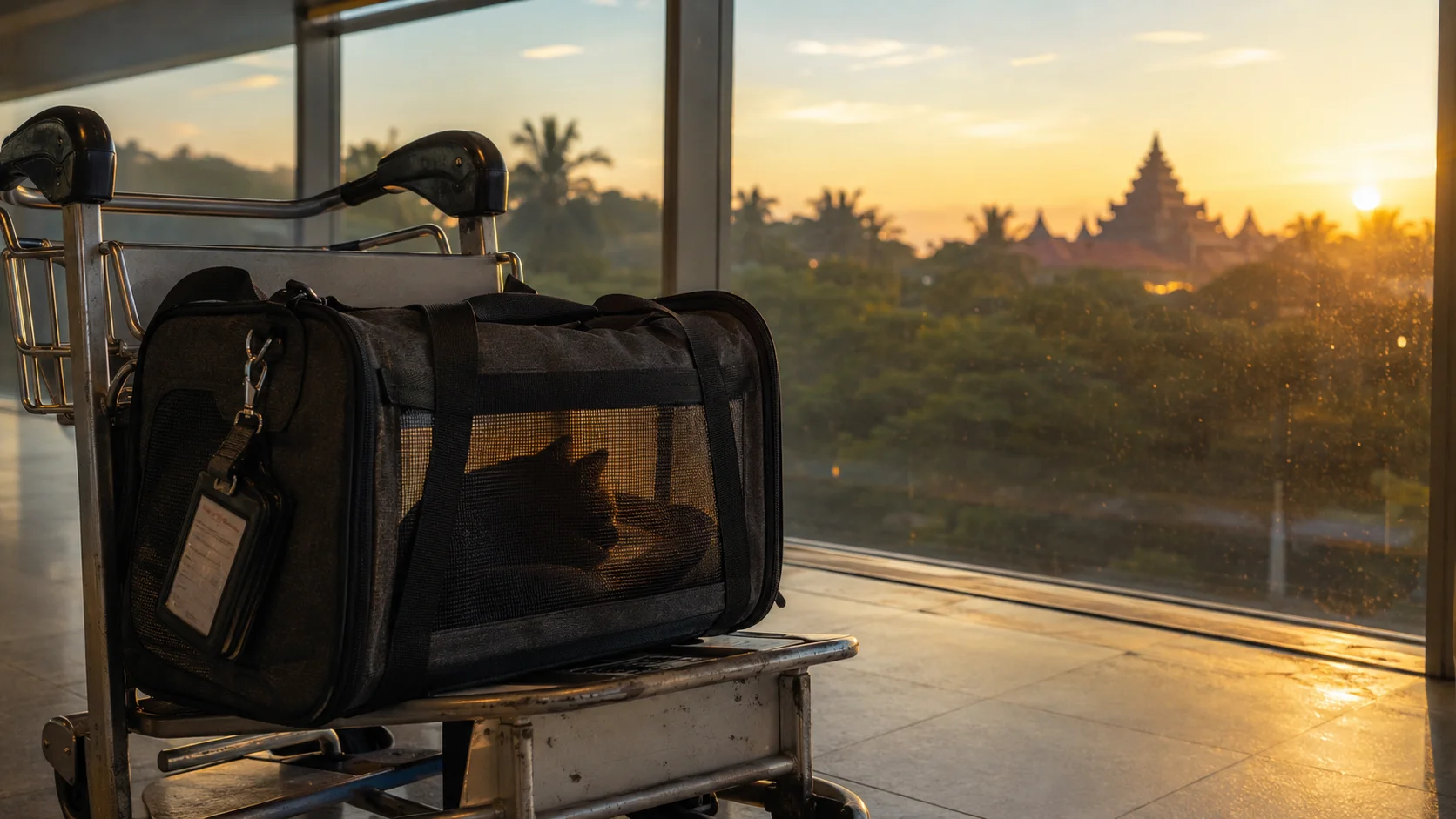
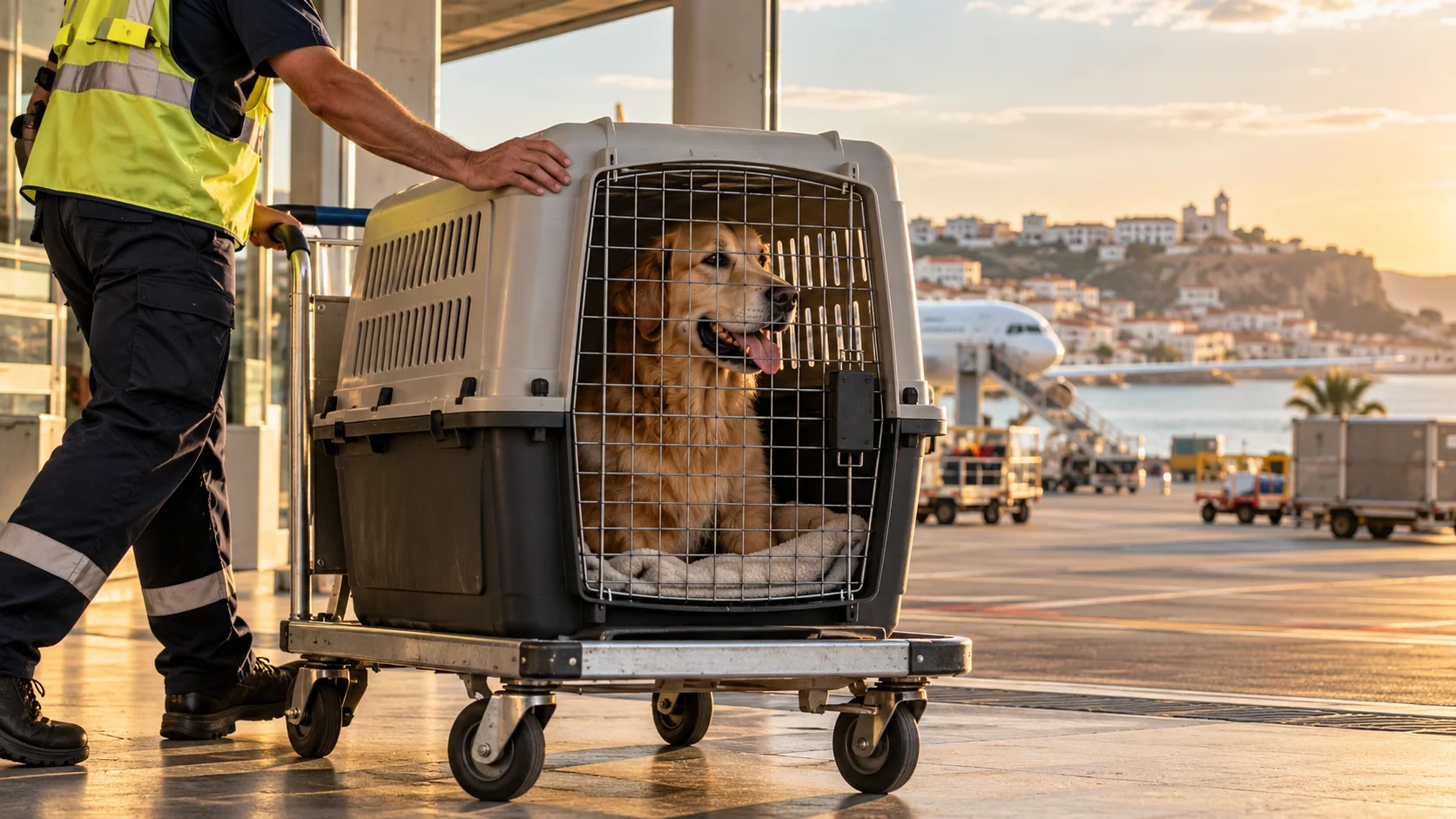
    Featured image. A medium-to-large dog in a well-built travel crate on a trolley at an airport cargo or check-in area, warm late-afternoon light suggesting a Portuguese

    The Document Depends on Where You’re Flying From

    Every pet entering Portugal from outside the EU needs the same underlying protections: a working microchip, a current rabies vaccination, and paperwork proving both. What that paperwork looks like splits sharply by origin country, and this is the single most common source of confusion in the whole process.

    UK owners: the Animal Health Certificate, not a pet passport

    Since the rule change that followed Brexit, owners travelling from England, Scotland or Wales cannot use an EU pet passport to enter Portugal, even if that passport was originally issued by an EU vet before the animal moved to Britain. GOV.UK is explicit about the consequence: present the wrong document and the pet can be refused entry outright.

    An animal health certificate (AHC) replaces it, issued by an Official Veterinarian and valid for 10 days from the date of issue to entry into the EU, then a further 6 months for onward travel within the EU and for re-entry back to Great Britain. That second window is where owners get caught. A pet passport, once issued, worked for years. An AHC does not: it is single-trip paperwork, and a new one has to be issued by a vet before every departure from Britain, not just the first. Budget the vet visit and the fee into every trip, not only the move itself.

    Northern Ireland sits outside this rule. Residents there can still travel to the EU on an EU pet passport, a genuine and easy-to-miss exception if your move involves family or a shipment routed through NI.

    US owners: a USDA-endorsed EU health certificate

    American owners never had a pet passport to begin with, so the adjustment is smaller but the paperwork chain is longer. A USDA-accredited veterinarian completes the EU’s official health certificate (the Annex IV form), and USDA APHIS then endorses it. APHIS’s own Portugal-specific guidance sets the deadline that matters most: the pet must arrive in the EU within 10 days of the date USDA endorses the certificate, not 10 days of the vet’s exam. Book the APHIS endorsement appointment around the flight date, not the vet visit, or the certificate can expire before the animal ever leaves the ground.

    EU pet passports still work, just not for these two groups

    An EU-issued pet passport remains valid for pets that already hold one from an EU member state, and it is the only document accepted from EU territory. It is not a fallback for UK or US owners, and it is not obtainable retroactively once a UK or US pet has already left home without one.

    Microchip and Rabies Vaccination: The Baseline Every Pet Must Clear

    Underneath the paperwork differences, the same three physical requirements apply to every pet entering Portugal, regardless of origin. The European Commission’s own guidance sets the sequence, and getting the order wrong invalidates the whole chain that follows it.

    • Microchip first. An ISO 11784 or 11785-compliant chip must be implanted before, or on the same day as, the rabies vaccination. A vaccination given before the chip is read does not count, no matter how current it is.
    • Minimum age 12 weeks. A dog or cat cannot receive a valid first rabies vaccination for travel purposes before it turns 12 weeks old.
    • 21 full days. After a first rabies vaccination, the pet cannot travel until 21 full days have passed. A booster given while the previous vaccination is still within its validity window carries no waiting period at all, which is the detail that catches owners of older pets off guard when they assume every renewal resets the clock.

    Miss any one of these three and the fix is not a faster vet appointment. It is a delay measured in weeks, because the 21-day window cannot be compressed by paying more or asking nicely.

    The Rabies Titre Test Myth

    Most of the generic EU pet-travel guides mention a rabies neutralising antibody titre test somewhere in the checklist, and a lot of UK and US owners assume it applies to them because it is common enough elsewhere to feel like a default EU rule. It is not, and for a pet travelling from Britain or the United States to Portugal, it is not required at all.

    The titre test exists for pets arriving from countries the EU has not classified as low-risk for rabies. Both the UK and the US carry that low-risk listed status, so a compliant pet from either country clears Portuguese entry on the microchip, vaccination and health certificate alone. Where the test does apply, it is a serious commitment: a blood sample drawn no sooner than 30 days after the rabies vaccination, sent to an EU-approved laboratory, followed by a mandatory 90-day wait from the date of that blood draw before the animal is eligible to travel at all. Skipping it when it is not required wastes nothing. Assuming it is required when it is not can cost three months of planning for no reason.

    Quarantine, Answered Directly

    A pet arriving in Portugal from the UK or the US with complete, correctly sequenced documentation is not quarantined. There is no holding period, no kennel stay, no waiting for a vet to sign off before the animal goes home with its owner. Mandatory isolation is reserved for animals that arrive without valid documentation, or from a country the EU has not listed as low-risk for rabies. For the readers this guide is written for, the honest answer is that quarantine is not the obstacle. Getting the paperwork sequence right, three weeks in advance and in the correct order, is.

    Tapeworm Treatment: Required in Five Places, and Portugal Isn’t One of Them

    Echinococcus multilocularis (a tapeworm with public health consequences serious enough that a small number of EU countries treat it as its own entry gate) is required for dogs entering Finland, Ireland, Malta, Northern Ireland and Norway. Portugal has no such requirement. If your only flight path runs UK or US to Lisbon, Porto or Faro directly, you can skip this step entirely, and several competitor guides that apply it as a blanket EU rule are simply wrong about Portugal specifically.

    The exception worth knowing: if your itinerary connects through one of those five, the treatment requirement travels with the connection, not the final destination. A dog transiting through Dublin or Helsinki on the way to Lisbon needs the treatment for that leg even though Portugal itself never asked for it. Check the full route, not just the destination, before assuming this section does not apply to you.

    The 48-Hour Notice Almost No Guide Mentions

    This is the requirement that separates a genuinely prepared arrival from one that stalls at the gate. Portugal’s Directorate-General for Food and Veterinary Affairs, DGAV, requires the owner or an authorised traveller to notify the Point of Entry for Travellers (PEV) at the arrival airport at least 48 hours before the pet lands. This is not a general email to a DGAV inbox: it goes to a specific contact for the exact airport of arrival, using DGAV’s own Notice of Arrival form, with the flight number, arrival time and scanned copies of the endorsed health certificate attached.

    The main points of entry for pets are Lisbon, Porto and Faro. Two of them have opening hours that catch owners on overnight or early-morning arrivals: the Lisbon PEV is closed from midnight to 6am, and Porto’s is closed from 11pm to 7am. A red-eye that lands inside those windows does not automatically fail, but it means confirming in advance, not on arrival, how an out-of-hours pet clearance is actually handled at that specific airport. Most owners never hear about this step until it is already too late to send the notice on time.

    Portugal’s Dog Breed Rules the Pet-Passport Checklists Skip

    If your dog is a Rottweiler, a Pit Bull Terrier, a Dogo Argentino, a Brazilian Fila, an American Staffordshire Terrier, a Staffordshire Bull Terrier, a Tosa Inu, or a cross of any of these, you will lie awake worrying about a headline you half-remember about banned breeds in Europe. You can stop. Portugal does not ban these breeds. Decree-Law 315/2009, published in Portugal’s official gazette, classifies them as potentially dangerous and attaches conditions, not a prohibition.

    What the conditions actually require: a stay of up to four months needs nothing beyond a signed statement of responsibility. A stay longer than four months requires the dog to be neutered or spayed, with a veterinary certificate as proof. Owners settling in Portugal must register the animal and obtain a licence from the local parish council (junta de freguesia) within 30 days of taking up residence, and must carry liability insurance covering a minimum of 50,000 euros. In public, the dog must be muzzled and kept on a lead. None of this is import paperwork. It sits entirely separate from the microchip, vaccination and health-certificate chain covered above, which is exactly why it is easy to clear one gate and walk straight into the other unprepared.

    Getting There: Cabin, Checked Baggage or Cargo

    Which of those three options fits your dog is worth deciding before you dive into the paperwork above. ExpatsDirect walks through the pathway your pet travels on (cabin, hold or cargo) as a decision in its own right, separate from the documents this guide covers.

    TAP Air Portugal’s own policy (as the national carrier flying most direct UK and US routes into Lisbon and Porto) sets a workable baseline. Cats and small dogs at least 12 weeks old can travel in the cabin if the animal and its carrier together weigh no more than 8kg, with the carrier small enough to fit fully under the seat in front, one pet per passenger. Larger dogs travel in the hold as checked baggage, up to 32kg combined weight on routes touching the US, Hungary, France or the Netherlands, and up to 45kg on TAP’s other routes. Above that, the option is manifest air cargo, booked and tracked separately from the owner’s own ticket, which TAP offers but does not publish standard pricing for. One routing detail worth checking before booking: TAP does not carry pets, in the cabin or the hold, on flights departing London Gatwick.

    British Airways runs a stricter policy from the UK side: no pets in the cabin under any circumstances, with the single exception of a registered assistance dog. Everything else moves as cargo, through the airline’s IAG Cargo division or its PetAir UK partnership. If your dog is small enough for TAP’s cabin allowance, that route is usually calmer for the animal and the owner alike; once a dog is too large for cabin travel, the practical choice becomes which carrier’s cargo process you trust, not which one avoids cargo altogether. The same cabin-versus-cargo logic applies on any long-haul pet route, not only this one, and we go into the mechanics, including how airlines size a crate against the animal rather than the breed, in taking a dog to Thailand.

    For owners flying from the US in summer, check one more condition before booking: heat. Take two owners with identical dogs and identical paperwork, one leaving Boston in April and one leaving Phoenix in July. The first books a hold slot without thinking about temperature. The second may find no hold slot at all, because US carriers work under USDA animal welfare rules that limit how long a dog or cat can be kept in heat above 85°F (29.5°C) on the ground, and in practice several airlines stop accepting pets in the hold on hot days or through the peak months, starting with flat-faced breeds. Ask the airline whether a seasonal or temperature embargo applies at your departure airport before you fix the moving date, and prefer early-morning or late-evening departures if you have to fly in the heat.

    What This Actually Costs

    The honest range is wide, because the two variables that drive it most (the size of the animal and whether it flies in the cabin or as freight) pull in opposite directions. Pre-travel documentation (the vet exam, the health certificate and the USDA or official-vet endorsement) typically runs $250 to $800 per pet before a flight is even booked. A small dog or cat travelling in the cabin adds a further $95 to $150 each way in airline fees, roughly £80 to £120. A larger dog booked as manifest cargo runs $500 to $2,500 or more one way, driven mostly by crate size and route, and owners flying into the UK on a connecting leg should budget an additional ground-handling and customs-clearance charge that can clear £500 on its own.

    Add it up and a straightforward cabin move for a small, healthy pet with no complications lands in the low hundreds of dollars to a little over a thousand. A larger dog on a cargo routing, especially one that also needs a custom crate, can run several thousand. If your dog’s measurements or your travel dates leave the right option unclear, SwiftCargo’s pet transport team can work through the cabin, hold and cargo choices against your specific animal and calendar rather than a generic size chart.

    A Timeline That Works Backward From Your Flight

    Work the calendar backward from the flight date instead of forward from today, and the process resolves into a straightforward checklist.

    1. Microchip, at least 12 weeks and 21+ days before travel. This has to happen before or on the same day as the rabies vaccination, not after.
    2. Rabies vaccination, the same day or after the chip, at least 21 full days before travel. This is the step that cannot be rushed once it is late; the 21-day clock is fixed regardless of budget.
    3. Health certificate, no more than 10 days before entry. For UK owners, this is the AHC from an Official Veterinarian. For US owners, it is the USDA-endorsed Annex IV form, and the 10-day clock for Americans starts at APHIS endorsement, not the vet exam.
    4. DGAV notice, at least 48 hours before arrival. Sent to the specific Point of Entry for Travellers at your arrival airport, not a general inbox.
    5. Travel day. Carry the endorsed certificate, the microchip documentation and, if your dog is a listed breed, proof of the statement of responsibility, even for a short stay.

    If your dog is only one part of a wider household move, see moving to Portugal from the UK for the rest of the relocation: visas, shipping and the post-Brexit paperwork that sits alongside this animal-specific process. The same AHC-versus-passport distinction shows up in our guide to moving from the UK to Thailand, even though the destination there sits outside the EU entirely. American owners relocating a pet face rules considerably stricter than Portugal’s; moving pets from the USA to Thailand shows what the process looks like when quarantine and titre testing genuinely do apply, and the comparison makes clear how much of Portugal’s process, once you strip out the myths, is actually straightforward. Getting the sequence right the first time costs a few phone calls. Getting it wrong after a refused booking costs the trip. If you want a second set of eyes on your own timeline, SwiftCargo’s pet transport team can help build the calendar backward from your actual flight date rather than a generic template.

    Frequently Asked Questions

    Can I take my dog to Portugal?

    Yes, provided the dog is microchipped with an ISO-standard chip, has a current rabies vaccination given at least 21 days before travel, and arrives with the correct health document for its country of origin, an animal health certificate for UK-origin dogs or a USDA-endorsed EU health certificate for US-origin dogs. Owners also need to send Portugal’s DGAV a Notice of Arrival at least 48 hours before landing. None of these steps is difficult individually; the process fails when one is skipped or done out of sequence.

    Do UK owners still use an EU pet passport for Portugal?

    No, not from England, Scotland or Wales. Since the post-Brexit rule change, GB-origin pets need an animal health certificate issued by an Official Veterinarian, valid for 10 days from issue to EU entry and then 6 months for onward EU travel and re-entry to Great Britain. A new certificate is required before every trip, not only the first. Northern Ireland is the exception: residents there can still travel on an EU pet passport.

    Does my dog need a rabies titre test to enter Portugal?

    No, not from the UK or the US. Both countries carry the EU’s low-risk rabies classification, so a compliant pet clears entry on the microchip, vaccination and health certificate alone. The titre test applies only to pets arriving from countries the EU has not listed as low-risk, and it involves a 30-day post-vaccination blood draw followed by a 90-day wait before the animal becomes eligible to travel.

    Will my dog be quarantined when I arrive in Portugal?

    No, not if the documentation is complete and in the correct sequence. Portugal does not hold compliant pets from the UK or the US in quarantine on arrival. Mandatory isolation applies to animals that arrive without valid paperwork or from a country outside the EU’s low-risk rabies list, which does not include the UK or the US.

    Does my dog need tapeworm treatment before entering Portugal?

    No, not for a direct flight from the UK or the US to a Portuguese airport. The EU’s Echinococcus multilocularis treatment requirement applies only to dogs entering Finland, Ireland, Malta, Northern Ireland and Norway. It becomes relevant only if your itinerary connects through one of those five on the way to Portugal, in which case the treatment is required for that connecting leg.

    Can I bring a Rottweiler or Pit Bull to Portugal?

    Yes. Portugal does not ban these breeds; Decree-Law 315/2009 classifies Rottweilers, Pit Bull Terriers, Dogo Argentinos, Brazilian Filas, American Staffordshire Terriers, Staffordshire Bull Terriers and Tosa Inus (and their crosses) as potentially dangerous and attaches ownership conditions rather than a prohibition. A stay under four months needs only a signed statement of responsibility. A longer stay requires the dog to be neutered, registered with a licence from the local parish council within 30 days of residence, and covered by at least 50,000 euros of liability insurance, with a muzzle and lead required in public.

    How much does it cost to fly a dog to Portugal?

    Pre-travel documentation typically runs $250 to $800 per pet. A small pet travelling in the cabin adds roughly $95 to $150 each way. A larger dog booked as manifest cargo typically costs $500 to $2,500 or more one way depending on crate size and route, and connections through the UK can add several hundred pounds in ground-handling and customs charges. A straightforward small-pet cabin move often totals under $1,000 all in; a larger dog on a cargo routing can run into the low thousands.

    Sources

  • Export Health Certificates for Pets Leaving Australia

    Export Health Certificates for Pets Leaving Australia

    Diagram of the five parties in Australia's pet export certificate chain: owner/exporter, registered veterinarian, DAFF certifying officer, airline/pet transport agent, and destination authority.

    Search “pet export health certificate Australia” and several of the first results use that phrase interchangeably with “fit to fly certificate,” as though the two were the same document issued by the same authority. They are not. One is a welfare opinion any vet can write on a prescription pad. The other is a government paper generated by DAFF and endorsed by a departmental officer, and it is the document Australia’s border actually relies on. The gap between the two is exactly where owners get caught out, usually a day or two before a flight, when someone finally asks which one they actually have.

    Fit-to-Fly Letter Versus the Official Export Health Certificate

    A fit-to-fly letter is informal by design. Any registered vet can write one. It confirms an animal appears healthy enough to travel, and airlines or pet transport companies sometimes ask for one as an extra layer of reassurance. It carries no government authority and satisfies no export legislation on its own. The export health certificate is a different category of document entirely: a formal paper certificate, generated by a DAFF regional officer under the Export Control Act 2020 and the Export Control (Animals) Rules 2021. It confirms the department itself is satisfied the animal has been prepared and examined in line with the destination country’s requirements. A fit-to-fly letter can exist alongside the official process. It cannot replace any part of it.

    The Destination Country Sets the Declarations

    DAFF does not decide what your pet’s export health certificate says. The importing country does. Every declaration on the certificate exists because the destination country’s own published requirements demand it: every test result, treatment record or statement it has to carry. DAFF’s role is to confirm those requirements have genuinely been met before endorsing the document. This is precisely why DAFF will not issue a health certificate based on information from a pet transport company or a website other than the official source of the importing country’s own government. Secondhand summaries of “what most countries want” are not an acceptable substitute for what your specific destination’s authority actually requires.

    MICoR and Destination Permits

    DAFF maintains the specific, country-by-country version of those requirements in the Manual of Importing Country Requirements (MICoR). This is the same reference the department checks your paperwork against, so it’s worth checking yourself before assuming your destination’s rules match a friend’s experience with a different country.

    A second point causes similar confusion: your Australian export health certificate is not the same thing as your destination country’s own import permit. They are separate documents, issued by separate authorities, running on separate timelines. Thailand specifically calls this the “Official Health Certificate,” or OHC, a term our Thailand’s import permit forms: R.1/1, R.6 and R.7 guide explains in full, including its roughly 10-day validity window from government endorsement. That OHC is this same certificate, viewed from the receiving end rather than the issuing end, not a different document.

    The Registered Veterinarian’s Role

    Your own registered vet carries out the final health and welfare examination and documents the clinical findings the certificate depends on: treatments given, tests performed, results recorded. This is the same vet recommended for booking alongside the Notice of Intention to Export. DAFF’s own guidance for veterinarians sets out this role, and the role stops short of government authority. The registered vet documents and attests to the animal’s clinical state. They do not, on their own, issue the export certificate.

    The DAFF Certifying Officer’s Role

    That authority sits with a different person entirely: the department’s certifying officer. Per DAFF’s guidance on veterinarians preparing companion animals for export, the certifying officer appointment happens after the registered vet’s final health and welfare examination, and at that appointment you present everything the vet has completed alongside any other relevant paperwork: import permits if required, vaccination certificates, the rest of the file. The certifying officer reviews that documentation and determines whether the animal has actually qualified for export. This is the moment the export permit and the health certificate come into existence as government documents. A fit-to-fly letter never reaches this step, because no government officer is ever involved in writing one.

    Government Endorsement

    “Endorsement” is doing real legal work in this process, not just formality. A completed set of veterinary documentation, however thorough, is not an export certificate until a DAFF certifying officer has reviewed it and formally signed off. DAFF’s own export documents and certification guidance confirms that exporters of live animals work from paper certificates generated by the department’s own regional officers, not templates an owner or agent fills in independently. Before that endorsement, what you’re holding is a well-prepared file. After it, you’re holding the document that actually authorises the export.

    Final Examination Timing

    The registered vet’s final health and welfare examination has to fall within 72 hours of departure, or a shorter period if the destination country’s own requirements set one. This is tighter than most owners expect from a document they associate with routine paperwork. It’s the reason early preparation, everything covered in our Notice of Intention guide, matters here. Nothing about the certificate’s legal validity comes from your pet being generally healthy months in advance. It comes from a specific examination inside a specific, short window right before travel.

    The Export-Permit Window

    The certifying officer appointment follows the same logic: it has to happen within 72 hours of the scheduled departure time, after the vet’s own exam. In practice, that means the entire government-side issuance of your export permit and health certificate compresses into the final three days before a flight, not because DAFF is slow to act but because the whole point of the timing rule is to certify the animal’s condition as close to the actual travel date as the process allows. This reconciles cleanly with the destination-side validity windows this cluster has covered elsewhere. Thailand’s own roughly 10-day OHC validity window is looser than Australia’s 72-hour issuance window, so a certificate that satisfies DAFF’s timing automatically satisfies Thailand’s too. That isn’t a coincidence: both countries’ rules converge on “close to the actual flight,” measured from each end.

    Originals and the Crate Document Pouch

    Physical originals matter here, not photocopies. Key certificates should travel as originals rather than copies (the rabies vaccination record among them), and the completed health certificate and any relevant import permits need to travel with the animal itself, not be emailed ahead or left with a departure-side agent. The travel container also has its own requirement chain: it must meet IATA live-animal transport standards, be new or disinfected, and be presented to the registered vet before use so the vet’s own sign-off covers the crate as well as the animal. SwiftCargo’s standard practice is to assemble a dedicated document pouch, secured to the crate itself, containing every original the airline and destination authorities will ask to see. “The paperwork travels with the pet” is an operational rule here, not a reminder to pack it somewhere sensible.

    Here is a detail that quietly stops certificates: the microchip number, usually fifteen digits long. It is what ties the rabies vaccination record, any laboratory results, the destination’s import permit and the health certificate to one specific animal, and officials at both ends check that it matches on every page. One transposed digit on a vaccination record from three years ago breaks that chain, and so does an owner’s name spelled differently on the permit and the certificate. Before the final examination, ask the vet to scan the chip and read the number aloud while you check it against every document in the pouch. It takes five minutes, and a record is much easier to correct then than inside the 72-hour window.

    Flight Cancellation or Amendment

    Because the whole certification chain is built around a roughly 72-hour pre-departure window, a real flight delay or cancellation after the certificate has already been endorsed is a genuine problem, not a minor scheduling footnote. If the actual travel date moves meaningfully, the examination and certifying-officer appointment that were timed against the original date may no longer cover the new one. Treat any significant schedule change as a reason to contact DAFF or your pet transport agent immediately, rather than assuming existing paperwork carries over. The specific answer depends on how far the date has moved and exactly what the destination country’s own requirements allow, which is worth confirming for your situation rather than assuming from a general rule.

    It is worth pricing that risk before you book rather than after the date moves. Choosing a departure is a bet on schedule reliability, and the two sides of it are not priced the same. If the flight holds, a conservatively chosen slot buys you nothing you can point to. If it moves outside the window, you pay for a repeat veterinary examination, a second certifying-officer appointment, and whatever the airline’s next available animal-hold slot turns out to be, which in peak season can run to weeks. Owners tend to judge that choice by how the last trip went, which is the wrong test, because a booking that happened to hold was not necessarily the better bet. A morning departure on a route with a spare same-day service is a materially different position from a tight connection that only operates once a week, even when the two fares look identical.

    Record Retention

    DAFF requires exporters to retain all records from the export process for at least two years. Registered vets separately keep their own clinical records under their state or territory’s veterinary board requirements. Keep your own copies well past that floor in practice. If this move is a temporary posting rather than a one-way trip, the same export file becomes part of the baseline evidence your pet needs for the return leg. Our preparing your pet to return to Australia before you leave guide walks through that requirement in full. A folder you never need is a minor inconvenience. A folder you need and don’t have is a much bigger one.

    A Document Ownership Map

    Five different parties touch this process, and each one owns a specific, non-overlapping piece of it. Use this to work out who to ask when something is unclear.

    PartyWhat they ownWhen
    Owner / exporterSubmitting the NOI, booking appointments, assembling and retaining the full document file, presenting originals at the crateFrom initial planning through departure, and for at least 2 years after
    Registered veterinarianFinal health and welfare examination, clinical documentation, treatments and test results, container inspectionWithin 72 hours of departure (or a shorter destination-set window)
    DAFF certifying officerReviewing the completed file, determining export eligibility, formally endorsing the export permit and health certificateAfter the vet exam, within 72 hours of scheduled departure
    Airline / pet transport agentIATA-compliant crate handling, accepting the document pouch with originals, may separately request a fit-to-fly letterAt check-in and throughout transit
    Destination authoritySetting the declarations the certificate must contain (via MICoR); issuing its own separate import permit; verifying the certificate’s validity window on arrivalBefore export (declarations) and on arrival (verification)

    This entire map runs in the opposite direction for a pet coming into Australia rather than leaving it: different evidence, different government system, different timing rules entirely. Owners managing that side of a move should read our companion guide to Australian pet import permits and the BICON system rather than assuming the export process described here runs in reverse.

    For the practical side of coordinating vets, DAFF appointments and destination-country paperwork against a single flight date, get a pet transport quote from SwiftCargo before the 72-hour window is the only runway left to work with.

    Frequently Asked Questions

    What is the difference between a fit-to-fly letter and an export health certificate?

    A fit-to-fly letter is an informal welfare check any vet can write, confirming an animal looks well enough to travel. Airlines sometimes ask for one, but it carries no government authority. The export health certificate is a government document, generated by DAFF and endorsed by a certifying officer, and it is what actually authorises your pet’s legal export from Australia. One is a courtesy note; the other is the paperwork the border relies on.

    Who decides what has to be written on my pet’s export health certificate?

    The destination country does, not DAFF. DAFF builds and endorses the certificate to satisfy the specific declarations the importing country requires, referenced through the Manual of Importing Country Requirements (MICoR). DAFF will not issue a certificate based on information from a pet transport company or a third-party website; only the destination country’s own official government source qualifies.

    How close to my flight does the final veterinary examination need to happen?

    Within 72 hours of departure, or a shorter period if the importing country’s own requirements set one. The DAFF certifying officer appointment then follows the vet exam, also within 72 hours of the scheduled departure time, which is why this entire stage of the process compresses into the final days before a flight rather than spreading out comfortably in advance.

    What happens to my pet’s export health certificate if a flight is delayed or cancelled?

    Treat it as a real risk to the paperwork, not just an inconvenience. Because the final exam and certifying officer appointment are both tied to a roughly 72-hour window before the scheduled departure, a meaningful delay or cancellation can push your actual travel date outside the window the certificate was issued against. Contact DAFF or your pet transport agent as soon as a schedule change looks likely, rather than assuming the existing paperwork still applies.

    How long do I need to keep my pet’s export documents?

    DAFF requires exporters to keep all records from the export process for at least two years. Keep them longer in practice: the same file becomes part of the baseline record your pet needs if you ever plan to bring it back into Australia.

    Is the Australian export health certificate the same thing as the destination country’s import permit?

    No, and this is one of the most common mix-ups in the whole process. The Australian export health certificate is issued on this end, by DAFF, to authorise the animal leaving Australia. The destination country’s import permit is a completely separate document, issued by that country’s own authority, required to let the animal in. Both have to exist, they run on independent timelines, and neither substitutes for the other.

  • Australia’s Notice of Intention to Export: A Plain-English Guide

    Australia’s Notice of Intention to Export: A Plain-English Guide

    Annotated fictional NOI (Notice of Intention to Export) form example graphic per the cluster brief's asset spec -- a mocked-up (clearly fictional, no

    Ask someone who has already exported a pet from Australia which document actually started the process, and most will say the health certificate, or the import permit for wherever the animal was going. Almost none of them will say the Notice of Intention to Export. It’s the plain, unglamorous form that has to reach DAFF at least ten working days before anything else in this story can happen, and most first-time movers don’t know it exists until a pet transport agent mentions it.

    Here’s the reassuring part: once you know what it is, the NOI is genuinely one of the more straightforward pieces of the whole export process. It isn’t the hard part. It’s the part that has to happen first, correctly, so that the harder parts later actually have time to work.

    What the NOI Actually Is

    The Notice of Intention to Export Live Animals (other than Livestock), or NOI for short, is the official DAFF form that opens your pet’s export file. It’s part of the wider process DAFF sets out on its exporting companion animals page. You’ll find the form itself among the forms for exporting non-livestock animals. It exists to do two things at once: let DAFF check your preparation plan against the destination country’s specific requirements, and book the appointments (a final veterinary exam, then a DAFF certifying officer review) that eventually produce the export permit and health certificate. Nothing about the actual export happens without this form landing first.

    What the NOI Is Not

    It is not the export permit, and it is not the health certificate. Those are separate documents, issued later, once a DAFF certifying officer is satisfied your pet has actually been prepared according to the destination country’s rules. We cover that document in full in a companion guide of ours: export health certificates for pets leaving Australia. It is also not an import permit for wherever you’re going; that’s a separate process run by the destination country’s own authorities, covered for the Thailand route in our guide to Thailand’s import permit forms. The NOI is closer to a formal heads-up with a deadline attached than a final approval. Getting a positive response to your NOI is genuinely good news. It confirms your plan as viable; it doesn’t mean the process is finished.

    Who Submits It

    The exporter completes the NOI and emails it, with supporting documents, to the regional DAFF office for the state or territory the animal is actually departing from. That’s usually the pet’s owner or a pet transport agent acting on the owner’s behalf. That regional detail matters: submitting to the wrong office is an easy, avoidable way to lose days you don’t have to spare against a ten-working-day floor.

    Required Route and Pet Details

    The form needs the specifics DAFF actually assesses: the owner or exporter’s contact details, the animal’s identification (species, and the microchip number that has to match every other document in the file exactly), the intended destination country, and the planned export route and date. Vague or placeholder information here is one of the more common reasons a straightforward NOI turns into a query-and-wait situation: a “likely” destination instead of a confirmed one, or an approximate date instead of an actual booked window.

    It’s worth being specific about why this matters more than it looks like it should. DAFF isn’t collecting these details to fill in a database field. It’s using them to decide, right at the start, whether your plan is even structurally viable before anyone books a vet appointment or pays a certifying-officer fee. A destination country listed as “somewhere in Southeast Asia, still deciding” tells DAFF nothing it can check against MICoR. A confirmed destination, even one that later changes, gives the department something real to assess. If your travel plans are still genuinely open, it’s better to wait a few extra days until they’re not than to submit a NOI built around a placeholder.

    Supporting Destination Conditions

    DAFF doesn’t assess your NOI in a vacuum. It checks your stated preparation plan against the specific importing country’s published requirements, which DAFF maintains through the Manual of Importing Country Requirements (MICoR). Different destinations set different rules on vaccination timing, testing, and documentation format. MICoR is the reference DAFF itself uses, so it’s worth checking your destination’s current entry before you submit, rather than relying on secondhand advice about what “most countries” require. MICoR is reviewed regularly, but importing countries can and do change their own requirements without notifying DAFF directly, which is part of why the department checks your specific plan rather than approving on a generic template.

    The 10-Working-Day Rule

    Submit the NOI at least 10 working days before your departure date, or, if your destination requires pre-export isolation, before the isolation period is due to start, whichever falls first. Treat ten working days as a floor, not a comfortable target. Submitting right at that limit leaves DAFF no room to come back with a question without your own timeline absorbing the delay. Questions are common enough on first submissions that building in extra runway is worth far more than it costs.

    The phrase doing the work in that rule is “working days”, and a calendar does not show them. Most people count back two weeks and stop, because the form’s unit and the reader’s mental unit differ only in weekends for most of the year. Public holidays widen the gap without warning. For a flight on Thursday 7 January 2027, Christmas Day, the Boxing Day holiday on Monday 28 December (the 26th falls on a Saturday) and New Year’s Day all drop out of the count, so ten working days reach back to around 21 December, more than a fortnight before departure. Commonwealth offices also commonly run reduced services between Christmas and New Year. If your flight falls near Easter, Christmas or a state holiday such as Melbourne Cup Day in Victoria, ask the regional office which days it counts before you set your submission date.

    Pre-Export Isolation Implications

    Most companion animals leaving Australia do not need pre-export isolation. Where it is required, it’s because the specific destination country’s import conditions call for it. The timeframe and the location both follow that country’s rules, not a general Australian standard, which is another reason the MICoR check above matters before you assume either way. If your destination does require isolation, that requirement moves your real deadline earlier: the 10-working-day submission rule then counts back from the start of isolation, not from your flight date.

    The DAFF Appointment

    Your NOI is also what books your pre-export appointment chain. DAFF’s own guidance for veterinarians preparing companion animals for export recommends arranging your final veterinary examination with your registered vet at the same time you submit the NOI. That’s specifically so both appointments land inside the timeframes each one requires relative to your actual departure: the vet exam and the subsequent DAFF certifying officer review. That appointment sequencing, and its tight timing window, get the full treatment in export health certificates. The point to take from this article is that the NOI is the trigger that starts that clock. Submitting it casually, without also locking in the vet appointment, undermines the whole point of submitting it early.

    What Happens After Submission

    DAFF reviews the NOI to confirm the information is complete and that your preparation plan looks sufficient to meet the destination country’s requirements. If it is, you’ll be advised the NOI is approved, which unlocks the next stage rather than the finish line. Approval of the NOI does not by itself mean DAFF will issue the export permit and health certificate; those follow only once the department is satisfied your pet has actually been prepared exactly as planned, confirmed at the appointments the NOI booked.

    Flight Changes

    A flight change after NOI submission is not automatically a problem, but it is something to actively manage rather than mention in passing. Because the whole appointment chain (vet exam, certifying officer review, eventual certificate endorsement) is anchored to the departure date you gave DAFF, a meaningful shift in that date can knock appointments outside the windows they need to fall inside. If your travel dates move by more than a few days after submitting, confirm with DAFF or your pet transport agent promptly, rather than assuming the original timeline still holds.

    Worked Example: Building Your Timeline Backward From a Flight Date

    The clearest way to see how the NOI fits into the wider process is to build a timeline backward from a confirmed departure, rather than forward from today. Take a Melbourne-based owner with a cat confirmed to fly to Bangkok on a Thursday in eight weeks. Working backward: the flight date is fixed first. Ten working days works out to roughly two calendar weeks, accounting for weekends. That’s the absolute latest the NOI can land with the Victorian regional office. This owner submits it a full four weeks out instead, deliberately building in a buffer against any query DAFF might raise. At the same time as the NOI, they book the final veterinary examination with their registered vet, timed to fall inside the window that appointment needs relative to the flight date. They book the certifying officer appointment once the vet exam is confirmed, again timing it against the same fixed flight date. Every appointment in this chain points back to the same anchor, the actual booked flight, which is exactly why a late flight change ripples through the whole sequence instead of affecting just one step.

    Notice what this owner did not do: wait until the flight was six weeks away to start thinking about paperwork, or submit the NOI with a placeholder date because the exact flight wasn’t booked yet. Both of those choices are common, and both of them are what turn a routine process into a rushed one.

    Common Errors

    • Submitting inside the 10-working-day floor. The minimum is a legal floor, not a safety margin. Treat it as the latest possible date, not the planned one.
    • Mistaking NOI approval for the export permit. Approval confirms your plan is viable; it doesn’t mean the permit or health certificate exist yet.
    • Vague destination or date details. A placeholder country or an approximate travel window forces DAFF to come back with questions instead of assessing cleanly.
    • Not booking the vet exam alongside the NOI. Submitting the form without also locking in the final veterinary appointment defeats the purpose of DAFF’s own recommended sequencing.
    • Ignoring destination-specific conditions. Assuming your destination’s requirements match what a friend’s pet needed for a different country, instead of checking MICoR for your actual destination.
    • Using an outdated form version. Downloading an old copy of the NOI PDF from a bookmark or a third-party site instead of the current version on DAFF’s own page.

    An Annotated NOI Example

    The table below shows the kind of information a completed NOI actually contains, using a fictional example (no real applicant’s details) to show what each field is doing.

    NOI fieldExample entry (fictional)What it’s actually for
    Exporter / owner name and contact detailsR. Halloway, mobile and email suppliedThe person DAFF corresponds with for this file
    Animal identificationDomestic cat, microchip 981000456789123Must match every later document (vet certificate, export permit) exactly
    Destination countryThailandDetermines which MICoR conditions DAFF checks the plan against
    Proposed export dateConfirmed flight date, not an estimateSets the 10-working-day submission deadline and anchors every later appointment window
    Departure point / regional officeSydney (NSW regional office)Determines which DAFF office actually receives and assesses the NOI
    Pre-export isolation required?Not required for this destination (confirmed via MICoR)If yes, moves the effective submission deadline earlier
    Preparation plan summaryVaccination and documentation schedule aligned to destination requirementsWhat DAFF actually assesses the NOI against

    Every field on that form is doing real work. DAFF is using it to decide whether your plan, as described, can realistically produce a compliant export permit and health certificate by your departure date. The NOI and the destination country’s own import paperwork run on parallel, independent clocks that both need to land before your actual flight date, not sequentially. That detail is covered from the receiving end in Thailand’s import permit forms R.1/1, R.6 and R.7. And if this move is a temporary posting rather than a one-way trip, it’s worth reading our guide to preparing your pet to return to Australia before you leave alongside this one: the NOI paperwork you file now becomes part of the baseline record your pet needs for the trip home.

    SwiftCargo’s pet transport team submits NOIs inside a comfortable margin ahead of the 10-working-day floor as standard practice, and books the vet appointment in the same conversation rather than as an afterthought. Get in touch before you confirm flights, since the flight date is what starts every clock this article has described.

    Related reading: Destination, Not Size, Drives International Pet Transport Cost

    Frequently Asked Questions

    What is the Notice of Intention to Export for a pet leaving Australia?

    It’s the form that starts the entire export process. Officially the Notice of Intention (NOI) to Export Live Animals (other than Livestock), it tells DAFF you plan to export a specific animal, on a specific route, and lets DAFF check your preparation plan against the destination country’s requirements and book the appointments that follow.

    Is the Notice of Intention to Export the same as the export permit?

    No. The NOI is the notification that opens the file and books the pipeline. The export permit and the health certificate are separate documents issued later, once DAFF’s certifying officer has confirmed your pet has actually been prepared in line with the destination country’s requirements. NOI approval means DAFF thinks your plan is sound, not that the paperwork is finished.

    How early do I need to submit the Notice of Intention to Export?

    At least 10 working days before your departure date or, if the destination country requires pre-export isolation, before the isolation period begins, whichever comes first. Ten working days is a floor, not a comfortable target; submitting right at that limit leaves no room for DAFF to query anything without your timeline slipping.

    Do all pets need pre-export isolation before leaving Australia?

    No. In most cases, pre-export isolation is not required for companion animals leaving Australia. Where it is required, it’s because the specific destination country’s conditions call for it, and the timeframe and location follow that country’s own rules. Check the requirements for your actual destination before assuming either way.

    Can I change my flight after submitting the Notice of Intention to Export?

    You can, but treat any date change as something to actively manage, not something to mention in passing. The NOI’s 10-working-day clock and the appointments booked off the back of it are anchored to the departure date you originally gave DAFF. A meaningful shift can affect whether your final veterinary exam and certifying appointment still land inside their own required windows. Confirm with DAFF or your pet transport agent as soon as a flight change is even likely.

    What is the most common mistake owners make with the Notice of Intention to Export?

    Treating NOI approval as the finish line. Owners submit the form, get a response that sounds positive, and relax. In fact, the harder, date-sensitive part is still ahead: the final veterinary examination and the certifying officer appointment, both tied tightly to the actual departure date. The NOI opens the door; it doesn’t walk you through it.

  • Australian Pet Import Permits: BICON, Timing and Common Errors

    Australian Pet Import Permits: BICON, Timing and Common Errors

    Permit application readiness checklist documents for an Australian BICON pet import, including microchip records and RNATT declaration paperwork

    Two applications for the same route, filed in the same week, rarely take the same number of weeks to clear. DAFF does not publish a fixed processing time for cat and dog import permits, and the reason has less to do with case backlogs than with a mechanical fact almost no first-time applicant is told: an assessor works through a BICON file in order, and stops at the first mismatch between what the application claims and what the attached evidence actually shows. Every stop adds days.

    The Department of Agriculture, Fisheries and Forestry (DAFF) uses BICON, the Biosecurity Import Conditions system, to decide whether a specific animal, on a specific route, meets Australia’s biosecurity requirements before it is allowed in. The system itself is not complicated by design. Most of what turns a straightforward approval into a stalled file is avoidable, and nearly all of it traces back to the same handful of predictable errors.

    Who Actually Needs an Import Permit

    Every cat or dog entering Australia needs an import permit obtained through BICON before travel, with a narrower, lower-evidence pathway for New Zealand and Norfolk Island under DAFF’s own step-by-step import guides. That requirement does not soften for pets with an Australian history. Take a dog that spent its whole life in Sydney before an owner’s two-year posting to Bangkok: it returns to exactly the same permit process as a dog that has never set foot in the country. DAFF’s framework evaluates where the animal has actually lived immediately before the trip, not where it lived before that. Owners planning a move that includes time overseas should read this permit process alongside our guide on preparing a pet to return to Australia before you leave. The same evidence trail this article covers is what an Australian-origin pet needs rebuilt for the return leg.

    What BICON Actually Is

    BICON is not the permit. It is the online system DAFF uses to publish country-and-species-specific import conditions and to receive, track and assess the application itself. Search BICON for “dogs” or “cats” from a specific country of origin and it returns the exact document list, testing requirements and quarantine implications that apply to that route. Conditions differ meaningfully by country group, which is why two owners moving from different countries can face entirely different paperwork for what looks, at a glance, like the same move. The permit is the output of that process: a formal document confirming DAFF has reviewed the evidence and approved that specific animal for import under stated conditions.

    Evidence by Country Group

    DAFF sorts import origins into risk-based groups, and the group determines how much evidence an application needs. New Zealand and Norfolk Island sit in Group 1. Group 1 carries the lightest evidence load. Group 2 includes a mix of countries and territories, Singapore among them. Singapore matters directly to this cluster: it is the staging country most Thailand-based Australians eventually route their pet’s return through, as covered in our comparison of staging options for the Thailand-to-Australia route. Group 3 countries carry the full evidence load: microchip, vaccination, an RNATT blood test, the associated wait period, and closer scrutiny of every supporting document. Thailand itself sits outside every approved group, which is why the 180-day approved-country rule exists as a separate, additional hurdle for Thailand-origin pets rather than something this permit alone resolves. Group membership is reviewed periodically, so confirm your specific country’s current classification directly in BICON before assembling an evidence pack around an assumption.

    Identity and RNATT Evidence

    For Group 3 origins, the application has to include a copy of the RNATT laboratory report and the accompanying RNATT declaration, endorsed by an official government veterinarian employed by the exporting country’s competent authority, not just a private clinic printout. This is where identity evidence and test evidence have to line up exactly: the microchip number on the RNATT paperwork has to match the number on the vaccination record and the number typed into the BICON application itself, character for character. Our companion article on how the RNATT test actually works covers the sequencing rule behind this evidence in full: identity has to be verified before the rest of the chain is considered valid, not after.

    Application Charges

    DAFF’s published fee schedule sets a $130 application charge for an import permit, on top of a separate initial assessment fee that varies by the category of the goods and how long DAFF expects the assessment to take. Both amounts are due upfront. The department does not begin assessing an application until the application charge and the initial assessment fee have both cleared. Treat the combined cost as case-specific, not a single number you can budget from a generic figure quoted elsewhere online. Check the current schedule directly before applying, since government fees are reviewed periodically.

    Processing Times

    Most of the “how long will this take” guides circulating online quote a tidy range of a few weeks. DAFF itself does not publish that figure. The department’s own framework does specify a statutory outer limit: under the Biosecurity Act 2015, a decision on an import permit application is required within 123 business days of receipt. That is a legal ceiling, not a typical experience, and it exists precisely because assessment time is not fixed. Most guides skip this fact, and it is the one that matters. A file where every document matches on the first read moves through review in a fraction of that ceiling, while a file that triggers even one query gets pushed toward it. A mismatched microchip digit or a declaration missing the right endorsement is enough to trigger that query. The single biggest lever an applicant controls is not the country of origin. It is whether the file needs a second look.

    Permit Validity

    Validity depends on the same country-group structure that determines evidence requirements. A permit issued against Group 2 evidence is valid for 12 months. A permit issued against Group 3 evidence is valid until the underlying RNATT result expires: 12 months from the date blood was drawn, per DAFF’s RNATT guidance. That means the permit’s real-world shelf life is tied to a testing clock the applicant is separately managing, not to a fixed calendar date DAFF sets independently.

    When to Apply

    Work backward from the travel date, not forward from today. For a Group 3 move, the RNATT blood draw and its 180-day wait (or, staging through a Group 2 country such as Singapore, the identity check and its 180-day wait) typically set the true floor for how early an owner has to start planning. The import permit application slots in after that clock is already running. Time it so the permit is issued with enough runway before the intended travel window and does not lapse before departure. Applying too early, before the RNATT and other evidence exist to attach, wastes the application fee on a file DAFF cannot yet assess; applying too late risks travel dates arriving before a permit under review has cleared. Families managing the Australia-to-Thailand leg of a move should read this timing alongside our breakdown of what the full move actually costs, since permit timing and cost planning are the same conversation in practice.

    What the Permit Does Not Guarantee

    An import permit is approval to bring a specific, correctly identified animal into Australia under stated conditions. It is not a quarantine booking, and it is not a guarantee that nothing else can go wrong between issue and arrival. It does not override the need for the animal presented at the border to match the permit exactly: same microchip, same identity evidence, same condition compliance. And it does not freeze DAFF’s requirements in place for the life of the permit. DAFF reviews and can change biosecurity conditions, so reconfirm a permit issued many months before travel against current BICON conditions as the departure date approaches. Do not assume it stays identical to the day it was granted.

    Common Rejection or Delay Causes

    The specific failure points repeat often enough to be predictable rather than random:

    • Microchip mismatch. The same number has to appear, identically, on the vaccination record, the RNATT declaration and the BICON application. A transposed digit is enough to trigger a formal query.
    • Unendorsed or wrongly endorsed test declarations. A RNATT report without the accompanying declaration from an official government veterinarian of the competent authority does not satisfy the evidence requirement, regardless of the lab result itself.
    • Breed listed without supporting proof. DAFF requires veterinary history or a microchip registration certificate to support a breed entry, particularly for any breed subject to additional scrutiny; an unsupported field is a common trigger for a query.
    • Incomplete payment. DAFF will not open a file for assessment until both the application charge and the initial assessment fee have cleared; a partial payment does not put the file in the queue.
    • Evidence pitched at the wrong country group. Attaching Group 2-level evidence to what is actually a Group 3 application (or the reverse) forces a resubmission rather than a quick fix.
    • Communicating outside the correct channel. DAFF’s own published guidance on interacting with the department sets out the expected process for queries and follow-ups; routing questions through the right channel the first time avoids the delay of a misdirected enquiry being redirected internally.

    Every one of these is a documentation problem, not a health problem. None involves whether the animal itself is fit to travel. Each tests whether the paperwork proves it cleanly enough for an assessor to approve on the first pass.

    Permit Variation

    A finalised permit is not necessarily the end of the process. If new information needs to be reflected after issue, only the original applicant can log into their BICON account and submit a permit variation request. Fees apply. Some variations are more straightforward than others: DAFF requires veterinary history or a microchip registration certificate before it will amend a breed already recorded on a finalised permit. That makes getting the breed evidence right in the original application considerably cheaper than correcting it afterward. If the person who applied is no longer involved in the move, a fresh application, full evidence pack included, is required rather than a variation.

    That rule turns a small administrative choice into a real one: whose BICON account the application goes into. Letting a pet transport agent lodge it is convenient, and it works well while the agent stays on the job. If the arrangement ends mid-process, though, the right to request a variation leaves with the applicant. Before anyone applies, decide which party you are most confident will still be handling the move on arrival day, and lodge under that account. If there is a meaningful chance you will change agents before then, lodge it yourself. If the agent does apply, get a commitment to process any variation written into the engagement, because a fresh application at that stage means paying the charges again and rejoining the assessment queue.

    Quarantine Booking After Permit Issue

    The permit and the quarantine booking are two separate systems, and the sequencing only runs one way. You can only create a Post Entry Biosecurity System (PEBS) booking for the Mickleham facility once the import permit has actually been granted; creating a reservation without a valid permit is explicitly against DAFF’s own process. A granted permit does not reserve a place either; demand runs high, particularly in peak relocation periods, so book as soon as the permit clears rather than treating the booking as a formality to handle later. Our full walkthrough of what actually happens inside Mickleham quarantine covers the facility itself in detail once a booking is confirmed.

    Permit Application Readiness Checklist

    Work through this before submitting, not after DAFF’s first query arrives.

    ItemWhat an assessor checks it againstWhere it commonly goes wrong
    Microchip numberMust read identically on the application, vaccination record and RNATT declarationA single transposed digit between documents
    Country group evidence packMust match the current BICON conditions for the actual country of originUsing an outdated or wrong-group evidence checklist
    RNATT report and declarationDeclaration must be endorsed by an official government veterinarian of the competent authorityAttaching the lab report alone, without the endorsed declaration
    Breed documentationVeterinary history or microchip registration certificate supporting the breed listedBreed entered without any supporting evidence attached
    Application charge and assessment feeBoth must be paid in full before DAFF opens the filePartial payment, or payment submitted separately from the application
    Applicant continuitySame person named through application, variation and quarantine bookingA change of applicant partway through, forcing a fresh application
    Timing against travel datePermit validity and RNATT expiry both need runway past the intended travel dateApplying too early (before evidence exists) or too late (permit still in review at departure)

    Owners working through Australia’s wider biosecurity framework for the first time may find useful background in our explainer on how the BICON system works across all imports, not just pets: the same evidence-matching logic that governs a dog’s import permit governs commercial biosecurity clearances too. For the practical side of arranging the move itself, get a pet transport quote from SwiftCargo before you lock in a travel date the permit timeline needs to support.

    Frequently Asked Questions

    Does every dog or cat entering Australia need an import permit?

    Yes, with a narrower process for New Zealand and Norfolk Island. Every cat or dog entering Australia from anywhere else needs an import permit obtained through BICON before travel, regardless of whether the animal previously lived in Australia. A pet that spent years in Melbourne before an owner’s posting overseas is assessed on the same basis as one that has never been to Australia at all.

    How much does a BICON pet import permit cost?

    DAFF charges a $135 lodgement fee plus a separate initial assessment fee set by category, and pet permits are assessed at Category 4, which carries a $491 assessment fee. That makes the real first-animal total $626, not the lodgement fee alone, and each additional pet added to the same permit adds $299. Both the lodgement fee and the assessment fee have to clear before DAFF opens the file at all, so budget the combined figure, not the headline application charge, and confirm the current schedule on DAFF’s own BICON fees page since government fees are reviewed periodically.

    How long does a BICON pet import permit take to process?

    DAFF doesn’t promise a fixed number, but it does publish real targets, and they are more useful than the 123-business-day statutory ceiling most guides quote instead. The department’s own stated aim is to decide standard, Category 1 applications within 20 business days, and non-standard Category 2 to 5 applications, which is where every pet permit sits, within 40 business days. The 123-business-day limit under the Biosecurity Act 2015 is the legal outer bound if a file gets paused for queries, not the typical wait. A file with matching microchip numbers, correctly endorsed test declarations and full payment upfront is the difference between the 40-day target and the 123-day ceiling. Treat that gap as the real cost of an incomplete application, not just a risk of one.

    Does having an import permit guarantee my pet a quarantine spot at Mickleham?

    No. The permit and the quarantine booking are two separate systems. You can only create a Post Entry Biosecurity System booking once the import permit has actually been granted, and a granted permit does not reserve a place. Demand for the Mickleham facility runs high, especially in peak relocation months, so booking promptly after permit issue matters more than most owners expect.

    What is the single most common reason a BICON pet import application gets delayed?

    A mismatch between what the application states and what the supporting evidence actually shows, most often a microchip number that does not read identically across the vaccination record, the RNATT declaration and the application form itself. Assessors work from the documents in front of them, not from context, so a single inconsistent digit is enough to trigger a formal query and restart the clock on that section of the review.

  • Pet Transport to Australia Cost: The Full Breakdown

    Pet Transport to Australia Cost: The Full Breakdown

    A staff member handing over travel documents at a check-in counter while a dog waits beside its travel crate, part of planning the cost of an Australia pet transport
    Owner reviewing a pet import cost breakdown and paperwork before shipping a dog to Australia

    A small cat and a large dog moving through Singapore on the same 10-day pathway can differ in total cost by more than the price of a small car, and almost none of that gap comes from the government fees, which are identical for both. It comes from eleven other line items that all move independently (crate size, airline freight, staging boarding, vet prep), and nobody selling a single headline number is telling you the whole truth. This is the actual stack, line by line, with two worked examples at the end showing how it adds up in practice. Understanding pet transport to Australia cost this way, as a stack of independent line items rather than one number, is what lets you actually budget instead of guessing.

    Why There Is No One Average

    Search for “cost to bring a dog to Australia” and you’ll find single numbers presented with more confidence than the underlying reality supports. The honest answer is that total cost is a sum of roughly a dozen line items, several of which scale with the animal’s size, several of which depend on which staging country and airline route is used, and one of which (whether the pet needs six months of staging-country residency at all) can add thousands of dollars or add nothing, depending entirely on where the pet started its life. A fixed number that doesn’t ask these questions first is a marketing number, not a planning one.

    Australian Government Fees

    This is the one part of the stack with genuinely fixed, published pricing. DAFF charges a daily husbandry fee of 56 AUD per animal per day at the Mickleham post-entry quarantine facility, plus a reservation charge of 282 AUD and an importation charge of 1,132 AUD per animal, 84 AUD each for inspection and document assessment, and an airline terminal fee of at least 170 AUD. The import permit, 626 AUD for the first animal, is charged on top, and DAFF’s own fees and charges schedule is the only source worth treating as current, since these figures are reviewed annually and change without much notice. Taken together, DAFF’s FAQ page estimates the total government-fee cost at 3,114 AUD for the minimum 10-day quarantine pathway, or 4,234 AUD for the minimum 30-day pathway, a difference of 1,120 AUD. Which figure applies depends on the staging country: from Singapore, a Group 2 country, it is the 10-day figure; from a Group 3 country it is 10 days only if identity verification happened before the RNATT blood draw, as our companion article on identity verification and RNATT covers in full.

    Veterinary Preparation

    Before any government fee is paid, there’s a run of veterinary costs with no fixed DAFF schedule at all, because they’re paid to private clinics in the staging country: the initial health check, any vaccinations that aren’t already current, the identity verification appointment itself, and a pre-export health certificate. None of this is optional, and none of it is cheap by local standards in most Group 2 staging countries. Budgeting several hundred dollars across these appointments, more if a vaccination series needs restarting, is realistic rather than pessimistic. This line item also tends to be the most schedule-sensitive one in the whole stack: a vaccination that lapses partway through a long staging period, or a booster that falls due right before a rabies blood draw (Singapore’s own serology, or the RNATT on a Group 3 path), can turn one planned appointment into two or three unplanned ones, each with its own consultation fee attached.

    RNATT and Laboratory

    This line exists only for a pet staging in a Group 3 country; Singapore is Group 2 and DAFF requires no RNATT from it, though Singapore’s own rabies serology for a pet arriving from Thailand, drawn in Thailand before the first flight, is a comparable laboratory cost with no published fee. Where an RNATT applies, the blood draw itself is a routine vet-visit cost, but the laboratory processing is a separate line item, billed by the approved laboratory rather than the vet clinic. For pets tested domestically ahead of a return trip, the Australian Centre for Disease Preparedness in Geelong is the recognised domestic option; for Thailand-origin pets staging elsewhere, the laboratory has to be one the exporting country’s government approves. Budget for this as its own line, and budget for the possibility of paying it twice: a failed or borderline result under DAFF’s 0.5 IU/mL threshold means revaccination and a second blood draw, at a second cost, with the 180-day clock restarting from the new sample’s laboratory-receipt date.

    Government Work Overseas

    Separate from the vet bills, most staging countries charge their own government processing fees for the identity verification appointment and any export documentation the competent authority issues. These are typically modest individually (often less than a single vet consultation), but they’re easy to forget when budgeting from an Australia-only mental model, since they’re paid to a foreign government agency rather than anywhere DAFF’s own fee schedule would mention. Singapore’s are published: 50 SGD for the import licence, 75 SGD for transport from Changi to the quarantine centre and 68 SGD for the rabies vaccination given on arrival, and then the cost most budgets miss, at least 30 days at the Animal Quarantine Centre for every pet arriving from Thailand, at 26 to 35 SGD a day (36 to 44 SGD from 1 December 2026), roughly 875 to 1,180 AUD for the stay.

    Crate

    An IATA-compliant travel crate (hard-sided, ventilated on all four sides for international travel, sized so the animal can stand, turn, and lie down without touching the walls) is a real purchase, not a formality, and reusing an old or borrowed crate that doesn’t meet current specifications is one of the more common ways owners get an animal rejected at check-in after everything else is already booked. Crate cost scales directly with animal size: a cat or small dog’s crate costs meaningfully less than the crate a large-breed dog requires, and that gap carries straight through into the next line item.

    Airline Freight

    This is usually the single largest line in the entire stack, and the one buyers most consistently underestimate. Airlines price live animal cargo by dimensional weight (the crate’s volume, not the animal’s actual body weight), which means two dogs of noticeably different size can end up billed almost identically if their crates are similarly sized, and a large-breed dog’s necessarily larger crate can push this line well above what a same-weight but more compact animal would cost. Route, season, and specific airline all matter here too; a direct or minimal-transit route generally costs less than one requiring a longer layover with animal handling at an intermediate airport.

    Transit

    If the route includes a layover, common for Thailand-origin pets staging through Singapore before the final leg to Australia, transit handling and any required overnight boarding at the transit point adds its own cost, typically billed per day the animal is in transit-country care. This is separate from, and smaller than, the six-month staging boarding discussed below; it’s specifically the shorter handling window around the actual flight itself.

    Mickleham

    Covered under Australian Government Fees above as the daily husbandry component, but worth flagging again here because it’s the line item most directly within an owner’s control. Our day-by-day guide to what happens inside Mickleham walks through the facility itself; from a pure cost standpoint, the minimum from Singapore is 10 days, and on a Group 3 staging path the quarantine-length question, and 1,120 AUD of set charges, comes down to whether identity verification happened before the RNATT blood draw months earlier.

    Melbourne Collection

    Once released, someone has to physically collect the animal from Mickleham, in Melbourne’s outer north. If you’re not already in Melbourne at release time, this means either a dedicated trip or a paid collection-and-onward-transport service, both of which carry a real cost that’s easy to leave out of an early budget built before the release date is known. Collection fees are one of the pet transport to Australia cost items people forget to budget for, precisely because they only apply after the flight has already landed.

    Domestic Onward Transport

    For families settling anywhere other than Melbourne itself, there’s a further domestic leg, a road transfer or a second domestic flight, to reach the actual final destination. This scales with distance and whether the animal needs another crate-and-cargo booking for a second flight, which for a Sydney, Brisbane, or Perth-bound family can mean effectively a second, smaller version of the international freight line item.

    Cost Differences for Cats and Dogs

    Government fees don’t discriminate by species: the permit and quarantine charges are the same structure for a cat or a dog. Everything downstream of that does discriminate, almost entirely through size. A cat’s crate is smaller, lighter, and cheaper, its dimensional weight for airline freight is lower, and its Mickleham husbandry costs are identical per day but it’s a smaller animal to transport at every other stage. As a rough rule, a cat’s total stack tends to land noticeably below a similarly-routed medium dog’s, and well below a large dog’s, for reasons that have nothing to do with any cat-specific fee and everything to do with the crate on the scale at check-in.

    Large Dog Cost Drivers

    Large and giant breeds don’t just cost more. They can hit real logistical ceilings that smaller animals never encounter. Some aircraft have maximum crate-size or weight restrictions in their cargo hold that rule out certain routes or aircraft types entirely for a big enough dog, narrowing the airline and routing options down to whichever carriers can actually accommodate the crate, which removes some of the price competition a smaller pet’s owner benefits from. Budget not just for a bigger number on the same list, but for the possibility that the cheapest routing option on paper simply isn’t available for your specific dog’s crate size.

    Non-Approved-Country Staging

    For Thailand-origin pets specifically, there’s a line item that doesn’t appear at all for pets starting in an already-approved country: six months of staging-country boarding, plus the staging-country vet and government fees covered above. See our guide to choosing six-month boarding during an Australian import for how to select a facility. From a pure cost perspective, six months of licensed boarding in a staging country like Singapore is very often the single largest number in the entire stack, larger than airline freight, larger than the Mickleham fees, and it’s the one first-time owners are most likely to discover partway through rather than budget for from the start. Our guide to the 180-day approved-country rule explains why this residency period can’t be shortened or skipped.

    The Complete Cost Stack

    Pulling every line item above into one table (figures are researched ranges, not fixed prices; every real case needs its own quote):

    Line itemTypical range (AUD)What drives the variation
    Import permit + quarantine levy + husbandry fees~3,100–4,25010-day (Singapore path) vs 30-day (Group 3 path without a prior identity check)
    Veterinary preparation (staging country)200–600Number of appointments, whether vaccinations restart
    RNATT and laboratory (Group 3 staging only; Singapore’s own serology otherwise, fee unpublished)150–500Single vs repeated test
    Government processing (staging country)50–250 (Singapore: ~215 in AVS fees)Country-specific fee schedule
    Mandatory arrival quarantine (Singapore, 30 days at AQC)875–1,180Fan or air-conditioned room; rates rise Dec 2026
    IATA-compliant crate150–600Animal size
    Airline freight1,000–5,000+Dimensional weight, route, season
    Transit handling100–400Layover length and location
    Melbourne collection150–500Distance traveled to collect, or paid service
    Domestic onward transport0–1,500Whether final destination is outside Melbourne
    Six-month staging boarding (Thailand-origin only)3,000–7,000+Facility type, kennel vs home boarding

    Two Illustrative Quote Examples

    The two scenarios below are illustrative constructions built from the ranges above, not real quotes for a specific shipment. They exist to show how the stack adds up differently for two different animals, not to promise a price.

    Illustrative example 1: small cat, Bangkok to Melbourne via Singapore staging, 10-day quarantine outcome

    Government fees (10-day pathway)~3,114 AUD
    Vet prep + Singapore serology + AVS fees~650 AUD
    Singapore 30-day AQC quarantine~900 AUD
    Crate (small)~180 AUD
    Airline freight (low dimensional weight)~1,300 AUD
    Transit handling + Melbourne collection~350 AUD
    Six-month Singapore staging boarding~3,400 AUD
    Illustrative total~9,894 AUD

    Illustrative example 2: large dog, Bangkok to Sydney via Singapore staging, 10-day quarantine outcome

    Government fees (10-day pathway)~3,114 AUD
    Vet prep + Singapore serology + AVS fees (large dog)~750 AUD
    Singapore 30-day AQC quarantine (air-conditioned)~1,180 AUD
    Crate (large breed)~520 AUD
    Airline freight (high dimensional weight)~4,200 AUD
    Transit handling + Melbourne collection + Sydney onward transport~1,400 AUD
    Six-month Singapore staging boarding (large dog)~4,600 AUD
    Illustrative total~15,764 AUD

    Same country of origin, same staging country, same general process. The difference between roughly 9,900 AUD and roughly 15,800 AUD is almost entirely size: a bigger crate, higher dimensional weight, a larger boarding run and the Sydney leg. Neither animal pays for an RNATT and both get the 10-day Mickleham figure, because Singapore is a Group 2 staging country.

    Why a Single Online Estimate Is Usually Wrong

    Most online pet-shipping calculators ask for an origin, a destination, and a weight, then return one number. That number is not dishonest, exactly. It’s just answering a much narrower question than the one being asked. It almost never asks whether the government fee should be calculated at the 10-day or 30-day rate, which depends on the staging country’s group and, in a Group 3 country, on whether identity verification preceded the RNATT. It rarely asks whether the animal is coming from an approved country directly or needs six months of staging first, which is the single biggest swing factor in the entire stack. A quote generated before those two questions are answered is a guess wearing the shape of a quote. The two illustrative examples above exist specifically to show how much the total moves once those questions get real answers, rather than defaulting to whichever outcome a calculator assumed by default.

    Cut through any quote with one plain question: does this number know whether my pet needs staging, and does it know which quarantine rate applies? If a quote can’t answer either one, it isn’t wrong exactly. It just hasn’t been asked the two questions that actually decide the price. Ask them directly before you compare a single figure against anything else.

    Build Your Own Worksheet

    Copy the ten-row table structure from the complete cost stack above into a spreadsheet, with three columns: line item, your researched estimate, and actual cost once confirmed. Fill in the government fees first, since those are the only genuinely fixed numbers; get real quotes for airline freight and staging boarding next, since those are the two lines most likely to move your total by a meaningful margin; and leave the smaller lines (crate, transit handling, collection) for last, since they’re the easiest to estimate accurately from the ranges above. Revisit the sheet after your pet’s identity verification is scheduled, since in Singapore that appointment starts the 180-day clock, and in a Group 3 country its timing against the RNATT decides which government-fee row applies.

    SwiftCargo’s pet transport team can turn this worksheet into a real, itemized quote once your pet’s origin, size, and staging plan are confirmed. Get in touch early, since several of these line items are cheaper to get right the first time than to fix after a vet appointment has already happened in the wrong order.

    Pet Transport to Australia Cost: Quick Recap

    Government fees, veterinary preparation, RNATT and laboratory work, crate build, airline freight, quarantine handling at Mickleham, and collection or onward domestic transport are the line items that make up the real total. Building your own pet transport to Australia cost worksheet from this list, rather than trusting a single online estimate, is what keeps a moving budget from blowing out mid-process.

    Frequently Asked Questions

    What is the minimum realistic cost to bring a dog to Australia?

    For a small dog going through the 10-day minimum quarantine pathway, with no staging boarding required, the government fees alone run to roughly 3,100 AUD (DAFF’s own published estimate is 3,114 AUD), before vet preparation, crate, airline freight, and collection are added. A realistic all-in figure for the simplest possible case tends to start around 4,500 to 5,500 AUD.

    Why does quarantine length change the total cost so much?

    Because the daily husbandry fee at Mickleham is charged per day, per animal, on top of a fixed import levy. Twenty extra days at 56 AUD per day adds 1,120 AUD, and it applies only to a pet staged in a Group 3 country without a prior identity check (from Singapore the minimum is 10 days), but the bigger cost is usually indirect: extra weeks away from a pet, delayed collection travel, and in some cases changed onward accommodation or work-start plans.

    Is it cheaper to import a cat than a dog?

    Usually, and the gap is almost entirely about size and weight rather than any difference in government fees, which are charged per animal regardless of species. A cat’s smaller IATA-compliant crate and lower dimensional weight typically means meaningfully lower airline freight charges than a medium or large dog on the same route.

    Does staging in Singapore for six months add a lot to the total cost?

    Yes, and it is usually the single largest line item most first-time owners forget to budget for. Six months of licensed boarding, plus Singapore’s mandatory 30-day quarantine on arrival and the identity verification appointment (no RNATT is needed from Singapore), can add several thousand dollars beyond the direct-import cost stack, which is why the staging decision is worth costing out early rather than discovering it mid-process.

    Are the two example quotes in this article real prices I can expect to pay?

    No. They are illustrative examples built from the same line items and researched ranges described earlier in this article, constructed to show how the stack adds up for two different animals, not a quote for your specific pet, route, or timing. Every real case needs its own quote, since airline rates, crate sizing, and staging costs all vary.

    What is the biggest single cost driver for a large dog specifically?

    Airline freight, by a wide margin, because most carriers charge live animal cargo by dimensional weight: the crate’s size, not just the animal’s actual weight. A large-breed dog needs a proportionally larger IATA-compliant crate, and that crate’s volume can push the freight charge up sharply compared to a small or medium dog on an identical route.

  • Six-Month Pet Boarding in Singapore Is a Welfare Decision, Not Convenience

    Six-Month Pet Boarding in Singapore Is a Welfare Decision, Not Convenience

    Clean, well-lit long-term boarding kennel with a settled dog during an Australia pet import
    Dog resting in a clean, well-lit boarding kennel run representing long-term pet boarding during an Australian import

    Somewhere in Singapore, for roughly six months, a dog that used to sleep at the foot of someone’s bed in Bangkok is going to fall asleep somewhere else every single night, and the owner won’t be in the building. That’s the actual shape of this decision, and it’s worth saying plainly before any checklist, because the checklist only matters if you’ve already accepted what you’re choosing between. This isn’t the kennel you use for a ten-day holiday, the one you picked because it was close to the airport and had a cancellation slot. It’s the place your pet will spend a season of its life while you are, most likely, already in Australia starting the job or the school term or the lease that made this move happen in the first place.

    Why This Is Not Ordinary Holiday Boarding

    The difference between a two-week boarding stay and a six-month one isn’t just duration multiplied out. It’s a difference in kind. A pet that has a rough first two days in a normal kennel stay recovers by day five and you’re picking them up by day ten regardless. A pet that has a rough first two weeks of a six-month stay is living inside that stress for a meaningfully long stretch of its life, and you may not be physically present to notice, intervene, or simply switch facilities if it isn’t working. The stakes of getting the choice right are not proportional to a normal boarding decision; they’re closer to choosing a school or a long-term carer. Why Singapore specifically tends to be the default choice for Thailand-origin pets is explained in our guide to comparing staging country options. This article assumes that choice is already made and focuses on the narrower, higher-stakes decision underneath it: which facility, specifically, gets six months of your pet’s life.

    Kennel or Home Boarding: The First Fork

    Commercial kennel facilities offer consistency: fixed routines, staff rotations that don’t depend on one person’s availability, and, critically for this specific use case, a government license you can independently verify. Private home boarding offers something a kennel structurally cannot: one-on-one attention, a household environment instead of an institutional one, and often a calmer adjustment for an anxious animal. Neither is universally correct. A high-energy young dog that thrives on routine and other dogs around it may do better in a well-run kennel than isolated in an unfamiliar house. An older, anxious cat may do far better in a quiet home than in a facility full of unfamiliar barking. The mistake isn’t picking one type over the other. It’s picking based on price or proximity without matching the choice to the actual animal.

    What Changes Between a Cat and a Dog Boarding Plan

    Cats and dogs are not interchangeable in a six-month boarding plan, and a facility that treats them identically is telling you something. Dogs generally need daily physical exercise beyond what a run or yard alone provides, more structured social contact with other dogs unless they’re kept solo by preference, and staff attentive to leash-and-gate discipline, since dogs escape through carelessness far more often than through failure of the enclosure itself. Cats need vertical space, secure double-door entry systems into their area (a cat that slips a single door is gone in seconds), and, for boarding stretches this long, enough environmental enrichment that six months doesn’t become six months of a small room with a litter box and a window. Ask any facility how their cat and dog protocols differ specifically. A generic answer is a weaker answer.

    Confirm the Licence Before You Do Anything Else

    In Singapore, anyone boarding pets commercially is required to hold a pet boarding licence from the Animal & Veterinary Service (AVS), and licensees must pass mandatory training in pet welfare and animal management before that licence is issued. This isn’t a formality worth skipping past. AVS publishes a public registry of licensed pet boarding facilities, and checking a prospective facility against it takes about two minutes. A facility that is licensed has agreed to operate under published terms and conditions covering vaccination requirements, food storage and hygiene standards, and constant access to clean water: specific, checkable obligations, not marketing language. A facility that isn’t on the registry may still provide good care. But you would be trusting that entirely on faith, for six months, in a country where you may have no other way to verify anything about the business if a problem arises. The licensing conditions themselves largely track international veterinary consensus on what a facility housing multiple animals actually needs: the American Veterinary Medical Association’s companion animal care guidelines set out comparable expectations around sanitation, waste removal frequency, and minimum space, which is a useful independent benchmark if you’re evaluating a facility in a country where you can’t easily check a government registry at all.

    Who Is the Vet, and Do They Know Your Pet’s History

    Ask which veterinary practice the facility uses, whether that vet is on-site, on-call, or simply “nearby,” and whether your pet’s full medical history, including the rabies serology and identity verification records our guide to identity verification and RNATT sequencing covers in detail, will actually reach that vet before an emergency, not after one. A facility with a genuine, named veterinary relationship can answer this in one sentence. A facility that says “we’ll find a vet if needed” is telling you the relationship doesn’t exist yet, which means it will be built, if at all, during a crisis rather than before one. Also ask what the facility requires before any animal is admitted: a boarding population is, by definition, a group of animals from different households mixing daily, and the American Veterinary Medical Association’s guidance on canine infectious respiratory disease complex is explicit that group settings like boarding meaningfully raise a dog’s exposure risk, which is precisely why Singapore’s licensing conditions require vaccination to be current at least two weeks before a boarding stay begins, not on arrival day.

    Is Anyone There Overnight

    Many boarding facilities, including well-regarded ones, are staffed during business hours only, with no one physically present overnight. For a two-night holiday stay this rarely matters. Over six months, the odds of something happening overnight (a medical event, an equipment failure, another animal’s escape attempt setting off a chain reaction) are no longer negligible. Ask directly whether staff sleep on-site, and if not, what the actual response time is if an alarm or camera alert goes off at 2 a.m. “We check in first thing in the morning” is a different answer than “someone lives on the property,” and the difference matters more the longer the booking runs.

    Climate Control Is Not a Luxury Feature

    Singapore’s climate is hot and humid year-round, not seasonally, which makes climate control a welfare requirement rather than a comfort upgrade. Ask specifically how indoor and outdoor areas are cooled, what happens during equipment failure, and whether outdoor exercise time is adjusted for heat rather than run on a fixed schedule regardless of conditions. A dog left in an under-ventilated outdoor run through the middle of the day, every day, for six months, is a welfare problem that compounds silently. Nobody notices a single hot afternoon, but the pattern adds up across a season in a way a two-week stay never would.

    How Pets Actually Escape

    Escapes rarely happen because a fence fails. They happen because a gate was left unlatched during a shift change, because a new staff member didn’t know a particular dog was a jumper, or because a double-door entry protocol got skipped once, on a busy day, by someone in a hurry. Ask what specific procedures prevent this: double-gate systems between outdoor runs and the perimeter, staff briefings on individual animals’ known behaviors, visitor and delivery protocols, rather than accepting “we’ve never had an escape” as sufficient reassurance on its own. Every facility that has one eventually had zero, until the day it didn’t.

    Exercise and Enrichment Over Six Months

    A facility can meet an animal’s minimum physical needs and still leave it understimulated for half a year. Ask what a typical day actually looks like hour by hour, not in general terms: how much time outside the primary enclosure, what kind of enrichment (toys, scent work, training sessions, rotation of play groups) is built into the routine, and whether that routine varies day to day or repeats identically for six months straight. Dogs and cats both decline, behaviorally and sometimes physically, under prolonged understimulation in a way that’s easy to miss in a single visit and obvious in retrospect after months of it. The World Small Animal Veterinary Association’s welfare guidelines treat this kind of behavioral enrichment as a core welfare requirement for any facility housing animals long-term, not an optional extra. That’s a useful frame to hold onto when a facility’s answer to “what does a typical day look like” turns out to be vaguer than its answer to “what do you feed them.”

    Medication Management for a Multi-Month Stay

    If your pet takes any regular medication, ask exactly how dosing is tracked, who is authorized to administer it, and what happens if a prescription needs renewing partway through a six-month stay, since you may not be in the country to collect a refill yourself. A facility with a real system will describe a specific process: logged doses, a named staff member or the on-call vet handling administration, a plan for renewal that doesn’t depend on you being physically present. A vague “yes, we can do that” without specifics is an answer that hasn’t actually been tested by a real multi-month case yet.

    Who Holds the Paperwork

    Over six months, your pet will accumulate a stack of documents that matter enormously to the eventual import permit: vaccination records, the identity verification confirmation, the RNATT laboratory report, veterinary visit notes. Decide, explicitly, who holds the originals (you, or your pet transport coordinator, not solely the boarding facility) and who holds working copies (the facility, so they can act on them without waiting for you to send a scan from another time zone). Facilities that have supported staging boarding before will already have an answer to this. Facilities that haven’t may need you to set the system up yourself.

    Getting Your Pet to Official Appointments

    The official identity check Australia requires doesn’t happen at the boarding facility. It happens with Singapore’s government veterinary authority, and its date starts the 180-day clock. Ask whether the facility provides transport to these appointments as standard, what it costs if not included, and who accompanies your pet if you can’t be there yourself. A facility unfamiliar with the Australian import process may not realize how much depends on that appointment’s date, which is a good reason to ask the question directly rather than assume competence on a process the facility may only rarely encounter. Singapore is a Group 2 country, so Australia needs no RNATT blood test for a pet staged there, but the identity check date determines the 180-day clock, so a missed or delayed appointment during boarding can cascade into a genuinely expensive scheduling problem months later, long after the boarding contract itself is forgotten.

    If Something Goes Wrong While You’re Not There

    Every boarding contract should specify who is legally authorized to make emergency veterinary decisions on your pet’s behalf, up to what dollar amount, and who is contacted first, second, and third if you can’t be reached immediately. This is not a hypothetical clause. Time zones, patchy phone reception during a move, and the ordinary chaos of relocating a household mean there is a real chance you won’t answer the first call. Name a local emergency contact (a relative, a friend, or your pet transport coordinator) explicitly in the paperwork, rather than leaving the facility to guess at your wishes under pressure.

    How You’ll Actually Know Your Pet Is OK

    Ask exactly how often you’ll receive updates, in what format, and get the answer in writing rather than a verbal assurance during the tour. Weekly photo or video updates are a reasonable minimum for a six-month stay; anything less specific than that tends to mean updates happen when something’s wrong, not as routine reassurance. This matters more than it might sound. Six months of silence, broken only by a problem, is a very different experience than six months of a Sunday-evening photo that tells you, concretely, that your dog is fine.

    Never Skip the Trial Stay

    Book a short paid stay, a few days to a week, before committing to six months, even if it means extra cost and coordination. A trial stay is the only way to see the facility’s actual daily routine rather than the version presented on a tour, and it gives your pet a chance to show you, in a low-stakes window, how it copes with the environment before the stakes become genuinely high. A facility that resists or discourages a trial stay before a six-month commitment is telling you something worth hearing.

    Reading the Contract Before You Sign It

    Read the payment structure specifically: is it paid monthly, in one lump sum upfront, or in installments tied to milestones? A facility demanding the full six months upfront, non-refundable, with no ability to move your pet elsewhere if the relationship isn’t working, is a different risk profile than one billing monthly. Check the cancellation and transfer terms, what happens to unused prepaid time if you need to move your pet to another facility partway through, and whether price increases can be applied mid-contract. None of this is unusual to ask about. A facility used to long-term staging bookings will have clear answers already written down.

    Most people skip this step not because they’re careless, but because asking about refund terms and cancellation clauses feels like doubting a provider you’ve already decided you like. That discomfort is real, and it’s also exactly backwards: a facility confident in what it offers has nothing to lose from clear terms, and the ones who get vague or defensive when asked are telling you something a friendly first tour never will. The five minutes spent on payment structure and cancellation terms is cheap insurance against a six-month commitment you can’t easily undo.

    Warning Signs to Walk Away From

    A few patterns show up disproportionately often in the boarding situations that go wrong, and they’re worth naming directly:

    • Reluctance to show you the actual kennel or run your pet will occupy, as opposed to a show unit, a stock photo, or “we’ll send pictures later.”
    • No independently verifiable license: claims of being licensed that you can’t confirm against a public registry.
    • Vague answers about overnight staffing that avoid a direct yes-or-no on whether anyone is physically present.
    • No named veterinary relationship, only a general assurance that “a vet is available if needed.”
    • Resistance to a trial stay before a six-month commitment.
    • Demanding full payment upfront with no refund or transfer path if the arrangement isn’t working.
    • Update frequency left undefined or described only as “we’ll reach out if there’s an issue.”

    Any single item on that list might have an innocent explanation. Two or more together, in the same facility, is worth treating as a real signal rather than a coincidence.

    Six-Month Boarding Due-Diligence Checklist

    Print or copy this list before your first facility visit. Bring it with you. Reading it off a phone during a tour works, but a printed copy is harder to rush past.

    • ☐ Facility appears on AVS’s (or the relevant staging country’s) public registry of licensed boarders
    • ☐ Named, confirmed veterinary practice with a real working relationship, not “a vet if needed”
    • ☐ Direct answer on overnight staffing: someone present, or a specific alarm-response time
    • ☐ Climate control explained for both indoor and outdoor areas, with a backup plan for equipment failure
    • ☐ Escape-prevention protocol described specifically (double-gate systems, staff briefings, visitor rules)
    • ☐ Hour-by-hour description of a typical day, including exercise and enrichment, not just feeding times
    • ☐ Written medication protocol if your pet takes any regular prescription
    • ☐ Clear agreement on who holds original documents versus working copies
    • ☐ Confirmed transport plan for the official identity check appointment
    • ☐ Emergency veterinary authorization named in writing, with a spending limit and contact order
    • ☐ Update frequency and format specified in the contract, not just promised verbally
    • ☐ Trial stay booked and completed before the six-month contract is signed
    • ☐ Payment structure, cancellation terms, and transfer rights read and understood before signing

    Six months is a long time to trust a stranger with a member of your family, and this checklist exists because most of what goes wrong in long-term boarding is knowable in advance, if someone asks the right questions before signing rather than after something happens. For the wider journey this boarding period sits inside, including how it connects to the 180-day approved-country clock, see our guide to the 180-day approved-country rule for pets entering Australia. SwiftCargo’s pet transport team works with vetted boarding partners in Singapore and can walk you through this exact due-diligence process before you commit six months of your pet’s life to a facility you found on a map.

    There is one more thing worth asking, and it has nothing to do with your pet’s day. It is about the business. Six months is long enough for a small facility to change hands, lose a licence, or quietly close, and that possibility sits outside every item on that checklist because it is not a welfare question. Ask what happens to your pet and to your prepaid balance if the business stops operating, and ask for the answer in writing with a named fallback facility in it. Ask, too, whether they carry care, custody and control cover rather than only public liability, because the two are not the same thing and only one of them responds when an animal in their charge is injured. A facility that has thought about this already will not be offended by the question.

    Frequently Asked Questions

    Why can’t my pet just wait out the six months in Thailand instead of boarding in a staging country?

    Because the 180-day clock only counts residency inside a country DAFF has approved. Thailand isn’t on that list, so time spent there, however long, never counts toward the requirement. The residency has to happen physically inside an approved country like Singapore, which is why boarding there specifically, rather than anywhere convenient, becomes necessary.

    Is a licensed boarding facility always better than a private home boarder?

    Not automatically, but licensing gives you something to verify independently rather than taking a stranger’s word for it. A licensed facility has passed a government inspection against a published standard and appears on a public registry. A home boarder may well provide excellent, calmer, more individual care, but you are relying entirely on your own judgment and their word, with no third party checking anything, for six months you won’t be present for.

    How often should I expect updates from a six-month boarding facility?

    Weekly, at minimum, with photo or video proof rather than a text saying everything is fine. Ask this exact question before booking, get the answer in writing in the contract, and treat any hesitation or vagueness about it as a warning sign rather than a detail to sort out later.

    Who should hold my pet’s RNATT and identity verification paperwork while it’s boarding?

    You, primarily, with the boarding facility holding working copies. The facility needs the documents on hand to get your pet to appointments and prove vaccination status, but the originals and a complete digital backup should stay with you or your pet transport coordinator, never solely with the boarder.

    What is a trial stay and why does it matter for a six-month booking?

    A trial stay is a short paid booking, a few days to a week, before committing to the full six months. It is the only way to see the facility’s real routine rather than the version shown during a tour, and it gives your pet a chance to show you how it copes before the stakes are six months instead of a few days.

    What’s the single biggest warning sign when evaluating a long-term boarding facility?

    Reluctance to let you see the actual kennel or run your pet will occupy, as opposed to a show unit or a photo gallery on their website. A facility with nothing to hide will walk you through the real space without hesitation. One that redirects, delays, or only offers photos is worth walking away from regardless of how good the sales conversation sounds.

  • Identity Verification and RNATT for Thailand-Origin Pets

    Identity Verification and RNATT for Thailand-Origin Pets

    A dog jumping up at a check-in counter while a staff member reviews travel documents, part of the identity verification step before RNATT testing
    Veterinarian scanning a dog's microchip during an official identity verification appointment for Australian pet import

    A government veterinarian’s signature on a single form is the first thing DAFF needs from a pet that started life in Thailand, and its timing sets the rest of the move. On the most common route, staging in Singapore (Group 2, rabies-free), the identity check is mandatory, there is no Australian rabies antibody test (RNATT), the 180-day approved-country clock starts on the day of the check, and the minimum stay at Mickleham is a flat 10 days. For a pet staging in a Group 3 country, the check is optional, but it must happen before the RNATT blood draw, at a separate visit, or the minimum stay doubles to 30 days. Either way it is booked months before anyone thinks about flights, and getting it wrong costs weeks of residency or weeks in a kennel forty minutes from Melbourne airport.

    Why a Thai Private Vet’s Microchip Scan Doesn’t Count

    Most Thailand-based owners have already done the responsible thing by the time they start researching Australian import rules: their dog or cat has a working ISO microchip, a Thai vet has scanned it, confirmed the number, and written it on a vaccination record. None of that touches the identity verification requirement that actually matters to DAFF, and the reason is not about the quality of Thai veterinary care. It’s about jurisdiction. Thailand does not appear anywhere on DAFF’s list of Group 1, Group 2, or Group 3 approved countries, a fact our companion article on why pets cannot fly directly from Thailand to Australia covers in full. A Thai veterinarian, however senior, however government-employed, is not the competent authority of an approved country, because Thailand is not an approved country. The scan is real. The number is accurate. It simply cannot be the identity check DAFF’s import pathway is asking for, because that check has to come from a country Thailand-origin pets are not yet legally resident in.

    This is why the staging strategy exists at all, and why it is not optional bureaucracy invented to generate fees. A pet has to spend time living in an approved country (commonly Singapore, a Group 2, rabies-free destination our guide to comparing pet staging options for Australia walks through in detail) before any of the steps in this article can begin counting toward an Australian import file. The Thai vet visit still matters. It just isn’t the visit that starts the clock. That six-month residency also has to happen somewhere physical, usually a licensed boarding facility, which is its own decision with its own failure modes. See our guide to choosing six-month pet boarding during an Australian import for how to vet a facility before committing a pet to it for half a year.

    What “Competent Authority” Actually Means

    DAFF’s own language is specific enough to be checkable, which is unusual for import rules and worth taking literally: the identity check must be performed by an official government veterinarian employed directly by the government of the approved country. Every word in that sentence is doing work. “Official” rules out a vet in private practice, even a well-regarded one. “Government veterinarian” rules out a vet who consults for the government occasionally but is not directly employed. “Of the approved country” rules out any vet, anywhere, working for a government that is not on DAFF’s list, which, again, rules out every vet in Thailand, for a Thailand-origin pet that has not yet relocated to its staging country.

    In practice, this means the appointment owners actually need is with the staging country’s own agriculture or veterinary authority, not a general veterinary clinic that happens to advertise “Australia import services.” In Singapore, that authority sits inside the Animal & Veterinary Service. The specific booking process varies by staging country, but the underlying requirement never does: a government employee, of a government DAFF already recognises, has to personally verify the microchip against the paperwork.

    The Group 2 Identity Sequence

    Most Thailand-origin pets stage through Singapore, which DAFF lists in Group 2, the rabies-free tier, and on this path there is no RNATT. DAFF’s Group 2 dog guide makes identity verification the first step: an official government veterinarian verifies the microchip, completes the identity declaration and sends it to DAFF directly, before any other pre-export preparation and at least 180 days before export. The pet is eligible for import 180 days after that check, and the minimum stay at Mickleham is 10 days. Dogs from Singapore must also be vaccinated against canine influenza. The one blood test on this route is Singapore’s, not Australia’s: Singapore’s Animal & Veterinary Service classes Thailand as Schedule III, so before leaving Bangkok the pet needs a rabies vaccination and a serology sample drawn at least 28 days later, between 90 days and 12 months before export to Singapore, then at least 30 days at Singapore’s Animal Quarantine Centre on arrival. That serology plays no part in DAFF’s assessment. Because the 180 days run from the identity check, book it with AVS as early as Singapore’s process allows.

    The Group 3 Identity Sequence

    If the staging country is instead in Group 3 (rabies present but well controlled, in DAFF’s words; Hong Kong, Taiwan, South Korea and the United Arab Emirates are on the current list, Thailand is not), the sequence changes. The RNATT is mandatory, the 180 days run from the date the RNATT sample arrives at the laboratory, and the identity check is optional, but DAFF’s Group 3 dog guide is explicit that doing it before the blood draw is what reduces the minimum Mickleham stay from 30 days to 10. DAFF asks owners to allow at least six months on both paths. The Group 3 path simply has more dates that can go wrong: a lapsed vaccination or a result under 0.5 IU/mL restarts the clock.

    Identity Before RNATT: Why the Order Is the Whole Game

    On the Group 3 path, here is the mechanism almost no general pet-relocation guide states plainly, because it sounds too simple to be the actual answer: identity verification and the RNATT blood draw cannot happen at the same appointment. DAFF’s guidance is explicit that these are two separate events, and the identity check has to be the earlier one. Booking both for the same morning seems reasonable and efficient, and nothing about the paperwork obviously warns against it. But an owner who does will walk out with a completed identity check and a completed blood draw, both technically valid, and still lose the 10-day outcome, because the sequence, not just the presence, of the two events is what DAFF is checking.

    Identity-to-RNATT Process Diagram: Correct Sequence (Group 3 Staging Country)

    1 Government vet appointment (staging country): official verifies microchip number against paperwork; identity check filed with the competent authority.
    ↓
    2 Rabies vaccination (if not already current): administered same day as, or before, the identity check; timing here is flexible.
    ↓
    3 21-day wait: minimum interval DAFF requires between vaccination and RNATT blood sample collection.
    ↓
    4 RNATT blood draw, separate appointment: happens only after the identity check is already on file; same vet, different visit.
    ↓
    5 Sample reaches an approved laboratory: this date, not the draw date, starts the 180-day approved-country clock.
    ↓
    6 Result: 10-day minimum quarantine eligibility, provided the RNATT reads 0.5 IU/mL or higher.

    Break step 1 and step 4 apart in the wrong order, or collapse them into one visit, and the outcome at step 6 changes to a 30-day minimum, with every other date on this list staying exactly the same.

    What Ten Days Versus Thirty Days Actually Costs You

    On the Singapore path this section does not apply: once the identity check and the 180 days are done, the minimum stay is 10 days. On a Group 3 path, the gap between the two outcomes isn’t abstract. The regulatory mechanics of that split are laid out in full in our why some pets stay 10 days and others 30 in Australian quarantine guide; this article is specifically about the one scheduling decision, months earlier, that puts a Thailand-origin pet on one side of that split or the other. Our day-by-day guide to Mickleham sets out what actually happens inside the facility during either stay, though the sequencing decision in this article is what determines which one your pet experiences. Twenty extra days at Mickleham means twenty extra days of daily husbandry fees, twenty extra days before your pet comes home, and, for owners who have already booked flights or start dates around a 10-day assumption, a real risk of needing to change onward travel or work arrangements because the identity check appointment got scheduled on the wrong side of the blood draw.

    Why Thai Rabies Work Still Matters, Just Not as the Final Step

    None of this makes the Thai side of the process pointless. A rabies vaccination administered by a Thai vet before departure is genuine, valid, and useful. It’s the vaccination Singapore’s own serology test is timed from (blood drawn at least 28 days after it), and on a Group 3 path the one the RNATT timeline runs from. Thailand’s Department of Livestock Development is the country’s own recognised national veterinary authority for animal health and export certification matters, and its vaccination and health documentation carries real weight in the file. It cannot substitute for a competent-authority identity check performed inside an approved country, because DAFF’s model is built around country-level approval status, not individual vet credentials. Owners sometimes assume a document that looks official (stamped, signed, in English) must satisfy an official-sounding requirement. The stamp is not the problem. The country issuing it is.

    If Your Pet Already Has Australian Papers

    Pets that have lived in Australia before get one genuine shortcut here, one our returning an Australian dog or cat from Thailand guide unpacks in full. An Australian-issued export certificate that already documents the microchip number can stand in for a fresh identity check, provided that number matches exactly across every subsequent document. That shortcut applies on a Group 3 path, where it removes the appointment most often sequenced incorrectly, though not the RNATT or the 180-day clock. On the Singapore path there is no shortcut: DAFF’s returning-animal exemption covers only a pet coming back directly from the Group 2 country it was exported to, so a pet that lived in Thailand first still needs the Singapore identity check and the 180 days after it.

    Two Microchips, One Confused System

    Pets that have moved between countries before sometimes carry two working microchips: an original from their country of birth, and a second implanted somewhere along the way, often because the first one wasn’t detected by a scanner that didn’t support its frequency. Both chips can scan cleanly and both can be entirely legitimate, and it can still create a problem, because DAFF’s system is checking for one consistent number across the identity verification record, any RNATT laboratory report, the vaccination certificate, and the permit application. A second chip that nobody flagged as “the old one, ignore it” is not redundancy. It’s a second place for a mismatch to originate, discovered at the exact stage of the process, permit review, where there is no time left to fix it quietly. The practical fix is unglamorous: before the identity check appointment, scan for every chip present, confirm which one is going on the paperwork, and make sure every document from that point forward uses that number and no other.

    When a Chip Fails to Scan

    This is the failure mode with the highest stakes in the whole pathway, and it is worth stating in DAFF’s own terms rather than softening it. DAFF’s industry advice on microchip recording accuracy states plainly that if a microchip cannot be read, or its number is recorded incorrectly anywhere in the documentation chain, the animal cannot be imported. Where a chip is found to be non-functional or mismatched after arrival, the department’s stated options range from extended quarantine, through mandatory re-export, to euthanasia in the rarest and most extreme cases. This is not a scare tactic; it’s the actual escalation ladder in the department’s own published advice, and it’s precisely why the identity check exists as a gate rather than a formality. A chip that scanned fine in Bangkok two years ago is not guaranteed to still read cleanly at a staging-country vet’s scanner. Confirming it early, well before any of the paperwork depends on it, is cheap. Discovering a failure at the permit stage is not.

    The pattern we see most often isn’t a chip that was implanted badly. It’s a chip that was implanted correctly years earlier, in a country with different scanner standards in common use, and never rechecked against current ISO expectations before a big trip. One case that came through our team involved a dog microchipped as a puppy at a Bangkok clinic on equipment that read the chip perfectly at every routine visit since, right up until a Singapore government vet’s scanner, calibrated to the stricter frequency range DAFF’s 15-digit ISO 11784/11785 standard assumes, returned an intermittent read. Nothing was wrong with the dog, or even really with the original chip. The fix was a same-day rescan and, once confirmed unreliable, a second compliant chip implanted well ahead of the identity check appointment rather than discovered as a surprise during it. Caught during routine prep, that cost an afternoon. Caught during the identity check itself, it would have cost the appointment, the months of preparation behind it, and quite possibly the 10-day outcome entirely.

    Reading an RNATT Result Correctly

    On a Group 3 path, once identity verification is correctly on file, the RNATT itself (covered in full mechanical detail in our companion guide to RNATT for Australia) measures antibody response to the rabies vaccine, not exposure to the disease. DAFF’s threshold is a result of 0.5 IU/mL or higher, and the sample has to be processed at a laboratory approved by the exporting country’s government to a standard the World Organisation for Animal Health recognises. For pets tested domestically in Australia ahead of a return trip, that laboratory is the Australian Centre for Disease Preparedness in Geelong. The result is valid for 12 months from the draw date. Separately, and this is where owners most often make a real scheduling error, the 180-day approved-country residency clock starts on the date the sample reaches the laboratory, not the date blood was drawn and not the date the identity check happened (on the Singapore path, with no RNATT, it starts on the identity check itself). Confusing these dates routinely costs owners one to two weeks they didn’t know they’d lost, usually discovered only when the export permit application gets queried.

    The Failure Patterns We See Most Often

    Across the identity-and-RNATT stage specifically, the same handful of mistakes account for almost every delay:

    • Booking the identity check and RNATT for the same appointment on a Group 3 path, to save a trip: the single most common error, and the one that most reliably converts a 10-day outcome into 30.
    • Assuming a Thai government stamp satisfies a “competent authority” requirement: it doesn’t, regardless of how official the document looks, because Thailand is not an approved country.
    • Not confirming which staging country group applies: Group 2 has no RNATT and runs its 180 days from the identity check; Group 3 needs the RNATT and runs them from laboratory receipt. Planning around the wrong one costs weeks.
    • Carrying two microchips without flagging one as inactive: creating two possible sources for a number mismatch instead of one clean record.
    • Confusing the RNATT blood-draw date with the laboratory-receipt date when calculating the 180-day clock on a Group 3 path: a small error that compounds if it isn’t caught early.
    • Skipping the identity check because it reads as optional in DAFF’s Group 3 wording: on the Singapore path it is mandatory, and on a Group 3 path it is the most expensive optional word in the whole guidance document.

    Every one of these is avoidable with a single conversation before the first vet appointment is booked, and every one of them is far more expensive to fix after the fact than before it. SwiftCargo’s pet transport team sequences the identity check, and the RNATT where the staging route requires one, in the correct order as standard practice for every Thailand-origin file, not as a premium add-on. Get in touch before that first appointment goes in the calendar, since it is the one that quietly decides the quarantine outcome six months later.

    Frequently Asked Questions

    Can my regular Thai vet do the identity check DAFF requires?

    No. Two separate things have to be true: the vet must be a government veterinarian, not a private clinic vet, and they must work for the government of an approved country. Thailand is not on DAFF’s approved country list at all, so no Thai vet, government or private, can perform an identity check that DAFF will accept. The check has to happen through the competent authority of whatever approved country your pet is staging in.

    Do I need identity verification, or is it optional?

    It depends on the staging country. In Singapore or another Group 2 country it is mandatory: DAFF requires it before any other pre-export preparation, and the 180-day clock runs from it. In a Group 3 country DAFF calls it optional, but skipping it means a minimum 30-day stay at Mickleham instead of 10, so it is optional in name only.

    Can the identity check and the RNATT blood draw happen at the same vet visit?

    No. On a Group 3 path DAFF requires the identity check to be completed before the RNATT blood sample is collected, at a separate visit, and this is the most common way owners lose the 10-day outcome. On the Singapore (Group 2) path the question does not arise, because there is no RNATT.

    What happens if my pet’s microchip won’t scan on arrival?

    If the microchip cannot be read, or the number on file does not match the number on your import documentation, your pet cannot be imported. DAFF’s own industry advice on this point states that unresolved microchip mismatches can result in extended quarantine, mandatory re-export, or, in the most extreme and rare cases, euthanasia. This is not a paperwork inconvenience; it is the single highest-consequence failure point in the entire process.

    My pet has two microchips from different countries. Which one counts?

    Whichever one is recorded, consistently and exactly, across every document in the file: the identity verification record, the RNATT laboratory report, the vaccination certificate, and the import permit application. A second, older chip that still scans is not a backup. It is a second possible source of a mismatch, and DAFF’s system checks for consistency, not for which chip is newer.

    If my dog already has Australian export papers from a previous trip, do I still need a new identity check?

    Only on a Group 3 path. There, an Australian-issued export certificate that documents your pet’s microchip can replace the overseas identity check, provided the number matches exactly. A pet staging in Singapore after living in Thailand is not a returning Australian animal in DAFF’s terms, so it needs the Singapore identity check and the 180 days that follow it.

    How long is an RNATT result valid, and when does the 180-day clock actually start?

    The RNATT result is valid for 12 months from the date blood was drawn. On a Group 3 path the 180-day approved-country clock starts on the date that sample reaches the laboratory, not the draw date. On the Singapore (Group 2) path there is no RNATT, and the 180 days start on the date of the official identity check.

  • Thailand to Australia Pet Transport Typically Costs $10,000 to $21,000

    Thailand to Australia Pet Transport Typically Costs $10,000 to $21,000

    Published 21 August 2026. All figures in this article are illustrative planning ranges built from publicly available government fee schedules and typical market rates as of mid-2026. They are not real client invoices and are subject to change. Get a specific quote before committing to a budget, and verify current fees against agriculture.gov.au.

    A stepped stack of seven graduated material blocks in wood, stone, brass, and slate, narrowing toward the top, representing the layered cost stages of shipping a pet from Thailand to Australia

    Ask five different pet-relocation agents what it costs to move a dog from Thailand to Australia and you’ll get five different numbers, usually because each one is quietly quoting a different piece of the journey. A quote built around “the flight” alone might land under three thousand dollars. The real, complete cost of getting a dog from Bangkok to Melbourne, done legally with a valid import permit and no rejected application, usually runs somewhere between ten and twenty thousand Australian dollars. The flights are rarely the largest line on that bill.

    The direct answer: for a small cat with a clean, fast pathway, illustrative planning budgets start around AUD 10,500–11,500. A medium dog going on to Sydney runs closer to AUD 15,000–16,500. A large dog moving on to a city other than Melbourne, with a delay along the way, can reach AUD 19,500–21,500. The rest of this article shows exactly where that money goes, because understanding the structure is what lets you evaluate a real quote instead of just reacting to the total at the bottom of it.

    Why This Route Is Expensive

    Most people pricing this route mentally model it as “an international pet flight,” the same category as moving a dog from London to Sydney. It isn’t. Thailand does not appear in any of Australia’s approved country groups, so there is no direct pathway at any price. What you are actually budgeting for is two full journeys stitched together: Thailand to an approved staging country, and then that staging country to Australia, with a genuine six-month residency requirement sitting in between them. Every one of the sixteen cost components below exists because of that structural fact, not because pet transport to Australia is inherently a premium service. A dog moving from London, sitting in Group 3 with no staging requirement, pays for one flight, one wait, and one quarantine stay. A dog moving from Bangkok pays for two of almost everything.

    Here’s the part that surprises people who’ve already priced a London-to-Sydney move: it isn’t roughly double, and it isn’t roughly triple either. The doubled line items (two flights, two sets of import fees, two rounds of testing) stack against a genuinely fixed cost, the six-plus months of staging-country care, that a Group 3 origin never pays at all. That fixed layer is what breaks the simple “just double it” mental math. The sixteen-row breakdown below is the honest answer to what the multiplier actually is for your specific pet.

    Thai Preparation

    Before the first flight, your pet needs a working microchip (budget AUD 50–150 if not already fitted), a current rabies vaccination and any required boosters (AUD 100–300), and a round of pre-export veterinary health checks and parasite treatments (AUD 300–800). Singapore also wants its own rabies serology for a pet arriving from Thailand, drawn here at least 28 days after vaccination and 90 days to 12 months before the flight to Singapore; no published fee schedule covers the laboratory charge, so have it quoted. Thailand’s own export paperwork is the one genuinely cheap line in this entire budget: the Department of Livestock Development’s export health certificate carries a nominal government fee of around 50 Thai baht, roughly two Australian dollars. The real Thai-side cost is the IATA-compliant travel crate, which runs AUD 90–495 for standard sizes or AUD 600–1,200 for a custom-built large-dog crate. Total Thai preparation, before either flight, typically lands between AUD 500 and 1,700 depending on your pet’s size and starting point.

    First Flight: Bangkok to the Staging Country

    The first leg, commonly Bangkok to Singapore, the most-used staging country for this route per the staging-country comparison, is a relatively short regional flight, and cargo pricing reflects that: illustrative budgets of AUD 300–900 depending on crate volume and airline. This is the cheapest of the two flights in the entire journey, which surprises owners who assume the flights themselves are the expensive part.

    Staging-Country Import

    Entering Singapore (or another Group 2 staging country) triggers its own import process, separate from anything Australia requires. Singapore’s Animal and Veterinary Service charges SGD 50 for a personal import licence (SGD 100 express), SGD 75 to move the pet from Changi to the quarantine centre, and SGD 68 for the rabies vaccination every pet from a Schedule III country such as Thailand receives on arrival; a dog or cat licence and a GST permit are needed too. Budget roughly AUD 350–500 for this layer, a real cost, but a modest one next to what comes next.

    Quarantine There: The Mandatory 30 Days

    Because Thailand sits in Singapore’s higher rabies-risk schedule, a pet arriving from Bangkok serves a mandatory minimum 30-day quarantine at Singapore’s Animal Quarantine Centre before anything else can happen. AQC’s published rate is SGD 26 a day for a fan-cooled room and SGD 35 for air-conditioned, so 30 days runs SGD 780–1,050, roughly AUD 875–1,180 at the current exchange rate; the rates step up to SGD 36 and SGD 44 on 1 December 2026, which takes 30 days to about AUD 1,210–1,480. This part of the staging cost is fixed and non-negotiable; every Thailand-origin pet pays it.

    Six-Plus Months of Care

    Here is the calculation most competitor guides get wrong, and it’s worth explaining rather than just stating, because it’s the single biggest lever in this entire budget. Australia’s residency requirement is 180 days in an approved country, not 180 days in an institutional quarantine facility. Only the first 30 of those days are mandatory AQC quarantine. The remaining roughly 150 days can move to standard boarding, which in Singapore runs anywhere from about SGD 30 a day at a basic facility to SGD 70-plus a day at a premium one, often with meaningful long-term discounts for bookings of a month or more.

    A guide that simply multiplies the AQC daily rate by six months arrives at a number that can be double what a family who understands this distinction actually pays. Realistic illustrative ranges for the remaining ~150 days, choosing a mid-range long-term boarding option, run roughly AUD 4,000–8,000 depending on your pet’s size and the facility tier you choose. This is still the largest single component in the whole journey, but meaningfully lower than the naive calculation, and it’s the area where a family’s own choices move the total more than anywhere else in the budget.

    Identity Check, and the RNATT Only on a Group 3 Path

    Thailand is not in any of Australia’s approved groups, so Australia’s rules start in the staging country, and which rules depends on its group. Singapore is Group 2: there is no RNATT, the official identity check by an AVS government veterinarian is mandatory and comes first, the 180 days run from it, and the minimum Mickleham stay is 10 days. Budget AUD 50–150 for the identity-verification appointment (AVS publishes no fee for it, so that is an estimate) and book it as early as Singapore’s process allows, because every week of delay is a week on the whole move. Only if you stage in a Group 3 country does the RNATT rabies antibody test apply (typically AUD 300–600; detail on DAFF’s rabies neutralising antibody page), and there the identity check before the blood draw is what decides between 10 and 30 days at Mickleham.

    Import Permit

    Australia’s BICON import permit fee is AUD 626 for the first animal in a consignment (AUD 135 lodgement plus AUD 491 assessment) and AUD 299 for each additional animal, per DAFF’s current schedule, which is reviewed annually; confirm the live figure before budgeting. This is a fixed government fee, not something a broker can discount.

    Final Tests and Certificate

    In the weeks before the second flight, your pet needs a final pre-export veterinary health check and a government-endorsed export certificate issued by the staging country’s own veterinary authority. Budget AUD 200–500 for this stage, which is smaller than most other line items but easy to underestimate if it’s booked as an afterthought rather than planned into the timeline from the start.

    Second Flight: Staging Country to Melbourne

    The second flight is the longer, more expensive leg: staging country to Melbourne, where Mickleham is located. Illustrative cargo budgets run AUD 800–2,500 or more, scaling heavily with crate volume and therefore with your pet’s size far more than the first flight did.

    Mickleham

    Australia’s own quarantine fees are set on a cost-recovery basis and, as of the most recent published DAFF fee schedule, come to AUD 2,142 in set charges for a 10-day stay (reservation 282, importation 1,132, ten days at 56, inspection 84, document assessment 84) plus an airline terminal fee of at least AUD 170, so budget about AUD 2,312; a 30-day stay is AUD 3,432 on the same basis. DAFF’s own estimate including the permit is AUD 3,114 for 10 days and AUD 4,234 for 30. On the Singapore path the 10-day figure applies; the 30-day figure belongs to Group 3 staging without a prior identity check. See the full Mickleham facility guide for what daily life looks like inside either stay.

    Melbourne Onward Transport

    If Melbourne is your final destination, this line is zero. If your actual home is elsewhere, budget accordingly: Melbourne to Sydney or Brisbane typically runs AUD 400–900 by road, while Melbourne to Perth, a genuinely long domestic haul, can reach AUD 1,500–3,000 or more. Families who live outside Victoria sometimes forget to budget this leg at all, treating Mickleham’s release as the end of the journey rather than the second-to-last step.

    Dog Size

    Size compounds across nearly every layer above. A larger crate costs more to buy, and it weighs and measures more for volumetric air freight pricing on both flights. It also means a larger, costlier run at both the staging-country facility and Mickleham, and often a higher boarding rate during the six-month staging period. A large dog does not pay one bigger fee. It pays a slightly larger version of almost every fee in this article, which is why the gap between the small-cat and large-dog scenarios below is wider than any single line item would suggest on its own.

    Cat Versus Dog

    Cats are meaningfully cheaper across this entire route, generally 20–40% below an equivalent-process dog, driven by smaller crates, lower volumetric weight on both flights, and lower boarding and quarantine-run costs at both the staging country and Mickleham. The regulatory process itself is identical for cats and dogs: country groups, identity verification, the 180-day rule, and the RNATT where a Group 3 staging country is used. Only the physical-logistics costs scale down.

    Medical and Delay Reserve

    Build a contingency into the budget, not just the timeline. None of these are exotic scenarios on a journey this long and this document-dependent: a missed flight connection, an unexpected extra week of boarding while a document is corrected, or a veterinary issue that needs treating before travel can proceed. They are common enough that experienced movers budget for them as a matter of course rather than treating them as bad luck. A reserve of roughly 10–15% of the total estimated cost, or a flat few hundred dollars at minimum, is a reasonable planning buffer.

    Families planning this move for the first time tend to ask for a single number, and it’s worth being honest about why that number is the wrong thing to ask for. A six-figure-baht, five-figure-dollar process with sixteen moving parts spread across two countries and seven months is never going to land on one precise figure decided in July and unchanged by December. What separates families who feel in control of this budget from families who feel ambushed by it isn’t a better forecast. Forecasts this far out are never that good, no matter who makes them. It’s whether they built room for the number to move before they started, rather than treating the first estimate as a promise. The reserve isn’t really a line item. It’s the difference between a plan that survives contact with a delayed flight and one that doesn’t.

    Complete Versus Incomplete Quotes

    The single most useful thing you can do with this article is use it to interrogate a quote you’ve actually received. A quote that only covers “the flight”, even if it’s a well-priced flight, is not a complete quote for this route, because the flight is one of sixteen cost layers, not the whole journey. Use the checklist below against any quote before comparing price to price.

    Full Cost-Stack Illustration

    Cost layer Illustrative AUD range Fixed or variable
    1. Thai preparation (microchip, vaccination, health checks, crate) 500–1,700 Variable by pet size
    2. First flight, Bangkok to staging country 300–900 Variable by size
    3. Staging-country import fees (AVS licence, transport, arrival rabies shot: SGD 193 sourced) 350–500 Semi-fixed
    4. Mandatory 30-day quarantine there 875–1,180 (1,210–1,480 from Dec 2026) Fixed (rate-based)
    5. Remaining ~150 days of care 4,000–8,000 Highly variable: biggest lever
    6. Identity verification (Singapore); add RNATT only on a Group 3 path 50–150 (350–750 with RNATT) Semi-fixed, path-dependent
    7. Australian import permit 626 Fixed government fee
    8. Final tests and export certificate 200–500 Semi-fixed
    9. Second flight, staging country to Melbourne 800–2,500 Variable by size
    10. Mickleham quarantine (set charges + airline terminal fee) 2,312 (10-day; Singapore path) or 3,432 (30-day; Group 3 path) Fixed, outcome-dependent
    11. Melbourne onward transport 0–3,000+ Depends on final city
    12. Contingency reserve 400–900 Recommended buffer

    Three Anonymised Planning Scenarios

    The following are illustrative planning composites built from the ranges above, not real client invoices. They are meant to show how the same cost stack plays out differently depending on size, staging-care tier and destination city. All three stage through Singapore, so all three carry the 10-day Mickleham figure.

    Scenario A: Small Cat, 10-Day Outcome, Final Home Melbourne

    Thai preparation AUD 550
    First flight AUD 350
    Staging import + 30-day quarantine AUD 1,250
    Remaining ~150 days care (budget option) AUD 4,200
    Identity verification (Singapore, no RNATT) AUD 100
    Import permit AUD 626
    Final tests and certificate AUD 250
    Second flight AUD 900
    Mickleham (10-day, set charges + airline terminal fee) AUD 2,312
    Onward transport AUD 0 (already in Melbourne)
    Contingency AUD 400
    Illustrative total ≈ AUD 10,500–11,500

    Scenario B: Medium Dog, Standard Boarding, Final Home Sydney

    Thai preparation AUD 900
    First flight AUD 550
    Staging import + 30-day quarantine AUD 1,500
    Remaining ~150 days care (standard option) AUD 6,500
    Identity verification (Singapore, no RNATT) AUD 100
    Import permit AUD 626
    Final tests and certificate AUD 300
    Second flight AUD 1,400
    Mickleham (10-day, set charges + airline terminal fee) AUD 2,312
    Onward transport, Melbourne to Sydney AUD 600
    Contingency AUD 600
    Illustrative total ≈ AUD 15,000–16,500

    The Mickleham line is identical in Scenario A and Scenario B, because on the Singapore path the minimum stay is 10 days once the identity check and the 180 days are done; the gap between them is size, boarding tier and the Sydney leg. The 30-day outcome exists only for a pet staged in a Group 3 country without a prior identity check, where Mickleham’s set charges rise by AUD 1,120, which is why that one appointment matters so much on that path.

    Scenario C: Large Dog, 10-Day Outcome, Final Home Perth, Delay Used

    Thai preparation (custom large crate) AUD 1,600
    First flight AUD 850
    Staging import + 30-day quarantine (air-conditioned run) AUD 1,700
    Remaining ~150 days care (mid-range option) AUD 7,800
    Identity verification (Singapore, no RNATT) AUD 150
    Import permit AUD 626
    Final tests and certificate AUD 300
    Second flight (higher volumetric weight) AUD 2,200
    Mickleham (10-day, set charges + airline terminal fee) AUD 2,312
    Onward transport, Melbourne to Perth AUD 2,200
    Delay contingency (actually used: missed connection, extra boarding days) AUD 900
    Illustrative total ≈ AUD 19,500–21,500

    Quote-Comparison Checklist

    Before comparing two quotes by their bottom-line number, confirm both actually cover the same journey. Check whether each quote includes:

    Item Included in a complete quote?
    Thai export preparation and crate Should be itemised, not bundled into “documentation”
    Both flights, not just one Confirm the second, longer-haul leg is priced, not estimated later
    Staging-country import and quarantine fees A quote that omits this is missing the largest cost in the journey
    Six-month staging-country care Confirm whether this is arranged and priced, or left for you to book separately
    Identity verification (plus RNATT only if staging in a Group 3 country) Ask who performs the official identity check and when, since in Singapore the 180 days run from it
    Australian import permit fee Fixed government fee: should be a named line, not folded into a margin
    Mickleham fees Confirm it uses DAFF’s current fee schedule, and if it assumes 30 days, why
    Onward transport beyond Melbourne Only relevant if your final home isn’t Melbourne: confirm either way

    A lower quote that quietly omits two or three of these rows is not a better deal. It’s a smaller slice of the same journey, with the rest of the cost arriving later as a surprise. For a complete, coordinated Thailand-to-Australia move, see Swift Cargo’s international pet transport service. If you’re planning the reverse route, Australia to Thailand pet transport costs looks considerably different, since Thailand’s own import side does not require the staging or quarantine that make this direction more expensive.

    Frequently Asked Questions

    Why is Thailand to Australia pet transport so much more expensive than other routes?

    Because it is not one journey. It is two flights, one full import process into a staging country, roughly six months of care there, and then Australia’s own import and quarantine process on top. Thailand is not an approved country for direct export, so every leg the staging requirement adds is a real, unavoidable cost most other pet-relocation routes never incur.

    How much should I budget to move a cat from Thailand to Australia?

    Illustrative planning range for a small cat with a smooth, ten-day Mickleham outcome and no onward transport beyond Melbourne is roughly AUD 10,500 to 11,500, spread across five to seven months of preparation. This is a planning range, not a quote. Get a real quote before budgeting a specific figure.

    How much should I budget to move a medium or large dog from Thailand to Australia?

    Illustrative planning ranges run roughly AUD 15,000 to 16,500 for a medium dog going on to Sydney, and AUD 19,500 to 21,500 for a large dog with onward transport to a city like Perth and a delay contingency used. Size, staging-care tier and final destination city are the three biggest swing factors.

    What’s the single biggest cost in this route?

    The staging-country care period, not the flights. Roughly six months of boarding or care in an approved country like Singapore, sitting on top of a mandatory thirty-day institutional quarantine stay there, typically outweighs both international flights and the Australian quarantine fee combined.

    Does a quote that only covers flights count as a complete Thailand-to-Australia quote?

    No. A complete quote for this specific route should address Thai export preparation, both flights, staging-country import and care, identity verification (and the RNATT if staging in a Group 3 country), the Australian import permit, Mickleham fees, and onward transport if your final home isn’t Melbourne. A quote covering only the two flights is a partial quote, not a low one.

    Can I reduce the cost of the staging-country boarding period?

    Often, yes. Only the first thirty days in a country like Singapore are mandatory institutional quarantine at the higher facility rate. The remaining roughly five months toward the 180-day residency requirement can often move to standard boarding or a lower-cost care arrangement, which is frequently the single highest-leverage saving in the entire budget.