Lighting is where Australian electrical compliance gets serious. A phone charger has one regulatory conversation to survive. A recessed LED downlight has four: electrical safety under the EESS, EMC under ACMA arrangements, energy efficiency under GEMS where applicable, and the building-and-insulation rules that grew out of a genuinely bad chapter in Australian housing history. Importers who order, ship and list lighting like any other electronics category discover this the hard way, usually when a marketplace delisting email or an ERAC compliance query arrives.
The Regulatory Stack: RCM, EESS and Who Answers for the Product
Start with the mark everyone recognises. The RCM, the Regulatory Compliance Mark, is the tick inside a triangle and the visible tip of Australian electrical compliance. It signifies that the product meets both electrical safety requirements and ACMA’s EMC and radiocommunications requirements. One mark, two regulatory regimes underneath it.
The safety regime is the EESS: the Electrical Equipment Safety System, administered through ERAC (the Electrical Regulatory Authorities Council) and adopted by Queensland, Victoria, South Australia, Western Australia, Tasmania and the ACT, with New South Wales running a closely aligned scheme. The EESS does two things that matter to an importer:
First, it requires anyone who imports in-scope electrical equipment for sale to register as a responsible supplier on the national database. This is an annual registration tied to your Australian business entity. Note the word carefully: the responsible supplier is the Australian importer or manufacturer, the first entity in the supply chain that Australian regulators can actually reach. Your factory in Zhongshan is not the responsible supplier, no matter what its sales team tells you. When something goes wrong with a fitting, the doorbell that rings is yours.
Second, the EESS sorts equipment into three risk levels, and lighting sits disproportionately at the sharp end:
- Level 1 (low risk): no certification required, but you must hold evidence the product is electrically safe and meets the relevant standard. You still register as a responsible supplier and can voluntarily register the equipment.
- Level 2 (medium risk): you must hold a compliance folder of test reports demonstrating conformity with the applicable standard, and produce it on demand.
- Level 3 (high risk): the product must hold a current Certificate of Conformity from a recognised certifier before sale, and the equipment must be registered on the national database. Selling unregistered Level 3 equipment is an offence, full stop.
Here is the part that catches lighting importers: many household lighting products are Level 3. Self-ballasted LED lamps, the ordinary screw-in and bayonet bulbs, are classified as high risk. So are portable luminaires, the table and floor lamps with a plug and a flex. Decorative lighting outfits such as fairy lights sit there too. The categories consumers touch most casually are the ones regulators treat most seriously, which is not a coincidence: they are the products handled by people in bare feet at two in the morning.
Check the current classification list on the EESS website before every new product line, because classifications get reviewed. Do not rely on what applied to a product you imported three years ago.
The Standards Layer: AS/NZS 60598 and Friends
Registration is the administrative shell. Inside it sits the technical question: which standard must the product actually meet?
For luminaires, meaning fittings as opposed to lamps, the backbone is the AS/NZS 60598 series. Part 1 covers general requirements and tests for all luminaires; the Part 2 series adds particular requirements by type: 60598.2.1 for fixed general-purpose luminaires, 60598.2.2 for recessed luminaires (your downlights), 60598.2.4 for portable luminaires, and so on. Self-ballasted LED lamps are tested to their own lamp standards. AS/NZS 4417 governs the RCM marking itself: how the mark is applied and what records stand behind it.
Then there is EMC, and this deserves its own paragraph because LED lighting is one of the worst-behaved categories on the EMC bench. The problem is the driver. Every LED product contains a switched-mode power supply chopping mains current thousands of times a second, and a cheaply designed driver radiates and conducts interference like a small transmitter. ACMA’s EMC arrangements require lighting products to meet the applicable emissions limits, and LED drivers fail EMC testing more often than almost any other consumer electronics subsystem. Two practical consequences:
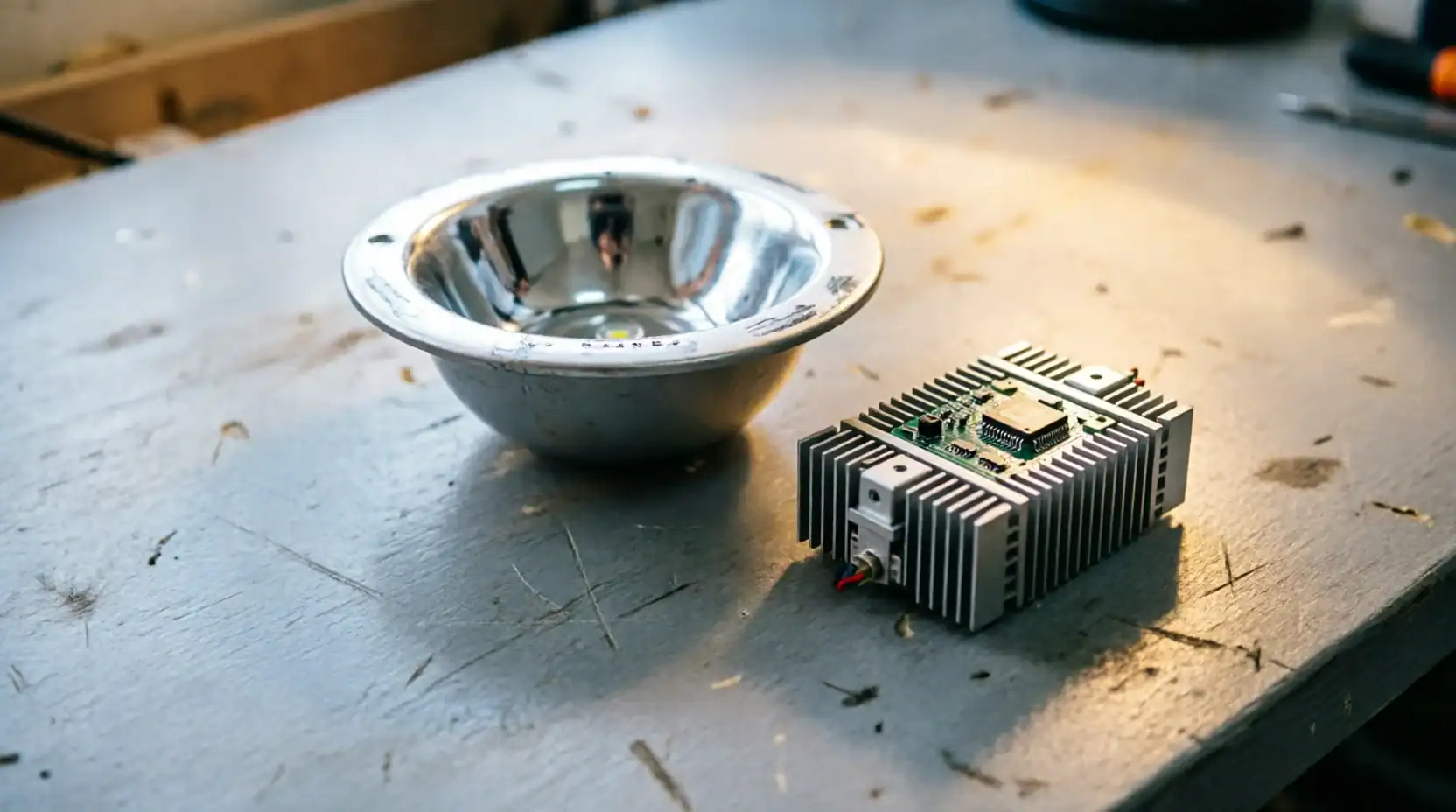
- The driver inside the fitting matters as much as the fitting. A luminaire is certified as a combination: housing plus driver plus wiring. Swap the driver and you have arguably created a different product.
- Factories substitute drivers constantly. Component shortages, cost-downs, a purchasing manager who found the same wattage two cents cheaper. Your certificate names a driver model; your production run may contain another. This is the single most common way lighting importers end up holding paperwork that does not describe the goods in the container.
Write driver make and model into your purchase order and require notification of any substitution. It is one sentence of contract language that prevents the most expensive category of surprise.
Category by Category: What Each Lighting Type Demands
LED bulbs and lamps
Self-ballasted lamps, the retrofit bulbs, are Level 3. Certification by a recognised certifier, national-database registration, RCM marking, all before the first unit sells. They also intersect with energy-efficiency regulation (more on GEMS below). The good news is that bulbs are a mature category: reputable factories hold genuine certifications and the testing pathway is well-trodden. The bad news is that the category is flooded with certificates that don’t say what sellers claim they say.
Recessed downlights
Downlights carry historical baggage. Through the late 2000s, Australia’s home-insulation boom put ceiling insulation into hundreds of thousands of roof spaces that already contained hot halogen downlights, and house fires followed. The regulatory response reshaped the category: recessed luminaires must be tested to AS/NZS 60598.2.2 and classified for insulation contact. An IC-rated fitting may be abutted by insulation; IC-4 (tested with the fitting completely covered, including with the transformer/driver) is the classification builders and electricians actually want; a non-IC fitting requires a mandated clearance from insulation.
LEDs run cooler than halogens, which lulls importers into complacency, but the driver still generates heat, and an incorrectly claimed IC rating on a product page is exactly the kind of thing that surfaces in an incident investigation. The classification must come from the test report, appear in the product marking, and match what your listing claims. Nothing about IC ratings is a marketing decision.
Decorative and pendant fittings
This is the aesthetic end of the market, and the end where compliance conversations get granular. Pendants and chandeliers are assemblies: lampholders, flex, cord grips, terminal blocks, suspension hardware. Certifiers care whether the critical components are themselves approved components, because a beautiful fitting with an unapproved lampholder is an unapprovable product. You will also strike the rewireable-versus-sealed question: fittings designed for connection by an electrician versus plug-in items, and whether the flex can be replaced without destroying the fitting. Get your certifier involved before you commit to tooling, not after the container ships. Component swaps at the design stage cost nothing; at the certification stage they cost a re-test.
Portable lamps
Table lamps, floor lamps and clip lights: anything with a plug and a flexible cord that a consumer moves around. These sit in a different risk posture from fixed fittings precisely because they get handled, knocked over, and used near beds and children. Portable luminaires are Level 3 territory under the EESS. Cord anchorage, stability testing and plug compliance (the plug itself must meet AS/NZS 3112) all come into play. A fitting that certifies easily as a fixed pendant can need genuine redesign to pass as a portable.
Outdoor and garden lighting
Outdoor splits into two very different products. 230V outdoor fittings such as wall lights, floods and bollards carry the full luminaire compliance load plus ingress-protection claims. If the box says IP65, the test report must say IP65; overstated IP ratings are one of the commonest accuracy failures in the category, and water ingress into a mains-voltage fitting is a safety issue, not a durability quibble. Extra-low-voltage garden systems, 12V or 24V downstream of a transformer, are a lighter regulatory lift for the fittings themselves, but the transformer or driver that feeds them is very much in scope, and it is usually the component your supplier thought about least.
Smart lighting
Add a radio and you add a regulator. Wi-Fi bulbs, Zigbee downlights, Bluetooth strips and their hubs must meet ACMA’s radiocommunications requirements on top of everything above, with the RF layer sitting alongside safety and EMC under the same RCM. Hub-based systems mean two products to think about: the fitting and the hub, each with its own compliance profile. The RF modules themselves are usually pre-certified, which helps, but the integration still has to be covered by your records, and firmware that changes radio behaviour is a compliance event, not just a software update.
Commercial highbays and panels
B2B lighting plays by the same legal rules with different commercial enforcement. An electrical wholesaler or a tier-one contractor will ask for your certificates, photometric files, and increasingly for flicker performance and photobiological safety data (the IEC 62471 blue-light-hazard classification) before a spec sheet gets near a project. Nobody is putting your highbay above a warehouse workforce on a handshake. The compliance folder that satisfies a regulator is the entry ticket; the folder that satisfies a specifier is thicker.
Solar garden lights
The stake-in-the-lawn solar light is genuinely low-risk electrically: no mains connection, small battery, sealed unit. The compliance exposure here is claims accuracy rather than electrocution: lumen outputs that exist only in marketing, “weatherproof” claims without an IP basis, and lithium cells that bring their own transport and quality questions. The ACCC’s consumer-law lens applies even where the electrical-safety lens barely does. Cheap category, cheap testing, no excuse for fiction on the packaging.
The Certificate Reality Check
Every lighting supplier in Guangdong will tell you the product “has SAA.” Treat that sentence as the beginning of a verification process, not the end of one. Here is the discipline:
- Get the actual certificate, not a screenshot. A certificate of conformity has an issuing body, a certificate number, an expiry date, a named certificate holder, and a schedule of covered models.
- Check the certifier is recognised. Certificates for the Australian market must come from a recognised external approvals scheme or JAS-ANZ-accredited certifier. There is a live trade in certificate-shaped documents from bodies no Australian regulator recognises: certificate mills produce paperwork that looks superb and covers nothing.
- Verify the number on the database. Certificates issued under the EESS are searchable on the national certification database. Thirty seconds of searching has saved importers five-figure mistakes.
- Match the model, exactly. Does the certificate schedule list your model number, your voltage, and above all your driver? A certificate covering the fitting with driver model A is silent about the same fitting shipped with driver model B. This is where most “certified” lighting quietly isn’t.
- Check the test reports behind it. Reports should come from a laboratory accredited by NATA or a lab recognised under the ILAC mutual-recognition arrangement. An unaccredited lab report is a nicely formatted opinion.
- Check who holds the certificate. If the factory holds it, confirm you are entitled to rely on it and that your name goes on the equipment registration. If a competing importer holds it, you cannot ride on it at all.
What does doing it properly cost? For a product family, meaning a group of variants sharing the same electrical design, expect roughly AUD 2,000 to 6,000 covering safety testing, EMC testing and certification, with the spread driven by product complexity and how much valid factory test data can be reused. That number frightens small importers until they do the amortisation: AUD 4,000 across a conservative 5,000-unit family lifetime is 80 cents a unit. Across 20,000 units it is 20 cents. Meanwhile the downside of skipping it is unsellable stock, marketplace delisting, penalties, and, in the genuinely bad scenarios, a recall with your company’s name on it. Certification is the cheapest insurance in your cost stack.
Energy Efficiency: MEPS and GEMS
Safety is not the only register. Australia runs Minimum Energy Performance Standards under the GEMS Act (Greenhouse and Energy Minimum Standards), administered through the Energy Rating framework, and lighting has been squarely in its sights since the incandescent phase-out. LED lamps are regulated products: where GEMS determinations apply to your lamp category, the models must be registered on the GEMS registry and meet the efficiency, lumen-maintenance and quality thresholds before sale. That is a separate registration from your EESS obligations, with its own fees and its own test evidence.
Fittings are less uniformly captured than lamps, but the direction of travel is clear and the determinations get updated; check the Energy Rating registration requirements for your specific category rather than assuming luminaires are out of scope. If you import both bulbs and fittings, budget administrative time for two registries, not one.
The Freight Profile: Fragile Meets Voluminous
Lighting freight is a tale of two densities. A carton of LED drivers is dense and robust. A carton of glass pendant shades is bulky air wrapped around heartbreak. Most lighting ranges mix both, which makes the freight planning genuinely interesting:
- Glass shades and decorative fittings demand real packaging engineering: moulded pulp or foam inserts, shade separated from hardware, cartons rated for the stacking load of an actually-full container. Budget a packaging prototype round with your supplier and drop-test it. Insurance claims for broken glassware are miserable to run and rarely make you whole; prevention is the strategy.
- LED panels are thin and rectangular, and they flat-stack beautifully, the container-utilisation dream. But their diffuser faces scratch and their corners crush, so edge protection and face films matter more than cube efficiency suggests.
- Drivers and transformers are your weight. A range heavy in magnetic transformers (some garden and architectural systems still use them) can push cartons toward weight limits before volume limits. Distribute them through the container plan rather than nose-loading a tonne of iron.
- Volumetric reality: pendants and floor lamps are low-density cargo, so sea freight is almost always right and your landed-cost model should key on cubic metres, not kilograms. A 500-unit pendant order can easily be 25–30 CBM.
For a broader treatment of the sea-freight mechanics, our China-to-Australia importing guide covers the routing, timing and documentation fundamentals that apply to lighting as much as to anything else.
Duty, GST and ChAFTA
Most luminaires and LED lamps attract a general customs duty rate of 5% on customs value. But the overwhelming majority of imported lighting is Chinese-origin, and under ChAFTA it enters duty-free with a valid Certificate of Origin. For a category with thin margins and high volumes, the ChAFTA preference is the easiest 5% you will ever save. GST of 10% applies on the value of the taxable importation either way. Classification within Chapter 85 and Chapter 94 has enough traps (lamps versus luminaires versus parts versus signage) that a licensed customs broker earns their fee; the Australian Border Force tariff rulings are the backstop when a classification is genuinely arguable. If FTA paperwork is new territory, see our guide to Australia’s free trade agreements for importers.
Worked Example: Launching a Three-Family Decorative Range
Meet a hypothetical importer launching a decorative range: a pendant family (six colourways, one electrical design), a table lamp family (three sizes, shared driver and lampholder design), and a fairy-light family (two lengths, one controller). First order: 1,200 pendants, 900 table lamps, 2,400 fairy-light sets.
Compliance costs (one-off)
- EESS responsible-supplier registration: AUD 400 (indicative annual fee; confirm the current schedule on the EESS site)
- Pendant family, fixed luminaire, Level 2 posture: safety + EMC testing, compliance folder: AUD 2,800
- Table lamp family, portable luminaire, Level 3: full testing + certification + national-database equipment registration: AUD 5,200
- Fairy-light family, decorative lighting outfit, Level 3: testing + certification + registration: AUD 3,600
- Compliance subtotal: AUD 12,000
Notice the shape: the “simple” products (a string of fairy lights, a table lamp) cost more to bring to market than the design-led pendant, because risk level, not retail price, drives certification burden.
Landed cost (first shipment)
- FOB value: pendants 1,200 × USD 18 = 21,600; table lamps 900 × USD 14 = 12,600; fairy lights 2,400 × USD 3.20 = 7,680 → USD 41,880 ≈ AUD 63,500
- Freight: ~34 CBM → one 20ft container underfoot, so a 40ft part-utilised or LCL split; assume FCL 40ft all-in with local charges: AUD 5,800
- Insurance: AUD 480
- Duty: AUD 0 (ChAFTA, CoO in hand; would be ~AUD 3,300 without it)
- GST: 10% of (customs value + freight + insurance) ≈ AUD 6,980, creditable for a registered business
- Broker and port charges: AUD 750
Cash out the door ≈ AUD 77,500 including creditable GST; true cost base ≈ AUD 70,530 plus the AUD 12,000 compliance layer. Amortised across the 4,500 units of order one alone, compliance adds AUD 2.67 a unit, and falls with every repeat order, because the families are certified once. Per-unit landed: pendants ≈ AUD 26.10, table lamps ≈ AUD 21.60, fairy lights ≈ AUD 5.60 before compliance amortisation. Against typical decorative-lighting retail multiples, the range works, and it works legally, which is the version of working that survives a regulator’s email.
Common Mistakes That End Badly
- Selling unregistered Level 3 gear. The most serious failure, and the most common among new importers who assumed “the factory has certificates” closed the matter. It is your registration or no sale.
- Certificates for a different driver. The paperwork names driver A; the container holds driver B. Legally you are selling uncertified product. Contractually forbid silent substitutions and spot-check incoming stock against the certificate schedule.
- Wrong IC-rating claims on downlights. Claiming IC-4 because the supplier said so, without it appearing in the test report and on the marking. In a category with a fire history, this is the claim you least want to be wrong about.
- No responsible-supplier registration at all. Some importers do the testing and skip the register, treating it as paperwork. The register is the system; unregistered suppliers of in-scope equipment are non-compliant regardless of how good their test file is.
- Overstated IP ratings on outdoor product. An IP44 fitting sold as IP65 is a consumer-law problem on a dry day and a safety problem on a wet one.
- Forgetting GEMS on lamps. EESS registration does not discharge energy-efficiency registration. Two regimes, two registrations.
The Sequence That Works
The order of operations for a lighting import that goes right: classify each product against the EESS risk levels and the GEMS determinations, then register as a responsible supplier. Verify or commission certification per family with the exact driver locked in the purchase order, then apply the RCM under your registration. Engineer the packaging for the fragile items and the container plan around the density mix, claim ChAFTA at the border, and keep the compliance folder where you can produce it in a day, because the day you are asked for it is not a day for searching.
Australian retailers, marketplaces and specifiers are getting steadily better at telling genuine compliance files from decorative ones, which is why the regulatory load doubles as a barrier to the competition that skips it. Swift Cargo handles the freight leg, packaging review, consolidation, customs clearance and delivery into Australia, every week.
Related Reading
- Importing Electronics from China to Australia: The Complete Guide
- Sourcing Electronics in Shenzhen: A Practical Playbook
- Importing Toys to Australia: Safety Standards and Freight
- Retail Import Logistics in Australia: From Port to Shelf
Frequently Asked Questions
Do I need EESS registration to import LED lighting to Australia?
In most cases, yes. If you import in-scope electrical equipment for sale, you must register as a responsible supplier on the EESS national database. Level 3 items, including many household lighting products such as mains-voltage LED lamps, portable luminaires and decorative lighting outfits, additionally require certification and equipment registration before sale. The importer, not the overseas factory, carries the obligation.
What is the RCM and who can apply it to lighting products?
The RCM is the single mark covering both electrical safety and ACMA EMC/radio compliance. Only a registered responsible supplier, an Australian or New Zealand entity, can authorise its use. Your factory applies it on behalf of your registration, backed by your records; it cannot lawfully apply it on its own account.
My supplier says the product already has an SAA certificate. Is that enough?
Not on its own. Confirm the certifier is recognised, the certificate is current, and the schedule covers your exact model including the specific LED driver fitted. Verify the certificate number on the EESS database and check the underlying test reports come from a NATA or ILAC-accredited laboratory. Certificates covering a different driver revision are the most common failure in the category.
How much does certifying a lighting product family cost?
Roughly AUD 2,000–6,000 per family for testing and certification, varying with complexity and how many variants share one electrical design. Amortised over realistic volumes it is typically well under a dollar per unit, dramatically cheaper than delisting, penalties or a recall.
What import duty applies to LED lighting from China?
The general rate for most lighting is 5%, but ChAFTA reduces Chinese-origin lighting to duty-free with a valid Certificate of Origin. GST of 10% applies regardless. Confirm classification with a licensed customs broker, with Australian Border Force tariff rulings as the backstop for arguable cases.
Do LED downlights need special certification for insulation contact?
Yes. Recessed downlights must be tested and marked for their insulation-contact classification (IC, IC-4 or non-IC with mandated clearances). Given the history of insulation-related downlight fires in Australian homes, the IC claim must come from the test report and appear in the product marking, never from a supplier’s assurance.