
Clearing customs at Suvarnabhumi is not the end of your pet’s journey to Phuket. It’s the end of the part everyone plans for. Almost no guide covers the next stretch in real detail: a boot, a back seat or a van floor, anywhere from two to twelve hours depending on where you’re going.
An ordinary Bangkok taxi will take your bags to a hotel without incident. It was never built to take a stressed, crated animal on a multi-hour highway run. Treating the two jobs as interchangeable is the most common planning mistake on this leg of the trip. Once your pet has cleared the Department of Livestock Development’s Animal Quarantine Station at the airport, no further government paperwork or checkpoint applies to the onward road or domestic-air leg. Everything from here is logistics, not regulation.
Why Ordinary Taxi Assumptions Fail
A metered taxi or ride-share car is optimised for a human passenger’s comfort in the cabin. It has air-conditioning zoned toward the front seats and a boot designed for suitcases, and its driver has no training in animal handling and no protocol if something goes wrong. On a 30-degree Bangkok afternoon, a crate wedged at an angle in a sedan boot with no airflow carries a very different risk from the same crate in a purpose-fitted van with independent rear climate control and a driver who can recognise a distressed animal before it becomes an emergency.
The gap widens on the longer routes, where Phuket and Chiang Mai mean hours of continuous road time, but it exists even on the short Pattaya run. A dog that just spent nine hours in an aircraft hold is now stressed, dehydrated and disoriented. It deserves a calmer next two hours than a stranger’s daily taxi shift can reliably provide.
Crate and Vehicle Fit
The crate needs to sit flat and fully supported, not wedged at an angle or stacked against loose luggage that can shift into it under braking. For anything larger than a small breed, that generally rules out a standard sedan boot entirely. A van or SUV with a folded second or third row gives a large dog’s crate a stable, flat floor with airflow on all sides, which a boot compartment usually cannot match.
Secure the crate to the vehicle’s own tie-down points, because the stakes are higher on Thailand’s provincial highways than on a short city transfer. Friction and the crate’s own weight are not enough. Motorbikes cutting into traffic force sudden braking on the Bangkok-Pattaya and Bangkok-Hua Hin roads as a matter of routine.
Air-Conditioning: The Detail That Actually Matters Most
The most important feature of a proper pet transport vehicle in Thailand’s climate is independent, adjustable airflow that reaches the crate itself, not just the human cabin up front. A car that feels comfortably cool for the driver and passengers can still leave a crate in the back sitting in warmer, poorly circulated air, especially on a stationary stretch in traffic. This is the ground-transport equivalent of the tarmac heat embargoes airlines apply before a flight.
Delivery Within Bangkok
If your pet’s actual destination is Bangkok itself, this is the simplest version of the journey: typically under an hour from Suvarnabhumi to most central Bangkok addresses outside of the worst rush-hour windows, in a vehicle that never needs a rest stop or overnight plan. The main variable is timing. Bangkok’s peak-hour congestion can stretch a 45-minute trip well past two hours on a bad afternoon, which matters to an animal that has already been travelling for a full day.
Between roughly May and October, add the weather to that calculation. Bangkok’s rainy-season storms tend to break in the late afternoon and evening, and a heavy downpour can flood low-lying roads and underpasses within the hour, turning the usual peak-hour crawl into a standstill. That is also when many flights from Australia land. For a late wet-season arrival, treat the overnight option described below as the default and a same-evening run as the exception.
Pattaya: The Short, Straightforward Run
At roughly 150 kilometres and commonly 1.5 to 3.5 hours depending on traffic, Bangkok to Pattaya is the most manageable of the four onward routes and rarely needs anything beyond a single water-and-toilet stop for a healthy adult pet. Timing matters more than distance here: leaving outside Bangkok’s peak congestion windows can shorten an otherwise straightforward trip considerably.
Hua Hin: Slightly Longer, Same Logic
Hua Hin runs about 200 kilometres and roughly two and a half to three hours from the airport, close enough to Pattaya in character that the same single-stop, same-day approach applies. Bangkok residents making leisure trips load the coastal route on weekends and holidays, so avoid a Friday afternoon or public holiday departure if your schedule allows.
Phuket: Where Flying Beats Driving for Most Pets
Phuket is roughly 820 kilometres and 10 to 12 hours by road, a different proposition from Pattaya or Hua Hin. Most pet transport operators recommend a domestic flight instead: about 90 minutes in the air on a route Bangkok Airways and other domestic carriers operate regularly. For a healthy pet already cleared through Suvarnabhumi’s Animal Quarantine Station, a same-day or next-day domestic connection is often the lower-stress option on time-in-transit grounds alone.
Road transport to Phuket is still the right call in specific situations: a pet with a medical condition that makes a second flight inadvisable so soon after the international leg, or one whose anxiety is worse in aircraft than in a moving vehicle. If you do choose the road, treat it as a two-day journey with a proper overnight stop, never a single continuous push.
Chiang Mai: The Northern Equivalent of the Phuket Decision
Chiang Mai poses almost the same trade-off as Phuket, just to the north instead of the south: about 750 kilometres and 8 to 10 hours by road, against roughly 75 minutes on a direct domestic flight.
Koh Samui and the Ferry Question
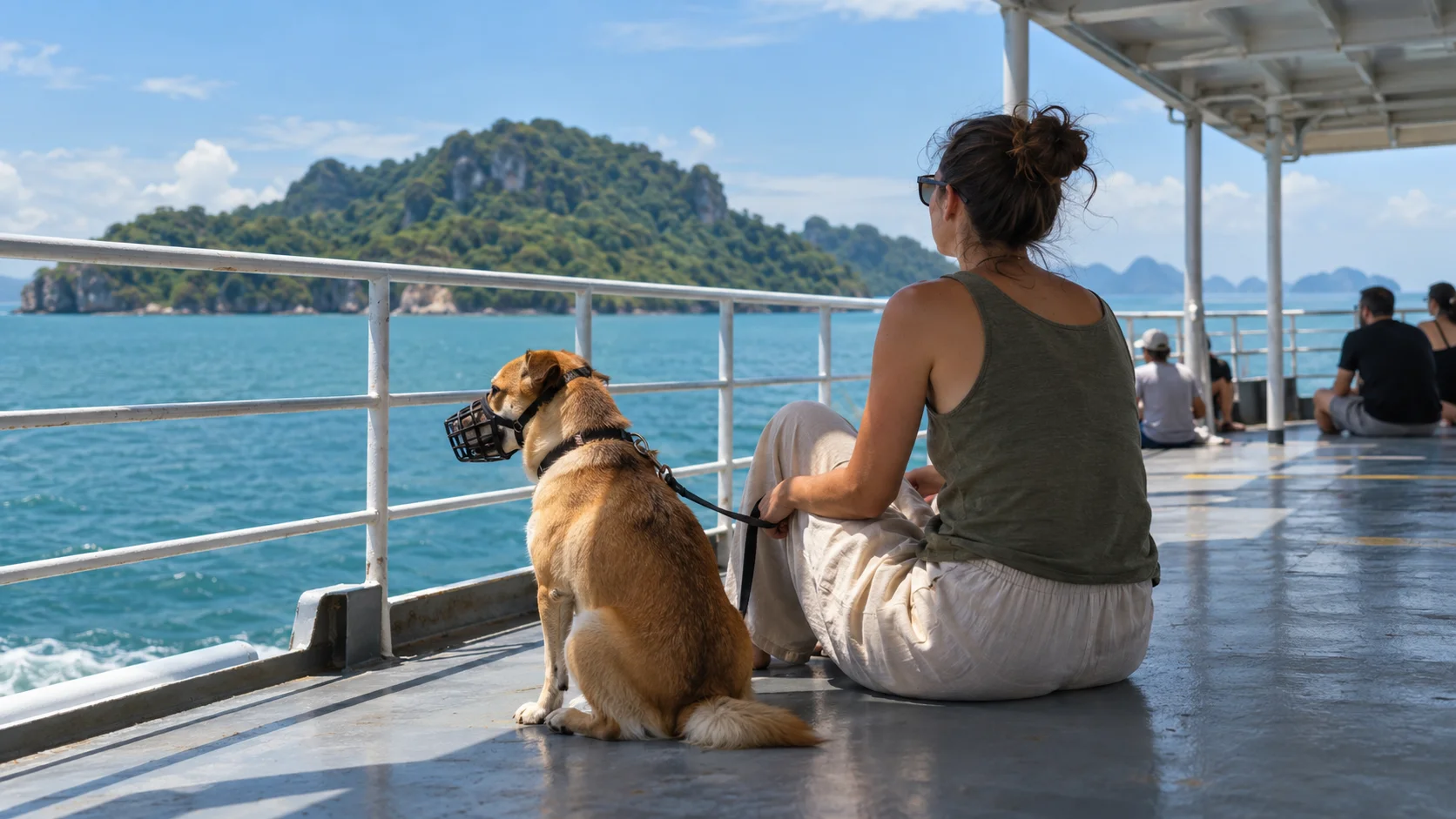
Of the two main operators running the Surat Thani crossing, Seatran does not permit pets on any service. Lomprayah’s own published terms do allow pets, for a 200 baht fee, but on a leash and muzzle, not necessarily inside a closed crate. The same clause excludes the bus, so the road leg to the pier has to be arranged separately. That distinction matters more than the headline “pets allowed” suggests: a leashed, muzzled animal on a passenger ferry carries a very different risk from a crated one, particularly for a cat, since the entire safety plan in this guide depends on the crate never opening.
Confirm the operator, the exact on-board arrangement and current terms directly before booking around a Samui ferry crossing, rather than assuming “pets allowed” means the same thing it would on a plane. For most dogs and virtually all cats, the dependable route to Samui is still a domestic flight with a carrier confirmed in advance to accept pet cargo, treated as the default plan rather than the fallback.
Rest Stops: What a Good One Actually Looks Like
A rest stop on the Phuket or Chiang Mai route needs to do three things well: shade for the vehicle, not just a parking space in direct sun; a controlled water offer without opening the crate fully in an unfenced area; and a real pause in engine vibration and road noise, which matters more to a stressed animal than owners tend to expect. Roughly every two to three hours is a reasonable rhythm for a healthy adult dog on the longer routes, more frequently for a puppy, a senior pet, or any animal already flagged as anxious or medically sensitive before departure.
Overnight Near the Airport: Sometimes the Better First Move
For a pet landing late in the day and facing a long onward road leg, an overnight stop near Suvarnabhumi before starting the drive is often better than pushing straight through. A calm night in a quiet, pet-appropriate space resets an animal that has already been through immigration, quarantine processing and hours of crate time. Starting the Phuket or Chiang Mai drive fresh the next morning is far easier on the pet than beginning it exhausted at 9pm.
Cat Escape Control
Cats carry a risk that dogs mostly don’t: a cat that seems perfectly calm in its crate can bolt the instant that crate is opened somewhere unfamiliar, and an escaped cat at a highway service station or an unfamiliar driveway is difficult to recover. Thailand’s roadside environments offer a frightened cat endless places to disappear into. Experienced handlers keep the crate closed for the entire vehicle transfer, door to door. They reassure the animal through the crate rather than opening it for a comforting hold at a rest stop. That’s the same standard IATA sets for secure crate handling in the air. It feels colder in the moment, but it is the difference between a stressful drive and a lost cat.
When Road Transport Is Better Than a Domestic Flight
Despite the time cost, road transport is not a generally inferior option. It is the better choice in three identifiable situations: a pet with a cardiac, respiratory or other condition where a second pressurised-cabin flight so soon after the international leg carries real risk (the kind of profile covered in our guide to flying an older or medically complex pet internationally), a pet whose anxiety is measurably worse in aircraft than in a moving vehicle, or an owner who specifically wants to avoid adding another handling transfer on top of an already long journey. The logic that decides your departure airport in Australia applies again in Thailand: total time and handling transfers matter more than the fastest option on paper. Our comparison of Australian gateway cities for a pet flight to Thailand covers this in more detail.
Vehicle and Handler Checklist
Confirm every item below with your driver or pet transport operator before the vehicle leaves the airport, not after you’re already on the highway:
- Independent, adjustable air-conditioning reaching the crate position, not just the front cabin
- Crate secured flat against the vehicle’s tie-down points, not resting loose against luggage
- Non-slip flooring or bedding under the crate to stop sliding under braking
- A collapsible water bowl and fresh water accessible without fully opening the crate
- A clear rest-stop plan: shaded parking, no full crate opening in an unfenced area
- Driver briefed on this specific pet’s temperament, any medical needs, and what a problem looks like for this animal
- A confirmed overnight plan for any route exceeding roughly six hours of road time
- Your phone number and the driver’s, exchanged before departure, not assumed via an app
- For cats specifically: a zero-open-crate rule, agreed with the driver in advance
Sample Journey Plans
| Route | Distance | Road time | Recommended approach |
|---|---|---|---|
| Suvarnabhumi to Bangkok (city) | Under 30km | 30–90 min (traffic-dependent) | Direct transfer, avoid peak-hour departure |
| Suvarnabhumi to Pattaya | ~150km | 1.5–3.5 hours | Same-day direct, one rest stop |
| Suvarnabhumi to Hua Hin | ~200km | 2.5–3 hours | Same-day direct, avoid weekend/holiday traffic |
| Suvarnabhumi to Phuket | ~820km | 10–12 hours by road / ~90 min by air | Domestic flight for most pets; road with overnight stop for medically complex pets |
| Suvarnabhumi to Chiang Mai | ~750km | 8–10 hours by road / ~75 min by air | Domestic flight for most pets; road with overnight stop where a second flight isn’t appropriate |
| Suvarnabhumi to Koh Samui | Road to Surat Thani, then ferry (Lomprayah only, leash and muzzle) | ~1.5 hours by air | Domestic flight for most pets; ferry only after confirming on-board terms |
Frequently Asked Questions
Can a regular taxi take my pet from Bangkok airport to Pattaya or Hua Hin?
Technically often yes for a calm, well-crated small pet, but an ordinary metered taxi or ride-share car is not built for the job. The air-conditioning is zoned for human comfort in the cabin, not a crate in the boot or back seat. Drivers are not trained to handle a distressed animal, and there is no fallback plan if your pet has an accident, escapes a poorly secured carrier, or needs a stop. A dedicated pet transport vehicle costs more than a taxi fare for good reasons that matter most on the longer or hotter routes.
How long does it take to drive from Bangkok airport to Phuket with a pet?
Around 10 to 12 hours by road, covering roughly 820 kilometres, which is long enough that most pet transport operators recommend flying the final leg domestically instead: about 90 minutes in the air versus most of a day on the road. Road transport to Phuket is still the right call for a pet that cannot fly a second time on medical or anxiety grounds, but it needs an overnight stop built into the plan, not attempted as a single push.
Can I take my pet to Koh Samui by ferry from the mainland?
It depends which operator, and the details matter. Seatran does not permit pets on any service. Lomprayah’s own published terms do allow pets for a small fee, but on a leash and muzzle rather than necessarily inside a closed crate, which is a meaningfully different, higher-risk arrangement than air travel for a nervous animal or a cat. Confirm the exact on-board arrangement directly before booking, and for most cats especially, treat a domestic flight with a pet-cargo-accepting carrier as the dependable default rather than the ferry.
What size vehicle do I need to transport a large dog from Bangkok airport?
A vehicle where the crate sits flat, fully supported, with the dog able to stand and turn around inside it, which usually rules out a standard sedan boot for anything larger than a small breed. A van or SUV with the second or third row folded, and a secured, non-sliding crate position, is the standard setup for medium and large dogs on any of these routes.
How do you stop a cat escaping during ground transport in Thailand?
The crate stays closed and secured for the entire vehicle transfer, with no exceptions for a quick reassurance cuddle at a rest stop. Cats that seem calm can bolt the instant a door or crate opens in an unfamiliar place, and an escaped cat at a highway service station is extremely difficult to recover. Handlers experienced with cats build in zero open-crate handling between the airport and the final destination, reassuring the animal through the crate rather than by opening it.
Is it better to drive or fly domestically from Bangkok to Chiang Mai with a pet?
For most pets, flying domestically wins on this specific route: roughly 75 minutes in the air against 8 to 10 hours on the road for a similar distance. Road transport is still the better choice for a pet that is medically unsuited to a second flight so soon after the international leg, or for an owner who specifically wants to avoid another airport handling transfer, but plan it as a genuine multi-stop journey with an overnight break, not a same-day marathon.
Road conditions, ferry policies and domestic flight schedules in Thailand change without much notice, so confirm current routing directly with your driver, airline or pet transport handler before you travel. For onward transport built around your pet’s specific route and needs, get a pet transport quote from SwiftCargo.