
Moving a dog or cat from the USA to Thailand is achievable, but it requires a specific sequence of US government documentation. The bottleneck is not Thailand’s requirements; Thailand’s Department of Livestock Development (DLD) issues import permits straightforwardly. The bottleneck is the US side: USDA-accredited veterinary health certificates endorsed by USDA APHIS (Animal and Plant Health Inspection Service). Moving pets from the USA to Thailand works when those steps run in order: microchip, rabies vaccination, import permit, then the endorsed health certificate.
The permit and quarantine mechanics are set by Thailand’s Department of Livestock Development. See the DLD animal quarantine guidance for current requirements.
Get the sequence wrong and your pet will be denied boarding in the USA or refused entry in Thailand. A wrong microchip standard, a health certificate issued too early, or a rabies vaccination outside the valid window is all it takes.
A companion guide covers moving pets from Europe to Thailand.
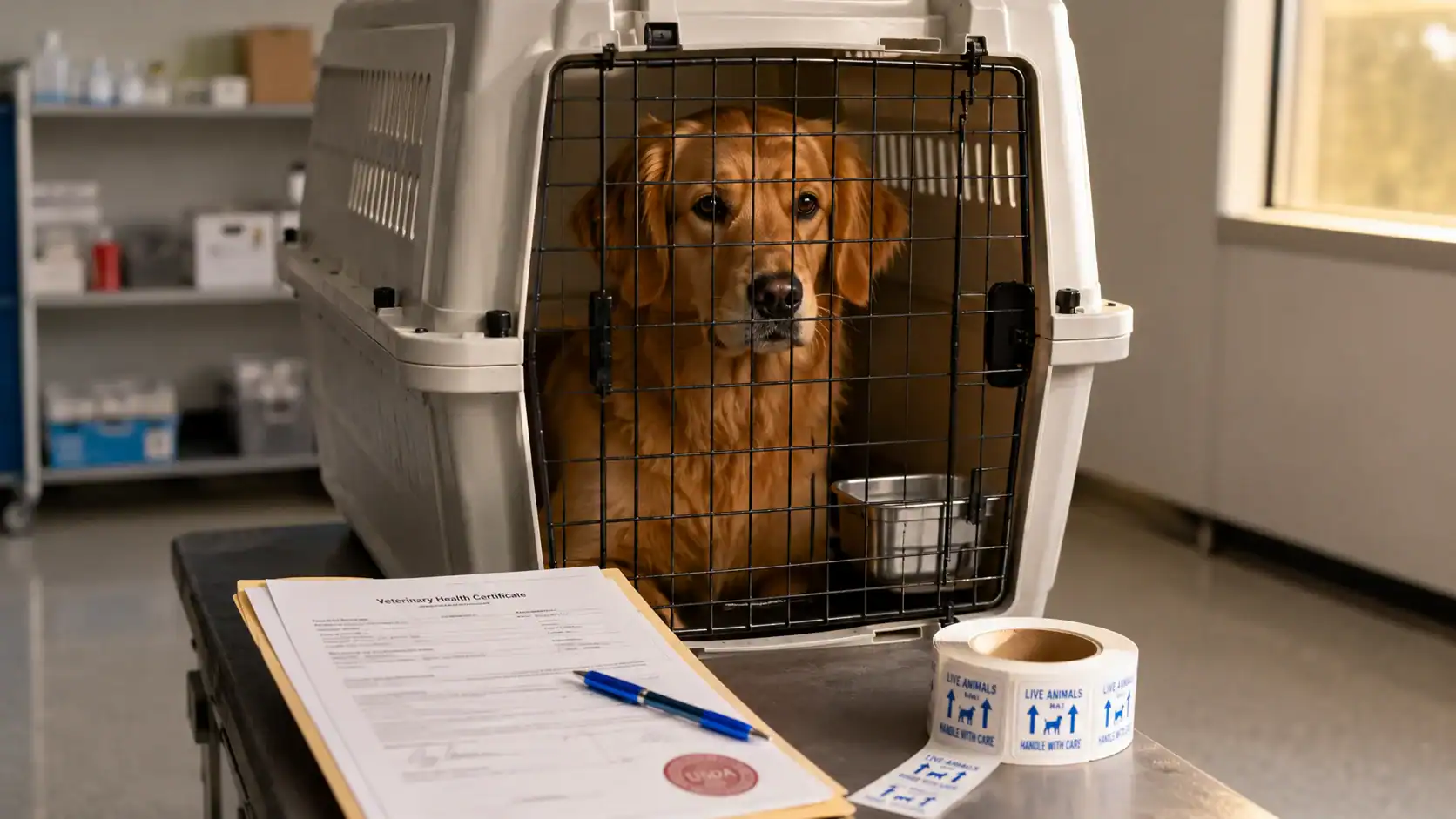
Thailand’s Status on Rabies and Why It Matters
Thailand is not a rabies-free country, and the DLD’s instruction sheets list a rabies vaccine for every dog and cat. We found no exemption by country of origin in any current sheet.
For pets arriving from the USA, Thailand’s DLD applies its full import protocol: valid Thai import permit, USDA APHIS-endorsed health certificate, current rabies vaccination within the valid window, and ISO-compatible microchip. If you meet these requirements correctly, there is no mandatory quarantine period. A DLD inspection at the livestock checkpoint inside customs typically takes 30–60 minutes, and then DLD releases your pet to you.
Step-by-Step: The US-to-Thailand Pet Import Process
Step 1: Microchip (ISO 11784/11785 Standard)
Thailand requires a 15-digit ISO 11784/11785-compliant microchip (134.2 kHz) for all imported dogs and cats. This matters for American pet owners because many US vets implant a different standard, the 125 kHz (9-digit) chip that HomeAgain and AVID use in the USA. Thailand’s ISO scanners cannot read a 125 kHz chip.
If your pet already has a US-standard chip, you have two options:
- Have a second ISO-compliant chip implanted (your vet can do this; the old chip stays in place). The ISO chip must be implanted before the rabies vaccination that will appear on the health certificate; otherwise the certificate cannot link the rabies vaccination to the ISO chip number.
- Purchase a universal scanner that reads both chip types and carry it with you. However, Thai DLD may scan only with its standard equipment, so this is not a reliable workaround.
Step 2: Rabies Vaccination
Thailand requires proof of current rabies vaccination. The timing constraints are:
- Minimum: a primary rabies vaccination must be administered at least 21 days before you apply for the import permit, and the same wait applies to a shot given after the previous one had lapsed. The Thai embassy’s sheet counts the 21 days to the application; the Chicago consulate and the DLD’s guidelines count them to departure. Vaccinating 21 days before you apply meets both. A booster given while the previous vaccination was still valid carries no 21-day wait, but the earlier vaccination records must be submitted with the permit application. A primary rabies shot needs a pet at least 12 weeks old, and APHIS sets a minimum age of 4 months at import.
- Maximum: The vaccination must be current, meaning within the manufacturer’s stated validity period (typically 1 year or 3 years depending on the vaccine). Thailand checks the vaccination expiry, not just the date administered.
An annual booster must be given before the previous vaccination expires. A lapsed rabies vaccination means starting the 21-day wait again, which may delay your travel date.
Step 3: Thai DLD Import Permit
You need an import permit from Thailand’s Department of Livestock Development (DLD). The application goes to the Animal Quarantine Station at your port of entry, and the Royal Thai Embassy’s instruction sheet for US travellers sets the window: request it within 60 days of departure but no later than 7 days before it. Submit the documents at least 7 business days out. The permit issues 5 to 7 business days after DLD has a complete set and stays valid for 60 days. Applying around 30 days out sits comfortably inside the window and leaves room for a query.
The import permit application requires:
- Application Form R1/1 (your name, Thai and home addresses, the pet’s breed, sex, date of birth, colour and microchip number)
- Microchip implantation certificate and flight itinerary
- Copy of your passport
- Colour photo of the pet with the face clearly shown
- Vaccination certificates in English
The DLD issues the permit as a PDF. Print it and carry it with all other pet travel documents, and confirm the validity dates when you receive it, because the permit covers a specific arrival window.
Step 4: USDA-Accredited Vet Health Certificate
A USDA-accredited veterinarian must issue the health certificate; a licensed vet alone is not enough. Search for USDA-accredited vets in your state using the USDA APHIS veterinary accreditation portal.
Critical timing constraint: the health certificate is valid for only 10 days from the date USDA APHIS endorses it, not from the date your vet signs it, and the pet must arrive in Thailand inside that window. The Thai embassy’s sheet says Thai quarantine accepts only the original endorsed certificate with the APHIS stamp and that electronic copies are not valid, while APHIS’s Thailand page (updated 2 October 2026) says it can endorse digitally. Ask the Animal Quarantine Station (qsap_bkk_import@dld.go.th) before you rely on a digital copy.
The health certificate must include:
- Pet’s name, species, breed, sex, age, colour
- Microchip number (the ISO 11784/11785 chip number)
- Rabies vaccination details (date, vaccine brand, batch number, expiry date)
- General health examination confirming the pet is clinically healthy and free of clinical signs of infectious disease
- Companion vaccinations, which Thailand requires rather than merely recommends: for dogs, canine distemper, canine hepatitis, canine parvovirus and leptospirosis; for cats, feline panleukopenia. A dog without a valid leptospirosis vaccine must either wait 21 days after it is given or carry a negative leptospirosis test result from within 30 days before departure
- Confirmation that the pet is fit to travel
The USDA-accredited vet completes the certificate in a format accepted by USDA APHIS for endorsement. Ask your vet to use the USDA Form VS 7001 (official interstate and international certificate of health examination for small animals) or confirm that they know the Thai DLD requirements and the APHIS endorsement process.
Step 5: USDA APHIS Endorsement
After the USDA-accredited vet signs the health certificate, the USDA APHIS Veterinary Services Center must endorse it (countersign and stamp).
APHIS has no in-person or drop-off service, so there are two routes:
- Through your vet (fastest): the accredited vet submits the certificate in VEHCS, APHIS’s export certification system, and APHIS endorses it digitally or returns a stamped original on your prepaid express label.
- By mail: Ship the original signed certificate to the USDA APHIS office serving your state, by overnight or Saturday delivery with a prepaid express return label; allow 3–5 business days (standard) or 1–2 business days (expedited). USDA APHIS charges USD 101 per certificate for endorsement, or USD 160 with one or two laboratory tests.
Because the certificate is valid for only 10 days from endorsement, and endorsement takes 1–5 business days, the practical window is tight. For a travel date of Day 0:
- Day -10 to -8: vet appointment, health certificate signed
- Day -8 to -4: your vet submits it in VEHCS, or you ship it to APHIS; endorsement returned
- Day -4 or later: endorsed certificate in hand, travel documents complete
Schedule the vet appointment no later than Day -7. APHIS can be delayed, and holiday and high-volume periods add time. Have the Thai DLD import permit, microchip certificate, and rabies certificate ready before the appointment so the vet can complete the health certificate in one visit.
Stop before the endorsement step until the flight is fixed. The permit survives a change: the DLD’s guidelines say it can be reused if the flight, date or time moves within its 60 days. The certificate cannot, because it runs only 10 days from the APHIS endorsement date. A flight that moves past day 10 needs a new certificate and a second USD 101 endorsement fee. We would book the flight and the crate first and request the endorsement last.
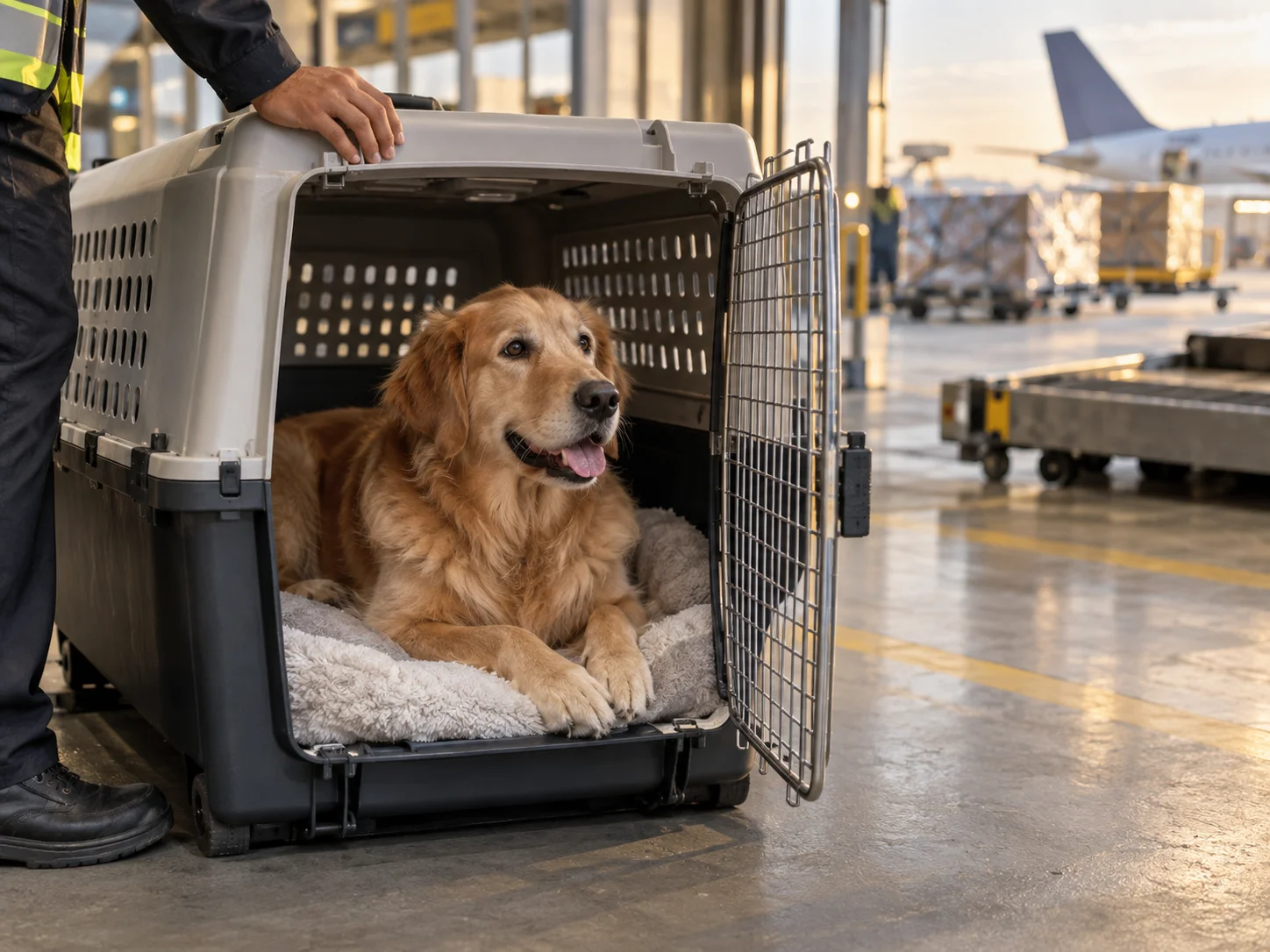
Airline Options from the USA to Thailand
Swift Cargo coordinates the cargo shipment for pets not eligible for cabin travel, and you can get a quote on pet transport to Thailand.
In-Cabin (small pets only)
In-cabin pet carriage (pet in a carrier under the seat) is available on some routes for small dogs and cats (combined weight of pet + carrier typically under 8–10 kg). However, the route from the USA to Thailand requires at least one connection, and not all airlines allow in-cabin pets on all segments. Thai Airways, EVA Air and Japan Airlines (JAL) do not accept pets in the cabin on international flights, service animals excepted. Confirm directly with the airline at the time of booking, because policies change frequently and are enforced at check-in.
Checked Baggage (medium pets)
Pets travelling as checked baggage ride in the temperature-controlled cargo hold. This option is available on some routes for pets too large for in-cabin carriage but meeting the airline’s weight/size limits. Temperature and pressure conditions in modern aircraft holds are appropriate for pet travel, but confirm the airline’s specific temperature restrictions (many airlines suspend pet carriage in holds when ambient temperatures exceed 85°F/29°C at origin or destination).
Cargo Shipment (large dogs, pets not eligible for passenger cabin/baggage)
Three groups must travel as manifest cargo through an IATA-certified pet transport agent: large dogs above airline weight limits, snub-nosed (brachycephalic) breeds that most airlines restrict (English Bulldogs, French Bulldogs, Pugs, Shih Tzus, Persian cats, etc.), and pets whose owners are not flying on the same flight. The pet travels in a larger IATA-compliant crate in the cargo hold, shipped as freight rather than passenger baggage.
IATA Live Animals Regulations (LAR) govern the crate standards, minimum dimensions (the pet must be able to stand, turn, and lie down), ventilation, bedding, and food/water requirements for cargo shipments. An IATA-certified pet relocation agent arranges the cargo booking, coordinates with the airline cargo department, and handles the freight customs documentation on arrival in Thailand.
Airlines with dedicated air cargo pet handling on US–Thailand routes: Thai Airways Cargo, Singapore Airlines Cargo (via Singapore), Korean Air Cargo (via Seoul), Japan Airlines Cargo (via Tokyo). Confirm current policies and availability, because cargo space for live animals must be booked separately from passenger tickets.
Restricted and Prohibited Breeds
The Royal Thai Embassy’s instruction sheet for US arrivals (revised 30 January 2025) states that no dog breeds are banned from importation, and the Chicago consulate agrees, but the Canberra embassy page still lists the Pit Bull Terrier and American Staffordshire Terrier as prohibited, and airlines may have their own breed restrictions. If your dog is a bull-terrier type or cross, confirm the position with the Animal Quarantine Station in writing when you apply for the permit. See our guides to taking a dog to Thailand and forbidden items you cannot ship to Thailand.
Snub-nosed (brachycephalic) dogs and cats face additional airline carriage restrictions: many airlines refuse to carry them in holds or cabins due to respiratory risk. For brachycephalic breeds, cargo shipment through a specialist pet relocation agent is typically the only viable option.
Snub-nosed breeds narrow the airline list fast, so it is worth booking the crate and cargo space before the vet appointment is set, not after.
At Bangkok’s Suvarnabhumi Airport
US-to-Thailand flights typically arrive at Suvarnabhumi Airport (BKK). On arrival with your pet:
- Proceed through immigration (passport control) normally
- Collect your baggage and pet carrier (or collect your pet from the cargo hall if travelling as freight)
- Before exiting customs, present yourself at the Animal Quarantine Station (AQS) (operated by Thai DLD; next to baggage carousel 8 for a hand-carried pet, while a cargo pet goes to the cargo station below)
- Present all documents: Thai DLD import permit, USDA APHIS-endorsed health certificate, microchip certificate, rabies vaccination record
- A DLD officer inspects the pet, scans the microchip, and reviews the documents
- If all documents are in order, the AQS issues the import approval (Form R-6) and licence (Form R-7) and takes the fee; you then take the pet and the paperwork to the Goods to Declare channel at Customs
There is no mandatory quarantine for pets from the USA that arrive with correct documentation. A DLD officer can still detain or return a pet whose documents are incomplete, whose microchip number does not match, or that shows signs of illness, at the owner’s cost.
A cargo pet is cleared at the cargo-side AQS in the Free Zone, which is open weekdays only and closed on Thai public holidays, so book a weekday arrival. Our Suvarnabhumi pet arrival guide compares the baggage and cargo routes.
Thai Customs says pets are not exempt from duty and publishes no amount for a dog or cat. They appear to fall under tariff heading 0106.19.00, which the 2022 tariff decree sets at 40 percent, plus 7 percent VAT, with the officer setting the value. One 2026 owner guide reports paying 1,000 baht at the exit, which is one reported case, not a rate.
Costs Summary
| Item | Approximate cost |
|---|---|
| ISO microchip implantation (if needed) | USD 40–100 |
| Rabies vaccination (if due) | USD 30–80 |
| USDA-accredited vet health certificate | USD 80–250 |
| USDA APHIS endorsement | USD 101 per certificate |
| Thai DLD import permit (free) plus arrival processing fee | THB 500 per animal |
| Thai customs duty and VAT on the pet | No published amount; the Customs officer sets the value |
| IATA-approved travel crate (if needed) | USD 50–200 depending on size |
| Airline pet carriage fee (in-cabin) | USD 100–250 per flight |
| Airline cargo pet fee (large pets) | USD 400–1,500+ depending on route, weight, airline |
| Pet relocation agent (if using) | USD 500–2,500 for full coordination |
Thailand does not require a rabies antibody titre test. The titre belongs to rabies-free destinations such as Australia, Japan and New Zealand. The DLD instruction sheet for US arrivals lists no rabies titre test. What Thailand does impose is a sequence with fixed durations: the 21-day wait after a primary or lapsed rabies vaccination, a health certificate that is valid for only 10 days from the date USDA APHIS endorses it, and an endorsement step that has to fit inside that same window.
Fold the pet timeline into your wider Thailand relocation plan instead of bolting it on at the end. If you’re moving the whole household, our guide for Americans moving to Thailand covers the pieces that sit right alongside your dog or cat’s paperwork.
We keep the USDA sequence and the flight on one calendar
Tell us about your dog or cat and the month you want to fly, and one coordinator sequences the permit, the vaccination and the certificate so nothing lands out of order.
A Timeline for Moving Pets from the USA to Thailand
Start 8 to 12 weeks out with an ISO 11784/11785 microchip and the rabies vaccination, then allow the 21-day wait. Apply for the DLD import permit around 30 days before travel, and keep the USDA-accredited vet visit and APHIS endorsement inside the final stretch, because the certificate is valid for only 10 days from endorsement.
Frequently Asked Questions
Do I need a USDA-endorsed health certificate to bring my pet to Thailand from the USA?
Yes. Thailand requires a health certificate from a USDA-accredited vet endorsed by USDA APHIS. The certificate must be issued within 10 days of travel. APHIS endorsement takes 1–5 business days. Budget 7–10 days minimum for the US documentation step.
Is there a quarantine for pets entering Thailand from the USA?
No mandatory quarantine for dogs and cats with correct documentation: Thai DLD import permit, USDA APHIS-endorsed health certificate, ISO-compliant microchip, and current rabies vaccination (administered at least 21 days before you apply for the import permit). Inspection at the airport livestock counter takes 30–60 minutes.
Will my US microchip work in Thailand?
Many US pets have 125 kHz chips (HomeAgain, AVID) which are NOT ISO 11784/11785 standard. Thailand’s DLD scans only ISO 134.2 kHz chips. If your pet has a US-standard chip, have an ISO 15-digit chip implanted before the rabies vaccination on the health certificate.
Which airlines fly pets from the USA to Thailand?
No direct US-Thailand flight accepts in-cabin pets currently. Thai Airways, EVA Air, and JAL do not accept pets in the cabin on international flights, service animals excepted. Larger pets must travel as cargo through an IATA-certified program. Confirm all policies at time of booking.
How far in advance should I start the pet import process?
Start 8–12 weeks before travel. DLD import permit: at least 30 days before. Microchip and rabies vaccination: 10–12 weeks out (wait 21 days after vaccination before you apply for the import permit). USDA vet certificate and APHIS endorsement: final 7–10 days before departure.