
A small cat and a large dog moving through Singapore on the same 10-day pathway can differ in total cost by more than the price of a small car, and almost none of that gap comes from the government fees, which are identical for both. It comes from eleven other line items that all move independently (crate size, airline freight, staging boarding, vet prep), and nobody selling a single headline number is telling you the whole truth. This is the actual stack, line by line, with two worked examples at the end showing how it adds up in practice. Understanding pet transport to Australia cost this way, as a stack of independent line items rather than one number, is what lets you actually budget instead of guessing.
Why There Is No One Average
Search for “cost to bring a dog to Australia” and you’ll find single numbers presented with more confidence than the underlying reality supports. The honest answer is that total cost is a sum of roughly a dozen line items, several of which scale with the animal’s size, several of which depend on which staging country and airline route is used, and one of which (whether the pet needs six months of staging-country residency at all) can add thousands of dollars or add nothing, depending entirely on where the pet started its life. A fixed number that doesn’t ask these questions first is a marketing number, not a planning one.
Australian Government Fees
This is the one part of the stack with genuinely fixed, published pricing. DAFF charges a daily husbandry fee of 56 AUD per animal per day at the Mickleham post-entry quarantine facility, plus a reservation charge of 282 AUD and an importation charge of 1,132 AUD per animal, 84 AUD each for inspection and document assessment, and an airline terminal fee of at least 170 AUD. The import permit, 626 AUD for the first animal, is charged on top, and DAFF’s own fees and charges schedule is the only source worth treating as current, since these figures are reviewed annually and change without much notice. Taken together, DAFF’s FAQ page estimates the total government-fee cost at 3,114 AUD for the minimum 10-day quarantine pathway, or 4,234 AUD for the minimum 30-day pathway, a difference of 1,120 AUD. Which figure applies depends on the staging country: from Singapore, a Group 2 country, it is the 10-day figure; from a Group 3 country it is 10 days only if identity verification happened before the RNATT blood draw, as our companion article on identity verification and RNATT covers in full.
Veterinary Preparation
Before any government fee is paid, there’s a run of veterinary costs with no fixed DAFF schedule at all, because they’re paid to private clinics in the staging country: the initial health check, any vaccinations that aren’t already current, the identity verification appointment itself, and a pre-export health certificate. None of this is optional, and none of it is cheap by local standards in most Group 2 staging countries. Budgeting several hundred dollars across these appointments, more if a vaccination series needs restarting, is realistic rather than pessimistic. This line item also tends to be the most schedule-sensitive one in the whole stack: a vaccination that lapses partway through a long staging period, or a booster that falls due right before a rabies blood draw (Singapore’s own serology, or the RNATT on a Group 3 path), can turn one planned appointment into two or three unplanned ones, each with its own consultation fee attached.
RNATT and Laboratory
This line exists only for a pet staging in a Group 3 country; Singapore is Group 2 and DAFF requires no RNATT from it, though Singapore’s own rabies serology for a pet arriving from Thailand, drawn in Thailand before the first flight, is a comparable laboratory cost with no published fee. Where an RNATT applies, the blood draw itself is a routine vet-visit cost, but the laboratory processing is a separate line item, billed by the approved laboratory rather than the vet clinic. For pets tested domestically ahead of a return trip, the Australian Centre for Disease Preparedness in Geelong is the recognised domestic option; for Thailand-origin pets staging elsewhere, the laboratory has to be one the exporting country’s government approves. Budget for this as its own line, and budget for the possibility of paying it twice: a failed or borderline result under DAFF’s 0.5 IU/mL threshold means revaccination and a second blood draw, at a second cost, with the 180-day clock restarting from the new sample’s laboratory-receipt date.
Government Work Overseas
Separate from the vet bills, most staging countries charge their own government processing fees for the identity verification appointment and any export documentation the competent authority issues. These are typically modest individually (often less than a single vet consultation), but they’re easy to forget when budgeting from an Australia-only mental model, since they’re paid to a foreign government agency rather than anywhere DAFF’s own fee schedule would mention. Singapore’s are published: 50 SGD for the import licence, 75 SGD for transport from Changi to the quarantine centre and 68 SGD for the rabies vaccination given on arrival, and then the cost most budgets miss, at least 30 days at the Animal Quarantine Centre for every pet arriving from Thailand, at 26 to 35 SGD a day (36 to 44 SGD from 1 December 2026), roughly 875 to 1,180 AUD for the stay.
Crate
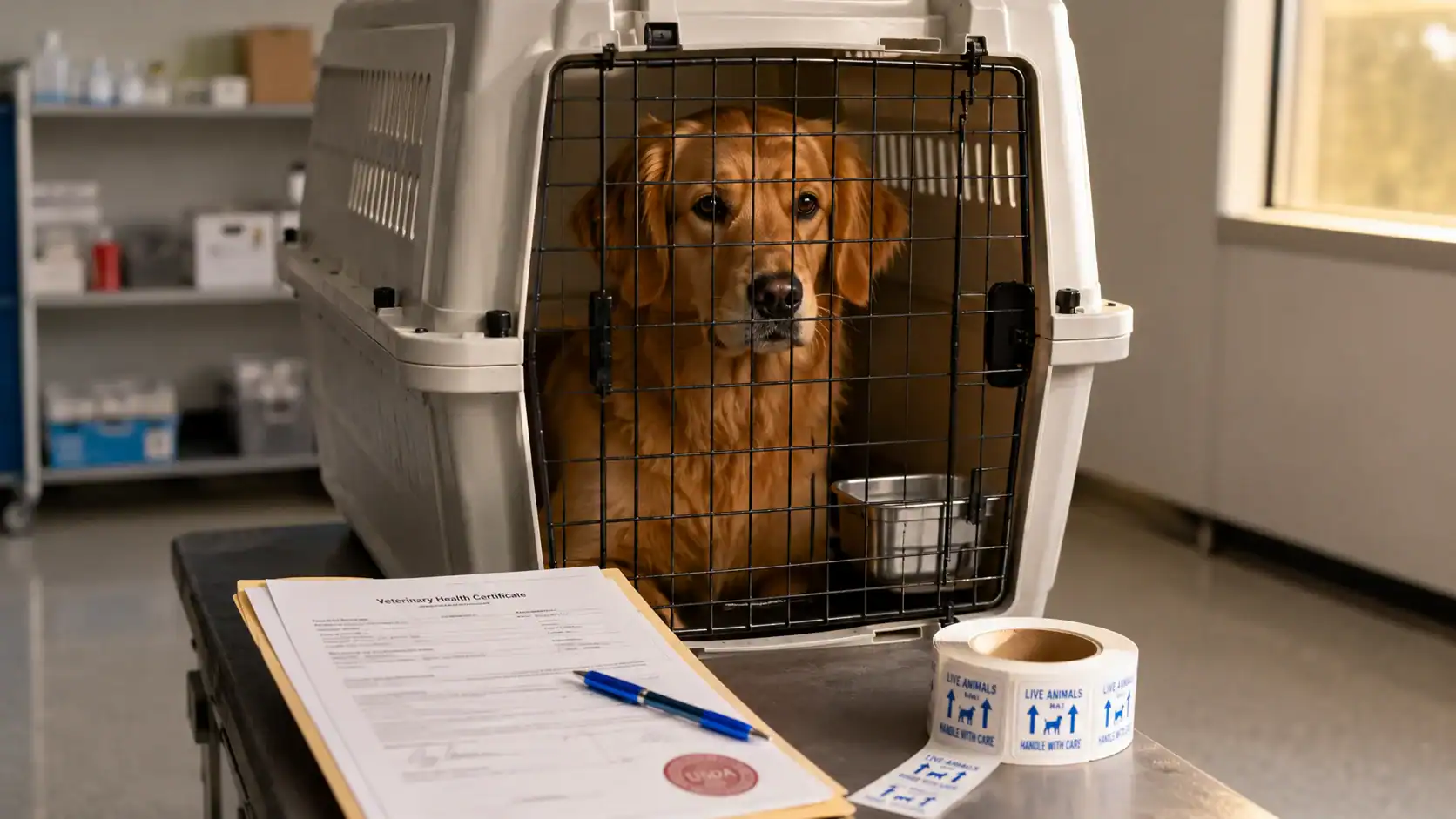
An IATA-compliant travel crate (hard-sided, ventilated on all four sides for international travel, sized so the animal can stand, turn, and lie down without touching the walls) is a real purchase, not a formality, and reusing an old or borrowed crate that doesn’t meet current specifications is one of the more common ways owners get an animal rejected at check-in after everything else is already booked. Crate cost scales directly with animal size: a cat or small dog’s crate costs meaningfully less than the crate a large-breed dog requires, and that gap carries straight through into the next line item.
Airline Freight
This is usually the single largest line in the entire stack, and the one buyers most consistently underestimate. Airlines price live animal cargo by dimensional weight (the crate’s volume, not the animal’s actual body weight), which means two dogs of noticeably different size can end up billed almost identically if their crates are similarly sized, and a large-breed dog’s necessarily larger crate can push this line well above what a same-weight but more compact animal would cost. Route, season, and specific airline all matter here too; a direct or minimal-transit route generally costs less than one requiring a longer layover with animal handling at an intermediate airport.
Transit
If the route includes a layover, common for Thailand-origin pets staging through Singapore before the final leg to Australia, transit handling and any required overnight boarding at the transit point adds its own cost, typically billed per day the animal is in transit-country care. This is separate from, and smaller than, the six-month staging boarding discussed below; it’s specifically the shorter handling window around the actual flight itself.
Mickleham
Covered under Australian Government Fees above as the daily husbandry component, but worth flagging again here because it’s the line item most directly within an owner’s control. Our day-by-day guide to what happens inside Mickleham walks through the facility itself; from a pure cost standpoint, the minimum from Singapore is 10 days, and on a Group 3 staging path the quarantine-length question, and 1,120 AUD of set charges, comes down to whether identity verification happened before the RNATT blood draw months earlier.
Melbourne Collection
Once released, someone has to physically collect the animal from Mickleham, in Melbourne’s outer north. If you’re not already in Melbourne at release time, this means either a dedicated trip or a paid collection-and-onward-transport service, both of which carry a real cost that’s easy to leave out of an early budget built before the release date is known. Collection fees are one of the pet transport to Australia cost items people forget to budget for, precisely because they only apply after the flight has already landed.
Domestic Onward Transport
For families settling anywhere other than Melbourne itself, there’s a further domestic leg, a road transfer or a second domestic flight, to reach the actual final destination. This scales with distance and whether the animal needs another crate-and-cargo booking for a second flight, which for a Sydney, Brisbane, or Perth-bound family can mean effectively a second, smaller version of the international freight line item.
Cost Differences for Cats and Dogs
Government fees don’t discriminate by species: the permit and quarantine charges are the same structure for a cat or a dog. Everything downstream of that does discriminate, almost entirely through size. A cat’s crate is smaller, lighter, and cheaper, its dimensional weight for airline freight is lower, and its Mickleham husbandry costs are identical per day but it’s a smaller animal to transport at every other stage. As a rough rule, a cat’s total stack tends to land noticeably below a similarly-routed medium dog’s, and well below a large dog’s, for reasons that have nothing to do with any cat-specific fee and everything to do with the crate on the scale at check-in.
Large Dog Cost Drivers
Large and giant breeds don’t just cost more. They can hit real logistical ceilings that smaller animals never encounter. Some aircraft have maximum crate-size or weight restrictions in their cargo hold that rule out certain routes or aircraft types entirely for a big enough dog, narrowing the airline and routing options down to whichever carriers can actually accommodate the crate, which removes some of the price competition a smaller pet’s owner benefits from. Budget not just for a bigger number on the same list, but for the possibility that the cheapest routing option on paper simply isn’t available for your specific dog’s crate size.
Non-Approved-Country Staging
For Thailand-origin pets specifically, there’s a line item that doesn’t appear at all for pets starting in an already-approved country: six months of staging-country boarding, plus the staging-country vet and government fees covered above. See our guide to choosing six-month boarding during an Australian import for how to select a facility. From a pure cost perspective, six months of licensed boarding in a staging country like Singapore is very often the single largest number in the entire stack, larger than airline freight, larger than the Mickleham fees, and it’s the one first-time owners are most likely to discover partway through rather than budget for from the start. Our guide to the 180-day approved-country rule explains why this residency period can’t be shortened or skipped.
The Complete Cost Stack
Pulling every line item above into one table (figures are researched ranges, not fixed prices; every real case needs its own quote):
| Line item | Typical range (AUD) | What drives the variation |
|---|---|---|
| Import permit + quarantine levy + husbandry fees | ~3,100–4,250 | 10-day (Singapore path) vs 30-day (Group 3 path without a prior identity check) |
| Veterinary preparation (staging country) | 200–600 | Number of appointments, whether vaccinations restart |
| RNATT and laboratory (Group 3 staging only; Singapore’s own serology otherwise, fee unpublished) | 150–500 | Single vs repeated test |
| Government processing (staging country) | 50–250 (Singapore: ~215 in AVS fees) | Country-specific fee schedule |
| Mandatory arrival quarantine (Singapore, 30 days at AQC) | 875–1,180 | Fan or air-conditioned room; rates rise Dec 2026 |
| IATA-compliant crate | 150–600 | Animal size |
| Airline freight | 1,000–5,000+ | Dimensional weight, route, season |
| Transit handling | 100–400 | Layover length and location |
| Melbourne collection | 150–500 | Distance traveled to collect, or paid service |
| Domestic onward transport | 0–1,500 | Whether final destination is outside Melbourne |
| Six-month staging boarding (Thailand-origin only) | 3,000–7,000+ | Facility type, kennel vs home boarding |
Two Illustrative Quote Examples
The two scenarios below are illustrative constructions built from the ranges above, not real quotes for a specific shipment. They exist to show how the stack adds up differently for two different animals, not to promise a price.
Illustrative example 1: small cat, Bangkok to Melbourne via Singapore staging, 10-day quarantine outcome
| Government fees (10-day pathway) | ~3,114 AUD |
| Vet prep + Singapore serology + AVS fees | ~650 AUD |
| Singapore 30-day AQC quarantine | ~900 AUD |
| Crate (small) | ~180 AUD |
| Airline freight (low dimensional weight) | ~1,300 AUD |
| Transit handling + Melbourne collection | ~350 AUD |
| Six-month Singapore staging boarding | ~3,400 AUD |
| Illustrative total | ~9,894 AUD |
Illustrative example 2: large dog, Bangkok to Sydney via Singapore staging, 10-day quarantine outcome
| Government fees (10-day pathway) | ~3,114 AUD |
| Vet prep + Singapore serology + AVS fees (large dog) | ~750 AUD |
| Singapore 30-day AQC quarantine (air-conditioned) | ~1,180 AUD |
| Crate (large breed) | ~520 AUD |
| Airline freight (high dimensional weight) | ~4,200 AUD |
| Transit handling + Melbourne collection + Sydney onward transport | ~1,400 AUD |
| Six-month Singapore staging boarding (large dog) | ~4,600 AUD |
| Illustrative total | ~15,764 AUD |
Same country of origin, same staging country, same general process. The difference between roughly 9,900 AUD and roughly 15,800 AUD is almost entirely size: a bigger crate, higher dimensional weight, a larger boarding run and the Sydney leg. Neither animal pays for an RNATT and both get the 10-day Mickleham figure, because Singapore is a Group 2 staging country.
Why a Single Online Estimate Is Usually Wrong
Most online pet-shipping calculators ask for an origin, a destination, and a weight, then return one number. That number is not dishonest, exactly. It’s just answering a much narrower question than the one being asked. It almost never asks whether the government fee should be calculated at the 10-day or 30-day rate, which depends on the staging country’s group and, in a Group 3 country, on whether identity verification preceded the RNATT. It rarely asks whether the animal is coming from an approved country directly or needs six months of staging first, which is the single biggest swing factor in the entire stack. A quote generated before those two questions are answered is a guess wearing the shape of a quote. The two illustrative examples above exist specifically to show how much the total moves once those questions get real answers, rather than defaulting to whichever outcome a calculator assumed by default.
Cut through any quote with one plain question: does this number know whether my pet needs staging, and does it know which quarantine rate applies? If a quote can’t answer either one, it isn’t wrong exactly. It just hasn’t been asked the two questions that actually decide the price. Ask them directly before you compare a single figure against anything else.
Build Your Own Worksheet
Copy the ten-row table structure from the complete cost stack above into a spreadsheet, with three columns: line item, your researched estimate, and actual cost once confirmed. Fill in the government fees first, since those are the only genuinely fixed numbers; get real quotes for airline freight and staging boarding next, since those are the two lines most likely to move your total by a meaningful margin; and leave the smaller lines (crate, transit handling, collection) for last, since they’re the easiest to estimate accurately from the ranges above. Revisit the sheet after your pet’s identity verification is scheduled, since in Singapore that appointment starts the 180-day clock, and in a Group 3 country its timing against the RNATT decides which government-fee row applies.
SwiftCargo’s pet transport team can turn this worksheet into a real, itemized quote once your pet’s origin, size, and staging plan are confirmed. Get in touch early, since several of these line items are cheaper to get right the first time than to fix after a vet appointment has already happened in the wrong order.
Pet Transport to Australia Cost: Quick Recap
Government fees, veterinary preparation, RNATT and laboratory work, crate build, airline freight, quarantine handling at Mickleham, and collection or onward domestic transport are the line items that make up the real total. Building your own pet transport to Australia cost worksheet from this list, rather than trusting a single online estimate, is what keeps a moving budget from blowing out mid-process.
Frequently Asked Questions
What is the minimum realistic cost to bring a dog to Australia?
For a small dog going through the 10-day minimum quarantine pathway, with no staging boarding required, the government fees alone run to roughly 3,100 AUD (DAFF’s own published estimate is 3,114 AUD), before vet preparation, crate, airline freight, and collection are added. A realistic all-in figure for the simplest possible case tends to start around 4,500 to 5,500 AUD.
Why does quarantine length change the total cost so much?
Because the daily husbandry fee at Mickleham is charged per day, per animal, on top of a fixed import levy. Twenty extra days at 56 AUD per day adds 1,120 AUD, and it applies only to a pet staged in a Group 3 country without a prior identity check (from Singapore the minimum is 10 days), but the bigger cost is usually indirect: extra weeks away from a pet, delayed collection travel, and in some cases changed onward accommodation or work-start plans.
Is it cheaper to import a cat than a dog?
Usually, and the gap is almost entirely about size and weight rather than any difference in government fees, which are charged per animal regardless of species. A cat’s smaller IATA-compliant crate and lower dimensional weight typically means meaningfully lower airline freight charges than a medium or large dog on the same route.
Does staging in Singapore for six months add a lot to the total cost?
Yes, and it is usually the single largest line item most first-time owners forget to budget for. Six months of licensed boarding, plus Singapore’s mandatory 30-day quarantine on arrival and the identity verification appointment (no RNATT is needed from Singapore), can add several thousand dollars beyond the direct-import cost stack, which is why the staging decision is worth costing out early rather than discovering it mid-process.
Are the two example quotes in this article real prices I can expect to pay?
No. They are illustrative examples built from the same line items and researched ranges described earlier in this article, constructed to show how the stack adds up for two different animals, not a quote for your specific pet, route, or timing. Every real case needs its own quote, since airline rates, crate sizing, and staging costs all vary.
What is the biggest single cost driver for a large dog specifically?
Airline freight, by a wide margin, because most carriers charge live animal cargo by dimensional weight: the crate’s size, not just the animal’s actual weight. A large-breed dog needs a proportionally larger IATA-compliant crate, and that crate’s volume can push the freight charge up sharply compared to a small or medium dog on an identical route.