

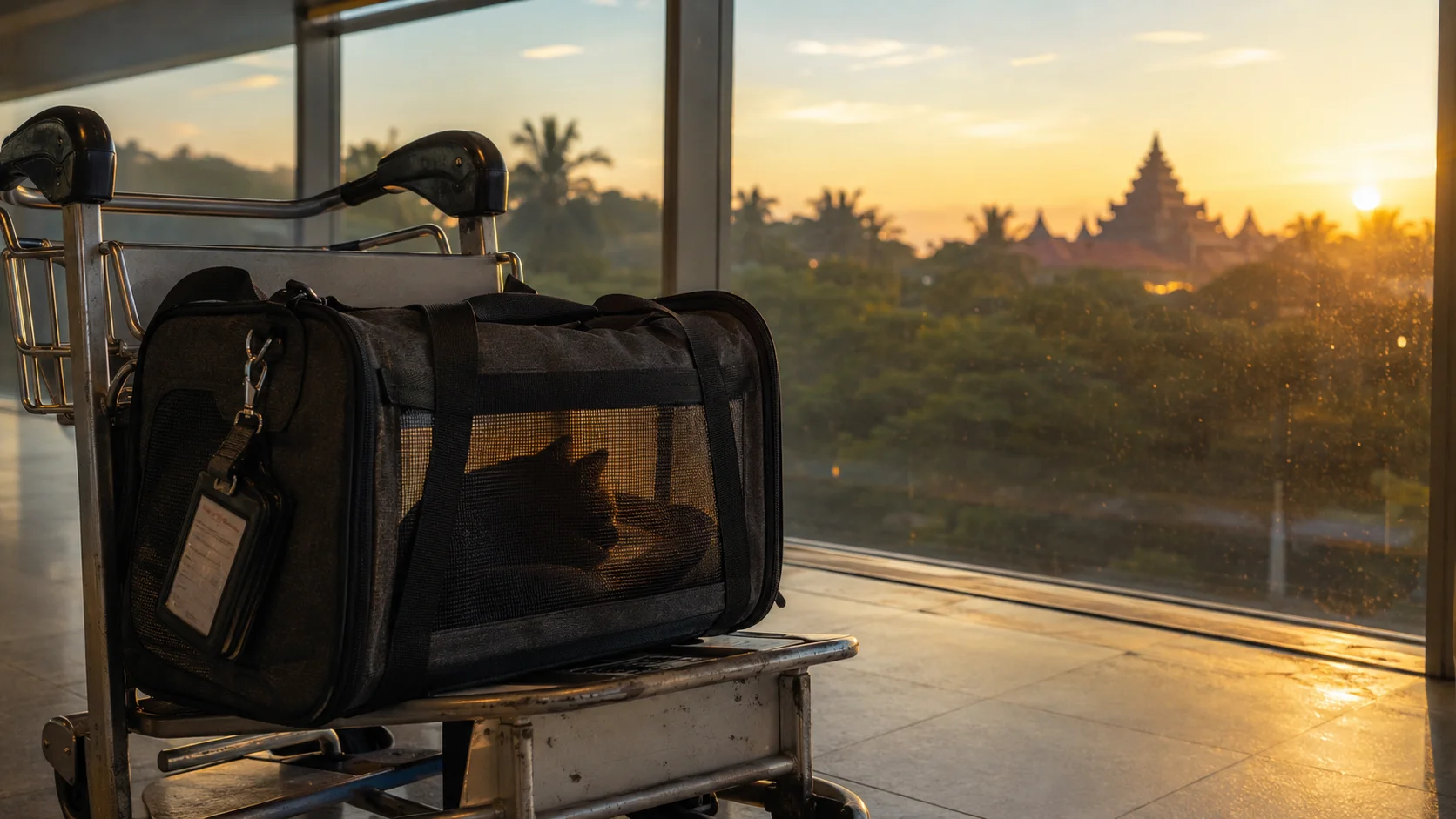
Somewhere in Singapore, for roughly six months, a dog that used to sleep at the foot of someone’s bed in Bangkok is going to fall asleep somewhere else every single night, and the owner won’t be in the building. That’s the actual shape of this decision, and it’s worth saying plainly before any checklist, because the checklist only matters if you’ve already accepted what you’re choosing between. This isn’t the kennel you use for a ten-day holiday, the one you picked because it was close to the airport and had a cancellation slot. It’s the place your pet will spend a season of its life while you are, most likely, already in Australia starting the job or the school term or the lease that made this move happen in the first place.
Why This Is Not Ordinary Holiday Boarding
The difference between a two-week boarding stay and a six-month one isn’t just duration multiplied out. It’s a difference in kind. A pet that has a rough first two days in a normal kennel stay recovers by day five and you’re picking them up by day ten regardless. A pet that has a rough first two weeks of a six-month stay is living inside that stress for a meaningfully long stretch of its life, and you may not be physically present to notice, intervene, or simply switch facilities if it isn’t working. The stakes of getting the choice right are not proportional to a normal boarding decision; they’re closer to choosing a school or a long-term carer. Why Singapore specifically tends to be the default choice for Thailand-origin pets is explained in our guide to comparing staging country options. This article assumes that choice is already made and focuses on the narrower, higher-stakes decision underneath it: which facility, specifically, gets six months of your pet’s life.
Kennel or Home Boarding: The First Fork
Commercial kennel facilities offer consistency: fixed routines, staff rotations that don’t depend on one person’s availability, and, critically for this specific use case, a government license you can independently verify. Private home boarding offers something a kennel structurally cannot: one-on-one attention, a household environment instead of an institutional one, and often a calmer adjustment for an anxious animal. Neither is universally correct. A high-energy young dog that thrives on routine and other dogs around it may do better in a well-run kennel than isolated in an unfamiliar house. An older, anxious cat may do far better in a quiet home than in a facility full of unfamiliar barking. The mistake isn’t picking one type over the other. It’s picking based on price or proximity without matching the choice to the actual animal.
What Changes Between a Cat and a Dog Boarding Plan
Cats and dogs are not interchangeable in a six-month boarding plan, and a facility that treats them identically is telling you something. Dogs generally need daily physical exercise beyond what a run or yard alone provides, more structured social contact with other dogs unless they’re kept solo by preference, and staff attentive to leash-and-gate discipline, since dogs escape through carelessness far more often than through failure of the enclosure itself. Cats need vertical space, secure double-door entry systems into their area (a cat that slips a single door is gone in seconds), and, for boarding stretches this long, enough environmental enrichment that six months doesn’t become six months of a small room with a litter box and a window. Ask any facility how their cat and dog protocols differ specifically. A generic answer is a weaker answer.
Confirm the Licence Before You Do Anything Else
In Singapore, anyone boarding pets commercially is required to hold a pet boarding licence from the Animal & Veterinary Service (AVS), and licensees must pass mandatory training in pet welfare and animal management before that licence is issued. This isn’t a formality worth skipping past. AVS publishes a public registry of licensed pet boarding facilities, and checking a prospective facility against it takes about two minutes. A facility that is licensed has agreed to operate under published terms and conditions covering vaccination requirements, food storage and hygiene standards, and constant access to clean water: specific, checkable obligations, not marketing language. A facility that isn’t on the registry may still provide good care. But you would be trusting that entirely on faith, for six months, in a country where you may have no other way to verify anything about the business if a problem arises. The licensing conditions themselves largely track international veterinary consensus on what a facility housing multiple animals actually needs: the American Veterinary Medical Association’s companion animal care guidelines set out comparable expectations around sanitation, waste removal frequency, and minimum space, which is a useful independent benchmark if you’re evaluating a facility in a country where you can’t easily check a government registry at all.
Who Is the Vet, and Do They Know Your Pet’s History
Ask which veterinary practice the facility uses, whether that vet is on-site, on-call, or simply “nearby,” and whether your pet’s full medical history, including the rabies serology and identity verification records our guide to identity verification and RNATT sequencing covers in detail, will actually reach that vet before an emergency, not after one. A facility with a genuine, named veterinary relationship can answer this in one sentence. A facility that says “we’ll find a vet if needed” is telling you the relationship doesn’t exist yet, which means it will be built, if at all, during a crisis rather than before one. Also ask what the facility requires before any animal is admitted: a boarding population is, by definition, a group of animals from different households mixing daily, and the American Veterinary Medical Association’s guidance on canine infectious respiratory disease complex is explicit that group settings like boarding meaningfully raise a dog’s exposure risk, which is precisely why Singapore’s licensing conditions require vaccination to be current at least two weeks before a boarding stay begins, not on arrival day.
Is Anyone There Overnight
Many boarding facilities, including well-regarded ones, are staffed during business hours only, with no one physically present overnight. For a two-night holiday stay this rarely matters. Over six months, the odds of something happening overnight (a medical event, an equipment failure, another animal’s escape attempt setting off a chain reaction) are no longer negligible. Ask directly whether staff sleep on-site, and if not, what the actual response time is if an alarm or camera alert goes off at 2 a.m. “We check in first thing in the morning” is a different answer than “someone lives on the property,” and the difference matters more the longer the booking runs.
Climate Control Is Not a Luxury Feature
Singapore’s climate is hot and humid year-round, not seasonally, which makes climate control a welfare requirement rather than a comfort upgrade. Ask specifically how indoor and outdoor areas are cooled, what happens during equipment failure, and whether outdoor exercise time is adjusted for heat rather than run on a fixed schedule regardless of conditions. A dog left in an under-ventilated outdoor run through the middle of the day, every day, for six months, is a welfare problem that compounds silently. Nobody notices a single hot afternoon, but the pattern adds up across a season in a way a two-week stay never would.
How Pets Actually Escape
Escapes rarely happen because a fence fails. They happen because a gate was left unlatched during a shift change, because a new staff member didn’t know a particular dog was a jumper, or because a double-door entry protocol got skipped once, on a busy day, by someone in a hurry. Ask what specific procedures prevent this: double-gate systems between outdoor runs and the perimeter, staff briefings on individual animals’ known behaviors, visitor and delivery protocols, rather than accepting “we’ve never had an escape” as sufficient reassurance on its own. Every facility that has one eventually had zero, until the day it didn’t.
Exercise and Enrichment Over Six Months
A facility can meet an animal’s minimum physical needs and still leave it understimulated for half a year. Ask what a typical day actually looks like hour by hour, not in general terms: how much time outside the primary enclosure, what kind of enrichment (toys, scent work, training sessions, rotation of play groups) is built into the routine, and whether that routine varies day to day or repeats identically for six months straight. Dogs and cats both decline, behaviorally and sometimes physically, under prolonged understimulation in a way that’s easy to miss in a single visit and obvious in retrospect after months of it. The World Small Animal Veterinary Association’s welfare guidelines treat this kind of behavioral enrichment as a core welfare requirement for any facility housing animals long-term, not an optional extra. That’s a useful frame to hold onto when a facility’s answer to “what does a typical day look like” turns out to be vaguer than its answer to “what do you feed them.”
Medication Management for a Multi-Month Stay
If your pet takes any regular medication, ask exactly how dosing is tracked, who is authorized to administer it, and what happens if a prescription needs renewing partway through a six-month stay, since you may not be in the country to collect a refill yourself. A facility with a real system will describe a specific process: logged doses, a named staff member or the on-call vet handling administration, a plan for renewal that doesn’t depend on you being physically present. A vague “yes, we can do that” without specifics is an answer that hasn’t actually been tested by a real multi-month case yet.
Who Holds the Paperwork
Over six months, your pet will accumulate a stack of documents that matter enormously to the eventual import permit: vaccination records, the identity verification confirmation, the RNATT laboratory report, veterinary visit notes. Decide, explicitly, who holds the originals (you, or your pet transport coordinator, not solely the boarding facility) and who holds working copies (the facility, so they can act on them without waiting for you to send a scan from another time zone). Facilities that have supported staging boarding before will already have an answer to this. Facilities that haven’t may need you to set the system up yourself.
Getting Your Pet to Official Appointments
The official identity check Australia requires doesn’t happen at the boarding facility. It happens with Singapore’s government veterinary authority, and its date starts the 180-day clock. Ask whether the facility provides transport to these appointments as standard, what it costs if not included, and who accompanies your pet if you can’t be there yourself. A facility unfamiliar with the Australian import process may not realize how much depends on that appointment’s date, which is a good reason to ask the question directly rather than assume competence on a process the facility may only rarely encounter. Singapore is a Group 2 country, so Australia needs no RNATT blood test for a pet staged there, but the identity check date determines the 180-day clock, so a missed or delayed appointment during boarding can cascade into a genuinely expensive scheduling problem months later, long after the boarding contract itself is forgotten.
If Something Goes Wrong While You’re Not There
Every boarding contract should specify who is legally authorized to make emergency veterinary decisions on your pet’s behalf, up to what dollar amount, and who is contacted first, second, and third if you can’t be reached immediately. This is not a hypothetical clause. Time zones, patchy phone reception during a move, and the ordinary chaos of relocating a household mean there is a real chance you won’t answer the first call. Name a local emergency contact (a relative, a friend, or your pet transport coordinator) explicitly in the paperwork, rather than leaving the facility to guess at your wishes under pressure.
How You’ll Actually Know Your Pet Is OK
Ask exactly how often you’ll receive updates, in what format, and get the answer in writing rather than a verbal assurance during the tour. Weekly photo or video updates are a reasonable minimum for a six-month stay; anything less specific than that tends to mean updates happen when something’s wrong, not as routine reassurance. This matters more than it might sound. Six months of silence, broken only by a problem, is a very different experience than six months of a Sunday-evening photo that tells you, concretely, that your dog is fine.
Never Skip the Trial Stay
Book a short paid stay, a few days to a week, before committing to six months, even if it means extra cost and coordination. A trial stay is the only way to see the facility’s actual daily routine rather than the version presented on a tour, and it gives your pet a chance to show you, in a low-stakes window, how it copes with the environment before the stakes become genuinely high. A facility that resists or discourages a trial stay before a six-month commitment is telling you something worth hearing.
Reading the Contract Before You Sign It
Read the payment structure specifically: is it paid monthly, in one lump sum upfront, or in installments tied to milestones? A facility demanding the full six months upfront, non-refundable, with no ability to move your pet elsewhere if the relationship isn’t working, is a different risk profile than one billing monthly. Check the cancellation and transfer terms, what happens to unused prepaid time if you need to move your pet to another facility partway through, and whether price increases can be applied mid-contract. None of this is unusual to ask about. A facility used to long-term staging bookings will have clear answers already written down.
Most people skip this step not because they’re careless, but because asking about refund terms and cancellation clauses feels like doubting a provider you’ve already decided you like. That discomfort is real, and it’s also exactly backwards: a facility confident in what it offers has nothing to lose from clear terms, and the ones who get vague or defensive when asked are telling you something a friendly first tour never will. The five minutes spent on payment structure and cancellation terms is cheap insurance against a six-month commitment you can’t easily undo.
Warning Signs to Walk Away From
A few patterns show up disproportionately often in the boarding situations that go wrong, and they’re worth naming directly:
- Reluctance to show you the actual kennel or run your pet will occupy, as opposed to a show unit, a stock photo, or “we’ll send pictures later.”
- No independently verifiable license: claims of being licensed that you can’t confirm against a public registry.
- Vague answers about overnight staffing that avoid a direct yes-or-no on whether anyone is physically present.
- No named veterinary relationship, only a general assurance that “a vet is available if needed.”
- Resistance to a trial stay before a six-month commitment.
- Demanding full payment upfront with no refund or transfer path if the arrangement isn’t working.
- Update frequency left undefined or described only as “we’ll reach out if there’s an issue.”
Any single item on that list might have an innocent explanation. Two or more together, in the same facility, is worth treating as a real signal rather than a coincidence.
Six-Month Boarding Due-Diligence Checklist
Print or copy this list before your first facility visit. Bring it with you. Reading it off a phone during a tour works, but a printed copy is harder to rush past.
- ☐ Facility appears on AVS’s (or the relevant staging country’s) public registry of licensed boarders
- ☐ Named, confirmed veterinary practice with a real working relationship, not “a vet if needed”
- ☐ Direct answer on overnight staffing: someone present, or a specific alarm-response time
- ☐ Climate control explained for both indoor and outdoor areas, with a backup plan for equipment failure
- ☐ Escape-prevention protocol described specifically (double-gate systems, staff briefings, visitor rules)
- ☐ Hour-by-hour description of a typical day, including exercise and enrichment, not just feeding times
- ☐ Written medication protocol if your pet takes any regular prescription
- ☐ Clear agreement on who holds original documents versus working copies
- ☐ Confirmed transport plan for the official identity check appointment
- ☐ Emergency veterinary authorization named in writing, with a spending limit and contact order
- ☐ Update frequency and format specified in the contract, not just promised verbally
- ☐ Trial stay booked and completed before the six-month contract is signed
- ☐ Payment structure, cancellation terms, and transfer rights read and understood before signing
Six months is a long time to trust a stranger with a member of your family, and this checklist exists because most of what goes wrong in long-term boarding is knowable in advance, if someone asks the right questions before signing rather than after something happens. For the wider journey this boarding period sits inside, including how it connects to the 180-day approved-country clock, see our guide to the 180-day approved-country rule for pets entering Australia. SwiftCargo’s pet transport team works with vetted boarding partners in Singapore and can walk you through this exact due-diligence process before you commit six months of your pet’s life to a facility you found on a map.
There is one more thing worth asking, and it has nothing to do with your pet’s day. It is about the business. Six months is long enough for a small facility to change hands, lose a licence, or quietly close, and that possibility sits outside every item on that checklist because it is not a welfare question. Ask what happens to your pet and to your prepaid balance if the business stops operating, and ask for the answer in writing with a named fallback facility in it. Ask, too, whether they carry care, custody and control cover rather than only public liability, because the two are not the same thing and only one of them responds when an animal in their charge is injured. A facility that has thought about this already will not be offended by the question.
Frequently Asked Questions
Why can’t my pet just wait out the six months in Thailand instead of boarding in a staging country?
Because the 180-day clock only counts residency inside a country DAFF has approved. Thailand isn’t on that list, so time spent there, however long, never counts toward the requirement. The residency has to happen physically inside an approved country like Singapore, which is why boarding there specifically, rather than anywhere convenient, becomes necessary.
Is a licensed boarding facility always better than a private home boarder?
Not automatically, but licensing gives you something to verify independently rather than taking a stranger’s word for it. A licensed facility has passed a government inspection against a published standard and appears on a public registry. A home boarder may well provide excellent, calmer, more individual care, but you are relying entirely on your own judgment and their word, with no third party checking anything, for six months you won’t be present for.
How often should I expect updates from a six-month boarding facility?
Weekly, at minimum, with photo or video proof rather than a text saying everything is fine. Ask this exact question before booking, get the answer in writing in the contract, and treat any hesitation or vagueness about it as a warning sign rather than a detail to sort out later.
Who should hold my pet’s RNATT and identity verification paperwork while it’s boarding?
You, primarily, with the boarding facility holding working copies. The facility needs the documents on hand to get your pet to appointments and prove vaccination status, but the originals and a complete digital backup should stay with you or your pet transport coordinator, never solely with the boarder.
What is a trial stay and why does it matter for a six-month booking?
A trial stay is a short paid booking, a few days to a week, before committing to the full six months. It is the only way to see the facility’s real routine rather than the version shown during a tour, and it gives your pet a chance to show you how it copes before the stakes are six months instead of a few days.
What’s the single biggest warning sign when evaluating a long-term boarding facility?
Reluctance to let you see the actual kennel or run your pet will occupy, as opposed to a show unit or a photo gallery on their website. A facility with nothing to hide will walk you through the real space without hesitation. One that redirects, delays, or only offers photos is worth walking away from regardless of how good the sales conversation sounds.