
Most comparison sites give the same version of the UK-to-Thailand removal cost: a wide range (usually something like £1,500 to £8,000), with little explanation of what determines where in that range a specific move lands. The number is technically accurate and practically useless.
Four inputs determine the actual cost of shipping household goods from the UK to Thailand: the volume of goods in cubic metres, the service level chosen (packing-included vs self-pack, door-to-door vs port-to-port), the departure port and month (which affects surcharge levels and transit time), and whether Thai customs duty applies (which depends on your Thai residency status when goods arrive). Once you know these four inputs, the cost range narrows considerably.

The UK-to-Thailand Route
The standard sea freight route from UK ports to Laem Chabang, Thailand changed structurally from late December 2023. Before the Houthi attacks on Red Sea shipping that began in late 2023, the standard routing was UK → Suez Canal → Indian Ocean → Strait of Malacca → Laem Chabang: approximately 28–33 days port-to-port.
Since late December 2023, the great majority of UK-origin container shipping to Thailand is routed via the Cape of Good Hope, rounding the southern tip of Africa rather than transiting the Red Sea. BIMCO’s analysis of the disruption documented an additional 10–14 days of transit time on this routing, plus a fuel cost uplift that carriers recover through a War Risk Surcharge and increased Bunker Adjustment Factor. The Cape route is now the standard for most UK-to-Asia shipments.
The table below gives current UK-to-Laem Chabang transit times:
| UK departure port | Transit (port to port) | Route |
|---|---|---|
| Southampton | 35–45 days | Via Cape of Good Hope; direct Laem Chabang call on some services |
| Felixstowe (primary) | 38–50 days | Via Cape of Good Hope + Singapore or Tanjung Pelepas transshipment |
| Liverpool / Tilbury | 40–52 days | Via Cape of Good Hope + feeder and transshipment |
The single biggest driver of the spread is not the carrier, it is where your UK port sits in that carrier’s European rotation. Yang Ming’s published June 2026 schedule shows Southampton at 40 days to Laem Chabang on a single vessel with no transshipment, and lists Rotterdam at 36 days on one service and 49 on another in the same week, because Rotterdam is the last European call on one rotation and an early call on the other. Ask which service the booking is on. As of August 2026 the Red Sea picture is also mixed rather than settled: Suez transits are at their highest since January 2024 but still around 41% below pre-crisis levels, and the carriers running the direct Laem Chabang calls remain on the Cape. A Suez-routed sailing runs roughly 10 to 14 days quicker.
Port-to-port transit does not include time at origin (packing, export clearance, container loading: typically 3–7 days) or at destination (Thai customs clearance, last-mile delivery: typically 7–15 working days). Total door-to-door from packing day to Bangkok delivery is 65–90 days for a full container, and longer for groupage.
Volume and the LCL/FCL Decision
The most significant cost variable in a UK-to-Thailand removal is the volume of goods, measured in CBM (cubic metres). Volume determines whether the shipment moves as LCL (less than container load, consolidated with other shippers’ cargo in a shared container) or FCL (full container load, a dedicated 20ft or 40ft container). For what those volumes look like in practice, room by room and with box counts, see the CBM size guide.
These are approximate volume guidelines for furnished household goods (packed):
| Property size | Approximate packed volume | Recommended mode |
|---|---|---|
| Studio / bedsit | 3–7 CBM | LCL |
| 1-bedroom apartment | 8–14 CBM | LCL |
| 2-bedroom apartment | 15–22 CBM | LCL or 20ft FCL |
| 3-bedroom house | 23–38 CBM | 20ft FCL |
| 4-bedroom house | 38–55 CBM | 40ft FCL |
The LCL/FCL crossover point for UK-to-Thailand removals is approximately 15–17 CBM. Below this volume, LCL is typically more cost-effective. Above it, a 20ft FCL container becomes competitive on price and you get better handling control, because only your goods occupy the container, which reduces the risk of damage from loading and unloading of adjacent consignments.
For moves in the 15–20 CBM range, request quotes for both LCL and 20ft FCL before deciding. The total cost difference at the crossover point is often smaller than expected, and the FCL advantage in handling control can be worth the modest premium.
At that volume the price gap is small enough that handling risk, not price, is the deciding factor: LCL means your boxes share a container and are handled alongside other consignments, which is one of the real reasons shipments get damaged.
The Six Cost Layers
A complete UK-to-Thailand removal generates costs across six layers. UK-based removal companies typically quote only some of them. Understanding each layer prevents post-booking surprises.
Layer 1: UK Origin Costs
- Packing service: Professional packing of a 2BR apartment by a team of 3: £400–700 for materials and labour. Self-pack (you pack, they collect): £0 packing cost but less protection and potential insurance complications.
- Origin THC (Terminal Handling Charge): Felixstowe charges a THC for receiving and loading your container. For FCL: £150–250 per container. For LCL: £8–15 per CBM.
- Export customs declaration: Post-Brexit, all household goods leaving the UK for Thailand require a formal HMRC export declaration. Your removals company files this; cost is typically £60–120 or included in the agent fee.
- Bill of lading fee: The ocean carrier charges £30–60 for issuing the B/L.
- LCL origin CFS fee (LCL only): £8–15 per CBM for receiving goods at the UK consolidation warehouse.
Layer 2: Ocean Freight and Surcharges
- Base ocean freight: LCL rate from UK to Laem Chabang: £40–80 per CBM. 20ft FCL: £1,200–2,200 all-in freight. 40ft FCL: £1,800–3,200.
- Bunker Adjustment Factor (BAF): £30–80 per CBM (LCL) or £200–500 per FCL.
- Low Sulphur Surcharge (LSS): IMO 2020 requirement, passed through at £20–60 per CBM or £100–200 per FCL.
- War Risk Surcharge: Cape of Good Hope rerouting surcharge. Applies to virtually all UK-origin cargo on Asia trades: £50–150 per CBM or £200–500 per FCL.
- Peak Season Surcharge (if applicable): Q3 (July–September) and Chinese New Year periods attract a PSS of £100–400 per FCL. Avoid Q3 shipments if cost-sensitive.
Layer 3: Marine Cargo Insurance
Marine insurance is not included in freight quotes unless explicitly stated. All-risks marine cargo insurance for household goods: 2–3.5% of the declared replacement value. For goods valued at £20,000, the premium is £400–700. Household goods cover is a different product from commercial marine cargo and is priced far higher: it is written on new-for-old replacement value at destination for used goods, and it extends to mould, mechanical derangement and pairs-and-sets. Commercial containerised cargo runs a fraction of this. Owner-packed cartons are normally restricted to total-loss-only and are not covered at this rate. Ocean carrier liability under the Hague-Visby Rules is capped at approximately £2.10 per kg, far below the value of household goods on a typical removal.
Layer 4: Thai Destination Port Charges
- Destination THC: Laem Chabang charges a destination terminal handling fee. 20ft FCL: THB 3,500–5,000 (~£80–115). 40ft FCL: THB 5,500–8,000 (~£125–185). LCL: THB 300–700 per CBM (~£7–16/CBM).
- CFS deconsolidation fee (LCL only): THB 400–900 per CBM (~£9–21/CBM), charged by the Thai CFS operator, almost never included in UK freight quotes.
Layer 5: Thai Customs Costs
- Import duty: Zero if personal effects duty relief is granted (see conditions below). If not qualifying: typically 10–30% of CIF value for household goods categories.
- VAT: 7% on CIF value plus duty. Even on qualifying personal effects, some VAT administration may apply depending on the broker’s clearance approach.
- Customs broker fee: THB 3,000–6,000 per personal effects entry (~£70–140). Covers preparing and filing the customs entry.
Layer 6: Last-Mile Delivery in Thailand
- Laem Chabang to Bangkok (LCL van delivery): THB 2,000–4,000 (~£45–95).
- Laem Chabang to Bangkok (FCL truck delivery): THB 4,000–8,000 (~£90–185).
- Bangkok to provincial cities (Chiang Mai, Phuket, Hua Hin): THB 8,000–18,000 (~£185–415) depending on distance.
- Building access surcharges: Bangkok high-rise buildings often require advance booking for elevator access and may apply surcharges for restricted delivery windows.
These six layers are typical ranges for a UK move, and the only way to know where your own shipment lands is pricing your actual volume against them.
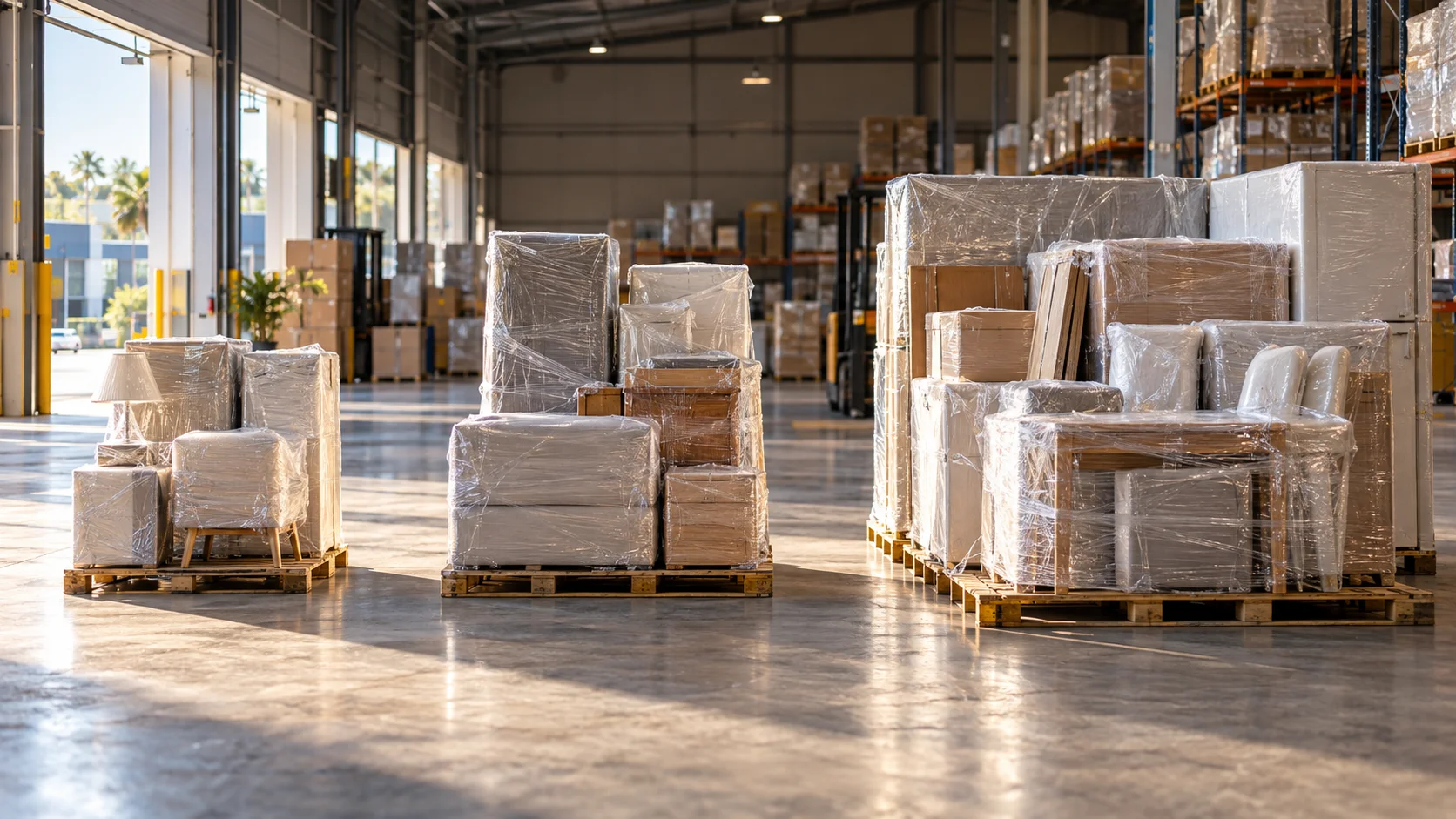
Three Full Cost Scenarios
The following scenarios illustrate all-in cost estimates for three representative UK-to-Thailand moves. All costs are in GBP at approximate current exchange rates (THB 45/£1, USD 1.25/£1). Ocean freight figures reflect current market rates for Felixstowe–Laem Chabang.
Scenario 1: Studio Move (5 CBM, LCL, Bangkok delivery, personal effects qualify)
From ~£3,585, door to door. Bangkok delivery, duty relief granted. This package price includes origin pickup, loading, packing, short-term storage, ocean transit and surcharges (including the current Cape of Good Hope War Risk Surcharge), Thai customs clearance, destination port charges, last-mile delivery, removal of packaging, and marine insurance.
Scenario 2: One-Bedroom Apartment (12 CBM, LCL, Bangkok delivery, personal effects qualify)
From ~£5,920, door to door. Bangkok delivery, duty relief granted. This package price includes the same inclusions as above, scaled for a larger load.
Scenario 3: Two-Bedroom Apartment (20 CBM, 20ft FCL, Chiang Mai delivery, personal effects qualify)
From ~£6,700, door to door. Chiang Mai delivery via Bangkok transshipment, duty relief granted. This package price includes origin pickup, loading, full packing, short-term storage, ocean transit and surcharges, Thai customs clearance, destination port charges, last-mile delivery, removal of packaging, and marine insurance.
Treat every figure here as a budget to plan around, not a fixed quote. Nobody in this industry can responsibly price a move without knowing the details. Real costs move with things a blog post can’t account for: building access (a third-floor walk-up costs more to load than a ground-floor pickup), the time of year, and events like storms or global shipping disruptions that move freight rates with little warning. Fragile, oversized, or high-value items that need custom crating or special handling can add substantially to the total as well. The scenarios above assume a straightforward household load. Declared value also isn’t tied to room size or CBM: some people value ordinary furniture and electronics very low, while a small load of antiques or collectibles can be worth far more than a full container of everyday items. Our team works with you on your specific job and situation to give accurate, current pricing when it’s actually time to move.
Thai Customs Duty Relief: The Conditions That Determine Whether You Pay
Within the Thai customs layer, everything turns on whether personal effects duty relief applies. The difference between qualifying and not qualifying can be £800–3,000 in duty and VAT on a typical one-bedroom removal.
The conditions are strict. All of the following must be true at the time goods arrive at Thai customs:
- Valid Thai residency permission: A tourist visa or 30/60-day visa-exempt entry never qualifies. A Non-Immigrant B visa held alongside a valid one-year work permit, or a Long-Term Resident (LTR) visa, meets the standard criteria directly. Thailand’s official relocation criteria does not name retirement (O-A/O-X), marriage-based Non-Immigrant O, or Thailand Elite among the qualifying groups, so none of those routes qualifies and duty plus 7% VAT applies.
- Six-month window: Goods arrive within six months before or after the importer establishes residence in Thailand.
- Used personal effects: Goods must be demonstrably used and for personal use: not new goods, not commercial goods, not goods intended for resale.
- One shipment per change of residence: The relief applies once. A follow-up shipment from the same move is assessed at standard duty rates.
The practical implication is this: if you arrive in Thailand on a tourist visa intending to convert later, your goods will arrive at customs before your long-term visa is issued. Request duty relief and it will be denied. The duty and 7% VAT will be assessed on the CIF value of the goods.
The solution is to apply for your long-term Thai visa at a Thai embassy or consulate in the UK before departure. Non-Immigrant B (business), O (retirement/family), and OA (retirement) visas can all be obtained in the UK, but only the B route paired with a work permit puts you inside the standard duty-relief criteria without further substantiation. For a full breakdown of qualifying conditions, see our guide to duty-free import rules in Thailand.
Retirement and marriage visas need extra evidence to qualify.
If your visa route isn’t Non-Immigrant B with a work permit, it’s worth confirming what evidence Thai customs will actually accept before your goods sail.

Post-Brexit UK Export Requirements
Since January 2021, all goods leaving the UK for non-EU destinations, including Thailand, require a formal HMRC customs export declaration (gov.uk: export goods from the UK). For household goods on a personal removal, this is filed by your removals company or freight forwarder on your behalf using the CDS (Customs Declaration Service) system.
What you need to provide for the UK export declaration:
- Detailed inventory of goods and estimated values
- Your name and UK address
- Your Thai destination address
- A commodity code for the main goods categories (e.g. 9903.00.00 for removal goods, or specific codes for electronics, furniture)
The export declaration must be filed before the goods are loaded for export. Goods that leave the UK without a valid export declaration face complications at the point of export, and potentially at Thai customs where import documents must match export records. Confirm with your removals company that export declaration is included in their service (most professional companies include it; some budget operators do not).
FX Exposure: Three Currencies in One Bill
A UK-to-Thailand removal bills you in three currencies: GBP at origin (packing, UK agent, export services), USD for ocean freight and surcharges (ocean freight is universally USD-denominated), and THB for Thai destination charges (port handling, customs broker, last-mile delivery).
The time between booking and final payment can be 90–120 days, from the UK packing date to the final Thai last-mile invoice. During this period, GBP/USD and GBP/THB exchange rates will move. On a £4,000 total move, a 5% USD appreciation against GBP adds approximately £130 to the USD-denominated components. Build a 5–8% FX buffer into your total cost estimate if your budget is set in GBP.
Three currencies move independently between booking and delivery, and locking in a real quote for your route is the only way to know your actual GBP total.
Five Ways to Reduce the Total Cost
1. Get an all-in quote before confirming
Request a quote that explicitly itemises every cost layer: UK origin THC, B/L fee, ocean freight, named surcharges, marine insurance, Thai destination THC, CFS deconsolidation (if LCL), customs broker fee, and last-mile delivery to your specific Thai address. A quote that covers the full chain lets you compare providers on a like-for-like basis and eliminates post-arrival invoice surprises.
2. Reduce volume before the pre-move survey
In international removals, every unnecessary CBM adds cost at every layer: UK THC, ocean freight, surcharges, and Thai destination THC all scale with volume. A pre-move declutter that reduces a 1BR move from 14 to 10 CBM saves approximately £800–1,200 across the full cost stack on a UK-to-Thailand LCL shipment. Sell or donate furniture and appliances that you will replace in Thailand, where good-quality equivalents are readily available at lower prices than the UK.
3. Secure your Thai long-term visa before shipment departure
As noted above, the difference between qualifying and not qualifying for Thai personal effects duty relief can be £800–3,000 for a typical household removal. Apply for the correct Thai non-immigrant visa at the Thai Embassy in London before your goods depart. Retirement, marriage, and LTR visas are all obtainable in the UK. This is the highest-return single action available to a UK-to-Thailand mover.
4. Avoid Q3 departures and Songkran arrivals
Q3 (July–September) departures attract Peak Season Surcharges of £100–400 on FCL shipments. Songkran-window arrivals (goods reaching Laem Chabang in April) add 7–14 days to clearance and generate storage costs of THB 500–1,500 per CBM per week. Both are avoidable with timing. If you must move in Q3, request the PSS rate upfront and factor it into your comparison.

5. Consider FCL at the 15 CBM threshold
For moves in the 14–18 CBM range, the cost difference between LCL and 20ft FCL is often £300–600. The FCL option eliminates the CFS deconsolidation fee, reduces handling risk (your goods are not moved twice at Thai port), and typically keeps transit times more predictable. Request both quotes and compare all-in before assuming LCL is cheaper at this volume range.
Most shipping quotes are written like they’re hiding something, and often they are. “From £2,400” tells you nothing except the cheapest possible number the company can legally print. The real cost of a UK-to-Thailand move is six separate line items: freight, origin handling, destination handling, customs clearance, duty (if it applies), and delivery. Ask any quote to break out those six lines before you sign anything. If a company can’t or won’t itemise them, that’s not a red flag about their pricing so much as a red flag about what happens when your shipment hits an unexpected charge halfway through the journey. A good quote reads like a receipt, not a headline. Ask for the receipt version.
Related reading: Part Load Removals to Thailand: Sailing Dates, Duty and Crates
Related reading: Moving Pets from UK to Thailand: Certificate 2917 and Flights
Frequently Asked Questions
How much does it cost to move from the UK to Thailand?
The all-in cost of a UK-to-Thailand removal depends primarily on volume and whether Thai duty relief applies. A studio move of 5 CBM with duty relief typically runs from about £3,585, door to door. A one-bedroom move of 10–12 CBM starts closer to £5,920, and a two-bedroom move of 18–22 CBM closer to £6,700 for an LCL or FCL option. These figures include UK origin charges, ocean freight and surcharges (including the current Cape of Good Hope War Risk Surcharge), Thai destination port fees, customs broker, and Bangkok delivery.
How long does shipping from the UK to Thailand take?
Ocean transit to Laem Chabang is currently 35–45 days from Southampton and 38–50 days from Felixstowe, which transships, both via the Cape of Good Hope. Total door-to-door from UK packing day to Bangkok delivery is 65–90 days. Add 7–15 days for Thai customs clearance after vessel arrival, and last-mile delivery time within Thailand.
Do I need to pay Thai import duty on my household goods from the UK?
Not if you qualify for personal effects duty relief. The conditions: you must hold a valid Thai long-term residency permit (not tourist or visa-exempt) at the time goods arrive at Thai customs, and retirement or marriage-based Non-Immigrant O entrants fall outside the standard criteria and do not qualify; goods must be used personal effects; they must arrive within six months of you establishing Thai residence; and this is a one-time relief per move. If conditions are not met, duty of 10–30% on CIF value plus 7% VAT applies to household goods categories.
What port do UK removals to Thailand depart from?
Felixstowe is the primary UK export port for Thailand-bound container shipments. Southampton and Liverpool are used by some carriers and removals companies. Most removal companies collect from your property and transport goods to their partner port, and the specific departure port affects transit time by 1–3 days.
Is a 20ft container enough for a two-bedroom move from the UK to Thailand?
For most two-bedroom apartment moves, yes. A 20ft container has 25–28 CBM of usable load space, which comfortably accommodates 18–22 CBM of packed household goods from a two-bedroom apartment. A pre-move survey confirms actual volume. If the packed volume exceeds 22 CBM, a 40ft container avoids the risk of overpacking.