
Somewhere between booking the flight and packing the crate, a lot of British owners make the same mistake: they assume the blue EU pet passport sitting in the kitchen drawer still works. It does not, not for a dog or cat travelling from Great Britain, and the rule that changed it took effect while most owners were not looking. Present that passport at check-in instead of the document Portugal actually requires now, and an airline can refuse to board the animal before its owner has even reached security.
The document you need depends on where you are flying from, not on whether the animal is a dog or a cat. A UK-issued certificate and a US-issued one solve two different bureaucratic problems, and neither is optional paperwork you can skip once the microchip and vaccination are sorted. A rabies titre test, routine quarantine and tapeworm treatment show up on nearly every generic EU pet-travel checklist, and none of the three applies to a compliant UK or US pet flying directly into Portugal.
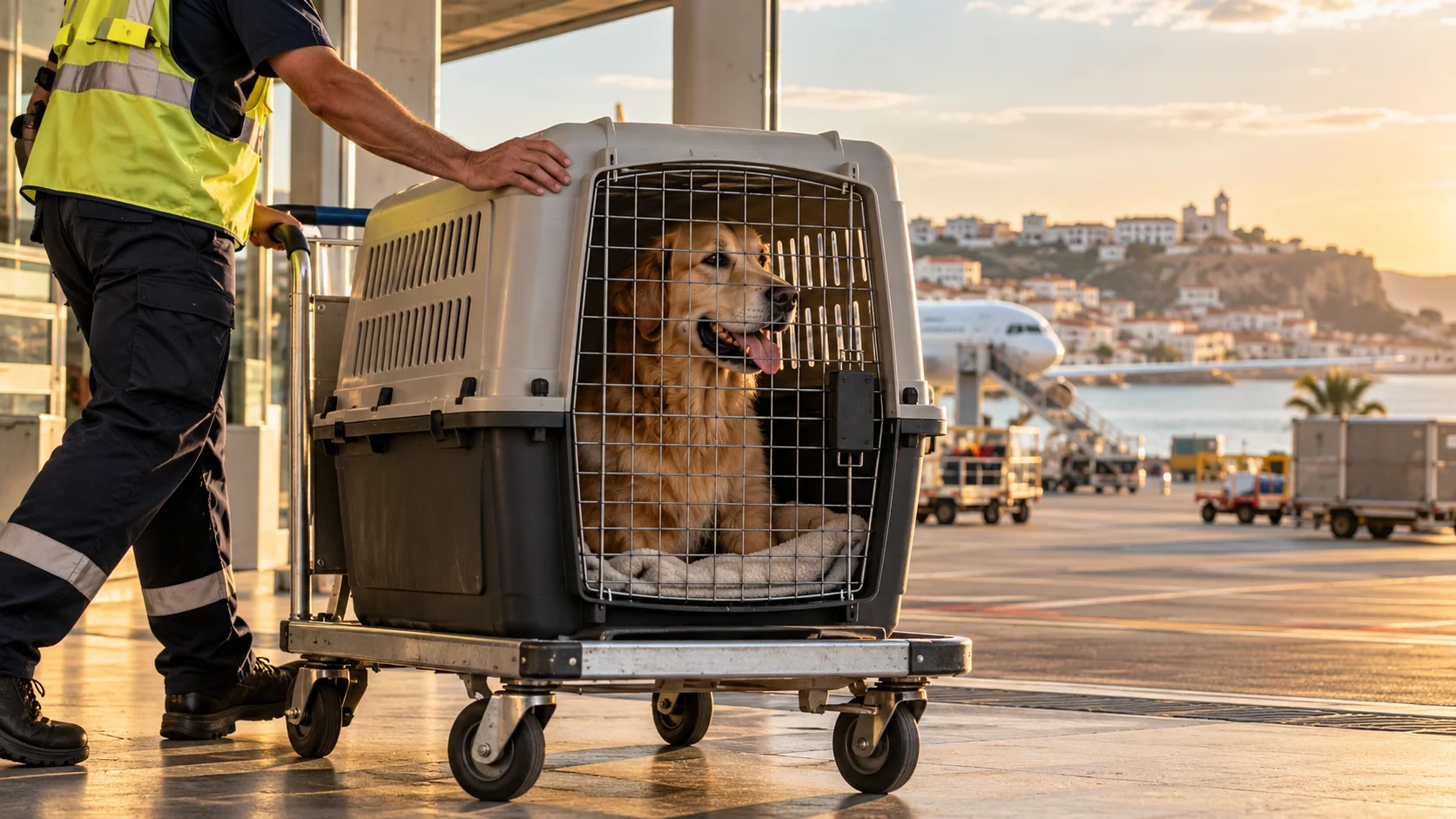
The Document Depends on Where You’re Flying From
Every pet entering Portugal from outside the EU needs the same underlying protections: a working microchip, a current rabies vaccination, and paperwork proving both. What that paperwork looks like splits sharply by origin country.
UK owners: the Animal Health Certificate, not a pet passport
Since the rule change that followed Brexit, owners travelling from England, Scotland or Wales cannot use an EU pet passport to enter Portugal, even if that passport was originally issued by an EU vet before the animal moved to Britain. GOV.UK is explicit about the consequence: present the wrong document and the pet can be refused entry outright.
An animal health certificate (AHC) replaces it, issued by an Official Veterinarian and valid for 10 days from the date of issue to entry into the EU, then a further 6 months for onward travel within the EU and for re-entry back to Great Britain. That second window is where owners get caught. A pet passport, once issued, worked for years. An AHC does not: it is single-trip paperwork, and a new one has to be issued by a vet before every departure from Britain, not just the first. Budget the vet visit and the fee into every trip, not only the move itself.
Northern Ireland sits outside this rule. Residents there can still travel to the EU on an EU pet passport, a genuine and easy-to-miss exception if your move involves family or a shipment routed through NI.
US owners: a USDA-endorsed EU health certificate
American owners never had a pet passport to begin with, so the adjustment is smaller but the paperwork chain is longer. A USDA-accredited veterinarian completes the EU’s official health certificate (the Annex IV form), and USDA APHIS then endorses it. APHIS’s own Portugal-specific guidance sets the deadline that matters most: the pet must arrive in the EU within 10 days of the date USDA endorses the certificate, not 10 days of the vet’s exam. Book the APHIS endorsement appointment around the flight date, not the vet visit, or the certificate can expire before the animal ever leaves the ground.
EU pet passports still work, just not for these two groups
An EU-issued pet passport remains valid for pets that already hold one from an EU member state, and it is the only document accepted from EU territory. It is not a fallback for UK or US owners, and it is not obtainable retroactively once a UK or US pet has already left home without one.
Microchip and Rabies Vaccination: The Baseline Every Pet Must Clear
Underneath the paperwork differences, the same three physical requirements apply to every pet entering Portugal, regardless of origin. The European Commission’s own guidance sets the sequence, and getting the order wrong invalidates the whole chain that follows it.
- Microchip first. An ISO 11784 or 11785-compliant chip must be implanted before, or on the same day as, the rabies vaccination. A vaccination given before the chip is read does not count, no matter how current it is.
- Minimum age 12 weeks. A dog or cat cannot receive a valid first rabies vaccination for travel purposes before it turns 12 weeks old.
- 21 full days. After a first rabies vaccination, the pet cannot travel until 21 full days have passed. A booster given while the previous vaccination is still within its validity window carries no waiting period at all, which is the detail that catches owners of older pets off guard when they assume every renewal resets the clock.
The Rabies Titre Test Myth
Most of the generic EU pet-travel guides mention a rabies neutralising antibody titre test somewhere in the checklist, and a lot of UK and US owners assume it applies to them because it is common enough elsewhere to feel like a default EU rule. It is not, and for a pet travelling from Britain or the United States to Portugal, it is not required at all.
The titre test exists for pets arriving from countries the EU has not classified as low-risk for rabies. Both the UK and the US carry that low-risk listed status, so a compliant pet from either country clears Portuguese entry on the microchip, vaccination and health certificate alone. Where the test does apply, it is a serious commitment: a blood sample drawn no sooner than 30 days after the rabies vaccination, sent to an EU-approved laboratory, followed by a mandatory 90-day wait from the date of that blood draw before the animal is eligible to travel at all.
Quarantine, Answered Directly
A pet arriving in Portugal from the UK or the US with complete, correctly sequenced documentation is not quarantined. There is no holding period, no kennel stay, no waiting for a vet to sign off before the animal goes home with its owner. Mandatory isolation is reserved for animals that arrive without valid documentation, or from a country the EU has not listed as low-risk for rabies.
Tapeworm Treatment: Required in Five Places, and Portugal Isn’t One of Them
Treatment for the tapeworm Echinococcus multilocularis is required for dogs entering Finland, Ireland, Malta, Northern Ireland and Norway. Portugal has no such requirement. If your only flight path runs UK or US to Lisbon, Porto or Faro directly, you can skip this step entirely.
The exception worth knowing: if your itinerary connects through one of those five, the treatment requirement travels with the connection, not the final destination. A dog transiting through Dublin or Helsinki on the way to Lisbon needs the treatment for that leg even though Portugal itself never asked for it. Check the full route, not just the destination, before assuming this section does not apply to you.
The 48-Hour Notice Almost No Guide Mentions
Portugal’s Directorate-General for Food and Veterinary Affairs, DGAV, requires the owner or an authorised traveller to notify the Point of Entry for Travellers (PEV) at the arrival airport at least 48 hours before the pet lands. This is not a general email to a DGAV inbox: it goes to a specific contact for the exact airport of arrival, using DGAV’s own Notice of Arrival form, with the flight number, arrival time and scanned copies of the endorsed health certificate attached.
The main points of entry for pets are Lisbon, Porto and Faro. Two of them have opening hours that catch owners on overnight or early-morning arrivals: the Lisbon PEV is closed from midnight to 6am, and Porto’s is closed from 11pm to 7am. A red-eye that lands inside those windows does not automatically fail, but it means confirming in advance, not on arrival, how an out-of-hours pet clearance is actually handled at that specific airport.
Portugal’s Dog Breed Rules the Pet-Passport Checklists Skip
If your dog is a Rottweiler, a Pit Bull Terrier, a Dogo Argentino, a Brazilian Fila, an American Staffordshire Terrier, a Staffordshire Bull Terrier, a Tosa Inu, or a cross of any of these, Portugal does not ban these breeds. Decree-Law 315/2009, published in Portugal’s official gazette, classifies them as potentially dangerous and attaches conditions, not a prohibition.
What the conditions actually require: a stay of up to four months needs nothing beyond a signed statement of responsibility. A stay longer than four months requires the dog to be neutered or spayed, with a veterinary certificate as proof, unless it is registered in an officially recognised pedigree stud book. Owners settling in Portugal must register the animal and obtain a licence from the local parish council (junta de freguesia) within 30 days of taking up residence, and must carry liability insurance covering a minimum of 50,000 euros. In public, the dog must be muzzled and kept on a lead. None of this is import paperwork.
Getting There: Cabin, Checked Baggage or Cargo
ExpatsDirect walks through the pathway your pet travels on (cabin, hold or cargo) as a decision in its own right, separate from the documents this guide covers.
TAP Air Portugal’s own policy (as the national carrier flying most direct UK and US routes into Lisbon and Porto) sets a workable baseline. Cats and small dogs can travel in the cabin if the animal and its carrier together weigh no more than 8kg, with the carrier small enough to fit fully under the seat in front, one carrier per passenger holding up to two pets of the same species. Larger dogs travel in the hold as checked baggage, up to 32kg combined weight on routes touching the US, Hungary, France or the Netherlands, and up to 45kg on TAP’s other routes. Above that, the option is manifest air cargo, booked and tracked separately from the owner’s own ticket, which TAP offers but does not publish standard pricing for. One routing detail worth checking before booking: TAP does not carry pets, in the cabin or the hold, on flights departing London Gatwick.
British Airways runs a stricter policy from the UK side: no pets in the cabin under any circumstances, with the single exception of a registered assistance dog. Everything else moves as cargo, through the airline’s IAG Cargo division or its PetAir UK partnership. If your dog is small enough for TAP’s cabin allowance, that route is usually calmer for the animal and the owner alike; once a dog is too large for cabin travel, the practical choice becomes which carrier’s cargo process you trust, not which one avoids cargo altogether. The same cabin-versus-cargo logic applies on any long-haul pet route, not only this one, and we go into the mechanics, including how airlines size a crate against the animal rather than the breed, in taking a dog to Thailand.
For owners flying from the US in summer, check one more condition before booking: heat. Take two owners with identical dogs and identical paperwork, one leaving Boston in April and one leaving Phoenix in July. The first books a hold slot without thinking about temperature. The second may find no hold slot at all, because US carriers work under USDA animal welfare rules that limit how long a dog or cat can be kept in heat above 85°F (29.5°C) on the ground, and in practice several airlines stop accepting pets in the hold on hot days or through the peak months, starting with flat-faced breeds. Ask the airline whether a seasonal or temperature embargo applies at your departure airport before you fix the moving date, and prefer early-morning or late-evening departures if you have to fly in the heat.
What This Actually Costs
The range is wide, driven mostly by the size of the animal and whether it flies in the cabin or as freight. Pre-travel documentation (the vet exam, the health certificate and the USDA or official-vet endorsement) typically runs $250 to $800 per pet before a flight is even booked. A small dog or cat travelling in the cabin adds a further $95 to $150 each way in airline fees, roughly £80 to £120. A larger dog booked as manifest cargo runs $500 to $2,500 or more one way, driven mostly by crate size and route, and owners flying into the UK on a connecting leg should budget an additional ground-handling and customs-clearance charge that can clear £500 on its own.
Add it up and a straightforward cabin move for a small, healthy pet with no complications lands in the low hundreds of dollars to a little over a thousand. A larger dog on a cargo routing, especially one that also needs a custom crate, can run several thousand. If your dog’s measurements or your travel dates leave the right option unclear, SwiftCargo’s pet transport team can work through the cabin, hold and cargo choices against your specific animal and calendar rather than a generic size chart.
A Timeline That Works Backward From Your Flight
- Microchip, at least 12 weeks and 21+ days before travel. This has to happen before or on the same day as the rabies vaccination, not after.
- Rabies vaccination, the same day or after the chip, at least 21 full days before travel. This is the step that cannot be rushed once it is late; the 21-day clock is fixed regardless of budget.
- Health certificate, no more than 10 days before entry. For UK owners, this is the AHC from an Official Veterinarian. For US owners, it is the USDA-endorsed Annex IV form, and the 10-day clock for Americans starts at APHIS endorsement, not the vet exam.
- DGAV notice, at least 48 hours before arrival. Sent to the specific Point of Entry for Travellers at your arrival airport, not a general inbox.
- Travel day. Carry the endorsed certificate, the microchip documentation and, if your dog is a listed breed, proof of the statement of responsibility, even for a short stay.
If your dog is only one part of a wider household move, see moving to Portugal from the UK for the rest of the relocation: visas, shipping and the post-Brexit paperwork that sits alongside this animal-specific process. The same AHC-versus-passport distinction shows up in our guide to moving from the UK to Thailand, even though the destination there sits outside the EU entirely. American owners relocating a pet face rules considerably stricter than Portugal’s; moving pets from the USA to Thailand shows what the process looks like when quarantine and titre testing genuinely do apply. If you want a second set of eyes on your own timeline, SwiftCargo’s pet transport team can help build the calendar backward from your actual flight date rather than a generic template.
Frequently Asked Questions
Can I take my dog to Portugal?
Yes, provided the dog is microchipped with an ISO-standard chip, has a current rabies vaccination given at least 21 days before travel, and arrives with the correct health document for its country of origin, an animal health certificate for UK-origin dogs or a USDA-endorsed EU health certificate for US-origin dogs. Owners also need to send Portugal’s DGAV a Notice of Arrival at least 48 hours before landing. None of these steps is difficult individually; the process fails when one is skipped or done out of sequence.
Do UK owners still use an EU pet passport for Portugal?
No, not from England, Scotland or Wales. Since the post-Brexit rule change, GB-origin pets need an animal health certificate issued by an Official Veterinarian, valid for 10 days from issue to EU entry and then 6 months for onward EU travel and re-entry to Great Britain. A new certificate is required before every trip, not only the first. Northern Ireland is the exception: residents there can still travel on an EU pet passport.
Does my dog need a rabies titre test to enter Portugal?
No, not from the UK or the US. Both countries carry the EU’s low-risk rabies classification, so a compliant pet clears entry on the microchip, vaccination and health certificate alone. The titre test applies only to pets arriving from countries the EU has not listed as low-risk, and it involves a 30-day post-vaccination blood draw followed by a 90-day wait before the animal becomes eligible to travel.
Will my dog be quarantined when I arrive in Portugal?
No, not if the documentation is complete and in the correct sequence. Portugal does not hold compliant pets from the UK or the US in quarantine on arrival. Mandatory isolation applies to animals that arrive without valid paperwork or from a country outside the EU’s low-risk rabies list, which does not include the UK or the US.
Does my dog need tapeworm treatment before entering Portugal?
No, not for a direct flight from the UK or the US to a Portuguese airport. The EU’s Echinococcus multilocularis treatment requirement applies only to dogs entering Finland, Ireland, Malta, Northern Ireland and Norway. It becomes relevant only if your itinerary connects through one of those five on the way to Portugal, in which case the treatment is required for that connecting leg.
Can I bring a Rottweiler or Pit Bull to Portugal?
Yes. Portugal does not ban these breeds; Decree-Law 315/2009 classifies Rottweilers, Pit Bull Terriers, Dogo Argentinos, Brazilian Filas, American Staffordshire Terriers, Staffordshire Bull Terriers and Tosa Inus (and their crosses) as potentially dangerous and attaches ownership conditions rather than a prohibition. A stay under four months needs only a signed statement of responsibility. A longer stay requires the dog to be neutered (unless registered in an officially recognised pedigree stud book), registered with a licence from the local parish council within 30 days of residence, and covered by at least 50,000 euros of liability insurance, with a muzzle and lead required in public.
How much does it cost to fly a dog to Portugal?
Pre-travel documentation typically runs $250 to $800 per pet. A small pet travelling in the cabin adds roughly $95 to $150 each way. A larger dog booked as manifest cargo typically costs $500 to $2,500 or more one way depending on crate size and route, and connections through the UK can add several hundred pounds in ground-handling and customs charges. A straightforward small-pet cabin move often totals under $1,000 all in; a larger dog on a cargo routing can run into the low thousands.
Sources
- GOV.UK: Taking your pet dog, cat or ferret abroad, travelling to an EU country
- European Commission: Travelling with a pet within the EU
- USDA APHIS: Pet travel from the United States to Portugal
- DGAV (Direção-Geral de Alimentação e Veterinária): Travelling to Portugal with pets, dogs, cats and ferrets
- Diário da República: Decree-Law 315/2009, potentially dangerous dog breeds
- TAP Air Portugal: Travelling with pets