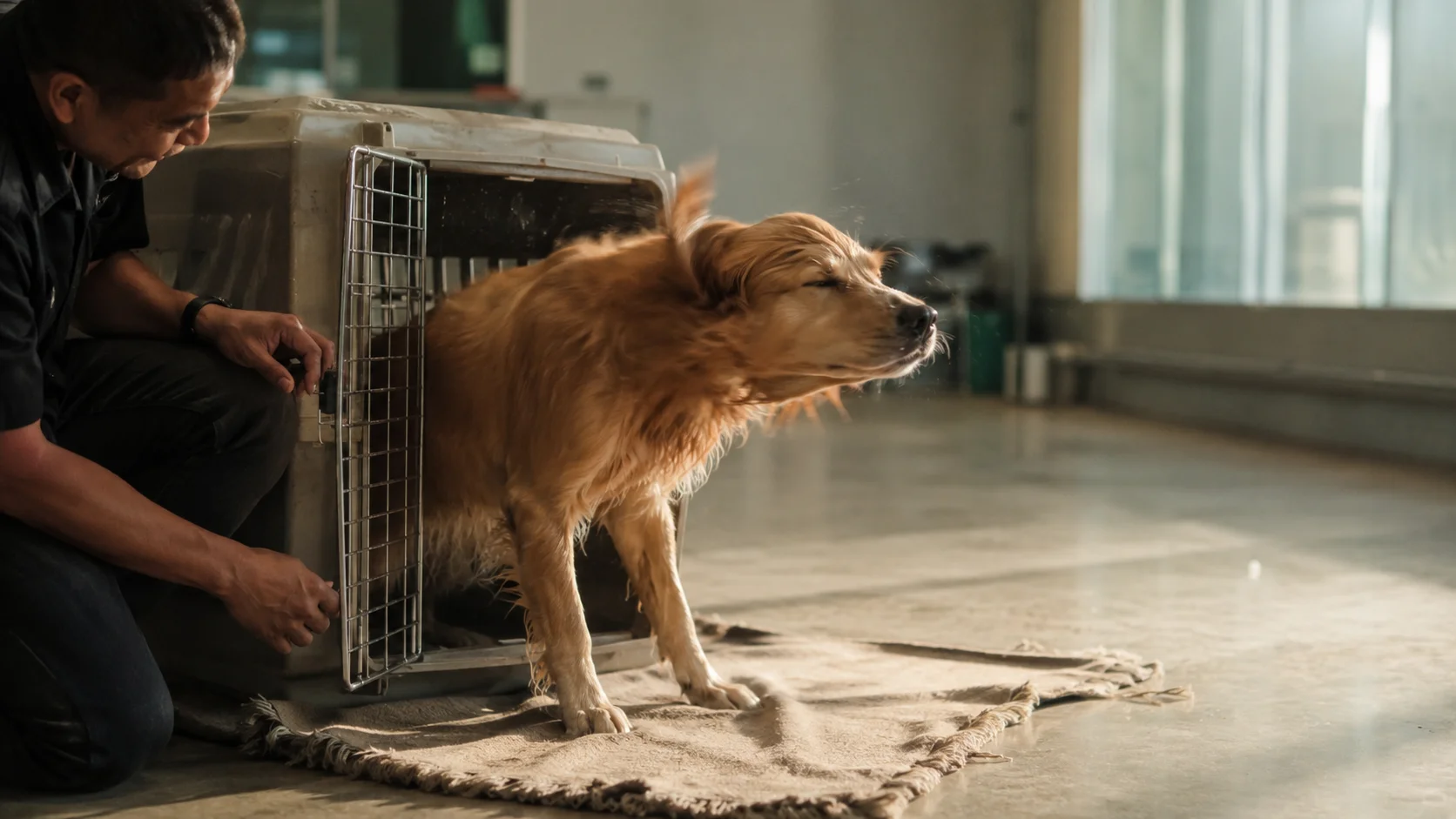
Two dogs can land on the same flight to Bangkok and go through completely different afternoons. One is clipped to its owner’s carry-on lead, walks off the jet bridge, and is home within two hours. The other rode in the belly of the same aircraft as manifested cargo, and its owner is still waiting at a warehouse desk in the Cargo Free Zone four hours later, holding an airway bill instead of a leash. Same airport, same flight, same paperwork requirements underneath. Yet the arrival looks completely different, and almost nobody explains which one you’re booking until it’s already decided.
The difference comes down to one choice made weeks earlier: whether your pet is checked in as accompanied baggage on your own ticket, or shipped as freight on an airway bill. Everything else that follows on arrival day flows from that single decision: where you stand, which door your pet comes through, how long you wait. Both paths are detailed below, sourced to Airports of Thailand’s own arrival guidance, the Royal Thai Government’s official pet-import guidance, and the Department of Livestock Development’s Animal Quarantine Station procedures, not to a single traveller’s one-off experience.
Two Different Arrivals: Passenger-Associated and Cargo
A pet flying as accompanied baggage travels on the same ticket and the same flight as its owner, checked in at the airline counter at departure like an oversized suitcase. On arrival, it comes off the aircraft with the rest of the hold baggage and is available for collection at roughly the same time as checked luggage, normally within an hour or so of the doors opening, quarantine processing included. This is the path most solo travellers and couples use for a cat or a small-to-medium dog.
A pet flying as manifested air cargo travels under its own airway bill, independently of any passenger ticket. This is standard for larger dogs whose crate exceeds the airline’s baggage allowance, for owners who fly on a different date to their pet, and for shipments arranged through a pet transport agent rather than booked at a check-in counter. Cargo pets clear through the airport’s Cargo Free Zone (the bonded warehouse area handling all air freight, not the passenger terminal), and the process typically runs to a slower clock, often several hours rather than one.
Neither path is “better” in the sense of being less compliant; Thai import law applies the same permit, health-certificate and vaccination requirements to both. What changes is logistics: who meets the pet, where, and how quickly.
Immigration, Baggage, and Where Your Pet Actually Waits
If your pet travelled as accompanied baggage, you clear passenger immigration first, exactly as you would without a pet. Your pet does not walk through immigration with you. It stays in the terminal’s animal holding area, under airline and ground-handling staff, until you’ve cleared into the baggage hall. This gap is the part first-time flyers find hardest: a dog that has just spent 9-plus hours in a crate is now waiting alone in an unfamiliar building for another 20 to 40 minutes while its owner queues at a passport desk. It is a genuinely uncomfortable stretch for the pet and for you, and no amount of preparation removes it entirely. The honest answer is that you get through it, and it is shorter than it feels standing in the queue.
Once through immigration, you collect any checked luggage, then proceed, not to a general customs exit but specifically to the Animal Quarantine Station, before customs.
The Animal Quarantine Station Near Carousel 8
Suvarnabhumi’s Animal Quarantine Station sits inside the passenger terminal, and Airports of Thailand’s own airport guide places it in the arrivals area in front of Baggage Claim Belt 8. That is exactly where the “baggage carousel 8” detail that circulates on pet-travel forums comes from. Terminal layouts do get adjusted as the airport expands its facilities, so treat “near Carousel 8” as the reliable general orientation rather than a guarantee that won’t ever shift; confirm the current desk location with your airline or handler on the day, the same way you’d confirm a gate change.
This is a livestock-and-companion-animal quarantine desk, not a customs booth. It exists specifically to verify the animal’s health documentation before Thai customs ever gets involved. Officers here are checking whether the dog or cat in front of them matches the paperwork that was submitted weeks earlier, not assessing duty or value.
What the Officer Checks: Documents and the R6/R7 Forms
The Department of Livestock Development’s own guidance for Suvarnabhumi’s Animal Quarantine Station sets out a specific document set officers check on arrival, all of which should have been prepared and, for the import permit, pre-approved well before departure:
- The import permit, Form R1/1: applied for in advance, with DLD’s own processing guidance allowing lodgement no fewer than 7 and no more than 60 days before departure, and roughly 5–7 Thai business days to process once the file is complete
- The original veterinary health certificate, valid for 10 days from the date your vet endorsed it: book the vet visit against your flight date, not the other way around
- Proof of current core vaccinations: rabies for both species, plus distemper, hepatitis, parvovirus and leptospirosis for dogs, and feline panleukopenia for cats
- The pet’s microchip number, matched against every other document in the file
If everything matches, the station issues two further documents on the spot: Form R6, the arrival inspection record confirming the physical animal was checked against the paperwork, and Form R7, formal permission to release the animal to its owner. You carry both forms, along with your import permit and health certificate, to the next stop, because customs asks for them again.
The Goods to Declare Channel and the Fee You’ll Actually Pay
A live animal is not a suitcase you can quietly wheel through the green “nothing to declare” lane. Thai customs requires import-permit holders to present their pet and paperwork at the red Goods to Declare channel, where an officer reviews the same permit and forms the quarantine station just issued, and assesses whatever is applicable to the shipment.
The Animal Quarantine Station’s own published fee is straightforward: a 500 baht inspection fee per animal, payable in cash. That is the one number worth memorising before you travel. It is not, however, the only number you’ll pay on arrival day. Airlines and ground handlers separately charge for cargo handling, and if your pet arrives outside the AQS’s normal processing window, warehouse storage adds up by the hour. Build a buffer into your arrival-day budget rather than assuming 500 baht is the full bill.
If Your Pet Travels as Cargo: The Cargo Free Zone Route
Cargo arrivals skip the passenger terminal entirely. Your pet’s crate is offloaded with the rest of the flight’s air freight and moved to the airline’s cargo warehouse inside the Cargo Free Zone, tracked against its airway bill rather than a boarding pass. You do not meet your pet at a baggage belt in this scenario. You meet it at the warehouse counter, after presenting the airway bill, the same import permit and health certificate, and (in most cases) working with a cargo agent or pet transport handler who manages the counter-side paperwork on your behalf.
The Animal Quarantine Station still inspects cargo arrivals against the same document checklist and issues the same R6/R7 forms. The compliance bar does not lower because the pet arrived as freight. What changes is the physical route: airway bill and cargo manifest instead of a boarding-pass baggage tag, warehouse collection instead of a terminal exit, and, realistically, a longer clock. Where a passenger-associated pet might be in your arms within an hour of landing, a cargo pet’s total time from touchdown to collection commonly runs three to five hours once warehouse processing, quarantine inspection and customs are all sequenced.
Timing: Late-Night Arrivals versus Business Hours
Here is the detail that decides whether your arrival day is smooth or genuinely stressful: the Animal Quarantine Station is not a 24-hour desk in the way passenger immigration is. Live-animal processing runs across extended hours to match Suvarnabhumi’s flight schedule, but staffing thins overnight, and a pet landing in the small hours can sit considerably longer than one landing mid-afternoon, whether that wait happens in the terminal’s holding area or the cargo warehouse.
If you have any control over flight selection, route the arrival into business hours. With a pet involved, it’s worth treating this as a real selection criterion rather than an afterthought. A flight that lands at 2pm and clears by 4pm beats a flight that lands at 1am and clears by sunrise, even if the 1am option was cheaper or more convenient for your own onward connection. Confirm current AQS operating hours directly through Suvarnabhumi’s own pet travel guidance before you book, since hours are the kind of detail that gets updated without much notice.
Meeting Your Driver and Getting Home
Once Form R7 is issued and customs has cleared the shipment, the practical part of the day is almost done. If SwiftCargo or another handler has arranged ground transport, the meeting point is typically just outside the arrivals hall for passenger-associated pets, or at the Cargo Free Zone’s own vehicle access point for cargo arrivals. These are two different physical locations at the airport, so confirm which one your driver is briefed for, particularly if you booked transport separately from the pet shipment itself. A mismatch here is a common, entirely avoidable source of a 30-minute delay at the exact moment everyone involved, pet included, is ready to be finished with the airport.
When Something Goes Wrong: Delays, Damaged Crates, or Missing Water
Most arrivals go smoothly. Some don’t, and it’s worth knowing what “not going well” actually looks like rather than imagining the worst version. There are three realistic failure modes. A delayed connecting flight can push your pet’s arrival into the thin overnight staffing window described above. A water dispenser can come loose or run dry during a long transit; ground staff are trained to flag and top it up, but check it yourself the moment you see the crate. Least often, but most upsetting, a crate door or latch can arrive damaged in handling; airlines are required to address that before release rather than hand the crate back as-is. Every crate moving through Suvarnabhumi as air cargo is checked against IATA’s Live Animals Regulations, the international standard airlines use for container strength, ventilation and water access. A crate built to that standard is far less likely to produce either failure mode in the first place.
None of these are reasons to panic, and none of them are unique to Suvarnabhumi. They are the standard set of things that can go wrong moving a live animal through any major international airport. What matters is knowing, before you’re standing in the terminal exhausted, which of these are yours to raise immediately (crate damage, missing water) versus which are simply the process taking its normal, slower cargo-side course.
If you do need to raise something, be specific rather than general. “The crate looks damaged” gets a slower response than “the left latch is bent and won’t fully close.” That phrasing tells the staff member exactly what to look at and exactly what fixes it counts as done. The same goes for water: don’t say the crate seems dry, point at the dispenser and say it’s empty. Vague concerns get queued behind whatever else is happening at the counter; specific, checkable ones get handled on the spot.
What Firsthand Blogs Get Right, and Where They Mislead You
Search “Suvarnabhumi pet arrival” and most of what comes back is a single traveller’s account of the one day they did this once. That’s genuinely useful for atmosphere and reassurance. Knowing that someone else’s dog also found the terminal overwhelming and was fine within the hour is worth something. Where these accounts get shakier is anywhere they present a one-off experience as a fixed rule: the exact wait time (which varies by flight-load and time of day far more than any single post admits), the exact fee charged at the Goods to Declare counter (some travellers report figures well above the AQS’s own published 500 baht inspection fee, which likely reflects cargo handling or storage charges bundled in without the traveller realising they were separate line items), and confident claims about which terminal door or counter to use, which can go stale the moment the airport adjusts a walkway.
The documents, forms and the official 500 baht inspection fee described in this guide come from Thailand’s Department of Livestock Development and Airports of Thailand directly, not from any single traveller’s memory of one trip. Treat blog accounts as useful colour on top of that official baseline, not as a replacement for it.
Does the Process Change Depending on Where Your Pet Started?
Not materially. The Animal Quarantine Station applies the same document checklist, the same R6/R7 forms and the same 500 baht inspection fee regardless of whether the pet’s journey started in Sydney, Los Angeles or Rotterdam. Thai import law is written around the animal and its paperwork, not its passport. What does change from origin to origin is everything that happens before the airport: which vaccinations count as “core,” how far in advance the health certificate can be issued, and how the exporting country’s own rules interact with Thailand’s. Families who moved pets from the United States or from Europe describe the same Suvarnabhumi arrival day covered here. The origin-specific work happens weeks earlier, at the vet’s office and the DLD permit application, not at the airport itself.
The one origin-specific wrinkle worth flagging for Australian movers specifically: DAFF’s biosecurity rules on the Australian side are considerably stricter about what your pet can be exposed to than Thailand’s are about what it can bring in. If any part of this trip is a fixed-term posting rather than a one-way move, it’s worth reading Australia’s own biosecurity import requirements before you fly out, not after. And if a return to Australia is even a possibility, the mechanics of why Thailand doesn’t support a direct pet flight home are explained in full in our companion guide on why pets can’t fly directly from Thailand to Australia. Reading that before you leave, rather than discovering it two years into a posting, is the difference between an inconvenience and a genuine problem.
Your Suvarnabhumi Arrival Checklist
Carry physical originals of everything below. A phone photo is not an accepted substitute for the Animal Quarantine Station’s document check:
- Approved import permit, Form R1/1
- Original veterinary health certificate, endorsed within the last 10 days
- Vaccination record showing current rabies cover, plus the other core vaccines for your pet’s species
- Microchip certificate or record, with the number legible and matching every other document
- Airway bill (cargo arrivals only) or baggage claim tag (accompanied arrivals)
- 500 baht in cash, per animal, for the AQS inspection fee
- A spare collapsible water bowl and a small water bottle, in your carry-on, for the gap between landing and collection
- Your handler’s or driver’s phone number, and confirmation of which arrivals point they’ll meet you at
Families arranging this move through SwiftCargo’s pet transport service get this checklist confirmed against their specific flight and crate before departure, so nothing on this list is a surprise on the day.
Related reading: Moving a Pet from Bangkok Airport to Pattaya, Hua Hin, Phuket or Chiang Mai
Frequently Asked Questions
What happens when your pet arrives at Suvarnabhumi Airport?
Your pet is met on arrival by Thailand’s Animal Quarantine Station, located inside the passenger terminal near Baggage Claim Belt 8 for accompanied pets, or through the Cargo Free Zone for pets travelling as freight. An officer checks the import permit, health certificate and vaccination record against the physical animal, issues the arrival form, and directs you to the Goods to Declare customs channel before you can leave with your pet.
Is my pet’s arrival handled differently as accompanied baggage versus air cargo?
Yes. A pet checked in as accompanied baggage on your own ticket clears through the passenger terminal alongside you, usually within an hour or two of landing. A pet shipped as manifested air cargo, which is common for larger dogs or when the owner travels separately, clears through the airport’s Cargo Free Zone against an airway bill, and is collected from a cargo warehouse rather than a passenger baggage belt.
Where do I actually collect my pet at Suvarnabhumi: is it near Baggage Claim 8?
For passenger-associated arrivals, yes. Airports of Thailand’s own signage places the Animal Quarantine Station in the passenger terminal in front of Baggage Claim Belt 8, so most travellers collect checked luggage first, then walk to the quarantine desk before customs. Gate and terminal layouts can shift with airport works, so confirm the current desk location with your handler or airline on the day rather than relying on any single travel blog.
What documents does the Animal Quarantine Station check on arrival?
The officer checks the pre-approved import permit (Form R1/1), the original veterinary health certificate issued within 10 days of travel, the rabies and core vaccination record, and the microchip number against the paperwork. On a clean file, the station issues Form R6 (the arrival inspection record) and Form R7 (permission to release the animal), which you then present to customs.
How much does pet customs clearance cost at Bangkok airport?
The Animal Quarantine Station charges a standard inspection fee of 500 Thai baht per animal, payable in cash. This is separate from any freight, handling or cargo-warehouse storage charges your airline or forwarder invoices, and separate from any customs assessment at the Goods to Declare channel, so budget for more than the 500 baht figure alone.
What should I do if my pet’s flight lands late at night?
Confirm the Animal Quarantine Station’s operating hours for your exact arrival slot before you book the flight, not after. Suvarnabhumi runs live-animal arrivals across extended hours, but staffing thins overnight, and a pet landing outside core hours can face a longer wait at the airport, or in the cargo warehouse, before an officer is available to process the file. Where possible, route arrivals into business hours.
Every one of the requirements above can change as Thai and Australian rules are updated, so confirm current forms, fees and hours with Thailand’s Department of Livestock Development or your pet transport handler before you travel. For a plan built around your specific route, crate and flight, get a pet transport quote from SwiftCargo.