
An importer in Chiang Mai declared 200,000 THB of furniture last year and budgeted for the 20% duty rate his HS code showed. He expected a bill of about 40,000 THB. The assessment came back at 68,480 THB: 71% higher than his estimate. Nothing was wrong with the assessment. He had made three separate errors, and each one is baked into how Thai customs duty calculation actually works.
Walk it backwards. First, duty is not charged on the price of the goods. It is charged on CIF value: cost plus insurance plus freight. His 200,000 THB of furniture travelled with 38,000 THB of sea freight and 2,000 THB of insurance, so the dutiable base was 240,000 THB. Second, his 20% duty came to 48,000 THB, not 40,000. Third, Thailand then charges 7% VAT, but not on the goods value. VAT is charged on the accumulated total of CIF plus duty: 7% of 288,000 THB is 20,160 THB. Add a small customs processing fee and the bill lands at 68,480 THB.
None of this is hidden. It is all published by the Thai Customs Department. But the calculation cascades in a specific order, and if you estimate any layer on the wrong base, every layer after it is wrong too. This guide walks through the full stack, step by step, with worked numbers at every stage, so the assessment that arrives matches the one you budgeted.

Step 1: Establish the Customs Value (CIF)
Everything starts with the customs value, and in Thailand that means CIF: Cost + Insurance + Freight.
This trips up importers from FOB-basis countries. The United States, for example, assesses duty on the price of the goods alone, excluding international shipping. Thailand does not. The money you spend getting the goods to a Thai port is itself dutiable.
What counts inside customs value:
- Cost: the transaction price actually paid or payable for the goods. For commercial shipments, this is the commercial invoice value. It includes packing costs, selling commissions, royalties tied to the sale, and any assists (materials or tooling you supplied to the manufacturer free or at reduced cost).
- Insurance: the premium for insuring the goods in transit. If you did not buy insurance, Thai Customs applies a notional figure (conventionally 1% of the cost-plus-freight amount) rather than treating it as zero.
- Freight: international transport charges to the Thai port of entry. Domestic trucking inside Thailand after clearance is not included; the ocean or air leg is.
A quick example. You buy machinery for 500,000 THB, pay 45,000 THB in sea freight, and skip insurance. Customs does not use 545,000 THB. It adds notional insurance of roughly 5,450 THB (1% of 545,000), producing a customs value of about 550,450 THB. Small, but it compounds through every later layer.
One more subtlety: currency conversion. Invoices in USD, EUR, or RMB are converted to THB at the exchange rate published by Thai Customs for the relevant period, not the rate on your credit card statement. On large shipments, a few percent of currency movement between purchase and clearance changes the assessment.
Step 2: Find Your Duty Rate by HS Code
Every product entering Thailand is classified under a Harmonized System (HS) code, and each code carries a duty rate. Thailand’s tariff schedule runs from 0% to 80%, and the spread is not gentle. Typical bands:
- Electronics and IT equipment: often 0–10%. Many computers, phones, and components enter duty-free under the Information Technology Agreement. A laptop is typically 0%; some consumer audio gear sits at 10%.
- Machinery and industrial equipment: commonly 0–15%, depending on type and whether promotional exemptions apply.
- Clothing and textiles: around 30% for most finished apparel. This is one of the most consistently painful categories for small importers.
- Furniture: generally 20%.
- Cosmetics and perfume: up to 30%, and perfume additionally attracts excise tax (more on that below).
- Alcohol: 54–60% duty on wine and spirits, before the excise stack that makes the real burden several times higher.
- Vehicles: up to 80% duty on imported cars (the top of the schedule), and vehicles also carry heavy excise, which is why an imported car in Thailand can cost double or triple its overseas price.
Two warnings about classification. First, the rate depends on the precise code, not the general category. “Furniture” is not one rate; a wooden dining chair, a metal office chair, and a mattress classify differently. Second, if you self-classify wrong, Customs reclassifies at clearance: always at their code, sometimes with a penalty for the misdeclaration. If your product is ambiguous, get a binding ruling before shipping (covered in the final section) rather than guessing.
Free trade agreements can cut these rates dramatically. Goods of ASEAN origin often enter at 0% under ATIGA; goods from China, Japan, Korea, Australia, and others may qualify for preferential rates under their respective FTAs, but only with a valid certificate of origin presented at clearance. Without the certificate, you pay the general rate. No exceptions after the fact.

Step 3: The Cascading Calculation Order
This is the engine of the whole system. Thai import taxes are not parallel charges on the same base. They cascade: each tax is calculated on a base that includes the taxes before it. The order is fixed:
- Import duty = duty rate × CIF value
- Excise tax (selected goods only) = excise rate applied to the duty-inclusive value
- Interior tax = 10% × the excise tax amount
- VAT = 7% × (CIF + duty + excise + interior tax)
Excise applies only to a specific list: alcohol, tobacco, perfume and certain cosmetics, motor vehicles, motorcycles, yachts, and a handful of others. Ordinary goods (clothing, furniture, electronics, machinery) skip steps 2 and 3 entirely and go straight from duty to VAT. But VAT always applies, and it always applies to the accumulated total, never to the goods value alone.
Worked example: how 30% becomes 46%
Take a shipment of clothing with a CIF value of 100,000 THB, duty rate 30%, no excise.
- CIF value: 100,000 THB
- Import duty: 30% × 100,000 = 30,000 THB
- VAT base: 100,000 + 30,000 = 130,000 THB
- VAT: 7% × 130,000 = 9,100 THB
- Total tax: 30,000 + 9,100 = 39,100 THB, an effective rate of 39.1%, not 30%.
Now the same 100,000 THB CIF, but a good carrying 30% duty and a 30% excise burden, say a perfume consignment:
- Import duty: 30% × 100,000 = 30,000 THB
- Excise tax on the duty-inclusive value: 30% applied to 130,000 in simplified form ≈ 39,000 THB (the Excise Department uses a suggested-retail-price formula in practice; the simplified version shown here understates it slightly)
- Interior tax: 10% × 39,000 = 3,900 THB
- VAT base: 100,000 + 30,000 + 39,000 + 3,900 = 172,900 THB
- VAT: 7% × 172,900 = 12,103 THB
- Total tax: 85,003 THB, an effective rate of 85% from a headline duty rate of 30%.
Even without excise, the pattern holds: multiply your duty rate’s effect by the VAT cascade and the true burden on ordinary goods is roughly duty rate + 7% + (7% × duty rate). A 20% duty is really 28.4%. A 30% duty is really 39.1%. A 60% duty is really 71.2%. Budget on the headline rate and you will always come up short.
Where does “46%+” come from, the figure you sometimes see quoted for 30%-duty goods? Add the pieces many shipments actually carry: notional insurance uplift on the base, customs processing fees, and (for goods with even a modest excise component) the interior tax rider. The gap between the sticker rate and the invoice is structural, not an error.
Step 4: Check Whether the Stack Applies at All
Two carve-outs matter enormously, because when they apply, the entire calculation above disappears.
Personal effects exemption
If you are relocating to Thailand and importing used household goods and personal effects, a duty exemption can apply to foreigners with a qualifying documented status (a work permit valid for a year or more, a non-immigrant visa with a confirmed working period of at least a year, Thai permanent residence, or a full one-year Smart Visa) and to returning Thai nationals who have been abroad at least a year. A retirement or marriage-based Non-Immigrant O does not qualify. The goods must be used (generally owned six months or more), reasonable in quantity for a household, and imported within the eligibility window around your arrival.
When the exemption applies, there is no CIF calculation, no duty, no VAT on the qualifying items. When it does not (new goods mixed into the shipment, duplicate appliances, commercial quantities, a visa category that does not qualify), the affected items drop straight into the full stack, valued at Customs’ assessment of their worth. This is the single biggest fork in the road for household movers, and we cover the qualification rules in detail in our guide to Thailand’s duty-free import rules.
De minimis for postal and courier imports
Parcels arriving by post or courier with a CIF value of 1,500 THB or less clear free of duty and VAT. Two things to understand about this threshold:
- It is CIF, so a 1,300 THB item with 400 THB shipping is over the line at 1,700 THB.
- It is a cliff, not an allowance. A 1,600 THB parcel pays duty and VAT on the full 1,600 THB, not on the 100 THB excess.
Splitting one order into several sub-threshold parcels to the same address is a known pattern that Customs watches for, and consolidated treatment (plus penalties) is the likely outcome if flagged.

Step 5: Survive the Valuation Review
You declare a value; Customs decides whether to believe it. Thai Customs maintains reference pricing databases built from historical import data: what comparable goods, from comparable origins, have been declared at. If your declaration sits well below the reference band, the officer can reject the transaction value and reassess.
Reassessment is not an accusation of fraud by itself. But it moves the burden onto you, and the duty is calculated on their number until you displace it. What actually works as evidence:
- The commercial invoice: itemized, consistent with the packing list, showing seller, buyer, and payment terms.
- Proof of payment: bank transfer records or card statements matching the invoice amount. This is the strongest document you can hold.
- Marketplace or catalogue evidence: a live listing showing the item genuinely sells at your declared price, useful for discounted or clearance goods.
- Correspondence: the negotiation trail, if you secured a below-market price for a documented reason (end-of-line stock, damaged packaging, bulk terms).
What does not work: a proforma invoice conjured for customs at a fraction of the real price, or “the seller marked it as a gift.” Gifts are dutiable at market value in Thailand; the gift label changes nothing except the officer’s level of suspicion. Undervaluation is also among the most common reasons cargo stalls at the border, a pattern we unpack in why shipments get stuck at Thai customs.
Valuing used goods
Used goods are dutiable on current market value, not original price and not a token figure. In practice, Customs accepts reasonable depreciation when you document it: the item’s age, purchase receipt, condition, and comparable second-hand prices. Depreciation schedules in the region of 10–20% per year of use are commonly applied for household goods and equipment, usually with a floor: a ten-year-old machine is not worth zero for customs purposes.
Concretely: a three-year-old camera bought for 60,000 THB might reasonably be declared around 30,000–36,000 THB with the original receipt attached. Declare it at 3,000 THB and you invite reassessment on the whole shipment, because one implausible line item taints the credibility of every other line.
Step 6: Know the Cost of Getting It Wrong
The Customs Act gives Thai Customs unusually sharp teeth on valuation offences. For under-declaration that evades duty, the exposure is:
- Fines of up to four times the duty evaded (in serious cases, calculated on duty plus taxes), on top of paying the duty itself;
- Seizure of the goods: forfeiture is available for smuggling-classified offences, and deliberate under-declaration can be classified that way;
- Criminal liability in aggravated cases, including potential imprisonment.
Run the arithmetic on a real case. Goods with a true CIF of 300,000 THB at 30% duty owe 90,000 THB duty plus 27,300 THB VAT. Declare them at 150,000 THB and you “save” roughly 58,650 THB. If caught: you pay the full correct tax, plus a fine that can reach four times the ~45,000 THB duty evaded (up to 180,000 THB), and the goods can sit in seizure while it is resolved, accruing storage. The downside is four to six times the upside, before counting the flag that now sits on your importer record and raises your inspection rate on every future shipment.
Look at who suggests the low invoice and who carries the outcome. The supplier who offers to write 150,000 THB on the paperwork loses nothing if the declaration is caught; the fine, the seizure and the flag on the importer record all land on you. Past success is weak evidence here too. Thai Customs can audit entries after clearance, so a run of shaded declarations that went through without questions tells you the review has not reached you yet, and little else. Declare the real value and the downside is capped at the tax you already budgeted.
Honest mistakes are treated more leniently than deliberate evasion (voluntary disclosure before detection materially reduces penalties), but the cleanest protection is a declaration you can document to the baht. Many of the errors that trigger penalties are clerical rather than strategic; our rundown of common customs paperwork mistakes in Thailand covers the ones we see most.
Step 7: Pre-Calculate Before You Ship
Now assemble the whole method into a pre-shipment estimate. The procedure, every time:
- Build CIF: goods cost + freight quote + insurance (or 1% notional).
- Classify the goods and look up the duty rate (verify against the Thai Customs Department tariff, or get a broker to confirm).
- Duty = rate × CIF.
- If the goods are excisable, add excise on the duty-inclusive value, then interior tax at 10% of excise.
- VAT = 7% × everything accumulated so far.
- Add ~200–1,000 THB in customs processing and, for larger shipments, terminal and clearance fees.
Example A: Electronics (the friendly case)
A business imports 350,000 THB of laptops; air freight 18,000 THB; insurance 1,200 THB.
- CIF: 369,200 THB
- Duty at 0% (ITA-covered): 0 THB
- VAT: 7% × 369,200 = 25,844 THB
- Total tax: 25,844 THB, effective rate 7.0%. Electronics are the best case in the entire schedule: no duty on many codes, VAT only. But note VAT still applied to freight and insurance, not just the goods.
Example B: Furniture (the standard case)
Household furniture, CIF 240,000 THB (the Chiang Mai importer from the opening), duty 20%.
- Duty: 20% × 240,000 = 48,000 THB
- VAT: 7% × 288,000 = 20,160 THB
- Total: 68,160 THB on 200,000 THB of goods, an effective rate of 34.1% against the goods price, from a 20% headline duty. Add the processing fee and you reach his 68,480 THB assessment exactly.
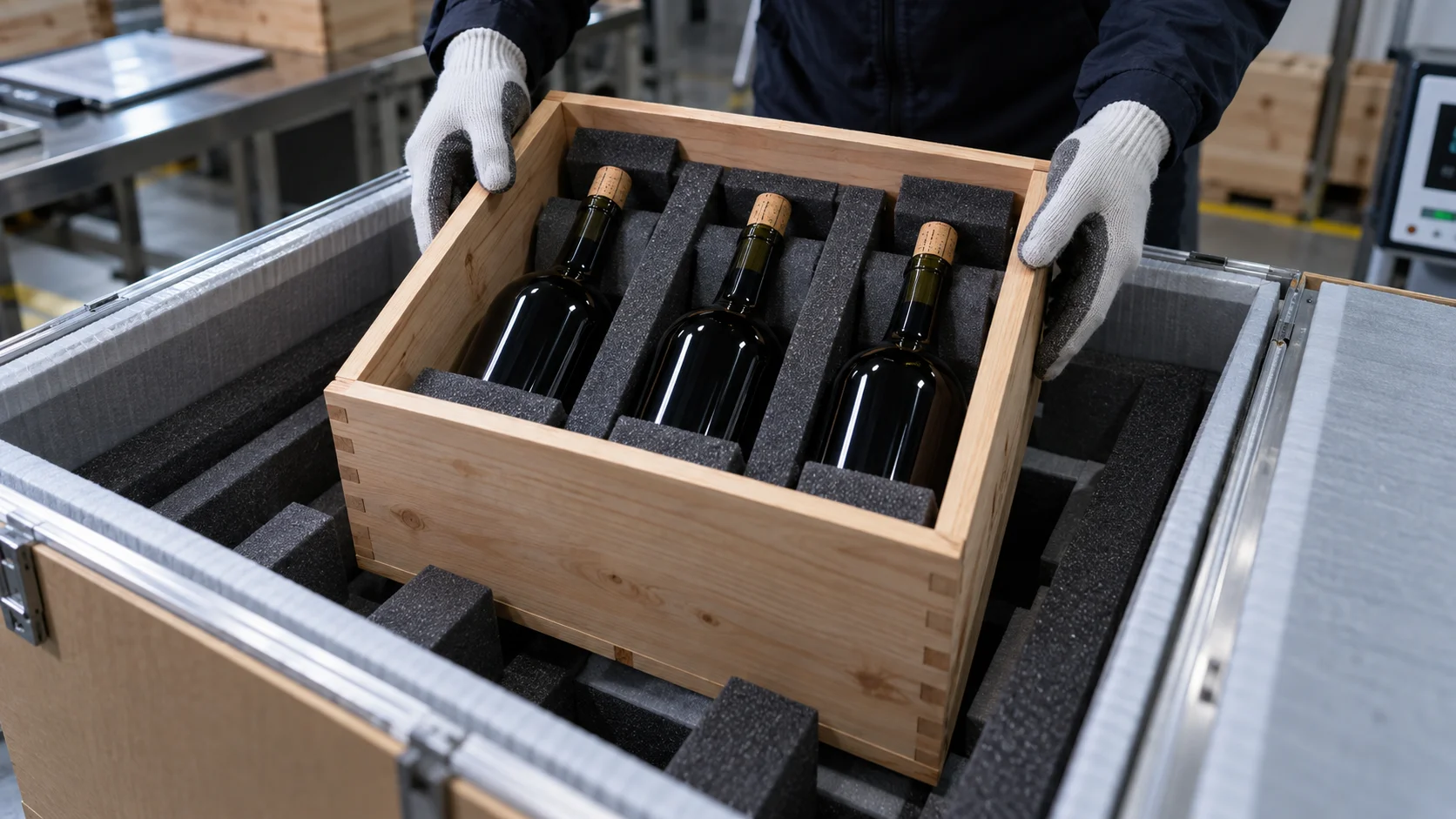
Example C: Wine (the brutal case)
Twelve cases of wine, goods cost 80,000 THB, freight and insurance 8,000 THB. CIF: 88,000 THB.
- Import duty at 54%: 47,520 THB (running total: 135,520)
- Excise: wine excise is assessed on a suggested-retail-price basis with both ad valorem and per-litre-of-alcohol components; on a shipment like this it commonly lands around the duty-paid value again, call it 135,000 THB (running total: 270,520)
- Interior tax: 10% × 135,000 = 13,500 THB (running total: 284,020)
- VAT: 7% × 284,020 = 19,881 THB
- Total tax: 215,901 THB on 80,000 THB of wine, an effective rate of about 270%, and depending on the wine’s alcohol content and assessed retail price the stack routinely reaches 300–400%.
This is why wine in a Bangkok restaurant costs what it costs, and why “I’ll just bring a few cases in my container” is one of the most expensive casual decisions a relocating family can make. Alcohol above the tiny personal allowance is never worth shipping; the traveller allowance rules are set out in our duty-free Thailand import guide, and the broader budget traps in the hidden costs of shipping to Thailand.
Notice the spread across the three examples: 7%, 34%, 270%. Same country, same month, same calculation method. The variable is the goods. No useful average “Thailand import tax rate” exists, only the calculation, run on your specific shipment.
Step 8: Get a Binding Ruling When the Stakes Justify It
If your shipment is large, recurring, or sits on a classification boundary, do not rely on your own read of the tariff. The Thai Customs Tariff and Ruling Service offers advance rulings on three questions: tariff classification (which HS code applies), customs valuation (how a pricing arrangement will be valued), and origin (whether goods qualify for FTA preference).
How it works in outline:
- You apply before importation, with product specifications, samples or images, and the commercial context.
- The Customs Department issues a written ruling: processing typically takes around 30 working days, longer for complex products.
- The ruling binds Customs for the goods described, generally for a period of around two years, so the rate you planned on is the rate you pay.
For a one-off box of personal effects this is overkill. For a business importing 30% of its cost base through Laem Chabang every month, an advance ruling converts the largest variable in the landed-cost model into a fixed number. It also neutralizes the classification-penalty risk entirely: you cannot be penalized for using the code Customs itself put in writing.
Rates themselves move too. Duty rates are set under the customs tariff decree and adjusted by the Ministry of Finance; excise rates shift with policy (alcohol excise in particular has been restructured several times in recent years). A calculation you ran two years ago is a hypothesis, not a fact. Re-verify rates against the Customs Department and Excise Department schedules before each significant shipment.
The Method, Compressed
Everything above reduces to a card you can keep next to any quote:
- CIF, not price. Goods + insurance + freight is the base. No insurance bought? Customs adds a notional 1%.
- Rate by exact HS code. 0–80% range; electronics 0–10%, clothing ~30%, furniture ~20%, vehicles up to 80%. FTA certificate = potentially 0%.
- Cascade in order. Duty on CIF → excise (alcohol, tobacco, perfume, vehicles) → interior tax at 10% of excise → VAT 7% on the accumulated total.
- Check the exits. Qualifying personal effects: exempt. Postal/courier parcels ≤1,500 THB CIF: exempt. Everything else: the full stack.
- Document your value. Invoice + proof of payment beats the reference database; used goods at documented depreciated market value.
- Never shade the declaration. Up to 4× the evaded duty in fines, plus seizure.
- Big or recurring shipment? Binding ruling first.
The Chiang Mai importer’s 71% surprise was three small errors compounding: wrong base, right rate, missing VAT layer. Run the six-line calculation before you commit to shipping and the number on the assessment stops being a surprise at all. If you would rather have someone run it for you (with current rates, your actual freight quote, and the right HS codes), that is precisely the work a forwarder’s customs team does before your goods ever leave origin. See how Swift Cargo handles Thai customs clearance for a shipment like yours.
Related Reading
- Duty-Free Thailand Import: What You Can Bring In Without Paying
- Duty-Free Import Rules for Thailand: The Personal Effects Exemption Explained
- The Hidden Costs of Shipping to Thailand
- Why Shipments Get Stuck at Thai Customs
- Customs Paperwork Mistakes That Cost Importers in Thailand
- Importing Commercial Goods to Thailand: A Business Guide
Frequently Asked Questions
Is Thai customs duty calculated on the price I paid or on CIF value?
On CIF value: the cost of the goods plus international freight plus transit insurance. If you paid 100,000 THB for goods and 15,000 THB to ship them with 1,000 THB of insurance, duty applies to 116,000 THB. Importers used to FOB-basis systems like the United States consistently underestimate Thai assessments for exactly this reason.
Why is my total Thai import tax higher than the duty rate suggests?
Because the taxes stack rather than run in parallel. Duty is charged on CIF, then 7% VAT is charged on CIF plus duty, plus excise and interior tax where those apply. A 30% duty rate produces roughly a 39% total burden on ordinary goods, and dramatically more on excisable goods such as wine, perfume, or vehicles.
What is the de minimis threshold for imports into Thailand?
Postal and courier imports with a CIF value of 1,500 THB or less are exempt from both duty and VAT. It is a cliff, not an allowance: a parcel worth 1,600 THB is taxed on the entire 1,600 THB. Deliberately splitting orders to stay under the line is a pattern Customs monitors.
Can Thai Customs reject my declared value?
Yes. Officers compare declarations against reference pricing databases of comparable historical imports. A declaration well below the reference band can be reassessed upward, with duty calculated on Customs’ figure. Commercial invoices matched by proof of payment are the strongest defence; “gift” labels and low-ball proforma invoices are not.
How are used goods valued for Thai customs duty?
At current market value. Customs generally accepts documented depreciation (often in the range of 10–20% per year of age, with a floor) when you provide the original receipt and evidence of condition. A token declared value on a used item tends to trigger reassessment of the entire shipment.
What is the penalty for under-declaring value to Thai Customs?
Fines of up to four times the duty evaded, on top of the correct tax, and possible seizure of the goods, since deliberate under-declaration can be treated as smuggling under the Customs Act. Voluntary disclosure before detection reduces penalties; accurate, documented declarations avoid the issue entirely.