
AUSFTA already brings duty close to zero on most lines, but the real gate is compliance: US electronics need the RCM mark, motorcycle helmets need an Australian-approved standard, and a US certification does not carry over automatically.
The USA is one of Australia’s most significant sources for sporting goods: performance footwear, protective equipment, fitness technology, and specialist outdoor gear all have US-origin supply chains that Australian retailers, distributors, and clubs rely on. But the import pathway from the United States carries specific compliance requirements that differ from China or Vietnamese sourcing, and getting those requirements wrong creates delays, duty shortfalls, or goods that cannot legally be sold on arrival.
How Sporting Goods Are Classified for Import
Australian customs classifies sporting goods under Schedule 3 of the Customs Tariff Act 1995, which implements the Harmonized System (HS). The principal chapters relevant to sporting goods imports are:
- Chapter 95: Toys, games and sports requisites. HS headings 9506 (sports equipment including balls, rackets, gym equipment, water sports gear) and 9507 (fishing rods, hooks, and accessories)
- Chapter 64: Footwear. Sports shoes, cleats, and specialist footwear
- Chapter 62/63: Apparel and textile accessories. Sports jerseys, wetsuits, compression garments
- Chapter 90: Optical, photographic, measuring instruments. GPS sports watches, fitness trackers, performance monitors
- Chapter 39: Plastics. Protective pads, guards, helmets with plastic components
The correct HS code determines the base tariff rate and any applicable anti-dumping measures. Misclassification (the most common error on sporting goods imports) can move you from a 0% duty heading to a 5% heading, or bring your goods within the scope of a different compliance regime. Confirm the classification with your licensed customs broker before the first shipment.
AUSFTA Tariff Rates: What You Actually Pay
The Australia-United States Free Trade Agreement (AUSFTA), in force since January 2005, eliminated tariffs on most goods traded between the two countries. For sporting goods, the practical effect is:
- HS Chapter 95 sporting equipment: 0% duty under AUSFTA for goods with US origin
- Sports footwear (Chapter 64): 0% under AUSFTA (the general rate is 5% or free, depending on the tariff item)
- Sports apparel (Chapters 61–63): 0% under AUSFTA (the general rate is 5% or free, depending on the tariff item)
- Electronic sports equipment (Chapter 90): 0% under AUSFTA
To claim the AUSFTA preferential rate, your goods must qualify as originating in the USA under the agreement’s rules of origin. For most manufactured goods, this means the goods are wholly obtained in the USA, produced there entirely from originating materials, or meet the product-specific rule of origin for their tariff heading (usually a change in tariff classification). AUSFTA does not require a certificate of origin: you claim the preference on your own knowledge of the goods’ origin, and you must be able to give ABF, on request, a statement of why the goods qualify and the records behind it. A written declaration of US origin from your US supplier is the usual way to hold that information. ABF can ask for the statement and records on any shipment.
Goods manufactured in China or Vietnam and imported through a US distributor (a common supply chain structure for mass-market sporting goods) are not US-origin goods. They attract the standard MFN tariff rate and are not eligible for AUSFTA preferences regardless of where the shipment departs from.
Product Safety Compliance: Where the Real Risk Sits
For most product categories, Australian consumer safety law creates higher practical compliance risk than the tariff system. The Australian Competition and Consumer Commission (ACCC) enforces mandatory safety standards under the Australian Consumer Law (ACL). Sporting goods that are subject to mandatory standards cannot be sold in Australia unless they comply, and goods that arrive non-compliant cannot be rectified at the border. They are either destroyed, re-exported, or treated as prohibited imports.
Protective equipment standards
These protective-equipment categories carry Australian standards, but only bicycle helmets have a mandatory ACCC safety standard:
- Bicycle helmets: the Consumer Goods (Bicycle Helmets) Safety Standard 2024 is mandatory. A helmet complies if it meets any one of AS/NZS 2063 (2008 or 2020 edition), EN 1078, ASTM F1447, the US CPSC standard (16 CFR Part 1203) or Snell B-95, so a US helmet certified to CPSC 1203 can be supplied in Australia. Confirm with your supplier which of those standards the specific model was tested to, and keep the test report.
- Motorcycle and motorsport helmets: state and territory road rules require an approved helmet. In Western Australia that means AS 1698 or AS/NZS 1698, or UN ECE 22.06 (ECE 22.05 only for helmets imported before 3 January 2024), and other jurisdictions publish their own lists. A US DOT certification alone is not an approved standard.
- Eye protection: AS/NZS 1337.1 covers occupational eye and face protectors. The ACCC has no mandatory standard for sports eyewear, so confirm which standard the product claims and ask for the test evidence behind that claim.
- Personal flotation devices: AS 4758 (life jackets) applies to water sports PFDs sold in Australia.
For categories without a mandatory standard, the general ACL safety provision applies: goods must not be unsafe. This is a performance standard, not a document standard, but it creates liability exposure if goods cause injury and are found not to meet reasonable safety expectations.
RCM compliance for electronic sporting goods
Fitness trackers, GPS running watches, wireless heart rate monitors, cycling computers, and any sporting equipment that transmits or receives a radio signal must carry the Regulatory Compliance Mark (RCM) before being supplied in Australia. The RCM is the single mark used for ACMA’s rules (radiocommunications, electromagnetic compatibility and telecommunications) and for the state-run Electrical Equipment Safety System, and the ACMA labelling rules say a product cannot automatically be supplied with an overseas mark such as FCC or CE.
US sporting goods brands frequently sell devices that are FCC-certified (the US equivalent) but not RCM-certified. FCC certification does not satisfy ACMA requirements. The importer (not the US brand) is responsible for RCM compliance on goods sold in Australia. If the supplier cannot provide RCM documentation, contact the brand’s Australian distributor or consider whether the brand has an authorised Australian supply chain that you should be buying through rather than importing directly.
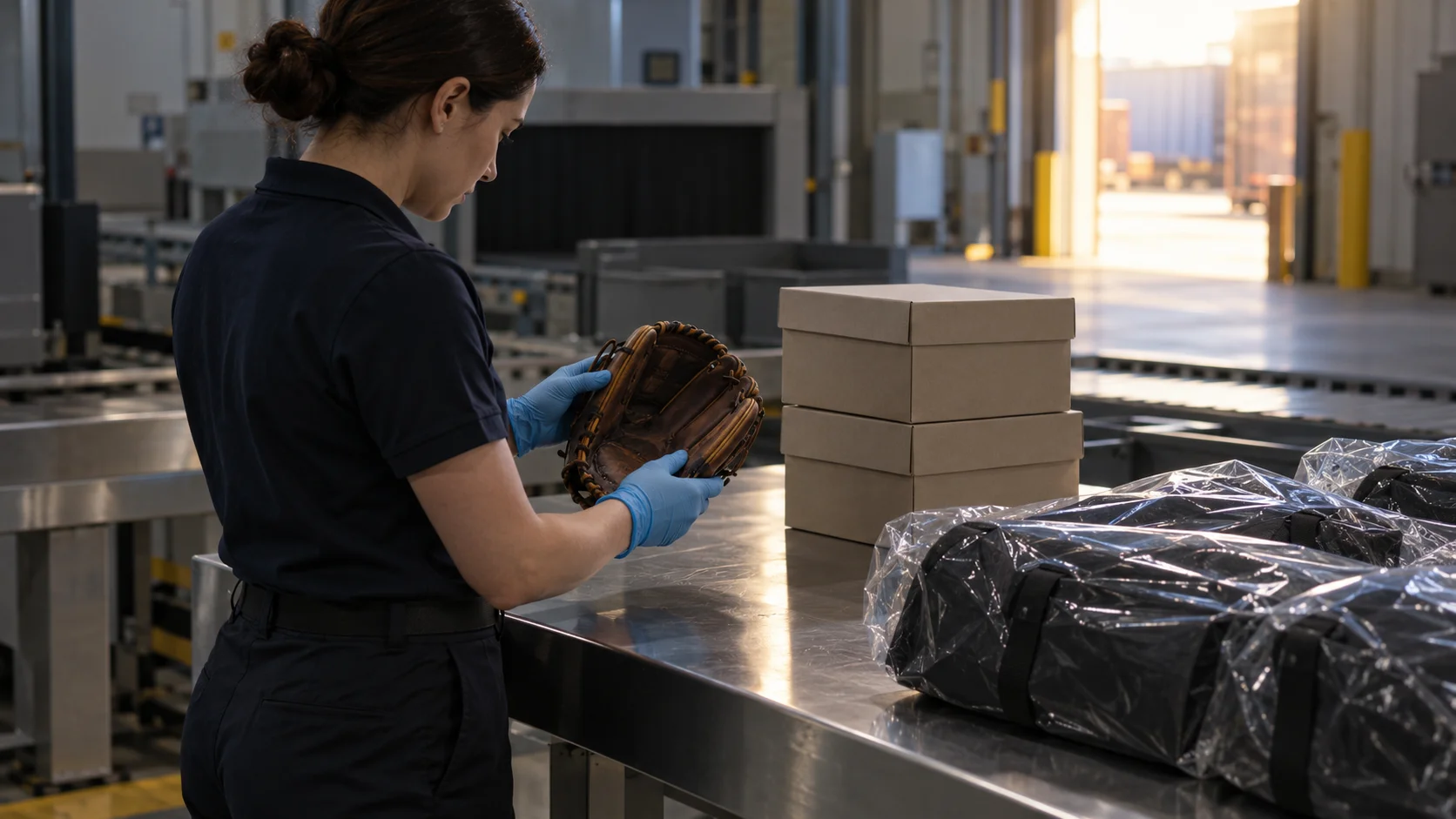
Biosecurity: Product Categories by Risk Level
The Department of Agriculture, Fisheries and Forestry (DAFF) assesses biosecurity risk on all commercial imports. For sporting goods, the risk level varies significantly by product category.
Lower risk
New, synthetic goods in original sealed packaging (rubber-soled footwear, synthetic balls, plastic equipment, aluminium frames) are the lowest risk category. They clear biosecurity without intervention in most cases. Declare them accurately and ensure the packing list describes the goods specifically rather than generically (“rubber composite footballs” rather than “sporting goods”).
Moderate risk
- Leather goods: Baseball gloves, leather sports balls, and leather-faced protective equipment require declaration of the leather type. Treated leather generally clears without intervention; untreated or partially treated hides carry higher risk. Your commercial invoice should specify “full-grain leather, chrome-tanned” or equivalent.
- Foam padding: Equipment with foam components (padding in protective gear, yoga mats, gymnastic mats) may be questioned if the foam composition is ambiguous. Some foam types use animal-derived binders. Synthetic foam with a clear composition declaration clears without issue.
- Wooden components: Baseball bats, cricket bat handles and gym equipment with wooden structural elements are timber goods, so look up their import conditions in BICON. Any timber packaging (pallets, crates and dunnage) must comply with ISPM 15 phytosanitary treatment requirements, which regulate solid wood packaging material, and the treatment mark must be visible on the packaging.
Higher risk
Second-hand or used sporting goods are the highest-risk category. DAFF treats used outdoor equipment (hiking boots, climbing gear, kayaks, bicycles) as a priority biosecurity risk because of soil, plant material, and biological residue. All used goods must be declared on import documentation. Expect mandatory inspection. Clean goods in declared condition with no visible contamination will clear; goods with soil, seeds, or animal material present will require treatment or destruction.
Freight Options: USA to Australia
The USA-Australia lane offers three practical freight modes for sporting goods imports.
Air freight
Air freight from US East or West Coast to Sydney, Melbourne, or Brisbane takes 5–8 business days. Rates are typically USD 8–18 per kilogram depending on the airline, season, and weight/volume ratio of the goods. Air freight suits high-value, low-weight goods (GPS devices, performance eyewear, specialist footwear for a new season’s range) where the cost of air is justified by inventory timing or product value.
LCL sea freight
Less than container load (LCL) is the standard mode for import volumes under approximately 15 cubic metres. Goods are consolidated at a US freight station with other importers’ cargo and deconsolidated at the Australian destination port. Transit time from the US West Coast to Sydney or Melbourne is approximately 28–35 days. The advantage is cost-efficiency at low volumes; the disadvantage is a longer and less predictable transit window compared to direct FCL services.
FCL sea freight
A full container load (either 20-foot or 40-foot) makes sense when your shipment volume exceeds 15–20 CBM or when you need the predictability and security of a dedicated container. Transit time from the US West Coast is 22–30 days on direct services, depending on the carrier and port of origin. FCL from the US East Coast (for brands with east coast distribution) adds 5–8 days. The economics of LCL versus FCL for Australian importers are covered in detail in How to Scale Your Import Business in Australia.
For the Incoterm structure that governs your freight responsibility on USA imports (whether your supplier books freight to port or you control the full movement), see What Incoterms Mean for Australian Importers.
Common Problems on the USA-Australia Sporting Goods Lane
Non-US origin goods routed through US distributors
Many sporting goods brands (footwear especially) manufacture in Vietnam, Cambodia, or Indonesia and distribute through US-based entities. An invoice from a US company does not make goods US-origin for AUSFTA purposes. If you claim AUSFTA preference on goods that are not genuinely US-origin, ABF can issue a post-clearance audit demand for the unpaid duty plus penalties. Verify origin at the product level, not the supplier level.
The invoice from the US distributor tells you who sold the goods. It does not tell you where they were made, and that distinction is exactly what a post-clearance audit is built to test. When ABF opens a file on an AUSFTA claim, the document that actually settles the question is not the commercial invoice from the US seller, it is the manufacturer’s own export declaration from the country where the goods were produced. Importers who ask their US distributor for “proof of US origin” usually get a letter on the distributor’s letterhead, which proves nothing an auditor will accept. Ask instead for the factory’s export paperwork from Vietnam, Cambodia or Indonesia, the same document that would accompany a direct shipment from that factory. If the distributor cannot produce it, that is the finding, before any audit happens.
RCM compliance missed on electronics
The most consistent compliance failure on electronic sporting goods is assuming that FCC certification covers Australian requirements. It does not. Importers who receive a shipment of GPS watches or fitness monitors without RCM documentation face two options: hold the goods until RCM is obtained (which requires testing by an accredited laboratory and can take 4–12 weeks), or re-export. Budget for RCM certification costs when evaluating US-origin electronics imports. They are a genuine landed cost item on this lane.
Bicycle helmet test evidence
Bicycle helmets are the one line in this guide with a mandatory ACCC safety standard, and it is more accommodating than many importers expect. A helmet complies if it meets any one of AS/NZS 2063, EN 1078, ASTM F1447, the US CPSC standard (16 CFR Part 1203) or Snell B-95, so a US helmet certified to CPSC 1203 is lawful to supply here. Do not import helmets for resale without written confirmation from the brand of which of those standards the specific model was tested to.
With helmets the risk is documentary rather than technical: a test report that covers a different production batch, or a certificate that names none of the accepted standards, found only once the container is already on the water. The assumption that a US certification transfers does fail elsewhere on this lane, most clearly for electronics, where FCC certification does not satisfy ACMA.
Biosecurity declaration errors on leather goods
Generic descriptions on commercial invoices (“sports gloves,” “leather accessories”) create biosecurity uncertainty. DAFF assessors work with the documentation provided. A shipment described as “baseball gloves, full-grain leather, chrome-tanned, new and unused, in original manufacturer packaging” clears faster than one described as “leather goods.” The investment in precise documentation on moderate-risk categories is negligible; the cost of a hold and inspection is not.
Inventory timing on air-to-sea transitions
Australian sporting goods importers often receive their first season’s sample order by air freight (fast, manageable cost at low volume) and then discover that the transit time on sea freight for bulk reorders is 35 days, not 8 days. A buyer whose sell-through on a first season is strong and who reorders on the same day the samples sell out is already four to five weeks behind on replenishment. Build USA-sea freight lead times into your buying cycle from the start. For a framework on managing inventory against longer transit windows, see How to Avoid Stockouts When Importing to Australia.
Working with US Suppliers: What Australian Importers Need to Know
Importing directly from a US brand or manufacturer (rather than through an Australian distributor) is more common in sporting goods than in most other categories because the USA has a deep, specialist supply base for performance equipment, outdoor gear, and fitness technology that does not have direct equivalents in Australian wholesale distribution.
Before placing a first order, establish the following with your US supplier.
Minimum order requirements
US sporting goods brands that are accustomed to selling domestically often have minimum order quantities (MOQs) designed for the US wholesale market: in some cases, minimum values of USD 5,000 to USD 15,000 per purchase order. For a first import from the USA, a lower MOQ trial order is preferable even if the unit economics are worse. The first shipment will surface any compliance, documentation, or transit-time issues before you have committed to a large inventory position.
Commercial invoice and packing list requirements
Australian customs requires commercial invoices to include: the seller’s name and address, buyer’s name and address, date of invoice, description of goods (specific, not generic), quantity, unit price, total value in the transaction currency, country of origin, and Incoterm. A US supplier accustomed to domestic sales may not include all of these elements, particularly the country of origin declaration, which is essential for both tariff classification and AUSFTA preference claims.
Provide your supplier with a commercial invoice template before the first shipment. Fixing a documentation error after goods have departed is expensive; fixing it before shipment is a 10-minute conversation.
Origin documentation for AUSFTA
For goods manufactured in the USA, the AUSFTA preference is claimed by the importer on the strength of its own knowledge or information, and a certificate of origin is not required. The usual evidence is a statement from your supplier on the commercial invoice or as a separate declaration, naming the supplier, describing the goods and stating that they are of US origin within the meaning of the AUSFTA. ABF publishes sample statements, there is no mandatory form, and most US exporters with international experience will have a template.
For goods where the brand is US-based but manufacturing is offshore, ask the supplier to confirm the country of manufacture for the specific products you are ordering, not the brand’s headquarters country. This matters for duty rate, compliance standards, and potentially for anti-dumping risk on certain product categories.
Payment terms on the USA lane
US sporting goods suppliers commonly offer net 30 or net 60 payment terms on open account for established domestic buyers. For a new Australian importer without a trading history with the supplier, expect either prepayment (wire transfer before shipment) or a credit card arrangement for the first one to three orders. Once a payment history is established, many US suppliers will extend open account terms, which materially improves your import working capital position. Letters of credit are uncommon on the USA-Australia lane; wire transfer on confirmed payment terms is the standard mechanism.
The Customs Clearance Process for USA Sporting Goods
For standard new sporting goods from the USA, the clearance sequence is predictable.
Pre-arrival lodgement
Your customs broker will lodge an Import Declaration (previously known as an N10) through the Integrated Cargo System (ICS) before your goods arrive in Australia. For sea freight, lodgement typically occurs 2–5 days before vessel arrival. The import declaration includes your ABN, the tariff classification, the customs value, the duty rate, and any applicable FTA preference claims. ABF reviews the declaration and may either grant clearance electronically (green channel) or direct the goods to physical or documentary examination.
DAFF biosecurity screening
Simultaneously with customs processing, DAFF screens import documentation for biosecurity risk. For new synthetic sporting goods in sealed original packaging, the DAFF response is typically a routine clearance with no physical inspection required. For categories with moderate or higher biosecurity risk (leather, wood, used goods), DAFF may direct the goods to a biosecurity examination facility, a process that adds 2–5 business days and examination costs to your clearance timeline.
For a complete reference on biosecurity import conditions by product category, the DAFF BICON database at agriculture.gov.au/bicon is the authoritative source. Search by commodity type to confirm the applicable import conditions before your first shipment.
Duty and GST payment
Once both ABF and DAFF clearances are issued, duty and GST are payable before the goods can be released from the port. Your customs broker will advise the duty and GST amounts and arrange payment on your behalf (deducting from your account or invoicing you for the amounts). If your goods are duty-free under AUSFTA and you are GST-registered, the only payment at this stage is GST, which you reclaim on your next BAS. For a first-time importer, ensure your bank account has sufficient cleared funds to cover the GST component before the goods arrive.
Port release and delivery
After clearance, your goods are released from the port or air freight facility. Your freight forwarder arranges drayage to your nominated warehouse address. For LCL sea freight, goods go to a port container freight station (CFS) for deconsolidation before delivery; this adds 1–3 business days after vessel arrival. For FCL, the container moves directly from the port to your warehouse on a wharf cartage truck, subject to your warehouse’s container unpack capability.
For a full breakdown of the supplier-to-warehouse chain and how each handoff works for Australian importers, see How to Manage Supplier to Warehouse Logistics in Australia.
Landed Cost Calculation for USA Sporting Goods
The full landed cost of a sporting goods import from the USA includes components that many buyers miss when evaluating the economics against domestic wholesale supply.
Working from a FOB New York or FOB Los Angeles price:
- Ocean freight (LCL): AUD 150–250 per CBM, port-to-port
- Origin charges: CFS handling, export documentation, USD 80–150 per shipment
- Destination THC and port fees: AUD 200–350 per shipment (LCL) or AUD 400–700 per container (FCL)
- Customs duty: 0% for AUSFTA-eligible goods, otherwise the general rate (5% on many lines and free on others)
- GST: 10% on the customs value plus duty plus transport plus insurance (the standard TAV calculation)
- Customs brokerage: AUD 150–300 per import declaration
- DAFF biosecurity import declaration charge: AUD 71 per sea freight declaration and AUD 48 per air freight declaration from 1 July 2026 (check current rates in DAFF’s biosecurity fees and charges)
- Drayage (port to warehouse): AUD 200–500 depending on distance and volume
GST is an importer cash flow cost, not a true cost if you are registered for GST. You claim it back on your next BAS. But the cash outlay at customs clearance is real and should be modelled in your working capital plan, particularly for high-value shipments where 10% GST on a AUD 100,000 customs value is a AUD 10,000 cash outflow that sits in your BAS cycle for up to 90 days.
Swift Cargo ships commercial and personal cargo from the USA to Australia, including LCL and FCL sea freight, air freight, and full customs brokerage. Get a quote for USA-to-Australia freight.
Building a Reliable USA Supply Chain
The USA sporting goods market is highly brand-structured. Most performance categories are dominated by brands with established global distribution. Before importing directly, confirm whether the brand has an authorised Australian distributor. Direct importation that bypasses an authorised distributor can create problems with warranty support, product recall communications, and future brand access.
Related reading: Five Avoidable Causes Trigger Most Australian Customs Holds
Frequently Asked Questions
What is the import duty rate on sporting goods from the USA to Australia?
Most sporting goods from the USA enter Australia at 0% duty under the Australia-United States Free Trade Agreement (AUSFTA). Goods that do not qualify as US-origin, for example goods made in another country and shipped through a US distributor, pay the general rate, which is 5% on many sporting goods lines and free on others. AUSFTA does not require a certificate of origin, but you must hold information from your supplier showing the goods are US-origin and be ready to produce it to ABF on request.
Do I need any safety certifications to import sporting goods into Australia?
Protective equipment may need to meet Australian standards, but only some categories have a mandatory ACCC safety standard. Bicycle helmets do, and that standard accepts several overseas standards, including the US CPSC standard; motorcycle helmets must meet an approved standard under state and territory road rules. Electronic sporting goods (GPS units, fitness trackers, heart rate monitors) require RCM (Regulatory Compliance Mark) certification under ACMA rules before they can be sold in Australia.
How long does it take to ship sporting goods from the USA to Australia?
Sea freight from the US West Coast to Australian east coast ports (Sydney, Melbourne) takes approximately 25–35 days depending on the carrier and any transshipment routing. Air freight takes 5–8 days. For high-value, low-volume goods or time-sensitive orders, air freight can be cost-effective. For bulk or container-volume orders, sea LCL or FCL is standard.
Is a customs broker required for importing sporting goods from the USA?
For commercial imports with a customs value above AUD 1,000, a formal customs entry lodged through the Integrated Cargo System (ICS) is required. Most importers use a licensed customs broker for this. While it is technically possible to lodge your own entry, errors in tariff classification or valuation can result in duty shortfalls, penalties, and compliance audit exposure.
What biosecurity checks apply to sporting goods imported from the USA?
Most synthetic sporting goods (rubber, plastic, metal) clear biosecurity without issue. Risk areas include: leather goods (treated hides, gloves, balls), wooden items (bats, handles, accessories), goods with foam padding (contamination risk from animal-derived components), and any goods that have been used outdoors. Timber packaging must meet ISPM 15 treatment requirements. DAFF can request inspection on any consignment. Clean, new goods in original packaging clear faster.
Can I import second-hand or used sporting goods from the USA?
Yes, but second-hand and used sporting goods carry a significantly higher biosecurity inspection risk. Soil, plant material, and biological residues on used outdoor equipment are a priority concern for DAFF. All used goods must be declared on the import documentation. Expect mandatory inspection on footwear, outdoor gear, and any item with foam or organic components. Cleaning certificates from a recognised treatment provider can reduce but not eliminate inspection risk.