
Most people who move to Thailand discover the same problem about three months before their intended departure date: they have left the logistics planning too late, and two incompatible clocks are now running simultaneously: the visa processing clock, which is largely outside your control, and the shipping clock, which has its own sequence of steps that cannot be compressed below a minimum timeline.
This guide maps the real end-to-end timeline for a Thailand relocation, stage by stage, with durations, sequencing constraints, and the specific points where most moves slow down or fail. It is not a general checklist. See the Thailand relocation checklist for the task-by-task operational sequence. This guide is specifically about timing: how long each stage takes, what depends on what, and how to build a realistic schedule that accounts for the constraints Thai Customs imposes at the destination end.

The Governing Constraint: The Thai Customs Duty-Free Window
Before mapping the timeline, the most important constraint needs to be understood clearly, because it controls the entire schedule.
Thai Customs allows incoming residents to import their used household goods and personal effects duty-free under a personal effects concession. The conditions, as stated by the Thai Customs Department, are:
- The applicant must be entering Thailand to reside for a period of not less than one year
- Items must have been owned and used by the applicant for at least 12 months prior to the move
- The duty-free clearance application must be submitted within 6 months of the applicant’s first qualifying entry into Thailand
- The applicant must have entered Thailand before the goods clear customs, not after
This last condition is the planning constraint that most movers misunderstand. Your goods cannot be cleared under the personal effects concession unless you are already in Thailand on the qualifying visa. If your shipment arrives before you enter the country, the goods sit at Laem Chabang accumulating storage charges while you wait, or worse, they are processed at full commercial import duty rates.
The practical sequencing rule: your visa entry into Thailand should precede your goods’ arrival at Laem Chabang by 1–4 weeks. Not simultaneously. Not goods first. Visa and entry first, then goods arrive.
Stage 1: Decision and Research (Weeks 20–28 Before Departure)
Duration: 4–8 weeks
The decision to relocate to Thailand typically involves establishing the basics: which visa category applies to your situation, which city or region you are targeting, and a rough sense of whether you are shipping a small apartment’s worth of goods or a full household.
The practical output of this stage is a visa target (the specific visa category you will apply for) and a rough departure date range. Without both, you cannot book anything downstream.
Statuses that qualify for the personal effects concession:
- A Department of Labour work permit valid for one year or more, in practice held alongside a Non-Immigrant B visa
- A non-immigrant visa with a confirmed working period of not less than one year
- Thai permanent residence
- A full one-year Smart Visa
- Returning-Thai-national status after 12 or more consecutive months abroad
Statuses that do not qualify: Non-Immigrant O (retirement), Non-Immigrant O-A and O-X, Non-Immigrant O (family or guardian), Thailand Elite, education visas, tourist visas and visa-exempt entries. Visa types O and O-A will not be considered for duty-free entry and are subject to duties and taxes, per the FIDI Global Alliance‘s Thailand customs guide. A Thailand LTR holder qualifies only where the LTR carries a work permit or a confirmed one-year working period, and then through that route rather than through the LTR itself.
For a retiree this is the most consequential line in the whole timeline. There is no duty-free window to plan the shipment around, so the move should be budgeted with import duty and 7% VAT on the declared value from the first quote onward. Note that the visa still governs the schedule, because the entry date still gates the rest of the move. It just does not gate a concession.
If you are arriving on a tourist visa intending to switch to a longer-term status, your duty-free goods window does not start until you hold a qualifying status, and switching onto a retirement visa does not start it at all.
Consult the Thai Immigration Bureau or a licensed Thai immigration agent for current requirements, which change periodically. The financial thresholds for Non-O retirement visas (THB 800,000 in a Thai bank account or provable monthly income of THB 65,000) should be confirmed against current regulations before beginning the application.
Stage 2: Visa Application (Weeks 14–24 Before Intended Thailand Entry)
Duration: 10–14 weeks from application to visa in hand, depending on category and processing country
This is the least compressible stage of the relocation. The visa determines your entry date. Your entry date determines your goods arrival target. Everything downstream schedules backward from here.
Processing times as a practical guide:
- Non-Immigrant O (retirement) applied at Thai consulate in Australia: 2–4 weeks for single-entry; bank transfer and financial documents add 4–6 weeks of preparation if not already in place
- Non-Immigrant O applied in Thailand at the border or immigration office: 1–3 weeks for conversion from tourist entry, subject to immigration officer discretion, less predictable than consulate application
- LTR visa: 4–8 weeks from application to approval, plus additional time if supporting documents need verification
The preparation time is often longer than the processing time. The financial documentation requirements for Non-O retirement (bank statements showing qualifying funds, pension income evidence, or a letter of income certification) typically take 4–8 weeks to assemble from scratch, particularly if funds need to be transferred into a Thai bank account and seasoned.
The practical implication for your timeline: start the visa process at least 16–20 weeks before your intended Thailand entry date. This is not conservative. It reflects real delays that materialise at the document-gathering stage.

Stage 3: Removals Company Selection and Survey (Weeks 12–16 Before Packing Day)
Duration: 2–4 weeks from first contact to confirmed booking
You should approach removals companies before your packing date is confirmed, but you need a firm enough departure window (within 2–3 weeks either direction) to get accurate quotes. Removals companies price based on volume (cubic metres) and ship schedule, so a moving window of more than 4 weeks creates pricing uncertainty for them.
The survey visit (where a removals estimator assesses your household goods volume) is the foundation of a valid quote. Do not book based on a phone estimate. An in-home survey gives you a binding volume figure, a container size recommendation (LCL for most 1–2 bedroom apartments, FCL for 3+ bedrooms or large furniture volumes), and a packing day proposal.
For the full door-to-door service mechanics, including what the survey assessment covers and what the three service tiers include, see the Thailand door-to-door relocation guide.
Book at least two surveys from independent companies. Volume estimates can vary by 15–20% between companies for the same household, which directly affects the quote. The company with the more accurate survey (verified by asking how they derived the figure) is the more reliable partner.
Stage 4: Pre-Packing, Declutter, and Documentation Preparation (Weeks 8–12 Before Packing Day)
Duration: 4–8 weeks (overlaps with visa and removals booking stages)
Thai Customs documentation standards are strict. The duty-free clearance application requires a detailed packing list: item-by-item, with descriptions that match the physical contents of every box and item. A vague packing list (“personal belongings,” “household goods”) triggers examination. A precise packing list, cross-referenced against box numbers, passes more smoothly.
If you are using a professional packing service, the removals crew creates the packing list during the packing process. If you are packing your own boxes, you must create the list yourself (item by item, box by box) before goods are collected.
The documentation you will need for customs clearance includes:
- Detailed packing list (quantity, description, approximate value of each item)
- Copy of your passport (full document, all pages)
- Copy of your Thai visa and entry stamp
- Bor Sor 1 form (duty-free exemption application: your removals agent or customs broker can provide this)
- Bill of lading or airway bill
See the guide to avoiding customs delays when moving to Thailand for the documentation standard in detail, including which packing list descriptions pass and which trigger examination.
This stage is also when the duty-free eligibility check should be completed. The 12-month ownership rule means items purchased within the past year do not qualify for duty-free import. Identifying those items in advance (electronics, furniture bought for the move) lets you either document their age accurately or decide not to ship them.
Stage 5: Packing Day and Collection (Fixed Date, Approximately Weeks 5–8 Before Vessel Departure)
Duration: 1–3 days depending on household size; vessel departure typically 7–14 days after collection
Packing day is a fixed point in the schedule, not a flexible one. Once it is confirmed, your vessel booking and everything downstream is anchored to it. Changes after packing day (rescheduling the vessel, adding items, changing the destination address) attract costs and often delays.
After collection, goods go to the consolidation depot (for LCL shipments) or directly to the port (for FCL). The period between collection and vessel departure is typically 7–14 days for LCL and 3–7 days for FCL, depending on vessel schedule and port availability at origin.
This is also the point at which you cross-check: your expected vessel departure date minus ocean transit time should produce an estimated arrival at Laem Chabang that is at least 1–2 weeks after your planned Thailand entry date. If the arithmetic is tight, discuss with your removals company whether a later vessel is available.

Stage 6: Ocean Transit (Weeks 2–7 After Vessel Departure, by Origin)
Duration varies significantly by origin port:
| Origin Region | Origin Port(s) | Standard Transit | Peak Season / Slow Route |
|---|---|---|---|
| Australia (east coast) | Sydney / Melbourne / Brisbane | 12–18 days | 18–25 days |
| Australia (west coast) | Perth / Fremantle | 10–15 days | 15–22 days |
| United Kingdom | Felixstowe / Southampton | 57–70 days (Cape of Good Hope, standard since mid-2024) | 65–80 days (Q3 peak season) |
| Germany / Netherlands | Hamburg / Rotterdam | 55–68 days (Cape of Good Hope, standard since mid-2024) | 63–78 days (Q3 peak season) |
| United States (west coast) | Los Angeles / Seattle | 18–25 days | 22–30 days |
| United States (east coast) | New York / Miami | 25–35 days | 30–45 days |
These are port-to-port transit times for the vessel leg only. They do not include origin consolidation (3–10 days), Laem Chabang port queue (0–5 days), or customs clearance (7–35 days). Total origin-collection-to-delivery timelines are longer.
For LCL shipments, note that the LCL consolidation process at origin typically adds 5–10 days to the schedule. Your goods share the vessel with other shippers’ cargo and the container is not sealed until all consignments for that sailing are in. For the full LCL staging and transit mechanics, see how LCL shipping to Thailand works.
Cape of Good Hope routing on Europe-to-Asia lanes has extended transit times for UK and European origin moves since 2024. This is now the standard routing, not an occasional slow-route exception. If you are moving from Europe, use the 55–70 day range as your planning figure rather than historical pre-Cape-routing estimates of 28–40 days.
Stage 7: Arrival at Laem Chabang and Port Queue (Days 1–5 After Vessel Arrival)
Duration: 1–5 days
The vessel arrives at Laem Chabang (or Bangkok port for smaller shipments) and the container enters the port queue for discharge. For most shipments, discharge happens within 1–3 days of vessel arrival. Vessel berth queues at Laem Chabang are generally shorter than at major Australian ports, but peak season (December–February for Western movers; Q3 for commercial freight) can extend this to 5 days.
The Port Authority of Thailand provides berth schedule information for Laem Chabang. Your removals agent will track the vessel and notify you of the expected discharge date.
Free time at the destination port: Laem Chabang provides a standard free time of 7–14 days after discharge before storage charges apply. For LCL shipments, the CFS (container freight station) free time is typically 5–10 days. Plan customs clearance to be completed within the free time window to avoid demurrage and CFS storage costs.
Stage 8: Thai Customs Clearance (Weeks 1–6 After Goods Available for Inspection)
Duration: 7–21 days when documentation is complete; 28–56 days if examined or documentation is deficient
Thai Customs clearance for personal effects is managed through a licensed Thai customs broker, who your removals company will engage on your behalf. The process follows this sequence:
- Broker receives bill of lading and all required documents from your removals company
- Broker files the import declaration and Bor Sor 1 duty-free exemption application
- Thai Customs reviews the declaration. Two outcomes: green channel (release) or examination
- Green channel: goods released to the CFS or direct to delivery within 3–7 working days of declaration filing
- Physical examination: container is unstuffed at the port examination facility; examination takes 3–10 working days; goods then re-stuffed or transloaded for delivery
The examination rate for personal effects at Laem Chabang is not publicly published by Thai Customs, but the categories that consistently trigger examination include: electronics (particularly multiple units of the same item), new-in-box items, alcohol (limited duty-free allowances apply separately), and shipments where the packing list is imprecise or the declared values appear inconsistent.
Items that do not qualify for duty-free import (goods purchased within the past 12 months, commercial quantities, prohibited items) should be identified before shipping and either excluded from the shipment or declared accurately at commercial import values. See the duty-free import rules for Thailand for the full eligibility criteria and what happens when non-qualifying items are included in a personal effects declaration.
Stage 9: Delivery to Your Thai Address (Days 1–5 After Customs Release)
Duration: 1–5 days within Bangkok metro; 3–7 days for Chiang Mai, Phuket, or other provincial destinations
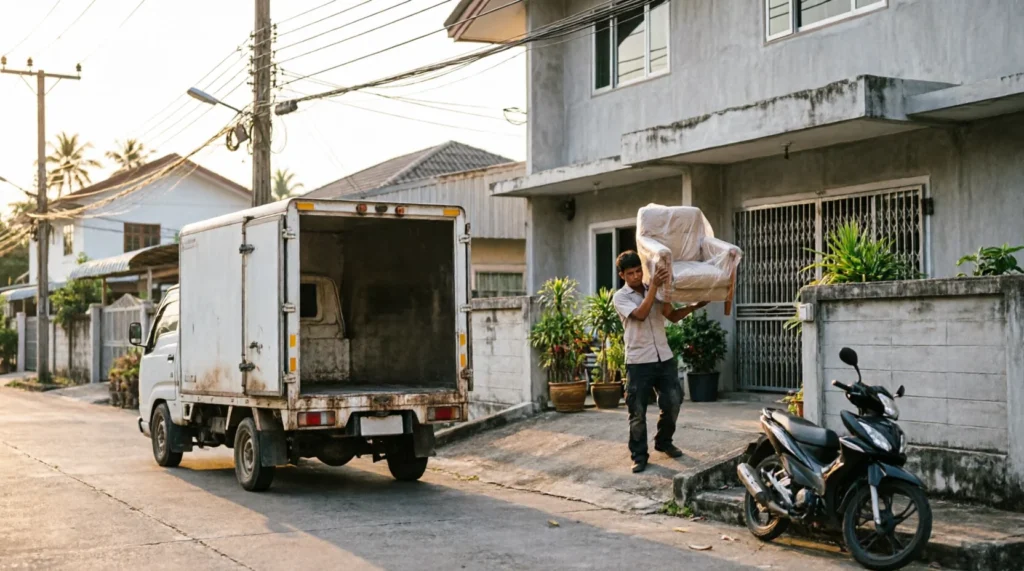
Once customs clearance is confirmed, your removals company arranges the final delivery leg. For Bangkok and surrounding areas (Nonthaburi, Pathum Thani, Samut Prakan), delivery typically happens within 1–3 days of customs release. For upcountry destinations (Chiang Mai, Hua Hin, Phuket), delivery takes 3–7 days and involves additional inland transport from Laem Chabang.
Island destinations (Koh Samui, Phuket via ferry, Koh Chang) add a ferry crossing leg that must be coordinated with the ferry schedule. This typically adds 1–2 days and handling costs for the ferry transit.
Bangkok apartment deliveries frequently encounter service lift restrictions. Building management may limit moving hours to weekday daytime only, and older buildings with small lifts may require furniture disassembly. Confirm these constraints with your building before packing day, not on delivery day.
The Full Timeline: End-to-End by Origin
Adding the stages together, here is the realistic end-to-end timeline from decision to goods delivered and unpacked in Thailand:
| Stage | Duration | Notes |
|---|---|---|
| Decision + research | 4–8 weeks | Visa category confirmed, departure range set |
| Visa application + approval | 10–14 weeks | The hard constraint: cannot be shortened below ~10 weeks from scratch |
| Removals company selection + survey | 2–4 weeks | Overlaps with visa stage |
| Pre-packing + documentation preparation | 4–8 weeks | Overlaps with visa stage |
| Packing day + collection to vessel departure | 2–3 weeks | Fixed schedule point |
| Ocean transit (Australia) | 2–3 weeks | 8–10 weeks from UK/Europe (Cape of Good Hope routing) |
| Port arrival + discharge queue | 1–5 days | |
| Customs clearance | 1–8 weeks | 1–3 weeks if documentation complete; 4–8 weeks if examined |
| Final delivery | 1–7 days | Longer for provincial or island destinations |
Total, Australia origin, best case (documents complete, no examination): 16–20 weeks from decision to delivered
Total, Australia origin, realistic case (some document delays, normal clearance): 20–26 weeks
Total, UK/Europe origin, best case: 32–38 weeks
Total, UK/Europe origin, realistic case: 38–48 weeks
These are the numbers that most moves should be planned to. Not the marketing headline figure (“3 weeks door to door”) which refers to ocean transit only and omits the stages at both ends.
The Five Points Where Thailand Moves Actually Break Down
Most Thai relocation timeline failures are not random. They concentrate at five predictable points:
1. Visa processing starts too late. The removals booking cannot be confirmed until the departure date is known. The departure date depends on the visa. Starting the visa process less than 14 weeks before the intended departure means the schedule is already compressed before anything else happens. Begin the visa process first, before any other logistics.
2. Goods arrive before the applicant enters Thailand. This is the customs sequencing error that costs the most. A shipment that arrives at Laem Chabang 2 weeks before the applicant’s visa entry date cannot be cleared under the personal effects concession until the applicant is present with a qualifying visa stamp. The goods accrue storage charges during that wait and the clearance timeline resets. Build a 2–4 week cushion between your visa entry date and your goods’ expected Laem Chabang arrival.
3. Packing list is inadequate. A packing list that lists “household goods” by category rather than by item is insufficient for Thai Customs. The broker cannot file a precise declaration without precise documentation. Either use a professional packing service (the crew’s detailed packing list is the documentation) or prepare your own item-by-item list before packing day. Do not expect the broker to accept a list created after packing. The document must match what is in the container.
4. Non-qualifying items are included without disclosure. New electronics, goods purchased within the past 12 months, multiple units of the same item, and commercial quantities are the most common causes of examination and duty liability. If you are unsure whether an item qualifies for duty-free import, declare it separately and let the customs broker advise. Do not assume inclusion. See the hidden costs of shipping to Thailand for a breakdown of what typically generates unexpected charges at Thai customs.
5. Upcountry delivery is not planned for. A shipment cleared at Laem Chabang still needs to travel from the port to Chiang Mai, Phuket, or Hua Hin. This inland leg is not automatically included in all removals quotes and is often priced separately. Confirm the delivery destination clearly in your contract and ask whether the inland transport is included or a separate charge.
Most people plan a move forward from today: book the shipper, then the visa, then hope customs cooperates. The families whose moves go smoothly do the opposite. They fix the one date that cannot move (the day their duty-free window opens against a qualifying status, or, for a retiree who has no such window, their visa entry date itself), and build the whole schedule backward from it. You will not fully see why that ordering matters until you are standing in a half-packed house realising the vessel sails in nine days. Set the immovable date first, and every other deadline falls into place behind it.

Planning Your Timeline: The Right Sequence
Working backward from your intended delivery date to Thailand:
- Set your intended Thailand entry date (the date you want to be in Thailand on your qualifying visa)
- Start visa preparation immediately (bank documentation, financial proofs, medical certificate if required) at minimum 16–20 weeks before that date
- Book your removals survey 12–14 weeks before your intended packing date (which will be approximately 6–10 weeks before your departure date, depending on transit time)
- Schedule packing day such that the vessel departure date gives an estimated Laem Chabang arrival 2–4 weeks after your intended Thailand entry date
- Prepare documentation (packing list, passport copies, visa confirmation) in the 4 weeks before packing day
- Enter Thailand on your qualifying visa, then monitor the shipment arrival
- Engage your customs broker (through your removals company) immediately upon visa entry, so they can file the declaration as soon as the goods are available
For the operational task sequence within each stage (which forms to prepare, which appointments to make, what to do about your lease, utilities, and banking), see the moving to Thailand checklist. The timeline and the checklist are complementary documents: this one tells you when; the checklist tells you what.
For Swift Cargo’s Thailand shipping process and to get an indicative quote for your shipment, see the Thailand shipping page.
Humans have been timing long migrations around external clocks for most of history: harvest seasons, monsoon winds, the opening and closing of mountain passes. A modern relocation to Thailand runs on the same basic principle, just with different clocks. The Thai customs duty-free window replaces the harvest deadline. The Cape shipping route’s transit time replaces the monsoon. The visa validity period replaces the mountain pass. None of these clocks care about each other, and none of them wait for you to catch up if one slips. What hasn’t changed is the underlying challenge: sequencing scarce windows against each other. What has changed is that today’s movers have the data to see all the clocks in advance, instead of discovering mid-journey that two of them just closed at once.
Frequently Asked Questions
How long does moving to Thailand take from start to finish?
The minimum realistic timeline from decision to settled in Thailand is approximately 16–20 weeks for an Australian or New Zealand origin. UK and European moves take 32–40 weeks due to longer ocean transit (8–10 weeks vs 2–3 weeks for Australia, reflecting the Cape of Good Hope routing standard since 2024). The hard constraint at the front end is visa processing. Allow 10–14 weeks for a Non-Immigrant O visa with a retirement extension. At the destination end, Thai customs clearance adds 2–6 weeks depending on documentation quality and examination risk.
Do my household goods need to arrive before or after I enter Thailand?
Your goods should arrive after your visa entry date, not before. Thai Customs’ personal effects duty-free concession requires the applicant to have already entered Thailand on a qualifying status. Two separate things go wrong here. Sequencing: goods reaching Laem Chabang before you have entered cannot be cleared under the concession. Eligibility: a Non-O or retirement visa is not a qualifying status at all, so a retiree’s shipment attracts import duty and 7% VAT however well it is sequenced. For those who do qualify, the safest sequencing is to enter Thailand first, then allow the shipment to arrive 1–4 weeks after your entry date.
How early should I book a removals company for a Thailand move?
Book your removals company at least 10–14 weeks before your intended packing date. The survey visit (which determines your final quote and container size) takes 1–2 weeks to arrange; packing and collection is typically scheduled 2–4 weeks after the survey; and ocean transit to Thailand takes 2–7 weeks depending on origin. The bottleneck that catches most movers is not the removals booking but the visa processing timeline. You cannot confirm your packing date until you know your travel date, which depends on visa approval.
What is the 6-month rule for importing household goods to Thailand?
Under Thai Customs regulations, the personal effects duty-free concession requires goods to have been owned and used by the applicant for at least 12 months before the move, and the application for duty-free clearance must be made within 6 months of the applicant’s first entry into Thailand on a qualifying status. If your goods arrive after this 6-month window has closed, you lose the duty-free concession and pay full import duty on household effects, which can be substantial, particularly on electronics and furniture. The 6-month rule only reaches importers whose status qualifies in the first place. A retirement visa holder has no window to miss, because the concession was never open to them.
How long does Thai customs clearance take for household goods?
Thai customs clearance for personal effects takes 1–3 weeks when documentation is complete and correct: a stamped packing list, a copy of your passport with visa entry stamp, and the duty-free exemption application (Bor Sor 1 form). If documentation is incomplete, if items on the packing list do not match physical contents, or if Thai Customs selects the container for physical examination, clearance can extend to 4–8 weeks. Containers selected for examination at Laem Chabang face an additional 1–3 week delay for the physical inspection process.