
Vietnam has become one of Australia’s most significant sourcing markets over the past decade. Textiles and apparel, furniture, footwear, electronics, and seafood are among the product categories where Vietnamese manufacturers have built substantial export capacity, and Australian importers have responded with a rapid shift in sourcing away from China toward Vietnamese suppliers in many of those categories. Importing from Vietnam to Australia rewards that shift with 0% duty on most goods, but only with valid proof of origin for each shipment, usually a Form AANZ (RCEP origin also qualifies).
The trade relationship is supported by a genuine tariff advantage under the ASEAN-Australia-New Zealand Free Trade Agreement (AANZFTA), which brings most Vietnamese-origin goods to zero or near-zero import duty when properly documented. But the compliance requirements (particularly for timber products, food items, and biological materials) are specific to Vietnam’s risk profile and can catch importers who approach Vietnam sourcing as though it were identical to China sourcing.

What Australia Imports from Vietnam
According to Austrade trade data, the major categories of Australian imports from Vietnam include:
- Textiles and apparel: garments, footwear, handbags, and accessories: Vietnam is one of the world’s top three garment exporters and a primary sourcing market for Australian fashion retailers
- Furniture and home goods: timber furniture, upholstered furniture, rattan and bamboo products: Vietnamese furniture manufacturing has expanded significantly since the 2010s
- Electronics and electrical goods: consumer electronics, components, and electrical equipment: driven partly by Samsung, Intel, and LG manufacturing operations in Vietnam
- Seafood: shrimp, pangasius, tuna, and other processed seafood products
- Agricultural products: coffee, pepper, cashews, rice, and processed food products
- Machinery and equipment: industrial machinery, tools, and mechanical parts
The product category matters for compliance purposes: furniture and timber products carry specific DAFF biosecurity requirements; electronics require ACMA compliance; food and seafood require DAFF import permits and biosecurity conditions.
AANZFTA: The Tariff Advantage and How to Claim It
The ASEAN-Australia-New Zealand Free Trade Agreement, administered by DFAT, provides preferential tariff rates for goods originating in ASEAN member states, including Vietnam. For most product categories, AANZFTA brings Australian import duty to 0%.
To claim the AANZFTA preferential rate, the importer must hold a valid certificate of origin (Form AANZ) for each shipment. The Form AANZ must be:
- Issued by an authorised body in Vietnam: the Ministry of Industry and Trade (MoIT) or an organisation authorised by a provincial people’s committee (Circular 40/2025/TT-BCT, effective 1 July 2025)
- Completed accurately with the correct HS code, origin criteria, and value declaration
- Held by the importer when the goods are imported, and produced to ABF on request, at the time of import or later
The AANZFTA rules of origin require goods to satisfy one of several criteria, the most common being: wholly obtained in Vietnam (for agricultural products), or manufactured in Vietnam with regional value content of at least 40% of FOB value or a change in tariff heading (for manufactured goods, unless a product-specific rule applies). The certificate of origin is the supplier’s declaration that the goods meet the applicable criteria, and the importer is responsible for ensuring that the certificate is correct and held on file.
What happens without a certificate: Without a valid AANZFTA Form AANZ, you pay Australia’s general tariff rate: typically 5% for most manufactured goods. On a AUD 200,000 annual import program, the AANZFTA saving is AUD 10,000 per year. Establishing the certificate of origin as a non-negotiable document requirement from the first order is straightforward; attempting to backfill it for historical shipments is significantly more complex.
Exporter Declaration of Origin: Under AANZFTA, an approved exporter authorised by Vietnam’s competent authority can issue a Declaration of Origin instead of a certificate. This can simplify the documentation process for established supplier relationships. Ask your forwarder whether your supplier qualifies.
Trusted Trader waiver: since 1 October 2025, importers accredited under the ABF’s Australian Trusted Trader programme do not have to obtain or present an AANZFTA certificate of origin to claim the preferential rate (Australian Customs Notice 2025/28). They must still keep evidence that the goods meet the rules of origin for at least five years from the day of importation and produce it if ABF asks. The notice lists the proof of the last place of manufacture, commercial documents and contracts, statements on the manufacturing process, and materials and cost evidence from manufacturers as examples.
Freight Routes and Realistic Transit Times
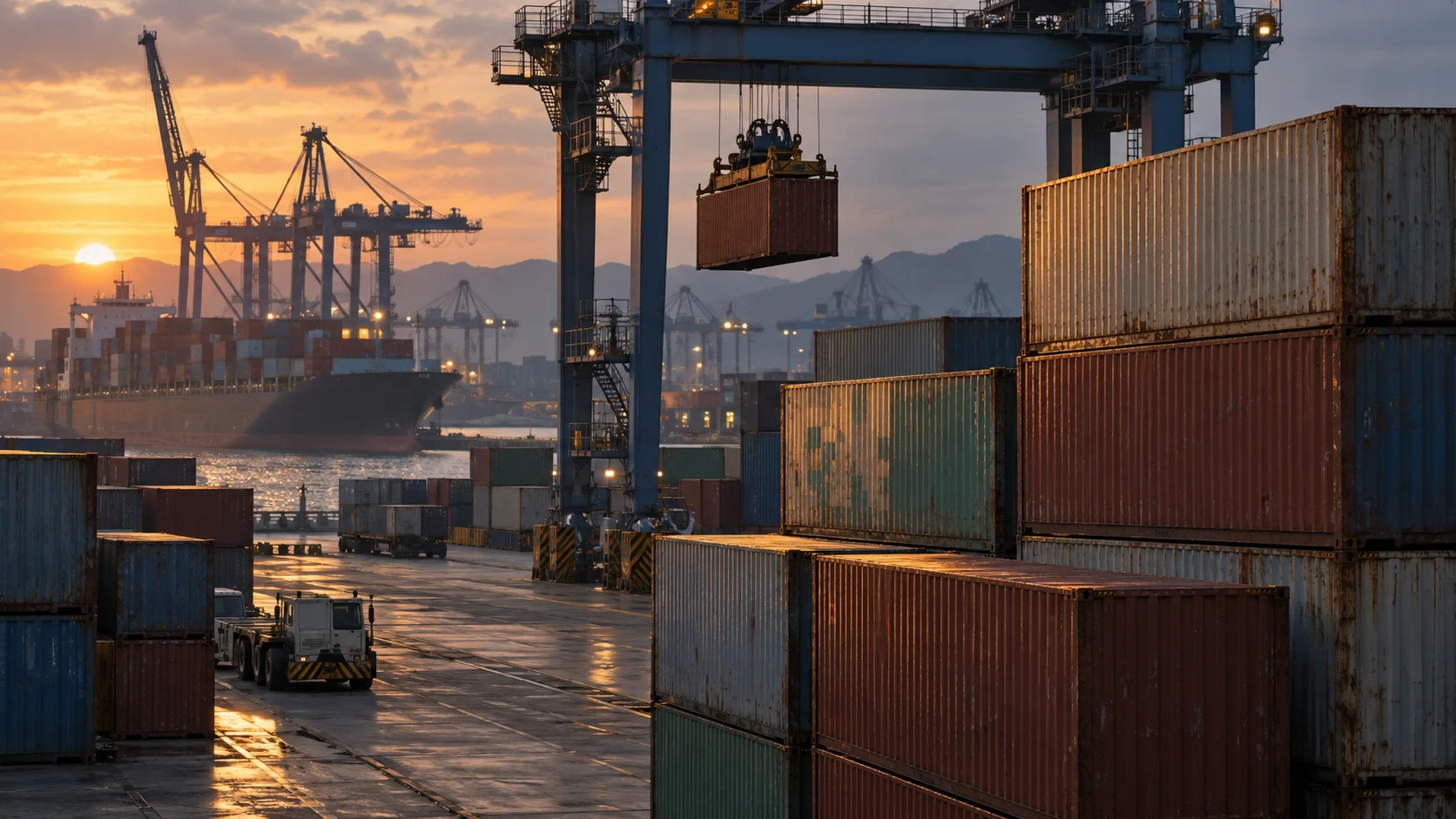
Vietnam has two major export port clusters. The choice of which port your goods ship from affects your transit time and, for LCL shipments, your consolidation schedule.
Southern Vietnam, Ho Chi Minh City (Cat Lai port): The primary export gateway for goods manufactured in the southern industrial provinces (Binh Duong, Dong Nai, Long An). Most furniture, garments, and electronics for export ship from Cat Lai.
Northern Vietnam, Hai Phong (Lach Huyen terminal): The primary gateway for goods from Hanoi and the northern industrial belt, including Samsung’s major manufacturing facilities. Samsung-produced electronics and goods from Bac Ninh and Bac Giang provinces typically ship through Hai Phong.
Transit times (vessel leg only, port to port):
| Origin Port | Sydney | Melbourne | Brisbane | Perth |
|---|---|---|---|---|
| Ho Chi Minh City (Cat Lai) | 18–24 days | 20–26 days | 16–22 days | 14–20 days |
| Hai Phong | 21–28 days | 23–30 days | 19–26 days | 17–24 days |
These are direct sailing estimates. Many Vietnam-Australia services include a transshipment call at Singapore, Port Klang (Malaysia), or Hong Kong, which can add 3–7 days to transit time and introduce a transshipment risk point. Ask your forwarder whether your booking is direct or transshipped and factor the appropriate transit range into your lead time planning.
For total supply chain lead time from purchase order to goods in your Australian warehouse, add: production lead time (14–60 days depending on product complexity and order size), origin LCL consolidation if applicable (5–10 days), Australian port arrival to customs release (3–7 days standard, 14–28 days if examination triggered). See the supplier-to-warehouse chain guide for the full nine-stage breakdown.
DAFF Biosecurity Requirements for Vietnamese Products
Vietnam’s tropical climate and diverse agricultural base mean that DAFF biosecurity requirements for Vietnamese-origin goods are extensive. The categories requiring specific attention:
Timber and Timber Products (Including Furniture)
Vietnam is a significant timber furniture exporter, and a significant source of biosecurity risk for timber products. DAFF classifies Vietnam as a high-risk source country for several wood-boring insects and timber diseases. Requirements for timber and timber products from Vietnam include:
- ISPM 15 treatment for all timber packaging material (pallets, crates, dunnage): heat treatment to 56°C for 30 minutes throughout the wood, or methyl bromide fumigation to ISPM 15 specifications, with an IPPC-compliant mark on all timber packaging
- Treatment certificate for solid wood furniture: a certificate from a DAFF-approved treatment provider in Vietnam confirming the treatment method, temperature/time record, and the specific consignment it applies to
- Phytosanitary certificate: issued by Vietnam’s Plant Protection Department for regulated plant products, required for unprocessed timber, rattan, and bamboo products
DAFF applies a high inspection rate to timber furniture from Vietnam. Consignments that arrive without treatment certificates, or where the IPPC mark is absent from timber packaging, are held for treatment or directed for re-export.

Food and Agricultural Products
Vietnamese food products (seafood, fruit and vegetables, processed foods, coffee, spices) require DAFF import permits and biosecurity conditions specific to each product category. The DAFF BICON database (Biosecurity Import Conditions) is the authoritative source for current conditions for any specific product. Key categories:
- Seafood: most processed seafood (cooked, canned, commercially sterile) can be imported without an import permit; raw or minimally processed seafood requires an import permit and biosecurity conditions
- Coffee: roasted and green (unroasted) coffee beans do not need an import permit, and only commercial roasted kopi luwak does; check the BICON coffee case for the conditions
- Spices: most processed spices are permitted; fresh or minimally processed plant material requires an import permit
- Fruit and vegetables: fresh produce can be imported only where BICON lists conditions for that commodity from Vietnam; a commodity with no listing cannot enter until DAFF completes a risk analysis
Electronics and Electrical Products
Electronics from Vietnam do not carry specific DAFF biosecurity requirements, but must meet ACMA (Australian Communications and Media Authority) compliance standards for electromagnetic compatibility and electrical safety. Most consumer electronics must carry the RCM (Regulatory Compliance Mark) before being sold in Australia. The RCM mark depends on showing compliance with Australian/New Zealand standards, which may differ from the IEC or CE standards your Vietnamese supplier’s products are manufactured to, and ACMA requires test reports for higher-risk equipment (an accredited testing body for its highest compliance level). Verify compliance testing status before placing orders.
Vietnamese Supplier Qualification
Vietnam’s manufacturing sector spans a wide quality range: from globally certified facilities supplying major international brands to small-scale workshops with inconsistent output. The gap between a factory’s sample quality and its production run quality can be significant, and the systems for managing that gap are less mature in Vietnam than in China’s more established export manufacturing base.
A practical qualification process for Vietnamese suppliers:
Step 1: Business registration verification. Vietnam’s National Business Registration Portal lets you verify a supplier’s business licence, registered address, and legal representative. A supplier that is reluctant to provide their business registration number is not a supplier you should rely on.
Step 2: Factory audit. For first-time suppliers and orders above AUD 20,000, an independent factory audit is cost-justified. Third-party audit firms including Bureau Veritas, SGS, and Intertek operate throughout Vietnam’s industrial provinces. An audit confirms that the factory exists as described, has the capacity and equipment claimed, and meets the relevant quality and ethical standards. A video walk-through is an acceptable substitute only for very small, low-risk first orders.
Step 3: Reference check. Ask the supplier for references from Australian or other English-speaking importers currently buying from them. Contact those importers and ask specifically about documentation quality, on-time production, and how the supplier handles quality disputes.
Step 4: Pre-shipment inspection on first orders. A pre-shipment inspection (PSI) by an independent inspector at the factory, before goods are packed and sealed, verifies quality before the goods are loaded, which is when risk passes to you under FOB terms. PSI costs USD 200–400 per inspection day: modest relative to the cost of receiving a non-conforming production run. The inspection report also gives you documented evidence of condition at origin if a dispute arises about damage in transit.
For how supplier qualification feeds into the total chain management from factory to Australian warehouse, see the import chain management guide.
Payment Terms and Currency Risk with Vietnamese Suppliers
Most Vietnamese manufacturers quote in USD, which introduces currency risk for Australian importers paying in AUD. The AUD/USD exchange rate has historically ranged between 0.60 and 0.80, meaning a USD 50,000 order costs about AUD 83,300 at 0.60 and AUD 62,500 at 0.80, a swing of about AUD 20,800 depending on when payment is made.
New importers typically start on 100% T/T (telegraphic transfer) before production begins: the supplier’s preferred arrangement because it eliminates their credit risk entirely. This is appropriate for first orders where the relationship is unproven, but it means your capital is at risk if the supplier fails to deliver.
As the relationship matures, 30% deposit before production and 70% against copy bill of lading documents is a more balanced arrangement: the supplier has a deposit commitment before production, and you retain 70% of the order value until you have proof of shipment. This also reduces currency risk: you hedge or convert 30% at deposit stage and 70% at shipment, spreading the conversion across two market points rather than one.
Letters of Credit (L/C) provide the strongest buyer protection for larger orders: the bank only releases payment to the supplier when compliant shipping documents are presented, but carry bank fees of 1–2% of the L/C value and require the supplier to have a bank willing to handle the L/C. Many small Vietnamese manufacturers cannot efficiently handle L/C documentation, which limits its practical use to larger, more established suppliers.
Currency hedging through a forward contract (fixing the AUD/USD rate today for payment 60–90 days forward) removes exchange rate uncertainty from the landed cost calculation. For importers with annual Vietnam purchase volumes above AUD 500,000, forward contracts are worth discussing with your bank or a foreign exchange provider. For smaller volumes, using a currency exchange service (rather than your bank’s spot rate) captures the spread difference without the commitment of a formal hedge.

Quality Control Systems for Vietnamese Manufacturing
Quality consistency is the most frequently cited challenge for Australian importers sourcing from Vietnam, particularly from smaller factories. The same factory that delivers an excellent sample may produce a first production run with 8% defects, then a second run with 2%, then a third with 12%: not because quality has deteriorated, but because it was never systematically controlled in the first place.
Building a quality control system that works across the supply chain (without visiting Vietnam for every order) requires specific structural elements:
Written quality specifications in the purchase order. “Same as sample” is not a specification. A purchase order quality annex that defines acceptable colour variance, dimensional tolerances, defect categories (critical, major, minor), and AQL (Acceptable Quality Level) sampling parameters gives the supplier a measurable standard and gives you a basis for rejecting non-conforming goods.
In-line inspections for longer production runs. A pre-shipment inspection (PSI) at 100% production completion catches defects after they are made. An in-line inspection at 30–40% production completion catches process failures early enough to correct them within the production run. For orders above AUD 30,000, in-line inspection is cost-effective even at USD 400 per inspection day: the cost of correcting a defect in the factory is a fraction of the cost of receiving a non-conforming shipment in Australia.
Photo documentation protocol. Require the supplier to send 15–20 photos of packed goods before the container is sealed: carton construction, labelling accuracy, packing list verification against physical count, and ISPM 15 marks on timber packaging. This does not replace physical inspection but catches the most common documentation and packaging failures before the container leaves.
Defect resolution procedure defined in advance. Agree in the purchase order what happens if a non-conforming shipment arrives in Australia: credit against the next order, replacement in the next production run, or financial compensation calculated by defect category.

Common Compliance Problems on the Vietnam-Australia Lane
The most frequently occurring compliance issues on Vietnam-Australia shipments, based on what triggers ABF examination, DAFF holds, and customs disputes:
Certificate of origin missing, expired, or incorrectly issued. The AANZFTA Form AANZ has specific requirements: correct HS code, accurate origin criteria, issuing authority signature and stamp. A certificate for the wrong HS code, or without the correct authorisation, is rejected, and the general tariff rate applies. Retroactive issue is allowed in limited cases (Form AANZ has an “issued retroactively” box under Rule 11 of the operational certification procedures), so a late certificate is not always lost. Even so, establish a pre-shipment documentation checklist that requires the certificate before the vessel departs, not after arrival.
ISPM 15 non-compliance on timber packaging. Vietnamese factories sometimes use timber packaging that has not been treated to ISPM 15 standard or lacks the IPPC mark. The importer discovers this at the Australian port when DAFF holds the consignment. Treatment post-arrival (heat treatment or fumigation at an approved Australian facility) costs AUD 800–2,500 depending on the shipment size, plus storage charges during the hold. Specifying ISPM 15 compliance in the purchase order, and verifying the IPPC mark is present on pre-shipment photos, prevents this.
Invoice value understatement. Some Vietnamese suppliers offer to understate the invoice value to reduce the importer’s customs duty liability. This is fraud under Australian customs law and creates personal criminal liability for the importer, not just the supplier. ABF has specific tools for detecting undervaluation, including reference pricing databases for common product categories. The duty saving is not worth the risk; insist on accurate invoicing at the transaction value.
Misdeclared HS classification. Incorrect tariff classification is the most common cause of post-clearance ABF audits on the Vietnam lane. Products in categories with higher duty rates (footwear, textiles, certain food products) are occasionally declared under a lower-rate HS code either through error or intent. The correct classification is determined by the product’s composition and use, not by what the supplier wrote on the invoice. Your customs broker should classify the product independently, not simply transcribe the supplier’s description.
Documentary discrepancies between commercial invoice, packing list, and bill of lading. A commercial invoice that lists 500 units and a packing list that lists 480 units creates an ABF discrepancy flag. Require a pre-shipment photo package showing the sealed cartons, packing list, and carton count before the container is sealed.
For the documentation standards that prevent customs delays, see the Incoterms and import compliance guide for how Incoterm selection affects which documentation obligations fall on the seller versus the buyer.
For Swift Cargo’s Vietnam-to-Australia freight services, including LCL and FCL options from Ho Chi Minh City and Hai Phong, see the Australia freight page.
A Checklist for Importing from Vietnam to Australia
Hold a valid Form AANZ for every shipment, confirm ISPM 15 treatment and IPPC marks on timber packaging, and check BICON before ordering food or other regulated goods. Book a pre-shipment inspection on first orders, at USD 200 to 400 per inspection day, and plan 18 to 24 days of vessel transit from Ho Chi Minh City to Sydney before adding clearance time.
Frequently Asked Questions
What are the import duty rates from Vietnam to Australia?
Under AANZFTA, most Vietnamese-origin goods qualify for preferential rates from 0% to 5%, with many categories at 0%. To claim the AANZFTA rate, you need a valid Form AANZ certificate of origin issued by an authorised Vietnamese issuing body or a Declaration of Origin from an approved exporter. Without the certificate, you pay the general tariff rate of 5% on most manufactured goods.
How long does shipping from Vietnam to Australia take?
From Ho Chi Minh City: Sydney 18–24 days, Melbourne 20–26 days, Brisbane 16–22 days, Perth 14–20 days. From Hai Phong: add 2–4 days on most routes. These are vessel transit times only: add production lead time, LCL consolidation (5–10 days), and Australian customs clearance (3–7 days) for total supply chain lead time.
Does Vietnam furniture need to be fumigated before importing to Australia?
Solid wood furniture and timber products from Vietnam must meet DAFF biosecurity requirements including ISPM 15 treatment for all timber packaging material and a treatment certificate from a DAFF-approved provider for solid wood furniture. Vietnam is classified as a high-risk source for timber pests. DAFF applies a high inspection rate to timber furniture consignments from Vietnam.
What are the most common compliance problems when importing from Vietnam?
The most common problems are: certificate of origin missing or incorrectly issued (AANZFTA rate lost); ISPM 15 timber packaging non-compliance (consignment held for treatment); DAFF import permit not obtained for regulated goods; documentary discrepancies between invoice, packing list, and bill of lading; and misdeclared HS classification triggering ABF examination or post-clearance audit.
How do I verify a Vietnamese supplier before placing a production order?
Four steps: verify business registration through Vietnam’s National Business Registration Portal; commission an independent factory audit (Bureau Veritas, SGS, or Intertek operate across Vietnam’s industrial provinces); check references from other Australian importers they supply; and conduct a pre-shipment inspection on first and second orders. PSI costs USD 200–400 per inspection day: modest relative to the cost of a non-conforming production run.