
Kitchenware looks like an easy category from a distance. No electrical compliance, no quarantine drama for most of it, five per cent duty at worst, and a supplier base in China and Southeast Asia so deep you can source a full dinnerware range from a single trade fair aisle. Then the first container arrives with eleven per cent of the bowls chipped, a customer emails asking whether the glaze on your bargain stoneware contains lead, and you discover your breakage insurance excludes, of all things, breakage.
The Food-Contact Safety Landscape: No Gatekeeper, Full Liability
The thing that surprises importers coming from the US or European markets: Australia has no single mandatory pre-market approval regime for food-contact articles. There is no Australian equivalent of the US FDA’s food-contact substance notification pathway, and no direct counterpart to the EU’s framework regulation on materials intended to contact food. Nobody stamps your dinnerware “approved” before it can be sold.
That absence is not a free pass. It is the opposite. The Australian Consumer Law applies in full to every plate, tumbler and spatula you sell. Goods must be of acceptable quality, safe for their ordinary use, and match every claim on the packaging. When there is no regulator pre-approving your product, the entire compliance burden sits with you, the importer. It surfaces after the fact, when something goes wrong, through the ACCC, a state fair trading office, or a personal injury claim. A US importer can sometimes point to an FDA pathway as evidence of diligence. An Australian importer pointing at nothing has nothing.
Within that general framework, specific instruments do exist. The most important for this category are the limits on lead and cadmium release from glazed ceramic ware: the migration of heavy metals from glaze into food, tested by acid-extraction methods. For plastics in contact with food, AS 2070 is the relevant Standards Australia framework; it is not mandatory in the way an electrical safety standard is, but it is the benchmark a court or regulator will reach for when asking whether your plastic containers were fit for purpose. Standards Australia publications are voluntary until a regulation calls them up. And “voluntary” stops mattering the moment someone is harmed and the question becomes what a reasonably careful importer would have done.
The Ceramic Glaze Problem, Specifically
Glaze is glass: a silica melt fluxed with metal oxides so it fuses at kiln temperature and grips the clay body. Done properly, the metals are locked into the vitrified matrix and stay there. Done cheaply (glaze underfired to save fuel, lead-fluxed frits used because they melt low and give brilliant colour, decoration applied over the glaze instead of under it), the matrix is incomplete, and acidic food will pull heavy metals out of it. Tomato sauce, vinegar-dressed salads, citrus, wine: everyday Australian food is an extraction solvent for bad glaze.
The failure mode is invisible. A leaching plate looks identical to a safe one. Colour is no guide (though heavily decorated ware, especially with on-glaze decals in reds and oranges, is statistically higher risk). Country of origin is no guide either: Chaozhou and Jingdezhen produce some of the best-controlled glaze chemistry in the world and some of the worst, sometimes in factories a street apart.
The answer is testing, and it is cheap. A lead/cadmium migration test on representative samples from a NATA-accredited lab in Australia, or an ILAC-recognised lab near your supplier, typically runs AUD 250–600 per product line. On a 2,000-piece order that is under 30 cents a piece. Against the cost of a recall, a fair trading investigation, or one injured customer, it is the cheapest insurance you will ever buy. The rule of thumb: any glazed ceramic from a factory you have not personally vetted gets tested before the production run ships. Ask for the test on your production glaze batch, not a year-old certificate for a different SKU: certificates recycle around trading companies with remarkable fluidity.
Category by Category: What Each Material Wants From You
Ceramics and Porcelain
Beyond glaze testing, two things matter commercially. First, chip resistance. Vitrified porcelain fired above 1300°C is a different material from stoneware at 1200°C or earthenware at 1050°C: porosity, edge strength and thermal shock tolerance all track firing temperature and body composition. Hospitality buyers know this and will ask; if you are selling into cafés, an edge-chipping grade from the factory (many use impact-test protocols borrowed from hotel-ware specs) is worth having on file.
Second, the handmade-versus-factory tension for boutique importers. Hand-thrown, hand-glazed ware from small workshops is exactly what the premium homewares market wants, and exactly where glaze control is weakest, because small workshops mix glazes in buckets rather than batching from certified frits. If your brand story is “artisan,” your testing budget needs to be bigger, not smaller, and you should test per glaze colour, not per shape.
Glassware
The distinction that matters is tempered versus annealed. Annealed glass (most stemware and decorative pieces) is slowly cooled and breaks into shards. Tempered glass is rapidly quenched so the surface is in compression; it is several times stronger, tolerates thermal shock, and dices into granules when it does fail. Suppliers will describe almost anything as “toughened.” If your listing says heat-resistant, thermal-shock-proof, or safe for boiling water, that is a claim under the ACL and it needs substantiation: a factory test report against a recognised thermal shock protocol, at minimum. A tumbler that shatters when someone pours tea into it is both an injury and a misleading-conduct case in one incident.
Cookware
Nonstick is a claims minefield. “PFOA-free” is technically true of virtually all current production (PFOA was phased out of PTFE manufacture years ago), which means the claim is simultaneously accurate and capable of misleading, if presented to imply the pan is free of all fluoropolymers or somehow chemically inert. The ACCC has form on environmental and health claims that are literally true but create a false overall impression. Say what the coating is, accurately, and keep the supplier’s material declaration on file.
Induction compatibility is the other one. Induction needs a ferromagnetic base; an aluminium pan needs a bonded steel plate, and a thin or poorly bonded plate heats unevenly and can delaminate. “Induction compatible” on the box is a performance claim. Test it on an actual induction hob (a $40 portable unit in your warehouse settles it) before the artwork goes to print.
Knives
Ordinary kitchen knives face no import restriction: chef’s knives, santokus, cleavers, paring knives all clear without permits. But state weapon laws and the Commonwealth prohibited imports list touch the edges of the category. Flick knives (automatic opening) and butterfly knives are prohibited imports full stop, and the definitions are mechanical, not marketing-based: a “kitchen” knife with an assisted-opening mechanism can fall inside them. Push daggers, concealed blades and some disguised knives are similarly caught. The practical rule: plain fixed blades and conventional folders are fine; anything with a spring, a gravity mechanism or a novelty concealment feature gets checked against the Australian Border Force prohibited imports material before you place the order, not after seizure.
Plastics and Melamine
Melamine tableware is durable, cheap and everywhere in the café and kids’ segments. Its known weakness is chemistry at temperature: melamine-formaldehyde resin releases measurable melamine and formaldehyde into hot, acidic food, which is why it is not microwave-safe and why migration testing at realistic temperatures matters more than room-temperature results.
The bamboo-melamine composite deserves its own warning. Cups and bowls marketed as “bamboo fibre” are usually bamboo dust bonded in melamine resin, and the composite migrates worse than plain melamine, because the filler disrupts the resin matrix. European authorities pulled large numbers of these products from the market, and several jurisdictions concluded the material combination is simply not authorised for food contact. Australia has no equivalent pre-market rule, but importing a product other sophisticated regulators are actively removing is a poor bet under the ACL’s acceptable-quality guarantee. Separately, calling a product that is mostly melamine resin “bamboo,” “natural” or “eco-friendly” is greenwashing, and greenwashing is an active ACCC enforcement priority. Describe the material honestly or pick a different product.
Wooden Boards and Utensils
Timber is where kitchenware brushes against biosecurity. Wooden articles are subject to assessment by the Department of Agriculture, Fisheries and Forestry on arrival: bark, insect holes, or evidence of borers can trigger treatment or destruction. Buy from suppliers who kiln-dry properly and can document it; acacia and rubberwood from established Vietnamese and Thai factories generally arrive clean, while rustic “live edge” pieces with bark inclusions are asking for an inspection hold. And remember the packaging itself: pallets and dunnage must be ISPM 15 treated and stamped, or the whole consignment sits at the wharf.
On finish: oiled boards (food-grade mineral oil or hardened plant oils) ship better and present better than raw timber, which can check and crack as moisture content swings between a humid factory and a dry container crossing the equator. Raw-finish boards should be shipped at 8–12 per cent moisture content with desiccant in the cartons; ask for the moisture reading, because a supplier who cannot give you one is not measuring it.
Fragility Freight Engineering: Getting Ceramics Here Intact
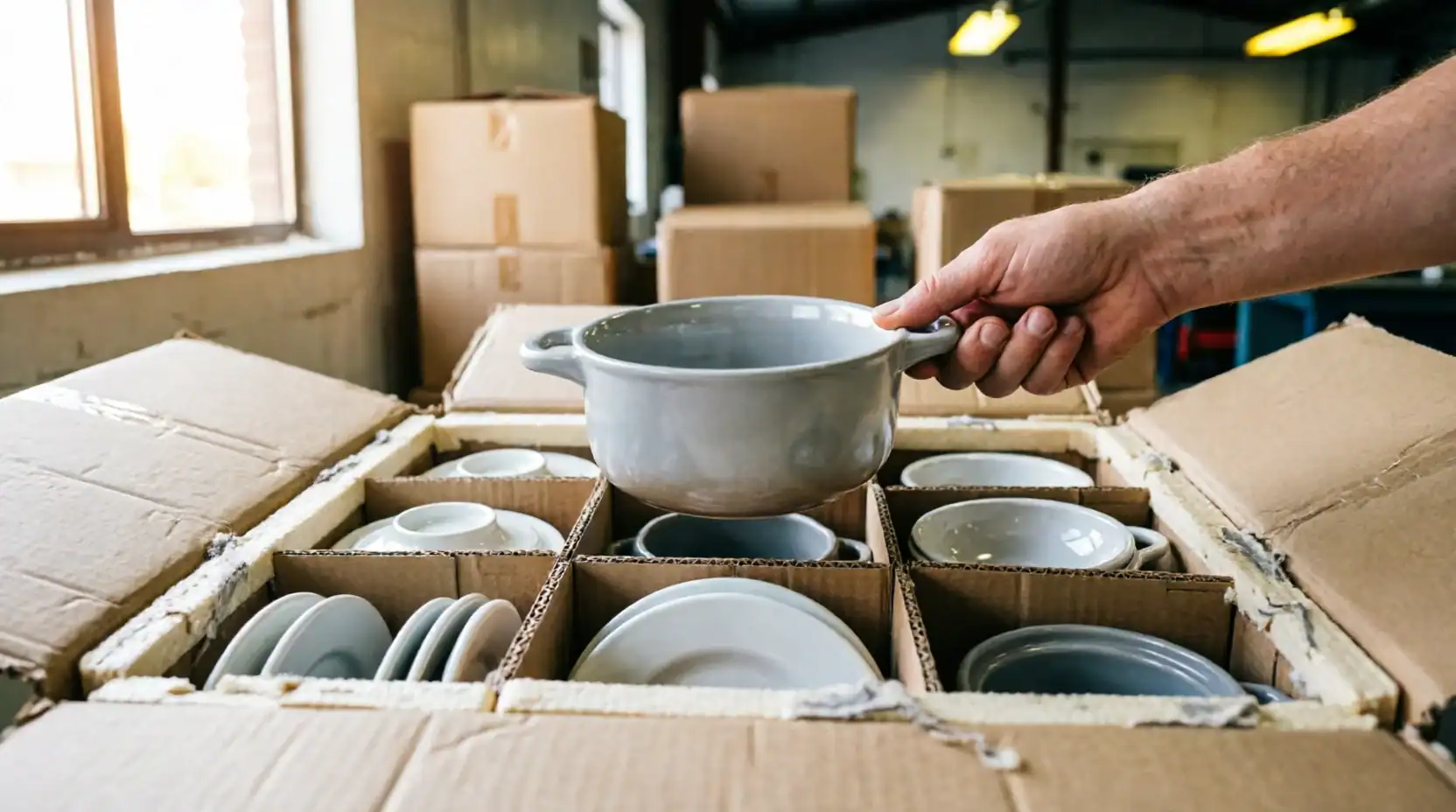
Now the freight problem. Ceramic dinnerware fails in transit through three mechanisms: edge-to-edge contact inside the carton (chipping), carton crush in the stack (fracture under compression), and shock at handling points (drop breakage). Each has a specific engineering answer, and none of them is “more bubble wrap.”
Compartmentalised cartons. Every piece in its own cell. Corrugated cell dividers between plates, foam or pulp interleaving in bowl nests, and nothing, nothing, packed loose to “fill space.” A 16-piece dinner set should arrive in a carton where no ceramic surface can touch another ceramic surface no matter how the carton is oriented. This is the single biggest determinant of breakage rates.
Edge protection and stacking strength. Double-wall outers as a minimum for sea freight, edge boards on palletised stacks, and a stated stacking limit the factory actually honours. A carton engineered for a two-high stack in a domestic Chinese truck will sit seven-high in a container for four weeks with humidity cycling that halves corrugated board strength. This is why the supplier’s domestic packaging is not export packaging, ever. Ask explicitly: “Is this your export spec or your domestic spec?” and get the answer in writing on the PI.
Drop-test a sample carton. Before the production run ships, have the factory pack one carton exactly to the agreed export spec and courier it to you. Then drop it: flat, edge and corner, from roughly 76 cm, which approximates real handling abuse. Open it and count. Fifteen minutes and one sacrificial dinner set will tell you more than any packaging datasheet. If the sample arrives damaged just from the courier journey, you have learned something even cheaper.
Stow position. For LCL especially, ask your forwarder to request stowage away from the container door end (where cargo shifts hit first) and off the top tier of heavy mixed stow. It is a request, not a guarantee, but forwarders who consolidate their own boxes can and do honour fragile-stow requests, and it costs nothing to ask. Marking cartons with fragile and this-way-up symbols is worth doing; it will be ignored sometimes, and respected sometimes, and you want the sometimes.
Insurance: Read the Breakage Exclusion Before You Need It
Marine cargo insurance has two traps for ceramics importers. First, many policies covering fragile goods carry a breakage exclusion or a punitive fragile-goods excess unless breakage cover is specifically bought back. An Institute Cargo Clauses (A) policy sounds like “all risks,” but breakage of brittle goods is commonly excluded or excess-loaded unless declared, and the premium loading for proper breakage cover on ceramics is entirely worth paying. Declare the commodity honestly at placement; insurers decline claims where the cargo was described as “homewares” and turned out to be porcelain.
Second, general average. If the vessel suffers a casualty and general average is declared, every cargo owner contributes to the loss whether their own cargo was touched or not, and uninsured importers must post a cash bond before their container is released. Insurance handles the guarantee for you. It is a once-a-decade event that is catastrophic exactly once.
For claims, documentation discipline decides outcomes. Photograph damaged cartons before unpacking, keep the damaged goods until the surveyor releases them, count per carton against the packing list, and lodge notice within the policy’s time limit (often three days for concealed damage). A claim supported by “carton 47 of 120: 6 of 16 pieces fractured, photos attached” gets paid; “a bunch of plates broke” gets argued.
Quantity Economics: Why Kitchenware Is an LCL-Friendly Category
Kitchenware is mid-density cargo. Ceramic dinnerware runs around 250–350 kg per cubic metre packed; cookware similar; glassware a little lighter for the volume; melamine lighter again. That means neither the weight limits nor the volume limits of a container bind first in an awkward way: you pay for space roughly in proportion to what you are shipping, which makes LCL genuinely economic at small order sizes rather than merely tolerable.
Typical CBM profiles: a 2,000-piece dinnerware order (say 125 sixteen-piece sets) packs to roughly 8–10 CBM depending on carton design. A starter cookware range of 500 boxed sets might be 6–7 CBM. Both sit comfortably in LCL territory, where the breakeven against a 20-foot container is usually somewhere around 13–15 CBM once you account for LCL’s per-CBM handling fees at both ends. Below that, ship LCL and spend the savings on packaging and testing; above it, take the box: a full container also means your fragile cargo travels alone, untouched by consolidation handling, which quietly cuts breakage rates too.
Labelling and Claims: The Cheap Compliance Layer
Country of origin marking must be accurate: “Made in China” where it is made in China, and no Australiana trade dress that implies otherwise. Care instructions are your warranty-cost control: if stoneware should not go from freezer to oven, say so. And treat every convenience claim as a testable assertion, because under the ACL it is one. “Dishwasher safe” means the decoration survives a few hundred domestic dishwasher cycles without fading. There are standard test protocols, and factories can run them. The difference between on-glaze decoration (sits on the surface, dies in the dishwasher) and in-glaze or underglaze decoration (protected, durable) is exactly the kind of thing to specify at ordering time. “Microwave safe” means no metallic decoration and a body that does not superheat. Untested claims are deferred liabilities with your brand name on them.
Duty and FTA Treatment
Most kitchenware classifies across a familiar spread of tariff headings (ceramic tableware, glassware, plastic tableware, base-metal cookware, cutlery), and the general duty rate for most of it is 5 per cent of the customs value. The good news: preference wipes it out for the dominant origins. Under ChAFTA, Chinese-origin kitchenware enters duty-free with a valid certificate of origin or declaration; under AANZFTA, the same applies to Vietnamese, Thai, Malaysian and Indonesian origin goods. On a $30,000 order that is $1,500 back for the price of asking your supplier for a document at ordering time, not at clearance, when a missing certificate means paying the duty and chasing a refund later. GST of 10 per cent applies on the value of the taxable importation either way; if you are GST-registered it is claimable as an input credit, so it is a cash-flow item rather than a cost. Classification is not always obvious at the edges (is a bamboo-melamine bowl plastic or vegetable material? Plastic, for the record), so have your broker confirm headings on a new range rather than copying last year’s entry.
Worked Landed Cost: 2,000-Piece Ceramic Dinnerware Order, Chaozhou to Sydney
The full arithmetic on a realistic order: 125 cartons of 16-piece stoneware dinner sets (2,000 pieces) from a Chaozhou factory, FOB Shantou, shipping LCL to Sydney. FX assumed at AUD/USD 0.66.
- Goods: USD 4.10/piece FOB × 2,000 = USD 8,200 = AUD 12,424
- Export packaging upgrade (cell dividers, double-wall outers, edge boards, factory quoted as an extra): USD 0.18/piece = USD 360 = AUD 545
- Glaze migration testing (lead/cadmium, ILAC lab, 2 glaze colours + sample courier and drop-test set): AUD 780
- LCL sea freight, Shantou→Sydney, 9.2 CBM @ USD 62/CBM incl. origin charges: USD 570 = AUD 864
- Destination LCL charges (port service, unpack, delivery order, cartage to a Sydney 3PL): AUD 1,180
- Customs clearance + broker: AUD 220
- Duty, 5% of customs value, waived under ChAFTA with certificate of origin (saving ≈ AUD 648): AUD 0
- GST: 10% on (customs value + freight + insurance) ≈ AUD 1,430, claimable input credit for a registered business, excluded from unit cost below
- Marine insurance incl. breakage buy-back: 1.1% of CIF+10% ≈ AUD 165
- Breakage provision, 2.5% of goods value (a realistic rate for well-packed LCL ceramics; budget 5%+ if you skipped the packaging upgrade): AUD 311
Total landed cost: AUD 16,489, or AUD 8.24 per piece, roughly AUD 131.90 per 16-piece set against an FOB cost of about AUD 99.40 per set. The freight, compliance and risk layer adds about 33 per cent to FOB. Note where the money went: testing plus packaging plus breakage provision together cost AUD 1,636 (about 10 per cent of the landed total), and they are precisely the lines that inexperienced importers delete to make a spreadsheet look better. Delete them and the spreadsheet improves while the business gets worse: a 10 per cent breakage rate on unprotected cartons costs AUD 1,242 in goods alone, before customer refunds and review damage. At a retail price of AUD 299 per set, the landed cost supports a healthy margin with every safeguard paid for. For a landed cost estimate on your own order, get a Swift Cargo quote.
Common Mistakes
No glaze test on cheap ceramics. The cheaper the ware, the higher the leaching risk and the more certain you should be, yet testing budgets usually shrink with unit price. Under 30 cents a piece on a 2,000-piece order. Just do it.
Accepting domestic packaging for export transit. The factory’s standard carton survived a truck to Guangzhou. Yours faces a crane, a consolidation warehouse, four weeks at sea, humidity cycling and two more handling yards. Specify export packaging, pay the small premium, drop-test a sample.
Dishwasher-safe claims untested. On-glaze decals fade in fifty cycles and your reviews will document it in photographs. Specify underglaze or in-glaze decoration, or drop the claim.
Missing breakage provision in landed cost. Some percentage of ceramic cargo breaks. Pricing as if it will not does not make it not; it just means each breakage event reads as a surprise loss instead of a budgeted cost. Provision 2–3 per cent for well-packed freight and reconcile against actuals every shipment: your real rate is a supplier quality metric worth tracking.
One more for free: recycled test certificates. A certificate for a different SKU, a different glaze batch or a different factory is decoration, not diligence. Test what you are actually shipping.
Related Reading
- Total Landed Cost When Importing to Australia
- What Causes Shipping Damage in International Freight
- Importing from China to Australia: The Complete Guide
- Retail Import Logistics in Australia
Frequently Asked Questions
Does kitchenware need food-contact approval to be imported into Australia?
No. Australia has no single mandatory pre-market approval regime for food-contact articles, unlike the US or EU. But the Australian Consumer Law applies fully: goods must be safe and of acceptable quality, and specific lead/cadmium limits apply to glazed ceramic ware. The compliance burden sits entirely with the importer, which is why independent testing of high-risk items is the professional default.
How much does glaze leaching testing cost?
Typically AUD 250–600 per product line at a NATA or ILAC-accredited laboratory. On a 2,000-piece order that is under 30 cents per piece. Test your actual production glaze batch, per colour, not a recycled certificate for a different SKU.
What duty applies to kitchenware imports?
Most lines carry a 5 per cent general rate, reduced to zero under ChAFTA or AANZFTA with valid origin documentation. GST of 10 per cent applies regardless and is claimable by GST-registered businesses. Sort the certificate of origin at ordering time, not clearance time.
How do I reduce breakage on ceramic shipments?
Compartmentalised cartons with cell dividers, double-wall outers, edge protection, an honest stacking limit, a drop-tested sample carton before the run ships, a fragile stow request to your forwarder, and marine insurance with breakage cover explicitly bought back. Then provision 2–3 per cent for breakage anyway and document claims per carton.
Are kitchen knives restricted imports?
Conventional kitchen knives are not restricted. Flick knives and butterfly knives are prohibited imports, and some state weapon laws capture push daggers and concealed or disguised blades. Anything with an opening mechanism beyond a plain folder should be checked against Australian Border Force prohibited imports guidance before ordering.
Should I import bamboo-melamine tableware?
Probably not. The composite migrates melamine and formaldehyde at higher rates than plain melamine and has been withdrawn from several overseas markets. Marketing it as “bamboo” or “eco” also creates greenwashing exposure under the Australian Consumer Law. If you proceed anyway: migration testing at temperature, and an honest material description.