
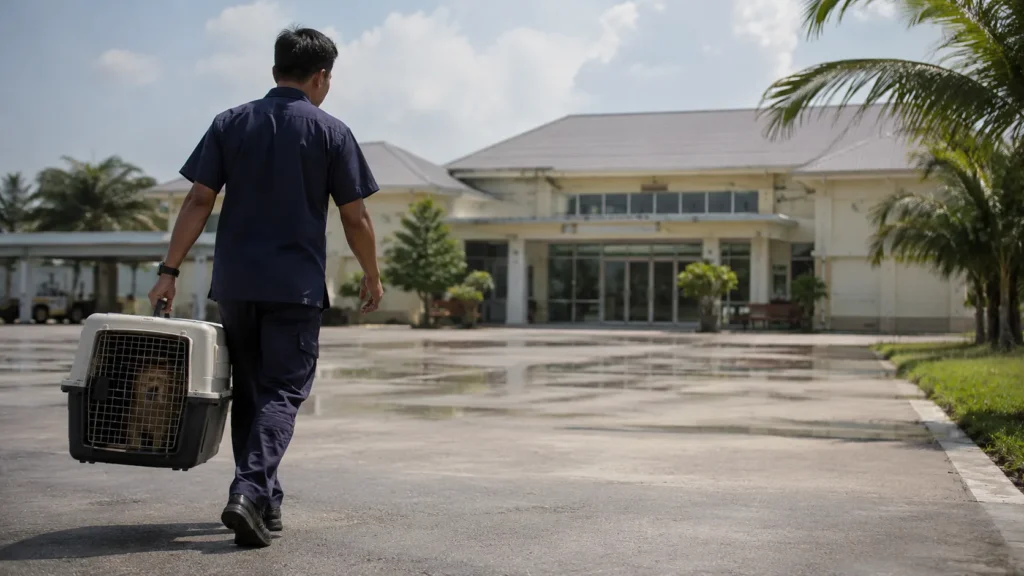
Six Thai airports run an Animal Quarantine Station capable of legally clearing a dog or cat on arrival. Krabi, one of Thailand’s most popular tourist gateways and the road-and-ferry doorway to Railay and Ao Nang, isn’t one of them. That single fact is the reason this question is worth answering properly before booking anything: the nearest-sounding airport to your final destination is not automatically the right one, and Thailand’s import permit is written for one specific port of entry, not for “Thailand” in general.
It’s a reasonable thing to get wrong. Nobody plans a move around an airport’s quarantine-station address; they plan it around where they’re actually going to live. But the permit doesn’t work that way, and finding out at the counter is exactly the kind of avoidable stress this article exists to prevent, not three months earlier when the R.1/1 application gets filed.
The Permit Is Port-Specific, and That Locks In Early
Thailand’s R.1/1 import permit application names an intended port of entry as one of its required fields, and the Animal Quarantine Station at that specific airport is the one that reviews the file and later clears the pet on landing. This isn’t a formality that travels quietly with the rest of the booking. It’s a real administrative fact, decided at the moment the application is submitted, weeks before departure. An owner who books Suvarnabhumi on the R.1/1 form and later finds a better fare through a different Thai gateway hasn’t just changed a flight. They’ve changed which government office is supposed to be handling their file, and the fix is contacting that new station directly, not assuming the paperwork follows automatically.
Suvarnabhumi: The Default, for Real Reasons
Bangkok’s main international gateway carries the load for most of Thailand’s pet imports, and it’s not just inertia. Suvarnabhumi’s Animal Quarantine Station is the largest and most experienced of Thailand’s six stations, located at the second passenger terminal in front of Baggage Claim 8. It’s also the airport every direct Australia-Bangkok flight actually lands at (Qantas and Thai Airways both fly this route nonstop), and its passenger-side desk is confirmed to run 24 hours. For an owner whose actual destination is Bangkok, or who’s willing to add a domestic or road connection afterward, it is the least complicated of the six choices by a comfortable margin.
Where Suvarnabhumi Falls Short
The trade-off is everything that happens after clearance. A pet landing at Suvarnabhumi bound for Phuket, Chiang Mai, or anywhere outside greater Bangkok still faces a domestic flight or a multi-hour road transfer on top of an already long international journey. That additional leg is exactly the kind of extended ground exposure that matters most to actual pet-travel safety, not the international flight itself. Choosing Suvarnabhumi because it’s the default, without planning the onward leg with the same care as the international booking, just moves the hardest part of the trip to the end of the day instead of the beginning.
Phuket: Can You Actually Fly There Directly?
Here’s the part that surprises most owners planning a Phuket move: the airport itself is fully equipped. Phuket International Airport runs its own Animal Quarantine Station, split between a passenger-terminal desk near Baggage Claim 1 and a separate cargo-terminal facility. It can legally clear a pet the same way Suvarnabhumi does. The problem isn’t the airport. It’s the flight. Jetstar operates the only direct passenger service between Australia and Phuket, daily from both Melbourne and Perth, and Jetstar does not carry live animals in any class on those routes, cabin or cargo, because its aircraft holds aren’t pressurized for it. A fully capable airport, sitting at the end of a route that currently can’t carry a pet at all. In practice, a pet aimed at Phuket almost always still travels as manifest cargo through Bangkok or another hub, then makes the final leg to Phuket separately, which makes Phuket less a starting-line airport for this decision and more a finish-line one.
Chiang Mai: A Domestic Connection, Not a Direct Flight
Chiang Mai International Airport also runs its own Animal Quarantine Station, and it’s a legitimate port of entry on the R.1/1 form. What it isn’t, currently, is a nonstop destination from Australia. There’s no confirmed direct passenger service on that city pair. The realistic path is a direct international flight into Bangkok, followed by a domestic connection. Thai Airways alone operates roughly 35 flights a week between Bangkok and Chiang Mai, which is frequent enough that the domestic leg is rarely the bottleneck. The planning implication is the same one that applies to Phuket: budget for two legs, not one, when timing a pet’s arrival against the health certificate’s tight validity window.
Don Mueang: Bangkok’s Other Airport
Don Mueang, Bangkok’s secondary airport, has its own Animal Quarantine checkpoint too, based in a warehouse facility rather than inside the main passenger terminal. It’s less relevant as an international arrival point for an Australian departure, since Don Mueang is primarily a domestic and regional budget-carrier hub. But it matters for the onward-connection question, since some low-cost domestic routings to regional Thai cities operate out of Don Mueang rather than Suvarnabhumi. Worth checking specifically if your onward domestic ticket routes through it.
Koh Samui: The Boutique Exception
Samui rounds out Thailand’s list of designated pet-import airports, which surprises people given how small and specialised it is. The airport is privately built and operated by Bangkok Airways rather than the state airport authority that runs the other five. There’s no direct international service from Australia, and the practical route is the same two-leg pattern as Phuket and Chiang Mai: international arrival elsewhere, then on to Samui. It’s included here mainly so owners considering the island don’t assume it’s excluded from the whole system. It isn’t; it’s just a genuinely small operation.

Krabi: Why the Closest Airport to Railay Doesn’t Work
This is the fact that makes the whole question worth asking properly. Krabi International Airport is not one of Thailand’s designated Animal Quarantine Station airports, despite being the usual gateway for Ao Nang, Railay, and the string of beach towns along that stretch of coast. An owner who books flights the way a human traveller would, picking the airport closest to the final address, will find there’s no legal path to clear a pet there at all. The fix is straightforward once you know about it: clear the pet through Phuket’s Animal Quarantine Station instead, then cover the final stretch to Krabi by road, a well-travelled route of a few hours rather than a genuine obstacle. But that only works if it’s planned for in advance, not discovered at an arrivals hall with a confused, jet-lagged animal and no station to check in with.
Passenger-Side Versus Cargo-Side Capability
Most of these stations, Suvarnabhumi and Phuket both included, actually run two separate physical setups: a passenger-terminal desk for pets travelling with their owner, and a separate cargo-terminal facility for pets travelling as manifest freight. They’re not interchangeable, and which one applies to your booking changes both the location you’re heading to inside the airport and, often, the hours it operates. Confirm which side your specific booking falls under before travel day, not during it. Otherwise, an owner can end up walking to the wrong terminal building while a jet-lagged pet waits somewhere else entirely.
Office Hours and What Happens If You Land Late
This is where the “nearest airport” instinct can go wrong in a way that has nothing to do with distance. Via Thailand’s own diplomatic missions, Suvarnabhumi’s passenger-side desk is confirmed to run 24 hours a day, a genuinely useful fact for anyone on a late-arriving international sector. Its cargo side does not share that schedule. Cargo clearance runs business hours only, Monday to Friday, and is closed on weekends and Thai public holidays. That means a manifest-cargo pet landing on a Saturday can sit at the airport, legally arrived but not yet released, until Monday morning. Phuket, Chiang Mai, Don Mueang and Samui’s exact published hours are less consistently documented than Suvarnabhumi’s. That itself is useful information: it means confirming hours directly with the relevant station before booking a red-eye or a weekend arrival at any airport other than Bangkok, rather than assuming the same 24-hour standard applies everywhere.
Road Transport or a Domestic Flight for the Last Leg
Once a pet clears whichever station applies, the journey usually isn’t over. Phuket’s resort areas, Chiang Mai’s old city, and Krabi’s beach towns all sit some distance from their nearest AQS-equipped airport. The choice between a domestic flight and a road transfer for that last leg is a real decision, not a formality: a domestic flight adds a second loading-and-unloading cycle and a second round of tarmac exposure, while a road transfer avoids that but takes considerably longer and depends entirely on the vehicle’s own climate control and the driver’s experience handling an anxious animal. Neither option is automatically safer; it depends on season, distance, and how well the connection is actually planned, which is exactly the kind of routing decision a dedicated operator plans around rather than defaulting to whichever option is cheapest on the day.
The Decision, Laid Out Plainly
Put together, the six airports compare like this:
| Airport | AQS on site | Direct AU flights carrying pets | Hours confidence | Best suited for |
|---|---|---|---|---|
| Suvarnabhumi (Bangkok) | Yes, largest station, passenger + cargo | Yes (Qantas, Thai Airways to Bangkok; cargo via Qantas Freight) | Passenger side confirmed 24h; cargo side business hours only | Bangkok destinations, or as the entry point before an onward domestic/road leg |
| Phuket | Yes, passenger + separate cargo facility | No; Jetstar is the only direct carrier and carries no live animals | Not consistently published; confirm directly | Final-leg clearance after routing through Bangkok, not a starting point |
| Chiang Mai | Yes | No confirmed nonstop service from Australia | Not consistently published; confirm directly | Final-leg clearance after a Bangkok domestic connection |
| Don Mueang | Yes, warehouse-based checkpoint | Primarily domestic/regional, not a typical AU international arrival point | Not consistently published; confirm directly | Onward domestic connections rather than the international leg |
| Samui | Yes | No direct international AU service; privately operated by Bangkok Airways | Not consistently published; confirm directly | Final-leg clearance for Samui-bound pets only |
| Krabi | No AQS at all | Not applicable | Not applicable | Not usable; clear via Phuket, then transfer to Krabi by road |
Read as a decision tree rather than a table: if your final destination is Bangkok itself, Suvarnabhumi is the straightforward answer. If it’s Phuket, Chiang Mai or Samui, plan for two legs: an international arrival (almost always Suvarnabhumi, given the current state of direct routes) followed by a domestic or road connection to the actual station nearest your destination, timed against the health certificate’s short validity window. If it’s Krabi, Ao Nang or Railay, route through Phuket and finish by road; there is no version of this trip that clears a pet at Krabi directly.
Owners planning the Bangkok leg of that journey in more detail should read our full walkthrough of what happens when your pet arrives at Suvarnabhumi, and those still comparing the cost implications of a two-leg routing against a simpler Bangkok-only move may find our Australia-to-Thailand pet transport cost breakdown useful for budgeting the difference. Swift Cargo’s pet transport team plans the port of entry against the R.1/1 application from the outset, specifically to avoid an owner discovering a routing problem after the paperwork is already filed.
Related reading: Moving Pets from Canada to Thailand: CFIA, Flights and Timing
Frequently Asked Questions
What is the best Thailand airport for pet import?
For most owners arriving from Australia, Suvarnabhumi in Bangkok is the most reliable choice: it has the largest Animal Quarantine Station, the most direct flight options, and a passenger-side desk that operates 24 hours. The better airport for any individual pet still depends on the final destination: a pet headed for Phuket or Chiang Mai will need a domestic or road connection either way, so the real comparison is where that connection happens, not just which airport the international flight lands at.
Can a pet fly direct to Phuket from Australia?
Phuket International Airport does have its own Animal Quarantine Station and can legally clear a pet on arrival. The complication is the flight itself: Jetstar operates the only direct Australia-Phuket passenger routes, and Jetstar does not carry live animals in any class on those services. In practice, most pets travelling toward Phuket still route through Bangkok or another hub as cargo, then transfer onward.
Can I bring my pet into Thailand through Chiang Mai?
Chiang Mai International Airport has its own Animal Quarantine Station and does accept pet arrivals, but there is no confirmed nonstop service between Australia and Chiang Mai. The realistic routing is a direct flight to Bangkok followed by a domestic connection. Thai Airways alone operates roughly 35 flights a week on the Bangkok-Chiang Mai sector, rather than a single-flight journey.
Does Krabi Airport accept pet imports?
No. Krabi is not among Thailand’s designated Animal Quarantine Station airports, alongside Suvarnabhumi, Don Mueang, Chiang Mai, Phuket and Samui. Owners heading to Krabi, Ao Nang or Railay need to clear their pet’s import through Phuket’s Animal Quarantine Station instead and arrange the final leg to Krabi by road.
Is the Bangkok airport open 24 hours for pet arrivals?
The passenger-side Animal Quarantine Station at Suvarnabhumi is confirmed to operate 24 hours, which matters for owners on a late-arriving flight. The cargo side operates business hours only, Monday to Friday, and is closed on weekends and Thai public holidays. A manifest-cargo pet that lands outside those hours can be held at the airport until the next business day.
Does the Thailand pet import permit specify which airport I have to use?
Yes. The R.1/1 import permit application names an intended port of entry, and that airport’s Animal Quarantine Station is the one that reviews and later clears the application. Changing the arrival airport after approval generally means contacting the new station directly rather than assuming the original approval simply carries over.
