
There is a teak dining table in a Bangkok showroom on Sukhumvit priced at THB 42,000. The same table, same maker, same finish, sits in a Phuket showroom near Cherngtalay for THB 51,500. Nothing about the table changed on its way south. What changed is that it crossed 850 kilometres of road, a bridge, and several margins to get to an island where almost everything arrives the same way. That 22 percent gap is the single most useful number in this guide, because it quietly rewrites the biggest decision of your move: not how little can you ship to Phuket, but how much.
Most relocation advice is written for city moves, and it leans hard on one instruction: downsize. Sell the furniture, ship the minimum, buy locally. For Bangkok that logic mostly holds. For Phuket it frequently fails, and it fails for reasons that are pure logistics. This guide follows the freight: how a container actually reaches the island, what the inland leg costs, why island prices run high, and how the marine climate and monsoon calendar should shape what goes in the box. By the end you will be able to make the ship-versus-buy call with numbers instead of instinct.
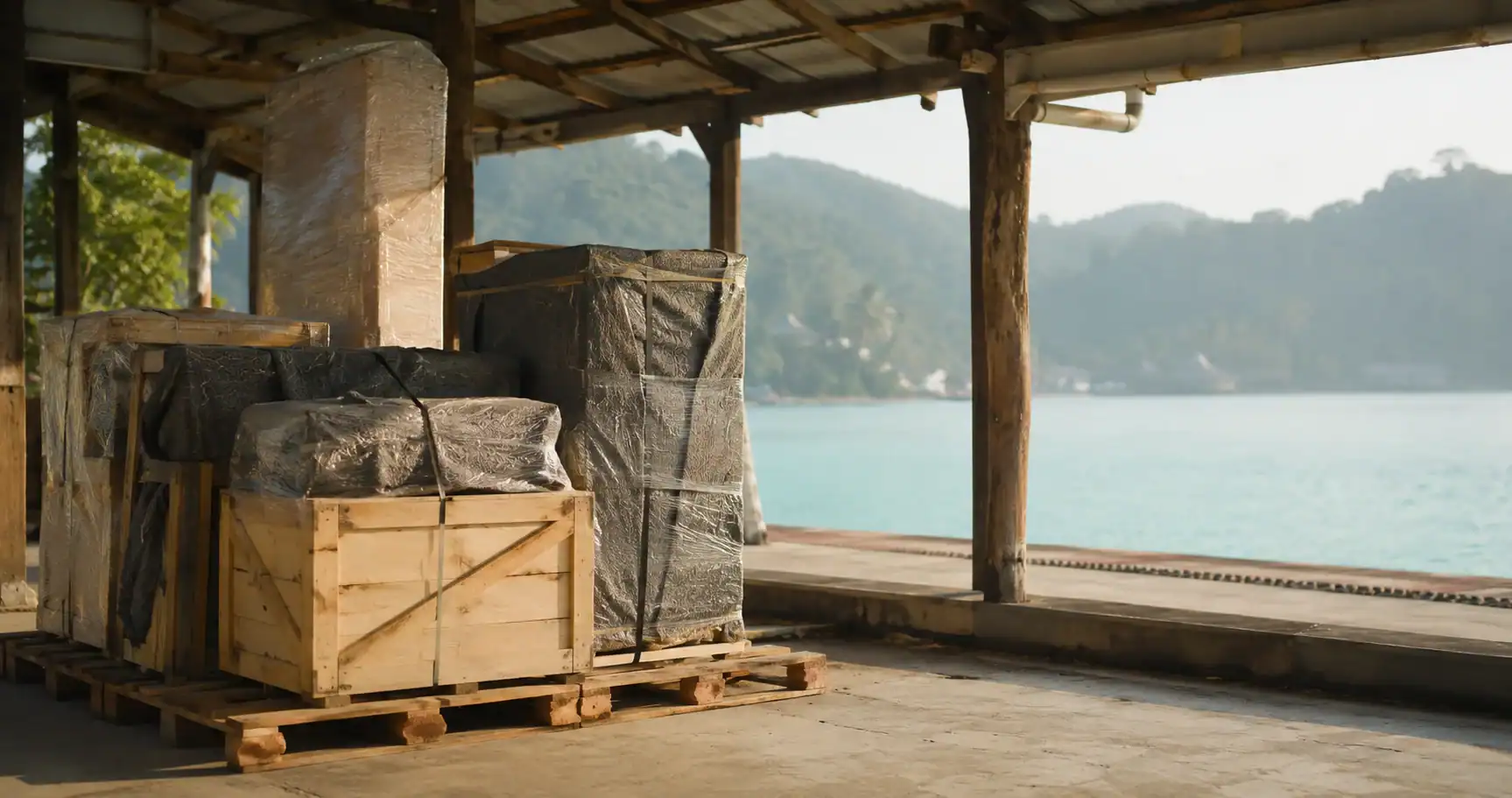
How Freight Actually Reaches Phuket
Start with a mild surprise: your sea freight to Phuket almost certainly does not sail to Phuket.
Phuket has a deep sea port at Ao Makham on the island’s southeast coast. It exists, it works, and it handles cruise ships, bulk cargo, and a limited rotation of regional feeder services. It does not have the dense, frequent container connectivity of Thailand’s main gateway. Laem Chabang, the deep-water complex southeast of Bangkok, is where the mainline vessels from Europe, North America, and East Asia actually call, and it is where the vast majority of household-goods containers bound for Phuket first touch Thai soil.
From there, two paths exist on paper:
Path one: Laem Chabang plus road haul. Your container clears Thai Customs at the port, is loaded onto a truck chassis, and drives roughly 850 kilometres south along Route 4 through Chumphon, Ranong province’s edge, and Phang Nga, before crossing the Sarasin Bridge onto the island. This is the default. It is how your sofa, your neighbour’s motorbike, and the showroom’s teak table all made the trip. The road leg typically adds two to four days to the door-to-door schedule, longer in heavy monsoon weather.
Path two: regional feeder into Phuket Deep Sea Port. A small number of feeder services connect Phuket to regional hubs, chiefly for specific commercial cargo. For a household shipment this path is rarely quoted, rarely faster, and often not cheaper once you account for the thinner schedules and double handling at a transhipment hub. Unless your forwarder has a specific, current service that fits your dates, treat the feeder option as a footnote rather than a plan.
So the practical route for your goods is: origin port, ocean leg to Laem Chabang, customs clearance, then the long drive south. Understanding this one fact explains almost everything else about moving to Phuket: the costs, the delays, and above all the prices in that Cherngtalay showroom.
The Inland Leg: What 850 Kilometres Costs
The road haul from Laem Chabang to Phuket is a real, separately priced leg of your move, and it is where Phuket quotes diverge from Bangkok quotes.
For a full container load, expect the inland haul to add roughly THB 25,000 to 45,000 on top of what the same container would cost delivered to a Bangkok address. The range depends on container size, fuel surcharges at the time of the move, whether the trucker gets a return load, and how awkward the final delivery address is. A 20ft box to a villa with clean access sits at the lower end; a 40ft box to a hillside estate in green-season rain drifts toward the top.
For less-than-container (LCL) shipments, the premium shows up as a per-cubic-metre surcharge on the destination side. Because LCL cargo for Phuket is deconsolidated near Bangkok and then trucked south as groupage, each cubic metre carries its share of the haul. If you are comparing LCL quotes, look specifically at the destination charges section: that is where a Phuket move hides its extra cost, and where a quote that looked cheap on the ocean leg becomes expensive at the door.
Time-wise, add two to four days beyond an equivalent Bangkok delivery. That covers truck scheduling out of the port, the drive itself, and delivery booking on the island. It is not dramatic. But it matters for one planning reason: if you are targeting a villa handover date, count backwards from Phuket delivery, not from vessel arrival at Laem Chabang.
The Island Premium: Why You Should Probably Ship More, Not Less
This is the spine of this article, and it is worth stating bluntly: on Phuket, the standard downsizing advice is often wrong.
Every imported item sold on the island (furniture, appliances, quality mattresses, building materials, fittings) has already paid for the same journey your container would make. The importer paid ocean freight to Laem Chabang or Bangkok. Then the distributor paid the road haul south. Then the island retailer added a margin sized for a captive audience, operating with higher rents per square metre of showroom and a smaller competitive market than Bangkok’s. The result is consistent: imported goods on Phuket typically retail 10 to 25 percent above Bangkok prices for the same items, with bulky items (the exact things movers tell you to sell before you leave) at the top of that range, because bulk is what makes the road haul expensive.
Run the arithmetic on a real decision. Suppose you own THB 400,000 worth of good furniture and appliances at replacement value. The Bangkok playbook says sell it for THB 120,000 second-hand and rebuy on arrival. In Bangkok, rebuying costs about THB 400,000 and the maths of selling is at least arguable. On Phuket, rebuying the same quality costs THB 440,000 to 500,000. Meanwhile the marginal cost of shipping those goods is often THB 60,000 to 100,000 all-in, including the inland leg: the difference between the small container you were going to book and the larger one that fits everything. Ship the goods and you come out THB 150,000 or more ahead, and you skip six weekends of showroom visits at island prices.
The rule of thumb that falls out of this: for a Phuket move, the break-even point for shipping an item is lower than for any mainland Thai destination. Items that are borderline for Bangkok (the decent sofa, the two-year-old washing machine, the solid-wood wardrobe) tip clearly into “ship it” territory for Phuket. Some items still do not travel well: cheap flat-pack furniture that will not survive handling, anything the salt air will destroy quickly (more on that below), and 220-volt-incompatible electronics if you are coming from a 110-volt country.
This is the insight to hold onto while every generic checklist tells you to purge. Purging is a Bangkok strategy. Phuket rewards the full container.
It is worth asking where the generic “downsize before you move to Thailand” advice actually comes from, because tracing it explains why it fails here. Nearly every checklist and forum thread giving that advice is written by, or based on the experience of, someone who moved to Bangkok or a mainland city where the retail markup this section describes barely exists. That advice is not wrong in general: it is accurate for the place it was written about, and simply gets copied and repeated without anyone checking whether Phuket’s supply chain looks the same. It does not. Advice that travels without its context attached is how a Bangkok-specific truth turns into a Phuket-specific mistake.
I didn’t understand this until a friend who had already moved to Phuket sent back a single photo: her old Bangkok sofa, still wrapped in its plastic, sitting in a shipping container six weeks after the movers loaded it. She had been told, like everyone is told, to downsize before a move to Thailand: sell what you can, ship only the essentials, buy the rest when you land. It’s good advice. It’s just good advice for Bangkok, where a replacement sofa costs what you’d expect. On the island, that same sofa costs 20 percent more, and there’s no way to know that from a generic moving checklist written for the mainland. Looking back, she realized the advice hadn’t been wrong. It just wasn’t written for where she was actually going.
Housing Patterns: Villas, Sois, and Gate Protocols
The second reason Phuket favours shipping more is what you will be moving into. Bangkok expat life happens overwhelmingly in condominium towers: freight elevators to book, loading bays with time slots, strict building rules, and floor plans that punish large furniture. Phuket expat life happens overwhelmingly in villas and houses: standalone homes in Rawai and Chalong, pool villas around Cherngtalay and Bang Tao, family houses in the Thalang interior.
For the delivery crew this is mostly good news. A villa means the truck parks at or near the door, no elevator booking, no condo juristic office signing off on your move date, and no sofa jammed in a service lift. Delivery days at houses run faster and damage rates run lower.
Two island-specific caveats, though. First, soi width. Many Phuket homes sit down narrow lanes that a full-size container truck cannot enter. The standard solution is a shuttle: the container is worked at the mouth of the soi or a nearby yard, and a smaller truck runs the goods the final few hundred metres. It is routine, but it costs extra and it should appear on your quote before delivery day, not as a surprise invoice after. When you confirm your address with your mover, send photos of the lane and the gate: thirty seconds of effort that prevents the single most common Phuket delivery dispute.
Second, gated-estate protocols. The managed estates that dominate the Cherngtalay–Bang Tao corridor run their own delivery rules: advance vehicle registration, driver ID, working-hour windows, sometimes a deposit against road damage for heavy trucks. None of it is difficult; all of it takes lead time. Have your landlord or agent connect the mover with estate management a week ahead.
And note the compounding effect on the shipping decision: a villa has more rooms, more floor area, and outdoor living space to furnish. More space means more furniture, and more furniture at island prices means the container case gets stronger still.
The Marine Climate: Salt, Damp, and What Survives It
Phuket is a tropical island, and your goods will live in marine air for as long as you do. This deserves a place in your packing decisions, not just your postcard expectations.
Salt air corrodes. Anything with exposed metal or contacts (electronics, appliance circuit boards, air-conditioner heat exchangers, door hinges, tools, bicycle drivetrains) ages measurably faster within a few kilometres of the coast than it would in inland Bangkok. Plan for it three ways. Ship electronics sealed, with desiccant packs, and unpack them into air-conditioned rooms rather than sea-facing verandas. When you buy fittings for the house (hinges, rails, outdoor hardware), specify stainless or marine-grade, which the island’s suppliers stock precisely because everyone learns this lesson. And adjust the ship-versus-buy calculus for lifespan: an appliance that would give you eight Bangkok years may give you five or six on the coast, which argues for shipping the good three-year-old machine you own rather than buying new at a 20 percent island premium only to watch the sea tax it anyway.
The green season is damp in a way that gets into things. From May to October, humidity sits high for weeks at a stretch. The practical kit list is unglamorous: a proper dehumidifier for at least one storage room, silica tubs in wardrobes, leather goods kept ventilated and checked monthly, books and documents in sealed boxes rather than open shelves. Mould prevention on Phuket needs to be a notch more deliberate than in Bangkok, where sealed condo towers and constant air-conditioning do some of the work for you. In a villa with rooms you do not air-condition around the clock, the climate takes its share of anything neglected.
None of this argues against shipping. It argues for packing intent: wrap the vulnerable goods properly at origin, and land with the dehumidifier in the shipment rather than on a shopping list.
Timing the Move: Monsoon, High Season, and the Festival Calendar
Phuket runs on a two-season clock, and your delivery date will land somewhere on it.
Green season, May to October. The southwest monsoon brings rain that arrives in bursts, rarely all-day, often intense. For logistics it means three things: the road haul south can slow when weather closes in on Route 4’s hillier stretches; delivery days need rain contingency, especially for villas on unpaved sois that soften in a downpour; and crews will want covered unloading arranged where possible. Deliveries absolutely happen all green season (the island does not stop), but schedules deserve slack. If your vessel docks at Laem Chabang in September, pad the delivery window by a few days and do not book the handover of your old accommodation against the optimistic date.
High season, November to April. Dry, reliable, and busy. Tourism at full tilt means more traffic on the island’s roads, fuller schedules for every service business including movers, and delivery slots that book out further ahead. Conditions are better; competition for them is stiffer. Book earlier, expect punctuality.
See Swift Cargo’s peak shipping months for Thailand for the mainland side of this calendar before booking your Laem Chabang departure.
Two calendar notes worth flagging. Songkran in mid-April effectively pauses Thai logistics for the better part of a week: ports slow, trucking stops, and the days either side are congested; do not schedule a clearance or delivery across it. And Phuket’s Vegetarian Festival (usually late September or October, dates follow the lunar calendar) fills the island’s roads, particularly around Phuket Town, with processions and closures. It is a marvellous thing to witness and a poor week to steer a 40ft container through.
Arrival Logistics: The Advance Party and the Storage Question
A sea shipment to Phuket takes the ocean transit plus clearance plus the road haul: from Europe, realistically nine to twelve weeks door to door. You will be living on the island for most of that time, which makes the arrival sequence worth engineering.
Excess baggage as the advance party. The reliable pattern: fly with the maximum airline baggage you can sensibly book (clothing for the first months, work equipment, children’s essentials, the kitchen basics that make a rental feel operational). Air freight a small consignment if the gap demands it. Let the sea container carry everything whose absence you can tolerate for a season. This is standard for any Thailand move; the longer Phuket timeline just raises the stakes on getting the split right.
The duty-free window applies here as anywhere. Thai Customs’ rules do not change at the Sarasin Bridge: qualifying importers (returning Thai nationals and foreigners arriving on eligible long-stay visas) can bring used household effects in duty-free within six months of arrival, one sea shipment per person, with the goods matching a genuine household in kind and quantity. The clearance happens at the port of entry before the truck ever turns south, so have your visa status, passport stamps, and packing list aligned before the vessel arrives. If your visa class does not qualify, budget for duty and tax on the declared value and get that assessment estimated in writing early.
Storage: think origin, not island. This is a quiet asymmetry that catches people. Bangkok has a deep market of professional storage: climate-controlled units, document storage, household lots, competitive pricing. Phuket’s storage market is thin: limited stock, higher prices per square metre, and less climate control in a climate that punishes its absence. If your villa is not ready when your goods are, the better lever is usually at the other end of the pipeline (hold the shipment in storage at origin, or delay the vessel booking) rather than paying island rates to store a container’s contents in humid sheds. Time the dispatch so the goods land when the house can receive them.
Families and Practicalities, Through the Logistics Lens
Two non-freight facts shape Phuket freight plans enough to earn a line each.
Schools cluster in the north. Phuket’s international schools concentrate in the Thalang and Cherngtalay area, which is why relocating families overwhelmingly land in the island’s northwest, and why the gated-estate delivery protocols described above will apply to most family moves. If you are choosing a house by school run, you are also choosing your delivery logistics; the two decisions arrive together.
Immigration is local and busy. The Phuket Immigration office in Phuket Town handles the island’s large expat population, and 90-day reporting, extensions, and residence certificates all queue through it. The logistics relevance: your visa status underpins your duty-free eligibility, so get the immigration paperwork moving before the shipment sails, not after it lands.
Worked Example: The Same 20ft Container, Two Destinations
Numbers make the argument better than adjectives. Below is an illustrative comparison for the same 20ft container of household goods shipped from the UK: once to a Bangkok condominium, once to a Phuket villa. Ocean-leg pricing is identical because the vessel does not care where you sleep; the divergence is entirely on the destination side. Figures are planning-grade estimates in Thai baht; your quotes will vary with the season and the address.
| Cost component | UK → Bangkok condo | UK → Phuket villa | Notes |
|---|---|---|---|
| Origin packing & UK haulage | THB 95,000 | THB 95,000 | Identical: same crew, same container |
| Ocean freight to Laem Chabang | THB 120,000 | THB 120,000 | Identical: same vessel, same port |
| Thai customs clearance & port charges | THB 18,000 | THB 18,000 | Cleared at port of entry in both cases |
| Inland haul to destination | THB 8,000 | THB 35,000 | ~130 km to Bangkok vs ~850 km to Phuket |
| Delivery access costs | THB 6,000 | THB 4,000 | Condo elevator booking & long carry vs direct villa access |
| Shuttle / restricted access contingency | N/A | THB 6,000 | Narrow-soi shuttle if the big truck cannot reach the gate |
| Door-to-door total | THB 247,000 | THB 278,000 | Phuket premium ≈ THB 31,000 (~13%) |
| Extra transit time | N/A | +2 to 4 days | Road haul south of Laem Chabang |
| Replacing the same goods locally instead | ≈ THB 400,000 | ≈ THB 440,000–500,000 | Island premium of 10–25% on imported goods |
Read the bottom two rows together and the decision frames itself. The Phuket surcharge for shipping a full container is about THB 31,000 in this example. The Phuket surcharge for not shipping (for buying the same household on the island instead) is THB 40,000 to 100,000 on top of already-full Bangkok replacement prices. The road haul is the cheapest way your possessions will ever cross those 850 kilometres, because everything you would buy in a Phuket showroom crossed them too, with more margins stacked on top.
The Samui and Krabi Footnote
Phuket’s pattern is not unique; it is just the largest example of it. Koh Samui takes everything above and adds a ferry or barge leg from Donsak: another transfer, another charge, another point where weather can slip the schedule, and retail prices on the island that reflect all of it. The smaller islands amplify further still. Krabi, being mainland-connected, skips the ferry but shares the long road haul and the elevated prices for imported goods across the Andaman coast. The portable rule: the more legs between Laem Chabang and your front door, the higher local prices run, and the stronger the case for putting more, not less, in the container.
Five Mistakes Phuket Movers Make
1. Budgeting with Bangkok delivery rates. An ocean quote to “Thailand” that was priced against a Bangkok delivery will grow by tens of thousands of baht when the destination becomes a Phuket villa. Get the quote to the island address from the start, with the inland leg itemised, so the road haul is a line item and not a shock.
2. Downsizing as if moving to a city. The purge-everything instinct is the expensive mistake here. Selling good furniture at second-hand prices to rebuy it at island prices is paying twice for the same road haul. Inventory what you own at Phuket replacement value before deciding what stays behind. The answer will surprise you.
3. Ignoring the green season in the schedule. A delivery planned to the day in September, against a villa handover, with no slack for monsoon delays on the haul south, is a plan built to fail politely. Pad green-season windows and keep your accommodation overlap generous.
4. Shipping salt-vulnerable goods unprotected. Electronics loose-wrapped, tools bare, leather unventilated. The marine climate finds all of it. Specify export wrapping with desiccant for sensitive items and tell your packers the destination is coastal; good crews pack differently for it.
5. Leaving the paperwork behind the freight. The duty-free window is generous but conditional. A shipment that arrives before your qualifying visa status is settled clears expensively or waits expensively. Sequence immigration first, vessel second.
Related Reading
- Chiang Mai vs Bangkok: Relocation Logistics Compared
- Door-to-Door Shipping to Thailand: How It Works
- Shipping Household Goods to Thailand: The Complete Guide
- Thailand’s Duty-Free Import Rules for Household Effects
- Storage Options When Moving to Thailand
Frequently Asked Questions
How does sea freight actually get to Phuket?
Almost all of it lands at Laem Chabang near Bangkok and travels the final 850 km by road, crossing the Sarasin Bridge onto the island. Phuket’s own deep sea port at Ao Makham handles limited regional feeder traffic and is rarely the practical route for household shipments. Budget THB 25,000–45,000 for the inland leg on a full container and 2–4 extra days.
Is it cheaper to ship furniture to Phuket or buy it there?
Usually to ship it. Imported goods on the island run 10–25% above Bangkok prices because they made the same road journey your container would, with retail margins added on top. Phuket is the rare destination where shipping more, not less, is often the financially sound call.
Does the 6-month duty-free window apply to Phuket moves?
Yes, Thai Customs applies the same rules island-wide. Qualifying importers on eligible long-stay visas can bring used household effects in duty-free within six months of arrival, one shipment per person, with clearance completed at the port of entry before the road haul south begins.
When is the best time to schedule delivery to Phuket?
The dry high season (November–April) is the most reliable but busiest; book slots early. The green season (May–October) works fine with slack built in for monsoon delays on the road haul and rain contingency on delivery day. Avoid scheduling across Songkran in April and Phuket’s Vegetarian Festival in the September–October window.
How do I protect electronics and appliances from the salt air?
Ship them sealed with desiccant, unpack into air-conditioned rooms, specify stainless or marine-grade fittings around the house, and run a dehumidifier through the green season. Coastal air shortens appliance lifespans, which is another reason to ship the good machines you own rather than buy new at island prices.
Do Koh Samui and Krabi work the same way?
Same pattern, amplified. Samui adds a ferry leg with its own cost and schedule risk; Krabi skips the ferry but shares the long road haul and elevated Andaman-coast prices. The more legs between Laem Chabang and your door, the stronger the case for the fuller container.