
Miguel spent nineteen years building a cellar in Vila Nova de Gaia. Not a grand one, maybe two hundred bottles, tucked into a cool room behind the garage, vintage ports from years that meant something. His daughter’s birth year. The year he bought the house. When the Bangkok job offer came through, he sat down with our surveyor and worked through the whole apartment room by room. Sofas, yes. The azulejo panel his grandmother left him, yes, crated properly. Books, bicycles, the lot. Then he opened the cellar door and the surveyor shook his head before Miguel even asked. You can pack almost everything when you leave Portugal. The cellar is the thing that stays.
That is the strange shape of a Portugal-to-Thailand move. In most respects it is the gentlest relocation on the entire Europe–Thailand corridor. The climate transition barely registers, your plugs work, your summer wardrobe survives intact. And then there is one category of belongings, the one Portuguese households often care about most, that simply cannot make the trip.
A large share of the people leaving Portugal for Thailand these days were never Portuguese to begin with. The NHR years brought tens of thousands of foreign residents to Lisbon, Cascais, Porto and the Algarve, and as that tax regime wound down, plenty of them are now moving onward rather than home. If you are a Briton, German or American leaving your second country for a third, your checklist differs from a Portuguese national’s in a few specific places. We flag those throughout.
Leaving Portugal Properly: The Departure Admin
Portugal will not stop you at the airport and demand an exit form. That is precisely the danger. Because nothing forces you to close your records, it is easy to leave them open, and open records generate problems that surface a year later, usually as a tax letter you never receive.
Finanças and your NIF
Start with the tax authority, because your NIF touches everything else. Your Número de Identificação Fiscal does not expire and you do not surrender it. You will keep it for life, and you will need it if you ever sell Portuguese property or receive Portuguese income. Your registered status changes. Through the Portal das Finanças (or in person at a Finanças office), update your address to your Thai address and, if you are genuinely ceasing Portuguese tax residency, file the change of residency status. If you no longer have a Portuguese or EU address, you may need to appoint a fiscal representative in Portugal to receive correspondence on your behalf. This is a common requirement for non-EU-resident NIF holders, and skipping it means official mail goes to an address where nobody lives.
Time this carefully. Portuguese tax residency generally hinges on 183 days of presence or maintaining a habitual home, so the date you declare matters for which country taxes that year’s income. If your affairs are simple, the Portal filing is enough. If you spent your Portugal years under NHR, get an hour of professional advice before you file anything, because the wind-down rules and the interaction with Thailand’s remittance-based taxation of foreign income are exactly the kind of thing you do not want to improvise.
Junta de Freguesia and residence registration
If you registered your residence at your local Junta de Freguesia (typically to obtain an Atestado de Residência for some other process) that registration does not clean itself up. A short visit or written request to the same Junta cancels it. Portuguese nationals moving abroad should also consider registering with the Portuguese consulate in Bangkok once they arrive; it keeps your Cartão de Cidadão renewable without a trip home and puts you on the consular register for elections.
For the double-expat crowd, the equivalent step depends on your paperwork. EU citizens who registered under free movement hold a CRUE (Certificado de Registo de Cidadão da União Europeia) from their Câmara Municipal, and formally cancelling it when you leave is the tidy move. Non-EU residents holding an AIMA residence permit should understand what absence does to it: most Portuguese residence permits lapse after extended absence from the country, generally six consecutive months or eight non-consecutive months within the permit’s validity, unless you fall under an exception. If there is any chance you will want the door back open (and after a year of Bangkok traffic some people do) check those thresholds before you assume the permit will be waiting for you.
Segurança Social
At a high level: your Portuguese social security contributions are not lost when you leave. Your contribution record sits in the system and remains part of your eventual pension entitlement, and Portuguese nationals can in some circumstances continue voluntary contributions from abroad. But Thailand has no bilateral social security agreement with Portugal, so your years there will not add to the Portuguese record, and you will not be covered by Segurança Social while living in Thailand. Notify Segurança Social of your departure, especially if you receive any benefit, because continuing to draw a residence-linked benefit from abroad creates a debt you will eventually repay. Then arrange private health cover for Thailand, since your SNS entitlement is tied to Portuguese residence and Thai visa categories increasingly require proof of insurance anyway.
The rest of the loop
Close or convert utilities (EDP, Galp, MEO/NOS/Vodafone contracts have notice periods, so check for fidelização penalties on term contracts), redirect mail through CTT, and tell your Portuguese bank you are moving. That last one matters more than people expect: banks apply different compliance treatment to non-resident accounts, and some will ask you to update your tax residency declaration. Keeping a Portuguese account open is usually wise, since it makes selling property, receiving deposits back and paying the odd lingering bill vastly easier, but keep it honest and updated.
Shipping Out: Lisbon, Leixões and the Sines Question
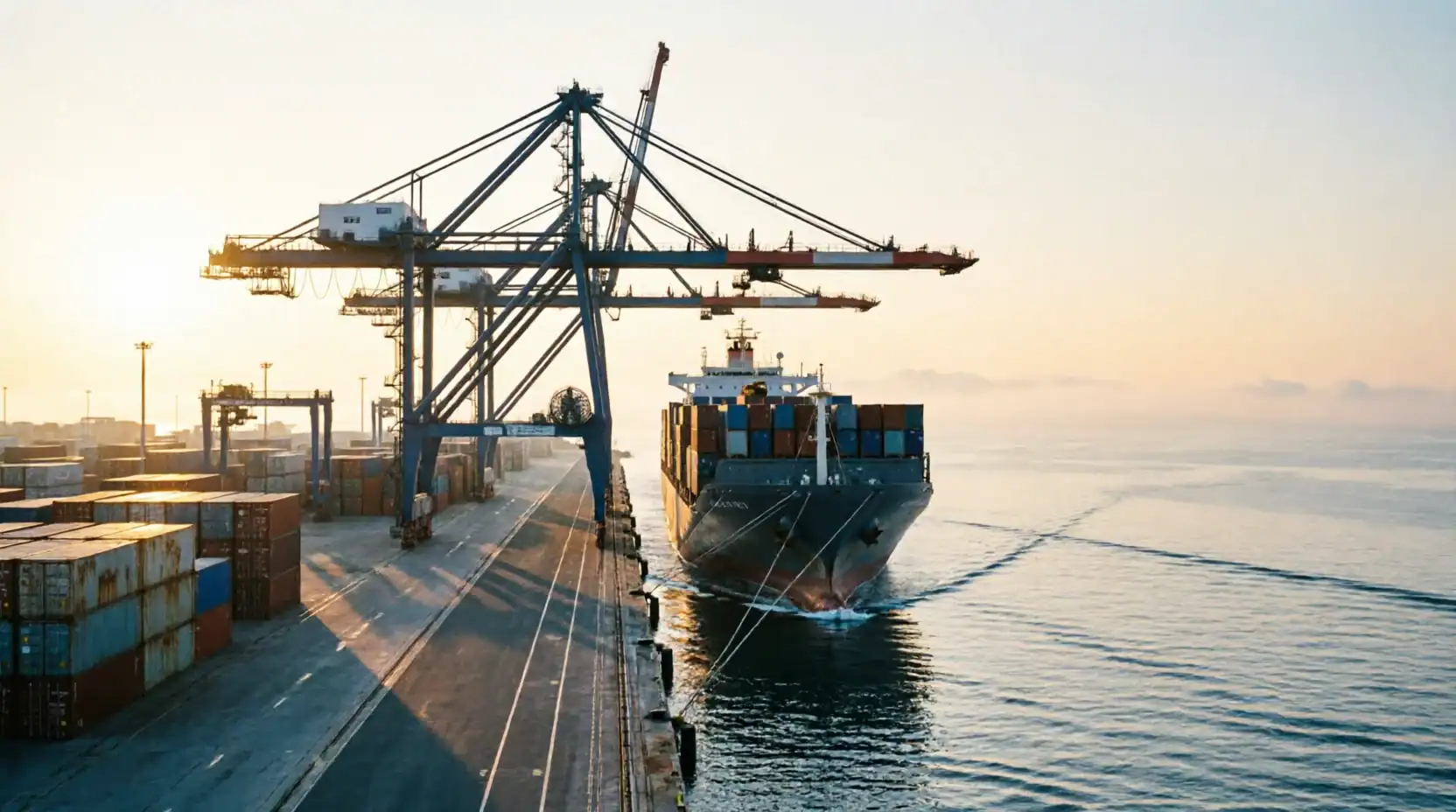
Portugal’s container geography is straightforward once you see the pattern. There are three ports that matter for household shipping, and they play different roles.
Lisbon is the natural origin for anyone in the capital, the Setúbal peninsula or the central coast. It handles substantial container volume, but for Asia-bound cargo it functions mostly as a feeder port: your container is loaded onto a smaller regional vessel and relayed to a main-line hub (typically Algeciras or Valencia in Spain, sometimes Rotterdam) where it joins a large Asia-service vessel. The feeder leg adds a few days and one transhipment to the journey.
Leixões, just outside Porto at Matosinhos, plays the same feeder role for the north. If you live in Porto, Braga or anywhere down the A3/A4 corridors, your groupage or container will gate in at Leixões and relay to a hub. Porto-region movers should not be tempted to truck goods to Lisbon “because it’s the bigger port”. It makes no difference to the ocean routing and adds domestic haulage cost.
Sines is the interesting one. An hour and a half south of Lisbon, Sines is Portugal’s deepwater port and its only terminal taking regular direct calls from the largest main-line vessels on Asia rotations. If your shipment routes via Sines, it can skip the feeder-and-transhipment step entirely, which removes both days and a handling event (and every handling event is a small risk event for household goods). You do not usually choose this yourself, since your forwarder books the carrier and the carrier’s service string determines the port, but it is worth asking whether a Sines direct service is available for your dates, particularly for FCL moves from the Lisbon–Setúbal–Algarve half of the country.
Suez, the Cape, and why Portugal’s position is unusual
This is where southern Europe differs from the north, and where you should be careful with anything you read that was written for a Hamburg or Felixstowe audience. Historically, Mediterranean and Iberian origins were the best-placed in Europe for Asia trade: a vessel leaving Algeciras or Valencia enters the Suez corridor quickly, and Portugal-to-Thailand transits were correspondingly tight. The Red Sea disruption that began in late 2023 upended that calculus. When carriers reroute around the Cape of Good Hope, the geometry reverses: a Cape routing from Iberia means sailing south past the entire African coast, and the transit penalty for southern-European origins is proportionally heavier than for northern ones.
The honest picture in 2026 is mixed and shifting. Some services have returned to Suez routings as conditions allow; others still run via the Cape, and carriers change service strings with little notice. What this means for you practically: do not treat any quoted transit time as a promise, ask your forwarder which routing your specific sailing takes, and build slack into your plans. The difference between a Suez and a Cape routing on this corridor can be ten days or more. Book on the schedule, plan on the pessimistic end of it.
Transit time: what to actually expect
Put together, with the feeder leg, hub transhipment and main-line ocean leg, a realistic Portugal-to-Thailand port-to-port window is 45 to 55 days to Laem Chabang. Direct Sines calls on a favourable routing land near the bottom of that range; a Cape-routed feeder itinerary sits at the top or beyond it. Door to door, once you add origin packing, export formalities, destination customs clearance and delivery upcountry or into Bangkok, plan on 8 to 10 weeks. For a deeper dive into how these legs stack up across the continent, see our guide to shipping times from Europe to Thailand.
Thai Customs: The Duty-Free Personal Effects Rules
Thailand’s household-goods concession is generous if you fit its frame and expensive if you miss it. The rules, per Thai government guidance, in plain terms:
- Who qualifies: under Thai Customs’ standard criteria, foreigners entering on a work-permit-matched non-immigrant visa or an LTR visa. Retirement and marriage-based non-immigrant O visas are both excluded from that standard test, and neither qualifies on the visa alone. Tourist and short-stay entries do not qualify at all.
- Ownership and use: the goods must be used personal or household effects that you have owned and used for at least one year. New items, or items still boxed with retail tags, are dutiable. This is the “one-year ownership-and-use” test, and Thai officers apply it with discretion: a room full of obviously new purchases invites assessment.
- The arrival window: your shipment must arrive in Thailand within six months of your own arrival. This is the deadline people miss. Given a 45–55 day ocean transit, you have real slack, but not infinite slack. Do not leave your goods in Portuguese storage for five months “until we’re settled” and then book the ship.
- One shipment: the concession applies to one sea shipment (or one sea plus one accompanying air shipment arriving together in spirit) per person. Splitting your household into three consignments over a year burns the concession on the first.
- Reasonable quantities: one of each major appliance per family is the working expectation. Two televisions, three espresso machines and four bicycles for a single adult reads as import for resale.
Paperwork-wise, your forwarder’s Thai agent will need your passport, visa evidence, a detailed packing list in English, and the bill of lading, and clearance is smoothest when you are already in Thailand with your visa activated before the vessel arrives. The full mechanics, including what happens when a shipment is partially assessed, are covered in our dedicated guide to duty-free import rules for Thailand.
The Cellar Problem: What Not to Ship from Portugal
Every origin country on this corridor has its heartbreak category. For Portugal, it is wine, and above all, port.
Wine and port: the numbers that end the conversation
Thailand permits an arriving traveller to bring one litre of alcohol duty free. One bottle, roughly. Beyond that, imported wine into Thailand faces layered import duty, excise tax, interior tax and VAT that compound to a combined burden regularly exceeding 400 percent of the wine’s value, and alcohol is excluded from the household-effects concession entirely, so there is no “but it’s my personal collection” route through customs. A €40 bottle of Douro red becomes a €200 bottle before it reaches a Thai shelf, which is why restaurant wine lists in Bangkok read the way they do. Shipping a two-hundred-bottle cellar would mean declaring it commercially, paying tax that dwarfs the collection’s value, and navigating an import-licence regime built for distributors. Nobody does this, because it cannot be done sensibly.
The maths above is public, and it does not stop every departing collector from trying a middle path. Under-declaring the cellar, or splitting it across several smaller shipments to stay under the commercial-import threshold, can work on any given crossing purely because Thai customs cannot physically inspect every consignment. That is not evidence the exposure has gone away. It is evidence the exposure has not been tested on this specific shipment yet. The movers who eventually get caught rarely used a worse method than the ones who didn’t; they are simply the ones whose consignment happened to draw a manual inspection. A collection that has crossed borders quietly before is not a safer collection. It is an untested one.
So Miguel’s options are everyone’s options. Drink the best of it in the months before departure, a farewell project with real charm. Gift bottles to the people who helped you move. Sell the tradeable vintages through a merchant. Or place the collection in professional bonded or climate-controlled storage in Portugal, which for serious port collections is often the right answer: vintage port is patient, storage in Gaia is not expensive by collectible standards, and your cellar becomes the standing reason to come home every year or two.
What ships beautifully
The good news list is longer. Azulejos and ceramics travel well with proper export packing: individual wrapping, double-walled cartons, crating for panels and anything antique. If you own mounted azulejo work, tell your surveyor at the quote stage so custom crating is priced in, and photograph everything before it is wrapped. (One caution: genuinely antique tiles can fall under Portuguese cultural-heritage export rules, so anything old and significant deserves a provenance check before it leaves the country.) Cork products (flooring offcuts, furniture, bags, boards) ship without restriction and without customs interest. Books, furniture, kitchenware, textiles, bicycles, tools: all standard, all fine under the used-goods concession.
The usual exclusions
Beyond alcohol, the do-not-pack list is standard for Thailand: no weapons or replica weapons without permits, no drone without checking current Thai NBTC registration rules, no plants, seeds, soil or fresh food, and no counterfeit goods. Be careful with medicines: bring prescriptions and check controlled-substance lists rather than boxing up the medicine cabinet wholesale. Vehicles are their own regime with punitive duty; almost no private mover ships a car to Thailand and neither should you.
The arithmetic does not make the cellar decision hard. A 400 percent tax on top of declaring a private collection commercially settles that question in about four seconds. It is hard because a wine collection was never really about the wine as an asset; it was about years of choices, occasions, and the specific bottle someone was saving for something. Selling or gifting it feels like liquidating a memory, even when leaving it in professional storage back in Portugal is, financially and logistically, the obviously correct answer for anything worth keeping. Naming that feeling for what it is, sentiment rather than strategy, is usually what it takes to actually make the sensible call instead of stalling on it until moving week.
The Climate Dividend: Why This Is the Easiest Packing Job in Europe
This is the quiet advantage nobody prices in. Lisbon summers run 28–35°C; the Algarve hotter. Bangkok runs 28–35°C essentially year-round. Of every European origin we cover, Portugal-to-Thailand is the gentlest climate transition there is. A Portuguese summer wardrobe is, functionally, a Thai wardrobe. Linen shirts, light dresses, sandals, technical fabrics: everything you wore from June to September travels and gets used from the day you land.
Compare the northern-European mover, who confronts a wardrobe that is one-half wool and a garage full of winter tyres and snow shovels, and faces a genuine purge-or-pay decision on all of it. Your version of that decision is small: the handful of proper winter coats you kept for Serra da Estrela weekends or January trips north can come along for future European holidays (they cost you a fraction of a cubic metre) or go to charity. Either way, the climate continuity typically saves Portuguese households one to two cubic metres of shipping volume and an entire category of replacement spending on arrival. Your body will still notice the humidity, since Bangkok’s wet-season air is a different animal from Atlantic-dried Lisbon heat, but your suitcase will not.
Plugs and Appliances: Type F Travels Well
Another quiet win. Portugal runs 230V/50Hz on Type F Schuko plugs. Thailand runs 220V/50Hz, comfortably inside every appliance’s tolerance, and the modern Thai Type O socket, along with the ubiquitous universal sockets in Thai homes and condos, accepts round two-pin European plugs. In practice, nearly everything Portuguese plugs straight in: kitchen appliances, lamps, chargers, power tools. No transformers, no voltage converters, at most a handful of cheap adapters for older Thai outlets.
Two caveats. Earthing in older Thai buildings is inconsistent, so put computers, televisions and audio equipment behind surge-protected boards. And leave the tumble dryer decision to arrival, because many Thai condos have no venting provision and the climate does the job for free.
LCL or FCL: Matching the Shipment to the Household
The volume logic on this corridor is the same as everywhere, with euro figures attached.
LCL (groupage) means your goods professionally packed, wrapped and consolidated into a shared container. You pay per cubic metre. This is the right answer below roughly 15 m³, which covers studio, one-bedroom and most two-bedroom moves. The trade-offs: consolidation and deconsolidation add handling and typically a week or two of time, and per-m³ pricing means ruthless decluttering pays cash dividends.
FCL (your own container): a 20ft container holds about 28–33 m³ of household goods; a 40ft about 60–67 m³. Once your survey comes back above ~15 m³, a 20ft container starts beating LCL on price per cube, and it is sealed at your Portuguese door and opened at Thai customs, so fewer hands, fewer handling events, faster at destination.
Indicative costs, Lisbon to Laem Chabang (EUR, 2026)
| Shipment type | Typical household | Volume | Indicative door-to-door cost |
|---|---|---|---|
| LCL, small | Studio / 1-bed apartment | 5–8 m³ | €1,100–€1,800 |
| LCL, medium | 2-bed apartment | 10–15 m³ | €1,900–€3,400 |
| FCL 20ft | 2–3 bed house | up to ~30 m³ | €3,300–€4,600 |
| FCL 40ft | 4-bed+ house, full household | up to ~65 m³ | €4,800–€6,500 |
Treat these as planning ranges, not quotes: routing (Suez vs Cape), season, fuel surcharges and destination services (Bangkok condo delivery with lift booking vs upcountry delivery) all move the number. Leixões-origin pricing runs close to Lisbon’s; Algarve pickups add domestic haulage. Marine insurance, typically 2.5–3.5 percent of declared value, sits on top and is not optional in any sane plan.
A worked example
Take a couple leaving a two-bedroom apartment in Campo de Ourique for a Sukhumvit condo. Pre-move survey says 13 m³ after they sell the wardrobes and give away the terrace furniture. They ship LCL: packing and collection in Lisbon, feeder to Algeciras, main-line vessel to Laem Chabang, clearance under the husband’s Non-Immigrant O visa, delivery and unpacking in Bangkok. The invoice: €2,650 freight and services, plus €280 marine insurance on €9,000 of declared value, plus roughly €120 in Thai destination sundries (documentation, condo lift fee). Call it €3,050 all-in, door to door in nine weeks. Against that, they saved perhaps €700 by cutting three cubic metres at the decluttering stage, which is the general lesson: on LCL, every box you don’t ship is €150–€230 you keep. For how this compares across origins, our Europe-to-Thailand cost guide has the full picture.
Visas: The Legal Frame That Makes the Shipping Work
Your visa is not a separate workstream from your shipping. It is a precondition, because the duty-free concession hangs on it. The two routes most Portugal leavers use:
Non-Immigrant O is the workhorse category, covering retirement (O/O-A for over-50s with the funds requirement: THB 800,000 in a Thai bank or THB 65,000 monthly income), marriage to a Thai national, and family accompaniment. Apply through the Royal Thai Embassy in Lisbon before you go; enter Thailand, extend in-country to the full year. Both the retirement and marriage bases are excluded from the standard relocation criteria described above, so your household shipment clears as dutiable goods, not under the exemption.
LTR (Long-Term Resident) is Thailand’s ten-year visa for wealthy pensioners, remote workers for substantial foreign companies, and high-skill professionals. Income thresholds are meaningful (broadly US$80,000/year for the main categories, with carve-outs), but the package (ten years, fast-track immigration, a 17 percent flat rate for some workers, lighter reporting) makes it the best-value option for anyone who qualifies. Many NHR-era professionals leaving Portugal fit the LTR remote-worker profile better than they expect.
Whichever route: secure the visa before the container sails, and land in Thailand before the vessel does. Clearing customs as a visa-holding resident is routine; clearing as a tourist “whose visa is coming” is a storage-fee generator.
For a shipping quote to Thailand, get a quote here.
Five Named Mistakes, and the Sequence That Avoids Them
1. The Cellar Denial. Deciding you will “figure out the wine later” and leaving it in the shipment scope until packing week. Later never comes with better options. The 1L limit and 400-percent-plus tax load are not negotiable. Decide in month one: drink, gift, sell, or store in Portugal. It is the only decision on this list with a pleasant execution phase, so give it the months it deserves.
2. The Open-Records Exit. Flying out with your Finanças address unchanged, no fiscal representative appointed, Segurança Social uninformed and the Junta registration live. Twelve months later a tax notice goes to an empty apartment in Benfica and compounds quietly. Close the loop before you leave. It is a fortnight of admin, not a project.
3. The Six-Month Drift. Arriving in Thailand, spending five months choosing a condo, and only then shipping, colliding with the six-month arrival window with a 45–55 day transit still to run. Sequence it the other way: book the shipment to sail around when you fly, or within a month or two of it.
4. The Northern-Europe Copy-Paste. Planning from a guide written for German or British movers: wrong transit assumptions (Iberian routings differ, especially under Cape diversions), wrong port logic (your feeder hub question is Algeciras/Valencia, and Sines direct calls are an option Hamburg never has), and a winter-wardrobe purge you do not need.
5. The Double-Expat Blind Spot. Non-Portuguese residents treating departure as if they were Portuguese: forgetting the CRUE cancellation or AIMA-permit absence rules, missing the fiscal-representative requirement that specifically bites non-EU-resident NIF holders, and, most expensively, not taking NHR wind-down tax advice before setting a departure date.
The correct sequence, compressed: (1) visa application and tax advice, three to four months out; (2) survey, quotes and the cellar decision, three months out; (3) declutter and book the shipment, two months out; (4) Finanças, Segurança Social, Junta/CRUE, utilities and bank, the final month; (5) fly, activate the visa, receive the container, and open the one bottle you carried in your hand luggage on the new balcony. Ship first steps first, and this corridor, the easiest in Europe on climate, plugs and wardrobe, behaves like it.
Related Reading
- Shipping from Europe to Thailand: The Complete Overview
- Moving from Spain to Thailand: Freight and Relocation Guide
- Thailand Duty-Free Import Rules for Household Goods
- What It Costs to Move from Europe to Thailand
- Shipping Times from Europe to Thailand, Port by Port
Frequently Asked Questions
How long does shipping take from Portugal to Thailand?
Expect 45 to 55 days port to port from Lisbon or Leixões to Laem Chabang, including the feeder leg via Algeciras, Valencia or Rotterdam. Direct calls from Sines can trim several days; Cape of Good Hope diversions can add ten or more. Door to door, budget 8 to 10 weeks including packing, Thai customs clearance and delivery.
Can I ship my wine or port collection to Thailand?
No, not sensibly. Thailand’s duty-free allowance is 1 litre per adult, alcohol is excluded from the household-effects concession, and the combined tax load on imported wine regularly exceeds 400 percent. Drink it, gift it, sell it, or store it professionally in Portugal.
Do I qualify for duty-free import of household goods into Thailand?
Yes, if you hold a non-immigrant visa of one year or longer, the goods are used items you have owned and used for at least a year, and the shipment arrives within six months of your own arrival. One shipment per person, in reasonable household quantities.
Will my Portuguese plugs and appliances work in Thailand?
Almost all of them. Portugal’s 230V/50Hz matches Thailand’s 220V/50Hz, and Thai sockets accept the round two-pin European format, so Type F plugs generally fit directly. Use surge protection for electronics, as earthing in older Thai buildings is variable.
What does it cost to ship from Lisbon to Laem Chabang?
As 2026 planning ranges: LCL around €150–€230 per cubic metre door to door, a 20ft container €3,300–€4,600, a 40ft container €4,800–€6,500. A typical two-bedroom apartment shipping 12–15 m³ lands around €2,200–€3,400 all-in, plus marine insurance.
Do I need to deregister anywhere in Portugal before leaving?
There is no compulsory exit procedure, but update your address and residency status with Finanças (appointing a fiscal representative if required), notify Segurança Social, cancel any Junta de Freguesia registration or CRUE certificate, and put your bank on notice of non-residency. Portuguese nationals should also register with the consulate in Bangkok after arrival.