
In March a forty-foot container out of Southampton sat at Laem Chabang for eleven days. Not because of paperwork, not because of a valuation dispute, but because an X-ray operator spotted a cylindrical shadow in a crate marked “sporting goods” and flagged it. It was a scuba tank. Still charged to about 100 bar, valve closed, packed lovingly in a duvet by an owner who thought he was being careful. The tank was treated as undeclared dangerous goods, the container was pulled for full devanning, and every other family with goods in that consolidation waited while one man’s dive kit was processed. Total cost to him: a fine, storage charges, and a tank he never got back.
That story is the whole reason this guide exists. Sports equipment looks like the easiest category in a relocation (no food, no medicine, no vehicles), and ninety percent of it genuinely is easy. But the remaining ten percent contains pressurised cylinders, lithium batteries and duty traps that catch more people than almost anything else we move to Thailand.
The Rule That Governs Everything: Personal Effects and the One-Year Test
Before the categories, the framework. Thai Customs extends a personal effects concession to eligible arrivals (typically returning Thai nationals and foreigners taking up residence on qualifying visas) covering used household and personal goods. The operating standard is ownership and use: gear you have owned and genuinely used for around a year reads as personal effects. Sports equipment gets no special carve-out and no special penalty. A scuffed set of irons, a bike with worn brake pads, a surfboard with pressure dings: all of it slots into the concession alongside your sofa and your books.
What breaks the concession is newness. A driver still in shrink wrap, a bike in its original manufacturer box with zero miles, a treadmill with the console film still on: these are imports of new goods regardless of what the packing list says, and Thai Customs officers have seen every version of the “it’s mine, honestly” argument. New goods attract duty at the applicable tariff rate plus 7% VAT on the duty-inclusive value. The practical rule is blunt: use it before you ship it, or buy it after you arrive. There is rarely a sensible middle position.
Condition evidence helps at the margin. Photos of you using the gear, purchase receipts showing dates a year or more back, service records for bikes: none of it is formally required, but when an officer is deciding whether your mountain bike is “used personal property” or “undeclared commercial import,” a Strava-scarred frame with a two-year-old receipt settles the question in seconds. For the broader mechanics of the concession, our guide to the Thailand duty-free import rules covers eligibility in detail.
Golf Clubs: Thailand’s Favourite Import Question
Thailand has more than 250 golf courses and green fees that make expats from Surrey or Singapore laugh out loud, so golf clubs are the single most common sports item in our Thailand shipments. The good news: clubs are about as friction-free as sports equipment gets. Used clubs are personal effects, full stop. No permit, no inspection drama, no battery, no pressure vessel. A standard cart bag with fourteen clubs packs into roughly 0.15 cubic metres and weighs 15 to 20 kilograms with a travel case.
The real question with golf is not “can I ship them” but “should I”, and here the arithmetic deserves attention. Thai pro-shop prices for new premium clubs run notably higher than US prices and roughly comparable to UK/European retail once you account for import duty baked into local pricing; a current-generation driver that retails at USD 600 in the States commonly lists at 25,000–28,000 baht (roughly USD 700–780) in Bangkok. The second-hand market in Thailand is decent but thinner than in Japan or the US. So the buy-versus-ship maths lands firmly on ship for anyone with clubs they like:
- Ship within a relocation container: marginal cost effectively nil: 0.15 cbm inside a shipment you are paying for anyway.
- Ship standalone by sea (LCL): uneconomic: minimum charges, handling and clearance fees mean a lone golf bag by LCL costs USD 250–400 all-in and takes six to ten weeks.
- Fly as sports baggage: most full-service carriers into Bangkok either include a golf bag in the checked allowance or charge USD 100–200 as excess. For a bag alone, this beats cargo every time.
- Replace in Thailand: only sensible if your current set is due for replacement anyway. You will pay a premium over Western retail for new gear.
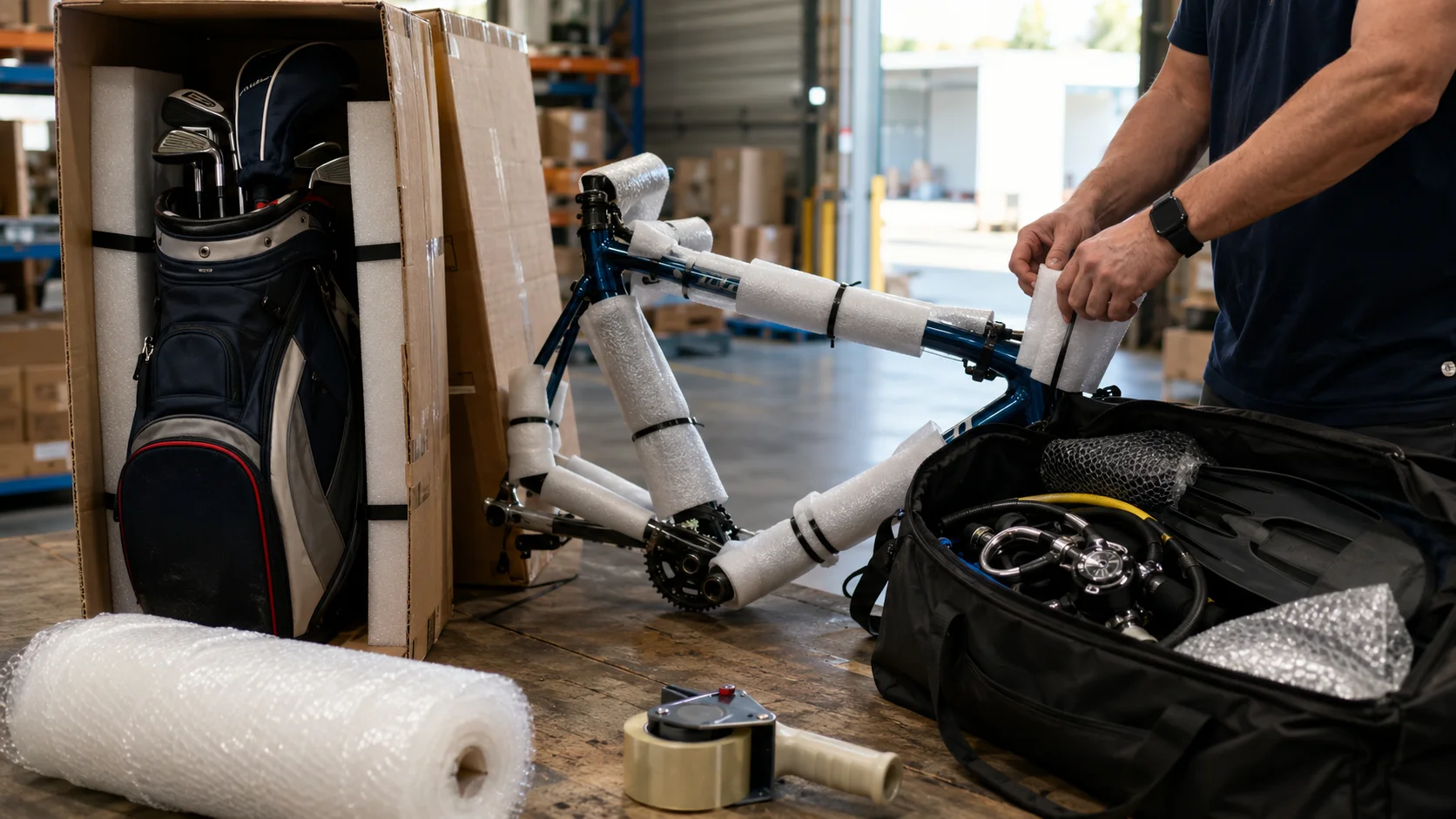
Packing standard: a hard travel case is adequate inside a container; a soft bag should go inside a cardboard golf box at minimum. For a genuinely valuable set (tour-spec irons, a collectible putter), a dedicated timber crate costs USD 60–100 and removes the crush risk entirely. Stuff towels around the club heads, tape the bag’s rain hood down, and pull the adjustable driver head off and box it separately if you can.

Diving Gear: The Tank Is the Problem, Nothing Else Is
Thailand is one of the world’s great diving economies (Koh Tao alone certifies tens of thousands of divers a year), so dive kit rides along in a large share of our shipments. Here is the clean split:
Ships freely: regulators, BCDs, wetsuits, fins, masks, torches (batteries removed or per lithium rules below), dive computers, cameras, weight belts without weights or with them (lead is heavy but harmless). Pack regulators and dive computers as you would electronics: padded, boxed, kept away from anything that can crush a hose or crack a screen. A first stage with a bent hose fitting is a costly service job.
The tank. A pressurised scuba cylinder is dangerous goods under both the IATA Dangerous Goods Regulations for air and the IMDG Code for sea. It cannot travel charged, and “I let most of the air out” does not count. The compliant procedure is specific:
- Drain the cylinder completely to ambient pressure.
- Remove the valve, or leave it fully open, so an inspector can physically verify zero pressure. An opened cylinder is no longer a pressure vessel. It is a metal tube.
- Keep the hydrostatic test documentation with the packing paperwork, and note the empty/valve-open state on the inventory.
Even done correctly, ask yourself whether it is worth it. A standard aluminium 80 costs 8,000–12,000 baht new in Thailand, every dive operation rents them for pennies, and a cylinder that has travelled in a sea container will need a visual inspection (and possibly a hydro test) before any Thai fill station touches it. Most divers we move ship the regulator and BCD and leave the tanks behind. The Laem Chabang story at the top of this article is what the alternative looks like.
Bicycles: Used Is Free, New Is a Trap, Electric Is Complicated
Three bikes, three completely different customs outcomes.
The used personal bike is the easy case. A road or mountain bike you have owned and ridden for a year travels as personal effects within a qualifying relocation. Officers know what a used bike looks like (chain wear, tyre scrub, cable stretch), and it will not raise an eyebrow.
The new bike is the trap. Bicycles attract meaningful Thai import duty (the tariff on complete bicycles has historically sat in the double digits, and 7% VAT stacks on top of the duty-inclusive value). A new bike in its OEM box inside your container is not personal effects; it is a dutiable import that happens to be travelling with your furniture, and it is exactly the kind of thing an X-ray flags. On a USD 3,000 carbon road bike, the duty-plus-VAT bill can run to several hundred dollars, plus the delay while it is assessed. If you have just bought the bike of your dreams before moving: build it, ride it for months, let it acquire honest wear, and ship it as what it will then genuinely be: your used bicycle.
The e-bike adds a lithium problem to whichever of the above applies. The frame and motor are just a bicycle for customs purposes. The battery (typically 400–750 watt-hours) is squarely over the thresholds that make lithium-ion cells regulated dangerous goods. By air, a battery that size travels only as declared cargo under the IATA DGR with UN-spec packaging, and never in a household-effects consolidation. By sea, it can move, but it must be declared, and many consolidators simply refuse loose e-bike batteries in groupage containers. The workable options are: ship the bike without the battery and buy a replacement battery in Thailand; or route the battery through a proper DG channel as a separate declared piece. What you must never do is leave the battery on the bike and say nothing. An undeclared lithium battery discovered in a container triggers the same undeclared-DG cascade as that scuba tank: fines, delays, and consequences for every other shipper in the box.
Disassembly protocol (applies to every bike, electric or not): pedals off (left pedal is reverse-threaded, and the number of sheared crank arms we have seen from people forcing it the wrong way is genuinely impressive), bars rotated or removed, rear derailleur unbolted and zip-tied inside the rear triangle or removed entirely and wrapped, seatpost dropped or pulled, tyres deflated to soft (not flat: some pressure protects the rims), frame padded with pipe lagging or foam at every tube. A proper bike box or a hard bike case, then into the container. A bike thrown in whole “because there’s room” arrives with a bent hanger and scratched everything.
Gym Equipment: The Economics of Dense Freight
Gym gear is where sea freight’s pricing logic works in your favour. Ocean freight charges primarily by volume, and nothing on earth is more volume-efficient than iron. A 150 kg set of plates, bars and dumbbells occupies perhaps 0.3 cubic metres. By sea, that is one of the cheapest-per-kilo things you will ever ship. If you own a good barbell set or a power rack you like, shipping it within a container is close to free at the margin, and equivalent equipment in Thailand (where serious strength equipment is a niche import market) often costs more than Western retail.
Two caveats. First, weight distribution: dense items must be floor-loaded and spread, never stacked over furniture, and your mover needs the weights declared honestly so the container floor loading and the delivery crew are planned for it. Second, powered machines: check the voltage plate before you ship a treadmill or a smart bike. Thailand runs 220V/50Hz, so UK, European and Australian machines plug straight in with at most a plug adapter (Thai sockets take both flat and round two-pin). A US 110V treadmill, by contrast, needs a step-down transformer rated well above the motor’s peak draw. For a 2-horsepower treadmill motor that means a bulky 3kVA+ transformer costing more than the hassle is usually worth. US-spec cardio machines are frequently the right thing to sell before moving; everything unpowered ships.
Kayaks, Surfboards, SUPs and Windsurfers: Paying for Air
Boards and boats invert the gym-equipment economics: they are light and enormous, and freight pricing punishes that. A 9-foot longboard or a 3.5-metre kayak triggers oversized/long-length surcharges in LCL shipping, and by air the dimensional weight makes standalone shipment absurd. The honest guidance:
- Inside your own container (FCL): ship them. The space is yours. Boards travel nose-and-tail protected (foam blocks or purpose-made nose/tail guards), in padded board bags, and for two or more boards a single lightweight timber crate with foam separators is worth the USD 100–150 it costs. Fins off, leashes off, wax scraped (softens in tropical heat and glues everything together).
- In groupage/LCL: get the length surcharge quoted before committing. A single mid-size board is usually fine; a sea kayak may cost more to ship than to replace.
- Windsurf/wing kits: masts and booms bundle into a padded tube bag; sails roll, never fold hard. The board follows surfboard rules.
Thailand’s board market is real but thin outside Phuket. Decent used shortboards circulate, but specific shapes, big-volume boards and touring kayaks are hard to source. If you ride something particular, ship it.
Ski Gear, Fishing Tackle and Fight Kit: The Easy Shelf
Ski equipment in a Thailand shipment sounds like a punchline until you look at flight schedules: Bangkok to Sapporo and Tokyo is one of the busiest expat leisure corridors in Asia, and a Thailand-based family that skis Japan every January is a completely ordinary pattern. Skis, boots and poles ship as personal effects without any issue. The only genuine consideration is storage at destination. Boot liners and skins do not love a year in a non-climate-controlled Thai storage room; keep soft goods in the air-conditioned part of the house and store skis flat, not leaning.
Fishing gear is straightforward: rods in tubes (PVC pipe with capped ends is the gold standard), reels boxed and padded, tackle in its own sealed boxes. No permits for ordinary tackle. The one adjacent trap is spearguns, which fall under Thai weapons regulation, not sporting goods. Leave them out of the shipment entirely unless you have specific clearance.
Muay thai and martial arts equipment (gloves, pads, shin guards, gis, even a heavy bag) ships without restriction. Given that half the people moving to Thailand plan to train, the funnier point is that this is the one category where buying locally is unambiguously better: Thailand manufactures the world’s best muay thai equipment at local prices. Ship your broken-in gloves if they are dear to you; buy everything else at a Bangkok fight shop for half what you paid at home.
A Word on Drones (Because Everyone Asks)
Drones are not sports equipment, but they live in the same mental drawer (the “hobby gear” box), so here is the flag: Thailand regulates drones far more tightly than most sports gear. Every drone flown in Thailand must be registered with the NBTC (the National Broadcasting and Telecommunications Commission). The operator needs registration too, and insurance is mandatory. Flying unregistered carries genuinely severe penalties. The drone itself can be shipped (its lithium battery follows the same DG size rules as any other: most consumer drone batteries under 100Wh are manageable, but declare them), but budget time for the NBTC registration process after arrival and before the first flight. Do not treat a drone like a frisbee with a camera.
Worth pausing on a pattern running through the last few sections. Look at what actually stops a sports-gear consignment, and it is almost never the big, awkward, expensive thing. Nobody’s container gets held for a kayak. The kayak is just a surcharge on the invoice. What stops it is a cylinder with pressure still in it, or a battery nobody wrote down, or a drone packed in a sock drawer, items you could carry under one arm. The reason is not that customs cares more about small objects. It is that the categories carrying real regulatory weight in Thailand happen to be small ones: pressure vessels, lithium cells, radio transmitters. Small things are also the things people forget to mention. Declare the light items carefully. The heavy ones mostly look after themselves.
Air vs Sea for Sports Gear: The Actual Numbers
The decision tree for sports equipment has three branches, and which one you are on matters more than any rate card.
Branch one: you are relocating and have a container or groupage shipment anyway. Put the sports gear in it. Three items round to zero at the margin inside a 20-foot container you have already paid for: a golf bag (0.15 cbm), a boxed bike (0.35 cbm) and a dive bag (0.1 cbm). This is the single most useful sentence in this article. Details on baseline shipment pricing are in our shipping cost to Thailand guide.
Branch two: you are travelling, not relocating. Airline sports allowances beat cargo. A golf bag as excess baggage costs USD 100–200 each way; the same bag as standalone air cargo costs a similar amount in freight but then adds airline terminal fees, airport handling, customs brokerage at Suvarnabhumi and delivery (typically another USD 150–250) and arrives days after you do, as freight, requiring clearance. Excess baggage clears customs with you at the green channel. For anything you can check on your own flight, check it.
Branch three: you are shipping gear alone, with no move attached. This is the awkward branch. Sea LCL minimum charges mean anything under about 1 cbm costs nearly the same whether it is one golf bag or four; air cargo makes sense only for compact, valuable, urgent items. If you find yourself pricing a standalone shipment of a bike and a dive bag, first ask whether a friend’s container, a delayed shipment consolidation, or simply flying with it might not be smarter. Our air freight to Thailand guide walks the chargeable-weight arithmetic in detail.
Worked Example: Golf Set + Road Bike + Dive Kit
Meet a composite client: moving from Manchester to Bangkok on a one-year-plus work assignment, shipping a two-bedroom household in a 20-foot container, and owning a full golf set (three years old), a carbon road bike (18 months old, well used), and a complete dive kit including one steel 12-litre cylinder.
Within the relocation:
- Golf set in hard travel case: 0.15 cbm, personal effects, marginal freight cost effectively £0. Packing materials: £15.
- Road bike, disassembled into a cardboard bike box: 0.35 cbm, personal effects (18 months of documented use), marginal cost £0. Professional disassembly and boxing by a bike shop: £40. Cheap insurance against a bent derailleur hanger.
- Dive kit minus tank: 0.1 cbm, £0 marginal. The cylinder: drained, valve removed, technically shippable, but he sells it in Manchester for £120 and will rent or buy in Thailand. Correct call.
- Insurance: clubs declared as a set at £1,400 replacement, bike at £2,800, dive kit at £900. At a typical 2.5–3% premium rate, the sports gear adds roughly £130–150 to the policy. Declared. Worth it.
- Total incremental cost of moving £5,100 of sports equipment: about £200.
The same gear standalone (no container, hypothetically shipped separately): roughly 0.6 cbm of LCL sea freight at minimum-charge rates, origin handling, destination THC, customs clearance and Bangkok delivery: a realistic all-in of £450–650, six to nine weeks, plus the same £150 insurance. Or by air: chargeable weight around 60–70 kg volumetric, call it £500–700 in freight before clearance fees. The container inclusion is not slightly better. It is five to ten times cheaper. If a relocation is happening at all, sports gear rides free; the mistake is shipping it separately later because “the container was already full of furniture decisions.” Plan the gear into the survey from day one, and request a quote for your own shipment and watch for the destination-side charges covered in our hidden costs guide.
Packing Standards, Category by Category
- Golf clubs: hard case or boxed soft bag; towels around heads; adjustable heads removed; crate only for high-value sets.
- Bikes: full disassembly protocol (pedals, bars, derailleur, seatpost), frame padding, bike box or hard case. Note the frame number on the inventory. It is the serial for insurance.
- Boards: nose/tail guards, padded bags, wax off, fins off; crate multiples together with foam separation.
- Dive electronics and regulators: pack as electronics, padded, boxed, top-loaded, never under weight. Dive computers with user-replaceable batteries travel installed (they are small lithium coin/AA cells, unregulated at that size); note them on the inventory anyway.
- Gym equipment: floor-loaded, weight declared, bars sleeved in pipe lagging, plates in small double-walled boxes (a 25 kg plate destroys a big box from the inside).
- Everything: photograph before packing. Condition photos date-stamp the “used” claim and anchor any insurance conversation.
For how sports gear fits into the wider packing and inventory process, see our full guide to shipping household goods to Thailand.
Five Mistakes That Actually Happen
- The charged dive tank in the container. The opening story. Undeclared dangerous goods, container pulled, everyone’s shipment delayed, fine issued. Drain it, open it, document it, or sell it.
- The new bike in its OEM box. Zero miles is zero exemption. It will be assessed as a new import with duty and VAT, and it advertises itself on X-ray. Use it first or buy it there.
- The undeclared e-bike battery. Left on the bike, wrapped in a jumper, not on the inventory. This is the lithium version of the dive tank and consolidators are actively looking for it. Declare it, DG-route it, or replace it in Thailand.
- The whole bike thrown in unboxed. It arrives with a bent derailleur hanger, scratched frame and a snapped brake lever, and the insurance claim fails on inadequate packing. Forty pounds of bike-shop boxing prevents all of it.
- Insuring the bag, not the set. Clubs get declared as “golf bag: £300” when the contents are £1,400 of matched irons. When two clubs from a set are damaged, a proper pairs-and-sets declaration pays on the set’s diminished value; a vague declaration pays on almost nothing.
Related Reading
- How to Ship Household Goods to Thailand
- Thailand Duty-Free Import Rules for Personal Effects
- Air Freight to Thailand: Rates, Transit Times and Chargeable Weight
- Shipping Costs to Thailand: A Full Breakdown
- Hidden Costs When Shipping to Thailand
- Shipping Antiques and Fragile Items to Thailand: Packing, Insurance and Customs
Most people shipping sports gear treat it as one decision: air or sea, pick a mode, done. The three-branch structure above shows why that’s the wrong frame. A golfer relocating with a container has already paid for the cubic metres a golf bag needs, so the “decision” is really just remembering to pack it, not a shipping choice at all. A traveler flying for a two-week trip is optimizing an entirely different problem, airline excess-baggage allowance against standalone air cargo, where the answer almost always favors checking it on the flight. Someone shipping gear alone, no move and no flight attached, is solving a third problem again. The best-prepared movers don’t apply one rule to all three situations. They correctly identify which branch they’re actually on before they price anything, because the right answer changes completely depending on the question being asked.
Related reading: Lire cet article en français
Frequently Asked Questions
Can I ship a full scuba tank to Thailand?
No. A charged cylinder is dangerous goods and cannot travel in a household shipment. Drain it completely, remove or open the valve so zero pressure is verifiable, and document it, or, more sensibly, sell it and rent tanks in Thailand, where every dive operation supplies them. Regulators, BCDs, wetsuits and dive computers ship without restriction.
Will my bicycle be duty-free as part of a relocation?
A used bike you have owned and ridden for around a year qualifies as personal effects for eligible arrivals. A new bike in its original box is a dutiable import (Thai duty plus 7% VAT) regardless of intent. Put honest miles on it before shipping, or buy after arrival.
Can I ship an e-bike to Thailand?
The bike itself, yes. The lithium battery is regulated dangerous goods under the IATA DGR (air) and IMDG Code (sea) and usually must be declared and shipped through a DG channel or replaced at destination. Never leave it undeclared on the bike. It can stop the whole container.
Is it cheaper to fly golf clubs as baggage or ship them as cargo?
For a trip: baggage, always. USD 100–200 in excess fees beats cargo freight plus handling, brokerage and delivery. For a move: neither. Put them in the relocation shipment, where a golf bag’s 0.15 cbm costs essentially nothing.
Do I need permits for sports equipment in Thailand?
Ordinary gear needs none. The exceptions adjacent to sports gear: drones require NBTC registration and mandatory insurance before flying in Thailand, and spearguns fall under weapons rules. Everything from muay thai pads to kayaks clears as normal goods.
How do I insure a golf set or a bike properly?
Itemise, declare replacement values, and declare sets as sets so the pairs-and-sets principle applies if part of a matched set is damaged. Record the bike’s frame number and photograph everything before packing. Condition photos support both the used-goods claim at customs and any later claim.