
We have been based in Bangkok for fourteen years, and in that time we have seen every variety of freight damage that international shipping produces. The damaged furniture that arrived from a Melbourne consolidation point with forklift tine marks through the side panels. The electronics consignment that arrived at Laem Chabang with water stains across the carton tops, condensation that had accumulated over three weeks at sea and dripped from the container ceiling the entire voyage. The personal effects move where the owner had packed everything carefully in their Sydney home, and the goods arrived in Chiang Mai with broken items that were not broken when they left. Between them, those three shipments show the common causes of shipping damage at work: forklift handling, container condensation and breakage in transit.
Damage in international shipping is not primarily caused by storms at sea or reckless carriers. It is caused by a predictable set of conditions (packaging failures, condensation physics, CFS handling, load shift) that can be identified before a shipment leaves and largely prevented by addressing them at the origin stage.
If your cargo has already arrived and you are dealing with damage right now, the claims process and documentation deadlines matter more than the mechanism. See cargo damage claims and prevention for what to do in the first 24 hours. What follows here is the mechanism itself: why this happens, mode by mode, and the specific measures that prevent it.
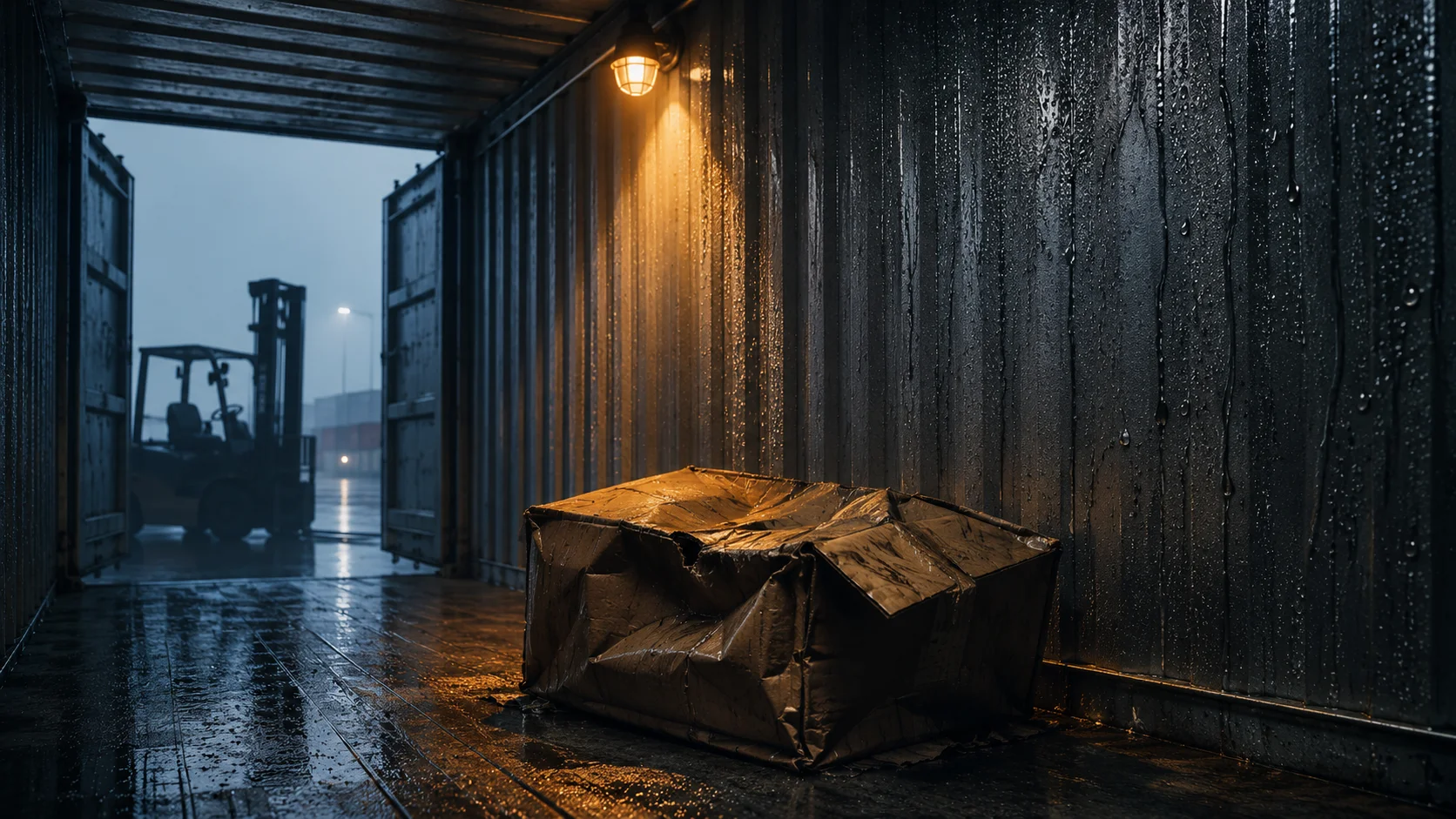
Seven Mechanisms That Damage International Shipments
International freight damage can be categorised into seven distinct mechanisms. Which mechanism is most likely for a given shipment depends on the goods, the packaging, the mode, and the trade lane. That determines which prevention steps matter most.
1. Packaging failure under static load: cartons crushed by the weight of goods stacked above them in a container or on a pallet. It’s the most common cause of damage in FCL sea freight.
2. Container condensation (container rain): moisture that forms inside the container as it transits between temperature zones, drips onto goods, and causes water damage, mould, or corrosion. It’s most common on routes that cross major temperature differentials.
3. Load shift: goods moving inside the container during transit due to vessel motion or road vibration. It causes impact damage when goods collide with each other or with the container walls.
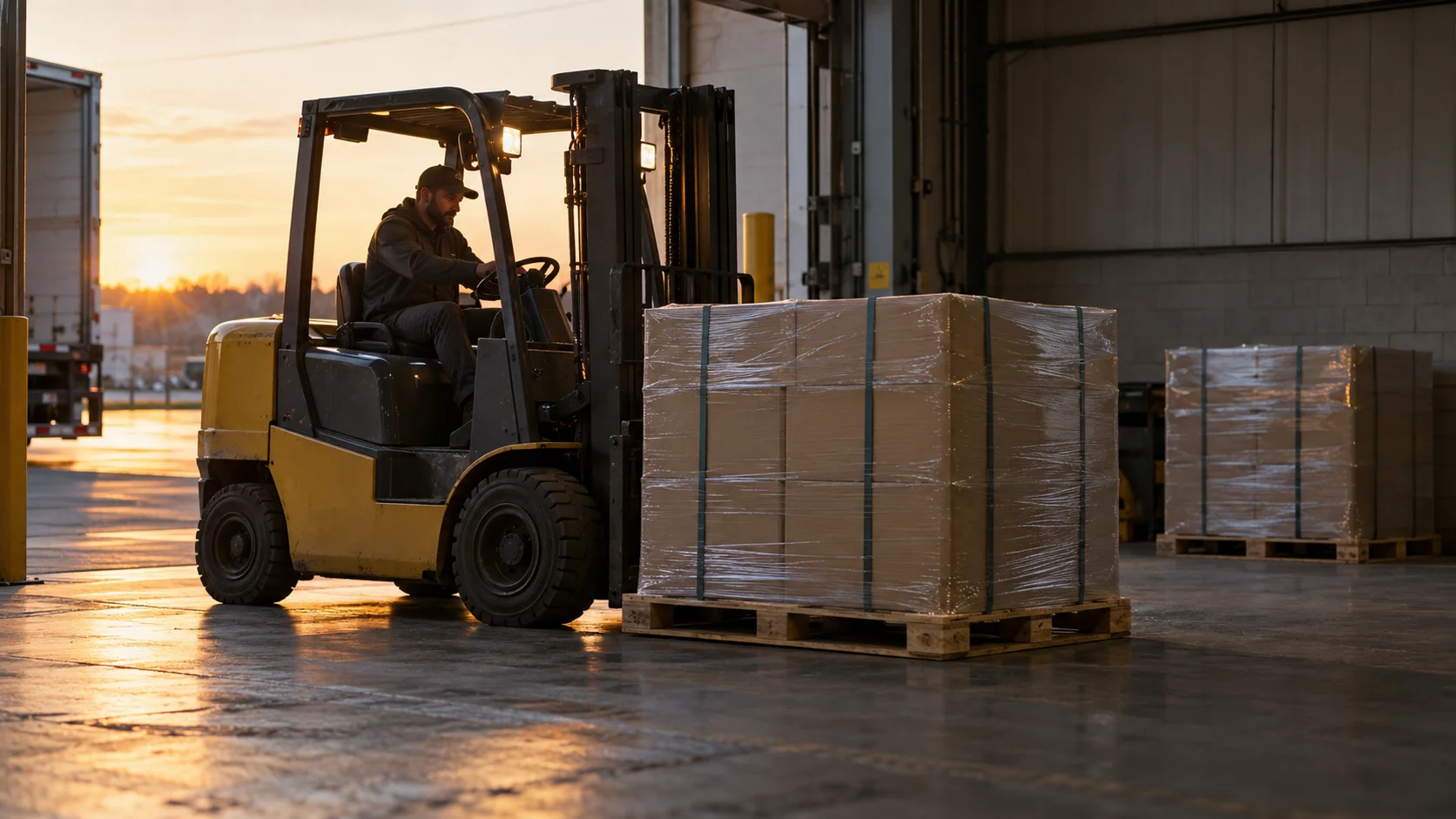
4. CFS handling damage: physical damage caused by forklift operations, manual handling, and pallet stacking during consolidation or deconsolidation at a container freight station. It’s the primary risk for LCL shipments.
5. Moisture intrusion: water entering the container through damaged door seals, holes in packaging, or inadequate moisture barriers. It’s distinct from condensation in that the moisture source is external rather than internal.
6. Examination damage: goods that are physically inspected by customs authorities and not repacked correctly. A carton that is opened, searched, and roughly resealed is more likely to arrive at the consignee with visible damage than a carton that was never opened.
7. Mishandling at warehouse interfaces: forklift damage at the origin warehouse when loading, at the port terminal, at the destination CFS or deconsolidation point, and at the consignee’s warehouse during final delivery. Each handling event is an opportunity for damage.
For most commercial shipments, mechanisms 1, 2, and 4 are responsible for the majority of damage claims. For personal effects moves, mechanisms 1, 3, and 7 dominate.
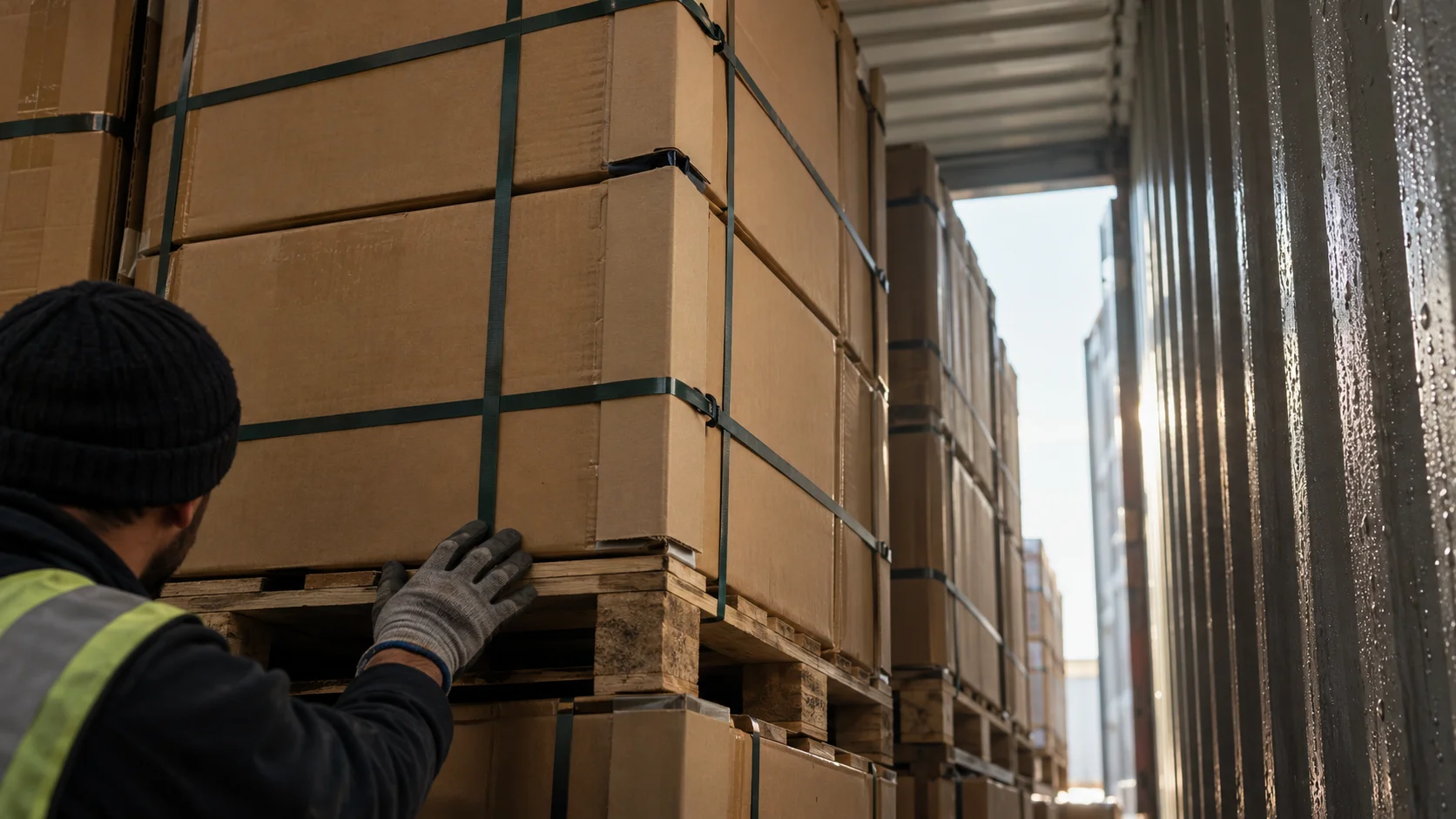
Sea Freight Damage: Container Loading, Stacking, and Moisture
In a loaded sea freight container, the goods on the bottom of each stack bear the combined weight of everything above them. A standard 40ft container can hold 28–30 tonnes of cargo, distributed across its floor area. Cartons at the bottom of a 6-high stack on a 1.2m pallet are bearing more compressive load than they were designed for if the packaging specification assumed 3-high stacking in a domestic warehouse.
The failure mode is predictable: the carton walls collapse inward, the goods inside are crushed or deformed, and the damage is only discovered when the container is unpacked at the destination CFS or the consignee’s warehouse. By that point, the origin packaging failure is days or weeks behind the shipment.
The packing standard that prevents this: cartons must be specified by the importer on the purchase order with an explicit stacking strength requirement (expressed in kilograms of top-load capacity) that accounts for the maximum expected stacking height in a container. For goods shipped in standard cartons from China to Thailand, a minimum of 180 kg top-load capacity is a reasonable starting point for goods that will be palletised and double-stacked. Fragile goods, or goods with high density, require individual assessment.
Void fill inside the carton matters for impact protection but not stacking strength. A well-filled carton that is structurally weak will still fail under stacking pressure. The carton wall and corner integrity are the load-bearing elements; void fill protects the goods from shifting inside a carton that has already failed to protect them from stacking load.
Container condensation is the damage mechanism that surprises importers who thought their packaging was adequate. A shipping container loaded in Bangkok in June (ambient temperature 35°C, relative humidity 80%) crosses to Sydney in July, where the vessel encounters ambient temperatures of 12–18°C as it moves south. The air inside the container, saturated with moisture at tropical temperatures, cannot hold that moisture at colder temperatures. The excess moisture condenses on the container’s steel walls and ceiling (which are the coldest surfaces) and drips onto whatever is below.
The moisture source is not only the air. Timber pallets, wooden dunnage, cardboard cartons, and natural fibre goods all release moisture as humidity changes. A 40ft container loaded with goods packed in unconditioned cardboard on green timber pallets can generate several litres of condensation over a 3-week voyage. Containers are not waterproof inside: they are steel boxes designed to be weathertight from external water, but internal condensation is not an external problem.
To prevent this, address both moisture sources:
- Desiccants: silica gel packets placed inside the container absorb moisture from the air during the voyage. Minimum quantity: 1 kg of silica gel per 10 CBM of container space; for hygroscopic goods (textiles, leather, paper, food), increase to 2–3 kg per 10 CBM. Desiccant bags are hung from container walls or placed on top of cargo, not buried inside cartons.
- Kiln-dried timber: pallets and dunnage made from kiln-dried timber release less moisture than green or air-dried timber. Kiln-drying alone does not satisfy the ISPM 15 biosecurity requirement for Australian imports: the timber must be heat treated to the ISPM 15 schedule (56°C at the core for 30 minutes) and carry the IPPC mark.
- Polyethylene wrapping: wrapping palletised goods in stretch film or shrink wrap before loading adds a moisture barrier that prevents condensation droplets from reaching the goods even if they form on the container ceiling.
- Ventilated containers: available as a specialist equipment type, these containers have vents in the walls that allow air circulation and reduce the temperature differential between the container interior and exterior. Suitable for goods that can tolerate airflow (coffee, cocoa, spices, some foods) but not for goods that require controlled humidity.
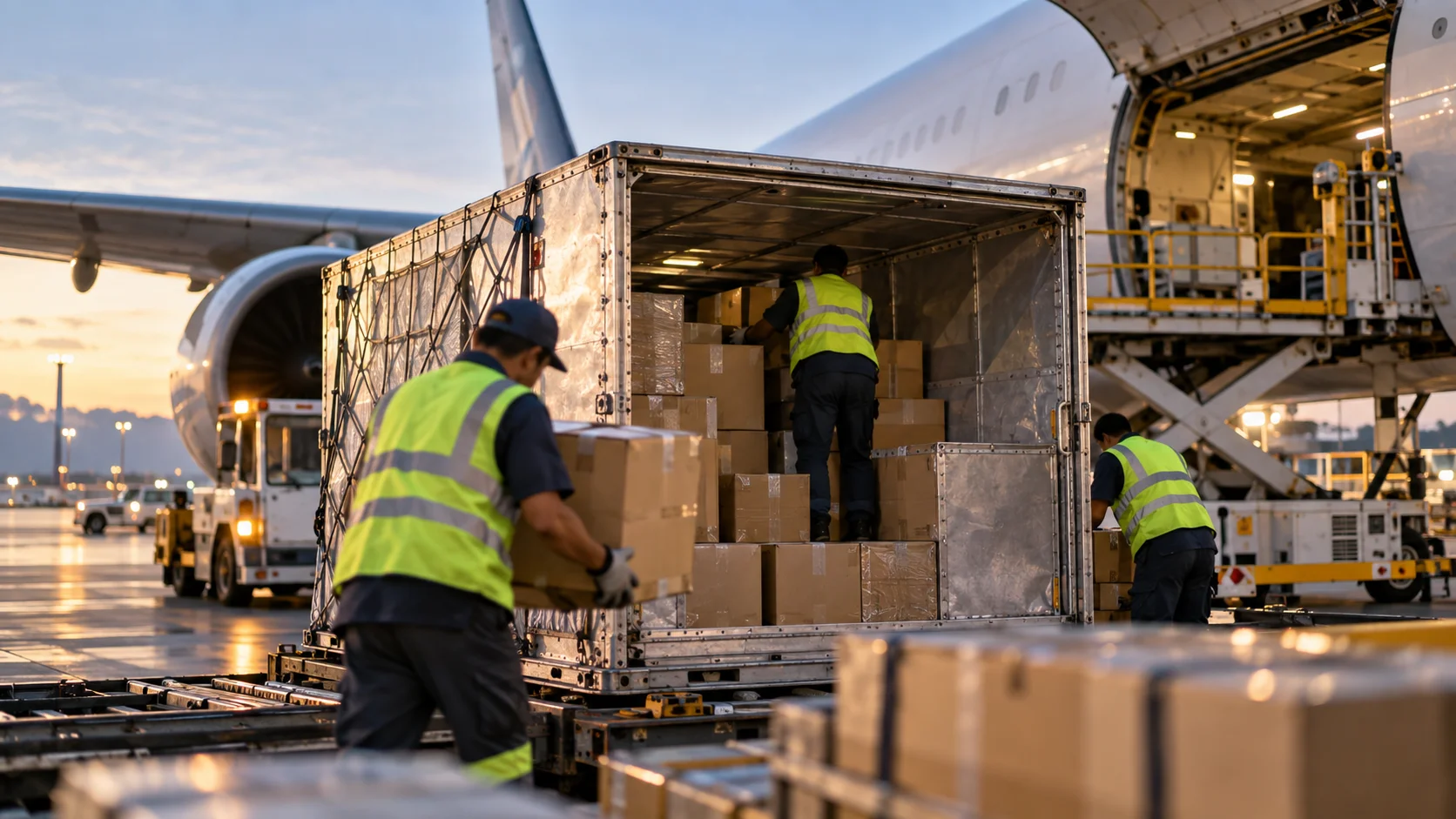
Air Freight Damage: Handling and the ULD Environment
Air freight damage occurs at different points in the chain than sea freight damage. The transit itself (in the pressurised hold of a passenger or freighter aircraft) is a controlled environment. Temperature and pressure in the hold are maintained at levels suitable for most cargo. The damage events in air freight happen at the ground handling interfaces.
Air cargo is built into Unit Load Devices (ULDs), aluminium containers or pallets designed to fit the aircraft’s cargo hold geometry. Goods arrive at the cargo terminal, are accepted and screened, and are then assembled into these units by ground handling agents. Building a ULD means stacking goods to its weight and volume limits. Cartons at the base of a ULD build bear the load of everything above them, and ground handlers building ULDs are working at speed.
The specific damage risk for air freight: goods packed in cartons designed for road or sea transit are not necessarily sized for efficient ULD loading. Cartons that leave voids in the ULD build are filled with other cargo; cartons that protrude beyond the ULD profile are compressed. The result can be crush damage on the carton faces that contact adjacent cargo or the ULD wall.
For Bangkok’s Suvarnabhumi airport, goods arriving as general air freight are handled by THAI Cargo or Bangkok Flight Services (BFS) depending on the airline. For express courier (DHL, FedEx, UPS), the handling is tighter and more controlled, which is one reason express courier damage rates are lower than general air freight. The courier envelope is also the primary packaging, not an afterthought.
For high-value or fragile goods shipped by air, individual carton marking (THIS WAY UP, FRAGILE, HANDLE WITH CARE) protects the goods only marginally. The more effective intervention is carton design. Size the carton to fit a ULD build efficiently and cushion it internally against the compressive force of ULD loading: a carton built this way performs better than one marked fragile that collapses under compressive load regardless of the label.
CFS Handling: The LCL Risk That Most Importers Underestimate
LCL (Less-than-Container-Load) shipments are consolidated with other importers’ cargo at an origin CFS, loaded into a shared container, deconsolidated at a destination CFS, and stored there until the individual consignees arrange collection. A single LCL consignment is typically handled at minimum four times before the importer collects it: at the origin CFS when consolidated, during container loading, during container unloading, and at the destination CFS when deconsolidated.
Each handling event is an opportunity for forklift damage, improper stacking, or carton crushing. TT Club loss prevention data consistently identifies CFS and warehouse handling among the leading contributors to cargo claims globally. At the destination CFS in Thailand (Laem Chabang’s CFS facilities handle large volumes of LCL cargo from Australia, China, and Europe), consignments wait for the container to complete customs clearance and for the deconsolidation process to work through all the cargo in the container. During this wait, cartons are stacked in the CFS shed, often not under controlled conditions. That is why CFS handling ranks among the common causes of shipping damage for LCL cargo in particular.
The CFS risk is asymmetric: a damaged carton in a consolidated container means that one importer’s goods were damaged by another’s poorly packed cargo sharing the same space, or by CFS forklift operations that the importer had no visibility over. When this happens, photographic evidence of the damage condition at the CFS is critical for insurance claims. Damage noted on the delivery receipt is the documentation that supports the claim; damage discovered after collection with no CFS evidence is significantly harder to claim.
Mitigation for LCL shipments:
- Pallet all cartons: palletised LCL cargo is handled as a unit (forklift under the pallet) rather than as individual cartons (manual stacking). This reduces the number of individual handling events and reduces the risk of cartons being placed under heavy cargo by CFS workers who are consolidating multiple consignments.
- Sturdy outer packaging: use double-wall cartons for anything fragile, or timber crating for anything that cannot absorb forklift incidental contact.
- Corner protectors and edge boards: protect carton corners from forklift tine contact and pallet band crushing
High-Risk Conditions by Trade Lane and Season
Some routes and seasons produce higher damage rates than others.
Australia to Thailand (sea freight, LCL): The routing from Australian ports to Laem Chabang typically transships at Singapore. This adds one additional container manipulation (transshipment) to the standard sea freight journey. LCL cargo may also change CFS at Singapore during transshipment. That adds two more handling events. For fragile LCL cargo from Australia, this route has above-average handling exposure compared to direct port-to-port services.
China to Thailand (sea freight, direct): The Shanghai-Laem Chabang and Guangdong-Laem Chabang services are short (5–9 days ocean transit), which reduces condensation exposure compared to longer routes. The primary risk on this lane is CFS handling in both countries and load quality at the Chinese origin CFS, where consolidation standards vary by facility and operator.
Monsoon season (June–October, Bay of Bengal): The monsoon season affects the Bay of Bengal routing used by some services from South Asia and the Indian subcontinent. For Thailand-origin or Thailand-bound cargo, the more significant monsoon effect is on inland transport within Thailand. Roads in northern Thailand and the Mekong region can be affected by flooding during the monsoon, adding transit time and road condition risk for inland delivery from Laem Chabang to Chiang Mai or beyond.
Q4 peak congestion (October–December): Port congestion during the Q4 peak shipping season extends container dwell times at terminals and CFS facilities. Longer dwell time means more handling events and more exposure to storage conditions. For temperature-sensitive goods, extended CFS storage during Thai wet season can compound moisture risk.
Packing Standards That Prevent Damage
Damage prevention begins at the supplier’s packing bench, not at the port. The most effective intervention is issuing a written packaging specification with every purchase order and verifying compliance via pre-shipment inspection before the container is sealed.
A complete packaging specification for international sea freight should address:
Carton strength: specify the minimum bursting test (kPa) or edge crush test (ECT) value for cartons, based on the goods weight and the maximum expected stack height. For most commercial goods going into sea freight containers, a minimum 400 kPa bursting test or 7.2 kgf/cm ECT is appropriate; heavier goods or taller stacking heights require stronger cartons.
Inner packaging: specify the void-fill material (polyethylene foam, bubble wrap, kraft paper, air pillows) and the minimum clearance between the goods and the carton wall on each face. For fragile goods, a minimum 5 cm of cushioning on all six faces prevents goods from impacting the carton wall during transit vibration.
Moisture protection: for goods sensitive to moisture (electronics, leather, textiles, paper), specify that each carton contains a moisture-barrier lining (polyethylene bag or liner) in addition to any outer carton wrapping.
Pallet specifications: specify pallet dimensions (1200×1000 mm or 1200×800 mm, depending on container floor width optimisation), maximum weight per pallet, and whether pallets must be kiln-dried/ISPM 15 treated. Specify whether goods should be stretch-wrapped to the pallet and to what height. An unwrapped pallet of cartons in an LCL CFS is a stable surface for someone else to stack their cargo on top of. The wrapping makes it one unit.
Marking requirements: cartons should be marked on two adjacent sides with consignee name, PO number, carton number (e.g., 1/24, 2/24), gross weight in kg, net weight in kg, country of origin, and any special handling instructions. Use indelible ink for all marks; marks that cannot be read in the CFS shed cannot be matched to a packing list during deconsolidation.
What Carrier Liability Actually Covers
When goods are damaged in transit, the carrier’s liability is governed by international convention rather than by the commercial value of the goods. For sea freight, the Hague-Visby Rules apply to most international shipments:
- Maximum liability per package: SDR 667 (approximately AUD 1,300 at mid-2026 exchange rates)
- Maximum liability per kilogram: 2 SDR (approximately AUD 3.90 per kilogram)
- The higher of the two applies
Take a carton of electronics declared as one “package,” with a commercial value of AUD 8,000 and a weight of 25 kg. Its carrier liability cap is:
- Per package: AUD 1,300
- Per kilogram: 25 kg × AUD 3.90 = AUD 97.50
- Applicable cap: AUD 1,300 (higher of the two)
The carrier owes the importer a maximum of AUD 1,300 on AUD 8,000 worth of damaged goods. The remaining AUD 6,700 is the importer’s loss unless cargo insurance is in place.
The Hague-Visby Rules also include carrier exemptions, circumstances under which the carrier owes nothing even when goods are damaged. These include: errors in navigation or management of the ship, fire (unless caused by the carrier’s actual fault), perils of the sea, acts of war, acts of God, inherent defect of the goods, and insufficient packaging. The insufficient packaging exemption is relevant: if the importer fails to pack goods adequately for sea transit, the carrier may successfully argue it owes nothing at all.
Cargo Insurance: What to Buy and How to Value It
Cargo insurance under the Institute Cargo Clauses (ICC) provides three levels of cover:
ICC-A (All Risks): the broadest cover. Covers all risks of physical loss or damage to the insured cargo except for the named exclusions (inherent vice, delay, war, strikes). For commercial shipments, ICC-A is the appropriate standard; it is the cover that responds when damage occurs from causes that are not yet determined.
ICC-B (Named Perils, broader): covers fire, explosion, vessel stranding, grounding, capsizing or overturning, collision, discharge at port of distress, earthquake, lightning, general average, jettison, and entry of sea water. Does not cover theft, contamination, or rough handling unless evidenced by the named perils.
ICC-C (Named Perils, narrower): the most restricted cover. It suits bulk cargo or low-value shipments where the specific risk is well-defined, but it isn’t appropriate for commercial cargo in cartons.
The insured value formula: CIF value + 10–15%. The 10–15% addition covers the anticipated profit on the goods. The importer’s loss is not just the cost of the goods but the margin they would have made selling them. For personal effects, the insured value is the replacement value of the goods in the destination country, not the original purchase price.
Premium cost for ICC-A on general cargo runs approximately 0.1–0.5% of the insured value. On an AUD 60,000 CIF shipment, the premium is AUD 60–300. On a AUD 30,000 personal effects move, the premium is AUD 30–150. The premium reflects the commodity risk, packaging standard, trade lane, and the importer’s claims history.
Confirm one clause with your insurer before shipping: the survey requirement, which conditions the claim on noting damage at the time of delivery and requesting a survey within a set window, typically three business days. Miss either step and the insurer can decline even a genuine loss. Cargo damage claims and prevention covers this process in full, including what to write on the receipt and how the notification window works.
Most transit damage is not bad luck. It happens in the handoffs, the moments when your cargo belongs to nobody in particular. Call it the custody gap. The container is stuffed by a CFS operator who will never meet you, ridden by a vessel crew who cannot see inside it, and unpacked by a warehouse team paid for speed rather than care. Every one of those parties is doing their job correctly, and your carton still bursts, because no single one of them owns the outcome you actually care about. The importers who stop losing goods do one unglamorous thing: they close the gap in advance. They write the packing specification into the purchase order, so the responsibility for surviving the journey sits with the supplier before the goods ever move, not with whoever happens to be holding the box when it fails.
If Your Shipment Has Already Arrived Damaged
What you document in the first 24 hours after delivery decides the outcome of the claim more than anything else in this guide: what you note on the delivery receipt before signing, whether you photograph before unpacking, and whether you notify the insurer inside the policy deadline. Cargo damage claims and prevention walks through the full process, including the two moments that decide most claims and a real case where a claim failed on the documentation, not the damage.
If you are shipping personal effects or commercial cargo to Thailand and want to understand the damage risk profile for your specific goods, route, and packaging, Swift Cargo’s Thailand specialists can advise on packaging requirements and connect you with cargo insurance options appropriate for the shipment.
Preventing the Common Causes of Shipping Damage
For commercial cargo, packaging that fails under stacking load, container condensation and CFS handling account for most claims, so write carton strength, moisture protection and pallet wrapping into the purchase order and verify them before the container is sealed. Carrier liability rarely covers the full loss, so insure under ICC-A at CIF value plus 10 to 15%.
Frequently Asked Questions
Why do shipments get damaged during international shipping?
The most common damage causes in international shipping are: (1) improper packaging that fails under sea freight stacking weight or air freight handling; (2) container condensation (‘container rain’) caused by temperature differentials as a vessel crosses climate zones; (3) load shift inside the container from insufficient securing or overweight top-loading; (4) rough handling at container freight stations (CFS) during LCL consolidation and deconsolidation; (5) moisture intrusion through container door seals or holes in packaging; (6) forklift damage at origin or destination warehouses; and (7) examination damage when customs authorities unpack and repack cargo. Most damage is preventable with correct packaging specifications issued to the supplier before shipment.
Who is liable when goods are damaged in international shipping?
Carrier liability for sea freight damage is governed by the Hague-Visby Rules, which cap the carrier’s liability at SDR 667 per package or 2 SDR per kilogram, whichever is higher. At current SDR values, this equates to approximately AUD 1,300 per package, far below the value of most commercial shipments. Carriers are also exempt from liability for a range of ‘nautical fault’ circumstances including navigation errors, fire, and acts of God. In practice, the carrier’s liability rarely covers the actual loss. Cargo insurance (ICC-A All Risk or ICC-B Named Perils) covers the gap between carrier liability and the actual value of the goods.
What is container rain and how do I prevent it?
Container rain is condensation that forms inside a shipping container when warm, humid air at the origin port cools as the vessel transits to a colder climate zone. Water vapour in the air, and moisture absorbed by timber packaging, dunnage, or the goods themselves, condenses on the container’s steel walls and ceiling, then drips onto the cargo below. Prevention methods: use desiccant packets inside the container (minimum 1 kg of silica gel per 10 CBM of cargo space); use ventilated containers for hygroscopic goods; ensure timber packaging and dunnage are kiln-dried; wrap goods in polyethylene sheeting before loading. Routes most affected by container rain are those crossing major temperature differentials: Australia-Japan, China-Northern Europe, Southeast Asia-Scandinavia.
Do I need cargo insurance for international shipments?
Cargo insurance is not legally required, but carrier liability is so limited under the Hague-Visby Rules (SDR 667 per package, approximately AUD 1,300) that most commercial shipments are effectively unprotected without it. All Risk cargo insurance (ICC-A) typically costs 0.1–0.5% of the insured value depending on commodity, packaging, and trade lane. On a AUD 50,000 shipment, that is AUD 50–250 in premium. The insured value should be calculated as CIF value plus 10–15% to cover the anticipated profit on the goods. For personal effects moves, the same logic applies: a 20ft container of household goods worth AUD 30,000 has a carrier liability cap of less than AUD 20,000, usually less, once the per-package calculation is applied.