
Every winter, a wave of Australian retailers and ecommerce sellers makes the same discovery at the same time: outdoor living is a seasonal import category with a biosecurity problem attached. The products look simple. A teak dining setting, a four-burner BBQ, a stack of terracotta pots. But between the factory in Vietnam and the customer’s deck in Brisbane sits the world’s strictest biosecurity regime, a gas appliance certification system with genuine teeth, and a selling season that opens in September whether your container has arrived or not.
Think in Risk Tiers, Not Product Lists
The most useful mental model for this category is not a product catalogue. It is a risk map with two axes: biosecurity risk (does DAFF care about this?) and regulatory risk (does a safety regulator care about this?). Every outdoor product sits somewhere on that grid, and where it sits determines your documentation burden, your inspection probability, and your downside if something goes wrong.
Low on both axes: a powder-coated steel fire pit. It is inert metal. Nobody at the border loses sleep over it. High on biosecurity, low on regulatory: untreated timber furniture. High on regulatory, low on biosecurity: a gas BBQ. High on both: almost nothing, which is a small mercy.
The frame matters because importers who think in product lists get surprised one SKU at a time. Importers who think in risk tiers ask the right question before ordering anything new: what is this made of, and what does it do? Plant material and soil trigger biosecurity. Gas and electricity trigger safety certification. Claims on the box trigger consumer law. Run every product through those three filters and the category stops producing surprises.
The Biosecurity-Heavy Half of the Category
Outdoor Timber Furniture
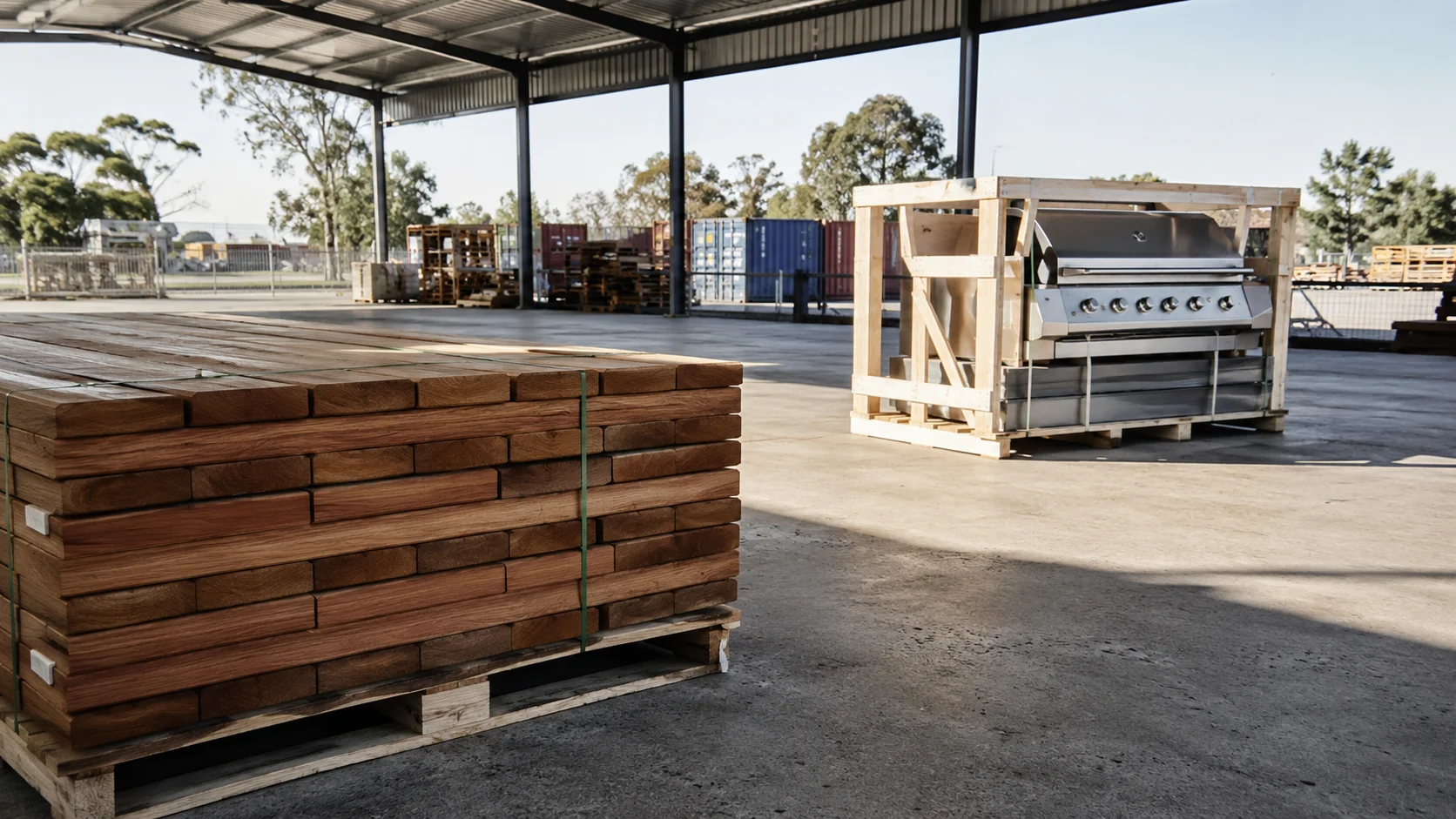
Timber is where the Department of Agriculture, Fisheries and Forestry (DAFF) concentrates its attention, and for good reason: wood borers, bark beetles and termite species that Australia does not have arrive hidden inside wood that looks perfectly finished. The distinction that matters is treated and processed versus raw and untreated.
Commercially manufactured furniture from kiln-dried, treated timber (the standard output of established Vietnamese and Indonesian factories) is generally low-friction. The timber has been through processes (kiln drying, machining, finishing) that kill or exclude pests. Where importers get into trouble:
- Raw or semi-processed timber elements. Rustic-style furniture with bark still attached, live-edge slabs, untreated hardwood logs turned into stools. These are treated as raw timber, not furniture, and raw timber needs treatment evidence (heat treatment or fumigation certificates from an approved provider) or it gets treated on arrival at your cost, or exported, or destroyed.
- Borer holes. Visible insect exit holes in timber are an inspection failure even if the insect is long dead. Factories in the tropics sometimes use borer-affected timber in low-visibility components. Put it in your QC checklist: no insect damage, anywhere, including undersides and frames.
- Packaging. All solid timber packaging (pallets, crates, dunnage) must be ISPM 15 compliant, stamped with the treatment mark. This is old news to experienced importers, but note the subtlety: when your product is raw timber, ISPM 15 on the pallet does not cover the product itself. The product needs its own treatment pathway. Plenty of first-timers assume the pallet stamp covers everything in the crate. It does not.
Check the specific commodity in DAFF’s BICON database before you order. Conditions change, and the database, not a blog post, is the authority. Our biosecurity requirements when importing to Australia guide gives a deeper grounding in how the system works.
Bamboo, Rattan and Cane
These materials deserve their own paragraph because they trip up importers who think of them as “furniture” when DAFF thinks of them as “plant material.” Bamboo in particular is a borer hotel. The rule of thumb: commercially manufactured, fully processed items with treatment certificates are importable; anything raw, bark-on, or undocumented is a problem. Get your supplier to provide heat treatment or fumigation documentation as a condition of the order, and expect a higher inspection rate than for hardwood furniture regardless. If your supplier cannot explain their treatment process, that tells you something about the shipment’s prospects at the border.
Garden Tools
Here the distinction is new versus used, and it is absolute. New garden tools (spades, secateurs, hose fittings) are unremarkable general cargo. Used garden tools, including anything sold as vintage or reconditioned, are a biosecurity risk item because of one word: soil. Soil is essentially prohibited. It can carry everything from fire ant colonies to plant pathogens. Any used equipment with soil residue will fail inspection, and “we brushed it off” is not a cleaning standard DAFF recognises. If you are importing used machinery or tools, they must be cleaned to a genuinely soil-free, as-new standard, and even then expect inspection. For most commercial importers the answer is simpler: import new.
Planters, Pots and Growing Media
Terracotta, glazed ceramic, fibreglass and plastic pots are fine: they are inert manufactured goods. The trap is anything that ships with growing media. Pre-planted arrangements, pots with a “starter soil disc,” hanging baskets lined with coco fibre and filled with compost: growing media and soil are prohibited or heavily restricted. Coco peat and coir products have their own specific conditions. If a supplier offers to include “free soil pellets” as a value-add, decline firmly.
Decorative Stone, Pebbles and Water Features
Stone and pebbles are generally clean from a biosecurity standpoint provided they are washed and free of soil and organic matter. The real question with stone is economic, not regulatory: it is extraordinarily heavy relative to its value. A container of pebbles hits maximum legal weight at a fraction of its cubic capacity, so your freight cost per dollar of product value is brutal. Run the numbers before assuming stone is a good container filler.
Water features split into two components: the vessel (stone, resin, ceramic: simple) and the pump (an electrical appliance: not simple). Any mains-powered pump needs to comply with Australian electrical safety requirements and carry the Regulatory Compliance Mark (RCM). Low-voltage solar-powered features are lighter-touch but still need compliant transformers if mains-charged. Do not treat the pump as an afterthought bundled with the fountain; it is the regulated part of the product.
The BBQ Sub-Category: Where Certification Gets Serious
If timber is the biosecurity heart of this category, BBQs are its regulatory heart. And the stakes are higher, because a biosecurity failure costs you a shipment while a gas safety failure can cost you the business.
Gas BBQs
Australia runs its own gas appliance certification system. Appliances must be certified against the relevant Australian standard (for outdoor gas BBQs, AS 4557 is the reference standard) and carry approval recognised by state gas technical regulators. Certification has historically run through bodies such as the Australian Gas Association (AGA) and state-based approval schemes, and retailers will not stock an uncertified unit.
You can’t just import the BBQ that sells well in the US or Europe because the appliance is engineered for a different gas supply. Australian LPG and natural gas differ in pressure and composition from overseas supplies, and the jets, regulators and burner tuning are specific to them. An overseas BBQ connected to Australian LPG can run over-gassed, producing dangerous flame characteristics and carbon monoxide. This is why the rules exist, and it is why enforcement is not theoretical: selling uncertified gas appliances exposes you to serious penalties, product recalls, uninsurable liability, and personal exposure if someone is hurt. Of all the mistakes in this guide, this is the one that ends companies.
Your options as an importer: buy from factories that already produce Australian-certified models (many large Chinese BBQ factories do, so ask for the certificate and verify it), or fund certification yourself, which costs real money and months of lead time and only makes sense at volume. There is no third option.
Electric Grills and Outdoor Heating
Electric grills, plancha tops and electric pizza ovens are regulated as electrical appliances: RCM marking, compliance with electrical safety standards, and registration on the national database where required. This is a well-trodden path (the same one every appliance importer walks), but it is still a path, not a formality.
Outdoor heating splits neatly along the same fault line. Gas patio heaters: full gas certification, exactly as with BBQs, and worth extra caution because the mushroom-style heater market has a long history of grey imports. Wood-fired fire pits and chimineas in steel or cast iron: simple, unregulated metal goods. Charcoal BBQs likewise: no gas, no electricity, no certification. If you want an easy entry point into the outdoor category, charcoal and fire pits are it.
Shade, Shelter and the Claims You Make
Umbrellas, gazebos and shade sails are structurally simple imports: aluminium, steel, polyester. The regulatory exposure here is not the product but the packaging copy. Two claims dominate this segment, and both are governed by Australian Consumer Law (ACL), enforced by the ACCC:
- Wind ratings. “Withstands winds up to 40 km/h” is a factual claim. If the gazebo folds in a 25 km/h gust, that is a misleading representation under the ACL. Either have test data behind the number or do not print the number.
- UV protection. “UPF 50+” is a testable, certifiable claim under Australian/New Zealand UV protective standards. Substantiate it with actual UPF test reports on the actual fabric batch, not the supplier’s assurance. Sun protection claims in the Australian market attract scrutiny for obvious public health reasons.
The pattern to internalise: in this segment you are not importing a product so much as importing a set of claims, and you own every one of them the moment you offer the product for sale.
Outdoor Textiles: Cushions, Covers and the Mould Problem
Outdoor cushions and furniture covers are regulatorily boring and logistically treacherous. Textiles shipped through tropical humidity in a sealed container are a mould culture waiting to happen. Condensation forms on container walls as the ship moves through temperature zones (“container rain”), drips onto cargo, and three weeks later you open the doors in Brisbane to the smell of a failed shipment. Mouldy textiles are also a biosecurity flag.
The mitigations are cheap and standard: dry containers inspected before loading (no roof holes, sound door seals), adequate desiccant dosing hung through the container, moisture-barrier bagging on the cushions themselves, and confirmed dry-season or climate-controlled warehousing at origin. Spend the extra hundred dollars on desiccant. It is the best-value insurance in freight.
One more seasonal overlay: shipments from BMSB risk countries (parts of Europe and Asia designated by DAFF) during the September-to-May brown marmorated stink bug season may require mandatory offshore treatment depending on origin and cargo type. Outdoor furniture from Vietnam is outside the core BMSB target list, but if you also source from Italy or other risk countries (outdoor heaters and premium furniture often come from Europe), check the current season’s requirements before booking. How these seasonal measures interact with routine screening is the subject of our DAFF biosecurity inspection triggers breakdown.
Seasonality: The Economics That Decide Whether Any of This Makes Money
This is the strategic layer that separates professional outdoor importers from opportunists. The Australian outdoor selling season runs roughly September to March, peaking hard through November and December. The Christmas BBQ is a cultural institution, and it is bought in the eight weeks before Christmas. April to August, the category hibernates.
Now work the calendar backwards from a September selling start:
- Stock landed and warehoused: by early August. This is your anchor date. Everything else derives from it.
- Vessel departure from Asia: late June to early July. Allow 3 to 4 weeks transit Vietnam or China to the Australian east coast, plus 1 to 2 weeks for clearance, any inspection, and delivery to your warehouse.
- Production complete: mid-June. That means production starts late April to May for a typical 4 to 6 week furniture production run.
- Purchase order placed and deposit paid: April to May. In the depths of the Australian autumn, when outdoor products feel maximally irrelevant and your cash wants to go elsewhere. Placing a large outdoor order in April requires conviction. That is precisely why it works.
There is a genuine structural advantage hiding in this calendar. Your peak ordering window (April–June) lands well before the northern hemisphere’s own big ordering push: by the time northern hemisphere retailers are placing their big orders for their spring (roughly August–November), you are already done. A southern hemisphere importer who orders in April is buying factory capacity when the factory wants the work, negotiating from the quiet side of the calendar. You will typically get better pricing, better timeline commitments and first pick of production slots than a buyer competing in the northern peak. Freight rates follow a similar seasonal rhythm. Check our seasonal freight pricing to Australia guide to see when the cheap sailings fall.
The failure mode is equally structural. Order in July because “the season is coming and we should get stock,” and your container lands in October, a third of the season gone. Order in November chasing a strong start to the season, and you land in February, selling into a dying market and carrying the stock through winter. Outdoor stock that misses its season is not slightly less valuable; it is capital frozen for eight months, minus storage. The calendar is unforgiving, so respect it more than any other variable in this category.
The Freight Profile: You Are Shipping Air
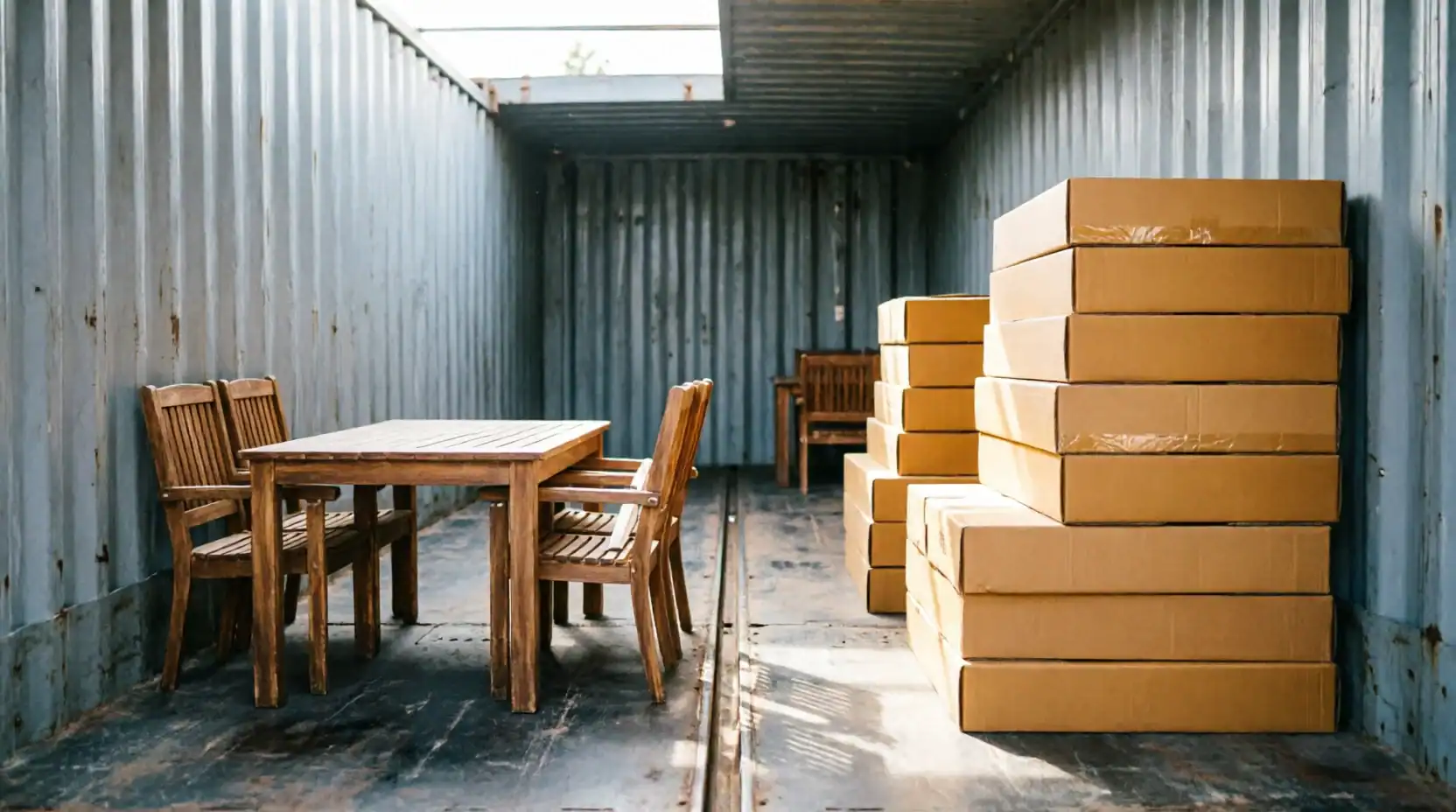
Outdoor furniture is the definitive volume-monster cargo. A 40ft high-cube container gives you about 76 cubic metres of usable space and a payload limit around 26 tonnes. A container of outdoor furniture “weighs out” at maybe 8 to 12 tonnes. You will hit the walls long before you hit the scales. Every landed-cost calculation in this category is therefore a cube calculation.
Which brings us to the single most consequential product decision: flat-pack versus assembled.
Take a 9-piece outdoor dining setting (table plus eight chairs). Assembled, with chairs nested as best the packers can manage, the set occupies roughly 3.5 to 4 cubic metres of container space. Flat-packed, with the table top separate from legs and chairs knocked down into dense cartons, the same set packs into 1.2 to 1.4 cubic metres. That is nearly a 3:1 ratio, and it flows directly through your unit economics: the assembled container carries perhaps 19 settings; the flat-pack container carries 55 to 60. Freight cost per setting drops from roughly $370 to about $120 on a $7,000 all-in container cost. Same product, same factory, same ship: a $250 per-unit difference created entirely by packing engineering.
The classic trap is the assembled teak set. Premium teak furniture is often built fully assembled with mortise-and-tenon joinery: genuinely better construction, and genuinely impossible to knock down. If you import assembled teak, accept that you are paying triple freight per unit and price accordingly; it can still work at the premium end. Importing mid-market assembled furniture into a price segment where competitors flat-pack does not work. They will beat your landed cost by hundreds of dollars per set and you will not understand why until you audit the cube.
Beyond flat-packing, container utilisation for bulky goods is its own discipline: carton dimensions designed to the container’s internal geometry (a carton that is 5cm too wide to fit three-across wastes a full column of space down the container’s length), mixed loading with dense goods low and light bulky goods high, and floor-loading versus palletising decisions (floor-loading recovers 10 to 15% of cube at the cost of slower devanning). On a product this volumetric, an afternoon spent on a load plan with your forwarder is worth more than a month of freight-rate negotiation.
The flat-pack-versus-assembled decision is really a question about what job the piece is hired to do for the end customer. A budget outdoor dining set is bought to fill a patio at a price point: the customer’s job is furnishing a space affordably, and flat-pack construction serves that job perfectly well. A premium teak set is bought as a statement piece, sometimes as a wedding gift or a long-term investment in a permanent home: the customer’s job includes the tactile confidence of mortise-and-tenon joinery, and a flat-pack version of that product would fail at the actual job it was bought for, however much freight it saved. Match the construction method to what the customer is really buying, not to whichever option happens to fit more units in a container.
Duty, GST and the FTA Angle
The tariff picture is mercifully simple. Most garden and outdoor products (furniture, BBQs, umbrellas, tools, pots) attract a general duty rate of 5%, with 10% GST applied on the landed value (customs value plus duty plus international freight and insurance). Confirm your specific tariff classification with the Australian Border Force (ABF) working tariff or through your broker, because classification determines everything downstream.
The 5% stops mattering when origin enters the picture. Indonesia and Vietnam (the two dominant origins for timber outdoor furniture) are both AANZFTA parties, and qualifying goods enter Australia duty-free with valid origin documentation. On a $60,000 container of furniture, that is $3,000 of duty eliminated by a certificate your supplier can arrange for a nominal fee. There are few easier wins in this business. The mechanics of origin documentation and supplier management differ by country; we have covered both routes in detail in our guides to importing furniture from Indonesia and importing furniture from Vietnam.
Chinese-origin goods similarly benefit from ChAFTA preference on most of this category: relevant for BBQs, umbrellas and steel goods, where China dominates production.
Worked Example: A 40ft of Flat-Pack Outdoor Settings, Vietnam to Brisbane
Let us land a real container, on the correct calendar. Purchase order placed in early May; production June; vessel ex Ho Chi Minh City early July; landed Brisbane late July; in your warehouse the first week of August, ready for the September season.
The cargo: 55 flat-packed 7-piece acacia outdoor dining settings (kiln-dried, treated, FSC-certified timber; powder-coated aluminium frames) at USD $520 FOB each.
- Goods (FOB): 55 × $520 = USD $28,600 ≈ AUD $43,300 (at 0.66)
- Ocean freight, 40ft HC Ho Chi Minh City–Brisbane: AUD $4,100 (July sailing, pre-peak rates)
- Marine insurance (0.4% of CIF value): AUD $195
- Import duty: $0, Vietnamese origin, AANZFTA certificate of origin supplied (saving $2,165 versus the 5% general rate)
- GST (10% of value of taxable importation ≈ $47,600): AUD $4,760 (payable, but recoverable as an input tax credit for GST-registered importers, so excluded from true cost below)
- Customs brokerage and import declaration: AUD $480
- Port and terminal charges, Brisbane: AUD $1,450
- DAFF processing and (budgeted) inspection: AUD $600 (treated-timber furniture will not always be inspected, but budget as if it will be)
- Transport, port to warehouse, and container unpack: AUD $950
Total landed cost: approximately AUD $51,075. Per setting: AUD $929. Against a retail price of $2,199 for a 7-piece hardwood setting, that supports a healthy margin structure even after warehousing, fulfilment, marketing and the inevitable damage allowance: flat-pack timber travels well, but budget 1 to 2% for split slats and lost fittings.
Now the counterfactual that makes the point: the same order assembled instead of flat-packed fits perhaps 19 settings in the container. Freight, port, brokerage and local costs are container-level and barely change, so roughly $8,000 of landing costs spreads across 19 units instead of 55. Landed cost per setting jumps past $1,200 before you account for the higher assembled FOB price. Two identical products, $300+ apart in landed cost, separated only by a packing decision made months earlier at a factory in Binh Duong.
For a landed-cost estimate on your own container, get a quote for shipping to Australia.
The Five Mistakes That Define This Category
- Importing uncertified gas BBQs. The category’s most dangerous mistake, legally and physically. No Australian gas certification, no sale, and no shortcut. Verify certification before the deposit, not at the port.
- Raw-timber products without treatment evidence. The bark-on bench, the live-edge table, the rustic log stool. Without heat treatment or fumigation certificates these become expensive lessons in DAFF’s treatment-or-export options. The pallet’s ISPM 15 stamp does not cover the product.
- Shipping assembled when the market flat-packs. Wasting 60% of your container space is invisible on any single invoice and fatal in aggregate. Audit cubic utilisation on every bulky-goods order.
- Landing stock in April. The season ends in March. Stock arriving as demand dies is working capital imprisoned until spring. Anchor every order to an August landing and walk the calendar backwards.
- Printing claims you cannot substantiate. Wind ratings, UPF ratings, “weatherproof,” “marine-grade.” Under the ACL, the importer owns the claim. Test reports first, packaging copy second.
Related Reading
- Importing Furniture from Vietnam to Australia
- Importing Furniture from Indonesia to Australia
- Biosecurity Requirements for Importing to Australia
- Seasonal Freight Pricing to Australia
- DAFF Biosecurity Inspection Triggers Explained
Frequently Asked Questions
Do I need a permit to import timber garden furniture to Australia?
Most manufactured timber outdoor furniture does not need an import permit, but it must meet DAFF biosecurity conditions. Furniture made from processed, treated timber with documentation generally clears without issue. Raw or minimally processed timber, bark-on pieces, and items showing borer holes will be directed for inspection and possibly treatment or export. Check the DAFF BICON database for the specific commodity before ordering.
Can I import gas BBQs to Australia without certification?
You can physically import them, but you cannot legally sell an uncertified gas appliance in Australia. Gas BBQs must be certified for Australian gas types and pressures, and state gas regulators enforce this seriously. An overseas BBQ jetted for a different gas supply is not compliant just because it lights. Factor certification cost and lead time into sourcing before committing to an order.
When should I order outdoor furniture for the Australian summer season?
Work backwards from a September selling start: 4 to 6 weeks production, 3 to 4 weeks ocean transit from Southeast Asia, 1 to 2 weeks clearance and distribution. That means purchase orders by May or June and stock landed by August. Later orders risk arriving mid-season, or as demand collapses in autumn.
Is bamboo and rattan furniture hard to import to Australia?
Bamboo, rattan and cane are high-risk plant materials because they can harbour borers. Commercially manufactured items are importable, but expect treatment documentation requirements and a higher inspection likelihood. Untreated or bark-on material is where imports fail. Confirm treatment evidence with your supplier before production, not after arrival.
What duty applies to garden and outdoor products imported into Australia?
Most garden and outdoor products attract 5% general duty plus 10% GST on landed value. Goods of Indonesian or Vietnamese origin can enter duty-free under AANZFTA with a valid certificate of origin: worth thousands on a full container of timber furniture.
Why is flat-pack so important for outdoor furniture imports?
Outdoor furniture fills a container long before it reaches the weight limit. An assembled dining setting can consume three times the cubic space of the same product flat-packed, inflating freight and per-unit landed cost. Flat-pack versus assembled is the single biggest lever on landed unit economics in this category.