
Most freight problems are not bad luck. They are predictable failures that occur on a schedule: the same errors repeated by different importers, at different volumes, across different product categories. The importer who says their last shipment was “held up by customs” usually made a documentary error in week one that customs found in week eight. The importer who paid emergency air freight rates to stock a retail promotion usually set their order date at a point where sea freight was never going to make it.
The mistakes below have real cost consequences, not the obvious ones (wrong address on a label), but the structural ones that quietly erode margins or trigger regulatory attention. Each one is avoidable. Most are fixed by changing a decision made at the start of the import process, not the end.
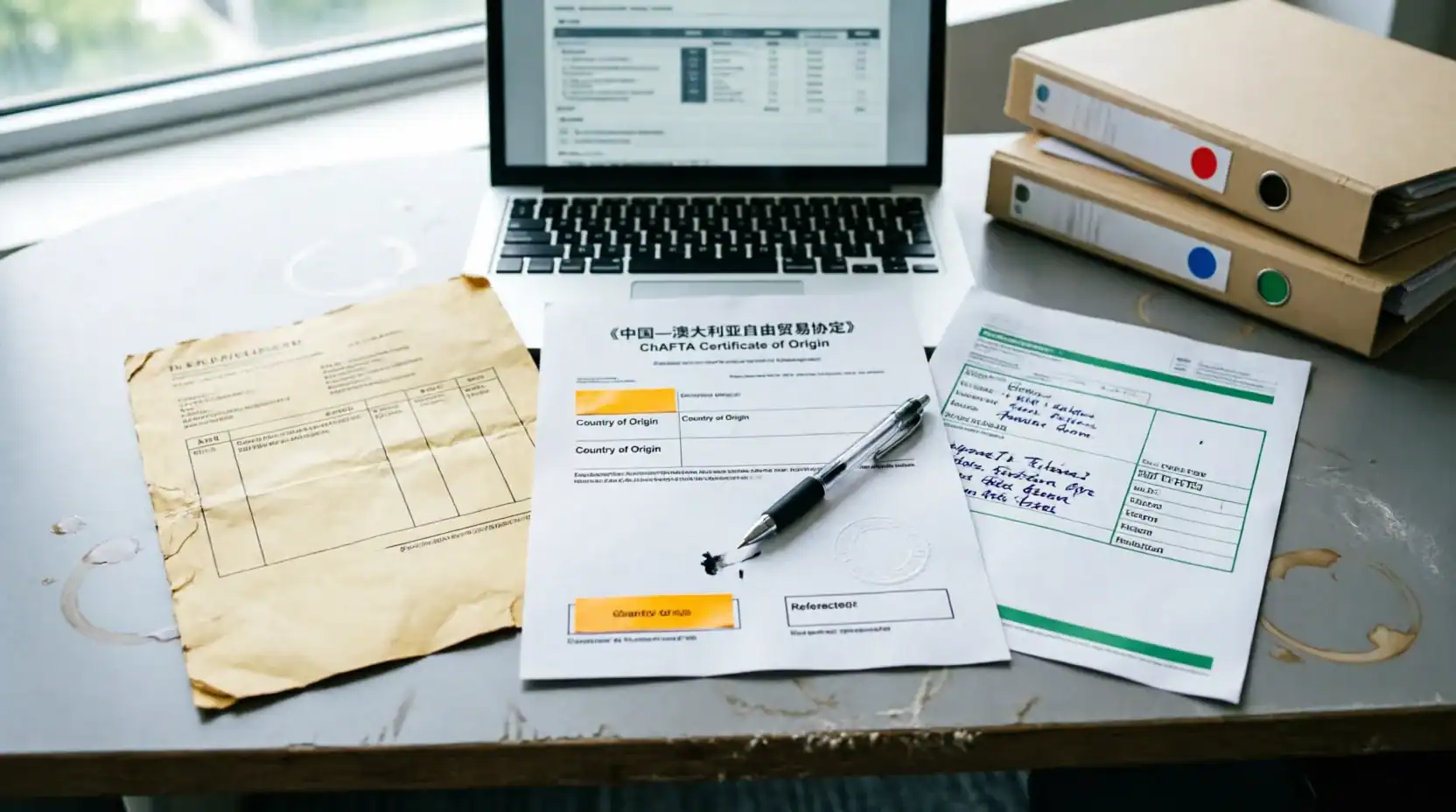
1. Getting the ChAFTA Certificate of Origin After Loading
The China-Australia Free Trade Agreement eliminates or reduces duty on thousands of product categories. On a AUD 100,000 order of goods attracting 5% general duty, ChAFTA saves AUD 5,000 per shipment. That is not a paperwork technicality. It is real margin.
The mistake: the importer asks their Chinese supplier for a Certificate of Origin after the goods have shipped. The supplier provides a backdated document, or the importer arrives at customs clearance without one and scrambles to get it.
The regulatory reality: under ChAFTA, the preferential origin declaration must be completed at or before the time of export. A Certificate of Origin issued after the goods have left China is not valid for preferential duty treatment. A backdated CoO is worse: it is a false customs document. The only remedy for a missed CoO is to pay full MFN duty and lodge an amendment later if you can reconstruct the origin evidence.
The fix: Make the Certificate of Origin part of the pre-shipment document checklist (alongside the commercial invoice and packing list) before the booking is confirmed. Your freight forwarder should not accept a booking without confirming CoO status on FTA-eligible goods. Run a binding product classification and FTA eligibility check once per SKU, not per shipment. That removes the scramble entirely. The Australian customs import process includes FTA documentation requirements that apply to every China-origin shipment.
2. Calculating Profitability on FOB Price Instead of Landed Cost
An importer agrees a FOB price of AUD 8.00 per unit with a Chinese supplier. They calculate their retail margin on AUD 8.00 and proceed. The shipment arrives. The landed cost comes to AUD 11.40 per unit. That figure includes sea freight, insurance, destination port charges, import duty, customs brokerage, and the DAFF biosecurity levy. The retail margin is gone.
This is the single most common structural mistake among importers in their first 12–18 months. FOB price is a supplier’s price. Landed cost is what you actually paid. On a typical China-to-Australia ocean shipment, the gap between the two is routinely 25–50% above FOB value, and higher for goods with elevated duty rates. That gap includes all port charges, brokerage, duty, and biosecurity costs.
The full landed cost framework (all eight cost layers) is covered in our total landed cost guide for Australian importers. The short version: never commit to an import order without running a landed cost calculation first. The calculation takes 15 minutes. A wrong margin assumption takes months to unwind.
The fix: Build a landed cost spreadsheet and run every new product through it before placing the order. Include: FOB price, ocean freight estimate, insurance premium (0.1–0.5% of CIF), origin port charges, destination port charges (THC, wharfage), customs duty (correct HS code rate, with or without FTA concession), the DAFF biosecurity levy (AUD 53.10 per declaration), and customs brokerage (AUD 150–400 for a standard entry). Verify the biosecurity levy against DAFF’s current fee schedule before you rely on it. If the landed cost exceeds your pricing model, renegotiate FOB or drop the product before any goods move.
3. Assuming CE or UL Marking Means the Product Complies in Australia
CE marking (European Union) and UL certification (United States) are legitimate compliance marks in their jurisdictions. They have no legal standing in Australia. This is not a technicality: it is a structural difference between regulatory regimes that Australian Border Force and the ACCC both enforce.
The cost of this mistake ranges from customs hold and re-export at importer’s expense (for products that cannot be made to comply), to product recall and ACCC enforcement action (for non-compliant products already sold into the Australian market). The consequences are not hypothetical: the ACCC publishes product recalls monthly, and a significant proportion involve imported goods where the importer assumed overseas certification was sufficient.
The Australian compliance requirements by product category:
| Product Category | Australian Standard | Regulatory Body | CE/UL Valid? |
|---|---|---|---|
| Electrical/electronic goods | AS/NZS standards + RCM mark (ACMA registration) | ACMA | No |
| PPE (respirators, helmets, gloves) | AS/NZS test report per product | State WHS authorities | No |
| Children’s products | ACCC mandatory standards by product type | ACCC | No |
| Therapeutic goods (supplements, devices) | TGA ARTG registration | TGA | No |
| Solar panels | IEC 61730:2023 + CEC approved product list | CEC / state energy authorities | Partial overlap only |
| Building materials | National Construction Code (NCC) / relevant AS/NZS | State building authorities | No |
The fix: Before placing an order for any product with a safety, electrical, or health dimension, confirm the specific Australian standard that applies. The Australian Government’s Product Safety Australia portal lists mandatory standards by product category. For electrical goods, confirm ACMA registration requirements before the goods are manufactured. Retrofitting RCM compliance after production is expensive and sometimes impossible.
4. Non-Compliant Wood Packaging Arriving at the Border
ISPM 15 is the international phytosanitary standard for wood packaging material (pallets, crates, dunnage) used in international shipments. Australia is a strict ISPM 15 jurisdiction. DAFF holds wood packaging on arrival if it does not carry the ISPM 15 mark, the international plant protection symbol with treatment method and country code. The DAFF wood packaging material requirements apply to every commercial shipment.
The control actions available to DAFF include: re-export at importer’s expense, treatment in Australia (heat treatment or methyl bromide fumigation, typically AUD 200–800 plus 5–12 days delay), or destruction. Demurrage on a delayed container at Australian ports runs AUD 80–200 per day. A missed ISPM 15 mark on a single pallet can cost AUD 1,500–5,000 in treatment, storage, and demurrage by the time the goods are released.
The mistake occurs at the source: the importer does not specify ISPM 15-compliant wood packaging in the purchase order. The supplier uses whatever packaging is available in their warehouse. By the time the goods arrive in Australia, the non-compliant packaging is part of the loaded container and cannot be retroactively treated in origin.
The fix: Include ISPM 15 compliance as a specific requirement in every purchase order. Specify: “All wood packaging material must bear the ISPM 15 mark with heat treatment (HT) designation.” Request photographic confirmation from the supplier before the container is sealed. Your freight forwarder should confirm ISPM 15 status in the pre-shipment documentation review. Our guide to why shipments get held at Australian customs explains what triggers biosecurity holds and how to avoid them.
5. Mistiming Orders and Paying Emergency Air Freight
The China-to-Australia sea freight transit time is 14–22 days. Add origin processing, container booking, and customs clearance at both ends, and the realistic door-to-door timeline is 35–50 days under normal conditions. During Q3-Q4 peak season, when freight rates spike and vessel space tightens, add another 7–14 days and 30–80% to the freight rate.
The mistake: the importer places an order eight weeks before a retail promotion, product launch, or peak sales period, then discovers sea freight will not make it and pays air freight rates instead. Air freight from China to Australia costs approximately AUD 7–15 per kilogram. Sea freight costs approximately AUD 0.40–1.20 per kilogram equivalent. For a 500 kg shipment, the difference is AUD 3,000–7,000 in freight cost alone, often more than the margin on the goods being shipped.
This mistake repeats because importers plan from the order date, not from the in-store date. The correct approach is to work backwards: if goods must be in the warehouse by 1 October for a 15 October retail promotion, sea freight from China needs to be booked by approximately 20 August (allowing for origin processing, 20-day transit, and 10-day customs clearance and delivery). The order to the supplier needs to be placed 4–6 weeks before that to allow for production. The planning window is therefore mid-June to early July, not September.
The fix: Build a shipment planning calendar that works backwards from required in-warehouse dates. Apply a buffer of at least 15 days above your forwarder’s stated transit estimate: delays at origin, transshipment port congestion, and customs holds are regular occurrences, not exceptional ones. Our air vs sea freight guide for Australian importers covers the air-versus-sea decision framework, including when air genuinely makes sense and when it signals a planning failure with an expensive fix.
6. Using the Wrong HS Code
The Harmonized System (HS) code assigned to imported goods determines the duty rate, the applicable FTA concessions, any anti-dumping duties that apply, and the DAFF biosecurity pathway it triggers. An incorrect HS code is not a paperwork error. It is a false declaration to Australian Border Force.
The consequences of incorrect HS code classification range from duty underpayment (which ABF can recover with interest and penalties on audit) to misclassification into a controlled or prohibited goods category. ABF conducts random and targeted post-clearance audits. Importers who have been clearing goods under an incorrect code for multiple shipments accumulate a compounding liability.
The most common direction of the mistake is downward: importers misclassify goods into a lower-duty heading, either through genuine confusion or on the advice of a low-cost customs broker who did not verify the classification. High-risk categories include: goods with anti-dumping duty orders (Chinese steel, aluminium extrusions, certain chemical products) where misclassification avoids a significant additional duty; goods on the ACCC mandatory standards list where the correct HS code triggers a compliance pathway; and multi-function goods where the correct heading depends on the product’s primary function.
The fix: For any new product category, obtain an ABF Binding Tariff Advice (BTA) before the first shipment. A BTA is a written ruling from ABF on the correct HS code for your specific product: it is free, legally binding for the importer, and provides certainty across multiple shipments. The application is lodged through the ABF website. Allow 28 days for the ruling. A competent customs broker can advise on HS code classification; a broker who simply enters what you tell them is not advising you on classification.
7. Taking CIF Terms from the Supplier and Losing Freight Control
CIF (Cost, Insurance, Freight) terms mean the supplier arranges and pays for freight and insurance to the named Australian port. It seems convenient. It is usually expensive and removes your visibility into the shipment until it arrives.
When a supplier arranges freight under CIF, they use their freight forwarder, who is optimising for the supplier’s relationship, not your cost. The freight cost is embedded in the supplier’s invoice and is often above-market. You have no carrier relationship to call when the shipment is delayed, no direct line to the freight forwarder, and no leverage over service quality. If the shipment is damaged or short-delivered, your insurance claim is against a policy you did not choose and may not fully cover your goods.
The Australian import duty calculation also uses CIF value. A higher embedded freight cost therefore increases your dutiable value, and the duty you pay. Taking FOB terms reduces the dutiable value, gives you direct carrier relationships, and allows you to negotiate freight rates against a competitive market rather than accepting a supplier’s margin.
The fix: Negotiate FOB terms on all significant import programs and manage the freight side directly through a freight forwarder who represents your interests. The transition from CIF to FOB is a one-time conversation with your supplier; the freight cost savings and operational control are recurring. If a supplier insists on CIF and will not negotiate, factor the freight cost opacity into your supplier evaluation.
8. Declaring Customs Value Without Including All Assists
Australian customs value is not simply the price you paid for the goods. It includes “assists”: any value you provided to the supplier that is not reflected in the invoice price. Common assists that importers fail to declare:
- Dies, moulds, tooling, or equipment provided to the supplier for manufacturing
- Engineering work, design drawings, or technical specifications provided free of charge
- Packaging materials supplied by the importer and incorporated in the goods
- Royalties or licence fees paid to a third party that relate to the imported goods
ABF applies the WTO Customs Valuation Agreement, which requires assists to be added to the transaction value for duty purposes. An audit that discovers undeclared assists results in duty reassessment, interest, and penalties on the understated amount across all affected shipments.
The fix: If you provide anything of value to your supplier beyond the invoice payment (tooling, design work, materials), flag this to your customs broker before the first shipment. The disclosure and valuation methodology is straightforward when declared upfront; it becomes expensive when discovered retrospectively.
9. Not Checking for Anti-Dumping Duties Before Placing Orders
Australia maintains active anti-dumping duty orders on dozens of imported products, predominantly Chinese steel, aluminium extrusions, certain chemical compounds, and other manufactured goods. Anti-dumping duties are imposed on top of general import duty and can be substantial: 5–80%+ of customs value depending on the specific product and exporter.
The mistake: an importer secures a competitive price from a Chinese manufacturer on hot-rolled steel coil, for example. The ChAFTA duty rate is 0%. They budget accordingly. The goods arrive and attract an anti-dumping duty of 17.8% of customs value, plus the port surcharge. The landed cost calculation was wrong before the order was placed.
The supplier does not disclose anti-dumping duties. Many suppliers are unaware they apply. The Australian Border Force Anti-Dumping Commission publishes all current measures. The search takes two minutes.
The fix: Before placing any significant order, search the ABF Anti-Dumping Commission register for your product’s HS code and country of origin. If your product is subject to a measure, verify the duty rate for the specific exporter: rates vary by manufacturer. This check belongs in your pre-order process, not your post-arrival surprise.
10. Skipping Cargo Insurance and Relying on Carrier Liability
The Hague-Visby Rules cap a sea carrier’s liability for lost or damaged goods at SDR 2 per kilogram, approximately AUD 4.00–4.50 per kilogram at current exchange rates (verify current SDR/AUD conversion via the IMF). For a 500-kilogram shipment of electronics valued at AUD 50,000 (AUD 100/kg), the carrier is liable for a maximum of AUD 2,250, approximately 4.5% of the goods’ value.
The importer who assumes the carrier covers their goods in full will discover this gap at the worst possible time: during a transit damage event, when they can do nothing about it. On a standard commercial shipment, the cargo insurance premium for an all-risks (ICC A) policy is typically 0.1–0.4% of CIF value: AUD 50–200 on a AUD 50,000 shipment.
The fix: Include cargo insurance in every shipment. Take FOB terms and arrange your own cover rather than relying on a supplier’s CIF policy (which may have exclusions or valuation terms you cannot verify). Verify that your policy is ICC (A), all risks, not ICC (C), which excludes many common loss scenarios. Our cargo insurance guide covers the full insurance decision, including the insufficient packing exclusion that voids most claims when packing is substandard.
For a structured view of the complete end-to-end import process (from supplier selection through to warehouse delivery), see our complete guide to importing from China to Australia. When you are ready to move goods, get a quote for your Australian import shipment from Swift Cargo.
The ABF’s Voluntary Disclosure program reveals how Australian customs enforcement actually works. It was mentioned above as the remedy for several of the mistakes in this article. Voluntary Disclosure exists because the ABF, like most revenue agencies, cannot audit every declaration. It operates on a detected-violation model, so it creates incentives for self-correction: importers who identify and disclose their own errors before the ABF does receive reduced penalties. The importers who face serious consequences for the mistakes documented here are almost always those who made them systematically and at scale, not those who made them once and corrected them through self-reporting. This does not make the mistakes less costly to fix. An importer who finds an error in a prior declaration is better served by proactive disclosure to the ABF than by silence. The penalty structure explicitly rewards self-correction over concealment.
Frequently Asked Questions
What is the most expensive import mistake Australian importers make?
In frequency-weighted cost terms, the most expensive recurring mistake is missing the ChAFTA Certificate of Origin. Because the document process was not established at the start of the supplier relationship, importers forfeit a 5–10% duty concession on a product category, repeatedly, across multiple shipments. On a AUD 500,000 annual import program at 5% duty, the missed ChAFTA concession costs AUD 25,000 per year.
How do I find the correct HS code for my product?
Start with the Australian Border Force online tariff tool (border.gov.au/Tariffs). For products where the correct heading is ambiguous (multi-function goods, goods that could fit multiple categories), apply for an ABF Binding Tariff Advice (BTA). A BTA is free, legally binding, and valid across multiple shipments of the same product.
What should I do if I discover I have been using the wrong HS code?
Seek advice from a qualified customs broker immediately and do not continue clearing goods under the incorrect code. ABF treats self-reporting before an audit more favourably than a discovered error. ABF has a Voluntary Disclosure program that can mitigate penalties for importers who come forward proactively.
Can I fix a missed ISPM 15 issue after goods arrive in Australia?
In some cases, DAFF will permit heat treatment or fumigation of non-compliant wood packaging in Australia at the importer’s expense. However, this adds 5–12 days to clearance time, costs AUD 200–800 per treatment, and does not eliminate demurrage charges during the delay. The only reliable fix is specifying ISPM 15-compliant packaging in the original purchase order.
Is it worth having a customs broker, or can I lodge my own import entries?
Self-lodged entries are legally permitted for low-volume, low-complexity imports. For any import program involving FTA concessions, goods subject to anti-dumping measures, regulated product categories (electrical, PPE, therapeutic), or volumes above a few shipments per year, a competent customs broker pays for itself many times over, both in avoided errors and in duty classification that only a trained, licensed broker can provide.