
AANZFTA brings the duty to zero on most categories, but WaterMark certification for plumbing fittings and RCM for electrical items still gate the shipment separately from any tariff question. To import building materials from Vietnam to Australia without a seizure or an unsellable container, settle asbestos testing and those certifications with the supplier before anything ships.
Vietnam is a significant source of building materials for Australian construction, renovation, and fit-out projects: timber flooring, ceramic and porcelain tiles, structural bamboo, aluminium profiles, hardware fittings, and stone cladding all move on the Vietnam-Australia lane at commercial scale. The compliance picture is more complex than for furniture or apparel, because building materials imported into Australia interact with construction codes, certification schemes, and one zero-tolerance prohibition: asbestos.
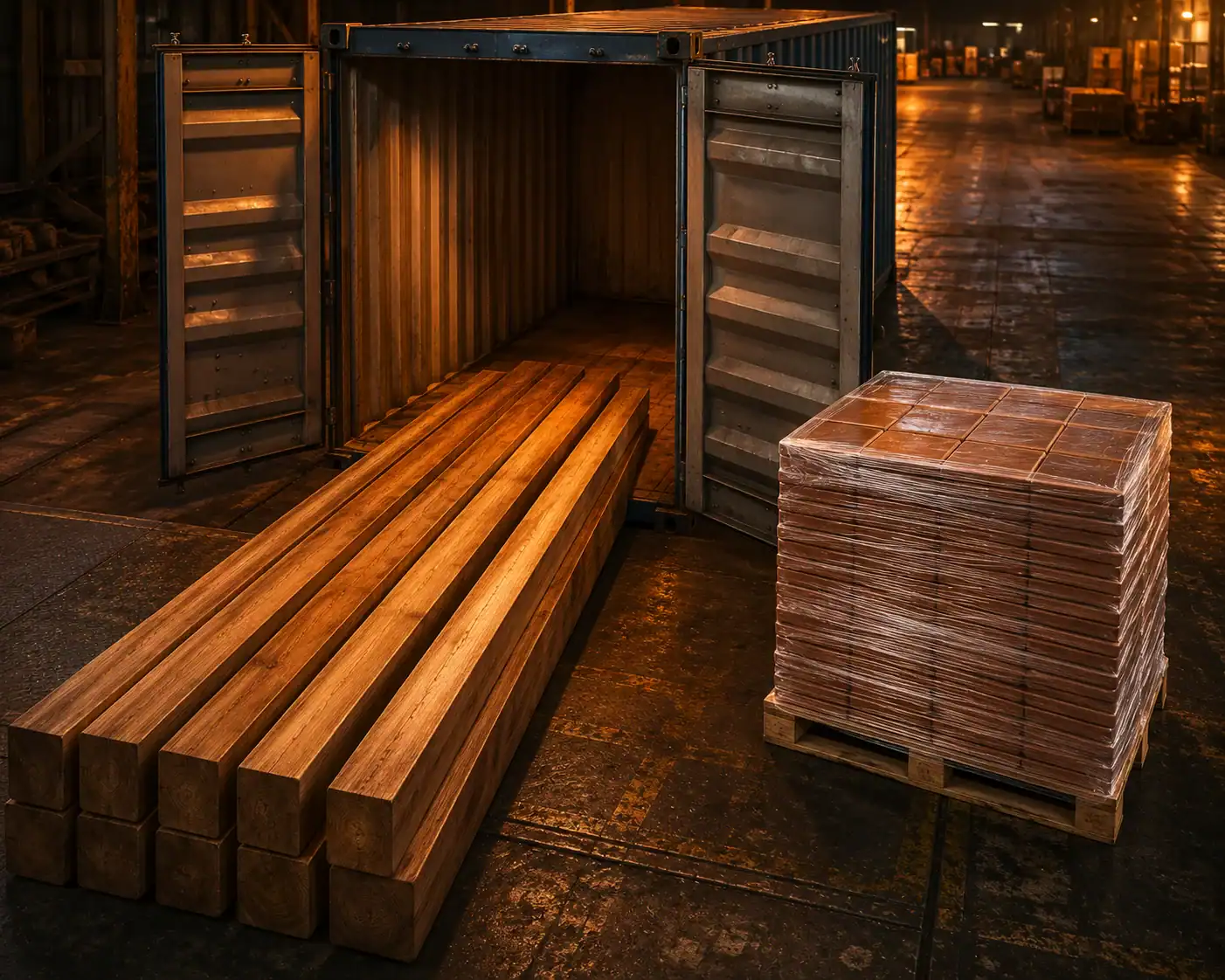
What Australia Imports from Vietnam in Building Materials
The major product categories in the Vietnam-Australia building materials trade are:
- Timber: Structural timber, hardwood flooring, decking, cladding, door and window frames, engineered timber products (LVL, glulam), bamboo flooring and structural bamboo
- Ceramic and porcelain tiles: Floor tiles, wall tiles, large-format porcelain slabs, mosaic tiles
- Steel fabrications: Structural steel sections, steel reinforcing bar (rebar), steel doors and frames, balustrade components
- Aluminium profiles and extrusions: Window frames, curtain wall systems, louvre systems, architectural hardware
- Stone and natural materials: Granite, marble, and sandstone tiles and slabs; natural stone cladding
- Plumbing and electrical fittings: Faucets, fittings, conduit, wiring accessories, switches and sockets
- Construction hardware: Fasteners, brackets, anchors, hinges, door furniture
AANZFTA Duty Rates for Building Materials
The ASEAN-Australia-New Zealand Free Trade Agreement (AANZFTA) provides a 0% preferential duty rate for most Vietnamese building materials entering Australia. The standard MFN rates that apply without AANZFTA are typically 0–5% depending on the HS heading, meaning the AANZFTA benefit is most significant on the categories that carry a 5% MFN rate (some aluminium products, certain ceramic products, and some timber headings).
To claim the AANZFTA rate, your Vietnamese exporter must provide either a Form AANZ (issued by a Vietnamese authorised body: Chamber of Commerce or Ministry of Industry and Trade) or a self-declaration of Vietnamese origin on the commercial invoice. This documentation must accompany the shipment and be available at Australian customs clearance. A Form AANZ not issued before departure is very difficult to obtain after the shipment has arrived.
For importers of high-value construction materials where duty at 5% MFN represents a material cost, the AANZFTA documentation process should be treated as a non-negotiable supplier requirement, built into the purchase order terms and verified before every shipment.
The Asbestos Prohibition: Zero Tolerance
Australia has a complete ban on the importation of all forms of asbestos, chrysotile (white asbestos), amosite (brown asbestos), crocidolite (blue asbestos), and all other asbestos varieties, under the Customs (Prohibited Imports) Regulations 1956 and the Industrial Chemicals (Notification and Assessment) Act. The penalty for importing goods containing asbestos is severe: seizure of the goods, significant financial penalties, and potential criminal prosecution.
Vietnam officially banned chrysotile asbestos use in 2020, but the legacy of asbestos-containing materials in the supply chain means that Australian importers of Vietnamese building materials must actively manage the asbestos risk. The product categories that carry the highest residual exposure are those where Vietnam historically used asbestos as a reinforcing fibre: roofing sheets, cement products, pipe fittings, gaskets, and some insulation materials.
High-risk product categories
The following Vietnamese building material categories carry elevated asbestos risk and require active testing or strong supplier assurance:
- Fibre cement products: Cement sheeting, fibre cement cladding panels, compressed cement board
- Roofing materials: Corrugated cement sheets, roofing tiles with fibre reinforcement
- Gaskets and sealing products: Any cement or compressed fibre gasket used in plumbing or mechanical applications
- Pipe fittings: Older-design cement pipe fittings and transition collars
- Brake and friction components: Not a building material, but commonly co-imported in hardware shipments
How to manage asbestos risk
Written asbestos-free declaration: Require your Vietnamese supplier to provide a written declaration that the goods are free of all forms of asbestos, signed by a responsible officer of the manufacturing company. This does not provide full protection against non-compliance, but it creates contractual liability on the supplier and a clear paper trail.
Independent laboratory testing: For fibre cement products, cement sheeting, or any product where you cannot independently verify the raw material inputs, arrange independent laboratory testing before the first import. Accredited Australian laboratories can test samples for asbestos presence: cost is typically AUD 150–400 per sample. One test result on a product line from a specific supplier provides assurance for subsequent shipments from the same source, unless the supplier’s raw material supply changes.
Safe Work Australia guidance: Safe Work Australia publishes current guidance on asbestos importation risk and the categories of goods that are actively monitored at the border. Review this guidance before importing any category that might carry asbestos risk.
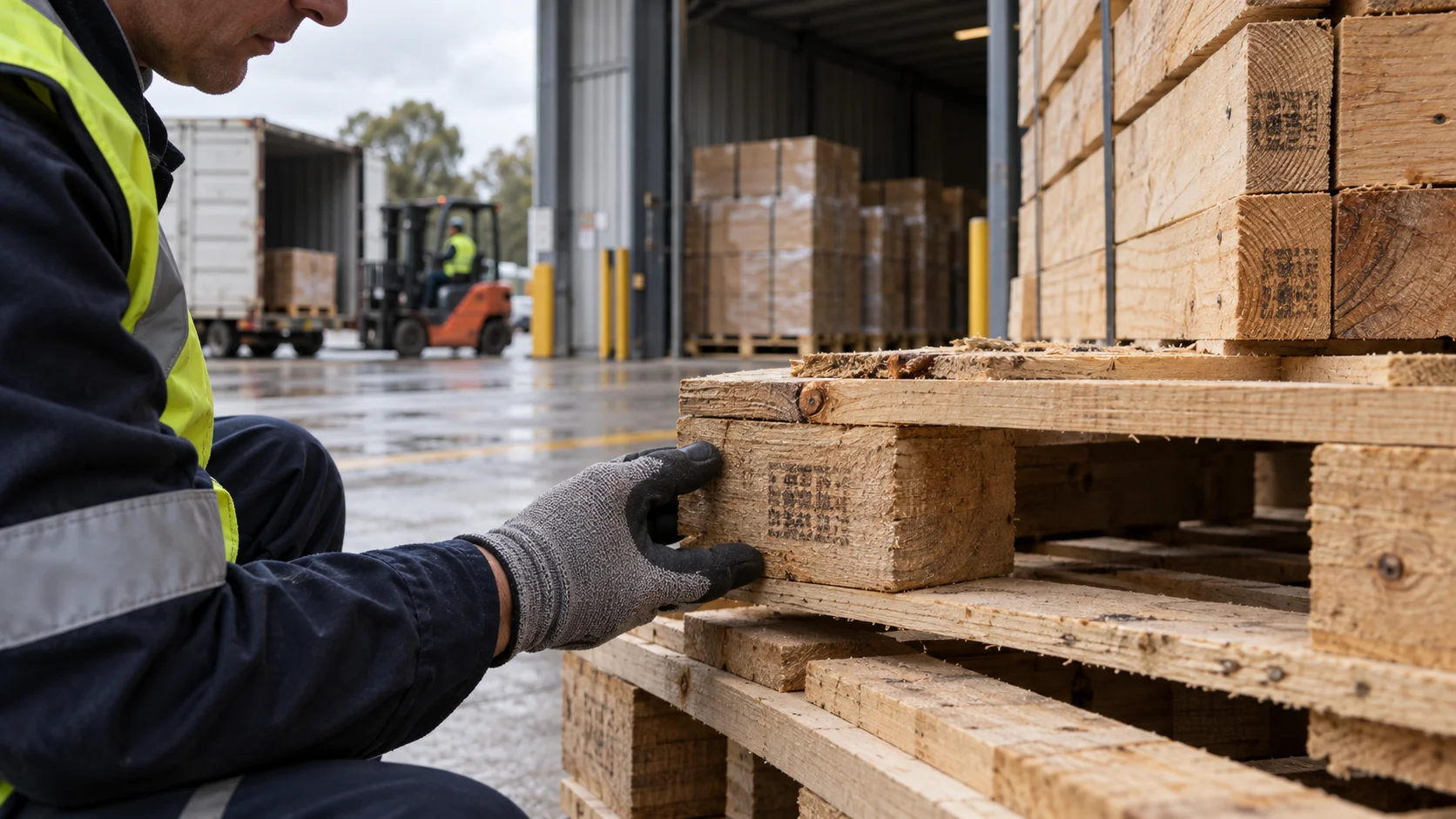
Timber Biosecurity: Building Materials in Detail
Timber building materials are subject to DAFF biosecurity requirements under the same framework as timber furniture, but the product forms differ: structural beams, flooring boards, and decking are distinct from furniture components, and some engineered timber products have different treatment requirements.
Solid timber building materials
Structural beams, hardwood flooring, decking, cladding, and door frames in solid timber must comply with ISPM 15 heat treatment requirements: core temperature of 56°C for 30 continuous minutes, with the IPPC mark physically stamped on each timber element or the packaging. Vietnam is a high-risk timber source country: DAFF inspection rates on Vietnamese timber are elevated relative to lower-risk origins. Documentation must specifically identify the timber species, treatment type, and treatment provider.
Engineered timber products
Plywood, MDF (medium-density fibreboard), LVL (laminated veneer lumber), and particleboard are processed timber products that have undergone manufacturing processes that significantly reduce pest risk compared to solid timber. DAFF’s import conditions for these products differ from solid timber: check the DAFF BICON database for the specific import conditions applicable to your product form before the first shipment.
Bamboo products
Bamboo is a grass, not a timber, and is subject to DAFF import conditions as a plant product rather than under the timber/ISPM 15 framework. Commercially processed bamboo flooring and structural bamboo products (heat-treated and fully manufactured) generally present lower biosecurity risk than raw or minimally processed bamboo. Declare bamboo products accurately on documentation as “processed bamboo [product type]” rather than “timber” to ensure the correct biosecurity assessment regime is applied.
Ceramic and Porcelain Tiles: Straightforward Compliance
Ceramic and porcelain tiles from Vietnam have one of the most straightforward import compliance profiles in the building materials category. They attract 0% duty under AANZFTA, have low biosecurity risk as fully manufactured ceramic products (no organic material, no pest risk), and do not present asbestos risk under standard tile specifications.
The primary compliance consideration for tiles intended for retail sale or specification in Australian construction projects is slip resistance. Australian building codes require specific slip resistance ratings for tiles used in wet areas, stairways, and public pedestrian zones. The relevant standards are AS 3958.1 (ceramic tiles, installation guidance) and AS/NZS 4586 (slip resistance classification). Request slip resistance test data from your Vietnamese supplier for tiles intended for commercial or regulated applications.
Large-format porcelain slabs (1200×2400mm and above), popular in Australian kitchen and bathroom markets, are a specific logistics challenge. These require specialist handling, custom packaging (foam-lined A-frames or purpose-built crating), and careful assessment of stacking weight limits in the container. Breakage during transit is the primary commercial risk on this product format, not compliance.
Steel and Aluminium: Structural Standards
Structural steel from Vietnam (beams, columns, RHS sections, rebar) requires compliance with AS/NZS 3678 (structural steel hot-rolled bars and sections) or AS/NZS 4671 (steel reinforcing materials) if it is to be used in structural applications under the National Construction Code (NCC). Vietnamese steel mills serving the Australian market are generally aware of these requirements and can provide mill certificates confirming compliance: request mill certificates on every shipment and retain them for the life of the structure they are used in.
Aluminium profiles and extrusions from Vietnam are subject to AS/NZS 1734 (aluminium and aluminium alloys) for structural applications, and any specific window or door systems must be assessed under the relevant NCC energy efficiency and structural provisions. Vietnamese aluminium manufacturers serving the Australian market typically have their systems tested and documented for NCC compliance: verify this with your supplier before committing to a first import.
Plumbing and Electrical Fittings
Plumbing fittings and fixtures for installation in Australian buildings must carry the WaterMark certification, administered by the Australian Building Codes Board. WaterMark applies to plumbing and drainage products that could affect public health or safety if they fail: taps, mixers, valves, pipe fittings, and similar products. Importing Vietnamese plumbing fittings without WaterMark certification for retail sale or installation in Australian buildings is non-compliant. Vietnamese manufacturers producing for the Australian market are increasingly WaterMark-certified: verify certification before ordering.
Electrical wiring accessories (switches, sockets, switchboard components) must carry the RCM (Regulatory Compliance Mark) under ACMA requirements. The same applies to any electrical component incorporated into a building material product (LED strips built into cove profiles, powered louvre systems, etc.). As with RCM certification for other electrical products, FCC or CE certification does not satisfy Australian ACMA requirements.
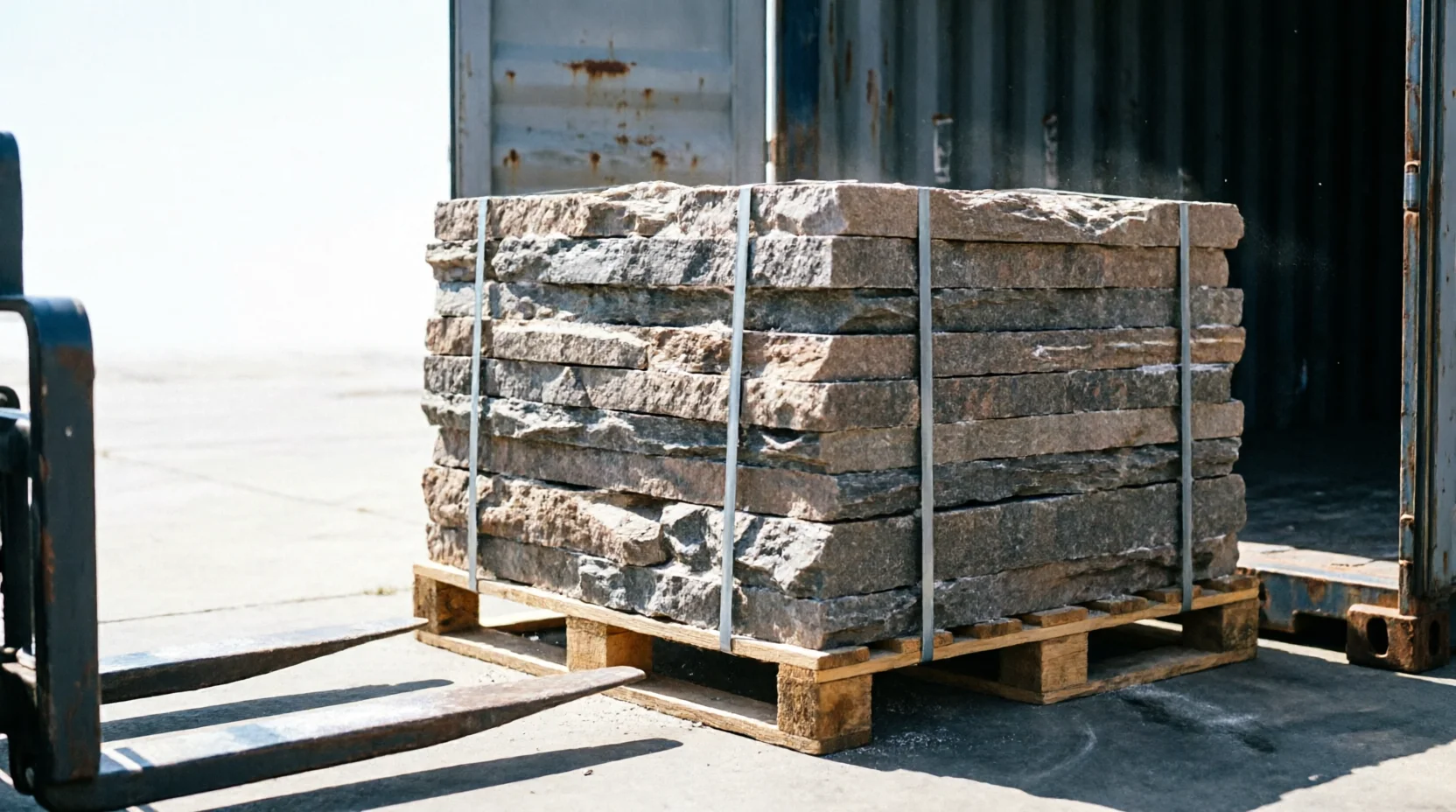
Stone and Natural Materials from Vietnam
Vietnam produces and exports granite, marble, basalt, and sandstone, as cut tiles, slabs, cladding panels, and decorative elements. Vietnamese stone, particularly basalt from the central highlands, has grown significantly in the Australian architectural specification market over the past decade as an alternative to Chinese or Indian stone on price and lead time.
The biosecurity risk on natural stone from Vietnam is lower than on timber, but not zero. Cut and polished stone in commercial tile format presents minimal biosecurity risk. Rough-cut or bush-hammered stone with unfinished faces and stone with visible soil or organic material in crevices can trigger DAFF inspection. Documentation should specify the stone type, surface finish, and that goods are “commercially cut, polished/finished, new goods, no soil or plant material present.” This specificity speeds biosecurity assessment.
Stone is a weight-dense category: granite tiles run 25–35 kg/m² and slabs significantly heavier. A 20-foot container of polished granite tiles will often hit the payload weight limit (21–22 tonnes) with 60–85 m² of tile, leaving substantial volume unused. For stone imports, calculate your container loads on weight capacity, not CBM.
There is no asbestos risk associated with natural stone products: granite, marble, basalt, and sandstone are silica-based and do not contain asbestos. Asbestos risk is specific to manufactured fibre-cement products, not natural quarried stone.
Common Problems on the Vietnam Building Materials Lane
The most costly problems on this lane cluster around asbestos compliance, timber biosecurity documentation, and structural certification gaps. Each can be prevented with supplier-level quality management before goods depart Vietnam.
Asbestos detection on arrival
A shipment of fibre cement sheeting that tests positive for asbestos at the Australian border results in mandatory seizure and destruction of the entire consignment at the importer’s cost. ABF and Safe Work Australia actively test high-risk building material categories, and the testing regime has become more systematic since a series of high-profile asbestos detections in Vietnamese-origin goods in the 2018–2022 period. Prevention is the only viable strategy: laboratory test results on the specific product from the specific supplier before the first import order.
ISPM 15 non-compliance on timber packaging
This is the same failure as on furniture imports: the structural timber itself may have valid heat treatment documentation, but the wooden pallets or dunnage used to pack the shipment are not IPPC-marked. DAFF inspects all timber in a consignment. A structural timber shipment held for biosecurity examination generates examination fees, treatment costs, and delivery delays that can run AUD 2,000–5,000 per container on a commercial building project. Include ISPM 15 compliance on all packaging timber in your purchase order and verify it on the pre-shipment inspection checklist.
WaterMark and RCM gaps on fittings
Vietnamese hardware exporters frequently offer products that meet European or US certification requirements but do not hold Australian WaterMark (plumbing) or RCM (electrical) certification. An Australian plumbing contractor cannot legally install non-WaterMark fittings, and non-RCM electrical products cannot be supplied for installation. Importers who receive a container of Vietnamese plumbing fittings without WaterMark discover the compliance gap at the point of sale, not at customs clearance: the goods clear the border but cannot be sold in the Australian market. Verify certification before ordering, not on arrival. Clearing customs proves nothing about WaterMark or RCM when you import building materials from Vietnam to Australia; only the certificate does.
Structural certification unavailable for steel
Structural steel from Vietnam must be accompanied by mill certificates confirming compliance with the relevant AS/NZS standard. Vietnamese steel mills vary significantly in their quality documentation: some have full third-party certified mill certificates; others provide in-house test results of uncertain provenance. For structural steel that will be used in certified construction under the NCC, the mill certificate is a legal compliance document. A steel fabrication delivered to site without a compliant mill certificate may require the steel to be independently tested before it can be incorporated into the structure, a cost and delay that is entirely avoidable with proper supplier qualification.
Large-format tile breakage in transit
Large-format porcelain slabs and tiles (900×900mm and above) require A-frame packaging or purpose-built crates for sea freight transit. A Vietnamese exporter using flat carton packaging for large-format slabs will produce a predictable level of breakage on a 14–22 day sea journey through tropical waters. Include packaging specification in the purchase order (A-frame with foam interleaving and corner protection) and verify packaging on the pre-shipment inspection. Freight insurance covers breakage above a threshold, but the administrative burden of a breakage claim and replacement ordering is disproportionate to the cost of proper packaging.
There is a pattern on this lane that catches experienced importers off guard: the cheapest Vietnamese supplier frequently produces the most expensive shipment. It looks paradoxical until you frame the job the material is actually being hired to do. An importer is not buying tiles or steel or fittings in the abstract: they are buying a component that has to pass certification on an Australian building site. A batch that arrives at a lower unit price but lacks AS/NZS conformance, a valid WaterMark, or a clean asbestos-free declaration cannot do that job, and the cost of that failure (rejection, retesting, replacement, project delay) dwarfs the saving. The suppliers worth qualifying are the ones who understand which certification the material must satisfy on arrival, not simply the ones who quote low.
Landed Cost for Vietnamese Building Materials
Building materials are typically higher-value-per-container than general merchandise, making the landed cost components material to project economics. Working from an FOB HCMC price on a typical 20-foot container:
- Ocean freight (FCL 20-foot, HCMC to Sydney/Melbourne): AUD 1,800–3,200 depending on carrier and season
- Origin charges (export customs, CFS handling, document fees): USD 200–350 per container
- Destination THC (terminal handling): AUD 350–600 per container
- Wharfage and port fees: AUD 100–250 per container
- Customs duty: 0% with valid AANZFTA Form AANZ; 0–5% without (product-dependent)
- GST: 10% on the customs value plus freight plus insurance
- Customs brokerage: AUD 150–300 per import declaration
- DAFF biosecurity levy: approximately AUD 36.80 per declaration: DAFF-legislated charges are indexed annually on 1 July, so confirm the exact current figure against the DAFF fees schedule before quoting a landed cost
- DAFF biosecurity examination (if triggered): AUD 300–800 plus potential treatment costs
- Drayage (port to site or warehouse): AUD 400–900 depending on distance and whether the delivery point can take a side-loader or requires a crane unload
For structural and heavy materials, delivery to site rather than to a warehouse is common, and site delivery charges vary significantly depending on access, crane requirements, and time-on-site restrictions. Factor site delivery logistics into your landed cost from the first quotation.
For the broader framework on managing costs across a growing import program, including when FCL volume justifies a rate agreement with your forwarder, see How to Scale Your Import Business in Australia.
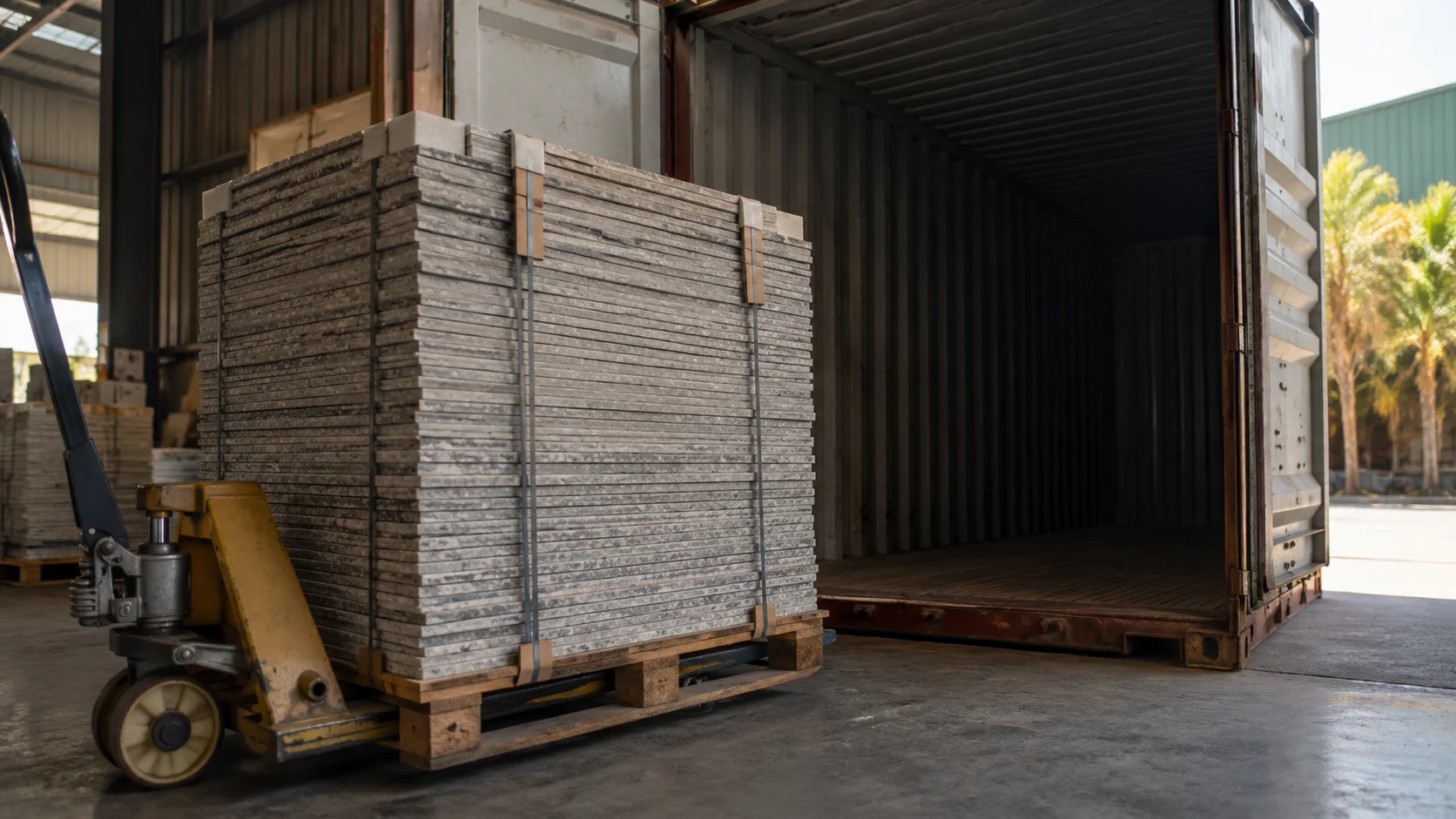
Freight for Building Materials: Weight and Volume Dynamics
Building materials are predominantly weight-dense: tiles, stone, steel, and structural timber all load to the container’s weight limit well before the volume limit is reached. This inverts the freight economics compared to light manufactured goods, where volume (CBM) typically drives cost.
A standard 20-foot container has a maximum payload of approximately 21–22 tonnes. For ceramic tiles (which can weigh 18–22 kg/m²), a full 20-foot container may hold as little as 60–80 m² of large-format tile before hitting the weight limit, well short of the 33 CBM volume capacity. Plan your container utilisation on weight, not CBM, for tiles, stone, steel, and dense timber.
LCL is generally unsuitable for heavy building materials beyond small sample orders. Fragile goods (tiles, glass, stone) carry higher damage risk in LCL consolidation. Weight-sensitive goods (structural steel, tiles) are priced per tonne in LCL, which quickly makes FCL more economic. For most commercial building material imports from Vietnam, FCL is the appropriate freight mode from the first order.
Transit times from HCMC to Australian east coast ports (Sydney, Melbourne, Brisbane) are 14–22 days. For the full freight and landed cost framework applicable to Vietnam imports, see Importing from Vietnam to Australia: What Businesses Need to Know. For the specific timber biosecurity requirements that overlap with building materials, see How to Import Furniture from Vietnam to Australia: the ISPM 15 requirements are identical for structural timber and furniture timber.
Supplier Qualification for Vietnamese Building Materials
Vietnamese building material manufacturers range from large, internationally certified export factories to small workshops producing primarily for domestic construction. Qualification criteria should be matched to the compliance requirements of your specific product category.
For asbestos-risk categories, the minimum qualification requirement is: a written asbestos-free declaration plus independent laboratory test results on samples from the specific production run. For structural applications (steel, aluminium, structural timber), request and verify compliance certifications and mill certificates before the first order. For ceramic tiles, request slip resistance test data for any tiles intended for commercial specification.
A factory audit (either in person or via a third-party inspection service) is justified for annual import programs above AUD 100,000 from any single Vietnamese supplier. Below that threshold, sample-based testing and documentation review on each shipment is the appropriate risk management approach.
For projects where building materials are being imported against a specific construction schedule, transit time variance on the Vietnam-Australia lane must be built into the project programme. A missed vessel connection at a transshipment port adds 7–14 days to a nominal 14–22 day transit. For a project critical path, that variance is significant. Order building materials with a minimum 4-week buffer over the project commencement date, and hold a certified copy of all compliance documents (AANZFTA Form AANZ, ISPM 15 certificates, mill certificates, WaterMark certifications) in a project folder before works commence. For inventory management against variable transit windows, see How to Avoid Stockouts When Importing to Australia.
For a freight quote on building materials from Vietnam to Australia, including LCL and FCL options with customs brokerage, see Swift Cargo’s Australia shipping quote.
Most importers treat supplier qualification as a box to tick once, at the start of the relationship, and then stop looking. The best importers treat it as a discovery process that never fully closes, because a supplier’s certification status is a snapshot, not a guarantee. A factory that passed asbestos-free testing on its first production run can start sourcing a cheaper substrate six months later without telling you, especially if a subcontractor changes. The qualification event is not the end of the discovery, it is the start of an ongoing one. Build a re-verification trigger into your purchase order cadence, for example every fourth order or any order after a stated price drop, rather than assuming the certificate you filed at onboarding still describes what ships today.
Before You Import Building Materials from Vietnam to Australia
Get laboratory test results on fibre cement and any other asbestos-risk product, ISPM 15 treatment and IPPC marks on all solid timber and packaging, and WaterMark, RCM or mill certificates for fittings and structural steel. Plan FCL loads on weight rather than volume, and hold a buffer of at least four weeks over the project start date against the 14 to 22 day transit from Ho Chi Minh City.
Frequently Asked Questions
What is the import duty on building materials from Vietnam to Australia?
Most building materials from Vietnam enter Australia at 0% duty under the ASEAN-Australia-New Zealand Free Trade Agreement (AANZFTA). This covers timber products, ceramic tiles, steel and aluminium fabrications, glass, and most construction hardware. A Form AANZ certificate of origin from the Vietnamese exporter is required to claim the preferential rate. Without AANZFTA documentation, MFN rates apply, typically 0–5% depending on the product category.
Is asbestos a risk when importing building materials from Vietnam?
Yes. Australia has a strict ban on the importation of all forms of asbestos under the Industrial Chemicals Act and the Customs (Prohibited Imports) Regulations. Vietnam historically used asbestos in certain construction materials, and the risk is highest in ceramic fibre products, cement sheeting, roofing materials, gaskets, and legacy pipe fittings. ABF and Safe Work Australia actively test imported building materials for asbestos. Importers must obtain written asbestos-free declarations from Vietnamese suppliers and, for high-risk categories, independent laboratory test results before importing.
Do timber building materials from Vietnam require biosecurity treatment?
Yes. Solid timber building materials (structural beams, flooring, decking, cladding, door frames) must comply with ISPM 15 phytosanitary treatment requirements. Vietnam is classified as a high-risk timber source country by DAFF. All solid timber must have been heat-treated to a minimum core temperature of 56°C for 30 continuous minutes and carry the IPPC mark. Engineered wood products (MDF, plywood, particleboard) have different requirements: check BICON for the specific conditions applicable to each product type.
What Australian Standards apply to imported building materials?
Structural timber must comply with AS 1720 (Timber Structures) if it is to be used in structural applications in Australian buildings. Steel and aluminium structural products must comply with the relevant AS/NZS standards for the application. Electrical materials must carry the RCM (Regulatory Compliance Mark). Plumbing fittings must carry the WaterMark certification. Ceramic tiles must meet AS 3958.1 for slip resistance and AS/NZS 4586 if used in wet areas or pedestrian traffic zones.
How long does sea freight from Vietnam to Australia take for building materials?
Sea freight from Ho Chi Minh City (Cat Lai) to Sydney or Melbourne takes 14–22 days. From Hai Phong to east coast Australia, 18–26 days. Building materials typically ship FCL (full container load) due to their weight and volume: a 20-foot container can carry approximately 21 tonnes of payload for heavy goods like tiles, stone, and structural steel.
Are ceramic tiles from Vietnam safe to import to Australia?
Yes, ceramic and porcelain tiles from Vietnam have a straightforward import compliance profile. They attract 0% duty under AANZFTA, have low biosecurity risk as manufactured ceramic products, and do not require asbestos testing under standard conditions. The main compliance requirement is ensuring the tiles meet AS 3958.1 and AS/NZS 4586 slip resistance ratings if they are to be used in areas where slip resistance is specified in Australian building codes.