
The Cost of Moving from Europe to Thailand: A Complete Breakdown
Almost everyone who moves from Europe to Thailand receives one freight quote and budgets around it. The quote covers the sea freight. It does not cover the six other invoice lines that arrive separately: the packing at origin, the destination handling charge at Laem Chabang, the customs broker fee, the port storage charge if paperwork is not ready, the final delivery to the Thai address, and sometimes a duty assessment from Thai customs that nobody told them to plan for.
The total cost of moving household goods from Europe to Thailand is not a single number. It is a range with inputs. Those inputs are shipping volume in CBM, the departure city and port, whether the move happens in April or November, whether professional packing is used, and whether the goods qualify for Thai personal effects duty relief.
The Six Cost Layers
A Europe-to-Thailand move has six distinct cost layers. Most freight quotes cover one or two of them.
- Origin charges: packing materials and labour, collection from the European address, loading into a container or LCL consolidation trailer, and transport to the port or container freight station (CFS) at the departure port.
- International sea freight: the port-to-port or door-to-port rate, either LCL (per CBM in a shared container) or FCL (a dedicated 20ft or 40ft container). This is the line item most people treat as the total cost.
- Destination port handling and CFS charges: for LCL shipments, the deconsolidation fee at Laem Chabang where the shared container is unpacked, the Thai port terminal handling charge, and any customs examination fee if goods are selected for physical inspection.
- Thai customs clearance: the licensed customs broker fee, the import declaration filing cost, and any duty assessed on the goods. Personal effects that qualify for the Thai change-of-residence duty relief are assessed at 0%, but the broker fee and filing cost apply regardless of duty status.
- Final delivery: transport from the Laem Chabang port area to the Thai destination address. Bangkok is approximately 130 km from the port. Chiang Mai is approximately 780 km. Phuket is approximately 900 km. The delivery cost scales accordingly.
- Marine insurance (optional but strongly recommended): Standard carriers operate under the Hague-Visby Rules, which cap their liability at the higher of SDR 666.67 per package or SDR 2 per kg of gross weight, roughly EUR 2.4 per kg at current exchange rates. On a 500 kg personal effects shipment booked as a single unit, that is approximately EUR 1,200 of total cover, regardless of what the goods are actually worth. If the bill of lading enumerates the cartons, the per-package figure applies to each. Marine cargo insurance fills the gap at a cost of 2–3.5% of declared value for household goods, which is written on new-for-old replacement value and priced well above commercial containerised cargo.
Each of these can appear on a separate invoice, from a separate party, at different points in the move. A freight forwarder offering a full door-to-door service consolidates them, but confirm in writing what the scope includes before you sign any contract.
Here is the trap worth naming: the single-quote reflex. You ask three forwarders for a price, compare the three freight numbers, pick one, and feel diligent. But you have only compared the first of six invoices. Forwarders who quote low on freight are often the ones who unbundle the other five layers and let them arrive later, separately, from parties you never chose. The question that actually protects your budget is whether the quote already puts all six layers in writing.
Freight Cost by Volume: The LCL Rate Table
For most European movers to Thailand, the international freight rate is charged per cubic metre under an LCL arrangement until the shipment volume reaches approximately 15–18 CBM, at which point a dedicated FCL container often becomes more economical on a total-cost basis.
Current market rates for LCL Europe-to-Thailand range from USD 80 to USD 180 per CBM, depending on the departure port, the routing, the season, and the forwarder’s consolidation relationships. Since the Cape of Good Hope rerouting took effect in late December 2023 following Red Sea security disruptions, the rate floor has stayed approximately USD 15–30 per CBM higher than pre-2024 levels on a typical LCL basis.
| Move scenario | Approximate CBM | LCL freight estimate (USD) | What this represents |
|---|---|---|---|
| Essentials-only / personal effects | 3–5 CBM | USD 240–900 | Bags, boxes, compressed linens, small electronics. No furniture. |
| Studio or minimal 1BR | 6–10 CBM | USD 480–1,800 | Furniture minimal or none. Books, electronics, clothing, kitchen essentials. |
| Full 1-bedroom apartment | 10–15 CBM | USD 800–2,700 | Bed, sofa, dining set, 20–30 boxes. Most personal goods. |
| LCL/FCL crossover zone | 15–18 CBM | USD 1,200–3,240 | At this volume, compare LCL total vs 20ft FCL quote; FCL may win on total cost. |
| Full 2-bedroom or growing family | 20–30 CBM | FCL 20ft recommended | 20ft FCL: USD 2,800–5,000 door-to-port from North European ports. |
| Full 3-bedroom home | 30–45 CBM | FCL 40ft recommended | 40ft FCL: USD 4,000–7,000 door-to-port. Most economical for large-volume moves. |
Freight estimates represent sea freight only. Origin charges, destination handling, Thai customs, final delivery, and insurance are additional. Rates vary by departure port, season, and routing. For a full door-to-door estimate, request a full door-to-door quote.
The CBM size guide for international moves gives item-by-item breakdowns at each volume milestone: how many boxes, which furniture, and what a 5 CBM or 15 CBM move physically contains.
What Moves the Freight Rate Up or Down
Specific variables determine where a shipment lands within the USD 80–180 per CBM LCL range.
Departure port and routing
Northern European ports (Hamburg, Rotterdam, Antwerp) have high consolidation frequency to Singapore and Port Klang, with well-established LCL services to Laem Chabang. Rates are competitive because volume is high. Mediterranean ports (Marseille, Barcelona, Genoa) offer lower origin collection costs for southern European movers, but direct consolidation to Thailand is less frequent. Shipments sometimes need transshipment via Singapore or Port Klang, which adds both time and cost. A shipment from Barcelona may cost EUR 150 less in origin collection but USD 200 more in freight than the same volume from Rotterdam.
Season
April is the most expensive month to clear customs in Thailand. Songkran, the Thai New Year running 13–15 April, shuts commercial operations at Laem Chabang for the surrounding week. Shipments that arrive between late March and late April face port storage charges after the terminal’s free storage period expires (typically 5–7 days for LCL). Storage runs approximately THB 500–1,500 per CBM per week. A 10 CBM shipment held for two weeks in April accumulates THB 10,000–30,000 (approximately USD 280–850) in storage charges alone, on top of any demand-driven freight surcharge.
The most cost-effective freight windows for Europe-to-Thailand departures are May–June and September–early October. The most expensive windows are March–April (Songkran) and November–January (Chinese New Year consolidation pressure on Asia-originating return loads, which influences space availability on the Europe-Asia leg).

Packing service vs self-pack
A professional packing service at origin costs approximately EUR 300–800 for a studio or minimal 1BR and EUR 800–2,000 for a full 3BR. Self-packing with purchased materials typically costs EUR 100–300 in materials and takes considerably more time. The financial difference is real. The non-financial difference is also real: a professionally packed shipment is easier to insure at full declared value, and some marine insurers require professional packing for fragile or high-value items as a condition of covering them.
Three currencies, one move
A Europe-to-Thailand move is invoiced across three currencies: origin costs arrive in EUR (or GBP for UK movers), international freight in USD, and destination and Thai customs charges in THB. The final total in any single currency depends on exchange rates at the time of each invoice. A move budgeted in EUR at one exchange rate can cost considerably more if the EUR weakens against the USD between deposit and final invoice. Building a 10–15% currency buffer into the total budget is a reasonable hedge against this.
The Cape of Good Hope Factor
Since Houthi attacks on Red Sea shipping escalated in late December 2023, the great majority of container traffic between Europe and Asia has rerouted via the Cape of Good Hope, adding approximately 3,500–4,000 nautical miles to the voyage. For Europe-to-Thailand shipments, the practical consequences are two: additional transit time and an elevated freight rate floor.
Transit time from North European ports to Laem Chabang now runs 36–49 days port-to-port, compared to the 25–35 days quoted on most pre-2024 moving company websites. The Cape routing has become the baseline. Add origin packing and loading (3–7 days), Thai customs clearance (5–15 days), and final delivery, and the realistic door-to-door timeline is 50–80 days. Budget 90 days as a planning anchor if a fixed move-in date, job start, or school enrolment date cannot slip.
The fuel and surcharge premium from the Cape routing has been absorbed into all-in LCL rates quoted by most forwarders. It is not always broken out as a separate line. When comparing quotes, confirm whether the rate is inclusive of all surcharges or whether bunker adjustment factors (BAF) and emergency equipment surcharges (EES) are added at invoicing.
The Europe-to-Thailand shipping time guide covers the current post-rerouting picture by departure port: departure ports, transshipment ports, and what each stage actually takes.
Thai Customs and Personal Effects Duty Relief
Thai customs duty on imported goods is real. On a household goods shipment assessed without duty relief, it can add 10–30% of assessed value plus 7% VAT to the total cost. But goods shipped as part of a genuine change of residence can qualify for duty-free import, which brings that line to zero.
The duty relief conditions
Under Thai customs regulations governing the import of personal effects for change of residence, duty relief applies when:
- A qualifying status exists. Thai Customs grants the relief against documented status: a work permit valid for one year or more (in practice with a Non-Immigrant B visa), a non-immigrant visa with a confirmed working period of at least one year, Thai permanent residence, a full one-year Smart Visa, or returning-Thai-national status after 12 or more continuous months abroad. A retirement or marriage-based Non-Immigrant O visa (including O-A and O-X) does not qualify, and neither does a tourist visa or visa exemption.
- The goods arrive within six months of the qualifying status being granted. The date of the first permission, not the date of renewal or extension, is the clock start. Shipments arriving after the six-month window may be assessed for full duty.
- The goods are used personal effects. Thai customs interprets this as items that show evidence of use prior to shipment. New goods purchased in Europe specifically for the move (a new television, a new appliance) may be assessed at the standard import duty rate rather than the personal effects relief rate, even if shipped in the same container as used items.
- Only one shipment qualifies. The personal effects duty relief exemption applies to a single shipment as part of a single change of residence. A second shipment of remaining goods, even if genuinely personal items, may be assessed for duty as if it were a standard commercial import.
The Thai customs authority making these determinations is the Customs Department under the Ministry of Finance. The relevant regulations are set out in the Thai Customs Department under the Customs Act B.E. 2560 (2017) and its implementing notifications. In practice, the customs officer at Laem Chabang determines whether goods qualify at the time of entry. That is why a licensed Thai customs broker who knows the Laem Chabang clearance officers and documentation requirements is worth the fee.
What happens when duty applies
A shipment can fail to qualify for duty relief for four reasons: the owner holds a status that never qualifies (a retirement or marriage visa, for example), the qualifying status was not finalised before the goods arrived, it is a second shipment, or some items fall outside the personal effects definition. When that happens, Thai import duty applies at rates that vary by HS code. Household furniture and furnishings: typically 10–20%. Consumer electronics: 0–10% (many categories are already zero-rated under ASEAN FTA agreements). Textiles and clothing: 10–20%. Wine and spirits: 54–60% plus excise tax plus VAT, which is why wine is near the top of every “do not ship” list for Thailand moves.
The duty is assessed on the CIF value (cost, insurance, and freight as declared and as assessed by Thai customs), not on your purchase price or declared value. Thai customs can, and do, refer to reference values for common goods categories when they believe a declared value is understated.
The customs broker fee
Whether a shipment qualifies for duty relief or not, a licensed Thai customs broker is required to file the import declaration at Laem Chabang. The broker fee typically runs THB 3,000–8,000 (approximately USD 85–230 at current rates). Full door-to-door freight forwarders generally include this within their service; forwarders quoting port-to-port or door-to-port will arrange the broker separately, with the cost appearing on a destination agent invoice.
The Destination Cost Stack
For LCL shipments, the destination cost stack, separate from the international freight rate, typically comprises the following charges, which arrive from the Thailand-side destination agent or freight station:
- CFS deconsolidation fee (Laem Chabang): THB 5,000–15,000 (approximately USD 140–430). This is charged by the container freight station that unpacks the shared container and makes individual consignments available for customs examination and collection. It scales with volume: a 5 CBM shipment attracts a lower fee than a 15 CBM shipment, but the floor cost keeps the per-CBM rate high for small volumes.
- Port terminal handling charge: Typically USD 50–150, usually included in freight quotes but worth confirming.
- Customs examination fee: Applied only if the shipment is selected for physical inspection by Thai customs, either at random or because the declaration triggers a review. THB 2,000–6,000 depending on scope of examination.
- Final delivery from Laem Chabang:
- Eastern Seaboard / Pattaya area: THB 2,000–5,000 (USD 55–140)
- Bangkok: THB 4,000–9,000 (USD 115–260)
- Hua Hin / Prachuap: THB 5,000–10,000 (USD 140–285)
- Chiang Mai: THB 9,000–16,000 (USD 260–460)
- Phuket: THB 11,000–20,000 (USD 315–575)
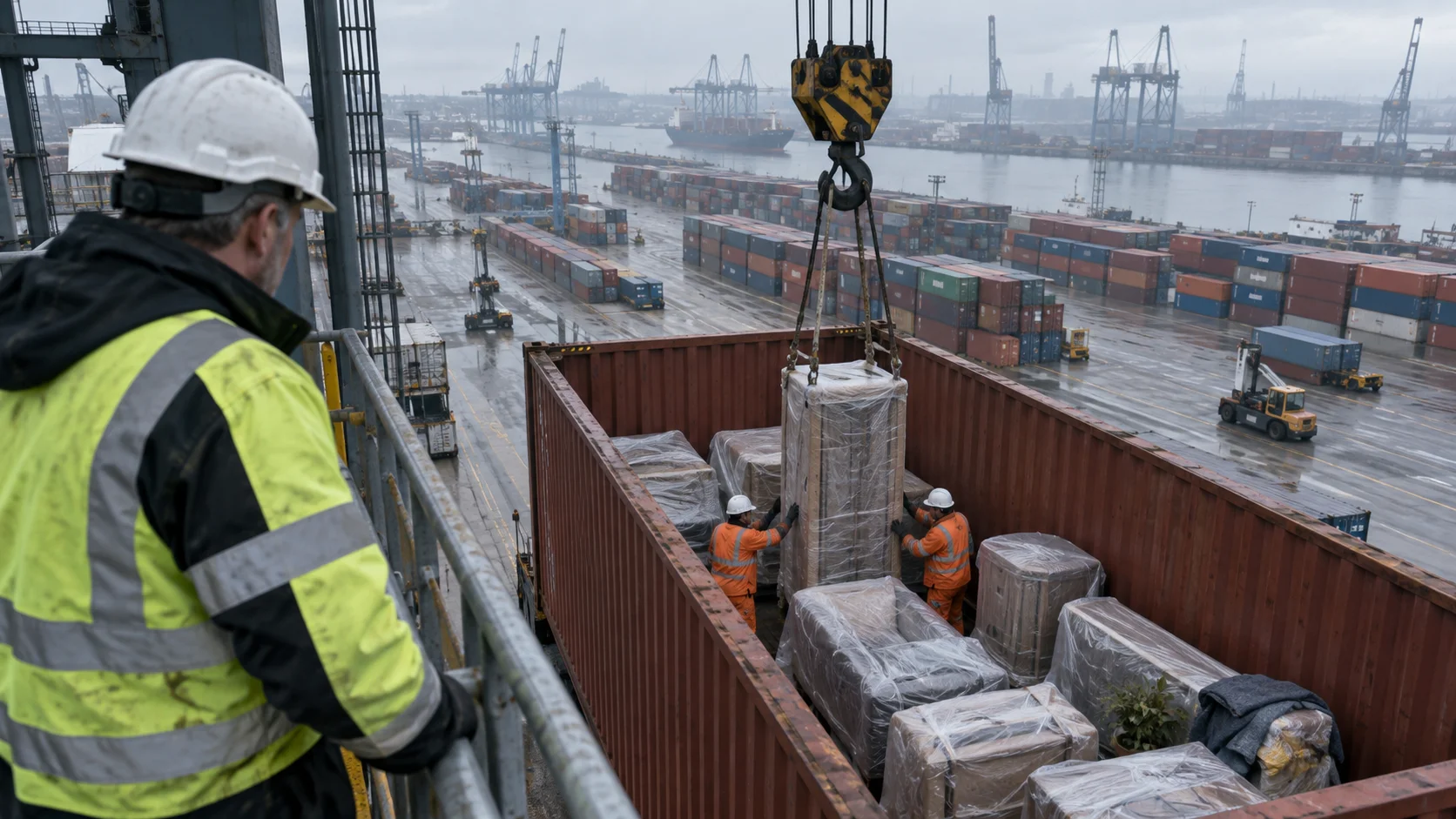
The destination cost stack for an LCL shipment typically adds USD 400–1,200 to the total before any duty assessment, a number that can equal or exceed the international freight cost on a small move.
LCL vs FCL: When the Crossover Matters
At approximately 15 CBM, the total LCL cost (freight at the upper end of the rate range, plus the Laem Chabang CFS deconsolidation fee) reaches parity with a 20ft FCL rate from most North European ports. Above 18 CBM, FCL is almost always cheaper in total. An FCL container is sealed at origin and opened only at Thai customs, with no intermediate deconsolidation, so it avoids the CFS deconsolidation fee entirely. Below 12 CBM, LCL will be more economical for the freight component, though the CFS floor cost still applies to the destination side.
The practical consideration: FCL gives full control over the container. No other shipper’s goods share the space. The container is sealed at the door in Europe and opened at Thai customs. Fragile items, antiques, high-value goods, and anything at real risk of other cargo shifting or leaking onto it benefit most from FCL’s control. The reduced handling can justify the cost premium even at volumes below the strict mathematical break-even point.
For an in-depth framework on the LCL vs FCL decision (economics, timing, fragility, and when FCL makes sense below the volume crossover), the LCL vs FCL guide covers the analysis that applies equally to moves destined for Thailand as those destined for Australia.
Three Complete Cost Scenarios
These three representative total-cost scenarios are estimates based on current market rates. Use them as planning anchors rather than precise quotes. The actual total depends on your specific origin address, departure port, chosen service level, and Thai destination.
Scenario A: Essentials-only move, 5 CBM, Hamburg to Bangkok
| Cost layer | Estimate |
|---|---|
| Origin charges (self-pack, packing materials, collection to CFS) | EUR 250–400 |
| International LCL freight (5 CBM × USD 130 midpoint) | USD 650 |
| Destination CFS + terminal handling (Laem Chabang) | USD 250–450 |
| Thai customs broker fee | USD 90–150 |
| Final delivery to Bangkok | USD 115–230 |
| Marine insurance (EUR 8,000 declared value, 2–3.5%) | EUR 160–280 |
| Total estimate (all layers combined) | Approx. USD 1,580–2,270 equivalent |
At this volume, the destination cost stack (CFS + broker + delivery) accounts for approximately 29–37% of the total, a significant share given it receives the least attention in most online freight quotes.
Scenario B: Full 1-bedroom apartment, 14 CBM, Rotterdam to Bangkok
| Cost layer | Estimate |
|---|---|
| Origin charges (professional pack and wrap, collection) | EUR 600–900 |
| International LCL freight (14 CBM × USD 130 midpoint) | USD 1,820 |
| Destination CFS + terminal handling (Laem Chabang) | USD 350–650 |
| Thai customs broker fee | USD 120–200 |
| Final delivery to Bangkok | USD 115–260 |
| Marine insurance (EUR 22,000 declared value, 2–3.5%) | EUR 440–770 |
| Total estimate (all layers combined) | Approx. USD 3,610–4,870 equivalent |
Scenario C: Full 3-bedroom family relocation, 38 CBM FCL 40ft, Felixstowe to Chiang Mai
| Cost layer | Estimate |
|---|---|
| Origin charges (professional pack, container loading at door) | GBP 900–1,800 |
| International FCL freight, 40ft (Felixstowe to Laem Chabang, door-to-port) | USD 5,000–7,500 |
| Destination port handling + customs examination | USD 300–700 |
| Thai customs broker fee | USD 120–230 |
| Final delivery Laem Chabang to Chiang Mai | USD 260–460 |
| Marine insurance (GBP 38,000 declared value, 2–3.5%) | GBP 760–1,330 |
| Total estimate (all layers combined) | Approx. USD 7,940–13,150 equivalent |
Currency conversions use European Central Bank reference rates of 27 August 2026 (EUR 1 = USD 1.16, GBP 1 = USD 1.36). All three scenarios assume personal effects duty relief is claimed. Duty on non-qualifying goods would be additional, and on retirement or marriage visa routes, which do not qualify for the relief, the whole shipment attracts 10–30% import duty plus 7% VAT on assessed value. The FCL scenario avoids the Laem Chabang CFS deconsolidation fee, which is a meaningful saving at this volume.
How to Reduce the Total Cost
Five levers reduce the total cost of a Europe-to-Thailand move.
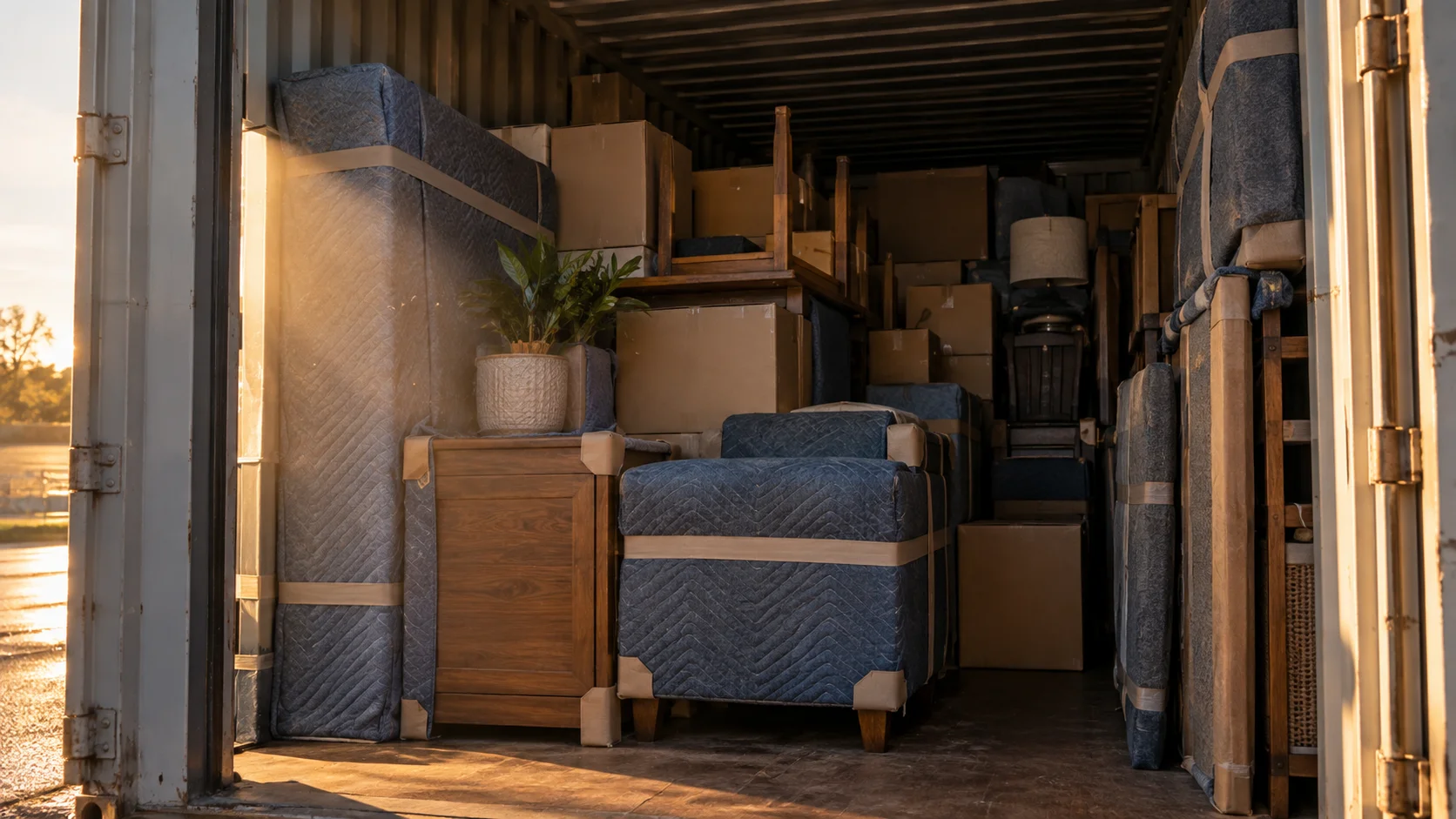
- Reduce CBM before the quote. Every cubic metre removed reduces freight cost by USD 80–180 and reduces the Laem Chabang CFS fee proportionally. The items that consume the most CBM with the least value in transit are cheap flat-pack furniture (replace at destination for less than the freight cost), old mattresses (better replaced at destination than shipped), large garden furniture, bulk books (dense: they hit weight limits before volume limits on LCL), and bulky household appliances that are better sold and replaced. The CBM size guide identifies each category with specific reasoning.
- Time the arrival to miss Songkran. Aim for goods to arrive at Laem Chabang either before 10 March or after 20 April. A two-week shift in departure date can eliminate port storage charges and Songkran-period surcharges worth USD 300–800 on a typical move. Work back from the required Laem Chabang arrival date. Given 36–49 days of sea transit, plan the packing and departure date from Europe deliberately, not by convenience.
- Finalise Thai residency documentation before shipment. The personal effects duty relief requires a qualifying status, such as a one-year work permit, to exist at the time of customs entry, not at the time of departure from Europe. A shipment that arrives at Laem Chabang before that status is finalised faces two bad options: store the goods in a bonded warehouse (at cost) until the documentation is ready, or clear customs without relief and pay duty. Getting the Thai documentation sorted before the ship leaves European waters is worth whatever it costs in administrative effort.
- Compare LCL and FCL at volumes above 12 CBM. Request both quotes at any volume above 12 CBM. At 15–18 CBM, the FCL total (which already avoids the CFS deconsolidation fee) may be within a few hundred dollars of the LCL total. Above 18 CBM, FCL is almost always the better choice in total cost terms.
- Use a single forwarder for the full door-to-door service. When origin, freight, and destination are split across separate providers arranged independently, the cost gaps between them can be significant. Destination agents arranged separately from the freight forwarder typically charge 20–40% more for the same services than a pre-arranged door-to-door rate. A single accountable forwarder for the full service reduces this risk and gives a single point of contact when paperwork problems arise, which happens occasionally on a Thailand customs clearance.
Getting an Accurate Quote
An accurate quote for a Europe-to-Thailand move requires three inputs: your shipping volume in CBM (or a room-by-room inventory from which CBM can be estimated), your pickup address and preferred departure port, and your Thai destination address. With those three inputs, a forwarder can give a full door-to-door cost across all six layers, not just the freight line.
For French and European movers, the France to Thailand shipping cost overview gives indicative EUR pricing for the full door-to-door service. The most efficient way to generate a CBM estimate without an in-person survey is a video walkthrough, a 5–10 minute video of every room showing each item clearly. Swift Cargo’s relocation team will assess the video and return a CBM estimate and full cost breakdown, including all destination charges, within 48 hours. For the full process from inventory to Laem Chabang delivery, the household goods shipping guide for Thailand covers every stage.
Request a full cost breakdown from Swift Cargo with your European pickup city, estimated volume or room count, and Thai destination. The team will return a complete breakdown (origin charges, freight, Thai handling, customs, delivery, and insurance) as a single document.
Country-Specific Guides
The cost mechanics above apply across Europe, but ports, routing and paperwork differ by origin. Dedicated guides per country:
- Moving from Germany to Thailand
- Moving from Netherlands to Thailand
- Moving from Spain to Thailand
- Moving from Italy to Thailand
- Moving from Belgium to Thailand
- Moving from Denmark to Thailand
- Moving from Sweden to Thailand
- Moving from Switzerland to Thailand
- Moving from Austria to Thailand
- Moving from Ireland to Thailand
Related reading: Lire cet article en français
Frequently Asked Questions
How much does it cost to move from Europe to Thailand?
Total door-to-door cost ranges from approximately USD 1,580–2,270 for a small (3–5 CBM) essentials-only move, USD 3,610–4,870 for a full 1-bedroom apartment (12–15 CBM), and USD 7,940–13,150 or more for a full 3-bedroom family relocation using a dedicated 40ft container. These figures include all six cost layers: origin charges, international freight, Thai destination handling, customs broker fee, final delivery, and marine insurance. Thai customs duty, if it applies, is additional: retirement and marriage visa routes do not qualify for personal effects relief, so on those routes add 10–30% import duty plus 7% VAT.
Do I pay import duty when moving household goods to Thailand?
Personal effects shipped as part of a genuine change of residence qualify for duty-free import under Thai customs regulations, provided four conditions are met: a qualifying status exists at the time of customs entry (a work permit valid for one year or more, a non-immigrant visa with a confirmed working period of at least one year, Thai permanent residence, a full one-year Smart Visa, or returning-Thai-national status after 12 or more continuous months abroad; a retirement or marriage-based Non-Immigrant O visa does not qualify); the goods arrive within six months of that status being granted; the goods are demonstrably used personal effects (not new items purchased for the move); and this is the first and only shipment under the exemption. Goods that do not qualify are subject to import duty of 10–30% of assessed CIF value, plus 7% VAT on top. The customs broker fee applies in all cases.
How long does shipping take from Europe to Thailand?
Since the Red Sea rerouting in late December 2023, sea transit from Northern European ports to Laem Chabang runs 36–49 days port-to-port via the Cape of Good Hope, up from the 25–35 days quoted on most pre-2024 moving company websites. Total door-to-door time, including packing, loading, Thai customs clearance (5–15 days), and final delivery, is typically 50–80 days. Budget 90 days from the packing date for any move with a fixed arrival deadline.
Is LCL or FCL cheaper for a Europe-to-Thailand move?
LCL is typically more economical for moves under 15 CBM. At 15–18 CBM, the total costs often reach parity when the Laem Chabang CFS deconsolidation fee is included in the LCL total. Above 18 CBM, FCL (a dedicated container) is almost always cheaper in total and eliminates the CFS deconsolidation fee entirely. Anyone moving 20 CBM or more should request both LCL and FCL quotes before committing.
What is Songkran and how does it affect my moving costs?
Songkran is the Thai New Year, celebrated 13–15 April, which effectively closes commercial operations at Laem Chabang port for the surrounding week. Shipments arriving at Laem Chabang in late March or April face port storage charges after the free storage period expires, typically THB 500–1,500 per CBM per week, plus demand-driven freight surcharges. A 10 CBM shipment held for two weeks in the Songkran period can accumulate USD 300–800 in storage charges alone. Timing the shipment to arrive before 10 March or after 20 April avoids this entirely.