
PPE is one of the most compliance-sensitive product categories an Australian importer can work with. The regulatory framework is split across at least three separate authorities depending on the product and its intended use: the Therapeutic Goods Administration for anything with a medical claim, AS/NZS standards enforced by state and territory WHS regulators (national policy sits with Safe Work Australia) for industrial safety equipment, and the AICIS (Australian Industrial Chemicals Introduction Scheme) for PPE that contains chemical formulations or coatings. Getting any one of these wrong does not just delay a shipment. It can leave you holding goods that cannot legally be sold in Australia. Before you import PPE to Australia, work out which of those frameworks your product falls under, because some products must satisfy more than one.

How Australia Regulates PPE: Three Separate Frameworks
Any PPE import compliance assessment starts by identifying which regulatory framework applies to the specific product. The three frameworks are not mutually exclusive, and some PPE products must satisfy more than one.
Framework 1, AS/NZS standards (occupational and industrial PPE): PPE sold for workplace use must comply with the relevant Australian/New Zealand Standard, under the Work Health and Safety Act 2011 and equivalent state legislation. Compliance is typically demonstrated through a test report from an accredited testing laboratory confirming the product meets the standard’s performance requirements. Safe Work Australia publishes guidance on which standard applies to each PPE category; state WHS regulators (WorkSafe Victoria, SafeWork NSW, etc.) enforce these requirements in their jurisdictions.
Framework 2, TGA medical device registration (medical-grade PPE): Under the Therapeutic Goods Act 1989, PPE that counts as a medical device must be listed or registered on the Australian Register of Therapeutic Goods (ARTG) before it can be legally supplied in Australia. “Supplied” includes importing for sale, so goods cannot enter the country as stock unless the ARTG listing is already in place.
Framework 3, AICIS (chemical-contact PPE and coatings): AICIS does not regulate finished articles as such, but it does regulate industrial chemicals that are designed to be released from them, and some PPE carries chemical formulations that can fall inside that scope. Biocide-treated gloves, antimicrobial coatings on masks, and flame-retardant treatments on garments are the usual cases to check. The AICIS Inventory lists the chemicals that can be introduced as listed; for a chemical that is not on the Inventory, the introducer must categorise the introduction as exempted, reported, assessed or commercial evaluation, and AICIS sets different obligations for each category.
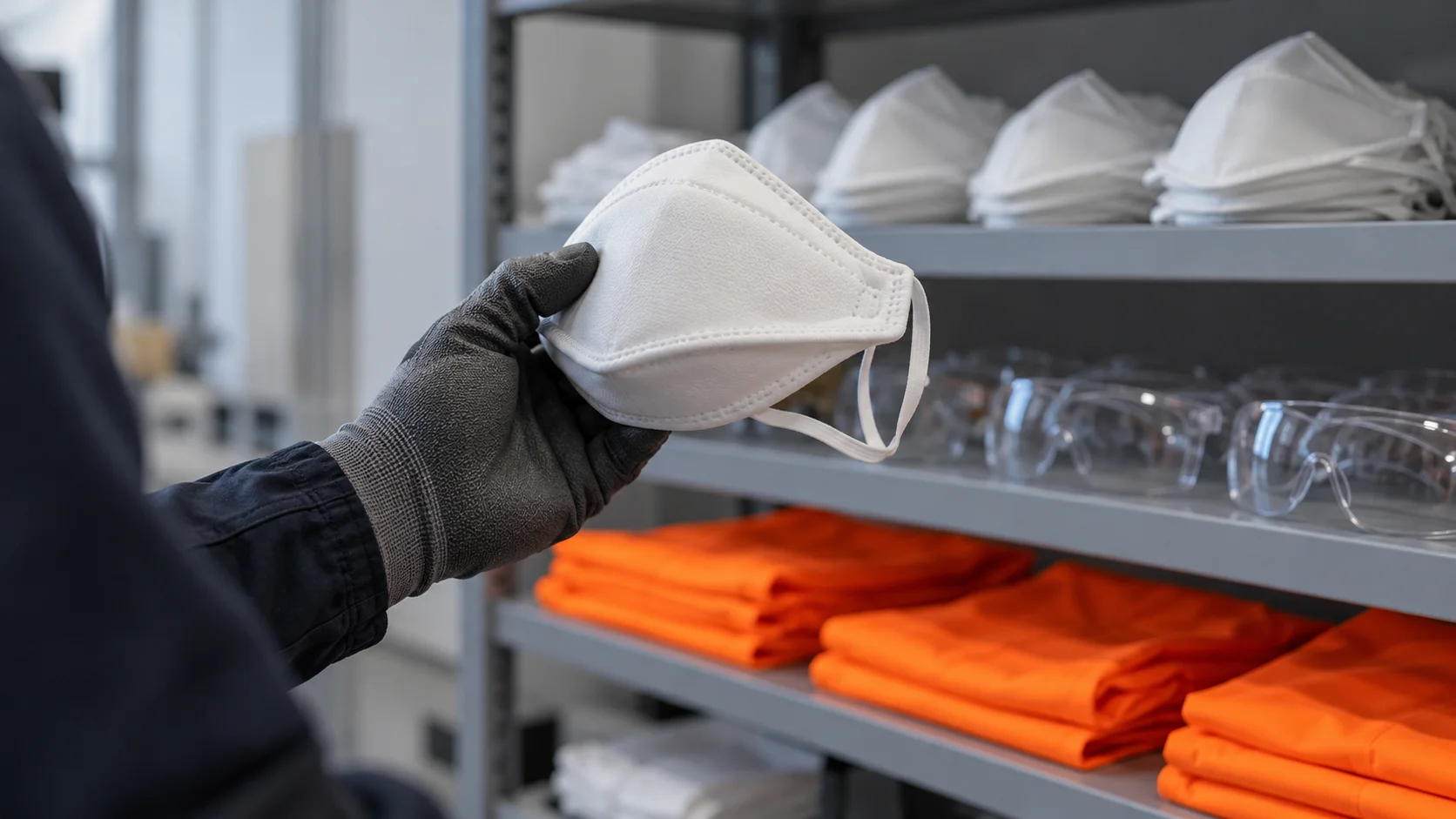
AS/NZS Standards by PPE Category
The relevant standard determines the performance requirements a product must meet. Below is the compliance reference for the main PPE categories imported commercially to Australia.
Respiratory Protection
AS/NZS 1716:2012, Respiratory Protective Devices applies to non-powered air-purifying respirators (P1, P2, P3 particulate respirators), half-face and full-face gas respirators, self-contained breathing apparatus, and supplied air respirators. The standard specifies the filtration efficiency, fit test requirements, and classification markings required for each protection class.
The P2 class (≥94% filtration efficiency against particles) is the industrial equivalent of the N95 standard used in other markets. PPE importers selling P2 respirators must ensure the product’s test report references AS/NZS 1716 specifically. A product tested to EN 149 (European FFP2) or NIOSH N95 (US) is not automatically compliant, though the performance levels are broadly comparable. The test must be from an ILAC-accredited laboratory.
Disposable respirators marketed for medical use (surgical respirators, procedure masks) require TGA listing as a medical device (see the TGA section below).
Eye and Face Protection
AS/NZS 1336:2014, Recommended practices for occupational eye protection is a guidance document, not a performance standard; it references AS/NZS 1337 for the actual product requirements.
AS/NZS 1337.1:2010, Eye and face protectors for occupational applications covers safety spectacles, goggles, and welding filters. The standard specifies optical class, impact resistance, and field of vision requirements. Products must be marked with the relevant class designation and the testing laboratory’s certification mark.
AS/NZS 1337.6:2012, Prescription eye protectors against low and medium impact applies to occupational eye protectors fitted with prescription lenses. That is a separate pathway from non-prescription industrial eye protection.
Head Protection
AS/NZS 1800:1998, Occupational protective helmets: Selection, care and use is the selection and maintenance guide. The performance standard is AS/NZS 1801:2024, Occupational protective helmets, which replaced AS/NZS 1801:1997 in September 2024. Industrial hard hats must comply with AS/NZS 1801, which specifies impact attenuation, penetration resistance, and retention system requirements. The standard sorts helmets into types by the hazard they are made for, from general falling-object protection (Type 1) up to fall-related head injury (Type 4), so confirm which type the buyer’s site rules call for.
Hard hats marked to EN 397 (European standard) or ANSI Z89.1 (US) are not compliant with AS/NZS 1801. Australian site safety rules call for AS/NZS 1801 marking specifically. Chinese manufacturers supplying the Australian market typically test to both AS/NZS 1801 and EN 397; confirm the AS/NZS marking is present on the helmet itself, not just the packaging.
Hand Protection
AS/NZS 2161, Occupational protective gloves is a multi-part standard: 2161.1 (selection, use and maintenance), 2161.2 (general requirements and test methods), and the hazard parts 2161.3 (mechanical risks, including cut resistance), 2161.4 (heat and fire) and 2161.10 (chemicals and micro-organisms). The applicable hazard part depends on the primary hazard the glove is designed to protect against.
Nitrile disposable examination gloves sold for industrial use (not medical examination) must comply with AS/NZS 2161 for the relevant hazard class. The same glove sold for medical examination use requires TGA ARTG listing as a medical device.
Anti-dumping note: check the ADC register for rubber examination gloves before placing any order, because measures are set per tariff item and country of origin and can be introduced when a new case opens. No glove measure appeared on the register when this was checked on 12 October 2026. The anti-dumping section below covers that check in full.
High Visibility Clothing
Two standards govern high-visibility workwear: AS 4602.1:2024, High visibility safety garments, Part 1: Garments for high risk applications, and AS/NZS 1906.4:2023, High-visibility materials for safety garments. They replaced AS/NZS 4602.1:2011 and AS/NZS 1906.4:2010. Between them they define the performance requirements for the fluorescent background material and the retroreflective tape. Class D/N (day/night) garments are the most commonly required specification on Australian construction sites.
Chinese manufacturers supplying the Australian market typically offer AS/NZS 4602.1-compliant high-visibility vests and garments as a standard export configuration. The compliance requirement applies to the specific batch tested. Documentary evidence means a test report from an ILAC-accredited laboratory that tested the actual production run. A test report on a visually similar garment built to a different specification does not transfer compliance.
Fall Protection
AS/NZS 1891, Industrial fall-arrest systems and devices is a multi-part standard: 1891.1 (harnesses and ancillary equipment), 1891.2 (horizontal lifeline and rail systems), 1891.3 (fall-arrest devices associated with a rigid anchorage line), and 1891.4 (selection, use and maintenance). Fall protection equipment imported to Australia must comply with the relevant parts of AS/NZS 1891 for the product type.
Fall protection is a life-safety category. ABF and state WHS authorities treat non-compliant fall protection equipment as a priority enforcement matter. Test reports must be from ILAC-accredited laboratories; compliance marking must appear on the product itself, not only on the packaging.

TGA Requirements for Medical-Grade PPE
The boundary between industrial PPE and medical-grade PPE is defined by the intended purpose, not the physical product. A nitrile glove sold for general industrial use is regulated under AS/NZS 2161. The same glove becomes a medical device under the Therapeutic Goods Act as soon as its labelling or marketing points to clinical use: examination of patients, protection during clinical procedures, or handling of body fluids. At that point it requires TGA ARTG listing. The same pre-market clearance gate governs other TGA-regulated import categories, including supplement shipments arriving from the US, where the sponsor’s listing status gets checked long before the container leaves port.
The TGA medical device classifications most relevant to PPE importers:
- Surgical masks: Class I medical devices. They must be listed on the ARTG before supply in Australia. The sponsor (the Australian entity responsible for the product) applies to TGA for listing. That listing requires evidence of compliance with TGA’s Essential Principles and the applicable Australian standard (AS 4381 for surgical masks).
- Examination gloves (medical): Class I medical devices, or Class IIa if sterile. They require ARTG listing, with testing to AS/NZS 10282 (sterile surgical gloves, which replaced AS/NZS 4179 in March 2026) or AS/NZS 11193.1 (single-use medical examination gloves, which replaced AS/NZS 4011.1 in March 2026).
- Face shields (medical): Class I medical devices when indicated for infection control in clinical settings. They require ARTG listing, and performance evidence comes from AS 4381 or the relevant TGA guidance document.
- Protective gowns (medical): Class I medical devices when the gown is intended to protect against clinical contamination. AS 3789 and TGA’s Essential Principles cover them.
For Class I (non-sterile) medical devices, the sponsor self-declares that the product meets TGA’s Essential Principles and the applicable standards, and supports that declaration with a Declaration of Conformity. TGA reviews submissions and issues ARTG listing numbers. TGA’s own processing of a Class I application is short: its published processing times for July to December 2021 show a median of 1 TGA day for applications completed without audit and 11 days for those selected for audit, so much of the lead time sits with the sponsor assembling the Declaration of Conformity and test evidence.
Goods that require TGA listing but arrive without it cannot be released to the market. ABF can detain goods at the border pending TGA confirmation of their status. Importers who discover a TGA listing gap after goods have already arrived pay storage while they complete the listing. TGA assessment must therefore happen before you raise the purchase order, not after the container is at port. If you import PPE to Australia for both industrial and clinical buyers, both pathways apply to the same product.
AICIS for Chemical-Containing PPE
The Australian Industrial Chemicals Introduction Scheme (AICIS) regulates chemicals introduced into Australia for industrial use. PPE products that incorporate chemical formulations may contain industrial chemicals that are not yet on the AICIS Inventory. Biocide treatments, antimicrobial silver coatings, flame-retardant finishes, and chemical-resistant coatings are the usual sources.
The AICIS Inventory lists chemicals that have been assessed and can be introduced without prior notification (subject to conditions). If a chemical in the PPE product is designed to be released and is not on the Inventory, the importer must categorise the introduction under AICIS (exempted, reported, assessed or commercial evaluation) and meet the obligations that category carries before importing commercially.
PPE categories where AICIS is most likely to apply:
- Antimicrobial-treated masks or garments (silver ion treatments, triclosan)
- Flame-retardant treated PPE (organophosphate or brominated flame retardants not on the Inventory)
- Chemical-resistant gloves with proprietary polymer coatings
- Biocide-impregnated gloves (including some examination gloves marketed as antimicrobial)
The AICIS check is straightforward: identify the chemicals in the product formulation from the supplier’s Safety Data Sheet (SDS), then cross-reference each one against the AICIS Inventory. If all chemicals are on the Inventory and within the permitted use conditions, no further AICIS action is required. If any chemical is absent from the Inventory, settle the introduction pathway before ordering.
HS Code Classification for PPE
PPE classification under the Australian Customs Tariff is not always intuitive. The same physical product can have different tariff classifications depending on its material composition and primary function, and the duty rate varies accordingly. The list below sets out the principal HS codes for PPE categories:
- Safety helmets: 6506.10. Duty rate typically 0% under ChAFTA/TAFTA or MFN; confirm for the specific origin.
- Safety spectacles/goggles: 9004.90. Duty 0% for most origins.
- Respiratory masks (non-medical, air-purifying): 6307.90. Duty 0% for most origins.
- Medical/surgical masks: 9020.00 (breathing appliances). Duty 0%.
- Rubber examination gloves (natural latex): 4015.11. Duty 0–5%, depending on origin and any ADC measures.
- Nitrile disposable gloves: 4015.12. Duty 0–5%; ADC check required.
- Protective gloves (general, not rubber): 4015.19. Confirm by material.
- Leather protective gloves: 4203.29.
- High-visibility garments (textile): 6211.20 (men’s) or 6211.42/43 (women’s, by fabric). Duty 0% MFN if ChAFTA/TAFTA origin.
- Safety footwear with protective metal toecap: 6401.10 (rubber/plastic outer sole, rubber/plastic upper), or 6402.91 (rubber/plastic outer sole and upper, no toecap protection claim).
- Fall arrest harnesses: 6217.10 (clothing accessories). Confirm with a broker for multi-component sets.
Classification errors on PPE are a known ABF compliance focus. The distinction between 6307.90 (made-up textile articles, including non-medical respirators) and 9020.00 (medical breathing apparatus) changes both the duty rate and the TGA position. A respirator classified as 9020.00 with no TGA listing will trigger scrutiny. Have a licensed customs broker confirm the classification with the actual product specification in hand.
Anti-Dumping: Gloves and the ADC Register
Australia’s Anti-Dumping Commission (ADC) was renamed the Australian Trade Remedies Commission on 29 September 2026. It publishes a dumping commodity register of the goods currently under measures. On 12 October 2026 that register listed 31 commodities, mostly steel and aluminium products, and none was a glove or any other PPE item, but the list changes as new cases open. Anti-dumping measures impose an additional duty on top of the standard customs duty, based on the dumping margin calculated by the ADC.
Anti-dumping measures apply per tariff item and per country of origin. A nitrile glove product from Country A may be subject to measures; the same product specification from Country B may be measure-free. The ADC public register is searchable by HS code and by country. A search before placing the purchase order takes less than ten minutes, and it is the only way to confirm the current status.
Measures on the ADC register may be:
- Active: the measure is currently in force, and the additional duty applies.
- Interim: a preliminary measure applied during an ongoing investigation.
- Lapsed or terminated: the measure is no longer in force.
- Under review: a sunset review may extend or terminate the measure.
The register itself is not the failure point. It is public, searchable, and free to check. The failure point is a procurement process where nobody is assigned to check it before the purchase order goes out. In every case reviewed for this guide, the importer who got caught by an active anti-dumping measure had not been deceived by a hidden rule. The rate was published. The register was searchable. What was missing was a single named person whose job included the ten-minute search before the order was placed. That is not a compliance gap. It is an accountability gap, and it is the cheaper of the two problems to fix.
By the time an importer discovers an active anti-dumping measure at customs clearance, the goods are already in Australia. The measure must be paid before they are released. The measure is a percentage of the customs value and can range from 5% to 80%+ of the CIF value depending on the product and the investigation outcome. For a hypothetical AUD 200,000 CIF container of examination gloves subject to a 30% anti-dumping measure, that is AUD 60,000 in additional duty that was not in the landed cost calculation. That kind of clearance-stage surprise is exactly the pattern behind most customs delays on Australian imports: the paperwork was correct, but nobody checked a register that changes independently of the shipment.
Sourcing Structure: China vs Thailand vs Malaysia
Most PPE imported to Australia is manufactured in China, Malaysia, or Thailand. Each origin has different compliance and tariff implications:
China (ChAFTA): The China-Australia Free Trade Agreement eliminates or reduces tariffs on most PPE categories for goods meeting the Rules of Origin (substantial transformation or specific product rules). Goods claiming the ChAFTA preference need a ChAFTA Certificate of Origin issued by an authorised body in China (the General Administration of Customs or the China Council for the Promotion of International Trade), which customs can ask to see. ADC measures are set per product and origin and none covers PPE at present, but the register changes, so check it before ordering. An AICIS check matters most for Chinese PPE with proprietary chemical treatments.
Thailand (TAFTA): The Thailand-Australia Free Trade Agreement reduces tariffs on goods meeting the Rules of Origin. Thailand is a significant manufacturer of rubber and nitrile gloves, and that duty preference reaches those gloves wherever the Rules of Origin are met. Thailand is not on the BMSB targeted countries list, which is relevant for timber packaging compliance.
Malaysia (MAFTA): The Malaysia-Australia Free Trade Agreement also reduces tariffs on qualifying goods. Malaysia is a major global glove manufacturer, and no glove measure is on the dumping commodity register today, although Malaysian-origin goods such as aluminium extrusions are listed. MAFTA preference does not reduce or eliminate anti-dumping measures. Anti-dumping duty is levied on top of any applicable duty rate.
Total Landed Cost Model for PPE: AUD 180,000 CIF Safety Equipment Shipment
Take a 20ft FCL from China to Sydney with a CIF value of AUD 180,000, carrying hard hats (6506.10), high-visibility vests (6211.20), and P2 respirators (6307.90):
- Ocean freight (included in CIF): AUD 0 additional
- Customs duty: 0% on all three categories under ChAFTA origin = AUD 0
- GST: 10% on CIF = AUD 18,000
- Import declaration (ICS) lodgement fee: AUD 120
- Customs broker: AUD 350
- Port THC/container handling: AUD 380
- Inland delivery (Sydney port to warehouse): AUD 650
- Total landed cost: approximately AUD 199,500
Now suppose you add AUD 40,000 CIF of examination gloves to the same shipment and a 28% ADC measure applied to that glove component. No such measure is on the register today, so treat this as an illustration of the exposure:
- Anti-dumping measure on gloves: 28% × AUD 40,000 = AUD 11,200
- GST on glove component after anti-dumping: 10% × (AUD 40,000 + AUD 11,200) = AUD 5,120
- Revised total landed cost for full shipment: approximately AUD 255,820 (AUD 199,500 + AUD 40,000 gloves + AUD 11,200 measure + AUD 5,120 GST)
A 10-minute ADC register check before placing the order would have avoided that AUD 11,200 liability entirely, either by confirming no measures applied, or by prompting a switch to a measure-free origin before the container was loaded.

Pre-Order PPE Compliance Checklist
For each new PPE product category you plan to import to Australia, complete the following checks before you raise the purchase order:
1. Identify the regulatory framework: Is this industrial PPE (AS/NZS standards), medical-grade PPE (TGA), or both? The intended end use and any marketing claims determine the framework. If your customer intends to sell the same product for both industrial and medical use, both pathways apply.
2. Confirm the applicable AS/NZS standard: Identify the correct standard for the product category from the Safe Work Australia reference list. Obtain the current edition of the standard (AS/NZS standards are periodically revised; test reports against superseded editions may not satisfy current requirements).
3. Verify test report currency and accreditation: The test report must reference the correct edition of the applicable AS/NZS standard and must be issued by an ILAC-accredited testing laboratory. Review any test report older than 3 years for relevance. If the product specification has changed or the standard has been revised, a re-test may be required.
4. Check ARTG status (if medical-grade): Search the TGA ARTG database for the product. If the product is not listed, complete the listing before importing any goods for sale. If the product is listed by a different sponsor (manufacturer or importer), confirm that the listing is transferable or that a new listing is required for your company’s sponsorship.
5. Check AICIS Inventory (if chemical-containing): Request the SDS from the supplier for any PPE with biocide treatment, antimicrobial coating, flame retardant treatment, or chemical-resistant formulation. Cross-reference each listed chemical against the AICIS Inventory. Flag any chemical not on the Inventory before ordering.
6. Check the ADC register: Search the ADC public register by the applicable HS code and country of origin for any active anti-dumping or countervailing measures. Run this check for every new product category and every new country of origin, because measures change and previous searches go stale.
7. Confirm HS code classification: Have a licensed customs broker confirm the 8-digit tariff item, the applicable duty rate, and any import permit or quota requirement for the specific product and origin. For PPE that sits at the boundary between two tariff items (e.g., a garment that could be classified as PPE clothing or as a general garment), get the classification confirmed in writing before the first shipment.
8. Specify compliance requirements on the purchase order: Once all checks are complete, incorporate the compliance requirements into the purchase order: the applicable AS/NZS standard, the required marking on the product itself, the ILAC-accredited test report to be supplied with the shipment, ISPM 15 timber packaging, and BMSB treatment where required (for target goods shipped from BMSB target countries between 1 September and 30 April, judged by the shipped-on-board date).
PPE compliance failures in Australia carry consequences beyond a delayed shipment. Non-compliant PPE that has entered the supply chain has already been sold to distributors and issued to workers on site. At that point it creates liability for the importer under the Work Health and Safety Act, and under the Therapeutic Goods Act for medical-grade PPE. The pre-order checklist is the point in the process where these risks are still manageable.
Swift Cargo works with Australian importers across industrial and medical PPE categories. That work includes sea freight programs from China, Thailand, and Malaysia. For guidance on the compliance documentation required for your specific PPE program, visit swiftcargo.solutions to speak with our team.
What to Settle Before You Import PPE to Australia
Confirm the regulatory framework and the current edition of the AS/NZS standard, get an ILAC-accredited test report for the actual production run, and check ARTG status for anything with a clinical use. Then check the AICIS Inventory for chemical treatments and search the ADC register by HS code and origin, a check that takes less than ten minutes.
Related reading: PPE from China to Australia: ChAFTA Duty and AS/NZS Compliance
Frequently Asked Questions
What standards apply to importing PPE to Australia?
PPE imported to Australia must comply with the relevant AS/NZS standard for the product category: AS/NZS 1336 (eye protection), AS/NZS 1337 (safety glasses and goggles), AS/NZS 1716 (respiratory protective equipment), AS/NZS 1801 (occupational protective helmets), AS/NZS 2161 (occupational protective gloves), AS 4602.1 and AS/NZS 1906.4 (high visibility garments), and AS/NZS 1891 (fall protection). Surgical masks, medical gloves, and gowns count as medical-grade PPE, and all of them also require TGA (Therapeutic Goods Administration) listing before sale in Australia. Non-compliant PPE cannot legally be sold in Australia and may be seized at the border.
Is there anti-dumping duty on gloves imported to Australia?
No gloves are subject to anti-dumping measures on the dumping commodity register of the Australian Trade Remedies Commission (formerly the Anti-Dumping Commission, or ADC) as of October 2026. Measures are product- and country-specific and the register changes as new cases open, so check it by tariff item and country of origin before ordering any glove product. As with all anti-dumping situations, the check must be done before the purchase order goes out. Discovery at clearance is too late to avoid the duty.
Does TGA apply to all PPE imports?
TGA (Therapeutic Goods Administration) registration applies specifically to PPE that meets the definition of a medical device, meaning goods whose primary intended purpose is medical or clinical. This includes: surgical masks (ARTG listed as Class I medical devices), examination gloves and surgical gloves, medical gowns used in clinical settings, and face shields used in clinical care. Industrial PPE sold for workplace safety (construction helmets, high-visibility vests, safety boots) is not subject to TGA and is regulated instead by Safe Work Australia and state WHS regulators through AS/NZS standards. An importer must be clear about the intended end use: marketing the same glove for ‘general use’ vs ‘clinical use’ determines whether TGA applies.
What HS codes apply to PPE imported to Australia?
Common HS codes for PPE categories: safety helmets 6506.10; safety glasses/goggles 9004.90; respiratory masks (non-medical) 6307.90; surgical masks (medical) 9020.00; rubber examination gloves 4015.11; nitrile disposable gloves 4015.12; protective gloves (general) 4015.19; high-visibility garments 6211.20; safety footwear with protective toecaps 6401–6405 (dependent on material); fall arrest harnesses 6217.10. Classification should be verified by a licensed customs broker against the actual product specifications, as duty rates and permit requirements vary by tariff item.