
Air Canada flight AC65 leaves Vancouver at 23:20 on Mondays, Wednesdays and Saturdays and is scheduled to land at Bangkok’s Suvarnabhumi Airport at 05:15, two calendar days later. Since summer 2026 it has run all year. For anyone moving pets from Canada to Thailand, that single flight changes the planning, because a great deal of pet-travel advice still starts from the assumption that no Canadian flight reaches Thailand without a stop.
The second surprise sits on the Canadian side. Thailand does not appear on the Canadian Food Inspection Agency’s list of countries with a negotiated pet export certificate. Your dog or cat still needs a certificate signed by a Canadian vet and endorsed by a CFIA veterinarian before it leaves, but nobody has pre-agreed the form. Owners who expect to download a Thailand certificate the way they would for Japan or Singapore find an empty slot instead, and that discovery is better made in month one than in the final week.
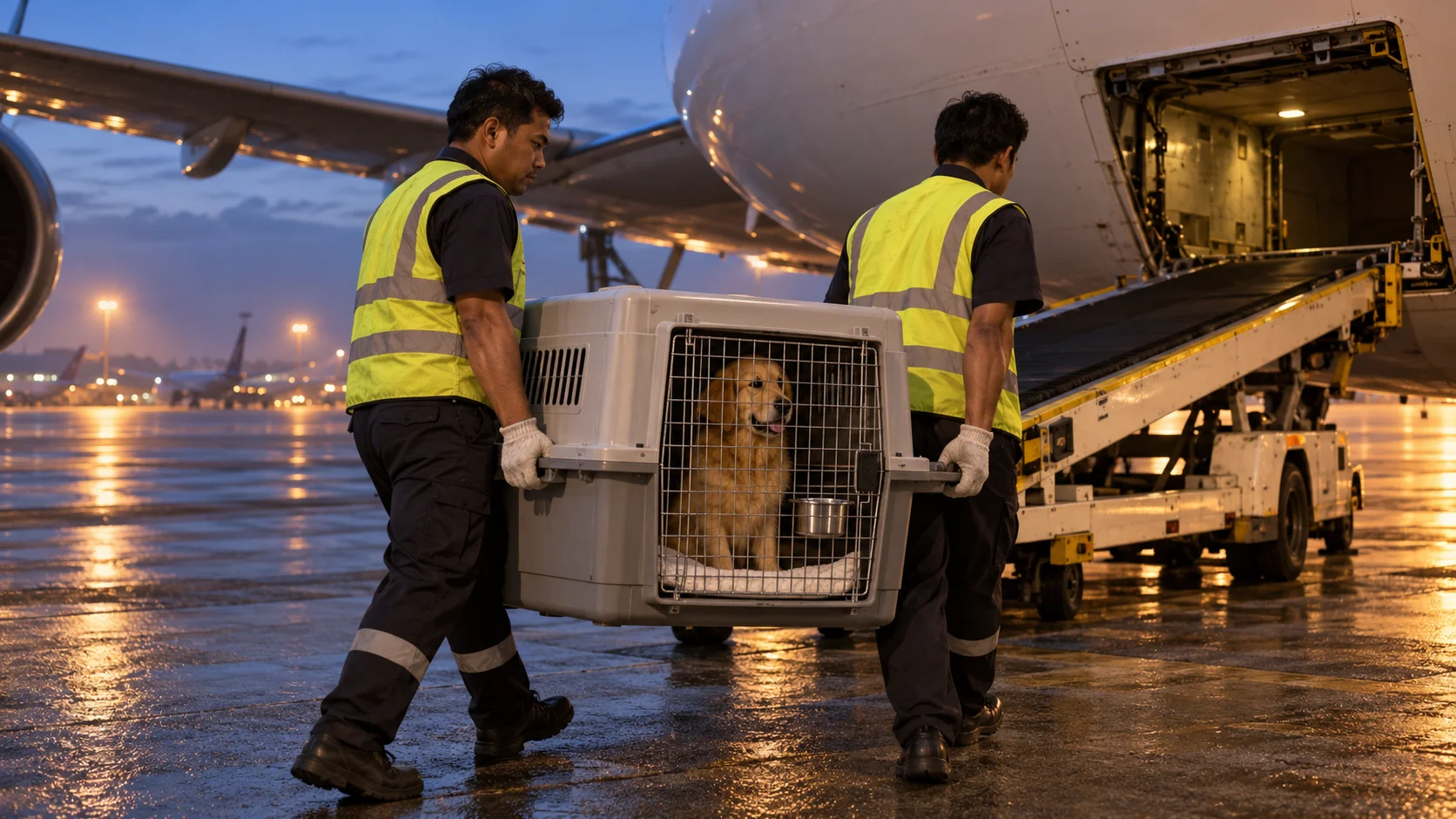
The Direct Flight Most Pet Guides Say Does Not Exist
Air Canada announced on 10 September 2025 that its seasonal Vancouver to Bangkok route would become year-round from summer 2026, and called itself the only airline with non-stop, continual service to Thailand from North America. The published schedule is AC65 from Vancouver on Mondays, Wednesdays and Saturdays, and AC66 back from Bangkok at 07:15 on Mondays, Wednesdays and Fridays. Air Canada adds the usual warning that schedules are subject to change, so check the live timetable before you build a plan around it.
For pet transport from Canada to Thailand, a nonstop matters more for the animal than for its owner. Every connection is another loading and unloading, another stretch on an apron in whatever weather that airport has, and often another country’s transit rules. One flight removes all of that. It also means one airline’s pet policy governs the whole journey, which is far easier to plan against than two carriers with two rulebooks.
The nonstop is not a free pass, though. The Air Canada pet policy decides whether your animal can board it, in which compartment and in which month, and Thailand has its own rules about when you may land. Toronto, Montreal and Calgary owners also have a choice to make: connect in Vancouver onto AC65, or take a one-stop route through an Asian or European hub. Whichever they choose, the paperwork sets the earliest date the animal can fly.
What Canada Requires Before the Animal Leaves
The CFIA’s pet export certificates page states the rule plainly. Most pets travelling from Canada to another country need an export certificate issued by a licensed veterinarian and endorsed by an official CFIA veterinarian, and the endorsement must happen before the animal leaves Canada. The CFIA cannot endorse a certificate once the animal is gone, and nothing at the Thai end can repair that.
Thailand is not on the certificate list
No ready-made CFIA export certificate exists for Thailand. The same page lists the countries for which a certificate exists, alphabetically. Under T it shows Taiwan, Trinidad and Tobago, Türkiye and the Turks and Caicos Islands. Thailand is absent. For a destination with no negotiated certificate, the CFIA’s instruction is to get the current import requirements from that country’s veterinary authority or embassy. If Thailand has no prescribed format and its requirements can be met, the Canadian International Health Certificate can be used. If not, the requirements go to your local CFIA animal health office for review, and the CFIA warns that negotiating a new certificate with another country can take several months.
In practice that means one early email and one early call. Ask the Suvarnabhumi Animal Quarantine Station what the health certificate must state, and ask your CFIA office whether the Canadian International Health Certificate covers it. Both are easy to postpone, because every other part of the move feels more urgent. It is the one step where a delay is measured in months rather than days.
The endorsement is by appointment only
The CFIA’s appointment page sets out how endorsement works. Walk-ins are not accepted. Your own vet completes and signs the certificate first. You then book the CFIA appointment, and a CFIA officer calculates the service fee, which you pay online at least 3 days before the appointment by credit card or prepaid credit card. Debit cards are not accepted. Once booked, the fee is non-refundable, although a paid fee carries over if a cancelled or moved flight forces you to reschedule.
That sequence has a quiet consequence. Your vet visit, the CFIA appointment and the payment deadline all have to sit inside the window Thailand accepts for the certificate, and an appointment on the exact day you want is not guaranteed. Book the appointment as soon as your flight is confirmed, not when the certificate is signed.
If you are comparing this with a move to the United States, our guide to moving pets from Canada to the US shows how light the CFIA side is on that border, where CFIA sets no separate export certificate for a personal pet. Thailand sits at the opposite end of that spectrum.
What Thailand Requires on Arrival
Thailand’s Department of Livestock Development publishes one set of import instructions for dogs, cats and rabbits. The Thai side is the same whether the animal comes from Vancouver, Sydney or Paris, and it asks for the following.
- A microchip, with the same number on the permit application, the vaccination record and the health certificate. Officers scan the chip on arrival and compare it with the paperwork.
- Vaccinations recorded in English. Dogs need rabies, canine distemper, canine hepatitis, canine parvovirus and leptospirosis. Cats need rabies and feline panleukopenia. The record must carry the pet’s breed, sex, date of birth, colour and microchip number, plus the vaccinating vet’s full name, licence number and signature.
- An import permit on form R1/1, emailed with a copy of your passport and a colour photo showing the pet’s face to the Animal Quarantine Station at your arrival airport.
- An official health certificate from the exporting country’s veterinary authority, endorsed and stamped by that government. For a Canadian pet, that endorsement is the CFIA step above.
The DLD’s remarks set the timing. After a primary vaccination, or one given after an earlier vaccination lapsed, the animal must wait 21 days before departure. A primary rabies vaccine only counts if the animal was at least 12 weeks old when it was given. A dog without a valid leptospirosis vaccine needs a negative leptospirosis test within 30 days of departure instead. A booster given while the earlier shot was still valid carries no wait, provided the earlier records go in with the permit request.
The permit itself runs on its own clock. For cargo, the DLD requires the application at least 7 working days before arrival, and staff aim to email the permit within 7 working days. It is valid for 60 days, and a rescheduled flight inside those 60 days does not need a new application. For a pet travelling in the cabin or as checked baggage, the DLD also lets you apply for the permit on arrival, but it does not recommend that route for passengers with short transits and warns that processing time depends on how many pets arrive at once.
One number from other guides does not belong in a Canadian plan. The 10-day health certificate window that appears in many Thailand checklists comes from the DLD’s instructions for pets from the USA, where it runs from the date the USDA endorses the certificate. The DLD’s general instructions set no Canada-specific window. Ask the Animal Quarantine Station how recent it wants a CFIA-endorsed certificate to be when you apply for the permit, and plan the CFIA appointment backwards from that answer.
The species detail runs deeper than this corridor guide needs to go. Taking a dog from Canada to Thailand adds breed restrictions and crate engineering, which our guide to taking a dog to Thailand explains. Bringing a cat from Canada to Thailand is simpler on paper, and the cat transport guide untangles the panleukopenia naming problem that catches cats vaccinated under a Canadian FVRCP label.
The CFIA appointment, the R1/1 permit and the vaccine waits each carry a deadline, and we can sequence your pet’s move so they line up.
Cabin, Hold or Cargo on the Vancouver Nonstop
Air Canada carries pets three ways, and the size of the animal usually picks the option for you.
- In the cabin. One cat or small dog per passenger, in a soft-sided carrier under the seat in front. Hard-sided carriers have been refused in the cabin since 1 June 2025. On Air Canada’s Boeing 777 and 787 aircraft the carrier limit is 40 cm wide, 43 cm long and 20 cm high, with different dimensions in Business Class, and pets are not allowed in Premium Economy or in exit and bulkhead rows.
- In the baggage compartment. The pet travels in the hold on your ticket, in a hard-sided kennel with no mesh top, up to 45 kg for pet and kennel combined and 292 cm in linear dimensions. Snub-nosed dog breeds cannot travel this way at all.
- With Air Canada Cargo. Heavier animals, larger kennels and pets travelling without their owner go through the airline’s AC Animals service as cargo.
Both passenger options have to be registered by phone after you buy your own ticket, and Air Canada recommends doing it within 24 hours of booking so the fare can be refunded if the pet cannot be accommodated. An unregistered pet is refused at the airport. On the day, you check in with an agent, 30 minutes before the usual recommended time, because online and kiosk check-in are not available with a pet. Air Canada also advises against tranquillisers and other medication unless your vet says otherwise. For the welfare and handling differences between the three modes, read our comparison of cabin and cargo pet travel.
The minimum age on Air Canada is 10 weeks in most cases. Thailand’s rules make that irrelevant for a first rabies shot: at 12 weeks plus 21 days, a puppy or kitten on its primary vaccination cannot legally fly into Thailand much before 15 weeks old.
For a hold or cargo kennel, the measuring method in our guide to measuring a pet travel crate applies unchanged. Air Canada’s own wording is that the kennel must let the animal stand, turn around and lie down, and that staff must refuse transport if it cannot.
When Your Pet Can Fly: Canadian Winter, Thai Heat
Most owners expect a winter embargo. The real picture has two seasons, and they pull in opposite directions.
Winter is the Canadian constraint. From 1 November to 31 March, and at any other time when the temperature is 0 °C or below, Air Canada does not accept cats or dogs under 4.5 kg in the baggage compartment of any of its aircraft. A small cat that could legally fly in the hold in October cannot in January. It either travels in the cabin or waits. From 18 December to 4 January Air Canada accepts no pets as checked baggage or cargo at all, because of peak holiday loads. A family planning a Christmas move with a large dog is planning against a closed door.
Summer is the heat constraint. Air Canada says it may not always be possible to accommodate a pet when summer temperatures exceed 29.5 °C, and recommends direct flights and early or late departures when it is hot. Bangkok is not on Air Canada’s list of restricted checked-pet destinations, but the list matters for anyone connecting elsewhere: Air Canada refuses pets in the baggage compartment to Hong Kong, Japan, Korea and China from 1 June to 30 September. A Toronto owner who books an Air Canada flight to Tokyo in July with a dog in the hold has booked a flight the dog cannot take.
The Vancouver nonstop helps on both counts. It departs late at night, which Air Canada’s own heat advice favours, and it lands before dawn in Bangkok. Neither fact overrides the policy, and a heat refusal is decided on the day, so keep some slack between the flight and anything that cannot move.
From Toronto, Montreal or Calgary: One-Stop Routes and Transit Rules
No airline flies nonstop from Toronto to Bangkok. Eastern Canadian owners either connect onto AC65 in Vancouver, keeping one airline and one pet policy, or fly one-stop through an Asian or European hub. The Vancouver connection is usually the simpler choice for the animal, because a domestic Air Canada leg stays under the same rules and there is no foreign transit to clear.
If you do route through another hub, three rules decide whether it works.
- Codeshares do not carry pets under Air Canada’s policy. Air Canada states that if an itinerary includes a flight marketed by Air Canada but operated by a codeshare partner, you cannot travel with your pet. The operating carrier’s rules apply, and you must check them directly.
- The transit country has its own rules. The CFIA tells owners to contact the veterinary authority of every transit country as well as the destination, because additional certification may apply. Since 15 January 2022 the European Union has required dogs, cats and ferrets transiting its territory to meet specific conditions and be certified, which matters for any routing through a European hub.
- Hong Kong needs a permit if the aircraft changes. The Agriculture, Fisheries and Conservation Department’s transshipment rules for dogs and cats require a permit in advance for any transit that involves a change of aircraft, and say the animal may not stay in Hong Kong longer than 24 hours without prior approval. An animal that stays on the same aircraft throughout needs no permit.
A Thai Airways onward leg from an Asian hub brings its own policy. Thai Airways accepts only escort and assistance dogs in the cabin, and its checked-baggage pet policy takes dogs and cats older than 4 months on international flights, with the request complete at least 3 working days ahead and 34 dog breeds, mostly snub-nosed, embargoed. Two airlines and a transit country is three sets of rules to reconcile, which is the strongest argument for the Vancouver nonstop when the animal is eligible for it.
Transit rules for Japan, Korea and Taiwan change and are specific to how the animal moves through the airport. Confirm them with each country’s animal quarantine service for your exact itinerary rather than relying on a summary, including this one.
Landing at Suvarnabhumi at 05:15
Because AC65 leaves Vancouver on Mondays, Wednesdays and Saturdays, it arrives on Wednesdays, Fridays and Mondays: always a weekday. That is useful, because the DLD lists the Suvarnabhumi Animal Quarantine Station’s office hours as Monday to Friday, 08:30 to 12:00 and 13:00 to 15:30, excluding Thai public holidays. A 05:15 landing is three hours before that office opens.
How much that matters depends on how the pet travelled. A pet in manifested cargo is cleared through the cargo side, so expect it to wait until the office opens, and check the Thai public holiday calendar against your arrival date. For a pet in the cabin or checked baggage, the inspection happens before you leave the customs hall. Published accounts of the passenger-side desk’s overnight staffing differ, so treat it as unconfirmed. Email the station at the address in the DLD instructions before you book and ask whether a 05:15 arrival will be inspected on landing. Our Suvarnabhumi pet arrival guide maps the terminal and the collection process.
When the documents are in order, the DLD states that the animal is released on the arrival date. The station issues a Notice of Import Approval (R-6) and an Import Licence (R-7) and charges 500 baht per pet plus 10 baht per shipment. When they are not, the DLD’s wording is blunt: the violator may be fined or the animal returned to the country of export at the owner’s expense.
What Moving Pets from Canada to Thailand Costs
Only a few numbers on this corridor are published, and they are worth quoting exactly. Air Canada’s one-way charge for a pet in the cabin on an international flight is CA$100 to CA$120, and for a pet in the baggage compartment it is CA$270 to CA$324, both including the taxes that may apply to your itinerary. Thailand charges 500 baht per animal at the Animal Quarantine Station, plus 10 baht per shipment.
Everything else is priced for your case. The CFIA calculates its endorsement fee when you book the appointment. Air Canada Cargo quotes AC Animals shipments individually. Vet fees for the certificate, vaccinations and any leptospirosis test vary by clinic and province. We are not going to print an average for any of them, because an average would be wrong for most readers.
The pet is usually the smaller part of the bill. For the household side of the same move, our guide to moving from Canada to Thailand covers the export declaration and the Vancouver or Halifax container question, and the Canada to Thailand moving cost guide breaks the shipment down in Canadian dollars.
A Schedule Counted Back From Take-Off
Each party in this move keeps its own calendar. Your vet, the CFIA, Air Canada and the DLD all set deadlines, and none of them checks the others. This order keeps them from colliding for a healthy pet that has never had a rabies vaccine.
- Four months or more out: email the Suvarnabhumi Animal Quarantine Station for the health certificate requirements, and call your CFIA animal health office to confirm whether the Canadian International Health Certificate can carry them.
- Three to four months out: check that the microchip reads and matches every record, then vaccinate. The rabies shot has to be given at 12 weeks or older, and the 21-day wait starts from the last primary vaccine.
- Two to three months out: choose the travel mode and book your own flight, then register the pet with Air Canada within 24 hours. Check the month against the winter, holiday and heat restrictions before you pay.
- As soon as the flight is confirmed: book the CFIA endorsement appointment, and start carrier or kennel training.
- Four to six weeks out: email the R1/1 permit application. The minimum is 7 working days before arrival, and the permit stays valid for 60 days.
- In the window the station specified: have your vet sign the certificate, pay the CFIA fee at least 3 days before the appointment, and get the endorsement.
- Flight day: carry the originals of the endorsed certificate, the vaccination record and the permit printout, plus your passport.
Steps one and four are the easiest to leave late. Neither is difficult. Both have waiting times you cannot compress, and both sit on the Canadian side, where a Thai permit cannot help you.
Moving pets from Canada to Thailand works when the paperwork is ordered around the one flight that suits the animal. The Vancouver nonstop has made that flight easier to find than it used to be, and Air Canada’s seasons, the missing CFIA certificate and a pre-dawn arrival are what still decide the date. For other corridors, moving pets from the USA to Thailand sets out the USDA sequence and moving dogs and cats from Europe to Thailand handles the European export certificates.
We move dogs and cats from Canada to Thailand.
Tell us about your pet and your travel month in a form that takes about 60 seconds, and we plan the CFIA, permit and flight steps.
Frequently Asked Questions
Is there a direct flight from Canada to Thailand for pets?
Air Canada flies nonstop from Vancouver to Bangkok, and announced that the route becomes year-round from summer 2026. Its pet policy allows a cat or small dog in the cabin and larger pets in the baggage compartment or with Air Canada Cargo, subject to seasonal and breed restrictions. There is no nonstop from Toronto, so eastern Canadian owners connect in Vancouver or fly one-stop through another hub.
Does the CFIA have an export certificate for pets going to Thailand?
Thailand is not on the CFIA’s list of countries with a negotiated pet export certificate. The CFIA tells owners to get the destination’s current requirements and, where the destination has no prescribed format, to use the Canadian International Health Certificate if it meets them. Either way, a Canadian vet signs the certificate and a CFIA veterinarian must endorse it, by appointment, before the animal leaves Canada.
What vaccinations does a dog or cat need to enter Thailand from Canada?
Dogs need rabies, canine distemper, canine hepatitis, canine parvovirus and leptospirosis. Cats need rabies and feline panleukopenia. After a primary vaccination the animal must wait 21 days before departure, and a primary rabies vaccine only counts if the animal was at least 12 weeks old.
Can my pet fly from Canada to Thailand in winter?
Often, but with limits. From 1 November to 31 March, Air Canada does not accept cats or dogs under 4.5 kg in the baggage compartment, so a small pet has to travel in the cabin. From 18 December to 4 January Air Canada accepts no pets as checked baggage or cargo at all.
Does my pet have to go into quarantine in Thailand?
Not when the documents are in order. The Department of Livestock Development states that a correctly documented dog or cat is released on the arrival date after inspection, for 500 baht per pet plus 10 baht per shipment. If the documents are not in order, the owner can be fined or the animal returned to the country of export at the owner’s expense.